



Abstract
Intimate partner homicide (IPH) is a significant public health issue that has negative consequences for families and communities. Evidence is needed to support heterogeneity among groups affected by IPHs. This study examined differences in characteristics of male-perpetrated and female-perpetrated killings of native-born and foreign-born residents in the United States. We analyzed 2003-2013 IPH homicide data collected in 19 U.S. states by the National Violence Death Reporting System, Center for Disease Control and Prevention, comparing IPH cases where the victim was U.S.-born versus foreign-born. We examined characteristics associated with male-perpetrated female killings and female-perpetrated male killings. Among the total homicides (n = 147,092), foreign-born victims were more likely than U.S.-born victims to be associated with intimate-partner-violence-related deaths. Women were the victims in 77.4% of IPHs, with a greater proportion of women victims of IPHs being foreign-born than U.S.-born. Foreign-born women killed by their partners were more likely than U.S.-born women to be young, married, and killed by a young partner who stabbed, strangled, or suffocated them. IPHs policies, prevention, and intervention efforts need collaborative efforts between victim services, mental health, and the legal system to identify and intervene with populations at risk. Culturally specific prevention and intervention strategies are needed to address risks of IPHs among diverse groups based on nativity and race/ethnicity.
The U.S. immigrant population totaled nearly 42.4 million in 2014, accounting for 13.3% of the U.S. population (Zeigler & Camarota, 2015); approximately half of immigrants are women (American Immigration Council, 2014). Immigrants to the United States are more likely to experience intimate partner violence (IPV) than nonimmigrant women (Bauer, Rodriguez, Szkupinski Quiroga, & Flores-Ortiz, 2000; Erez, Adelman, & Gregory, 2009; Klevens, 2007; Menjivar & Salcido, 2002; Raj & Silverman, 2002). This vulnerability is tied to social, institutional, and structural inequalities in the lives of immigrant women such as attitudes consistent with traditional gender roles, social isolation, low socioeconomic status, and lack of divorce or employment options for women (Counts, Brown, & Campbell, 1999; Erez et al., 2009; Menjivar & Salcido, 2002; Raj & Silverman, 2002). Immigrant survivors of IPV have more difficulty accessing social service and criminal justice resources and report greater perceived risks and barriers to leaving an abusive relationship (Amanor-Boadu et al., 2012; Messing et al., 2015).
Intimate partner homicide (IPH) is a major public health problem in the United States and, similar to IPV, disproportionately affects women overall including immigrants (Runner, Yoshihama, & Novick, 2009). According to Frye, Hosein, Waltermaurer, Blaney, and Wilt (2005), the strongest risk factor for murder of a female partner by a male in New York City was being foreign-born (Frye, Hosein, Waltermaurer, Blaney & Wilt, 2005). Research has examined differential risk factors for repeat and severe IPV between U.S. and foreign-born women, finding that many of the risk factors are similar. However, foreign-born women also faced unique risks including having a partner who is U.S.-born, being married, having no children in the home, having no children in common with their abusive partner, feeling ashamed of the abuse, and victim unemployment (Messing, Amanor-Boadu, Cavanaugh, Glass, & Campbell, 2013). Furthermore, abusive men who prevent their partners from going to school, getting job training, or learning English as well as those who threaten to turn the victim in to child protective services, immigration, or other authorities are more likely to perpetrate repeat and severe repeat violence (Messing et al., 2013). While previous research has addressed racial/ethnic differences in IPH (e.g., Jurik & Winn, 1990; Sabri, Campbell, & Dabby, 2016), research has not examined how factors associated with IPH differ between U.S.-born and foreign-born women. Similarly, while gender differences have been examined across IPH with men more likely to kill current and estranged intimate partners (Jurik & Winn, 1990; Sabri et al., 2016; Swatt & He, 2006; Wilson, 2005), researchers have not examined gender differences in IPH within those who are U.S.- and foreign-born.
The Danger Assessment (www.dangerassessment.org, Campbell et al., 2003) is the only IPV risk assessment intended to predict IPH and has been assessed for predictive validity in seven research studies (Campbell, O’Sullivan, Roehl, & Webster, 2005; Campbell, Webster, & Glass, 2009; Goodman, Dutton, & Bennett, 2000; Heckert & Gondolf, 2004; Hilton, Harris, Rice, Houghton, & Eke, 2008; Hilton et al., 2004; Weisz, Tolman, & Saunders, 2000). Risk factors for homicide that are included on the Danger Assessment are an increase in the frequency and severity of abuse (Campbell et al., 2003), having a child who is not the abuser’s (Campbell et al., 2003), recent estrangement (Wilson, Johnson, & Daly, 1995), controlling behaviors (Campbell et al., 2003), stalking (McFarlane et al., 1999), threats to kill or threats with a weapon (Campbell et al., 2003), strangulation (Glass et al., 2008), partner access to a firearm (Campbell et al., 2003; Campbell, Glass, Sharps, Laughon, & Bloom, 2007), perpetrator unemployment (Campbell et al., 2003), partners use of illegal drugs or problem drinking (Sharps, Campbell, Campbell, Gary, & Webster, 2003), avoiding arrest for domestic violence (Campbell et al., 2003), abuse during pregnancy (McFarlane, Campbell, Sharps, & Watson, 2002), forced sex (Campbell et al., 2003), extreme sexual jealousy (Campbell et al., 2003), and suicide threats or attempts (Koziol-McLain et al., 2006). Furthermore, men and women in nonmarital cohabiting relationships and those estranged from their partners have been found to be at greater risk of being victimized by an IPH (Mize, Shackelford, & Shackelford, 2009).
Research Gap and Purpose of the Study
This analysis of National Violent Death Reporting System (NVDRS) data from 19 states fills a gap in the literature by examining gender differences in characteristics of IPHs among U.S.-born and foreign-born victims. Since prior research on IPHs in the United States has not examined differences in characteristics among the U.S.-born and foreign-born victim, this study contributes to the literature by identifying if there were some unique characteristics of IPHs among the foreign-born. This study examined (a) prevalence of IPH among U.S.-born and foreign-born from 2003 to 2013, (b) factors that differentiated U.S.-born and foreign-born IPHs, and (c) gender differences in individual characteristics, incident-related characteristics, and circumstances preceding the crime. The U.S.-born and foreign-born IPH victims were compared on (a) male-to-female killings and (b) female-to-male killings. Findings could inform lethality risk assessment, be instructive for practice with victim-survivors of IPV and IPH, and assist in the identification of groups most at risk for IPH, and may assist in guiding the design of prevention and intervention programs.
Method
This study analyzed 2003-2013 data collected by the NVDRS, a multistate active surveillance system run by the Centers for Disease Control and Prevention (CDC). NVDRS is an incident-based violent death surveillance system that contains reports related to both victims and suspects associated with a homicide (Palladino, Singh, Campbell, Flynn, & Gold, 2011). The system combines multiple data sources such as death certificates, coroner/medical examiner records, law enforcement reports and data abstractor input and thus is a significant advance over data from law enforcement alone (e.g., Federal Bureau of Investigation [FBI], Supplemental Homicide Reports; CDC, 2015; Logan et al., 2008; Palladino et al., 2011). From 2003 to 2013, 19 states were included in the NVDRS (i.e., South Carolina, Georgia, North Carolina, Virginia, New Jersey, Maryland, Alaska, Massachusetts, Oregon, Colorado, Oklahoma, Rhode Island, Wisconsin, California, Kentucky, New Mexico, Utah, Ohio and Michigan; CDC, 2015). Statewide data are collected by participating states with the exception of California, which collects data in only four of its counties (Los Angeles, Riverside, San Francisco and Santa Clara; Logan et al., 2008). The health department’s NVDRS office in each state manages data collection and abstraction of variables from multiple source documents. Data extracted from various reports are coded by trained abstracters in each state. The coders are trained annually, and a coding manual is provided. All data are reviewed by multiple abstracters for reliability checks (Palladino et al., 2011).
Selection of Cases and Analysis
We selected 147,092 records that were based on data years: 2003 to 2013, the person died was a victim or both suspect and a victim in the case of homicide-suicide, and the victim was more than 18 years of age. Of the 147,092 records, we selected only those cases (n = 5,085) in which the primary suspect was an intimate partner (defined as a spouse, ex-spouse, girlfriend/boyfriend, ex-girlfriend/ex-boyfriend, or girlfriend/boyfriend unspecified whether current/ex) who directly killed another partner, regardless of whether nonintimate partner victims were killed in the incident.
We excluded cases where birthplace of victims was unknown (n = 285), and we were not able to impute missing data based on the existing database variables. The final sample for analysis of IPHs was 4,800 records (4,404 U.S.-born and 396 foreign-born). Using the definition of U.S. Census Bureau (2014), foreign-born included those who were not U.S. citizen by birth. U.S.-born included anyone born in the United States, Puerto Rico, U.S. Island areas (American Samoa, Guam, the Commonwealth of the Northern Mariana Islands, or the U.S. Virgin Islands; U.S. Census Bureau, 2014). No power analysis was done as we analyzed all available relevant IPH records.
Variables
Using a triangulated theoretical framework, which reviews IPH data through victim, perpetrator, and situational dynamics (Sebire, 2013), this analysis compares U.S.-born and foreign-born homicides on victim characteristics, perpetrator characteristics, incident characteristics, and circumstances preceding the crime. The assumption of triangulated framework is that while every homicide may be unique, there are identifiable areas of commonality when these characteristics converge at the point of the offence. Grouping these commonalities can assist in identifying clusters of event and situation types, which can predict potential use of lethal violence (Sebire, 2013). Because there is limited research on specific homicide risk factors for foreign-born women, Danger Assessment items guide our inclusion of variables in this analysis. Male-to-female and female-to-male killings among the foreign-born were compared with those among the U.S.-born on the following characteristics:
Victim characteristics
Victim characteristics included age, education, marital status, race/ethnicity, nativity, whether served in military/U.S. armed forces, mental health problem, alcohol problem or dependence, nonalcohol substance problem, and alcohol use suspected hours prior to the incident, based on scene investigation-witness or investigator’s report and circumstantial evidence. Victim characteristics also included victim’s perpetration/experiences of interpersonal violence in the past month. The interpersonal violence was to be distinct and to have occurred before the violence that killed the victim. It included all forms of violence (e.g., robbery of a stranger or an assault in a bar).
Perpetrator characteristics
Perpetrator characteristics included available records on age, race/ethnicity, history of abusing the victim, whether the perpetrator’s attack on victim was believed to be a direct result of mental illness and whether perpetrator attempted suicide (fatal or nonfatal) after the incident (assessed as an additional indicator of mental illness).
Relationship characteristics
For relationship characteristics, we examined marital status (i.e., married, current nonmarital relationship, for example, girlfriend or a boyfriend), previous relationship (e.g., ex-spouse, ex-girl-friend/ex-boyfriend), or a nonmarital relationship, but it was unknown whether current or ex.
The incident characteristics
The incident characteristics included location of the crime (i.e., victim’s home vs. elsewhere) and methods of killings (i.e., killed by a firearm, sharp instrument, blunt instrument, hanging, strangulation, suffocation, or other method).
Circumstances preceding the crime
For circumstances preceding the crime, we examined whether (a) immediate/ongoing violence or conflict between partners (IPV) was suspected to have played a role in the homicide; (b) jealousy or distress over the intimate partner’s relationship led to the killing—in NVDRS, IPV is coded “yes” for jealousy cases; (c) a specific argument (e.g., money) was perceived to be related to the victim’s death (if argument is drug-related, “drug involvement is coded “yes”); (d) drug dealing, drug trade, or drug use was suspected to have played a role in the killing; (e) deaths were precipitated by another serious crime (e.g., robbery); and (f) stalking behaviors precipitated the violent incident or facilitated a perpetrator in committing the IPH.
Statistical Analysis Procedures
For bivariate analysis, significance was tested using chi-square and t-tests. The findings of the bivariate analysis are presented in Table 1. For multivariate analysis, logistic regression models were used to identify factors that differentially related to whether or not a female killed by a male or a male killed by a female was a foreign-born victim or a U.S.-born victim. For heterosexual killings, we examined two dichotomous outcomes: (a) U.S.-born versus foreign-born (male-to-female killings) and (b) U.S.-born versus foreign-born (female-to-male killings). The “U.S.-born” was the reference group. Due to multicollinearity, two separate models were constructed for each outcome. The data were analyzed using Stata 12.1. Variables that were theoretically relevant (e.g., perpetrator’s attempted suicide, which is an evidence-based risk factor in the Danger Assessment instrument) and/or those with p < .15 significance levels (as recommended by Tabachnick & Fidell, 2007) were included in the multivariate models (Models 1 and 2; Tables 2 and 3). Some variables (e.g., drug involvement) were not included in inferential statistical analysis (logistic regression models) due to small sample sizes resulting in unreliable estimates. Because the outcomes in the multivariate statistics (e.g., foreign-born status) did not occur after the independent variables (e.g., characteristics of the homicide), all reported relationships are associations.
Gender Differences in Intimate Partner Homicides (IPHs): Comparison of U.S.-Born and Foreign-Born IPHs (N = 5,085).

Note. 61% of the stalking behaviors involved an ex-partner or spouse.
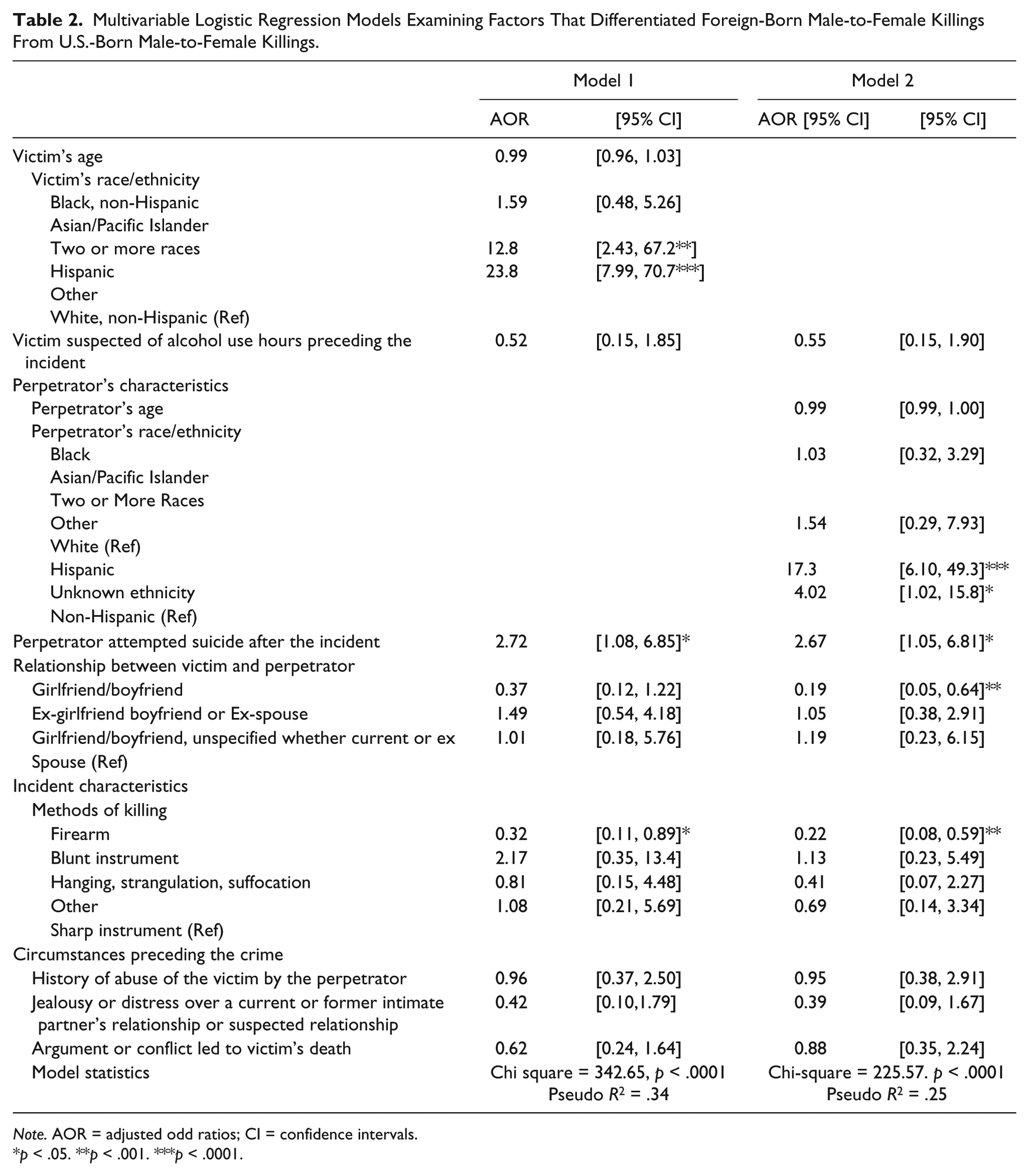
Multivariable Logistic Regression Models Examining Factors That Differentiated Foreign-Born Male-to-Female Killings From U.S.-Born Male-to-Female Killings.
Note. AOR = adjusted odd ratios; CI = confidence intervals.
p < .05. **p < .001. ***p < .0001.
Multivariable Logistic Regression Models Examining Factors That Differentiated Foreign-Born Female-to-Male Killings From U.S.-Born Female-to-Male Killings.

Note. AOR = adjusted odd ratios; CI = confidence intervals.
p < .05. **p < .001. ***p < .0001.
Results
Overall Sample Characteristics
Among the total homicides (n = 147,092), a higher proportion of foreign-born (6.0%, n = 529) than U.S.-born (4.6%; n = 6014; p < .001) were victims of IPV-related crimes, which involved both IPV-homicides (n = 6,456) and IPV-homicide-suicides (n = 1,567). More foreign-born IPHs (5.20%, n = 192) than U.S.-born (3.95%, n = 1,273) were IPV-homicide-suicides (p < .001), with perpetrators most likely to be males (7.2% of perpetrators among the foreign-born vs. 5.1% among the U.S.-born).
IPH cases (intimate partner killed another partner; n = 5,085) involved 77.4% (n = 3,935; 0.29 to 1 ratio) female and 22.6% male (n = 1,149; 3.4 to 1 ratio) victims (p < .001). Among the total femicides (murder victim is a female; n = 31,966), more foreign-born femicides (65.9%, n = 350/531 foreign-born femicides) than U.S.-born femicides (61.5%, n = 3,346/5,443 U.S.-born femicides; p < .04) were IPHs.
Birthplace data for perpetrators was not available. The majority of perpetrators of IPHs were males (78.9%, n = 3,986 vs. 21.1% females, n = 1,067), with most male perpetrators killing a female spouse or an ex-spouse/partner. The recorded motives in most male-to-female killings (vs. female-to-male killings) were jealousy, argument, stalking, and history of abuse of victim by the perpetrator (p < .001). Most female perpetrators killed a nonmarital partner (48.8%, n = 521/1,066 female perpetrators).
Male-to-Female Killings (Intimate Partner Femicides [IPFs])
Bivariate results
Foreign-born IPF victims (M = 37.1 years) were significantly younger than U.S.-born IPF victims (M = 41.0 years; p < .05). While the majority of victims within the foreign-born were Hispanics (nearly 45%), the majority within the U.S.-born were Whites (p < .001). Based on crime scene investigation, more U.S.-born IPF victims (18.3%) than foreign-born IPF victims (10.4%) were suspected of alcohol use prior to the incident (p < .001; Table 1).
The majority of male perpetrators for both U.S.-born and foreign-born IPF victims were White, with a significantly greater proportion of White perpetrators in foreign-born IPF (58.2%) than U.S.-born IPF (52.3%; p < .001). In more cases among the foreign-born IPF (22%) than U.S.-born IPF (10.6%), the male perpetrator’s attack on the victim was believed to be a direct result of mental illness (p < .05; Table 1).
Most femicide victims among both foreign-born and U.S.-born were killed by a male spouse. A significantly greater proportion of spousal killings occurred among the foreign-born (55.9%) than U.S.-born (43.8%), with more foreign-born victims (17% vs 14.6% U.S.-born) killed by an ex-partner (p < .001; Table 1). U.S.-born IPF victims were significantly more likely than foreign-born IPF victims to have been killed by a boyfriend/nonmarital partner (p < .001; Table 1).
Regarding incident characteristics, firearm killings comprised a higher proportion within the U.S.-born (58.3%) than foreign-born IPFs (41.4%; p < .001). Foreign-born femicide victims were more likely than those who were U.S.-born to have been killed by a sharp instrument or by hanging, strangulation, or suffocation (p < .001; Table 1).
A greater proportion of IPF victims within the foreign-born than those within the U.S.-born were victimized by the male partner due to an ongoing conflict or violence (p < .05), jealousy, or distress over an intimate partner relationship or suspected relationship (p < .01) and an argument or conflict (p < .05). Drug involvement was suspected to have played a role in the killings of more U.S.-born-IPF victims (3%) than those who were foreign-born (0.6%; Table 1).
Multivariate results
IPF victims from Hispanic (odds ratio [OR] = 23.8, 95% confidence interval [CI] [7.99, 70.6]) or mixed racial backgrounds (OR = 12.8, 95% CI [2.43, 67.2]) were more likely than White IPF victims to be foreign-born. Hispanic perpetrators were more likely than those who were non-Hispanic to have been involved in a foreign-born female killing (OR = 17.3, 95% CI [6.10, 49.3]). In cases where the perpetrator attempted suicide after the incident, the IPF victim was significantly more likely to be foreign-born than U.S.-born (OR = 2.72, 95% CI [1.08, 6.85]). U.S.-born IPF victims were significantly more likely than those who were foreign-born to have been killed by a boyfriend/nonmarital partner. Killings with firearms were more likely to occur among the U.S.-born than foreign-born (OR = 0.32, 95% CI [0.11, 0.89]; Model 1). In circumstances preceding the crime, no significant differences between foreign-born and U.S.-born-IPF victims were found in multivariate analysis (Table 2).
Female-to-Male Killings
Bivariate results
Most U.S.-born male victims were White (45.4%) or Black (44.8%). In contrast, nearly half (i.e., 47.1%) of the foreign-born male victims were Hispanics (p < .001). A significantly higher proportion of female perpetrators for foreign-born male victims than female perpetrators for U.S.-born male victims were White (68.8% vs. 48.1% U.S.-born) and Hispanic (30.4% vs. 5.4% U.S.-born; p < .001). Black females were significantly more likely to be perpetrators for U.S.-born male victims (42%) than foreign-born male victims (13.4%). U.S.-born male victims (47.7%) were more likely than foreign-born male victims (35.3%) to have been killed by a firearm. In contrast, foreign-born male victims (52.9%) were more likely than those who were U.S.-born (42.0%) to have been killed by a sharp instrument (Table 1).
Multivariate results
In multivariate analysis, Hispanic (OR = 35.8, 95% CI [4.13, 309.8]) male homicide victims killed by a female perpetrator were significantly more likely than White victims to have been foreign-born than U.S.-born. None of the perpetrator characteristics or methods of killing significantly differentiated between foreign-born and U.S.-born male homicide victims in the multivariate model (Table 3).
Discussion
In this study, we examined gender differences in characteristics of IPHs comparing U.S.-born victims with foreign-born victims. These characteristics were examined to understand which characteristics of IPHs were unique among foreign-born and U.S.-born individuals and what factors might differ for men and women. In both U.S.-born and foreign-born homicides, women were disproportionately affected in both IPV-related deaths and deaths in which an intimate partner directly killed another (i.e., IPH). These findings are consistent with numerous studies that suggest that women are at greater risk for being killed by an intimate partner and represent an important population for prevention efforts (Campbell et al., 2007; Puzone, Saltzman, Kresnow, Thompson & Mercy, 2000; Sabri et al., 2016; Stockl et al., 2013). IPV-related reasons were more likely to be a cause for foreign-born victims’ deaths (particularly female) than U.S.-born victims’ deaths in both homicides and homicide-suicides. This finding is in line with previous study of femicides in New York City (1990-1999), which found that one of the strongest predictors of femicide by an intimate partner was being foreign-born (Frye et al., 2005).
For femicides (i.e., women killed by men), we identified victims’ and perpetrators’ racial/ethnic background, type of relationship between the victim and perpetrator, methods of killing, and perpetrators’ suicide attempt after the incident as characteristics that differentiated U.S.-born femicides from those that were foreign-born. The foreign-born femicide victims were more likely to be Hispanic or from mixed racial background. However, the largest proportion of perpetrators for foreign-born femicide victims was from White racial/ethnic background. Although we did not have information on the immigration status of the perpetrator, it may be that foreign-born victims were in a relationship with a U.S.-born White male partner.
In a study of 83 immigrant and refugee survivors (Sabri et al., 2018), some survivors perceived a partner not being from the same race/ethnicity or being a White male as a risk factor for severe abuse or homicide for immigrant women. The reported reason was that the abuser from a White majority culture knows the system in the United States, and has support from his family and community, which can place an immigrant survivor at risk. In contrast, the immigrant woman has no support system in place in the United States and is more vulnerable due to lack of knowledge and social isolation (Sabri et al., 2018). Since the birth information for perpetrators was not available, we could not confirm whether these White perpetrators were U.S.-born or foreign-born perpetrators of European or Middle-Eastern descent. Hispanic perpetrators were more likely than those who were non-Hispanic to have been involved in a foreign-born female killing. Thus, prevention efforts are particularly needed among immigrants in inter-racial relationships or immigrants from Hispanic origins.
In our analysis, the majority of U.S.-born femicide victims were Whites followed by Blacks. However, Black victims were disproportionately represented when compared with the Black population in NVDRS participating states. For instance, according to the U.S. census 2014 report, 30.3% of the population in Maryland is Black (U.S. Census Bureau, 2015), but Blacks comprise 55.3% of the IPHs in Maryland. In contrast, 58.6% of the population in Maryland is White (U.S. Census Bureau, 2015), but Whites comprise 35.8% of IPHs in that state. Thus, when taking into account the proportion in the population, women from Black racial/ethnic groups may be particularly at risk for IPHs. In an analysis of overall homicides among adult women collected by the CDC (Petrosky et al., 2017), non-Hispanic Black women experienced the highest rates of homicides (4.4 per 100,000 population). Although homicides occur in women among all race/ethnicities, racial/ethnic minority women were disproportionately affected (Petrosky et al., 2017).
Separation/divorce has been found to be a significant risk factor for femicide in prior research (Campbell et al., 2007). In NVDRS, estrangement or separation may not always be known to the police or family and recorded in the NVDRS database. We, however, noted some patterns in our analysis. Most foreign-born and U.S.-born femicide victims in our analysis were killed by a spouse, though these victims may have been married but separated from their partners. When compared with female-perpetrated IPHs, a greater proportion of male-perpetrated IPHs involved an ex-spouse/nonmarital partner. Thus, for women, separation/divorce can be a risk factor for IPH, as shown in prior research (Aldridge & Browne, 2003; Campbell et al., 2007).
In our study, U.S.-born femicide victims were more likely than those who were foreign-born to have been killed by a current nonmarital partner. Foreign-born femicide victims were more likely than U.S.-born to be killed by an ex-boyfriend/spouse. Thus, homicide prevention/safety planning efforts are needed for women in both current and former dangerous abusive relationships (marital or nonmarital), with attention to abusive nonmarital relationships among the U.S.-born and separated/divorced relationships among the foreign-born.
Compared with the U.S.-born, foreign-born femicide victims were more likely to have been killed by a sharp instrument/stabbing. Firearms killings involved more U.S.-born than foreign-born IPHs. These findings are consistent with studies in the United States where firearms have been found to be most commonly used weapons for IPHs in the general population (Campbell et al., 2007; Frye et al., 2005) and stabbing as the frequently used method of killing among immigrants (Sabri et al., 2016) and non-U.S. populations (Ganpat & Liem, 2012). Foreign-born femicide victims were also more likely to be killed by hanging, strangulation, or suffocation than those who were U.S.-born. The lack of tradition of gun ownership, ease of access to sharp instruments at home, or ease of other methods of killing may be related to lesser use of firearms among immigrants than those who are U.S.-born (Sabri et al., 2016).
Femicides were more likely than male homicides to involve circumstances such as jealousy, stalking, and history of abuse of victim by the perpetrator. Compared with U.S.-born femicide victims, for a greater proportion of foreign-born femicides, the circumstances preceding the crime involved an ongoing/immediate conflict with the intimate partner, jealousy, and an argument that led to the victim’s death. These findings are consistent with prior research on risk factors for IPFs (Aldridge & Browne, 2003; Campbell et al., 2007). In prior research, jealousy and an argument preceding the victim’s death were the more commonly reported circumstances among Hispanic victims than among non-Hispanic Black and White victims (Petrosky et al., 2017).
In cases where the perpetrator attempted suicide after the incident, the femicide victim was significantly more likely to be foreign-born than U.S.-born. We also found that in a higher proportion of the foreign-born femicides than U.S.-born femicides, the male perpetrator’s attack on the victim was believed to be a direct result of mental illness. Perpetrator’s mental illness has been found to play a role in homicides followed by suicides in an analysis of homicides in 2003-2004, with 11% of perpetrators having a documented mental illness at the time of the incident (Bossarte, Simon, & Barker, 2006). Thus, while the majority of IPH is not driven by mental illness, it is important to consider the role of mental illness in exacerbating risk for IPHs and IPH-suicides for a subgroup of cases. For immigrant groups, multiple factors such as immigration-related stress, unmet needs for mental health services, and other situational factors can play a role in IPHs. There is need for programs and policies that provide increased access to mental health services for at-risk populations including immigrant groups.
In our analysis, we also found some similarities and differences in characteristics in U.S.-born and foreign-born female-perpetrated male killings. The majority of U.S.-born male victims were killed by current girlfriends using a firearm. The majority of foreign-born male victims were also killed by current girlfriends but mostly using a sharp instrument. While the majority of female perpetrators for U.S.-born male victims were White or Black, most female perpetrators for foreign-born male victims were Hispanics. There is no information in the data regarding prior abuse of the victim or the perpetrator; however, previous research has found that women who kill an intimate partner were likely to have been abused by that partner prior to the homicide and may be acting in self-defense (Block & Christakos, 1995; McFarlane et al., 1999).
A number of limitations should be considered—It is possible that some IPHs are not identified in the system and the prevalence calculated is likely to be an underestimate of the true prevalence. Data were not available on birth place of perpetrators, which could be important for identifying at-risk individuals. For instance, perpetrator being U.S.-born and knowing the system could be an additional risk factor for a foreign-born woman who may be unaware of available resources or lack support systems in the United States. We could not analyze additional risk factors for IPHs that have been identified in previous research such as perpetrator’s criminal background and perpetrator’s unemployment since the data were not available on these variables in the NVDRS. Furthermore, data on types of foreign-born (i.e., recent immigrant vs. those who have been immigrants for a long period of time) were not available for analysis. Despite these limitations, the study is an important contribution to the field because it examines gender differences in characteristics of IPH for U.S.-born and foreign-born victims. There is need for culturally specific efforts to prevent IPHs among the foreign-born. It is critical to improve efforts toward intervening early and preventing IPHs among at-risk groups in the United States. The findings are useful to identify populations at risk and factors that could be incorporated in IPH policies, and prevention and intervention efforts.
Footnotes
Declaration of Conflicting Interests
The author(s) declared no potential conflicts of interest with respect to the research, authorship, and/or publication of this article.
Funding
The author(s) disclosed receipt of the following financial support for the research, authorship, and/or publication of this article: This research was supported by Eunice Kennedy Shriver National Institute for Child Health and Human Development (K99HD082350 and R00HD082350).