




Abstract
Relationship violence in college students continues to be an important social problem. Prior research has identified several risk factors for relationship violence including trauma exposure, impulse control difficulties, and hostility toward women; however, previous research assessing these variables has mainly focused on bivariate relationships, with little work attempting to connect multiple correlates to relationship violence while utilizing a theoretical, interactive approach. The purpose of this study was to simultaneously examine several correlates of relationship violence (i.e., hostility toward women, trauma exposure, and impulse control difficulties), and to examine male perpetration of relationship violence among a sample of male college students using a cross-sectional design. It was hypothesized that among men in this sample, hostility toward women and trauma exposure would moderate the relationship between impulse control difficulties and relationship violence. The findings suggested that college-aged men, who have high impulse control difficulties, high hostility toward women, and who have multiple trauma exposures, may be more likely to perpetrate relationship violence against a female intimate partner than those who are low in impulse control difficulties, report low levels of hostility toward women, or report fewer or no trauma exposures. Thus, the current study suggests that exposure to trauma predisposes men with specific attributes to relationship violence, which may provide a treatment target for future intervention programs.
Relationship violence is an important social problem; approximately 33% to 43% of women in the United States report having experienced relationship violence in their lifetime (Black et al., 2011; Neufeld, McNamara, & Ertl, 1999). Furthermore, approximately 21% to 30% of male college students self-report perpetrating relationship violence against their female intimate partner (Desmarais, Reeves, Nicholls, Telford, & Fiebert, 2012; Shorey, Cornelius, & Bell, 2008). Such high rates of perpetration among college students highlight the importance of identifying potential correlates of relationship violence, to better understand the characteristics of men who initiate relationship violence.
Prior research examining relationship violence has identified several individual difference and experiential correlates, including impulse control difficulties, hostility toward women, and trauma exposure (Derefinko, DeWall, Metze, Walsh, & Lynam, 2011; Parrott & Zeichner, 2003; Vivolo-Kantor, DeGue, DiLillo, & Cuadra, 2013); however, no study has examined these variables concurrently. The current study attempted to address these gaps in the research by examining relationship violence, hostility toward women, trauma exposure, and impulse control difficulties in a sample of male college students without the confirmation of a clinical diagnosis of posttraumatic stress disorder (PTSD) or other disorders. The current sample may be of particular importance given that a vast number of college students have experienced prior trauma (e.g., 66%), but relatively few meet PTSD diagnostic criteria (e.g., 9%; Read, Ouimette, White, Colder, & Farrow, 2011). Furthermore, because college samples suggest that nearly 21% to 30% of male students perpetrate relationship violence toward their female intimate partner (Desmarais et al., 2012; Shorey et al., 2008), it seems warranted to more accurately examine the extent to which experiencing trauma contributes to relationship violence in the absence of PTSD.
I3 Theory
Due to the multitude of risk factors for relationship violence, I3 theory, has sought to integrate theory of relationship violence. Specifically, Finkel and colleagues (2012) developed a three-pillar approach to examine the processes of relationship violence. These three processes are instigation, impellance, and inhibition, all of which interact to influence one another. In other words, I3 theory states that certain attitudes and behaviors act as instigative factors, others act as impellance factors, and still others act as inhibitive factors. Furthermore, the attitudes and behaviors that make up all three of these categories interact with one another to predict the perpetration of relationship violence, according to this theoretical approach.
Specifically, instigation factors are those that refer to the direct exposure to a partner’s behavior, which, in turn, may cause an urge to aggress (i.e., provocation). Second, impellance factors consist of dispositional or situational factors that psychologically prepare an individual to experience an urge to aggress when encountering an instigator. However, both instigation and impellance can be overcome if an individual’s inhibition is high. More specifically, inhibitive factors act as executive control functions that raise the likelihood that an individual will resist these instigations and impellances. In other words, if the combined effect of the instigation and impellance an individual experiences is stronger than the inhibition, then the individual is likely to aggress toward his or her intimate partner, but if his or her inhibition is stronger than the effect of the instigation and impellance, intimate partner violence will be unlikely to occur. In this manner, I3 theory provides a recipe for a sort of “perfect storm,” which may predict relationship violence through an interactive model where relationship violence is more likely to occur under a specific set of circumstances. Specifically, I3 theory states that intimate partner violence is most likely to occur when instigation and impellance are high, and inhibition is relatively low (Slotter & Finkel, 2011). Within the context of the present study, an individual’s impulse control likely acts as an inhibitory process described within the tenets of I3 theory, in that, it describes an individual’s abilities to resist his or her impulses when he or she is upset by something (Gratz & Roemer, 2004). Similarly, hostility toward women and trauma exposure likely represent impellance forces, which make relationship violence more likely to occur (DeGue & DiLillo, 2004; Parkhill & Abbey, 2008). As such, hostility toward women and trauma exposure act as moderating variables within I3 theory, in that, when an individual is high in impellance (hostility toward women and trauma exposure) and has greater difficulties controlling his or her impulses when he or she is provoked by some sort of instigating factor (indicating low inhibition), he or she may be more likely to perpetrate relationship violence above and beyond men who have either low levels of impellance (low hostility toward women and/or low trauma exposure) or high inhibitions (low impulse control difficulties).
Predictors of Relationship Violence
Impulse Control Difficulties
Theory and research have suggested numerous predictors of relationship violence, including gender, substance use, neuroticism, and psychopathology (Abbey, Jacques-Tiura, & LeBreton, 2011; Breiding et al., 2014; Busby, Holman, & Walker, 2008; Catalano, 2004; Fals-Stewart, Golden, & Schumacher, 2003; Karney & Bradbury, 1995). One predictor that has demonstrated a consistent relationship with intimate partner violence is impulse control. Impulse control is a multidimensional construct that describes four different facets: negative urgency, premeditation, perseverance, and sensation seeking (Whiteside & Lynam, 2001). Negative urgency, or the tendency to act impulsively when strong negative affect is present, has been correlated with high rates of intimate partner violence (Scott, DiLillo, Maldonado, & Watkins, 2015). One possible explanation for this involves having depleted self-regulatory resources that affect one’s level of self-control (Baumeister, 1997); in turn, this lack of self-control may lead to more aggressive behavior toward an intimate partner (Finkel, DeWall, Slotter, Oaten, & Foshee, 2009). In support of this assertion, one study found that college students with high self-control showed lower impulse control problems, reported less anger, and were better at managing their anger than college students with low self-control (Tangney, Baumeister, & Boone, 2004). Furthermore, because negative urgency is linked with intimate partner violence (Derefinko et al., 2011) and intimate partner violence is higher in those who lack self-control (Baumeister, 1997), intimate partner violence may be one way individuals with impulse control difficulties maladaptively regulate negative emotions (Jakupcak, 2003).
Hostility Toward Women
Hostility toward women has emerged as a reliable predictor of intimate partner violence (Abbey, McAuslan, Zawacki, Clinton, & Buck, 2001; DeGue & DiLillo, 2004; DeGue, DiLillo, & Scalora, 2010; Farr, Brown, & Beckett, 2004; Malamuth, Sockloskie, Koss, & Tanaka, 1991; Parkhill & Abbey, 2008). In a study of incarcerated men, research demonstrated a positive correlation between childhood emotional abuse and relationship violence, which was mediated by hostility toward women. Compared with those who reported low hostility toward women, those high in hostility toward women showed a heightened frequency of relationship violence. This suggests that hostility toward women may be a risk factor for relationship violence following a childhood trauma (Vivolo-Kantor et al., 2013). Furthermore, several studies have shown that trait anger, broadly defined as the affective component of aggression, is a reliable predictor for the male perpetration of relationship violence (Beasely & Stoltenberg, 1992; Leonard & Blane, 1992; Leonard & Senchak, 1993, 1996). Specifically, men who experience anger more frequently, more intensely, and for longer periods of time—which may be an indicator of emotion regulation difficulties—are also more likely to perpetrate relationship violence compared with others who are more effective at coping with anger (Zians, 2007). In a sample of single men, trait anger was the most influential predictor of hostility toward women (LeBreton, Baysinger, Abbey, & Jacques-Tiura, 2013). Negative attitudes toward women are also predictive of relationship violence perpetration in men who experience trait anger, according to previous research. Finally, Parrott and Zeichner (2003) found that hostility toward women moderated the relationship between trait anger and the frequency of physical assault, in that, men who were both high in hostility toward women and who experienced trait anger were more likely to assault their partner than men who experienced trait anger but who were low in hostility toward women. Thus, trait anger and hostility toward women may function simultaneously to predict relationship violence.
Trauma Exposure
Prior research assessing trauma exposure suggests that trauma-exposed men may be more aggressive than men who have not experienced a prior traumatic event. For instance, in a nonclinical sample, men with higher PTSD symptom severity exhibited higher anger, aggression, and violence than men with lower PTSD symptom severity. Also, in a sample of legal offenders, traumatic events (as assessed on a continuous scale) demonstrated a strong positive relationship with both PTSD symptom severity and appetitive aggression (the attraction to violence). Furthermore, PTSD symptom severity was positively related with appetitive aggression. This result demonstrates that aggression and the level of perpetrated violence may be higher in those with more traumatic experiences and greater PTSD symptom severity (Sommer et al., 2017). Thus, it appears as if trauma exposure may predispose men to behave more aggressively in certain situations.
However, it is also important to note that exposure to a traumatic event does not necessarily lead to development of PTSD. Indeed, among American men, only 8% of those who experience a traumatic event go on to develop PTSD as a result of that experience (Kessler, Sonnega, Bromet, Hughes, & Nelson, 1995). As such, it is important to conduct additional research examining the effects of trauma exposure among those who have experienced a traumatic event, but do not meet criteria for a PTSD diagnosis.
Relationship Violence
Men who have been exposed to trauma, and subsequently develop PTSD symptoms, may be more likely to perpetrate relationship violence toward a female intimate partner. As evidence of this, in a sample of Vietnam veterans and their spouses, amount of combat exposure male veterans experienced was positively correlated with the frequency of relationship violence perpetration by these men against their spouses. Furthermore, male combat veterans with greater PTSD symptoms self-reported perpetrating relationship aggression at higher frequencies compared with veterans with lesser PTSD symptoms (Byrne & Riggs, 1996). In addition, in a nonclinical sample, trauma-exposed men reported perpetrating nearly twice as many aggressive or violent acts toward an intimate partner as men who were not exposed to trauma (Jakupcak & Tull, 2005). Finally, 75% of men in a sample of male perpetrators of intimate partner violence, recruited from a domestic violence center, reported at least one traumatic event. More specifically, individuals who reported higher PTSD symptoms also reported more relationship problems and higher levels of abusive behavior (i.e., physical assault, sexual coercion, emotional abuse) with their intimate partners than those with lower levels of PTSD symptoms (Semiatin, Torres, LaMotte, Portnoy, & Murphy, 2017). Given that trauma exposure is related to disruptions in emotional processes (Boden et al., 2013; Tull, Barrett, McMillan, & Roemer, 2007), trauma exposure and subsequent PTSD symptoms may be related to relationship violence perpetration through these disruptions in emotional processes (e.g., emotion regulation difficulties).
Schoenleber, Sippel, Jakupcak, and Tull (2015) provided one possible mechanism, which may explain both this correlation between emotion regulation difficulties and trauma exposure, as well as how greater emotion regulation difficulties could also lead to a greater likelihood of violence perpetration. Specifically, they suggested that trauma exposure raises the likelihood of experiencing negative emotions such as shame, which is correlated with the use of physical aggression when there is a threat to one’s self-esteem (Gilligan, 1997, 2003). In other words, previous research suggests that shame may produce feelings of inadequacy such as unworthiness, or the feeling that oneself is flawed, which, in turn, may lead to secondary negative emotional responses regarding the self. To avoid these additional negative emotions, individuals may use physical violence as a maladaptive coping mechanism to deflect these unwanted feelings and emotions (Jakupcak, 2003).
Although prior research suggests that experiencing trauma may be correlated with impulse control difficulties (Tripp, McDevitt-Murphy, Avery, & Bracken, 2015), most of the literature on impulse control difficulties and trauma exposure has focused heavily on subsequent PTSD symptoms. For example, PTSD symptoms have been correlated with several facets of general emotion regulation, including impulse control difficulties (Tull et al., 2007). Furthermore, in a sample of 35 survivors of a ferry collapse, those with more severe PTSD symptoms yielded higher impulsiveness scores than those with less severe PTSD symptoms (Joseph, Dalgleish, Thrasher, & Yule, 1997). Also, in a sample of 130 psychiatrically hospitalized adolescents, impulsivity and PTSD symptom severity contributed greatly to the prediction of violence perpetration. More specifically, higher impulsivity and more severe PTSD symptom severity were related to a heightened frequency of physical violence perpetration (Fehon, Grilo, & Lipschitz, 2005). However, it is important to note that few studies have examined both trauma exposure and impulse control difficulties simultaneously in a college population.
The Current Study
The present study sought to replicate existing literature examining the bivariate relationships among impulse control difficulties, hostility toward women, trauma exposure, and intimate partner violence, and to simultaneously examine all of these variables in a sample of college-aged men. Furthermore, the current study used I3 theory to inform and integrate relationship violence into an interactive, theory-driven model. As previously mentioned, I3 theory was created to further understand relationship violence over and above bivariate relationships. As such, the current study uses I3 theory to examine the interactive effects of several bivariate correlates of relationship violence concurrently. In doing so, I3 theory provides an important theoretical framework for the way in which these variables may interact with one another to predict relationship violence. Specifically, taking into account the prior research linking impulse control difficulties, hostility toward women, and trauma exposure to relationship violence, it seems warranted to further examine the interaction of impulse control difficulties as an inhibitory process following an instigation, trauma exposure as an impellance process, and hostility toward women as an impellance process within the context of I3 theory.
As previously mentioned, prior research has examined several bivariate correlates of relationship violence. For instance, it has been documented that trauma exposure is linked with impulse control difficulties (Tull et al., 2007). Furthermore, because previous research also suggests that impulse control difficulties are associated with relationship violence (Watkins, Maldonado, & DiLillo, 2014), hostility toward women is a risk factor for relationship violence following a traumatic event (Vivolo-Kantor et al., 2013), and the perpetration of relationship violence is especially prevalent among college men (Desmarais et al., 2012), these variables were examined with regard to relationship violence perpetration in a sample of collegiate males. Finally, because impulse control difficulties, hostility toward women, and trauma exposure may all be used to predict relationship violence, the current study is particularly novel because, to our knowledge, no study has empirically examined the effect of these four variables simultaneously, while utilizing I3 theory as a theoretical framework, in a study of undergraduate men. In addition, because hostility toward women is a risk factor for relationship violence after prior trauma exposure (Vivolo- Kantor et al., 2013), the current study examines two impellance variables (hostility toward women and trauma exposure) as potential moderators for the association between impulse control difficulties (an inhibition) and relationship violence perpetration.
In addition, previous research examining the relationship between trauma exposure and impulse control difficulties has focused primarily on PTSD symptom severity (Fehon et al., 2005; Joseph et al., 1997; Tull et al., 2007); however, the risk for developing PTSD following a traumatic event is approximately 5% to 8% in American men (Kessler et al., 1995; Read et al., 2011). As such, research should examine general trauma exposure in individuals without a PTSD diagnosis because of the impact that trauma exposure has on emotion regulation processes (Boden et al., 2013; Tull et al., 2007). This is especially important because no known study has examined relationship violence, impulse control, and trauma exposure in a sample of college students, without a PTSD diagnosis.
Hypotheses
Based on previous literature, four main hypotheses were proposed. First, because impulse control difficulties were positively correlated with relationship violence (Scott et al., 2015), and because relationship violence is theorized as a strategy to suppress unwanted emotional experiences (Gratz, Paulson, Jakupcak, & Tull, 2009), the first hypothesis was that impulse control difficulties would be positively correlated with relationship violence in our sample of college-aged men (Hypothesis 1). Next, previous research has shown that hostility toward women is a risk factor for relationship violence following a traumatic event (Vivolo-Kantor et al., 2013), and it was hypothesized that hostility toward women would also be correlated with relationship violence (Hypothesis 2). Furthermore, because exposure to trauma has been linked with relationship violence (Tull et al., 2007), it was hypothesized that trauma exposure, conceptualized as the number of traumas an individual has experienced, would be positively correlated with relationship violence (Hypothesis 3). Finally, it was hypothesized that all four of these variables would interact, such that hostility toward women and number of traumas experienced would moderate the relationship between impulse control difficulties and relationship violence in our sample such that those with high impulse control difficulties, high trauma exposure, and high hostile attitudes regarding women would be more likely to perpetrate relationship violence than those with high impulse control difficulties and either low hostility toward women or low prior trauma exposure (Hypothesis 4).
Method
Participants
Male undergraduate students (n = 295) were recruited to participate in this study through the psychology department subject pool at a large, suburban, Midwestern university. The sample was fairly characteristic of a college sample in that 59.0% (n = 174) of participants were 18 to 20 years old, 27.8% (n = 82) were 21 to 25 years, 8.5% (n = 25) were 26 to 30 years, and the remaining 4.7% (n = 14) were 31 years or older. Most participants (67.5%, n = 199) were Caucasian, 9.5% were Middle Eastern (n = 28), 7.5% (n = 22) were African American, 6.4% (n = 19) were Asian American, 4.1% (n = 12) were multiracial, 1.4% (n = 4) were American Indian, 0.3% (n = 1) was a Pacific Islander, 1.7% (n = 5) identified themselves as “Other,” and 1.7% (n = 5) declined to answer.
Procedure
Using an online data management system, participants in the undergraduate psychology research pool enrolled in the study based on their availability and a brief description of the study, which informed participants that we were examining how their attitudes and past behaviors would relate to their responses during the experimental tasks. Due to a slight procedural change, one cohort was directed to the website surveymonkey.com to complete the survey. However, a later cohort of different students was prompted to come to an on-campus lab to complete the same measures. These cohorts did not differ in terms of age, t(294) = −1.159, p = .124; race, χ2(7, n = 295) = 7.839, p = .347; or sexual orientation, χ2(4, n = 295) = 1.640, p = .802; also, they did not differ in terms of any of the study variables, including impulse control difficulties, t(290) = −0.504, p = .615; hostility toward women, t(292) = −0.035, p = .972; relationship violence perpetration, t(288) = −1.029, p = .304; or trauma exposure, χ2(1, n = 295) = 1.536, p = .215. In both cohorts, informed consent was obtained before the survey began, and during the survey, participants were free to decline to answer any question, which they did not wish to answer by selecting an option labeled “prefer not to answer.” On completion of the survey, participants were compensated with partial course credit.
Measures
Covariate
Hostility (Buss & Perry, 1992)
Participants’ general hostility was assessed using the eight-item Hostility subscale of the 29-item Aggression Questionnaire (Buss & Perry, 1992). Items from this measure were assessed on a 5-point scale, ranging from 1 = extremely uncharacteristic of me to 5 = extremely characteristic of me, and a sample item from this subscale is “At times, I feel I have gotten a raw deal out of life.” Items were averaged to form this subscale, which was used as a control variable during data analysis. Reliability estimates were good for this subscale, with Cronbach’s α = .853.
Independent variables
Traumatic Life Events Questionnaire (TLEQ; Kubany et al., 2000)
A modified version of the TLEQ was used to assess past traumatic experiences that participants had experienced at some point in their lives. The modified version contained 21 items, which were assessed on a 7-point scale from 1 = never to 7 = 5+ times. Responses to these items were summed together to form a count variable of the total number of traumas that each participant had experienced. The TLEQ covers a variety of traumatic experiences ranging from experiencing a natural disaster, unexpected death of a loved one, and unwanted sexual contact, and a sample item from this scale is “Have you ever been hit or beaten up and badly hurt by a stranger or by someone you didn’t know very well?”
Impulse control difficulties (Gratz & Roemer, 2004)
Impulse control difficulties were assessed using the six-item Impulse Control Difficulties subscale of the 36-item Difficulties in Emotion Regulation Scale (DERS). Items from this subscale were assessed on a 5-point scale from 1 = almost never (0%-10%) to 5 = almost always (91%-100%), and a sample item is “When I’m upset, I feel out of control.” During data analysis, the six items were averaged together to form a scale score. Reliability estimates were good for this subscale, with Cronbach’s α = .838.
Hostility toward women (HTW; Lonsway & Fitzgerald, 1995)
The participants’ hostile attitudes, beliefs, and cognitions about women were assessed using 10-items, with items assessed on a 7-point scale, ranging from 1 = strongly disagree to 7 = strongly agree. A sample item from this scale is “When it really comes down to it, a lot of women are deceitful.” Items from this scale were averaged together during data analysis, and reliability estimates were good for this scale, with Cronbach’s α = .871.
Dependent variable
Relationship Violence Scale (Whitmire, Harlow, Quina, & Morokoff, 1999)
Relationship violence perpetration was assessed with nine items assessed on a 5-point scale. The first item asks participants how they usually behave during arguments with their partner, with higher responses corresponding to higher levels of aggression, from 1 = I give in to 5 = I become violent. The remaining eight items ask participants how often they have committed a variety of aggressive or violent acts toward a sexual partner, and these items are assessed on a scale from 1 = never to 5 = very often. A sample item from this scale is “How often in your life have you pushed, shoved, or grabbed your partner?” During data analysis, items were averaged together to form this scale, and reliability estimates were good, with Cronbach’s α = .784.
Results
Data Analysis
Prior to conducting the main data analysis, the means, standard deviations, and bivariate correlations of all study variables were examined, and these results are presented in Table 1. Then, a hierarchical multiple regression analysis was used to test our hypotheses related to trauma exposure, impulse control difficulties, hostility toward women, and relationship violence. General hostility was entered during Step 1 as a control variable, to ensure that the effects of hostility toward women were not merely an artifact of general hostility, which is not specifically directed toward women. In Step 2 of the model, the centered average of items from the Impulse Control Difficulties subscale of the DERS scale, the centered average of all items from the HTW scale, and the centered trauma count variable were entered into the model. In Step 3 of the model, the two-way interaction terms between impulse control difficulties and hostility toward women, impulse control difficulties and trauma count, and between hostility toward women and trauma count were entered into the model. Finally, in Step 4, the three-way interaction between impulse control difficulties, hostility toward women, and trauma count was entered into the model. Participants’ self-reported perpetration of relationship violence served as the dependent variable in this analysis.
Bivariate Correlations, Means, and Standard Deviations for Study Variables.

p < .05. ***p < .001.
Step 2 of the regression analysis was examined to test the first three hypotheses, regarding the main effects of impulse control difficulties, hostility toward women, and trauma exposure on relationship violence. These results supported these hypotheses, in that, after controlling for general hostility, there were main effects of impulse control difficulties, β = .168, t = 2.581, p = .010, 95% confidence interval (CI) = [0.014, 0.103], hostility toward women (β = .192, t = 2.895, p = .004, 95% CI = [0.015, 0.079]), and trauma count (β = .128, t = 2.202, p = .028, 95% CI = [0.001, 0.009]).
To test the fourth hypothesis, regarding the three-way interaction of impulse control difficulties, hostility toward women, and trauma exposure on relationship violence, the fourth and final step of the regression analysis was also examined. This fourth step was significant, R2 = .135, F(1, 280) = 7.101, p = .008, which indicated that, as hypothesized, there was an interaction between impulse control difficulties, hostility toward women, and number of traumas, to predict relationship violence perpetration (β = −.223, t = −2.665, p = .008, 95% CI = [−0.008, −0.001]). Full results of all four steps of this regression are available in Table 2.
Hierarchical Multiple Regression Analyses Predicting Relationship Violence Perpetration Among the Total Sample.
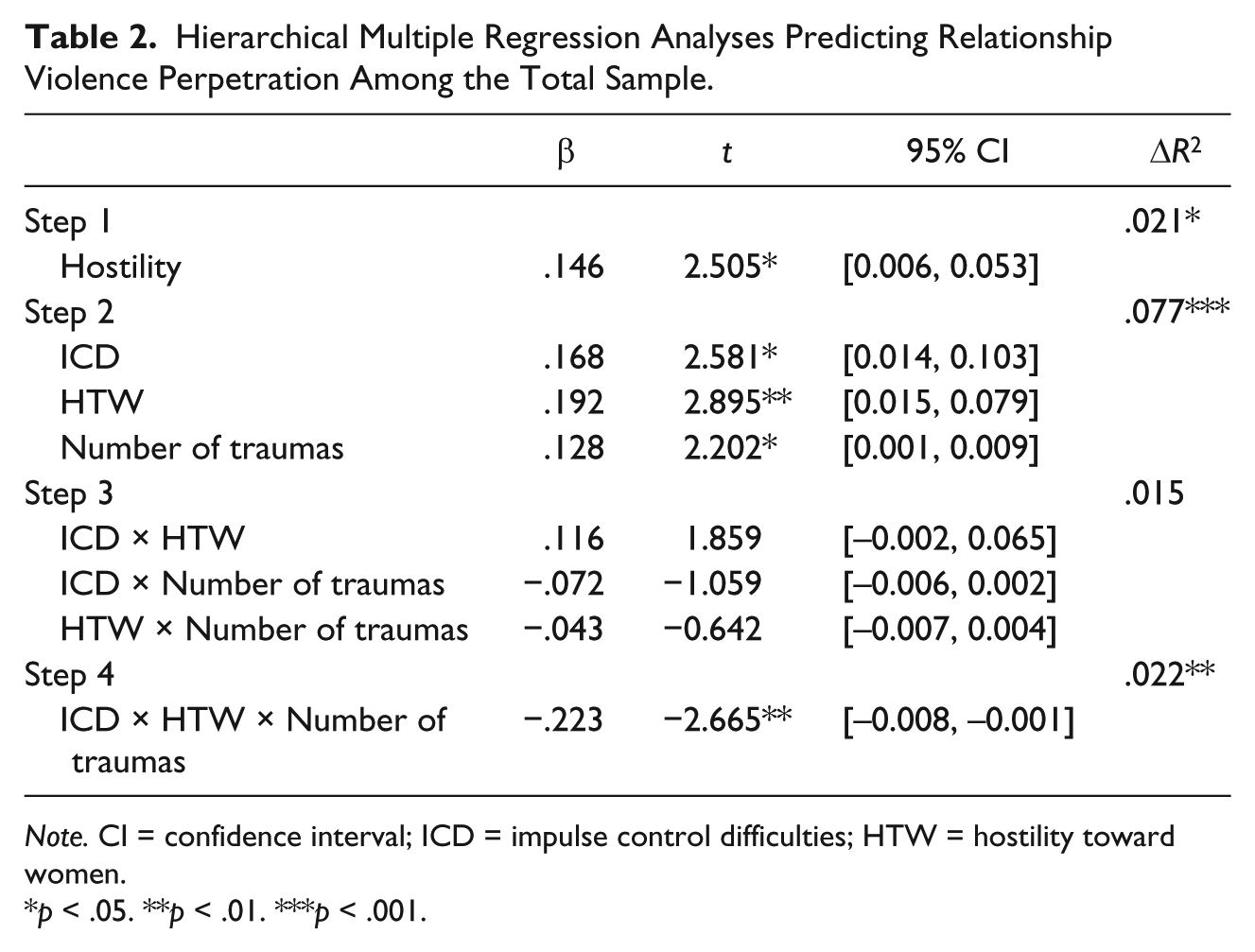
Note. CI = confidence interval; ICD = impulse control difficulties; HTW = hostility toward women.
p < .05. **p < .01. ***p < .001.
Supplemental analyses
To further probe this interaction, the three-way interaction between impulse control difficulties, hostility toward women, and number of traumas predicting relationship violence was also assessed among the subsample of participants who had experienced at least one trauma (n = 231). This regression analysis was conducted using the same variables entered in the same steps as the first regression analysis, conducted on the full sample. Results of this analysis were similar to the results of the analysis with all participants, in that, Step 4 of the regression was significant, R2 = .217, F(1, 220) = 17.743, p < .001, indicating that impulse control difficulties, hostility toward women, and number of traumas continued to interact to predict the perpetration of relationship violence, in the subsample of participants who had experienced at least one trauma (β = −.398, t = −4.212, p < .001, 95% CI = [−0.009, −0.003]). Full results of this regression are available in Table 3.
Hierarchical Multiple Regression Analysis Predicting Relationship Violence Among the Subsample of Participants Who Had Been Exposed to Trauma.
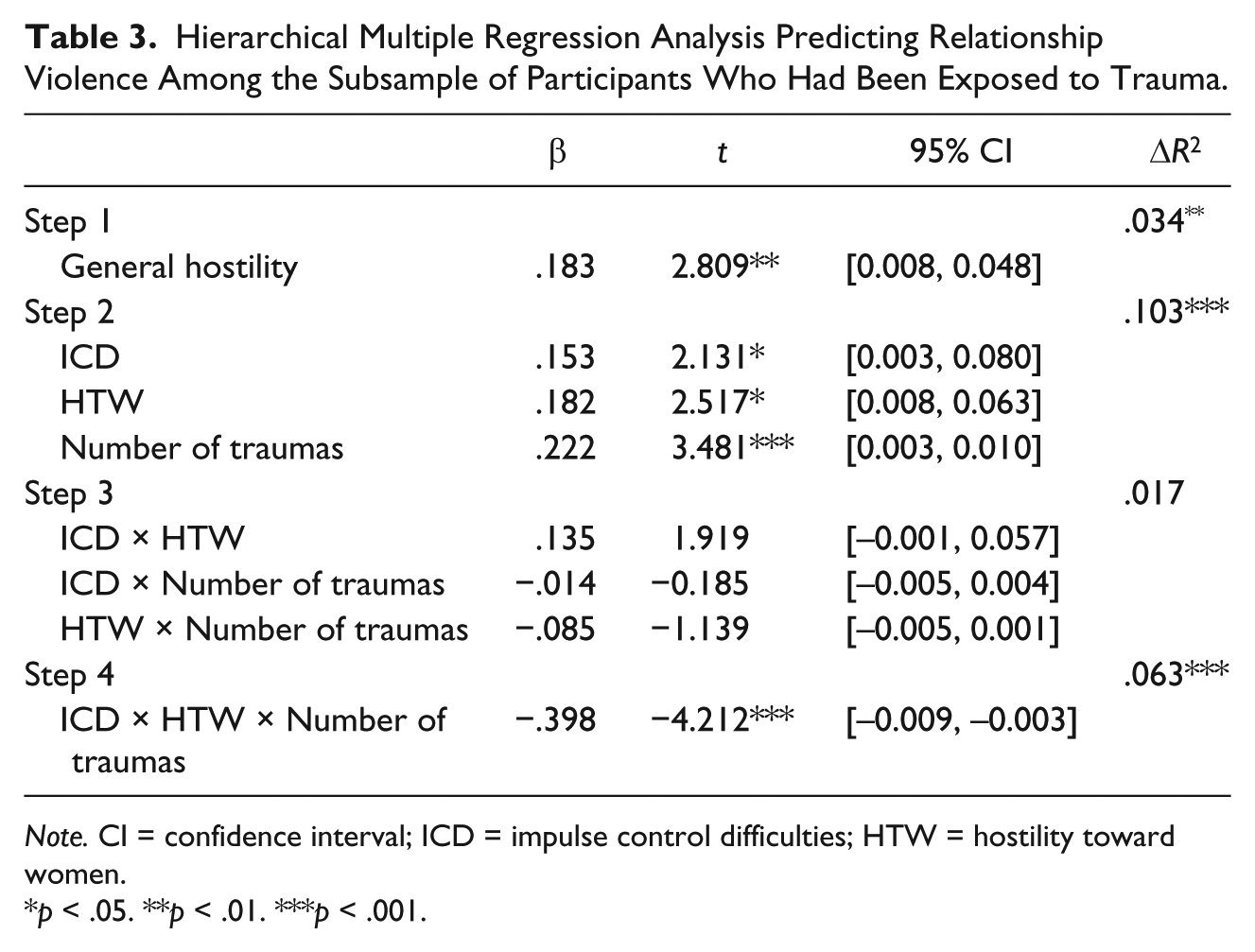
Note. CI = confidence interval; ICD = impulse control difficulties; HTW = hostility toward women.
p < .05. **p < .01. ***p < .001.
To interpret the three-way interaction between impulse control difficulties, hostility toward women, and number of traumas, and to assess moderation, a simple slopes test was run, as recommended by Aiken and West (1991). This test examined the effects hostility toward women and number of traumas, each at one standard deviation above and below the mean, had on the relationship between impulse control difficulties and relationship violence, among the subsample of participants who self-reported exposure to at least one trauma (n = 231). Results of these analyses revealed that participants who reported low levels of hostility toward women and low exposure to trauma reported reduced perpetration of relationship violence when they had high impulse control difficulties relative to when they had low impulse control difficulties (β = −.391, t = −2.609, p = .010, 95% CI = [−0.187, −0.026]). However, participants who reported low hostility toward women and a high number of traumas did not differ on their relationship violence perpetration when they had low compared with high impulse control difficulties (β = .106, t = 0.926, p = .356, 95% CI = [–0.032, 0.090]). Finally, participants showed more frequent relationship violence perpetration when they had high impulse control difficulties relative to low impulse control difficulties when they also reported high levels of hostility toward women and a low number of traumas (β = .457, t = 3.700, p < .001, 95% CI = [0.058, 0.190]) or when they reported high hostility toward women and a high number of traumas (β = .319, t = 0.319, p < .001, 95% CI = [0.040, 0.133]). Full results of this interaction are available in Figure 1.
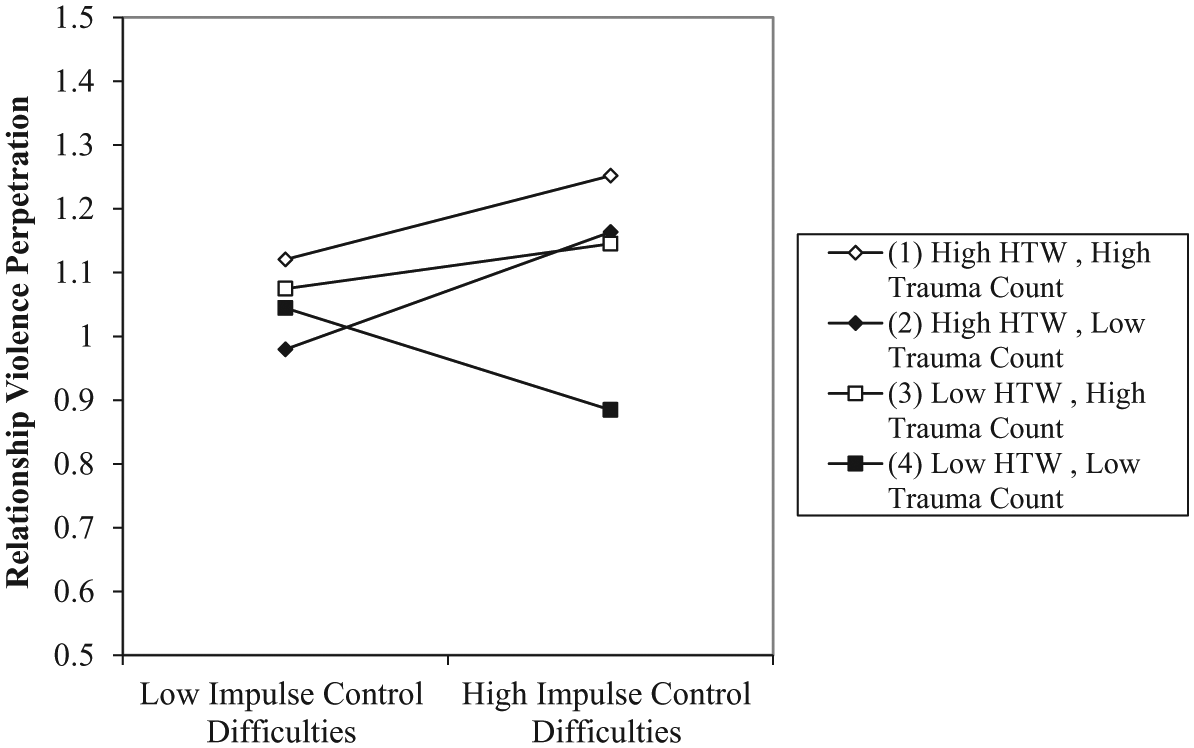
Interaction between HTW, impulse control difficulties, and number of traumas predicting relationship violence perpetration.
Similarly, participants who had not reported any exposure to trauma (n = 64) were assessed separately, to determine whether impulse control difficulties and hostility toward women continued to predict relationship violence in those who had not been exposed to trauma. As above, a regression analysis was used to assess the relationship between these variables, though trauma exposure was not included because, by design, no participants in this subsample were exposed to trauma. Thus, in this regression, general hostility was entered in Step 1 as a control variable, impulse control difficulties and hostility toward women were entered in Step 2, and the interaction between impulse control difficulties and hostility toward women was entered in Step 3. Results of this analysis showed that, among this subsample, impulse control difficulties and hostility toward women did not interact to predict relationship violence perpetration R2 = .095, F(1, 55) = 0.147, p = .703. Full results of this regression are available in Table 4.
Hierarchical Regression Analysis Predicting Relationship Violence Among the Subsample of Participants Who Had Not Been Exposed to Trauma.
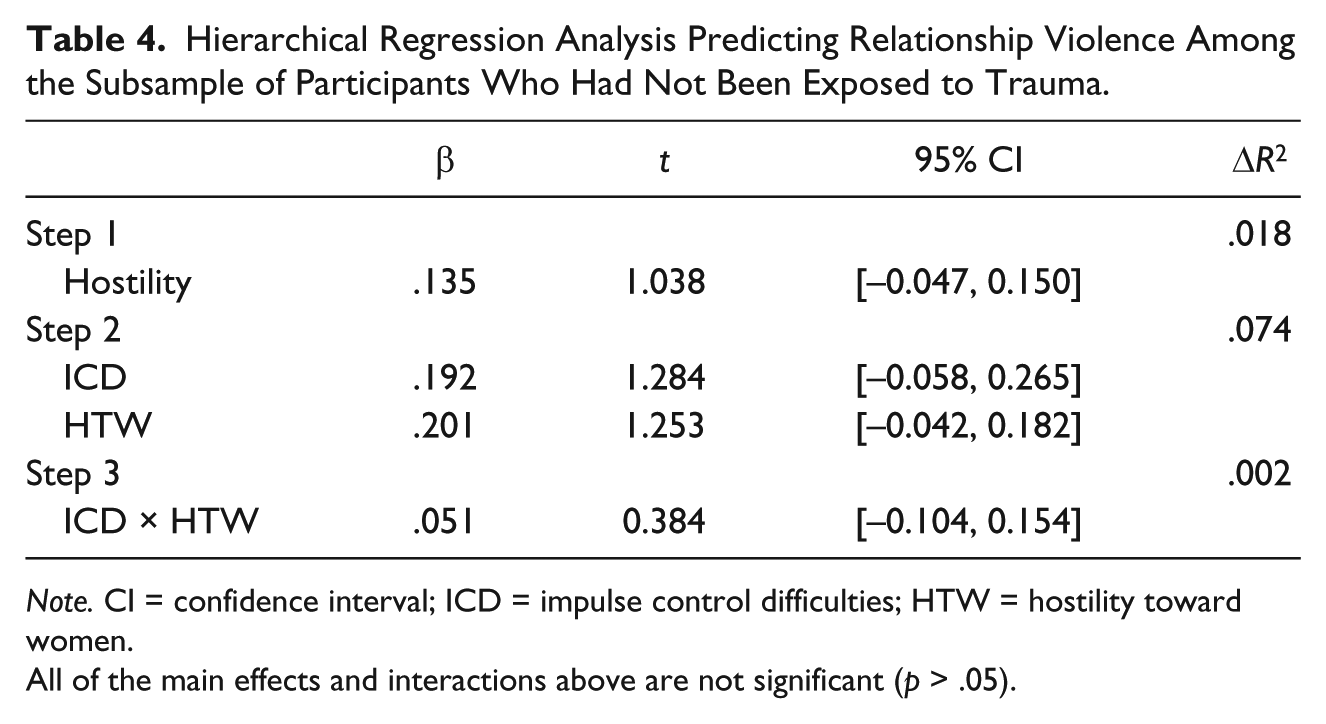
Note. CI = confidence interval; ICD = impulse control difficulties; HTW = hostility toward women.
All of the main effects and interactions above are not significant (p > .05).
Discussion
The current study examined correlational data investigating the effect of impulse control difficulties, hostility toward women, and trauma exposure on male perpetration of relationship violence. It was hypothesized that impulse control difficulties, trauma exposure, and hostility toward women would influence the frequency of relationship violence, and these hypotheses were supported, in that hostility toward women and trauma exposure moderated the relationship between impulse control difficulties and relationship violence. These findings were consistent with I3 theory, in that, both hostility toward women and trauma exposure (impellances), and impulse control difficulties (an inhibitor), significantly interacted with one another to predict relationship violence. In addition, the findings suggested that college men maladaptively engage in relationship violence when faced with difficulties controlling their impulses. Furthermore, the findings also suggested that hostility toward women, trauma exposure, and impulse control difficulties may be correlated with relationship violence among college-aged men. In accordance with I3 theory, the current study provides evidence for two impellance variables (hostility toward women and trauma exposure) moderating the association between impulse control difficulties (an inhibition) and relationship violence perpetration.
To test the first hypothesis, impulse control difficulties and relationship violence were examined, and the results suggested that those who had difficulties controlling their impulses were more likely to engage in relationship violence than those who are better able to control their impulses. One possible explanation for this finding may involve negative urgency. Specifically, when strong negative affect is present, college men may resort to acting impulsively (Scott et al., 2015), and physical violence may act as a way to diminish these negative emotions in the moment (Gratz et al., 2009). Furthermore, prior research suggests that impulse control difficulties may be linked with relationship violence (Derefinko et al., 2011), especially when one is experiencing the presence of unwanted emotional experiences, and when there is a lack of adaptive resources to regulate these unwanted emotions (Gratz et al., 2009). In this manner, when unwanted emotions arise, men may perpetrate relationship violence at a higher rate because they are low in inhibitory processes, which results in them being less able to inhibit themselves from perpetrating relationship violence.
The second hypothesis stated that hostility toward women was a risk factor for relationship violence, and this hypothesis was supported by both prior research (Abbey et al., 2011) and the current study. One possible explanation for this finding may include threats to one’s self-esteem (Gilligan, 1997, 2003) and a difficulty regulating impulsivity following a traumatic event (Tull et al., 2007). According to this explanation, when strong negative affect occurs, such as due to negative urgency, impulsivity may be invoked and preexisting hostility toward women may raise the likelihood that a man engages in physical violence toward a female partner to reduce this threat to his self-esteem (Gilligan, 1997, 2003). Alternatively, if negative emotions arise such as sadness and fear, men may use aggression as a way to avoid these negative emotions in the moment (Jakupcak, 2003), or to demonstrate their masculinity by using aggression as a more socially acceptable masculine response (Jakupcak, Tull, & Roemer, 2005).
The third hypothesis was that the main effect of trauma exposure would be predictive of relationship violence. The current study supported this hypothesis as the number of traumas an individual experienced was positively correlated with his or her perpetration of relationship violence. This correlation may be explained by previous research on trauma exposure and relationship violence, which has largely focused on the role of emotion regulation difficulties (Boden et al., 2013). Specifically, posttraumatic stress symptom severity (PTSS) was correlated with emotion regulation difficulties (Tull et al., 2007), and it may be that those with greater emotion regulation difficulties as a result of PTSS are more likely to perpetrate relationship violence.
Finally, the fourth hypothesis involved impulse control difficulties, hostility toward women, trauma exposure, and relationship violence perpetration, and it was hypothesized that hostility toward women, relationship violence, and trauma exposure would be positively correlated due to extensive previous literature (Abbey et al., 2001; DeGue & DiLillo, 2004; DeGue et al., 2010; Farr et al., 2004; Tull et al., 2007). Results supported this hypothesis as impulse control difficulties were associated with relationship violence, and this effect was moderated by hostile attitudes toward women and trauma exposure, such that when impulse control difficulties, hostility toward women, and frequency of trauma exposure were high, relationship violence was more likely to occur. However, when either hostility toward women, trauma exposure, or impulse control difficulties were low, relationship violence was less likely to occur. One possible explanation for this finding could involve impulse control difficulties and/or trauma exposure, because having hostile attitudes toward women may result in physical violence when one cannot self-regulate his or her emotions effectively (Gratz et al., 2009; Shorey, Brasfield, Febres, & Stuart, 2011).
Another possible explanation for these results can be drawn from I3 theory. In short, when an individual is high in an impellance (such as hostility toward women or exposure to trauma) and low in an inhibition (such as impulse control difficulties), men may be more likely to perpetrate relationship violence because the strong impellance outweighs their inhibitory capacity. In other words, when both hostility toward women and trauma exposure are high, college-aged men with high impulse control difficulties may perpetrate relationship violence at higher rates than when either one of these variables is low, due to their being more susceptible to be impelled to perpetrate such relationship violence, and their lowered ability to inhibit these resulting aggressive impulses when some sort of instigation upsets them. Furthermore, trauma exposure has been correlated with perceived shame and this has also been positively correlated with physical violence to suppress these negative emotions (Åslund, Starrin, Leppert, & Nilsson, 2009; Bushman, Baumeister, & Phillips, 2001; Lewis, 1971; Schoenleber et al., 2015). Thus, the experience of trauma exposure may produce feelings of shame in men who have experienced prior trauma, and combined with hostilities toward women, this could escalate into a violent response to suppress these negative emotions.
Limitations
The current study is not without limitations. First, because the TLEQ covers a wide range of traumas that one could experience (i.e., natural disasters, life-threatening illnesses, unexpected death of a loved one), and because an individual participant may have reported multiple traumas, we were unable to determine whether the effects were specific to any individual traumatic incident or to any specific type of trauma. In addition, the current study also utilized the TLEQ as a continuous, frequency measurement, meaning that it only determined the total number of traumas that an individual participant reported, and did not attempt to determine the severity of that trauma. As such, it is unclear whether or not the severity of the trauma an individual experienced had any effect on his or her responses to these variables. Furthermore, our data were collected via self-report, and included many measures that were likely considered sensitive, including relationship violence, hostility toward women, and exposure to trauma. As with any survey study on sensitive behaviors, one critical limitation of the present study was that it relied heavily on participants’ willingness to tell the truth regarding these sensitive behaviors. This study sought to reduce this limitation by assuring participants that their information was anonymous, in that, their names and other identifying information were not collected, and by allowing participants to complete the survey privately; however, some participants still may not have felt comfortable enough to disclose their previous experiences with these sensitive topics. Also, because the current study did not assess the participants’ relationship status, histories, durations, and/or frequencies, we were unable to examine the effects that these variables may contribute to male-perpetrated relationship violence. On a similar note, several of the hypotheses that could potentially explain this relationship, such as shame and negative urgency, were not examined in the current study. However, they were included as a possible rationale to explain the relationships between these characteristics of relationship violence. Also, the present study recruited an exclusively male sample, because it sought to examine the effect of factors such as hostility toward women on relationship violence; however, in doing so, it unfortunately risks overlooking the no less serious issue of female-perpetrated relationship violence as well. Finally, the data assessed in the present study were cross sectional in nature, meaning that the results are correlational only, and conclusions regarding causality or the temporal relationships between the various constructs cannot be assessed using these data.
Directions for Future Research
Future research should utilize the findings of the current study to further examine the roles of trauma exposure, impulse control difficulties, and hostility toward women on men’s perpetration of relationship violence. For example, additional research should be directed at further investigating the role of trauma exposure by directly comparing men who have previously experienced a trauma exposure with men who have not been exposed to a trauma. In addition, the current study was fairly representative of a typical college-aged sample, which limits the generalizability to various age groups, levels of emotional and cognitive functioning, and socioeconomic statuses, and so, future studies should replicate the current study in clinical or community samples with a more diverse sample of men. Furthermore, although the present study assessed inhibition factors in the face of instigation by asking participants about their impulsivity when they are upset by something, the present study did not measure instigation directly. Future research should address this issue by specifically asking participants about potential instigation factors, which preceded relationship violence perpetration specifically, rather than the broader questions used in the present study. Finally, the TLEQ measurement assessed a variety of different types and severities of trauma. For instance, in our sample, experiencing a life-threatening illness, natural disaster, combat, childhood sexual abuse, and a variety of other experiences were all considered to be equivalent experiences, because all of them represent a single trauma. Future research should examine these incidents in more detail, such as the type, severity, age at the time of the trauma, length of time since the trauma occurred, and so on, to develop a deeper understanding of the traumas the sample was exposed to. For example, a future study may aim to determine which specific types of trauma are most likely to predispose an individual to develop hostile attitudes toward women. Such research will aid in the development of a more comprehensive understanding of the characteristics of trauma, which may result in improved treatment targets for intervention programs to help prevent the perpetration of relationship violence.
Implications
The current study is of particular importance because it may identify men who are likely to perpetrate relationship violence. More specifically, the current study suggests that college-aged men with specific attributes such as high impulse control difficulties, high prior trauma experiences, and high hostile attitudes toward women may be more likely to perpetrate relationship violence. Such information may assist in developing treatment targets for future intervention programs. Specifically, future intervention programs among college men should target those with high impulse control difficulties, high hostile attitudes toward women, and with more experiences with prior trauma, to proactively assist them in reducing their hostility toward women, symptoms associated with prior trauma, and/or impulse control difficulties, to prevent the future perpetration of relationship violence.
Conclusion
The current study suggests that college-aged men who have difficulties with impulsivity, report high frequencies of prior trauma exposure, and have high hostility toward women may be more likely to perpetrate relationship violence toward their intimate partner. The current study replicates existing research on the bivariate relationships between impulse control difficulties and relationship violence, between hostility toward women and relationship violence, and between trauma exposure and relationship violence. Furthermore, the present study expands on the work in previous literature, as it is the first to establish hostility toward women and trauma exposure as moderators between impulse control difficulties and male perpetration of relationship violence toward women in a sample of college men, using the tenets of I3 theory. This three-way interaction between impulse control difficulties, hostility toward women, and trauma exposure on the male perpetration of relationship violence is significant because it strengthens the literature by confirming known correlates, and by utilizing these variables within a larger theoretical model, which may assist in the development of targeted intervention programs to prevent at-risk men from perpetrating relationship violence.
Footnotes
Declaration of Conflicting Interests
The author(s) declared no potential conflicts of interest with respect to the research, authorship, and/or publication of this article.
Funding
The author(s) received no financial support for the research, authorship, and/or publication of this article.