



Abstract
This study examines the association between childhood physical abuse and an increased risk for violent victimization in youth and young adulthood in China. It further assesses if this relationship is mediated by an individual’s routine activities. Data used in this study were collected from more than 2,000 individuals of school-based samples in Changzhi, a city of over 3 million people in Northern China. Drawing from a survey that captures childhood physical abuse, violent victimization, and routine activities, this study uses negative binominal regression to examine the relationships between childhood physical abuse, routine activities, and violent victimization among Chinese youth and young adults. We find that individuals who were physically abused in childhood were at a greater risk for violent victimization in youth and young adulthood, and that an individual’s routine activities (e.g., drinking) partially mediated this relationship. The findings from this study suggest that routine activity theory provides a useful framework for explaining the link between childhood physical abuse and risk for violent victimization in the Chinese context. Furthermore, our findings stress the importance of future research to look more closely at childhood experiences when studying future behaviors. In addition, our findings challenge beliefs held among Chinese parents about the acceptability of physical punishment to discipline children. These findings can be used to shape programs that create awareness of acceptable parenting practices in China.
Introduction
Prior research has documented that victimization is unequally distributed within the population, and demographic variables, such as age, sex, socioeconomic status, and marital status, play a role in determining one’s risk for future victimization (Miethe & McDowall, 1993; Shaffer & Ruback, 2002). More recently, researchers in the field of child development have become increasingly interested in childhood experiences and their subsequent effects on victimization in adolescence and adulthood. In particular, researchers have found that those who were abused as children are especially susceptible to future victimization (Widom, Czaja, & Dutton, 2008). Notably, the general approach to explaining this link has been to look at within-individual changes that occur as one experiences abuse, and explanations have typically focused on lowered self-esteem, learned helplessness, and distorted cognitions (Finkelhor, Turner, Hamby, & Ormrod, 2011).
Although prior studies have expanded our knowledge about the mechanisms through which childhood abuse may impact future victimization, important questions remain. First, as prior studies have focused on specific types of violent victimization, such as intimate partner violence and sexual violence, it is unknown whether childhood physical abuse (CPA) is related to general violent victimization beyond these specific types. Because violence is a “salient and powerful life experience that shapes developmental pathways and influences the character and content of later life” (Macmillan, 2001, p. 11), those who experience CPA may also have a higher risk for other kinds of violent victimization. This possibility, however, has not been adequately tested.
Second, when explaining the observed relationship between CPA and future victimization, prior studies have focused on victim characteristics alone, such as lowered self-esteem, learned helplessness, and distorted cognitions (Finkelhor et al., 2011). A full understanding of victimization, however, requires looking at both the characteristics of victims and their behavior (Messman-Moore & Long, 2003). In this regard, criminological theories, specifically routine activity theory (RAT), may be useful in expanding the focus to an individual’s daily activities. This focus may help explain the relationship between CPA and violent victimization by examining the opportunities for victimization created by one’s daily activities.
Third, prior research has only examined the relationship between CPA and subsequent victimization in Western cultures, and it is unknown whether such a relationship exists in non-Western cultures. This is an oversight because the relationship between CPA and subsequent victimization may be specific to Western cultures. It is especially important to assess this relationship within the Chinese context for at least two reasons. First, China is the most populous country in the world, and the estimate of lifetime prevalence of child abuse is significantly higher than international and Asian contexts (Ji & Finkelhor, 2015). Second, the Chinese culture emphasizes strong family ties (Fuligni, Yip, & Tseng, 2002; Messner, Lu, Zhang, & Liu, 2007) and accepts the use of physical punishment to discipline children (Lau, Takeuchi, & Alegria, 2006). Thus, the relationship between CPA and subsequent violent victimization may be weakened within the Chinese context.
Against this backdrop, and heeding calls to use victimization as an independent variable to understand the consequences of such an experience on the lives of victims (Turanovic & Pratt, 2013), this article assesses whether exposure to CPA increases an individual’s risk for violent victimization in youth and young adulthood and the extent this relationship is mediated by routine activities. To this end, we use data collected from more than 2,000 individuals in Changzhi, a city of over 3 million people in Northern China. Below we present a review of the extant literature on CPA and RAT. After describing the data and methods, we discuss the results and the implications of the findings for theory, research, and practice.
Background
As Kempe, Silverman, Steele, Droegemueller, and Silver (1962) first described the symptoms of “the battered child syndrome,” researchers have increasingly paid attention to the consequences associated with CPA. Studies have consistently documented several short-term and long-term negative consequences of CPA on individuals’ physical, mental, and social well-being. One such consequence is an increased vulnerability for domestic violence and sexual assault (Coid et al., 2001). In attempting to explain why CPA increases an individual’s risk for future victimization, a number of perspectives have been proposed. Wyatt (1984), for example, argued that the experiences of violence in childhood may result in the development of “patterns of vulnerability,” because such experiences may deny individuals the opportunity to develop healthy relationships and violate expectations they have for relationships with persons they trust (Finkelhor & Baron, 1986). In addition, some scholars have argued that victims of CPA may experience emotional difficulty such as anxiety and depression, develop a general mistrust of others, and begin to accept violence as an expected norm for adult relationships, thereby increasing their risk for future victimization (Malinosky-Rummell & Hansen, 1993).
The explanations discussed above have largely focused on the victim and the impact violent childhood experiences have on the development of the abused child. Although insightful, such a focus fails to take into account interpersonal relationships and cultural factors that might influence future victimization (Messman-Moore & Long, 2003). Furthermore, these explanations have ignored how experiences of childhood abuse alter social settings that lead to an increased risk for victimization. This is an oversight as a complete understanding of why childhood abuse and future victimization are linked may require researchers to focus on the mechanisms that increase vulnerability within the settings in which individuals’ function (Messman-Moore & Long, 2003).
RAT and Its Application to Violent Victimization
Criminologists have often relied on RAT to explain why some individuals are more likely to become victims. According to this theory, victimization is a result of an individual’s exposure and proximity to possible offenders, their attractiveness as targets, and the level of guardianship to protect them against victimization (Cohen & Felson, 1979; Miethe & Meier, 1990). While few have used this theory to study the link between CPA and future victimization, we believe that it has considerable promise to understanding this link. Specifically, the child abuse literature suggests that physical abuse can be a traumatic experience for an individual, and is linked to a multitude of negative outcomes, including low self-esteem, emotional problems, and interpersonal problems (Malinosky-Rummell & Hansen, 1993), all of which may shape a person’s life course trajectory (Macmillan, 2001). Thus, through its effects on various domains in a person’s life, CPA may affect individuals’ exposure and proximity to possible offenders, their attractiveness as a target, and the levels of guardianship, thereby affecting their risk for violent victimization. The mechanisms through which CPA could affect these factors are further discussed below.
CPA and exposure to motivated offenders
Research has documented the link between childhood abuse and engaging in delinquent or aggressive acts (Briere & Runtz, 1990; Pollock et al., 1990). Specifically, Pollock and colleagues (1990) found that among 201 men interviewed, self-reported abuse predicted aggression toward others, including fighting and violent criminal acts. Briere and Runtz (1990) obtained similar findings with female samples. In addition, children who are abused are more likely to use drugs and alcohol (Kilpatrick et al., 2000), which is related to an increased risk for violent and delinquent behaviors (Lisak & Beszterczey, 2007). Furthermore, research has linked delinquent behavior and substance abuse to both personal and property victimization (Lauritsen, Laub, & Sampson, 1992; Mustaine & Tewksbury, 1998), because engaging in risky behaviors increases the likelihood of an individual coming into contact with motivated offenders (Gottfredson, 1984; Sparks, Genn, & Dodd, 1977). Relatedly, extant literature suggests that engaging in risky behaviors increases association with deviant others (see Monahan, Steinberg, & Cauffman, 2009), further escalating one’s contact with motivated offenders, thereby increasing one’s risk for victimization (Schreck, Wright, & Miller, 2002).
CPA and target attractiveness
CPA may also influence subsequent victimization through its effect on target attractiveness. As discussed above, CPA may increase the risk for delinquent and risky behaviors, which could in turn make individuals more attractive as targets for at least two reasons. First, engaging in delinquent behaviors can place an individual at a higher risk for retribution. When someone commits a crime or is a member of a group that engages in crime, there is an increased risk for retaliation by victims or other groups (Peterson, Taylor, & Esbensen, 2004; Schreck & Fisher, 2004). Second, engaging in risky behaviors may reduce an individual’s ability to protect themselves. Drinking, for example, can impair individuals’ cognition and motor skills, thereby reducing their ability to protect themselves and in turn making them easy targets (Schreck, Stewart, & Fisher, 2006).
CPA and low guardianship
Being exposed to potential offenders or being an attractive target alone may not lead to victimization. According to RAT, crime can only occur in the absence of a capable guardian, as it leaves a suitable target unprotected against a motivated offender when they come together in time and space (Cohen & Felson, 1979). Guardians refer to actors who are responsible for being the protectors of a potential target (Reynald, 2010). Parents can act as guardians to their children by closely monitoring them, regulating their behaviors, and being aware of their whereabouts (Patterson, Reid, & Dishion, 1992). An important factor determining the quality of parental monitoring is parent–child communication (Stattin & Kerr, 2000). CPA, however, is a dysfunctional form of parent–child communication (Borsella, 2006) and may reduce effective communication that otherwise may lead to protection from victimization. Specifically, the experience of CPA may evoke feelings of fear, anxiety, and anger in children, which, if directed toward parents, can interfere with a positive parent–child relationship and cause children to be fearful of and avoid their parents (Bugental & Goodnow, 1998; Saarni, Campos, Camras, & Witherington, 1998). Thus, parents of abused children may be less aware of dangers facing their children and in turn may not be able to serve as effective guardians. Similarly, schools can serve as guardians. Interviews conducted by social workers indicated that 40% of the adolescents who were exposed to violence in the family engaged in truancy (Pfouts, Schopler, & Henley, 1981), which is considerably higher than the truancy rate of those not exposed to family violence (Malinosky-Rummell & Hansen, 1993). This finding suggests that physically abused children may spend more time away from school and in the absence of capable guardianship.
In sum, individuals who were physically abused in childhood may be at a greater risk for subsequent violent victimization, at least in part because those individuals are more likely to engage in routine activities that allow them to come in close contact with motivated offenders, make them more attractive targets, and reduce guardianship, all of which, per RAT, are conditions conducive to victimization. To date, only one study has linked childhood abuse with future violent victimization by using a routine activity approach (see Tillyer, 2015). By looking at the combined effect of neglect, sexual abuse, and physical abuse, Tillyer (2015) found a significant relationship between childhood maltreatment and adolescent violent victimization, with risky lifestyles appearing to mediate this relationship. Importantly, more research is needed to understand whether specific types of abuse in childhood, such as physical abuse, independently impacts future victimization risk (see Schaaf & McCanne, 1998). In this regard, although a large body of research has documented the adverse effects of childhood sexual abuse on future victimization outcomes (see Tyler, Hoyt, & Whitbeck, 2000; Walker, Freud, Ellis, Fraine, & Wilson, 2017), little is known about the effect of CPA on victimization. This oversight is notable because CPA is more prevalent than sexual abuse (U.S. Department of Health & Human Services, Administration for Children and Families, Administration on Children, Youth and Families, Children’s Bureau, 2015), and at least owing to its prevalence, it is imperative to better understand the relationship between CPA and future violent victimization in youth and young adulthood.
The Chinese Context
China, with 1.3 billion people, is the world’s most populous country. In 2013, 220 million of its population were estimated to be children (National Bureau of Statistics of China, 2013). With such large numbers of children making up its population, there has been growing interest in child abuse research. For example, a meta-analysis found that the lifetime prevalence of any CPA in China was 36.6% (Ji & Finkelhor, 2015). This is significantly higher than the worldwide prevalence, at 22.6% (see Stoltenborgh, Bakermans-Kranenburg, van IJzendoorn, & Alink, 2013). 1 Turning to other Asian countries, Ahn and colleagues (2017) found the prevalence rate of CPA was 7.1% in South Korea; the prevalence rate of CPA in Thailand was between 15% and 16.7% (Chaopricha & Jirapramukpitak, 2010; Jirapramukpitak, Harpham, & Prince, 2011). In addition, Hussey, Chang, and Kotch (2006) found the prevalence rate of CPA was 28.4% in the United States.
Assessed gender differences in CPA in China and found that the prevalence of any CPA was 35.2% for women (95% confidence interval [CI] = [26.9, 43.6]) and 43.8% for males (95% CI = [31.9, 55.6]). Moreover, a prevalence of 43.1% was estimated for minor physical abuse, 26.6% for severe physical abuse, and 7.8% for very severe physical abuse, all of which are significantly higher in mainland China than in non-mainland China (Ji & Finkelhor, 2015). In addition, 40% to 70% of parents in China have been found to use corporal punishment on their elementary school-age children within a 12-month period (Wang & Liu, 2014).
Despite growing interest in the study of child abuse in China (see Chan, 2011, 2013; Chan, Yan, Brownridge, & Ip, 2013), an examination of the impact of abuse on the lives of Chinese children is far from complete. For example, little is known about the effect of CPA on subsequent victimization later in life. To understand why child abuse could differently impact future violent victimization within the Chinese context, as compared with the Western context, two characteristics of Chinese culture should be noted. First, Chinese culture is characterized by Confucian values (Ross et al., 2005). At the center of these values is the idea of filial piety which gives parents the power to control and punish children. Physical discipline is seen as beneficial to a child’s future as parents believe that physical discipline teaches children to be obedient to and respect authority (Qiao & Chan, 2005). Such positive attitudes toward parental control and physical punishment could then lead to less negative outcomes arising from the experience of CPA (Lansford et al., 2005). Thus, the experience of CPA may not be related to future victimization outcomes in China.
Second, unlike Western societies, Chinese culture is characterized by a collective orientation, emphasizing strong ties and stakes in extended family relationships (Messner et al., 2007). In particular, Chinese children spend a large amount of time with family, both within the immediate household and outside the household (Messner et al., 2007). Furthermore, Chinese parents generally show less concern for independence and privacy and are often heavily involved in the lives of their children (Chao, 1994; Chen, Liu, & Li, 2000; Messner et al., 2007). Such an emphasis on social ties and parental involvement ensures that many of the routine activities of Chinese youth and young adults are performed in a collective manner. This reduces the probability that individuals are alone inside and outside of their homes and increases capable guardianship (Messner et al., 2007). These strong interpersonal connections could serve as a protective factor, thereby causing any relationship between CPA and violent victimization to weaken or disappear.
In sum, given the unique characteristics of Chinese culture and high rates of CPA, it is imperative to determine whether a link between CPA and future violent victimization exists in China. Doing so provides an opportunity to examine the role of culture in linking these two experiences. Furthermore, using RAT to study this link allows a test of the theory in explaining violent victimization in other cultural contexts. To date, only three studies have examined victimization in the Chinese context and found limited support for RAT in its application to violent victimization. Specifically, using data collected from the city of Tianjin, Messner et al. (2007) found that RAT was more useful in explaining property victimization, such as personal theft, than violent victimization, such as robbery and assault. Also using data collected from the city of Tianjin and by focusing on target attractiveness, guardianship, and exposure to potential offenders at the household and neighborhood levels, Zhang, Messner, and Liu (2007) assessed the risk and protective factors for bicycle-theft victimization. Their findings largely support RAT. More recently, using data collected from a sample of high school students in a southern Chinese city, Ren, He, Zhao, and Zhang (2017) found that low self-control was positively associated with both violent and property victimizations, and risky lifestyle factors—delinquency with friends, gang involvement, and exposure to offenders—partially mediated the effects of low self-control on victimization.
In addition, others have tested the usefulness of RAT when studying victimization in Asia beyond mainland China, such as South Korea and Taiwan (e.g., Cho, Wooldredge, & Sun Park, 2016; Kuo, Cuvelier, & Chang, 2009; Kuo, Cuvelier, Sheu, & Zhao 2012). While these studies did find support for RAT in explaining victimization, some of the findings diverged from the patterns found in studies using Western samples. For example, while studying a Taiwanese sample, Kuo et al. (2009) found that females had a higher risk of being robbed, married and affluent persons were more likely to be victims of personal larceny, and those who stayed home at night were more likely to be assaulted than those who went out at night. These divergent findings have led scholars to conclude that the social and cultural context is important when studying victimization. Thus, by assessing if factors intimated by RAT help to explain the link between CPA and future violent victimization using a Chinese sample, this study constitutes a further test of this theory and its applicability to violent victimization in China.
The Current Study
The current study examines the effect of CPA on future violent victimization. In doing so, this study contributes to victimization research in several ways. First, it assesses whether CPA affects one’s risk for violent victimization beyond sexual abuse and intimate partner violence. If a link between CPA and general violent victimization exists, it would suggest that CPA is the starting point of a series of victimizations, indicating that researchers may need to look more closely at childhood experiences of abuse to understand why some individuals are at an increased risk for victimization. Second, drawing on RAT, this study considers how routine activities create opportunities for victimization, thereby linking experiences of abuse in childhood to subsequent violent victimization. In doing so, this study assesses the usefulness of RAT in explaining the link between CPA and future victimization in China. Third, by using data collected in China, this study is further able to examine the role that cultural values and attitudes may play in the relationship between CPA and violent victimization. Specifically, drawing on prior research and RAT, we investigate two hypotheses.
Data and Method
Data
To assess the link between CPA and risk for violent victimization, we use self-reported survey data collected from a sample of 2,245 students in Changzhi, China, in December 2009. The city of Changzhi is located in the mid-eastern part of China. Rich in agricultural land, it is a transportation hub which serves both industrial and agricultural interests. The heavy industry is run by coal mined in the surrounding rural areas. The city’s economy, which is shaped by agricultural and mining activities, has drawn a large number of rural residents to the city for work, resulting in a diverse mix of rural and ethnic minorities (Pyrooz & Decker, 2013).
To further maximize variability in personal experiences, such as academic performance and life chances, 2,500 questionnaires were administered to students in six schools, consisting of one college, two high schools, one comprehensive school with both college students and vocational school students, and two vocational schools. The questionnaire was translated from English to Chinese by a Changzhi native, and then was back-translated back to English by a Chinese native. 2 The questionnaire was administered only in Chinese.
Within each school, we contacted several teachers with whom we are acquainted and asked for their cooperation to administer the questionnaires to students in their home classrooms. We then tried to secure consent from the parents of the students who were younger than 18 and from the students who were older than 18, which resulted in a response rate of 90%, with 2,245 questionnaires being completed. The students were told that they were invited to a research study that assesses the correlation between social stratification and self-reported social behavior, and their responses to the questionnaire would be anonymous and confident. No incentive was provided. Completing the questionnaire took approximately 20 min.
The sample for this study is further reduced by 4.2% (N = 94), due to missing information on the dependent variable. In addition, respondents who do not belong to Han ethnicity are excluded from the analysis (N = 155). This is done because more than 93% of the respondents are of Han ethnicity; those who were not of Han ethnicity are few and may be heterogeneous in various ways. Thus, the present study conducts an analysis on 2,068 students. Overall, the sample consists of more males (59.8%) than females (40.2%), the average age is 17.4 years, and the majority of the sample resided in rural areas (62%). Online Appendix A presents the demographic information of the sample.
Dependent Variable
Three survey items are used to measure violent victimization. Respondents were asked “How often in the past 12 months have you (a) been hit by someone trying to hurt you; (b) had someone use a threat, a weapon, or force to get money or things from you; and (c) been attacked by someone with a weapon or by someone trying to seriously hurt or kill you.” All items were originally coded as an ordinal variable (0 = never, 1 = once or twice, 2 = 3-5 times, 3 = 6-10 times, and 4 = more than 10 times). Consistent with prior studies (e.g., Turanovic, Reisig, & Pratt, 2015), we operationalize violent victimization as a variety score. To do so, we recode each item to a dichotomous variable where it takes a value of “1” if a respondent was exposed to each form of violence during the past 12 months and “0” if otherwise. Then, we sum these three values to construct a violent victimization variety score, ranging from 0 to 3. This score reflects whether an individual was victimized and the number of types of violent victimizations experienced in the past 12 months. Overall, violent victimization is positively skewed in the sample with 10.64% (N = 220) reporting one type of victimization, 3.53% (N = 70) reporting two types of victimization, and 2.65% (N = 51) experiencing all three forms of victimization.
Independent Variable
The key independent variable for the present study is CPA. CPA is defined as being a victim of physical abuse within one’s household during childhood. It is measured using five questions drawn from the Childhood Trauma Questionnaire (Bernstein & Fink, 1998; Bernstein et al., 2003). The questions focus on child maltreatment and its subtypes. In general, the scale has demonstrated good criterion-related validity. 3 Response options for each item range from 0 = never to 4 = always. We average responses to these five items (Cronbach’s alpha = .90) to create an index, with a higher score indicating a higher level of CPA.
Mediating Variables
Five measures tapping routine activities that have been found to increase the risk of harm and violence in previous studies (Schreck et al., 2002; Turanovic et al., 2015) are used. These include violent offending, violent delinquent peers, skipping classes, drinking, and low parental monitoring. Engaging in delinquent behavior increases the probability of victimization because it increases one’s proximity to potential offenders (Stewart, Elifson, & Sterk, 2004). In this study, violent offending is measured by responses to four survey items that capture violent delinquency. Respondents were asked, how often in the past 12 months they would engage in activities, such as carrying a hidden weapon for protection. Responses were originally coded as 0 = never, 1 = once or twice, 2 = 3-5 times, 3 = 6-10 times, and 4 = more than 10 times. We recode each item to a dichotomous variable where it takes on a value of “1” if a respondent engaged in each form of offending during the past 12 months and “0” if otherwise. We then create a violent offending variety score by summing these four dichotomous variables (Cronbach’s alpha = .74). Such a measure has been found to be a valid measure of overall involvement in illegal activity (Mulvey et al., 2010; Sweeten, 2012). Higher scores indicate greater involvement in offending.
Delinquent peers might increase the risk of violent victimization because these peers will make it more likely that an individual is in the proximity to motivated offenders (Schreck & Fisher, 2004). In this study, we create the violent delinquent peers index to measure peer involvement in violent delinquency. Respondents were asked how many of their close friends engaged in activities such as using a weapon in a fight. Responses range from 0 = none to 4 = all of them. We average responses to the five items to create the violent delinquent peers index (Cronbach’s alpha = .81). Higher scores indicate higher levels of violent peer delinquency.
The next measure of routine activities is skipping classes, as it is argued that the more time a person spends away from authority figures and engages in unstructured activities, the more often he or she will be away from effective guardians (Osgood, Anderson, & Shaffer, 2005; Schreck et al., 2002). Skipping classes is measured by responses to the following question: “During the past 12 months, how often have you skipped classes without an excuse?” Responses are coded as an ordinal variable (0 = never, 1 = once or twice, 2 = 3-5 times, 3 = 6-10 times, and 4 = more than 10 times). Furthermore, drinking is included because it may expose individuals to motivated offenders by reducing one’s ability to protect themselves (Schreck et al., 2006). Respondents were asked how often in the past 12 months they used alcohol, which we use to measure drinking behaviors. Responses range from 0 = never to 4 = every day. 4
Finally, low parental monitoring, which reduces the potential for parents to protect their children from possible harm, is operationalized as an index averaged across responses to four items that measure the extent to which respondents report that their parents monitor their whereabouts and activities (Cronbach’s alpha = .79). Responses to these items range from 0 = never to 4 = always. We reverse code responses to these items such that higher scores indicate lower levels of parental monitoring.
Control Variables
To ensure that the relationship between CPA and violent victimization is not confounded by other factors, we include control variables that may be related to both CPA and violent victimization. 5 Specifically, age (in years), sex (1 = male, 0 = female), rural residence (1 = rural residence, 0 = urban residence), and family income are included in the analysis. Family income is a measure of the average monthly income of both parents. Income ranges from 1 = less than RMB 500 (approximately US$80) to 7 = over RMB 5,000 (approximately US$780). In addition, because prior research in the United Stated has found that low self-control has a direct effect on violent victimization (see Pratt, Turanovic, Fox, & Wright, 2014), we include an low self-control index by averaging responses to 13 items that are drawn from the Brief Self-Control Scale (Tangney, Baumeister, & Boone, 2004). The low self-control index has a high level of reliability (Cronbach’s alpha = .72) and is coded so that higher scores indicate lower levels of self-control. Table 1 presents descriptive statistics for all study variables. Online Appendix B presents descriptive statistics and prevalence rates for all survey items that are used to construct the indexes.
Descriptive Statistics (N = 2,068).

Analytic Strategy
The sample contains 2,068 Han youth and young adults who provided valid responses to all the items measuring violent victimization. Of the 2,068 respondents, approximately 8.03% had missing values on one or more study variables. To address the missing data problem, we perform multiple imputation (MI), because MI is “one of the most attractive methods for general-purpose handling of missing data in multivariate analysis” (Allison, 2000, p. 301; see also Acock, 2005; Brown & Kros, 2003). We performed MI with chained equations in Stata 13 (StataCorp, College Station, TX). Ten imputations in total are performed using the “mi estimate” command (Kenward & Carpenter, 2007; Rubin, 2004). 6
As violent victimization has a highly skewed distribution and shows evidence of overdispersion (M = 0.248, variance = .634), we use negative binomial regression models to examine violent victimization (Long, 1997). Negative binomial regression can be regarded as an extension of Poisson regression, and it relaxes the assumption of Poisson regression that the variance is equal to the mean by introducing an additional parameter which estimates the extent of overdispersion in the model. By doing so, negative binomial regression does not lead to standard errors that are biased and does not result in inflated significance levels (Long, 1997).
The main goal of this study is to determine if CPA increases an individual’s risk of violent victimization in youth and young adulthood and if routine activities mediate this link. To this end, our analysis includes seven negative binomial regression models. In the first model (Model 1), we regress violent victimization on CPA and the control variables. In the next five models (Model 2-Model 6), we regress violent victimization on CPA, the control variables, and each of the five variables that we use to measure routine activities, respectively. Such a strategy is selected to determine whether every measure of routine activities included in the study is significantly linked to violent victimization and to establish which variable has the strongest mediating effect on the relationship between CPA and violent victimization. Finally, to assess the extent to which all routine activities mediate the link between CPA and violent victimization, we regress violent victimization on CPA, all the variables measuring routine activities, and the control variables in the last model (Model 7).
Results
Bivariate Results
Table 2 presents the bivariate correlations among all of the study variables. To test if routine activities mediate the relationship between CPA and violent victimization, three empirical conditions must be established (see MacKinnon, Krull, & Lockwood, 2000). First, it is necessary to confirm that CPA is significantly related to violent victimization. Table 2 indicates that the correlation between CPA and violent victimization is positive and statistically significant (r = .24, p < .001). With regard to the second requirement, we find that CPA is positively and significantly related to all of the routine activity measures. Last, Table 2 suggests that all of the routine activity measures are positively and significantly associated with violent victimization. Thus, by meeting these three empirical conditions, the bivariate analysis suggests that routine activities may mediate the relationship between CPA and violent victimization.
Bivariate Correlations Among Study Variables.
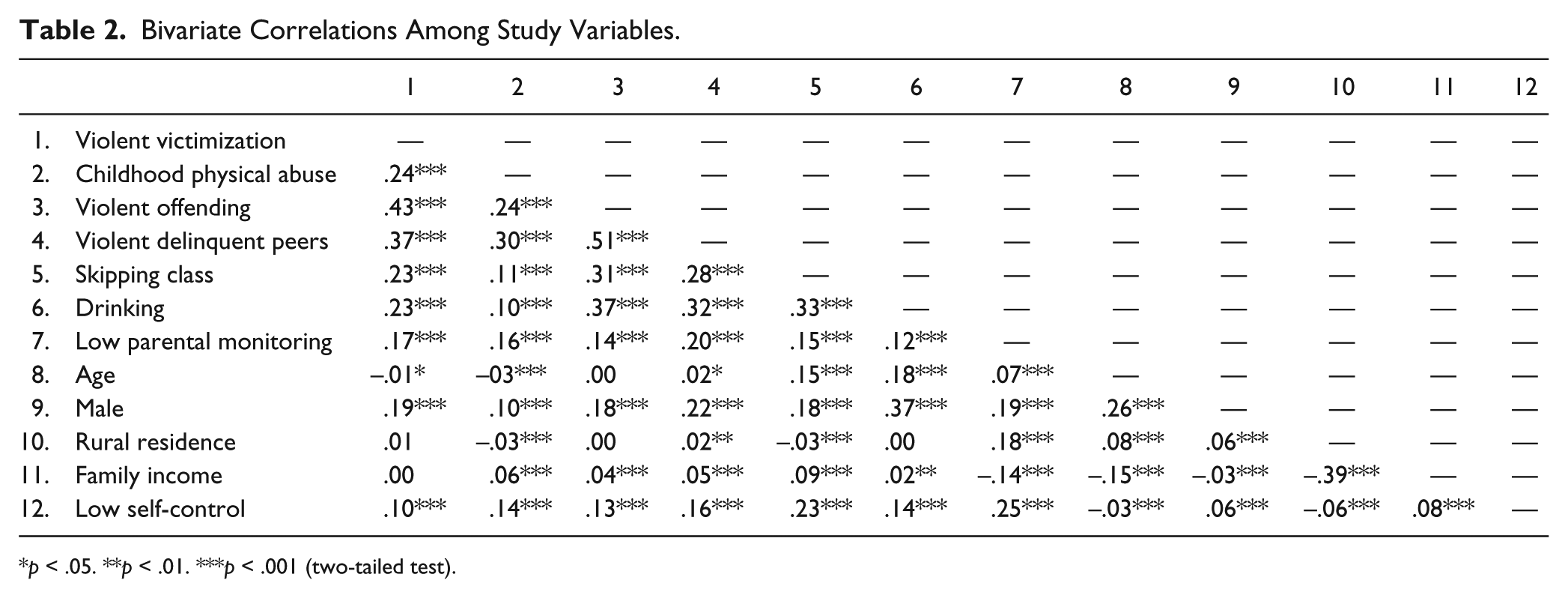
p < .05. **p < .01. ***p < .001 (two-tailed test).
Multivariate Results
Before proceeding to the multivariate analysis, we conduct various diagnostic tests to ensure that there is no harmful multicollinearity. The correlation coefficients among independent variables are all below the traditional threshold of .70 used to detect collinearity. Furthermore, the mean variance inflation factors (VIF) among all variables is 1.24, which is well below the standard cutoff of 4. Thus, multicollinearity is not a concern.
Table 3 presents the results from the negative binomial regression analyses. Turning to the first hypothesis which expects that individuals who experience CPA are at a greater risk for violent victimization, we find that those individuals who experienced physical abuse in childhood are more likely to experience violent victimizations in youth and young adulthood (b = .12, SE = .02, p < .001; see Model 1).
Negative Binomial Regression Coefficients of the Relationship Between Childhood Physical Abuse, Routine Activities, and Violent Victimization (N = 2,068).
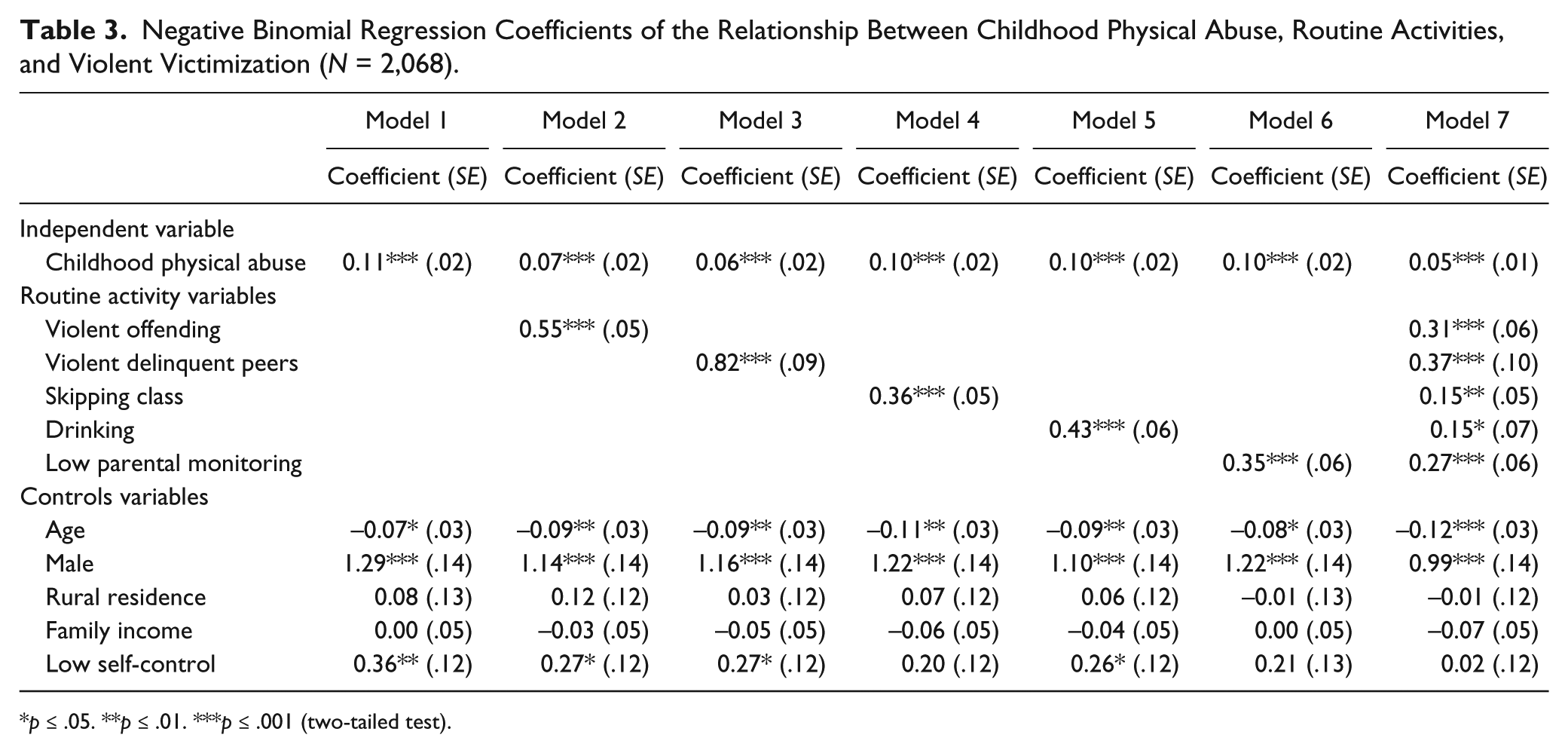
p ≤ .05. **p ≤ .01. ***p ≤ .001 (two-tailed test).
In Models 2 through 6, we examine whether the link between CPA and violent victimization can be explained by each of the five routine activity measures included in the study. A review of these models indicate that every routine activity measure is significantly related to an increased risk for violent victimization. Specifically, Model 2 shows that those individuals who engage in violent offending are at an increased risk for violent victimization (b = .55, SE = .05, p < .001). Furthermore, the coefficient of CPA is reduced from .11 in Model 1 to .07 in Model 2 when violent offending is included in the model, suggesting that 36% ([.11 – .07] / .11) of the effect of CPA on violent victimization is explained by violent offending.
Similarly, inspection of Model 3 suggests that individuals who have violent delinquent peers are at a greater risk for violent victimization (b = .82, SE = .09, p < .001). Furthermore, when violent delinquent peers is added to the equation, we find that the coefficient of CPA is reduced from .11 in Model 1 to .06 in Model 3, suggesting that 45% ([.11 – .06] / .11) of the effect of CPA on violent victimization is explained by violent delinquent peers. Likewise, review of Models 4 to 6 indicates that skipping classes (b = .36, SE = .05, p < .001), drinking (b = .43, SE = .06, p < .001), and low parental monitoring (b = .35, SE = .06, p < .001) also increase the risk for violent victimization. Comparing the coefficient of CPA in Model 1 to Models 4 to 6, we find that skipping classes, drinking, and low parental monitoring account for 9% of the effect of CPA on violent victimization, respectively. Overall, it seems that violent delinquent peers had the largest mediating effect on the relationship between CPA and violent victimization.
Model 7 includes all the routine activity variables. Review of this model indicates that being physically abused as a child continues to have a positive and statistically significant effect on violent victimization, net of all variables measuring routine activities and the control variables. In addition, all the variables capturing routine activities are statistically significant in Model 7. More importantly, we find that including all the routine activity variables results in a decrease in the coefficient of CPA from .11 in Model 1 to .05 in Model 7. Therefore, the routine activity variables together explain 55% ([.11 – .05] / .11) of the effect of CPA on violent victimization. Thus, the results from Model 7 provide support for the second hypothesis that anticipates that the relationship between CPA and violent victimization will be mediated by an individual’s routine activities.
In addition, we find that sex and age have significant effects on violent victimization in every model, with males and younger individuals being at a greater risk for violent victimization. 7 Furthermore, low self-control, which is statistically significant in Model 1, has no significant effect on violent victimization when routine activities are accounted for in Model 7. Thus, low self-control fails to have a statistically significant effect on violent victimization when we include skipping classes and low parental monitoring (see Models 4 and 6). This finding is contrary to some research which suggests that low self-control has a direct effect on violent victimization, even after routine activities are accounted for (e.g., Turanovic & Pratt, 2014).
Discussion and Conclusion
The goal of this article is to examine the link between CPA and future violent victimization in youth and young adulthood in China. Using data collected in Changzhi, China, we find that individuals who were physically abused in childhood are at a greater risk for violent victimization in youth and young adulthood, and that routine activities partially mediate the relationship. Even after accounting for routine activities, however, the experience of CPA continues to exert a statistically significant and direct effect on violent victimization in youth and young adulthood.
Before discussing the implications of the results, we consider the anomalous finding that low self-control fails to have a statistically significant effect on violent victimization when skipping classes and low parental monitoring are included in the model. Notably, prior research has largely found that low self-control is an important risk factor for violent victimization, exerting direct and indirect effects when routine activities are accounted for (e.g., Franklin, 2011; Turanovic & Pratt, 2014), and this finding has also been observed when studying a Chinese sample (see Ren et al., 2017). We suggest two possible explanations for our seemingly anomalous finding regarding the effect of self-control. First, parental monitoring and skipping classes are possible measures of the quality of parent–child relationships and involvement in school. Given the importance placed on social relationships in Chinese culture, social bonds may serve as a mediator between self-control and violent victimization. Put simply, low self-control may lead to weaker social bonds, which may result in a greater risk for future victimization. If so, the effect of low self-control on violent victimization may be fully mediated by these possible measures of parent–child relationships and school involvement. Future research should test this possibility. Second, Chinese culture emphasizes strong family ties and interpersonal connections, where parents and family show less concern for independence (Chao, 1994; Chen et al., 2000; Messner et al., 2007). This could mean that the behaviors of individuals in collectivist cultures occur in the context of family, school, or community, minimizing the role of self-control when children choose between behavioral alternatives that could increase the risk for victimization.
Importantly, the results of this study suggest that RAT provides a useful framework for explaining the link between CPA and violent victimization in the Chinese context. Such a finding has at least two theoretical implications. First, RAT is applicable in studying violent victimization in other cultural contexts. To date, only three studies have examined victimization in China using a routine activity/risky lifestyle approach (Messner et al., 2007; Ren et al., 2017; Zhang et al., 2007). Thus, the findings of this study add to the growing body of literature demonstrating the applicability of RAT in accounting for violent victimization experiences in Chinese culture. Second, our findings suggest that RAT may be useful in explaining why adverse childhood experiences, such as CPA, increase the risk for violent victimization. Given this, it may be a fruitful line of inquiry to apply criminological theories, such as routine activity, to explain links between abuse and victimization as well as involvement in delinquency.
As one of the initial attempts to investigate how the experience of CPA serves as a risk factor for future general violent victimization, this study has implications for future research. First, while criminologists have investigated how the experience of abuse in childhood leads to greater likelihood of offending later in life (Widom, 1989; Widom & Maxfield, 2001), few have examined whether the experience of childhood abuse leads to increased risk for future general violent victimization. The findings of this study, however, indicate that adverse childhood experiences increase the risk for victimization in youth and young adulthood, suggesting that criminologists should look more closely at childhood abuse in the study of victimization. Doing so could provide greater insights into why some individuals have a greater risk for violent victimization. Second, the study results show that some victimization experiences increase the risk for future victimization, suggesting that studying victimization as an independent variable is warranted (Turanovic & Pratt, 2013).
This study has an important implication for practice. The finding that CPA is linked to violent victimization challenges the long-held belief among Chinese parents that physical punishment is needed to discipline a child and, if done with this intention, it will not have negative consequences (Lansford et al., 2005). The knowledge that CPA is positively related to future violent victimization can help shape programs aimed at changing public perceptions about acceptable parenting practices. These programs, for instance, can focus on demonstrating how physical discipline could increase children’s risk for violent victimization. Furthermore, treatment professionals should be mindful of the vulnerability of future violent victimization among those who have experienced CPA. Interventions should focus on reducing such susceptibility. One way to do so could be building healthy relationships between children who have experienced CPA and caregivers (Van der Kolk, 2015). These caregivers could be the parents who have abused the child. In fact, several researchers have highlighted the importance of incorporating abusive parents when dealing with CPA (Friedrich, 1990; Kolko & Swenson, 2002; Lipovsky & Hanson, 2007), indicating that problems associated with CPA cannot be addressed without bringing the family and the current living situation into the treatment (Friedrich, 1990). By including both the abusive parent(s) and the child, for example, professionals can address the needs of both the parent(s) and the child while also focusing on improving their interactions (Kolko & Swenson, 2002). In this way, the abusive parent(s) may be able to acquire parenting skills and learn nonphysical methods of discipline (Kolko & Swenson, 2002). Moreover, by focusing on the interaction between the abusive parent(s) and the child, treatment can build mutual trust and improve the lines of communication. In focusing on the current living situation, steps can be taken to create a safe environment for a healthy recovery (see Van der Kolk, 2015). One way to do this is by establishing routines for those that have been abused, and training caregivers, both the abusive and nonabusive caregiver, to be attentive to the needs of the child (Van der Kolk, 2015).
Despite these important implications, this study is not without limitations. First, the survey measured CPA by asking respondents, aged between 14 to 24 years, to recall events that took place in their childhood. This could have resulted in recall errors, with unhappy, distressed individuals remembering negative childhood experiences more readily (Finkelhor et al., 2011). Second, the onset and duration of CPA could not be established in this study. The timing of abuse may be an important factor to consider when studying the effects of childhood abuse on future outcomes. For example, Thornberry et al. (2001) found that only maltreatment experienced in adolescence and maltreatment that persisted through childhood and adolescence were associated with stronger, more negative consequences in adolescence. The inability to measure the length of time between CPA and other negative consequences is also of concern in this context. Third, while research in childhood abuse indicates that abuse results in several intra-individual changes that affect future victimization, this study was unable to account for these. Fourth, a possible limitation of this study is that many of the variables were arbitrarily grouped and were not continuous. Although this approach is very common in criminological research, continuous measures are preferred when conducting regression analyses because they would allow for greater variability (Higgins & McCabe, 2000). Thus, future research should work to include variables more continuous in nature, which will allow for greater precision in analysis. Fifth, the data were collected in December 2009. Although the data were almost 9 years old, they were used because, to our knowledge, they were the only data available that ask Chinese respondents to report their CPA and subsequent violent victimization experiences. Notably, Chinese society is rapidly changing, and the most conspicuous change, since our survey data were collected, is the smartphone penetration. Specifically, smartphones have become a daily necessity which is “rapidly altering the way people live, work, travel, learn, and play” and has created “unprecedented economic and social consequences” in China (O’Regan & Chang, 2015, p. 238). Despite that, the influence of Confucianism and collectivism, which characterize Chinese culture and play an imperative role in shaping individuals’ lifestyles and routines (Messner et al., 2007), remains strong (Deng & Roosa, 2007; Rojek, 2001). To the extent that the relationship between CPA and being a victim of future violent offending has changed over time, using these data might be a limitation. Thus, a replication of this analysis with more recent data may be valuable.
Even with these limitations, we believe that our findings are both substantively and statistically important. Given the positive attitudes held by Chinese parents toward physical punishment and the higher prevalence of CPA among Chinese children (see Ji & Finkelhor, 2015), it is important to know if and why CPA is related to negative outcomes such as future violent victimization in youth and young adulthood in China. Moving forward, future research should use longitudinal study designs to assess the link while accounting for intra-individual changes and routine activities. In addition, considering that not all abused children become victims of future violence, a fruitful line of research would be to focus on the factors that help individuals escape victimization.
Supplemental Material
Supplementary_Material – Supplemental material for Examining the Link Between Childhood Physical Abuse and Risk for Violent Victimization in Youth and Young Adulthood in China
Supplemental material, Supplementary_Material for Examining the Link Between Childhood Physical Abuse and Risk for Violent Victimization in Youth and Young Adulthood in China by Natasha B. Khade, Xia Wang and Scott H. Decker in Journal of Interpersonal Violence
Footnotes
Acknowledgements
The authors want to thank Kate Fox for her feedback on the previous draft and Jillian Turanovic for her helpful comments and suggestions. They also want to thank the Editor and the reviewers for their constructive feedback and insights.
Declaration of Conflicting Interests
The author(s) declared no potential conflicts of interest with respect to the research, authorship, and/or publication of this article.
Funding
The author(s) received no financial support for the research, authorship, and/or publication of this article.
Notes
Author Biographies
References
Supplementary Material
Please find the following supplemental material available below.
For Open Access articles published under a Creative Commons License, all supplemental material carries the same license as the article it is associated with.
For non-Open Access articles published, all supplemental material carries a non-exclusive license, and permission requests for re-use of supplemental material or any part of supplemental material shall be sent directly to the copyright owner as specified in the copyright notice associated with the article.
