




Abstract
Rapes perpetrated during college are both common and underreported. Research highlights that several person- and incident-level factors relating to gender and sexuality may diminish reporting, by themselves and as they pertain to attributions of blame for the assault. In this study, male and female college students (N = 916) read vignettes describing a rape perpetrated by a man against a woman, a man against a man, or a woman against a man. Participants rated the blameworthiness of both perpetrator and victim and rated the likelihood that they would disclose the rape to social ties or health services or report it to authorities if they were in the victim’s position. We found that male gender and heterosexual orientation predicted higher victim blame, lower perpetrator blame, and lower likelihood of disclosure, although relative endorsement of masculine gender ideology seemed to be driving these associations, as well as predicted lower likelihood of reporting to authorities. Controlling for other factors, vignettes portraying a woman raping a man led to a lower likelihood of disclosing or reporting the assault, compared with a male-on-female rape. We also found that the effects of female-on-male rape and traditional masculine ideologies tied to rape disclosure partially by decreasing blame to the perpetrator, which itself carried a unique influence on decisions to report. Our findings overall indicate that factors related to gender, sexuality, and blame have myriad influences and may contribute to low rates of disclosing rape to important outlets.
Rape frequently goes unreported (Fisher, Daigle, Cullen, & Turner, 2003; James & Lee, 2015), both per se and relative to other violent crimes (Rennison & Rand, 2003). Those who disclose being raped tend to adjust better (e.g., Orchowski, Untied, & Gidycz, 2013), perhaps owing to the increased likelihood of being connected to material supports and health resources (Ullman, 1999). However, deciding whether or not to disclose being raped is a multifaceted and complex choice point, with victims fearing negative treatment from third parties (e.g., Ahrens, 2006), as well as potential retaliation from perpetrators (Wolitzky-Taylor et al., 2011). Nevertheless, decisions not to report contribute to the low rate of incarceration for rapists, with some estimates being as low as 1% (U.S. Department of Justice, 2015).
The issue of underreporting may be especially problematic on college campuses, given that rates of reporting tend to be lower therein (Fisher, Cullen, & Turner, 2000), and evidence suggests that many perpetrators of campus rape are repeat offenders (Lisak & Miller, 2002). Offenders who do not face criminal proceedings or expulsion pose a significant threat to the safety of potential future victims. Disclosure of assaults to peers may enable individuals to avoid or limit interactions with potential repeat offenders; as such, lack of disclosure may preclude this possibility and unduly inflate perceptions of campus safety. In addition, reticence to report rape undermines estimates of its occurrence, which can influence the behavior of campus administrators who are in a position to enact policy changes, preventive efforts, and victim outreach (Orchowski, Meyer, & Gidycz, 2009). As the underreporting of rape by college students has several important implications for their health and safety, research examining potential reasons for the low rates of disclosure on college campuses is of high value.
There also is a dearth of research on disclosure decisions by male rape victims. Although underreporting may obscure estimates on its occurrence, men are also victims of rape (Chapleau, Oswald, & Russell, 2008), perhaps especially in college settings (Struckman-Johnson & Struckman-Johnson, 1991). Though limited, the available evidence suggests that the circumstances under which these rapes occur are similar to those for female victims (e.g., a perpetrator known by the victim; Hodge & Canter, 1998), as are the psychological consequences (e.g., Mezey & King, 1989). Unfortunately, the reality of male rape is often attributed only to prison settings or gay male subcultures (Pino & Meier, 1999), with these and other stereotypes being impediments to reporting by male victims (Donnelly & Kenyon, 1996).
Attributions of Blame and the Disclosure of Sexual Victimization
Unlike other forms of assault, rape victims are often blamed for having been assaulted. Many argue that this bias stems from prevailing rape myths that apportion blame to victims who presumably could have avoided, incited, or perhaps even wanted and enjoyed the sexual assault (e.g., Du Mont, Miller, & Myhr, 2003). Victims are exonerated from blame only when the details of the sexual assault match the script of the “classic” rape (Williams, 1984), that is, an unknown perpetrator, a female victim, bodily injuries, physical resistance, and a victim who did not “provoke” the attack through her behavior, attire, or state of intoxication. Those subject to assaults that deviate from the classic rape script are judged more harshly. For instance, individuals attribute more blame to victims in assault scenarios wherein the victim consumed alcohol, violated gender norms, or had a previous acquaintance with the perpetrator (Grubb & Turner, 2012; Monson, Langhinrichsen-Rohling, & Binderup, 2000).
The common tendency for people to blame victims in instances of rape likely contributes to why it is infrequently reported to third parties. Indeed, a defining feature of victim-blaming rape myths is their pervasiveness in society (Lonsway & Fitzgerald, 1994), meaning that victims are likely to anticipate hostility, dismissal, and blame from myriad authorities, family members, and peers in response to disclosure. Critically, victims of rape also may hold the same victim-blaming cultural narratives about victimization or have internalized the stigmatizing reactions they anticipate from others (see Finkelson & Oswalt, 1995). As a result, many victims may ultimately blame themselves for a sexual experience that meets the legal criteria for rape.
Applications of attribution theory to rape disclosure further highlight that individuals who take ownership for being sexually victimized experience a host of cognitive–affective sequelae such as feelings of shame and embarrassment, which are commonly reported barriers to disclosure (e.g., Sable, Danis, Mauzy, & Gallagher, 2006). This aligns with studies demonstrating the tendency of victims to self-blame, which corresponds to a decreased likelihood of disclosure in both hypothetical scenarios (Orchowski et al., 2009) and actual cases of rape (Zinzow & Thompson, 2011). These studies overall characterize nonreporting as a logical decision to avoid negative social reactions when victims feel they are blameworthy for the rape or believe that others will blame them. This notion is supported by evidence that victims are much more likely to disclose sexual assaults that conform to the classic rape script—the circumstances under which victims are typically judged as less blameworthy. For example, Fisher et al. (2003) found that female victims were more likely to report an assault to authorities when the incident had “believable” features (e.g., injury; Wolitzky-Taylor et al., 2011). In contrast, rapes deviating from the classic rape script have lower rates of disclosure (see Cohn, Zinzow, Resnick, & Kilpatrick, 2013), as well as associate with internalizing emotional responses (e.g., shame; Fitzgerald & Riley, 2000).
Notably, similar patterns of disclosure emerge for male victims of rape, who are more likely to disclose an assault when there is evidence that they could not have successfully defended themselves (Pino & Meier, 1999). However, myths about male rape suggest that sexual assaults on men do not happen, reflect a lack of masculinity, or imply latent homosexuality on the part of the victim (Stermac, Del Bove, & Addison, 2004). Consequently, heterosexual male victims of rape may be seen as the most blameworthy (see Struckman-Johnson & Struckman-Johnson, 1992), and correspondingly, these men are perhaps the least likely to disclose having been raped (Isely, 1998)—fearing ridicule and humiliation for being perceived as less masculine or possibly gay (McMullen, 1990). Openly gay men who are victims of rape also report several barriers to disclosing to authorities and peers that variously relate to myths such as sexual assault being a normative experience for gay men (Jackson, Valentine, Woodward, & Pantalone, 2017) or that experiencing an erection during an assault implies consent (McLean, 2013).
Considered overall, these studies support the existence of various victim-blaming rape myths and the notion that individuals use them to guide disclosure decisions (Ryan, 2011). Although a causal relationship has not been directly established, the low rates of reporting in circumstances that also correspond to higher victim blaming are certainly suggestive of a link. However, data supporting these propositions are scarce or entirely absent from the literature.
Victim Blame, Gender, and Sexuality
Research has identified several factors that can affect blame attributions in sexual assault (e.g., alcohol involvement; Grubb & Turner, 2012). However, some of the strongest determinants of blame relate to gender and sexuality. For instance, higher levels of victim blame are associated with male victims, homosexuality in the case of a male victim, and female perpetrators (for a review, see Davies & Rogers, 2006). These findings likely reflect how prominently gender and sexuality factor into cultural narratives surrounding rape. For instance, the notion that men should be able to defend themselves against rape (Stermac et al., 2004) may contribute to the inference that they should carry some of the blame for its occurrence, especially when the perpetrator is a woman. Similarly, a predominant rape myth is that men are perennially inclined and ready for sex (Clements-Schreiber & Rempel, 1995) unless the gender of the perpetrator is misaligned with his sexual preferences. This may account for why gay men are blamed less when the perpetrator is female, as are heterosexual men who are victimized by other men (Davies, Pollard, & Archer, 2006).
The gender and sexuality of the individual making these judgments also significantly affect perceptions of and attributions about rape. Compared with female or gay male respondents, heterosexual men attribute more blame to victims of any gender (Davies & McCartney, 2003), are more susceptible to situational factors that facilitate victim blaming, and more strongly perceive the victim as deriving pleasure from the rape (McCaul, Veltum, Boyechko, & Crawford, 1990). One explanation for gender differences in assigning blame is that heterosexual men have been found to adhere more strongly, on average, to traditional ideologies regarding masculinity (Anderson & Swainson, 2001), which coincide with rape myths, homophobia, and gender stereotypes—including the notions that men should be physically strong, sexually assertive, and actively heterosexual (Chapleau et al., 2008; Davies, Gilston, & Rogers, 2012; Suarez & Gadalla, 2010). This constellation of hypermasculine beliefs facilitates victim blaming and fosters greater sympathy toward perpetrators because male victimization is antithetical to this characterization of manhood (Groth & Burgess, 1980). For individuals endorsing these beliefs, male perpetration and sexual objectification of women are extensions of the stereotypical masculine and feminine sex role characteristics of sexual assertiveness and receptivity, respectively. This may be the case even more so when the perpetrator uses minimal physical force or the victim does not physically resist, regardless of gender configuration (Fisher et al., 2000; Kassing & Prieto, 2003). Similarly, perceivers who endorse traditional gender roles are more likely to blame male rape victims who did not adhere to male stereotypes (White & Kurpius, 2002). Perhaps they do so because the male victims are seen to have failed as “real men” (Doherty & Anderson, 2004).
The Current Study
There is a critical need for research exploring the reasons underlying the low rates of disclosure for rape on college campuses. Given that the preponderance of rapes is against women, identifying factors that may facilitate disclosure have important implications for the safety and well-being of many women across campuses nationwide. Though far less common, sexual assaults committed against men are, proportionally, even less likely to be reported. Information that can help reduce barriers to reporting among male victims of sexual assault may open up avenues for recovery currently inaccessible to those suffering in silence.
The present study used a vignette methodology to explore the relationships among attributions of blame, gender, sexual orientation, and male and female college students’ decisions to disclose sexual assault. We first tested the premise that gender and sexuality of the victim, which typically associate with greater victim blaming, would correspond to a lower likelihood of disclosure. Research has identified rape myths that shift third-party attributions of blame toward victims, particularly for sexual assaults involving gay male victims and heterosexual male victims of female perpetrators. These factors heighten third-party victim-blaming attributions and also parallel the circumstances under which victims are less likely to report rape. This pattern of findings suggests that prevailing rape myths may influence disclosure decisions through increased blame, but this notion has not been evaluated in an experimental context.
We were also interested in the intersection between participant gender, sexual orientation, and adherence to gender norms. One explanation why men may be more disinclined to report being raped pertains to the widespread myths regarding the rapes of men. That is, both heterosexual and gay men may be least likely to report being raped because, in accordance with the above-mentioned rape myths, they are the most likely to be blamed for it. But, men—in particular heterosexual men—are more likely to blame rape victims regardless of gender, which may reflect the fact that they are also more likely to adopt stereotyped masculine ideologies that facilitate blaming victims. Correspondingly, it is plausible that heterosexual male victims may be least likely to report being raped, especially to the extent that they adhere to more traditional masculine gender role ideologies. However, both heterosexual men and woman are likelier to support traditional gender roles than their sexual minority counterparts (Kachel, Steffens, & Niedlich, 2016), which may also account for why the latter are more likely than the former to report various forms of sexual assault (Beaulieu, Dunton, McQuiller Williams, & Porter, 2017). Currently, there is very little research exploring whether stronger adherence to these belief systems influence disclosure rates or whether this may account for why being heterosexual and/or male associates with a decreased likelihood of reporting having been raped.
Finally, we directly evaluated the effects of blame attributions on the likelihood of disclosure. The preponderance of research in this area focuses on victim blame, and there is evidence that self-blame for a sexual assault correlates uniquely with nondisclosure (Zinzow & Thompson, 2011). However, less is known about how ascriptions of blame toward the perpetrator also influence disclosure decisions. It is conceivable that the extent of perpetrator blame may be equally important, as, for example, it may be the more actionable criterion for police and legal proceedings. In addition, we tested whether ascriptions of blame served as the intermediary influence between vignette and person-level characteristics and the likelihood of reporting or discussing the rape. These analyses will not only indicate the extent to which attributions of blame matter with respect to disclosure but also whether other factors tied to decreased reporting (e.g., victim gender) carry their influence by way of increased blame.
We presently tested the following specific hypotheses:
Regardless of participant gender and sexual orientation, participants would attribute more blame to the victim and thus be less likely to report rape in situations when the victim was male and/or when the perpetrator was female.
Male gender and heterosexual orientation would associate with greater blame placed on victims versus perpetrators and a correspondingly lower likelihood of disclosure or reporting across conditions. We also evaluated whether or not gender and sexual orientation interact, with heterosexual males being assumed to most favor the perpetrator over the victim and be least likely to disclose or report rape if in the victim’s position.
Stronger endorsement of masculine gender ideologies would predict higher levels of victim blame, lower levels of perpetrator blame, and lower rates of disclosure/reporting, and that the anticipated effects of gender and sexuality would be at least partially accounted for by greater adherence to traditional masculine ideals.
Respectively higher and lower levels of victim and perpetrator blame would predict lower likelihoods of disclosure/reporting, with blame attributions mediating the association between vignette characteristics and personal attributes and the likelihood of disclosure.
Method
Participants
Undergraduates (N = 969) were recruited from a state university in the northeast United States. Using email and listserv announcements, we targeted psychology, nursing, management, human development, and anthropology courses, as well as from the School of Engineering. We collected basic demographics, including gender, race/ethnicity, relationship status, sexual orientation, year in college, Greek affiliation, and number of sexual partners in the past 12 months. We excluded from the analyses cases that did provide sufficient information on at least one critical variable. The final sample (N = 916) was predominantly female (n = 595, 65.0%), single (n = 517, 56.4%), and Caucasian (n = 602, 65.7%), with the remaining sample identifying as Asian/Pacific Islander (n = 136, 14.8%), Latino/a (n = 93, 10.2%), African American (n = 37, 4.0%), Afro-Caribbean (n = 16, 1.7%), or mixed race/other (n = 28, 3.1%). Four individuals (<1%) did not report their race/ethnicity. Most individuals identified as Catholic (n = 395, 43.1%), followed by atheist (n = 182, 19.9%), Jewish (n = 144, 15.7%), Protestant (n = 122, 13.3%), “other” (n = 38, 4.1%), Buddhist (n = 15, 1.6%), Muslim (n = 12, 1.3%), and Taoist (n = 1, 0.1%), with seven individuals (0.8%) not reporting their religious affiliation. The sample comprised mostly Freshman (n = 337, 36.8%) and Sophomores (n = 307, 33.5%), with the remaining sample being approximately split between Juniors (n = 128, 14.0%) and Seniors (n = 144, 15.7%). There were 154 (16.8%) individuals reporting a Greek affiliation.
Measures
Sexual orientation
We modeled sexual orientation as a continuous variable. Specifically, we asked participants to rate the extent that their “sexual contacts and partners” were of the same or other sex, which they rated on a Likert-type scale with anchors ranging from 0 (other sex only; n = 821, 89.6%) to 6 (same sex only; n = 16, 1.7%) with a midpoint of 4 (“Both sexes”; n = 22, 2.4%). The mean item response was 0.30 (SD = 1.09). There was significant kurtosis, but a square root transformation successfully normalized the variable.
Victim and perpetrator blame
Victim blame was measured using a scale developed by Trangsrud (2010), based on previous scales that had shown internal reliability ranging from adequate to excellent (e.g., Langhinrichsen-Rohling & Monson, 1998). Eight items were measured on a 7-point Likert-type scale with responses ranging from 1 (strongly disagree) to 7 (strongly agree). Responses were averaged, with higher scores indicating greater victim blaming. Sample items included [the victim] had control over the events that occurred in the described scenario and [the victim] was most responsible for the event that occurred at the end of the scenario. The scale average for men and women was 2.47 (SD = 1.19) and 2.02 (SD = 1.11), respectively, with coefficient alpha being .91 and .93 for men and women, respectively. Perpetrator blame was a summated scale comprising nine items mirroring the victim blame scale and that used the same Likert-type rating scale used to measure victim blame. A higher average score on the scale indicated greater perpetrator blaming, with sample means of 5.96 (SD = 1.07) and 6.21 (SD =.99) for men and women, respectively, with the scales being reliable for both men (α = .90) and women (α = .91). Perpetrator and victim blame were correlated at r = .57, p < .001.
Rape disclosure
Following the vignette, participants read the item stem [i]f you were [victim] how likely would you be to discuss this event with . . . , which was tied to the following options: “your best friend,” “your parent,” “your health care provider,” “the campus health services,” “the campus counseling services,” and “the emergency room.” Each option was evaluated separately using a 6-point Likert-type scale, with higher scores indicating a greater likelihood of discussing the rape. The same format was used to measure likelihood of reporting the rape to authorities, with the item stem targeting the likelihood of filing a report to each of the following: “University ombudsman?”, “Dean of Students office?”, “University police?”, and “other local law enforcement?”. These response options were developed in accordance with online materials at the University regarding Title IX and sexual assault guidelines. For men, the sample average score was 3.85 (SD = 1.42) and 3.56 (SD = 1.82) for disclosing and reporting, α = .79 and .89, respectively, whereas women’s sample averages were 4.11 (SD = 1.42) and 3.72 (SD = 1.87), α = .81 and .91, respectively.
Masculinity ideology
We measured adherence to stereotyped masculine ideals through the Male Role Attitudes Scale (MRAS; Pleck, Sonenstein, & Ku, 1993) and the Adolescent Masculinity Ideology in Relationships Scale (AMIRS; Chu, Porche, & Tolman, 2005). The MRAS consisted of eight items to assess status (e.g., It is essential for a guy to get respect from others), toughness (e.g., A young man should be physically tough, even if he’s not big), and anti-femininity (e.g., It bothers me when a guy acts like a girl) using a 4-point Likert-type scale response (1 = strongly disagree, 4 = strongly agree). In young male samples, the MRAS has been positively associated with risky sexual behavior, adversarial beliefs about heterosexual relationships, violence, and substance use (Pleck et al., 1993; Santana, Raj, Decker, La Marche, & Silverman, 2006).
The AMIRS consisted of 12 items with a 6-point Likert-type scale response (1 = strongly disagree, 6 = strongly agree), with similar content reflecting toughness (e.g., I can respect a guy who backs down from a fight), emotional invulnerability (e.g., It’s important for a guy to act like nothing is wrong, even when something is bothering him), and heterosexual dominance (e.g., In a good dating relationship, the guy gets his way most of the time). Items were reverse-scored, where appropriate, so that higher scores represent stronger alignment with hegemonic masculinity beliefs. The AMIRS expands upon the MRAS by examining internalization of masculine ideology more specifically in the context of interpersonal relationships (Chu et al., 2005). The two measures are further distinguished by the MRAS’s focus on maintaining true privilege and power in relationships, compared with the AMIRS’s focus on projecting a convincing semblance of this status. Responses to items on each scale were averaged, with sample averages for the MRAS and AMIRS being 2.37 (SD = .51) and 2.44 (SD = .79) for men and 2.11 (SD = .45) and 1.73 (SD = .58) for women, with men to a significant extent endorsing items more strongly than women on both scales, t(914) = 7.93 and t(914) = 15.63, respectively, p < .001. Coefficient alpha was .77 and .73 for men and women on the MRAS and .85 and .78 on the AMIRS.
Procedures
Data were collected through an anonymous online survey utilizing Qualtrics (Qualtrics.com). Participants were randomly assigned to one of three vignette scenarios developed by Trangsrud (2010) describing a typical hookup encounter. The vignettes used in the study were modified by the removal of alcohol use and by varying the gender of the perpetrator and victim, yielding three conditions: (a) male perpetrator/female victim, (b) male perpetrator/male victim, and (c) female perpetrator/male victim. The reporting and disclosure outcome measures were administered following the vignette assigned to each condition. An example of the vignettes used is as follows: Bill and Mary attended a party that a mutual acquaintance threw on Friday night. They did not know each other previously, but met that night at the party and visited throughout the evening. Besides, he thought she was quite attractive, especially in the sexy outfit she had worn to the party, so he offered to drive Mary home. Mary accepted Bill’s offer to drive her home. When they got to Mary’s apartment building, Bill walked Mary up to her apartment and gave her a kiss goodnight. Mary invited Bill into her apartment “to watch a movie.” Bill accepted, so Mary put in a movie for them to watch. Neither of them was actually watching the movie; instead they were kissing, touching, and stroking each other. They undressed each other and continued making out. Mary told Bill she did not want to have intercourse but was enjoying making out with him. Later Mary felt Bill’s penis penetrate her vagina. She told him to stop, but he did not.
We used a “strong” rape situation to rule out the possibility that participants’ likelihood ratings for disclosure and reporting could reflect a lack of acknowledgement that the situation represented rape. As a manipulation check, participants were asked whether or not the described scenario was a sexual assault using the following response options: (1) strongly disagree, (2) disagree, (3) somewhat disagree, (4) neither agree nor disagree, (5) somewhat agree, (6) agree, and (7) strongly agree. Collapsed across conditions, 90.56% of the sample (n = 825) endorsed some level of agreement, 5.26% (n = 48) said neither agree nor disagree, whereas only 4.28% (n = 39) endorsed some form of disagreement. Notably, whereas the frequency of endorsement for each response category did not differ across the male-on-female and male-on-male conditions, χ2(6) = 3.59, p =.73, the response frequencies in female-on-male condition were significantly different from the male-on-female scenario, χ2(6) = 30.6, p < .001, and male-on-male scenario, χ2(6) = 17.5, p = .008. Visual inspection of cell frequencies suggested a shift toward less strong agreement that the female-on-male condition constituted rape (e.g., 23.36% [n = 214] endorsing strongly agree in the male-on-male condition vs. 17.47% [n = 160] in the female-on-male scenario).
Participants then completed the other survey measures. Bohner et al. (1998) found that assessing rape-related attitudes affected participants’ subsequent ratings of rape proclivity. Therefore, to limit the potential effects of both fatigue and prior assessment of masculine ideology on blame and disclosure attributions, the questionnaires were presented after the vignettes. Participants gave informed consent at the beginning of the survey and were debriefed at its conclusion. The study received institutional review board approval from the University.
Planned Analyses
Using the SPSS.22 MIXED syntax, we developed a model wherein the items assessing victim blame, perpetrator blame, likelihood of disclosure, and likelihood of reporting were treated as separate outcomes repeated within individuals. Each outcome was provided its own intercept, so the effects of each variable on each outcome could be evaluated separately. Our baseline (i.e., empty) model provided initial estimates for the −2Log Likelihood (−2LL) information criterion, which allowed us to test improvements in fit at each step of the model using a −2LL difference test.
We first examined potential control variables including year in school, Greek affiliation, and number of sexual partners in the past 12 months. The effects of condition were estimated next, alongside individual-level predictors of gender and sexual orientation. A dummy coding scheme was used to code for male-on-male and female-on-male rape (1 identifying those in that condition, otherwise 0). For gender, male versus female was coded as 0 and 1, respectively, and the sexual orientation measure was scaled so that heterosexual equaled 0. Under this scheme, the intercept parameters represent the expected value of each outcome for the male-on-female vignette, as rated by heterosexual male participants. Regression weights for the other vignette conditions indicate the expected mean difference between male-on-male and female-on-male vignettes relative to male-on-female reference condition. The estimate for gender reflects the expected change in ratings for each outcome for participants who are female, whereas increases in sexual orientation represent the effects of increased deviations from strictly heterosexual. We subsequently entered in the product term of gender and sexuality to evaluate the hypothesized interaction effect. We then added the MRAS and AMIRS scales to test the influence of stereotyped gender identification, as well as whether stronger ascription to these beliefs accounted for the hypothesized effects of gender, sexual orientation, or their interaction. Finally, we explored the unique effects of victim and perpetrator blame on disclosure, evaluating whether or not ascriptions of blame mediated the effects of the incident- and person-level variables using PRODCLIN (MacKinnon, Fritz, Williams, & Lockwood, 2007), which tests significance using confidence intervals (CIs) that account for the asymmetric sampling distribution around product terms.
Results
We first estimated a model sans predictors, which provided values for the initial variance–covariance matrix. We found that the best fit to the error structure was an unstructured matrix, wherein each variance and covariance element has a separate estimate. As a set, the control predictors significantly improved model fit, χ2(12) = 45.37, p < .001, with greater seniority predicting increased victim blame, b = .10 (.04), 95% CI: [.03, .17], p = .004, and Greek affiliation predicting a decreased likelihood of reporting to authorities, b = −.35 (.16), 95% CI: [ –.67, –.02], p = .035.
Does Gender and Sexuality of the Perpetrator, Victim, and Observer Matter?
We predicted that vignettes with male victims would elicit higher victim blame, lower perpetrator blame, and decreased likelihood of disclosing and reporting the assault when controlling for gender and sexual orientation of the participant. Compared with other participants, we predicted that those who are heterosexual and male would assign higher levels of victim blame and lower levels of perpetrator blame, as well as correspondingly lower likelihoods of disclosure or reporting. The analysis provided partial support for our hypotheses, with parameter estimates displayed in Table 1 (Model A). Specifically, we found that participants in the female-on-male condition blamed the victim more, perpetrator less, and were less likely to report or disclose rape relative to participants in the male-on-female vignettes. Also in line with our hypotheses, both female gender and nonheterosexual orientation uniquely predicted decreases in both victim blame and increases in perpetrator blame, as well as associated with a higher likelihood of discussing the event with those in their social network or health resources. The hypothesized interaction effect for gender and sexual orientation was not significant for any of the outcomes, suggesting that while being heterosexual and male may contribute to relatively lower levels of reporting, these influences are additive rather than multiplicative. We removed the interaction term from subsequent models but retained its constituent variables as separate predictors. As a set, these predictors significantly improved model fit, χ2(16) = 122.25, p < .001.
Parameter Estimates for Study Variables Predicting Victim and Perpetrator Blame and Disclosure to Social Ties/Health Resources and Reporting to Authorities.
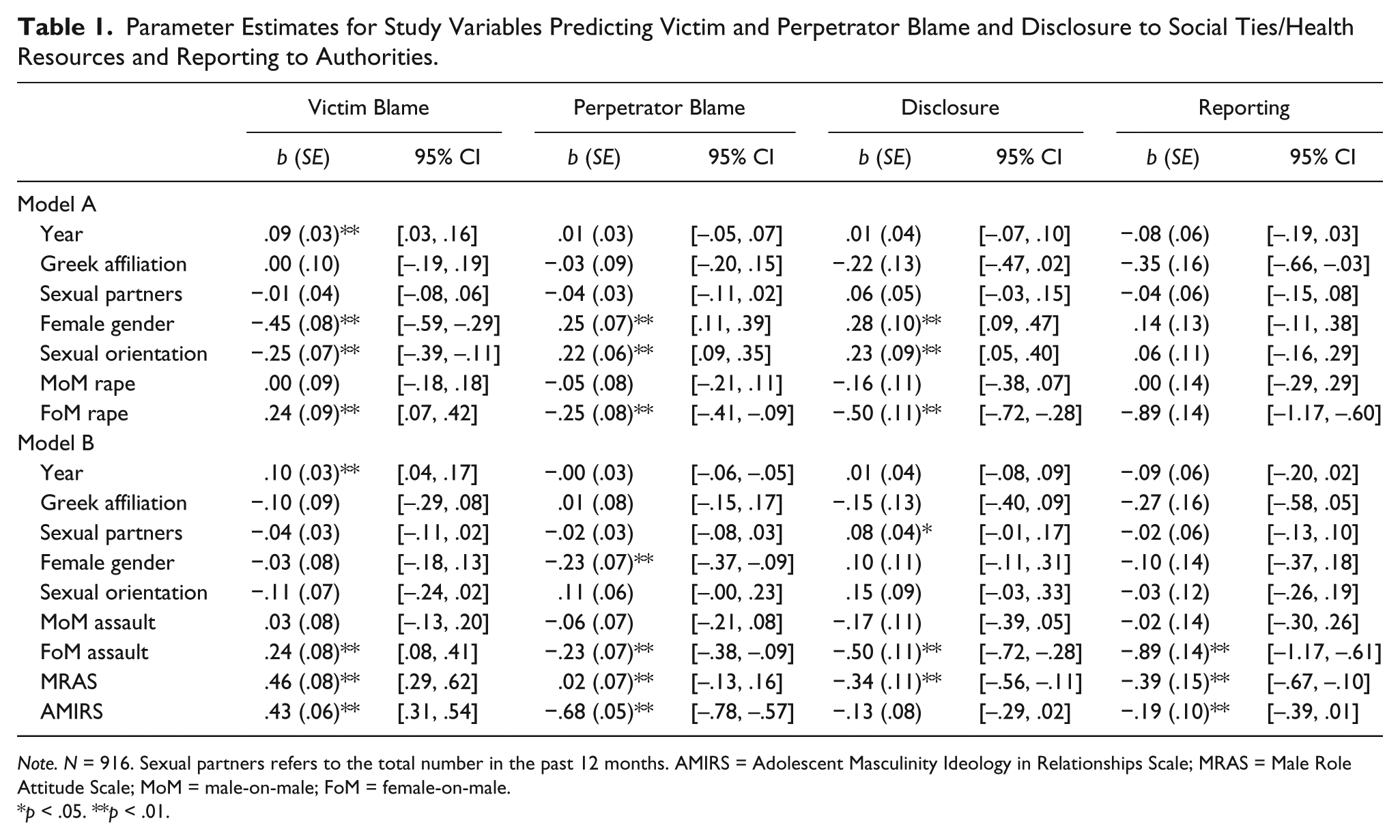
Note. N = 916. Sexual partners refers to the total number in the past 12 months. AMIRS = Adolescent Masculinity Ideology in Relationships Scale; MRAS = Male Role Attitude Scale; MoM = male-on-male; FoM = female-on-male.
p < .05. **p < .01.
Does Masculine Gender Ideology Predict Blame or Disclosure?
We hypothesized that stereotypic masculine gender identification would predict greater victim blame, less perpetrator blame, and a decreased likelihood of disclosure. We also predicted that ascription to these beliefs would at least partially account for the effects of gender and sexuality found previously. As shown in Table 1 (Model B), the MRAS associated significantly with victim blame, whereas the AMIRS did so for perpetrator blame. Higher MRAS scores associated with a decreased likelihood of discussing the event with social ties/health resources and reporting the event to authorities. Addition of these variables accounted for the previously significant effects of gender and sexual orientation across outcomes, but created a significant suppressor effect for gender in predicting perpetrator blame. That is, women were now less likely to blame the perpetrator once accounting for adherence to traditional masculine gender roles. As a set, these variables significantly improved the model, χ2(8) = 263.43, p < .001.
The Direct and Mediating Influences of Victim and Perpetrator Blame on Disclosure
Finally, we evaluated whether attributions of blame uniquely predicted disclosure and reporting decisions, as well as whether these variables served as the intermediary link between these outcomes and the female-on-male rape condition, the MRAS, and the AMIRS. The results supported our hypothesis, but only with respect to perpetrator blame. Specifically, attributions of blame to the victim did not uniquely correspond to the likelihood of disclosure, b = .05 (.05), 95% CI: [–.05, .15], p = .32, or reporting, b = −.10 (.06), 95% CI: [–.23, .02], p = .11. In contrast, as perpetrator blame increased, there was a significant increase in the likelihood that participants would disclose the assault to social ties/health resources, b = .17 (.06), 95% CI: [.06, .28], p = .003, and report to authorities, b = .17 (.07), 95% CI: [.02, .31], p = .023. Moreover, we found small but significant mediated effects of the female-on-male rape condition through perpetrator blame for disclosure, b = −.04 (.02), 95% CI: [–.08, –.01], and reporting, b = −.04 (.02), 95% CI: [–.09, –.004]. However, the effects of female perpetration on outcomes remained significant for both disclosure to social ties, b = −.48 (.11), 95% CI: [–.69, –.26], and reporting to authorities, b = −.83 (.14), 95% CI: [–1.09, –.55], ps < .001, indicating only partial indirect effects through perpetrator blame for both outcomes. Increased perpetrator blame also mediated the AMIRS impact on disclosure, b = −.12 (.04), 95% CI: [–.20, –.04], and reporting, b = −.11 (.05), 95% CI: [–.21, –.02], although the AMIRS had no significant direct effects on either outcomes (see Table 1). As the MRAS only associated significantly with victim blame, mediation through perpetrator blame was not tested. These results together suggest that female-perpetrated rape and stronger adherence to male role ideologies associated with decreased likelihoods of disclosure and reporting, in part, by decreasing the amount of blame attributed to the perpetrator.
Discussion
Our current aim was to disentangle the effects of observer- and assault-level variables on rape disclosure with a focus on gender and sexuality and evaluate whether any observed effects were mediated by blame attributions. Consistent with expectations, our findings indicate that (a) women and those more strongly identifying as nonheterosexual assigned less blame to the victim and more blame to the perpetrator and were more likely to disclose the rape regardless of perpetrator and victim gender; (b) regardless of observer gender, assault vignettes with a female perpetrator and male victim elicited more victim blame, less perpetrator blame, and less likelihood of reporting or disclosing the assault, compared with male-on-female assault vignettes; (c) greater ascription to male gender role ideology predicted blame attributions and likelihood of disclosure and (d) accounted for nearly all of our gender and sexual orientation effects; and (e) greater perpetrator blame predicted unique variance in both disclosure to social contacts/health resources and authorities, which (f) carried part of the effects of the female-to-male violence scenarios and also linked higher endorsement of traditional male role ideology to disclosure.
Several of our results help unpack the effects of gender and sexuality on decisions to disclose or report rape. Consistent with prior studies (e.g., Banyard et al., 2007), men were less likely than women to endorse that they would disclose being sexually assaulted. However, we found this effect to be consistent across conditions, even when men imagined themselves in the role of female victim to a male perpetrator, suggesting that men do not report less simply because male victimization is more stigmatized (Graham, 2006). Similarly, we found that those identifying with a heterosexual only orientation were less inclined to disclose or report, regardless of gender, indicating that sexual minorities may report victimization at higher rates not solely because there is a disproportionately higher frequency of sexual assault in this population (Rothman, Exner, & Baughman, 2011). Rather, our findings suggest that those endorsing a nonheterosexual orientation may be less likely to hold views that impede disclosure and reporting, such as more traditional gender roles or one of its correlates that also links to blame attributions and disclosure decisions (e.g., homophobia; Anderson, 2004). This appeared to be the case presently, as the effects of both gender and sexual orientation were driven largely by relatively stronger adherence to traditional masculine norms by men and heterosexual participants. Traditional masculine norms often serve to decrease blame accorded to perpetrators, which aligns with our mediation effects for the AMIRS on both disclosure to social ties/health resources and reporting to authorities. However, the MRAS has direct effects on decreasing the reported likelihood of disclosure for both outlets, which may be by way of negative attitudes toward help-seeking (Berger, Levant, McMillan, Kelleher, & Sellers, 2005) and/or emphasis on male independence and emotional fortitude (Addis & Mahalik, 2003). It is also notable the MRAS and AMIRS affected outcomes by alternate routes, altogether suggesting that different elements of traditional masculinity may link to rape disclosure and reporting for different reasons. In any case, for victims of sexual assault, stronger adherence to traditional male role ideologies appears to be a barrier to utilizing support from their social networks, accessing medical and psychological services, initiating campus disciplinary procedures that could reduce contact between victim and assailant, and bringing assailants to face legal consequences.
Our results also suggest that female-on-male rape may be underreported not simply because men are less likely to report or disclose a sexual assault. Rather, participants in general were less likely to disclose or report male victimization by a female perpetrator, even after accounting for individual differences in gender, sexuality, and adherence to traditional male role ideologies. This may reflect that participants in this sample generally held negative attitudes toward male victims of female-perpetrated rape or recognized that such disclosures are often met with hostility by third parties (Walker, Archer, & Davies, 2005), who may further lack the requisite training and experience to respond appropriately (Javaid, 2016). It is also possible that participants viewed the consequences of rape as being less for men and, therefore, less worthy of report. However, female-on-male assault influenced disclosure and reporting decisions partially by way of decreased blame toward the female perpetrator. This may be because female perpetration is incompatible with scripts regarding rape, as gender stereotypes often characterize women as having low sexual libidos, being gatekeepers (rather than instigators) for sex, and desiring sex primarily for emotional intimacy (Sakaluk, Todd, Milhausen, Lachowsky, & Undergraduate Research Group in Sexuality, 2014). In any case, these findings overall suggest that male victims of sexual assault likely face additional hurdles to disclosing or reporting when the rape was perpetrated by a woman.
We also found the extent to which individuals perceived the perpetrator as having some unique causal role played into decisions to disclose or report, which contrasts arguments that victim and perpetrator blame are interchangeable judgments (Pollard, 1992). Irrespective of how much participants blamed the victim, decreased perpetrator blame tied to lower likelihoods of disclosure and reporting. This is consistent with the finding that people rationalize or excuse sexual assault perpetration (Coates & Wade, 2004), but further demonstrates that this may somehow factor into an individual’s accounting of whether or not they would be likely to report. Specifically, individuals may take some ownership for being raped but may be likelier to report if they believe that the perpetrator owns some greater share of the overall blame.
These findings should be considered in light of the participants’ general consensus that the scenarios in the vignettes constituted rape. This suggests that their stated likelihoods of disclosure had less to do with a lack of acknowledgement (Cohn et al., 2013) and pertained more to either their own beliefs about rape or assumptions that they held about the perspectives of relevant others. Within that frame, it is notable that the sample means for our disclosure and reporting measures hovered toward the scale’s midpoint, implying some degree of uncertainty or ambivalence surrounding the decision to report, even when the individual has correctly identified the experience as a rape. Our findings also support the notion that disclosure decisions have myriad inputs (Orchowski & Gidycz, 2012), which range in effect size but nonetheless may accumulate and shift this tenuous decisional balance in one or the other direction. Therein, even relatively small influences may account for a substantial number of underreported rapes when played out over large populations of college students.
Several methodological aspects of our study require further discussion. First, the use of hypothetical scenarios allowed us to experimentally parse out the effects of variables that are naturally intertwined, but may not effectively mirror the processes inherent to the situations in the real world. However, this criticism should be tempered by the correspondence between findings derived from vignette methods (e.g., Doherty & Anderson, 2004) and those using other operations that converge on the same pattern of results (e.g., Pino & Meier, 1999
Considered overall, our study identified specific barriers preventing disclosing and reporting sexual victimization, which in turn sheds light on potential targets for sexual assault prevention programs and victim interventions. Federal guidelines and sexual assault researchers already recommend institution-level policies that are easily accessible, centered on victim needs, and clearly written (Graham et al., 2017; McMahon, Wood, Cusano, & Macri, 2019), but our findings reinforce the idea that such policies should not inadvertently lay blame on particular victims or imply that certain types of perpetrators are more likely to be exonerated. More specifically, including definitions of sexual violence that go beyond male-against-female penile–vaginal penetration may reassure other types of victims that their unwanted sexual experiences are serious and worthy of disclosing. It is also notable that, presently, factors shown to transfer blame from perpetrators to victims were only partially mediated by how the participants themselves apportioned responsibility, suggesting that students also weighted in their decision making how other people would likely respond to a reported rape. Thus, disclosure rates may be improved through increased clarity regarding the process and potential outcomes of sexual assault adjudication, which is a factor that significantly contributes to victim satisfaction with the justice system in community samples (Amar, Strout, Simpson, Cardiello, & Beckford, 2014; Laxminarayan, Bosmans, Porter, & Sosa, 2013). It also provides reassurance to victims that their university complies with federal guidelines to avoid questions that might be used to blame victims or exonerate perpetrators (e.g., what the victim was wearing) during the adjudication process (White House Task Force to Protect Students from Sexual Assault, 2017). It is also worth discussing that attitudes that depress reporting are embedded and reinforced within universities and the larger context of society. Factors such as individuals’ perception of peer norms regarding blame attributions and sexual aggression perpetration are an important part of the larger ecological systems wherein campus sexual assault is unfortunately so prevalent (Banyard, 2013; McMahon et al., 2019; Moylan & Javorka, 2020). In line with other researchers calling for intervention efforts aimed at broader environmental level change (Casey & Lindhorst, 2009), we believe that efforts targeting faculty, peers, parents, and the community are likely to have better outcomes than interventions focusing on only one of these groups. Interventions targeting students before they begin college may be an important facet of sexual assault prevention.
Our study also highlights the particular importance of addressing gender role ideology both independently and alongside blame attributions in assault scenarios. Rigid adherence to traditional male role ideology has long been identified as a predictor of destructive behaviors, including perpetration of physical assault, sexual assault, and relationship violence (Hong, 2000; Kimmel & Mahler, 2003; Moore & Stuart, 2005; Santana et al., 2006); however, our study further suggests a relation between these ideologies and maladaptive attributional and behavioral responses following sexual victimization. Traditional male role ideology thus appears harmful not only to those individuals who are more likely to be victimized at the hands of those who endorse it but also when those who endorse it are themselves victimized. Unfortunately, interventions directly targeting traditional gender roles face many challenges. Although gender role attitudes and blame attributions have previously been a target of sexual assault prevention programs, these efforts have had limited results (Gray, Hassija, & Steinmetz, 2016). Moreover, interventions aimed at reducing gendered violence with an explicitly feminist agenda can be derailed by participants’ adherence to hegemonic male gender roles and facilitators’ deference to such ideologies (Schrock & Padavic, 2007). Nevertheless, the importance of confronting masculine role ideology in sexual assault prevention curricula should be emphasized across the board, as these beliefs also have been linked to lower willingness to intervene in bystander emergency situations (Tice & Baumeister, 1985). These findings altogether suggest that attempts to prevent sexual assault or ameliorate its negative sequelae will be of limited efficacy to the extent that hypermasculine beliefs continue to be inadequately addressed. However, future research is needed to ascertain which forms of intervention may be most effective in evolving these ideologies in ways that attenuate their association with sexual violence perpetration and disclosure.
Footnotes
Acknowledgements
A special thanks to undergraduate research assistants in Binghamton University’s Sex Lab.
Declaration of Conflicting Interests
The author(s) declared no potential conflicts of interest with respect to the research, authorship, and/or publication of this article.
Funding
The author(s) received no financial support for the research, authorship, and/or publication of this article.