



Abstract
Intimate partner violence (IPV) refers to harmful acts occurring among members of an intimate relationship. Many studies have explored individuals’ experiences of IPV as well as its consequences; however, so far, few studies have explored the lives of IPV victim-survivors after escaping from the violent relationship and the experiences of building new intimate relationships. Thus, the purpose of this study was to understand the young female adults’ experience of building a new intimate relationship after ending their abusive relationship. This study used a qualitative phenomenological design to understand the women’s lived experiences in their own voices, as suggested by Giorgi. In total, 13 young female adults in South Korea were recruited and interviewed. All interviews were audio-recorded and transcribed. Drawing on the interview data, we constructed the structure of their experiences through identifying five themes: (I) having difficulty in meeting new people, (II) starting to build a new relationship based on trauma, (III) struggling to escape the boundaries of the abuser, (IV) learning about healthy intimate relationships, and (V) something’s wrong again. The findings were meaningful in that they showed how victim-survivors clearly needed care and support even after they escaped from their abusive relationships and began new ones. In addition, we found that some of them entered into another abusive relationship with their new partners. Finally, this study informs researchers and health professionals across the world about the experiences of IPV victims within specific cultural background. We hope that the findings of this study will contribute to building various interventions and programs for victim-survivors of IPV.
Introduction
Intimate partner violence (IPV) is a serious type of interpersonal violence that occurs among members of an intimate relationship. It can include physical, psychological, and sexual violence and is regarded as an ongoing and highly prevalent problem that occurs regardless of gender, age, and nationality. For instance, in the United States, about 83% of female college students have reported experiencing some form of psychological violence from partners, while 32.4% have reported experiencing physical violence (Fass, Benson, & Leggett, 2008). Among male college students in the same study, 86.5% and 41.9% had experienced psychological and physical violence, respectively (Fass et al., 2008). Moreover, IPV often has devastating consequences for victims, such as physical injuries, posttraumatic stress disorder (PTSD), externalizing and internalizing disorders, substance abuse, suicidal ideation, and even death (Ely, Nugent, Cerel, & Vimbba, 2011; Kamimura, Nourian, Assasnik, & Franchek-Roa, 2016; Peltzer, Pengpid, McFarlane, & Banyini, 2013; Reidy et al., 2016; Swahn, Bossarte, & Sullivent, 2008).
As in other countries, the rates of IPV and its sequelae in South Korea are a serious problem. According to recent data, about 12.5% and 50.8% of female college students reported a history of physical and sexual partner violence, respectively (H. N. Park & Jang, 2012), and about 25.4% of married women in South Korea reported experiencing any form of IPV (G. R. Park, Park, Jun, & Kim, 2017).
When thinking about gender power issues in South Korea, gender inequality (with men having dominance over women) and a patriarchal social system have long existed in Korean society due to strong influence of Confucianism (Kim, 2001). Confucianism, which originates in traditional Chinese culture, describes a set of moral and philosophical values required of members of society. These values have spread to numerous Asian countries, such as Japan, Taiwan, and South Korea (Gao et al., 2012). A key aspect of Confucianism is the importance of family and country, with a particular emphasis along patriarchal lines. According to Confucian thought, women are required to care for family members and are considered to belong to the head of the family, who is always a man—usually, their father before marriage and their husband or son after marriage (Park & Schepp, 2015). Furthermore, women are required to remain married to one man their lives; therefore, they are often unable to leave their husband once married (Kim, 2001). Although women’s social status has much improved compared to in the past, in part due to the influence of Western culture and increased women’s education level, the traditionally patriarchal gender-related thoughts and values, including gender-role beliefs and gender stereotypes, are considered to remain embedded in Korean society.
Because of this cultural background, it has long been considered rude to intervene in others’ intimate relationships, even when they are abusive (Rye, 2014). Therefore, despite the high prevalence of IPV, there is still a lack of adequate legal protection for the victims of IPV as well as a lack of IPV prevention programs in South Korea (Gover, Park, Tomsich, & Jennings, 2011; H. Lee & Jeong, 1999; Rye, 2014). While there is much research on IPV worldwide, IPV issues in South Koreans, a minority population, have been relatively neglected. There have been several studies conducted in South Korea exploring dating violence (DV) and IPV issues, but the majority of those studies have been quantitative, mainly focusing on the predictive or protective factors for DV or IPV—for example, childhood adversity and adverse parenting (Suh, 2004; Suh, Choi, & Kim, 2007) as predictive factors, and alcohol intake (M. Lee, Stefani, & Park, 2014), female education, and social support (S. Lee & Lee, 2018) as protective factors. In addition, several qualitative studies exist, which have mainly explored the experiences of DV in female South Koreans (K. Park & You, 2017; Woo, Jang, & Kwon, 2017). Specifically, K. Park and You (2017) explored the psychological adaptation process in Korean female victims of DV. Woo et al. (2017), on the contrary, described general DV experiences in female victims in South Korea.
However, when considering the fact that South Korea is still a relatively sexually conservative society, where men have (or are expected to have) power over the relationship due to the vestiges of traditional Confucian thoughts and values, victim-survivors of IPV might have greater difficulty or unusual experiences not only in their violent romantic relationships but also after escaping from these relationships. Nonetheless, none of the studies, to our knowledge, explored what victim-survivors in South Korea experienced after they left their abusive partners.
This article focused on female IPV victim-survivors in the Korean cultural context. The purpose of this phenomenological study was to understand the experience of building new intimate relationships in Korean female young adults whose abusive intimate relationships had just ended. Specifically, we tried to understand IPV victim-survivors’ overall experiences of building new intimate relationships in South Korea, including how they feel and behave after ending their previous abusive relationships, how they find and adapt to the new relationships, and what types of help they need in this process.
Method
This study was a secondary aim of a larger project examining the overall experiences of Korean IPV victims. The larger project included data from 25 IPV victim-survivors (14 women and 11 men) in South Korea. This study used a qualitative phenomenological design to understand a given phenomenon—namely, young women’s lived experiences—in their own voices (Giorgi, 1997).
Study Participants
The target population for this study was Korean female young adults who had experienced IPV. The specific inclusion criteria were (a) being Korean and female, (b) having experienced IPV, (c) being aged 19 to 34, (d) being unmarried and not having children, and (e) agreeing to participate in this study. We targeted only females because we thought the experiences of males and females would be different due to social and cultural factors. Moreover, only unmarried women without children were recruited because the focus of this study was couple relationships and their dynamics. According to Korean literature, both marriage and children are major factors influencing subsequent couple relationships in South Korea (Kang, 1995; Kim, 2001).
Study participants were recruited from two universities and online by using flyers. The flyers included examples of violent behaviors by referring to several items from the Korean version of the Conflict Tactics Scale 2 (CTS2; Choi, 2005; Straus, 1979). A total of nine behaviors were described on the flyers: “consistently insulting and blaming,” “consistently ordering you to do something,” “checking your personal call and text histories,” “consistently degrading you sexually,” “hitting or threatening to hit you,” “swearing,” “forcing you to have sex,” “restricting your freedom and excessively surveilling you,” and “repeatedly performing the above behaviors and apologizing for coming back to you.” We encouraged individuals to participate if they had experienced any of the above behaviors.
A total of 25 young adults (11 males and 14 females) were recruited for the larger project; however, we used the interview data of only 13 female participants. This was because one of the 14 female participants refused to give her thoughts about new intimate relationships she might have in the future, as she was still in an IPV relationship and did not want to leave it. The remaining 13 female participants had all just completed their IPV relationships. Seven of them had already begun a new intimate relationship, whereas three had not had a relationship since their abusive one ended. The remaining three had broken up with their new boyfriends. Specific information about the participants is listed in Table 1. Regarding the types of IPV in Table 1, physical violence is defined as any nonaccidental harmful behavior resulting in physical injury or pain, such as hitting, punching, or slapping. Psychological violence involves stalking, threatening, blaming, degrading, and surveilling, while sexual violence involves sexual harassment, rape, and sexual coercion (coercing someone to have sex when they do not want to).
Characteristics of the Study Participants.
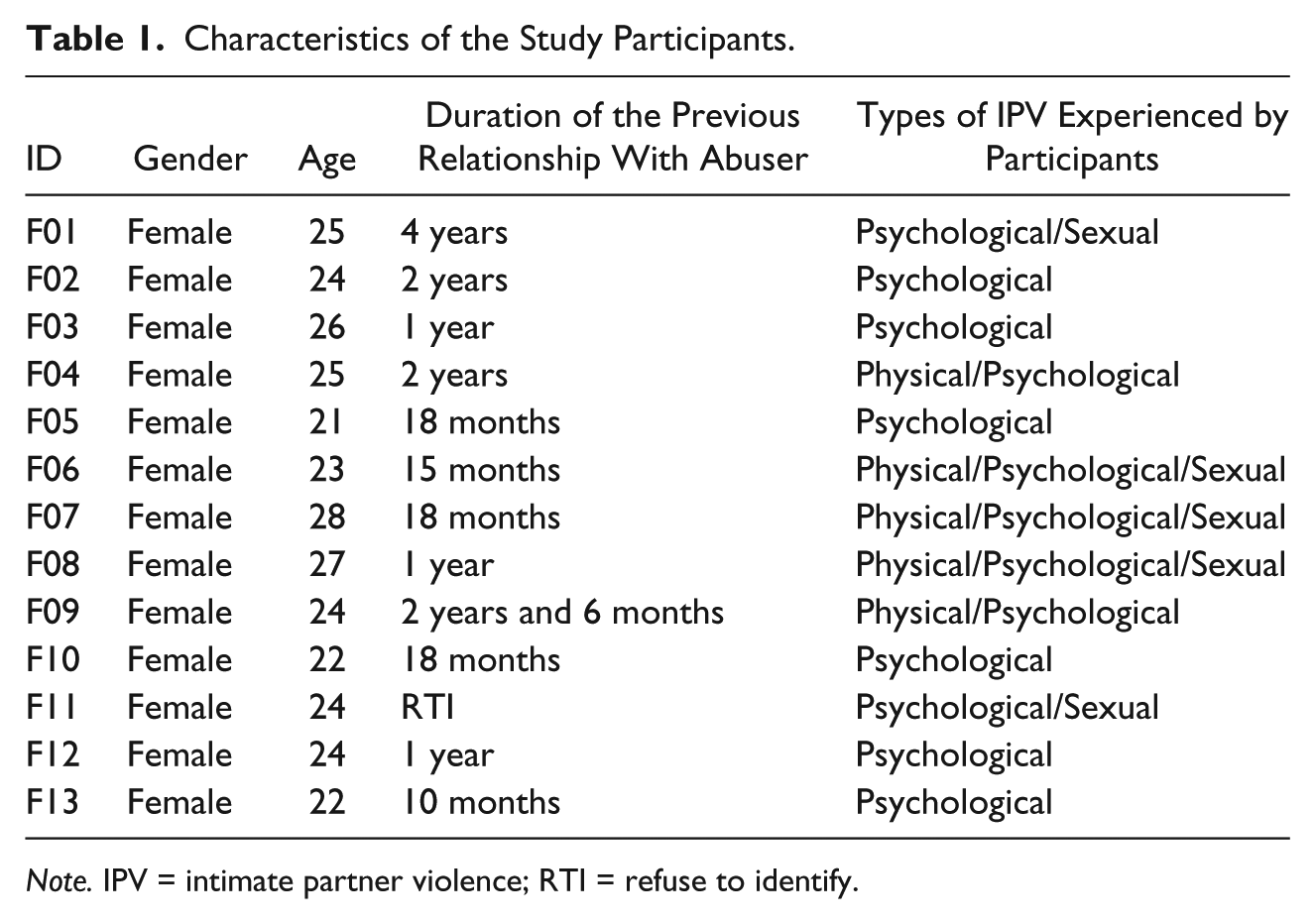
Note. IPV = intimate partner violence; RTI = refuse to identify.
Ethical Consideration
Ethical approval was granted by the institutional review board of Inha University prior to recruitment of the study participants. Participants were asked to read and sign an informed consent form. In this form, we included information on how victims can get help, such as the locations of psychological treatment centers and shelters and police hotline numbers that they can call for help in an emergency. In the “Results” section of this study, we do not add any information (e.g., participants’ ID) after the quotations to ensure their safety.
Data Collection
Data collection was performed using semi-structured, in-depth interviews. The researcher asked participants to choose either face-to-face interviews or phone interviews based on their preference and recommended phone interviews if they did not want to show their faces. The interviews took about 1 to 2 hr for each participant. The researcher began each interview by asking an opening question, “What inspired you to participate in this study?” The interview was then continued by asking them to respond to main guiding questions. The guiding questions focused on exploring their IPV experiences, the process of escaping from the IPV relationship, experiences after the IPV relationship had ended, and experiences of their new intimate relationships: (1) “Please share your experience of IPV,” (2) “Please tell me about your experiences of seeking help,” (3) “What was your life like after completing the IPV relationship?” and (4) “If you are in a new intimate relationship, please tell me about it (or, if not, what do you perceive your next intimate relationship to be like?).” In addition, follow-up questions were freely asked to deepen and clarify our understanding of their experiences. All interviews were audio-recorded and transcribed verbatim. For this study, we analyzed only the answers to Questions 3 and 4.
Data Analysis
The data were analyzed using the phenomenological method described by Giorgi (1997), which consists of four phases: (a) acquire a sense of the whole, (b) discriminate meaning units from a psychological perspective, (c) translate each unit into psychological language, and (d) synthesize the translated meaning units into an essential structure of experience. For the first step, all interview transcripts were read multiple times in full to obtain a sense of the whole text. In the second step, the authors returned to the beginning of the transcripts and identified meaning units by breaking down the sentences according to shifts or changes in meaning. Then, in the third step, each meaning unit, which was expressed in participants’ everyday language, was translated into psychological description and delineated based on the essence of participants’ experiences. More specifically, the authors used imaginative variation to determine the essence of phenomenological meaning of participants’ experiences. Finally, the transformed meaning units were synthesized by identifying the essential structures of the experience of IPV victim-survivors in building new intimate relationships.
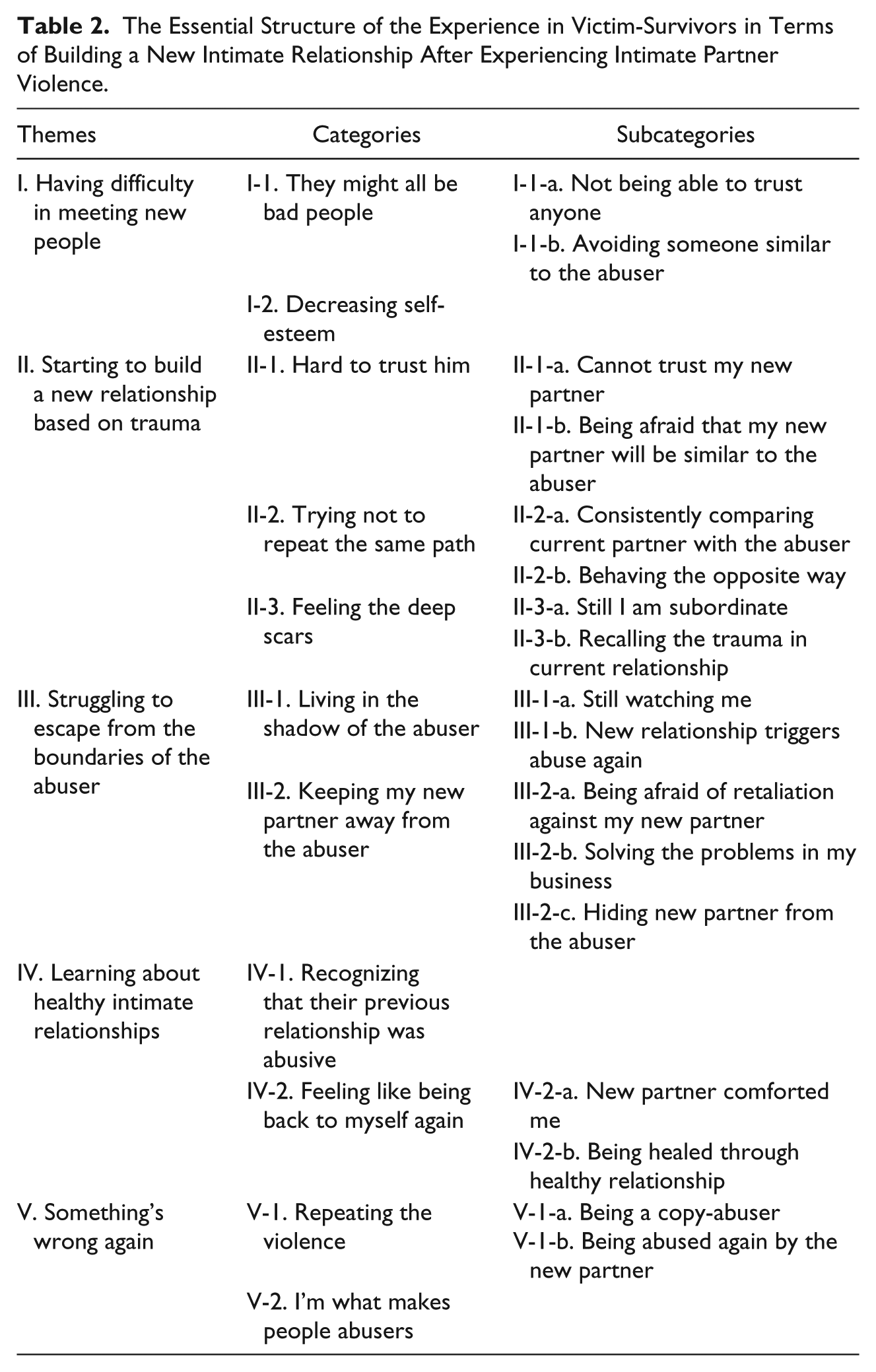
To strengthen the validity of our analysis, two authors of this study conducted these steps individually and discussed their results at the end of Steps 1, 3, and 4. Any disagreements were discussed until a consensus was reached. In addition, one PhD candidate in Nursing, who had a bachelor’s degree in nursing and a master’s degree in psychology, reviewed the entire coding process by cross-checking with the interview transcripts. In total, five themes were constructed to reflect the essential structure of the experience of building new intimate relationships in Korean IPV victim-survivors. The whole structure of their experience is shown in Table 2. To describe their experiences vividly, the names of the categories and subcategories were labeled by emics—namely, the exact words expressed by the interview participants. In addition, the coding structures and interview quotes were translated from Korean to English through several discussions between the corresponding author of this study and a bilingual expert in English translation.
The Essential Structure of the Experience in Victim-Survivors in Terms of Building a New Intimate Relationship After Experiencing Intimate Partner Violence.
Results
Thirteen participants of this study described their experiences of building new intimate relationships after their abusive relationship ended. Using their own voices, we revealed the structure of their experiences by identifying five themes: (I) having difficulty in meeting new people, (II) starting to build a new relationship based on the trauma, (III) struggling to escape from the boundaries of the abuser, (IV) learning about healthy intimate relationships, and (V) something’s wrong again. To aid reader comprehension, we have referred to the previous abusive boyfriends as “abusers,” and the new boyfriends (who participants met after their IPV relationship ended) are referred to as “new partners.”
Theme I: Having Difficulty in Meeting New People
After ending their relationship with the abusers, participants had a hard time meeting new people.
They might all be bad people
All participants reported that abusers had initially seemed like nice, gentle people. However, at some point, the abusers revealed their true nature. As a result, participants had difficulty trusting anyone. They said that they feared meeting new people, who might also have two different faces but hide the cruel one: I think I might not meet any person. He [the abuser] had a very good image to people. He showed me a good image at first, but I saw his real face eventually when meeting him. Actually, I am scared to meet people for that reason. Maybe this new person [the new partner] will ultimately show his real face. Unintentionally, I was thinking that maybe this guy [the new partner] would be similar to him [the abuser], you know, maybe every guy would be the same.
Participants avoided any person who showed the slightest resemblance to their abusers. This tendency was even more peremptory in some participants. They looked for characteristics that were the exact opposite of those of their abusers in terms of personality, appearance, and even family environment: [I came to know that] the family environment is really important. The abused child becomes an obsessive person in order to be loved, like him [the abuser]. So, now I consider one’s family environment, and whether he is obsessive to me or not. When my friend offered to set me up on a blind date, I first asked “Will he also force me to have that kind of relationship [a sexual relationship]?” If the friend said, “No, he will not. He really respects his girlfriends” . . . then, I would try to meet that guy.
Decreasing self-esteem
Participants reported experiencing a steep decline in self-esteem while they were in a relationship with their abusers. This was another reason that they found it difficult to meet with people. In other words, they explained that they could not meet anyone due to their low self-esteem. They were often blamed by and felt the need to obey their abusers, which made them feel small and withdraw into themselves. Although their abusive relationships had ended, they continued to fear blame from anyone and became suspicious when someone showed positive feelings toward them: There was someone who really liked me, but I could not believe him. [I thought,] “What does he want from me?” I lost all my self-esteem and I am depressed. I cannot meet new people . . . Even if I start to meet somebody, I will be afraid that I will have to endure all of his violence.
Theme II: Starting to Build a New Relationship Based on the Trauma
Many of participants began building new intimate relationships. They confessed that they wanted to have someone they could rely on. However, their new intimate relationships were highly influenced by their previous abusive relationship.
Hard to trust him
Even after they started going out with their new partners, participants could not fully trust them. They felt nervous about whether their new partners would finally reveal their real characters, which might be cruel, violent, or obsessive. They consistently regarded their new partners with suspicion and tried to find any resemblance to their abusers. Some participants concealed their information, such as the location of their houses and workplaces, from their new partners: I did not tell him [the new partner] where my workplace was located. Even though he wanted to drive me home, I only allowed him to come near my village and then sent him back. I thought it would be safer to not disclose the locations of my workplace and home. I’m thinking “maybe he [the new partner] will also become abusive when he gets angry.”
Trying not to repeat the same path
Participants struggled not to repeat the abusive and violent relationship. Nonetheless, some of them felt that they were building their new relationship on a weak foundation, rather than a strong one. Participants could not see their new partners the way they were, only getting to know them by consistently comparing them with the abuser. In fact, their criterion for judging whether a person was good or bad became whether that person was similar to the abuser or not. They also mentioned that they were not able to open their minds to their new partners until they confirmed that he was not like the abuser: Maybe he [the new partner] could rape me if he wanted, but he didn’t. He didn’t even do it [touch me]. He respected me. So I opened my mind to him. Meanwhile, I was thinking he might have a plan [to rape me], because he was also a man . . . But he didn’t.
Some of them asked new partners to behave in ways that were the direct opposite of their abusers and tried to behave differently from when they were in the abusive relationship to avoid repeating their abusive experiences: I decided to meet him [the new partner], because he was not a person obsessing about me. If he was an obsessive person, maybe something would happen later [like he would become dangerous again] . . . I actually asked him to put his friends before me. Now I tried to say things directly, like “what you [the new partner] said when you were drunk made me uncomfortable.” Before [in the previous relationship], I couldn’t [say what I felt directly].
Feeling the deep scars
Despite their efforts, participants unconsciously experienced flashbacks in their current relationship, and were aware that they had deep psychological scars. They said that they unconsciously recalled memories from their abusive relationships whenever there were in similar situations or experienced conflict with their new partner: When he [the new partner] goes out drinking [with his friends], I become too anxious. Unconsciously, I recall my previous memories, especially when we start to argue and his voice goes up.
Moreover, many of them were surprised with themselves, as they still behaved like the subordinate in the relationship. One of the participants said that she shocked herself by unreservedly apologizing to her new partner (as she had done to the abuser) whenever they fought. Another participant said that she felt strange when her new partner did not get angry when they fought: We don’t argue a lot. But when we argue, I say “I’m sorry, I’m sorry,” even though I didn’t do anything wrong. But I felt like I’ve messed up everything and I feel sorry. Tears continue to flow. Because I had adjusted to my previous [violent] situation, I was curious as to why he [the new partner] did not become abusive [even though we argued].
Theme III: Struggling to Escape From the Boundaries of the Abuser
Living in the shadow of the abuser
Participants felt that they were still watched by their abusers even after the abusive relationship had ended. In fact, many knew that their abusers were still watching them and investigating them through social networking services or mutual friends, which made them feel extreme fear, anxiety, and anger toward these abusers: When he [the abuser] felt that I might have a new boyfriend, he always called me and asked “Who is that guy?”
Unfortunately, in many cases, participants’ new intimate relationships triggered violence from their abusers again. The abusers, on learning of the participants’ new intimate relationships, became obviously obsessive and violent. They blamed, threatened, stalked, attacked, and even tried to rape survivors: After about a month [after breaking up with abuser], I started to meet with the new guy. He [the abuser] suddenly called me and began obsessing over me again. [When he learned I had a new boyfriend], he [the abuser] started to blame me, [and said] “Why are you meeting with a new guy?” He threatened to tell him [the new partner] about all my personal things [her previous sexual relationships] and tell him that I am such a bad 000 [curse]. [He said to me,] “Unless you run to me in 5 minutes!” But it would have taken me at least ten minutes to get there. [When the abuser learned I had a new boyfriend,] I got over 60 missed calls and hundreds of messages. He sent me his last will, and slit his wrists . . . The only thing he wanted from me was to get together again. [When he learned I had a new boyfriend,] he [the abuser] ordered me to die. He said it would be very funny if I died and my new boyfriend felt sad about it. Then he slapped me while holding my hair.
Keeping my new partner away from the abuser
Participants’ new partners became another target of abusers. When that happened, participants had to confide in new partners about their victimization history and warn them that they could also be attacked: (I told him the [new partner] that) “I met someone before, . . . and you could be attacked, too.”
Participants acted in a way to protect their new partners from the abusers rather than relying on or cooperating with the new partners to get through the situation. Indeed, all participants whose abusers reappeared in their lives refused to get help from their new partners and hid the partners from the abusers. This was because, according to the participants, they did not want to trigger violence from the abusers and were afraid of disclosing their previous sexual relationships to their new partners: He [the new partner] asked me whether I needed his help. But I refused it because his intervention would trigger him [the abuser] and make the situation much more dangerous . . . I rather asked help from my female colleagues [because female friends would not trigger the abuser].
Theme IV: Learning About Healthy Intimate Relationships
Fortunately, some participants were able to build healthy intimate relationships with their new partners. Through these relationships, they were able to relax and become comfortable, and learned about healthy relationships.
Recognizing that their previous relationship was abusive
Participants mentioned that they learned what a healthy intimate relationship looks like through their new intimate relationships. One of them said that she learned how important trust is in romantic relationships: When two persons meet, trust seems to be the most important thing. Without it, there would be obsession and confinement in the relationship.
At the same time, they realized that their previous relationship had been abnormal. They became aware that they were victims in that relationship and formed a more objective view about their previous relationship. They admitted that they had suffered under the abuser’s violence: Before, I thought the obsessive and restraining behaviors were intimate behaviors, but now I know that that is not love but control . . . Through this current relationship, I learned about normal intimate relationships. If I go back, I think I could not do it again. Before, I always took pictures and sent these to him to prove where I was and what I was doing, but now I don’t think that I could do it again. Because now I know it was wrong.
Feeling like being back to myself again
Participants who experienced healthy relationships felt that the thoughts, attitudes, and behaviors that they had formed when they were victims were gradually disappearing, and they were returning to their original selves, whom they viewed as confident and energetic. The new partners played a large role in this regard. According to the participants, the new partners understood what the participants had previously experienced and waited until they opened their minds to get close. Furthermore, many of their partners were extremely careful to avoid triggering participants’ trauma and were very gentle with them: I realize that I am gradually back to being me again, after meeting my new boyfriend. My current boyfriend suggested that I go to a psychiatrist [to heal my trauma]. He [the new partner] was surprised about what I’d experienced. He treated me very carefully. He is not obsessing over me, and trusts me even though I don’t call him.
Theme V: Something’s Wrong Again
Unfortunately, other participants experienced IPV again in their new relationship. Interestingly, however, the participants assumed the role of either victim or perpetrator.
Repeating the violence
Some participants confessed becoming abusers themselves—that is, they exhibited similar behavior as their abusers toward their new partners. They surveilled and interfered with their new partners’ lives, and became obsessively overdependent on those partners. One of the participants said that she felt shocked about her behaviors and tried to stop, but found that she could not: I was totally shocked. I had suffered from his [the abuser’s] obsessions and restrictions, but I was doing the same thing to my new boyfriend! I felt so sorry . . . I tried not to do it, but I couldn’t stop it.
There were other participants who were victimized by their new partners as well. They said that they felt a deep sense of frustration, shame, and anger due to the repeated victimization: When we argue, he [the new partner] starts to mention the previous one [abuser], [and says] “Are you guys still meeting?” Guy A [she named the abuser A and new partner B during the interview] is somehow a taboo subject in my life. But B consistently reminded me of my trauma and asked, “Did you do the same thing with him?” [This survivor’s new partner knew about her previous sexual victimization. He had not asked her to have a sexual relationship, but when she asked him to break up], he suddenly touched my body and tried to rape me. I said “What are you doing?” I experienced a miserable feeling already, you know . . . His face looked really pissed off and seemed to say “What’s so special about you? Why won’t you have it with me even once?” [i.e., not having sex with him].
I’m what makes people abusers
Participants who had experienced repeated partner violence expressed extremely negative feelings, including anxiety, frustration, anger, and guilt. Guilt was a particularly strong feeling, and they began to think that maybe they were at fault—namely, that they made people abusers: The reason I think that I am the one with the problem is that the previous one [the abuser] was also very abusive and threated to slit his wrists. So, I am confused about whether I have a tendency to meet people with those characteristics or if I am the one who makes the partners abusive. All the relationships I had ended like this. It may be because I chose the wrong guys, but also because I made guys like this.
Those participants seemed devastated by their consecutive victimizations and expressed extreme anxiety about their next romantic relationship: Do you [researcher] think that it will be a good idea for me if I get some counseling? Would it be OK for me to meet someone again? What should I do if a similar thing happens again?
Discussion
Recently, in South Korea, IPV seems to be becoming an increasingly serious social problem. This is perhaps because IPV has long existed in South Korea but is increasingly being recognized by the public as a social problem. Simultaneously, people are becoming aware that there is little policy in place for saving and supporting victims. Some feministic private organizations and the Korean government have begun several social campaigns; however, most focus on disclosing females’ sexual victimization (so-called Me Too), warning perpetrators to stop their violent behaviors or encouraging victims to leave relationships by helping them to recognize the violence they are experiencing (Meresca, 2018). However, through this study, we wanted to show that ending the relationship does not end the problem. In addition, we wanted to explore what victim-survivors actually needed by understanding what they experienced after leaving the abusive relationship. Therefore, in the current study, we interviewed 13 women whose IPV relationships had just ended and revealed the structure of their experiences of building new relationships in five themes.
The findings of this study showed that participants tended to suffer from symptoms of trauma incurred from their previous relationships even after they had met somebody new, as we expected. These individuals were often exposed to cues and situations in their new intimate relationships that provoked the recall of negative memories from the previous relationship, which could lead to prolonged distress. Particularly, participants struggled to deal with the negative feelings and emotions of their new partners. Although for some the new relationship was not abusive, they often experienced extreme fear and anxiety when faced with a partner’s negative emotion (e.g., anger). J. H. Lee and Lee (2014), in their experiment, found that IPV victim-survivors experienced an attentional bias—that is, IPV victim-survivors showed longer dwell times on faces with negative emotions (e.g., angry or fearful faces), which was attributed to their greater exposure to such emotions during the abusive relationship.
Participants showed various coping behaviors. They often avoided anything that reminded them of their abusers—for instance, they avoided any person with similar characteristics, appearances, or even family environments. They also ruminated on memories of their abusers and refused to disclose their own personal information to their new partners, including the locations of their workplace and home. However, none of these behaviors had a positive effect on the formation of new healthy relationships, and participants often suffered from such behaviors. Ehlers and Clark (2000), who created a cognitive model of PTSD, considered these behaviors as the maladaptive cognitive strategies to overcome distress due to trauma. They argued that these strategies might in fact trigger symptoms of trauma and inhibit changes in negative appraisals about the trauma and its consequences. They instead suggested that health professionals could help them by elaborating their traumatic memories, modifying problematic appraisals, and breaking their dysfunctional behavioral and cognitive coping strategies.
In addition, we confirmed that the threat posed by some abusers often lasted long after the relationship ended: Abusers were often obsessed, constantly surveilling victims and feeling physically and emotionally attached to them. In fact, in some cases, the postrelationship period was even more dangerous for the victim-survivor. Thus, perhaps, the feeling of threat that arises in connection with victim-survivors’ trauma may not be due solely to the nature of the trauma-related memory but also due to the ongoing threat of real violence.
Some researchers put forth the concept of coercive control to explain the reason that some perpetrators cannot leave victims or stop abusing them. Dutton and Goodman (2005) suggested the model of coercion in IPV relationships, according to which violence is merely a tool for abusers to control the victims. In other words, abusers engage in abusive behaviors (i.e., isolating, surveilling, threatening, raping, and battering the victims) to achieve their real goal—to control and possess the victims. For this reason, violence often becomes more frequent and severe over time, and any perceived failures to control the victim triggers even more frequent and severe violence toward the victims (Verschuere, van Horn, & Buitelaar, 2018). Accordingly, the period after escaping from the abuser and building a new relationship can be considered one of the most dangerous periods for victims. Based on these findings, health professionals should avoid trying to limit their roles in caring for the physical and mental conditions of victims when they first meet them in hospital or community settings. Indeed, it is essential that health professionals confirm victims’ safety and assess the possible risk of incidents.
Unfortunately, most health professionals in South Korea do not seem ready for this. Yoo, Cha, Cho, and Lee (2012) reported that 91.6% of Korean nurses in their survey had experience with physically victimized patients and 76% of nurses had experience in caring for victims of sexual assault; however, 68.9% of nurses reported that they did not know what to do when they met these victim-survivors because they had not learned about it in their nursing educational curriculum. Hence, forensic education may be necessary for health professionals to ensure victim-survivors’ safety as well as provide adequate care.
Interestingly, in this study, several victim-survivors themselves engaged in violence in their new relationships. In other words, they imitated the violent behaviors of the abusers and directed the behaviors at their new partners. On the contrary, several victim-survivors experienced victimization from their new partners. This is consistent with the results of a recent study (Park & Kim, 2019) asserting that victims of violence often have a greater likelihood of experiencing future violence, either as victims or as perpetrators; thus, previous victimization experiences can play an important role in the cycle of violence.
Park and Kim (2019) suggested two explanations for this phenomenon of the victim becoming the perpetrator: (a) aggressive or abusive attitudes, beliefs, and behaviors could be adopted by abused partners (Sellers, Cochran, & Branch, 2005), or (b) the victim-survivor is attempting to escape from the victim’s role, causing them to show more aggressive attitudes or behaviors toward others (Jang, 2013). Indeed, when we asked the victim-survivors the reason for imitating the abusive behaviors, all reported that they could not stop even if they tried. Some of them were shocked that they followed their abuser’s behaviors and that their partners had experienced the same feelings that they had before. In addition, the victims reported behaving in the opposite way from their previous relationship to avoid experiencing violence again. While they did not say that they became aggressive to avoid the victim role, it was still clear that their behaviors were influenced by their efforts to avoid being victimized again. Accordingly, both explanations suggested by Park and Kim (2019) might be reasonable for explaining why some victims become perpetrators in IPV relationships.
On the contrary, other victim-survivors again experienced IPV perpetrated by their new partners. Indeed, many previous studies have demonstrated that IPV victims are often exposed to violence in childhood. Lewis and Fremouw (2001) reviewed previous literature on DV victims’ shared characteristics and reported that experience of child abuse, witnessing interfamilial violence, and parental divorce were risk markers of subsequent victimization. Another study (Park & Kim, 2018) reported that “witnessing IPV between the parents” was the strongest predictor of IPV victimization, followed by bullying experiences. We might thus interpret the phenomenon of repetitive victimization using social and role learning perspectives; however, further studies are needed to clarify and confirm whether such perspectives are apt.
Often, repetitive victimization is called polyvictimization or multiple victimization (Sabina & Straus, 2008). According to one recent study (Cyr et al., 2017), 81% of adolescents in Quebec were victimized in their lifetime, and about 82% of these individuals experienced more than one form of victimization. Worse still, polyvictimization has severe consequences. Sabina and Straus (2008) reported that polyvictimization has a significant influence on depressive symptoms in college women as well as PTSD in both males and females. In addition, according to Eshelman and Levendosky (2012), victims exposed to multiple forms of violence experience more severe mental health symptoms, and those exposed to more frequent forms of violence tend to experience more mental health symptoms and physical injuries. As quantitatively explored in past studies, the current study presented victim-survivors’ experiences of polyvictimization in their own voices. They all felt extreme guilt about their consecutive victimizations, blaming themselves for making their partners abusive. They also showed even worse anxiety when meeting new people.
Finally, there are some cultural aspects of our results. Specifically, South Korea remains a sexually conservative society, which seemed to serve as a means for abusers to manipulate and control the victims. In other words, several participants reported that when their abusers returned, they threatened to expose their premarital sexual relationships. Thus, victim-survivors were afraid of not only abusers’ violence and threats but also their disclosure of victim-survivors’ previous sexual relationships. For this reason, the victims tried to resolve the matter by themselves, refusing to ask others for help (including their new partners and families). Shen (2011), who conducted a qualitative study of 10 Taiwanese female DV victims, also found that victims experienced feelings of shame. Considering that Confucianism has also influenced Taiwan, it seems that IPV female victims living in Confucian societies might have similar feelings and experiences as IPV victims. Shen (2011) explained that the sexually conservative culture of Taiwan caused battered women who had had premarital sex with their abusive partners to feel pressured to keep their previous sexual relationships a secret, which in turn caused them to avoid seeking help.
A limitation of this study relates to the limited generalizability of the findings, as the data were collected only from Korean females. Furthermore, memory bias might have influenced the results because of the retrospective design used to collect the data. Nonetheless, this study has several implications. First, the findings confirmed several phenomena usually examined in quantitative studies, such as polyvictimization, repetition of violence, and the mental health consequences of IPV among victim-survivors. Moreover, this study can inform researchers and health professionals throughout South Korea of the experiences of female Korean IPV victims.
Conclusion
IPV has become one of the rising social problems in South Korea, as people begin to recognize and understand its seriousness. Through this study, we showed that the victim-survivors of IPV experience numerous negative consequences even after their abusive relationships have ended. Importantly, we want to stress that ending the abusive relationship does not end their experience of abuse. The findings of this study highlighted the definite need for care and safety plans as well as emotional support for IPV victim-survivors. Care plans to treat their symptoms of trauma should be carefully designed, with particular consideration for their safety. Moreover, preventing further violence in victim-survivors should be also considered.
Footnotes
Declaration of Conflicting Interests
The author(s) declared no potential conflicts of interest with respect to the research, authorship, and/or publication of this article.
Funding
The author(s) disclosed receipt of the following financial support for the research, authorship, and/or publication of this article: This research was funded by the INHA University Research Grant (2019).
