



Abstract
Electronic intrusiveness is a form of cyber dating abuse that includes monitoring a partners’ location, whom a partner is talking to, and other private information via technology and social networking sites. The aim of this study was to further explore the prevalence of electronic intrusiveness, as well as to assess how electronic intrusiveness relates to in-person dating violence while controlling for known risk factors for in-person dating violence, namely, depression, emotion regulation, and acceptance of couple violence. Data for this study were drawn from the baseline assessment of a larger clinical trial. A sample of high-risk adolescent females between the ages of 14 and 17 with a lifetime history of prior dating violence victimization or perpetration was used. Participants completed self-report measures for all study variables. Findings demonstrate that perpetration of electronic intrusiveness within the past 3 months is common among a sample of high-risk adolescent females, with rates across various modes of technology ranging from 30% to 57%. Results also revealed electronic intrusiveness is associated with in-person dating violence perpetration after accounting for known risk factors. This study highlights the need to increase awareness of electronic intrusiveness and to better incorporate electronic intrusiveness into theoretical and empirical models of dating violence.
Introduction
Adolescent dating violence (ADV) is a serious public health concern affecting youth (Vagi, Olsen, Basile, & Vivolo-Kantor, 2015). ADV refers to physical (e.g., hitting, slapping, kicking, and choking), sexual (e.g., unwanted sexual advances, manipulating a partner for sex), and psychological or emotional (e.g., yelling, insulting, name-calling) violence within a dating relationship (Stonard, Bowen, Lawrence, & Price, 2014). Although considerable research has explored in-person ADV (i.e., face-to-face), the literature is just beginning to assess how ADV occurs via technology. Electronic media and social networking sites are now a primary method of communication for adolescents (Lenhart, 2015; Temple, Choi, Brem, et al., 2016). Technology and social networking sites can be sources of unhealthy relationship behaviors, creating a forum for dating partners to monitor and control one another’s whereabouts and communication. Further research is needed to understand how these monitoring and controlling behaviors via technology translate to the real world in association with in-person ADV.
Cyber Dating Abuse
The study of cyber dating abuse, also sometimes referred to by other terms (e.g., digital dating abuse), is fairly recent. Debate within the field remains as to how to appropriately categorize and label this cluster of behaviors (see Brown & Hegarty, 2018). Among some researchers, cyber dating abuse has been defined as the “control, harassment, stalking, and abuse of one’s dating partner via technology and social media” (Zweig, Lachman, Yahner, & Dank, 2014).
Similar to ADV, there are different types of cyber dating abuse behaviors. Although labels vary, behaviors can generally be broken into categories of direct hostility, public humiliation, exclusion, and electronic intrusiveness (EI; Bennett & Guran, 2011; Borrajo, Gámez-Guadix, Pereda, & Calvete, 2015; Picard, 2007; Van Ouytsel, Ponnet, & Walrave, 2016; Zweig et al., 2014). Examples of direct hostility include sending mean or threatening messages, whereas examples of public humiliation include posting embarrassing stories or photos publicly for others to see. Conversely, exclusion includes behaviors such as blocking or removing a partner from “followers” or “friends.” Finally, EI refers to monitoring a partners’ location, whom a partner is talking to, and other private information (Bennett & Guran, 2011; Reed, Tolman, & Safyer, 2015; Reed, Tolman, & Ward, 2016). EI may also include monitoring a partner’s social networking account, repeatedly checking up on a partner via cell phone or social networks, or going through a partner’s phone or social networks without permission (Baker & Helm, 2011; Draucker & Martsolf, 2010; Peskin et al., 2017; Reed, Tolman, & Ward, 2017; Zweig, Dank, Yahner, & Lachman, 2013). To be characterized as abuse, these behaviors are commonly conceptualized as a pattern of repetitive acts; however, due to the subjective experience of a victim, these behaviors may be abusive in isolation (Brown & Hegarty, 2018; Reed, Tolman, & Ward, 2016).
Similar to the pattern seen with ADV, cyber dating abuse victimization and perpetration are highly correlated with one another, suggesting the behaviors are bidirectional (Reed, Tolman, & Ward, 2016). Cyber dating abuse is fairly common among adolescents, with 12-month rates of victimization ranging between 16% and 25% and perpetration ranging between 8% and 12% (Yahner, Dank, Zweig, & Lachman, 2015; Zweig et al., 2013). The prevalence of cyber dating abuse also varies by age, with rates of cyber dating abuse peaking in middle to late adolescence (Cutbush, Williams, Miller, Gibbs, & Clinton-Sherrod, 2012; Peskin et al., 2017; Temple, Choi, Brem, et al., 2016). Gender differences also exist; evidence indicates that, among middle and high school samples, females tend to perpetrate certain acts of cyber dating abuse, such as monitoring or possessive behaviors, with greater frequency compared with males, who tend to perpetrate acts of sexual cyber abuse at greater rates (Cutbush, Ashley, Kan, Hampton, & Hall, 2010; Lucero, Weisz, Smith-Darden, & Lucero, 2014; Reed et al., 2017; Stonard et al., 2014; Zweig et al., 2013).
Multiple studies of adolescents have found that cyber dating abuse and traditional forms of in-person ADV are highly correlated. For instance, cyber dating abuse perpetration and victimization have been found to be positively associated with physical, sexual, and psychological dating abuse perpetration and victimization (Cutbush et al., 2010; Temple, Choi, Brem, et al., 2016; Zweig et al., 2013). Among a sample of adolescents, nearly 60% of cyber dating abuse perpetrators also perpetrated physical ADV and about 75% also perpetrated psychological ADV (Zweig et al., 2013). Perhaps not surprisingly, the strongest correlations between cyber dating abuse and ADV tend to be found between cyber dating abuse and psychological abuse (Borrajo, Gámez-Guadix, & Calvete, 2015; Cutbush et al., 2012; Reed, Tolman, & Ward, 2016; Zweig et al., 2013). Although these findings have prompted some researchers to speculate that cyber dating abuse is purely a method through which psychological ADV occurs (Zweig et al., 2014), some researchers have noted modest associations between cyber dating abuse and psychological ADV (i.e., less than .30; Borrajo, Gámez-Guadix, & Calvete, 2015; Temple, Choi, Brem, et al., 2016). Furthermore, despite the high prevalence of cyber dating abuse among those who have experienced psychological ADV, researchers have shown that cyber dating abuse occurs in the absence of psychological ADV and other forms of in-person ADV (Marganski & Melander, 2018). Notably, there are several differences between cyber and in-person psychological aggression. Forms of cyber dating abuse can be either overt or covert; the victim may not even be aware of the ways in which they are being victimized (e.g., cyber monitoring or snooping). Individuals can be less inhibited when acting through technology compared with in-person (Suler, 2004), and exchanges through technology are often devoid of important social cues that may inform the perpetrator of the influence on the victim (Melander, 2010). Technology also affords constant accessibility between partners (Melander, 2010; Stonard et al., 2014; Zweig et al., 2014). Due to these differences and reports of cyber dating abuse in the absence of other forms of in-person ADV, some researchers believe cyber dating abuse may be a unique experience or distinct cluster of behaviors (Borrajo, Gámez-Guadix, & Calvete, 2015; Marganski & Melander, 2018; Temple, Choi, Brem, et al., 2016; Zweig et al., 2014). Further research is clearly needed to better understand how cyber dating abuse should be conceptualized in the context of in-person ADV.
Within the literature on cyber dating abuse, certain behaviors are more common than others. The most common subtype of cyber dating abuse behaviors reported by both males and females is EI. Similar to cyber dating abuse generally, the prevalence of EI among adolescents varies within the literature. For instance, 30% to nearly 50% of adolescents endorse a history of EI (Picard, 2007; Reed et al., 2017; Reed, Tolman, Ward, & Safyer, 2016). Analogous to the data on cyber dating abuse, females report greater frequency of EI perpetration (Lucero et al., 2014; Stonard, Bowen, Walker, & Price, 2017; Zweig et al., 2013).
Exploration of EI perpetration is especially important given its reportedly high prevalence rate. The existing literature on EI suggests that these behaviors are often perceived as normative by teenagers and young adults, with many youth reporting it is a sign of trust for a partner to be able to monitor one’s social media account or cell phone use (Lucero et al., 2014; Van Ouytsel, Van Gool, Walrave, Ponnet, & Peeters, 2016; Zweig et al., 2013). The perceived normalcy of EI perpetration appears to be particularly common among females (Lucero et al., 2014). Some investigators have hypothesized that society’s gendered portrayal of girls as possessive and boys as untrustworthy may partially account for females’ justification of perpetrating EI in romantic relationships (Reed et al., 2017). Furthermore, advancing technologies on cellular devices and social networking sites more commonly include mechanisms to monitor exchanges between users or track user locations. The availability of such functions may contribute to its perceived normalcy. However, reports that the behavior is frequent and commonly perceived as normative among youth do not preclude its potential risk. Due to the limited research on the subject and evolving nature of the behavior (e.g., through changes in technology), it is not yet known whether EI is developmentally appropriate, nor the extent to which EI may be associated with consequences for adolescents. For instance, recent research indicates that EI is viewed as intrusive by some teens and may be indicative of further relational dysfunction and violence (Baker & Carreño, 2016; Stonard et al., 2014). This suggests that additional research is needed on this specific subset of cyber dating abuse behaviors, such as its associations with problematic relationship behaviors including in-person ADV.
One method of exploring the relation between EI and ADV is to examine EI’s unique association with ADV beyond other factors known to be linked with ADV. In particular, it would be informative to know whether EI is associated with known risk factors for in-person ADV. Three factors commonly linked to ADV perpetration among adolescent samples both cross-sectionally and longitudinally include attitudes supporting couple violence, poor emotion regulation, and depression (Foshee, Reyes, & Ennett, 2010; Foshee et al., 2015; Vagi, Rothman, et al., 2015). Specifically, adolescents who hold agreeable attitudes toward relationship violence have been found to be more likely to perpetrate ADV in their dating relationships (Foshee et al., 2008; Temple, Choi, Elmquist, et al., 2016; Temple, Shorey, Tortolero, Wolfe, & Stuart, 2013). Poor management of emotions, such as anger, has also been linked with ADV among adolescents (Fernández-González, Calvete, Orue, & Echezarraga, 2018; Foshee et al., 2015). Although links exist between violence supporting attitudes and poor emotion regulation with ADV across adolescents, depressive symptoms place females at particularly high risk of future ADV perpetration (Dardis, Dixon, Edwards, & Turchik, 2015; Foshee et al., 2010). Gender-based differences are also seen with ADV prevalence rates, such that females tend to perpetrate physical and psychological ADV at slightly higher rates than boys (Haynie et al., 2013; O’Leary, Smith Slep, Avery-Leaf, & Cascardi, 2008; Stonard et al., 2014).
Current Study
The objective of this study was to expand upon the current literature on cyber dating abuse by focusing specifically on the most common form, EI, in adolescent females’ dating relationships. More specifically, this study aimed to assess how EI relates to in-person ADV. First, we assessed the prevalence of EI among a high-risk sample of 78 adolescent females with a lifetime history of in-person ADV and by examining the relationship between EI and current ADV behaviors. Next, we assessed whether EI was associated with ADV over and above known risk factors for ADV, namely, depression, emotion regulation, and acceptance of couple violence. To address our questions of interest, we focused specifically on perpetration among a sample of adolescent females as they more frequently perpetrate both of these behaviors. Females also tend to report perceived normalcy of engaging in EI. These prior findings suggest that studying ADV perpetration specifically among girls is important due to the elevated prevalence and unique combination of risk factors. Finally, we have also chosen to examine these associations among a high-risk sample of adolescent females, in particular, to capture sufficient variability in ADV. That is, given the perceived normative experience of many EI behaviors, disentangling its potential risks may be clearer among females already exposed to prior ADV. Furthermore, we hoped that by identifying potential malleable targets among adolescent females previously exposed to ADV, we may better inform future efforts to disrupt patterns of abuse that often persist across relationships (Exner-Cortens, Eckenrode, Bunge, & Rothman, 2017).
Hypotheses
We hypothesized that more than half the sample would endorse a history of EI, especially given the use of a sample of female adolescents with prior ADV history. Consistent with prior research, we hypothesized that EI would be positively related to all forms of ADV, with the strongest relation occurring between EI and psychological ADV. However, as little research exists regarding correlates for EI, our investigation of the relationships between EI and existing risk factors for ADV was exploratory in nature. Similarly, our assessment of the relation between EI and ADV while controlling for risk factors of ADV was also an exploratory aim; thus, no specific hypotheses were made.
Method
Participants and Procedures
Data for this study were drawn from the baseline assessment of a larger clinical trial evaluating the efficacy of an ADV and sexual risk prevention program (Rizzo et al., 2017). Participants were females (ages 14-17) recruited from high schools in a New England city. With parental consent, interested students completed the Conflict in Adolescent Dating Relationship Inventory (CADRI) to screen for a history of ADV. A total of 109 adolescent females who endorsed a prior history of physical ADV perpetration or victimization were enrolled in the parent study. Participants completed the assessment battery for the study using audio-computer-assisted structured interviews (ACASI). All study procedures were approved by the affiliated hospital institutional review board.
Participants from the parent study were included in our sample if they endorsed having a boyfriend or girlfriend in the past 3 months. Of the 109 participants, 78 endorsed having a boyfriend or girlfriend and were included in this study (Mage = 15.78). The ethnic background of the participants was 53.8% Hispanic or Latina and the racial background was 32.1% Black, 23.1% White, 10.3% American Indian or Alaskan Native, 1.3% Asian, and 52.6% other; respondents were able to select more than one race. The majority of participants self-identified as heterosexual (80.8%), with the remaining participants identifying as bisexual (9.0%), undecided (7.7%), and homosexual (2.6%).
Measures
EI
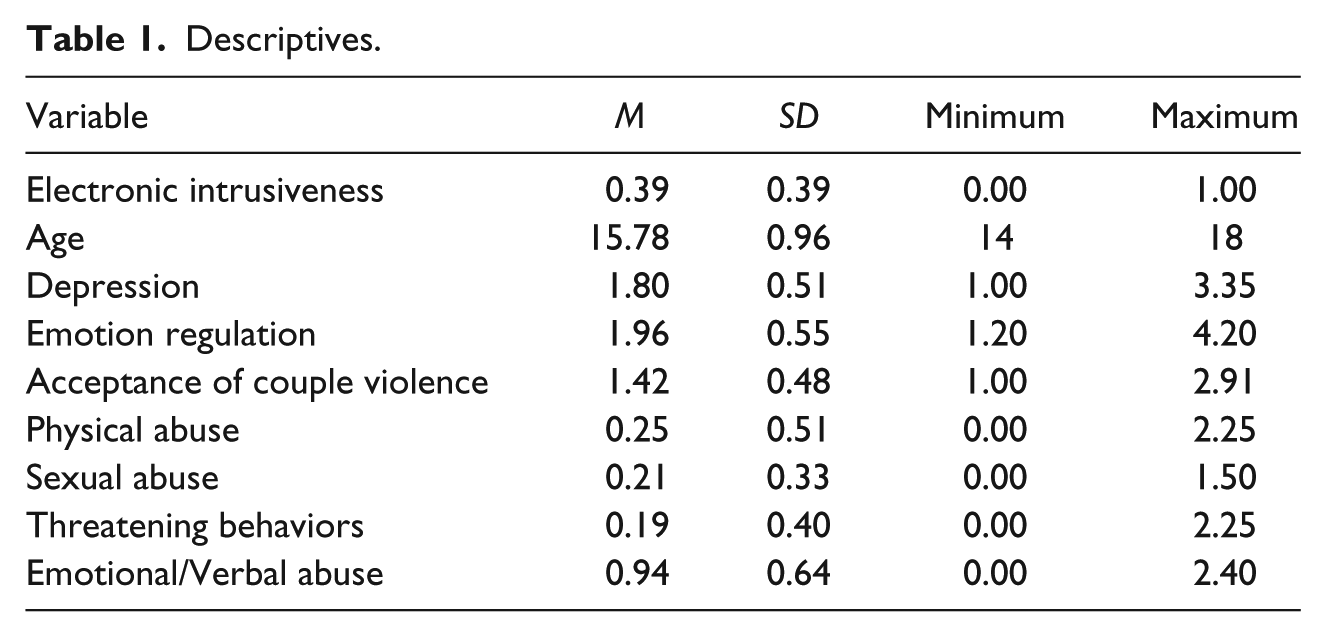
Participants completed items related to perpetration of EI as part of a larger self-report questionnaire of technology use. The EI scale consisted of three items to assess monitoring a partner’s (a) social networking sites, (b) cell phone call list, and (c) text messages. Items assessed perpetration of EI across the lifetime and within the past 3 months. The three items were worded as follows: “Have you checked through a boyfriend/girlfriend’s cell phone call list [social networking profile; text messages] to see whether they have spoken to someone you don’t trust (e.g., a person they may be hooking up with behind your back)?” Respondents replied “yes” or “no” and responses were averaged to create a composite variable of EI (see Table 1); respondents who endorsed perpetrating all three behaviors received a composite value of 1. The scale demonstrated adequate internal consistency within this present study (α = .75). A similar three-item scale to assess EI has been used in other studies (e.g., Reed et al., 2015) and has demonstrated good reliability (α = .74).
Descriptives.
The Beck Depression Inventory–II (BDI-II)
Participants completed the BDI-II (Beck, Steer, & Brown, 1996), a 21-item, 4-point Likert scale self-report instrument intended to assess symptoms of depression within the past 2 weeks using criteria from the American Psychiatric Association’s Diagnostic and Statistical Manual of Mental Disorders (4th ed.; DSM-IV; American Psychiatric Association, 1994). A mean score was calculated for each participant, with higher scores indicating greater depression symptom severity. Using this scoring convention, the greatest possible value was 4. The BDI-II has shown adequate reliability (α ranging from .71 to .91), as well as strong concurrent, convergent, and discriminant validity among adolescent samples (Osman, Kopper, Barrios, Gutierrez, & Bagge, 2004). Within the present study, the BDI demonstrates excellent internal consistency (α = .88).
Regulation of Emotions Questionnaire (REQ)
The REQ is a 21-item, 5-point Likert scale self-report measure intended to assess both functional and dysfunctional strategies of emotional regulation that are directed either internally (“I harm or punish myself in some way”) or externally (“I take my feelings out on others verbally”) (Phillips & Power, 2007). The REQ produces four subscales: “internal function,” “internal dysfunction,” “external function,” and “external dysfunction.” For this study, internal and external dysfunctional behaviors were averaged together. Larger values are indicative of greater dysfunction. Among adolescents, the REQ has shown evidence of reliability and validity (Phillips & Power, 2007). Within the present sample, the REQ dysfunctional subscale demonstrated adequate internal consistency (α = .74).
Acceptance of couple violence (ACV)
The ACV is an 11-item, self-report measure that assesses an individual’s acceptance of couple violence (Foshee, Fothergill, & Stuart, 1992). Participants rate how strongly they agree with statements using the four-item Likert-type scale. Example items include “violence between dating partners can improve the relationship,” “a girl who makes her boyfriend jealous deserves to get hit,” and “boys sometimes deserve to get hit by the girls they date.” Items are averaged together to create a variable to representing general acceptance of couple violence. The ACV has been shown to have strong internal consistency (Cronbach’s α range = .71-.94; Dahlberg, Toal, Swahn, & Behrens, 2005; Foshee et al., 1992) and adequate construct validity (Foshee, Ennett, Bauman, Bennefield, & Suchindran, 2005). Within this study, the ACV demonstrated excellent internal consistency (α = .90).
CADRI
Participants completed CADRI, a 35-item, self-report questionnaire intended to assess abusive behavior in adolescent dating relationships (Wolfe et al., 2001). Items related to perpetration within the past 3 months were included in this study. The CADRI has strong internal consistency (α = .83), 2-week test–retest reliability (r = .68, p < .01; Wolfe et al., 2001), and acceptable partner agreement (r = .64, p < .01; Wolfe et al., 2003). In this present study, the CADRI demonstrated adequate internal consistency across the four perpetration subscales that were used (physical abuse: α = .80; threatening behaviors: α = .75; emotional/verbal abuse: α = .87), with the exception of sexual abuse (α = .51).
Analytic Strategy
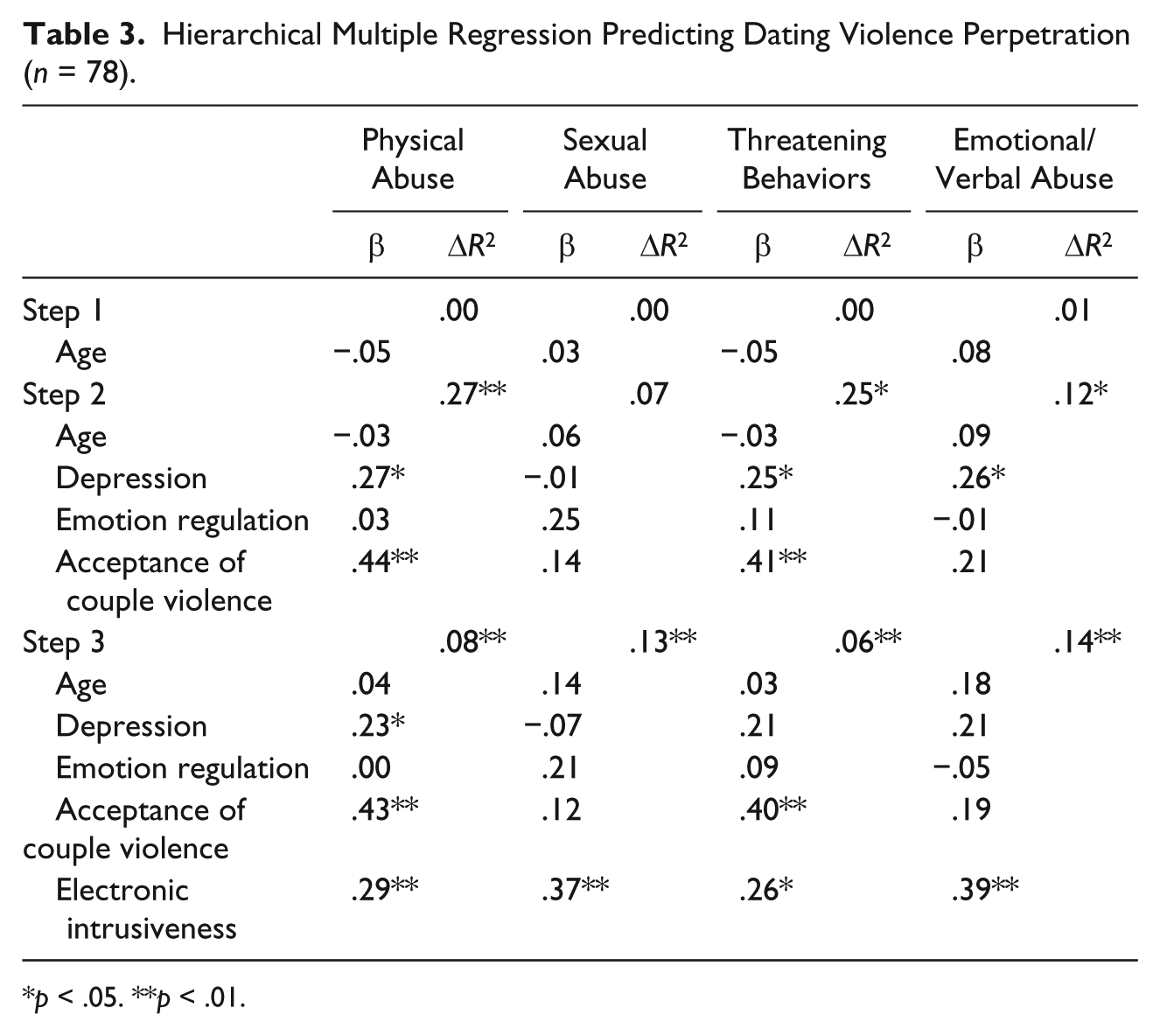
Descriptive statistics were calculated for EI and ADV behaviors (see Table 1). To further explore the relationship between behaviors of EI with ADV and ADV risk factors, bivariate correlations were conducted (see Table 2). We have only reported on analyses and models including the perpetration of EI within the past 3 months although patterns were consistent for lifetime perpetration (supplemental results available from corresponding author). To assess the relationship between perpetration of EI and perpetration of ADV while accounting for known risk factors of ADV (i.e., depression, emotional dysregulation, and acceptance of couple violence), we conducted several hierarchical regression analyses (see Table 3). For each analysis, age was entered into the first block; depression, emotional dysregulation, and acceptance of couple violence were entered simultaneously into the second block; and perpetration of EI was entered into the third block. A separate model was run for each subtype of ADV. Although we have only reported on the results from the third block, findings were largely consistent across the three blocks (results are available upon request from the corresponding author).
Correlations.

p < .05. **p < .01.
Hierarchical Multiple Regression Predicting Dating Violence Perpetration (n = 78).
p < .05. **p < .01.
Results
Descriptives
EI
Among the 78 participants, 70.5% endorsed having checked up on a partner’s social networking site in their lifetime and 56.4% reported doing so in the past 3 months; 37.2% endorsed going through a partner’s cell phone call list in their lifetime and 30.8% reported doing so in the past 3 months; and 41% endorsed going through a partner’s text messages in their lifetime and 29.5% reported doing so in the past 3 months.
Dating violence
Within the sample, 29.5% endorsed physical abuse, 27% endorsed threatening behaviors, 37.2% endorsed sexual abuse, and 89.7% endorsed emotional verbal abuse.
Primary Analyses
Perpetration of EI was positively correlated with the perpetration of each subtype of ADV. Perpetration of EI was also negatively correlated with age. Conversely, perpetration of EI was not significantly related to depression, emotional dysregulation, or acceptance of couple violence. Within this sample, the correlations between the subtypes of ADV perpetration and depression, emotional dysregulation, and acceptance of couple violence varied. Perpetration of physical abuse and threatening behaviors was positively associated with depression and acceptance of couple violence, whereas perpetration of emotional verbal abuse was only positively correlated with depression. Perpetration of sexual abuse was positively correlated with emotional dysregulation (see Table 2). The magnitude of effect sizes can be interpreted such that .10 = small effect, .3 = medium effect, and .5 = large effect (Cohen, 1988).
Within the hierarchical regression models, EI was significantly associated with perpetration of physical abuse (β = .29, p < .01), threatening behaviors (β = .26, p = .01), sexual abuse (β = .37, p < .01), and emotional verbal abuse (β = .39, p < .01) after accounting for age, depression, emotion regulation, and acceptance of couple violence. Across all models, age was not significantly related to ADV. Depression was significantly related to physical abuse (β = .23, p = .04). Acceptance of couple violence was significantly related to physical abuse and threatening behaviors (β = .43, p < .01 and β = .40, p < .01, respectively). For each model, we assessed whether there was an interaction effect with age; however, results were not significant.
Discussion
The current study contributes to our understanding of EI, a particularly common form of cyber dating abuse among youth. We provide additional descriptive information about linkages between EI and ADV perpetration, as well as among other known associates of in-person ADV. In this way, our findings help to orient EI within a broader understanding of theoretically and empirically indicated factors associated with ADV. Furthermore, we aimed to expand our understanding of the role of EI by examining the unique associations between EI and ADV in the context of other factors known to be linked to ADV. Indeed, EI continued to be associated with ADV perpetration even after accounting for other established correlates, thereby evidencing a need to better incorporate it into our research on ADV.
The prevalence of EI found in this study is consistent with prior research (Picard, 2007; Reed et al., 2017), further underscoring the pervasiveness of EI perpetration. This study also offers preliminary evidence that perpetration of EI is associated with perpetration of ADV, which is consistent with existing data that cyber dating abuse increases one’s odds of ADV (Marganski & Melander, 2018). These results are also consistent with the notion that engagement in one form of intimate partner violence is associated with engagement in other forms (Halpern, Oslak, Young, Martin, & Kupper, 2001; Marganski & Melander, 2018). Furthermore, to our knowledge, this is the first study that has assessed the relationship between EI and ADV while accounting for other existing factors associated with ADV. As a result, our findings provide some indication that perpetration of EI is uniquely linked to the perpetration of ADV.
Although further analysis of the relationship between EI and ADV is needed, perpetration of EI may be associated with ADV for several reasons. As suggested by some, cyber dating abuse, and thus EI, may simply be a vehicle through which other forms of ADV are carried out. However, within this study, the associations between EI and ADV were modest (i.e., less than .40). One may expect that the correlations would be greater if these behaviors were synonymous. This may suggest that, although related, EI is an independent set of behaviors that is conceptually distinct from other subtypes of ADV, including psychological ADV, but co-occurs with other forms of ADV. Longitudinal studies are needed to determine whether the link between EI and in-person ADV is tied to a temporal process whereby cyber dating abuse becomes more strongly linked with ADV over time. Furthermore, it may be that the perpetration of EI serves as an indicator of poor relationship health, such as limited trust and poor communication. It could also be the case that EI contributes to risk of in-person ADV. For instance, perpetration of EI may lead to the eventual unveiling of behavior or content, such as indiscretion, that serves as a source of conflict. Relatedly, perpetration of EI may be uncovered by the other partner and contribute to conflict or subsequent violence. These possibilities could not be assessed in this study using cross-sectional data; however, these preliminary findings indicate that further speculation regarding the relationship between EI and ADV is warranted.
Data from this study also revealed greater rates of EI perpetration among younger participants. This is consistent with some data indicating cyber dating abuse may peak in middle adolescence (Cutbush et al., 2010; Cutbush et al., 2012; Temple, Choi, Brem, et al., 2016). Although there is certainly need for further exploration into the association between age and perpetration of EI, there are a few plausible explanations for these findings. It may be that the typical life adjustments common to middle adolescence (e.g., starting high school), which are often characterized by new social groups, heighten the use of electronics and social media, as well as the potential for social stress. As a result, middle-aged adolescents may utilize electronics and social media more often, which may contribute to elevated rates of EI. It is also possible that new social groups and related social stressors may intensify motivations to monitor and control one’s partner, thus elevating rates of EI during these developmental periods. However, the motivations behind perpetration of EI are not well known, indicating more research on this topic is needed.
Our study also serves as an initial indicator that EI may not be associated with known risk factors of ADV. Although not the specific intent of this study, the lack of associations between EI and depression, emotion regulation, and acceptance of couple violence is unexpected. Although there has been limited research connecting psychosocial factors and cyber dating abuse (Peskin et al., 2017; Zweig et al., 2013) and cyberbullying (Chen, Ho, & Lwin, 2017), there are several plausible reasons for this lack of findings. First, it may be due to our exclusive focus on perpetration, that is, depression may have a stronger link to EI victimization compared with perpetration. According to the target vulnerability theory, depressive symptoms (e.g., hopelessness, negative self-image, increased insecurity, lack of motivation) decrease one’s ability or impulse to mitigate victimization and thus enhance risk (Brooks-Russell, Foshee, & Ennett, 2013; Cascardi, 2016; Iverson et al., 2013). As such, symptoms of depression may decrease one’s motivation or ability to mitigate intrusiveness by a partner. Second, our small sample size and use of only females may have limited our ability to detect associations and differences that may be found across genders, as indicated by Dardis and colleagues (2015). For example, in prior research with emotion regulation, only the impulse control aspect of emotion regulation was found to be a predictor of relationship aggression among females (Gratz & Roemer, 2004). The current study was not able to make comparisons by genders, nor did our measures have the subscale specificity to assess these potential unique relationships. Third, our current understanding of EI is limited such that the existing literature does not provide a clear indication of the motivation behind perpetrating EI. It may be the case that perpetrating EI is not driven by intense emotional states, such as insecurity or jealousy, and thus it would not be expected that EI would be associated with depression or emotion regulation.
Another potential reason for the lack of association between EI and depression, emotional regulation, and acceptance of couple violence may be due to adolescents’ perception of EI as normative and acceptable (Baker & Carreño, 2016; Lucero et al., 2014; Reed et al., 2017). As previously mentioned, several existing studies of adolescents have reported that sharing one’s password with a partner is a symbol of trust and commitment, whereas failing to do so signals there is something to be hidden (Baker & Carreño, 2016; Lucero et al., 2014). Therefore, this behavior may not follow the typical trajectory that applies to other dysfunctional relationship behaviors. Adolescents may initially engage in EI under the pretense it signifies relationship with health without awareness of the risks and distress this behavior may cause. Perhaps not surprisingly, EI often contributes to increased jealousy and conflict (Baker & Carreño, 2016), as well as feelings of distress—particularly among females (Baker & Carreño, 2016; Lucero et al., 2014). As a result, links between cyber dating abuse and depression, emotion regulation difficulties, and acceptance of couple violence may not arise until EI behavior escalates, additional forms of cyber dating abuse are used, or ADV begins.
Depression, emotion regulation, and acceptance of couple violence also were not consistently correlated with each type of ADV, nor were they consistent contributors of ADV across each of the regression models. These patterns are somewhat expected given prior research reporting differences in risk based on the severity of ADV behaviors (e.g., Sears, Byers, & Price, 2007; Shorey, Brasfield, Febres, & Stuart, 2011). Moreover, these inconsistencies may be similarly attributed to the reasons listed above, including this study’s exclusive focus on females and perpetration, as well as measurement limitations.
In sum, EI is common and is uniquely associated with in-person ADV even when related covariates are accounted for. Findings from this study, coupled with the literature highlighting the perceived normalcy and acceptance of EI, suggest that enhancing awareness of EI and its link to ADV is important. As such, prevention programs for ADV may benefit from incorporating content on EI. Awareness of EI among software engineers and web developers may also be necessary to highlight the potential misuse of certain device or software features by users. Perhaps improved options can be created to ensure protection of one’s privacy or to limit access to such features. Relatedly, increased parental monitoring may be one such method to reduce access to and engagement in EI among adolescents. Indeed, parental monitoring has proved to be an effective method of risk reduction for other adolescent risk behaviors (Borawski, Ievers-Landis, Lovegreen, & Trapl, 2003; DiClemente et al., 2001); as such, it is promising that increased monitoring of electronics use by parents may limit EI.
Limitations and Future Directions
The present study addressed several important limitations within the existing literature by examining the links between EI and ADV perpetration in the context of other theoretically and empirically supported factors associated with ADV. However, there are important limitations to consider. First, we cannot determine the directionality of associations. That is, although EI may serve as a potential precursor to ADV, it is equally possible that ADV begins first and becomes sufficiently pervasive that it contributes to EI. Indeed, longitudinal assessments of these behaviors are very limited to date, making the underlying processes of EI and ADV unclear. Future work should aim to examine the directionality among other known risk factors for dating aggression, EI, and ADV perpetration to better understand the function of EI, in particular. For example, it may be that EI is a mechanism through which more distal risk factors, such as depression, contribute to ADV. By examining these associations longitudinally, we may be able to identify appropriate opportunities for intervention and prevention efforts. Relatedly, future studies should explore the relation between EI and ADV within the context of other covariates beyond those selected for this study. Notably, there are likely many other variables that were beyond the scope of this study that could contribute to the association between EI and ADV.
A second limitation in the current study is the small sample size. As a result, although we used an indicated sample to ensure a greater rate of physical and sexual ADV, they were nonetheless relatively rare occurrences. Concerns about this limitation are somewhat assuaged by the replication in findings across more common forms of ADV, including threatening behaviors, relational aggression, and emotional verbal abuse. However, future work should aim to examine these patterns within a larger sample to better understand these preliminary findings. Another concern includes the low Cronbach’s alpha value from the CADRI sexual abuse perpetration subscale, suggesting that within this sample this subscale may not be assessing what is intended. In particular, it appears that one item from the scale does not correlate well with the others; as such, results including the sexual abuse subscale should be interpreted with caution.
Third, the current study was designed for adolescent females who have already experienced ADV victimization or perpetration. Thus, we cannot generalize to a broader sample of adolescent females or males. However, given the high risk of revictimization or reperpetration among this sample, the presence of these patterns is nonetheless contributory as it may suggest EI may be one mechanism through which risk is incurred. Future work should aim to also examine these patterns within a broader sample of adolescents and be inclusive of boys to determine whether gender differences emerge.
Finally, we were only able to examine associations between perpetration of EI and perpetration of ADV. In many respects, this is also a strength of the current study as the majority of work in this area has focused on victimization is isolation (e.g., Marganski & Melander, 2018). Within the broader ADV literature, patterns tend to be similar across perpetration and victimization (Haynie et al., 2013). Thus, work should aim to include EI in the examination of both ADV perpetration and victimization together to understand whether similarities also emerge.
Conclusion
These limitations notwithstanding, the current study contributes to the growing literature examining cyber dating abuse. Although perceived as normative and acceptable, the current study demonstrates that EI is associated with ADV perpetration even after accounting for other factors known to be linked with ADV. Future research is necessary to further investigate whether EI functions as a gateway through which in-person violence develops. In sum, the current study highlights the need to better incorporate EI and cyber dating abuse more broadly into our theoretical and empirical models of ADV.
Footnotes
Authors’ Note
H.D. conceived the study, performed the statistical analyses, and drafted the manuscript; C.C. aided in the conception of the study, assisted with analysis and interpretation, and drafted and reviewed the manuscript; E.H. assisted in drafting the manuscript; D.I.G.S. assisted in drafting the manuscript; B.D. assisted in editing the manuscript; C.R. collected the data and aided in the conception of the study, interpretation of analyses, and edits to the manuscript. All authors read and approved the final manuscript. Charlene Collibee and Brett DeJesus are now affiliated to Rhode Island Hospital, Providence, RI, USA.
Declaration of Conflicting Interests
The author(s) declared no potential conflicts of interest with respect to the research, authorship, and/or publication of this article.
Funding
The author(s) disclosed receipt of the following financial support for the research, authorship, and/or publication of this article: This research was supported by National Institute of Mental Health grant K23 MH086328 (Principal Investigator: Rizzo)