




Abstract
One of the most frequent refrains heard in the public discourse on intimate partner violence (IPV) is why do they stay? The literature has demonstrated that IPV victims face multiple barriers to safely exiting their relationships. Currently, there has been a limited examination of the role social media can play in elucidating the lived experience of IPV. With 25% of the population using Twitter, there are opportunities to examine its utility for deepening understandings of IPV. Using data generated from the #WhyIStayed Twitter campaign, the purpose of this study is to examine Twitter users’ reasons for staying in their abusive relationships. The study sample (n = 3,086) is composed of a random sample of 61,725 English speaking tweets globally that employed the #WhyIStayed and #WhyILeft hashtags. We analyzed all tweets using thematic content analysis methods. This process involved multiple rounds of coding. In response to #WhyIStayed, Tweeters worldwide shared the barriers they faced that made leaving their abusive partners difficult. Seven primary themes emerged that influenced their decision-making processes: (a) impact of IPV on personal well-being, (b) lack of awareness regarding the dynamics of abusive relationships, (c) not identifying as a stereotypical IPV victim, (d) fear of reinforcing racial stereotypes, (e) internalizing social scripts regarding relationships, (f) structural barriers, and (g) leaving takes time. Twitter messages have the capacity to function as micronarratives that recount the complex barriers IPV victims confront when negotiating their relationships. This analysis provides a multifaceted description of the challenges associated with leaving abusive relationships that can augment existing theoretical frameworks on victim readiness. Furthermore, these findings demonstrate the myriad ways that societal representations of domestic violence (DV) serve as impediments for victims leaving their abusive relationships. Therefore, social media has the potential to provide a platform for capturing the lived experience of IPV.
One of the most enduring refrains heard in the public discourse on intimate partner violence (IPV) is “Why do they stay?” Despite efforts of feminist scholars to emphasize the myriad individual, interpersonal, situational, and structural factors that can impede individuals’ ability to safely exit abusive relationships, members of the general public (Nabors, Dietz, & Jasinski, 2006) and even some social service providers (Dunn & Powell-Williams, 2007; Thapar-Bjorkert & Morgan, 2010) believe that abuse victims have the agency to sever an abusive relationship. Therefore, IPV victims are often perceived to be at least partially responsible for the abuse if they remain in a relationship with an abusive partner (Policastro & Payne, 2013).
The challenges victims face leaving abusive relationships surfaced in the 2014 social media campaign: #WhyIStayed. This hashtag emerged on Twitter in 2014 in response to former Baltimore Ravens football player Ray Rice physically assaulting his partner Janay Rice in a hotel elevator. Although there was a critique of the National Football League’s minimal response to the incident (a two-game suspension), much of the public outcry centered around Ms. Rice’s defense of her partner, denial of a pattern of abuse, and ultimate decision to stay in the relationship (Clark, 2016). In frustration, a former IPV survivor and public relations executive Beverly Gooden tweeted, “I stayed because I thought it would get better. It never got better. #WhyIStayed.” This campaign is one of the most robust examples of the feminist-oriented hashtag campaigns that have erupted in response to gender injustice issues worldwide. For example, New Hampshire Public Radio tweeted that the #WhyIStayed media campaign is “the largest and most public discussion we’ve ever seen about domestic violence.” 1 Digital technology or “big data” has the potential to be a rich source of data to understand social movements in virtual platforms, social interactions, and behaviors among users, and to investigate social phenomena (McCay-Peet & Quan-Haase, 2017). Despite the increased attention to the potential of social media in social science research, there has been a limited systematic application in the field of IPV research. Given that social media functions as a space for public dialogue, each tweet is an attempt for an individual Twitter user (herein referred to as a Tweeter) to contribute a micronarrative on his or her personal experiences of IPV. Therefore, the purpose of this study is to systematically examine the self-reported reasons for “staying” in an abusive relationship discussed by Tweeters who employed the #WhyIStayed hashtag.
Historical Context and Defining IPV
Currently, there are no universally endorsed definitions of IPV among scholars, social service providers, and members of the general population (Buzawa, Buzawa, & Stark, 2017). The terms dating violence, domestic violence, and IPV are often used interchangeably in the academic literature and public discourse. Historically, the battered women’s movement, predominantly the product of the mainstream second-wave feminist movement, raised awareness regarding instances of severe physical violence to generate public support for supportive services especially shelters and police interventions (Berns, 2004). These early organizing efforts are critiqued for taking a “colorblind approach” that centered the experiences of White middle-class female-identified individuals and essentializing the diverse experiences of women of color, sexual minorities, gender-nonconforming, and male-identified victims (Ake & Arnold, 2017). The vestiges of this early movement can still be seen in contemporary framings of IPV both within advocacy and academic communities and in the public discourse surrounding IPV (Berns, 2004).
In this article, we will use the term IPV to reference a pattern of coercive behaviors including physical, emotional, sexual abuse in individuals’ current or former romantic relationships (Bowen & Walker, 2015). The term abuse will be employed throughout this article to capture one of these forms of violence. The terms victim and survivor will both be used to honor individuals’ varying perspectives on “naming” their abuse experiences. We acknowledge that IPV occurs across intimate relationships, although sociocultural demographic factors play a critical role in contextualizing an individual’s abuse experiences. For example, although both male- and female-identified individuals have reported instances of IPV, female-identified individuals endure disproportionately higher incidences of physical acts of IPV (Hamby, 2014), with nearly 70% of murders committed nationally perpetrated against female-identified individuals (Bureau of Justice Statistics, 2009).
Prevalence of IPV
The National Intimate Partner and Sexual Violence Survey, which includes a nationally representative sample of individuals in the United States, found that 35.6% of female-identified and 28.5% of male-identified individuals have reported enduring physical or sexual assaults or stalking by an intimate partner in their lifetime (M. C. Black et al., 2011). Importantly, the majority of large-scale statistically generalizable studies measure predominantly physical acts of IPV. The incidence of IPV is even higher when less reported incidents of verbal, mental, and emotional abuse are accounted for (Coker et al., 2014). Although IPV occurs across demographic groups, evidence suggests that certain vulnerable populations endure a higher burden of abuse. Within the United States, 46% of American Indian/Native American female-identified individuals, 43.7% of African American female-identified individuals, and 37.1% of Latina/Hispanic female-identified individuals have experienced IPV. In reference to Lantinx individuals, rates of IPV increase the longer they live in the United States and have greater reported rates of acculturation (Caetano, Ramisetty-Mikler, & McGrath, 2004; Klevens, 2007). Furthermore, evidence suggests that sexual minority populations may be at elevated risk (Calton, Cattaneo, & Gebhard, 2016). For example, in a large nationally representative sample, 61% of bisexual female-identified individuals, 37% of bisexual male individuals, 44% of lesbians, and 26% of gay male-identified have reported experiencing sexual assault, physical abuse, and/or stalking incidence in their lifetimes (Walters, Chen, & Breiding, 2013). Although underreported, 51.7% of individuals who identify as transgender have reported IPV in their lifetimes (Langenderfer-Magruder, Whitfield, Walls, Kattari, & Ramos, 2016).
Literature Review
Leaving Abusive Relationships
Within the current IPV literature, there has been extensive research on the individual, relational, and structural factors that impede victims’ ability to terminate their relationships. These barriers can include financial constraints including threats of homelessness (Anderson & Saunders, 2003), lack of employment (Lacey, Saunders, & Zhang, 2011), lack of adequate and safe housing, and police nonresponsiveness (Lacey et al., 2011). IPV victims with children in the home have reported fearing raising children alone, interventions from child welfare agencies, or losing custody of their children to their abuser (Bui, 2003).
It has also been suggested that victims’ decision-making processes to leave abusive partners is influenced by their subscription to stereotypes or “information myths” (Westbrook, 2009, p. 828). These myths included things such as IPV only constitutes physical abuse and survivors are to blame for staying in their relationships. The nature of the abuse can also play a role in an individual’s decision-making processes to leave or stay (Anderson & Saunders, 2003). Severe physical abuse can prompt leaving, whereas for others, it may create fear that the perpetrator could retaliate with further abuse (Raghavan, Swan, Snow, & Mazure, 2005). This fear is well founded, given that nearly half of all murders committed against female-identified individuals are perpetrated by current or former intimate partners (Petrosky et al., 2017).
Given that IPV is a socially situated and context-bound social phenomena (Sokoloff & Dupont, 2005; Testa, Livingston, & VanZile-Tamsen, 2011), scholars have reinforced the importance of factoring how an individual’s multiple intersectional identities and unique situational, cultural, and structural contexts can make certain populations particularly vulnerable to abuse and influence abuse victims’ decision-making processes to stay or leave their relationships (Sokoloff & Dupont, 2005). Given that the majority of prevention and intervention services are race neutral, marginalized and underrepresented communities have often been presented with culturally insensitive, linguistically inappropriate, or hostile advocacy services (Richie, 2012). Relatedly, though there has been copious research on risk factors associated with IPV in minority communities, few have acknowledged community strengths, culturally specific protective factors, and histories of historical trauma and oppression (Burnette & Figley, 2017). Indeed, the privileging of criminal justice–based responses to IPV overlooks the long history of police brutality and injustice within communities of color (Richie, 2012).
As a result, members of underrepresented communities face unique barriers to leaving that have often been overlooked in the mainstream IPV movement. For example, undocumented immigrants face fears of deportation and have a distrust of the formal legal system due to experiences of discrimination (Raj & Silverman, 2002; Raj & Yore, 2018). These barriers are compounded by cultural expectations regarding the central role women and mothers play in “holding a family together” (Molina & Abel, 2010) and concerns of negatively reinforcing stereotypes regarding members of their immigrant communities (Raj & Silverman, 2002). In reference to sexual minorities, Calton and colleagues (2016), through a thematic literature review, found that IPV victims who identify as lesbian, gay, bisexual, transgender, queer, intersex, and asexual (LGBTQIA) endure unique barriers to help seeking, including a shortage of services tailored for sexual minority populations, lack of service provider awareness on the dynamics of LGBTQIA relationships, and survivors’ internalized experiences of community-level discrimination and stigma. These experiences may be compounded for male-identified gay men, who confront bias from service providers regarding men’s experiences of abuse (Calton et al., 2016). Indeed, male-identified IPV victims have reported their gender identity is an obstacle to help seeking, because they fear service providers will not believe them.
Theoretical Foundations for Staying and Leaving Abusive Relationships
Numerous scholars have developed and employed theories and models of predominantly health behavior change to predict IPV victim’s likelihood of safely terminating his or her abusive relationships, and to shed light on the complex social processes that can inform and influence his or her decision making. Byrne and Arias (2004), for example, investigated the utility of the theory of planned behavior to contextualize IPV survivors’ intentions to terminate their relationships. This theory posits that an influential determinant of an individual’s decision to adopt a health-promoting behavior is his or her intention to make a new behavior change. His or her intentions are most influenced by his or her attitudes regarding the behavior, his or her subjective norms regarding the opinions of key referents (i.e., parents, peers) for adopting (or not adopting) a given behavior change, and the participant’s perceived ability to control his or her adoption of the behavior (Ajzen, 1991). The Byrne and Arias (2004) sample was comprised of 48 female-identified individuals who endured severe acts of physical violence and were currently living in a domestic violence shelter. They reported that survey respondents’ intentions to leave their relationships were influenced by having a positive attitude toward leaving and a belief that they had some degree of control to terminate the relationship. The severity of violence endured the previous year and normative beliefs from family and friends were not found to be significant determinants of leaving their relationships.
The transtheoretical model of change (TTM) is one of the most frequently employed health behavior theories investigated. This model identifies five stages (precontemplation, contemplation, preparation, action, or maintenance) that individuals often pass through when making significant personal changes (Grimley, Prochaska, Velicer, Blais, & DiClemente, 1994). Reisenhofer and Taft (2013) conducted a literature review of 24 mixed-methods studies that explored the applicability of the TTM and its related constructs to IPV victim’s decision-making processes to stay or leave relationships where IPV was present. Across the reviewed studies, the authors concluded that IPV victims often fall across this continuum of readiness, are involved in complex decision-making processes, and discussed the utility of tailoring interventions to IPV victim’s unique stage of change. Furthermore, this review of the literature identified critical decisional-balance factors that can influence an individual’s decision to end his or her relationship such as the risk of losing children, the availability of external supports, financial resources, and support for leaving from family and religious leaders.
Although theories of health behavior change are important for identifying individual-level decision-making processes, they often are not inclusive of complex structural, societal, and institutional factors that influence IPV victim’s “level of readiness” (Tarzia et al., 2016). These factors include the flexibility of one’s employer, the availability of emergency shelters, external sources of financial support or child care, and the responsiveness of the criminal justice system in one’s given community. Furthermore, unlike with adopting health-promoting behaviors such as smoking cessation or adopting a new exercise regimen, victims have limited control over their partner’s abusive behaviors (Cluss et al., 2006; Tarzia et al., 2016). Despite the preponderance of research investigating the utility of the TTM, its applicability to complex social phenomena such as IPV has been questioned because individuals in abusive relationships are often in multiple stages simultaneously: Thus, stage-based theories may not be appropriate to detail the complexity inherent to abusive relationships (Cluss et al., 2006; Reisenhofer & Taft, 2013). In light of these observations, Cluss and colleagues’ (2006) psychosocial readiness model and Overstreet and Quinn’s (2013) IPV stigmatization model were introduced to account for the litany of internal and external factors that often coexist in abusive relationships and influence abuse victims’ decision-making processes within their relationships.
Rather than focus on an individual’s discrete stages of readiness, the psychosocial readiness model acknowledges that an abuse victim’s actions are in flux and fall along a “continuum of readiness” ranging from status quo to readiness. Within this model is also the acknowledgment that leaving is not always an abuse victim’s ultimate goal—and, thus, leaving should not always be a benchmark of programmatic efficacy (Cluss et al., 2006). The psychosocial readiness model has identified three internal factors that can influence an individual’s decision-making process to leave his or her relationships. These stages include an individual’s awareness that his or her partner’s behaviors constitute abuse, victim’s sense of power or self-efficacy to overcome hardships and victim’s perceptions of support from trusted referents in his or her social environments (regardless of whether that support is material or substantive). In addition to these internal factors, Cluss and colleagues (2006) identified external factors that can challenge an individual’s change continuum. These factors can include judgmental comments by family members or medical professionals or structural factors such as the availability of affordable child care. This model has found some empirical support in studies by Chang et al. (2010) and Tarzia et al. (2016).
An important, though underinvestigated, model of help seeking, particularly among vulnerable and underserved populations, is Overstreet and Quinn’s (2013) IPV stigmatization model, which identifies three distinct ways that perceptions and experiences of stigma can influence IPV victims’ processes of help seeking and meaning making regarding the dynamics present in their relationships (Overstreet and Quinn, 2013). These include cultural stigma, stigma internalization, and anticipated stigma. Cultural stigma exemplifies a type of structural violence and involves predominant societal-level beliefs regarding victims of IPV. These beliefs can include assumptions that victims provoke their assaults, that victims’ prior vulnerability precipitates their entry into abusive relationships, and victims have the agency to leave abusive relationships if they so desired. Stigma internalization describes the processes by which victims come to identify with and come to believe societal-level stereotypes regarding abuse victims. Anticipated stigma details victims’ concern over how others will respond to their abuse experiences, given the prevalence of stereotypes and misconceptions regarding IPV (Overstreet & Quinn, 2013). This anticipation regarding how others will judge or characterize their experiences can affect a victim’s decision-making processes to seek support from friends or community members.
Despite the plethora of research on the barriers to leaving and disclosing abusive relationships, there are critical gaps in the evidence base. First, much of the theory development has been focused on understanding IPV victims’ processes of leaving or terminating their relationships with an emphasis on identifying “turning points” (Catallo, Jack, Ciliska, & MacMillan, 2012; Chang et al., 2010) that contributed to their decision making. It also could be instructive to acquire perspectives from individuals who have remained in their abusive relationships or not sought formal support from IPV service providers. Second, the majority of research on IPV has come from clinical samples of victims who are receiving shelter or advocacy services through IPV service providers (Raghavan et al., 2005). Although individuals who receive formal services likely participate on social media platforms, social media data offer the opportunity to solicit experiences and perspectives from the broader population of IPV victims. Therefore, the purpose of this article is to examine how Twitter users in the #WhyIStayed media campaigns self-reported reasons for “staying” in their abusive relationships.
Method
The results presented in this article emerged from a larger study titled “#WhyIStayed: The Lived Experience of Intimate Partner Violence in 140 Characters.” This broader study investigated the manner in which IPV is represented in feminist-oriented hashtag campaigns. We explored how survivors/victims frame their experiences of IPV, as well as how IPV service providers are using social media advocacy services. We collected data in March 2015, and analysis occurred from September 2015 to October 2016.
Study Context
What is Twitter?
Twitter is one of the most widely utilized social media platforms worldwide. Nearly 24% of online adults users worldwide and 21% of Americans used Twitter in some capacity (Greenwood, Perrin, & Duggan, 2016). This study found that although 36% individuals aged 18 to 29 currently use Twitter, these numbers decline as users age, with only 10% of adults above the age of 65 using Twitter. In addition, nearly 30% of individuals making more than US$50,000 a year use Twitter, compared with approximately 20% of individuals who make less than US$50,000 per year. There were no significant regional or self-identified gender differences (Greenwood et al., 2016).
Data acquisition
There are two primary strategies that social scientists often use to access Twitter data, and both require familiarity with application program interfaces (APIs). API refers to a method by which researchers can interact with web-based applications such as Twitter, Google, and Facebook. An API allows the user to create their own application (app), and then define a set of protocols whereby the new app “talks” to the existing web application and acquires information. In the case of Twitter, one could access one of his or her APIs to search for relevant hashtags, public users, or geo-enabled tweets.
Twitter’s search API formerly allowed for the short-term, real-time programming of applications using Twitter data. For example, suppose you were browsing your Twitter feed, and you came across an interesting hashtag, related to a social phenomenon of interest to you. Because you were aware of the hashtag early in its usage, you could use the standard search API to run a query on the hashtag, thereby gathering tweets using that specific hashtag in real time. However, there were limitations on the quantity or age of the tweets that can be accessed using the standard search API: Any tweet more than 7 days is only accessible through Twitter’s enterprise search API.
Therefore, as was the case for this research study, archival Twitter data and/or data sets with large amounts of tweets must be purchased through Twitter’s enterprise API. Twitter’s enterprise API (formerly known as GNIP, Inc.) can be understood as a set of APIs supporting access to Twitter data involving many days and/or gigabytes/petabytes of data, both historical and in real time. Formerly, there were several API families one could access through the enterprise API: the real-time APIs, the search APIs, and the historical powertrack APIs, for example. The current study used the historical powertrack enterprise API. This API provided either the past 30 days (30-day search API), the entire Twitter archive (full archive search API), or a filtered view of the full Twitter archive (historical power track). Because we were interested in two specific hashtags (#WhyIStayed and #WhyILeft) at a specific point in time (September 9, 2014, to October 9, 2014), the historical power track API was used to access the data. 2
Following receipt of the data from the API, it was stored on a secure Unix-based terminal server as a .json file and later converted into a .csv within R studio (RStudio Team, 2017), in which form it could be analyzed with a variety of quantitative and qualitative data analysis software.
Data and Sample
Given the research questions for this article, we were interested in identifying only those tweets that involved tweeters’ experiences of staying in abusive relationships. In total, we obtained N = 61,725 tweets from the historical powertrack enterprise API. We took a random sample (5%) of these, for an n = 3,086. This random sample included all tweets that contained the #WhyIStayed and/or #WhyILeft hashtags. After an initial inductive analysis of the codes, we identified four primary types of tweets: reasons for staying (n = 1,147), push factors for leaving (n = 515), educational and advocacy messages (n = 581), and general responses from members of the Twitter community (n = 1,390; i.e., “everyone needs to read these tweets” or “#WhyIStayed is so important,” etc.). The results presented in this article are from those that were interpretively coded as “reasons for staying” or by the coding shorthand #WhyIStayed, for a final n = 1,147.
To be included in the global sample (n = 61,725), tweets could have been made from any location worldwide, but they needed to be tweeted in English. We excluded tweets if they were used for commercial purposes (i.e., trending hashtags are often included to sell or market products). For example, the Apple Watch and Samsung Galaxy phone were released the same week that #WhyIStayed was trending. Therefore, advertising tweets for these products included #WhyIStayed even though they had no direct relevance to the campaign. The only exception was a tweet made by DiGiorno pizza on September 8, 2014 (#WhyIStayed You had pizza), because it triggered a series of reaction tweets that became a strand of this discussion on Twitter. We excluded tweets where a significant portion of the content of the tweet was indiscernible either because the user applied multiple emoticons (which are difficult to extract from the API and require separate processing for conversion to readable characters) or because the tweet was truncated during the data acquisition process.
We excluded individual Twitter user handles, demographic information including their self-reported race, gender, and geographic location from the analyzed sample. We opted to redact this information for two reasons. First, the self-reporting of this information on social media is often unreliable, because users may inaccurately report personal information (i.e., younger users stating they are older). Second, the internal review board at Tulane University required that the research team omit any potentially identifiable information, out of concern that these type of data points could be triangulated to determine the identification of the tweeter. Given that tweeters could not give formal consent to participate in this research, the research team opted to remove all demographic information included as part of the tweeters’ Twitter profile. We did code demographic designations when the tweeters explicitly self-reported their identities within the content of their tweet. For example, when a tweeter stated “As a black woman, . . . ,” we coded the tweet as African American and female. We did not extract this information from their profile or use an algorithm to statistically predict their identities.
Data analysis
For this analysis, we used a traditional exploratory thematic content analysis approach (Braun & Clarke, 2006; Hsieh & Shannon, 2005) as a rigorous method for identifying central themes across a data set (Saldana, 2009). Braun and Clarke (2006) describe thematic content analysis as the systematic process of “identifying, analyzing and reporting patterns or themes within data . . . to find repeated patterns of meaning” (p. 79). We imported all data into Dedoose analytic software. The analysis involved multiple rounds of iterative coding, which included assigning meaning to passages within the data by interpretively naming individual words, phrases, or sections within the texts (Saldana, 2009). For example, we grouped the following codes under the category structural factors: shortage of shelters, unemployment, legal issues, police inaction, and immigration issues. We inductively created a codebook in Dedoose during the first round of data analysis. This codebook included detailed definitions for each code and guidelines for code usage. We clustered all codes into categories composed of similar constructs. Example of categories included types of abuse, structural factors, external pressure to stay, and concern for children. The lead author initially coded the sample of tweets in Dedoose. One master’s-level and one doctoral-level and master’s-level research assistant each conducted secondary coding on half of the data set. Therefore, each tweet was coded a minimum of 2 times. When discrepancies in coding emerged, one of the graduate students would flag the tweet with the code “coding double check” and provide a memo in Dedoose regarding differences in coding. The research team would then discuss the tweets with the “coding double check” code applied and resolve discrepancies in coding. Although there were a limited number of divergences in coding, the team had discussions regarding applying multiple codes to the same tweet. This collaborative analysis process promoted consistency in coding and to solicit a diversity of interpretive viewpoints. The research team used memos throughout the analysis process to surface key themes.
Reflexivity statement
Given that reflexivity is an important benchmark of rigor in qualitative research (Stige, Malterud, & Midtgarden, 2009), it is critical to discuss the individual researcher’s relationship and orientation to this research project. The lead author is an academic researcher, who has spent many years working in the field of dating and domestic abuse prevention. She describes herself as a “reluctant tweeter,” but has become increasingly more active in using this social media platform. The second author is an academic researcher who primarily studies quantitative text analysis methods for use in big data research and is particularly interested in methods for analyzing social media data. She has lived experience involving IPV: Her mother is a survivor and she a witness. The third author, a doctoral-level research assistant, has worked extensively in the field of domestic and dating violence, providing direct services to survivors of IPV and working to address systems-level issues to support victim safety.
Results
In response to #WhyIStayed, Tweeters worldwide shared the myriad emotional, structural, and interpersonal barriers they faced that made leaving their abusive partners difficult. Seven primary thematic categories emerged as factors that influenced their decision-making processes to stay in their abusive relationships: (a) impact of IPV on personal well-being, (b) lack of awareness regarding the dynamics of abusive relationships, (c) not identifying as a stereotypical IPV victim, (d) fear of reinforcing racial stereotypes, (e) internalizing social scripts regarding relationships, (f) structural barriers, and (g) leaving takes time. We summarized these findings in Table 1.
Primary Themes Cited for “Staying” in Abusive Relationships.

Note. IPV = intimate partner violence.
Barrier to Leaving: Impact of IPV on Personal Well-Being (n = 384)
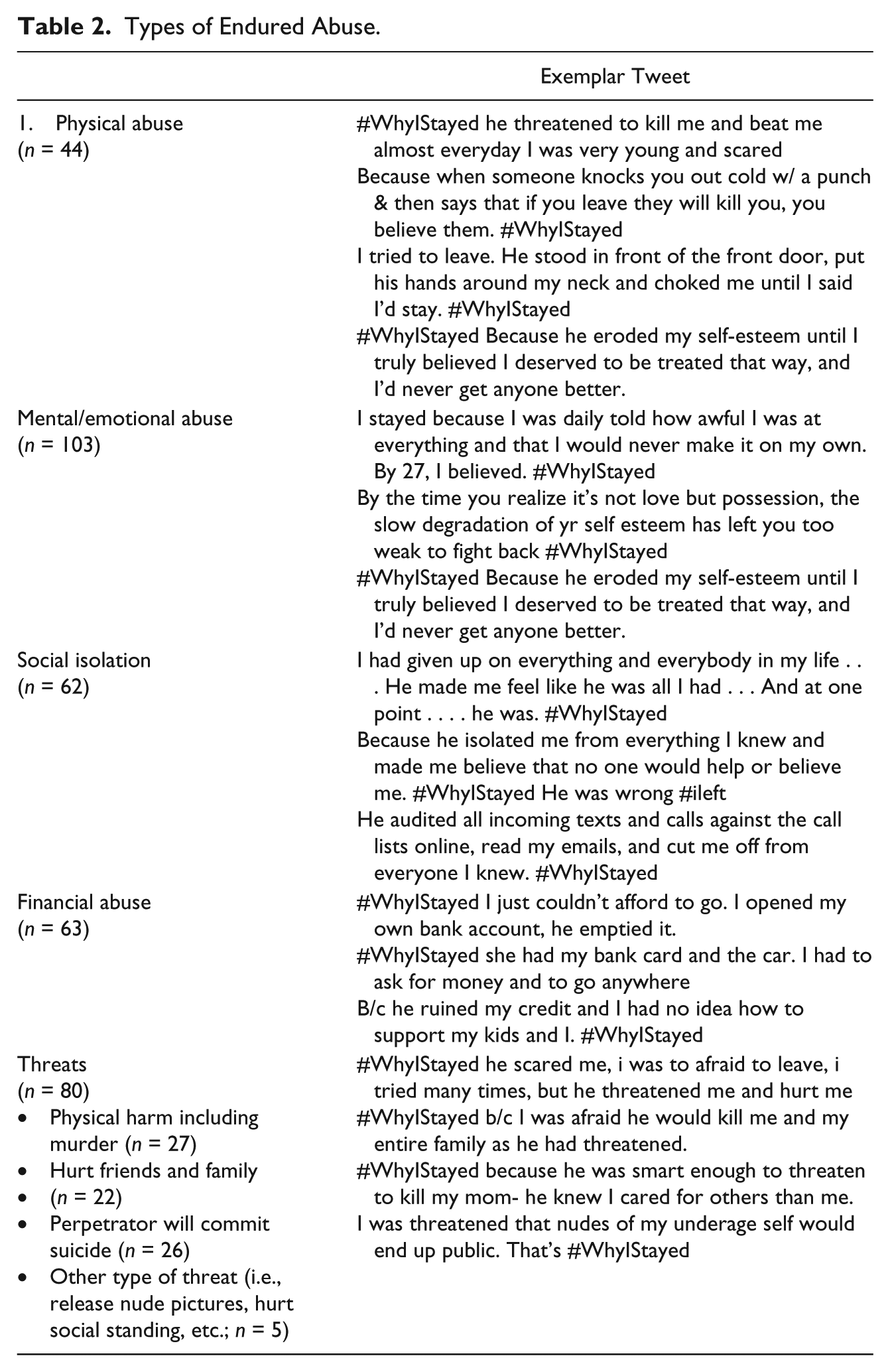
Across the #WhyIStayed sample, 384 individual tweets contained a description of the various types of abusive behaviors present in their relationships and the residual impact of these behaviors on the tweeter’s well-being. As summarized in Table 2, these behaviors map onto the intersecting behaviors that IPV researchers and advocates have described encompassing abusive relationships. The most frequently cited types of abuse included physical, emotional, mental abuse, financial exploitation, and threats of violence. Many of these tweets describe how the cumulative impact of multiple types of abuse affected their sense of emotional well-being, as the following tweet exemplifies: “Because after years of emotional, verbal and physical abuse you believe you are unworthy of happiness.”
Types of Endured Abuse.
Barrier to Leaving: Lack of Awareness Regarding the Dynamics of Abusive Relationships (n = 100)
Across the sample, #WhyIStayed tweeters shared a lack of awareness that their partners’ patterns of abusive behaviors met the threshold for being labeled abusive. This rationale was based on their perceptions that their experiences did not map onto their understanding of what a “typical” abusive relationship looked like. This includes the relationship not involving physical abuse or an acknowledgment that IPV relationships typically depict a pattern of abusive behaviors.
No physical abuse (n = 50)
Fifty tweets referenced the absence of physical abuse present in the tweeter’s relationship. For example, one tweeter shared “#WhyIStayed because both he and the world said that it wasn’t REAL abuse if he wasn’t leaving obvious, physical marks that people could see.” Similarly, another tweeter wrote, “I thought victims had to have bruises, black eyes and live in fear. I didn’t. He played nice just enough to keep me hopeful.” Therefore, the lack of physical abuse and its visual evidence present in their relationships made it difficult for abuse victims to see their partners’ behaviors as abusive.
Not always abusive (n = 50)
An additional barrier to leaving is the overarching belief that the relationship would get better because there were periods of relative equanimity—a pattern of abuse some DV scholars have described as “the cycle of abuse.” The following tweet illustrates this pattern “I thought he would go back to being the ‘charming’ & ‘romantic’ person I first met.” Similarly, another tweeter shared, “The first time he hits you, you tell yourself it was an isolated incident. He’s remorseful. You forgive. Life is normal again.” In this sense, tweeters described periods of time (sometimes extended) after incidents of heightened abuse where things were “good.” Furthermore, victims “lived in hope, it would get better,” with one tweeter adding “Nothing is more dangerous than the power of hope. Make you or break you.”
Barrier to Leaving: Not Identifying as a Stereotypical DV Victim (n = 85)
Overlapping with the previous theme regarding awareness of the complex dynamics of IPV, tweeters shared not identifying as abuse victims, because their experiences did not match societal constructions of victimhood. Tweeters shared either not identifying as abuse victims because they did not perceive themselves to be weak or because their gender identities or sexual orientations did not correspond with their perceptions of typical abuse victims.
Belief that IPV victims are disempowered and weak (n = 26)
Tweeters shared that they had a difficult time identifying as IPV victims, because of their assumption that IPV victims are in some way “weak” or “deficient.” In other words, their experiences did not correspond with dominant societal representations of IPV victims, as the following tweet exemplifies: “Strong women like me don’t end up in abusive relationships, so my relationship couldn’t have been abusive.”
“Nontraditional” victims (n = 59)
Similarly to the theme above, some tweeters stated that their personal identity did not match dominant representations of abuse victims. For example, tweeters in same-sex relationships and male victims of female-perpetrated abuse did not see their experiences reflected in dominant representations of abuse victims as White female-identified individuals in heterosexual relationships. As one tweeter shared, “I didn’t know lesbians could be in abusive relationships, everyone called it a ‘catfight.’” Similarly, a presumably male IPV survivor shared, “#WhyIStayed because there is no awareness for men’s abuse, because her story is always right, because I am a man even though I had the marks.”
Barrier to Leaving: Concern Regarding Reinforcing Racial Stereotypes (n = 7)
Although not a theme across the entire data set, a small sample of tweeters described how their decisions to stay in their relationships were motivated by a desire to not be associated with negative stereotypes that minority relationships are somehow pathological or inherently more violent. As the following tweet exemplifies: “Pressure of being the representation of ALL black women w/ a failed marriage or engagement proof that we aren’t worthy of love #WhyIStayed.” In addition, another tweeter posted “From the outside our relationship looked great, I wanted 2 believe it [could] be. I didn’t want 2b yng blk sgle [young, black, single] mom statistic.” Although there were only a small number of tweets (n = 7) with explicit reference to how racial identity affects decisions to remain in abusive relationships, this outlying perspective is an important context for understanding barriers for African American and Other people of color to reach out for supportive services.
Barrier to Leaving: Internalizing Social Scripts Regarding Relationships (n = 32)
Across the data set, tweeters reported internalizing implicit or explicit messages that they should work through the “challenges” they confronted in their relationships. Tweeters reported internalizing social scripts such as “relationships take work,” “children need a father,” and “marriage is forever.” For example, one tweeter stated, “he was my best friend, i married 4 life, i wanted to keep my family together . . .” Similarly, another participant shared “I didn’t wanna run when we hit a rough patch.”
The source of these messages mostly came from religious leaders, friends, and family members. In reference to council received from religious leaders, one participant shared the “Church taught me to forgive all things and that love is hopeful and patient. Church encouraged me to ‘love him through it.’” Similarly, another tweeter posted, “My church encouraged me 2 love without fail, pray for him, and be an example of God’s love to help heal him.” In reference to pressure from victims’ social networks, one tweeter posted, “People i turned to for help said I was abandoning my family—hurting and betraying them—and that I just needed to forgive. #whyistayed.” The subtext of these messages is that victims have a responsibility and capacity to support their partners and that abuse in relationships was something that could be “healed.”
Barrier Participants shared the overarching perception that “women are supposed to fix busted relationships, and if we don’t were [sic] failures.” As the following tweeter writes,
Barrier to Leaving: Structural Constraints (n = 78)
Across this sample, some Twitter participants described the structural factors that contributed to an overall feeling of being “stuck” in their abusive relationships. The following two tweets capture the multitude of factors that can make it difficult to leave an abusive relationship: “Some barriers to leaving: Shelter, Finances, Documentation, Children, Familial Support. Isolation. Violence. Hoping for Change #WhyIStayed.” “#WhyIStayed because i had two small children, no college degree, no job, and most of all no hope.” Table 3 provides examples of the most frequently occurring structural barriers: lack of shelter or no safe place to go, police inaction, and fear of losing children and interactions with the child welfare system. It is important to underscore that these tweets frequently co-occurred with other themes such as financial abuse, fear of leaving, and isolation from sources of support, which reinforces the interlocking factors that create the perception that obstacles to leaving are insurmountable.
Tweets Referencing Structural Barriers to Leaving Abusive Relationships.

Note. DV = domestic violence.
Barrier to Leaving: It Takes Time (n = 18)
The last thematic domain expressed by victims elucidated that separating from an abusive partner is complicated and takes significant time. For example, one tweeter shared “It’s not that f** simple. Wanting to leave and actually doing are 2 separate things. Til you’ve been there, you get no say. #WhyIStayed.” This tweeter underscores not only the ambivalence that survivors of IPV endure but also the perception that individuals who have not been in an abusive relationship do not understand the emotional, physical, and material challenges faced by abuse victims. As the following tweet illustrates, “#WhyIStayed Because as much as people believe this to be true, it wasn’t easy to ‘just leave.’”
Discussion and Implications for Practice
In response to the prompt #WhyIStayed, tweeters worldwide described the barriers associated with leaving abusive relationships. The compendium of #WhyIStayed tweets, produced a multifaceted representation of the lived experience of IPV. In describing their reasons for staying, tweeters recounted the cumulative impact of enduring multiple types of intersecting cyclical patterns of abuse, strategies for promoting their family’s safety, not identifying their partner’s behaviors as abusive, and the internalization of societal messages regarding victimhood and the causes of domestic violence. Thus, an in-depth analysis of these micro-narratives provides insight into the challenges associated with leaving abusive relationships, identifies critical places of intervention to support victim and survivors coping with abusive relationships, and underscores the potential of social media to capture the lived experience of IPV. Furthermore, the emergence of feminist-oriented hashtags such as #WhyIStayed and #MeToo presents a critical opportunity to reflect on the state of the field, discuss the applicability of existing theoretical frameworks and theories to describe IPV processes of leaving abusive relationships, and the impact of societal-level discourses on IPV victim’s meaning-making processes regarding their relationships.
Moving Toward More Process-Based Models of Staying and Leaving
Models of predominantly health behavior change, such as transtheoretical models of change and the health belief model, have been employed to identify strategies to bolster IPV victims’ levels of readiness and support victims in leaving their relationships. Although there is certainly a utility for stage-based theories, they have been critiqued in the IPV field for overemphasizing victim’s internal decision-making processes, while minimizing the structural and external factors that can make leaving not only challenging but potentially dangerous (Cluss et al., 2006; Tarzia et al., 2016). This study underscores that “readiness” is a multifaceted concept that is influenced by a litany of internal and external factors that the victim has no control over such as the availability of housing. Recasting leaving as more of a process rather than a singular “turning point” could help honor the hills and valleys that often accompany abuse survivors’ journeys navigating their relationships.
Therefore, these findings provide substantive empirical evidence for theoretical models, such as the model of psychosocial readiness and Overstreet and Quinn’s (2013) IPV stigmatization model, which underscore the interaction between internal and external factors in influencing victims’ complex processes of negotiating their relationship dynamics. For example, #WhyIStayed tweeters shared how they did not perceive their relationships to be abusive, because they did not include overtly physically abusive behaviors or because there could be periods of equanimity in their relationships. Therefore, individual-level awareness, a construct in Cluss et al.’s (2006) model of psychosocial readiness, can be an important indicator of IPV victims’ levels of readiness.
This study also provides important empirical evidence for elements of Overstreet and Quinn’s (2013) IPV stigmatization model, particularly concerning cultural stigma and stigma internalization. In this sample, historical representations of IPV victims as predominantly White, heterosexual, and weak, and/or disempowered figured prominently in tweeters meaning-making processes regarding their relationships. Furthermore, these findings emphasize the myriad ways that external factors get internalized and function to influence individuals’ decision-making processes to remain in abusive relationships. In reference to the IPV stigmatization model, these findings underscore how IPV victims have internalized cultural myths regarding what constitutes IPV, what a typical IPV victim looks like, and social scripts regarding individuals’ roles in “working through” relationship problems and elevating the “sanctity” of marriage. Elements of anticipated stigma were also evidenced by tweeters describing their reluctance to seek help, because they predicted not being believed (because of their social identity) or because they did not want to reinforce perceived stereotypes regarding members of their racial identities (in the instance of African American women). Trusted family members and faith leaders were seen as the predominant sources of tweeter’s misconceptions regarding their relationships. Therefore, these findings contradict Byrne and Arias’ (2004) finding that the support of family members did not predict an individual’s decision-making processes.
Although previous studies have investigated how stigma can serve as a barrier for LGBTQIA individuals (Calton et al., 2016), this study provides foundational evidence that many IPV victims—across marginalized identities—experience fear of being judged and not being believed. Future research should investigate similarities and differences in how stigma experiences are refracted through intersecting gender, sexual, racial, and socioeconomic positionalities. Furthermore, given that this research supports elements of multiple theories and models of leaving abusive relationships, future research would benefit from investigating areas of overlap and potential integration of theoretical frameworks into a more comprehensive model of leaving that incorporates the central role of stigma internalization.
These findings provide important implications for service providers that come in contact with abuse victims. First, IPV providers need to be aware that individuals who do not conform to dominant representations of abuse victims may be hesitant to identify as victims, name their experiences of domestic violence, and anticipate having their experiences minimized or discounted. Given that prior research has found that even well-intentioned DV workers can have biases regarding IPV victim’s culpability (Dunn & Powell-Williams, 2007; Thapar-Bjorkert & Morgan, 2010) and discriminatory attitudes regarding male-identified and non–gender-conforming victims’ experiences of abuse (Calton et al., 2016), antibias training is critically important for all service providers who work with IPV victims including those in the criminal justice and medical settings.
The Potential of Social Media Data to Develop More Expansive Understandings of IPV
This research demonstrates that Twitter messages have the capacity to function as micro-narratives that recount the lived experience of IPV. Although there has been attention to Twitter’s potential to be a tool to catalyze social change movements and to sensitize Twitter users to critical social issues (Ahlquist, 2014; Allen, Wicks, & Schulte, 2013), there has been a paucity of research investigating how Twitter can be used as a tool in applied social science research, particularly with regard to domestic and dating violence. This research points to the promise of using social media as a tool to investigate the complex lived experiences of IPV. Emergent themes such as “hoping it would get better” and “IPV depletes you emotionally,” and structural barriers such as lack of housing reinforce the existing literature on barriers to leaving abusive relationships (Anderson & Saunders, 2003; Lacey et al., 2011). This similarity with the IPV research and practice knowledge base provides a modicum of evidence for the validity and reliability of social media data, especially for hard to reach populations that can be difficult to locate using traditional data collection tools. This research provides evidence that Twitter can capture the experiences of individuals in the general population who may never come in contact with social service organizations and the criminal justice system. Future research should explore specifically what critical contextual information can be gleaned from using social media data to investigate underrepresented groups of DV survivors.
This research also reinforces the potential to use social media platforms as intentional opportunities to support victims in their processes of meaning making about their experiences in abusive relationships. Twitter users described the strength in being heard, speaking their “truth,” and setting the record straight about the barriers to leaving an abusive relationship. As one tweeter said, “#WhyIStayed I’VE ALWAYS WANTED TO BE HEARD.# thank you for opening this forum up.” This desire to be heard may be particularly pronounced for members of underrepresented communities such as people of color, gender-nonconforming individuals, and members of the LGBTQIA whose voices and experiences are sidelined and erased in the politicization of IPV. Therefore, there is the potential for social media platforms such as Twitter to function as spaces for members of underrepresented groups who have endured IPV to push back against dominant narratives that erase or misrepresented their experiences of violence.
Increased Community-Level Education Regarding IPV
Given the impact of external social messaging on individual’s decision-making processes to remain in their relationships, this study reinforces the importance of population-level social norms campaigns that target attitudes and norms that promote the acceptability of IPV (Lundgren & Amin, 2015). Clearly, abuse survivors are negatively affected by misinformation and stereotypes regarding IPV. Therefore, it would be remiss to not mention the importance of more robust community education on this social issue. As of 2014, only 13 states have mandated IPV prevention programming be implemented in schools, and school districts have considerable discretion in the content of implemented prevention programming (Black, Hawley, Hoefer, & Barnett, 2017). Based on the findings presented in this study, it is evident that all individuals receive more education on the antecedents of abuse, the diversity of individuals who are affected by abuse, the various types of abuse and behaviors that encompass abusive relationships, and the challenges to safely exiting abusive relationships. Furthermore, individuals need guidance on strategies to meaningfully support victims of abuse in ways that do not reinforce existing feelings of blame and culpability. As one tweeter in this study posted “It’s 2014 and the same question is still being asked: Why do women stay? Educate the nation.”
Limitations
There are several limitations worth noting. First, Twitter users are not a representative sample, and individuals use this platform in a variety of different ways (i.e., consuming news, connecting with work colleagues, etc.). Therefore, there are likely significant differences between Twitter users and the general population: This sample is generalizable only to those who respond to and follow social issues on Twitter. Next, we did not have access to twitter user handles, so the unit of analysis was each discrete tweet not the individual. Relatedly, another notable limitation is that this sample is not inclusive of Twitter user demographics scrapped from user’s profiles. Therefore, we could not report on the demographic composition of the sample, although we did inductively code for individuals’ self-reported demographics within the body of each tweet. It should be noted that self-reported information within online spaces is unreliable and interpreted cautiously. Finally, the inability to translate emoticons into text (i.e., smiley faces, hearts breaking, etc.) means the researchers lost potentially important pieces of context that could inform the analysis process.
Conclusion
The #WhyIStayed social media campaign extended beyond a space of feminist dialogue and became a broader platform for global public discourse on the barriers to leaving abusive relationships. The depth of the #WhyIStayed tweets in their entirety represents an important primer about the lived experience of living with and leaving abusive relationships and can validate and augment existing theoretical models of leaving abusive relationships. These findings paint a compelling portrait of the multitude of barriers across system levels that inform victims’ decision-making processes to “stay” in their abusive relationships. Tweeters described enduring beliefs that the relationship would improve, to being emotionally worn down by the abuse, to a strong desire to heed the advice of trusted referents to “keep one’s family together.” Because of the robust nature of social media data, this study provides a unique glimpse into the processes and mechanisms that influence individual decision making and meaning making. In short, as this quantity and diversity of Tweets in response to the question “Why did you stay?” illustrates, there is never just one reason why victims stay with their abusive partners. Although there are common experiences, impressions of structural barriers, and patterns of abuse, what we found in this compendium of tweets is, “Leaving was a process, not an event. And, sometimes, it takes a while to navigate through the process. #WhyIStayed.”
Footnotes
Acknowledgements
The authors would like to thank Bev Gooden for initiating this groundbreaking social media campaign, and for all of the tweeters who bravely shared their abuse experiences. We also would like to acknowledge Jessica Bagneris and Joe Mienko, for their research support on this project.
Declaration of Conflicting Interests
The author(s) declared no potential conflicts of interest with respect to the research, authorship, and/or publication of this article.
Funding
The author(s) received no financial support for the research, authorship, and/or publication of this article.