




Abstract
Families can play an essential role in preventing violent and antisocial behaviors, which are considered a significant public health issue. However, some studies argue that most children are antisocial only during adolescence, and even teenagers can mimic antisocial behavior in ways that are normative and well-adjusted. This study analyzed patterns of competence and adjustment in young adults with and without an antisocial tendency during adolescence from authoritative (characterized by warmth and strictness), authoritarian (strictness but not warmth), indulgent (warmth but not strictness), and neglectful (neither warmth nor strictness) families. Emergent research has indicated that in a European context, the indulgent parenting style is optimal. Offspring’s competence and adjustment were captured through self-esteem (academic and family), psychosocial development (self-competence and empathy), and low emotional maladjustment (nervousness and hostility). Participants consisted of a community sample of 489 Spanish young adults, 191 men (39.1%) and 298 women (60.9%), aged 18 to 34 years old. The design was a 4 × 2 × 2 × 2 MANOVA (parenting style × antisocial tendency × sex × age). Analysis of main effects showed that youths with an antisocial tendency have less self-esteem and psychosocial development, but more emotional maladjustment. Regardless of the parenting style, an antisocial tendency during adolescence is consistently associated with worse adjustment in young adults. Both the authoritative and indulgent parenting styles are consistently associated with better outcomes (higher self-esteem and psychosocial development, and lower emotional maladjustment) than the authoritarian and neglectful parenting styles. However, there are interactions between the parenting style and the antisocial tendency. For young adults without an antisocial tendency, only indulgent parenting is associated with less emotional maladjustment. These results support the idea that in Europe the indulgent parenting style performs better than the authoritative style, but only when raising adolescents without an antisocial tendency. For young adults with an antisocial tendency, indulgent and authoritative parenting are equally optimal for all the studied outcomes.
Introduction
Despite public authorities’ efforts to reduce young people’s tendency toward antisocial behaviors and violence, this problem continues to be considered a major public health issue by the World Health Organization (WHO; 1996, 2015; see also Krug, Mercy, Dahlberg, & Zwi, 2002). American and European data suggest an unprecedented surge in the tendency toward antisocial behaviors and violence against socially established norms among young people. Therefore, this epidemic not only affects violent youths and their families, victims, and peers but it also involves society as a whole (Office of the Surgeon General, 2001). Researchers currently study children with antisocial tendencies in contexts such as the school (bullying, E. M. Lund & Ross, 2016; cyberbullying, Garaigordobil, 2017; Larrañaga, Yubero, Ovejero, & Navarro, 2016), the family (even child-to-parent aggression, Calvete, Orue, & Gámez-Guadix, 2012), teen dating (traditional dating, Sjodin, Wallinius, Billstedt, Hofvander, & Nilsson, 2017; cyberdating, Sánchez, Muñoz-Fernández, & Ortega-Ruíz, 2015), and the neighborhood (Gracia, Fuentes, García, & Lila, 2012). Children’s antisocial tendency involves undercontrolled behaviors that are manifested as aggression, disruptiveness, defiance, hyperactivity, and impulsivity (e.g., Ackerman, Brown, & Izard, 2003; Pinquart, 2017). This tendency is conceptualized in numerous studies as a pandemic that constitutes a community problem (WHO, 1996, 2015) and is associated with multiple indicators of youth maladjustment, such as lack of psychosocial maturity, low self-esteem, and aggression problems (Gracia et al., 2012; E. M. Lund & Ross, 2016; Sjodin et al., 2017). Moreover, in some severe cases, an antisocial tendency can lead to psychiatric disorders and criminal behaviors (Moffitt, 1993; Steinberg, Blatt-Eisengart, & Cauffman, 2006; Uceda-Maza & Alonso, 2017).
However, the theory of adolescence-limited antisocial behavior (for a review, see Moffitt, 1993) argues that a large group of children are antisocial only during adolescence, and even teens can mimic antisocial behavior in ways that are normative and well-adjusted (Moffitt, Caspi, Harrington, & Milne, 2002; Roustit et al., 2009). Reinforcing this argument, traditional clinical studies have suggested that adolescents’ “identity crisis” and “individuation” both imply a certain degree of discomfort, disruptiveness, and defiance for the family, but they are justified because teenagers on the path to healthy adulthood have to free themselves from dependence on their parents to form an identity of their own (Blos, 1967; Erikson, 1968). From the opposite point of view, several traditional studies of community samples of adolescents drawn from schools, rather than clinics (Josselson, Greenberger, & McConochie, 1977; Rutter, Graham, Chadwick, & Yule, 1976), argue that “while storm and stress may be the norm in families of teenagers with depression or conduct disorder, conflict is not normative in average families” (Steinberg, 2001, p. 4).
Parenting socialization theory explains that parents’ behaviors can contribute to the social behavior of their children or fail in the parenting socialization process when their children manifest antisocial behavior. Research conducted mainly in Anglo-Saxon contexts with European American samples has largely identified authoritative parents (i.e., warm and responsive parents who provide firm control and maturity demands at the same time) as the optimal (i.e., normative) parenting style. Authoritative homes have consistently been associated with a wide range of optimal outcomes in children and adolescents. Based on an extensive set of children’s outcomes analyzed, children from authoritative households (warm and firm) are more psychosocially competent, more successful in school, and less prone to internalizing or externalizing problems than their peers who have been raised in authoritarian (firm but not warm), indulgent (warm but not firm), or neglectful (neither warm nor firm) homes (Baumrind, 1983; Darling & Steinberg, 1993; Lamborn, Mounts, Steinberg, & Dornbusch, 1991; Lewis, 1981; Maccoby & Martin, 1983).
Parents are still considered the main socializing agents during adolescence, a period in which the concentration of antisocial behavior is well-documented (Moffitt, 1993, 2018), despite the importance given to other factors, such as peer social influences, broader social and contextual factors, cultural approval of violence, or even genetic predispositions (for reviews, Moffitt, 2018; Raine, 2002). In fact, seminal cross-sectional (Lamborn et al., 1991) and longitudinal (Steinberg, Lamborn, Darling, Mounts, & Dornbusch, 1994) community studies showed a persistent pattern of association between parenting styles (authoritative, authoritarian, indulgent, or neglectful) and four sets of adolescent outcomes (psychosocial development, school achievement, internalized distress, and problem behavior) during adolescence. These studies showed a typical pattern of competence and adjustment that has been associated with the four parenting styles: (a) the optimal style is the authoritative one, (b) the indulgent and authoritarian styles fall in the middle (e.g., as a mixed option of qualities and problems), and (c) the worst style is the neglectful one.
On one hand, in numerous studies, authoritative parenting (warmth and strictness) is continuously found to be the optimal parenting style across a wide range of developmental and behavioral outcomes (Hoffmann & Bahr, 2014; Lamborn et al., 1991; Maccoby & Martin, 1983; Steinberg et al., 1994). Therefore, adolescents from authoritative households tend to use illegal drugs less (Hoffmann & Bahr, 2014; Montgomery, Fisk, & Craig, 2008), be more resilient (Kritzas & Grobler, 2005), have higher levels of self-esteem (Turner, Chandler, & Heffer, 2009), achieve better academic performance (Cohen & Rice, 1997; Im-Bolter, Zadeh, & Ling, 2013), have better psychological competence (Lamborn et al., 1991; Turner et al., 2009) and more adaptive strategies (Aunola, Stattin, & Nurmi, 2000), and be less involved in a broad spectrum of behavior problems (e.g., school misconduct, drug use, and delinquency; Lamborn et al., 1991; Steinberg et al., 1994). On the other hand, neglectful parenting (neither warmth nor strictness) is constantly found to be the worst parenting style for adolescents in terms of promoting more harmful outputs, for instance, the tendency to use more drugs, have less resilience, have more psychological maladjustment, use more ineffective adaptive strategies, and be involved in more problems (Aunola et al., 2000; Hoffmann & Bahr, 2014; Lamborn et al., 1991; Steinberg et al., 1994; Turner et al., 2009). In the middle, adolescents with authoritarian parenting score reasonably well on obedience and conformity to norms (they do well in school and are less likely than their peers to be involved in deviant activities, for example, drug use or delinquency), but they have relatively worse self-reliance and higher psychosocial and somatic distress. Adolescents from indulgent homes show a strong sense of self-confidence, but they report a higher frequency of substance abuse and school misconduct and are less engaged in school (see Lamborn et al., 1991; Steinberg et al., 1994).
Optimal authoritative parenting consists of parental strictness (also referred to as demandingness, imposition, and parental firmness) to correct and punish children’s maladaptive behavior, along with the firm aim of achieving their children’s adjustment and full compliance with the social rules. However, authoritative parenting also involves parental warmth (also referred to as responsiveness, acceptance, and involvement) to reinforce parental support and help children to reach conformity and compliance with the social norms. Hence, for children with highly responsive parents, this context will include parental warmth and acceptance of the child, as well as an emphasis on aspects such as reciprocity (rather than mere compliance), psychological autonomy (rather than mere conformism), and rational discourse (rather than coercion and intimidation). In most cases, discipline will be nonpunitive and accompanied by clear explanations and reasoning (e.g., Baumrind, 1971; Grusec, Danyliuk, Kil, & O’Neill, 2017; Lamborn et al., 1991; Steinberg et al., 1994). Dual elements of warmth and strictness are crucial for optimal authoritative parenting—with the former (warmth) referring to parental involvement and responsiveness to support and reinforce the developing child’s individuality, whereas the latter (strictness) is related to parental imposition and demandingness in an attempt to make the child conform to societal and family expectations. Thus, parenting socialization theory claims that the practices of parents who are warm and involved (i.e., authoritative and indulgent) have a different meaning from the same practices administered by parents who are cold and uninvolved (i.e., authoritarian and neglectful; Darling & Steinberg, 1993; F. García & Gracia, 2009, 2014; Martínez, Cruise, García, & Murgui, 2017). The parenting styles framework captures overall long-term parenting characteristics that integrate and organize particular or specific parenting practices and accurately establish the relations among parenting styles, parenting practices, and their associations with children’s short- and long-term adjustment or maladjustment (Darling & Steinberg, 1993; F. García & Gracia, 2009, 2014; Lamborn et al., 1991; Maccoby & Martin, 1983; Symonds, 1939).
However, there are doubts about whether the acceptance and involvement component of authoritative parents (shared by authoritative and indulgent styles) is always necessary for an optimal parenting style (e.g., Clark, Yang, McClernon, & Fuemmeler, 2015). Literature on parenting also supports the authoritarian parenting style (strictness, but no warmth) as an appropriate parental strategy (i.e., normative parenting style) in needy ethnic minority families and dangerous communities, where authoritarian parenting may not be as harmful and may even have some protective benefits (Furstenberg, Cook, Eccles, Elder, & Sameroff, 1999). Earlier studies in the United States with ethnic minority groups, such as African Americans (Baumrind, 1972; Deater-Deckard & Dodge, 1997; Deater-Deckard, Dodge, Bates, & Pettit, 1996), Chinese Americans (Chao, 1994; Wang & Phinney, 1998), Hispanic Americans (Torres-Villa, 1995; Zayas & Solari, 1994), or multiethnic Americans (Steinberg, Dornbusch, & Brown, 1992), suggest that the authoritarian parenting style is an appropriate parental strategy. Steinberg et al. (2006), sampling severe juvenile offenders, conclude that “it is not that authoritarian parenting is good for poor, urban, ethnic minority adolescents, but, rather, that authoritarian parenting may not be as bad for these adolescents as it has been shown to be for their middle-class, suburban, white counterparts” (p. 56).
Furthermore, previous findings examining how antisocial youth might have better or worse outcomes depending on different parenting styles through parenting intervention programs for children with antisocial behaviors suggest that parental practices could improve or exacerbate children’s antisocial behavior (Buchanan-Pascall, Gray, Gordon, & Melvin, 2018). Nevertheless, most of these studies stem from clinical studies, rather than from community samples, and they do not offer clear evidence. On one hand, warm, affective, responsive, and inductive parenting (shared by indulgent and authoritative parenting styles) tends to improve prosocial behaviors in antisocial children (Pinquart & Kauser, 2018). However, other studies have suggested that parental involvement (i.e., warm, affective, responsive, and inductive) could undermine children’s social adjustment in antisocial children, exacerbating both externalizing and internalizing problems (Ruiz-Ortiz, Braza, Carreras, & Muñoz, 2017). On the other hand, authoritarian parenting characterized by harsh parenting has been associated with more antisocial behavior in children (Martínez, Murgui, Garcia, & Garcia, 2019; Tung & Lee, 2018), although other findings have suggested that a lack of strictness and imposition could be associated with antisocial behavior (Furstenberg et al., 1999).
In addition, the indulgent parenting style, characterized by warmth but not strictness, also provides ample benefits for children’s well-being (i.e., normative parenting style) in European and Latin American countries (DiMaggio & Zappulla, 2014; F. García et al., 2015; F. García & Gracia, 2009, 2010; O. F. Garcia, Serra, Zacares, & Garcia, 2018; Gracia et al., 2012; Martínez et al., 2017; Valente, Cogo-Moreira, & Sanchez, 2017; Wolfradt, Hempel, & Miles, 2003). For Spanish adolescents, the indulgent parenting style appears to be a main protective factor against alcohol and drug use and as useful as the authoritative parenting style (Calafat, García, Juan, Becoña, & Fernández-Hermida, 2014; Fuentes, Alarcón, García, & Gracia, 2015; F. García & Gracia, 2009, 2010; Martínez, Fuentes, García, & Madrid, 2013). In fact, the indulgent parenting style provides better results than the authoritative style on criteria such as self-esteem, values internalization, psychological maladjustment, personal competence, and a broad spectrum of behavioral problems (Fuentes, Alarcón, et al., 2015; Fuentes, García, Gracia, & Alarcón, 2015; Garaigordobil & Aliri, 2012; Martínez & García, 2007; Riquelme, Garcia, & Serra, 2018). For example, a critical community study with Spanish adolescents (F. García & Gracia, 2009) that analyzed 17 outcomes (related to multidimensional self-esteem, psychosocial maladjustment, personal competence, and problem behaviors) showed that (a) adolescents from indulgent and authoritative parenting styles were associated with better outcomes than those with authoritarian and neglectful parenting and (b) indulgent parenting was always equal to or better than the authoritative style. These findings reinforce the influence of culture on the relation between parental socialization and psychological adjustment (Baumrind, 1972; Chao, 1994; Darling & Steinberg, 1993; F. García & Gracia, 2009, 2014; Steinberg et al., 1992). In addition, the concepts of collectivism (emphasizing one’s interdependence) versus individualism (valuing personal independence), and vertical (emphasizing hierarchy) versus horizontal (valuing equality) cultural backgrounds have traditionally been called upon to explain observed differences in the association between parenting styles and youth outcomes (e.g., Rudy & Grusec, 2001; Triandis, 2001; White & Schnurr, 2012). Researchers have suggested that in European cultures (e.g., Spain), considered to be horizontal and collectivistic, the relationship between parents and their children is more egalitarian than in Anglo-Saxon countries (individualistic culture) or Asian or Arabic countries (vertical collectivist culture). European children could perceive parental strictness, punishment, and imposition as meddling and coercive rather than as parental care and responsibility (Calafat et al., 2014; Chao, 1994; F. García & Gracia, 2009; Martínez & García, 2007; White & Schnurr, 2012).
It is widely assumed in the literature that children with an antisocial tendency have the poorest psychological competence and consistently worse adjustment on several outcomes (Gracia et al., 2012; E. M. Lund & Ross, 2016; Sjodin et al., 2017), and public authorities have conceptualized this tendency as a pandemic that constitutes a community problem (e.g., WHO, 1996, 2015). However, studies have commonly analyzed adolescents’ antisocial tendency as one more outcome of the parenting style (Garaigordobil & Aliri, 2012; Garcia & Gracia, 2010; Lamborn et al., 1991; Steinberg et al., 1994), but not as a factual pandemic risk factor that can undermine the psychosocial health of teenagers on the path to healthy adulthood (Blos, 1967; Erikson, 1968). As adolescence-limited antisocial behavior theory suggests (Moffitt, 1993), a large number of children are antisocial only during adolescence, which casts doubt on whether this large group with an antisocial tendency will have any future psychosocial health handicaps, or whether they are only manifesting an adolescent normative antisocial behavior of “storm and stress” (F. García & Gracia, 2009; Rutter et al., 1976; Steinberg, 2001).
This study examines the long-term effects of parenting socialization beyond adolescence in children with an antisocial tendency (Krug et al., 2002; WHO, 1996, 2015). Based on the literature review, we hypothesize, first, that youths with an antisocial tendency will be associated with the worst adjustment. Based on public authorities and current research, children with an antisocial tendency have the poorest psychological competence and consistently worse adjustment. Second, indulgent and authoritative parenting styles will be associated with better outcomes in children than authoritarian and neglectful parenting styles. Based on the literature in Europe (e.g., Spain), the parental warmth shared by indulgent and authoritative parenting styles will be related to advantaged children (i.e., psychological competence and adjustment), and a lack of parental warmth, shared by the authoritarian and neglectful parenting styles, will be related to disadvantaged children (i.e., psychological incompetence and maladjustment). Third, the indulgent parenting style will be associated with better child adjustment compared with authoritative, neglectful, and authoritarian parenting styles. Accordingly, as literature in Europe (e.g., Spain) shows, of the two parenting styles that share warmth and involvement, the indulgent parenting style (warmth but not strictness) will be more related to better advantaged children than the authoritative parenting style (warmth and strictness).
Method
Participants and Procedure
The study was carried out at a large university in southeastern Spain. Participants were 489 young adults (298 female and 191 male; mean age = 23.09 years, SD = 4.58; range = 18-34) recruited in undergraduate education courses (Manzeske & Stright, 2009; Parish & McCluskey, 1992). The research protocol was approved by the Research Ethics Committee of the Program for the Promotion of Scientific Research, Technological Development and Innovation of the Spanish Valencian Region, which funded this research. All the young adults who participated in this study (a) were Spanish, as were their parents and four grandparents; (b) reported no official contact with the police as a juvenile (until the age of 18) or an arrest as an adult (at the age of 18 or more); (c) participated voluntarily; and (d) received some course credit for participating. Data were collected by using an online survey with mandatory responses hosted on the University website. As data protection measures, (a) identifiers (e.g., university account) and survey data were saved in separate files and (b) directory passwords were protected, and sensitive files were encrypted. During a regular class period, participants completed information about the purpose of the study and signed a declaration of consent. Participants who did not complete the online survey on time (1 week) were removed from the sample (1.2%, n = 6). The questionnaires were examined for questionable response patterns, such as reporting implausible inconsistencies between negatively and positively worded responses (J. F. García, Musitu, Riquelme, & Riquelme, 2011; Tomas & Oliver, 1999, 2004). About 3% (n = 15) of the cases were identified as questionable and removed from the sample. With the study sample of 489 participants, sensitivity power analysis guaranteed the detection of a medium-small effect size of 0.188 (four parenting style groups; f = 0.188, α = .05, 1 − β = .95; Calafat et al., 2014; Erdfelder, Faul, & Buchner, 1996; F. García & Gracia, 2014; Gracia, García, & Musitu, 1995; Pérez, Navarro, & Llobell, 1999).
Measures
Parenting styles
Parental warmth was measured with the 20-item Warmth/Affection Scale (WAS, Ali, Khaleque, & Rohner, 2015; Rohner, Saavedra, & Granum, 1978), which offered a reliable measure of the extent to which the young adults had perceived their parents as loving, responsive, and involved during their adolescence. Two sample items are as follows: “Let me know they loved me” and “Talked to me about our plans and listened to what I had to say.” Parental strictness was measured with the 13-item Parental Control Scale (PCS, Rohner & Khaleque, 2003, 2005), which offered a reliable measure of the extent to which the young adults had perceived strict parental control over their behavior during their adolescence. Two sample items are as follows: “Told me exactly what time I had to be home when I went out” and “Gave me certain jobs to do and would not let me do anything else until I was done.” Because all the statements were about participants’ adolescent years, we included the following sentence in the instructions: “Here are some phrases or statements that describe how parents act with their children (adolescent). Compare each statement to the way your parents treated you” (Buri, 1991; Hammond, Landry, Swank, & Smith, 2000; Kuyumcu & Rohner, 2018). Each item on both scales was answered on a 5-point scale ranging from 1 (no, never) to 5 (yes, always). Both parenting indexes measured family parenting behavior (see Lamborn et al., 1991; Steinberg et al., 1994), so that higher scores represent a greater sense of parental warmth and parental strictness (F. García et al., 2015; F. García & Gracia, 2014). Cronbach’s alpha for each scale was as follows: parental warmth, .945, and parental strictness, .888. Following the procedure of Lamborn and colleagues (1991) and Steinberg (2005), four parenting styles (authoritative, indulgent, authoritarian, and neglectful) were established by the median split (50th percentile) in each family dimension (warmth and strictness), and then both variables were examined together. Authoritative families scored above the 50th percentile on both warmth and strictness, whereas neglectful families were below the 50th percentile on both variables. Authoritarian families scored below the 50th percentile on warmth and above the 50th percentile on strictness, whereas indulgent families scored above the 50th percentile on warmth, but below the 50th percentile on strictness (Chao, 2001; Gracia et al., 2012; Musitu & Garcia, 2001).
Antisocial tendency was measured with the 13-item Youth Deviance Scale (Gold, 1970; Herrenkohl et al., 2000; Spanish Adaptation: F. García & Gracia, 2010), which evaluates acts ranging from mischief at school to severe harm or threats of harm to other people (F. García & Gracia, 2009; Lamborn et al., 1991; Steinberg et al., 1994). Two sample items are as follows: “Painting or damaging the walls of the school/institute” and “Attacking or hitting strangers.” Because all the statements were about the participants’ years in high school, we included the following sentence in the instructions: “Listed below are behaviors that could be performed by adolescent students. Please read each statement and decide to what extent it describes your case during adolescence” (Collette, Pakzad, & Bergheul, 2015; Kennedy, Bybee, Palma-Ramirez, & Jacobs, 2017; Rebellon & Straus, 2017). Participants responded on a 3-point scale ranging from 1 (never) to 3 (two or more times). Higher scores represent a greater antisocial tendency. Cronbach’s alpha value was .750. Young adults were grouped by the median split (50th percentile) into a low or high antisocial tendency (Petee & Walsh, 1987).
Self-esteem
Academic and family self-esteem were measured with two 6-item subscales from the Multidimensional Self-Esteem Scale (AF5; F. García, Gracia, & Zeleznova, 2013; F. García & Musitu, 1999; J. F. García et al., 2011; J. F. García, Musitu, & Veiga, 2006). A sample item for academic self-esteem is: “I am a hard worker [good student]”; and a sample item for family self-esteem is: “My family would help me with any type of problem.” Young adults responded on a 99-point scale, ranging from 1 (strong disagreement) to 99 (strong agreement). Modifications were made to obtain a score index ranging from 0.10 to 9.99. Higher scores represent a greater sense of self-esteem. Cronbach’s alpha for each subscale was as follows: Academic, .885, and Family, .848.
Psychosocial development was measured with the Self-Competence and Empathy subscales of the Psychosocial Maturity Questionnaire (CRPM3; Zacarés, Serra, & Torres, 2015; see Greenberger, Josselson, Knerr, & Knerr, 1974; Lamborn et al., 1991). Self-competence was measured with 12 items. Two sample items are as follows: “I consider myself to be effective in my work” and “I have confidence and trust in myself.” Empathy was measured with five items. Two sample items are as follows: “I am sensitive to others’ feelings and needs” and “I know how to listen to other people.” On both scales, young adults responded on a 5-point scale ranging from 1 (strongly disagree) to 5 (strongly agree). Higher scores on self-competence and empathy indicate a greater sense of psychosocial development. Cronbach’s alpha value for each subscale was as follows: Self-Competence, .846, and Empathy, .629.
Emotional maladjustment was measured with the Nervousness and Hostility subscales. Nervousness was assessed with eight items from the Psychosocial Maturity Questionnaire (CRPM3; Greenberger et al., 1974; Zacarés et al., 2015). Two sample items are as follows: “I am usually tense, nervous and anxious” and “I get irritated easily.” Young adults responded on a 5-point scale ranging from 1 (strongly disagree) to 5 (strongly agree). Higher scores on nervousness represent greater emotional maladjustment. Cronbach’s alpha value was .794. Hostility was assessed with the six items from the Personality Assessment Questionnaire (PAQ; Ali et al., 2015; F. García & Gracia, 2009, 2010; Rohner, 1978). Two sample items are as follows: “I think about fighting or being mean” and “I get so mad I throw or break things.” The young adults responded on a 4-point scale ranging from 1 (almost never true) to 4 (almost always true). Higher scores on hostility represent greater emotional maladjustment. Cronbach’s alpha value was .673.
Plan of Analysis
The relation between the parenting style and the antisocial tendency and the young adults’ adjustment was examined in a four-way multifactorial multivariate analysis of variance (MANOVA). In addition, to analyze these relations, we also take into account two demographic variables (sex and age) that have been identified in the literature as relevant in understanding associations between an antisocial tendency, parenting, and outcomes. We will use these variables as independent variables (i.e., factors), rather than as statistical controls, to (a) test for any possible moderation (i.e., interaction) and (b) analyze whether well-documented effects of demographic factors on the dependent variables (i.e., outcomes or criterion variables) are as expected. All these design factors control (decrease) residual variance and increase the multivariate Λ-test and univariate F-test power (see Gracia, García, & Lila, 2011; Maxwell & Delaney, 2004). A factorial (4 × 2 × 2 × 2) MANOVA was applied for the six outcome variables: (a) academic and (b) family self-esteem outcomes; (c) self-competence and (d) empathy psychosocial development outcomes; and (e) nervousness and (f) hostility emotional maladjustment outcomes. The four factors were parenting style (authoritative, authoritarian, indulgent, and neglectful), the antisocial tendency (low vs. high), sex (men vs. women), and age (18-24 vs. 25-34). Follow-up univariate F-tests were performed for all the sources of variation when we found multivariate statistically significant differences. Univariate significant results were followed by post hoc Bonferroni comparisons among all the possible pairs of means (F. García & Gracia, 2009; Lamborn et al., 1991; Steinberg et al., 1994; Veiga, Garcia, Reeve, Wentzel, & Garcia, 2015).
Results
Parenting Style Groups
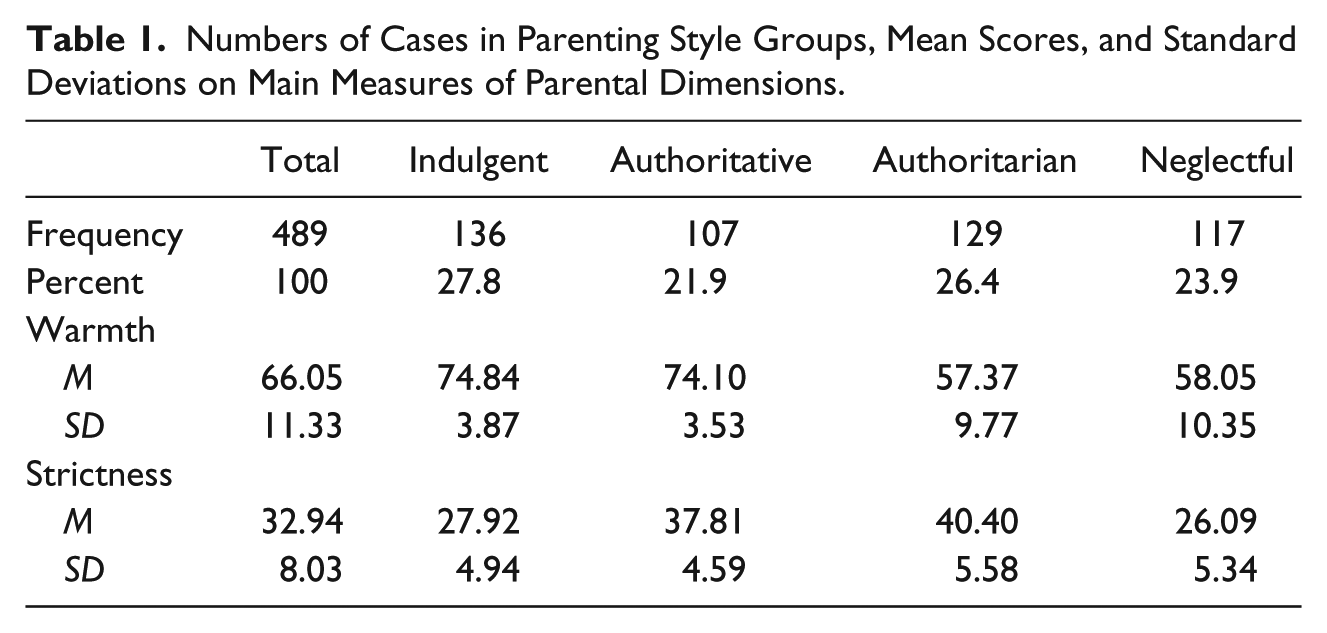
Young adults were classified into one of the four parenting groups (indulgent, authoritative, authoritarian, or neglectful; Table 1). The indulgent group contained 136 (27.8%) young adults, with high warmth, M = 74.84, SD = 3.87, but low strictness, M = 27.92, SD = 4.94; the authoritative group contained 107 (21.9%), with high warmth, M = 74.10, SD = 3.53, and high strictness, M = 37.81, SD = 4.59; the authoritarian group contained 129 (26.4%), with low warmth, M = 57.37, SD = 9.77, and high strictness, M = 40.40, SD = 5.58; and the neglectful group contained 117 (23.9%), with low warmth, M = 58.05, SD = 10.35, and low strictness, M = 26.09, SD = 5.34. Additional analyses also showed that the two parental dimensions, warmth and strictness, consistent with the orthogonality assumption, were modestly intercorrelated, r = −.129, R2 = .017, less than 2%, p < .005; the distributions of families by parenting style categories were homogeneous, χ2(3) = 4.05, p = .256; and the parenting style × sex interaction was not statistically significant, χ2(3) = .59, p = .898.
Numbers of Cases in Parenting Style Groups, Mean Scores, and Standard Deviations on Main Measures of Parental Dimensions.
Multivariate Analyses
The MANOVA analysis yielded statistically significant interaction effects between the parenting style and the antisocial tendency, Λ = .937, F(18, 1278.9) = 1.65, p < .05, and main effects of parenting, Λ = .729, F(18, 1278.9) = 8.38, p < .001; antisocial tendency, Λ = .943, F(6, 452.0) = 4.52, p < .001; sex, Λ = .916, F(6, 452.0) = 6.89, p < .001; and age, Λ = .953, F(6, 452.0) = 3.68, p = .001 (Table 2).
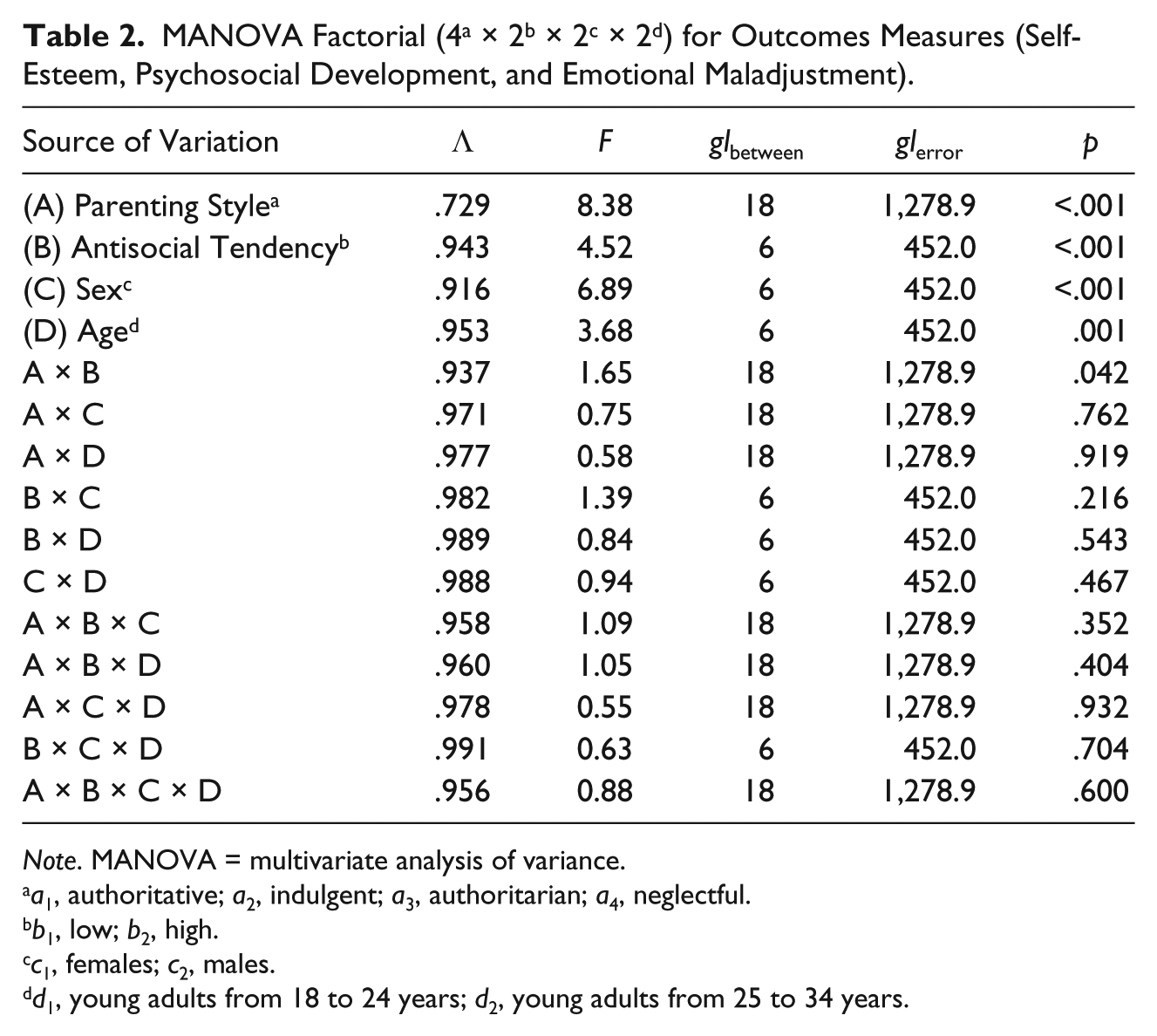
Note. MANOVA = multivariate analysis of variance.
a1, authoritative; a2, indulgent; a3, authoritarian; a4, neglectful.
b1, low; b2, high.
c1, females; c2, males.
d1, young adults from 18 to 24 years; d2, young adults from 25 to 34 years.
Univariate analyses for parenting and antisocial tendency effects
In the case of self-esteem, in both the academic and family dimensions, the results confirmed the first hypothesis: Young adults with an antisocial tendency have less academic and family self-esteem than non-antisocial youths (see Table 3). Regarding the second hypothesis, young adults from indulgent and authoritative families reported higher academic and family self-esteem than their peers from authoritarian and neglectful homes.
Means (Standard Deviations) of Parenting Style, Antisocial Tendency, and Sex, and Main Univariate F Values for Outcomes Measures (Self-Esteem, Psychosocial Development, and Emotional Maladjustment).

Note. Bonferroni test α = .05; 1 > 2 > 3. Significant level test on Bonferroni post hoc test comparison was indicated by α = .05. Superscripts "1, 2, and 3" indicated that mean with superscript 1 is higher than mean with superscript 2; and mean with superscript 2 is higher than mean with superscript 3.
p < .05. **p < .01. *** p < .001.
In the case of psychosocial development, on both self-competence and empathy, the results confirmed the first hypothesis: antisocial young adults showed less self-competence and empathy than non-antisocial youths. Regarding the second hypothesis, young adults who characterized their parents as indulgent and authoritative had higher self-competence and empathy scores than those from authoritarian and neglectful homes.
For emotional maladjustment, the results confirmed the first hypothesis: antisocial young adults reported higher nervousness and hostility scores than non-antisocial young adults. On nervousness emotional maladjustment, supporting the third hypothesis, young adults from indulgent families had the lowest nervousness scores. The highest scores corresponded to those from authoritarian families, and in the middle position were young adults from authoritative and neglectful households. In addition, we found interaction effects of parenting style × antisocial tendency, F(3, 457) = 2.877, p = .036 (see Figure 1). Interestingly, the results confirmed the third hypothesis only for non-antisocial young adults, whereas for antisocial young adults, the results confirmed the second hypothesis. Hence, raising non-antisocial children in indulgent families is associated with the lowest scores on nervousness.
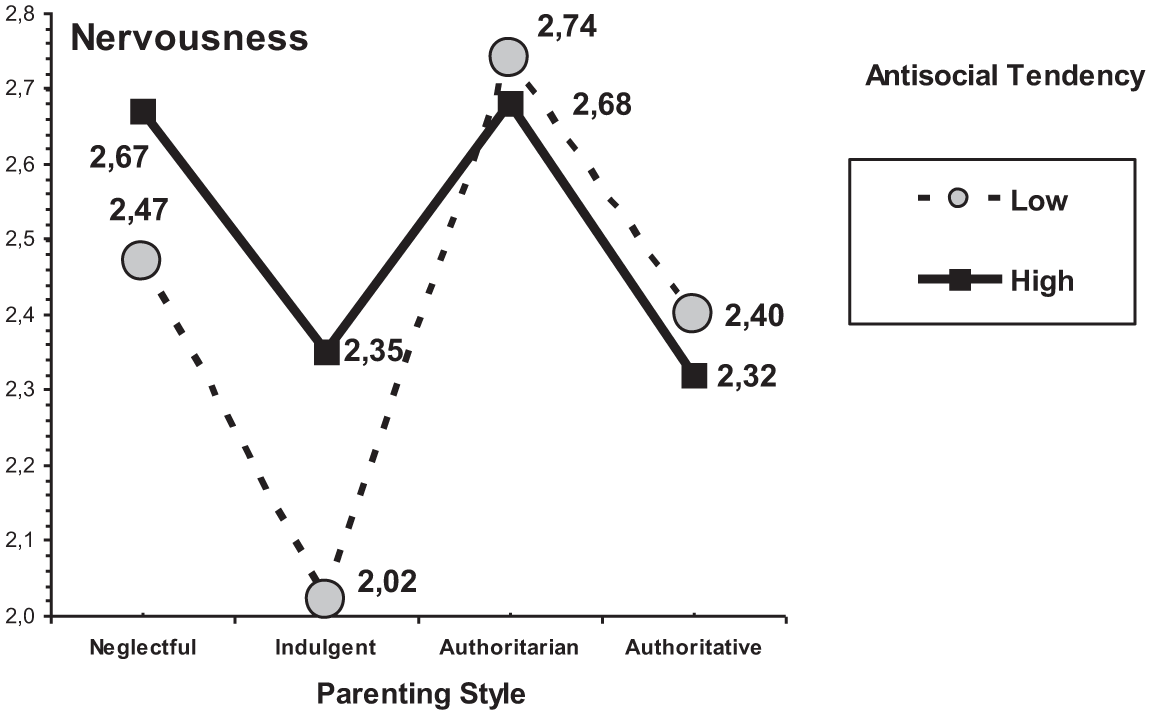
Means of nervousness emotional maladjustment, combining parenting style groups with antisocial tendency conditions.
On hostility emotional maladjustment, as in the third hypothesis, young adults who characterized their parents as indulgent reported the lowest hostility scores. By contrast, young adults from authoritative, authoritarian, and neglectful families had the highest hostility scores. Furthermore, we found an interaction effect between the parenting style and the antisocial tendency, F(3, 457) = 3.172, p = .007 (see Figure 2). Once again, the third hypothesis was only confirmed for non-antisocial young adults, whereas for antisocial young adults, the results confirmed the second hypothesis. Therefore, raising non-antisocial children in indulgent families is associated with optimal scores on hostility.

Means of hostility emotional maladjustment, combining parenting style groups with antisocial tendency conditions.
Main Effects of Sex and Age
Although not central to the proposals of this study, several univariate main effects for sex and age reached significance (see Table 3). For self-esteem, the analyses indicated that family self-esteem scores were higher among girls, and the academic self-esteem score was higher for young adults from 18 to 24 years old. In the case of psychosocial development, girls reported more empathy than boys, and self-competence was higher for the young adults from 18 to 24 years old. Regarding emotional maladjustment, nervousness and hostility scores were lower for the young adults from 18 to 24 years old.
Discussion
This article analyzes the patterns of competence and adjustment in a community sample of Spanish young adults with an antisocial tendency during adolescence from indulgent, authoritative, authoritarian, and neglectful families. The competence and adjustment of the young adults were captured through self-esteem (academic and family), psychosocial development (self-competence and empathy), and emotional maladjustment (nervousness and hostility). Results of this study confirmed that an indulgent parenting style was associated with optimal overall outcomes.
Analyzing the main effects, youths with an antisocial tendency were associated with the worst outcomes: less self-esteem and psychosocial development and greater emotional maladjustment. In the same negative direction, the neglectful parenting style (neither warmth nor strictness) and the authoritarian parenting style (strictness but not warmth) were associated with the worst outcomes. Interestingly, the results of this study show that, for young adults with an antisocial tendency, both the indulgent (warmth but not strictness) and authoritative (warmth and strictness) parenting styles are equally optimal. However, we found that, only for young adults without an antisocial tendency, those who characterize their families as indulgent are associated with the lowest scores on nervousness and hostility. Regardless of the antisocial tendency of the young adults, those who characterized their parents as indulgent or authoritative when they were adolescents showed no differences in academic and family self-esteem, self-competence, or empathy.
One of the most distinguishable findings of the present study is that for young adults with an antisocial tendency, the indulgent and authoritative parenting styles are equally optimal. This result contrasts with other studies suggesting that the strictness and firm control component (shared by authoritative and authoritarian parenting styles) seems to be perceived negatively in Southern European and Latin American countries (F. García & Gracia, 2009, 2010, 2014; Martínez & García, 2007, 2008; White & Schnurr, 2012), which are culturally more similar to Spanish culture. On the contrary, but only for young adults without an antisocial tendency, our study extends results from previous studies to young adulthood. Once more, children from indulgent families obtained similar or even better scores on overall outcomes than children from authoritative families. In addition, young adults who defined their parents as authoritarian or neglectful when they were adolescents accomplished the worst ratings overall on all the outcomes analyzed (Calafat et al., 2014; DiMaggio & Zappulla, 2014; F. García et al., 2015; F. García & Gracia, 2009, 2010, 2014; O. F. Garcia et al., 2018; Martínez et al., 2017; Martínez et al., 2019; Musitu & García, 2001, 2004).
Findings from this study have significant implications in today’s society, where youth violence has been declared a major public health issue by the WHO (Krug et al., 2002; WHO, 1996, 2015). In a European community sample of young university students, this study found that the antisocial tendency of adolescents is related to their later incompetence and maladjustment in young adulthood. It is a pandemic community problem that systematically undermines public health, even when analyzing competence and adjustment in university students (Ackerman et al., 2003; Moffitt, 1993; Moffitt et al., 2002; Roustit et al., 2009; Steinberg et al., 2006). Thus, findings from this study contradict the idea that adolescent antisocial behavior is only limited to adolescence because they do not confirm the classic “storm and stress” hypothesis (Blos, 1967; Erikson, 1968; Rutter et al., 1976; Steinberg, 2001).
Furthermore, socialization theory shows that parents’ behaviors can contribute to the social behavior of their children or fail when children demonstrate a tendency toward antisocial behavior (Baumrind, 1983; Darling & Steinberg, 1993; Lamborn et al., 1991; Lewis, 1981; Maccoby & Martin, 1983; Moffitt, 1993; Steinberg et al., 2006). One important implication of this study for the literature on quality parenting and children’s well-being is that the combination of parental warmth and involvement is always a protective factor in adolescent outcomes (F. García & Gracia, 2009, 2010; Martínez & García, 2007, 2008; White & Schnurr, 2012). However, parental warmth and involvement with lack of strictness and imposition (i.e., indulgent style) also seems to be a protective parenting strategy for children with an antisocial tendency (F. García & Gracia, 2009; White & Schnurr, 2012). Unlike other cultural contexts where strictness is a necessary and sufficient parenting strategy (e.g., Clark et al., 2015; Furstenberg et al., 1999), the findings of this study reinforce the idea that the parental warmth and involvement component (shared by authoritative and indulgent styles), but not the parental strictness and imposition component (shared by authoritative and authoritarian styles), contains strategic factors that favor the offspring’s well-being (Calafat et al., 2014; I. Lund & Scheffels, 2019; Valente et al., 2017). In fact, the findings of this study reinforce the idea that neglectful and authoritarian parenting styles are the worst parenting strategies in youths with or without an antisocial tendency (Calafat et al., 2014; F. García & Gracia, 2009, 2014). Interestingly, our findings contrast with previous studies on intervention programs for antisocial children that recommend the use of strictness and imposition parenting practices (see Furstenberg et al., 1999). Our findings indicate the benefits of parental warmth and involvement (i.e., indulgent and authoritative styles), even when parents are raising children with an antisocial tendency. Our results show that young adults with an antisocial tendency from indulgent and authoritative homes (both parental warmth and involvement) have less nervousness and hostility than their peers from authoritarian or neglectful families (both sharing lack of parental warmth and involvement).
In addition, results of this study agree with previous findings on the relations between the demographic variables of sex and age and competence and adjustment. Our results confirm previous studies showing that family self-esteem (Musitu & Garcia, 2001; Riquelme et al., 2018) and empathy (Mestre, Samper, Frías, & Tur, 2009) are higher in young females. Overall, young adults from 18 to 24 years old are more competent than those from 25 to 34 years old on all the outcomes examined, suggesting that university studies are normative in early young adulthood, but not in late young adulthood. Therefore, this greater academic competence in 18- to 24-year-old young adults is also associated with other positive indicators, such as self-competence or less emotional maladjustment (nervousness and hostility; Côté & Schwartz, 2002; Zacarés et al., 2015). As research suggests, delaying the obligations of early young adulthood, such as university studies or job seeking, is related to personal maladjustment in late young adulthood (Côté & Schwartz, 2002; Zacarés et al., 2015). However, this could be related to inconsistent and rapidly changing socioeconomic conditions, along with a range of difficulties for present-day young adults in Western societies. In the early part of the 21st century, this generation is trying to integrate into the labor market and acquire financial autonomy, which appears to be affecting their progress through the personal and social achievements of adulthood (Lopez-Fernandez, Stack, & Mitra, 2019).
Finally, this study has strengths and limitations. The use of the two-dimensional four-style model to assess parenting offers an approach to the ongoing debates by examining parenting styles in a broad context of different outcomes across different demographic variables, settings, and countries, with conventional and explicit hypotheses across several studies, thus contributing to the replication and consistency of the findings. The cross-sectional design of the present study does not determine causality, although it establishes a link between a specific parental strategy for raising children and an antisocial tendency and competence indicators of adjustment in young adulthood.
We should be cautious in interpreting the present findings, given its cross-sectional design and reliance on self-report data gathered entirely from the young adults themselves. Moreover, the data on parenting and the antisocial tendency were collected retrospectively. We cannot exclude either causal relations between variables or third-variable explanations, although the relative demographic similarity of the sample makes such third-variable accounts less likely. In the absence of longitudinal or experimental data, the findings must be viewed as preliminary. Finally, this study uses a community sample of university students, rather than a clinical or offender sample, although the results offer evidence that is consistent with previous research. More studies are needed with other samples, such as nonuniversity young adults or youths from poor neighborhoods, to extend the parenting evidence.
Despite these limitations, the findings of the present study agree with conceptions from recent parenting literature on children’s antisocial tendency as a pandemic community problem, ruling out alternative conceptions of the normative function of antisocial behaviors during adolescence. Although there can be adolescence-limited antisocial behavior, the larger group of Spanish children with an antisocial tendency experience multiple indicators of maladjustment during young adulthood. This maladjustment persists even if they are raised according to the normative parenting for the context where they are socialized.
Footnotes
Authors’ Note
Olatz Lopez-Fernandez is now affiliated with Monash University, Australia.
Declaration of Conflicting Interests
The author(s) declared no potential conflicts of interest with respect to the research, authorship, and/or publication of this article.
Funding
The author(s) disclosed receipt of the following financial support for the research, authorship, and/or publication of this article: The research reported in this article has been partially supported by Grants ACIF/2016/431 and BEFPI/2017/058 (Valencian Regional Government, and European Social Fund) and FPU16/00988 (Ministry of Science, Innovation and Universities, Government of Spain).
