



Abstract
One in five college women report being sexually assaulted, while men have the greatest likelihood to commit a sexual assault while attending a university. Because freshmen and sophomore college women are particularly vulnerable to victimization, it is important to provide effective sexual assault prevention education. The current study examines a multisession approach to sexual assault prevention at a southwestern university. This exploratory study assesses scores measuring knowledge of sexual assault, knowledge about healthy sexual relationships, and intent to act to prevent a sexual assault or after one has occurred, after students complete at least one of five sexual assault prevention programs (Community of Care, Consent and Respect, Step Up!, Live Well, or Frisky Business). Results demonstrated that participation in each program had unique effects and the number of programs a student participated in did not significantly affect scores. None of the programs produced significantly higher scores on all three measures. Multiple programs produced significantly higher scores on the knowledge and intervention/resources scales, but none had the same results for the healthy sexual relationships scale. Also, a student’s experiences of sexual violence significantly predicted their scores on all three measures. Because each program had different characteristics, the varying results make it difficult to identify the particular factors that led to the best results. Future research must seek to identify the particular combination of factors that produce the best outcomes in terms of changing attitudes and behavior concerning sexual assault and intent to act.
Introduction
One in five college women report being sexually assaulted while attending a university (National Sexual Violence Resource Center, 2015). The most vulnerable of college students are undergraduate female students (Raphael, 2013) who are more vulnerable during their freshman year (Cranney, 2015). College is also the time when men have the greatest likelihood to commit sexual assault; 23% of college men reported committing acts that meet the definition of sexual assault and 35% reported some proclivity toward sexual assault if they could be assured they would not get caught (Burgess, 2007). Female college students are less likely to report a sexual assault and are also more likely to believe that a sexual assault is a personal matter and not serious enough to report (Department of Justice, 2014).
Victims on college campuses experience similar psychological effects as the broader population, including increased risk of depression, anxiety, and suicidal ideation (Chang et al., 2015). However, sexual assault has a unique and profound impact on college women, including detracting from the quality of their college experience (Fisher, Daigle, & Cullen, 2009). Victims may have difficulty resuming their regular daily activities, perform poorly academically (Banyard et al., 2017), and may not be able to carry a full course load or contribute to the campus community (American Association of University Professors, 2012). They are more likely to drop classes, have lower institutional commitment, and have higher stress (Banyard et al., 2017). College women who experience sexual assault are also at an increased risk of engagement in risky health and sexual behaviors, such as sleeping with multiple partners with inconsistent use of contraception (Turchik & Hassija, 2014). They are also more likely to develop an eating disorder or posttraumatic stress disorder (American Association of University Professors, 2012).
Current prevention methods may not be using effective strategies to prevent sexual assault; college women are just as likely to be sexually assaulted as they were 10 years ago (Department of Justice, 2014). It is important to ensure the most effective approaches are being utilized to educate college students about sexual assault, how it can be prevented, and change norms surrounding sexual relationships to develop strategies and skills to create and maintain healthy relationships. Effective prevention programs can be targeted to the attitudes, beliefs, and perceptions that lead to the continued perpetuation of sexual violence. Programs can also seek to change behavioral intentions.
Theoretical Framework: Theory of Planned Behavior (TPB)
Behavioral achievement, including behaviors that can prevent sexual assault, depends on the motivation and ability to utilize skills (Ajzen, 1991) that serve to prevent sexual violence. The TPB offers a model for predicting both maladaptive and positive behaviors that contribute to the understanding of the link between intention and behavior (Parker, Manstead, & Stradling, 1995). The TPB proposes three primary determinants of intentions and behaviors: attitudes, perceived norms, and perceived behavioral control (Emanuel, McCully, Gallagher, & Updegraff, 2012). Attitude refers to a person’s perception of and positive or negative evaluation of the behavior (Ajzen, 1991). An individual’s likelihood of committing sexual violence is influenced by their perspective of the serious nature of sexual assault. Perceived norms, or subjective norms, are relevant beliefs about the behavior (Ajzen, 1991). These norms refer to the social pressure an individual feels to perform (or not perform) a certain behavior. There are multiple social norms that encourage men to participate in sexually aggressive behavior (World Health Organization, 2009) and compel women to comply (Elliott & Umberson, 2008). Behavioral intent also captures an individual’s motivation to execute a behavior.
In addition, accurate prevalence rates can be difficult to assess among college students (Rape, Abuse & Incest National Network, 2015); the risk of social desirability may be higher when measuring incidents of sexual assault. Therefore, measuring behavioral intent provides a useful alternative to potentially inaccurate prevalence rates. For those who may not believe they had an opportunity to engage in bystander behaviors, intent to change allows the measurement of at least the potential to be an active bystander. Therefore, those evaluating the effectiveness of prevention programs can use intent to change as a proxy for actual behavioral change. Studies have had mixed results in demonstrating the link between intent and behavior. Results from some studies showed a weak correlation between intent and behavior (Albarracin, Johnson, Fishbein, & Muellerleile, 2001). One potential reason is that multiple factors may influence the relationship between intent and behavior (Eccles et al., 2006). Those external factors may prevent someone from acting on their intent. Despite multiple studies demonstrating a weak relationship between intent and behavior, some data suggest a strong correlation; intent to act directly influences behavior (Eccles et al., 2006).
Acting on behavioral intent requires self-efficacy, which is a person’s belief in how well they can engage in certain actions (Ajzen, 1991). If an individual is highly motivated and feels confident in their abilities, they may be more likely to be an effective bystander to prevent a sexual assault. Other factors that influence an individual’s behavioral intentions include their access to resources and opportunities to use those skills (Ajzen, 1991), their feelings of moral obligation to intervene or participate in healthy sexual relationships (Ajzen, 1991), and the role identity someone has created for themselves (Conner & Armitage, 1998). If someone sees themselves as a person who participates in consensual sexual relationships and takes action to prevent sexual assault, they may be more likely to engage in prosocial behaviors that discourage sexual violence.
Previous research has demonstrated mixed results in determining whether TBP is an effective theoretical foundation for predicting behavior. However, it has been shown to be a useful model (Armitage & Conner, 2001). For example, previous studies have demonstrated the effectiveness of TBP in predicting adolescent and young adult behavior (Plotnikoff et al., 2011). A study examining binge drinking among undergraduate students demonstrated that TBP successfully predicted intent to drink, with self-efficacy and attitudes being the strongest predictors (Norman, 2011). Therefore, TBP can be a valuable framework for sexual assault prevention programs that seek to decrease sexual assault on college campuses through improving knowledge about sexual assault, changing norms that contribute to the perpetuation of sexual violence, and increase skills and self-efficacy around effective bystander behaviors.
Sexual Assault Prevention
College women are at high risk of victimization early in the school year (Department of Justice, 2017). Therefore, early prevention education is imperative to reducing the prevalence of sexual violence. There are multiple approaches to sexual assault prevention. Primary prevention focuses on stopping a behavior before it occurs (Centers for Disease Control and Prevention, 2014). Primary prevention in sexual assault requires a focus on addressing the root causes of sexual assault, including misperceptions and norms that negatively influence behavior; education and skill building focused on healthy relationships; sexual wellness; communication; asking for and giving consent; and creating healthy norms for college students (American College Health Association, 2008).
There are mixed results when examining the overall effectiveness of sexual assault prevention in changing outcomes (DeGue et al., 2014), whether that be attitudes about sexual assault, rape myths, gender norms and roles, or knowledge about sexual assault and healthy relationships. However, research has shown that particular program elements can have positive effects. For example, studies have shown that risk reduction strategies reduce the potential for sexual assault, particularly among freshman women (Senn et al., 2015). However, risk reduction can potentially reinforce norms that focus on women’s behavior in sexual assault prevention. Other elements that may be effective include professional facilitation, frequent sessions offered in a classroom setting, gender-targeted programs, and longer interventions (Vladutiu, Martin, & Macy, 2011).
The content of the programs can also affect their effectiveness. It is imperative that sexual assault prevention addresses multiple topics such as gender-role socialization, sexual assault education, human sexuality, rape myths, sexual assault awareness, dating communication, and victim empathy (Vladutiu et al., 2011). It is important that these programs cover these topics in depth rather than with superficial overviews (Anderson & Whiston, 2005). Previous studies have demonstrated comprehensive sexual assault prevention programs that address the most relevant issues have the greatest likelihood of reducing problematic rape attitudes, increasing rape awareness, positively affecting behavioral intentions, increasing sexual assault knowledge, reducing rape myth acceptance, increasing empathy, and reducing sexual victimization (Vladutiu et al., 2011). Programs must also use the most effective implementation strategies, including identifying the best individual(s) to facilitate the program. Current studies, however, indicate that certain facilitators improve certain outcomes. For example, peer-led groups are better at changing attitudes and beliefs about sexual assault. However, professionals are more likely to improve behavioral intentions and more positively influence participants (Vladutiu et al., 2011).
Current studies have demonstrated that sexual assault prevention programs are more effective at increasing knowledge regarding the prevalence and consequences of sexual assault more than changing behavior, and the attitude changes that do occur are likely to decrease over time (Newlands & Donohue, 2016). One approach that has been more effective in changing detrimental norms is the bystander approach. Bystander intervention programs that engage the college community in preventing sexual assault and address roots of oppression (American College Health Association, 2008) have been utilized to attempt to change those norms that potentially lead to sexual violence and create healthy norms that reduce sexist and abusive behaviors (Elias-Lambert & Black, 2016). Another benefit of the bystander approach is that it does not rely on identifying men as perpetrators (Elias-Lambert & Black, 2016); labeling men as perpetrators can lead men to disengage from the conversation about sexual assault and how it can be prevented. Studies have demonstrated that bystander intervention has been effective at reducing rape myth acceptance, increasing prosocial behaviors, and decreasing sexually coercive behaviors (Elias-Lambert & Black, 2016).
Sexual assault prevention programs have also begun implementing programs online due to a need to be cost-effective and reach as many students as possible (Kleinsasser, Jouriles, McDonald, & Rosenfield, 2015). However, there is little known about the efficacy of online programs. Online interventions have been successful in changing health-related behaviors, such as maintaining a healthy weight or quitting smoking (Webb, Joseph, Yardley, & Michie, 2010). However, there is little known about the efficacy of online sexual assault prevention programs. One study of an online bystander intervention found that an online model could lead to increased feelings of efficacy to be an effective bystander and increased participation in bystander behaviors (Kleinsasser et al., 2015).
Sexual assault prevention must also take into consideration the limitations of adolescent cognitive development and its implications for decision making. Research has shown that even with accurate knowledge, confidence, self-efficacy, an ability to reason, and a rejection of problematic attitudes and beliefs about sexual assault, college students may still participate in risky behavior (McDermott, 1998). Adolescents and young adults lack the ability to make mature judgments that require self-reliance, independence, and autonomy (Commendador, 2003). They may also lack the self-efficacy to engage in prosocial behaviors that could prevent sexual assault (McDermott, 1998). Young adults also find their peer relationships (Chein, Albert, O’Brien, Uckert, & Steinberg, 2011) and intimate relationships (Paul & White, 1990) to be of great importance. A developmentally appropriate program would discuss social pressures, relationship norms, and how to engage in healthy sexual relationships. The importance of peers also presents the opportunity to use peer leaders in the implementation of programs. Previous research has demonstrated that peers can successfully change maladaptive beliefs, norms, and behaviors that lead to sexual violence (Weisz & Black, 2010). Although different prevention programs may utilize different educational strategies, effective prevention strategies are comprehensive, developmentally appropriate, culturally competent, utilize varied teaching methods, have sufficient dosage, create supportive social and gender norms, educate about healthy relationships, are administered by well-trained staff, and include outcome evaluation (Nation et al., 2003).
Current Study
The current exploratory study will examine the effectiveness of a multisession approach to preventing sexual assault that seeks to change knowledge, attitudes, and norms about sexual assault, and behavioral intentions at a southwestern university. This study seeks to understand the multiple factors that could contribute to differences in knowledge, attitudes, and behavioral intentions. Although previous research has examined the effect of individual program participation on attitudes and intent to change, studies have not explored the cumulative effect of participating in multiple sessions with differing strategies and implementation methods. This study goes beyond measuring individual program effectiveness to identify whether a combination of approaches or factors leads to the best outcomes. Researchers wanted to know whether participation in a certain number of programs leads to improved understanding of sexual assault, attitudes toward sexual assault, and intent to participate in bystander or intervening behaviors. It also sought to assess whether a combination of certain programs leads to the same improved outcomes. The following is a brief description of each program.
Community of Care
Community of Care is on online education program required of all new students, including freshmen, graduate, and transfer students. A series of online videos with student-to-student facilitators are used to introduce students to the university community standards and code of conduct. The videos cover topics such as policies regarding alcohol use, how the university defines sexual misconduct and consent, how sexual violence affects members of the community, and how to help peers who are struggling. This 30-min program encourages students to engage in effective coping mechanisms for stress, recognize signs of distress, and intervene to help create and maintain a caring community.
Consent and Respect
Consent and Respect Version 2 is a voluntary online education program provided through 3rd Millennium Classrooms and targets freshmen and student leaders. The online program takes 30 minutes to complete. The purpose of Consent and Respect is to increase awareness of sexual and intimate partner violence, and stalking. The program also educates students on the impacts of violence and harassment. Students are taught the importance of consent and respect in intimate situations, risk reduction strategies, and how to intervene if someone they know has experienced intimate partner violence, sexual assault, stalking, or harassment.
Step Up!
Step Up! is a prosocial behavior and bystander intervention program that teaches students to proactively help others. Step Up! was developed by the University of Arizona Commitment to an Athlete’s Total Success (C.A.T.S.) Life Skills Program and the National Collegiate Athletic Association, along with national experts. This study adapted the Step Up! training to be presented by Arizona State University (ASU) students in a 26-min online video. The video discusses the bystander phenomenon and provides strategies for intervening. It includes an example of a situation that could lead to sexual violence and suggests a variety of interventions that could interrupt potential harm. It is implemented as a part of a mandatory course all freshmen are required to take. An instructor packet is provided to assist faculty with facilitating a class discussion to engage students in critically thinking about different situations and how to safely intervene.
Live Well
Live Well is a 30-minute video designed to educate students on how to maximize their college experience through personal wellness. Students are also required to participate in this program through a required course. Students are provided education and guidelines for managing stress, healthy eating and sleep habits, maintaining and enhancing fitness, participating in healthy relationships, and setting reasonable and attainable goals. There are also sections on consent and bystander intervention, and a brief discussion on the relationship between alcohol and sexual violence. Students are required to participate in this program through the same course that required them to participate in Step Up!.
Frisky Business/Healthy Sexuality
Frisky Business is an in-person program led by a trained facilitator. This program seeks to reduce sexual violence by educating students on skills needed within healthy relationships.
Multisession Format
Students who participate in all five sessions will have received sexual violence prevention education focusing on the following:
University expectations for behavior, definitions for sexual misconduct and consent, and how sexual violence affects members of the community;
Information on sexual violence, relationship violence and stalking, including definitions, the importance of consent, prevention strategies, and campus resources;
How to intervene effectively in a bystander situation;
The influence of alcohol use in sexual violence experiences among college students and characteristics of healthy relationships.
Method
The current exploratory study utilized a cross-sectional survey design to assess the potential benefits of participating in sexual violence education programs. The main purpose of the current study was to examine how the participation in the programs changed knowledge about sexual assault, understanding of healthy relationships, and intent to act to prevent a sexual assault or to share resources after one has occurred. The researchers wanted to answer the following research questions:
Procedure
At the end of their first academic year, all 11,500 freshmen from the 2015-2016 academic year were invited to participate in a 10- to15-minute online anonymous questionnaire. Freshmen were contacted via email with a link to the survey. The survey remained active for 4 weeks. After 2 weeks, students were sent a reminder email. Students were offered an incentive to participate; after completing the survey, students were given the option to participate in a raffle to receive US$ 50 on their university student card. There were a total of 10 prizes.
Participants
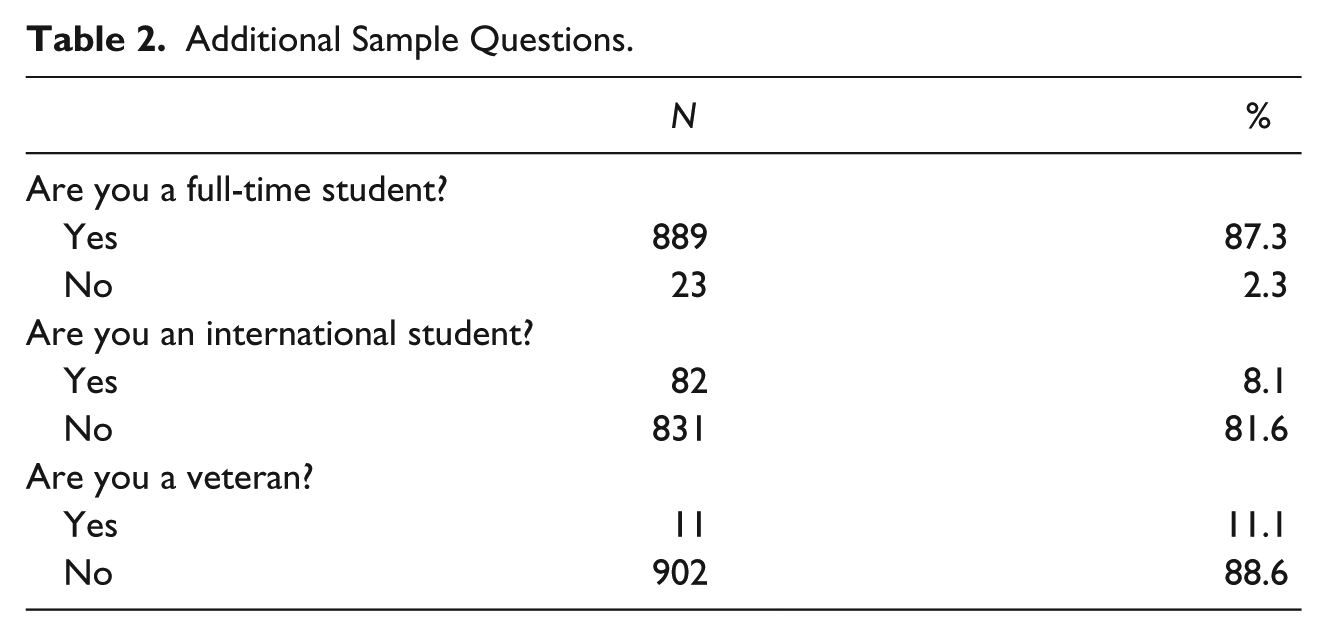
Students were asked demographic information (see Table 1) and asked additional questions related to their student status (see Table 2). There was a 9% response rate (n = 1,018). The majority of respondents identified as female (n = 592, 58.2%). The majority of the sample was White (n = 543, 53.3%) and freshmen (n = 863, 84.8%). Most students identified as heterosexual (n = 717, 77.7%) and single (n = 499, 49%). The majority of participants also currently live on campus (n = 668, 65.6%) and are full-time students (n = 889, 87.3%). Only 82 students (8.1%) were international students and 11 (1.1%) were veterans.
Demographics.

Items do not add up to 1,018 due to missing data.
Additional Sample Questions.
Measures
Knowledge scale
Participants’ knowledge of sexual assault was examined using five original questions (α = .71). Students answered true, false, or don’t know to questions such as “a person must be sober to give consent” and “most sexual assaults include alcohol.”
Healthy sexual relationships scale
Participants completed an original six-item scale to assess their understanding of healthy intimate sexual interactions (α = .94). Students answered questions such as “respect for each other’s boundaries is important in any sexual situation” and “open communication makes sex better” on a 4-point Likert-type scale from strongly disagree to strongly agree.
Intervention/resources scale
Participants completed an original six-item scale to assess their intent to intervene to prevent a sexual assault or act after one has occurred (α = .94). Students answered on a 4-point Likert-type scale from highly unlikely to highly likely to questions such as “intervene if you suspect that someone might be trying to get another student to drink too much” and “refer a student who has been sexually assaulted to resources on campus.”
Data Analysis Plan
First, independent samples t tests were used to assess whether there were differences in scores on all three measures based on demographics and participation in individual programs (see Table 3). An ANOVA analysis was done to examine the cumulative effect of participating in multiple programs and whether the number of sessions produces significantly different results. A regression analysis was performed to assess which programs were better at predicting higher levels of knowledge about sexual assault and healthy sexual relationships, and behavioral intent, and to also examine whether experiencing sexual violence predicts scores on any of the measures. A moderation analysis was performed to examine whether an experience of sexual violence affects the impact of program participation on scores on all three scales.
Program Participation.

Items do not add up to 1,018 due to missing data.
Results
First, researchers wanted to examine the factors that may contribute to differences in knowledge, beliefs, and behavioral intentions concerning sexual assault among college students. Researchers wanted to know whether there were significant differences, based on demographic variables, in their knowledge of the issue of sexual assault, their perceptions of healthy intimacy, and their willingness to intervene to prevent victimization or help a victim of sexual assault. A t test demonstrated that there were no statistically significant differences on any of the scales based on race. However, results demonstrated a significant difference in male (M = 3.15, SD = .42) and female (M = 5.92, SD = .39) participants on the healthy sexual relationship, t(905) = 3.014, p < .05, and intervene/resources, t(905) = 6.603, p < .001, scales. Women performed better on both scales. The categorical options for where they currently live were collapsed into two categories, on campus (Campus/residence hall, Fraternity/sorority, and University housing) and off campus (off campus with friends or roommates, off campus with other family members, off campus with parent(s) or guardian(s), and off campus by myself). There were statistically significant differences in scores based on whether students lived on campus (M = 1.34, SD = .39) or off campus (M = 1.41, SD = .49) on the knowledge scale, t(910) = −2.205, p < .05. Those who lived on campus performed better on the knowledge scale. The categories for relationship status were also collapsed into two categories, single (single, uncommitted, and divorced) and in a relationship (committed dating relationship/engaged, married). There were statistically significant differences between those who are single (M = 3.02, SD = .47) and married (M = 3.09, SD = .38) on the intervention/resources scale, t(910) = −2.179, p < .05. Those in relationships had better scores on the intervention/resources scale.
Researchers wanted to know which program(s) led to students adapting less problematic attitudes and beliefs about sexual assault. Overall, each of the programs produced unique significant differences on each of the measures. The t tests were performed to assess whether there were any significant differences in scores on any of the scales for students who participated in each of the interventions compared with those who did not. Those who participated in Community of Care had better scores on the intervention/resources scale, F(2, 914) = 3.81, p < .05. Those who participated in Consent and Respect had better scores on the knowledge scale, F(2, 917) = 5.91, p < .01. Those who participated in Step Up! had significantly better scores on two scales, the knowledge scale, F(2, 913) = 9.14, p < .01, and the interventions/resources scale, F(2, 913) = 3.67, p < .05. Live Well produced similar results, with participants having significantly better scores on both the knowledge, F(2, 912) = 3.24, p < .05, and intervention/resources, F(2, 912) = 2.88, p < .05, scales. Participation in Frisky Business had significantly better scores on the knowledge scale, F(2, 916) = 8.38, p < .000, and intervention/resources scale, F(2, 916) = 3.23, p < .05. None of the programs produced significantly different scores on the healthy sexual relationships scale. However, those who participated in Step Up! had the best scores on the healthy sexual relationships scale. The best scores on knowledge and intervention/resources scales were by those who participated in Frisky Business. Overall, participation in Step Up! yielded the highest scores on all scales.
Another factor that could account for differences in scores was an individual’s experiences of sexual violence. Researchers wanted to know whether there was a relationship between experiencing sexual assault and scores on the scales. Students were asked whether they had been sexually touched without consent in the last 3 months, with 127 participants (12.5%) responding yes. Sixty-six participants (6.5%) responded yes when asked whether someone had attempted to penetrate them vaginally, orally, or anally without consent in the last 3 months. When asked whether they had experienced penetration vaginally, orally, and anally without consent in the last 3 months, 38 students (3.7%) responded yes. Scores on all three scales were not significantly different based on whether you answered yes or no to any of the previous three questions. However, those who said they had been sexually touched without consent did better on the knowledge and healthy sexual relationships scales. Those who said they had experienced attempted rape or rape, Questions 2 and 3, did best on the knowledge scale.
Researchers also wanted to know which programs best predicted scores on each of the scales. Participation in Frisky Business provided the best predictive model for scores on the knowledge scale, F(1, 555) = 5,227, p < .05. Participation in two programs, Community of Care (b = .091, t = 2.213, p < .05) and Consent and Respect (b = .421, t = 3.964, p < .01), provided the best model to predict scores on the healthy sexual relationships scale, F(2, 554) = 9.242, p < .01. Participation in two programs, Community of Care (b = −.052, t = −2.474, p < .05) and Step Up! (b = −.037, t = −2.132, p < .05), best predicted scores on the intervention/resources scale, F(2, 906) = 6.627, p < .01.
Despite the lack of significant differences, a regression model was developed to examine whether responses based on their experiences of sexual assault affected their scores. Results demonstrated that a model including all three questions, unwanted sexual touching (b = .109, t = 2.058, p < .001), attempted rape (b = .007, t = .067, p = .946), and completed rape (b = .460, t = 4.526, p < .01), significantly predicted scores on the knowledge scale, F(3, 1014) = 70.141, p < .001. Those who had experiences of sexual touching, attempted rape, or completed rape had better scores on the knowledge scale. The same model including questions about unwanted sexual touching (b = .263, t = 3.285, p < .01), attempted rape (b = −.075, t = −.507, p = .612), and completed rape (b = 1.347, t = 8.773, p < .01) significantly predicted scores on the healthy sexual relationship scale, F(3, 1014) = 216.749, p < .001. Those who had experiences of sexual violence had higher scores on the healthy sexual relationships scale. Finally, the same model with unwanted sexual touching (b = .231, t = 3.027, p < .01), attempted rape (b = −.060, t = −.428, p = .669), and completed rape (b = 1.644, t = 11.272, p < .01) significantly predicted scores on the intervention/resources scale, F (3, 1014) = 333.020, p < .001. Those who had experiences of sexual violence had higher scores on the intervention/resources scale. Although the question assessing attempted rape was not an individual significant predictor in the model, excluded from the model it was a significant predictor of scores on all three scales: knowledge scale, F(1, 1016) = 739.306, p < .001, healthy sexual relationships scale, F(1, 1016) = 502.301, p < .001, and the intervene/resources scale, F(1, 1016) = 177.325, p < .001.
Researchers used a moderation analysis (see Table 4) to examine the interaction effects of a participant’s experience of attempted or completed sexual assault, participation in prevention programs, and their scores on all three scales. Experiencing sexual violence moderated the relationship between participating in Step Up!, ΔR2 = .17, ΔF(2, 1010) = 103.18, p < .001, b = .012, t(1010) = 2.053, p < .05, or Frisky Business, ΔR2 = .18, ΔF(2, 1013) = 109.179, p < .001, b = .023, t(1013) = 3.68, p < .001, and scores on the knowledge scale. For those reporting an experience of sexual violence, the association between participating in Step Up! or Frisky Business and scores on the knowledge scale was stronger compared with those who had not experienced sexual violence. There was a borderline significant interaction between participating in Live Well and experiencing sexual violence, ΔR2 = .18, ΔF(2, 1013) = 109.179, p < .001, b = .023, t(1013) = 3.68, p = .07, in predicting scores on the knowledge scale. Participating in Consent and Respect moderated the relationship between experiencing sexual violence and scores on the healthy relationships scale, ΔR2 = .45, ΔF(2, 657) = 263.048, p < .001, b = .145, t(657) = 2.475, p < .05. For those reporting an experience of sexual violence, the association between participating in Consent and Respect and scores on the healthy sexual relationships scale was stronger compared with those who had not experienced sexual violence. Finally, there was an interaction between participating in Community of Care and scores on the intervention/resources scale, ΔR2 = .472, ΔF(2, 1011) = 452.76, p < .001, b = −.03, t(1011) = −2.828, p < .01. For those reporting an experience of sexual violence, the association between participating in Community of Care and scores on the intervention/resources scale was stronger compared with those who had not experienced sexual violence.
Regression Analysis: Moderation.

Note. CI = confidence interval; SVE = sexual violence experience.
p < .05. **p < .01. ***p < .001.
Researchers also wanted to know whether there were a certain number of programs that produced the best results—not only the number of programs but also the specific combination of programs that led to the best outcomes. The cumulative effect of participating in multiple sessions of sexual assault prevention program was examined. The results of an ANOVA demonstrated that the number of programs a student participated in (see Table 5) did not produce significant differences in scores on any of the scales. The greatest number of students (n = 235, 23.1%) participated in five programs. However, analysis demonstrated that those who attended three classes, Step Up!, Live Well, and Frisky Business, had the best scores on the knowledge scale. Those who participated in four classes, Community of Care, Consent and Respect, Live Well, and Frisky Business, had the highest scores on the healthy sexual relationships scale. The highest scores on the intervention/resources scale required four classes, Community of Care, Step Up!, Live Well, and Frisky Business.
Number of Program Participants.

Discussion
The purpose of this study was to examine the effects of a multisession approach to sexual assault prevention education at a university. Researchers wanted to know which programs had the most significant impact on knowledge about sexual assault and healthy sexual behavior, and likelihood to intervene to prevent a sexual assault, assist a victim, or reach out for help themselves. Researchers also wanted to know the most effective number of programs that produced the best scores on all three scales.
Previous studies have demonstrated differences in attitudes and beliefs about sexual assault based on race (Baldwin-White & Elias-Lambert, 2016). However, the current study did not find any differences. One potential reason for finding the differences was the potential for increased empathy and understanding of oppressive belief structures by people of color. Perhaps this sample understood the impact of oppressive systems and problematic beliefs, potentially due to exposure to the prevention program. Therefore, the prevention education negated any impacts of race. Perhaps assessing attitudes and beliefs prior to participating in any program would have yielded similar results to previous research. Women had significantly better scores on the knowledge and intervention/resources scales after receiving any program. One reason for this difference could be the current discussion of sexual assault as a women’s problem. Therefore, men may not be as invested in making changes to reduce sexual violence. Also, the gendered nature of programs may lead men to be defensive while receiving interventions because they are always positioned as a potential perpetrator rather than an ally in prevention (Anderson & Whiston, 2005). Therefore, men may not be as open to receiving information. Also, programs may not be as effective in changing men’s attitudes and beliefs by emphasizing how they can be active in preventing sexual assault. Bystander intervention programs, for example, help men to be allies and may provide a better way to engage men in preventing sexual assault (Elias-Lambert & Black, 2016). Gender-targeted prevention programs may also be more effective in changing men’s attitudes, beliefs, and behavioral intent.
Those who live on campus had more knowledge about sexual assault. Those who live on campus may be exposed to more information through programs in dormitories and student organizations. Those who live on campus may also be more likely to participate in on-campus socializing and seek information about sexual assault due to their perceived risk of victimization. In addition, they may be exposed to more sexual assault prevention marketing on campus due to their daily activities. Those in relationships were more likely to say they would intervene to help someone at risk of victimization or seek out resources to help themselves. Being in a relationship may increase a person’s willingness to assist someone. A relationship may also increase someone’s empathy, or through a relationship, someone may learn to or become more comfortable prioritizing someone else’s well-being.
Those who participated in Community of Care had higher scores on the intervention/resources scale and, therefore, were more likely to intervene to help someone else or themselves. One of the goals of Community of Care is to encourage students to recognize signs of distress and intervene to maintain a healthy campus community. According to the results, this program achieves that goal. However, because all new students are required to take the course, it is imperative that this intervention be effective at changing multiple attitudes concerning sexual assault and lead to improvement in multiple areas, including knowledge about sexual assault and healthy sexual relationships.
Consent and Respect only influenced knowledge about sexual assault. The online implementation of this program may have been the reason that this program only affected information about sexual assault. An online implementation may be effective at increasing knowledge but not changing a willingness to act, whether it be in intimate situations, preventing an assault, or acting after one has occurred. Unlike the other programs that used the Internet to deliver the information, there was a human component to all except Consent and Respect. Previous research has demonstrated that a lecture format may be more effective at changing attitudes (Vladutiu et al., 2011). Therefore, Consent and Respect, due to its format, may be limited in scope.
The format of both Step Up! and Live Well may have contributed to its ability to not only improve knowledge but also increase positive behavioral intentions. Both programs are video-based. Previous research has demonstrated that the more someone is engaged in the learning process, the more likely they are to retain the information (Ahrens, Rich, & Ullman, 2011). The videos and subsequent discussion potentially allow students to be more actively engaged in the learning process. Frisky Business had the same results concerning knowledge and behavioral intentions. However, despite its focus on educating students about healthy relationships, it did not significantly affect attitudes about what it means to participate in healthy intimacy. Step Up! did have a positive impact on perspectives of healthy relationships, but it was not statistically significant. None of the programs significantly influenced scores on the healthy relationships scale. Encouraging students to participate in healthy relationships and educating them on what should happen in healthy intimacy can reduce sexual assault (Satia, Barlow, Armstrong-Brown, & Watters, 2010). However, perhaps the use of a professional to implement Frisky Business rather than peer educators prevents students from fully engaging in a sensitive and culturally taboo topic such as sex and relationships. Studies have shown that those who participate in peer-led programs demonstrate improvements in different areas compared with those who participate in professional-led programs (Vladutiu et al., 2011). Therefore, healthy relationships may be a topic better suited for peer educators so that students feel more comfortable.
Students who participated in Step Up! demonstrated the highest scores overall. However, it is not clear what elements of the program led to the scores. Both Step Up! and Live Well are mandatory for all freshmen and video-based in the classroom with a supplementary PowerPoint presentation. Unlike Live Well, peer educators are an important part of Step Up!. Therefore, it is possible that the peer educators made the difference in outcomes. Although the presence of peer educators may be the distinguishing factor between Live Well and Step Up!, Community of Care also involves peer educators, and that program had limited positive effects.
Research has shown that effective programs need to address topics in depth to cover the scope of influences on attitudes and behavior about sexual assault. However, covering too many irrelevant topics superficially can be detrimental to positive change in perceptions (Anderson & Whiston, 2005). The current research shows conflicting results about the amount of topics that should be covered to improve attitudes about sexual assault. Community of Care covers topics from the Code of Conduct to sexual violence. Consent and Respect only covers one topic, consent and sexual assault. However, they have the same limited impact. Step Up! is focused on bystander intervention, and Live Well covers multiple topics from consent to alcohol and relationships. Both have the same positive impact. Based on this research, it is not clear about the range of topics that should be explored in prevention programs.
Dosage has always been a concern in sexual assault prevention programs. Research on prevention programs has demonstrated that receiving multiple interventions is more effective than participating in one session (Nation et al., 2003). Current results, however, demonstrate that the number of sessions did not significantly affect scores. There may be multiple reasons for this. First, multiple interventions may be needed of the same content. Because there were different programs, each with its own purpose, for participants it may have felt like they were receiving one dosage of multiple programs rather than a reinforcement of the same content multiple times. Also, the unique implementation method of each program may have also distilled the effects; some information may have been more salient than others because it was delivered using more effective and relevant strategies. Finally, there may be a saturation point for sexual assault prevention programs. At some point, participants may stop listening or they may have absorbed as much content as possible about a single topic.
Despite the lack of significant differences in scores, some programs were better at predicting scores compared with others. For example, participation in Consent and Respect and Community of Care was a better predictor of improvement in knowledge of and engagement in healthy relationships. This success demonstrates that perhaps directly addressing an issue like healthy sexual relationships by using Frisky Business may not be the best approach. Perhaps addressing tangential issues like consent, respecting an individual’s boundaries and increasing a sense of ownership in the preservation of the campus community lead to healthier behaviors. However, this indirect approach may not be necessary for some topics. For example, participation in Community of Care and Step Up! was the best model that predicted improved scores on the intervention/resources scale; Step Up! directly addressed bystander behavior.
Although there were not significant differences in scores based on whether an individual experienced an attempted or act of sexual assault, responses to all three questions predicted scores on all three scales. Without knowing the directional relationship between participation in a particular program and experiencing sexual violence, it is difficult to know whether the trauma of the violence led to more understanding of sexual assault or whether those who showed improved scores just happened to have experienced a sexual assault, attempted rape, or completed rape. Those who have experienced an assault may have sought more knowledge due to the experience, may understand what needs to happen in intimate relationships to prevent an assault, and may be more likely to intervene because they know the negative effects of experiencing sexual violence or formally sought help themselves.
The TPB proves to be a relevant framework for implementing sexual assault prevention programs. It has the potential to provide an effective framework for both decreasing harmful attitudes and beliefs about sexual assault and increasing healthy norms in sexual relationships, and the intent to intervene to prevent an assault or assist a survivor after one has occurred. Previous research has demonstrated that increased behavioral control has the greatest influence on behavioral intentions (Webb & Sheeran, 2006). The fact that four of the five programs (Community of Care, Step Up!, Live Well, Frisky Business/Healthy Sexuality) all affected behavioral intentions demonstrates the potential for these programs to affect actual behavior. The TPB ultimately demonstrates that students need to perceive that they can make a difference (Webb & Sheeran, 2006), that their actions have real consequences, and that they have the skills to prevent the trauma of sexual violence. Therefore, increasing knowledge and changing norms play an important role in facilitating behavioral change that can have long-term positive effects on sexual assault prevention. A model of prevention based on TPB has the potential to be a useful framework for the development and implementation of sexual assault prevention program on college campuses.
Limitations
This study has multiple limitations. Researchers were not able to assess differences in results based on sexual orientation due to the lack of variation. However, future research can oversample for those in the lesbian, gay, and bisexual (LGB) community to examine whether sexual orientation, due to potential differences in relationship norms, affects attitudes and beliefs about sexual assault and intent to intervene. Selection bias is a concern; those who participated in the study may be those individuals who already engage in understanding sexual assault and how it can be prevented. Therefore, the data may not represent the scope of beliefs among the students on this campus. Also, those who participated, due to their own motivations, may have sought information beyond what they learned during the programs. Therefore, there may be multiple contributing factors to their knowledge concerning sexual assault and behaviors that can prevent an assault from occurring. Pre- and post-data would also provide a more comprehensive picture of how the programs changed knowledge, attitudes and beliefs, and behavioral intentions and whether particular programs lead to more improvement than others. An assumption is made that those who participate in programming do better on scales than those who do not. However, the researchers do not know whether that is true for this population because the study does not have a control or comparison group. Validated scales would have reduced the potential for measurement error and bias, and led to more generalizable results. Also, the large number of statistical analyses increased the likelihood for Type 1 error; however, all of the statistical analyses were in line with the research questions and broader purpose of the study. Finally, students may not have correctly recollected whether they participated in each program.
Conclusion
It is important for colleges and universities to know the optimum number of programs that produce the best results. This allows schools to be deliberate in how they allocate resources in developing and implementing sexual assault prevention program. Overall, results demonstrated that multiple sessions with multiple goals may be necessary to address changing attitudes about sexual assault, intent to participate in effective bystander behavior, or intent to intervene after one has occurred. Most individuals participated in multiple programs. And although there were not statistically significant differences in scores based on how many programs someone attended, each program had unique benefits. Results also show that the current programs do not sufficiently address and promote healthy sexual relationships. Future research can focus on identifying the specific characteristics that lead to the best results. For example, results of this study demonstrate the potential limitations in online delivery; however, online delivery allows universities to reach the maximum amount of students with limited resources. Therefore, future research should include more program evaluations that seek to identify the most effective programs and those factors (i.e., method of implementation, peer or professional facilitator, length of intervention, number of interventions, etc.) that lead to the best outcomes in changing behavioral intentions, and attitudes and beliefs that influence sexual behaviors. The current research provides a good starting point for confronting the complexity of sexual assault prevention education. Results show that multiple factors must be considered in creating and executing sexual assault prevention program that can have positive impacts on both perceptions and behaviors.
Footnotes
Declaration of Conflicting Interests
The author(s) declared no potential conflicts of interest with respect to the research, authorship, and/or publication of this article.
Funding
The author(s) received no financial support for the research, authorship, and/or publication of this article.
