




Abstract
High concerns about sexuality of unmarried adolescent girls (UAGs) in patriarchal societies and perceived links between sexuality and honor are likely to trigger controlling behavior and underlie a range of violence perpetrated against them. These concerns are heightened in the urban slums of Bangladesh, where economic and social changes challenge traditional gender roles and behaviors. Little is, however, known about control of and violence against UAGs perpetrated by families, romantic partners, and community. Using 12 key informant interviews, 15 focus group discussions, and 27 in-depth interviews carried out between June and November 2011 in Dhaka slums, this study explores the sociocultural expectations around sexuality of UAGs, how they interact with ground reality, control, resultant conflicts, violence against UAGs, and the ways UAGs grapple with controlling behavior and violence. The findings show that perceptions, attitudes, and expectations about the behavior of these girls remain patriarchal despite changes in economic and social circumstances reshaping gender roles and practices. Patriarchy finds new ways of controlling the girls by imposing dress codes, setting new boundaries for mobility and interaction with the opposite sex, and inflicting different forms of violence at different levels of the society. Some girls attempt to avoid violence by conforming to the new rules, while many negotiate the new boundaries with the family, romantic partner, and community. UAGs sometimes make compromises in one domain or level, while they resist control and violence in another. The findings lend support to the patriarchal bargain theory. Promotion of nonpatriarchal norms is expected to reduce vulnerability of these girls to violence.
Introduction
Controlling behavior is treated differently by different scholars. Some see it as a form of psychological intimate partner violence (IPV) (Robertson & Murachver, 2011; Stark, 2007), whereas some consider it as a separate form of IPV (Butchart, Garcia-Moreno, & Mikton, 2010; Kabir, Nasreen, & Edhborg, 2014), and yet others postulate that violence is instrumental in imposing control over another person (Dobash & Dobash, 1998; Dutton & Golant, 1995; Lloyd & Emery, 1994, 2000). We recognize that while an impetus to control may underlie violence, control may also be used as a type of violence independent of its instrumental function. Despite extensive research on violence against women and girls (VAWG) over the last few decades, control over and violence against unmarried adolescent girls (UAGs) and particularly multilevel contributors to this violence have not been studied adequately.
In South Asia, female sexuality is particularly controlled before marriage through purdah or veil, restricted mobility, and forbidden premarital relationship (Goonesekere, 2012; Jha, 2013; Reeuwijk & Nahar, 2013). We argue that heightened impetus to control sexuality of unmarried young girls leads to different forms of violence, demanding attention of the researchers, policy makers, and program implementers.
It is well established in the literature that, globally, women in urban slums are more likely than women in non-slum and rural areas to report experiences of spousal violence (United Nations Population Fund, 2007). In Bangladesh, 66% of women in slums versus 45% in non-slums and 55% in rural areas report spousal violence (National Institute of Population Research and Training [NIPORT], Mitra and Associates, & Macro International, 2009; NIPORT, MEASURE Evaluation, International Centre for Diarrhoeal Disease Research, Bangladesh, & Associates for Community and Population Research, 2008; Sambisa, Angeles, Lance, Naved, & Curtis, 2010). Unfortunately, prevalence rates of violence specifically against UAGs in slums or in non-slum areas are not available. The scant literature on the issue in Bangladesh focuses on sexual harassment in educational institutions and public spaces in rural areas. Alam, Roy and Ahmed show that 43% of rural UAGs experience sexual harassment on their way to school, college, or social visits (Alam, Roy, & Ahmed, 2010). Such violence often results in obstruction of girls’ education. Thus, 45% of rural girls aged 12 to 16 years and 73% of their parents reported considering stopping education due to violence (Karim, 2007). A qualitative study of sexual harassment of young female garment workers in Dhaka reports widespread sexual harassment at workplace and intimidation on the way to work (Siddiqi, 2003). Little is, however, known about the whole range of violence driven by an urge to control sexuality of young unmarried girls in families, communities, and within intimate relationship.
In urban areas, poverty and employment opportunities result in an influx of UAGs working outside the home, creating opportunities for interaction with males (Camellia, Khan, & Naved, 2012; Rashid, 2006). However, outside employment of UAGs, their interactions with men, and movement without purdah or veil are still condemned (Goonesekere, 2012; Hussain, 2010; Rozario, 2006). We hypothesize that contradiction among such norms, modernity, and life circumstances will generate new challenges and conflicts, leading to various forms of control over sexuality-related violence against UAGs within home, relationship, and community.
This article explores the sociocultural expectations around sexuality of UAGs living in slums, interaction of these expectations with the ground reality, controlling behavior imposed on adolescent girls, resulting conflicts and violence, and coping of the UAGs with these expectations, control, and violence. Guided by Connell (1999), we hypothesize that these sociocultural expectations would be dominated by emphasized femininity, which is an ideal of conduct and a set of related practices by which women comply with patriarchy. We also argue that young unmarried girls actively engage in bargaining with these expectations (Hunnicutt, 2009; Kandiyoti, 1988; Walby, 2010) at home, within own community, and in relationship.
Method
Study Design and Site Selection
This qualitative study has been conducted as part of a larger research project “Growing up Safe and Healthy: Addressing Sexual and Reproductive Rights and Violence against Adolescent Girls and Women in Urban Bangladesh” (SAFE; Naved & Amin, 2014). The data were collected through in-depth interviews (IDIs), key informant interviews (KIIs), and focus group discussions (FGDs) conducted between June and November 2011. The study sites included three slums from Dhaka city (Table 1).
Number of KIIs, FGDs, and IDIs.
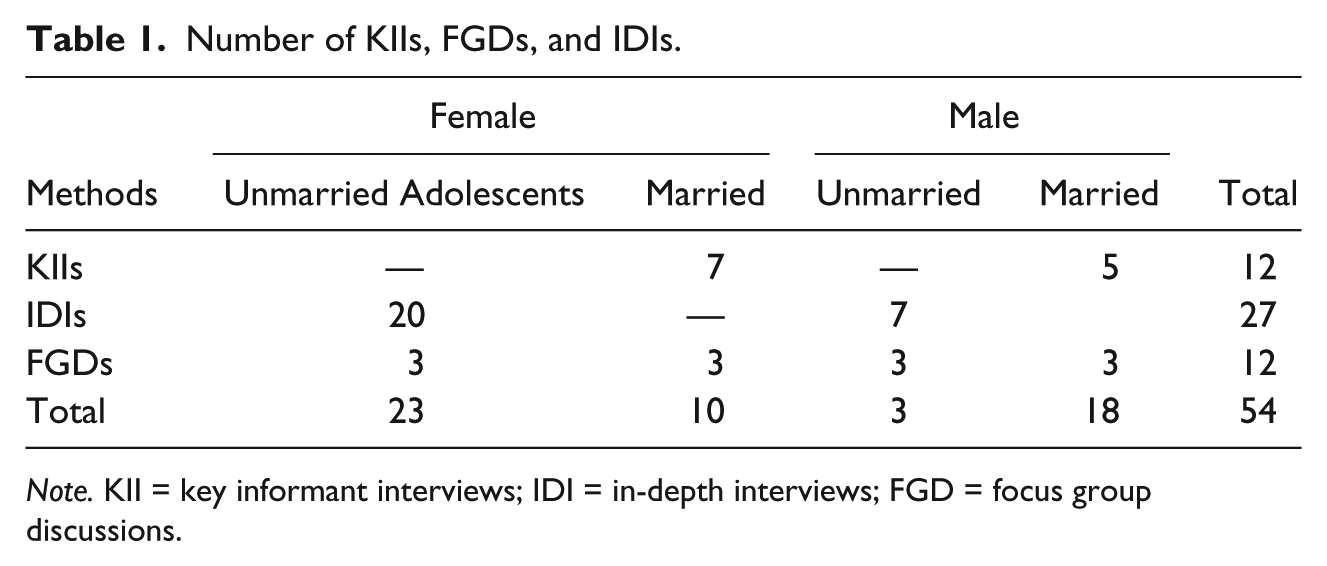
Note. KII = key informant interviews; IDI = in-depth interviews; FGD = focus group discussions.
Dhaka is popularly known as a city of slums. Slums have been defined as settlements with (a) poor housing conditions, (b) high overall density of population, (c) poor environmental services, and (d) high prevalence of economically disadvantaged people. There are no government services in the slums. Around 75% of the slum households have one-room accommodation and are in the lowest wealth quintile compared with those in the non-slum areas (NIPORT, International Center for Diarrhoeal Disease Research, Bangladesh, & MEASURE Evaluation, 2015).
Sampling and Selection of Participants
We conducted 12 KIIs with females and males, 27 IDIs with unmarried female and male adolescents, and 12 FGDs with unmarried female and male adolescents and married women and men. The sample was selected purposively. Age served as the criteria for selecting informants for IDIs. Thus, UAGs were aged 15 to 19 years and males were aged 18 to 35 years. KIIs and FGDs were designed to understand perceptions, attitudes, and practices regarding the safety and security situation in the community, gender roles and norms, gender relationships, and violence against women and girls.
Data Analysis
All interviews were transcribed verbatim. Based on the research objectives and reviews of the initial KII, FGD, and IDI transcripts, a preliminary code list was developed. This list was updated as dictated by emerging themes. Data were coded using the software Atlas.ti. Then, retrieved data were analyzed by themes through systematic comparison of codes, cases, and sources of data.
Ethical Considerations
World Health Organization’s (WHO, 2001) recommendations were followed to ensure no harm to the participants, confidentiality, and safety of the data and the participants. Informed consent was obtained from each participant prior to all interviews or discussions, and guardian’s consent was sought for interviewing minors (age <18). Interviews and FGDs were tape recorded after obtaining consent from the participants. The tapes were kept in locked files and erased following transcription. icddr,b’s Ethical Review Committee approved the study.
Results
Background Characteristics of the Unmarried Adolescent Girl Sample
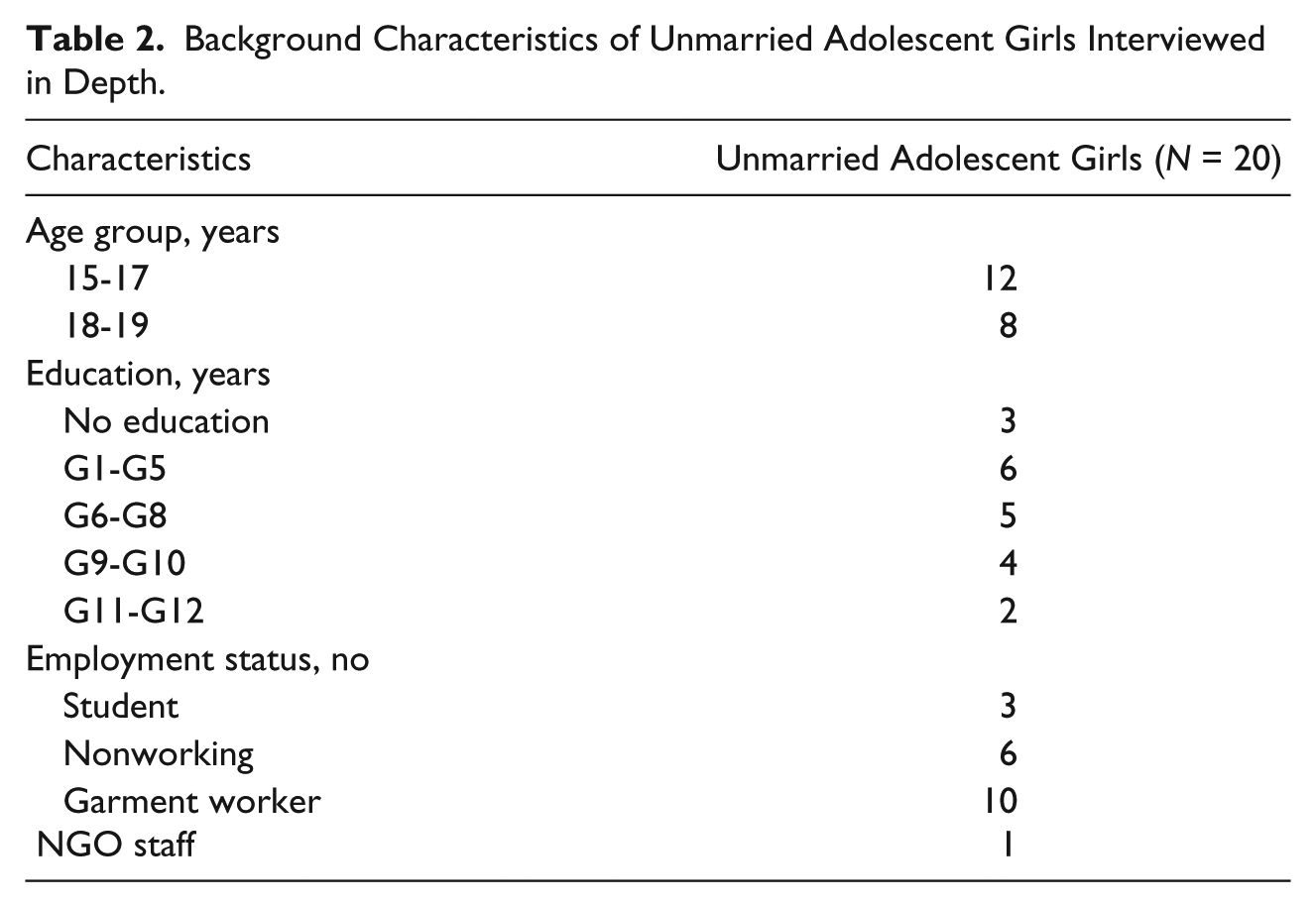
Most of the UAGs interviewed in depth were aged between 15 and 17 years (n = 12). Educational level was quite varied in the sample. Thus, three of the girls had no education, while two had matriculation. Most of the girls worked in garment factories (n = 10). Almost all of the girls who were currently unemployed had worked in garment factories previously. The main reason for working and not studying was household poverty. Only four girls were still in school/college. One of them managed to continue her studies by offering tuition to children (Table 2).
Background Characteristics of Unmarried Adolescent Girls Interviewed in Depth.
Social Expectations Around Sexuality of UAGs
Data suggest that societies expect UAGs to conform to a set of expectations regarding their dress, mobility, interactions with the opposite sex, and engagement in romantic relationships. In the studied slums, the traditional notion of separate spheres for males and females to function is still considered ideal. One unmarried male participating in an FGD put this as follows: Parents and people in the community consider a girl “very good” if she stays home, carries out household chores, prays five times a day, studies at home, does not hang out with males and does not go out on the street. (Unmarried adolescent boy, FGD)
However, the reality of life in urban slums stands in stark contrast to these expectations. Most UAGs make significant contributions to family income by working outside their home. Some UAGs also study. In our sample of 20 UAGs, 10 are employed in garment factories, six left their jobs recently and are looking for another job, one is employed by a nongovernment organization (NGO), and only three are studying. The mobility of UAGs creates an urge to protect their virginity, chastity, and family honor (maan-shomman), keeping intact the gender order. This produces certain codes of conduct for UAGs, who are crossing the boundaries of their home.
UAGs are expected to observe purdah and follow certain dress code when they go out. Stepping outside home dhekey dhukey (covering up her body) is a common expectation. There are also certain notions about how she needs to cover up. For instance, a “good” girl is not supposed to wear a short kameez (dress accompanied by shalwar or thin trousers worn by women in the subcontinent), shirts, sleeveless tops, jeans, or Western-style trousers or shorts. These clothes are perceived to expose women’s body and are considered odd and indecent. Shirts are particularly disliked because they are perceived to not cover breasts properly, draw men’s attention, and “allow” them to pass bad remarks. Long-sleeved kameez with shalwar or saree that covers the entire body is usually preferred. Part of the ideal dress is an extra piece of cloth such as orna used to cover head and breasts.
The families and communities consider it very important that the girls adhere to social expectations so that the girls’, their families’, and the community’s honor is upheld and the community environment is not contaminated with nontraditional ideas and practices. The girls are socialized to recognize this link between their behavior and honor. One study participant explained, When the daughters reach puberty the parents tell them ‘You see, you need to understand that you are the source of our shomman (honor) . . . .We’ll lose our shomman if somebody talks about you or passes any bad remarks. This is why you should not go out and you need to behave. If somebody visits us you’ll offer him a seat covering your head in a way that he cannot see your face. (Unmarried adolescent boy, FGD)
UAGs are also instructed not to walk with their backs straight as this is perceived to make their breasts prominent. They are advised to walk slowly bending their head avoiding looking around. Moreover, they are expected not to talk to strangers, challenge unsolicited comments or actions from strangers, or laugh aloud. Data suggest that some UAGs internalize these notions. It is clear from the excerpt presented below that sustaining individual and family honor underlies these restrictions: Participant 1: The good girls do not talk back. They keep walking away silently. . . Participant 2: bending her head. Participant 1: as she knows that talking to them would make her lose shomman (honor). Participant 3: Some girls are dirty and they get engaged in verbal dispute. Participant 4: Those who are faltu (worthless) do that. The good girls understand that speaking to the boys on the street leads to loss of shomman. (UAG, FGD)
Families also are quite particular about who a girl should socialize with. Thus, Koli told the interviewer about her instructions from the family: That girl talks and hangs out with men. Don’t make friends with her. This girl doesn’t do that. She is a good girl . . . .You can spend time with her. (UAG, unemployed, IDI)
Certain restrictions on mobility (e.g., avoiding certain places and times, and going without chaperon) are part of the strategy to protect the family and the girls. A “good” girl is also expected to avoid places considered risky for sexual assault or where sexual activities are assumed to take place. Thus, locations where men congregate and narrow or desolate alleys are particularly forbidden. One adolescent girl explained going to such places damages family reputation: Suppose there are five or six men in one place. If I go there by myself and if they pass remarks wouldn’t my mother’s maan-shomman (honor/reputation) be damaged? (UAG, garment worker, IDI)
Involvement of a UAG in a romantic relationship is perceived as particularly unacceptable (khubi kharap or oti kharap, that is, very bad or bissri, that is, disgusting) and considered ghrinno (hateful). Sexual relationship is usually suspected or assumed in romantic relationship. This assumption often hampers marriage prospects of the girl.
Control Over Sexuality of UAGs
In addition to restrictions imposed by the family, the community also stigmatizes a UAG often in an attempt to compel her to uphold patriarchal norms. Defiance from a UAG often leads to violence perpetrated by the family and the community.
Violence perpetrated by family
Once a girl reaches puberty, the family demands that she wears “decent” clothes and covers her head and chest with orna before stepping outside. A girl told the interviewer that her mother decides what she should wear to work: She instructs me to keep my head covered on the way to work and while I work. (UAG, garment worker, IDI)
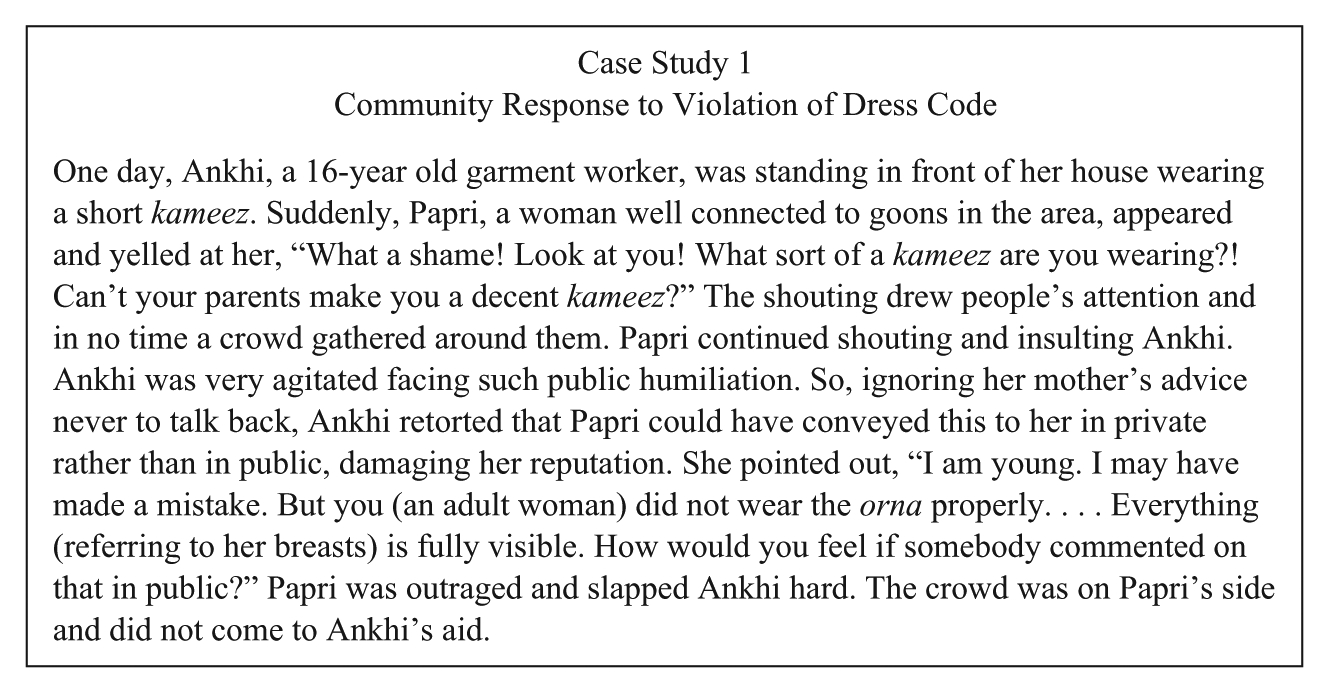
The family’s immediate concern is that “inappropriate” clothes will elicit sexual comments from men, which ultimately results in labeling the girl as a “kharap meye” (bad girl). UAGs are scolded, yelled at, and called names by family members if they refuse to follow the dress code. These measures help families ensure that their daughters conform to patriarchial norms. The community also takes an active role in imposing the dress code. IDI data suggest that most UAGs negotiate and actually attain greater mobility by conforming to the community dress code and code of conduct. As suggested by FGDs and KIIs, there is, however, also a trend of wearing nontraditional clothes such as trousers and t-shirts, notwithstanding restrictions and violence. This emerging trend is often challenged in the community through criticism, verbal abuse, and stigmatization of the UAGs and her family. At times, physical abuse is also perpetrated by community members in defending traditional norms. The story below vividly illustrates an example of how and to what extent the community may get involved in imposing dress code expectations on a girl (see Case Study 1).
Controlling a girl’s mobility and her interactions with males is a repetitive theme emerging from the data. Many UAGs report that they are not allowed to go out late in the evening. In case they are allowed, someone needs to accompany them: I am allowed to stay out until 7pm . . . .but my brother can stay out until 11pm or 12am. My mother says to me, “Take your older sister with you if you need to go out . . . you’re grown up now . . . you shouldn’t go out alone. (UAG, garment worker, IDI)
If working UAGs stay out in the evening after work, they are suspected of engaging in romantic relationship and scolded if they cannot justify being late. In extreme situations, lack of support from the community and family sometimes makes the girls to limit their mobility by stopping education or work. One female key informant said, Girls are not safe in this area. There are so many mastaan (gangsters), bokhatey (spoiled/derailed) boys out there. They harass the girls. Sometimes girls cannot go to school because of such harassment. This is why parents want their daughters married before anything bad happens to them. (Woman, private tutor, KII)
KII and FGD participants agreed that it is a shame to physically assault a pubescent girl. However, IDI data show that physical violence (e.g., slapping, beating) is also used to control mobility of these girls, particularly when they hang out with friends. The following quote describes such an experience: Last year, I went out with my female friends to celebrate the Bangla New Year early in the morning . . . .When I came back home in the evening everyone was angry at me . . . .I was beaten by my elder sister’s husband and my mother yelled at me, “Liar! Why don’t you tell us that you spent the day with a guy?! (UAG, unemployed, IDI)
Sexual harassment in public place
Men commonly harass young girls in public places. The most common sexual harassments reported in IDIs and FGDs include name-calling, making sexual comments, whistling, chanting, staring, proposing to enter into an affair or sex, making vulgar sexual gestures, touching the girls sexually, proposing sex or romantic relationship, threatening in face of refusal, and so on: They wink. They say, I suck your breasts. They touch us and bump against us. (UAG, garment worker, IDI) Men comment on “bad” parts of a girl’s body. They say they’d do “bad” things to the girl . . . .For instance, when a girl is passing by a man would say, “her breasts are large” or “. . . it’d feel good to kiss her’ . . . or “I’d enjoy sleeping with her. I wish I had this girl for a night.” (Unmarried adolescent boy, rickshaw puller, IDI) A young man from the locality always waits on the street for me . . . I am scared to go out . . . He proposed to me couple of weeks ago and I refused . . . A few days back, he threatened me by saying, “too much pride is not good . . . your beauty won’t last long! . . . I’ll see how long your aunts are going to protect you from me. (UAG, private tutor, IDI)
It is clear from the data that UAGs who are newcomers in the slum and those who live on their own are most vulnerable to sexual harassment and advances” Local mastaans and bokhatey young men chase girls who are new to the area, . . . who just came from the village . . . . They propose them to have a relationship. (Man, unemployed, KII)
Girls who live in slums alone have to tolerate sexual remarks and advances made by local men. They cannot protest or do anything else about it. Drug addicts were particularly mentioned as harassers: Men who do drugs usually hang out together. They wait for the female garment workers to appear on the street at lunch break or after work. They pull the girls’ orna . . . . Sometimes they stretch their leg to make a girl stumble or fall. Some whistle, while others jeer, “Get her, I like her, etc. (Woman, private tutor, KII)
Adult men may also sexually harass UAGs, although to a lesser extent than young men: The other evening I was coming home and there was a man standing in front of the shop. He is quite old and has a daughter of my age. [Seeing me] he commented, “Look how large the breasts of this young girl are. She must have made them large by doing things with the boy (her boyfriend).” I couldn’t imagine he would say such things. He is as old as my father. How could he ill-repute me? . . . These words hurt me so much that I cried for three days . . . .He continued making nasty comments whenever I passed him on my way to school. (UAG, unemployed, IDI)
The data from the girls suggest that they are sexually harassed more by men outside their own community, while within their own slum they are sexually harassed mostly by mastaan (gangsters) and bokhatey (derailed) young men.
To avoid being blamed, the UAGs usually remain silent about sexual harassment. Some girls report such incidents to their parents. When the case is very serious in nature, the families seek help from the community leaders. FGD and KII data suggest that a few girls maintain strong links and even enter into romantic relationships with the local elites as a strategy for dealing with sexual harassment, as men usually avoid harassing the girlfriend of local political leaders or mastaan (gangster): There are girls who maintain romantic relationship with powerful men in the area for protecting themselves from harassment by other men. If she is seen with a powerful guy in the community, no one will disturb her. (Man, microbus driver, KII)
As a consequence of public sexual harassment, women often face double jeopardy in the form of blaming and stigmatization by the community, family, and friends. This is well reflected in a group discussion with the community leaders: Men do not tease good girls . . . nowadays girls wear revealing clothes . . . short kameez, jeans . . . which provoke men. (Community leader, FGD)
Such beliefs are so pervasive that even parents tend to normalize sexual harassment. For instance, when Ankhi complained to her mother about sexual harassment by a young man from her own slum, her mother said, Why do you need to go out so frequently? If they find you walking around on the streets it’s very normal that they’ll harass you! (UAG, unemployed, IDI)
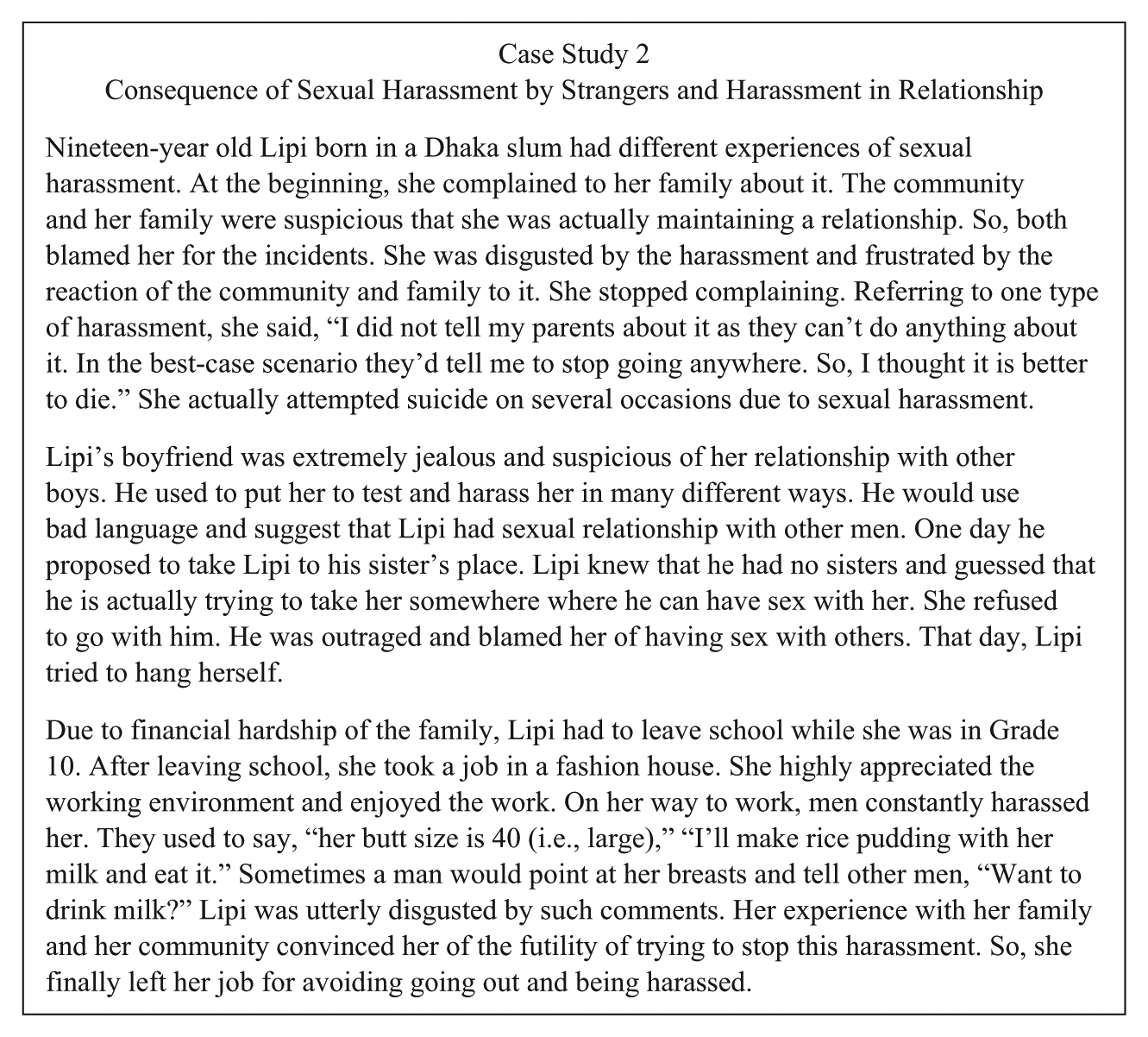
Sexual harassment and its aftermath affect UAGs’ mental health. In Lipi’s case, this led to suicidal thoughts and attempt (see Case Study 2).
As mentioned above, involvement of young girls in romantic relationship is usually unacceptable. If a UAG resists a marriage suggested by her parents, a romantic relationship is assumed and she gets labeled as a “bad girl.” This often leads to emotional and/or physical abuse of UAGs at home. These consequences force UAGs to hide their interactions with males and their romantic relationships, increasing their vulnerability to violence from the boyfriend.
In case of presumed or actual relationship, the families often put immense pressure on the girl for legitimizing the relationship via marriage. If the family does not like the boyfriend, there is often an attempt to hastily marry the girl to somebody else. Thus, for example, one girl reported that when her mother found out that she had a boyfriend, she quickly found a prospective groom for her. When the girl refused to marry the man of her mother’s choice, her mother shouted at her and threatened to take her back to the village: You have become “noshto” (spoiled/ polluted). You are developing relationship with men after you came to this city. You don’t listen to me anymore . . . I’ll take you back to the village and everything will be alright then. (UAG, unemployed, IDI)
The girls mentioned that such abuse at home curbs their opportunity to share their problems in relationship and hinder support-seeking from family in case of trouble.
Despite restrictions on interaction with the opposite sex, there is ample evidence that many UAGs engage in romantic relationship. If the relationship is revealed, UAGs try to gain their parents’ consent to the relationship. The girls often leave home if the parents refuse to marry them to the man of their choice. A marriage that does not receive approval from the girl’s parents often leads to loss of family support, leading to greater vulnerability to violence from the marital family.
Sometimes a boyfriend deceives a girl and coerces her into having sex by giving her false hopes of marriage. The UAGs may not disclose their problem in such situation fearing stigma and other negative consequences from family and community. However, one such girl in the sample made a futile attempt at availing support from the boyfriend’s family, from his employer, and even from the police.
Community control over romantic relationship and sexual harassment
In case of sexual harassment, only wealthy and influential people can make the community leaders take some action. Going to the community leaders for help may actually victimize the poor and people without important connection. One of the key informants said, When a girl is repeatedly harassed or threatened she goes to the community leaders for support . . . . If she is poor, [instead of providing any support] the leaders would say, “Why would he/they do this to you? You must have provoked it.” (Woman, unemployed, KII)
In case of an actual or assumed romantic relationship, the community imposes some control over the couple. Sometimes, when young men closely connected with powerful people inside or outside the community find a couple hanging out together, they extort money from them using threat of exposing the relationship to the community. This is known as fitting (framing). The main aim of fitting is actually extortion of money. If payment is made, the young men use the money to dine out. When “feasts” are arranged using the extorted money, the whole affair is referred to as “mamu or tehari bichar.” The word bichar literally means arbitration. Even though no arbitration is actually involved in the process, this label is used in an attempt to legitimize the unfair demand. If no payment is made, the young men usually abuse the victims emotionally and physically and threaten them with convening a shalish (local arbitration): It is very normal that girls will like boys and they’ll hang out together. But gangsters here don’t allow them to talk. They beat the man and demand money from the couple. If the couple fails to pay, they are taken to the community leaders for arbitration. (Woman, unemployed, KII)
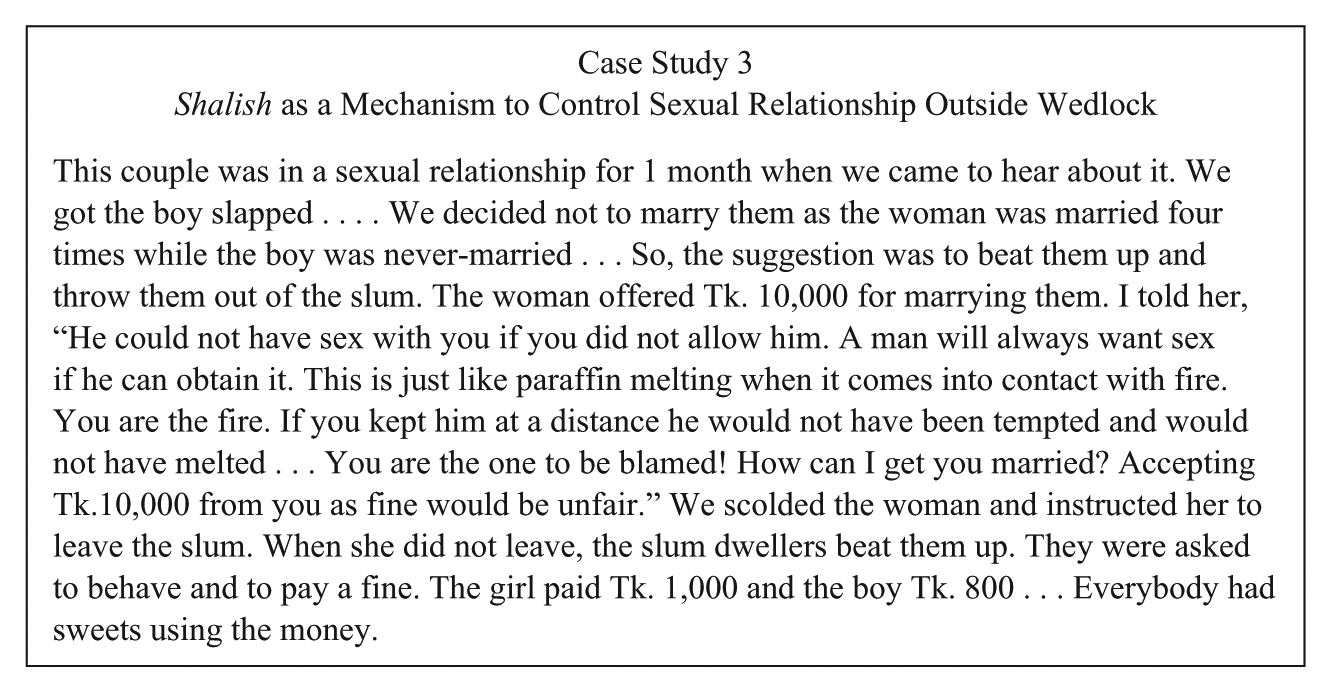
Nonpayment, thus, results in shalish at times. The members of the shalish are usually community leaders and elders. During bichar, or arbitration, both the UAG and her boyfriend are usually harassed, stigmatized, scolded, and physically assaulted. The ability to avert such abuse depends on financial capability and political influence of the couple involved (see Case study 3). If the victims refuse to pay the fine charged by shalish, they may be forced to leave the slum. This is more likely to happen in the case of a UAG with no relatives or supporters in the community.
One of the key informants pointed out to a different way of dealing with unwillingness to pay in fitting: If a boy and a girl engage in an illicit affair and 4-5 of us catch them and threaten to reveal their relationship to the community. They shake in fear of losing maan-shomman (honor). We use this opportunity to demand money for arranging a marriage for them. If they don’t agree to pay, we suggest that the girl has sex with us. This is what we call fitting. (Man, microbus driver, KII)
The following incident narrated by the UAGs participating in an FGD lends support to the assertion made by the key informant that men may also try to obtain sex if the couple refuses to pay the amount they demanded: There was an unmarried young couple Mala and Mannan, who used to have sex. One day, they were caught by a man (Barkat). Barkat threatened that he would tell Mala’s parents about this. Mala implored him not to do so. Barkat said he could keep silent only if Mala agreed to have sex with him. Mala did not agree to this. So, Barkat let out the secret. In this situation, Mannan denied ever having a relationship with Mala. Moreover, he sent Mala a letter threatening to rape Mala’s younger sister if she disclosed their relationship. Mala showed the letter to her parents. The parents requested a bichar/shalish (local arbitration). The shalish forced Mannan to marry Mala. (Man, microbus driver, KII)
According to the women in the slums, drug-addicted men are often on the lookout for boys and girls together so that they can take advantage of the situation and extort money from the couple. Fitting is a fairly common phenomenon in slums. According to the women participating in FGDs, there were eight to 10 such fitting cases during the year prior to data collection.
Control and violence in romantic relationship
Data revealed that expectations and aspirations from a romantic relationship differ by gender. The differences in expectations and the power dynamics within the relationship give rise to conflict and expose the UAGs to emotional, physical, and sexual violence. While UAGs usually expect a lasting relationship leading to marriage, men often treat the relationship as a pastime or as a means to gratify their sexual needs. According to men, a romantic relationship is temporary and only lasts as long as pleasure can be obtained from it. Marriage, on the contrary, is viewed by unmarried men as a long-term relationship involving some material and financial gains for men: I have four premika (girlfriends) at the moment [smiling] . . . I will finally marry one of them . . . I just have mauja (fun) with them (the other three) . . . . I will ditch the other three . . . . They can do nothing about it. They will just have to let it go. If they are actually good girls and care about their ijjat (honor) they will just keep their mouth shut and not tell anyone . . . ijjat is the most precious thing for a girl . . . losing it implies losing everything a girl has in her life. (Unmarried male adolescent, bus helper, IDI)
UAGs often have to put up with boyfriends who maintain multiple relationships. Men, however, do not tolerate even any suggestions of their girlfriends maintaining multiple relationships—they become jealous and suspicious and use emotional abuse to control the girls. The most common strategy used by them is to threaten to break up or to not marry. However, not all UAGs put up with such abuse. For instance, Lipi broke up with her overtly suspicious boyfriend: He always used to suspect that I am having affair with other men . . . I used to be a tutor . . . . he would say awful things if he saw me talking to my male students. If I wore makeup he would ask, for whom did I put on the make up. . . . sometimes he made his friends call me to check whether I enjoy talking to other men! . . . I decided to break up with him. He got furious and said, “Now I am sure that I was right about you! Tell me, who is the guy you are leaving me for? . . . I will see how you live in this locality! I’ll give you what you deserve!” . . . I was so scared that I could not go out alone for one year. (UAG, unemployed, IDI)
Men try to obtain sex by giving UAGs false hopes of marriage. Some girls succumb to their demands in hopes of continuing the relationship and getting married: Whenever I see him, he asks for physical closeness . . . like a leech . . . it makes me feel uncomfortable. He keeps asking me to hug him, to do this and that. I am suspicious . . . does he really love me? Or does he just want to have sex? (UAG, unemployed, IDI) I did not want to (have sex) . . . but he used to keep asking for it . . . he used to say “I’ll never leave you. If I really wanted to leave you why would I disclose our relationship to my parents? They know everything. I’ll marry you . . . trust me.” (UAG, unemployed, IDI)
Although interviews with unmarried men give an impression that having sex is not an uncommon practice in romantic relationship, very few women report having sex with boyfriends. While men’s narratives alluded to consensual sex these few girls reported coerced or forced sex. The male data suggest that a girl’s consent regarding sexual acts or preference for condom use is ignored and that physical violence is often used for achieving sex in relationship. This disregard of a girl’s choice and needs was explained by the notion of men’s sexual entitlement and irrepressible sexual urge: Her body and mind are mine . . . why wouldn’t she give it to me? . . . I used to tell her that I’ll leave her if she doesn’t give in . . . A man can’t control his urges. When he gets aroused, it’s not possible for him to consider if his partner is sick or getting hurt. (Man, rickshaw driver, IDI)
Pregnancy and forced abortion in romantic relationships were mentioned by male informants. One unmarried girl shared her personal experience of getting pregnant and inducing an abortion. She did not receiving any financial or emotional support for the abortion. The data provide example of how men use violence and threats to ensure abortion: I had to beat her . . . otherwise she wouldn’t agree to abort the child . . . I told her that I would leave her if she keeps the child. (Man, rickshaw driver, IDI)
Cases were reported when the men refused to marry the girls after having sex several times. Attempts at marrying the men met with physical and emotional violence from his side. In one case, the girl, Parul was stigmatized and emotionally and physically abused by the man’s family. When she persisted, she was threatened with rape by hired mastaan (gangsters): (His family members) said he made me pregnant and that is why I was chasing him. They would say, “She had an abortion” . . . . His mother, brother and his sisters called me names . . . . They threatened me over phone. They said, “If you come this way we would have you raped.” (UAG, unemployed IDI) After I came to know that he had married another girl I went to his workplace to see him and complained to the people there . . . he got so angry that he started hitting me . . . later his aunt threatened me over phone, “you whore! If you call again and we’ll tear you apart” . . . . I went to his house with my mother and his mother said, “You shameless hussy! You slept with my son, got pregnant and now you tell us that you are innocent!” Even though I was not pregnant people think I was! (UAG, unemployed, IDI)
Parul failed to get help from her boyfriend’s employers. She then filed a police case and bribed the police hoping for a positive outcome. But the boyfriend bribed the police as well and the police dropped the case.
Discussion
The study findings suggest that different opportunities and life circumstances in urban slums have drastically changed gender roles of the UAGs living in slums compared with their rural counterparts. Daughters traditionally perceived as financial burden of parents have become income earners. Poverty forces families to transgress patriarchal norms of gender division of labor and separate spheres for males and females to function, which contests conventional patriarchal norms. Thus, new sets of patriarchal norms emerge to deal with these new circumstances. The tension between life circumstances and the urge to sustain patriarchal norms creates an impetus to heighten control over UAGs’ sexuality. Security concerns in urban slums with high crime and violence levels also contribute to this impetus. As a compromise, the families and communities impose on the girls elaborate dress codes and restrictions on mobility and interacting with men. This is in line with Kandiyoti’s (1988) assertion about the transforming nature of patriarchy and new impositions by the patriarchy in a different context. The community appears as a locus of structural perpetration through the patriarchal norms targeting UAGs’ sexuality, and families convey the community role. Promoting patriarchal norms for controlling UAGs becomes all the more important in this context for preventing emergence of other types of femininity, which may enter into competition with emphasized femininity. Control over UAGs is often executed through emotional, physical, and sexual violence at various levels of the society.
Many girls conform to the family and community expectations, while others deviate from them despite stringent controlling measures. It is important to note that transgression of norms by UAGs does not necessarily happen equally in all the different spheres of her lived experience; she may conform to some, while deviate from others and adapt to others. For instance, a girl may practice purdah when outside the home, but still be in a romantic relationship. While having a romantic relationship is clearly a deviation from the norm, the relationship dynamic often follows traditional patterns of female subjugation. Consistent with previous studies (Kanji, Bode, & Haq, 2005; Moor, 2013), our findings show that UAGs deviating from societal expectations are stigmatized as “bad girls.” As pointed out by Feldman, shame is based upon sanctions imposed by members of a group with whom there is frequent interaction (Feldman, 2001). Inflicting shame is effective because a girl’s personal shame in a patriarchal society is tantamount to shaming one’s family. As a result, UAGs who enter romantic relationships tend to hide the relationship, fearing stigma and damaging family honor. This in turn puts them at higher risks of gender-based violence from their boyfriends.
Although girls’ exposure to the outside world creates opportunities for their empowerment, it also increases their risk of sexuality-related violence by the family, community, intimate partners, and men on the street. As Siddiqi (2003) rightly points out, men’s sense of entitlement to regulating women’s mobility and sexuality encourages and legitimizes sexual harassment. Sexual harassment and coercion of girls are also legitimized through widespread acceptance of men’s need for sex, sexual expression, and the belief that it is a UAG’s responsibility to protect herself by conforming to patriarchal norms. Lack of familial support and a culture of blaming underlie silence of UAGs around sexual abuse, making the UAGs more vulnerable. A few girls opt for the dangerous path of maintaining a romantic relationship with powerful men in the community for avoiding sexual harassment by other men.
Despite traditional gender norms and stigma, UAGs actively navigate between expectations and desires. They express their curiosity about sexuality and look for ways to get involved in romantic relationships. To cope with social expectations and conflicting norms, they try to keep their romantic relationship hidden. This allows men to continue abuse and to get away with it. Perpetration of this violence is backed by patriarchal ideology regarding romantic relationship and sexuality in the community and society.
Community intervention in romantic relationships disproportionately victimizes the girls by stigmatizing and blaming them, imposing on them higher fines, and sometimes even by making her vulnerable to rape and damaging her future prospects of marriage. As Papanek (1973) and Papanek and Minault (1982) suggest, community actions taken against women show that women’s relationships to their communities are tied directly to the regulation of sexuality and to women’s “innate tendencies towards infidelity” (Chakravarti, 1989), behaviors best controlled through shame (Mernissi, 1975). In contrast, the males involved in romantic relationship are often excused or justified or charged lower fines due to belief that men possess uncontrollable sexual attraction toward women.
It is interesting to observe that while patriarchal ties within family are weakened by the advent of economic opportunities for girls outside the family and dependence of girls upon community network for marriage or its stability is reduced, the girls’ interaction with the public sphere allows the community to get more engaged in controlling their sexuality. Feldman (2001) contends that in renegotiating the patriarchal bargain, regulatory control may shift from the privacy of the household to public institutions. Our findings show that the private and the public join hand in strengthening control over female sexuality in the context of urban slums.
This study did not adequately explore violence in the workplace. Limitations of this study also include possible underreporting of types of violence explored. However, this is unavoidable as this study was conducted in a cultural context where the topic is tabooed and disclosure of such violence might generate backlash. A greater number of IDIs could strengthen the study, but we address this limitation by using different sources of data (i.e., male IDIs, KIIs, and FGDs) and triangulation.
Despite its limitations, the study illustrates how control over and violence against UAGs are linked to the honor culture. This culture and tied to it preoccupation with virginity before marriage have to be addressed to reduce controlling behavior and violence at both the family and community levels. Grave consequences of sexual harassment and violence on the development of UAGs must be taken into account by the government. The Bangladesh government and NGOs should create an enabling environment where UAGs can report and discuss their vulnerabilities to gender-based violence without fear or hesitation. Communities must abandon any actions leading to victimization of the UAGs. Patriarchal attitudes, especially among young men, must be altered to allow UAGs to exercise their right to choice and consent in relation to their sexuality and to reduce sexual harassment and rape. This will have a synergistic effect on the family, leading to reduced control over UAGs, and allow them to become empowered young women who have control over their own lives.
Footnotes
Acknowledgements
The authors would like to acknowledge and thank the slum population who participated in the study.
Declaration of Conflicting Interests
The author(s) declared no potential conflicts of interest with respect to the research, authorship, and/or publication of this article.
Funding
The author(s) disclosed receipt of the following financial support for the research, authorship, and/or publication of this article: The study was funded the Embassy of the Kingdom of the Netherlands (EKN; Grant Number GR-00811).