




Abstract
College campus sexual assault is well-documented as a pervasive problem among U.S. colleges and universities, with female college students at the greatest risk. Although more than 30 years of research has been dedicated to uncovering college campus sexual assault and identifying risk factors for victimization, few studies have looked at the relationship between female students with disabilities and college campus sexual assault victimization. The present study uses data from the female respondents (N = 22,828) of the American College Health Association’s Fall 2016 National College Health Assessment (ACHA-NCHA) to explore the relationship between female college campus sexual assault victimization and disability status. The analysis finds that disability status produces significantly greater increased odds for sexual assault than other commonly cited risk factors such as binge drinking, drug use, or Greek affiliation. Specifically, female students with disabilities are at increased odds for any type of sexual assault compared with female students without disabilities (odds ratio [OR] = 1.96; p < .001). This increases when looking at specific types of assault. Female students with disabilities were over 100% more likely to experience completed assaults (OR = 2.34; p < .001), attempted assaults, (OR = 2.03; p < .001), and relationship assaults (OR = 2.22; p < .001) compared to female students without disabilities. Analysis also indicates differences in other significant independent variables when sexual assault status is broken down into categories of completed sexual assaults, attempted sexual assaults, and relationship sexual assaults. In addition, the types of disability showing significance vary between the different types of assault. These findings have important policy implications for campus violence prevention and intervention and suggest multiple avenues for further research.
Keywords
More than 30 years of research have been invested in uncovering sexual violence on college campuses (Fedina, Holmes, & Backes, 2016; Fisher, Daigle, & Cullen, 2010). Actual prevalence findings from research vary, depending on how broadly researchers define and measure sexual violence (Hipp & Cook, 2017), but the most frequently cited statistic is that one in five college women experience some type of sexual assault during their collegiate careers (Krebs, Lindquist, Warner, Fisher, & Martin, 2007). Although high rates of sexual assault affecting college women have been well-documented, research focused on female students with disabilities and college campus sexual assault is in its infancy. This is somewhat surprising considering that compared with the general population, women with disabilities are at similar or increased risk for all types of abuse, including sexual abuse (McCormack, 1991; Plummer & Findley, 2012). The present study contributes to this emerging literature by using data from the Fall 2016 American College Health Association’s National College Health Assessment (ACHA-NCHA) to address research questions regarding the relationship between students with disabilities and college campus sexual assault.
College Campus Sexual Assault
As mentioned, there is no scarcity of research documenting the pervasiveness of college campus sexual assault. Scholars have also identified several risk factors for victimization. Being a female is consistently the first and biggest risk factor for victimization (Fisher, Cullen, & Turner, 2000; Krebs, Lindquist, Warner, Fisher, & Martin, 2009). But many studies have also identified alcohol use, specifically binge drinking, frequent partying, drug use, sorority membership, being a freshman or sophomore, and living on campus as among the most significant risk factors for sexual assault of college women (Fisher, Cullen, & Turner, 2000; Franklin, 2012; Krebs et al., 2007). Although the foundation of research supporting both the pervasiveness of and risk factors for college campus sexual assault is solid, feminist scholars have criticized the overuse of quantitative analysis in these studies, maintaining that it generalizes women’s unique lived experiences and ignores marginalized populations of students (Bell, 2013). However, policy makers often look to quantitative research for empirical guidance. Given the focus feminist scholars also place on research that connects to social justice initiatives, often coming through policy change, it may not be possible or advisable for feminist scholars to abandon quantitative research on violence against women (Miner & Jayrante, 2013).
Students With Disabilities
The Americans With Disabilities Act defines disability as “a physical or mental impairment that substantially limits one or more major life activities of such individual; a record of such an impairment; or being regarded as having such an impairment” (Americans With Disabilities Act of 1990, 2008, Section 12102, para. 1). According to the U.S. Department of Education’s National Center for Education Statistics (2016) in 2011-2012, students with disabilities made up approximately 11% of college students in the United States. As Hong (2015) notes, the National Council on Disability (2003) reported that the number of college students with disabilities tripled over the prior 20 years, and these students spent twice as long finishing their degrees. With an increasing number of students with disabilities attending college, and staying in college longer than students without disabilities, taking a closer look at the way college campus sexual assault affects these students is certainly warranted.
Intersectional Feminism
The present study is embedded primarily in an intersectional feminist framework. Intersectionality, coined by Crenshaw (1989) and elaborated by Collins (2009) and multiple other scholars (see, for example, Baca Zinn & Thornton Dill, 1996; Cho, Crenshaw, & McCall, 2013), maintains that individuals and groups hold unique social locations created and maintained through overlapping and intersecting axes of oppression, which inform these individuals’ and groups’ opportunities and barriers on an individual and structural level. Intersectional feminism demands that scholars pay attention to whose stories are told through research and which groups are the focus of programming and policy (Hesse-Biber, 2013). Moreover, a feminist intersectional framework invites academics and practitioners to bring marginalized populations to the center of research, suggesting that understanding the experiences of marginalized individuals and groups will aid in a better understanding of social problems (Naples & Gurr, 2013).
By approaching college campus sexual assault from an intersectional feminist lens, the present analysis acknowledges that college students have qualitatively different experiences and social locations that influence their risk for sexual assault victimization. Furthermore, focusing specifically on students with disabilities recognizes these students’ marginalized positions on college campuses, examining what that might mean in terms of risk for sexual assault victimization. Although this research is guided by intersectional feminism, by no means does this study claim to be an exhaustive intersectional study of college campus sexual assault. Instead, the present study asserts that marginalized populations’ experiences, and specifically in this study, students with disabilities, have been largely left out of research on college campus sexual assault.
College Campus Sexual Assault and Students With Disabilities
Plummer and Findley (2012) conducted an exhaustive literature review on the topic of women with disabilities and abuse. This review was not focused solely on college women, or solely on sexual assault. Nonetheless, their findings bolster the imperative for the present study. Other subjects explored include personal assistance (PA) workers and abuse, intimate partner violence, and service/resource availability. Plummer and Findley (2012) note that results of these studies show prevalence rates of sexual and physical abuse of women with disabilities as equal to or higher than women without disabilities (Casteel, Martin, Smith, Gurka, & Kupper, 2008; Coker, Smith, & Fadden, 2005; Martin et al., 2006), but that prevalence rates have not been clearly established. They emphasize that women with disabilities may be particularly vulnerable to multiple kinds of abuse and rates could actually be much higher.
Of the 24 qualitative and quantitative studies examined by Plummer and Findley (2012), 10 of the studies focus on sexual abuse in some regard. Studies that looked at prevalence rates of sexual abuse for women with disabilities findings varied. Both Casteel et al. (2008) and Martin et al. (2006) found that women with disabilities were 4 times more likely to experience sexual abuse than women without disabilities. Oktay and Tompkins (2004), in a sample of 84 men and women with disabilities who use PA services, found that 3% experienced sexual abuse by their PA and 8% experienced sexual abuse by another person. Milberger, Israel, and LeRoy (2003) interviewed 85 women with disabilities and found that 66% reported sexual abuse. Nosek, Howland, Rintala, Young, and Chanpong (2001) found that 62% of women with disabilities in their study experienced some type of abuse; however, rates for women without disabilities were the same in those findings.
In their review, Plummer and Findley (2012) categorized risk factors into five general categories: isolation, role of perpetrators, dependency, lack of identification, and system and cultural barriers. Women who were more isolated, either physically or socially, were more likely to experience abuse (Gilson, DePoy, & Cramer, 2001; Nosek et al., 2006). The most commonly identified perpetrators included live-in partners or husbands (Milberger et al., 2003). The authors note that people with disabilities may make attractive targets for perpetrators because of their perceived vulnerability (Martin et al., 2006; Plummer and Findley, 2012). Women with disabilities are also often more dependent on chronic abusers, whether they be their spouse/partner, a caregiver, or family member, making it difficult to report abuse. They also report feeling unworthy of relationships and have poor self-esteem, which may prevent them from leaving abusive romantic relationships (Gilson et al., 2001; Hassouneh-Phillips & McNeff, 2005). Women with disabilities may find it difficult to recognize abuse and be unclear on how or where to report abuse (Gilson et al., 2001). Even if these women reach out for services or help, there is often a lack of appropriate, accessible services available (Plummer and Findley, 2012).
There have been two recent studies that look specifically at college students with disabilities and sexual assault (Findley, Plummer, & McMahon, 2016; Snyder, 2015). These studies show an increased or comparable risk of sexual assault victimization for students with disabilities compared to students without a disability. Using data from the Fall 2008 ACHA-NCHA with a sample size of 26,685 male and female students from 40 different universities and colleges, Snyder (2015) found that female students with attention deficit hyperactivity disorder (ADHD) were at significantly higher risk for unwanted sexual touching and rape than female students without ADHD. ADHD is only one of the disabilities college students may experience, which underscores the need for more research on students with an array of disabilities, and the relationship between different types of disabilities and risk for sexual assault.
Findley et al. (2016) conducted a cross-sectional survey of 36 male and 65 female students with disabilities from a large northeastern public university about their experiences with abuse. The authors found 5% of the women reported experiencing forced sex in the past year; no men reported forced sex in the past year. A finding of 5% may seem low, but this study had only 101 participants and was measuring sexual assault based on the question, “In the last year has anyone forced you to have sexual activities?” This question measures sexual assault only in terms of force and leaves much room for interpretation as to what constitutes “forced” sexual activities. This study was limited to one university, and as Findley and colleagues (2016) point out, their study was the first of its kind, stressing the need to explore further the relationship between students with disabilities and sexual assault on college campuses.
The Present Study
Few studies have looked specifically at the intersectional identity of female students with disabilities in terms of risk for college campus sexual assault. Moreover, the studies that have are small (Findley et al., 2016), or have a much narrower disability focus (e.g., Snyder, 2015). As such, there is relatively little to be found regarding disability status generally or for multiple specific disabilities, and risk for college campus sexual assault for female students, leaving the foundation of literature on college campus sexual assault and disability status very thin.
In addition, there is no research that specifically looks at the relationship between some of the commonly cited, and empirically supported risk factors for college campus sexual assault that have dominated the literature over the past three decades such as alcohol use, illicit drug use, marijuana use, Greek affiliation, and being earlier on in the collegiate career. The heavy focus on these risk factors in the college campus sexual assault literature (see, for example, Fisher, Cullen, & Turner, 2000; Fisher et al., 2010; Franklin, 2012; Krebs et al., 2007) casts a broad net often looking at these risk factors for college women generally, without specific acknowledgment that these may differ depending on one’s social identity characteristics, such as disability status.
The present study addressed gaps in the research and adds to the literature in four specific ways. First, using a series of logistic regression analyses, the study explored the relationship between female students’ disability status overall and risk for college campus sexual assault, adding to the foundation of literature on college campus sexual assault of female students and disability status more broadly. Second, the study explored whether or not certain types of disabilities put students more at risk for sexual assault, which highlights areas for future research, but also adds specificity to the emerging body of research on this topic. Third, the study interrogated the robustness of other risk factors by examining whether or not the relationship between these risk factors (e.g., alcohol use, Greek affiliations, etc.) and college campus sexual assault held true for the marginalized population of female students with disabilities. Finally, the focus on female students with disabilities and college campus sexual assault begins to apply a more intersectional lens to quantitative work on college campus sexual assault.
Research Questions and Hypotheses
With the relative scarcity of research on college students with disabilities and sexual assault, the present study intended to add to the foundation of this literature by exploring the following research questions:
While there is not a large body of previous research to draw on, Plummer and Findley’s (2012) review asserts that women with disabilities are at equal or increased risk for abuse generally, compared to women without disabilities. College women have consistently high rates of sexual assault. Therefore, regarding Research Question 1, I hypothesized the following:
Much of the last three decades’ worth of research has identified several risk factors, including drug and alcohol use and Greek life, that increase risk for sexual assault victimization of female college students (Fisher, Cullen, & Turner, 2000; Franklin, 2012; Krebs et al., 2007). Consequently, I hypothesized the following:
The last research question was meant to be exploratory, and therefore a specific hypothesis related to this question was not developed.
Method
Data
The data used for the present study came from the ACHA-NCHA of Fall 2016. The ACHA-NCHA is a national research survey designed to assist schools that choose to participate in collecting data about student health, behaviors, and perceptions (American College Health Association [ACHA], 2019). The survey focuses on questions regarding (a) alcohol, tobacco, and other drug use; (b) sexual health; (c) weight, nutrition, and exercise; (d) mental health; and (e) personal safety and violence (ACHA, 2019, Survey With the Broadest Reach Section, para. 1). The original Fall 2016 data include responses from students at 51 colleges and universities around the United States, with an N = 33,512. However, because college campus sexual assault disproportionately affects women, this analysis only looked at female college students’ experiences; all students who indicated they were assigned male at birth were dropped from the analysis, resulting in N = 22,828.
Variables and Measures
Sexual Assault Victimization was measured by combining responses from three different survey items designed to measure sexual assault victimization within the past 12 months. These items included the following questions: (a) Was sexual penetration attempted (vaginal, anal, oral) without your consent? (b) Were you sexually penetrated (vaginal, anal, oral) without your consent? and (c) Have you been in an intimate (coupled/partnered) relationship that was sexually abusive (e.g., forced to have sex when you did not want it, forced to perform or have an unwanted sexual act performed on you)? A dummy variable based on responses to the above three survey items was created. All models were also run with the dependent variable broken down into the three different types of sexual assault asked about on the survey, Completed Sexual Assault, Attempted Sexual Assault, and Relationship Sexual Assault, where each type of assault was measured independently as a dummy variable.
Disability Status was measured from participant responses to nine survey items that ask students about disabilities. These survey items asked students to respond yes or no, indicating whether or not they self-identified as having one of the following disabilities: (a) ADHD, (b) chronic illness (e.g., cancer, diabetes, autoimmune disorders), (c) deafness/hearing loss, (d) learning disability, (e) mobility/dexterity disability, (f) partial sightedness/blindness, (g) psychiatric condition, (h) speech or language disorder, or (i) other disability. Variables for disability status by individual type were created by separating responses for each of the above survey items, and creating separate dummy variables.
Control variables included the following seven demographic variables. Year in School, an ordinal variable coded 1 = first-year undergraduate, 2 = second-year undergraduate, 3 = third-year undergraduate, 4 = fourth-year undergraduate, 5 = fifth-year undergraduate, and 6 = graduate/professional. The other demographic variables were dichotomous measures for Campus Residence, Greek Life, Non-White, Heterosexual, International Status, and Veteran Status.
Two variables related to alcohol consumption were included, along with variables measuring illicit drug use and marijuana use. The ACHA-NCHA Fall 2016 survey provided a definition for one drink of alcohol before students answered questions related to drinking alcohol: “One drink of alcohol is defined as a 12 oz. can or bottle of beer or wine cooler, a 4 oz glass of wine, or a shot of liquor straight or in a mixed drink.” Binge Drinking is a continuous variable measured through a survey item that asked: Over the last 2 weeks, how many times have you had five or more drinks of alcohol at a sitting? Response categories ranged from 0 to 11 with 0 = N/A, don’t drink; 1 = none; 2 = 1 time; 3 = 2 times; 4 = 3 times; 5 = 4 times; 6 = 5 times; 7 = 6 times; 8 = 7 times; 9 = 8 times; 10 = 9 times; 11 = 10 or more times. Alcohol Frequency is an ordinal variable measured by a survey item that asked: Within the last 30 days, on how many days did you use alcohol (beer, wine, liquor)? Response categories were 0 = never; 1 = have used, but not in last 30 days; 2 = 1 to 2 days; 3 = 3 to 5 days; 4 = 6 to 9 days; 5 = 10 to 19 days; 6 = 20 to 29 days; 7 = used daily. Marijuana Frequency was measured using the same response categories. Although federally illegal, marijuana use is legal in many states and therefore was treated as independent from illicit drug use. Illicit Drug Frequency, combined responses from the survey items that ask: Within the last 30 days, on how many days did you use: cocaine, methamphetamine, other amphetamines, sedatives, hallucinogens, opiates, inhalants, MDMA, other club drugs, and other illegal drugs. Response categories are the same as Alcohol Frequency and Marijuana Frequency. Descriptive statistics were broken down for all female students, those female students with disabilities, and those female students without, and can be found in Table 1.
Descriptive Statistics for Variables Used in Analyses for Female Students.
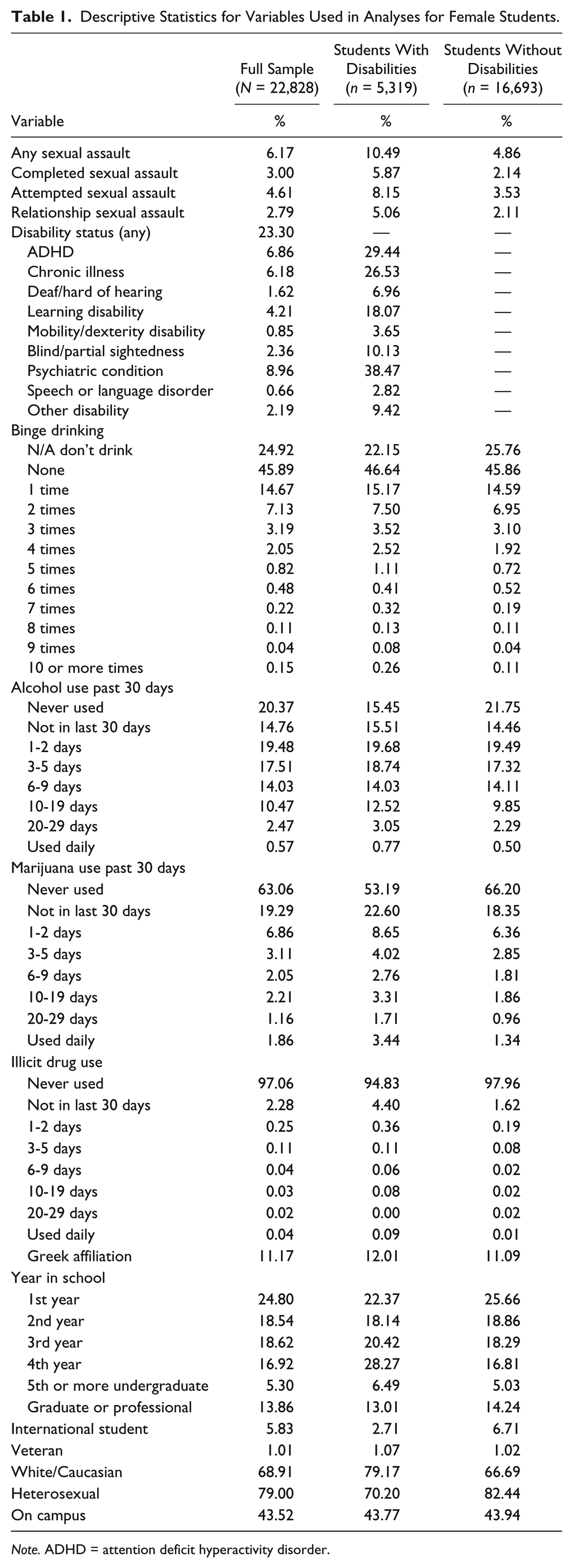
Note. ADHD = attention deficit hyperactivity disorder.
Analytic Plan
A series of logistic regressions were then run with any type of Sexual Assault Victimization as the dependent variable in the first set of regressions, and sexual assault victimization broken down by type: Completed Sexual Assault, Attempted Sexual Assault, and Relationship Sexual Assault in subsequent models. The rationale for this stemmed from the idea that like students with unique social locations, different types of sexual assaults may have different significant risk factors.
To address the first research question, whether or not female students with disabilities are at greater risk for experiencing sexual assault than female students without disabilities, the initial models included an independent variable measuring any kind of disability. Additional logistic regressions were completed to address Research Question 2. In these models, Disability Status was included with all other independent variables. However, in addition to the main effects, interaction terms were included to discern whether or not commonly cited risk factors compound the odds of college campus sexual assault victimization for female students with disabilities. In separate interaction terms Disability Status was multiplied with the variables measuring Binge Drinking, Alcohol Frequency, Marijuana Frequency, Illicit Drug Frequency, Greek Life, Sexual Orientation, and Year in School. To address Research Question 3, each type of disability was included as a stand-alone independent variable in the models to determine whether or not certain types of disability may be more or less likely to put students at increased risk for sexual assault victimization.
In short, different models were run to look at disability status and college campus sexual assault overall, the moderating effects of other risk factors on disability status in relation to sexual assault victimization, and more specifically, which types of disabilities, if any, increase risk for sexual assault. Odds ratios (ORs), which demonstrate the level of increased or decreased odds of sexual assault victimization for each independent variable, were reported for each model. Variance inflation factor measures were obtained, none of which showed scores above 2.5, indicating that multicollinearity was not an issue. In each model, listwise deletion was used to drop observations with missing data. Classification tests were run as well and each model showed correct classification of greater than 90%, indicating good model fit.
Results
Model 1 in Table 2 in the first set of regression analyses shows several significant variables that increase odds for any sexual assault victimization of college female students, but Disability Status shows the greatest increased odds (OR = 1.96; p < .001) for any Sexual Assault victimization compared to female students without disabilities. Binge Drinking, Frequent Alcohol Use, and Frequent Marijuana Use were also significant for increased odds of sexual assault victimization, but with much lower ORs than Disability Status. Binge Drinking showed increased odds for sexual assault (OR = 1.11; p < .001) for every 1-day increase in binge drinking over the prior 2 weeks; Alcohol Frequency (OR = 1.19; p < .001) and Marijuana Frequency (OR = 1.13; p < .001) increased odds for Any Sexual Assault victimization with each unit increase in use over the last 30 days. Illicit drug use was only significant in the dependent variable Any Sexual Assault (OR = 1.16; p < .05). Those female students with a Greek Life affiliation showed increased odds for sexual assault (OR = 1.21; p < .05). Year in School was significant, and showed that with each subsequent year in college odds of sexual assault victimization decreased (OR = 0.85; p < .001). Sexual Orientation also showed significance, with heterosexual students being at decreased odds for Sexual Assault (OR = 0.70; p < .001) compared with nonheterosexual students.
Female College Campus Sexual Assault (SA).

Note. Logistic regression model estimate. Standard errors in parentheses. Whether or not female college students with disabilities or other sociodemographic characteristics are at higher odds of being sexually assaulted during college. SA = sexual assault; OR = odds ratio.
p < .05. **p < .01. ***p < .001.
Model 2, which used completed assaults as the dependent variable, shows similar results in terms of significance, but increased odds for students with disabilities became higher for Completed Sexual Assaults (OR = 2.34, p < .001). Model 3 used Attempted Assault Victimization as the dependent variable, and outcomes were very similar to Model 1. Model 4, which used Relationship Sexual Assault as the dependent variable, showed increased odds of Relationship Sexual Assault for students with disabilities (OR = 2.22; p < .001) compared to those without disabilities. Greek Life and Alcohol Frequency were not significant for Relationship Sexual Assault. See Table 2 for ORs and detailed results of each model.
The next set of analyses involved several models that incorporated different interaction terms in addition to the main effects to explore whether the effects of disability status were compounded by other previously cited risk factors. Disability Status was therefore included with the following variables as interaction terms in separate logistic regression models: Binge Drinking, Alcohol Frequency, Marijuana Frequency, Illicit Drug Frequency, Greek Life, Sexual Orientation, and Year in School. Each model contained the same control variables as Model 1.
The only significant interactions with Disability Status included Binge Drinking, Alcohol Frequency, and Marijuana Frequency. While Binge Drinking, Frequent Alcohol Use, and Marijuana Use did increase odds of sexual assault for students with disabilities, increased odds for students without disabilities were significantly higher. This held true across the different types of sexual assault as well as the variable measuring any type of sexual assault. See Figures 1 to 3 for predicted probabilities for any type of Sexual Assault. These results were contrary to the hypothesis that other risk factors would compound the effects of disability status as compared to students without disabilities.

Predicted Probabilities of Any Sexual Assault with Alcohol Frequency and Disability Interaction.
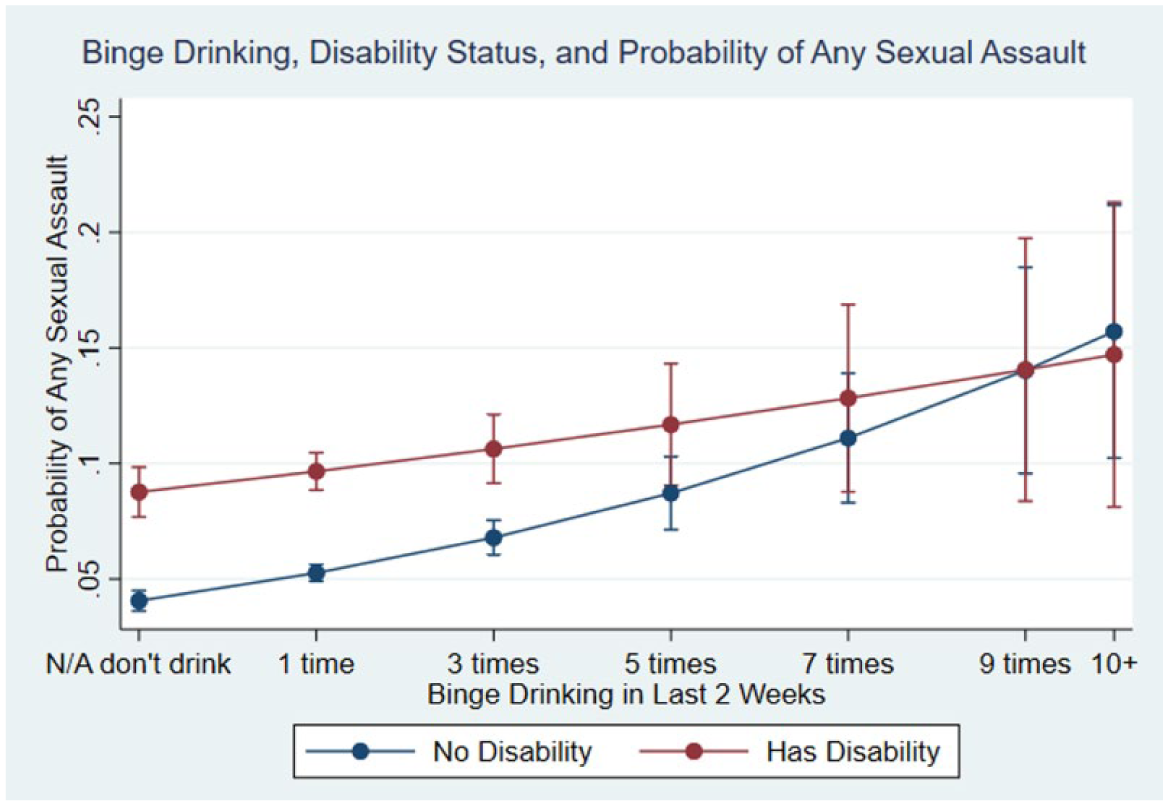
Predicted Probabilities of Any Sexual Assault with Binge Dirnking and Disability Interaction.
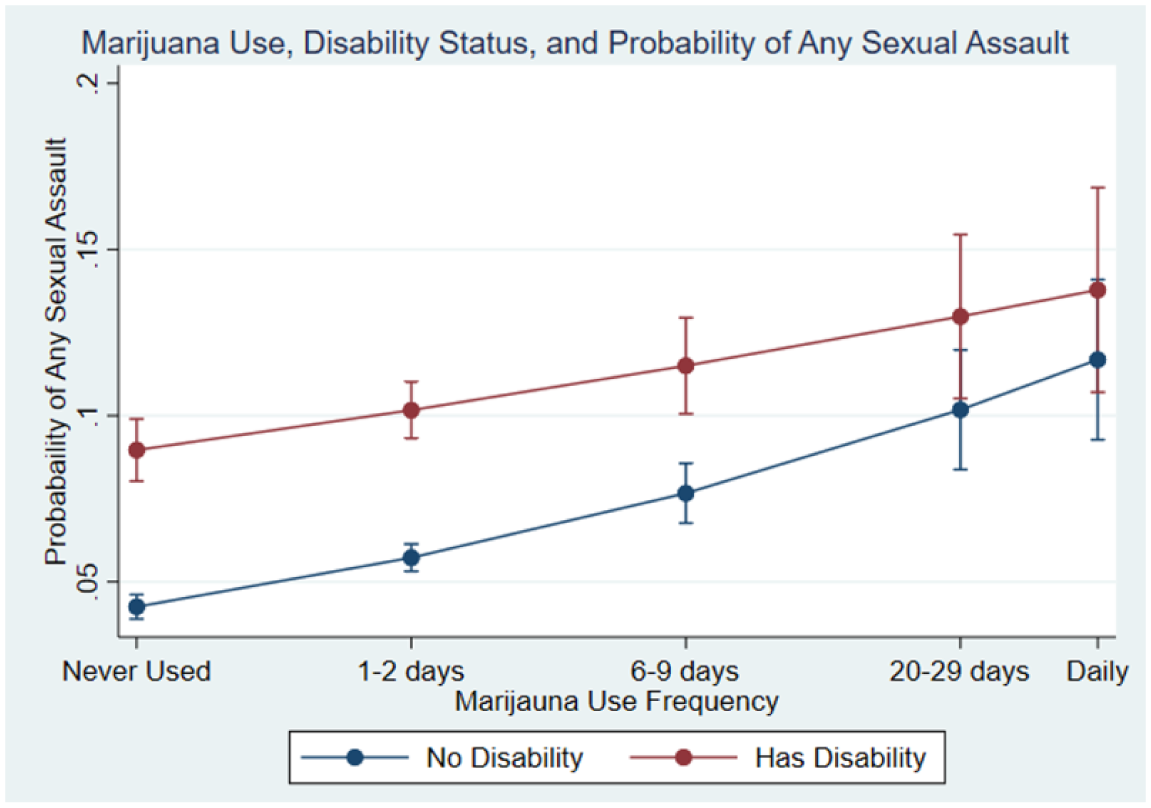
Predicted Probabilities of Any Sexual Assault with Marijuana Use and and Disability Interaction.
The final set of logistic regression models were run with disability statuses broken down by type of disability into individual dummy variables to examine whether certain types of disabilities were more likely to increase odds for sexual assault victimization. These models were run with the same control variables as previous models, and again, models with the four different measures of sexual assault victimization, Sexual Assault Victimization (any), Completed Sexual Assaults, Attempted Sexual Assaults, and Relationship Sexual Assaults as separate dependent variables. For complete results see Table 3.
Female College Campus SA.

Note. Logistic regression model estimate. Standard errors in parentheses. Whether or not female college students with specific types of disabilities have increased odds for sexual assault. This table excludes control variables, but betas and ORs are representative of entire model. Control variables included in the entire model are the same as those in previous analyses, and include binge drinking, frequent alcohol use, illicit drug use, frequent marijuana use, Greek life, year in school, international status, veteran status, White (vs. not), sexual orientation, and living on campus. SA = Sexual Assault; OR = odds ratio; ADHD = attention deficit hyperactivity disorder.
p < .05. **p < .01. ***p < .001.
Analyses of the various types of disabilities with all types of sexual assault as the dependent variable showed that students who identified as being Blind or Partially Sighted had increased odds of any type of Sexual Assault (OR = 1.42; p < .05). Students with a Learning Disability had increased odds for any Sexual Assault (OR = 1.52; p < .001), and students who identified as having a Psychiatric Condition had increased odds (1.95; p < .001) for any Sexual Assault. Other significant variables were similar to previous models with Binge Drinking, Frequent Alcohol Use, and Frequent Marijuana Use increasing risk for Sexual Assault. Again, as students’ Year in School increased, their likelihood of being sexually assault decreased. In addition, Sexual Orientation was significant. Heterosexual students had decreased odds of sexual assault victimization compared with nonheterosexual students.
When using Completed Sexual Assaults as the dependent variable, additional types of disability status became significant. Having a Learning Disability remained significant increasing odds of Completed Sexual Assault (OR = 1.36; p < .05). ADHD was also significant and increased odds (OR = 1.43; p < .01) for Completed Sexual Assault. Psychiatric Conditions remained significant, but with higher increased odds (OR = 2.27; p < .001). The same alcohol and substance abuse variables remained significant. As in prior models, Heterosexual students had decreased odds of sexual assault victimization compared with nonheterosexual students, and students’ odds of completed sexual assault decreased as their Year in School increased. Like any Sexual Assault, Greek Life also increased risk for Completed Sexual Assaults.
With Attempted Sexual Assault as the dependent variable, again, Learning Disabilities and Psychiatric Conditions were significant. However, Chronic Illness also became significant. Those students with Chronic Illness had increased odds of Attempted Sexual Assault (OR = 1.36; p < .05); those with Learning Disabilities had increased odds (OR = 1.60; p < .001), and ADHD (OR = 1.43; p < .05) also increased odds. Those with Psychiatric Conditions had increased odds (OR = 1.95; p < .001) for experiencing Attempted Sexual Assault.
With Relationship Sexual Assault as the dependent variable, Blindness or Partial Sightedness became significant. For students with Blindness or Partial Sightedness, odds of Relationship Sexual Assault increased (OR = 1.71; p < .01). Unlike results from prior models, Chronic Illness, ADHD, and Greek Life involvement were not significant for relationship sexual assaults. Similar to other models, those with Psychiatric Conditions had increased odds (OR = 2.09; p < .001) for Relationship Sexual Assault victimization. All results were obtained while holding all other variables constant.
Discussion
Several of the findings from this study add to previous research. Binge Drinking, Frequent Alcohol Use, and Marijuana Use were significant, all increasing odds for Sexual Assault overall, Completed Sexual Assault, Attempted Sexual Assault, and Relationship Sexual Assault. This held true in models in which disability was examined in the aggregate, and in models in which different types of disabilities were examined individually. In all models and for all types of assault, being Heterosexual as compared to not heterosexual decreased risk of sexual assault. As Year in School increased, odds of sexual assault decreased across all models for all types of sexual assault. These findings are not surprising, considering that previous research has consistently found that alcohol and drug use is associated with sexual assault victimization as well as perpetration (Fisher et al., 2010; Franklin, 2012; Krebs et al., 2007). The present study’s findings are also consistent with prior findings that odds for assault decrease as students’ progress in their studies, showing that younger and/or newer students are more likely to be victims of sexual assault (see, for example, Cantor et al., 2015; Krebs et al., 2007; Krebs et al., 2009).
Hypothesis 1, that female students with disabilities would have significantly higher increased odds for sexual assault than female students without disabilities, was supported. The analysis found that female students with disabilities had much higher odds of being sexually assaulted, regardless of the type of assault (completed, attempted, or relationship) compared to female students without disabilities. This finding supports the work of other researchers such as Cantor and colleagues (2015), whose report for the Association of American Universities (AAU), that 31.6% of undergraduate females with a disability reported nonconsensual sexual contact, compared with 18.4% of other undergraduate female students. The present study found that approximately 10.5% of female college students with a disability had been victims of some type of sexual assault, compared with 4.9% of female college students without a disability. While these numbers are significantly lower than those reported by Cantor et al. (2015), the present analysis showed that female students with disabilities made up 23.3% of the female student population, but accounted for 39.6% of all sexual assaults. These findings suggest that female students with disabilities are disproportionately experiencing sexual assault during their collegiate careers.
Hypothesis 2, that female students with disabilities’ odds of sexual assault victimization would be compounded if they also engaged in Binge Drinking, Frequent Alcohol Use, Marijuana Use, Illicit Drug Use, or were involved in Greek Life, was not supported. First, Greek Life and Illicit Drug Use interaction terms did not yield any significant results. However, when looking at Frequent Alcohol Use, Binge Drinking, and Marijuana Use, there were significant interactions. However, these interactions showed that while binge drinking, frequent alcohol consumption, and marijuana use did increase odds for sexual assault victimization in females with disabilities, these increased odds were significantly lower, compared to female students without disabilities. Further research would be needed to explore the relationship between disability status and substance use.
Finally, when the aggregate disability variable was broken down into different disability types as individual variables, several potentially important differences emerged. Female students with Psychiatric Conditions were at increased odds for sexual assault victimization across all three types of assault. However, students with Chronic Illness were at increased odds for only Attempted Sexual Assaults. Students with ADHD did not show increased odds for assault overall, but students with ADHD were at increased odds of experiencing a Completed Sexual Assault and Attempted Assault.
Female students with Blindness or Partial Sightedness had significant increased odds for Sexual Assault overall, and even greater increased odds for Relationship Assault. However, Blindness or Partial Sightedness was not significant for Completed or Attempted Assaults. These differences suggest that Relationship Assaults may be at least to some degree qualitatively different than nonrelationship assaults. Although other disabilities included in the analysis that may be readily visible were not significant, Speech or Language Disorders approached significance (OR = 1.84; p = .078) with Relationship Assault. It may be the case that relationship assaults are linked with more obvious disabilities (e.g., visible or audible disabilities) compared with nonrelationship assaults. Although Plummer and Findley’s (2012) review of disabilities and abuse focused on all types of abuse as opposed to just sexual assault or relationship sexual assault, they found that husbands or intimate partners are most often the perpetrators of abuse, and that these perpetrators may seek out women with disabilities due to their perceived vulnerability.
The results suggested that female students with disabilities are at increased odds for sexual assault victimization compared to female students without disabilities. But clearly, aggregating all students with disabilities into a single category when analyzing sexual assault victimization masks important differences in students’ experiences. Treating sexual assault as a singular type of experience may also have adverse consequences. As seen in this analysis, disabilities are diverse and may well have varying implications in terms of risk for different types of assault. Aggregating diverse disabilities into one homogeneous category misses the nuanced relationships that various disabilities have with the different types of sexual assault risk. In addition, the analysis showed that other risk factors such as binge drinking, frequent alcohol consumption, and marijuana use did increase the odds for sexual assault among students with disabilities, but at a disproportionately lower rate compared to students without disabilities.
Consequently, continuing to research college campus sexual assault without using an intersectional lens that takes diversity into account may result in overstating, or understating, the importance of different risk factors for different groups and thereby miss targeted prevention and intervention opportunities for groups that are at significantly greater victimization risk. An intersectional theoretical framework shows utility in terms of expanding research on college campus sexual assault beyond just looking at women, alcohol and drug use, and Greek affiliation, which have seemingly become the status quo. Certainly, the finding that college women with disabilities are at increased odds for sexual assault victimization compared to college women without disabilities is not in and of itself an exhaustive intersectional analysis. But the analysis does begin to lay the groundwork for continued exploration into the question of which women are the focus of campus sexual assault research, and how intersecting axes of oppression and marginalities beyond just being female may influence one’s odds for sexual assault victimization on campus.
Policy Implications
These results certainly point toward a fairly obvious policy implication: College campus sexual assault and intimate partner violence prevention and intervention programs should collaborate with disabilities services offices on college campuses. Prior research suggests that women with disabilities who do reach out for services related to violence against women often find these services inaccessible, insensitive, or unhelpful (Hassouneh-Phillips & McNeff, 2005; Milberger et al., 2003; Nosek et al., 2001; Plummer & Findley, 2012). This type of collaboration could increase the chances that students with disabilities who are victims of sexual assault will know what resources are available or be referred to appropriate resources. In addition, working with disabilities services may help violence prevention and intervention centers or programs tailor their responses to victims with disabilities in a more helpful, appropriate, and accessible manner.
Women with disabilities may not be able to readily identify abusive behavior and may fear not being believed if they report sexual assault or other abuse (Gilson et al., 2001; Plummer & Findley, 2012). Collaboration across offices may help educate students with disabilities about increased risk for sexual assault and safety planning. For instance, ADHD has been linked to risky behavior and impulsivity as well as increased substance use and abuse (Kaye et al., 2014; Molina & Pelham, 2014); violence prevention and intervention offices and disabilities resource centers could work in tandem to incorporate a focus on identifying risky scenarios, and harm reduction with alcohol and substance use when meeting with students who have disabilities. With regard to prevention, many feminist scholars and practitioners might take issue with focusing on potential victims with prevention activities, as opposed to working toward dismantling rape culture on college campuses, but these two prevention tactics are not mutually exclusive. Broad campaigns to educate college students about rape culture, and policies that combat rape culture, can be implemented while also acknowledging and educating students about risk factors for victimization in a non-victim-blaming manner. This may be doubly important for vulnerable populations such as college women with disabilities.
Limitations
As mentioned, the survey instrument used presented some measurement limitations. The measure sexual assault did not provide a detailed set of experiences that constitute sexual assault. Thus, students responding may have experienced a completed or attempted assault, but not have recognized it as such based on the survey questions. Therefore, the respondents in this dataset who identified as having been sexually assaulted in the past year may not be an entirely accurate representation of the sexual assault victims in the sample. Relatedly, the survey items measuring the different types of sexual assault were not mutually exclusive. Therefore, a student may have reported a completed sexual assault, but also reported a relationship sexual assault that were the same incident. In addition, while the survey instrument does include specific disabilities, there are not corresponding definitions. Disabilities such as ADHD are quite specific and may be easy for a respondent to identify whether they have ADHD, some of the other disabilities included are not as explicit. For instance, the survey includes psychiatric condition, chronic illness, and learning disability as well. This poses a couple of measurement problems. First, it is not clear what exactly constitutes a psychiatric condition, this could be interpreted very differently by different students thereby combining very different conditions into one variable. Finally, the ACHA-NCHA data are cross-sectional and not generalizable to all students. The sample is large, but it is not nationally representative. Any conclusions drawn from this study cannot be applied across all U.S. college students, and analysis limited in terms of identifying causal or predicting factors for college campus sexual assault.
Finally, this study incorporated an intersectional framework by concentrating on a marginalized and underrepresented population in college campus sexual assault literature, female students with disabilities. But in no way did this study claim to be completely intersectional. The focus of the study was narrow with the purpose of adding to the groundwork of empirical research on the topic of students with disabilities and college campus sexual assault. As such, other important variables were overlooked, such as race beyond a binary White versus non-White categorization or looking at experiences of those who are gender nonconforming.
Future Research
By design, the term disability is a broad one encompassing a vast array of possible impairments. Consequently, the finding that female college students with disabilities are at increased risk for sexual assault remains somewhat vague. More research is needed, therefore, to tease out the various ways that specific types of impairments may influence risk for different types of sexual assault victimization. For instance, the present study findings indicate that women with speech or language disorders and blindness or partial sightedness are at higher risk for sexual assault. These findings may suggest that women who have disabilities that are visually or audibly apparent upon interaction with others may be more susceptible to perpetrators of relationship violence. However, being deaf or hard of hearing, or having a mobility disability, both of which are often easily detectable in social interaction, did not significantly increase risk for any type of sexual assault in the present study.
Students with ADHD had greater odds of experiencing completed sexual assault and attempted assault. Previous research has shown that ADHD is linked to impulsivity and risk-taking behavior (Kaye et al., 2014). ADHD has also been associated with increased risk for substance use disorders (Molina & Pelham, 2014). Substance use, particularly alcohol and marijuana use, has been consistently cited as a risk factor for sexual assault. Female students with learning disabilities also had elevated risk for completed and attempted sexual assaults, and psychiatric conditions were significant across categories of assault. But ADHD is a specific diagnosis, while “learning disabilities” and “psychiatric conditions” leave broad room for interpretation among survey participants. More research is needed that explores specific learning disabilities and/or psychiatric conditions, their similarities to or differences from ADHD in terms of risk-taking behavior, including alcohol and substance use, and the relationship of all of these factors to risk for college campus sexual assault victimization.
It appears as though social group belonging may be more important for nonrelationship assault; as Greek life membership was not significant for relationship assault but was significant for all other types of sexual assault. These findings may have to do with the fact that women with disabilities experiencing relationship abuse are more isolated, and less likely to have extended social networks beyond their perpetrators (Gilson et al., 2001; Nosek et al., 2006; Plummer & Findley, 2012). Again, more research is needed to clarify the role of social group belonging to sexual assault victimization risk.
The survey instrument used for this study provided a vague explanation of sexual assault. Campus climate surveys, such as the AAU Campus Climate Survey on Sexual Assault and Sexual Misconduct by Cantor et al. (2015), or the Campus Sexual Assault (CSA) Study by Krebs et al. (2007), ask more detailed questions related to sexual assault, provide descriptions of specific behaviors that constitute sexual assault, and explore incapacitated and/or drug- and alcohol-facilitated sexual assault. Studies such as the AAU study and the CSA, are specifically looking to measure college campus sexual assault, while the ACHA-NCHA study that focuses on a wide range of college student health outcomes, only briefly touching on sexual assault. But these campus climate surveys do not ask about specific disability types; instead, they only ask whether the student has a disability. Surveys such as the CSA and the AAU campus climate survey should add items asking about specific types of disabilities to more fully gauge the relationship between disability status and college campus sexual assault risk. This seems particularly prudent considering the present study showed disability status increasing sexual assault victimization risk at higher percentages than other previously identified risk factors such as binge drinking or drug use that have been a central focus of previous research.
Finally, college campus sexual assault research should be undertaken with an intersectional lens. Quantitative researchers may consider developing alternative statistical analyses that get at the more specific social locations of their survey participants. Mixed-methods approaches should be used to add context to new findings, particularly for the burgeoning subfield of college campus sexual assault and students with disabilities. For instance, the present study found that alcohol and drug use increased odds for assault at a higher percentage for students without disabilities, than for students with disabilities. Focus groups on the topics of alcohol consumption, binge drinking, and drug use with students that have disabilities and students that do not have disabilities might yield some insight into this statistical finding.
Research findings that show female students with disabilities are at increased odds of being sexually assaulted while attending college are important in and of themselves as they add to the scarce literature available on the topic of students with disabilities and college campus sexual assault. The present study also points to the possibility that commonly cited risk factors such as drug and alcohol use may not be as central to sexual assault victimization risk for students with disabilities as they are to college women without disabilities. Accordingly, despite the many limitations, this study does underscore the imperative for continued rigorous empirical research into college campus sexual assault and female students with disabilities and offers several avenues for future research.
Footnotes
Declaration of Conflicting Interests
The author(s) declared no potential conflicts of interest with respect to the research, authorship, and/or publication of this article.
Funding
The author(s) disclosed receipt of the following financial support for the research, authorship, and/or publication of this article: This research was supported by the PEACE OUTside Campus: Lindsey M. Bonistall Fellowship, and by the Division on Women and Crime of the American Society of Criminology.
