




Abstract
Child abuse and neglect is a perplexing public health, human rights, and social justice issue that persists at unacceptable levels. This qualitative survey, involving brief oral conversations (n = 721) about perceptions of child abuse and neglect and its solutions, was drawn from a randomized telephone survey of residents in two U.S. communities. The study focused on two research questions: (a) individual and collective actions that would give child abuse and neglect prevention the best chance for success and (b) what participants would expect to see in a local child abuse prevention effort to have faith in its effectiveness. Participants were mostly female (61%), with the average age of 55.7 years, and had a median income of US$35,000 to US$49,000. Thirty-one percent identified as mandatory reporters and 76% were a primary caregiver for a child at some point in their lives. Thematic analysis identified six themes and one subtheme for the first research question and four themes for the second research question. Participants emphasized the importance of awareness raising, education, broad public support and the value of a locally developed plan, credible leadership, and reliable follow-through. Participants’ beliefs and recommendations were mapped to existing and promising child abuse prevention frameworks and implications for prevention planning are outlined.
Introduction
Despite a rapid expansion of evidence-based strategies, policy advances, and increased awareness overall, the abuse and neglect of children continues at unacceptable rates. By one estimate, there were approximately 4.1 million child welfare reports in fiscal year 2017, involving an estimated 7.4 million U.S. children (U.S. Department of Health & Human Services, Administration for Children and Families, Administration on Children, Youth and Families, Children’s Bureau, 2018). Although these reported rates are unacceptable, surveillance data suggest that they underrepresent actual rates of child maltreatment. According to the Fourth National Incidence Study of Child Abuse and Neglect (NIS-4), 3 times as many children are abused and neglected than are known to Child Protective Services (CPS) agencies (Sedlak et al., 2010). Some reports suggest that rates for child physical and sexual assault may be declining (Finkelhor, Saito, & Jones, 2018), though these findings should be weighed in light of methodological limitations (Finkelhor, Shattuck, Turner, & Hamby, 2014; Van Scoyoc, Wilen, Daderko, & Miyamoto, 2015).
Policy makers, researchers, and advocates have argued that child abuse and neglect reduction can be accelerated by much greater emphasis on primary prevention and community-based solutions (Benedetti, 2012; Daro & Dodge, 2009; Paxson & Haskins, 2009; Stagner & Lansing, 2009). Prevention as a construct and associated implementation strategies among these groups have varied, from an emphasis on early intervention, to home visitation programming (Daro, 2011), and to social norms change (Fortson, Klevens, Merrick, Gilbert, & Alexander, 2016). Primary prevention outcomes can be bolstered by capacity-building efforts that mobilize multiple and nontraditional sectors of the general public. Benedetti (2012) asserted that to be successful in child abuse prevention, “it is imperative that interventions work with the existing strengths and networks in the community, and are compatible with social norms and commonly held beliefs” (p. 10). Similarly, Daro (2010) emphasized the instrumental role of volunteers and other natural supports toward local solutions: This emerging generation of community child abuse prevention strategies focuses on creating supportive residential communities where neighbors share a belief in collective responsibility to protect children from harm and where professionals work to expand services and support for parents . . . such programs mobilize volunteers and engage diverse sectors within the community, including first responders, the faith community, local businesses and civic groups. (p. 9)
Transforming these ideals into broad, sustainable, and multisector public action is challenging, certainly, for every community-based prevention initiative. Indeed, what are the factors that can significantly (a) increase the likelihood of individual abuse prevention action and (b) foster a seismic norms shift toward a broadly endorsed sense of shared responsibility for the well-being and safety of every family and child in one’s community? Social norms theory suggests that people are heavily influenced by how they think other people think and act, have a conditional preference for complying with social norms, and operate under a set of perceived expectations for proper behavior (Berkowitz, 2005; Bicchieri & Mercier, 2014). These beliefs can be powerful drivers of behavior—and understanding them as they relate to child abuse prevention can be useful in framing and leveraging community mobilization efforts (Manuel & Davey, 2009). In addition, according to the Theory of Planned Behavior (TPB; Ajzen, 1991; Armitage & Conner, 2001), behaviors and actions are much more likely when individuals internalize the following perceptions: (a) the action is likely to be useful or effective; (b) important others believe the action is proper, valued, and expected; and (c) a sense of self-efficacy, that is, I can skillfully engage in the action (Edwards, Keller, Wong, & Krahn, 2015).
Informed by these assumptions, and in an effort to develop a locally relevant abuse prevention plan, this study investigated public opinion about child safety, abuse prevention perceptions, and family strengthening action. Other research teams have sought out public opinion for similar reasons (Bales, 2004; Daro & Gelles, 1992; Di Natale & Hock, 1998; Juhasz & Skivenes, 2017). For our purposes, and in light of social norms theory and TPB, we explored general public attitudes and beliefs centered in these overarching questions: What skills are required to prevent child abuse? What do I believe would be effective in preventing it? Will/would my actions matter or make a positive difference? Do I, and do people I know and value, believe that it is my responsibility to take action to ensure the safety of all children in my community?
This exploratory study, the Child Abuse Prevention Climate Survey (CAPCS), is grounded in the assumption that community-based solutions are much more likely to be supported, sustained, and effective when local beliefs and attitudes are actively sought, understood, and built into prevention plans (Cortez et al., 2011; Samuels, 2015). This qualitative study, based on data collected as part of a random-digit CAPCS, was designed to identify public beliefs about child abuse and neglect action, to provoke self-reflection and local conversation, and to inform the development of a countywide child abuse prevention strategic plan. The study, a descriptive randomized telephone survey of residents of Lane County, Oregon (n = 503) and Whatcom County, Washington (n = 410), addressed five research questions, ranging from whether participants believe child abuse and neglect is a problem in the local community, to the degree to which participants believe child abuse prevention is their personal responsibility. The 50-item survey included two open-ended items designed to capture public perceptions about (a) individual and collective actions that would give child abuse and neglect prevention the best chance for success (individual and collective self-efficacy) and (b) what participants would expect to see in a local child abuse prevention effort to have faith in its effectiveness (expectations, belief in usefulness). This article presents the findings from the open-ended portion of the survey. The study was funded by Meyer Memorial Trust.
Method
Design
The CAPCS (n = 913) used a computer-aided telephone interviewing system, drawing from a random sample of all working cell and landline phone numbers in Lane County, Oregon and Whatcom County, Washington. All residents of each community with a cell (38.8%) or residential phone number (61.2%) had an equal chance of selection. Residents were eligible to participate if they (a) were at least 18 years of age and (b) lived in Lane or Whatcom County. At the time of the call, all participants confirmed that they were current residents in our targeted counties. The cell to landline ratio matched local percentages at the time of survey implementation. The survey was available in English only. Interview length averaged 20.4 min. The full survey included 50 scaling questions, two open-ended questions, and two scenarios. The two open-ended questions analyzed in this study were (a) What do you believe is the single most important thing that must happen to significantly reduce child abuse and neglect in Lane/Whatcom County? and (b) I would be in full support of a local effort to significantly reduce child abuse and neglect if I was sure that ___ (participants were then invited to complete the sentence). These questions were designed to capture public opinions about child abuse prevention to assess their relationship to social norms and the TPB and, in light of those findings, to inform local prevention planning. Equity and inclusion principles were embedded throughout the study. For example, the open-ended research questions emerged following an inclusive community engagement participatory process that involved diverse sectors and nontraditional partners (Wallerstein & Duran, 2006). The research team, in partnership with 35 community groups and 5 regional leadership teams, developed the survey and determined the most useful open-ended questions given study and local prevention aims (Shirley et al., 2008). Participating groups included, for example, Juventud Faceta youth leadership, Head Start parent leaders, child welfare consumers, and trauma survivors. Participant responses to the open-ended items were transcribed verbatim. In total, 721 participants responded to the open-ended questions, a 79% participation rate.
The communities from which the sample was drawn, Lane County, Oregon and Whatcom County, Washington, are demographically similar. According to U.S. census data (2017), both communities consist of a largely White population (89% and 87%, respectively), report 91% high school graduation rates, and similar percentages of the population are below 18 years of age (19% and 20%, respectively). Median household income is comparable, though higher in Whatcom (US$54,207.00) than Lane (US$45,222.00). The largest cities in each county have populations of 80,000 (Whatcom) and 170,000 (Lane), both house a university and a community college, and are surrounded by several rural communities and agricultural and forest land.
Data were analyzed using methods consistent with thematic analysis (Braun & Clarke, 2006). Our methods were inductive; we engaged in an open coding process and sought a description of patterns across the entire data set (Patton, 1990). Thematic analysis involves the search for and identification of common themes that extend across a set of interviews (DeSantis & Noel Ugarriza, 2000). Our aim was to capture a rich description of participants’ beliefs about reducing child abuse and neglect and the factors that would lead them to actively support a local prevention effort (Braun, Tricklebank, & Clarke, 2013). Our analytic approach was situated within a critical realist framework (Sims-Schouten, Riley, & Willig, 2007). Given our adoption of a critical realist perspective, while analyzing these data we assumed that participants’ comments were both capturing their personal reality and a reflection of socially constructed meaning and environmental influences (Frauley & Pearce, 2007; Willig, 1999).
The themes that we identified were born of a comprehensive and systematic process; data were carefully reviewed by the second, fourth, and fifth authors; discussed throughout the analysis process; and followed a four-step process. This included (a) open and independent coding, (b) shared coding and broad discussion, (c) identification of provisional themes, and (d) review and agreement of final themes. Coding attended to both the semantic content of the data and our interpretation of their meaning (Braun & Clarke, 2012).
The analysis team (second, fourth, and fifth authors) split the transcripts for initial coding, and two research team members coded each transcript. Each coder read transcripts one time and then coded transcripts on the second and subsequent reads. Through open coding methods (Braun & Clarke, 2013; Charmaz, 2006), the analysis team independently noted the specific words used by participants, such as “awareness” and “education.” Following independent coding, the analysis team collectively compared initial codes and reviewed coding procedures to maintain consistency. For example, given that the word and construct education was so prominent in initial coding, the research team agreed to subcodes for education, such as “education for parents” and “education for community,” rather than simply the broad term education. This specificity fostered a coding process that generated codes very closely mapped to participants’ exact words.
Next, the analysis team reviewed the entire set of transcripts again and coded each question. The first research question yielded 179 total codes, and the second research question yielded 116 total codes. The analysis team made decisions about final themes based on the grouping of codes. For example, “education” yielded 24 codes in total (e.g., education about services, education about abuse, and education about reporting). Each of these specific codes yielded small frequencies (some as small as two). Given this, the analysis team decided to collapse all codes related to education to build one theme and one subtheme. The code of “education for parents” was markedly larger than the other codes and was assigned as a subtheme under education. In addition, for example, the final theme “it would work” was informed by codes such as “effective,” “a difference,” “positive outcome,” “beneficial,” “successful,” “change,” and “results.” The overall findings, which included the frequency of codes and main domains, were developed based on this process of collapsing codes and building into themes; thematic analysis involves the search for and identification of common threads across the data (DeSantis & Noel Ugarriza, 2000). The final descriptive summary included 11 main themes and one subtheme.
Several methods were utilized to ensure the trustworthiness of findings. One researcher acted as an internal auditor throughout the data analysis process. Regular debriefing sessions were held to ensure procedural fidelity and active discussion of emerging codes. In addition, bracketing and memos were used to identify each research team member’s personal beliefs, assumptions, and reactions to the data and emerging themes. Memos were reviewed in each debriefing meeting to be overt about ongoing reflections; researchers shared the contents of their memos ahead of discussing emerging codes. The research team engaged in ongoing discussions about what themes emerged for each analysis team member for the purposes of cross checking and continued bracketing. We wanted to ensure that the themes were rooted in the emerging themes in the data and not inordinately in our own individual interpretations of the data. For example, each analysis meeting began with sharing memos and noting both our own impressions of the data and emerging themes. This process fostered our ability to understand the intended meaning of participants’ comments. The analysis team used peer debriefing and a stepwise data collection and analysis audit trail (Creswell, 2008) to foster dependability and trustworthiness of the findings. Finally, with each theme and subtheme, we include a frequency, that is, the number of participants who voluntarily mentioned the theme or subtheme. Our intent is to provide a general sense of the variation and of the similarities of participants’ opinions in the context of open-ended questions; this is not a quantitative measure of relative frequencies. The counts had no bearing on our original analysis and were determined only after completing the thematic analysis.
Participants
Participants were mostly female (61%), on average 55.7 years old (SD = 18.7 years; range = 18-96 years), and had a median household income of US$35,000 to US$49,000. Many (55%) had a 2-year college degree or greater, and 76% were a primary caregiver of a child at some point in their lives. Thirty-one percent of the sample indicated that they were a mandatory reporter for child abuse and neglect and many lived in the community 20 or more years (56%). In addition, participants were read a definition of child abuse and neglect (Table 1) and then were asked, Based on this definition, did you experience child abuse or neglect in your childhood? Based on this item, among all participants, 35% reported a personal history of child abuse or neglect. Racial identity data were not collected.
Child Abuse and Neglect Definitions.
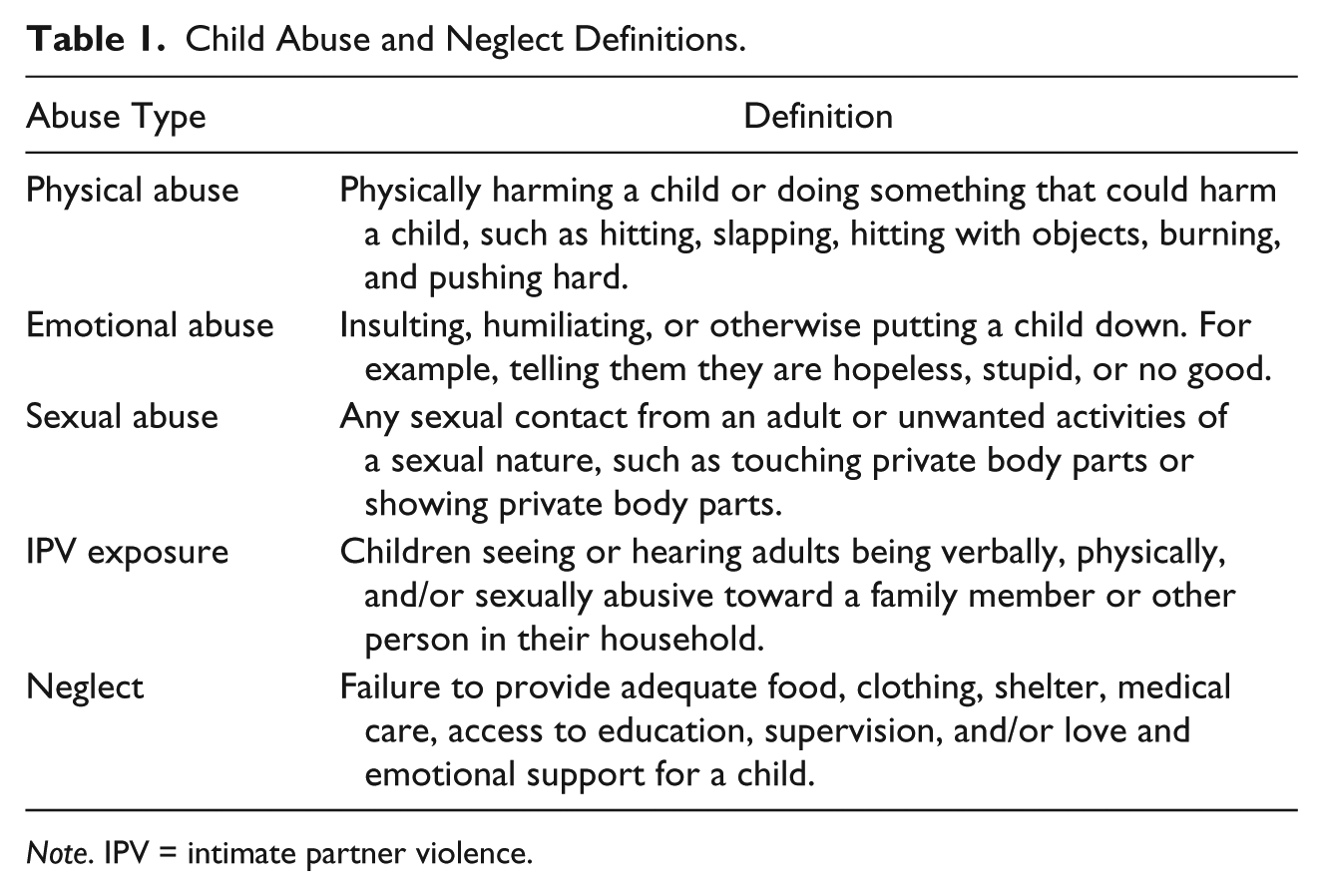
Note. IPV = intimate partner violence.
Findings
The first research question, pertaining to participants’ beliefs about the single most important actions that must happen to significantly reduce child abuse and neglect, produced six themes: (a) education, (b) awareness, (c) reduced substance abuse and poverty, (d) access to services, (e) support, and (f) I don’t know. This research question produced one subtheme: “education for parents.” The second question, that is, I would be in full support of a local effort to significantly reduce child abuse and neglect if I was sure that_____, yielded four main themes. They included the following: (a) it would work, (b) good leadership, (c) community involvement, and (d) children get help.
Question 1: Single Most Important Thing to Prevent Child Abuse
Participants (n = 721) were asked to describe what they believed to be the single most important action that must be taken to reduce child abuse and neglect. Participant responses were quite varied, ranging from specific changes such as reduction in drug abuse and poverty to more systematic efforts, such as development of a strategic prevention plan.
Education
Many participants (n = 156) emphasized the importance of active education efforts that point to specific actions people can take to promote child safety. Participants emphasized four targeted sectors: the public at large, schools, children and youth, and parents. Participants’ suggested “regular people” need to know both what child abuse is and what to do, to be more likely to “step up and take a role” and gain courage to intervene when and however needed. Others highlighted the importance of education for members of service delivery systems and schools, most often, to know how to contribute to prevention and intervention efforts: So many different ways to bring the community together. A lot of it I think is to give caregivers and teachers the proper recognition to know when a child is in danger. Ensure that our schools have the proper education to take care of it. (This is a) critical thing. All educational systems, daycare included.
Participants also highlighted the importance of educating children themselves and parents. Several participants believed that children need vivid examples of healthy and prosocial relationships as a kind of protective factor; an educational tool to better self-assess how they are being—and should be—treated. Education for parents, mentioned by 37 participants, should be provided universally as a part of the U.S. education system: “It should start in the school; we need to be taught about raising a child.” Many participants also indicated that given the highly stressful nature of parenting, education efforts should teach aspiring parents how to “deal with stress” as a routine part of parent education.
Awareness
Although education and awareness raising are closely related concepts, when participants described awareness, they tended to emphasize macro-level strategies, largely akin to systematic public health campaigns. One participant, for example, advocated for borrowing from other awareness-raising efforts, such as intimate partner violence campaigns, and applying these strategies to child abuse prevention, that is, “We’ve heard a lot about abused women, we need the same kind of campaign about abused children. We need to raise awareness.” Participants also emphasized how campaigns should be constructed, including persistent and systematic efforts across time, that is, (We can’t) “allow the issue to disappear,” “we have to follow through,” and “we need reminders and signs about stopping it.”
Participants also encouraged public health-like efforts that offer direction for what to do, that is, “knowing places to turn to—not just contacting the police or child protective services.” For participants who emphasized awareness raising, they routinely indicated that the function of awareness raising is to broadly mobilize public action.
Reduce substance abuse and poverty
Many participants (n = 105) believed reducing substance abuse is the single most important pathway to prevention, while others (n = 60) pointed to reducing poverty. Many participants correlated parental chemical dependency with neglect, argued for increased enforcement and accountability, and one individual reflected the sentiment of many by simply stating, “If we eliminated drug abuse, it would have the biggest impact.”
Several participants linked drug abuse, socioeconomic status, and stress. One person put it this way: “I think a lot of low income people turn to drugs because of financial reasons.” Although many participants indicated that reducing poverty is a “tall order,” they espoused a near-direct relationship between stress, poverty, and child abuse and neglect. One participant reflected the sentiment of many: “Remove the level of stress and burden on families due to poverty or lack of income so that they can focus on the well-being of their family.”
Access to services
Thirty-seven participants argued that traditional forms of direct service, such as those typically delivered by nonprofit organizations and the child welfare system, need to be (a) more abundant and (b) more accessible. Participants who emphasized the importance of access to services argued that family support services should be easy to access, “absolutely confidential,” nonjudgmental, and universally available for families at low, moderate, and high risk. Finally, several participants (n = 19) commented on a need to improve child welfare’s reputation and practices as one avenue toward better access to a government-based service that has promise for being more useful for families. Participants urged reduced caseloads, better follow-through, and improved decision making related to abuse investigations, custody, and resource allocation.
Support
Support, or framed as “connection” by many participants (n = 117), was frequently highlighted as the single most important avenue for child abuse and neglect prevention. Participants made an important distinction between “access to services” and “support.” Access to services, for most participants, was a reference to formal systems provided largely by people in paid positions, while support for most participants meant naturally occurring resources for parents and children, such as neighbors, friends, and acquaintances. For these participants, creating more closely connected communities seemed to be a kind of call to action: “I think that child abuse is somewhat indicative of individuals not receiving the emotional support they need” and ”when we talk to each other we can fulfill each other’s needs.” Many participants also argued that “a wide range of adults” need to be available as supportive figures for parents and children and that this should include simple acts of effective listening and widely advertised and well-coordinated pathways for family support.
I don’t know
Finally, 42 participants offered that they did not know how to reduce child abuse and neglect. Although a theme of I don’t know does not offer a vigorous answer to our inquiry, per se, it does represent the fact that many participants openly expressed that they were not able to articulate how child abuse might be significantly reduced.
Question 2: Full Support If
Four themes emerged in response to what participants would need to see to fully support a local child abuse prevention effort. This included the following: (a) it would work, (b) good leadership, (c) children get help, and (d) community involvement.
It would work
A large number of participants (n = 258) indicated that they would be in full support of a local effort if they were sure it would work, that is, “it solves the problem and isn’t just talk or marketing,” and that the effort is well planned and research informed. Participants seemed to be wary of efforts that come and go, that are isolated and poorly aligned, and that are unable to point to evidence of success or high promise for achieving success. Participants support a plan that is “clear,” “has been shown to be useful in other locations,” and “is pragmatic—too much of this is based on emotion.”
Participants also pointed to features that they need to see in a prevention effort in order for them to personally invest in its success. This included a credible plan with follow-through. One participant reflected the view of many: “We get promises and hopes and it just doesn’t happen.” Others called for (a) long-term solutions, (b) a “plausible plan,” (c) meaningful documentation and measurement over time, and (d) a transparent process so community members can see how well the plan is working.
Good leadership
Sixty-seven participants indicated that their full support would depend on good leadership. This boiled down to three areas of emphasis: (a) credible leaders, (b) responsible use of resources by those leaders, and (c) leadership promotes attitudes that are supportive, not condemning, of families. This included leaders who are trustworthy, skilled managers with content expertise, and people who “do what they say they are going to do.” Forty-one participants expressed a need to know that leaders were using resources responsibly, that is, the funds are being used as intended, within reason, and efficiently. In this regard, one participant reflected the viewpoint of many: “If it had a reasonable opportunity to succeed compared to the amount of money it would cost.”
In addition to emphasizing the importance of the personal characteristics of prevention leadership, participants highlighted the importance of how those leaders characterize families. Participants were very clear: leadership should in no way blame parents or foster messages that are punitive toward parents. Others touched on the delicate balance of public activism and personal rights, cautioning that leadership must not cross personal rights boundaries: “As long as government isn’t taking over” and “if (leaders) aren’t going to intrude and rip families apart in unnecessary situations.”
Community involvement
Thirty-five participants indicated that they would be in full support of a local child abuse prevention effort if it fosters wide community involvement. Participants would be enthusiastic about a prevention effort that is grassroots, enjoys full support from diverse sectors (e.g., local government, schools, spiritual leaders), and embodies “common sense community involvement.” Others would be in full support of an effort that is holistic and well-coordinated. One participant put it this way: “The community would do it as a whole . . . That it would be important enough to get people involved in it . . . if everybody was on the same page, working together.”
Children get help
Thirty-seven participants very specifically indicated that they would fully support a local effort to prevent child abuse if they were sure that children get help, that is, if they were certain, the effort “actually reaches the children it is supposed to.” Other participants alluded to a common perception that child welfare and perhaps other community services mishandle interventions and that these interventions are harmful to kids and families. As such, participants would fully support a prevention plan if they had assurance that community systems balance child and family needs, that is, “If I was sure that the kids would be safe and kids could stay in their family (whenever possible), “instead of shipping them off somewhere else.”
Limitations
The study has several important limitations. Our sample does not fully represent the local communities from which the sample was drawn. For example, the sample overrepresents women, underrepresents people who could not complete the study in English, and does not represent a youth perspective. Racial identity data were not collected and are not known. Although generalization to populations, time, or place is not generally an aim of qualitative research, theories that are constructed from data that do not represent the population of interest inherently underrepresent diversity. When this occurs, as it has in this study, it is a notable limitation. In addition, the data were collected over the phone on one occasion with each participant. This method did not allow for iterative development of questions or for deeper exploration of participant perspectives. The survey method did not allow for a review of findings with participants, such as member checking. Finally, the open-ended conversations relied fully on self-report. Data were not triangulated with other data collection strategies such as structured observations or validated measures.
Discussion
This study elicited public opinion to directly inform a regionally tailored child abuse prevention plan. Notably, a high percentage of individuals (79%) chose to take additional time to respond to two optional open-ended questions at the end of the survey and appeared to carefully weigh each question and offered thoughtful reflections. By implication, participants care about this issue; they were personally motivated to share their subjective views about child abuse and its prevention. Not surprisingly, many participants emphasized reduction in poverty, reduction in drug abuse, and increased access to services as key factors in reducing child abuse. Participants expressed the opinion that these factors, in themselves, very meaningfully contribute to child abuse prevalence. By extension, participants indicated that a marked reduction in these risk factors would significantly reduce child abuse and neglect incidence. These opinions are supported, in a general sense, by widely documented child abuse and neglect risk factors (Thornberry et al., 2014).
Many other participants pointed to social support as the single most important prevention action. This included support for parents themselves and supportive listening to children. Others highlighted the importance of community-wide efforts, that is, “we need a range of adults and supportive people.” This finding is consistent with evidence-based protective factors and policy recommendations. For example, social capital, measured as access to interpersonal support, has been shown to be negatively correlated with child abuse and neglect (Winkworth, McArthur, Layton, & Thompson, 2010). In addition, social support is promoted by the Center for the Study of Social Policy as one of the five central child abuse prevention protective factors (Browne, 2014). Similarly, participants’ emphasis on the role of community-wide support toward child abuse prevention is commensurate with the principles and practices of trauma-informed care, trauma-informed services, and trauma-informed communities (Davies, Todahl, & Reichard, 2015; Endres, Keller, Wong, & Krahn, 2015; Perry & Daniels, 2016).
Education and awareness raising, taken together, were endorsed most often (n = 246) as essential actions toward child abuse prevention. Many respondents believe that widely shared and readily available information (e.g., child abuse rates, parent education, resources, bystander involvement) would manifest in aware parents and an aware public equipped with the knowledge and skills needed to prevent child abuse and neglect. This finding surfaces a belief, shared by many participants in this study, that the attainment of pertinent information about child abuse—what it is, how often it occurs, available resources, parent education, and those things that community members can practically do about it—would significantly reduce its occurrence. Recommendations that promote parent education as a key factor in child abuse prevention are prevalent in the literature (e.g., Sanders, Cann, & Markie-Dadds, 2003; Shapiro, Prinz, & Sanders, 2012), and broad-spectrum recommendations for population-level awareness raising are promoted by many professional groups (e.g., Fortson et al., 2016; World Health Organization [WHO], 2016).
Many participants indicated that they would be in full support of a child abuse prevention initiative if (a) they were reasonably certain that it would be effective, (b) it was community-centered and locally developed, and (c) if the initiative’s leaders were credible and trustworthy. For many participants (n = 258), an effective effort would provide concrete solutions, a feasible plan, and follow-through. By implication, participants were hesitant to support ad hoc strategies; a concerted plan managed by credible leaders was essential for their support. Many participants also indicated that they would be in full support of a child abuse initiative that included local solutions and enjoyed broad community support and active community involvement. Given these factors, engagement of the general public in the planning process is very likely an important factor in the development of a tangible, credible, hopeful, and widely supported prevention plan (Bryson, Quick, Slotterback, & Crosby, 2013). Moreover, participatory efforts that engage a diverse representation of community members in an inclusive fashion are much more likely to develop equitable solutions (Wallerstein & Duran, 2006). In addition, in an effort to practice equity and inclusion throughout dissemination of findings, the results were distributed in multiple formats (e.g., conventional report, website summaries, list-serves, infographic displays) and have been shared in more than 100 local community presentations. Finally, study results have shaped community action. For example, the findings have been mapped to protective factors (Center for the Study of Social Policy), linked to practical community-selected prevention strategies, and incorporated into regional child abuse prevention plans by a diverse group of community volunteers.
Implications for Community-Based Prevention
Effective population-level child abuse and neglect prevention requires earnest investment of the public at large working in concert with government and nongovernment organizations (Benedetti, 2012; Daro, 2010). Participants in this study clearly indicated that certain conditions would likely increase their personal involvement in local efforts—and their recommendations were largely commensurate with many established and emerging child abuse prevention recommendations (Centers for Disease Control and Prevention, 2014; Daro & Dodge, 2009; WHO, 2016). Prevention efforts grounded in collective impact (Kania & Kramer, 2011) that engage broad sectors of the community, align efforts, and map and measure shared outcomes hold promise for creating the kind of aligned plan urged by participants in this study (Abramsky et al., 2014). Collective impact, for instance, has been applied to many public health and social justice efforts, such as homelessness reduction (Estoby & Walsh, 2014), menstrual health, and gender equity (Geertz, Iyer, Kasen, Mazzola, & Peterson, 2016), and may prove very useful for place-based child abuse prevention initiatives.
Models that frame solutions in a prosocial fashion and where individuals can imagine application of those solutions in their own lives also are likely to foster public investment (Ajzen, 1991; Armitage & Conner, 2001; Henshaw & Freedman-Doan, 2009; Rosenstock, 1974). For this reason, the protective factors framework promoted by the Center for the Study of Social—which centers on intuitive solutions (e.g., parental resilience, community support, concrete support in times of need)—speaks directly to community beliefs and points to feasible actions. Protective factor constructs can be bolstered by mapping them to concrete, research-informed strategies, some of which can be delivered by volunteers. For example, Safe Families for Children (Anderson, 2014), a faith-based respite and child abuse prevention service rapidly expanding in the United States, draws almost entirely on volunteer support. Safe Families is directly mapped to the protective factor “concrete support in times of need” and is a tangible call to action for members of the general public who are looking for practical ways to be a part of the solution.
Based on participant attitude reflected in this study and elsewhere, organized prevention efforts are likely to build momentum when they provide a mechanism to transform public will into action through implementation of practical strategies for the public at large. Examples of such community-supported strategies include Play Your Part (Gwinner, 2013), a long-standing universal strategy implemented by Australia’s National Association for the Prevention of Child Abuse and Neglect. Play Your Part and Green Dot, a bystander involvement strategy, both provide a vast menu of actions for all individuals and community groups (Cook-Craig et al., 2014; Gwinner, 2013). Strategies such as these map readily to a protective factor framework, rely on volunteerism and public participation, and can be bolstered when embedded in a locally made pathway to prevention plan that taps deeply into the public’s high desire for child safety and well-being (Schorr & Marchand, 2007).
Participants alluded to the kinds of attitudes that they would want individuals, groups, organizers, and communities to bring to a prevention effort. Participants emphasized a key role for nonjudgmental attitudes, working in a “caring way” and in a manner that is not punitive and blaming of parents. This, we believe, is a central point. “Othering” attitudes surrounding “those people” (e.g., parents struggling with addiction, people facing the stress of low income and/or housing insecurity, and even perpetrators of violence), as implied by participants in this study, will act as a corrosive force in any otherwise well-crafted plan (Henderson, Evans-Lacko, & Thornicroft, 2013; Sylaska & Edwards, 2014). What are the most important attitudes to promote in a collective child abuse prevention initiative? Concerted attention to this question and ubiquitous implementation of its answer cannot be overstated.
Finally, many members of the public, when asked about prevention, tend to describe secondary and tertiary prevention strategies (Ratzan, 2001). In this study, while many participants did describe the importance of education and awareness raising and the reduction of stigma for parents in times of need, these social norm-based activities were largely overshadowed by more downstream interventions. Very few participants, for example, described the importance of addressing the “family bubble” as described by the Frameworks Institute (Bales, 2004) or the culture of silence, denial, and minimization surrounding child abuse and neglect and the cultural norms that perpetuate it (Herman, 1992). Prevention efforts designed to broadly engage the general public, therefore, should educate the public about the spectrum of prevention (Cohen & Swift, 1999), the features of primary prevention, and the complementary opportunities that can occur when primary, secondary, and tertiary strategies are aligned (Kania & Kramer, 2011).
Footnotes
Declaration of Conflicting Interests
The author(s) declared no potential conflicts of interest with respect to the research, authorship, and/or publication of this article.
Funding
The author(s) received no financial support for the research, authorship, and/or publication of this article.
