



Abstract
Stalkers can be violent, and empirical studies have sought to identify factors associated with violence perpetrated by the stalker. Most of these works view physical violence as a homogeneous construct and do not differentiate between moderate and severe violence. The present study aims to identify correlates of nonviolent, moderate, and severe physical violence within an archival sample of 369 domestically violent police incident reports, where stalking behavior was indicated. The incident reports utilized in this study occurred between 2013 and 2017, among intimate or ex-intimate partners. The present study explored 12 independent variables that have yielded mixed findings in previous stalking violence literature, as well as two previously untested factors of nonfatal strangulation and child contact. The police records were coded for severity of physical violence using the Revised Conflict Tactics Scale and analyzed using a logistic regression. The regression analysis revealed significant independent associations between the outcome variable of severe physical violence and child contact, history of domestic violence, separation, nonfatal strangulation, jealousy, previous injury, and victim belief of potential harm. These results may help produce pragmatic recommendations for law enforcement agencies and other relevant bodies who seek to identify victims at risk of severe violence, increasing the potential for early intervention and prevention of physical harm. The awareness of factors that are shown to be related to serious physical violence may assist first responders in recognizing which victims may be at risk of serious harm, as well as effectively allocating any appropriate resources to reduce and prevent harm.
Unsolicited love letters, numerous phone calls, unwanted gifts, continuous messages—these forms of intrusive behavior can appear innocuous and are commonly experienced, often after the cessation of a relationship (De Smet, Buysse, & Brondeel, 2011). These seemingly harmless behaviors often do not constitute a crime when considered individually, but if repeated in a pattern, they can constitute stalking (James & MacKenzie, 2017).
In a recent report by the Crime Survey for England and Wales (CSEW; 2015), it was found that 1.1 million individuals between the ages of 16 and 59 had been stalked within a period of 1 year, with approximately 20% of these victims filing a stalking complaint to the police. Such large numbers of complaints, some of which may seem innocuous, make it difficult for police officers to ascertain level of risk within stalking incidents. As such, the intention of this research is to inform evidence-based policing practices, which are practices that are grounded in empirical research and used to inform scientifically supported procedures, and discourage ineffective procedures (Bullock & Tilley, 2009). As research has established a consistent positive relationship between stalking and intimate partner violence (Churcher & Nesca, 2013; McEwan, Mullen, & Purcell, 2007; Miller, 2012; Norris, Huss, & Palarea, 2011; Spitzberg & Cupach, 2007), the potential for violence toward victims of intimate partner stalking underlines the critical importance for law enforcement agents to be successful in identifying victims at high risk and intervene early using empirically supported practices.
Stalking and Violence
Precise rates of violence within stalking samples are difficult to ascertain due to inconsistency in definitions of both violence and stalking, as well as methodological considerations such as the measures employed. Mullen, Pathe, Purcell, and Stuart (1999) found that 36% of the stalkers in their study (n = 145) had physically assaulted their victims. Mullen et al. (1999) defined physical assault in a very general sense, including pushing, slapping, stabbing, and rape within a single category. In contrast, Meloy, Davis, and Lovette (2001) also looked at predicting risk factors for violence in a stalking sample (n = 59) and found the rate of violence to be 60%. Violence was defined as an aggressive and intentional act toward the victim or their property. This means that the category of physical violence did not differentiate between acts such as hitting the victim’s car with a fist and breaking the victim’s jaw. Although this research highlighted some important relationships between violence and stalking, it can be argued that violence should not be measured as a homogeneous construct.
James and Farnham (2003) suggested that violence is not a homogeneous construct, as acts can differ in severity (e.g., slapping vs. stabbing). They examined whether associations of violence in a stalking sample were the same for both severe and less serious violence. Results revealed that minor and severe violence were associated with different variables, supporting the notion that violence should not be treated as a single category. There is clear variation in research parameters that adds to difficulty in understanding the true nature of violence within stalking cases; however, consensus lies in the importance of early identification of stalking victims at risk of serious violence.
Research on cases of homicide and stalking has found that stalking can precede fatal violence, with a U.S. study showing that 76% of femicides (n = 141) were associated with prior stalking (McFarlane et al., 1999). As the presence of violence in stalking has been well established in the literature, research has focused on identifying the risk factors for violence perpetration. One of the most consistent findings within the literature is that intimate/ex-intimate partners are at a significantly higher risk of experiencing stalking violence than those stalked by strangers, acquaintances, friends, or family members (Farnham, James, & Cantrell, 2000; McEwan et al., 2007; Mohandie, Meloy, McGowan, & Williams, 2006; Resnick, 2007; Sheridan & Davies, 2001).
Risk Factors for Stalking Violence
A meta-analysis of 25 data sets explored risk factors for violence in stalking cases (Churcher & Nesca, 2013). Overt threats of harm were associated with a higher risk of stalking-related violence, a finding that had also been produced by Rosenfeld (2004). Churcher and Nesca (2013) also found that the presence of a criminal record and/or previous violence were associated with a higher risk of stalking violence; however, these findings are contrasted by research which has reported no significant associations between criminal history and stalking violence risk (Rosenfeld, 2004; Rosenfeld & Harmon, 2002). In particular, James and Farnham (2003) found that the absence of a violent history was associated with serious violence among stalkers. These authors suggested this might be because those perpetrators who commit serious offenses have very different personal profiles to those who commit minor offenses.
Mental health also seems to have an equivocal association with violence risk among stalking perpetrators. Roberts (2005) found no significant relationship between mental health and risk of violence, whereas Rosenfeld (2004) and Churcher and Nesca (2013) found the absence of psychosis and presence of personality disorder to be associated with risk of stalking violence. Rosenfeld (2004) speculated that this might be partially explained by the potential for psychotic stalkers to exhibit erotomanic delusions, and consequently be seeking romantic engagement rather than seeking to harm the victim. An important consideration when assessing mental health as a risk factor is the prior relationship between victim and perpetrator, as research shows that perpetrators who stalk strangers tend to have much higher rates of serious mental health problems, compared with ex-intimate partners who stalk a victim they were once in a relationship with (Farnham et al., 2000; Mohandie et al., 2006).
Typically, substance abuse has been a well-established risk factor for stalking violence (Churcher & Nesca, 2013; Groenen & Vervaeke, 2009; Mullen et al., 1999; Rosenfeld, 2004), although James and Farnham (2003) found no significant associations between substance abuse and serious stalking violence. Other risk factors that have been associated with stalking violence include separation (Dutton & Goodman, 2005; Kienlen, 1998; Mechanic, Weaver, & Resick, 2000; Melton, 2007; Walker & Meloy, 1998) and fear (Sheridan & Lyndon, 2012), although fear is a factor few studies have explored. Like fear, the association between suicidality and stalking violence has rarely been examined, although research has shown that stalkers have a higher rate of suicide than the general population (McEwan, Mullen, & MacKenzie, 2010), and risk assessments commonly outline suicidal ideation as a “red flag” for serious violence (MacKenzie et al., 2009; Meloy, Hoffman, Guldimann, & James, 2012). Victim’s perceptions of risk have been explored in domestic violence and often used as an assessment of danger (Campbell, 2004). Jealousy is another factor that has been the focus of few studies, although Roberts (2005) found that perpetrator jealousy was a significant predictor of increased stalking violence. Jealousy has been associated with family violence (FV)/domestic violence (Dutton & Goodman, 2005), and is a well-established characteristic of stalkers (Langhinrichsen-Rohling, Palarea, Cohen, & Rohling, 2000; Roberts, 2002; Silva, Derecho, Leong, & Ferrari, 2000). Although the research is beginning to shed light on the importance of such potential predictors in ascertaining risk of violence in stalking situations, the results are still somewhat inconsistent, and there remain potential risk factors that have not yet been explored (Churcher & Nesca, 2013).
One such factor is the contact that the perpetrator has with any children he or she may share with the victim. Harrison (2008) found that female victims of FV felt there was a higher potential for abuse as a result of government-appointed contact arrangements, and consequently access to the victim. Research also shows that stalking behavior and violence increase when the victim separates from the relationship (Melton, 2007). This increase in potentially harmful behavior could be the perpetrator’s attempt to stop the victim from separating (Mahoney, 1991). If the relationship is not completely severed, due to access to the child, perhaps the perpetrator’s need to control and harass the victim declines. The current study aims to explore this idea further and provides preliminary suggestions about the potential association between child contact and violence severity in a sample of stalkers within the context of an intimate/ex-intimate relationship.
A second factor that remains unexplored is the presence of nonfatal strangulation as a potential risk factor for more severe violence in stalking situations. Strangulation is a type of violence that is quite distinct from most other violent acts, as it is a gendered form of violence and often leaves no visible injury (Messing, Patch, Wilson, Kelen, & Campbell, 2018; New Zealand Law Commission, 2016). It is believed to be a way of exerting power and control over the victim by showing how easy it is for the perpetrator to take away the victim’s ability to breathe (Thomas, Joshi, & Sorenson, 2014). Indeed, risk of homicide is 7 times higher for victims who have previously experienced nonfatal strangulation than those who have not (Glass et al., 2008). A history of this unique form of violence may be an important consideration for a potential association with increased violence severity in intimate partner stalking situations. These unexplored factors, as well as the inconsistent conclusions regarding previously identified risk factors, suggest a need for further analysis and exploration, particularly where violence is not treated as a homogeneous variable.
The Current Study
The current study aims to analyze whether previously identified risk factors, and the previously unexplored factors of child contact and nonfatal strangulation, are significantly associated with violence severity in a sample of intimate and ex-intimate partners where stalking was also recorded. The study also aims to provide evidence-based conclusions that may be utilized pragmatically by law enforcement agencies, employing a data set of records provided by the Western Australia Police Force. From the standpoint of evidence-based policing, it is anticipated that this work may provide police officers with strategies to identify which perpetrators should be flagged due to a potential for serious harm toward the victim, as a result of the systematic testing of potential risk factors within police incident reports. These scientifically driven and pragmatic recommendations may encourage officers to rely less on routine and personal experience and potentially aid early intervention and prevention of harm to victims of stalking.
Method
Sample
The final sample for this study comprised 369 incident reports. A total of 30 cases were deleted from the data set. Cases were deleted either because the narrative description was too vague, for example, “assaulted,” whereby severity could not be determined, or because the relationship between the victim and perpetrator was neither intimate nor ex-intimate. Intimate partners included partners who had a casual relationship, “on/off” relationships, a current intimate relationship, were living together, or were separated. The data set did not include any dyads that were family, acquaintance, or strangers. Consequently, the term “intimate partner” is used throughout this work, which refers to victim–perpetrator partners who were at the time the police report was created, or were at one point, intimate partners.
Data Set Procedures and Variables
The data set was obtained with the help and permission of Western Australia Police Force. The current data set comprises Family Violence Incident Reports (FVIRs), which are recorded accounts of disturbances in a domestic setting, completed by the officer attending. The reports in this data set are from August 18, 2013 (the date at which current FVIR recording procedures began) to August 25, 2017. Reports were only selected if stalking was identified as a present factor by the officer completing the report. According to Section 338E of the Western Australian Criminal Code, stalking behavior is defined as pursuing another person with the intent to intimidate that person. Within the FVIRs, there is an allocated area for officers to write detailed descriptions of the incident. To assess violence severity using these narratives, the researchers required a sample that contained an even distribution of violence. As a result, 199 narratives were randomly chosen, which contained a majority of physically nonviolent reports, and 200 narratives were individually chosen by the Western Australia Police Force research team to achieve more even severity groups. A member of the Western Australia Police Force research team individually redacted a total of 399 narrative reports.
In addition to the free-narrative component of the FVIR reports, officers may indicate the presence/absence of 42 various factors relevant to the incident, as well as the date of the incident, to formulate a detailed account of the incident and highlight pertinent factors relating to the event, victim, and perpetrator. As these factors are only present in FVIRs, and do not appear in reports produced in response to a case of stalking, it was deemed necessary to gather a sample of FV reports in which stalking was indicated, as the analysis would not be possible if a sample of stalking reports was utilized. The factors included in this analysis are prior FV, victim fear, victim belief that perpetrator will kill the victim, victim belief that perpetrator will injure the victim, victim belief that the perpetrator will kill themselves, offender drug use, offender alcohol use, offender-related mental health problems, separation, previous harm to victim, child contact issues, offender jealousy, threats, and victim nonfatal strangulation. Victim nonfatal strangulation and child contact are novel factors that have not been tested for associations with stalking violence in earlier works. The remaining factors have previously been seen in the literature, although it is evident that the findings about their relationship with stalking violence are somewhat inconsistent and in need of further investigation.
Missing data
The FVIR contains 42 items, 34 of which are mandatory fields that cannot be left blank (four of these are conditional and indicate periods of time), whereas the other eight items are completed optionally and may be left blank. The majority of the FVIR variables are categorical and can be completed by choosing “yes”—this factor was present, “no”—this factor was not present, or “unknown”—this is unknown/not asked/not relevant. This is not a typical categorical data set where multiple options are available (e.g., marriage status), but rather the categories merely indicate the presence of a variable (e.g., was a weapon used). Officers who complete the FVIRs do not read out each individual item to the victim or perpetrator in the form of an interview. Instead, the officer talks to the victim/perpetrator/other relevant parties at the scene to get an understanding of the event that has occurred and then proceeds to complete all necessary paperwork, including the FVIR. This means that the majority of officers will not complete each individual optional item in the FVIR as it is not practical, but will instead flag all the factors which were clearly present based on the narrative that was told to the officer by the perpetrator/victim/other relevant party or based on what the officer observed. Based on this information, the categorical items that are blank or indicated as “no” or “unknown” are not being treated as missing data, but have instead been collapsed into one category—“unclear presence.” Those categorical items that contain a “yes” are considered to fall under the category of “clearly present.” Hence, categorical items on the FVIR have a binary outcome.
Justification for data selection
The current archival data set was chosen for a number of reasons. The use of an existing data set helps to eliminate common problems that are often seen in data collection, such as participant dropout, insufficient recruitment rates, difficulty in gaining access to relevant participants (e.g., a criminal population), and issues with anonymity. Stalking research often relies on sampling the general population, students, or self-reported victims of stalking. There are a small number of studies from the United States that have utilized police records to assess stalking behavior (Churcher & Nesca, 2013). Palarea, Zona, Lane, and Langhinrichsen-Rohling (1999) retrieved files from the Los Angeles Police Department Threat Management Unit to assess stalking victim–offender pairs. Similarly, Tjaden and Thoennes (1998) utilized FV crime reports from the Colorado Springs Police Department for the purpose of exploring stalking behavior. Other studies have utilized a combination of resources, including court documents, police files, clinical interviews, psychometric testing, and hospital records (McEwan, Mullen, MacKenzie, & Ogloff, 2009; Meloy & Boyd, 2003; Meloy, Mohandie, & Green, 2011; Mohandie et al., 2006). Although the majority of these studies are based on data from the United States, studies outside of the United States have utilized police records in the investigation of stalking as evidenced by a study conducted in Belgium, which coded police narratives to identify violence-related factors in stalking (Groenen & Vervaeke, 2009). More recently, research by McEwan, Shea, Nazarewicz, and Senkans (2017) utilized police records and offender accounts to estimate prevalence of intimate partner abuse among a stalking sample in Australia. These studies have expanded current understanding of stalking by utilizing forensic samples, moving beyond typical self-reports and student-based samples, and providing practical recommendations for law enforcement agencies, clinicians, and further research endeavors.
Coding
To analyze correlates of different levels of physical violence, the narratives were first coded numerically, based on the level of violence severity that was described in the incident report narrative. The coding procedure was based on the Revised Conflict Tactics Scale (CTS2; Straus, Hamby, Boney-McCoy, & Sugarman, 1996). The CTS2 is a well-validated measure of intimate partner violence, which will allow for reliable comparisons of violence across other studies that have utilized this measure. Violence severity was operationalized using the physical violence subscale of the CTS2, into moderate or severe levels (see Figure 1). Additional items were included, as the CTS2 did not encompass all types of physical violence existing within the narratives. Those that were added are seen in italics in Figure 1. These additional items were coded into either moderate or severe categories based on the severity of the injury likely to be inflicted on the victim as a result of the violent behavior. Figure 1 outlines the coding categories.
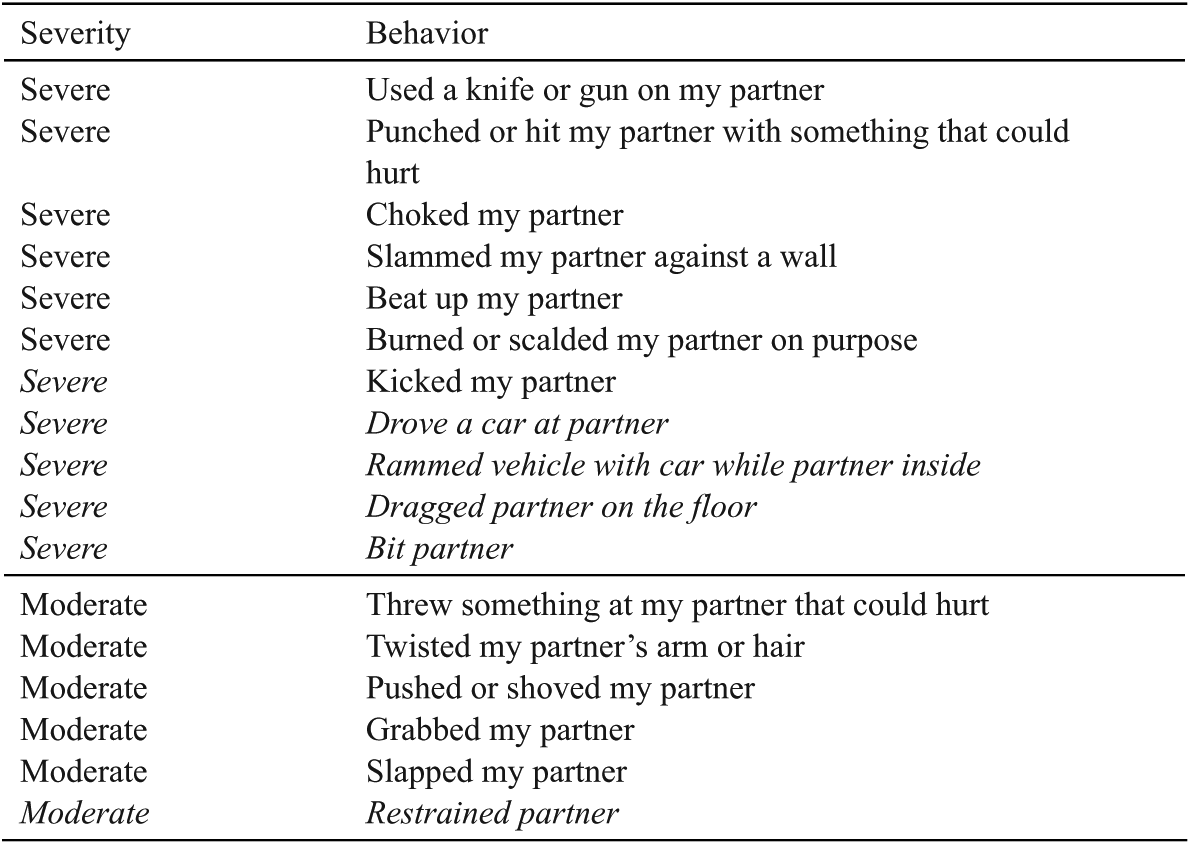
CTS2 violence categories with additional items italicized.
The coding process categorized violent incidents into “moderate” (1) or “severe” (2). Alternatively, those incidents that contained no mention of any violence, for example, if an offender breached a restraining order, were coded as “nonviolent” (0). These categories are mutually exclusive, and in cases where both severe and moderate violence occurred, the narrative was coded based on the behavior of the highest severity. In cases where there was significant confusion about the actual event (e.g., offender and victim had contradicting stories with no evidence for either story), or if the narrative was too vague to accurately determine severity, no severity coding was assigned to that case. The coded levels of severity refer to violence against the victim only, and not the perpetrator or any third parties. A second researcher coded a small sample (n = 20) of the data set to check for interrater reliability, with all 20 reports matching the code given by the first researcher.
Variables
The outcome variable in this study is violence severity, whereby a score of “0” indicates a nonviolent incident, “1” indicates a moderately violent incident, and a score of “2” indicates a severely violent incident. Each score pertained only to physical violence. As the dependent variable for this research question is ordinal, an ordinal regression was deemed the most appropriate analysis to test for any significant correlations between the independent variables and violence severity (Liu, 2009). The binary independent variables analyzed in this study included presence of prior domestic violence, victim fear, the victim’s belief that perpetrator will injure/kill them, the victim’s belief that the perpetrator will kill themselves, perpetrator problem drug use, perpetrator problem alcohol use, perpetrator mental health issues, separation, previous harm to victim, child contact, perpetrator jealousy, threats, and nonfatal strangulation.
Results
Table 1 displays a summary of the descriptive statistics. The majority of the sample incident reports did not report any physical violence (51.2%), whereas moderately violent incident reports comprised 14.1% of the total sample, and severely violent incident reports comprised 34.7% of the total sample. It is important to note that this distribution of severity is not representative of stalking incident reports in the context of domestic abuse, as 200 of the narratives were chosen systematically based on the presence of physical violence, to create a more even distribution among the severity categories. A large majority of the incident reports indicated that victims had previously been victims of other domestic violence incidents (71.8%). The data show that most victims were frightened at the time of the domestic incident reported in the FVIR (74.3%). Many victims had experienced threats from the perpetrator, indicating intent to kill or hurt the victim (57.2%). Interestingly, although most victims experienced fear and previous threats, a large majority of victims did not believe that the perpetrator would kill the victim (81.0%) or that the perpetrator would kill themselves (94.3%). However, most victims did believe that the perpetrator would cause injury to the victim (55.8%), and 69.1% of victims had previously been injured by the perpetrator. The data showed that 24.9% of victims had experienced nonfatal strangulation by the perpetrator. The data also showed that 43.6% of perpetrators had experienced problems with drugs in the past year, and 29.5% of perpetrators experienced problems with alcohol in the past year. The data showed that 27.4% of victims indicated that the perpetrator had had mental health problems in the past year. The majority of incidents indicated that the perpetrator was excessively jealous (61.0%). Most victims were separated from the perpetrator (73.7%), and 20.9% of incidents indicated that child contact issues were present.
Descriptive Statistics.
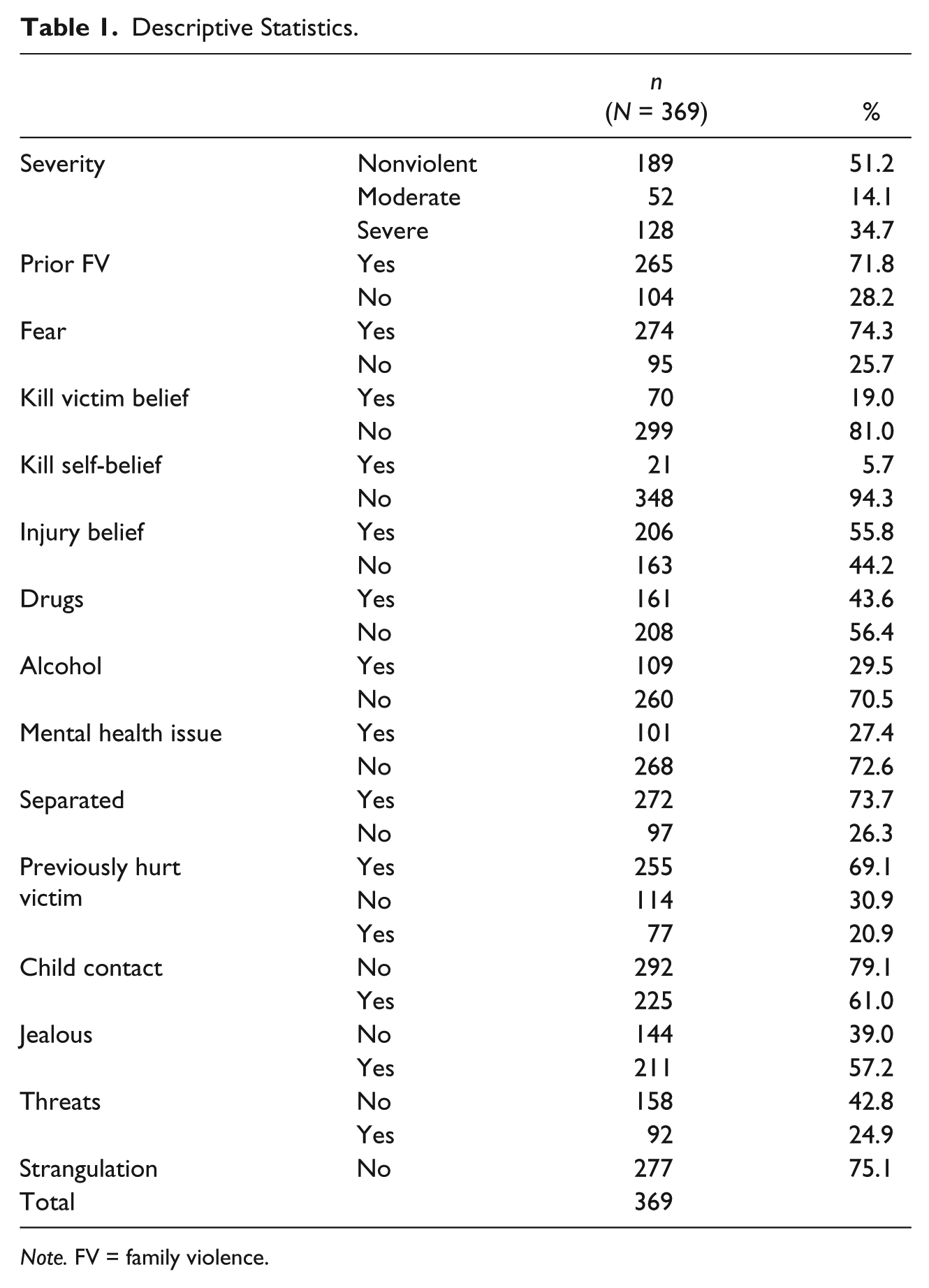
Note. FV = family violence.
Model Fit
The Pearson goodness-of-fit test, χ2(572) = 570.62, p = .508, and the deviance goodness-of-fit test, χ2(572) = 492.40, p = .993, both indicate that the model was a good fit to the data. The likelihood ratio test indicated that the final model was significantly better at predicting violence severity when compared with the intercept only model, χ2(14) = 103.42, p < .001.
Severity of Violence
Ordinal logistic regression was used to explore the presence and strength of any relationships between the independent variables and severity of violence. A summary of the ordinal regression results is found in Table 2. The odds of the FV incident containing a severe level of physical violence when the perpetrator had previously attempted to strangle the victim were 1.82 (95% confidence interval [CI] = [1.07, 3.08]) times higher than FV incidents where no previous strangulation attempts were made, an effect which is statistically significant, χ2(1) = 4.91, p = .027. The presence of excessive jealousy was also associated with higher odds of severe physical violence, with an odds ratio of 1.88 (95% CI = [1.18, 3.02]), χ2(1) = 6.94, p = .008. When the victim believed that the perpetrator would injure them, the odds of severe physical violence were 2.03 times higher than if the victim did not hold such beliefs (95% CI = [1.20, 3.44]), χ2(1) = 7.02, p = .008. If the victim had previously been hurt by the perpetrator, the odds of severe violence were increased, with an odds ratio of 2.53 (95% CI = [1.42, 4.51]), χ2(1) = 9.90, p = .002. Interestingly, the presence of a prior FV incident was associated with a 56% lower likelihood of experiencing severe violence, with an odds ratio of 0.44, (95% CI = [0.27, 0.74]), χ2(1) = 9.72, p = .002. If the victim and perpetrator were separated, the likelihood of severe violence was 54% lower than if the victim and perpetrator were together, with an odds ratio of 0.47 (95% CI = [0.28, 0.76]), χ2(1) = 9.26, p = .002. Finally, the presence of issues regarding the perpetrator having contact with children was associated with a 56% decrease in the likelihood of severe violence, with an odds ratio of 0.44 (95% CI = [0.24, 0.80]), χ2(1) = 7.15, p = .008. Victim fear, the victim’s belief that the perpetrator might kill the victim or themselves, drugs, alcohol, mental health, and threats were not significantly associated with violence severity.
Parameter Estimates, Significance Levels, and 95% Confidence Intervals for Independent Variables and Stalking Violence Severity.
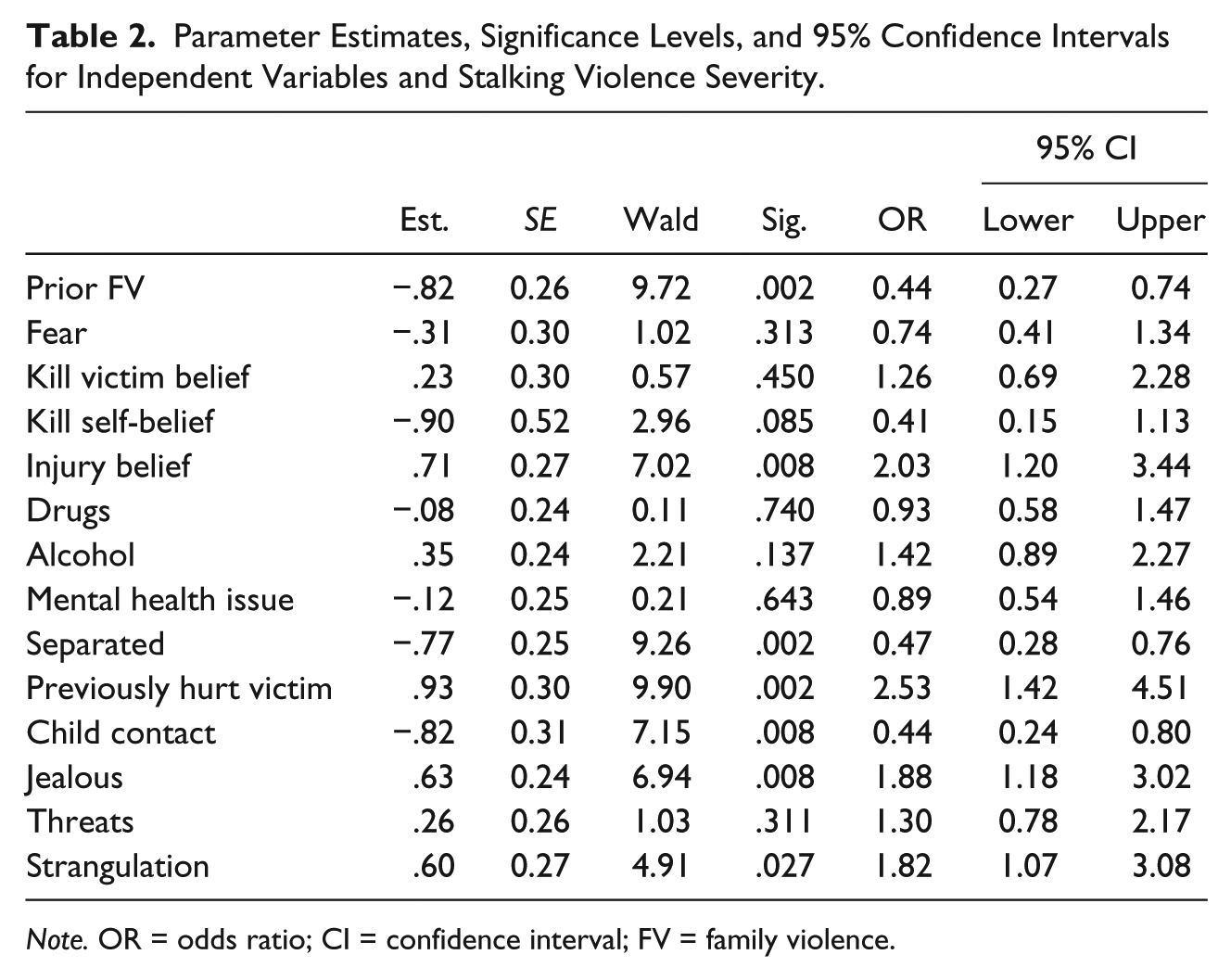
Note. OR = odds ratio; CI = confidence interval; FV = family violence.
Discussion
The principal aim of this study was to identify factors associated with higher severity violence in a sample of domestically violent intimate and ex-intimate partners where stalking had also been recorded. A number of significant associations were identified.
A significant association was found between the presence of jealousy and physical violence in the stalking sample, a finding consistent with previous research on stalking violence risk factors (Roberts, 2005). This finding further supports jealousy as a risk factor, as it was not only associated with stalking violence in general, but our study shows that jealousy was significantly associated with higher severity of physical violence. The results also showed that the victim’s belief that the perpetrator would cause them injury and previous physical harm to the victim by the perpetrator were associated with higher severity physical violence. What is interesting is that an absence of prior FV was significantly correlated with higher severity violence, a finding that is consistent with James and Farnham’s (2003) study. The finding is inconsistent with other studies that have found a positive correlation (Brewster, 2000) or no association at all (Rosenfeld, 2004); however, it is important to note that these studies treated violence as a homogeneous construct.
James and Farnham (2003) have offered a logical explanation for these findings, noting that the perpetrators of severe violence in their sample tended to be socially integrated and engaged in sudden and severe attacks, whereas perpetrators of mild violence were less socially integrated and engaged in habitual and repeated acts of mild violence. This may be explained by Schlesinger (2002) who described catathymic aggression as violence that is motivated by strong emotion and obsessive preoccupation, whereby a perpetrator engages in a violent act toward the victim following an “incubation” period. This is particularly relevant in the context of stalkers as stalking perpetrators are often fixated on their victim, coercively controlling, persistent, and emotionally fueled (Mullen, Pathe, & Purcell, 2009; Spitzberg & Cupach, 2007). However, it is also important to consider the fact that a history of violence or a criminal record fails to differentiate between multiple incidents of violence toward the same victim and multiple incidents of violence that are each associated with a different victim. Perhaps the significant association between prior victim injury and severe violence highlights the importance of examining prior violence to a specific victim when seeking to determine that same victim’s risk of harm, rather than focusing on general prior violence which may not have been perpetrated against that same victim.
Contrary to earlier works that have suggested separation as a risk factor for stalking behavior and violence (Dutton & Goodman, 2005; Kienlen, 1998; Melton, 2007), separation correlated negatively with violence severity in the present study. As suggested by Mechanic et al. (2000), physical violence may be more difficult to perpetrate as a result of being separated from the victim; however, typical stalking behaviors such as messaging and harassment via phone calls/social media are quite easy to accomplish. Although this study did not explore individual stalking behaviors, doing so may increase our understanding of why separation may be negatively correlated with violence severity. Furthermore, this analysis did not look at each individual perpetrator–victim dyad longitudinally. As previously mentioned, Schlesinger’s (2002) notion of catathymic aggression may help explain these findings. Schlesinger (2002) suggests that a serious act of violence may be the result of the perpetrator attempting to resolve intense emotional anguish and psychological pain, which may be the result of failed attempts to restore a relationship, as well as the reversal of power from the perpetrator, to the victim. The nature of this analysis may only be examining early incidents, the severity of which may not be entirely captured unless a longitudinal strategy is employed. A longitudinal analysis would help establish whether the perpetrator engages in more severe aggression after multiple failed attempts to restore a relationship, testing the notion of catathymic aggression in this context.
Child contact is a factor that has not been explored in the context of intimate partner violence in stalking situations. The results of the present study indicate that child contact is significantly and negatively associated with violence severity. Although this is a new finding and in need of further investigation, this significant association may be the reflection of the perpetrator experiencing some level of control, potentially alleviating the drive to engage in further controlling and harmful behaviors, such as violence. Similar to the negative association of separation, it may be that the contact with the child is what is keeping the relationship from being severed, which may be where the true danger and risk lie if the separation and feeling of power loss lead to serious aggression toward the victim. This finding should be interpreted with caution; if a perpetrator begins to realize over time that a relationship may be severed by the victim regardless of child contact, a catathymic type of aggression is a potential risk, as was discussed in the context of separation (Schlesinger, 2002). Consequently, child contact should be explored longitudinally to observe potential changes over time, particularly when there is an extended period of romantic separation between the perpetrator and the victim.
Our finding of a significant association between previous nonfatal strangulation/attempt at strangulation and violence severity provides support for the consideration of a new factor for violence risk assessment in stalking situations. Strangulation has been described as a form of violence that is separate from most other forms of violence, due to the gendered nature, the display of coercive control/power over the victim, and potential for lethality and serious long-term health risks (Glass et al., 2008; Thomas et al., 2014). Due to the often repetitive experience of strangulation and likelihood of increasing aggression and injury perpetrated by the abuser, strangulation may be the final violent indicator before death (McClane, Strack, & Hawley, 2001). Strangulation is often difficult to identify as symptoms may not appear until days after the attack, making it particularly difficult to identify by police officers who attend domestic violence callouts (Strack, McClane, & Hawley, 2001). These results highlight the importance of early detection, training, and accurate identifications of strangulation attempts, as the results of this research suggest that such attempts are associated with severely violent behavior.
Variables such as fear, kill victim belief, kill self-belief, drug/alcohol use, and mental health were shown to have no significant association with violence severity. Research shows that women’s perception of danger in the context of intimate partner violence is often underestimated, which may explain why the victim’s belief that the perpetrator will kill them and fear were not significantly associated with higher severity incidents (Campbell, 2004). Furthermore, research also shows that within the context of domestic violence, victims are often reluctant to disclose the true nature of the severity of the violence to law enforcement agents, which may explain why fear and the belief that the perpetrator will kill the victim were not significant factors (Wolf, Ly, Hobart, & Kernic, 2003). Like violence, fear itself is not a homogeneous construct and may vary from being mildly scared to petrified. Descriptive statistics show that 74.3% of the victims in this study were fearful, yet 81% did not have any beliefs that the perpetrator would kill them. This suggests that the levels of fear may vary widely within this sample, supporting the idea that fear should be explored further, but not as a homogeneous construct. These results may be further explained by works exploring coercive control in the context of domestic violence. Indeed, research shows that victims of coercively controlling perpetrators are often very fearful of the threats and other coercively controlling tactics used by the perpetrators rather than fear of the physical violence itself (Dutton & Goodman, 2005). This may help explain why fear was prevalent, but not significantly correlated with physical severity. The victim’s belief that the perpetrator will kill themselves was also not correlated with violence, although this variable relies on the report of the victim, which may not be aligned with the true ideation of the perpetrator. Research on mental health and substance abuse presents mixed conclusions regarding their relationship with stalking violence, and the results of this study reflect the research that has previously identified no significant relationship between these factors (James & Farnham, 2003; Roberts, 2005).
Our understanding of stalking behavior and the recognition of the seriousness of such offenses are gradually increasing, as evidenced by changes in legislation and criminalization of stalking behavior. Police and justice records highlight the large amount of stalking-related incidents that officers are presented with, and the research has consistently demonstrated the potential harm that may occur with persistent and often violent stalking behaviors. The connections between a criminal, their victim, environment, actions, and personal factors cannot be simplified to a controlled laboratory setting. Consequently, the use of a data set that is created as the crime occurs in its natural environment, such as the data set utilized in this study, has the advantage of being employed to develop practical applications that will be useful to those professionals who work in the field. Canter (1996) posed the argument that naturalistic data were much more useful to a relevant practitioner who works with that kind of information on a daily basis, than tightly controlled laboratory data. Although there exist inconsistencies in the research regarding risk factors for stalking behavior and violence, the current study helps to build upon existing literature on such risks and presents new factors for consideration, which have shown associations with serious violence among intimate and ex-intimate partners of stalkers.
Limitations
This research has some limitations. First, the data set consists of variables that are binary, which may silence the true effects of some variables. Factors such as mental health and fear may contain subcategories (e.g., disorder types) or may lie on a continuum (level of fear). Furthermore, the context in which the violence occurs, such as the motivation for the violence, was not explored in this study. It is recommended that further research be conducted with the expansion of these factors and inclusion of wider contextual variables. Second, the design of the study presents limitations upon the conclusions that can be drawn from the data. Stalking research has shown that timing is an important factor in determining risk; however, the associations (both significant and nonsignificant) in this research must therefore be interpreted with caution as we cannot see the effects over time. The nature of the recording process is also important to consider. Although it is not practical for officers to ask each victim a battery of questions upon arrival, it also means that the presence of various factors may go unnoticed, be missed, or simply not discussed by the victim and officer. The completion of the FVIR forms also involves some level of personal judgment and perception from the officers, and although officers are trained to recognize and respond to a variety of potential incidents where police presence is needed, officers are not specifically trained in stalking risk assessment.
Conclusion
The results of this study may be utilized pragmatically by officers to indicate which victims might benefit from being flagged, based on the presence of prior harm, absence of prior FV, separation, belief of future injury, perpetrator jealousy, child contact issues, and nonfatal strangulation. Although the findings of this work cannot be translated into a risk assessment as such, they may assist first responders in being able to recognize which victim/perpetrator variables are indicative of a higher likelihood of severe violence. As a result, police resources may be utilized more effectively through the recognition of “red flag” indicators and may consequently prevent harm to victims. It also provides a starting point for further research into child contact, strangulation, and jealousy, as potential risk indicators for intimate partner violence in stalking samples. Future studies should further explore child contact and nonfatal strangulation in the context of stalking and domestic violence and consider adopting a longitudinal design to see the effects of these factors over time.
Footnotes
Acknowledgements
We would like to extend our utmost appreciation for the assistance and cooperation of the research team at the Western Australian Police Force, and particularly to Christine McComb and Paul House, who have taken the time to redact and extract the data and consequently made this research study possible.
Declaration of Conflicting Interests
The author(s) declared no potential conflicts of interest with respect to the research, authorship, and/or publication of this article.
Funding
The author(s) received no financial support for the research, authorship, and/or publication of this article.
