



Abstract
This research was the first in the United Kingdom to examine the prevalence and nature of nonconsensual sharing of sexually explicit messages, pictures, and videos and to examine whether this varies according to gender and by role (i.e., perpetrator, victim, or as dual role of perpetrator/victim). In a sample of 391 young adults (aged 18-25 years), questionnaire data on subjective norms, consensual and nonconsensual sharing, and their motivations for these behaviors were collected. Perpetration of and victimization through nonconsensual sharing was experienced by a substantial number of individuals. There was an association between reporting perpetration of nonconsensual sharing and experiencing victimization. An association was also found between reporting being pressured (i.e., coerced) to send sexually explicit material and experiencing victimization of nonconsensual sharing, which suggests that these behaviors may form part of a continuum of violence and abuse, potentially within intimate relationships. No association was found between gender and (a) perpetration or (b) victimization. However, from a gendered perspective, females perceived there was greater social pressure to post messages, pictures, and videos, compared with males. Motivations for nonconsensual sharing were commonly explained as for fun/a joke, and generally not thought of as problematic, although some victims perceived motivations to be more negative and/or related to revenge/causing distress. Given that this research examined nonconsensual sharing across messages, pictures, and videos for both victimization and perpetration and found it was both perpetrated and experienced by females and males, this does not support the common perception that this is a male perpetrated behavior against women. This has implications for education, policy, intervention, and prevention, with approaches needing to be inclusive of both males and females when addressing perpetration and victimization.
Keywords
Developments in mobile and Internet technologies mean that individuals, particularly young adults, use a range of devices (e.g., phones, computers, tablets) to engage in diverse behaviors that involve sexual content, topics, and stimuli, that has collectively been named online sexual activity (OSA; Shaughnessy, Fudge, & Byers, 2017). OSA is commonly used within interpersonal relationships to maintain intimacy but also as a means of self-expression, self-definition, and self-representation (Attwood, 2009). This behavior can form part of healthy relationships, for fun and flirtation (e.g., Albury & Crawford, 2012; Burkett, 2015; Drouin, Vogel, Surbey, & Stills, 2013), to initiate sexual relationships and activity (Drouin et al., 2013; Henderson & Morgan, 2011), as a means of maintaining intimacy when distance separates relationships (Drouin et al., 2013; Walker, Sanci, & Temple-Smith, 2013), and for intimacy, sexual arousal, and pleasure (Burkett, 2015; Yeung, Horyniak, Vella, Hellard, & Lim, 2014).
However, at times, this behavior may not be healthy, and may become problematic (Burkett, 2015; Drouin, Ross, & Tobin, 2015; Drouin & Tobin, 2014; Ross, Drouin, & Coupe, 2019; Walker et al., 2013). For example, Drouin et al. (2015) found in their sample of college students, that a fifth had experienced being coerced and pressured into sending sexually explicit images or messages, and that these individuals experienced higher rates of sexual coercion and intimate partner violence. Likewise, Ross et al. (2019) found in their sample of 885 undergraduates (Mage = 20.43 years) that 8% had been coerced into sending sexually explicit messages or pictures, and this was related to negative mental health problems, sexual issues, and attachment dysfunction. In addition, this behavior is also unhealthy, when sharing with others occurs without the consent of those depicted (see Walker & Sleath, 2017), and it is specifically this nonconsensual sharing of private sexually explicit material in young adults, that is the focus of this article.
In England and Wales, the Criminal Justice and Courts Act (CJCA, 2015) criminalizes components of this behavior, whereby it is an offense to share without consent, and with the intention of causing distress “photographs or films which show people engaged in sexual activity, or depicted in a sexual way, or with their genitals exposed, where what is shown would not usually be seen in public” (CJCA, 2015, s33 (1)). Likewise, in certain states within the United States and also countries such as Japan (Dawkins, 2015; Matsui, 2015), similar legislation has also been introduced, underlining the harmful impact that this behavior can have for some individuals. However, as noted by Eaton, Jacobs, and Ruvalcaba (2017), there is very little research that has established the impact of nonconsensual sharing (described as nonconsensual pornography in their study). They found that in a U.S. general population study that individuals who had experienced nonconsensual sharing of their photos reported significantly worse mental health outcomes and higher levels of physiological problems than individuals who had not experienced these behaviors. Therefore, we need to develop a more in-depth understanding of this behavior, particularly if people are engaging in this behavior without understanding the potentially criminal nature of their actions.
A recent review by Walker and Sleath (2017) determined that there was no clear consensus on the definition of nonconsensual sharing, meaning that it is difficult to get an accurate picture of the prevalence and nature of this behavior. For example, in relation to victimization, Borrajo, Gámez-Guadix, and Calvete (2015) identified that of their 433 participants, 5.1% had been victims, based on whether anyone had disseminated their intimate information or compromising images (on instant messages, social media, or email) in the last 6 months. Conversely, Dir and Cyders (2015) found victimization rates of 12%, based on an open question about any negative experience of sexting ever, asking whether participants Had sent a sext to someone, who later spread the sext around to other people, but this rate was higher at 42% when they were asked whether they had a friend who had experienced this. In relation to perpetration, prevalence rates of 0.7% (males) and 1.1% (females) have been found in a sample of 321, 17- to 22-year-olds, based on asking whether they had within the last 12 months, Shared a sexually suggestive image of your partner without permission (Reed, Tolman, & Ward, 2016). However, a higher rate of 26% was found in a similar aged sample, when asked whether they had ever Forwarded or shared a sext with good friend (Strohmaier, Murphy, & DeMatteo, 2014). Based on this review of the literature, Walker and Sleath (2017) defined nonconsensual sharing as “the sharing of sexually explicit images (including photographs) and/or videos, without the consent of those depicted” (p. 10). This definition was adopted for the current study; however, importantly this study has broadened the focus to also investigate the nonconsensual sharing of electronic messages. As no U.K. research, thus far, has examined prevalence of nonconsensual sharing of messages, pictures, and videos within a young adult sample, this article will be the first to address this gap in knowledge.
Furthermore, only one study published to date (Reed et al., 2016) has examined gender differences in the perpetration of nonconsensual sharing, with the authors finding that in their sample of 365 undergraduate students (57% female), aged 17 to 22 years, there were no significant differences in relation to the sharing of sexually suggestive images without permission. Four studies have examined gender difference in relation to victimization (Borrajo et al., 2015; Gámez-Guadix, Almendros, Borrajo, & Calvete, 2015; Priebe & Svedin, 2012; Reed et al., 2016), with only Borrajo et al. (2015) finding a gender difference in their sample of 433 participants (160 males, 260 females, 13 unknown), aged 18 to 30 years, with males reporting significantly higher levels of victimization in relation to nonconsensual sharing of intimate information or compromising images. This is despite a general perception that experiencing the nonconsensual sharing of private sexually explicit material is exclusively a female issue, particularly in light of media influence and reporting, and the fact that high profile cases (of general public and celebrities) tend to involve female victims (e.g., “Pornography: On Gender and Other Agendas,” 2013). This study will therefore be unique in examining gender differences in both perpetration and victimization across nonconsensual sharing of multiple types of private sexually explicit material, that is, messages, pictures, and videos. This is important given the misperceptions that may exist in this topic area and adds clarity to context of how nonconsensual sharing manifests.
A second component to the current study relates to subjective norms and attitudes about nonconsensual sharing. Given that the Theory of Reasoned Action (Ajzen & Fishbein, 1980) pertains that behavior can be predicted by a person’s attitudes and subjective norms, it is important to also examine whether norms and/or attitudes about nonconsensual sharing predict perpetration of nonconsensual sharing across the three types of electronic material: messages, pictures, and videos. Attitudes have been defined as an individual’s perception of the positive or negative consequences associated with a certain behavior and the importance placed by the individual on such consequences (Ajzen, 1988). Subjective norms, however, reflect the attitudes of influential people (friends, family, and partner) toward the behavior (Ajzen & Fishbein, 1980). Hudson and colleagues (Hudson & Fetro, 2015; Hudson, Fetro, & Ogletree, 2014) found that sexting attitudes and subjective norms (i.e., sending, posting sexually suggestive electronic material) were related to sexting behaviors. However, no prior research has examined whether attitudes and/or norms predict the perpetration of nonconsensual sharing across isolated material types (i.e., messages, pictures, videos), which will be tested in this current study. As such, this will develop our theoretical understanding of how associated attitudes and/or norms relate to the perpetration of nonconsensual sharing. This will provide a test of the Theory of Reasoned Action within a new arena, thus extending the body of literature that has applied this model to our understanding of behavior.
In addition to this, in developing our understanding of nonconsensual sharing, an important factor to consider is the motivation and reason for engaging in this behavior. A type of nonconsensual sharing that is gaining attention from researchers, the media, and policy makers is termed as “revenge pornography.” Bates (2017) interviewed 18 female survivors who had experienced a range of incidents in which images were shared with the specific motivation of revenge. Negative mental health impacts included the following: trust issues; post-traumatic stress disorder (PTSD), anxiety and depression; and destroyed self-esteem and confidence and loss of control. “Revenge pornography” is a term that has been generated by the media and it has been suggested that this label is a misnomer (Franks, 2015), based on the fact that not all perpetrators are motivated by revenge and not all images serve a purpose of pornography (Henry & Powell, 2016). As such, given the nature of this behavior and its impact, it has been suggested that more fitting labels for the phenomenon include “non-consensual pornography” (Citron & Franks, 2014; Franks, 2015), “image-based sexual exploitation” (Henry & Powell, 2016), or the term gaining most momentum in the literature, “image-based sexual abuse” (McGlynn, Rackley, & Houghton, 2017). This recognizes that nonconsensual sharing may be undertaken simply as “a joke” or for “humor” (Burkett, 2015; Goggin & Crawford, 2011). Burkett (2015) highlighted that individuals see nonconsensual sharing as a “joke between us girls” and that in the context of friendships such behaviors were “funny” and “light hearted” and shouldn’t be seen as “offensive” or “sexual” (p. 846). Others (e.g., Ringrose, Gill, Livingstone, & Harvey, 2012; Ringrose & Harvey, 2015; Yeung et al., 2014) have suggested that this behavior is a method of bonding with friends and boasting, showing off and to gain popularity among peers. Indeed, Ringrose and Harvey (2015) suggested that boys, in particular, shared images with other boys and girls on their phones as a way of showing off. Likewise, Yeung et al. (2014) through focus group discussions with 39 participants aged 16 to 25 years, found that sexually explicit pictures or text messages were seen as “trophies” that could be shared nonconsensually, for individuals to demonstrate sexual success to others (p. 335).
One particularly disturbing motivation behind nonconsensual sharing of sexually explicit material is when this behavior is initiated and used within the context of intimate partner violence and abuse (IPVA). Drouin et al. (2015) suggest that experiencing coercion to send sexually explicit material needs to be considered as part of the IPVA construct. A recent study by Morelli, Bianchi, Baiocco, Pezzuti, and Chirumbolo (2016), of 715 participants aged 13 to 30 years (Mage = 22.01 years), found that the sharing of sexts about a partner without his or her consent predicted dating violence perpetration (also moderated through benevolent and hostile sexism). The authors concluded that while nonconsensual sharing is often conceived as a joke by young people, it can actually have dramatic consequences as the behavior becomes part of a continuum of violence toward a partner. Similarly, Henry and Powell (2015) note that while nonconsensual sharing is often done in the context of relationship breakdown to humiliate an ex-partner or friend, it is also the case that perpetrators of IPVA are increasingly using sexual imagery as a device to threaten, harass, and control, both current and previous partners.
It remains the case, however, that in the United Kingdom we still have little understanding of nonconsensual sharing of private sexually explicit material in young adults including accurate prevalence levels, the relevance of attitudes and/or norms about this behavior, nor an understanding of the motivations behind this behavior (including revenge pornography). Research to date has primarily been conducted in the United States and furthermore, no cross-national examinations of these behaviors exist, so it is currently unknown whether nonconsensual sharing prevalence, attitudes, and motivations are fundamentally different across countries and cultures. In addition, young adults are of particular interest because emerging adulthood (18-25 years) is a period that is characterized by exploration in the areas of sexuality, romantic relationships, identity, and values, as well increased participation in risk behaviors (Arnett, 2006). This gap in our understanding means that it is challenging to develop appropriately targeted policy that can shape responses to perpetration and victimization. This is particularly important given that there may be a gendered nature to this behavior and also with respect to potential links with intimate partner violence.
The prior literature has used a range of qualitative and quantitative research methods to provide some background to this topic area. Based on the objectives of the research, using a combination of these methods was the best approach to enable the researchers to address these questions; therefore, this study used a within stage mixed model design as advocated by Johnson and Onwuegbuzie (2004). For the current study, the data were gathered concurrently with an emphasis on quantitative methods that is then complemented by qualitative approaches. The following objectives were examined within the analysis of the data:
Determine the nature and prevalence of consensual and nonconsensual sharing of sexually explicit material (messages, pictures, and videos) among U.K. young adults;
Identify the reasons given for engaging in nonconsensual sharing of sexually explicit material.
In addition, the hypotheses tested in this study were as follows:
Method
Design
A between-subject within stage mixed model survey design was employed. Following Johnson and Onwuegbuzie’s (2004) approach to mixed methods, we gathered quantitative and qualitative data concurrently. Binary categorical data was gathered with regards to gender of participant, experiences of victimization, engagement in perpetration, experiencing coercion in the sharing of sexually explicit material. Scale variables that were gathered included subjective norms and attitudes in relation to nonconsensual sharing. Finally, qualitative data were gathered regarding motivations for engaging in perpetration of nonconsensual sharing and perceived motivations in cases of experiences of victimization. The data were gathered concurrently, but with a dominant focus on quantitative data. As suggested by Johnson and Onwuegbuzie (2004), the findings from the quantitative and qualitative data will be integrated to complement and contribute to our understanding of nonconsensual sharing.
Participants
Undergraduate students enrolled at one of three universities in England studying either Psychology and/or Criminology were recruited to take part in the study. Using G*Power, with an alpha of .05, a power of 0.80, and with an f value of 0.15, a reported sample size of 352 was required, which is achieved with the current sample. The total sample of participants consisted of 391 participants (n = 321 females, n = 70 males) with a mean age of 20.44 years (range = 18-25 years, SD = 1.59 years). In relation to ethnicity, 53.70% identified as being from a White background, 19.17% identified as being from an Asian background, 14.32% identified as being from a Black background, and 12.81% identified as being from Mixed/Other backgrounds. Statistics from England and Wales shows the population broadly comprises 86% White, 7.5% Asian, 3.3% Black, and 3.2% from Mixed/Other backgrounds (Office for National Statistics, 2012). This means that this sample is overrepresented of minority populations compared with the general population.
For use of technology, it was identified that 94.88% have/use a laptop, 96.42% have/use a mobile phone/smartphone, and 47.57% have/use a tablet. Regarding their online presence, 96.68% have a profile on a social networking site, 95.65% view others’ profiles and/or pictures on social networking sites, and 21.48% have a profile on a dating site or application. When communicating with others using technology, 96.93% send/receive text messages, 97.95% send/receive instant messages, 95.65% use their mobile phones to send/receive pictures or videos, 88.75% post photos online, 15.53% post videos online, and 86.96% use video chat.
Materials
An adapted version of the questionnaire used within the Sex and Tech: Results from a survey of teens and young adults survey (National Campaign to Prevent Teen and Unplanned Pregnancy & CosmoGirl.com, 2008) was implemented in the current study. The questionnaire comprised mainly of original items as found in the Sex and Tech, but some were adapted to refer to nonconsensual sharing, for example, “Have you ever shared sexy messages with other individual(s) without the consent of the sender? If so, who have you shared them with?” The Sex and Tech has been used in a number of studies previously (Crimmins & Seigfried-Spellar, 2014; Hudson & Fetro, 2015); however, to our knowledge, no validity testing of this scale has been carried out. Hudson et al. (2014) reported a Cronbach’s alpha of .81 for the original scale, demonstrating an excellent level of reliability. The adapted version began by gathering demographic data from the participants (gender, age, and ethnicity), followed by a section that asked subjective norms and attitudes about the consensual and nonconsensual sharing of sexually explicit material (described as sexy messages, sexy pictures, and sexy videos). Within the survey, “sexy messages” were defined as sexually suggestive written electronic personal texts, emails, instant messages, and so on, not including messages received as spam. “Sexy pictures” were defined as electronically (e.g., on a mobile phone or digital camera) captured sexually suggestive, semi-nude, or nude personal pictures taken of oneself (alone or by a friend), and not those found on the Internet, received from a stranger (such as spam). The definition of “sexy videos” was the same as the definition of pictures (with the word video substituted where appropriate).
Attitudes and subjective norms
Attitudes and subjective norms were measured using 18 and 11 questions, respectively, asking in relation to messages, pictures, and videos (based upon Hudson et al., 2014, use of the Sex and Tech survey items). Attitudes are defined as an individual’s perception of the positive or negative consequences associated with a certain behavior and the importance placed by the individual on such consequences (Ajzen, 1988). As such, an example attitude question used is “One has to be aware that sexy pictures may end up being seen.” Whereas, subjective norms reflect the attitudes of influential people (friends, family, and partner) toward behavior (Ajzen & Fishbein, 1980). As such, an example subjective norm question was “Sharing sexy pictures with people other than one(s) they were meant for.” The response set for all attitudinal questions, and one of the subjective norm questions (pressure to post sexy messages/pictures/videos) was on a 5-point Likert-type scale of strongly disagree to strongly agree. For the three remaining questions about subjective norms, the response set was a 4-point Likert-type scale of not common at all to very common. In the current study, Cronbach’s alpha for the subjective norm and attitude items was .86 and .74, respectively.
Behaviors regarding consensual and nonconsensual sharing
The final section of the questionnaire asked about consensual sharing (ever, i.e., lifetime) of the three types of sexually explicit material and then asked questions about the nonconsensual sharing of such material. These latter questions asked about victimization (e.g., “Has someone else ever shared, without your consent, sexy messages that you had sent to them?”) and perpetration of nonconsensual sharing (e.g., “Have you ever shared sexy pictures with other individual(s) without the consent of the sender?”). These data were binary coded so that the answer to these questions was 0 for no and 1 for yes. Questions in this section also determined how the sharing occurred and with whom the material was shared.
Motivations regarding nonconsensual sharing
Short qualitative questions were asked in relation to both perpetration and victimization to determine the (perceived) reasons why the nonconsensual sharing occurred (e.g., “Please state all reasons for why you shared these sexy pictures”; “Please state why you think they shared these sexy pictures”).
Procedure
This study was approved by each of the three Universities’ Ethics Committees and followed the guidelines of the British Psychological Society. To maximize recruitment, data collection used two methods: online (n = 323) through Bristol Online Survey and traditional paper-based (n = 68) methods. At Site 1, both of these methods were used, at Sites 2 and 3 only online data collection was used. No significant differences were found across the variables measured in this study between the participants who completed the study online compared with those who completed the study in a paper-based format.
For all data collection, opportunity sampling was used as participants were invited to take part in the study through a Research Participation Scheme. Through these schemes, students take part in research studies to gain course credit. Informed consent was obtained from all participants prior to completion of the questionnaire. Participants were only identifiable by a self-selected participant number (paper-based recruitment) or by an automatically assigned number (online data collection) enabling confidential participation in the survey. They could withdraw at any stage of the survey and were informed of their right to withdraw post-survey completion up to an end date of the data collection stage. Following completion of the study, participants were fully debriefed.
Data Analysis
As the data were largely categorical in nature, chi-square analyses were run to assess associations within the sample. Equivalent comparison group sizes are not an assumption of chi-square; however, it is important that in each cell size of any analysis, no expected value should be less than five (Field, 2013). This was achieved for all chi-square analyses reported below, which means all of the analyses of gender using chi-square were sufficiently powered. There is a lack of consistent sample size calculations for one-way multivariate analysis of variance (MANOVA), so a power analysis was run for the follow-up analysis of variances (ANOVAs). The sample size was achieved as reported in the participant section.
For the measures of attitudes and subjective norms, to test the measurement model, a set of confirmatory factor analysis (CFA) models were implemented in Mplus7.1. For subjective norms, four first-order factors corresponding to the four behaviors assessed (i.e., sending, sharing, posting, peer pressure) were defined. Each first-order factor was defined by its own indicators, corresponding to the different media used (i.e., message, picture, and video). A second-order factor was then posited. Because subjective norm items related to sending, sharing, and posting were assessed on a 4-point Likert scale, data were defined as categorical and Weighted Least Square Mean and Variance (WLSMV) adjusted estimator was used.
The initial fit was critical, with only comparative fit index (CFI) supporting the goodness of the model: χ2 = 258.549, degrees of freedom (df) = 40, p < .001; root mean square error approximation (RMSEA) = .118, confidence interval (CI) = [.105, .132], p < .001; CFI = .983. The main problem was related to the three items referring to peer pressure that seem unrelated to the others. Therefore, the factorial model was redefined including an independent Peer Pressure factor correlating with the General Subjective Norm second-order factor. Considering the structure of the measure, the error terms of the items referring to the same medium (i.e., message, picture and video, respectively) were allowed to correlate among each other. Although the fit improved, it was still critical: χ2 = 136.562, df = 33, p < .001; RMSEA = .090, CI = [.074, .105], p < .001; CFI = .992. To keep the model more parsimonious, it was then redefined fixing to 0 the correlation between error terms of items referring to the same medium that resulted not significant. In addition, after exploring modification indices, the error terms for items Q7a and Q7c were allowed to correlate. The final fit was very good: χ2 = 110.102, df = 35, p < .001; RMSEA = .074, CI = [.059, .090], p = .006; CFI = .994.
For attitudes, a CFA model was set up defining six first-order dimensions and a second-order factor. Because attitudes items were assessed on a 5-point Likert-type scale and were substantially normally distributed, data Maximum Likelihood (ML) estimator was used. In addition, in this case, initial fit indices were quite critical: χ2 = 459.648, df = 129, p < .001; RMSEA = .081, CI = [.073, .089], p < .001; CFI = .870. The main problem was related to the three items referring to “not being a big deal” that seem unrelated to the others. Hence, the factorial model was redefined including an independent factor ‘no big deal’ (NBD) to the General Attitude second-order factor. Furthermore, consistently with the model posited for Subjective Norms, the error terms of items referring to the same medium (i.e., message, picture, and video, respectively) were allowed to correlate. The associated fit was very good: χ2 = 178.402, df = 99, p < .001; RMSEA = .045, CI = [.035, .056], p = .749; CFI = .969. In the final model, the correlations between error terms that were not significant (p > .001) were fixed to 0 for parsimony. The corresponding fit indices were still very good: χ2 = 259.749, df = 119, p < .001; RMSEA = .055, CI = [.046, .064], p = .168; CFI = .944.
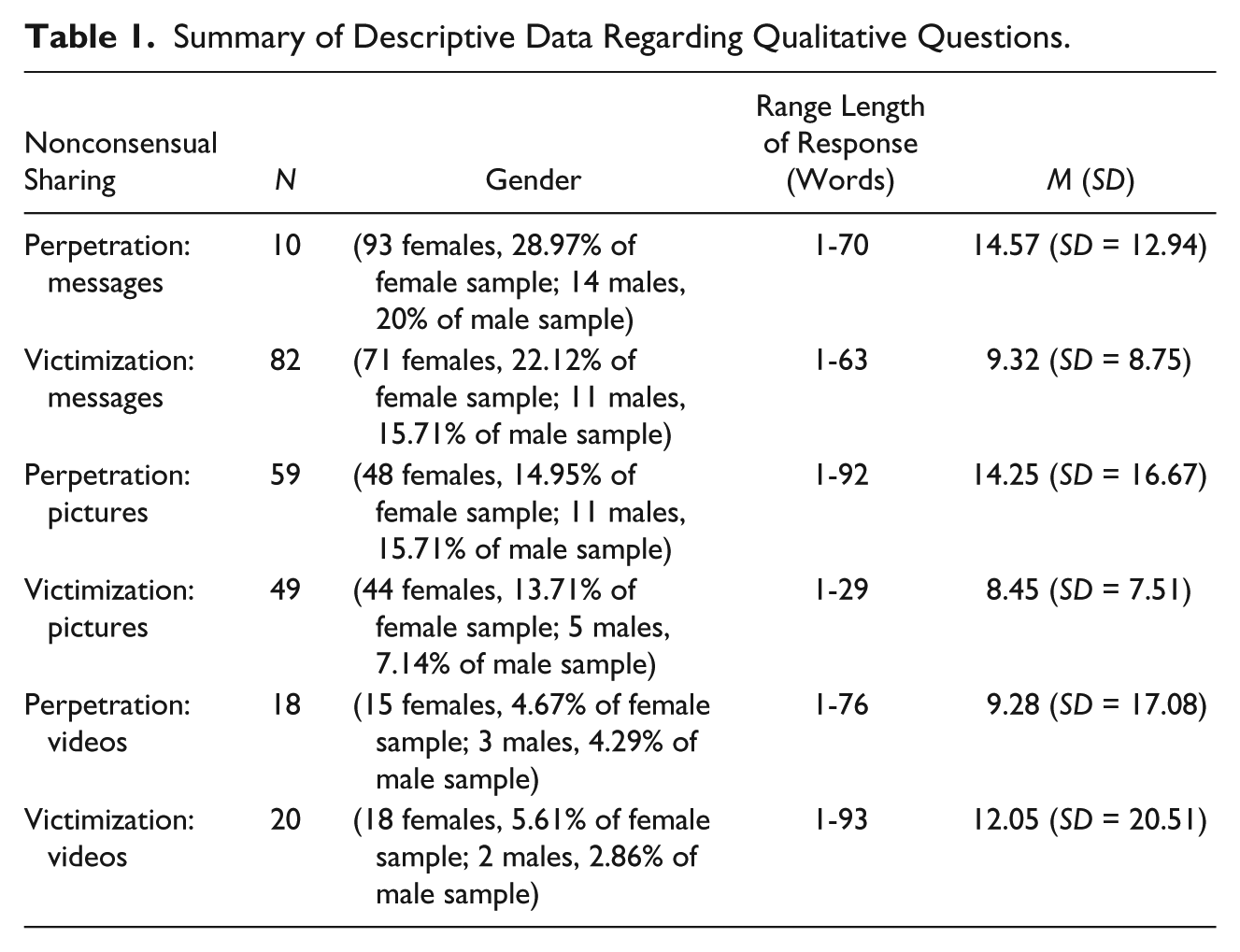
For the qualitative questions posed within the study, the responses in relation to perpetration and victimization of nonconsensual sharing were very brief and therefore a formal analytical method was not used. However, Braun and Clarke’s (2006) thematic analysis method was applied to ensure a structured analysis of the data was completed using both an inductive and deductive approach. This process of analysis includes an initial phase of familiarization in which the researcher ensures that they are familiar with the breadth and depth of the content of the responses. The second phase involves generating initial codes, which identify the features of the data, following by searching for themes in which initial codes are then categorized into broader themes. In the final stages of analysis, these initial themes were then reviewed, refined, and categorized into motivations for nonconsensual sharing. For further details about the descriptive data regarding these qualitative responses, please see Table 1.
Summary of Descriptive Data Regarding Qualitative Questions.
Results
Determine the nature and prevalence of consensual and nonconsensual sharing of private sexually explicit material (messages, pictures, and videos) among U.K. young adults.
In relation to the first objective, consensual sharing, in the whole sample, 71.10% had sent and 78.26% had received sexually explicit messages, 57.03% had sent and 59.08% had received sexually explicit pictures, and 27.62% had sent and 29.92% had received sexually explicit videos. The descriptive data in relation to whom this material was sent and received from and why it was sent is reported in Table 2. In relation to nonconsensual sharing of sexually explicit material, the descriptive data for perpetration and victimization in the whole sample are reported in Table 3. The subsequent percentages relate to the subsamples of those identified as perpetrators or victims. As the samples were so small for perpetration and victimization of nonconsensual sharing of sexually explicit videos, the data relating to whom and how this material was shared are not reported. As would be expected, it can be seen in Table 3 that the prevalence of both perpetration and victimization in relation to nonconsensual sharing is much lower than consensual sharing, for example, 16.37% of the sample have perpetrated nonconsensual sharing of pictures and 21.51% have experienced victimization of nonconsensual sharing of messages. For both victimization and perpetration, these materials were most frequently shared with a close friend and were most frequently nonconsensually shared by physically showing the other individual the material, or by forwarding the material through a messaging app or service.
Descriptive Statistics Regarding Consensual Sharing of Sexually Explicit Media.

Descriptive Statistics Regarding Perpetration and Victimization of Nonconsensual Sharing of Sexually Explicit Media.

As percentages of these behaviors are so small overall for videos, descriptive data are not given for who and why videos were shared.
Identify reasons and motivations for perpetration of and victimization of nonconsensual sharing of sexually explicit material.
In relation to the second objective, open-ended questions were asked to ascertain the motivations of the perpetrators of nonconsensual sharing of sexy messages, pictures, and videos. These provided short text responses from the participants, with some participants identifying multiple reasons. Of those who responded to the question regarding perpetration of nonconsensual sharing of messages, they reported that their main motivations included the following: To discuss and seek advice (n = 29, 27.10%), for fun/as a joke (n = 29, 27.10%), to discuss but chat/gossip about (n = 11, 10.28%), because they always share things like this with friends (n = 7, 6.54%), and to show off (n = 4, 3.74%). Of the participants who responded to the question regarding perpetration of nonconsensual sharing of pictures, the main motivations were as follows: For fun/as a joke (n = 13, 22.03%); to ask for advice, seek an opinion, or discuss (n = 11, 18.64%); because they always share things like this with friends (n = 5, 8.47%); to show off (n = 3, 5.08%); to get attention (n = 3, 5.08%); to prove that they had received them (n = 3, 5.08%); and because they were asked to do so (n = 3, 5.08%). Finally, of the participants who responded to the question regarding perpetration of nonconsensual sharing of videos, the main reason for sharing was for fun/as a joke (n = 7, 38.89%) or to feel sexy (n = 3, 16.67%).
Open-ended questions were also asked to ascertain the reasons victims thought that messages, pictures, and videos of themselves were nonconsensually shared (note these are therefore their perceptions of the motivations for their own victimization). Of the participants who responded to the question regarding experiencing victimization of nonconsensual sharing of messages, the main perceived motivations were as follows: to show off (n = 29, 35.37%); for fun/as a joke (n = 7, 8.54%); to get attention (n = 6, 7.32%); and for advice (n = 6, 7.32%); and for a range of negative reasons such as revenge (n = 2, 2.43%), jealousy, to shame or hurt the individual, anger, blackmail, insecurity and immaturity (n = 9, 10.97%). Of the participants who responded to the question regarding experiencing victimization of nonconsensual sharing of pictures, the main perceived motivations were as follows: to show off (n = 27, 55.10%), for revenge/cause distress (n = 7, 14.29%), and for fun/as a joke (n = 6, 12.24%). Finally, of the participants who responded to the question regarding experiencing victimization of nonconsensual sharing of videos, the main perceived motivations were for fun/as a joke (n = 4, 20.00%) and to show off (n = 3, 15.00%).
There will be an association between gender and experiences of perpetration and victimization of nonconsensual sharing of sexually explicit material (messages, pictures, and videos).
Three chi-square tests were computed to examine whether there was an association between participant gender and perpetration of nonconsensual sharing of sexually explicit messages, pictures, or videos. None of these three tests were significant (p > .05), demonstrating that there is no association between gender of participant and perpetration. Furthermore, three chi-square tests were run to assess whether there was any association between gender of participant and experiencing victimization through nonconsensual sharing of sexually explicit messages, pictures, or videos. None of these three tests were significant (p > .05), demonstrating that there is no association between gender of participant and victimization. Therefore, Hypothesis 1 is rejected.
There will be an association between perpetration of and experiencing victimization of nonconsensual sharing. Two chi-square tests were computed to assess whether there was any association between perpetration and victimization of nonconsensual sharing of messages and pictures (this was not analyzed for videos due to the small sample size). There were significant associations between perpetration and victimization for both material types, meaning Hypothesis 2 is supported. For messages, χ2(1) = 36.44, p < .001, based on the odds ratio, if participants had perpetrated nonconsensual sharing of messages, then they were 6.83 times more likely to experience victimization. For pictures, χ2(1) = 19.33, p < .001, based on the odds ratio, if participants had perpetrated nonconsensual sharing of pictures, then they were 5.32 times more likely to experience victimization.
There will be an association between coerced sending and victimization of nonconsensual sharing of sexually explicit material (messages, pictures, and videos). Two chi-squares tested associations between being pressured to send (a) messages and (b) pictures and victimization of nonconsensual sharing of that same material. Both of these tests were significant; therefore, Hypothesis 3 is supported: for messages, χ2(1) = 13.82, p = .001, and for pictures, χ2(1) = 40.37, p < .001. The odds ratio showed that if a participant reported being pressurized to send sexually explicit messages, then they were 4.19 times more likely to experience victimization. The odds ratio showed that if a participant reported being pressurized to send sexually explicit pictures, then they were 10.08 times more likely to experience victimization.
Subjective norms and attitudes about sending and sharing sexually explicit material (messages and pictures) will predict the perpetration of nonconsensual sharing of such material. The data were analyzed to determine whether subjective norms and attitudes predicted the perpetration of nonconsensual sharing across both messages and pictures. The continuous predictor variables and binary outcome variable (0 = has not perpetrated nonconsensual sharing, 1 = perpetrated nonconsensual sharing) meant that binary logistic regression was suitable for these analyses. Multicollinearity diagnostics were run, and all variance inflation factor (VIF) and tolerance values were in the acceptable range; therefore, no issues with multicollinearity were identified within this dataset for these analyses. Two binary logistic regressions were run to examine whether three subjective norms predicted perpetration of nonconsensual sharing of (a) messages and (b) pictures. These norms were as follow: (a) how common it is to send sexy messages/sexy pictures to someone else, (b) how common it is to share sexy messages/sexy pictures with people other than the one(s) they were meant for, and (c) that there is pressure among people my age to post sexy messages/sexy pictures in their networking site profiles. Neither of the models was significant.
To examine whether attitudes about sending and sharing sexually explicit messages/pictures predicted perpetration of nonconsensual sharing of (a) messages and (b) pictures, two binary logistic regressions were run with all predictors entered in Step 1. For messages, two attitudes predicted perpetration of nonconsensual sharing (see Table 4): (a) increased agreement that personal sexy messages end up being seen, b = .41, Wald χ2(1) = 6.26, p < .01, and (b) increased agreement that sending sexy messages is not a big deal, b = .31, Wald χ2(1) = 6.74, p < .01. For pictures, the model was nonsignificant. The findings from these analyses meant that Hypothesis 4 was rejected in relation to norms but partially supported in relation to attitudes.
Results of Binary Logistic Regression for All Predictor Variables in Relation to Perpetration of Nonconsensual Sharing.
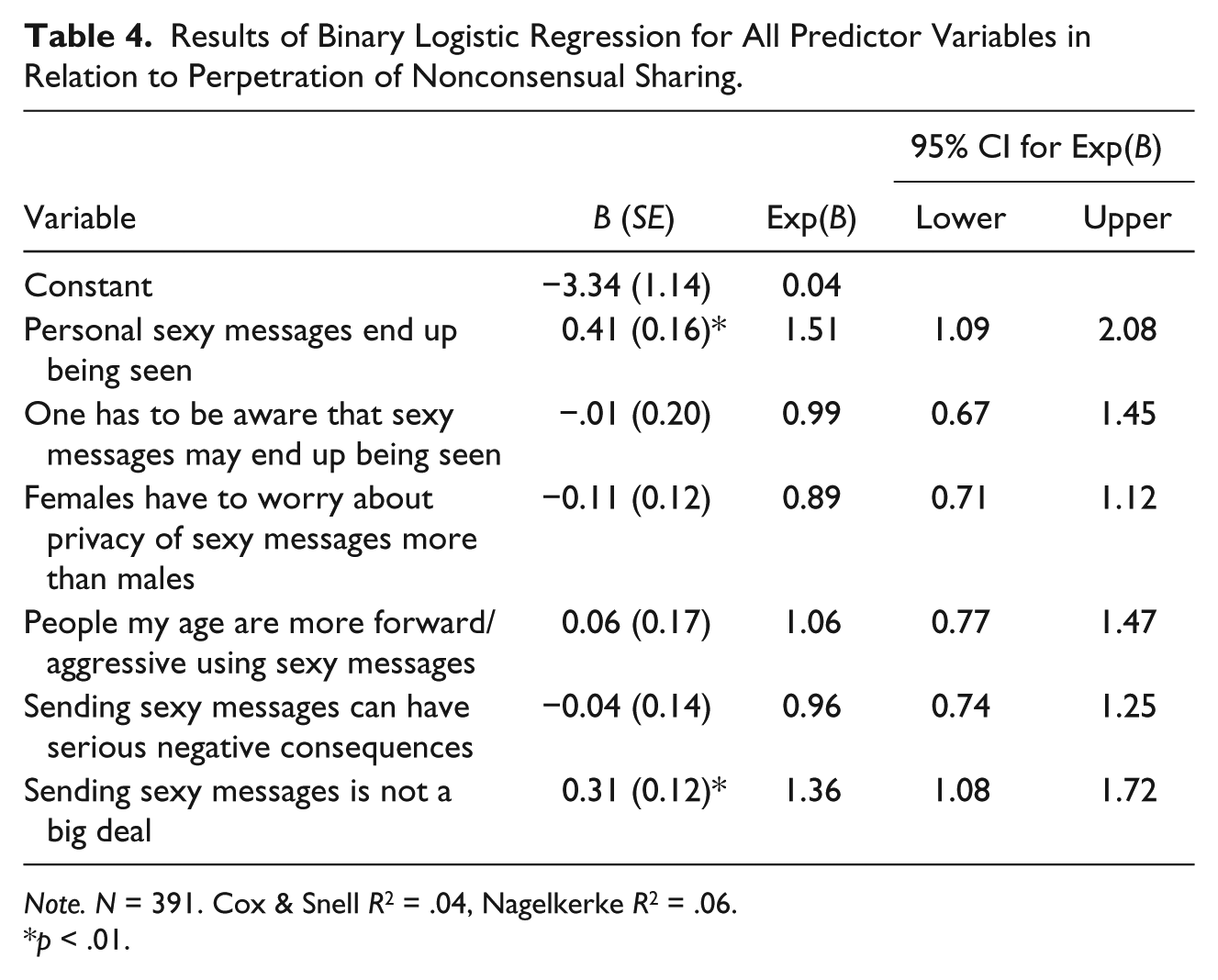
Note. N = 391. Cox & Snell R2 = .04, Nagelkerke R2 = .06.
p < .01.
There will be gender differences in the endorsement of subjective norms and attitudes about consensual and nonconsensual sharing of sexually explicit material subjective norms.
Gender differences were examined in relation to both subjective norms and attitudes about consensual and nonconsensual sharing.
Subjective norms
The first MANOVA determined gender differences in relation to subjective norms about sexy messages. Using Pillai’s trace, this analysis was significant, V = 0.02, F(3, 383) = 3.16, p = .02,
The second MANOVA determined gender differences in relation to subjective norms about sexy pictures. Using Pillai’s trace, this analysis was significant, V = 0.04, F(4, 369) = 3.91, p = .004,
The third MANOVA determined gender differences in relation to subjective norms about sexy videos. Using Pillai’s trace, this analysis was significant, V = 0.04, F(4, 369) = 3.91, p = .004,
Attitudes
The second analyses involved three MANOVAs with gender as the independent variable and attitudes about consensual and nonconsensual sharing as the dependent variables. The first MANOVA determined gender differences in relation to attitudes about sexy messages. Using Pillai’s trace, this was significant, V = 0.04, F(6, 312) = 2.43, p = .03,
The second MANOVA tested for gender differences in attitudes about sexy pictures, this analysis was not significant. The third MANOVA assessed for gender differences in relation to attitudes about sexy videos. Using Pillai’s trace, this was significant, V = 0.37, F(6, 353) = 2.27, p = .04,
Discussion
This research was the first to examine the nature of the perpetration and/or victimization of nonconsensual sharing in a U.K. young adult university-based population; specifically examining prevalence, subjective norms and attitudes, gender differences in behaviors, the association with coercion and finally, the motivations behind such behaviors. In doing so, this research has further confirmed that a significant number of young people are sending and receiving sexually explicit material (see also Drouin et al., 2013). However, importantly, the findings have also demonstrated that there are a small, but substantial number of individuals who are perpetrating and/or experiencing victimization through nonconsensual sharing of private sexually explicit material.
In relation to the first objective, this research has established that nonconsensual sharing (both perpetration and victimization) most commonly occurred in relation to sexually explicit messages. It was found that around a quarter of this sample had perpetrated nonconsensual sharing of sexually explicit messages, with fewer nonconsensually sharing pictures (16%), then videos (4%). Likewise, with victimization there was a similar pattern, where a fifth had experienced victimization through nonconsensual sharing of sexually explicit messages, with fewer experiencing their pictures being shared (13%) then videos (4%). Comparison with prevalence levels reported in other studies and understanding how this might differ by country and therefore cross-nationally, is challenging due to the lack of consistency in the research methodologies. However, in relation to experiences of victimization of nonconsensual sharing of images, these were higher (at 13%) than those reported in Reed et al. (2016; 3%, U.S. study) and Borrajo et al. (2015; 5.1%, Spanish study). Regarding perpetration (images), prevalence was higher than that reported by Reed et al. (2016; 1.1%, U.S. study) but lower than Hudson et al. (2014; 35.2%, U.S. study), who examined prevalence of nonconsensual sharing of both images and videos. One strength of our research is that it has determined prevalence according to the material type, whereas prior research (e.g., Hudson et al., 2014) has combined different material types together. To facilitate future comparisons of prevalence, research needs to adopt a consistent approach of measuring nonconsensual sharing according to the material type.
The levels of nonconsensual sharing of pictures are a more problematic issue than nonconsensual sharing of messages in that they may fall within the domain of the CJCA (2015), within England and Wales (if the intention behind the sharing is identified as “to cause distress”). This has significant implications for people’s lives if they do not understand that the behavior that they are engaging in is potentially criminal. As reported earlier, given that approximately 16% of the sample had nonconsensually shared pictures and 13% reported being victims, a proportion of the perpetrators may well have engaged in a criminal act (if their actions were deemed as having an intention to cause distress). There were occurrences of these materials being posted publicly, either through social media sites such as Facebook (e.g., approximately 3% of instances of victimization of nonconsensual sharing of pictures) or through general websites (e.g., 5% of instances of victimization of nonconsensual sharing of pictures); this, by its nature, is more likely to be seen as having intention to cause distress (more so than, for example, if the pictures were just shown to a friend) and therefore identified as a criminal act.
The levels of victimization found in the current study are equivalent to those in the extant literature. For example, Borrajo et al. (2015) reported that 2.9% of their sample had experienced a partner disseminating intimate information or compromising images about them on social media (note the different phrasing to this question), although this was measured in the last 6 months opposed to “ever” as in the current study. However, the levels of victimization in relation to posting on general websites are higher than previous studies have found. For example, Gámez-Guadix et al. (2015) reported that only 1.1% of their sample had “ever” experienced victimization of nonconsensual sharing on the Internet of sexually explicit photos or videos. No previous study has specifically examined the prevalence of social media or online posting in relation to the perpetration of nonconsensual sharing of sexually explicit pictures (or videos) before, so no comparisons can be made here. However, this study has found low levels of perpetration in terms of posting publicly on a social media site and no reports of posting pictures or videos publicly on a general website. It could therefore be the case, that this type of image-based sexual abuse is not being perpetrated within university populations in the United Kingdom (although more research would be required to assess for generalizability of these findings). Alternatively, due to the self-report nature of the research, and hence the potential for socially desirable responding around such behaviors, it is possible that there is some underreporting of this behavior.
For the second objective of this research, although, it has been discussed that nonconsensual sharing needs to be considered within the continuum of IPVA, the data also suggested that sexually explicit material was not necessarily from intimate partners and that the motivation for sharing is not always for revenge, or done with malice within the context of an abusive (ex) relationship. In the current study, the main motivation given for the perpetration of nonconsensual sharing was for fun/as a joke and was portrayed as something rather unremarkable by participants, suggesting that they do not necessarily identify this as being a problematic behavior. The motivation of fun/a joke was similarly found in research by Burkett (2015), who identified that sharing of sexually explicit material does not always occur within a specific “sexual context” (i.e., for the purpose of arousal, flirtation) and that nonconsensual sharing is often undertaken as a source of humor and a “joke” with friends. Burkett (2015) identified that it is framed as being commonly accepted and assumed that such behaviors are intended to be “funny” and “light hearted.” However, as Burkett (2015) also identified, while this can be framed as a joke and light-hearted and that those looking at the images do so in a nonsexual way, the images can actually be misinterpreted and viewed through a sexualized lens. It could be argued that purely dismissing nonconsensual sharing as a joke minimizes the potential harm that this may cause and the possible impact that such a “joke” may have on individuals’ rights, reputation, and feelings. Jokes such as this are subjective, and what is seen as funny by the “perpetrator” of the joke is not likely to be found as funny by the “victim” of the joke. It has been suggested that use of humor can be maladaptive, where this is used to humiliate others and decrease their popularity (Martin, Puhlik-Doris, Larsen, Gray, & Weir, 2003). This could suggest that although framing nonconsensual sharing as a “joke” and humorous, the motivation remains harmful and possibly with an intention to cause others distress (which then becomes a criminal offense). In addition, by framing this action as a joke, this is perhaps also a way for individuals to justify their behavior and reduce potential cognitive dissonance (Festinger, 1962) that might arise from nonconsensual sharing.
Similarly, a perceived reason and motivation for victimization, that is, the reasons why individuals thought they may have been victims of nonconsensual sharing, was for fun/as a joke. However, revenge/cause distress as a motivation was also cited by victims (but not perpetrators, although this could be due to social desirability), with 14.29% victims reporting this as a perceived motivation (i.e., this was the victim’s belief about what they thought the motivation was, which could not be confirmed/refuted by the perpetrators). If this is the case, such actions under the CJCA (2015) would be deemed as a criminal offense which raises some interesting questions and challenges and major implications for criminal prosecutions. For example, victims are identifying and suggesting that the intent is to cause distress, but perpetrators are suggesting it is done for fun/as a joke; therefore, how is the decision made as to whether this is criminal, particularly in determining intent which is likely to be perceived differently by the victims and perpetrators. Likewise, even if distress was not the intention (showing off, seeking advice, to discuss), the behavior could still cause distress and may leave individuals exposed to further sharing. However, the law is framed in relation to the intention of the perpetrator and not the many and various harms experienced by victims. Careful consideration is needed as to how we address the nonconsensual sharing of sexually explicit material and how we establish and determine the boundaries of criminal and noncriminal behaviors, to protect victims and effectively deal with image-based sexual abuse regardless of the intention behind it.
Hypothesis 1 stated that there would be an association between gender and perpetration and victimization; however, this hypothesis was rejected. No associations between gender and perpetration and victimization of nonconsensual sharing were found across either messages or pictures. The current study is the first to examine this across messages and pictures in relation to both victimization and perpetration. Of the four published studies that have examined gender and nonconsensual sharing, only Borrajo et al. (2015) found a significant gender difference in relation to a partner disseminating intimate information or compromising images about them, finding higher levels of reported victimization in male participants compared with female participants. In determining the implications of our findings, in the potentially parallel literature of IPVA, gender differences remains a significantly contentious issue, with numerous articles devoted to arguing both for and against the existence of such differences (e.g., Dutton & Nicholls, 2005). This debate may be being mirrored in relation to nonconsensual sharing and specifically “revenge pornography,” which is commonly viewed, particularly in the media, as a gendered crime. Our findings contest this depiction of nonconsensual sharing and suggest that it is not helpful to continue to frame this behavior as gendered, particularly as this is likely to be a barrier for men help-seeking. We know in relation to IPVA victimization, that males are less likely to report the occurrence and/or seek help and, when they do, they can experience several barriers such as finding support systems are for women only, that they are deemed to be the perpetrators and/or they are ridiculed and experienced gender-stereotyped treatment (Douglas & Hines, 2011). Data from the Revenge Pornography Helpline (GOV.UK, 2017) indicated that 75% of their callers were female victims, with only 25% being male, although it is not known how much this difference is due to underreporting and reluctance to help-seek by males. Our findings show that these behaviors are perpetrated and experienced by both males and females at comparable levels. This needs to be reflected in support services, policy, and education, meaning changes are required in these domains so that both men and women are acknowledged as perpetrators and/or victims and support is tailored, accessible, and available for both genders.
The above observations are particularly important given that the current study also found an association between reporting perpetration of nonconsensual sharing of sexually explicit messages and pictures and experiencing victimization of these material types. This supported Hypothesis 2. Again, there is evidence from the potentially parallel literature of IPVA that reciprocal use of partner violence is common in relationships (e.g., Cuenca Montesino, Graña Gómez, & Martínez Arias, 2015; Renner, Schwab Reese, Peek-Asa, & Ramirez, 2015; Straus, 2011) in both physical violence (e.g., Langhinrichsen-Rohling, Misra, Selwyn, & Rohling, 2012) and psychological abuse (Follingstad & Edmundson, 2010). It is possible that we are therefore seeing similar reciprocation in relation to nonconsensual sharing or that this behavior should be conceptualized within the framework of IPVA. Previous authors have suggested a link between revenge pornography and relationship violence (e.g., Henry & Powell, 2015), but this has only been tested by Morelli et al. (2016) who found a correlation between a combined measure of dating violence and nonconsensual sharing. However, the finding from the current study demonstrating an association between coercion and victimization suggests that this is of critical importance to examine further. This analysis supported Hypothesis 3. The findings from this study would fit with the gender symmetry model of IPVA aggression (e.g., Straus, 2011). This view argues that violence within relationships is bidirectional, with both partners engaging in violent behaviors, but that the underlying explanation why this occurs may be different, for example, in one relationship this may be retaliation by one partner in response to experiencing violence. This linkage needs to be explored in much more depth, particularly as the current study did not examine perpetration and victimization solely within relationships.
Subjective norms did not predict the perpetration of nonconsensual sharing across the three material types in this current study, which meant that we rejected Hypothesis 4 in relation to subjective norms. Previously, Hudson and Fetro (2015) found that subjective norms had the strongest influence, compared with attitudes and behavioral intentions, on whether an individual was a lifetime sexter. This was defined as having ever engaged in sexting behaviors such as sending, posting, Internet sending/posting, or sharing/forwarding sexy messages, sexy images, or both, which therefore may include an element of nonconsensual sharing. However, this does not isolate this behavior, or examine this by material type, making it difficult to make inferences in relation to nonconsensual sharing.
Two attitudes did predict perpetration of nonconsensual sharing of messages: increased agreement that personal sexy messages end up being seen, and increased agreement that sending sexy messages is not a big deal. This meant that Hypothesis 4 was partially supported in relation to attitudes. This suggests that perhaps beliefs about the commonality of a behavior and perceived risk about a behavior are associated with nonconsensual sharing. Such beliefs may serve as source of justification for the perpetration of such behaviors (or as offense supportive attitudes), and serve to minimize and reduce cognitive dissonance (Festinger, 1962) that may occur as a result of engaging in this type of behavior. The Theory of Reasoned Action (Ajzen & Fishbein, 1980), however, argues that attitudes and norms can influence behavior through behavioral intentions. Behavioral intentions were not measured in this study, so the full theory could not be tested. However, given the significant findings in relation to some attitudes being associated with perpetration, the testing of this model is needed, specifically regarding behavioral intentions in the context of nonconsensual sharing.
In examining gender differences in attitudes and subjective norms, only a few differences, with small effect sizes, were observed between genders. This meant that Hypothesis 5 was partially supported. For example, females believed that it was significantly more common for others to nonconsensually share pictures than males. However, medium effect sizes were found in relation to females perceiving there was more pressure to post pictures on social media and that messages end up being seen. No prior research has specifically examined these attitudes and norms, although Walker et al. (2013) did note that in their sample of adolescents, that perceptions about the pressure to be involved in sexting was shaped by gender dynamics, whereby girls felt coerced, bribed, or threatened into sending images. This finding that females perceive a greater social pressure to post messages, pictures, and videos was aligned with the finding in our study, in that our study found that between 16% and 27% (across the three types of material) reported that their reason for sending sexually explicit material was being pressurized to do so.
The findings from this research need to be considered in the context of the research design. The research was reliant on self-report about personal, sensitive, and possibly criminal behaviors (as participants had to be warned about the content of the CJCA). In relation to perpetration, participants’ responses may be affected by social desirability. It is also possible that both victims and perpetrators might be embarrassed about sharing information on their sexual practices, and so this may result in underreporting about experiences, although the findings in the current study are in line with those of other studies. To reduce the likelihood of this, all surveys were anonymous, with the majority being completed online. In relation to victimization, using self-report was reliant on individuals’ perceptions of the occurrences, so it could be argued that these might not necessarily be as accurate. For example, individuals might not always be aware they are a victim of nonconsensual sharing and if aware they can only surmise as to why a (ex)partner/other individual nonconsensually shared. Finally, the sample consisted of fewer males, with only 18% (n = 70) of the sample being male, although sufficient power was achieved to carry out the analyses and allowed for statistical comparisons to be made between the genders. This imbalance in the sample does mean that the findings are heavily influenced by females’ experiences and behaviors. However, the sample characteristics enabled us to demonstrate that perpetration is not only evident in male samples (a common perception). Finally, this was a university-based student sample; given the limited nature of the research at the moment regarding nonconsensual sharing, it is unclear whether this sample is generalizable to other populations.
In conclusion, this study has been the first to determine the prevalence of nonconsensual sharing among a U.K. young adult sample, as well as providing a thorough examination of the role of subjective norms and attitudes, gender, and motivations in relation to nonconsensual sharing. This has shown that there were no associations between gender and perpetration and victimization, but that there were associations between perpetration and victimization, as well as associations between being coerced to send sexually explicit materials and experiencing victimization. Some attitudes did predict perpetration of nonconsensual sharing; however, subjective norms did not predict perpetration. Finally, some gender differences were found in the endorsement of subjective norms and attitudes. As such, more research is required to develop our understanding of these elements, particularly in relation to determining the potential pathways following consensual sharing, coerced sharing, or nonconsensual taking (i.e., pictures/videos acquired without the knowledge of the person in them) of sexually explicit material to determine the decision-making process and motivations that may lead to perpetration and/or victimization. This will move the research forward from the findings from this current study, particularly in using a qualitative approach that could potentially better capture the process as it unfolds and therefore give a greater insight into all the different mechanisms (individual and contextual) that facilitate/promote or hinder the likelihood of nonconsensually sharing. The work also needs to be extended to other populations, for example, adolescents and older generations.
Advancements in technology, social media, the World Wide Web, electronic communication, and accessibility of technology for all ages comes with many advantages, opportunities and positives; however, there are disadvantages, challenges and negative outcomes that can also arise. Based on the findings of the current study, information, education, and policy that is gender inclusive needs to be developed to build an evidence-base to inform individuals that nonconsensual sharing is a societal issue, which is perpetrated and experienced equally by both males and females. Existing legislation requires strengthening to better protect victims and therefore not based on proving the intention to cause distress by the perpetrator. Legislation needs to acknowledge the harm and impact caused to victims, regardless of the motivations behind the nonconsensual sharing. Given the extent of nonconsensual sharing in the population that was studied and the attitudes and beliefs found regarding this behavior, more awareness raising is required for this age group in relation to legislation and the potential criminal implications, alongside the impact of their behaviors, regardless of the intention. As we create and build our digital footprints, we are opening ourselves to the possibility of other people abusing this. We therefore need to drive policy and education to protect (potential) victims and effectively work with (potential) perpetrators through evidence-based prevention and intervention planning and delivery.
Footnotes
Declaration of Conflicting Interests
The author(s) declared no potential conflicts of interest with respect to the research, authorship, and/or publication of this article.
Funding
The author(s) disclosed receipt of the following financial support for the research, authorship and/or publication of this article: The authors received pump prime funding from Coventry University to undertake the research.
