



Abstract
Based on an integration of the positive youth development model and the social cognitive theory, friends’ moral identity was examined as a moderator of the direct and indirect relations between school climate and adolescent’s cyberbullying perpetration via moral disengagement. Participants were 404 Chinese adolescents (Mage = 13.53 years, SD = 0.92). They completed the Perceived School Climate Scale and the Moral Identity Scale and nominated up to three friends whom they considered to be their “best friend” in their classroom at Time 1. After 6 months, they completed the Moral Disengagement Scale and the Cyberbullying Scale at Time 2. Results showed that adolescents who experienced positive school climate were less likely to cyberbully others, which was mediated by their moral disengagement. Friends’ moral identity moderated the direct and indirect relations between school climate and cyberbullying perpetration. Specifically, the indirect relationship between school climate and cyberbullying perpetration through moral disengagement became nonsignificant for adolescents interacting with high moral identity friends. The direct association between school climate and cyberbullying perpetration was moderated by friends’ moral identity.
Introduction
Cyberbullying has become a major youth problem worldwide, and its prevalence is increasing (Lee & Shin, 2017; Shapka, Onditi, Collie, & Lapidot-Lefler, 2018). It is also a major issue for Chinese adolescents (X. Wang, Lei, Liu, & Hu, 2016; X. Wang, Yang, Wang, & Lei, 2019). More importantly, cyberbullying can transpire at all hours. As a result, more and more adolescents are becoming involved in cyberbullying. For instance, cyberbullying perpetration among Chinese adolescents is relatively common with 34.84% having bullied someone (Zhou et al., 2013). The burden on society created by cyberbullying includes increased substance abuse, anxiety, and depression, making cyberbullying a public health priority (Guo, 2016; Hebert, Cenat, Blais, Lavoie, & Guerrier, 2016). Thus, it is of theoretical and practical importance to explore those factors that may contribute to a decrease or increase in adolescents’ cyberbullying perpetration. Positive school climate, as a protective factor, can significantly predict less bullying perpetration. Although considerable studies have established the significant association between school climate and adolescents’ bullying perpetration (Espelage, Polanin, & Low, 2014; Guerra, Williams, & Sadek, 2011; Klein, Cornell, & Konold, 2012; Williams & Guerra, 2007), much less is known about whether and how a positive school climate decreases the risk of adolescents’ cyberbullying perpetration. Cyberbullying perpetration often occurs outside of school settings and hours, and school administrators tend to believe that schools have little responsibility for cyberbullying perpetration (Holfeld & Leadbeater, 2017). To date, it is less clear whether positive school climate can potentially decrease the risk of cyberbullying perpetration. Thus, the aims of the present study were to explore whether school climate could significantly predict cyberbullying perpetration across 6 months and extend previous studies by exploring the underlying mediating and moderating mechanisms in this association.
School Climate and Cyberbullying Perpetration
School climate, as a relatively stable property of the school, refers to the character and quality of the school culture. Recently, educators and scholars have increasingly recognized the importance of positive school climate for preventing negative development such as bullying perpetration and cyber victimization (Holfeld & Leadbeater, 2017; Låftman, Östberg, & Modin, 2017). This can be explained by the positive youth development model which emphasizes strength-based approaches to adolescent’s development. One such model is the developmental assets framework which states that positive characteristics serve as protective factors for adolescents (Benson, 2003). The developmental assets include external assets (e.g., caring school climate and positive peer influence) and internal assets (e.g., honesty and integrity). These assets highlight the important roles of school (e.g., school climate) and school personnel (e.g., peer influences) and can help protect adolescents against high-risk behavior such as bullying (Edwards, Mumford, & Serra-Roldan, 2016).
However, the findings linking cyberbullying perpetration with school climate have been less consistent than for bullying perpetration. Specifically, some cross-sectional studies found that school climate was significantly associated with cyberbullying perpetration both at the individual and school levels (Konishi, Miyazaki, Hymel, & Waterhouse, 2017; Souza, Veiga Simão, Ferreira, & Ferreira, 2018; Williams & Guerra, 2007). Similarly, adolescents, who had the higher sense of belonging to the school (Wong, Chan, & Cheng, 2014) or who were monitored by teachers when using the Internet (Zhou et al., 2013), were less likely to cyberbully others. In contrast, teacher support as an important feature of school climate was not significantly associated with cyberbullying perpetration (Varela, Zimmerman, Ryan, & Stoddard, 2018). Satisfaction with school life also failed to be significant in predicting cyberbullying perpetration (Lee & Shin, 2017). Furthermore, one longitudinal study indicated that school climate was not significantly associated with cyberbullying perpetration (Cappadocia, Craig, & Pepler, 2013).
Taken together, although the results based on some cross-sectional studies suggest a significant association between school climate and cyberbullying perpetration, the current literature is inconclusive. One possible reason for these inconsistent findings may be that there are key mediators or moderators influencing the relationship between school climate and cyberbullying perpetration. To date, studies have focused primarily on the direct link between school climate and cyberbullying perpetration (Konishi et al., 2017; Lee & Shin, 2017; Souza et al., 2018; Varela et al., 2018; Williams & Guerra, 2007; Wong et al., 2014; Zhou et al., 2013). The mediating and moderating mechanisms underlying this relation remain largely unknown.
Adolescents’ Moral Disengagement as a Mediator
Moral disengagement (henceforth MD) is one of the most examined predictive variables of cyberbullying perpetration (Chen, Ho, & Lwin, 2017; Gini, Pozzoli, & Hymel, 2014; Kowalski, Giumetti, Schroeder, & Lattanner, 2014). Drawing from the social cognitive theory, we proposed adolescents’ MD as a potential mediator of the association between school climate and cyberbullying perpetration. Specifically, external social contexts can affect adolescents’ moral behaviors via moral self-regulatory mechanisms rooted in moral standards and self-sanctions, according to social cognitive theory, and these mechanisms operate only when they are activated. However, MD as the key deactivation process can deactivate these moral self-regulatory mechanisms. Therefore, the external social contexts may operate through MD to produce immoral behaviors. That is, the external social contexts such as school climate may influence the levels of adolescents’ MD, which in turn influence their immoral behaviors including aggression and bullying. Consistent with this theoretical framework, a growing number of studies have demonstrated that MD mediates the associations of family factors (e.g., childhood maltreatment, early rejection by parents, and parental attachment) with aggression and bullying (Bao, Zhang, Lai, Sun, & Wang, 2015; Hyde, Shaw, & Moilanen, 2010; X. Wang, Yang, Gao, et al., 2017). Surprisingly, only two studies, to our knowledge, have examined and indicated that MD mediates the relation between teachers’ responses and bullying as well as peer rejection and crime (Campaert, Nocentini, & Menesini, 2017; Fontaine, Fida, Paciello, Tisak, & Caprara, 2014). It is important to note, however, that youth tend to spend less time with their family and more time with their peers in school as adolescence progresses. Therefore, although not yet tested, it is reasonable to expect that adolescents’ MD would mediate the association between school climate and their cyberbullying perpetration. Two reasons underlie our argument for adolescents’ MD as a mediator.
First, high MD adolescents are more likely to cyberbully others. MD entails a variety of cognitive distortions associated with the anticipation of consequences, the attribution of causality, and the evaluation of responsibility that lead to view aggression and bullying as proper and legitimate in the pursuit of self-interest. Specifically, most people have developed personal moral standards to guide good behavior and deter bad behavior as moral self-regulatory mechanisms (Bandura, Barbaranelli, Caprara, & Pastorelli, 1996). However, these moral self-regulatory mechanisms can be deactivated by MD. Therefore, individuals can be freed from the self-sanction and guilt that would ensue when their behaviors such as cyberbullying perpetration violate their personal moral standards via MD. That is, cyberbullying perpetration can be cognitively reconstructed via MD so as to make it appear less harmful or not harmful at all (Meter & Bauman, 2018; X. Wang, Yang, Yang, Wang, & Lei, 2017).
Considerable research supports the idea that high MD adolescents are more likely to cyberbully others (X. Wang et al., 2016; X. Wang et al., 2019). Specifically, numerous cross-sectional studies have shown that MD is significantly and positively correlated with adolescents’ cyberbullying perpetration (Allison & Bussey, 2017; Lazuras, Barkoukis, Ourda, & Tsorbatzoudis, 2013; Orue & Calvete, 2019; Robson & Witenberg, 2013). This significant association still holds even after controlling for theoretically relevant third variables such as knowledge of cyberbullying moral standards, Machiavellianism, and parental monitoring (Bussey, Fitzpatrick, & Raman, 2015; Meter & Bauman, 2018; X. Wang et al., 2016). Furthermore, MD can predict adolescents’ cyberbullying perpetration 1 year later, even after controlling for baseline cyberbullying perpetration (Orue & Calvete, 2019). The results from meta-analyses also indicate that MD is significantly and positively associated with cyberbullying perpetration (Chen et al., 2017; Gini et al., 2014; Kowalski et al., 2014).
Second, school climate may affect adolescents’ MD. An individual’s MD develops from the increasing interplay between her or him and the external social context in which she or he operates according to Bandura’s view (Bandura et al., 1996). That is, MD, as a malleable social cognitive orientation, can be influenced by external social contexts. Therefore, it is reasonable to expect that adolescents’ MD is affected by their perceptions of external social contexts such as school climate. Although no study to our knowledge has examined the direct relation between school climate and MD, previous research has shown that adolescents’ MD is affected by the other social contexts such as family settings, peer groups, and teachers’ responses (Bao et al., 2015; Campaert et al., 2017; Caravita, Sijtsema, Rambaran, & Gini, 2014; Fontaine et al., 2014; Hyde et al., 2010; X. Wang, Yang, Gao, et al., 2017). For instance, adolescents exposed to higher levels of childhood maltreatment are more likely to score higher on MD (X. Wang, Yang, Gao, et al., 2017). Adolescents who are peer rejected are more likely than other adolescents to activate MD processes (Fontaine et al., 2014).
Friends’ Moral Identity as a Moderator
Although school climate may predict adolescents’ cyberbullying perpetration through MD, not all adolescents are equally influenced by school climate. This leads to a question: Why are there individual differences in susceptibility to school climate? Some theorists have claimed that the extent to which an external social factor affects adolescents’ problem behaviors may vary as a function of other social contexts (Lerner, 2004). Based on this view, we investigated whether the direct and indirect relations between school climate and cyberbullying perpetration would vary as the function of friends’ moral identity.
Friends become increasingly important for adolescents’ socialization as adolescence progresses (Marsh, Allen, Ho, Porter, & McFarland, 2006). More importantly, many moral development researchers have emphasized the roles of peer group context such as friendships for adolescent’s moral development and behaviors from early on (Damon & Killen, 1982; Malti & Buchmann, 2010; McDonald, Malti, Killen, & Rubin, 2014). For instance, Kohlberg’s “moral atmosphere” assumes that adolescent’s moral or immoral behaviors are not only influenced by individual moral characteristic but also affected by norms within peer group context such as friendships (Kohlberg, 1984). Friendships as the emotionally salient relationships have positive effects on adolescent’s moral development in two main ways (Damon & Killen, 1982; McDonald et al., 2014; Schonert-Reichl, 1999). First, adolescents learn to take others’ perspectives and to critically reflect on their own moral arguments via interactions with their friends. Second, adolescents can co-construct elaborate solutions to moral dilemmas and improve their moral development via discussion with friends about moral conflicts (Carpendale, 2000; Damon & Killen, 1982; Walker, Hennig, & Krettenauer, 2000). However, the roles of friends’ moral characteristics in adolescents’ behavioral socialization are largely neglected (Gasser & Malti, 2012). Only a few studies have examined the effects of friends’ moral characteristics on adolescent’s bullying. For instance, friends’ MD can indirectly influence adolescents’ bullying (Sijtsema, Rambaran, Caravita, & Gini, 2014), and normative beliefs of the peer group can significantly predict their attitudes regarding bullying roles (Almeida, Correia, & Marinho, 2009).
It is important to note, however, that the beneficial effect of adolescents’ friendships on their moral development largely depends on friends’ moral development. That is, interactions with friends who have higher levels of moral development are more likely to positively affect one’s own moral development; in contrast, having friends who have lower levels of moral development is unlikely to improve one’s own moral development (Taylor & Walker, 1997). Specifically, the direction of friends’ influence is likely to depend on the negative or positive features of friends’ identities such as moral identity (Gasser & Malti, 2012). Interaction with friends who have high moral identity as an important peer contextual factor may render mechanisms of MD less effective. As a result, friends’ moral identity may moderate the indirect relation between school climate and cyberbullying perpetration via MD.
Some indirect evidence exists to support friends’ moral identity as a moderator. First, “Bandura suggested that MD develops from increasing personal experiences and reciprocal relationships with others, including friends” (Caravita et al., 2014). That is, friends can exert a strong influence on the application of preexisting moral standards by evaluative justifications that make cyberbullying perpetration morally permissible. Second, some empirical studies roughly supported this expectation by showing that an adolescent’s MD is significantly associated with their friends’ MD (Caravita et al., 2014; Sijtsema et al., 2014), and an adolescent’s social status among peers indicated by perceived popularity can moderate the effect of MD on bullying (Caravita, Gini, & Pozzoli, 2012). Thus, considering the possible effect of friends’ moral identity on MD, we expected that friends’ moral identity would moderate the indirect relation between school climate and adolescent’s cyberbullying perpetration via MD. Specifically, for adolescents interacting with higher moral identity friends, the indirect effect of school climate on cyberbullying perpetration via MD might become much weaker or even nonsignificant. In contrast, for adolescents having friends with lower moral identity, their MD and cyberbullying perpetration would be less likely to be beneficially affected by their friends’ moral identity. Thus, school climate would still significantly and indirectly affect adolescents’ cyberbullying perpetration via MD. We also proposed that the direct association between school climate and adolescent’s cyberbullying perpetration might be moderated by friends’ moral identity.
The Current Study
By incorporating positive youth development model and social cognitive theory, we aimed to provide a more comprehensive understanding of the mechanisms through which school climate is likely to affect cyberbullying perpetration. Based on the aforementioned literature, the aims of the current study were twofold. The first aim was to explore whether school climate could significantly predict adolescents’ cyberbullying perpetration across 6 months. The second aim was to examine whether MD would mediate the association between school climate and cyberbullying perpetration. The third aim was to test whether the direct and indirect relations between school climate and cyberbullying perpetration via MD would vary as the function of friends’ moral identity. These questions regarding the underlying mediating and moderating mechanisms in the relation between school climate and cyberbullying perpetration would form a moderated mediation model. Based on the literature review and our aims, we proposed the following hypotheses:
Method
Participants and Procedure
We recruited participants from 10 classes in one junior middle school in Taiyuan, a mid-sized city in the middle of China. Participants included 478 adolescents who took part in the Adolescent Moral Disengagement Project conducted from 2016 to 2017. They were recruited from seventh (four classes) and eighth (six classes) grades. We chose this age group because cyberbullying rates peak in early adolescence (Kowalski et al., 2014) and are much higher for adolescents aged 12 to 15 as Slonje and Smith (2008) asserted. This investigation was approved by the corresponding author’s University Ethics Committee. We obtained parental consent and student assent from all participating students before the data collection. Adolescents filled out questionnaires in a quiet classroom and were free to withdraw from the study at any time. They placed their names and student numbers on the measures and the confidentiality of their responses was assured. We checked all questionnaires for completeness when participants finished. All questionnaires took approximately 40 min to complete.
During the first assessment, 456 adolescents from the 478 total consenting participants completed the Perceived School Climate Scale and the Moral Identity Scale. Adolescents also nominated up to three friends whom they considered to be their “best friend” in their classroom at Time 1. After 6 months, 435 adolescents from the 456 adolescents completed the MD Scale and the Cyberbullying Scale (95.39% retention rate) at Time 2. Data of 31 adolescents, who did not nominate up to three friends, were deleted. Finally, data were from a sample of 404 adolescents (215 females and 189 males). The sample size was determined using power analyses and 404 participants are enough to test our hypotheses. In the final sample, the mean age of the participants was 13.53 (SD = 0.92), ranging from 11 to 16. Results from attrition analyses indicated that adolescents who dropped out of the study after Time 1 were not significantly different from those who participated in the study for both times on the measures (i.e., school climate and moral identity) used at Time 1.
Measures
School climate
School climate was measured by the Perceived School Climate Scale (Bao, Zhang, Li, Li, & Wang, 2013). The scale consists of six items. Participants rated each item (e.g., “Cheating in school tests is a problem of this school”) on a 5-point scale (1 = always; 5 = never). Responses to all items were averaged with higher scores representing more positive perceptions of school climate. This scale has been used in the Chinese population (Li, Zhou, Li, & Zhou, 2016). Cronbach’s α was .86 in the present study.
Cyberbullying perpetration
The Cyberbullying Scale developed by Wright (2014) was administered to test adolescents’ levels of cyberbullying perpetration. It consists of nine items, such as “How often do you spread bad rumors about another peer online or through text messages.” Participants were asked to rate how often (with reference to the current semester) they had enacted the behavior described in each item on a 5-point Likert-type type scale ranging from 1 (never) to 5 (all the time). This scale has been used in the Chinese population (X. Wang et al., 2016). Cronbach’s α was .87 in the present study.
MD
The MD Scale developed by Bandura et al. (1996) was used to test adolescents’ levels of MD. It consists of 32 items. A representative item was “Kids cannot be blamed for misbehaving if their friends pressured them to do it.” Participants rated each item on a 5-point scale (1 = strongly disagree; 5 = strongly agree). Responses to all items were averaged with higher scores indicating higher levels of MD. The Chinese version of the MD scale has been demonstrated to be a reliable and valid measurement in assessing MD among Chinese adolescents (X. Wang, Yang, Gao, et al., 2017). For the current study, Cronbach’s α was .93.
Individual’s and friends’ moral identity
First, individual’s moral identity was measured by the 10-item Moral Identity Scale developed by Aquino and Reed (2002). Adolescents viewed nine adjectives (e.g., caring, compassionate, fair, friendly, generous, honest, and kind) and were told that these characteristics describe a person “who could be you or someone else.” They then rated the self-importance of these characteristics in terms of their moral identity on a 5-point Likert-type scale (1 = strongly disagree; 5 = strongly agree). Higher scores indicate higher levels of moral identity (example item: “It would make me feel good to be a person who has these characteristics”). The average of the 10 items’ scores was the total score for individual’s moral identity. The Chinese version of the Moral Identity Scale has been demonstrated to be a reliable and valid measurement among Chinese adolescents (Yang, Wang, Huan, & Liu, 2018). Cronbach’s α was .72 for the current study. Second, friends’ moral identity was calculated by averaging scores of nominated friends’ moral identity. At Time 1, adolescents nominated up to three friends whom they considered to be their “best friend” in their classroom. They could nominate same-sex or opposite-sex friends. This method has been used successfully by other studies (Sijtsema et al., 2014).
Data Analysis
The skewness and kurtosis of school climate, MD, individual’s moral identity, and friends’ moral identity fell within the acceptable range (skewness cutoff of 2.0 and kurtosis cutoff of 7.0; Curran, West, & Finch, 1996). However, the distributions of cyberbullying perpetration (skewness = 2.84) were somewhat skewed. Thus, the bootstrapping method was used to calculate estimators. Bootstrapping is one approach for implementing statistical tests and constructing confidence intervals (CIs) without the use of the traditional statistical assumption of normality (Preacher & Hayes, 2008). This method was used to examine and verify the statistical significance of the paths in the current study without consideration of data distribution. Specifically, we first calculated bivariate relations among school climate, cyberbullying, MD, individual’s moral identity, and friends’ moral identity. Second, structural equation modeling (SEM) was used to examine the mediating effect of MD. Finally, we further explored whether the mediation process was moderated separately by friends’ moral identity using Hayes’s (2013) PROCESS macro (Model 59).
Results
Bivariate Analyses
Means, standard deviations, and correlations for all variables are presented in Table 1. School climate was negatively associated with cyberbullying perpetration and MD, but not significantly associated with friends’ moral identity. MD was positively associated with cyberbullying perpetration. Individual’s moral identity was negatively associated with cyberbullying perpetration. However, friends’ moral identity was not significantly associated with cyberbullying perpetration, MD, and individual’s moral identity.
Descriptive Statistics and Correlations Among Variables of Interest.
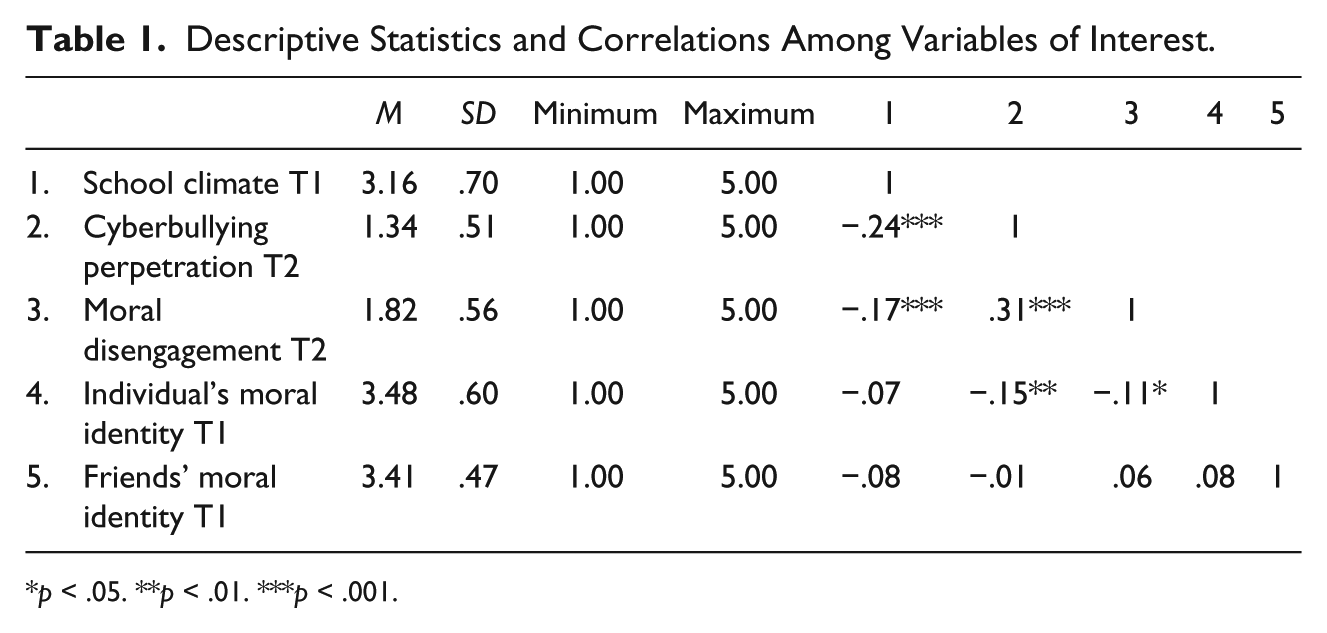
p < .05. **p < .01. ***p < .001.
Testing for Mediation Effect
We used SEM to examine the mediating effect of MD in the association between school climate and cyberbullying perpetration. First, the direct path coefficient from school climate to cyberbullying perpetration in the absence of MD was significant, γ = –.28, p < .001. Second, a partially mediated model with MD as a mediator revealed a satisfactory fit to the data: χ2(73) = 259.15, p < .001; root mean square error approximation (RMSEA) = .079; standardized root mean square residual (SRMR) = .048; and comparative fit index (CFI) = .94. Specifically, Time 1 school climate significantly and negatively predicted Time 2 MD and cyberbullying perpetration. At Time 2, MD was significantly and positively associated with cyberbullying perpetration. That is, MD partially mediated the association between school climate and cyberbullying perpetration (Figure 1).
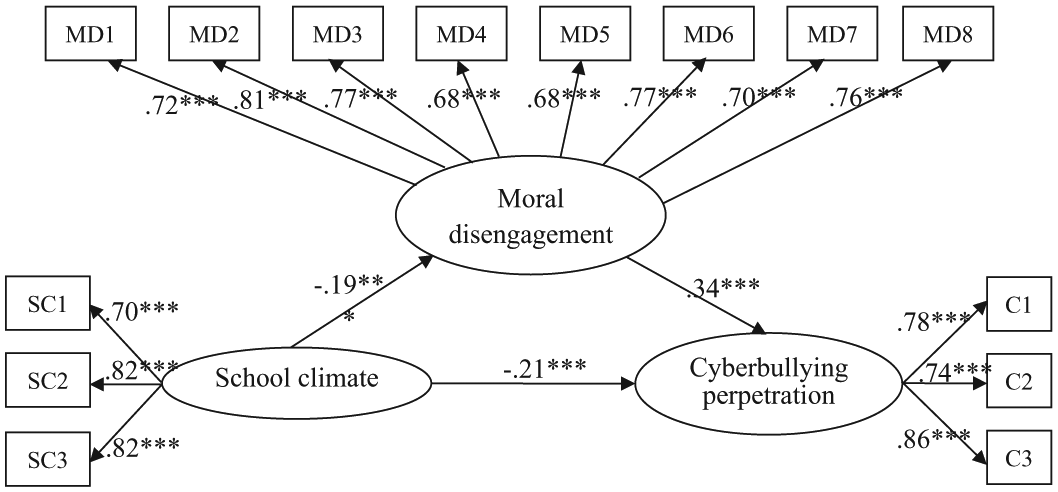
The mediation model.
A bootstrap procedure was applied to assess the size of the indirect effect of school climate on cyberbullying perpetration. We generated 1,000 bootstrapping samples from the original dataset by random sampling. The results indicated that the indirect effect was –.073 (SE = .036, 95% CI = [–.143, –.027], p = .002). Empirical 95% CI didn’t consist of zero, indicating that school climate exerted a significant indirect effect on cyberbullying perpetration via MD.
Friends’ Moral Identity as a Moderator
We expected that friends’ moral identity would moderate the direct and indirect effects of school climate on cyberbullying perpetration via MD. To examine this hypothesis, we estimated parameters for two regression models with Hayes’s (2013) PROCESS macro. We tested whether friends’ moral identity moderated (a) the relation between school climate and cyberbullying perpetration, (b) the relation between school climate and MD, and (c) the relation between MD and cyberbullying perpetration. In each model, individual’s moral identity was controlled.
As Table 2 illustrates, in Model 1, Time 1 friends’ moral identity didn’t moderate the relation between Time 1 school climate and Time 2 MD. Model 2 indicated that Time 1 friends’ moral identity didn’t significantly predict Time 2 cyberbullying perpetration, but it moderated the relation between Time 1 school climate and Time 2 cyberbullying perpetration. For descriptive purpose, we plotted predicted cyberbullying perpetration against school climate, separately for low and high levels of friends’ moral identity (Figure 2). Simple slope tests showed that for adolescents with high moral identity friends, school climate significantly predicted cyberbullying perpetration, bsimple = –.33, p < .001. However, for adolescents with low moral identity friends, school climate didn’t significantly predict cyberbullying perpetration, bsimple = –.08, p = .23. Furthermore, Model 2 indicated that friends’ moral identity moderated the relation between MD and cyberbullying perpetration. For descriptive purpose, we plotted predicted cyberbullying perpetration against MD, separately for low and high levels of friends’ moral identity (see Figure 3). Simple slope tests showed that for adolescents with low moral identity friends, MD was significantly associated with cyberbullying perpetration, bsimple = .42, p < .001. However, for adolescents with high moral identity friends, this association became nonsignificant, bsimple = .11, p = .12.
Testing the Moderating Effect of Friends’ Moral Identity on the Relation Between School Climate and Cyberbullying Perpetration Via Moral Disengagement.
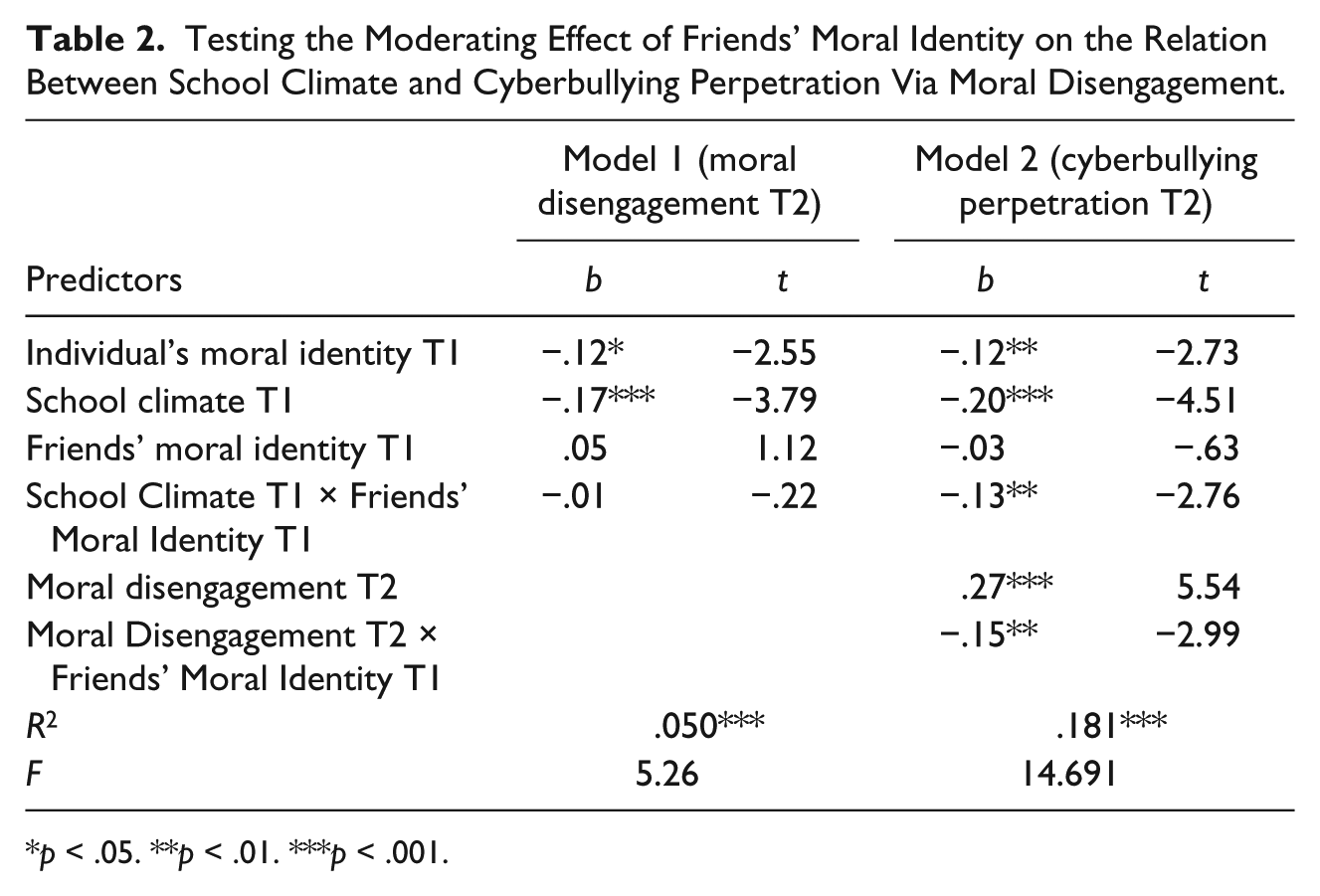
p < .05. **p < .01. ***p < .001.
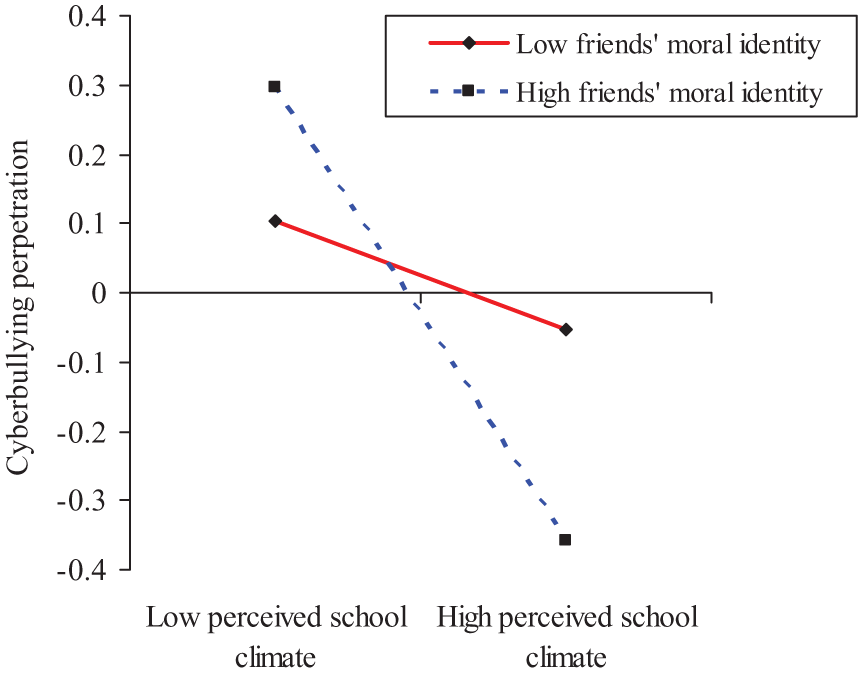
Interaction between school climate and friends’ moral identity on adolescents’ cyberbullying.

Interaction between moral disengagement and friends’ moral identity on adolescents’ cyberbullying.
The bias-corrected percentile bootstrap results further indicated that the indirect effect of school climate on cyberbullying perpetration via MD was moderated by friends’ moral identity. Specifically, for adolescents with low moral identity friends, school climate had a negative effect on cyberbullying perpetration via MD, b = –.069, SE = .035, 95% CI = [–.151, –.011]. In contrast, this indirect effect became nonsignificant for adolescents with high moral identity friends, b = –.021, SE = .027, 95% CI = [–.087, .015]. In sum, these results indicated that friends’ moral identity moderated the direct and indirect associations between school climate and cyberbullying perpetration via MD.
Discussion
Although the beneficial effect of school climate on adolescent’s bullying has garnered considerable empirical support (Espelage et al., 2014; Guerra et al., 2011; Klein et al., 2012), much less is known about whether and how a positive school climate decreases the risk of adolescents’ cyberbullying perpetration. More specifically, questions regarding the mediating mechanism (i.e., how school climate associates with cyberbullying perpetration) and moderating mechanism (i.e., when the protection is most potent) underlying this association remain largely unanswered. Thus, we formulated and examined the moderated mediation model based on an integration of existing theories (i.e., the positive youth development model and the social cognitive theory). Our results indicated that school climate significantly predicted adolescent’s cyberbullying perpetration, and this protective effect was explained in part by decreased MD. The indirect association between school climate and cyberbullying perpetration via MD became nonsignificant for adolescents interacting with high moral identity friends. The direct association between school climate and cyberbullying perpetration was also moderated by friends’ moral identity.
The Mediating Role of MD
Consistent with our expectations, we found that school climate significantly predicted adolescents’ cyberbullying perpetration across 6 months. This is consistent with the previous studies showing that adolescents who experience positive school climate are less likely to cyberbully others (Konishi et al., 2017; Souza et al., 2018; Williams & Guerra, 2007; Wong et al., 2014; Zhou et al., 2013). This finding also allows us to contribute to the ongoing debate regarding whether school climate is significantly associated with cyberbullying perpetration. Specifically, although cyberbullying perpetration often occurs outside of school settings and hours, and school administrators usually believe that schools have little responsibility for cyberbullying perpetration (Holfeld & Leadbeater, 2017), our finding indicates that positive school climate can significantly decrease adolescent’s cyberbullying perpetration. This can be explained by the positive youth development model which emphasizes that positive characteristics serve as protective factors for adolescents (Benson, 2003). Positive school climate as a protective factor can help adolescents against high-risk behavior, such as bullying (Edwards et al., 2016) and cyberbullying. Positive school climate may create a climate where the effects of using these new technologies can be discussed to limit their negative impacts. Thus, it can contribute to a decrease in adolescents’ cyberbullying perpetration. More importantly, unlike the most previous studies, which use the cross-sectional design (Lee & Shin, 2017; Varela et al., 2018), we use a short-term longitudinal design to test the stability of the relationship between school climate and cyberbullying perpetration.
Although two studies have indicated that MD mediates the associations between school factors and adolescent’s bullying and criminal behavior(Campaert et al., 2017; Fontaine et al., 2014), to our knowledge, our study is the first to document that MD as a crucial and underlying moral mechanism mediates the association between school climate and cyberbullying perpetration. This finding goes beyond the previous studies by uncovering why positive school climate is significantly associated with less cyberbullying perpetration. In the past cyberbullying research, the positive youth development model emphasized the developmental assets such as positive school climate serve as protective factors for adolescents (Benson, 2003), whereas the social cognitive theory focused on the adverse effect of MD. However, these two theories have developed largely independently of each other and neglected the possible association between school climate and MD. We innovatively integrated studies from both theories to unpack adolescent’s cyberbullying perpetration to fill this gap. Specifically, we took into account the potential association of school climate with MD and examined the mediating effect of MD. Our integrated model shows that adolescents, who experience positive school climate, are less likely to shape MD, which in turn leads to less cyberbullying perpetration.
The Moderating Role of Friends’ Moral Identity
Consistent with our hypotheses, friends’ moral identity moderated the indirect association between school climate and cyberbullying perpetration via MD. Specifically, for adolescents having friends with lower moral identity, school climate had a significant indirect effect on adolescents’ perpetration cyberbullying via MD, but this indirect effect became nonsignificant for adolescents interacting with high moral identity friends. However, friends’ moral identity only moderated the second stage of the mediation process (i.e., MD → cyberbullying perpetration), but not the first stage (i.e., school climate → MD). That is, although friends’ moral identity doesn’t directly predict adolescent’s MD and cyberbullying perpetration, it moderates the association between MD and cyberbullying perpetration. This association becomes nonsignificant for adolescents interacting with high moral identity friends. Our results are roughly consistent with Kohlberg’s “moral atmosphere,” which assumes that adolescent’s moral or immoral behaviors are not only influenced by individual moral characteristic but is also affected by norms within peer group context (Kohlberg, 1984). However, our findings further indicate that individual’s immoral behaviors such as cyberbullying perpetration are the results of interaction between MD and friends’ moral identity. It is important to note that our findings are consistent with the previous studies suggesting that the beneficial effect of norms within peer group largely depends on friends’ moral development (Taylor & Walker, 1997). That is, when adolescents interact with high moral identity friends, they are less likely than other adolescents to activate MD mechanisms and cyberbully others. Our findings also confirm one elementary principle in child development: The interaction of individual’s and friends’ moral development has important implications for individual’s behavioral socialization. However, understanding how friends can moderate the adverse effect of MD on their cyberbullying perpetration is an interesting question that should be explored in future research.
In addition, we found that friends’ moral identity moderated the direct relationship between school climate and cyberbullying perpetration. For adolescents interacting with high moral identity friends, school climate significantly and negatively predicted cyberbullying perpetration, whereas this association became nonsignificant for adolescents interacting with low moral identity friends. This finding indicates that the beneficial influence of positive school climate is stronger for adolescents interacting with high rather than low moral identity friends. Thus, adolescents who interact with high moral identity friends will particularly benefit from prevention/intervention programs seeking to promote positive school climate.
Limitations and Implications for Interventions
In sum, our study contributed to the understanding of how positive school climate decreases adolescents’ cyberbullying perpetration and how this relationship varies across friends’ moral identity. Several limitations, however, should be addressed. First, the nature of our study is a correlational study, limiting the possibility of drawing causal conclusions. Although we used a short-term longitudinal design to examine temporal associations, the relationship between MD and bullying perpetration was still examined concurrently. Further study should use a three-wave longitudinal design to test the indirect effect of school climate on cyberbullying perpetration via MD. Second, we didn’t distinguish between different dimensions of school climate but measured school climate by a global index as the previous study did (W. Wang et al., 2014). In fact, these two approaches both exist in the previous literature. However, a growing number of studies recently treat school climate as a multidimensional construct. Thus, future research should focus on the relation between different dimensions of school climate and cyberbullying perpetration. Third, the data were collected through self-report measures and our sample was recruited from one middle school only, which might affect the validity of the current study. Other informants may add unique perspective to the study and would be helpful in decreasing the limitation of subjectivity of the results. Finally, our study is based on adolescents living in the context of Chinese culture. This may limit its generalizability. Future studies should include adolescents from different cultural groups and explore whether our findings suit Western culture.
Despite these limitations, our findings have some implications for anti-cyberbullying prevention. First, our findings indicate that school plays an important role in preventing adolescent’s cyberbullying perpetration. Thus, efforts to create a positive school climate may prevent the emergence of cyberbullying perpetration. For instance, Media Heroes, a school-based cyberbullying prevention program, aims to create more positive experiences of school climate by addressing student’s attitudes toward cyberbullying through role-playing activities such as perspective taking (Holfeld & Leadbeater, 2017; Wolfer et al., 2014). School psychologists also need to address the social norms students may have toward bullying others in cyberspace. Second, our findings confirm the mediating and moderating mechanisms underlying the beneficial effect of positive school climate on cyberbullying perpetration. This will help to design effective interventions aimed at preventing and reducing cyberbullying. Anti-cyberbullying interventions should take MD into consideration and develop strategies to decrease adolescent’s MD, based on our findings. For instance, educators and school psychologists can make students more aware of MD mechanisms and teach them to counter-argue and reject MD mechanisms not only in real life but also in cyberspace. Finally, our findings support that friends’ moral development has important implications for an individual’s behavioral socialization. Thus, adolescents may reduce their cyberbullying perpetration via discussion with friends about moral standards and identity, especially moral standards in cyberspace. School psychologists also can improve adolescents’ moral identity through (a) commitment to moral values and norms and (b) opportunities for students to master the virtues of self-control and integrity in line with moral values.
Footnotes
Authors’ Note
Xingchao Wang and Fengqing Zhao are co-first authors who contribute equally to this work.
Declaration of Conflicting Interests
The author(s) declared no potential conflicts of interest with respect to the research, authorship, and/or publication of this article.
Funding
The author(s) disclosed receipt of the following financial support for the research, authorship, and/or publication of this article: This work was supported by grants from the Program for the Innovative Talents of Higher Education Institutions of Shanxi and the Ministry of education of Humanities and Social Science project (16YJA190009).
