




Abstract
Previous research suggested the benefits for sexual assault survivors to talk about their trauma and its mental health implications, but it remained unclear what steps sexual assault survivors need to take to be able to have these conversations. To address this gap in the literature, this study aims to explore the journeys of sexual assault survivors with the use of narrative interviews to retain the richness of the data. This study reports the findings of a narrative analysis of the accounts of six female sexual assault survivors aged between 20 and 38. The analysis provides an individual case profile for each participant, the core aspects and tone of each narrative, and a cross-case analysis. The cross-case analysis reveals an overarching theme of “the bumpy journey” within which the individual difficulties encountered are examined. The analysis also reveals the two main factors that motivated the participant to strive to make a difference for other sexual violence survivors and to improve their mental health through talking about their experiences. The implications for services providing continuous and long-term support to sexual assault survivors and clinical practices are discussed.
On average, around 404,000 women will experience sexual assault each year in the United Kingdom (Office for National Statistics, 2015), which has been linked to a range of negative psychological outcomes. Shortly after an assault, many women experience withdrawal, shock, fear, and anxiety, which may consequently disrupt their everyday functioning (Jordan, Campbell, & Follingstad, 2010). In the long term, victims often report guilt, low self-esteem, and shame (Koss, Bailey, Yuan, Herrera, & Lichter, 2002). Women affected by sexual violence also frequently report a lasting change in their world view due to the deeply personal nature of sexual violence (Frazier, Conlon, & Glaser, 2001). Diagnosable psychiatric conditions also often follow the experience of sexual violence. For example, between 17% and 65% of women affected by sexual assault develop posttraumatic stress disorder (PTSD) and 73% to 82% develop anxiety disorders (Campbell, Dworkin, & Cabral, 2009; Chen etal., 2010). Survivors of sexual violence are also 13 times more likely to have attempted suicide (Brooker & Durmaz, 2015). These negative mental health consequences of sexual violence are well established and may affect some survivors for years postassault (Campbell etal., 2009).
Due to the grave consequences of sexual assault, it is important to identify helpful strategies to facilitate better mental health outcomes in female survivors. Previous research has suggested the potential benefits for female survivors to talk about the emotional and psychological consequences of their assault in both informal and formal settings. For example, women who disclosed their experience of the sexual assault in greater depth and details reported less PTSD symptom severity at a follow-up appointment (Ullman & Filipas, 2001). Furthermore, both female and male sexual assault survivors who reported positive and supportive disclosure experiences showed lower rates of posttraumatic stress up to a year postassault (Dworkin & Schumacher, 2018). Talking about the assault may elicit appropriate emotional support from others and allow female survivors to process the trauma more actively; both of which have been suggested to assist with recovery, restore a healthy sense of self-worth, and challenge maladaptive coping (Littleton, 2010). This finding supports the notion that emotional disclosure and conversations focusing on the mental health implications of the assault may have therapeutic values, and could potentially lead to better mental health outcomes in female survivors.
Despite the potential benefits of talking about the mental health consequences of sexual assault, it is important to recognize that women often face negative social reactions that are not only unhelpful, but could harm their well-being and mental health (Ullman, Townsend, Filipas, & Starzynski, 2007). These harmful reactions may involve victim blaming, discrimination, doubt, distracting responses (such as asking the victims to move on), and egocentric reactions (such as ignoring the victim’s needs by centering the conversation around how upset they are to hear about the assault; Ullman, 2000). While these reactions may not be intentional, it is argued that they reflect a lack of understanding around sexual violence and the appropriate way to support the needs of sexual assault survivors (Ullman, 1999). These negative reactions and endorsement of rape myths, such as the stereotypic rape victim or the belief that women lie about rapes out of regret, are alarmingly common and can be seen in the general public, legal services, healthcare professionals, and police officers (Suarez & Gadalla, 2010). These inappropriate responses could have real consequences for the victims. For instance, negative disclosure experiences have been associated with the development of maladaptive coping strategies, self-blame, and more severe PTSD symptomatology (Ullman etal., 2007).
As talking about sexual assault and its impact could either help or harm the survivors, it is important to understand what makes such conversations advantageous for the survivors. This study explores women’s journeys to being able to talk about sexual assault and its impact, including their experiences, personal factors, priorities, obstacles, and facilitators. With most research to date focusing on factual disclosure (such as describing the assault to the police), women’s journeys to being able to talk about sexual assault and their mental health are not yet well understood. However, such conversations are arguably as important, especially when it comes to achieving better mental health outcomes and well-being. Therefore, it is crucial to allow women to narrate their journeys to these conversations in an unrestricted manner, so that more information can be gathered to foster a supportive climate in numerous settings for survivors to talk about their experiences.
This study allows women who have made the journey to being able to discuss the impact of sexual assault in either formal (i.e., psychiatric help, specialist counseling) or informal (i.e., friends) settings to tell their stories in an uninterrupted manner using a narrative methodology. In narrative interviews, the participants have the autonomy to lead the narration, and decide what they prioritize when recounting their journeys. Storytelling can reflect one’s identity and perspective, as the storyteller organizes events that are important to them into a meaningful sequence while taking context and emotions into consideration. Allowing the informant to have complete control over the narration of their story means that researchers have the chance to examine the omission and inclusion of specific information, the order of the information, as well as the emphasis of the narration. It also avoids imposing structure and ideas on the informant, which, it has been suggested, could suppress narratives in women who have experienced violence (Mishler, 1986). All of these factors make the narrative methodology particularly valuable for retaining as much richness and nuance in the data as possible. The study of narratives is, therefore, particularly suitable for exploring how women who have been affected by sexual violence make sense of and emotionally process the disruptive, traumatic event.
Method
Preparation and Patient and Public Involvement (PPI)
To prepare for the study, the lead researcher attended various sexual violence workshops and consulted a range of experts and professionals who have experience working with women affected by sexual violence. People consulted included clinical psychologists at a university; a counselor coordinator, a psychotherapist, and outreach workers from several specialist organizations supporting sexual assault survivors; a service manager at an organization supporting victims of crime; Global Health and Anthropology researchers; and sexual assault survivors. Their advice was used to ensure the interview design was ethical and that the participants could have the most comfortable experience possible.
Participants
Participants were recruited using numerous platforms, including several London-based voluntary-sector organizations that provide specialist services for female sexual assault survivors. Those contacted promoted the study where they deemed appropriate, which included sharing the study information on online social networking platforms such as Twitter, or placing the recruitment materials in their counseling centers. Women were eligible to participate if they were over 18 years old, and reported having been able to discuss the impact of the assault on their mental health with either formal or informal sources previously. Six participants contacted the researcher, all of whom met the study eligibility criteria.
Procedure
The university research ethics committee approved the study. When a potential participant contacted the researcher, she was sent the participant information sheet with the eligibility criteria. If she confirmed that she was eligible to participate, a time was arranged to meet on university premises for the interview. Before each interview, the participant would read the participant information sheet again, and the researcher would explain the study verbally and answer any questions the participant may have had. When the participant was clear about what the study entailed and was still interested in participating, she would sign the informed consent form.
Interview Schedule
The interview schedule was developed based on discussions between the authors, and with external consultants who work with women affected by sexual violence, and female sexual assault survivors (Table 1). The interview schedule was reviewed by the researcher’s colleagues, external consultants, and researchers who have been involved in research for similar studies.
Interview Schedule.
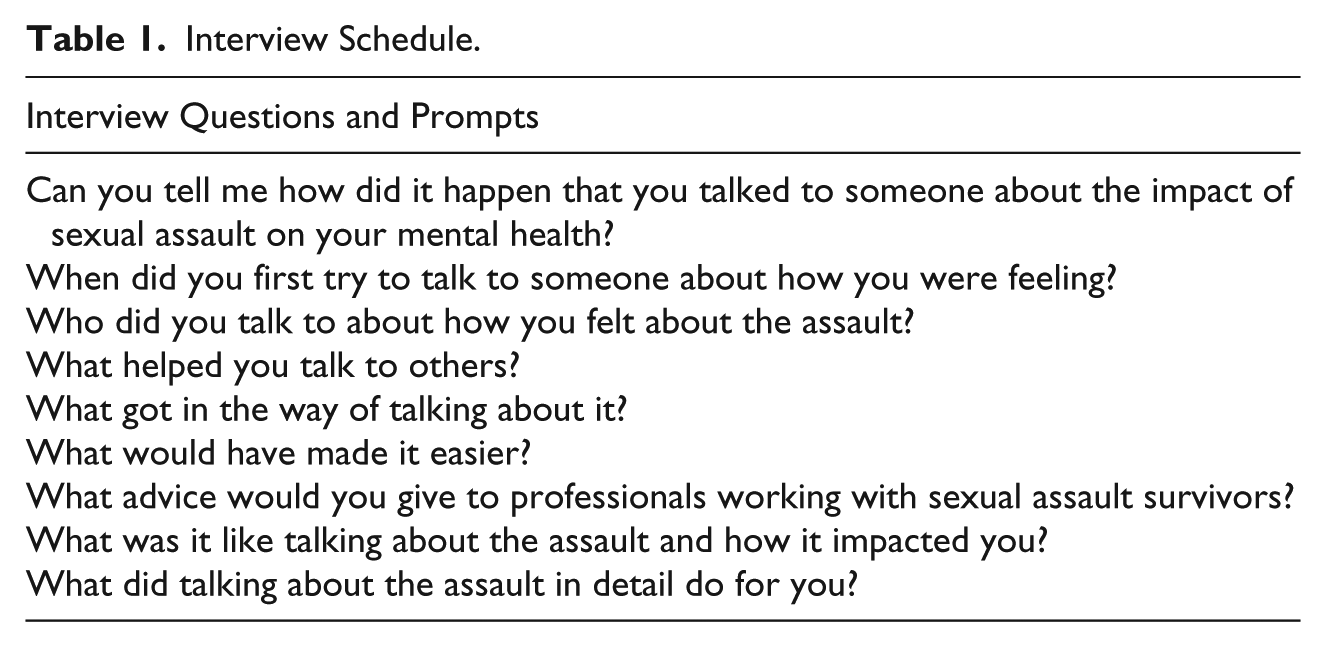
The semistructured interview conducted with each participant involved minimum prompt questions but included what impact their conversations with others had had on their mental health, the facilitators and barriers to talking about mental health, and their advice for mental health professionals. The interviews were conducted on university premises, and each interview lasted approximately 1 to 1.5 hr. All interviews were recorded and transcribed verbatim by the first author.
Data Analysis
Common to a range of narrative methodologies, this study comprised three stages. The first stage involved repeated reading of the transcripts to identify initial themes and patterns. The initial analysis was not guided by a priori determined thematic categories, so the data were not approached with the aim of finding evidence for specific themes (Charmaz, 2006), but rather a list of preliminary themes was produced inductively from the data. The second stage involved summarizing each account considering the structure, emotions, and the emphasized points in the narrative. The third stage involved comparing and contrasting the narratives between participants for similarities and differences. The data were annotated on paper but NVivo 11 was also used to assist in organizing and coding the data. Only one researcher was involved in reading and analyzing the narratives, although emerging themes and observations of narrative structures were frequently discussed with the other authors. To improve the credibility and ethics of the study, the transcripts of interview and summaries were sent to the informants to review via e-mail. Three out of six participants confirmed that the narrative summary appropriately captured the essence of their journeys (i.e., congruent with their personal goals, correct tones). Three participants did not respond.
Results
The final sample consisted of six female participants recruited from various platforms, including social media and sexual violence support services. The following table (Table 2) details the participant characteristics including their pseudonym, age, sexual orientation, occupation, time since the assault, recruitment platform, and person(s) with whom they discussed the assault.
Participant Characteristics.
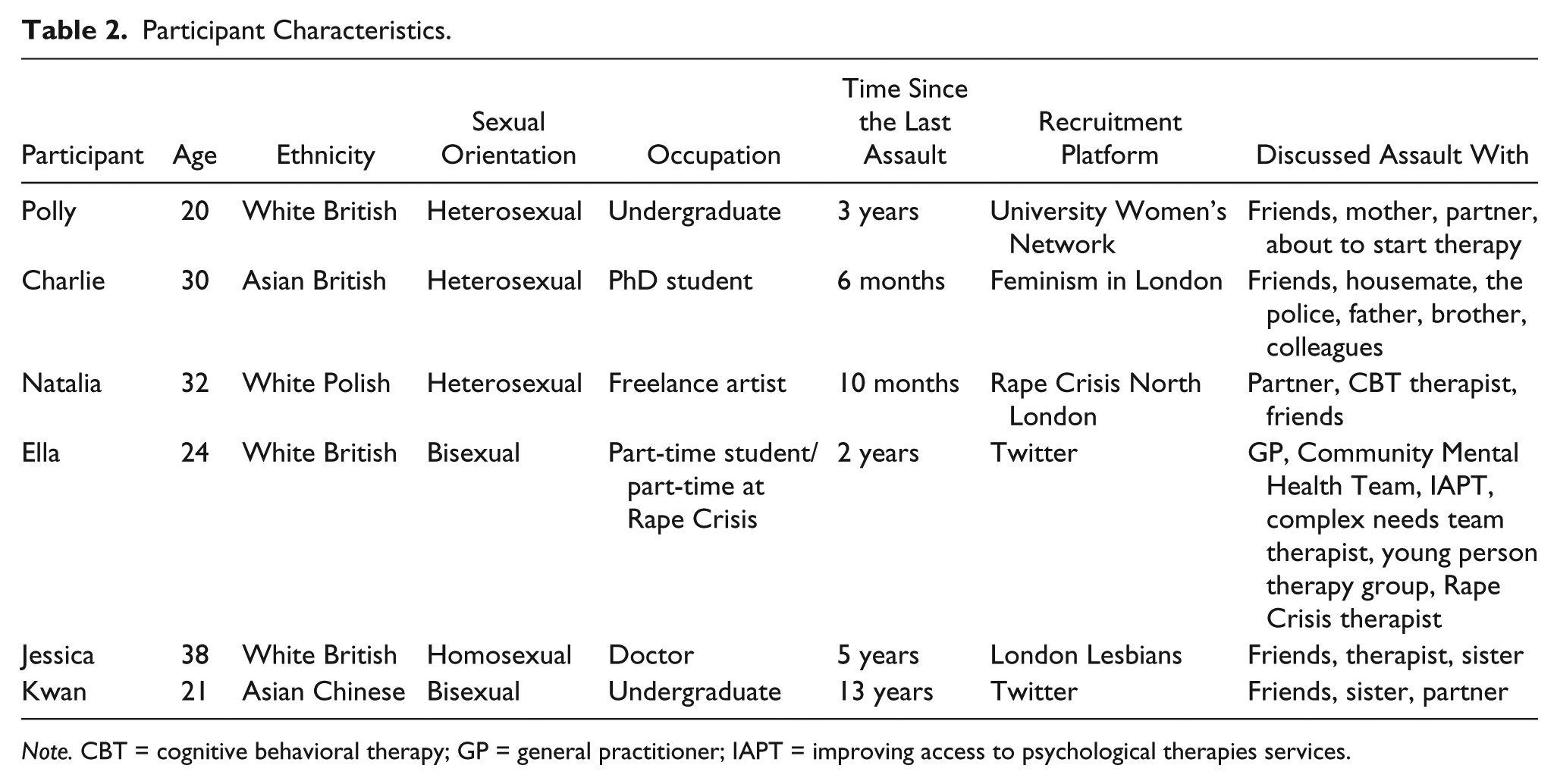
Note. CBT = cognitive behavioral therapy; GP = general practitioner; IAPT = improving access to psychological therapies services.
Participant Characteristics
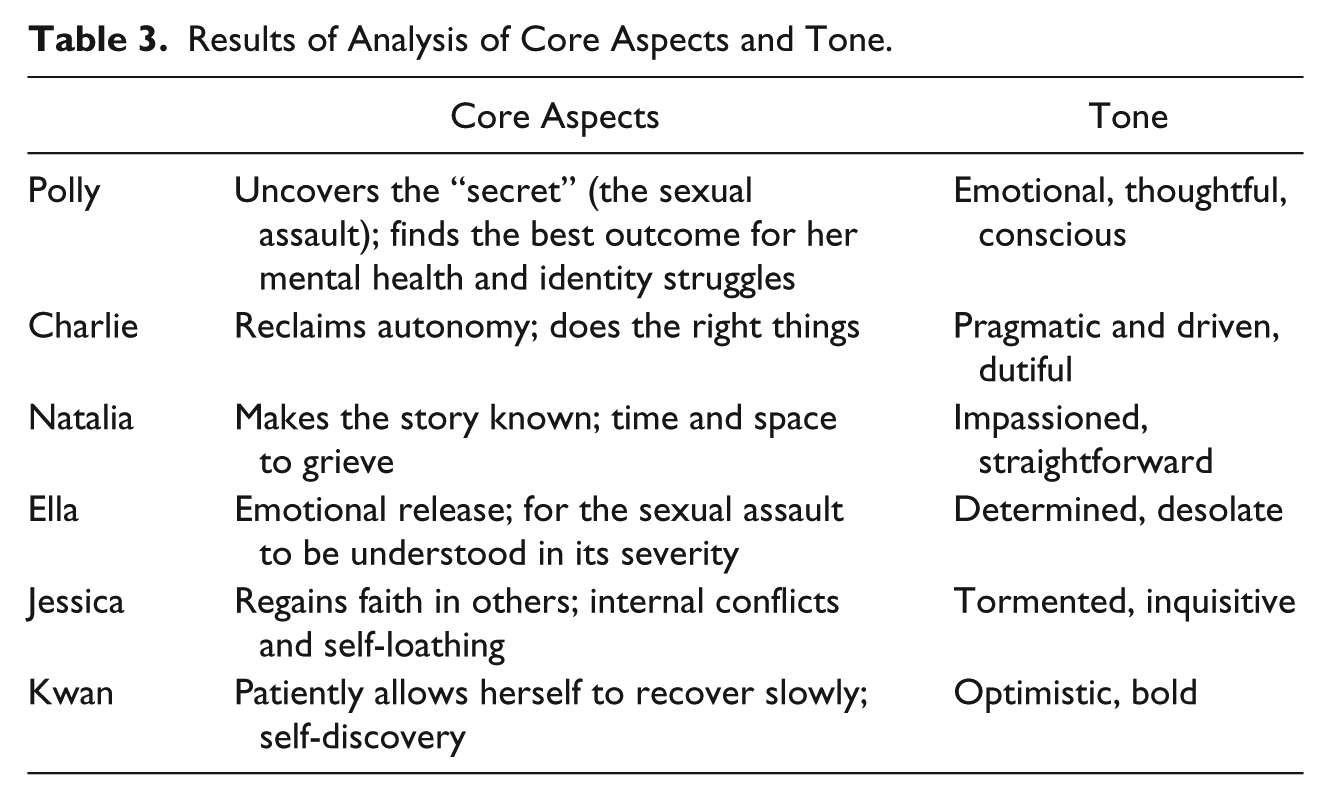
The following section presents a summary table (Table 3) of the narrative core aspects and the tone of each participant, the information for which was gleaned from understanding more about each participant’s background. Each narrative’s core aspects, tone, main message, and role of talking is then elaborated on in the prose following the table.
Results of Analysis of Core Aspects and Tone.
Polly
Polly is a White, British, undergraduate student in her 20s, and she found the study through the University Women’s Network. She was assaulted approximately 3 years ago by a sexual partner. Polly’s narrative consisted of two core aspects: to bring the “secret” (the assault) into light by talking about it openly with others, and to determine the best outcome to expect for herself in terms of mental health and identity while being realistic about the potentially permanent impact of the assault. Polly’s tone was emotional, as seen in her highly emotive language when trying to communicate her feelings and insecurities. Polly was very thoughtful. In addition to practical aspects such as seeking mental health help, Polly demonstrated ongoing contemplation regarding how she could fit this traumatic event into her life and her identity. Much of Polly’s insecurity came from the possibility that people may stigmatize her, as seen in her concern for being stereotyped as a “damaged, volatile,” “psycho” woman for her mental health struggles after the assault. Polly wanted to make something positive out of this traumatic experience and help other women in similar situations by talking about it.
Charlie
Charlie is an Asian, British, PhD candidate in her 30s working in the field of science, and she found the study through the organization Feminism in London. Charlie was assaulted approximately 6 months ago by a housemate she had considered a friend. Charlie’s narrative consisted of two core aspects. The first was Charlie’s quest to reclaim her autonomy, by addressing the mental health consequences of the assault, and the second was how she intended to let her moral principles guide her actions, so that she could reaffirm her personal identity and resist being reduced to a victim of sexual assault. Charlie’s tone was pragmatic and driven. Her decision to talk about the assault was highly motivated by the belief that it could address and improve her mental health issues, allowing her to return to work and normality sooner. Charlie displayed a strong sense of duty for others: She talked about her assault because she wanted to protect other people from being sexually assaulted by the perpetrator, and felt a duty to raise awareness on a societal level. For Charlie, talking to others about the assault was a strategy to resolve the identity struggles and address the mental health consequences that prevented her from pursuing her aspirations freely.
Natalia
Natalia is a White, Polish, freelance artist in her 30s, and she found the study through Rape Crisis. It had been 10 months since she was assaulted at her workplace by her manager. Natalia’s narrative consisted of two core aspects. First, Natalia’s determination was to make her story and the obstacles she encountered known to others. Second, was her desire to have the time to process her experience and grieve properly. Natalia was very impassioned, as illustrated by Natalia’s emotional account of the injustice and apathetic responses she encountered, and her wish to make a difference. She was also forthright; for example, Natalia was very frank in expressing that compassion and emotional responses were what she “demanded” from her listeners. Natalia was eager to talk to others about sexual violence, as she was keen to let other people know what she has gone through and have the severity of it acknowledged by others. Talking about the assault was also a way for Natalia to recognize any unhelpful coping strategies she may have.
Ella
Ella is a White, British, part-time student and part-time employee at an organization supporting survivors of sexual violence in her 20s. It has been more than 2 years since the last assault, and she found the study through Twitter. Ella is currently living in London with her daughter. Ella’s narrative consisted of two core aspects. The first core aspect identified was her drive to talk about the assault and the mental health consequences in therapy so that she could stop feeling “suffocated” by bottled-up feelings. The second aspect was the desire for the severity of her experience to be understood. The first tone identified in Ella’s narrative was “determined.” Ella’s goal throughout the journey was to talk to someone in therapy about her mental health struggles following the assault, and despite numerous negative experiences in the healthcare system, she persisted. The second tone identified was “desolate.” Ella’s narration painted an intensely lonely and helpless road to help, where she faced rejection and invalidation from numerous groups within the healthcare system when she spoke of her mental health struggles. Her journey also illustrated the ability of positive talking experiences to lift and empower her, and its contribution to her transformation from a victim to a survivor. Ella’s desire to talk was driven by her belief that talking about her problems in therapy would be the way for her to “move on” from her trauma.
Jessica
Jessica is a White, British, medical professional in her 30s. The assault happened 5 years ago, and she found the study through London Lesbians. Jessica was assaulted by a longtime romantic partner. Jessica’s narrative consisted of two core aspects. The first core aspect was Jessica’s quest to regain her faith in other people, so that she could maintain meaningful interpersonal relationships again. The second core aspect was her long-standing internal conflict and self-loathing, resulting from the fact that she did not take further action against her perpetrator out of love, despite her strong feminist beliefs. The first tone identified was “tormented,” she was shocked and hurt that someone she trusted and loved for years would hurt her, and she struggled to forgive herself for not reporting the perpetrator. The second tone was “inquisitive”; Jessica constantly questioned how she could resolve her sense of guilt due to the complex nature of her assault, and manage the suicidal ideation stemming from her self-loathing. For Jessica, talking was her “thinking aloud” exercise to work through her guilt and self-loathing, so that she could come to terms with the inherently different routes people deal with sexual violence as survivors.
Kwan
Kwan is a 21-year-old, Chinese, undergraduate student studying law, and she found the study through Twitter. She was assaulted as a child, approximately 13 years ago. Kwan’s narrative consisted of two core aspects. First, to have a slow and steady recovery where she could patiently resolve the consequences of the assault without pushing herself too hard, so that frustration did not sabotage her progress. Second, to understand more about herself through addressing the consequences of the assault. Kwan’s tone was “optimistic” throughout the narrative, and while she was discussing the devastating and deeply rooted problems the assault has caused her, she demonstrated faith in herself and in the people around her. Kwan was also very bold. She was not afraid to elaborate on the feelings that were foreign to her such as fear and powerlessness. Kwan was very patient and confident in tackling the challenges she faced in overcoming her deeply rooted fear of physical intimacy and turning this trauma into a journey of self-discovery.
To reveal important elements of the narratives, the following cross-case analysis presents the similarities and differences regarding the main themes identified in the narratives.
Cross-Case Analysis
The bumpy road: Recovery as a nonlinear journey
While each participant had their own priorities and goals, they all described a bumpy, nonlinear journey. The nonlinearity was reflected in the participants’ discussions of different struggles throughout their narratives, suggesting the journey following the assault to be an ongoing battle with ups and downs.
Although Polly was able to talk about the assault unashamedly, she was still affected by numerous social factors at various points of her journey. She felt inadequate compared with other survivors: “I compare myself and I think I haven’t managed, I haven’t gotten to that stage.” Her self-doubt, which she described as an ongoing struggle, was also exacerbated by negative social interactions: “Hearing it externalise and hearing it from someone else’s mouth like . . . I just found it to be profoundly, profoundly hurtful.” Triggers of sexual violence in media, daily interactions, and at work also disturbed her emotional stability, with their consequences leaking into her romantic life at times: “I, often I make it into something like it’s me being stressed or this thing or something, but actually what I realised is that it is more of the trauma itself.”
The presence of these external factors fed into her concerns about being perceived as a “damaged, volatile” woman who has not managed to “be really sorted” throughout her journey, which made her pursuit to do what is best for her fraught. Polly actively tried to identify healthy coping strategies such as participating in activities that let her have agency, and avoided those that were unhelpful for her, such as looking at sexual violence statistics. She appeared to be determined in her narrative despite the difficult journey, and emphasized throughout the narrative her intention to take ownership of the trauma and help others like her.
In contrast, Charlie’s struggles throughout her journey were personal and goal-oriented. Charlie’s priority in life before the assault was her work. The assault had led to mental health consequences that disrupted her work, and this, in turn, bred resentment and anger that she had to process in her journey Because I really just like cracking on with things and getting things done, and this thing has got in the way of me doing that, and that has made me really angry. Like he has this thing that he has made my problem and now I can’t do the things I want to do every day, or the things I want to do every day is much more of a struggle now, and I resent that.
On a more personal level, Charlie’s experience of being labeled as a vulnerable victim in the legal system was in conflict with her knowledge of herself. While both Charlie and Polly examined their feelings about “labels” postassault, Charlie’s narrative centered around her own beliefs of her identity So as long as I do everything I can to make sure that I behave in a way that is consistent with that, then I think that it will probably help with that [taking back power], and my struggle with my identity.
Similar to Polly, Charlie also showed that addressing self-doubt as a survivor was an ongoing battle, even though rationally she knew that it was not her fault: “My brother is good in the sense that he just said, ‘It’s not, it’s not your fault.’ So I like to be reminded of that, that was helpful, especially at the start.”
While Charlie appeared pragmatic and collected during most of the narrative, she also disclosed a substantial amount regarding her struggle with her identity upon being asked about the difficult aspects of her journey. On Charlie’s quest to rebuild and reaffirm her identity by being consistent in doing what she believed to be right, it was also important to acknowledge her fight with autonomy violation and struggles with identity.
Natalia explicitly talked about her fluctuation in mood and depression relapses throughout her journey—on some days, she felt motivated to seek help, but, on some days, she felt that everything was pointless. This was coupled with a sense of urgency she had regarding “doing something” to help herself and others, and the race with time also contributed to her mood swings as she felt that she was lagging behind and that people were forgetting about the assault. Similar to Polly, Natalia touched upon the external pressure that made her feel she had to move on quickly after the assault. However, Natalia was concerned about her own well-being rather than social perceptions of her What is sad is that you don’t have time to grieve . . . it’s just happened to you, you have to meet to go to the police, the lawyers, the doctor, take these pills, you have to try and be happy, you have to get over it, everybody is just saying to you don’t think about it because you are overtaking it, and you are just like, you really want to be, sad.
Despite the consistent drive to get her story out there, negative talking experiences still made her feel vulnerable at times: “Once you’ve talked to people who are not really ready to hear about it, then you kinda go back to being again vulnerable and wonder how you are gonna do this again.”
Negative talking and help-seeking experience also silenced Ella during her journey, but these setbacks brought on by the response of others were particularly central to Ella’s narrative. Ella struggled to talk about the assaults for most of her journey. Therefore, anything that led her to be more guarded was significant: “It was making me worse by, me opening up and talking about these things, and having no kind of like emotional support afterward, I felt less supported, and like I regret it, actually trying to open up and talk.” Unfortunately, this was encountered repeatedly throughout her journey, as she had numerous negative experiences with people in the healthcare system, which further impacted her ability to speak about the assault and led to further deterioration of her mental health It was after like, quite a lot of months of this going on, I just totally lost it I have had enough . . . I just can’t do this anymore, I can’t carry all of these feelings I just can’t carry it, and try and get help and be turned down everywhere that I go. I think after my first experiences of opening up and actually disclosing something big, I found that I just felt shot down again. I did that and I got shot down and I just didn’t open up properly again.
Despite these negative experiences, the ending to her narrative was one of the most positive . . . you know I’ve just sat down with someone and talked to her for an extensive period of time, over months, and now I don’t feel like a victim anymore. Like I feel, yeah something bad really happened to me but I don’t have to let that define who I am and define where I go in my life, and I think that was the difference. I was lifted up rather than capped.
Ella spoke of empowerment through receiving therapy from a specialist service, and articulated what talking could do for traumatized individuals.
Jessica’s setbacks throughout her journey were linked to the nature of her assault. As her perpetrator was a long-time partner, the trauma of the assault surfaced every time she got close to a potential romantic partner. Despite improvement being made after therapy, she still struggled with the “intrusive thoughts” of the possibility of someone betraying and hurting her Every time someone expressed interest in me and I consider our relationship to be more than friendship, that’s when I get, get scared and wanna step back. I want to run. My head would be filled with all these scenarios of us being in a nice, trusting, stable relationship, and then they’d hurt me, just like how it happened with my ex. For days after I’d be down and feeling vulnerable too.
She characterized herself as a genuine and trusting person, so these intrusive thoughts that made her doubt and question other people’s sincerity had made her feel “like a horrible person.” This conflict of pre- and postassault identities resembled Charlie’s experience, and it also contributed to the recurrence of low moods throughout Jessica’s journey.
Kwan’s experience with childhood sexual abuse, and its subsequent repression, led to the surfacing of problems at different stages of her life. While she showed herself compassion and patience in the process of facing the consequences of the assault, she still suffered from unexpected panic attacks, dissociation, and other physical discomforts, such as pain: “My fear usually quickly translates into physical reactions. My hands often tremble and shake when I think about it. My heart trembles, also quite literally and physically.” Other consequences of the assault also surfaced when she began a serious relationship. Although many problems such as physical intimacy and distrust of men were brought to her attention as she reflected on her relationship, she was dissimilar to Jessica in that she ensured her heart was open. She believed that she could only recover fully by confronting all the difficulties resulting from the assault. She shifted her perspective and, encouraged by her partner’s support, continued in her journey to recovery rather than seeing these issues related to intimacy as setbacks. Although Kwan could not control the consequences of the assault, she did embrace unexpectedness as the nature of recovery and persevered through problems such as trauma-related flashbacks.
As illustrated above, all participants had different factors and triggers that made various points of their journey more challenging. Despite the differences in time since the assault, all of their paths were still evidently nonlinear and consisted of constant battles.
Reasons to continue the journey
The narratives revealed two main factors that motivated the participants to continue their journeys in spite of the challenges outlined above. The first reason that contributed to all the participants’ perseverance through their journeys was the desire to address the mental health consequences of the assault. All the participants believed that talking about how the sexual assault had affected their mental health was key to addressing their mental health struggles. At the start of their journeys, talking had helped them realize the impact of the assault as well as the severity of the consequences I haven’t really had time to talk about how my sex life, is actually ridiculous, it’s barely happening; and why, and how the fuck that I go climbing and, I am one of the only girls that wear shorts instead of leggings because I feel very uncomfortable . . . So those things, when you talk about things, the more you talk about them the more you are able to open up.
Through talking about her assault with her therapist, Natalia started to unravel how the assault has impacted her.
The participants also valued the emotional support they received from talking about the assault with others. For all the participants, recognition of mental health distress suffered helped them deal with the self-doubt and shame they felt because of the assaults. Both Charlie and Polly mentioned that the validation of their mental health struggles as normative and understandable was especially valuable at the beginning And sometimes I supposed it’s like you are, you don’t know if you are overreacting, there’s self-doubt about it. It’s sort of difficult as well, um because you think is this really this serious? And then everytime you talk to somebody about it, they say yes, it is. (Charlie)
For Polly, Natalia, Ella, Jessica, and Kwan, the support from others also helped them feel more ready to deal with the mental health struggles. For example, Jessica considered her friends to be one of the main reasons she could continue her journey I owe it to my friends. My friends have supported me unconditionally. When you feel alone in what you are going through, and you are feeling depressed, suicidal, the words, or even just your friends being next to you, spending time with you, it really meant the world to me. I really do feel so much better when I can speak to my friends about how I’m feeling.
Kwan also mentioned the importance of talking while working through her mental health struggles But the breakdowns and the trembling are almost unbearable sometimes. I tremble really badly and sometimes I tear up for no reason . . . But I think it is really really really important to talk to someone about it. It can change everything.
The second reason all the participants cited as motivation to continue their journeys was the desire to raise awareness and make a difference for other female survivors of sexual assault. Polly, Charlie, Natalia, Jessica, and Kwan all discussed the anger that made them want to make a difference. Polly mentioned that a close friend doubting whether what happened to her was rape was an important experience: “. . . in some ways it [the friend’s doubt] actually made me like angrier and kind of feel more open about discussing it.” Similarly, Jessica also articulated her negative experiences with mental health professionals to be a motivating factor for her to talk and represent this often-erased perspective One of them [therapist] told me women can’t rape women. These people have such an appalling and outdated understanding of us, and the complete lack of mental health awareness made me realise I cannot stop talking about my experience. There’s enough erasure.
For Charlie and Natalia, their personal experiences have led to reflections on sexual violence as a societal problem. It prompted them to want to discuss their experiences so that people are aware of its prevalence and the profound damage it causes You realised the extent of it in the society and all the things in the society that lead to this, you feel angry ’cause everybody is so desensitised to it. So yeah you do everything you can to change it, because ultimately I don’t really know what kind of person I would be, you know, if you kind of just sat back and continue to let it happen even though you know what it feels like. (Charlie)
Natalia also expressed the desire for others to take on some responsibility in addressing the injustice she encountered in the legal system: “. . . I want to tell people what happened to me, I want to bloody tell you, because, I want you to go and do something about it.”
Ella and Jessica elaborated on the specific aspects they would like to bring the public’s attention to. Ella cited her daughter as the reason she revisited her trauma after a long period of burying it I feel like my mindset really changed after having a daughter because I was really aware of like, okay, this stuff has happened to me, maybe it can happen to her, maybe, there’s something that I need to do to stop that from happening.
Polly, Charlie, and Kwan also talked about how trying to make a difference was another exercise for them to regain agency and feel empowered. Kwan encouraged herself by acknowledging the conversations on childhood sexual abuse to be brave, in addition to which she found the positive responses from others made talking empowering I found myself very brave talking to my friends for the first time. I found myself back. I think it’s really reclaiming my body . . . The three incidents [discussing her experience with others] were almost magical. I felt liberated. I felt understood. I felt I claimed back my strength and what is rightly mine. I felt so much stronger.
It is also noted that, with the exception of Ella, all participants began their journey by talking in informal settings with friends before seeking professional mental health help or reporting the assault to the police. The informal but in-depth conversations with friends tended to prompt the survivor to acknowledge the nature of the incident as assault, consider the impact of it, and, thus, eventually recognize the need to seek professional help for it.
Discussion
This study explores the journeys of sexual violence survivors in being able to discuss the impact of sexual assault on their mental health. The use of a narrative approach was crucial to investigate this broad research question, as it allows the voices of female survivors to be retained and represented. Our analyses reveal these sexual assault survivors’ journeys to be rocky and full of challenges. We also examine the factors that motivated the participants to continue their journeys in spite of these difficulties.
Nonlinear Disclosure and Recovery From Sexual Trauma
The narratives in this study reveal a myriad of problems that made the journey to talking about the mental health implications of sexual assault a nonlinear one. While little research has been done on the journey of talking about sexual violence, previous literature has suggested that many survivors do not have a linear recovery from rape trauma (Dworkin, Menon, Bystrynski, & Allen, 2017). It may be argued that the nonlinear recovery may correspond to the nonlinear journey to talking, as the survivor’s readiness to speak about how the assault has affected their mental health may be influenced by the severity of the symptoms and their emotional well-being. Many factors influence the survivor’s journey posttrauma, including their previous history of sexual assault or trauma, and the level of social support they received after the assault (Steketee & Foa, 1987). For example, a woman who was sexually assaulted by an intimate partner may be more reluctant to discuss their assault due to increased self-blame, shame, and anticipation of negative social responses (Kennedy & Prock, 2018). Moreover, the gradual or delayed presentation of mental health struggles after the assault, lack of resources, or being discouraged from help-seeking by others, may also determine how difficult it is to speak about the assault, as well as when they decide to do so (Stewart etal., 1987). This delay in receiving appropriate help may help explain the recurrence of mental health symptomatology later in the survivors’ journeys (Dworkin & Schumacher, 2018). Previous literature is consistent with our findings in which each survivor faced a unique myriad of problems that influenced how they progressed at various points; and that not all of them experienced or resolved the consequences of trauma in uniform manners.
Many parallels can also be drawn between our findings and previous literature on mental ill-health recovery. The current understanding of “recovery” in mental health is now broader in that it acknowledges that recovery does not have to mean the absence of the condition. It, instead, focuses on the individual’s resilience and encourages personal growth despite the mental health difficulties (Jacob, 2015). This is similar to the perspectives of the participants in this study where they believed that the impact of sexual assault was not something that could be reversed or erased, so their goal was to thrive despite the mental health consequences of the assault.
Motivating Factors for Survivors
The analysis illustrates that the two main reasons that motivated the participants to continue their journeys in spite of these difficulties were the desire to address their mental health struggles and the drive to make a difference. In line with previous literature, our participants deemed talking about the assault and its impact key to achieving the best mental health outcomes. Many survivors consider talking to an empathic audience that is knowledgeable about sexual violence to be therapeutic (Campbell & Adams, 2009). These conversations may also be important to elicit social support from others, which has been cited as a protective factor against increased future mental health distress (Brewin, Andrews, & Valentine, 2000). Previous qualitative research also supports the idea that many survivors are keen to turn their trauma into something positive by talking about it with others or in research. Emerging studies on posttraumatic growth following sexual assault have speculated that psychological growth can be shown through the survivors’ motivation to advocate for other survivors, and the desire to tackle related societal issues, such as problems with the legal system or sexism (Ulloa etal., 2016).
Strengths and Limitations
This study is valuable in that there is little previous research that paid attention to factors impacting the disclosure of mental health problems following sexual assault, and no previous literature that retained the complex thought process related to talking about sexual violence by using narrative interviews.
However, some limitations should be noted. As this study involved face-to-face interviews, it could have been improved by evaluating social desirability in the interviews. Factors such as the interviewer’s reactions could have impacted how the participants tell their stories as well as what they disclose. Appropriate evaluations could have allowed further insights.
Discussion of diversity
Future research should also seek to recruit participants of various sociodemographic backgrounds. Factors such as limited access to appropriate resources due to financial problems, and maladaptive coping strategies are common barriers for the women of lower socioeconomic status (SES)/educational backgrounds to disclose their experiences (Bryant-Davis, Ullman, Tsong, Tillman, & Smith, 2010). More participants of sexual and ethnic minorities are also needed as they generally experience more violence, and often face unique barriers to help (Roberts, Watlington, Nett, & Batten, 2010). More diverse perspectives could shed light on different barriers to talking, the role of talking in recovery, and how one’s background contributes to the process of making sense of sexual trauma.
This study may also only represent the experiences and views of those who felt confident talking about their experiences or have made relatively good progress following the trauma. Most participants have received therapy for the assault, which may have provided them with healthier coping strategies to deal with the mental health struggles. This is a significant problem, as we need to explore whether such help could be accessible by individuals of lower SES, as they may not have the financial means, or time, to do so, and would consequently have a different narrative trajectory. Most of the participants in this study identified as feminists, which may have influenced the way they dealt with sexual violence and their decision to speak about it as an act of activism. In future studies, platforms such as the National Health Service (NHS) may be used to reach a wider demographic. Using other mental health and quality of life measures, researchers may also investigate the differences between survivors who volunteer to share their journeys and those who do not, so that the needs of these two groups can be addressed.
Implications
All the participants dedicated much of their narratives to discussions of mental health struggles, and their desire to talk to mental health professionals who are knowledgeable about sexual violence. It would be immensely helpful if healthcare and mental health professionals could receive training on sexual violence from specialist organizations, such as The Haven or Rape Crisis (Starzynski & Ullman, 2014). Professionals should be aware of the common mental health consequences of sexual assault (i.e., PTSD, depression), the need to work sensitively with survivors to affirm that their mental health struggles are valid responses to trauma, and to ensure no victim-blaming attitudes are expressed (Campbell, Wasco, Ahrens, Sefl, & Barnes, 2001). When working with women who have been sexually assaulted in the past, professionals must not assume that the mental health consequences of these events were resolved. Many factors influence a survivor’s timing of sexual assault disclosure, and it varies greatly from weeks to years since the assault (Lanthier, Du Mont, & Mason, 2018). If mental health/healthcare professionals do not feel confident working with survivors themselves, they should be able to signpost appropriate public services, as inappropriate treatment could lead to secondary victimization (Ullman & Townsend, 2007). Long-term psychological support should also be provided whenever possible, as both the current study and previous research have suggested that sustained mental health help may be needed for survivors to achieve the best outcomes (Campbell etal., 1999).
Similarly, training for frontline professionals such as police, and accident and emergency service staff, should be implemented, as they are often the first point of contact after assault. While the need to deliver in-depth support may not be necessary in those settings, relevant frontline staff should be able to address the survivors without causing more harm. An efficient referral protocol should also be established so that the professionals could set up follow-up services for the survivor once they left the relevant institution.
Stigma also remains a major obstacle for sexual assault survivors. Education focused on consent, sexual violence, and debunking rape myths (inaccurate but widely held beliefs about sexual assault and its survivors that excuse the behavior) should be taught in schools, so that people could be armed with the knowledge to identify unwanted sexual contact. As implicated in previous research, a healthy understanding around sex and consent is crucial to fostering an encouraging environment for survivors to speak up and receive appropriate support for their trauma (Grose, Grabe, & Kohfeldt, 2014). Increasing public knowledge also means that people would be able to respond in an appropriate manner if a friend or family member is affected. This is important as friends and family tend to be those to whom the survivors disclose the assault, and can potentially impact their subsequent actions, as demonstrated by our results.
Research that explores the disclosure journey of sexual violence survivors should be understood within the appropriate social and political context. Numerous movements initiated by survivors in recent years, such as “#MeToo” and “Time’s Up,” raised awareness of sexual violence through allowing people to disclose their identity as a survivor on public platforms. Many of these movements were started by high-profile figures, and the public and celebrities participated in sharing their experiences of harassment and assault. By demonstrating that disclosure does not have to be associated with shame and guilt, these movements may help foster a more supportive environment for survivors. They may also highlight sexual violence as a prevalent and serious issue in our society that is in burning need of being addressed, which could change people’s responses when faced with disclosure. Therefore, ongoing research on sexual violence disclosure will be required to inform services as the culture continues to metamorphose.
Footnotes
Acknowledgements
To my wonderful supervisors Jo and Nicola, thank you for all your great advice and guidance along the way. To my inspiring and brave participants, thank you so much for sharing your stories; together we can heal and thrive. To my lovely friends, my family, my fellow classmates, and my partner, thank you for all your love and support throughout my own journey to recovery. I love you all very much and thank you again for making this possible.
Declaration of Conflicting Interests
The author(s) declared no potential conflicts of interest with respect to the research, authorship, and/or publication of this article.
Funding
The author(s) received no financial support for the research, authorship, and/or publication of this article.
