




Abstract
Cross-racial violence is a high-profile issue in the United States; however, there is little empirical research on the epidemiology of cross-racial homicides. The objective of this work was to use national-level data to evaluate the characteristics of homicides in which the victim and suspect are of the same or different race or Hispanic ethnicity. Victims and suspects from National Violent Death Reporting System data (2005-2015) were classified into seven-categories on the basis of race/ethnicity (six non-Hispanic races or Hispanic ethnicity), and 51,454 homicide events were classified as concordant (same race or ethnicity), discordant (different race or ethnicity), or unknown (missing race or ethnicity or no suspect information). While discordancy was observed to be similar across all race and ethnicity groups, it was less likely with relatives, romantic partners, and relatives of romantic partners; less likely to occur at home; less likely to occur in intimate partner violence–related homicides; less likely when the homicide was preceded by an argument over money or property; less likely when the homicide was associated with a family problem; more likely among rival gangs and strangers than other known person relationships; and more likely with drug-involved homicides. There were differences for victims of non-Hispanic Black race. Notably, discordance was more likely for justifiable self-defense and more likely with victim having used a weapon. These results suggest that discordant homicides may follow patterns of peer groups and close relationships in society regardless of victim race/ethnicity, that is, individuals may form closer relationships with individuals of the same race/ethnicity.
Introduction
Homicides are in the Top 10 causes of years of potential life lost (YPLL) before the age of 75 years in the United States (National Center for Health Statistics, 2017b). The public health burden associated with premature mortality makes homicides a notable public health burden because of its high ranking, despite its relatively low age-adjusted incidence in the United States at 9.1 per 100,000 (National Center for Health Statistics, 2017a). There are race and ethnic disparities in the contribution of homicides to YPLL, with homicides contributing to approximately 10% of YPLL in non-Hispanic Black victims; whereas, among non-Hispanic White victims and non-Hispanic Asian/Pacific Islanders, homicides contribute approximately 2% of YPLL (National Center for Health Statistics, 2017b). From 1980, there were improvements in the contribution of homicides to YPLL in Hispanic or Latino persons, but percentage contribution remained relatively constant in non-Hispanic racial groups. In addition, for non-Hispanic Black victims, homicides were in the Top 10 causes of mortality in 2015 (National Center for Health Statistics, 2017a). These race-based differences have been the subject of public and academic engagement in recent years (Jiang, Ranney, Perez, & Viner-Brown, 2016; Lichfield, 2015; Sherman, 2015; Singal, 2018; Walker, McLone, Mason, & Sheehan, 2016), and this work aims to provide additional empirical data to the discussion.
According to the Federal Bureau of Investigation, Uniform Crime Reports (UCR), the majority of homicides are committed by someone of the same race or Hispanic ethnicity as the victim (U.S. Department of Justice & Federal Bureau of Investigation, 2014), but the proportion of cross-racial or cross-ethnicity violence may be increasing over time (U.S. Department of Justice & Federal Bureau of Investigation, 2000). This increase over time may be a reflection of a changing broader demographic trend in the United States toward more cross-race or cross-ethnicity relationships (Bialik, 2017; Rico, Kreider, & Anderson, 2018), but the underlying characteristics are not well established. An understanding of details or nature of the relationships could help inform about relationship predictors or determinants of homicides.
Recent research supports that some violence, particularly intimate partner violence, differs by race and ethnicity (Cancio, 2020; Cancio & Altal, 2019; Karlsson et al., 2018; Renner, Whitney, & Vasquez, 2015), but less is known empirically about cross-racial or cross-ethnic interpersonal violence. A major goal of this work was to stratify by victim race or Hispanic ethnicity to evaluate differences in the characteristics associated with cross-racial or cross-ethnic homicides. There is a limited body of research that has examined cross-racial or cross-ethnic homicides, and the majority of that work is done in the context where race is the driving factor for crime, that is, hate crimes. The goal of this analysis was to evaluate crimes that were not necessarily racially or ethnically motivated.
There is some literature based on cross-racial or cross-ethnic intimate partner violence and peer victimization that supports that there may be differences based on victim race or Hispanic ethnicity. Carbone-Lopez (2013) examined differences in intimate partner violence based on the race or ethnicity of couple using the National Violence Against Women Survey. In models that controls for age, partner education, childhood victimization, and insurance status, being in an ethnic mono-racial relationship was associated with higher likelihood of physical violence, verbal aggression, and coercive control compared with a White mono-racial relationship, and being in an interracial relationship was associated with higher likelihood of verbal aggression and coercive control but not physical violence. Kawabata and Crick (2011) evaluated the role of cross-racial/ethnic friendships and peer victimization among 444 children. They observed that cross-racial/ethnic friendships occurred more frequently among European American and Asian American children than African American children, and the number of cross-racial/ethnic friendships was associated inversely with peer victimization, after controlling for other factors, such as race and ethnicity of child and classroom characteristics. They identified that some characteristics, such as diversity of the classroom and social preference, mediated these associations. These studies suggest that there may be differences based on the specific nature of the racial or ethnic composition of the pair in which violence occurs.
Data sources such as the UCR can provide statistics with demographic information, but more detailed characteristics about the nature of relationships are not available. The National Violent Death Reporting System (NVDRS) is a national-level data source of state-reported violent deaths and associated event characteristics aggregated from coroner/medical examiner records, law enforcement records, and death certificates on violent deaths (Jack et al., 2018). The objective of this descriptive epidemiology study was to use NVDRS to identify factors associated with situations in which the victim and suspect have concordant versus discordant race or Hispanic ethnicity. As a descriptive epidemiology study, the work was not guided by specific hypotheses and a goal was to identify factors that warrant further analysis in inferential studies.
Method
Data
NVDRS data from years 2005-2015 were used. While states joined NVDRS at differing time points in this period, there are currently 40 states, the District of Columbia, and Puerto Rico that participate in NVDRS (Centers for Disease Control and Prevention [CDC], 2018). The NVDRS is a state-based surveillance system that links data from coroner/medical examiner records, law enforcement records, and death certificates on violent deaths (suicide, homicide, legal intervention, and unknown intent), and unintentional firearm injuries (Jack et al., 2018). The records are based at the incident level and include information about the victims and suspected perpetrators (suspect), as well as information about circumstances and weapons. State-level data are de-identified and aggregated at the CDC. Data are made available to researchers through application and CDC review, and provided to researchers as a Restricted Access Dataset (RAD) that includes only the requested and relevant data to the research question. This data section included information only for deaths designated as a homicide, but does not include deaths from legal intervention. NVDRS data capture fatal outcomes and are de-identified for analysis, and this analysis was classified as “not human subjects research.”
The CDC has developed case definitions specifically for NVDRS. States are provided with ongoing training and coding manuals; ongoing coding support is provided through an email helpdesk, monthly conference calls with all states, and conference calls with individual states as needed or requested. The coding manual serves as the standard reference.
Victim and Suspect Characteristics
Victim characteristics included in this analysis were selected from the characteristics available in NVDRS and had sufficient variation to meaningfully group (e.g., sexual orientation and transgender, once stratified by race were too small to present): age, sex, combined race/ethnicity, education, marital status, and state of residence. Age was classified into quintile categories and unknown age was included in the oldest age category (n unknown < 10). The individuals with missing age cannot be disaggregated for presentation due to the small number. The number is so small for this characteristic that it does not introduce a bias to the age variable, but it was desirable to retain the individuals because of the information that they provide to other characteristics in the dataset. Sex was classified as male or female, and individuals with unknown sex were excluded from the analysis due to low number (n unknown < 10). Education was classified into categories of less than high school education, high school graduate or equivalent, some college or associate degree, baccalaureate degree, or unknown. Marital status was classified into categories of married or equivalent, divorced, never married, widowed, separated, and single not otherwise specified or unknown. State of residence was categorized into Census regions. Suspect characteristics included were age (categorized as 0-20 years, 21-40 years, and 41+ years or unknown), sex (male/female), combined race/ethnicity, and primary relationship to the victim. Primary relationship to the victim was collapsed into categories of spouse, girlfriend, boyfriend; ex-spouse, ex-girlfriend, ex-boyfriend, non-specified as to ex- or current girlfriend or boyfriend; first degree relative (parent, child, or sibling); other relative (including step, foster, or in-law); child of suspect’s romantic partner or intimate partner of suspect’s parent; other known person relationship; rival gang or stranger; law enforcement officer victim or injured by law enforcement officer; and unknown or other. Events with no suspect information were excluded from the analysis (n = 22,743); thus, missing data for any characteristics represents a lack of information for the suspect.
For both victim and suspect, the combined race/ethnicity category was used to assess concordance and discordance. In the NVDRS data, individuals could be classified into categories that include non-Hispanic White, non-Hispanic Black, non-Hispanic Asian, non-Hispanic Alaska Native/American Indian (AIAN), non-Hispanic Native Hawaiian/Pacific Islander (NHPI), and Hispanic. Classification is based on information found in source documents for NVDRS (law enforcement, medical examiner, or coroner investigative reports). Victims and suspects who matched on this category of race/ethnicity were marked as concordant, and discordant if they did not match. Due to the small numbers of individuals in the Asian and NHPI categories, these were collapsed to a “non-Hispanic other race victims” category.
Event Characteristics
Event characteristics were considered in the analysis if there were sufficient counts for meaningfully statistical interpretation (at least five affirmative counts), and included location, stressors, and homicide-specific. Location was considered in terms of the physical location of the event in brief (at home vs. not or at work vs. not) and in detail (as noted in Table 3 of the results). Stressors included in the analysis were as follows: argument over money/property, physical fight (two people), victim was perpetrator of interpersonal violence in past month, victim was victim of interpersonal violence in past month, family relationship problem, and other relationship problem. Homicide-specific characteristics included the following: intervener was assisting victim, justifiable self-defense/law enforcement, drug involvement, brawl, random violence, drive-by shooting, intimate partner violence related, jealousy (love triangle), victim used weapon, and victim was a bystander. In the event characteristics for stressors and homicide-specific, the null category is classified in NVDRS as “no, not available, or unknown.”
Statistical Analysis
Per data reporting requirements from the CDC, results with less than 10 individuals are suppressed. Logistic regression was used with discordance at the outcome variable. The largest category for multi-category, or the null or neutral option was used as the reference group. Logistic regression models were adjusted for victim age, sex, education, marital status, and region of residence. Analyses were stratified by victim race/ethnicity (non-Hispanic White, non-Hispanic Black, non-Hispanic other race victims, and Hispanic ethnicity). Analysis was performed using Stata 15.0 (StataCorp, TX). All analyses were conducted by a single person using reproducible coding practices (statistical code available from researchers upon reasonable request).
Results
Victim and Suspect Discordance in Race and Ethnicity
There were 23,882 race/ethnicity-concordant homicides (46.4%), 6,733 race/ethnicity-discordant homicides (13.1%), and 20,839 homicides with no suspect information (40.5%; Table 1). There were race/ethnicity disparities in having suspect information, with non-Hispanic other having the lowest proportion of no suspect information (39.6%) and non-Hispanic Black having the highest proportion of no suspect information (45.2%). Where concordant or discordant status was known, the majority of homicides were race/ethnicity-concordant for non-Hispanic White and non-Hispanic Black victims; whereas, for non-Hispanic other race victims, there was a higher proportion of discordant, and for Hispanic ethnicity victims, it was approximately split between concordant and discordant.
Homicides by Discordant Status and Race/Ethnicity of Victim in the Overall NVDRS Data and the Analyzed Data.
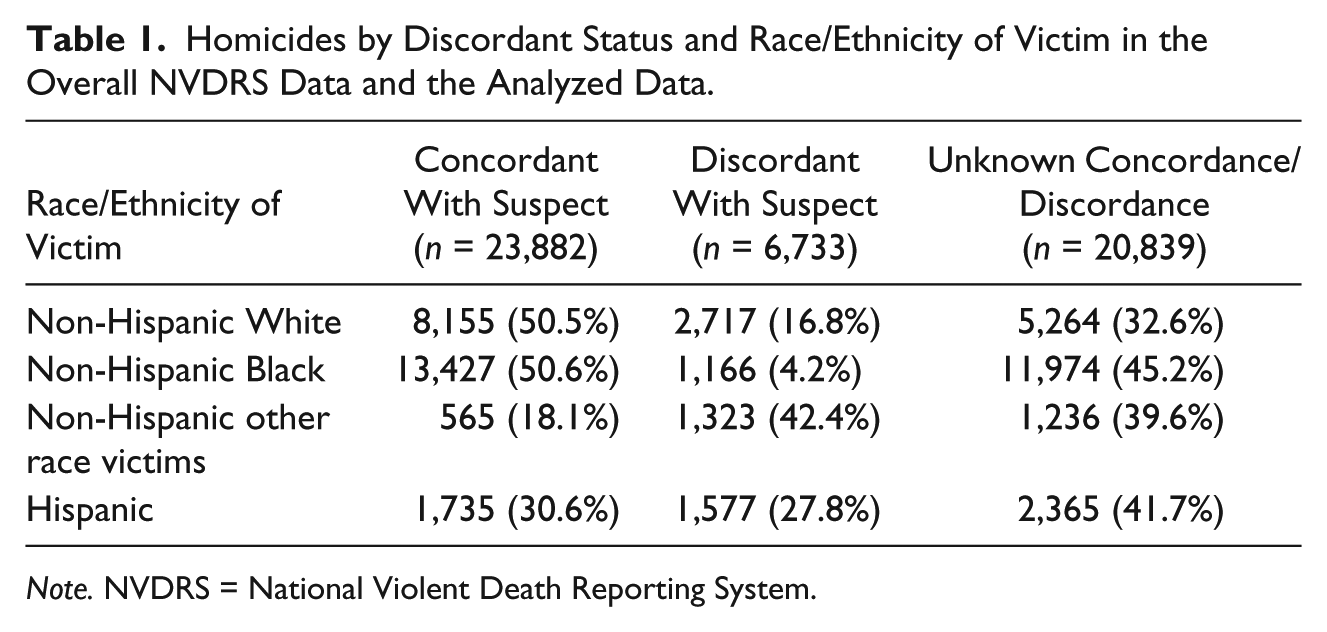
Note. NVDRS = National Violent Death Reporting System.
Victim Characteristics
The majority of homicide victims were younger, males, and never married (Table 2). Homicide occurs at higher proportions in younger individuals, and even more so for Black and Hispanic individuals, which partially explains the racial differences in YPLL. There was a clear pattern of a higher proportion of discordant homicides occur in male victims, and this is consistent across the race/ethnicity groups. There appeared to be a lower proportion of less educated individuals in discordant homicides for White, Hispanic, and other minorities, but no differences for Black individuals. The majority of victims were never married. No differences for discordant versus concordant for Black and Hispanic. For Whites, there is higher proportion of never married among the discordant homicides and, for other minorities, a lower proportion of never married among the discordant homicides. There were some differences in residence region across the race/ethnicity groups. In minority groups (not non-Hispanic White), a lower proportion of discordance was observed in residents of the Midwest, but a higher proportion of discordance was observed for non-Hispanic White victims. In non-Hispanic Black victims, discordance was observed in higher proportions in residents of the South, but discordance was observed in lower proportions in residents of the South for non-Hispanic White victims. Across the race and ethnicity groups, unknown concordant/discordant status displayed differing socioeconomic characteristics from concordant.
Victim Characteristics by Discordant Status and Race/Ethnicity. Data Presented is Frequency and Column Percentage.

Note. AA = Associate of Arts; AS = Associate of Science. *p < .05 from multivariable multinomial logistic regression (all variables in the table in the model; stratified by each race/ethnicity group) with concordant as the base outcome and compared with reference category (age: 0-21 years, sex: male, education: less than high school, marital status: married or equivalent, residence region: northeast). HS = high school.
Homicide Locations
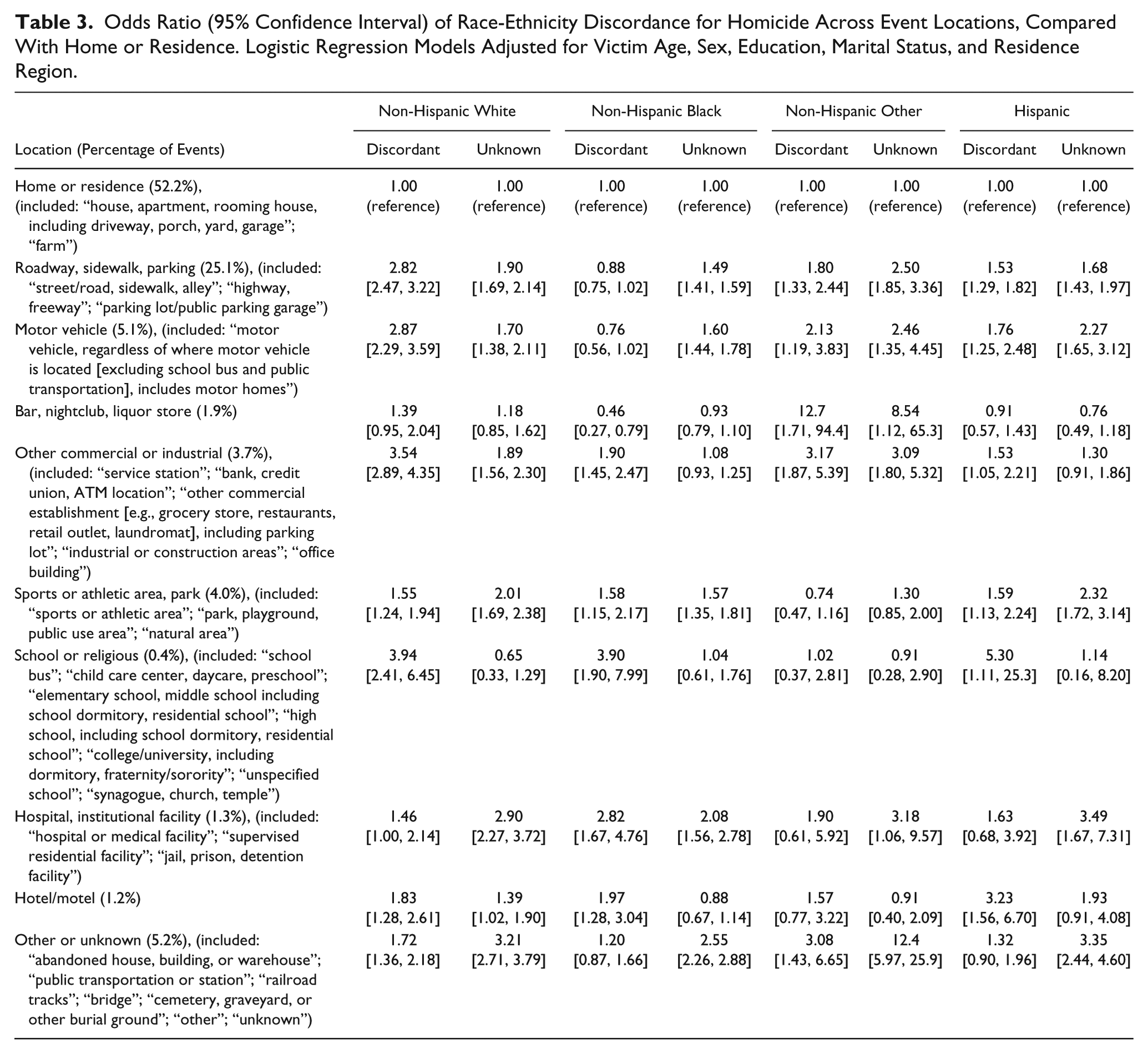
Discordant homicides were less likely to happen at home, compared with not at home, across all race/ethnicity groups. Discordant homicides were also more likely to happen at work, compared with not at work, across all race/ethnicity groups. When evaluating detailed locations of homicides, compared with happening at home or residence, the majority of other locations were significant more likely to be discordant homicides across the race/ethnicity groups (Table 3).
Odds Ratio (95% Confidence Interval) of Race-Ethnicity Discordance for Homicide Across Event Locations, Compared With Home or Residence. Logistic Regression Models Adjusted for Victim Age, Sex, Education, Marital Status, and Residence Region.
Stressors
In terms of stressors and homicide-specific characteristics, there was a pattern of situations in which individuals may be more likely to know each other to be less likely to be discordant on race/ethnicity (Figure 1a) or whether there was unknown discordance (Figure 1b). In general, discordance was not related to physical fight, and arguments were less likely to be discordant (Figure 1a). There were racial or ethnic differences in associations for being a perpetrator of interpersonal violence, other relationship problems, brawl-related homicides, random violence, drive-by shootings, victim using weapon, bystander victims, and justifiable self-defense. Drug-involved homicides were more likely be discordant for all race and Hispanic ethnicity groups. Intimate partner associated crimes were less likely to be discordant across all races, and jealously was significantly associated with being less likely to be discordant for Hispanics, non-Hispanic other, and non-Hispanic White victims. With the exception of drive-by shooting, unknown concordant/discordant status was less likely to be associated or nonsignificantly associated with event types (Figure 1b).

Odds ratio (95% confidence interval bands) of race-ethnicity discordance (a) and unknown status (b) for homicides in relation to stressors and homicide-specific characteristics by race/ethnicity of the victim. Logistic regression models adjusted for victim age, sex, education, marital status, and residence region.
Suspect Characteristics and Victim–Suspect Relationship
When suspect age was known, the majority of suspects were in the 21- to 40-year age group (32.3% overall; 59.6% of known suspect age; Figure 2). In non-Hispanic White victims, an older suspect (41+ years) was inversely associated with discordance (odds ratio [OR] = 0.39, 95% confidence interval [CI] = [0.35, 0.44]), and a younger suspect was positively associated with discordance (OR = 2.35, 95% CI = [2.03, 2.72]). In non-Hispanic Black victims, the opposing directions were observed, with an older suspect being positively associated with discordance (OR = 1.48, 95% CI = [1.25, 1.77]) and a younger suspect inversely associated with discordance (OR = 0.77, 95% CI = [0.65, 0.96]). Hispanic victims with a younger suspect were more likely to be discordant (OR = 1.37, 95% CI = [1.12, 1.68]), and an older suspect was inversely associated with discordance in non-Hispanic other race victims (OR = 0.69, 95% CI = [0.53, 0.90]). Males have a much higher prevalence of being homicide victims, at about 90%. Compared with males, Black victims are more likely to be racially discordant with the suspect (OR = 1.40, 95% CI = [1.15, 1.71]). Whereas, for other minorities and White victims, they are less likely to be discordant with the suspect: non-Hispanic White (OR = 0.34, 95% CI = [0.28, 0.41]), non-Hispanic other race victims (OR = 0.52, 95% CI = [0.38, 0.72]). There was no association between suspect gender and discordance for Hispanic victims (OR = 0.95, 95% CI = [0.71, 1.27]). The nonrelative acquaintance suspect is most common, at 31.6%.
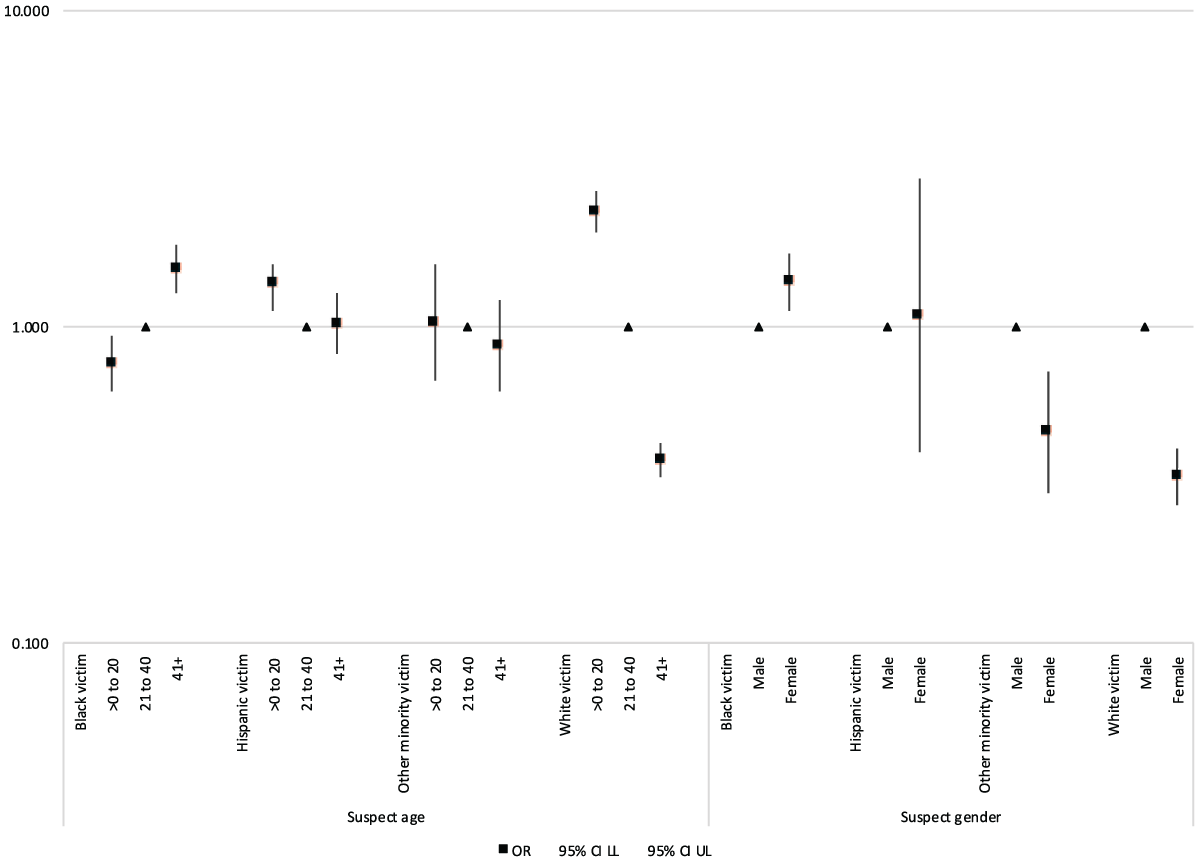
Odds ratio (95% confidence interval bands) of race-ethnicity discordance for homicides in relation to suspect age and gender by race-ethnicity of the victim. Logistic regression models adjusted for victim age, sex, education, marital status, and residence region. Triangle markers indicate the reference group used in the model.
Compared with this other known person relationship (nonrelative acquaintance), homicides were generally less likely to be concordant for more-known type of relationships and generally more likely to be discordant for stranger or less-known type of relationships, with similar directions of association across race/ethnicity of victims (Table 4).
Odds Ratio (95% Confidence Interval) of Race-Ethnicity Discordance for Homicide Across Relationships Between Victim and Suspect. Logistic Regression Models Adjusted for Victim Age, Sex, Education, Marital Status, and Residence Region.
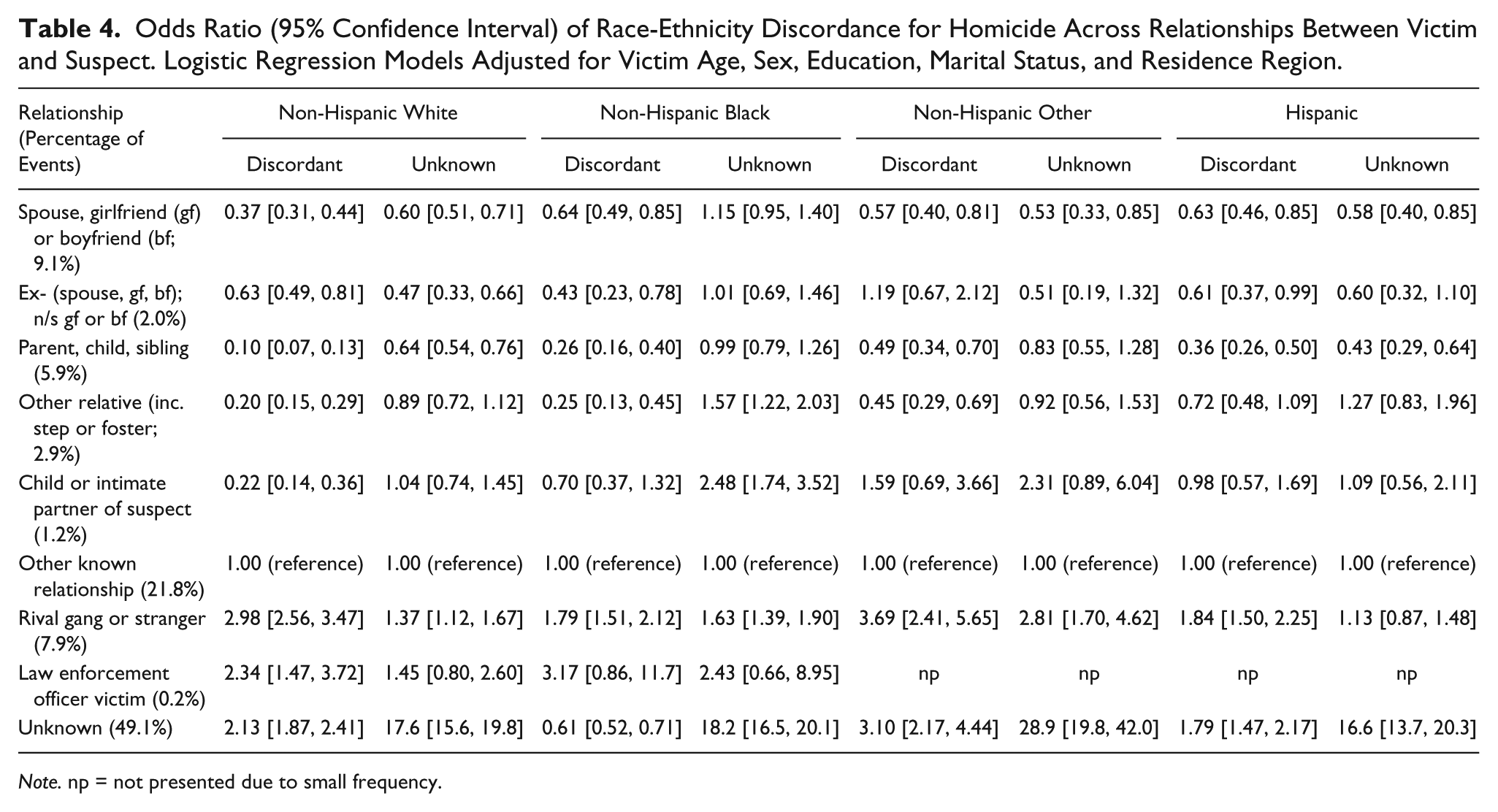
Note. np = not presented due to small frequency.
Discussion
There is a lack of research on the characteristics associated with cross-racial violence. For this descriptive epidemiology analysis, we are providing an overview of the associations observed in the population and NVDRS data provide a large and national-level source of data for this work. The work was not guided by specific hypotheses because the existing literature is not extensive, and to provide some contemporary data, this descriptive epidemiological analysis was undertaken to provide empirical data to inform future inferential-based analyses. There are several notable associations for which additional context is provided, specifically for victim–suspect relationship and for associations that exhibited differences based on victim race.
NVDRS does not include denominator data for the population, and this analysis was not designed to evaluate or compare the prevalence or incidence of cross-racial violence over time, but rather to identify characteristics that associated with race or Hispanic ethnicity discordance between victim and suspect. The development and patterns of cross-group relationships remains an element of active research, and studies indicate that cross-race or cross-ethnicity friendships or relationships tend to develop in situations where peer norms are supportive (Plummer, Allison, Stone, & Powell, 2016; Titzmann, Brenick, & Silbereisen, 2015; Tropp, O’Brien, & Migacheva, 2014). In the United States, the percentage of high school students with all or almost all same-race friendships decreased from approximately 76% in Whites and 58% in Blacks in 1976 to approximately 63% in Whites and 52% in Blacks in 1995 (Tuch, Sigelman, & MacDonald, 1999), indicating a declining trend over the latter part of the last century but still a high proportion of majority or all same-race friendships. In more recent data, the percentage of interracial or interethnic marriages increased in the United States from 7.4% to 10.2% from 2000 to 2012-2016 (Rico et al., 2018), paralleling similarly trends but also indicating a low overall prevalence. Our results suggest that discordant homicides may follow patterns of peer groups and close relationships in society regardless of victim race or ethnicity, that is, individuals may form closer relationships with individuals of the same race/ethnicity as illustrated with data on friendships and marriages (Bialik, 2017; Rico et al., 2018). Supporting this suggestion are the observations that discordancy was less likely with relatives, romantic partners, and relatives of romantics; less likely to occur at home; less likely to occur in intimate partner violence-related homicides; less likely when the homicide was preceded by an argument over money or property; less likely when the homicide was associated with a family problem; more likely among rival gangs and strangers than other known person relationships; and more likely with drug-involved homicides.
However, there were other interesting observations from this analysis that may warrant further work, particularly for victim and suspect gender and age that differed across victim race or Hispanic ethnicity that do not necessarily clearly fit with social patterns of relationships. There is not a body of research literature in which to compare violence cross-racially or cross-ethnically that also evaluates differences across victim–suspect age and gender. Thus, we can also posit some possible hypotheses that could be considered in future research. For suspect age, opposing directions of discordance were observed across ages for non-Hispanic White versus non-Hispanic Black victims. The reference category used was the middle-age group (21-40 years), and the interpretation is that for Black victims, discordance is less likely in younger and more likely in older, and for White victim, discordance is less likely in older and more likely in younger. For suspect gender, non-Hispanic Black victims were more likely to be racially discordant, but the opposing direction was observed for non-Hispanic White and other race victims. The reference category used was male, and the interpretation is that for Black victims, women are more likely to be discordant, and for White victims, women are less likely to be discordant. One might hypothesize that these observations about suspect age and gender may also follow patterns of social interaction in the population. Age has been observed to influence size and composition of social networks, with older individuals tending to have smaller social networks (Ajrouch, Antonucci, & Janevic, 2001; Ajrouch, Blandon, & Antonucci, 2005). The 2013 American Values Survey by the Public Religion Research Institute (PRRI) observed that White seniors were more likely to have all White social networks than younger individuals, which could support why older Whites in this study were less likely to be discordant (Cox, Navarro-Rivera, & Jones, 2016). However, the survey observed that White men and women were similar in percentages that had an all-White social network (76% men, 77% women), which would not support social interaction as a potential driving factor for differences across gender. In Black individuals’ networks, 83% composed people who were Black, compared with White individuals’ networks having 91% composed of people who were White, but the report from PRRI did not separate out age and gender for Black individuals, and we are not able to utilize this information for comparison. Future research in larger studies could evaluate the homicide circumstances more closely to try to understand why these differences exist for age in Black individuals and gender across all races. For example, if there are racial or ethnic differences in discordant homicides by suspect gender or age and location, stressor, or homicide-specific circumstances, they might explain these observations.
However, there were characteristics that followed unique patterns with victim race/ethnicity. There were particular distinctions for victims of non-Hispanic Black race. For example, discordance was more likely for justifiable self-defense and more likely with victim having used a weapon. It is important to note that this analysis did not include fatalities that were classified as legal intervention (justifiable deaths that occur during conduct of law enforcement activities); thus, the observations we have for the category of justifiable self-defense/law enforcement related are justifiable self-defense by civilians (not law enforcement). Thus, these observations suggest that homicides noted to be justifiable self-defense for non-Hispanic Black victims are more likely to have discordant race suspect, and non-Hispanic White victims are less likely to have a discordant race suspect. The number of justifiable homicides by private citizens in the United States has increased from 270 in 2012 to 331 in 2016, with the percentage that are by private citizens (vs. law enforcement) also increasing from 39% in 2012 to 43% in 2016 (U.S. Department of Justice & Federal Bureau of Investigation, 2016). A report from the Marshall Project suggests that when Black men are killed by White individuals, the deaths are more often classified as justifiable than deaths for other groups (Lathrop & Flagg, 2017); specifically, in all homicides, 2% were classified as justifiable and for homicides where victims are Black men, 17% were classified as justifiable in 400,000 homicides from 1980 to 2014 where data on the offender were available. Some might argue that this occurs because of differences in felony rates across race groups; however, the disparity occurs across a variety of homicide circumstances and is larger than be supported if that were the sole explanation. Our results also parallel patterns of higher deaths in Black males by legal intervention (law enforcement), in which Black males are 21 times more likely to be killed by a police officer than White males (Gabrielson, Sagara, & Grochowski Jones, 2014). These opposing directions of association with discordance are important and warrant further examination about the underlying mechanisms for why this is occurring. For example, depending on the specific hypotheses put forth and data available, an analysis stratified by or restricted to particular states based on justifiable self-defense laws may be a useful direction. Another avenue of work could involve qualitative evaluation of circumstances of these homicides within NVDRS to explore for details not possible to evaluate in binned data.
Others have hypothesized that geographic context or community factors are a key driver of interracial violence. One theory behind this idea is an ecological perspective to social disorganization (Park, 1925; Shaw & McKay, 1942), in which there are some areas that have higher levels of crime even when populations turnover. The suggestion is that there is social disorganization due to structural deficits in the area. This is extended in a model by Kasarda and Janowitz (1974), who view this as a large system, in which community attachment is influenced by social ties and disorganized communities have weaker social networks. In more contemporary work, Peterson and Ward (2015) suggest that areas that were more likely to interracial violence historically (e.g., lynching) are more likely to have higher rates of interracial violence contemporarily, and they observed that lynching had an effect on current levels of interracial violence through measures taken as part of anti-civil rights enforcement. Overall, these hypotheses and observations suggest a need for further research that evaluates whether the individual-level factors evaluated here differ across areas based on historical or current community-level factors, such as historically high levels of lynching and prior or current policies that resulted in community inequity.
The limitations of the data and analysis should be considered in the overall interpretation. One, for stressors and homicide-specific characteristics, the reference category was “no, not available, or unknown,” which means that there is high degree of sensitivity in the affirmative for the stressor, but a lower degree of specificity overall. This type of misclassification would mean that some affirmative situation may have been unknown and classified into the reference group, which would result in a conservative estimate of the association. Two, these data for NVDRS do not capture all states and should not be considered as nationally representative. NVDRS is an aggregation of state-based reporting, and, although there are standard protocols, there may be differences across the states in data collection. Similarly, the way that homicides are handled at local levels may differ across areas and national-level results may miss a different trend occurring at lower levels of geography. Three, some characteristics could not be evaluated in this analysis because of the small numbers of occurrences, and, even for some of the circumstances included, the relatively lower frequency of occurrence may have resulted in some associations not being statistically powerful enough to detect a significant association. Four, there was a large amount of information missing for known suspects (~40%) and the proportion varied across race/ethnicity, and it is not entirely possible to know which direction this exclusion may have biased association estimates. It is not possible to know whether stranger homicides are more represented in this group with missing information, and this may present an element of unknown bias in the analysis. We provide associations for missing suspect information with event and location characteristics so that readers can judge for possible bias in an analysis of interest. For example, the direction of association was the same but stronger in unknown discordance for arguments, and it could be hypothesized that not having suspect information to evaluate discordance biases that association conservatively toward the null.
Overall, less is known about characteristics of racial and ethnic discordance across homicide victim and suspects. While some observations may follow what is expected about peer groups and close relationships in society, these results provide context in a large-scale source of data in the majority of U.S. states. The differences in discordance for justifiable homicide that is not legal intervention warrant further evaluation in other studies and sources of data.
Footnotes
Declaration of Conflicting Interests
The author(s) declared no potential conflicts of interest with respect to the research, authorship, and/or publication of this article.
Funding
The author(s) disclosed receipt of the following financial support for the research, authorship, and/or publication of this article: This study was supported by Safe States Alliance through a cooperative agreement from the Centers for Disease Control and Prevention (#NU50CE002380).
