



Abstract
The purpose of our study was to examine how parental stress and coparenting relationship quality were related to dating violence perpetration and victimization among 114 Latinx adolescent mothers. We hypothesized that higher levels of parental stress and lower coparenting quality would be associated with increased dating violence perpetration and victimization. Prior to running a path analysis to test our hypotheses, we examined how frequently the Latinx adolescent mothers in our sample reported perpetrating at least one act of psychological or physical abuse against their partner in the past month. We found that 84.3% of the mothers in our study had perpetrated at least one act of violence against their partner in the past month and 74.7% reported they had been the victim of at least one act of violence by their partner in the past month. After accounting for frequency of contact with the father of their child, we found Latinx adolescent mothers were more likely to perpetrate abuse against, as well as be the victim of abuse by, their partner if they had a lower quality coparenting relationship. However, parental stress was not associated with dating violence perpetration or victimization after accounting for frequency of contact. Our findings show the importance of the quality of the coparenting relationship, above and beyond parental stress, as a predictor of dating violence victimization and perpetration, thus highlighting the importance of educating adolescent parents about how to navigate the coparenting relationship.
Dating violence can be defined as any physically, sexually, emotionally, and/or psychologically abusive behavior that occurs in the context of an intimate relationship (Centers for Disease Control and Prevention, 2019). The prevalence rate of dating violence is particularly high among Latinx youth compared with their White counterparts (Centers for Disease Control and Prevention, 2012; Howard & Wang, 2003; Sabina, Cuevas, & Bell, 2013), as well as among pregnant and parenting adolescents (Harrykissoon, Rickert, & Wiemann, 2002; Newman & Campbell, 2011; Roberts, Auinger, & Klein, 2005; Toews & Yazedjian, 2014). To illustrate, in a study of 126 pregnant and parenting Latinx adolescent mothers, 86% reported perpetrating and just more than 70% reported being victims of psychological dating violence, while almost 48% reported perpetrating and nearly 17% reported being victims of physical dating violence in the past 3 months (Toews & Yazedjian, 2014). Similarly, in their study of 73 pregnant and parenting Latinx adolescent mothers, Newman and Campbell (2011) found nearly 84% perpetrated and 80% were victims of psychological dating violence, while just above 56% perpetrated and almost 40% were victims of physical dating violence in the past 6 months.
One possible explanation for this high rate of dating violence among pregnant and parenting adolescents is that adolescents are often ill-equipped to handle the added stressors that pregnancy and parenting brings to a relationship (Ismail, Berman, & Ward-Griffin, 2007; Kulkarni, 2006; Williams et al., 2006). Despite this finding, few studies to date have examined parental factors as predictors of the increased risk of dating violence, particularly among Latinx adolescent parents. Latinx adolescent parents are a population of particular importance because Latinx youth make up nearly 32% of the total adolescent parent population (Office of Adolescent Health [OAH], 2016). Furthermore, Latinx families tend to endorse strong family cohesion and obligation values (Knight et al., 2010), and family interdependence self-construal that suggest family needs supersede individual needs (Schwartz et al., 2010). These values and self-construals might increase the salience and impact of family dynamics on youth adjustment. Thus, to fill this gap, we examined parental factors, specifically parental stress and the quality of the coparenting relationship, as predictors of both dating violence perpetration and victimization among Latinx adolescent mothers.
Literature Review
Parental Stress
Parenting stress represents individuals’ subjective sense of the balance between the demands of their parenting role and their capacity to respond to such demands (Berry & Jones, 1995). Often, stress and stressors are conflated; thus, the study of parental stress typically involves measuring individuals’ subjective experiences (i.e., parental stress) and the taxonomy of hassles and demands (i.e., parental stressors; Whipple & Webster-Stratton, 1991). For adolescent parents, major parental stressors tend to include time and financial constraints, sleep deprivation, and relationship issues (Herrman, 2013). Focused on the subjective experience of stress, adolescent mothers reported significantly higher levels of stress than their nonparenting peers (Logsdon, Hertweck, Ziegler, & Pinto-Foltz, 2008). Within a quantitative study of ethnically diverse adolescent and adult mothers, adolescent mothers also reported higher levels of parental stress compared with adult mothers (Andreozzi, Flanagan, Seifer, Brunner, & Lester, 2002), suggesting that stress and parental stress, in particular, are a significant concern for adolescent mothers.
Turning to the relationship between parental stress and violence, previous researchers have found a link between maternal stress and dating violence victimization among both adolescent (Larson, 2004) and adult (Loucks & Shaffer, 2014) mothers. To illustrate, in a qualitative study of 26 pregnant and parenting adolescent mothers, adolescent mothers reported that the stress of parenting increased their risk of dating violence (Herrman, 2013). In support of these qualitative findings, a longitudinal study of 187 mostly White and African American adolescent mothers showed a significant positive association between parental stress and dating violence victimization (Larson, 2004). Although this study provided one possible explanation for the increased risk of dating violence experienced by this population, it did not examine whether parental stress was also associated with dating violence perpetration. Furthermore, the qualitative study linking parental stress and violence among adolescent parents did not differentiate between perpetration and victimization. Thus, further research should explore the differential relationships between these two aspects of dating violence and parental stress.
Coparenting
Coparenting reflects the ways in which partners support one another in their parenting roles, agree on their parenting practices, and divide the parenting labor (Feinberg, Brown, & Kan, 2012). Although coparenting has been noted as an important moderating factor between stress and parent and child adjustment (Feinberg et al., 2012), there is a dearth of research on coparenting among adolescent parents (Lewin, Mitchell, & Ronzio, 2013; Mollborn & Jacobs, 2015). This might be in part because, although many adolescent parents demonstrate commitment to or interest in a coparenting relationship, many couples end their romantic relationship, which often affects the quality of their coparenting relationship (Lewin et al., 2015; Mollborn & Jacobs, 2015). In two studies that have been conducted utilizing a nationally representative sample from the Early Childhood Longitudinal Study, researchers have found that, compared with adult mothers, adolescent mothers reported less cooperative coparenting relationships with their male partners (Lewin et al., 2013). They also found that adolescent mothers who lived with the father of their child reported more conflictual coparenting relationships than those who lived apart (Lewin, Mitchell, Beers, Feinberg, & Minkovitz, 2012).
The increased conflict among coparenting adolescents might explain the increased risk of dating violence among this population. In support of this idea, previous research has found that adolescent parents who participated in a coparenting education program reported lower rates of dating violence than those in the control group (Florsheim, McArthur, Hudak, Heavin, & Burrow-Sanchez, 2010). Similarly, a statistically significant relationship was found between coparenting relationship quality and intimate partner violence in a sample of adult couples (Katz & Low, 2004). Specifically, couples who had a positive coparenting relationship, that is, one in which the partners were supportive and communicated with one another, reported lower rates of violence, while couples who had a hostile coparenting relationship that consisted of negative interactions and minimal communication reported higher rates of violence. It is important to note that although both of these studies asked partners to report on violence perpetration in their relationships, their scores were combined to create a couple-level score of partner violence that was used in the analysis rather than exploring differential relations between perceived coparenting quality and both violence perpetration and victimization.
Current Study
Given the high rates of dating violence among Latinx adolescent parents (Newman & Campbell, 2011; Toews & Yazedjian, 2014), it is important to understand what factors might contribute to dating violence to reduce the risks for this population. In the one study that has been conducted on factors related to dating violence among Latinx adolescent mothers, Toews and Yazedjian found communication with the adolescents’ parents, as well as perpetrating and being a victim of physical abuse were predictive of psychological aggression, while perpetrating psychological abuse was predictive of physical aggression. However, no studies to date have examined parental factors as predictors of the increased risk of dating violence among Latinx adolescent parents despite the fact that previous researchers have found a relationship between parental factors and dating violence victimization among non-Latinx adolescent mothers (Larson, 2004) and adult couples (Katz & Low, 2004). Therefore, the purpose of this study was to address this gap in the literature by examining how parental stress and coparenting relationship quality are related to dating violence perpetration and victimization among Latinx adolescent mothers. We hypothesized that higher levels of parental stress and lower coparenting quality would be associated with increased dating violence perpetration and victimization. Within this study, we controlled for adolescents’ frequency of contact with the coparent and adolescents’ living situation (e.g., living with a mother figure) because past research has noted that mothers’ social resources (e.g., contact with the coparent, maternal coparents) might be linked to lower parental stress (Cooper, McLanahan, Meadows, & Brooks-Gunn, 2009; Spieker & Bensley, 1994). We also controlled for adolescents’ language use and endorsement of familism support and closeness values as two measures of Latinx cultural orientation.
Method
Procedures and Participants
Data came from a larger study focused on understanding the social support networks and relationship dynamics of adolescent mothers and fathers. To identify participants, we first obtained the names of adolescents who were pregnant or parenting from eight public high schools in Central Texas; four high schools were in a large metropolitan city, the remaining schools were in surrounding suburban and rural areas. We then selected schools to represent a range of socioeconomic situations with the proportion of students receiving free/reduced lunch varying from 31.1% to 90.3% across schools. Eligible participants were required to be pregnant, have a romantic partner who was pregnant, or be the biological parent of a child; they also had to be enrolled in one of the eight high schools we served or be coparenting with a student who was enrolled in one of the eight schools.
Once the University’s institutional review board approved our study, we notified eligible participants of the project via trusted staff members at the schools (e.g., nurse, social worker, child care center director). We then provided students with a recruitment folder that included a recruitment flyer, parental consent form, and adolescent assent form. In addition, bilingual staff made follow-up calls, sent text messages, or provided in-person reminders to answer any follow-up questions. We asked students to return the recruitment packet if they chose to participate.
We identified 482 pregnant and parenting adolescents in the schools and 132 additional fathers through snowball sampling (total = 614). However, 188 participants could not be contacted or refused to participate in the project and 21 youth did not complete the pretest survey, but chose to participate in the larger program, resulting in a total of 405 adolescents who completed the pretest survey. Furthermore, given that the focus of this study was on understanding the role of parental factors on dating violence among Latinx adolescent mothers, we excluded adolescents who were pregnant and not currently parenting (n = 168), had contact with their child’s other parent less than once per month (n = 54), did not identify as Latinx (n = 57), were 20 years old or older (n = 28), or were male (n = 103) from the analysis. Our remaining sample consisted of 114 Latinx adolescent mothers, ranging in age from 14 to 19, with an average age of 16.72 (SD = 1.15). Adolescents were U.S.-born (n = 77), immigrant (n = 33; for example, born in Mexico, Guatemala, etc.), or refused to report their immigrant status (n = 4). Most adolescents reported living with a mother figure (n = 100), the remaining students reported living somewhere else (n = 12; for example, with their partner, at their partner’s parent’s home) or refused to report (n = 2). At the time of data collection, participants reported being in a relationship with the child’s other parent (n = 76), in a relationship with someone else (n = 3), single (n = 33), or refused to report (n = 2).
Instruments
A team of bilingual (English and Spanish) speakers forward translated into Spanish any measures that had not been previously translated and validated in Spanish, and reviewed all preexisting translated measures. During this process, the team compared the translated measures with the original items for meaningful equivalence and recommended changes to the original and translated materials (Prieto, 1992). By recommending changes to the original and translated material (decentering), we were able to ensure better cross-language equivalence compared with simple forward- and back-translation techniques (Knight, Roosa, Umaña-Taylor, 2009). Only 12 students chose to complete the survey in Spanish.
Parental stress was measured using the 18-item Parental Stress Scale (PSS; Berry & Jones, 1995; Oronoz, Alonso-Arbiol, & Balluerka, 2007). We asked adolescent parents to assess the extent to which they agreed (1 = strongly disagree to 5 = strongly agree) with a series 18 statements regarding their experiences of parental stress. Sample items included “I feel overwhelmed by the responsibility of being a parent” and “The major source of stress in my life is my child.” We used a mean of the responses in the analysis with higher values indicative of higher levels of parental stress. Cronbach’s coefficient alpha for this sample was α = .73.
Coparenting relationship quality was measured using a modified version of Feinberg and colleagues’ (2012) Coparenting Relationship Scale (CRS). Specifically, we used eight items from the shortened version of the CRS that measured the coparenting agreement, support, undermining, and division of labor subscales and then added two additional support items and an additional agreement item that assessed coparenting constructs relevant to the experiences of our sample given their age and the age of their children. This resulted in a scale that included 11 of the original 35 items to assess the frequency (1 = never to 4 = very often) in which the adolescents perceived their coparents to support their parenting (four-items), undermine their parenting (two-items), agree on issues related to parenting (three-items), and share in childrearing responsibilities (two-items). We also duplicated and reworded the support and undermining items to reflect what the adolescent did as a coparent. We then included two additional items to assess joint decision-making, a coparenting subconstruct described in coparenting theory (Feinberg, 2003): “When my partner and I disagree on parenting issues, s/he respects me to discuss and find a solution together” and “When my partner and I disagree on parenting issues, I expect my partner to accept my decisions.” We piloted the final 19-items with 44 adolescent parents prior to implementing the measure to the larger sample by administering a paper and pencil version of the items and then asking them to discuss the questions during a focus group. Based on the focus group discussion, we made additional changes to the wording of the questions. We used a mean of the responses for the total scale in the analyses with higher values indicative of a more positive coparenting relationship. Cronbach’s coefficient alpha for this sample was α = .85 for the total scale.
Psychological and physical dating violence were measured using the 21-item Conflict in Adolescent Dating Relationships Inventory (CADRI; Fernández-Fuertes, Martín, & Pulido, 2006; Wolfe et al., 2001). Selected for its psychometric properties, we used the CADRI to measure how frequently (1 = never to 4 = often) the adolescents and their partners engaged in (perpetration) or were victims of unhealthy conflict resolution tactics such as kicking, slapping, or pushing; insults; or threats in the past month. We used a mean of the responses in the analysis, with higher values indicative of more frequent perpetration (α = .86) or victimization (α = .87).
Control variables included in our analysis were the adolescents’ frequency of contact with the coparent, living situation, endorsement of familism-support and closeness values, and language use. Frequency of contact with coparent was measured by asking participants how often they had contact with their child’s other biological parent in a typical month (1 = less than once a month, 2 = once a month, 3 = bimonthly, 4 = weekly, 5 = biweekly, and 6 = daily). However, as noted above, we excluded those who had contact with their child’s other parent less than once per month. Living situation was assessed by asking the adolescents if they were currently living with a mother figure (0 = I do not live with a mother figure, 1 = I live with a mother figure). Familism support and closeness was measured using the Mexican American Cultural Values (MACV; Knight et al., 2010) familism support and closeness subscale, which was originally developed and validated in English and Spanish. This six-item subscale was used to assess the level to which adolescents agreed or disagreed (1 = strongly disagree to 5 = strongly agree) with statements such as “It is always important to be united as a family,” “family always comes first,” and “family provides a sense of security because they will always be there for you.” Mean scores were computed and the subscale showed good reliability (a = .86). Language use was assessed by coding the language in which adolescents chose to complete the survey (0 = Spanish and 1 = English).
Analysis Plan
We used a path analysis to measure the associations between the adolescents’ coparenting relationship quality, parental stress, dating violence perpetration, and dating violence victimization. We selected a path analysis because we wanted to measure the relationship between all of our study variables simultaneously, but did not have sufficient power to run a full structural model. We included adolescents’ coparenting relationship quality and parental stress as exogenous predictors of dating violence perpetration and victimization with frequency of contact with the coparent, living with mother figure, familism support and closeness, and language use as control variables. We ran the model in Mplus 8 (Muthén & Muthén, 1998-2017) using maximum likelihood estimator with robust standard error (Finney & DiStefano, 2006). We tested each path using an alpha of p < .05.
Results
We first ran descriptive statistics and correlations for all study variables (see Table 1). We found that 84.3% of our participants had perpetrated at least one act of psychological or physical abuse against their partner in the past month. In addition, 74.7% reported they had been the victim of at least one act of psychological or physical abuse by their partner in the past month. A correlational analysis was then conducted to determine relationships between the study variables. A probability level of p < .05 was used to test the correlational analysis. As can be seen in Table 1, Latinx adolescent mothers were more likely to perpetrate abuse if they had a lower quality coparenting relationship (r = –.46, p < .001) and higher levels of parental stress (r = .33, p < .001). They were also more likely to be the victim of abuse by the father of their child if they had a lower quality coparenting relationship (r = –.54, p < .001) and higher levels of parental stress (r = .38, p < .001).
Correlations, Means (M), and Standard Deviations (SD) for all Study Measures.

Note. Survey language is 0 = Spanish, 1 = English. Living with mother figure is 0 = not living with a mother figure, 1 = living with a mother figure.
p < .05. **p < .01. ***p < .001.
Next, we used a path analysis to assess the association between adolescent parents’ coparenting relationship quality and parental stress with dating violence perpetration and victimization (see Figure 1). Model fit indices were not obtained as the model was just identified; however, the R2 statistics for dating violence perpetration (R2 = .32) and victimization (R2 = .38) indicated the model accounted for a significant amount of variance in the outcomes. After controlling for parental stress and frequency of contact with the coparent, we found the coparenting relationship quality was negatively associated with dating violence perpetration (b = –.27, p < .01, β = –.45) and victimization (b = –.34, p < .001, β = –.51). Specifically, we found that for every 1-unit increase in coparenting relationship quality, dating violence perpetration decreased by .27 units and dating violence victimization decreased by .34 units. Parental stress was not associated with dating violence perpetration (b = .07, p = .27, β = .11) or victimization (b = .09, p = .24, β = .12). Parenting stress was negatively correlated with coparenting relationship (b = –.10, p < .001, β = –.40) meaning that higher levels of parental stress were associated with lower quality of coparenting relationship.
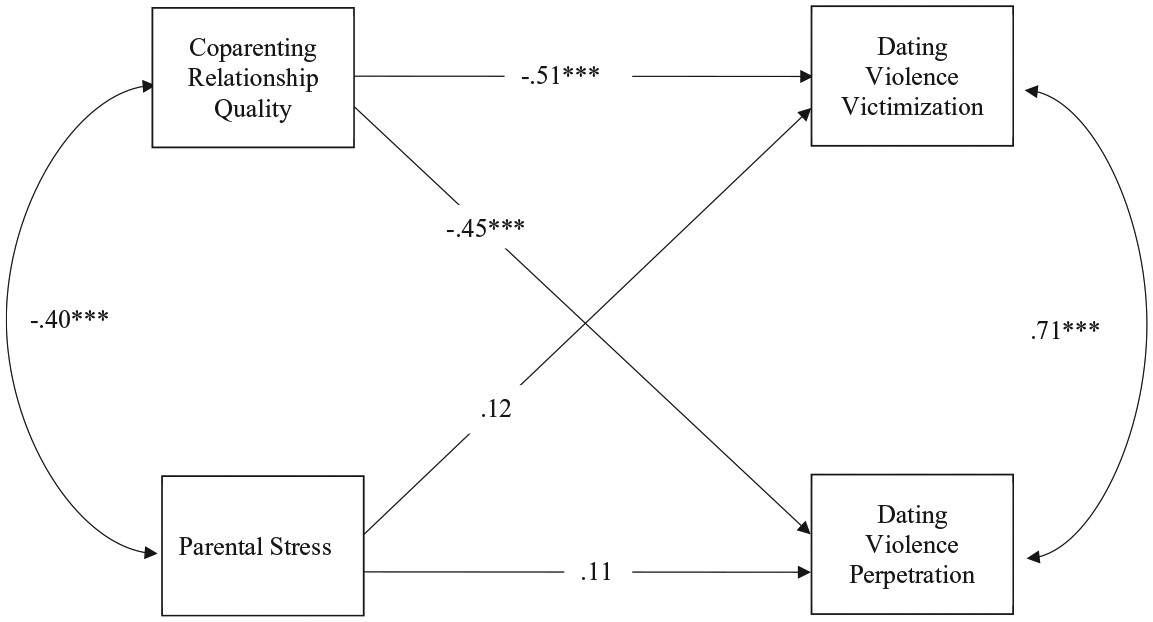
Parental factors predicting dating violence perpetration and victimization.
Turning to the control variables, frequency of contact with the coparent (b = .06, p = .29, β = .20) was not related to dating violence perpetration or dating violence victimization (b = .05, p = .44, β = .14). Living with a mother figure was also not associated with violence perpetration (b = .10, p = .08, β = .10) or violence victimization (b = .05, p = .43, β = .04). Familism support and closeness was also not associated with violence perpetration (b = .08, p = .07, β = .16) or victimization (b = .08, p = .10, β = .14). Finally, completing the survey in English was associated with higher reported levels of violence victimization (b = .17, p < .05, β = .16), but was not associated with violence perpetration (b = .12, p = .27, β = .13).
Discussion
The purpose of our study was to examine parental factors as predictors of both dating violence perpetration and victimization among Latinx adolescent mothers. Examining parental factors as predictors of dating violence is an important area of research because adolescent parents have a higher rate of dating violence (Harrykissoon et al., 2002; Roberts et al., 2005) compared with their nonparenting peers, particularly Latinx adolescent mothers (Newman & Campbell, 2011; Toews & Yazedjian, 2014). Adolescent mothers also experience higher rates of parental stress (Andreozzi et al., 2002; Bronte-Tinkew, Horowitz, & Carrano, 2010; Larson, 2004) and lower quality coparenting relationships (Lewin et al., 2012; Lewin et al., 2013) compared to adult mothers. Yet, we know very little about parental factors as predictors of increased dating violence among Latinx adolescent parents, even though Latinx youth make up nearly one third of the adolescent parent population (OAH, 2016) and tend to endorse strong family values (Knight et al., 2010; Schwartz et al., 2010) that might increase the salience of parental factors on dating violence.
Consistent with previous research examining a diverse group of adolescent parents (Florsheim et al., 2010), we found coparenting relationship quality was negatively related to dating violence perpetration and victimization. However, it is unclear whether the quality of the coparenting relationship leads to dating violence or vice versa. Furthermore, our research extends prior work that assessed the relationship between coparenting quality and violence among a sample of primarily White adult couples (Katz & Low, 2004) to show that positive coparenting is linked to lower reports of victimization and perpetration among Latinx adolescent coparents. Also similar to previous research on adult couples, we did find a relationship between coparenting and parental stress (Bronte-Tinkew et al., 2010; Dorsey, Forehand, & Brody, 2007). We also found a strong relationship between dating violence perpetration and victimization, thus supporting the idea that adolescents tend to engage in more mutual exchanges of violence (e.g., Newman & Campbell, 2011; Toews & Yazedjian, 2014).
However, our findings did not support previous research that found a relationship between parental stress and dating violence among primarily White and Black adolescent (Larson, 2004) or primarily Black adult (Loucks & Shaffer, 2014) mothers. One possible explanation for this finding is that because adolescent parents report significantly more parental support than adult parents and receive support from a larger variety of people (e.g., parents, siblings, extended family, school staff, friends; Letourneau, Stewart, & Barnfather, 2004), they might respond to stress in healthy and unhealthy (e.g., violence) ways with various people, not just their partner. It is also possible, for Latinx populations, the higher endorsement of familism values (Knight et al., 2010), which highlights the importance of family support, cohesion, and the need to place family needs above one’s own needs, might lead to higher use of family support networks and minimize the parental stress experienced by adolescent parents. Another possible explanation is that, as familism values also denote the need to put family needs above one’s own needs (Knight et al., 2010), Latinx adolescent mothers might be more prone to internalize parental stress instead of it letting it negatively influence their family relationships via dating violence. Our study supports the notion that there is a link between parental stress and familism as the adolescent parents in this study reported a relatively low level of parental stress and high level of familism support and closeness values, and we noted that higher familism support and closeness was linked with lower reports of parental stress. However, we cannot discern between the two possible explanations noted above; therefore, future research is needed to discern the mechanism through which familism is linked to parenting stress.
It is also possible that parental stress is relatively low among our sample because their parenting responsibilities align with traditional cultural norms related to gender (e.g., Latinx females are expected to engage in more household tasks and childrearing responsibilities than Latinx males; Hossain, Lee, & Martin-Cuellar, 2015; Raffaelli & Ontai, 2004). Although cultural norms related to gender roles might help explain the low stress levels in our sample and the nonsignificant relationship between parental stress and dating violence, these inferences are tentative as our study did not include a gender role attitudes measure. Thus, future research should explore the moderating role of gender role attitudes on the link between parental stress and dating violence. More culturally informed work that assesses the moderating roles of cultural values and gender roles attitudes will help inform more culturally responsive conceptualizations and culturally responsive services of family resilience factors that inform parenting adjustment, stress and coping, and dating violence.
Limitations
Although our study is one of the first to examine parental factors as predictors of dating violence among Latinx adolescent parents, the results must be interpreted with caution. First, our findings might not be applicable across groups because our sample size was small and our participants were all Latinx females. Thus, this population might have shown a weaker relationship between stress and dating violence due to the cultural resilience factors, such as familism values and strong support networks (Knight et al., 2010) that characterize this population. Second, due to the sensitive nature of the questions, social desirability bias might have influenced our findings. For example, given that many adolescent mothers feel judged for their parental status (e.g., Wiemann, Rickert, Berenson, & Volk, 2005), they might be less likely to report issues in their coparenting relationship or their experiences with dating violence out of fear regarding how they will be perceived as a parent. Third, because the data were correlational, no causal interpretations can be made. For example, as noted above, it is unclear whether the quality of the coparenting relationship leads to dating violence or vice versa.
Implications and Future Directions
Despite these limitations, this study has implications for future research and practice. First, these parental factors accounted for 38% of the variance in dating violence victimization and 32% of the variance in dating violence perpetration. Thus, future research should examine other possible predictors of dating violence among this sample to determine additional points of intervention. In addition, these findings highlight the importance of educating adolescent parents on how to navigate the coparenting relationship. Doing so can serve as a protective factor in preventing parental stress and dating violence. Finally, future programming should include both parents to determine if the outcomes are better when involving both the mother and father or if intervening with only one parent is sufficient.
As dating violence is a public health concern that expands beyond the relationship dyad, to inform children’s well-being (Lewin et al., 2012), it is important for researchers to understand what informs the emergence of dating violence perpetration and victimization. Our study extends prior research focused primarily on adult (Katz & Low, 2004; Loucks & Shaffer, 2014), European American mothers (Katz & Low, 2004; Larson, 2004), to study the relationship between coparenting quality, parenting stress, and dating violence among Latinx adolescent mothers. Our study also showed the strong relationship between coparenting quality and dating violence and provided culturally relevant interpretations of the results that highlight cultural strengths within the Latinx community. However, it is important that future research further explore these interpretations. Finally, and most importantly, we show the importance of coparenting relationship quality, above and beyond parental stress, as a predictor of dating violence victimization and perpetration. Thus, our study provides data that will allow researchers and practitioners to better serve adolescent parents and their children in the future.
Footnotes
Declaration of Conflicting Interests
The author(s) declared no potential conflicts of interest with respect to the research, authorship, and/or publication of this article.
Funding
The author(s) disclosed receipt of the following financial support for the research, authorship, and/or publication of this article: Funding for this research was provided by the United States Department of Health and Human Services, Administration for Children and Families (Grant HHS-2015-ACF-OFA-FM-0985). Any opinions, findings, and conclusions or recommendations expressed in this paper are those of the authors and do not necessarily reflect the views of the United States Department of Health and Human Services, Administration for Children and Families.
