



Abstract
Research has identified interpersonal violence (a broad term that includes stalking, harassment, sexual assault, and physical dating violence) as a major problem among adolescents. Research suggests that there are different patterns, or classes, of interpersonal violence victimization and perpetration, but little of this work has focused on adolescents. In the current study, we conducted latent class analysis using a sample of 2,921 adolescent girls and boys in high school from northern New England to assess varying patterns of interpersonal violence victimization and perpetration over the past 2 months, specifically stalking, harassment, sexual assault, and dating violence. Four classes of violence victimization and perpetration were identified: (a) No Victimization or Perpetration class (n = 1,898, 65.0%), (b) Low Victimization and Perpetration class (n = 343, 11.7%), (c) Harassment Victimization Only class (n = 560, 19.2%), and (d) High Victimization and Low Perpetration class (n = 120, 4.1%). Several differences in classes emerged as a function of demographic and behavioral health variables. For example, the High Victimization and Low Perpetration class had the highest proportion of girls and youth with sexual minority status. Furthermore, youth in the High Victimization and Low Perpetration class also had a significantly higher proportion of class members endorsing depressed mood and engagement in binge drinking than the youth in other classes. These findings demonstrate the heterogeneity in patterns of interpersonal violence, which future research should seek to better understand in terms of etiology, outcomes, and best practices for prevention and intervention.
Interpersonal violence (a broad term that includes stalking, harassment, sexual assault, and physical dating violence) is a major public health concern for adolescents. A recent report from the Centers for Disease Control and Prevention (CDC) found that 9.6% of high school boys and girls had been physically hurt (e.g., hit, slammed, or pushed into an object or injured with an object or weapon), and 10.6% had been forced to complete sexual acts (e.g., kissing, sexual touching, sexual intercourse) in the past year by a dating partner (Kann et al., 2016). One study, utilizing a sample of 10th grade boys and girls, found that 31% of adolescents had perpetrated dating violence (Haynie et al., 2013). Another study found that 8% of adolescents reported engaging in stalking behaviors with malicious intent (Ybarra, Langhinrichsen-Rohling, & Mitchell, 2017). Taken together, interpersonal violence is a serious problem among youth.
Correlates of Interpersonal Violence
Research has examined the extent to which demographic factors (e.g., gender, race, sexual identity) relate to experiences of interpersonal violence. In particular, although the literature is somewhat equivocal and contentious, in general, adolescent females are equally likely to perpetrate dating violence compared with adolescent boys, whereas adolescent males are more likely to perpetrate non-dating sexual violence and stalking than adolescent females (Clear et al., 2014; Haynie et al., 2013). Adolescents who identify as a racial minority (as opposed to White) as well as older adolescents (compared with younger adolescents) are generally more likely to experience interpersonal violence (Black et al., 2011; Clear et al., 2014; Dardis, Dixon, Edwards, & Turchik, 2014; Kann et al., 2016). Research also suggests that sexual minority youth experience all forms of interpersonal violence more than heterosexual youth (Clear et al., 2014; Edwards, 2018; Edwards & Sylaska, 2013; Edwards, Sylaska, & Neal, 2015).
There are a few reasons why some youth may be at increased risk of interpersonal violence. The developmental literature suggests that the time between childhood and young adulthood is a time of elevated risk behavior and that as adolescents age, early problem behaviors become more pronounced and, in some cases, escalate to violence (Sitnick et al., 2017). During the transition from childhood to adolescence, the composition of peer groups changes, romantic relationships develop, and normative beliefs that are supportive of problem behavior emerge (Miller et al., 2013). Such exposure and shifting stimuli may lead to higher exposure to interpersonal violence. For instance, as adolescents get older, they are more likely to date, have less parental supervision, and engage in other risk behaviors (e.g., binge drinking), which could increase risk of interpersonal violence experiences (Dir, Coskunpinar, & Cyders, 2014). Racial and sexual minorities may disproportionately experience interpersonal violence because of exposure to higher levels of stressful external stimuli such as experiencing discrimination or poverty (Lauritsen & Heimer, 2010; Meyer, 2003). For instance, research finds that experiencing stigma contributes to mental health problems and substance misuse, which relates to elevated risk of interpersonal violence experiences (Decker, Littleton, & Edwards, 2018; Edwards et al., 2015). Research also finds that lower socioeconomic status is related to higher rates of interpersonal violence among adolescents (Spriggs, Halpern, Herring, & Schoenbach, 2009), which likely contributes to the higher exposure of racial/ethnic minority members to violence (Lauritsen & Heimer, 2010).
In addition to demographic variables, research has also consistently documented associations between interpersonal violence and indicators of behavioral health, specifically depression and binge drinking. Longitudinal studies find that depressive symptoms are linked to development such that individuals who experience depression in childhood also experience depression in adolescence (Steinberg & Morris, 2001) and that the prevalence of depression increases during the adolescent period and continues to rise into adulthood (Costello, Erkanli, & Angold, 2006; Thapar, Collishaw, Pine, & Thapar, 2012). In addition, the vast majority of adolescents experiment with alcohol before the end of high school; however, relatively few adolescents will engage in problem drinking like binge drinking (Brown et al., 2008). Binge drinking in adolescents has been linked to sexual harassment victimization and perpetration such that high school students who experience or perpetrate sexual harassment have relatively higher rates of binge drinking (Clear et al., 2014). Thus, behavioral health problems increase risk of interpersonal violence (e.g., binge drinking may increase risk of victimization via impaired risk recognition) and also serve as outcomes of interpersonal violence (e.g., victimization increases the risk of developing depression).
Co-Occurrence of Interpersonal Violence
Types of interpersonal violence tend to co-occur (Hamby & Grych, 2013). Results from a nationally representative survey among children and adolescents indicated that experiencing physical assault within the past year contributes to an increased risk of experiencing past-year sexual victimization and that experiencing one type of violence significantly increases the risk of experiencing another type of violence (Finkelhor, Turner, Ormrod, & Hamby, 2009). Furthermore, youth are more likely to be both victims and perpetrators of interpersonal violence rather than victims only or perpetrators only (Cuevas, Sabina, & Picard, 2010). Most research to date, however, examines the presence or absence of interpersonal violence experiences as opposed to more nuanced patterns of interpersonal violence experiences.
Patterns of Interpersonal Violence
Although there are different ways that researchers can simultaneously assess interpersonal violence victimization and perpetration, a particularly innovative way to do this is to document different subtypes of interpersonal violence victimization and perpetration. This can be done through the use of person-centered analysis techniques, such as latent class analysis (LCA) and latent class growth analysis (Carbone-Lopez, Kruttschnitt, & Macmillan, 2006; Golder, Connell, & Sullivan, 2012; Haynie et al., 2013; Macy, Nurius, & Norris, 2007; Swartout, Swartout, & White, 2011; Young-Wolff et al., 2013). Using these techniques and assessing for latent, or indirectly observed, classes or groups of individuals with similar patterns of experiences, researchers can overcome the oversimplification of assuming homogeneity in interpersonal violence victimization and perpetration experiences (e.g., code a participant as yes or no for dating violence). Correlates of interpersonal violence may also vary depending on the specific type of pattern or class of interpersonal violence.
The current literature is limited in that studies often focus on either a single type of violence (e.g., dating violence, sexual violence) or victimization only (Dutton, Kaltman, Goodman, Weinfurt, & Vankos, 2005; French, Bi, Latimore, Klemp, & Butler, 2014; Golder et al., 2012; Haynie et al., 2013; Swartout et al., 2011; Young-Wolff et al., 2013). For instance, in a study utilizing LCA to assess variation in sexual victimization based on coercion features (i.e., verbal, physical, substance-facilitated), the analyses revealed four distinct classes of individuals with differences in behavioral health indicators (i.e., psychological distress) relative to class membership (French et al., 2014). Although an important contribution, the French et al. (2014) study did not concurrently assess perpetration or other forms of victimization. In another study exploring clustering of dating violence victimization and perpetration utilizing LCA, the authors found three distinct classes of victims and perpetrators (Haynie et al., 2013). As with the study by French and colleagues, there were class differences in health outcomes and engagement in problem behaviors such that youth in the classes with dating violence victimization and perpetration were more likely to report depressive symptomatology and alcohol use compared with the noninvolved youth (Haynie et al., 2013). The focus on one type of violence exclusively, without considering other forms of interpersonal violence, fails to explore how exposure to various types of interpersonal violence is linked to demographic and behavioral health issues.
To date, there are only a couple of studies that concurrently assess patterns of engagement in multiple forms of interpersonal violence victimization and perpetration among adolescent populations. The studies that have utilize growth curve modeling to explore transitions in adolescents (Fritz & Slep, 2009; Miller et al., 2013). Specifically, Fritz and Slep (2009), in a sample of 10th and 11th grade students, examining dating aggression, found stability over time in both physical and psychological dating aggression perpetration and victimization. Miller et al. (2013), exploring physical and psychological dating violence, sexual harassment, and bullying among a sample of seventh graders, found relative stability in class membership over time, and when transitions did occur, it was to a class with less victimization or perpetration. These studies offer important insight into victimization and perpetration in adolescents, especially that there is stability in class membership. However, the focus on dating violence exclusively or on younger adolescents leaves a gap in the literature. Studies exploring multiple types of violence among high school students are imperative, as repeated exposure to violence often contributes to behavioral health issues and ongoing violence throughout the life course. A baseline study of class membership exploring the correlates of multiple types of violence victimization and perpetration among a sample of exclusively high school students is warranted because high school is a particularly at-risk time for all forms of interpersonal violence and a developmental moment where such research is a high priority. Furthermore, a growing number of prevention efforts focus on reducing different forms of interpersonal violence, yet prevention strategies often focus on one form at a time (Matjasko et al., 2012). We need to better understand patterns of co-occurrence and correlates of membership in different categories of violence exposure. This type of information could be used to inform future research and practice.
Current Study
The current study aimed to (a) determine whether there are subgroups of adolescents with homogeneous patterns of interpersonal violence victimization and perpetration, and (b) document the association of subgroups with demographic and behavioral health indicators. Grounded in previous research reviewed above, we expected to find that there are at least two classes of interpersonal violence (Hypothesis 1), and that there are demographic (i.e., gender, racial/ethnic minority status, sexual minority status, and age) and behavioral health (i.e., depressive symptomatology, engagement in binge drinking) correlates of interpersonal violence class membership (Hypothesis 2). Specifically, based on previous research, we expected to find a larger proportion of girls, individuals of racial or sexual minority status, and older youth in classes with a greater amount or more types of interpersonal violence. Furthermore, we also expect to find a greater proportion of adolescents reporting depressed mood and engagement in binge drinking among classes with more types of interpersonal violence.
Method
Data were collected in the context of a larger cluster randomized controlled trial to evaluate a bystander-focused violence prevention curriculum among high school students (Edwards et al., 2019). Baseline data collected before the implementation of the intervention were used for the current analyses.
Participants
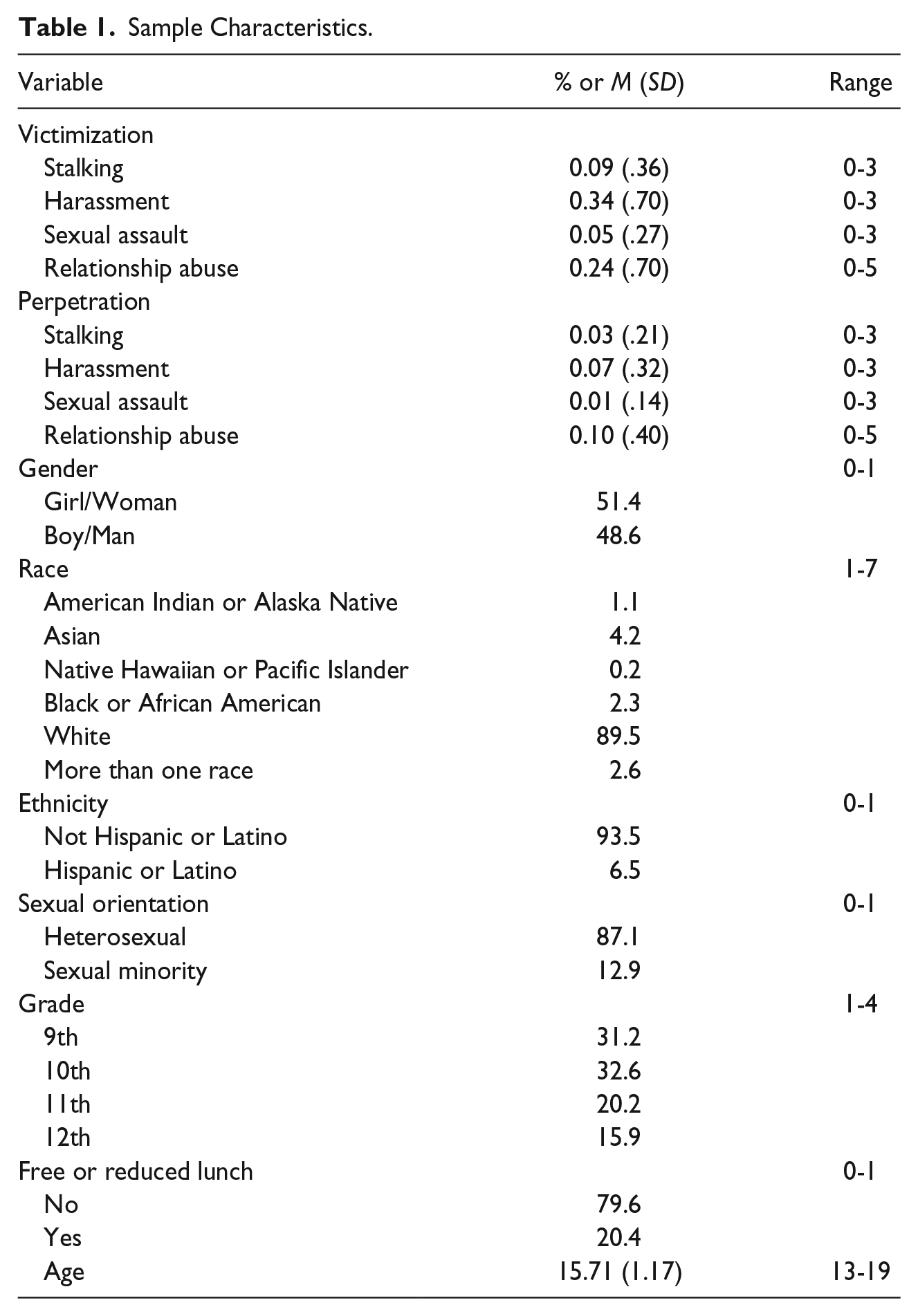
Participants were 3,172 high school students from 25 schools in northern New England who participated in a larger cluster randomized controlled trial to evaluate a bystander-focused violence prevention curriculum. In this article, we present data from the baseline survey and use participants without missing data on key victimization and perpetration variables (N = 2,921). The mean age of the participants was 15.71 years (range = 13-19, SD = 1.17). About one third (31.2%) of the sample was in ninth grade, 32.6% was in 10th grade, 20.2% was in 11th grade, and 15.9% was in 12th grade. Half of the students were girls (51.4%). The majority of participants identified as White (89.5%) and heterosexual (87.1%). Approximately one in five (20.4%) students reported receiving free or reduced lunch, a proxy for poverty. Analyses indicate that students in our sample did not differ on indicators of gender, race, and free/reduced lunch from the overall student body (collected from the respective Departments of Education; Maine Department of Education, 2015; Massachusetts Department of Elementary and Secondary Education, 2017; New Hampshire Department of Education, 2010). Sample characteristics are provided in Table 1.
Sample Characteristics.
Measures
Demographics
A brief measure was included to gather participant’s demographic data. Our questions were modeled after previous research and federal standards for the classification of race and ethnicity (Office of Management and Budget, 1997). Specific questions inquired about gender (male = 0, female = 1), age (13-19 years), racial group status (White = 0, non-White = 1), and ethnic group status (0 = non-Hispanic/Latino, 1 = Hispanic/Latino). Sexual minority status was determined by first asking, “what do you feel is your gender?” with response options ranging from boy/man, girl/women, and other. Then we used the Sexual Minority Assessment Team’s (2009) sexual attraction measure, asking participants the sex or gender they feel attracted to, with response options ranging from (1) “only attracted to girls” to (5) “only attracted to boys.” Options were then coded as 0 = nonsexual minority and 1 = sexual minority (anything other than only attracted to the same sex/gender).
Violence victimization and perpetration
We used Cook-Craig et al.’s (2014) measure of victimization and perpetration during the past 2 months. The measure consists of 28 items assessing a variety of forms of interpersonal violence including three sexual harassment items (e.g., “Made gestures, rude remarks, or used sexual body language to embarrass or upset you”), three sexual assault items (e.g., “Had sexual activities when you did not want because you were drunk or on drugs”), five relationship abuse items (e.g., “Threatened to hit, slap, or physically hurt you”), and three stalking items (e.g., “Made you afraid for your personal safety because someone showed up at your home, school, or work”) during the past 2 months. The set of 28 questions were asked for victimization (sexual harassment, sexual assault, relationship abuse, and stalking) and perpetration (sexual harassment, sexual assault, relationship abuse, and stalking) during the past 2 months. For each of the 28 items, participants responded 0 (no) or 1 (yes). Items were summed according to their subscale to create a total of eight subscale variety scores, which reflect the number of items to which participants answered affirmatively on each subscale. Past 2-month victimization and perpetration measures were utilized because they corresponded to the larger study’s intervention time line. In addition, recall bias is lower with shorter time frames (Kopec & Esdaile, 1990).
Behavioral health
Two items from the CDC’s Youth Risk Behavior Surveillance System (YRBSS; Eaton et al., 2012) were included to assess behavioral health, specifically depressed mood and binge drinking. The first item assessed the presence of depressive symptoms (e.g., “During the past month [30 days], did you ever feel so sad or hopeless almost every day for 2 weeks or more in a row that you stopped doing some usual activities?”), with a dichotomous “yes” or “no” response option. The second item assessed binge drinking (i.e., five or more drinks of alcohol in a row within a couple of hours) during the past month, with response options including never drank alcohol, 0 days, 1 or 2 days, 3 to 9 days, 10 to 19 days, and 20 to 31 days. Because this variable was zero-inflated, this item was recoded into a dichotomous “no binge drinking” or “any binge drinking” response option.
Statistical Analysis
We used LCA to assign class membership utilizing Mplus Version 7.4 software (Muthén & Muthén, 1998-2015). For all analyses, the “TYPE = MIXTURE missing” command was used to indicate the number of latent classes assessed, and the automatic estimator, full information maximum likelihood, was used to account for missing data in the analyses (Muthén & Muthén, 1998-2015). The variety scores for each of the eight subscales were then entered into the analysis as the indicator variables to determine latent classes. Due to the indicator variables (i.e., victimization and perpetration) assessing the variety of various possible victimization experiences in an individual’s history, it was treated as a count variable in Mplus using the “COUNT =” variable option, and the “(i)” option was used to specify whether zero-inflated Poisson models were fit (Muthén & Muthén, 1998-2015). The data were then fit to models ranging from one to five classes. Based on recommendations for LCAs by Nylund, Asparouhov, and Muthén (2007), to determine the appropriate number of classes based on best model fit, the following tests of model fit were assessed and reported: (a) the Bayesian Information Criterion (BIC), where smaller values indicate better model fit; (b) the bootstrap likelihood ratio test (BLRT), where p values less than .05 indicate the current model is a better fit than the model with one less class; (c) model entropy, where values near 1.00 suggest better class structure; (d) Lo–Mendell–Rubin likelihood ratio test (LRT), where p values less than .05 indicate the current model is a better fit than the model with one less class; (e) class accuracy, where a class should consist of no less than 1% of the total sample; (f) posterior probabilities, where values for each class should be near 1.00; and, finally, (g) class differences, which is a subjective assessment of the class averages for each subscale by the researcher based on the conceptual understanding of the data. Descriptive statistics for victimization and perpetration are reported. Finally, to assess class differences in demographics and behavioral health, a series of chi-square tests were performed due to the categorical nature of the outcome variables.
Results
Descriptive Statistics
Analyses indicated that 30.9% (n = 980) of participants reported at least one type of interpersonal violence victimization during the past 2 months and 13.1% (n = 415) reported at least one type of interpersonal violence perpetration during the past 2 months Specifically, 6.8% (n = 215) reported stalking, 22.8% (n = 723) reported harassment, 4.3% (n = 135) reported sexual assault, and 13.8% (n = 437) reported dating violence victimization. Furthermore, 2.7% (n = 86) reported stalking, 5.6% (n = 177) reported harassment, 1.0% (n = 33) reported sexual assault, and 13.8% (n = 437) reported dating violence perpetration. Also, 10.4% (n = 307) reported both victimization and perpetration of at least one type of interpersonal violence, whereas 22.0% (n = 650) reported victimization only, 3.2% (n = 94) reported perpetration only, and 64.4% (n = 1,907) reported no victimization and no perpetration.
LCA
Table 2 provides model fit statistics. Entropy for the four-class model (.659) was slightly smaller than the three-class model (.702). However, overall results indicate support for the four-class model. The BIC value was smallest for the four-class model. In addition, the significant p values (p < .05) for the BLRT and LRT suggest the four-class model was a better fit than the three-class model. Furthermore, based on the interpretation of the models and the additive value of a fourth class, the three-class model was rejected in support of the four-class solution.
Model Fit Statistics for Latent Class Analysis of Past 2-Month Interpersonal Violence.
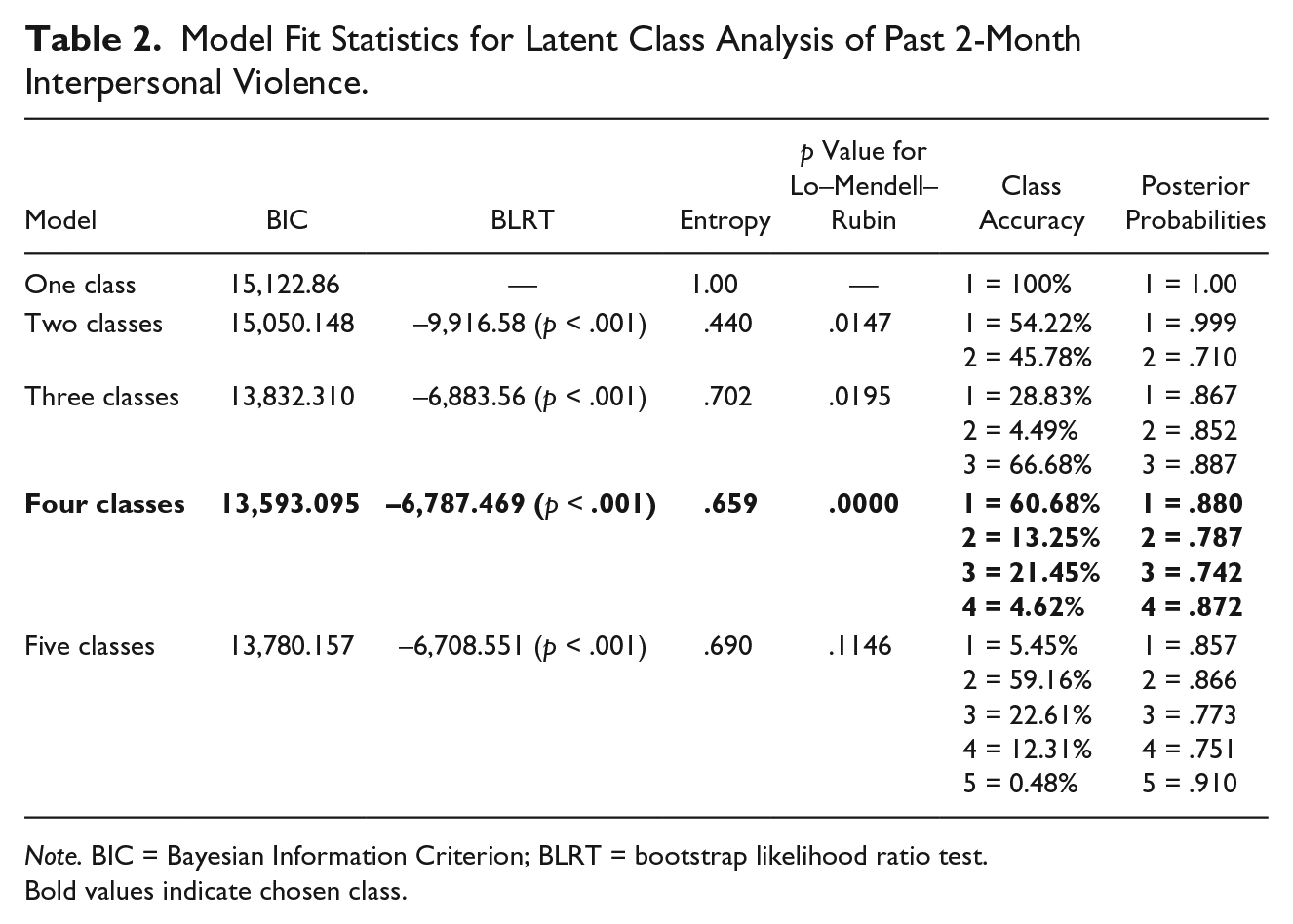
Note. BIC = Bayesian Information Criterion; BLRT = bootstrap likelihood ratio test.
Bold values indicate chosen class.
Class descriptions
Due to various amounts of missing data across model variables, class membership was assigned to only 2,921 (92.1%) participants (Figure 1). Of those, the majority (n = 1,898, 65.0%) were placed into the first latent class (Class 1), No Victimization or Perpetration class. Adolescents in this group did not experience any type of victimization nor did they perpetrate any form of sexual or dating violence. Class 2, Low Victimization and Perpetration, contains 343 (11.7%) participants and is characterized by experiencing a low variety, or types, of sexual harassment and dating violence victimization and perpetration. Class 3, Harassment Victimization Only, contains 560 (19.2%) participants and is characterized by experiencing a low variety of sexual harassment victimization, but no other forms of victimization or perpetration. The remaining participants (n = 120, 4.1%) were placed in the final class (Class 4), High Victimization and Low Perpetration, which is characterized by individuals experiencing a high variety of all forms of sexual and dating violence, as well as low variety of perpetration of sexual and dating violence.
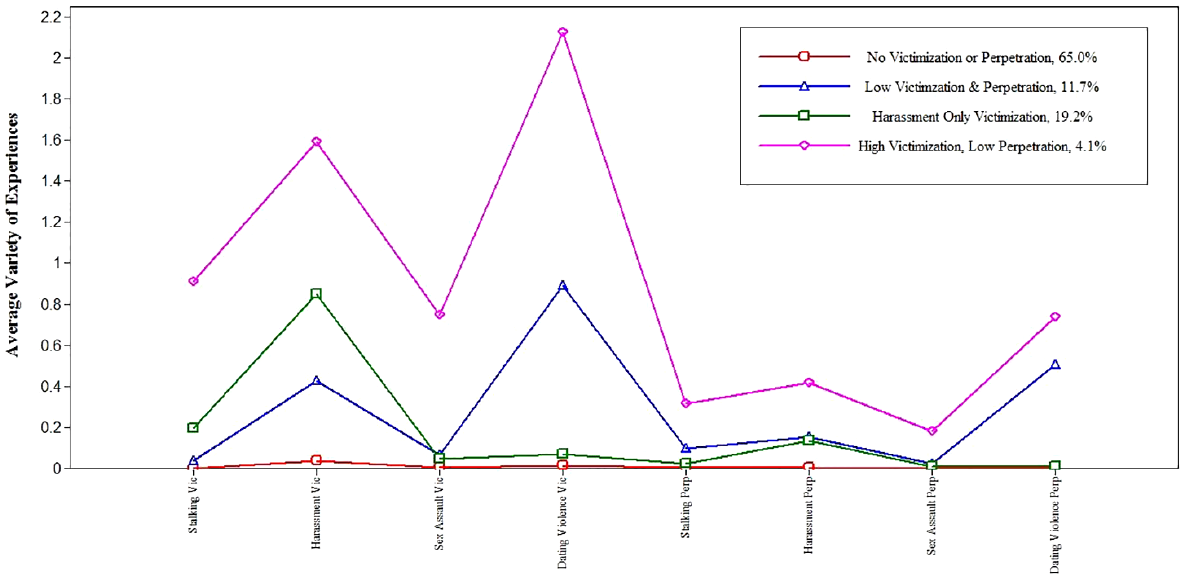
Visual representation of interpersonal violence classes.
Class differences
A series of chi-square analyses and a one-way ANOVA suggest that there were differences between the four classes on demographic and behavioral health indicators (Tables 3 and 4). Results indicated that the classes in this study significantly differ with respect to gender, sexual minority status, age, depressed mood, and binge drinking. The No Victimization or Perpetration class had a gender breakdown of 44.5% girls and 55.5% boys; the proportion of girls in this class was significantly lower than any other class. Sexual minority youth represented a significantly smaller proportion of the No Victimization or Perpetration class (8.5%) when compared with all other classes, and a significantly smaller proportion of the No Victimization or Perpetration class endorsed depressed mood (17%) and engaged in binge drinking (13.8%) compared with all other classes. Conversely, the High Victimization and Low Perpetration class had the largest proportion of members endorsing depressed mood (73.1%) as well as binge drinking (47.5%) and the highest proportion of females (69.2%). Finally, in terms of age, the Harassment Victimization Only class had a lower mean age (15.7) relative to the Low Victimization and Perpetration class. There were no significant differences between classes on proportions of individuals with racial/ethnic minority status.
Chi-Square Test for Independence Between Latent Classes, Demographics, and Behavioral Health Indicators.
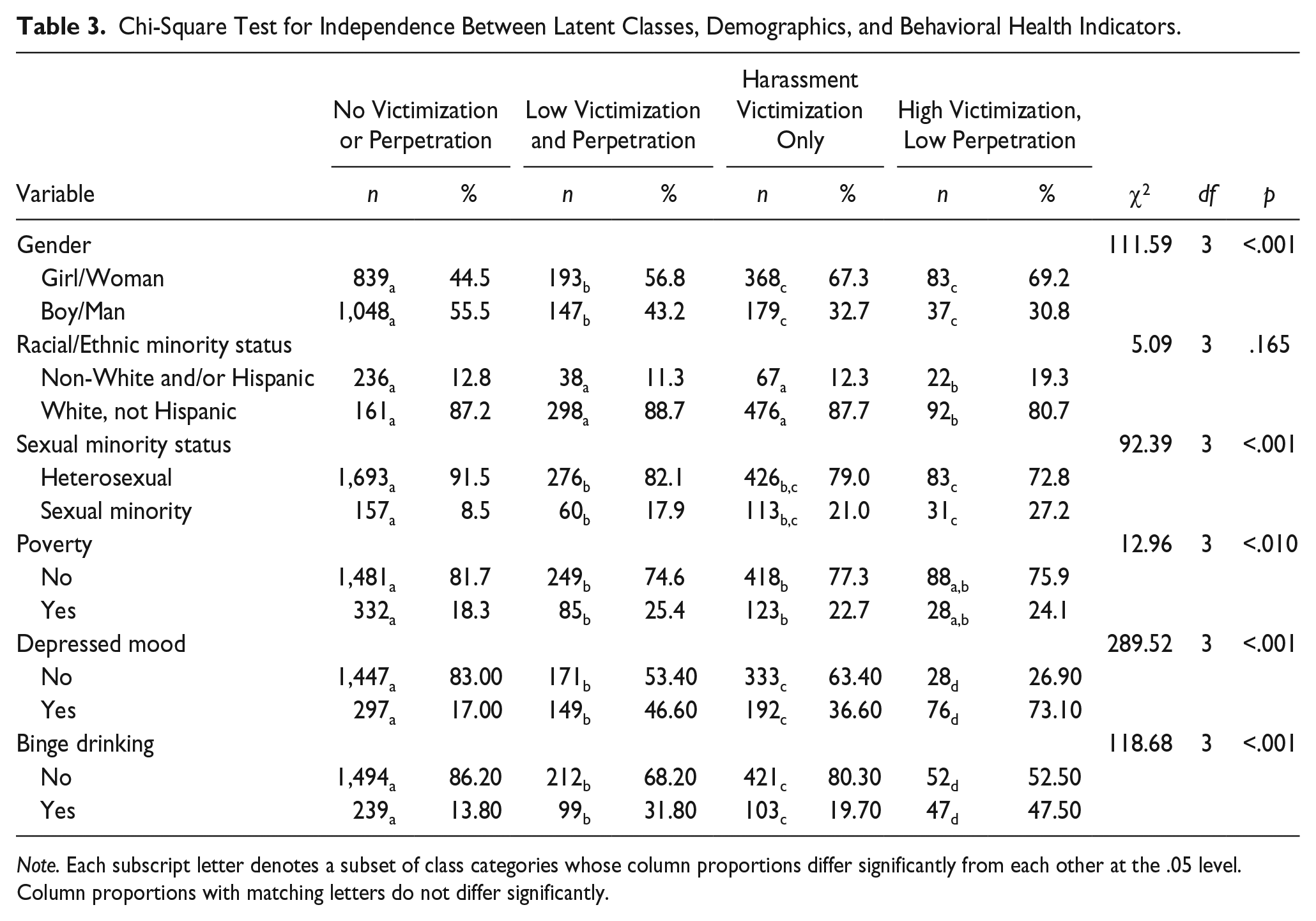
Note. Each subscript letter denotes a subset of class categories whose column proportions differ significantly from each other at the .05 level. Column proportions with matching letters do not differ significantly.
ANOVA Comparisons of Age by Class Membership.

Note. Class 1 = No Victimization or Perpetration class; Class 2 = Low Victimization and Perpetration; Class 3 = Harassment Victimization Only; Class 4 = High Victimization and Low Perpetration. HSD = Honestly Significant Difference.
Discussion
The developmental literature points toward the importance of exploring multiple forms of violence simultaneously to elucidate understandings of the entirety of adolescent experiences (Margolin, Vickerman, Oliver, & Gordis, 2010). In the current study, we examined classes of interpersonal violence victimization and perpetration, and demographic and behavioral health correlates of these classes, in a sample of adolescents. Results indicated that most adolescents in the current study have not recently experienced interpersonal violence, nor have they recently perpetrated interpersonal violence. Among youth with recent histories of interpersonal violence, Harassment Victimization Only was the most common form of interpersonal violence followed by Low Victimization and Perpetration. High Victimization and Low Perpetration, which represents the class with victimization but little perpetration of interpersonal violence, was the class to which the fewest youth belonged. In this sample of youth, whereas nonviolence was most common, when violence was present it tended to be more minor forms of violence that were most frequently endorsed, including a victimization-only class as well as a combined victim/perpetration class. These analyses extend previous research by examining classes of various forms of victimization and perpetration in a sample of adolescents.
Moreover, interesting findings emerged that differentiated classes by demographic and behavioral health factors. Girls and sexual minority youth were more likely than boys and heterosexual youth, respectively, to be in the classes characterized by more variation in the types of interpersonal violence. The research examining the presence or absence of interpersonal violence often finds either gender symmetry (Straus, Gelles, & Steinmetz, 2017; Winstok & Straus, 2016) or gender asymmetry (Spriggs et al., 2009) in rates of interpersonal violence. The current study adds to the latter literature by finding that when patterns of interpersonal violence are examined, girls are more likely than boys to report victimization experiences. Sexual minority youth may experience stressors caused by experiences such as discrimination and internalized homonegativity that make them more vulnerable to victimization and perpetration (Edwards & Sylaska, 2013; Meyer, 2003). With the exception of older youth being more likely than younger youth to be in the Low Victimization and Perpetration class relative to the Harassment Victimization Only and the No Victimization or Perpetration classes, there were no other differences in class membership as a function of age and race, which could be the result of small cell sizes in some analyses, the racially nondiverse sample, and/or the fact that we were measuring more nuanced classes as opposed to the overall presence or absence of one form of interpersonal violence, which could have resulted in more differences by age and race/ethnicity. The findings from the current study suggest that age differences do not play a major role in recent violence exposure. Instead, the findings reveal that a larger proportion of participants in classes that experience violence endorsed the behavioral health indicators than those in the class with no exposure to violence.
Finally, when assessing differences in behavioral health between the four latent classes, there was a clear progression in endorsement of depressed mood and engagement in binge drinking. Respondents categorized as High Victimization and Low Perpetration had the highest proportion of adolescents endorsing depressed mood and engagement in binge drinking. These data suggest that recent dating and sexual violence victimization experiences are correlates of poor behavioral health, consistent with prior research (Dardis et al., 2014; Devries et al., 2013; Shorey, Brasfield, Zapor, Febres, & Stuart, 2015; Ullman, 2004).
Limitations and Future Directions
The limitations of the current study must be noted. The sample was homogeneous with mainly White, non-Hispanic, heterosexual status adolescents. Results from a more diverse sample may differ. Furthermore, the victimization and perpetration questions only assess experiences and behaviors during the past 2 months. It is likely that there would be greater endorsement of the victimization and perpetration items if a larger time frame was assessed, yet even within a short time frame, classes of interpersonal violence emerged. Also, the LCA that was conducted does not account for the severity of interpersonal violence victimization and perpetration experiences and thus overlooks the nuances of such experiences and the effects that severity of one particular form of violence may have on behavioral health. Accounting for severity may provide further insight as to how and why these patterns of violence manifest among adolescents.
Practice Implications
Research is needed to determine whether prevention efforts work equally as well for youth who report varying classes of interpersonal violence experiences. Youth who report experiencing or perpetrating more violence may require more intensive prevention and intervention efforts to reduce the likelihood of recidivism and/or revictimization (Beatriz et al., 2018; Graham & Bellmore, 2007; Hickman, Jaycox, & Aronoff, 2004). These data also suggest that practitioners need to be aware of the fact that patterns of interpersonal violence likely affect behavioral health in young victims, and that youth who report sexual and dating violence victimization are more likely to present with higher rates of deleterious behavioral health indicators. Along these lines, youth who report treatment with high rates of binge drinking and depression should be screened carefully for experiences of interpersonal violence. In addition, research examining the movement of individuals among classes over time, particularly those exposed to prevention efforts, could help to uncover the relative stability or instability of class membership relative to prevention efforts. Although many of these practice implications require further replication and explication of the findings of the current study, it is likely that the effectiveness of our prevention and intervention efforts will be enhanced by a more nuanced understanding of classes of interpersonal violence.
Footnotes
Acknowledgements
We owe a great deal of gratitude to our school and community partners and the 50+ research assistants and program facilitators. Without these agencies and individuals, this project would not have been possible.
Authors’ Note
Laura Siller and Katie M. Edwards are now affiliated with University of Nebraska-Lincoln, USA.
Declaration of Conflicting Interests
The author(s) declared no potential conflicts of interest with respect to the research, authorship, and/or publication of this article.
Funding
The author(s) disclosed receipt of the following financial support for the research, authorship, and/or publication of this article: Funding for this study was provided by the Centers for Disease Control and Prevention (CDC), Grant #R01-CEO02524. The findings and implications presented in this article do not represent the official views of the CDC.
