



Abstract
This study investigated whether and how classroom-level bullies’ friendship networks, which reflect the popularity of bullies, were associated with the self-esteem of middle school students in the classroom. We analyzed survey data from 2,444 students in 101 classrooms from 22 middle schools in Korea. Respondents reported their friends’ and bullies’ names from their classroom. For each student, we generated the number of close friends that a respondent reported (outdegree) and the number of classmates who nominated him or her as a close friend (indegree). Bullies’ popularity was measured by the sum of all the bullies’ indegrees in a classroom. The findings showed that students in a classroom of bullies with larger popularity had a lower level of self-esteem. Moreover, bullies’ popularity was harmful to nonvictims’ self-esteem as well as victims’ self-esteem. This study suggests that even indirect exposure to bullying in a classroom can decrease the self-esteem of nonvictims by leading to negative emotions such as anger, anxiety, fear, and/or guilty feelings.
Keywords
Introduction
It has been well-documented that bullying victimization is negatively associated with diverse dimensions of psychosocial adjustment (see Hawker & Boulton, 2000, for review), including self-esteem (Jones, Bilge-Johnson, Rabinovitch, & Fishel, 2014; Meland, Rydning, Lobben, Breidablik, & Ekeland, 2010; O’Moore & Kirkham, 2001; Tsaousis, 2016). Understanding the harmful effects of bullying on self-esteem is a very important issue in assuring the health and well-being of children. Previous studies have shown that lowered self-esteem by victimization increases the risk of mental health problems such as depressive symptoms (Turner, Finkelhor, & Ormrod, 2010) and suicidal ideation (Jones et al., 2014) and can have a long-lasting effect on mental health in late adolescence (Arseneault, Bowes, & Shakoor, 2009). Being bullied is deleterious to self-esteem in that it increases a sense of inferiority and leads to detriments in self-processes and development in the victim (Turner et al., 2010).
Less research, however, has been devoted to the contextual effects of bullying on self-esteem at the classroom level. Bullying is essentially a group process (Salmivalli, 1999) that mostly happens in school for children and adolescents. Many bullies in a classroom may contribute to a negative classroom climate that harms nonvictims too and/or amplifies the deleterious effects on victims in the classroom. A few studies have shown that a perceived positive school or classroom climate, which has often been called school social cohesion or collective efficacy, is adversely associated with bullying behaviors and exposure to bullying in the school or classroom (Low, Van Ryzin, Brown, Smith, & Haggerty, 2014; Olsson, Låftman, & Modin, 2017; Springer, Jaramillo, Gómez, Case, & Wilkinson, 2016). However, to the best of our knowledge, no studies have analyzed the classroom-level contextual effects of bullying on the self-esteem of students in the classroom using multilevel analyses.
Moreover, if there exist classroom-level contextual effects of bullying on self-esteem, it is also open to examination whether or not the effects are shaped by the extent to which bullies are popular or dominant in the classroom. Although it has been reported that bullies create their subgroups (Huitsing & Veenstra, 2012) and enjoy a relatively high level of popularity (Thunfors & Cornell, 2008) in general, levels of bullies’ popularity may vary across classes, which results in different levels of negative classroom climate. Given that friendship is critical for the formation of adolescents’ self-esteem (Sarkova et al., 2014), friendship formation in favor of bullies in a classroom may amplify the effects of bullying in the classroom. In short, it has not yet been clearly determined whether and how the popularity of bullies at the classroom level is associated with the self-esteem of other students in classroom. This issue will be examined in this study.
In addition, previous studies have mainly focused on the self-esteem of victims, with a few exceptions focusing on that of bullies (O’Moore & Kirkham, 2001) and nonvictims (Pollastri, Cardemil, & O’Donnell, 2010). Classroom-level bullies’ popularity may have harmful effects not only for victims but also for nonvictims who recognize and observe that their classmates are being victimized. As a few studies have noticed that the hazards of witnessing bullying as well as being bullied exist (Rivers, Poteat, Noret, & Ashurst, 2009), there is no reason to assume that bullying is associated with the self-esteem of victims and bullies only. Even children who are not involved in bullying as either bullies or victims can be influenced by watching or ignoring bullying, although the effect on nonvictims may be relatively weaker than on victims. Still, being bystanders may harm nonvictims’ self-esteem by generating shame, guilt, anxiety, and other negative emotions. In addition, observing bullying episodes in the classroom may affect a student’s self-esteem by increasing the fear of becoming the next victim, and augmenting the perception of threats to personal safety (Chen, Chang, & Cheng, 2016; Lodge & Frydenberg, 2005). Thus, it would be worthwhile to investigate whether and how classroom-level bullies’ popularity is associated with the self-esteem of victims and nonvictims.
In this context, this study aims to examine (a) whether and how classroom-level bullies’ popularity measured by the size of bullies’ friendship network is associated with the self-esteem of students in the classroom and (b) whether and how the popularity has differential effects according to whether or not the students in question are experiencing direct victimization. All the respondents of this study are first-year middle school students. Friendship networks and exposure to bullying in the first year are potentially crucial for the self-esteem of students, given that the initial experiences students undergo in middle school may exert a sustained impact over their entire school career. It has been noted that friendship networks are likely to be stable over the school year (Değirmencioğlu, Urberg, Tolson, & Richard, 1998) and that, in particular, the first year in middle school is a period of transition when new friendships are formed after leaving elementary school. It has been observed that bonds of friendship forged in the first year affect the school adjustment and self-esteem of students (Wilkinson, 2004; Yim & Lee, 2007). Exposure to bullying in the first year was also associated with poorer subsequent school adjustment and lower levels of positive perception of the school environment (Nansel, Haynie, & Simons-Morton, 2003).
In this study, the individuals who were bullies and those who were their friends were detected by classmates’ survey answers, not by bullies’ self-appraisal. The survey collected a complete friendship network of 101 different classes nationwide in South Korea. The findings of this study extend our knowledge regarding the association between classroom-level bullying and self-esteem and provide an empirical basis for the necessity and strategy of school interventions.
Background
Bullying and Self-Esteem
It appears clear that bullying is adversely associated with the self-esteem of victims. Those who are bullied have lower levels of self-confidence, self-worth, and self-esteem (Boulton, Smith, & Cowie, 2010; Jones et al., 2014; Meland et al., 2010; O’Moore & Kirkham, 2001; Tsaousis, 2016). Being bullied is deleterious to self-esteem in that it increases a sense of inferiority and leads to detriments in self-processes and development in victims (Turner et al., 2010). Those who are bullied may not have a feeling of being worthy, which is harmful to self-appraisal (Turner et al., 2010). Lower self-esteem due to bullying victimization is an important factor in individual health by increasing the risk of mental disorders. In one study, bullying victimization was associated with suicidal ideation of adolescent psychiatric inpatients through lowered self-esteem (Jones et al., 2014).
As compared with victims, the effects of bullying in bullies and uninvolved individuals remain unclear. A few studies have shown that uninvolved children who were neither bullies nor victims had greater self-esteem than did both bullies and victims (O’Moore & Kirkham, 2001; Pollastri et al., 2010), whereas other studies have argued that bullying can be positively associated with psychosocial difficulties and mental health risks of uninvolved bystanders as well (Lambe, Hudson, Craig, & Pepler, 2017; Rivers et al., 2009).
There have been inconsistent findings regarding the relationships between bullying and the self-esteem of bullies (O’Moore & Kirkham, 2001; Pollastri et al., 2010). O’Moore and Kirkham (2001) observed that bullying is associated with low self-esteem in both bullies and victims versus in uninvolved children, whereas Pollastri et al. (2010) showed that it increases the self-esteem of bullies over time. This increase in the self-esteem of bullies has been explained in that bullying reflects social dominance in peer groups, which is critical for self-esteem (Pollastri et al., 2010). Because friendships are important for children/adolescents in terms of psychosocial adjustment, bullies may have a high level of self-esteem if they have friendship networks supporting them.
Classroom-Level Bullying Effects
In spite of increased recognition regarding the importance of the school/classroom context regarding bullying (Blickle, Meurs, & Schoepe, 2013; Low et al., 2014; Sarkova et al., 2014), less research has examined the contextual effects of bullying on self-esteem at the classroom level. Given that bullying is a group process (Salmivalli, 1999) that mostly happens in a school setting, the existence of classroom environments in which bullies and other students including both victims and uninvolved children interact with one another is very important to shape the effects of bullying on the self-esteem of students.
Studies have shown that bullying behaviors can be reduced in positive school or classroom climates, such as those having respectful and supportive relationships, a high level of trust, and good quality of relations among students (Low et al., 2014; Springer et al., 2016), which implies that there are different classroom contexts in regard to bullying behaviors and exposure to bullying. It is probable that being embedded in a classroom wherein bullies are popular, which can be determined based on the size of bullies’ favorable friendship networks, is more harmful to the self-esteem of students in the classroom due to being exposed to a negative classroom climate. Given that friendship is critical for the formation of adolescents’ self-esteem (Sarkova et al., 2014), friendship formation in favor of bullies in a classroom may amplify the effects of bullying in the classroom.
In this context, nonvictims as well as victims may be vulnerable in the classroom in which bullies create their subgroups (Huitsing & Veenstra, 2012) and enjoy a high level of popularity (Thunfors & Cornell, 2008). It has been often assumed that uninvolved children are not influenced by bullying, given that previous studies showed they have greater self-esteem than do bullies or victims (O’Moore & Kirkham, 2001; Pollastri et al., 2010). However, being embedded in a classroom wherein bullies and their friends form strong friendships may increase indirect exposure to bullying, or the risk of being bullied in the future.
Individual-level studies examining bullying-related experiences and self-esteem have the limitation of not capturing the common effects of bullies on students embedded in the classroom environment. Nonvictims also experience negative emotions such as disgust and anger toward bullying and have conflicting feelings such as guilt, anger, fear of becoming the next victim, and threats to personal safety (Chen et al., 2016; Lodge & Frydenberg, 2005). The harmful effects of bullying can extend to nonvictims in a classroom in which bullies are highly popular and have larger friendship networks.
Although common to both groups, the classroom-level contextual effects of bullying are unlikely to be the same between victims and nonvictims. Given that peer support is important in ameliorating the deleterious effects of being bullied (Holt & Espelage, 2007), friends’ social support of victims will be weaker in a classroom wherein bullies are more popular or supported by classmates. The sense of helplessness and the fear of further ostracism can be more acute among victims under those circumstances and may eventually harm victims’ self-esteem. Thus, bullies’ strong friendship network in a classroom can harm victims’ self-esteem more than that of nonvictims by depriving social support for victims within the classroom.
Within-classroom dynamics are particularly important for understanding bullying among middle school students in South Korea because it is the classroom where students stay for the longest time and make the most friends (Jo et al., 2002). Statistics show that Korean middle school students stay in school for more than 8 hour a day and spend most of those hours in their classroom, except for lunch and short breaks (Youth Human Right Act, 2015). In particular, Korean middle school students do not move between classrooms depending on subjects; instead, subject teachers come to each classroom. In short, a set of students stay, learn, and play together in one classroom all the year and, as a result, the occurrence of bullying, as well as learning and making friends, is overwhelmingly high in the classroom. With this in mind, notably, the proportion of bullying in the classroom rather than in other school locations such as the corridors and playgrounds increased from 25.0% in 2012 (Ministry of Education, 2012) to 48.2% in 2015 (Ministry of Education, 2015).
Capturing Friendship Networks in Classroom
A student’s popularity in a classroom can be captured by indegree friendship as opposed to outdegree friendship. Indegree is the number of friendship nominations received from classmates, whereas outdegree is the number of friendship nominations given to them. Indegree reflects how much an ego is popular, while outdegree captures how much he or she is gregarious (Sweet, 2016). A popular person with a large indegree may attract more friends and thus enjoy more popularity (Snijders, Van de Bunt, & Steglich, 2010).
To capture bullies’ overall popularity in a classroom, we aggregated all of the bullies’ indegrees in the classroom. For this, two different ways of aggregating exist. One is the number of bullies’ total indegree friends and the other is the sum of each bully’s indegree, allowing for double-counting of a common friend. Figure 1 illustrates how the two methods are different. Both Class I and Class II in the figure consist of two bullies (A and B) and their indegree friends (a, b, and c). Therefore, the two classes share the same number of total indegree friends (i.e., three). Class II, however, has a sum of indegree that is twice as large as that of Class I because all of the three students (a, b, and c) in Class II nominated both A and B as a friend. Consequently, both A and B have an indegree of three, whose sum is six. By contrast, if a, b, and c in Class I claimed either A or B as a friend, but not both, then A has indegree two and B has one, whose sum is three.

The same size but different strength of bullies’ friendships.
Comparing the two classes in Figure 1 reveals that the number of total indegree friends, that is, the range of popularity, cannot capture to what degree bullies and their friends form a strong clique. On the contrary, the sum of bullies’ indegrees will mostly reflect the degree of cohesive supports received through multiple friendships, given the number of total friends. It can capture to what degree bullies receive multiple social supports based on their popularity or the cohesiveness of popularity in short. If we found the harmful effect of the sum of bullies’ indegrees to be beyond the effect of the number of bullies or their indegree friends, it would be stronger evidence for the contextual effect of bullies’ friendship in a classroom.
Hypotheses
Based on previous studies that have reported the importance of the school/classroom context with regard to bullying (Blickle et al., 2013; Low et al., 2014; Sarkova et al., 2014) and the adverse associations evidenced between victimization and self-esteem (e.g., Boulton et al., 2010), we predict the following:
Our discussions using the two examples in Figure 1 suggest that our hypotheses will be better supported when cohesiveness of popularity, rather than the range of popularity, shows a significant effect.
Method
Data
The data used in this study were drawn in 2015 from a sample of 2,465 first-year students from 101 classrooms in 22 middle schools nationwide. The schools were randomly sampled and all of the first-year students in those schools were surveyed (42.6% female). The age of the students was not surveyed because most first-year students in 2015 were born in 2002 in accordance with the strict Korean policy for school entrance. There could be a very small proportion of students who were born in either January or February of 2003 because limited early entrances were allowed through parental appeal.
The South Korean school calendar starts in March and the survey was conducted during the beginning of the second semester or about two weeks from the end of August 2015 to the beginning of September 2015 after students had been accorded enough time to form friendship networks in their classroom. As the survey contained sensitive questions regarding bullies and friends, the questionnaire was sent to each school in advance and students were informed about their choice of declining their participation in the survey. Trained specialists were also dispatched to the school to help students fill out and seal the questionnaires by themselves. We had previously conducted a pilot survey to verify whether or not first-year students in middle school were able to understand and to answer the questionnaire items, and for the course of the main survey, a trained specialist provided direct explanations within the classroom whenever students faced any difficulties understanding questions. In this manner, the survey tried to secure candid and trustworthy answers from the respondents. The final sample was 2,444 students after excluding missing values from the variables in use.
Measures
The dependent variable
Students’ self-esteem was measured by the sum of responses to the three items developed by the Korean Educational Development Institute (KEDI). First, these items were generated by translating Rosenberg’s (1965) self-esteem indicators for adolescents into Korean. The translated indicators were then assessed through rigorous index development procedures that included empirical validation by 39,128 students in 1,170 schools in South Korea (Hyun, 2014). Our survey included the top three items explaining most of the variance of self-esteem in the validation process. The three items are “I am proud of myself,” “I feel that I have a number of good qualities,” and “I feel that I am a person of worth.” Answers were obtained using a 5-point scale ranging from strongly disagree to strongly agree.
Classroom-level bullies’ friendship variables
We generated three alternative variables regarding bullies and their friendship network at the classroom. The number of bullies in a classroom was simply defined as the number of students who were ever reported as a bully on a survey, without any consideration of the bullies’ friendship. The next two variables were explicated above with Figure 1: the number of bullies’ indegree friends and the sum of bullies’ indegrees. Moving from the number of bullies to the number of their friends and to the sum of indegrees, our measures increasingly reflect bullies’ popularity by their incoming supports regarding the classroom context of bullying.
Victimization from bullying and individual friendship networks
At the individual level, the main predictors are related to bullying and friendships. A dummy variable to ascertain whether a student had experienced victimization from bullying was generated from the survey question, “[w]ere you ever bullied either verbally or physically during the last semester?” The item was dummy coded (0 = nonvictim, 1 = victim). We did not ask about specific types or frequency of victimization beyond the question. On the contrary, a student was defined as a bully if that student’s name was ever reported in an answer to the question, “[w]hat is the name of the classmate who has bullied other classmates either verbally or physically?” Respondents were allowed to report up to five names.
Each respondent’s friendship was also measured. Friendship outdegree simply counted the number of close friends’ names that a respondent reported. One’s indegree was constructed by counting the number of classmates who reported his or her name as a close friend. Respondents were allowed to report up to 10 names of close friends and, therefore, outdegree was upper bounded by 10, whereas indegree was only bounded by the total number of classmates.
Control variables
Individual-level control variables included gender, academic stress, economic situation, and academic achievement at the individual level. Gender was dummy coded (0 = male, 1 = female). Academic stress was self-reported on a 5-point scale from very low to very high, economic situation was reported from very poor to very rich, and, finally, academic achievement was self-rated on a 5-point scale ranging from very poor to very good. Control variables at the classroom level included class size, or the total number of students, and a dummy for being coeducational between genders. Many Korean middle schools are not coeducational but rather are instead segregated by gender.
Analytic Strategy
Multilevel regression was employed to predict respondents’ self-esteem. The first level represented students and the second level represented classrooms. Correlations between error terms within a classroom were allowed in estimation by clustering on the second level. Two sets of regressions were conducted. The first and second sets of regression are to test Hypotheses 1 and 2, respectively. The first set was completed to examine associations between classroom-level bullies’ friendship networks and the self-esteem of students. Model 1 introduces control variables and variables concerning bullying, without any variable relating to friendship networks. Models 2a to 2c add friendship indegree and outdegree at the individual level and a contextual variable for bullying at the classroom level, in the order of the number of bullies, the number of bullies’ indegree friends, and the sum of bullies’ indegrees. Model 3 includes both the number of bullies’ indegree friends and the sum of their indegrees to test whether cohesive friendship between bullies and their friends lowers classmates’ self-esteem beyond the effect of the size of bullies’ friends.
The second set of multilevel regressions was designed to examine the cross-level interactions between classroom-level bullies’ friendship networks and an individual-level variable measuring whether or not a respondent experienced bullying victimization. The analytical models estimate how much the contextual effects of bullies’ friendships differed between victims and nonvictims by an interaction with a dummy for ever-bullied.
Results
Sample Statistics
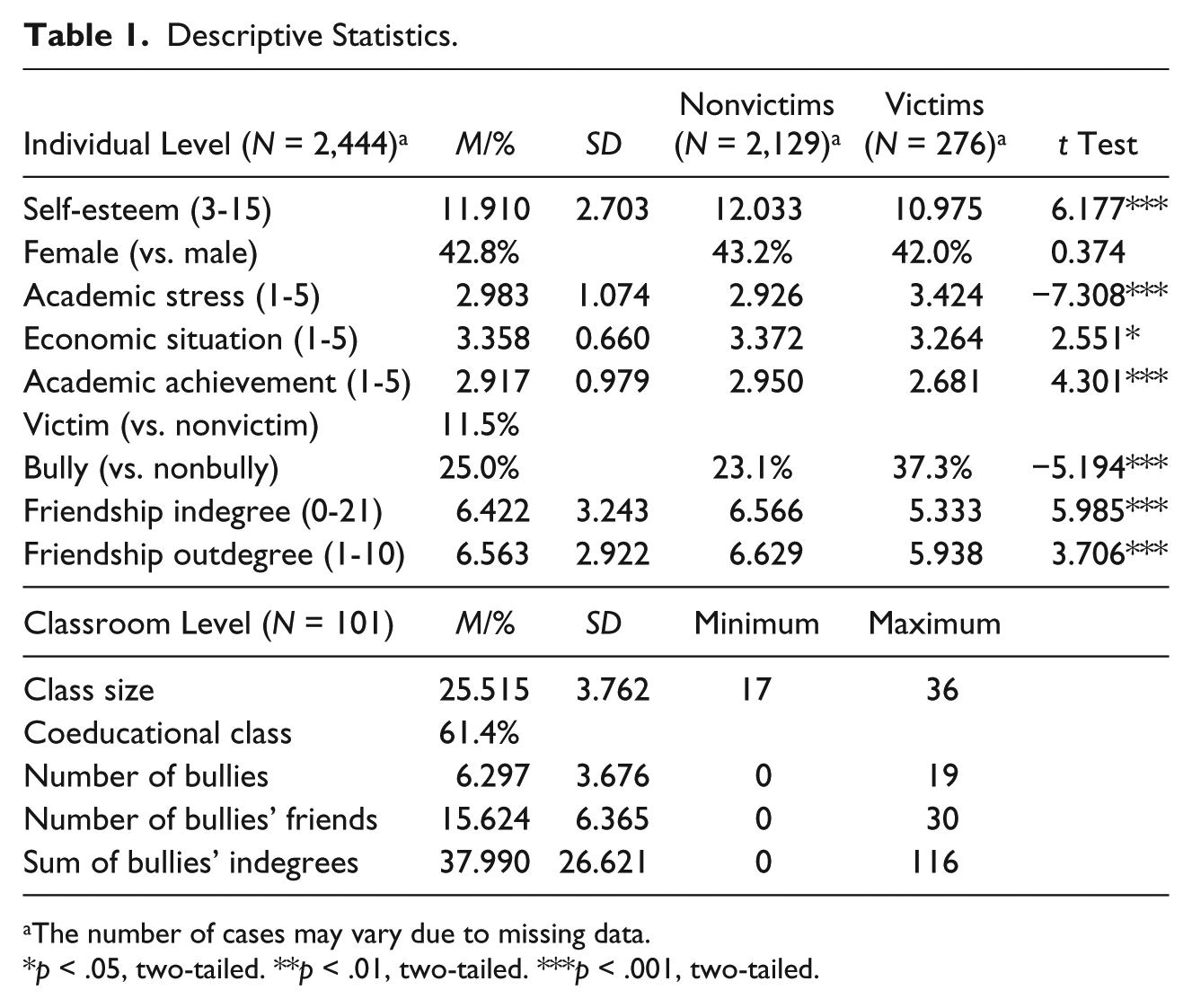
Table 1 summarizes descriptive statistics of variables in the analysis. Classroom-level statistics show that about 61.4% of 101 classes are coeducational (mixed gender) and that an average class has about 26 students. Individual-level statistics reveal that students have relatively high levels of self-esteem in combination with middle levels of academic stress and achievement. They also assess their economic situations to be slightly better than average.
Descriptive Statistics.
The number of cases may vary due to missing data.
p < .05, two-tailed. **p < .01, two-tailed. ***p < .001, two-tailed.
More importantly, about 11.5% of students reported having been bullied during the past semester, whereas about 25.0% of students were reported as having bullied classmates during the same term. These results imply that a classroom housed twice as many bullies as the number of victims and suggest that bullying is not inflicted on many students by a handful of deviant students. Rather, the act of bullying is repeatedly perpetrated on a handful of students (e.g., two to three students in a classroom of a mean size) by a much larger number of students (e.g., six to seven students) although 37.3% of students who were once victims of bullying have also bullied others.
It is also notable that the average outdegree of friendship is comparable to that of the indegree, though slightly larger. Students’ report on their friendships seemed to be fair, in general, without serious overreporting. Comparisons between victims and nonvictims in Table 1 observed that victims of bullying have significantly smaller friendship indegrees than do nonvictims (t = 5.985) and, though to a lesser degree, also significantly smaller outdegrees (t = 3.706). In addition, victims suffer from lower self-esteem (t = 6.177), greater academic stress (t = −7.308), and poorer academic performance (t = 4.301) than nonvictims.
The average number of bullies in a classroom is 6.30, roughly a quarter of an average class size, which is consistent with the percentage of bullies at the individual level in the same table. The average size of bullies’ indegree friends is 15.62, which implies that about 60% of students reported at least one bully as a close friend in a classroom. The sum of bullies’ indegrees had an average of 37.99, which is more than twice as large as the number of bullies’ friends (15.62). This finding suggests that a student who reported a bully as a friend tended to also report another bully as a friend. We can infer that bullies are connected by mutual friends and belong to supportive friendship networks.
Classroom-Level Bullies’ Friendship Networks and Self-Esteem
Table 2 presents estimates from a series of multilevel regressions. Across the five models, students’ self-esteem shows a much larger variance between students within a classroom than between classrooms, net of all the predictors. Model 1 tells us that female students have significantly lower self-esteem as compared with male students. Greater academic stress, poorer economic situation, and lower academic achievement all harm students’ self-esteem. Concerning the experience of bullying, being a victim is associated with lower self-esteem, whereas being a bully is not. Given a substantial overlap between victims and bullies, we tried estimating an interaction effect between being a victim and being a bully but found a nonsignificant effect (p = .738; data not shown). Being a victim seems to have a harmful effect, independent of whether bullying others or not. Neither class size nor coeducation affects the average level of self-esteem in a classroom.
Multilevel Regressions for Self-Esteem.

Note. No. of students = 2,397. No. of classrooms = 101. Unstandardized coefficients with standard errors in parentheses.
p < .05, two-tailed. **p < .01, two-tailed. ***p < .001, two-tailed.
The second model, Model 2a, adds friendship variables at the individual level and the number of bullies at the classroom level. Both friendship indegree and outdegree enhance self-esteem, which confirms that friendship is very important for adolescents’ self-esteem. More bullies in a classroom lower the average self-esteem of students in the classroom (p < .5).
The next models, Models 2b and 2c, are to test Hypothesis 1 (the popularity of bullies in a classroom is adversely associated with the self-esteem of the other students in that classroom) and they include different indictors regarding respondents’ friendship with bullies. In Model 2b, the number of bullies’ indegree friends in place of the number of bullies is not statistically significant, which suggests that bullies’ friendships may not matter, beyond the number of bullies as a context in a classroom. Model 2c, however, shows a significantly harmful effect of the sum of bullies’ indegrees (p < .01), which supported our Hypothesis 1.
It is noteworthy that, when comparing variance components between Model 2a and Model 2c, the sum of bullies’ indegrees explained between-classroom variance better than did the number of bullies (0.118 vs. 0.133). This effect in Model 2c is also robust in an additional model, Model 3, wherein the number of bullies’ friends is controlled. Given a fixed number of bullies’ friends in a classroom, four more friendship ties from them to bullies harms students’ self-esteem (= −0.011 × 4) as much as the existence of one more bully in a classroom (= −0.040 in Model 2a). Cohesive friendship between bullies and their friends is no less harmful than bullies themselves. When both the number of bullies and the sum of their indegrees were introduced in the same model, it is only the sum of bullies’ indegrees that was statistically significant. The model is not presented in Table 2 because the two variables are highly correlated (r > .9).
Differential Effects of Classroom-Level Bullies’ Friendship Networks Across Victims and Nonvictims
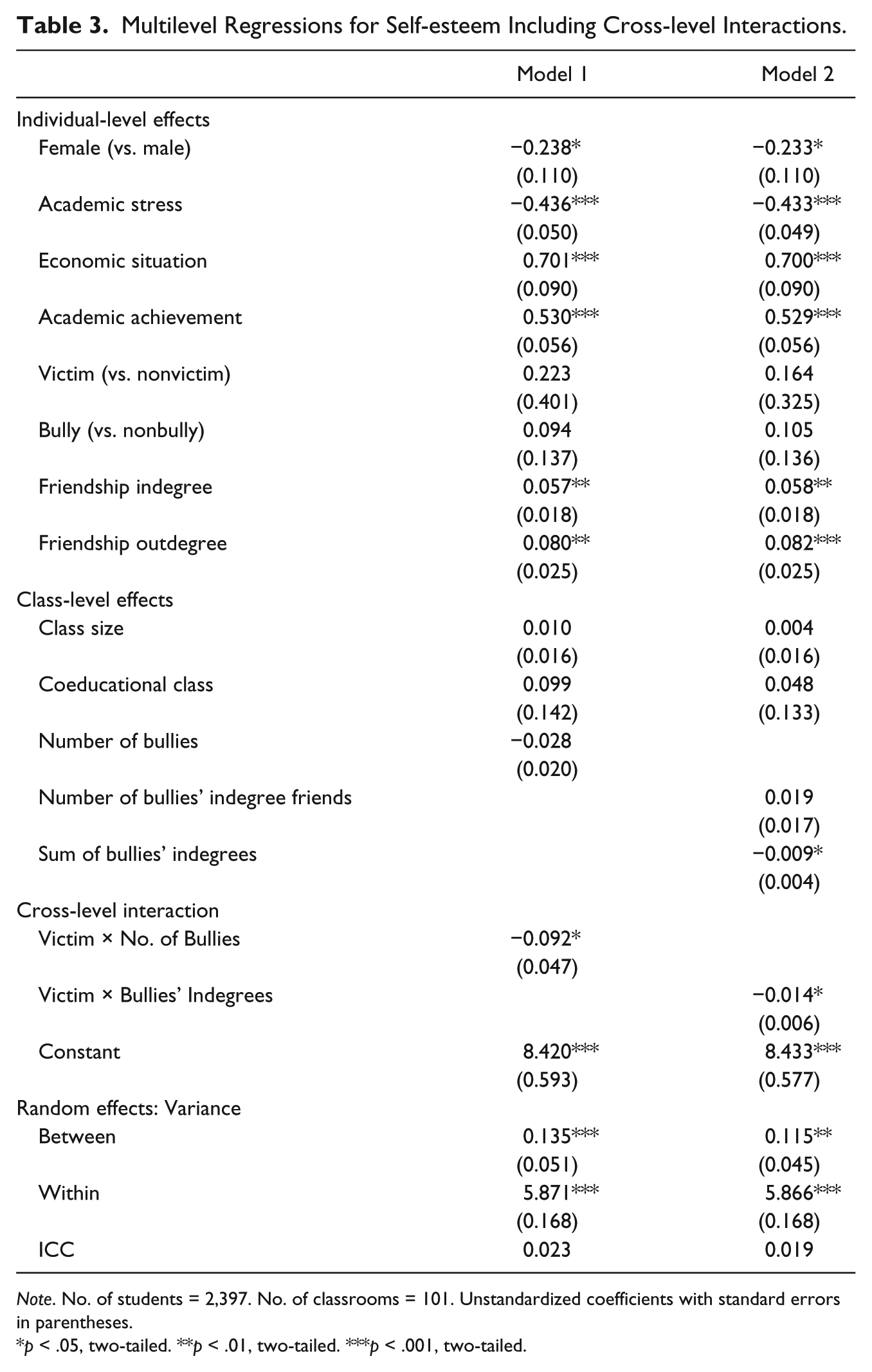
Table 3 presents analytic results including cross-level interactions between having been a victim and the number of bullies for Model 1, or the sum of bullies’ indegrees for Model 2. Model 2 is to test our Hypothesis 2, that is, the popularity of bullies in a classroom is more adversely associated with the self-esteem of victims than with the self-esteem of the nonvictims in that classroom. Both interactions are negative and statistically significant: both the number of bullies and the sum of their indegrees have a stronger contextual effect in a classroom for victims than for nonvictims. However, an interesting contrast between the two models is revealed while comparing the main effects between the two models. The main effect for the number of bullies in Model 1 is not significant, whereas that for the sum of their indegrees is significant in Model 2. In other words, more bullies in a classroom do not necessarily harm nonvictims’ self-esteem, but more friendship ties to bullies do. It is not more bullies but rather bullies’ cohesive friendships that form commonly harmful contexts for nonvictims as well as for victims. At the same time, we detected a stronger harmful effect in victims. Victims’ self-esteem is harmed more than that of nonvictims when bullies form cohesive friendship networks with classmates. Thus, it can be concluded that Hypothesis 2 is supported.
Multilevel Regressions for Self-esteem Including Cross-level Interactions.
Note. No. of students = 2,397. No. of classrooms = 101. Unstandardized coefficients with standard errors in parentheses.
p < .05, two-tailed. **p < .01, two-tailed. ***p < .001, two-tailed.
Figure 2 depicts the relationship between the sum of bullies’ indegrees and self-esteem estimated in Model 2 of Table 3. It shows that the levels of self-esteem for nonvictims as well as for victims decreased as the sum of bullies’ indegrees increased at the classroom level, although the decreasing slope is much steeper for victims (−.0225 vs. −.0087).
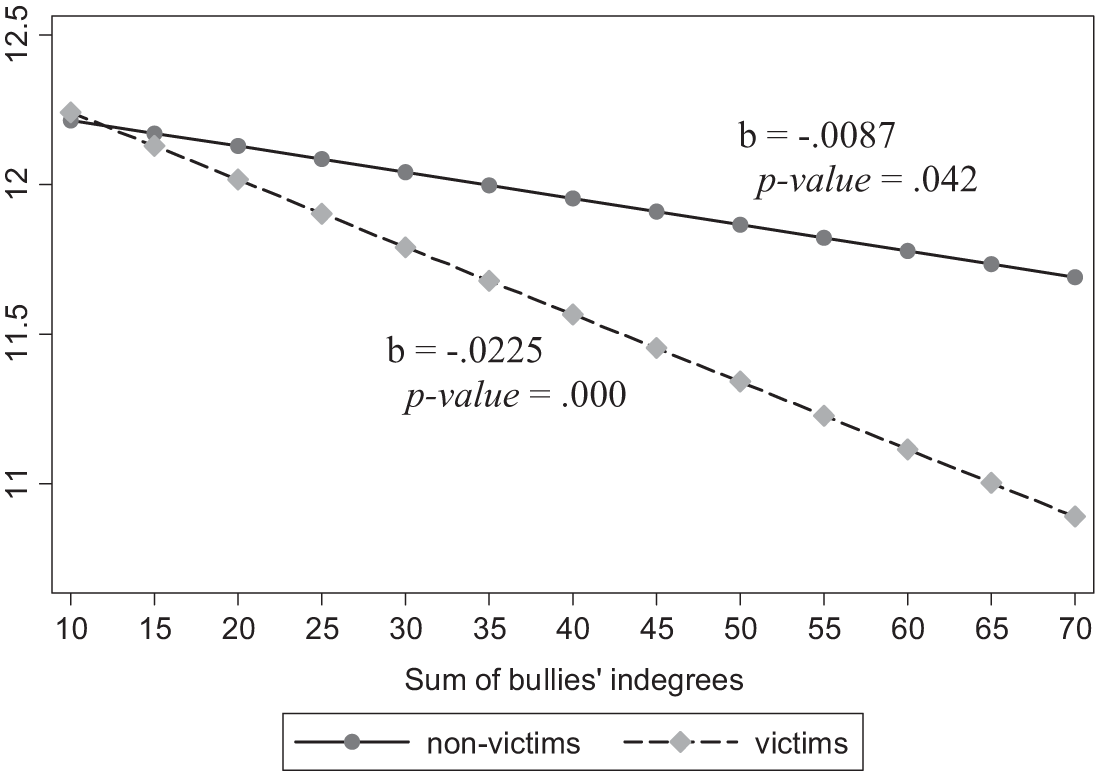
Predicted self-esteem of victims and nonvictims by classroom-level sum of bullies’ indegrees.
Discussion
Our analysis confirmed what previous studies observed: Students’ self-esteem is harmed by victimization from bullying and is enhanced by the existence of friendships (Boulton et al., 2010; Holt & Espelage, 2007). From this, we considered how students’ self-esteem would be affected by bullies’ friendship networks at the classroom level. Our analysis at the classroom level revealed that the overall popularity of bullies among their classmates exerts its own, unique, harmful effect on nonvictims, albeit in a less acute manner than on direct victims of bullying. Classroom-level bullies’ friendship networks were negatively associated with the self-esteem of students in the classroom even after controlling for whether or not a respondent had ever been bullied. Our nuanced analysis further revealed that the harmful effects of bullies’ popularity are not associated with the mere number of bullies’ friends but rather with the existence of cohesive friendship networks between bullies and their friends.
How does bullies’ popularity at the classroom level have harmful effects on the self-esteem of nonvictims as well as that of victims? First of all, given that being a nonvictim (bystander) also leads to negative feelings and emotions (Chen et al., 2016), being in a classroom wherein bullies have greater friendship networks may amplify these negative emotions by increasing the chances of indirect exposure to bullying. Bystanders experience negative emotions such as disgust and anger toward bullying and have conflicting feelings such as guilt, anger, fear of becoming the next victim, and threats to personal safety (Chen et al., 2016; Lodge & Frydenberg, 2005), which might have a harmful effect on self-esteem. In the classroom, where bullies obtain greater popularity or dominance, even uninvolved students might experience greater negative emotions and feelings of vulnerability, affecting their self-esteem.
Moreover, more cohesive popularity or dominance of bullies in a classroom can be harmful to classroom social cohesion, which in turn shapes a favorable context for bullying. Bullying behaviors can be reduced by positive school or classroom context such as respectful and supportive relationships, a higher level of trust and quality of relations among students, and increased collective efficacy (Low et al., 2014; Olsson et al., 2017; Springer et al., 2016). A study has also reported that bystanders are more likely to intervene in bullying if they are friends with the victims (Chen et al., 2016). It is probable that victims have fewer friends in the classroom with more cohesive bullies’ friendship networks, which reduces supportive relationships for the victims and worsens classroom social cohesion. Greater cohesion in bullies’ friendship networks may lower classroom social cohesion, which threatens the self-esteem of both nonvictims and victims.
In addition, in our data, there were more bullies than victims (25% vs. 11%), bullies were more popular than victims among classmates (6.0 vs. 5.3 average friendship indegree), and an average of 60% of students reported at least one bully as a close friend in the classroom. These observations together suggest that bullies have a relatively large base of classmate supports and, if those support networks are interlocking, bullies’ friendships can form a collective context for lowering self-esteem in a classroom. The avoidance of being a victim or of having a bully friend cannot protect students from this harmful context. Any student may feel vulnerable, helpless, or even guilty, which will eventually lower one’s self-esteem.
It should be also clearly noted that bullies’ friendship networks at the classroom level can be more harmful to victims, although it is also deleterious to the self-esteem of nonvictims. As the sum of bullies’ friendship indegrees increased, the self-esteem of respondents who had ever been bullied sharply decreased. As bullies’ friendship networks become more cohesive, victims might experience greater fear, anger, and helplessness. If bullies have more cohesive popularity, victims are more likely to be isolated from other classmates and experience lower social support, which can further harm victims’ self-esteem.
We have conducted supplementary analyses examining a cross-level interaction between classroom-level bullies’ friendship networks and whether or not a respondent is a bully in the classroom. The interaction was not significant (data not shown here), which means that classroom-level bullies’ friendship networks do not have differential effects on self-esteem between bullies and nonbullies. Another set of supplementary analyses examining respondents’ friendships with bullies in the classroom was also conducted (data not shown here). We measured two different indictors regarding respondents’ friendship with bullies: specifically (a) whether or not a respondent has a bully as a close friend in the classroom and (b) the number of bullies among the friends to whom a respondent is close. Neither variable was significant, so they were excluded from our analyses.
It should be noted that the classroom context in Korean middle schools might be related to our findings. Given that students do not move between classrooms for different subjects but, instead, subject teachers come to each classroom, classroom climate might be more impactful to students in the classroom setting. Students who stay with the same group of classmates throughout the year could be more vulnerable to a negative classroom climate where bullies have great popularity and potential victims have few alternative relationships outside the classroom. On the contrary, students in classrooms without bullies may benefit from a positive classroom environment where there is no anxiety about changing into different classrooms where there are bullies. In short, the negative effect of bullies’ popularity on students’ self-esteem within a classroom could be weaker in other contexts where students were more mobile between classrooms. Those students instead might become more exposed to bullies from other classrooms and vulnerable to school-level contexts rather than classroom-level contexts. Answering these possibilities will need further comparative studies.
Our findings suggest that teachers need to figure out the composition of students’ friendships and not just the number of bullies and bullying incidents in the classroom to decrease the harmful effects of bullying on students. Our analysis revealed that it is not the overall number of bullies’ friends but the number of common friends between bullies (i.e., the sum of bullies’ indegrees) that really matter beyond direct interactions between bullies and their victims. It would be most effective if practitioners could identify bullies’ potentially common or even central friends and intervene in their friendship formation in their attempt to discouraging bullying and improve students’ overall self-esteem. Students should be also educated that bullying is harmful not only to victims but also to all students in the classroom.
There are several limitations to this study. First, we cannot guarantee causality between bullying and self-esteem because the data used are cross-sectional. It is possible that self-esteem affects bullying behaviors (Gendron, Williams, & Guerra, 2011). We did, however, determine that individual self-esteem is not highly likely to affect classroom-level contexts such as bullies’ friendship networks. Further study analyzing longitudinal data should be completed. Second, there were limitations of our questionnaire in terms of its ability to capture frequency and types of bullying and diverse information on respondents such as objective levels of family socioeconomic standing and respondents’ academic achievement. Third, as mentioned above, our findings might be also specific to the classroom setting in Korea. Further studies in other countries with different classroom settings should be conducted to examine whether and how the harmful effects of bullies’ popularity could vary. Finally, friendship formation and the networks of children and adolescents are not fixed, but can change over time. Our study did not capture changes in friendship networks for a whole year in a classroom and the associated impact on self-esteem.
Despite these limitations, this study extends our previous knowledge regarding the effects of bullying on self-esteem by identifying the contextual effect of bullies’ friendship networks at the classroom level. Bullies’ popularity in the classroom was adversely associated with the self-esteem of students, although it is more harmful for victims’ self-esteem than for that of nonvictims. This study suggests that even indirect exposure to bullying in a classroom in which bullies have extended networks of friends may decrease one’s self-esteem by leading to negative emotions such as anger, anxiety, fear, and/or guilt in nonvictims. It should be also noted that a supportive friendship network of bullies amplifies the harmful effect of bullying victimization on self-esteem. School intervention programs should consider factors beyond direct interactions between bullies and their victims including classroom-level bullies’ friendships. Intervening in the relationship between bullies and victims would not be efficient if bullies have cohesive popularity in the classroom. Practitioners need to develop intervention programs to improve positive friendships and cohesion among all classmates.
Footnotes
Declaration of Conflicting Interests
The author(s) declared no potential conflicts of interest with respect to the research, authorship, and/or publication of this article.
Funding
The author(s) disclosed receipt of the following financial support for the research, authorship, and/or publication of this article: This work was supported by the National Research Foundation of Korea Grant funded by the Korean Government (NRF-2016S1A3A2925033).
