




Abstract
Offense process models are descriptive theories that provide a temporal outline of an offense—including its cognitive, behavioral, contextual, and motivational components—from a perpetrator’s perspective. Offense process models have been developed for a wide range of criminal offending (e.g., alcohol-impaired driving, child sexual offending, rape, aggravated robbery, homicide), but remain underdeveloped for family violence. The purpose of this study was to develop an offense process model of family violence. We conducted individual semistructured interviews with 27 participants—14 men and 13 women—completing community-based family violence perpetrator treatment programs, and systematically analyzed participants’ narratives of family violence events using grounded theory methods. The resulting event process model of family violence (FVEPM) contains four sections, arranged temporally from the most distal to the most proximal factors in relation to the family violence event: (1) background factors, (2) event build-up, (3) event, and (4) post-event. Each section outlines the cognitive, behavioral, contextual, and motivational factors that contribute to family violence perpetration. The FVEPM is the first attempt to consider whether a single offense process model can account for a broader range of family violence than that used solely by men toward their female intimate partners. Furthermore, the FVEPM highlights the dynamic nature of family violence events (FVEs), and the salient role of situational and interpersonal factors in contributing to family violence perpetration. We argue that the FVEPM has the potential to accommodate a range of types of family violence perpetration, and makes a useful contribution to theory and research on event-based models from a perpetrator perspective.
The systematic development of models of family violence (FV) events represents a key component of FV theory development. Following Ward and Hudson’s (1998) metatheoretical framework, theory development for criminal offending spans three distinct but interconnected levels. First, Level I theories are multifactorial and global; they lack detail about the phenomena they seek to explain, but integrate multiple potential explanatory factors from different levels. A number of Level I theoretical frameworks have been developed in the FV field, including ecological frameworks of intimate partner violence (IPV; Dutton, 2006) and child abuse and neglect (CAN; Cicchetti, Toth, & Maughan, 2000).
Level II theories focus on a specific component of a Level I theory. This component is typically viewed as a mechanism, so Level II theories unpack how the component—often in interaction with others—contributes to offending. For example, traditional sex-role ideology is a risk factor for IPV perpetration (Stith, Smith, Penn, Ward, & Tritt, 2004) for which multiple theoretical explanations have been proposed (e.g., Pence & Paymar, 1993).
Level III theories are descriptive theories of the offense process. Level III theories provide a temporal outline of an offense, including its cognitive, behavioral, contextual, and motivational components (Ward, Polaschek, & Beech, 2006). Descriptive accounts of the offending process are gathered from offenders themselves, and are systematically analyzed using grounded theory methods (Strauss & Corbin, 1990) to produce a model grounded in the offender’s perspective (Ward, Louden, Hudson, & Marshall, 1995). Background factors relevant to the offense, and transitions between each phase of the offense process, are also set out. Ward et al. (1995) were the first to develop an offense process model—of child sexual offending—using grounded theory methods. Offense process models have since been developed for offenses such as alcohol-impaired driving (Wilson, Ward, & Bakker, 1999), rape (Polaschek, Hudson, Ward, & Siegert, 2001), aggravated robbery (Nightingale, 2002), homicide (Cassar, Ward, & Thakker, 2003), sex offending by women (Gannon, Rose, & Ward, 2008), and violent offending (Chambers, 2006; Murdoch, Vess, & Ward, 2012). Collectively, these offense process models make a valuable contribution to understanding harmful behavior, from the perspectives of those who carry out this behavior.
In the FV field, etiological theories play a crucial role in informing intervention and prevention approaches and suggesting potential avenues for future research (Dixon, Graham-Kevan, 2011). Significant advances have been made, both in the empirical understanding of risk factors implicated in Level I and II theories (e.g., Stith et al., 2009; Stith et al., 2004) and in the development of Level I and II theories themselves. However, accounts of how individual risk factors for FV perpetration interact with situational and interpersonal variables—and with each other—during a FV event (FVE) remain sparse. As such, we continue to have limited understanding of the interpersonal and intrapersonal processes involved in, and the dynamic nature of, FVEs (Wilkinson & Hamerschlag, 2005). Examining FV perpetration within the context in which it occurs, as part of a sequence of interaction during a FVE, has the potential to provide a richer and more complete explanation of FV (Gnisci & Pace, 2016). Notwithstanding the limitations of perpetrator self-report, perpetrators have access to information about event processes (e.g., thoughts, feelings, perceptions) that are not available from any other perspective.
Although offense process models offer a useful framework for systematically examining a FVE, there is only one such model to date (Drummond, 1999). Drummond’s (1999) model was developed from the accounts of 10 New Zealand European men who had perpetrated physical IPV toward their female partner; the majority were imprisoned for this offense at the time of the research. The model contains four phases: background factors (e.g., the offender’s upbringing, relationship history, and violence history), offense context/build-up (e.g., victim/offender, relationship, and environmental characteristics), offense (e.g., the sequence of interpersonal and intrapersonal processes leading up to and during the offense), and post-offense (e.g., cognitive, behavioral, and affective processes following the offense). Drummond’s model highlighted the need to consider the dynamic processes involved in IPV events, including the changing nature of intrapersonal processes (e.g., decreasing cognitive control, escalating anger) and the dyadic interactional sequences preceding IPV perpetration. Nevertheless, this initial effort had some important limitations. First, Drummond (1999) did not identify distinct offending pathways for individual perpetrators; however, the heterogeneous and complex nature of IPV perpetration suggests that these are likely to exist (Bell & Naugle, 2008). Second, Drummond did not consider IPV perpetrated by women, or non-IPV forms of FV (e.g., CAN). Although distinctions between types of FV may be important in the academic and research literature, in practice, a wide variety of types of FV may be found among people referred to treatment for FV perpetration. This diversity supports the importance of understanding similarities between types, and of developing more inclusive frameworks of FV perpetration so as to provide a coherent intervention approach. Research suggests considerable overlap—both in terms of co-occurrence and etiology—between different types of FV (e.g., IPV and CAN; Dixon & Slep, 2017; Slep & O’Leary, 2005), supporting the inclusive approach taken here.
This study expands upon Drummond’s (1999) research by exploring FV in its broadest sense, including acts of psychological and physical FV toward intimate partners, children, and other family members. 1 The aim of the current study is to develop an offense process model of FV that (a) captures variation in the offense process; (b) is based on the narratives of a more diverse range of perpetrators—including women—accessing community intervention programs; and (c) provides insight into the dynamic nature of situational, interpersonal, and intrapersonal factors that influence FV perpetration during a FVE.
Method
Participants
Twenty-seven participants—14 men and 13 women—took part in this study. All participants were completing a community-based FV perpetrator treatment program at the time of their involvement in the research. Most participants were referred to the program for FVEs that included physical FV, but some were referred following FVEs that included only psychological—that is, not physical—FV. Fourteen participants—mainly men—were completing the program on a mandated basis as part of a community-based sentence (n = 6), as a condition of a protection order (n = 5), or following a FV-related prison sentence (n = 3). The remaining 13 participants—mainly women—were completing the program voluntarily; six were encouraged to attend by a legal or social service professional. Participants ranged in age from 22 to 50 years (M = 34.44, SD = 7.52) and identified as New Zealand Māori (44%), New Zealand European (30%), Pasifika (7%), or as having multiple ethnicities (19%; e.g., New Zealand Māori/European). Ten participants were unemployed, seven worked full-time, five were stay-at-home parents, four worked part-time, and one was a full-time student.
Procedure
Participants were recruited over a 24-month period from three FV service providers: two in the North Island and one in the South Island of New Zealand. Differing recruitment methods were used for each agency: Participants were recruited either directly through the first author’s (M.S.) attendance at their treatment program (n = 8), or indirectly through being informed of the research by their treatment provider (n = 19). Regardless of the initial recruitment procedure, M.S. met individually with each potential participant in a private room at the treatment agency. After providing informed consent, participants took part in a semistructured interview (i.e., participants’ observations interspersed with M.S.’s standardized prompts). Interviews ranged in length from 46 to 120 min (M = 78 min). Participants were asked to provide a detailed description of a specific FVE in which they had perpetrated FV, as well as any factors they perceived to be important in understanding why the FVE occurred. Participants were given a $30 voucher for their participation. All interviews were audio-recorded and transcribed by M.S. or a professional transcription service; M.S. reviewed each written transcript to ensure its accuracy.
Analytic Strategy
Participants collectively described 32 FVEs in which they perpetrated physical (and usually also psychological; n = 28) or only psychological (n = 4) FV against an intimate partner (n = 26), child (n = 3), sibling (n = 2), or parent (n = 1). Preliminary analysis revealed that FVEs involving physical FV and only psychological FV were conceptually similar, as were FVEs that involved partners and non-partners as event victims. As such, event narratives for all types of FVEs were included in data analysis. Many participants described FVEs involving their most severe act of FV in their relationship with the event victim. Alternatively, some participants described their most recent act, whereas others described their most memorable (e.g., the first time they had used FV). Acts of physical FV ranged from a single push that resulted in no physical injury, to acts of sustained or severe physical force (e.g., strangulation, use of a weapon) that resulted in significant injury (e.g., loss of conscious, a severed limb) to the event victim.
M.S. carried out data analysis using NVivo software. Grounded theory methodology and methods—as outlined by Strauss and Corbin (1990)—informed data collection and analysis. Grounded theory was selected because it seeks to explain and account for variation in human behavior, acknowledges the importance of context in understanding action and interaction, privileges a bottom-up approach to theory development, and is a particularly useful approach in the absence of alternative theories that adequately explain the phenomena of interest (Strauss and Corbin, 1990).
Consistent with a grounded theory approach, interviews were analyzed in sets of 1-4 to allow for iterative periods of data collection and data analysis. Initially, M.S. read each transcript multiple times to familiarize herself with the data. Next, M.S. methodically read each transcript on a line-by-line basis, identifying and then labeling individual meaning units. New, existing, and revised codes were applied to meaning units as data collection and analysis continued. Over time, conceptual links between meaning units began to emerge, tentative categories and sub-categories were developed and refined, and relationships between and within categories were identified and explored. Enduring categories were organized into interrelated paradigms and grouped into discrete sections based on their temporal proximity to the FVE. M.S. regularly discussed the emerging model with the second and third authors. Following analysis of the first seven transcripts, a preliminary model of the event process was developed. This preliminary model was used to guide data collection and analysis for a further eight interviews, resulting in a revised version of the preliminary model. The revised model was tested and refined over the course of two further “waves” of interviews until theoretical saturation occurred.
Results
As shown in Table 1, the event 2 process model of FV (FVEPM) comprises 55 categories organized into eight interrelated paradigms. These paradigms are grouped into the following four sections, arranged temporally from the most distal to the most proximal factors in relation to the FVE: (1) background factors, (2) event build-up, (3) event, and (4) post-event. The FVEPM contains three entry points—two in Section 1 and one in Section 2—at which different participants enter the model based on their reported experiences. For example, the third entry point in Section 2 identifies that some participants did not report experiencing any Section 1 categories. Each section will be described in turn. To assist the reader, category headings are written in bold and subcategory headings are written in italics.
Overview of the Event Process Model of Family Violence.

Section 1: Background Factors
As shown in Figure 1, Section 1 pertains to aspects of participants’ upbringing and early relationship histories deemed relevant to the FVE. Section 1 contains two entry points and 14 categories, organized into two interrelated paradigms. Black arrows denote Paradigm 1.1 and gray arrows denote Paradigm 2.2. Dotted arrows represent dynamic processes that induce change within and between other categories. Each paradigm will be described in turn.
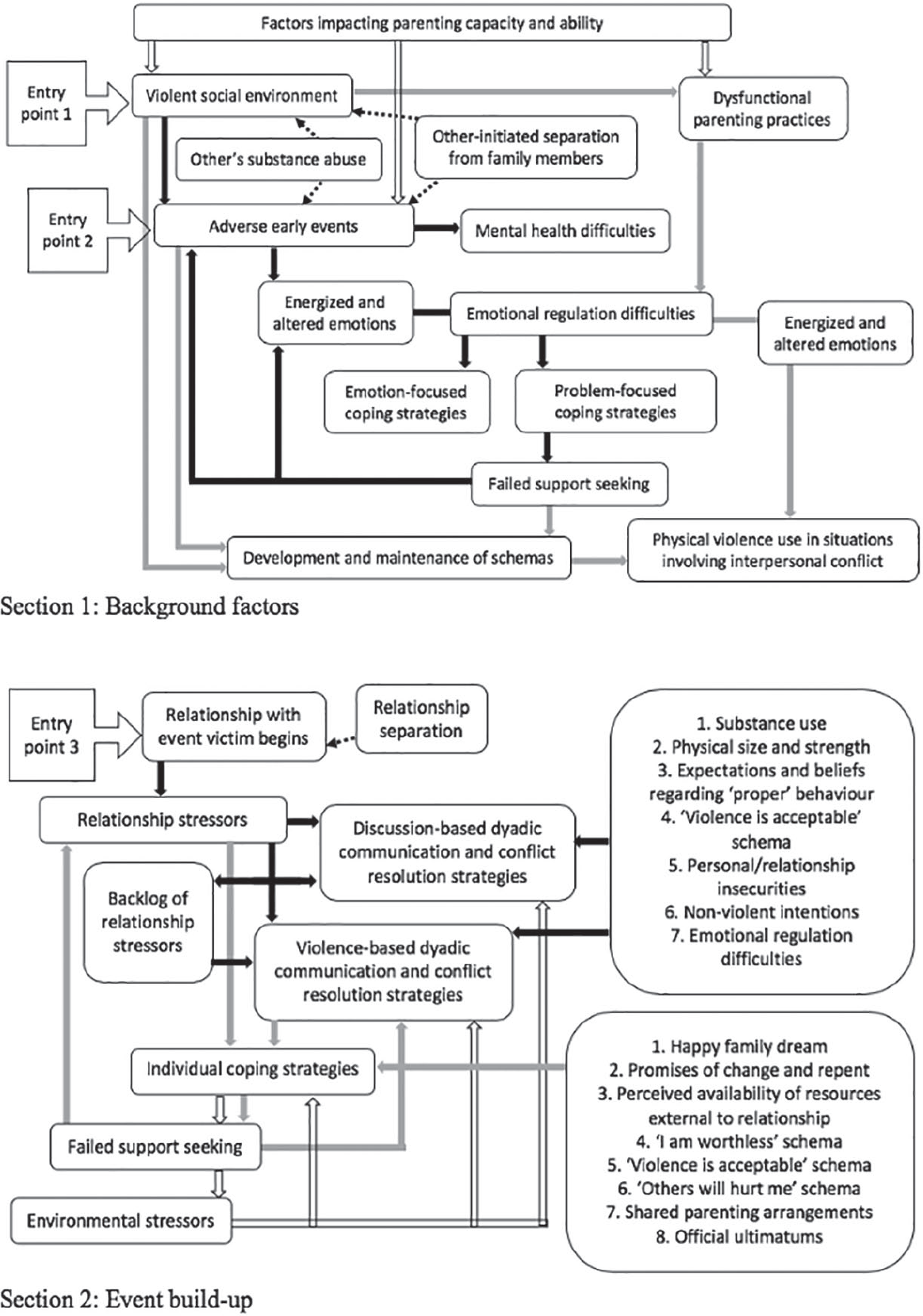
Sections 1 and 2 of the event process model of family violence.
Paradigm 1.1. Experiencing and managing adverse early events
Participants typically described either being raised in a
Within the context of their
Paradigm 1.2. Schema development and physical violence use
Participants’ experiences as outlined above resulted in their
Section 2: Event Build-Up
As shown in Figure 1, Section 2 pertains to participants’ relationship histories with event victims and the environmental context in which FVEs occurred. Section 2 contains one entry point and 24 categories, organized into three paradigms. Black arrows denote Paradigm 2.1, gray arrows denote Paradigm 2.2, and white arrows denote Paradigm 2.3. As in Section 1, dotted arrows represent dynamic processes that induce change within and between other categories. Each paradigm will be described in turn.
Paradigm 2.1. Dyadic communication and conflict resolution strategies
As represented by the third entry point in the FVEPM, a small number of participants did not grow up in a
Paradigm 2.2. Individual management of relationship stressors and relationship violence
Independent of the dyadic strategies listed above, many participants used
Paradigm 2.3. Experiencing and managing environmental stressors
Participants experienced a range of
Section 3: Event
As shown in Figure 2, Section 3 pertains to the FVE itself. This section contains 11 categories organized into two interrelated paradigms. Black arrows denote Paradigm 3.1 and gray arrows denote Paradigm 3.2. Each paradigm will be described in turn.

Sections 3 and 4 of the event process model of family violence.
Paradigm 3.1. Initiation of verbal interaction and conflict escalation
FVEs began with one person’s
Participants often
Paradigm 3.2. Script activation
Alternatively, in the absence of
Section 4: Post-Event
As shown in Figure 2, Section 4 pertains to the aftermath of the FVE. This section contains six categories organized into one paradigm.
Paradigm 4.1. Aftermath of the family violence event
Following the FVE, participants made negative or positive
Discussion
This study developed the FVEPM by systematically analyzing perpetrators’ first-person narratives of FVEs using grounded theory methods. The FVEPM represents one of the first attempts to construct an event-based model of FV, following established research on offense process models for various types of criminal offending. It is also the first attempt to consider whether a single model can account for a broader range of FV than that used solely by men toward their female intimate partners. The FVEPM provides a temporal framework of the event process, including the affective, behavioral, cognitive, and contextual factors that influence FV perpetration. Furthermore, it identifies patterns within the process while still providing broad scope for individual variation. We begin this discussion by considering the key features of the FVEPM, including its relationship to existing FV and offense process theories and research. We then discuss potential clinical implications of the model, its limitations, and potential avenues for future research.
First, the FVEPM highlights the importance of participants’ upbringings and early relationship histories in providing them—or failing to provide them—with the necessary building blocks to effectively manage adverse life experiences and interpersonal conflict. Specifically, many participants identified how their early exposure to violent social environments, adverse events, and dysfunctional parenting practices contributed to the development of three core processes—violence-supportive schemas, ineffective or absent coping strategies, and emotional regulation difficulties—that provided them with an unhelpful base from which to navigate family relationships. These three processes were a salient feature of each stage of the FVEPM, as participants entered relationships with event victims in which they continued to experience adversity and interpersonal stressors. Nevertheless, many participants who were directly or indirectly exposed to physical violence did not go on to routinely use physical FV in their relationship with the event victim. Specifically, some participants developed a clear intention not to use physical FV toward the event victim, based on their determination not to “let history repeat itself.”
The FVEPM is consistent with Finkel’s (2008) account of how schemas, emotional regulation difficulties, and individual coping strategies may contribute to FV perpetration. Specifically, using self-regulation as an organizing framework, Finkel’s (2008; Slotter & Finkel, 2011) I3 model organizes these phenomena into factors that impel, instigate, or inhibit FV; individual experiences determine the category to which each phenomenon belongs. Importantly, the I3 model accounts for the dynamic transition of these phenomena between each stage of the offending process; for example, participants’ use of individual coping strategies to manage relationship stressors may ordinarily inhibit their FV perpetration by providing temporary emotional relief. However, over time, their repeated unsuccessful use of these strategies may create a context (e.g., backlog of relationship stressors, depleted emotional and cognitive resources) that facilitates FV perpetration upon the further occurrence of a relationship stressor.
Second, the FVEPM highlights the dynamic nature of FVEs and the salient role of situational and interpersonal factors in contributing to FV perpetration. Consistent with Drummond’s (1999) offense process model, many participants reported experiencing changes in affect (e.g., increasingly energized emotions) and cognition (e.g., violence-supportive cognitions), as well as changes in their own and the event victim’s behavior (e.g., from engaging in verbal conflict to psychological FV to physical FV) as the FVE unfolded. FVEs began when one person—usually the participant—decided that the other person’s behavior was unacceptable in some way. These dynamic processes then facilitated participants’ initial and ongoing strategy reselection throughout the FVE. Importantly, participants’ initial strategy selection typically involved non-physically violent acts; however, as the conflict continued to escalate and initial acts proved unsuccessful in achieving their ultimate goal, participants increasingly utilized acts of physical FV. Similarly, participants frequently described shifting from a compliance to a harm intention as their ultimate goal remained unrealized. In large part, participants attributed the dynamic nature of their strategy reselection to the incompatibility of event victims’ responses with the goals set by the participant at the time of the initial appraisal of unacceptable behavior. Consistent with Drummond’s (1999) offense process model, participants often reported that event victims’ actions during the FVE facilitated their FV perpetration. For example, in approximately one third of FVEs, participants’ physical FV perpetration was precipitated by event victims’ own physical FV use; itself a reaction to participants’ acts. This point is raised not in an attempt to “blame the victim” but to illustrate the need to accurately evaluate potential interaction patterns between participants and event victims to fully understand patterns of FV perpetration. Although participants’ behavior can be understood as goal-directed, their strategies for achieving such goals—as well as the goals themselves—are adjusted in response to event victims’ behavior throughout the FVE. These adjustments following an evaluation of event victims’ behavior is consistent with earlier offense process research (e.g., Polaschek et al., 2001) and with crime science research on violent events (e.g., Topalli, Jacques, & Wright, 2015).
Comparison of the FVEPM to offense process models for violent (Cassar et al., 2003; Chambers, 2006; Murdoch et al., 2012) and sexual (Gannon et al., 2008; Polaschek et al., 2001) offenses suggests that these offense types share common characteristics. First, perpetrators’ developmental experiences and their sequelae (e.g., schema development, emotional regulation difficulties) are emphasized across many of the offense process models and are similar across types. As in the FVEPM, perpetrators’ maladaptive coping styles, in combination with their experiences of acute and chronic stressors, are also commonly identified in the lead-up to an offense. Pertaining to the offense itself, Polaschek et al. (2001) and Murdoch et al. (2012) similarly reported that some perpetrators reevaluated and revised their initial offending goals, based on both their own evaluation of the current situation and victims’ behavioral responses. Finally, the influential role of contextual factors (e.g., substance use) on offense goals and strategies was a salient feature of most models.
A notable difference between the FVEPM and existing offense process models also emerged: Contrary to violent and sexual offenses, the FVEPM is not characterized by a distal planning component. Even when participants initiated interaction with event victims based on their perceived unacceptability of event victims’ behavior, they very rarely selected physical FV as an initial strategy. Rather, participants primarily enacted physical FV after a prolonged period of conflict escalation. Alternatively, FVEs characterized by the immediate selection of a physically violent act often occurred in the context of a strongly negative and unexpected event (e.g., discovering the event victim in bed with another person). This finding further illustrates the importance of understanding both perpetrators’ perspectives of a FVE, as well as the sequence of action and interaction that culminates in FV perpetration.
The FVEPM was developed so that it could accommodate (a) physical and psychological FV (b) perpetrated by men and women (c) toward intimate partners and other family members. That it could do so suggests that one descriptive framework may be sufficient to explain diverse forms of FV perpetration at the event level. Some important gender differences emerged; for example, female participants were considerably more likely than their male counterparts to report experiencing recent and chronic IPV victimization by the event victim. 4 However, these gender differences were more in degree than in kind; that is, no categories were uniquely experienced by men or women. In contrast, feminist perspectives argue that male- and female-perpetrated FV require separate theoretical explanations (Dobash & Dobash, 1979); this—along with separate theoretical approaches for CAN—has led to fragmentation of FV theory and research (Dixon & Slep, 2017).
Although understanding distinctive etiology and event topology is important, so too is understanding overlap and similarity, especially for theories needed to inform interventions that are intended to accommodate diverse types of FV perpetration. This approach also recognizes that people who act aggressively and harmfully toward one family member are at increased risk of doing so toward other family members (Dixon, Hamilton-Giachritsis, Browne, & Ostapuik, 2007); therefore, the aim of intervention is to reduce all forms of FV. This joined-up approach is evident in New Zealand whereby perpetrators of IPV, CAN, and other forms of FV typically attend the same group, separated only by gender.
Clinically, the FVEPM suggests four key intervention targets to reduce FV perpetration: violence-supportive schemas, emotional regulation difficulties, the selection and use of effective coping strategies to manage relationship and environmental stressors, and interpersonal communication and conflict resolution skills. Given the extended period of conflict escalation that preceded many participants’ physical FV perpetration, teaching participants to identify and respond to high-risk situations (i.e., those that lead to physical FV perpetration) in a manner that deescalates—rather than escalates—conflict may also be a useful treatment target. However, in mutually violent relationships, participants’ abilities to successfully resolve interpersonal conflict and deescalate high-risk situations may rely on event victims’ abilities to do the same. In this regard, from perpetrators’ perspectives, some event victims may benefit from learning the same skills taught to participants in intervention programs. Finally, the FVEPM suggests that a core focus of many prevention and intervention programs—men’s collective need to exert power and control over women—may not be a relevant treatment target for many FV perpetrators based on perpetrators’ accounts. Although many participants expressed their intention to ensure the event victim’s compliance during the FVE, participants typically described this intention as being temporary and situation-specific. Participants’ more global need to exert control over their partners was discussed within the context of their relationship history with the event victim; the majority reported that controlling behaviors were not a characteristic feature of their relationship. Although research suggests that perpetrators may minimize or deny their FV perpetration (Heckert & Gondolf, 2000), participants appeared willing to disclose perpetrating other forms of psychological and physical FV; this suggests that they would also be willing to disclose their use of controlling behaviors.
The study design presents a number of limitations. First, the small sample size limits the generalizability of the FVEPM. Specifically, only six FVEs did not involve an intimate partner as the event victim. Furthermore, this was a sample of community-based participants—including self-referrals—and therefore may be more likely to represent the lower-risk end of the spectrum. Consistent with this view, few participants reported their repeated use of physical FV within the relationship. Given the ongoing empirical debate regarding the potential existence of qualitatively different “types” of FV—characterized by patterns in the frequency, severity, and motives for FV perpetration (see Johnson, 1995)— event process models involving the uncharacteristic use of physical FV may differ from those involving characteristic physical FV use.
Second, the FVEPM was developed entirely from participants’ subjective accounts of FVEs. These accounts will differ from those reported by event victims or third parties (e.g., police, witnesses), based both on factors that create discrepancies in any event accounts (see, for example, the eyewitness literature, where multiple parties typically recall different versions that each believes is accurate) or a more deliberate intention to present oneself in a positive light (Heckert & Gondolf, 2000). Participants in this study were in various phases of program attendance and a number had self-referred for help. Most participants made direct links between their perceptions of their behavior and distortions developed as a consequence of childhood exposure to FV. They appeared willing to offer information that cast them in a negative light, including information that they reported they had not disclosed to the police or treatment providers regarding their role in the FVE, and information about intrapersonal processes (e.g., harm intentions) that may be viewed unfavorably by others. Reconciling higher level theory with perpetrator accounts of their own behavior—including sometimes self-serving distortions and plausible misunderstandings resulting from early socialization—is a core task of perpetrator treatment programs. Systematic models of these accounts may therefore help to achieve this task.
Third, the FVEPM was primarily constructed based on M.S.’s analysis of interview transcripts; therefore, there is potential for researcher bias—unconscious or otherwise—to influence model development. M.S. routinely discussed the developing model with the second and third authors and consistently used other strategies throughout data collection and analysis that help to minimize researcher bias (e.g., constant comparative analysis, theoretical sampling, and memo writing; all hallmarks of grounded theory methodology). The limitations described above are common criticisms of a grounded theory approach and are shared by all studies involving the development of offense process models; these limitations are arguably outweighed by the advantages of using qualitative methods (Ward et al., 1995).
One strength of the FVEPM sample is the large proportion of indigenous—New Zealand Māori—participants. Despite being disproportionately represented in New Zealand’s FV statistics (New Zealand Police, n.d.), Māori have seldom been included in this type of research. This study adds to a small body of research examining FV from the perspectives of Māori perpetrators in New Zealand. However, the unique nature of our sample makes it even more important that future research tests the generalizability of the FVEPM with larger and different samples, including those who perpetrate FV against non-partner family members, who characteristically use physical FV in their relationships with event victims (e.g., a high-risk sample; extension currently underway), and with a wide range of ethnicities. Furthermore, the utility of the FVEPM can be enhanced by identifying distinct pathways through the model; we report this research in Stairmand, Dixon, & Polaschek (2019). Offense (or event) process models are the foundation stone for higher levels of theory development (Polaschek, 2016), and we expect that this first attempt to construct a comprehensive event process model of FV—perpetrated by men and women toward intimate partners and other family members—will stimulate further replication and additional theoretical advances.
Footnotes
Acknowledgements
The authors thank the participants and their program providers for their involvement in this research.
Declaration of Conflicting Interests
The author(s) declared no potential conflicts of interest with respect to the research, authorship, and/or publication of this article.
Funding
The author(s) disclosed receipt of the following financial support for the research, authorship, and/or publication of this article: This research was supported in part by funding from the University of Waikato Doctoral Scholarship and the Sasakawa Ryoichi Young Leaders Fellowship Fund.
