




Abstract
One in five college women report being sexually assaulted with 23% to 45% of men reporting attempting or completing a sexual assault while attending a university. One important concept in preventing sexual assault is consent. It is important to ensure that when students are being asked to wait for consent, they understand what consent is and the potential ways it could manifest in a sexual situation. In total, 25 female and 20 male college students participated in semistructured focus groups or interviews to gain a better understanding of their perspectives of consent and how they ensure that it has been given. Results demonstrate that college students do not have a consistent, coherent, or precise definition of consent. Participants often described consent using vague language and were only able to clearly identify verbal indicators of consent. Much of the discussion of consent centered around an individual’s ability or inability to clearly and directly communicate his or her needs. Data also show that how students communicate about consent is influenced by gender expectations. There are multiple complicating factors when determining consent, including alcohol consumption. Participants discussed not understanding how to navigate sexual encounters when one or both parties had been consuming alcohol. Results also showed that there are multiple factors that may lead women to say yes to sex they don’t want, and men to not ask for consent. For college students, consent is a complex concept—a concept they may not have a practical and useful definition of. Sexual assault prevention must take steps to provide college students with a definition of consent informed by their experiences and the reality of their sexual encounters.
Introduction
Sexual assault affects one in four women in the United States (Smith et al., 2017) and disproportionately affects college women (Rape, Abuse & Incest National Network, 2018). College-age women are 3 times more likely to experience sexual violence or assault during their time at a university (Rape, Abuse & Incest National Network, 2018). College is also the time when men have the greatest likelihood to commit sexual assault, with recent studies demonstrating a perpetration rate between 23% (Zinzow & Thompson, 2015) and 45% (Malamuth, Huppin, & Linz, 2018).
Sexual assault has a unique and profound impact on college women, including detracting from the quality of their college experience (Fisher, Daigle, & Cullen, 2009). Victims may have difficulty resuming their regular daily activities, may perform poorly academically (Banyard et al., 2020), and may not be able to carry a full course load or contribute to the campus community (American Association of University Professors, 2012). They are also more likely to develop an eating disorder or posttraumatic stress disorder (American Association of University Professors, 2012). Due to the significant effects of sexual assault, including depression, anxiety, and suicidal ideation (Chang et al., 2015), it is imperative to understand all of the factors that contribute to the perpetuation of sexual assault on college campuses, including consent. Consent is the crux of sexual assault prevention programming. However, when students are asked to “wait for consent,” it is possible that each unique student has his or her own perspective of what consent is, the cues that indicate consent, and how to ensure that consent has been given. Therefore, it is imperative to understand how college students conceptualize consent to better address misperceptions through sexual assault prevention programming.
Feminist Framework
Feminism is a progressive movement that challenges the idea that a woman’s fate is determined by her gender (hooks, 2000) or archetypes and expectations imposed on her because of her gender. Feminism provides an excellent framework for exploring and analyzing beliefs about sexual assault, including perceptions of consent that may be based on gender normative expectations of behavior. There are multiple reasons, rooted in gender norms; women may say yes to sex they do not want to participate in. Women have been socialized to believe that their sexuality must be pursued for them to have value, and that their existence is only validated through their ability to please a man (Friedan, 2010). Therefore, women may agree to participate in sexual activity despite their own misgivings because society has socialized them to believe that they are obliged to fulfill a man’s sexual needs.
Women are expected to be timid and therefore compliant when a man wants to have sex (McLean & Anderson, 2009). She may agree to sex to avoid being labeled a prude. Women have been taught that they should be nice (Hurst, Leberman, & Edwards, 2016), so they may say yes to someone’s sexual pursuits because they do not want to hurt the person’s feelings. Women have also been socialized to be indirect (Carnes, 2018) instead of directly stating what they do or do not want. In addition, sexual aggression among men has been normalized (Fleming, Gruskin, Rojo, & Dworkin, 2015); therefore, women may accept sexual aggression as a typical aspect of negotiation in sexual situations, eventually saying yes to reward a man’s persistence. Because college students’ understanding of consent is influenced by patriarchal norms, feminism can provide a useful framework for understanding how students give consent and ensure that consent has been given.
Literature Review
Even though there is no single legal definition of consent (Rape, Abuse & Incest National Network, 2018), it is important that college students have consistent characteristics they assign to consent to ensure that they have received it. Often sexual assault prevention on college campuses emphasizes the need to wait for consent before proceeding with any sexual activity. However, if students possess different images of and associate different behaviors with consent, there is no way to ensure that two people in an intimate situation are viewing consent in ways similar enough to recognize when it has been given.
The Department of Justice (2015) describes consent as a voluntary agreement to participate in sexual activity. College students have generally defined consent similarly as an agreement to participate in sexual activity (Jozkowski & Humphreys, 2014). Consent cannot be given under duress (Department of Justice, 2015), for example, if a woman says yes because she fears for her life or that nonconsent would lead to an assault (Pugh & Becker, 2018). A person cannot give consent if they have been subjected to actions or behaviors that elicit emotional, psychological, physical, reputational, financial pressure, threat, intimidation, or fear (Sexual Assault Prevention and Awareness Center, 2018). Consent can also be revoked at any time (Department of Justice, 2015), and it cannot be given if the person is incapacitated (Sexual Assault Prevention and Awareness Center, 2018). If an individual gives consent to one sexual activity, it cannot be presumed that they consent to all sexual activities (Rape, Abuse & Incest National Network, 2018).
One hurdle of preventing sexual assault may be capturing for students what is meant by incapacitated and the behaviors that indicate a person is not able to give consent. College students may not be able to recognize when a person is not able to give consent (Herbenick, Fu, Dodge, & Fortenberry, 2019). In addition, research has demonstrated that college students may not believe that alcohol consumption, even to the level of intoxication, reduces cognitive function and prevents someone from making decisions about participating in sexual activity (Drouin, Jozkowski, Davis, & Newsham, 2019). Because most sexual assaults on college campuses involve alcohol (Richards, Branch, Fleury-Steiner, & Kafonek, 2017), it is imperative to understand the role alcohol plays in college students’ sexual interactions and how they perceive the act of giving and ensuring that consent has been given when one, or both parties, has been consuming alcohol.
Multiple definitions of consent are also present in the research literature (Beres, 2014). Some describe consent as an explicit agreement, whereas others characterize it as an implicit agreement between partners (Beres, 2014). Consent must be given freely (Beres, 2014) and can be communicated either verbally or nonverbally (Jozkowski et al., 2013). Researchers often assume a common understanding of consent and do not explicitly define the term, leaving readers to base research findings on their own assumptions of what consent is and how it is gained (Beres, 2014). Therefore, inconsistent definitions of consent can negatively influence research on sexual assault prevention by not establishing clear standards by which people determine whether a sexual assault has occurred.
Currently, there are attempts to clarify consent and make explicit those behaviors that indicate that consent has been given. There is a movement to require active consent. Active consent is not simply waiting for the person to say no but requiring an enthusiastic yes; consent is no longer merely an absence of no (Jozkowski, Peterson, Sanders, Dennis, & Reece, 2014). Active consent requires men and women to proactively communicate about their sexual needs (Perry, 2008) and freely engage in sexual activity without feelings of duty or obligation (Jozkowski et al., 2014). Advocates are also educating individuals on continuous consent, an essential part of active consent. Continuous consent is the idea that with every progression in sexual intimacy, consent needs to be asked for and given (Antiviolence Project, 2018). Active and continuous consent may provide an adequate starting point to contextualizing consent in a way that is relevant to student’s experiences and provide standards to easily identify a mutually desired sexual experience.
Sexual communication is complex. Miscommunication theory (Muehlenhard, 1988) posits that miscommunication, rather than not giving consent, is one of the key reasons sexual assaults occur; college students may genuinely believe that consent has been given. Sexual assaults occur because men may overestimate a woman’s interest, interpret a no as yes (i.e., token resistance), men and women may use different nonverbal cues, or individuals may be too embarrassed or frightened to express what they truly want (Jozkowski & Humphreys, 2014). There are multiple concerns with this theory. First, the theory promotes the idea that women are responsible for preventing an assault because they are responsible for ensuring consent is communicated clearly (Jozkowski & Humphreys, 2014). Second, it assumes that there are universal and overt indicators of consent that individuals need to learn to prevent an assault (Jozkowski & Humphreys, 2014). Third, the subtext of many examples of miscommunication are gender norms that influence expectations around sex; for example, underlying token resistance may be this idea that women should not be believed when they express interest or disinterest because they do not know what they want.
Previous studies have demonstrated that men and women communicate consent differently (Jozkowski et al., 2014). When individuals communicate about sex, they often conform to sexual scripts, or cultural guidelines, for appropriate sexual behavior (Jozkowski et al., 2014). Traditional scripts require the woman to communicate consent (Jozkowski et al., 2014) and the communication to be subtle and indirect (Edgar & Fitzpatrick, 1993). These scripts result in expectations that men should ask for consent, women should initially resist, and men should persist until the woman agrees (Jozkowski et al., 2014). Due to gender stereotypes, men and women may conceptualize consent and interpret both nonverbal and verbal cues differently (Jozkowski et al., 2014). For straight couples, this difference in perspectives on consent may complicate and confuse any communication concerning sexual boundaries.
A suitable definition of consent needs to make it clear that a person contemplating sexual activity is not entitled to assume the other person’s willingness, and that the person who initiates physical intimacy must take steps to ascertain whether mutual desire is present. The person initiating that act must look for positive indications of willingness, exercise common sense, and take into account all the relevant circumstances (Schulhofer, 2015). It is important to acknowledge the flexible and contextual nature of consent (Schulhofer, 2015); however, it is also important to recognize that a subjective characterization of consent can contribute to the perpetration of sexual assault and prevent survivors from stepping forward because they do not recognize their own experience as a sexual assault (Beres, 2014). It is particularly important to provide a comprehensive definition of consent for college students who rely heavily on nonverbal and understood permission when engaging in sexual activity (Jozkowski & Peterson, 2013).
Current Study
The majority of studies exploring the beliefs of college students has been survey research and does not provide an in-depth understanding of their perceptions. Therefore, prevention strategies may be based on assumptions about this population rather than knowledge identifying their specific attitudes and beliefs concerning sexual assault. In addition, there is limited research on how college students conceptualize consent (Jozkowski & Humphreys, 2014). The current study utilized a descriptive qualitative approach (Sandelowski, 2000) with a feminist framework to gather information about college students’ perceptions and understanding of sexual assault, using semistructured focus groups or interviews. Semistructured interviews allowed the researcher to ask open-ended questions that focused on participants’ attitudes and beliefs about sexual assault and those factors that influence those perceptions; however, the semistructured nature also allowed for probing when respondents made comments that required follow-up. The qualitative descriptive approach aims to produce a description of perspectives in the words of the participants and allowed for the collection and summary of rich data (Kim, Sefcik, & Bradway, 2017). Qualitative description also allowed for the interpretation of those experiences (Sandelowski, 2000). The researchers wanted to gain a more comprehensive understanding of the beliefs of college students, specifically how they defined and communicated consent. The qualitative descriptive approach allowed for the exploration of college students’ understanding and perceptions of consent. Specifically, the researchers wanted to know:
Method
Procedure
Participants were college students between the ages of 18 and 25 and were recruited from a large southwestern university to participate in gendered focus groups or interviews, either in person or using video chat. The focus groups were gendered to reduce the possibility of social desirability and ensure, as much as possible, that respondents answered honestly. Participants in this study were recruited through snowball sampling, informational emails, instructors and professors, and a digital flier on a student portal. Participants received a US$15 Target or Amazon gift card for participating in the study. Snacks were given to those individuals and groups who participated in person. All focus groups and interviews were conducted by the researcher.
Participants completed a short demographic and personal characteristics questionnaire prior to participating in focus groups. After completing the survey, participants scheduled the semistructured focus group. All respondents who participated in focus groups or interviews gave consent prior to completing the online demographics survey. In addition, after reading the consent form and asking any questions, they gave verbal consent before beginning the focus group or interview. Participants responded to 25 questions (see Supplemental Appendix) that asked them about their attitudes and beliefs about sexual assault, including consent. Prior to the focus groups and interviews, the questions were examined by researchers outside of the project to identify any shortcomings of the questions and to help eliminate any unnecessary or redundant questions. The sample size of this study included 45 undergraduate and graduate students—20 male and 25 female. Participants were given the option to participate in individual interviews if they were not comfortable discussing the topic in a group setting. No participants chose not to participate in focus groups due to discomfort; however, others participated in individual interviews because other respondents did not arrive during agreed upon dates and times, despite oversampling for each scheduled focus group.
Due to the sensitive nature of the topic, the researcher attempted to keep below eight participants in each group. There were between three and eight participants in each of the focus groups with female participants, with five total groups (Group 1, n = 4; Group 2, n = 3, Group 3, n = 8; Group 4, n = 5; and Group 5, n = 3). Two female participants completed individual interviews. There were between two and four participants in each of the focus groups with male participants, with six total groups (Group 6, n = 2; Group 7, n = 2, Group 8, n = 2; Group 9, n = 2; Group 10, n = 4; and Group 11, n = 4). The researcher had four male participants’ complete individual interviews.
Focus groups lasted between 60 and 120 min. In person groups took place on the college campus in conference rooms. Video chat groups took place using Google Hangout; both the participants and researchers were in a place of their choosing. When available, a notetaker of the same gender as the participants co-led focus groups. This notetaker was utilized to help male participants, in particular, feel more comfortable discussing sexual violence and to ensure trustworthiness. A notetaker was present in four female focus groups and two male focus groups. This discrepancy in the number of focus groups based on gender was because four of the focus groups with men were completed online. In addition, field notes were used to guide the conversation and take note of probing questions or themes brought up by participants that could be used in future groups or interviews. After focus groups, due to the sensitive nature of the conversation, the researcher debriefed with participants. They were asked whether they had any questions or concerns and how focus groups could be improved. Respondents were given the space to freely talk about any issues that arose during the conversation. Resources were also offered to those who felt triggered by the experience. This study was approved by the Institutional Review Board.
Measures
Demographics
Participants completed a demographics survey (see Table 1), asking their age, ethnicity, education level, and gender, and a personal characteristics survey (see Table 2), asking their major, whether they are currently in a relationship, whether he or she has had a sexual partner, whether the student is an athlete, whether the students belong to any student or Greek organizations, whether the student feels comfortable discussing issues related to sex and sexual relationships with peers, whether they have an acquaintance, close friend, or family member who has had a personal experience with sexual assault or rape, how often they participate in social events, and how often they consume alcohol.
Demographics.
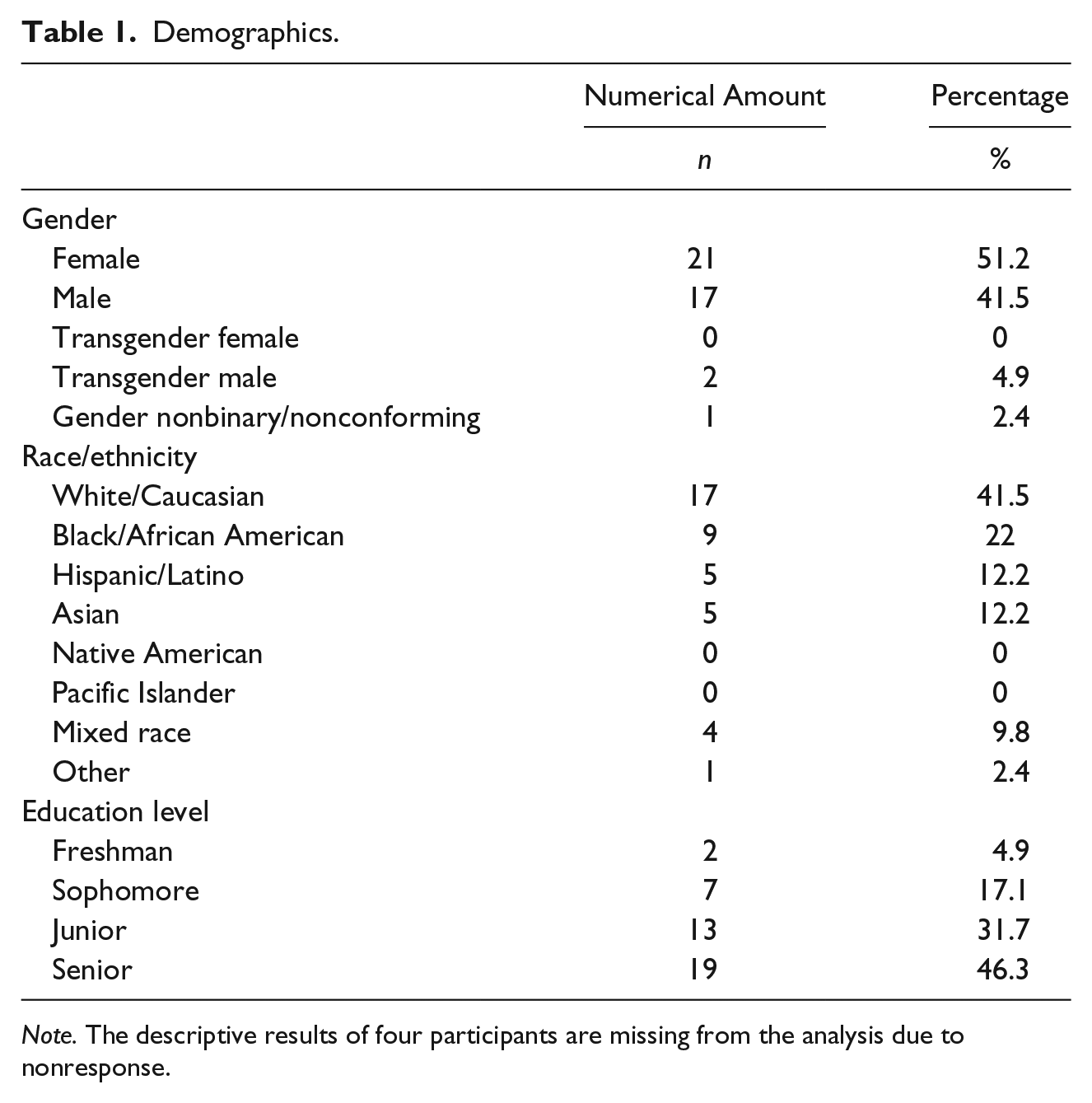
Note. The descriptive results of four participants are missing from the analysis due to nonresponse.
Participant Descriptive Questions.
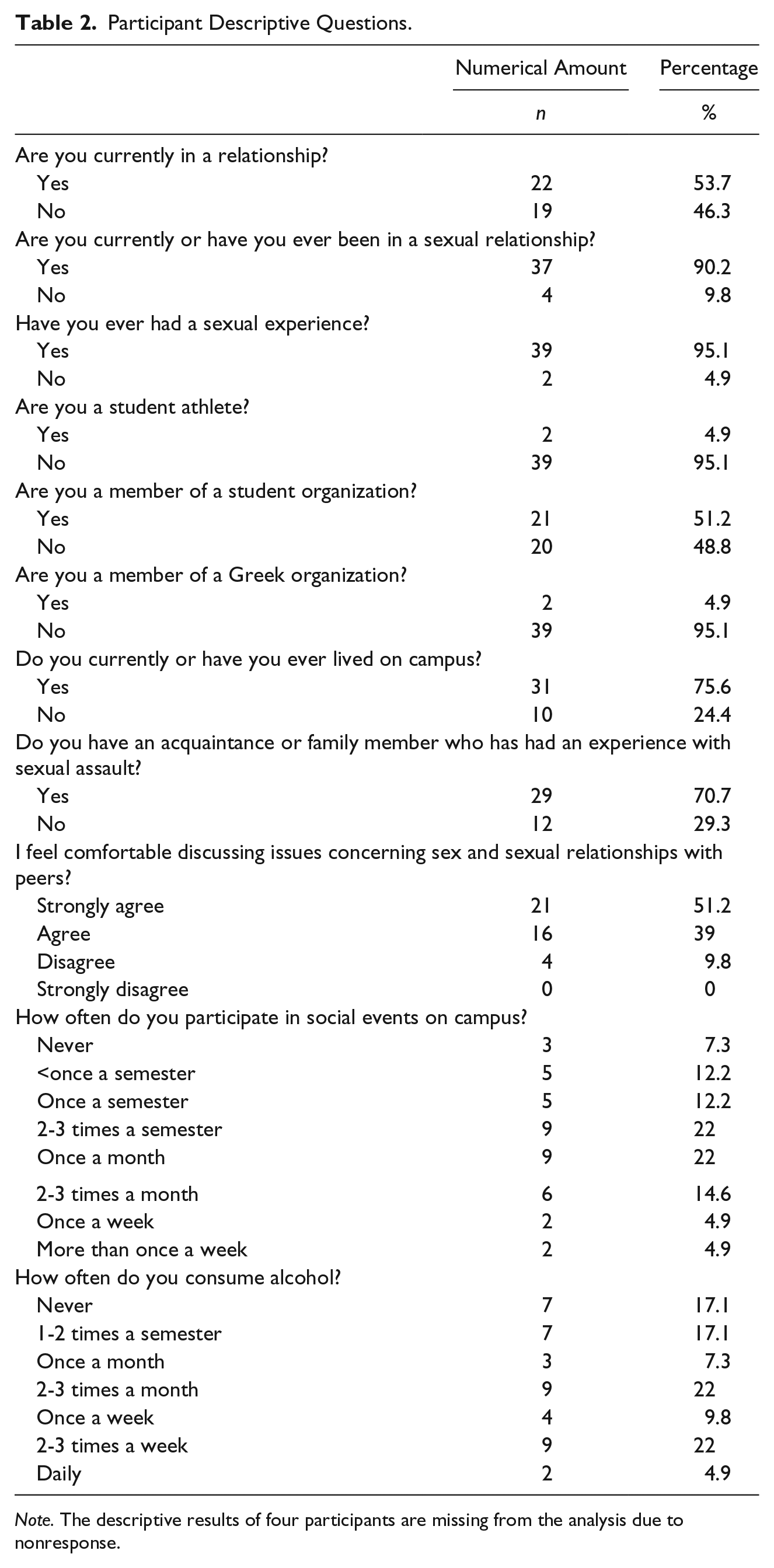
Note. The descriptive results of four participants are missing from the analysis due to nonresponse.
Analysis
The qualitative data collected for this study were transcribed by two professional transcriptionists, as well as the researcher. After all interviews or focus groups were transcribed, the data were read, and responses to each question were summarized across all focus groups and interviews. A web-based software, Dedoose, was then used to analyze data. Initial open coding was performed to identify patterns in the data of common themes, ideas, concepts, and categories discussed by participants (Charmaz, 2014; Corbin & Strauss, 1990). The data were not coded based on any expectations or previous knowledge, but rather coded based on what was emerging from the data. Following this, focused coding was utilized to categorize the data within those identified patterns (Charmaz, 2014). The researcher wrote memos and identified the gender identity of the participant throughout the coding process. Memos were also used to help the researcher analyze the codes, reflect on the data, clarify coding, identify patterns, inform and refine analyses, encourage the exploration of deeper meanings, and keep involved in the analytic process (Charmaz, 2014).
Methodological Rigor
Due to the different data collection methods used during this study, the researcher examined the data for thematic consistency across interviews and focus groups; and across interviews and focus groups that took place online and in person. Themes were identified and quotes were found from participants in each group to demonstrate consistency of themes across all data collection methods (see Table 3).
Thematic Consistency.

Results
The current study sought to understand how college students defined and characterized consent, how students ensure consent has been given, and how students communicate in sexual situations. This study focused on analyzing the qualitative data; the quantitative data can be found in Tables 1 and 2. As a disclaimer, although students were asked gender neutral questions, they referred to perpetrators using masculine pronouns and survivors using feminine pronouns; men were the ones who asked for consent and women were asked to give consent. Overall, students had difficulty defining or describing consent; they had individualized and sometimes contradictory images of consensual relationships. They identified multiple factors that influence a person’s ability to ensure consent has been given, including communication and social norms. Women also discussed reasons they say yes to sex they do not want; and men discussed reasons they do not ask for consent.
Defining Consent
Students frequently discussed the difficulty they had defining consent, often describing consent as something that was based on the individual and the circumstance. One female participant said that establishing a standard definition of consent can be difficult because, “you can’t just be told oh this is what you have to look out for because people are different, everybody’s going to be different, so you have to have that understanding to learn quickly about that person.” For the students, as a male respondent said, “consent looks like a lot of different things.” Another female participant said it is “hard to say how a person should give consent because every sexual encounter is different for everyone.”
The most concrete descriptions of consent were verbal; many students described consent as saying or communicating yes to a partner. Both male and female participants described consent as a “clear and coherent yes” that needs to be “enthusiastic” and not a “hard maybe.” When attempting to give detailed definitions of consent beyond verbal confirmation, many of their responses were vague and imprecise. For example, one female student said consent was “respecting the autonomy of another person,” but could not clarify what she meant or described actions that reflected a respect for a person’s autonomy.
Although their most explicit definitions of consent centered around verbal communication, most respondents preferred nonverbal communication. However, when probed to identify those nonverbal signs that a student is giving consent, students were not able to give examples. One male participant said that a woman could “sound uncomfortable like they don’t want to do it anymore.” Sometimes, they referred to eager participation as an indicator of consent; one male participant said, “when they are kissed, they kiss the person back.” Although students were often not able to give specific actions that demonstrated consent, it was often easier for students to describe both verbal and nonverbal indicators of resistance. The examples they gave included the following: The woman is pushing the man away, getting tense, sounds uncomfortable, is holding back, recoils, is not doing anything (i.e., not actively participating in sex), is covering herself, or closing her legs. Participants discussed overt physical cues, like if a person looks terrified, or subtle cues, like an engaging touch.
Factors Connected to Consent
Miscommunication
For students, miscommunication was a major reason sexual assaults occur, and they generally accepted the idea that it was possible to accidentally sexually assault someone due to miscommunication. For two male students, an incident could simply be a “misunderstanding between a guy and girl” and “sometimes the signals can get crossed.” They discussed how they could mistakenly continue with sex if the person, as one male participant said, “seems like they are down with it.” Students stated that clear communication was necessary for the man to know what the woman wanted, with one male student stating it was difficult to call an incident a sexual assault if the person’s “physical and verbal cues don’t match,” meaning the woman said yes but her body language suggested she was uncomfortable.
Because indirect and nonverbal communication is open to subjective interpretation, many students stated that when it comes to consent, direct communication is necessary. The problem is that, as one female participant said, “people aren’t direct,” and students “need to say [they] aren’t comfortable with it.” Male respondents said they need to hear a woman say no, with one stating, “I feel if someone who is not actively saying they don’t want to, but they aren’t expressively giving consent, there might be miscommunication that someone would take it as saying yes when they really didn’t want it.” Another male respondent reiterated the same idea, stating, “I don’t hear a no. I don’t hear anything. I assume the entire time that she’s with it. She’s not fighting it. She’s not doing anything. Like how am I supposed to know in that moment something’s wrong.” Students also discussed the difficulty of interpreting the subtle hints a woman may be using, with a male participant stating, “physical cues can be difficult to understand.” If a woman is uncomfortable, she must clearly say no, and if she does not, and “there is no clear communication about what [she] wants,” according to a male participant, a sexual encounter cannot be labeled a sexual assault. Two additional male participants stated, “they aren’t going to know the woman is not interested unless they hear the word no,” and that indirect and vague indicators, “makes me think about the things I could do to get the answer I want.” Understanding nonverbal cues can be especially difficult if two people just met. Students said that the college campus climate encourages one-night stands and therefore, the possibility of miscommunication is great.
Other participants acknowledged that there are potential challenges even when individuals use verbal communication. Students discussed token resistance; the idea that when a woman says yes, she means try harder (Jozkowski & Peterson, 2013). Many participants said that when a woman says maybe, it does not always mean that a man should not proceed; as one female participant said, it “depends on how you say maybe though. There are a lot of variables cause sometimes it’s like maaaayyybeeee.” One male participant said that his peers believe that when a woman says no, “she is just playing hard to get.” Another male participant expounded on this idea by discussing the social norms that teach men, “when a girl says no, you should be persistent until she says yes. But to me, that is coercion.” A female participant said, “society encourages men to work hard to get a woman even when she says no; men are taught they need to work for it.” Some students believed it was absurd to interpret a no as a yes. Female participants expressed frustration, with one student stating, In my experience, when I tell a boy no he keeps trying. It’s messed up that a regular no doesn’t stop a lot of guys. Why is my no not enough and why do they need some explanation as to why I said no?
Despite the belief from multiple participants that a man should know when a woman is not interested, when an advance is unwanted, and when he is getting positive feedback, one male participant said it is “understandable how someone can miss cues when you are full steam ahead.” Another male student stated, “[nonverbal communication] may not be enough for someone to stop if they’re in the moment.” Female participants also discussed the problem of men ignoring their communications about not wanting to have sex, with one woman stating, “I was aware of what was going on and I communicated that I did not want him to and he still went ahead with it because it sounded like I was enjoying myself.”
Alcohol
One factor frequently discussed that influenced perceptions of consent was alcohol consumption. Students did not have a clear understanding of how to ensure consent has been given when one or both people have been drinking alcohol. Some students stated that they have learned a person who has been drinking cannot give consent, with one female student saying, “if a person has been drinking, technically they can’t give consent.” However, for some students, alcohol consumption did not always indicate that a person cannot give consent. One male student stated, “it’s okay if the woman has been drinking as long as her body language is clear and she is aware enough to give consent.” A female student said that someone can “clearly see when a person is too drunk to give consent.” A woman cannot give consent, as a female respondent said, if “she’s passed her limit and she can’t walk straight or she can’t really talk without slurring her words. . . .” Male participants stated that, for students, if a person is drinking “they must be in their right mind,” to give consent and “be aware sex is going to take place.” Although students accepted alcohol consumption as a typical part of sexual interactions, they acknowledged that alcohol should never be used to put a woman in a state of mind where she is not capable of consent. One male respondent said, “you shouldn’t try to convince someone to drink more so you have a better chance of having sex with them.”
Gender expectations
Both male and female participants discussed the gender behavioral expectations that influenced how they give consent, how they ask for consent, and the norms that affect their decision to have sex. Female participants discussed the social norm and mandate that they should please men and are conditioned “to be flattered that they are into us [and] should just have sex.” One female participant said, “no one teaches women what to do if they feel a guy is pressuring them into sex,” while another mentioned the need for women to be taught they can say no at any point during a sexual encounter. Some female participants said they do not feel empowered to say no to sex and that society teaches them that they “are supposed to be timid and not say what [they] want” and “shouldn’t cause problems, cause fights or cause drama.” They feel “obligated to do something because [they] don’t want to hurt his feelings or because he is a nice guy.” Sometimes, they feel “it’s easier [to say yes], even if they don’t want to, to just go along with it.”
A female participant also discussed the social norms preventing women from directly communicating their sexual boundaries stating, “women imply no because they don’t want to be mean.” One participant said that he asked female peers after having sex they were uncomfortable with, “well did you say anything. I’ve straight up asked girls did you say anything. [They would say] well no but like I just didn’t know how I felt. You gotta say something.” Both male and female participants said it is a woman’s responsibility to herself to be clear and firm about what she wants. One female participant said, “it’s big problem if you’re not comfortable enough to say no to someone but you’re comfortable enough to have sex with them.”
Challenges to Giving Consent and Asking for Consent
Female participants often mentioned reasons they would agree to have sex with a male partner even if they did not want to. Students said they would engage in unwanted sexual activity in the face of potential retaliation or intimidating behavior, or due to fear of a man’s reaction to the rejection. Some said they felt unsafe and said yes to prevent a physical assault. Participants also discussed the obligation women feel in relationships to say yes to sex, with a male participant stating, “women expect that they have to have sex with a man once they are in a relationship with him.” A female participant discussed feeling obligated to try to repair a broken relationship, stating, I don’t understand how else I could be fixing this, but I am going to try by using sex because I know that it will make you feel loved and accepted and it will put a patch on our relationship.
Students were not explicitly asked why men do not ask for consent but many of the participants mentioned reasons why men are hesitant to ask. Students talked about men being afraid that if they asked for consent, sex would not happen. One female participant said that if every person “were to ask hey do you want to have sex before things were to get that far, a lot of times the sex wouldn’t happen.” Female participants said, “men just want to get their way” and would not want to do anything to jeopardize their opportunity for sex. Female participants also discussed that in the heat of the moment, the last thing men would want to do is stop and ask for consent. Men really want something to happen and, as one male respondent said, “don’t wanna give [women] the opportunity to think about it and regret it or process it.” Some participants said that college students believe that asking for consent ruins the moment. Multiple students said that some men consider it a mood killer and male participants said it does not allow them to be spontaneous. Respondents particularly thought that continuous consent, asking for consent with every sexual progression (i.e., kissing, touching, etc.), would be disruptive.
Participants also mentioned that no one, as one male participant said, “wants to feel rejected by their partner. Feel like they aren’t performing well.” Therefore, men do not ask for consent because they believe a no reflects their performance. One female student said, “it may be embarrassing to ask for consent.” Students discussed the need for men to understand that consent is not guaranteed. One male participant stated, I’ve been in a lot of situations where personally where I do take a girl home, and nothing ends up happening. Cause she’s like yeah I don’t want to actually do anything I changed my mind or I’m not in the mood anymore whatever.
Discussion
Sexual assault prevention often begins by telling students to ask for consent and to stop if consent is not given. However, if two people in a sexual situation do not recognize the same indicators of consent, a sexual assault may occur. Therefore, it is important to understand how students characterize consent and know they have received consent. A standard definition of consent does not currently exist in the literature (Beres, 2014) and participants’ discussion of consent reflected this same inconsistency. For participants, it was not possible to identify standard nonverbal and verbal indicators of consent because, according to them, everyone is different. Many of the students based their definitions of consent on their own experiences and how they give consent in intimate situations. When they did provide definitions of consent, most were vague and based on the individual’s preferences for giving consent; rather than a universal standard of consent that would be easily transferable to the situations they regularly encounter.
When they were able to give concrete descriptions, those descriptions often centered around verbal indicators, such as saying yes or no. Similar to results from previous qualitative studies (Jozkowski et al., 2014), participants preferred using nonverbal communication to communicate consent. And, similar to previous studies, they did not have consistent ideas of nonverbal indicators of consent (Jozkowski et al., 2014). Participants reinforced the belief that directly communicating interest could lead to embarrassment, shame, or rejection, making them reluctant to overtly disclose their intentions (Lindgren, Schacht, Pantalone, & Blayney, 2009). In addition, because sex is considered a taboo topic, many students may not feel comfortable directly discussing sex; they may lack the skills to negotiate sexual boundaries. For women, in particular, this cultural norm may be especially impactful. Women are not taught how to talk about sex with partners due to the norm that they should be virginal (Valenti, 2010). Young college women may not feel empowered to directly and/or verbally state they do or do not want to have sex.
Previous studies have indicated that gender roles have a tremendous influence on communicating consent (Jozkowski, Marcantonio, & Hunt, 2017). The gender expectation that women not directly talk about sex may contribute to the persistence of token resistance. In sexual situations, women are taught to adhere to the feminine mandate to be uninterested in sex, soft-spoken, and indirect. Therefore, college women may believe that they should pretend to be uninterested until the man has “earned” sex with them and to use hints and nonverbal communication because, otherwise, they are being masculine. College women may not trust their own instincts because they have been socialized to believe that they do not know what they want, and that they have to play games to be understood by men. In addition, a lack of sex education means that they may not have had the space to figure out what they want. It is essential to change the gender norms and expectations that serve to restrict a woman’s expression of her desires through demands of compliance and “being nice.” Sexual norms need to change so that women feel empowered to say yes or no based on what they truly want. In case they do not feel comfortable directly stating they do not want to have sex, students need to be taught to interpret any wavering on the part of their partner as nonconsent and not as an opportunity to interpret what the person may want based on the influence of gender expectations.
Women have been taught that their womanhood is validated when a man wants to have sex with them (Friedan, 2010). These gender expectations encourage women to say yes to unwanted sex. Participants expressed the idea that asserting their lack of desire to have sex is causing drama. It is detrimental to the safety of women for them to believe that saying no to sex is causing problems, and that their own autonomy should be circumvented by the expectation to be compliant. Manhood also needs to be redefined: Being a man should no longer require sexually aggressive behavior (Weiss, 2009). Women need to be empowered to assert their boundaries and no longer socialized to believe that being nice is more important than being autonomous. Both men and women need to be freed from their perception that college requires they have sex with multiple partners and the potentially false belief that their peers are engaging in frequent sex (Katz, 2006). Prevention education must work to reduce social and cultural norms, which perpetuate stereotypes that normalize unhealthy sexual behaviors. Participants discussed multiple reasons why men may not ask for consent, many of the reasons potentially stemming from men’s insecurities and desire to avoid feelings of rejection. Some college men, because of social norms that expect men to be aggressive (Jackson, 2018), may view asking for consent as contrary to masculinity. Because gender expectations teach men that they should just take what they want, asking for permission to continue with sexual acts may be considered contrary to being a man. Ultimately, increasing consensual activity on college campuses needs to include discussions about the influences of gender on how individuals communicate about sex.
The conversations with students indicated that communication was an essential factor in ensuring that consent had been given. In line with miscommunication theory (Muehlenhard, 1988), they believed that women have an obligation to be direct and communicate their discomfort. However, some participants did acknowledge that women may not feel comfortable saying no or fear the consequences of saying no. Because college students rely on nonverbal communication in sexual situations, it was problematic that participants could not give examples of specific nonverbal indicators of consent. Participants were, however, able to describe nonverbal acts of resistance. Their ability to recognize resistance but not engagement was not surprising considering that, in the past, most sexual assault prevention education has focused on teaching individuals to wait to hear a no when engaging in sexual activity (Murphy, 2016). The current shift to affirmative consent (Halley, 2016) has the potential to expand students’ understanding of communication about sex and how to recognize when consent has been given. There was agreement from both female and male participants that it is the responsibility of both parties to openly communicate their sexual needs and boundaries. It is the woman’s responsibility to communicate she is not interested and the man’s responsibility to be open to hearing her honest feedback.
Alcohol complicated what students perceived to be consent. For students, alcohol consumption did not automatically mean the person could not give consent. Previous research has emphasized that college students’ sexual experiences often include alcohol consumption (Tyler, Schmitz, & Adams, 2017), a sentiment reflected in the current study. However, alcohol consumption complicates a student’s ability to identify a consensual sexual situation. For students, their ability to give consent was based on how much they drank and how the alcohol affected their judgment. College students consider alcohol to be a typical and often welcomed part of sexual intimacy. Therefore, consent may need to be conceived in a way, particularly for college students, which allows for the unique circumstances surrounding their sexual interactions. College students may not understand what it means to be incapacitated and how to navigate sex when one or all interested parties have been consuming alcohol.
Participants discussed the implicit consent in relationships and the obligations partners may feel to have sex. The cultural taboo nature of sex may contribute to students’ preference for euphemisms and rely on their partners to understand the nuances of their nonverbal communication when engaging in sexual activity. Changing cultural norms that label sex a deviant behavior may lead to more open discussion about sexual boundaries, potentially preventing sexual assault. Changing these norms may also increase healthy behaviors in both short- and long-term sexual relationships because students will have the opportunity to learn skills that can help them navigate sex when “hooking up,” which is safe for all individuals.
Implications for Research and Practice
These data have multiple implications for prevention program development. As previously mentioned, the rates of sexual assault have remained unchanged (Department of Justice, 2014). Programs must first provide students with a standard definition of consent that is relevant and reflective of their experiences. This consistency allows all students to know when a sexual interaction is no longer consensual. Gender and social norms must also be addressed to disrupt gender narratives that create problematic perceptions of consent and lead college students to engage in sexual violence. This current study demonstrates the need for prevention specialists on college campuses to be given the resources to devote more time and resources to educating students about consent and providing the skills necessary to negotiate and express their needs during sexual activity. Little research has been conducted to evaluate whether programs are effective in educating students about consent and changing problematic perspectives. Therefore, future research should seek to understand whether current prevention programs are effectively ensuring that college students know how to recognize when consent has been given.
These data also have implications for direct practice. A survivor may not recognize their experience as a sexual assault because they endorse those problematic norms that lead to unhealthy perceptions of consent. For example, a woman may believe that coercion is typical and view the “wearing down” process as part of the sexual experience. A man may believe that his role mandates engaging in frequent sexual activity. Therefore, he may be persistent until he hears a yes, not fully understanding that his persistence is coerced sex and is not consensual. Therefore, understanding how individuals conceptualize consent may help identify any barriers that may worsen feelings of victim blaming (i.e., a woman may feel it is her responsibility to make sure her resistance is clearly communicated, so she may blame herself for an assault) that prevent recovery from the trauma of sexual assault.
Limitations
There are multiple limitations to this study. Because of the sensitive nature of the topic of sexual assault, social desirability is a concern. Although steps were taken (e.g., having groups and interviews away from administrators and professors) to make sure that students felt they were in a safe and nonjudgmental environment and could respond honestly to questions, the groups were still on campus. The location may have prevented them from being honest about their feelings about sexual assault. Another factor that could have prevented male participants from being open was the gender of the researcher. The researcher identifies and expresses as female; male participants may not have felt comfortable talking to a woman about sexual assault. Male notetakers were not always available during the scheduled times for focus groups and interviews, and they may have eased some of the anxiety that male participants may have felt.
Another limitation of the study is that all the participants were from one university. Also, due to time constraints, the researcher was not able to triangulate the data and provide more trustworthiness through member checking. In addition, there was only one coder for this study. Therefore, the data may not be as reliable had the researcher checked for interrater reliability. Some of the students participated in person while others participated online. Although the researcher took steps to ensure methodological rigor by ensuring thematic consistency across all data collection methods, there may have still been an impact on the content. Those who were online may have felt less inhibited due to the distance between them and the researcher. Also, the sample may have been limited by selection bias. The full scope of perspectives may not have been captured because those with more negative or troubling beliefs may not have wanted to participate due to the potential scrutiny.
Conclusion
Despite the limitations, this study contributes in-depth knowledge about the perceptions and understanding that college students have of consent. This study demonstrated that college students may have disjointed, consistent, and complex perceptions of consent. Therefore, a plea to wait for consent through a marketing campaign or formal prevention program may be ineffective because they do not recognize consent. Therefore, prevention programs must be developed in a way that aligns with their current beliefs. The act of participating in research may also provide college students with the opportunity to engage in important conversations about sexual assault. Multiple students said they decided to participate in the study simply because someone was interested in their perspective. Therefore, this study may have had a tertiary positive impact by giving college students a voice, validating their experiences and viewpoints, and making them feel as if they can be allies in reducing sexual assault. This study also brings to light the potential deficits of current prevention programming. Many of the students mentioned that they, along with their peers, had taken part in sexual assault prevention programs. Yet they could not define consent or give concrete examples of indicators of consent. Therefore, prevention programming may not have a lasting impact on their knowledge and understanding. Also, this study demonstrates a link between gender norms and communicating about sex, which needs to be addressed. Although changing gender norms is challenging, the results have demonstrated that it may be essential in improving sexual communication and reducing sexual violence. As the core indicator of a sexual assault, it is imperative that sexual assault prevention programs educate college students about consent and not assume that, as a concept, consent is understood. The current data suggest that students may have an intellectual, but not practical or applicable, understanding of consent.
Supplemental Material
Focus_Group_Questions_appendix – Supplemental material for “When a Girl Says No, You Should Be Persistent Until She Says Yes”: College Students and Their Beliefs About Consent
Supplemental material, Focus_Group_Questions_appendix for “When a Girl Says No, You Should Be Persistent Until She Says Yes”: College Students and Their Beliefs About Consent by Adrienne Baldwin-White in Journal of Interpersonal Violence
Footnotes
Declaration of Conflicting Interests
The author(s) declared no potential conflicts of interest with respect to the research, authorship, and/or publication of this article.
Funding
The author(s) received no financial support for the research, authorship, and/or publication of this article.

Supplemental Material
Supplemental material for this article is available online.
Author Biography
References
Supplementary Material
Please find the following supplemental material available below.
For Open Access articles published under a Creative Commons License, all supplemental material carries the same license as the article it is associated with.
For non-Open Access articles published, all supplemental material carries a non-exclusive license, and permission requests for re-use of supplemental material or any part of supplemental material shall be sent directly to the copyright owner as specified in the copyright notice associated with the article.
