




Abstract
Campus sexual violence is a complex issue that has led to a proliferation of federal legislation and best practices with the intent to better support student survivors. Despite these efforts, research suggests that many survivors do not disclose to formal resources on campus, but rather, to their peers. While there is growing theoretical and empirical support for the role of peer-level influences on both preventing and responding to sexual violence on college campuses, our understanding of students’ confidence in knowing how to respond is limited. Furthermore, disclosure research has yet to assess the impact of broader campus-level factors on students’ confidence in being able to support survivors. In the present exploratory study, undergraduate students responded to a survey, which included questions about receiving disclosures and perceived ability to respond as well as measures of individual-level correlates (gender, race, prior victimization) and campus community factors (perceptions of the university’s responsiveness, exposure to information, awareness of resources). Bivariate analyses were conducted to examine whether certain students were more likely to receive a disclosure on campus. To look at the impact of individual- and community-level factors, a series of hierarchical logistic regression models were estimated. Ability to respond to a disclosure was measured using three separate dichotomous variables. Findings show that 34% of our sample has received at least one disclosure of sexual violence from a peer since coming to campus. In addition, results show that above and beyond individual correlates, campus-level factors impacted students’ confidence in their roles as disclosure recipients. These results have significant implications for sexual violence programs on campus. Suggestions for future research are also discussed.
Over recent years, colleges and universities have grappled with the best way to support students who experience campus sexual violence. 1 Research indicates that many survivors do not disclose to formal resources on campus, but rather, tend to disclose to peers (Sabina & Ho, 2014). There is growing theoretical and empirical support for the role of peer-level influences on both preventing and responding to sexual violence on college campuses (Casey & Lindhorst, 2009; Thompson, 2014). The bystander intervention approach, a strategy that frames sexual violence as a community issue and one where all individuals have a role to play, leverages this knowledge (Banyard, Moynihan, & Plante, 2007). This approach is increasingly being adopted on campuses across the United States and was explicitly recommended by the White House Task Force to Protect Students from Sexual Assault (2014) under the Obama Administration.
As a part of the bystander framework, peers are encouraged to intervene before, during, or after an incident of sexual violence occurs (McMahon & Banyard, 2012). A central function of a pro-social bystander after an assault occurs is to support a peer who discloses an experience of sexual violence (McMahon & Banyard, 2012). Peers can assist survivors with seeking resources for both emotional recovery and support and understanding their reporting options and seeking justice (Illes, Waks, Seate, Hundal, & Irions, 2018). Because peers have the potential to play such an essential role in the disclosure process, it is crucial that they are informed about options for survivors, including how to access services and reporting options on campus. This is especially important given that utilization of mental health services and reporting by sexual assault survivors occur at low rates (Cantor et al., 2015; Paul et al., 2013). However, research suggests that peers are often unaware of resources on campus and thus unsure of how to respond upon hearing a disclosure of sexual violence (Walsh, Banyard, Moynihan, Ward, & Cohn, 2010). Therefore, it is important to determine what factors facilitate students’ awareness of resources and ability to respond effectively to peer disclosures.
To date, most of the research in this area has focused on the impact of social reactions to peer disclosures and less from the perspective of the disclosure recipient. The available scholarship on correlates of disclosure recipient confidence in how to respond focuses mostly on individual factors such as gender, but has not yet explored larger macro influences such as the campus climate. The focus of this study is to explore the influence of aspects of the campus climate on students’ confidence in being able to support survivors, including their awareness of resources, exposure to information about sexual assault provided on campus, and perceptions of the university’s responsiveness to sexual violence.
Campus Sexual Assault Disclosure
Research indicates that eventually, most sexual assault survivors disclose their experience, although it may be delayed and some individuals choose to never share this information (Sabina & Ho, 2014). Studies also show that for college students, those survivors who disclose are more likely to share their experience with an informal support such as peers rather than formal ones (agencies, law enforcement; Branch, Richards, & Dretsch, 2013; Chen & Ullman, 2010; Fisher, Daigle, Cullen, & Turner, 2003; Halstead, Williams, Gonzalez, & Guarda, 2017; Orchowski & Gidycz, 2015; Orchowski, Meyer, & Gidycz, 2009; Sabina & Ho, 2014; Walsh et al., 2010).
For those survivors who disclose their assault, the reaction of others can have a critical impact on their decisions and healing (Ahrens, 2006; Ahrens, Campbell, Ternier-Thames, Wasco, & Sefl, 2007; Campbell, Ahrens, Sefl, Wasco, & Barnes, 2001; Campbell, Greeson, Bybee, & Raja, 2008; Chen & Ullman, 2010; Filipas & Ullman, 2001; Orchowski & Gidycz, 2015; Ullman, 2010; Ullman & Filipas, 2001). Survivors who share their experiences with others often receive negative reactions, positive reactions, or both, and these are documented to have considerate implications for survivors’ well-being (Ahrens, 2006; Ahrens et al., 2007; Orchowski & Gidycz, 2015; Ullman, 2010; Ullman & Filipas, 2001). Positive social reactions include those that show support for the survivor through either tangible means or emotional support, while negative social reactions are those that convey blame to the survivor, invoke shame, or are angry and controlling (Ahrens, 2006; Orchowski & Gidycz, 2015; Ullman, 2000; Ullman & Filipas, 2001). There is research demonstrating that positive social reactions may be helpful to survivors in feeling supported and obtaining assistance and that positive reactions of friends are particularly important (Filipas & Ullman, 2001). This was supported in a recent study with adolescent survivors of sexual violence, where Campbell, Greeson, Fehler-Cabral, and Kennedy (2015) found that the way that survivors’ friends reacted to the disclosure and what they did with the information heavily influenced what happened to survivors and their pathway to help-seeking. Other research has demonstrated that while positive social reactions may be helpful to survivors, negative reactions may be even more powerful in ways that are harmful and distressing to the survivor. For example, Orchowski and Gidycz’s (2015) study with 374 undergraduate women found that survivors who received negative social reactions from informal sources to their disclosures reported a number of troubling psychological outcomes, such as higher levels of feelings of inadequacy, phobic anxiety, and paranoia.
Peers as Disclosure Recipients
Most studies on disclosure have focused on the experience of survivors and the impact of the disclosure, with less research available from the perspective of the disclosure recipient, which represents an important gap given the widespread prevalence of campus sexual violence and the role of peers in being the most likely source to receive disclosures (Banyard, Moynihan, Walsh, Cohn, & Ward, 2010; Paul et al., 2013). A few studies have examined the experience of disclosure recipients, which indicate that a large percentage of college students report receiving disclosures from peers. For example, Banyard et al. (2010) found that just below 30% of their sample of undergraduate students at one university reported receiving a disclosure of unwanted sexual experiences from a friend. In Paul et al.’s (2013) study using a national sample of college women, 41.5% of participants indicated receipt of a disclosure of sexual violence from a peer.
In terms of understanding students’ confidence in knowing how to respond, Ahrens and Campbell (2000) surveyed 60 undergraduate students who received disclosures from their friends and found that although peers are often supportive of disclosures, they are often uncertain about what the survivor needs and how to best help. While most participants felt positive about the assistance they provided, a majority also expressed negative emotions such as anger at the assailant. Banyard et al. (2010) expanded on the Ahrens and Campbell study with a study of 1,241 undergraduate students and found that of those students who received disclosures, almost two-thirds believed that their response was helpful to their friend who disclosed, and only a small percentage felt unsure of how to help. However, women and those with victimization histories reported more emotional distress as a result of receiving the disclosures.
Individual and Community Correlates to Receiving and Responding to Disclosure
Researchers have identified a number of correlates to receiving disclosures, including individual-level factors such as gender, with women more likely to receive disclosures (Banyard et al., 2010; Paul et al., 2013; Paul et al., 2014). Studies on disclosures have looked at the race and ethnicity of those who disclose but not that of disclosure recipients (e.g., Ullman & Filipas, 2001) although the larger bystander literature on campus sexual violence has demonstrated that White students tend to report more opportunities to intervene (Hoxmeier, O’Connor, & McMahon, 2018) and fewer missed opportunities to intervene (Hoxmeier, Acock, & Flay, 2020), while Brown, Banyard, and Moynihan (2014) found that Black students reported more pro-social behavior and fewer missed intervention opportunities.
The literature has also identified that those who have experienced sexual violence themselves within their lifetimes are also more likely to receive disclosures (Banyard et al., 2010; Paul et al., 2013; Paul et al., 2014). Paul et al.’s (2013) national study found that additionally, disclosure recipients were more likely than nonrecipients to report lifetime experiences of post-traumatic stress disorder (PTSD) and depression, past-year substance and drug use and abuse, and ever seeking professional help. In another study, Paul et al.’s (2014) study found that recipients of disclosures also held less perceived victim responsibility for sexual assault as well as less confusion about how to help victims, as compared to nonrecipients. Other research on attitudes about sexual violence and victim-blaming indicates a negative relationship between acceptance of rape myths, or beliefs that accept sexual violence, and intentions to intervene as a helpful bystander, although the study did not specifically ask about confidence in supporting survivors (McMahon, 2010).
Beyond individual-level factors, less is known about the impact that community-level variables have on students’ ability to intervene as pro-social bystanders, including responding to disclosures (Banyard, 2011; McMahon, 2015). The larger bystander literature provides support for the impact of community-level factors on students’ own pro-social bystander behaviors. For example, Fabiano, Perkins, Berkowitz, Linkenbach, and Stark (2003) found that students’ perception of their peers’ willingness to intervene to prevent sexual violence was a strong predictor of students’ own pro-social helping behaviors. In addition, Stein (2007) found that even after controlling for personal attitudes about rape and sexism, men’s perceptions of their close friends’ willingness to prevent rape predicted their own willingness to prevent rape. In addition to the modeling that peers provide, Sulkowski (2011) found evidence that college students’ trust in campus authorities was a significant predictor of students’ own bystander intentions.
Understanding broader levels of influence on students’ helping behaviors is aligned with socio-ecological frameworks which purport that there are factors at the group, community, institutional, and societal levels that work together to impact the individual (Banyard, 2011; Bronfenbrenner, 1979, Casey & Lindhorst, 2009; Dahlberg & Mercy, 2009). Liang, Goodman, Tummala-Narra, and Weintraub (2005) developed an ecological model of help-seeking, which was adapted by Ullman (2010) and applied to campus sexual assault by Walsh et al. (2010). Their models describe help-seeking as a process (recognizing the problem, making a decision to seek help, and selecting a particular type of support), and one that is influenced by both individual and contextual factors (Liang et al., 2005; Ullman, 2010). The contextual factors in these models include social climate, norms, culture, and access and availability of resources. Similarly, Banyard’s (2015) “action coil” model for bystander decision-making related to sexual and relationship violence includes recognition of the prominent role of contextual and climate factors.
Over recent years, the role of the campus climate related to sexual violence has received increased attention (McMahon, 2015; White House Task Force to Protect Students from Sexual Assault, 2014; Wood, Sulley, Kammer-Kerwick, Follingstad, & Busch-Armendariz, 2017). Perceptions of campus climate include a number of different dimensions, such as “. . . the way the campus responds to sexual assault, the viability of campus policies, how much campus leadership cares about sexual assault, and how safe students feel” (White House Task Force to Protect Students from Sexual Assault, 2014, p. 2). Additional aspects of the campus climate include the information made available to students on recognizing and reporting sexual assault (Banyard, 2011; Hayes-Smith & Hayes-Smith, 2009; Fleck-Henderson, Costello, Raghu, Rose, & Rosenfeld, 2012) and exposure to messages from the campus about sexual violence (through programs, written information, posters; Fleck-Henderson et al., 2012; Potter, Fountain, & Stapleton, 2012; Potter, Moynihan, & Stapleton, 2011). In addition, McMahon (2015) suggests an association between campus sexual misconduct policies and students’ bystander intentions as well as ability to help. While many campuses have sexual misconduct policies and sexual violence resources available on campus, studies have consistently found that many students do not have knowledge of campus services, other resources, and/or policies, which can lead to a lack of utilization (see Sabina & Ho, 2014), as well as limit students’ ability to appropriately respond to a peer who has experienced sexual violence. For example, Walsh et al. (2010) found that less than half of students in their study knew where the crisis center was located, and Hayes-Smith and Levett (2010) found that only 7% knew where to go to receive help if either they or a peer were sexually assaulted. The campus climate may not only be an important influence on students’ own help-seeking experiences but also their ability to engage in pro-social helping behavior including the provision of support to peers (McMahon, 2015).
Emerging research supports the importance of community and climate factors in impacting helping behaviors. Edwards, Mattingly, Dixon, and Banyard (2014) found greater pro-social intervention in relationship abuse in communities with more resources and greater collective efficacy. McMahon & Stepleton (2018) found that after exploring demographic variables, their sample of university students’ level of exposure to messages and information about sexual violence was related to greater awareness of campus resources and confidence in knowing how to seek assistance. In their study with another sample, McMahon & Stepleton (2018) found that exposure to information about sexual violence prior to college as well as since coming to campus was significantly associated with greater willingness to intervene as a helpful bystander in situations related to sexual violence. Sense of trust in the university has also predicted willingness to intervene in violent situations (Sulkowski, 2011) and also influences survivors’ perceptions of how their cases were handled as well as their own levels of trauma following victimization (Smith & Freyd, 2013).
Current examinations of disclosure among college populations have yet to assess the impact of students’ awareness of resources, the influence of exposure to information about sexual assault provided on campus, as well as students’ perceptions of the university’s response to sexual violence and their confidence in being able to support survivors.
Current Study
In the current study, we estimated a series of logistic regression models to better understand the individual- and community-level factors associated with students’ perceived ability to respond to a peer disclosure of sexual violence. Specifically, this study investigated the following three research questions: (a) How many students report receiving disclosures from their peers? Are certain students more likely to receive disclosures? (b) What is the influence of individual-level variables (gender, race/ethnicity, personal victimization, and acceptance of interpersonal violence) on students’ perceived ability to respond to a peer disclosure of sexual violence? and (c) What is the influence of community-level variables (awareness of on-campus resources, level of exposure to sexual and intimate partner violence information on-campus, and students’ perceptions of the university’s responsiveness) on students’ perceived ability to respond to a peer disclosure of sexual violence?
We expect that community-level factors will impact students’ perceived ability to respond to a peer disclosure of sexual violence above and beyond individual-level determinants. We examined community-level factors because much of the research exploring response to disclosure has focused on individual-level correlates and has failed to identify the role that broader, community-level factors have on students’ response to disclosure.
Method
Participants and Procedures
The current study involved the analysis of campus climate data collected in 2018 at one large, Mid-Atlantic public university in the United States. The campus climate survey tool in which the data were collected was based on validated tools from the Not Alone toolkit from The White House Task Force to Protect Students from Sexual Assault (2014). All students at the university were invited to participate and were randomly invited to take either a module on sexual violence or dating violence. A broad outreach campaign, including print materials, social media, and direct communications, publicized the survey, which was open for 1 month after Spring Break. Participants were recruited over email and were entered into raffles to receive several cash prizes.
The current study used data from undergraduate students who completed the sexual violence module, which yielded a 14.2% response rate for a final analytic sample of 2,316. For the purposes of this study, students with missing data on any of the included variables were deleted listwise resulting in an analytic sample size of 1,990.
Measures
Received peer disclosure
Students were asked, “Since coming to [University name], have any other students at [University name] told you they were a victim of an unwanted sexual experience?” Responses included yes or no.
Perceived ability to respond to a peer disclosure
To assess students’ perceived knowledge, helpfulness, and comfort when responding to a sexual violence disclosure from a peer, questions based on Banyard et al. (2010) were used. Only students who responded yes to the question, “Since coming to [University name], have any other students at [University name] told you they were a victim of an unwanted sexual experience?” were asked the following three questions: “Do you feel that you knew how to respond in a helpful way?”; “Do you believe that your response was helpful to the student?”; and “Did you feel comfortable talking to the student about their unwanted sexual experience?” Responses were yes or no for each of the three survey questions.
Demographics
Demographic characteristics included sex and race/ethnicity. Gender identity was classified as man and woman based on students’ self-reported gender identities.
Personal endorsement of beliefs that accept sexual violence
To gauge attitudes related to endorsement of beliefs that accept sexual violence, questions based on the Personal Acceptance of Sexual Violence scale from Krebs, Lindquist, Warner, Fisher, and Martin (2016) were used. Students rated their agreement with seven statements ranging from 1 (strongly disagree) to 5 (strongly agree; = .76) regarding their beliefs about sexual violence (e.g., “A person who is sexually assaulted while drunk is at least somewhat responsible for putting themselves in that position”).
Personal sexual victimization
To measure sexual victimization, questions based on Krebs et al. (2016) were used. Students were asked to answer a series of six questions about whether or not they had experienced various types of sexual violence since coming to campus, including unwanted sexual contact that involved coercion, force or threats of force, and when the student was unable to provide consent or to stop what was happening because they were “passed out, drugged, or incapacitated or asleep.” A conservative measure was used so if a student endorsed any of the items referring to an experience of a completed sexual assault (not attempted or for which the student is uncertain occurred) since coming to campus, the student was coded as experiencing sexual victimization.
Exposure to information about sexual violence on campus
Participants were asked to indicate whether they had been exposed to information about sexual violence on campus since coming to the university via 19 possible exposures (e.g., crime alerts about sexual violence). Students checked all that applied to their experience. Students’ numbers of total exposures were summed. This measure was created by the researchers in conjunction with a variety of stakeholders from the campus, as it is highly tailored to the specific campus where it was administered.
Awareness of resources
Participants were presented with eight offices on campus and asked to rate their awareness of each service related to sexual violence, ranging from 1 (not at all aware) to 5 (extremely aware; = .89). Examples of resources include the campus victim services office, office of student conduct, health services, counseling center, and office of Title IX compliance. A mean awareness score was calculated by averaging each student’s responses across these items. This variable serves to measure one aspect of students’ education on sexual violence, namely, their awareness of resources. This scale was also created by the researchers and is also highly specific to the individual campus where it was administered, and again experts in the field and key stakeholders reviewed the questions for content validity.
Perceived university responsiveness
To assess this construct, a seven-item scale from Defense Equal Opportunity Management Institute (DEOMI) Organizational Climate Survey (DEOMI, 2014) was included in the survey. Items assess participants’ perception of the university’s responsiveness in the wake of sexual violence incidents (e.g., “The university would take it [an incident of sexual assault] seriously”). Items included were answered using a 5-point Likert-type scale ranging from 1 (very unlikely) to 5 (very likely; = .91). The scale score represents the mean of items comprising the measure.
Data Analysis
Descriptive analyses and bivariate analyses were first performed to gain a thorough understanding of the sample regarding experience of receiving a disclosure of sexual violence from a peer and thereby address the first research question determining whether certain students are more likely to receive disclosures. Next, to look at the research questions about the impact of individual- and community-level factors, we estimated a series of hierarchical logistic regression models. Hierarchical logistic regression allowed us to compare two models as we are interested in the presence of micro observations embedded within a macro context (Wong & Mason, 1985): the first set of models examined whether various individual-level independent variables predicted the dependent variable for each of the three outcomes related to perceived response to disclosure, whereas the second set of models examined whether community-level variables predicted our outcome variables after controlling for gender, race/ethnicity, personal endorsement of beliefs that accept sexual violence, and personal victimization. The independent variables were entered in the regression equations in two blocks and model testing was conducted to allow the researchers to determine the changes of the coefficients when the second block was entered in the models and the size of changes in the coefficients. To help with interpretation of the coefficients, odds ratios (ORs) are presented.
Results
Most of the students included in our analytic sample identified as women (79.2%, n =528) and almost half (47.2%) identified as White, 26% as Asian/Asian American, 15% as Hispanic, 6% as Black/African American, and 6% as other. Overall, the demographic characteristics of the sample represented the undergraduate student population at the university, with female students overrepresented. For our campus-level variables, students in our analytic sample had moderate awareness of on-campus resources (average score of a 3.09 out of 5), on average were exposed to eight different sources of sexual violence information on campus, and perceived the university positively in terms of sexual violence supportiveness (3.95 out of 5).
Who Receives Disclosures
Table 1 shows bivariate results between student characteristics and experience of receiving a disclosure. Overall, approximately 34% (n = 668) of the participants responded that they have received at least one peer disclosure of an unwanted sexual experience since being on campus. Female gender and personal victimization were significantly associated with receiving a disclosure of sexual violence from a peer. Greater percentages of Hispanic students and White students received disclosures compared to Black, Asian, and students of other race/ethnicities. Greater awareness of resources, greater exposure to sexual violence information on campus, and lower personal endorsement of beliefs that accept sexual violence were significantly associated with receiving a disclosure, as was a less favorable perception of the university’s responsiveness to campus sexual violence.
Characteristics of Students Who Have Received Peer Disclosure.
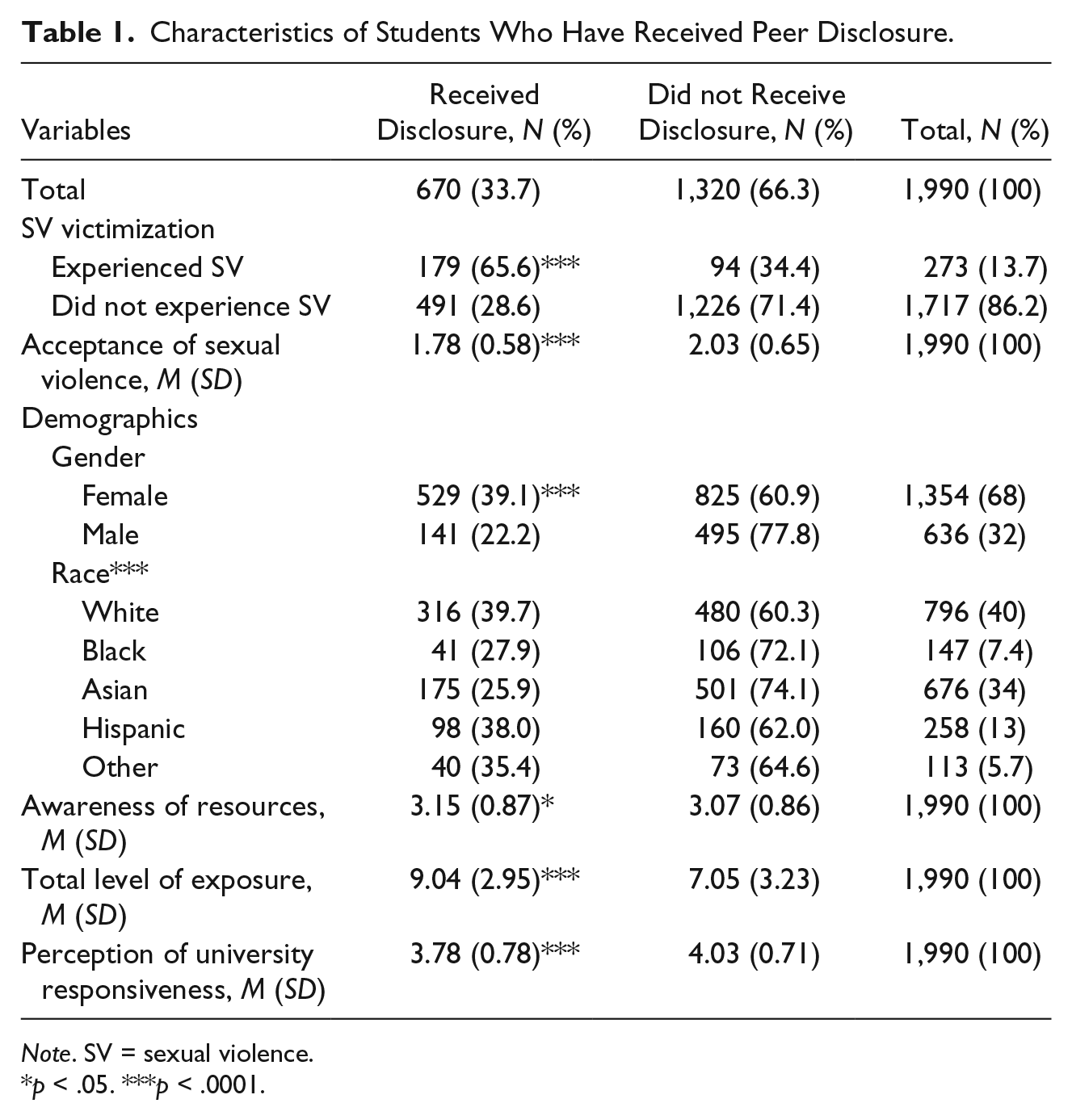
Note. SV = sexual violence.
p < .05. ***p < .0001.
Perceived Response to Disclosure
To assess the impact of campus-level variables on three outcome variables related to students’ perceived efficacy when responding to a peer disclosure of sexual violence, we conducted a series of hierarchical logistic regressions. To test the first research question that individual-level predictors are associated with disclosure recipients’ perceptions of their knowledge, helpfulness, and comfort in responding, the individual-level variables gender, race/ethnicity, personal victimization, and acceptance of interpersonal violence were entered in Step 1 for each of the hierarchical logistic regression models. To test the second research question, in Step 2, the three community-level variables (awareness of on-campus resources, level of exposure to sexual and intimate partner violence information on-campus, and students’ perceptions of the university’s responsiveness) were entered. Results of the hierarchical logistic regression analyses, including ORs, are presented in Table 2.
Multivariable Analysis of Students’ Perceived Ability to Respond to Disclosure.

Note. N = 666; OR = odds ratio; SV = sexual violence; R=reference group.
p < .05. **p < .01. ***p < .0001.
For the second research question related to the impact of individual-level variables, the overall logistic regression models were significant for all three outcomes, including perceived knowledge of how to respond, χ2(7) = 16.63, p < .05; perceived belief that their response was helpful, χ2(7) = 15.22, p < .05; and their comfort in providing support, χ2(7) = 25.12, p < .01. As can be seen in Table 2 (Model 3), students who identified as Asian/Asian American had lower odds of perceiving their response as helpful (OR = 0.613 [.40, .94], p = .026) and lower odds of feeling comfortable providing support to their peer (Model 5; OR = 0.549 [0.35, .87], p = .011) when controlling for demographic and individual-level variables, compared to White students. Students who experienced sexual violence victimization within their lifetimes (Model 1) had 50% greater odds of knowing how to respond (OR = 1.52 [1.04, 2.23], p = .032) and had nearly 60% greater odds of perceiving their response as helpful (Model 3; OR = 1.58 [1.01, 2.45], p = .044) when controlling for demographic and individual-level variables, compared to students who do not have an experience of sexual violence victimization.
For the third research question, regarding the impact of community-level variables, the overall logistic regression models were significant for all three outcomes, including perceived knowledge of how to respond, χ2(10) = 76.92, p < .01; perceived belief that their response was helpful, χ2(10) = 59.16, p < .01; and their comfort in providing support, χ2(10) = 39.12, p < .01. In addition, according to the likelihood ratio test statistics, all three of the models with the community-level variables were superior in terms of model fit to the first set of models, with only individual-level factors included. For each of the three outcome variables, the block chi-square statistics was significant at the .01 level, including perceived knowledge of how to respond (critical value = 60.14 [df = 3]) and the Nagelkerke R2 value was 5 times larger; perceived belief that their response was helpful (critical value = 43.94 [df = 3]) and the Nagelkerke R2 value was four and a half times larger; and their comfort in providing support (critical value = 14.8 [df = 3]) and the Nagelkerke R2 value was one and a half times larger. Therefore, these factors proved to be important for the prediction of perceived response to disclosure.
Results from the logistic regression models with community-level variables included show that Asian/Asian American students had lower odds of feeling comfortable supporting their peer (OR = .58 [.36, .90], p = .02) when controlling for demographic, individual-level, and community-level variables, compared to White students. Hispanic students also had lower odds of perceiving their response as helpful (OR = .58 [.34, .99], p = .04) when controlling for demographic, individual-level, and community-level variables, compared to White students. Personal victimization remained a significant predictor of perceived knowledge (OR = 1.70 [1.13, 2.56], p < .05) and helpfulness (OR = 1.65 [1.03, 2.63], p < .05). In terms of community-level variables, awareness of resources was associated with reporting perceived knowledge of how to respond (OR = 1.49 [1.19, 1.86], p < .01) and helpfulness (OR = 1.46, 95% CI: [1.14, 1.86], p < .01) but not comfort. Higher perceptions of the university’s responsiveness were associated with knowledge of how to respond (OR = 1.41 [1.12, 1.77], p < .01) but not helpfulness nor comfort. Greater level of exposure to sexual and intimate partner violence information on-campus was associated with all three outcome variables, including knowledge of how to respond (OR = 1.11 [1.04, 1.19], p < .01), helpfulness (OR = 1.14 [1.07, 1.23], p < .01), and comfort (OR = 1.12 [1.04, 1.20], p < .01).
Discussion
Our study found that 34% of the sample has received at least one disclosure of sexual violence since to campus, which is consistent with other studies (Banyard et al., 2010; Paul et al., 2013). This finding underscores the important role that peers play in responding to survivors who have experienced campus sexual violence (Sabina & Ho, 2014). This supports the need for efforts such as bystander intervention education, which frame sexual violence as a community issue where everyone has a role to be involved (Banyard, 2015). Students may be more receptive to programs about ways to help friends and peers, rather than be addressed as potential victims or perpetrators.
Similar to previous research, individual-level factors had an influence on disclosure recipients including who receives disclosures and their ability to respond. Prior examinations of disclosure experiences have explored the disparate number of women compared to men who have received disclosures of sexual violence (Banyard et al., 2010; Paul et al., 2013; Paul et al., 2014). In line with this research, a larger percentage of the sample in this study that received a disclosure were women (78%). However, this study did not find a difference in men and women’s response to disclosure. Some research has found that men may respond similarly to disclosures than women (Orchowski & Gidycz, 2012), but much of the disclosure literature has failed to explore the response of men that have received disclosures, examining primarily women’s responses. Further research is needed to more fully understand men’s response to peer disclosures of sexual violence.
Regarding race, one of the strengths of this study was having a diverse representation of students, which allowed comparisons that are often missing in similar work. In the current sample, White and Hispanic students reported receiving more disclosures as compared to Black, Asian, and students of other race/ethnicities. However, in terms of response to disclosure, Asian students were less likely to feel comfortable when responding to a disclosure compared to White students, and Hispanic students were less likely to feel their response was helpful compared to White students. While there are no previous studies available on the differences among the race of disclosure recipients, there is research indicating that women who identify as racial or ethnic minorities face additional barriers related to disclosing experiences of sexual violence more generally due to factors such as historical mistreatment, racism, and fear that they will experience discrimination when disclosing (Love et al., 2017). An exploratory study by Hoxmeier, O’Connor, and McMahon (2018) found that Black and Asian women were also less likely than White women to disclose their sexual victimization because of a hesitancy to appear as reflecting poorly on their racial/ethnic communities. There has been a call to better “center” the experiences of minority students when examining campus sexual violence (Linder & Harris, 2017), which should include a stronger understanding of their experiences of both making and receiving disclosures. Both prior research examining Asian and Black women’s likelihood of disclosing their sexual victimization, in addition to the findings of this study, support this need for further research.
Previous sexual violence victimization was also associated with a greater likelihood to identify as a disclosure recipient as well as with two of the three outcomes related to the perceived ability to respond (perceived knowledge of how to respond and perceived helpfulness), similar to findings by other research in this area (Banyard et al., 2010; Paul et al., 2013; Paul et al., 2014). This is not surprising, given that survivors would be more aware of resources as well as knowing what types of responses may or may not be helpful to others. It was not associated with comfort, however, which is also unsurprising, as addressing the issue of sexual violence may be uncomfortable for students in general yet particularly difficult for survivors. Given this finding, it may be especially important for education programs to acknowledge that those who have their own histories of victimization may need additional support when responding to disclosures of peers and offer suggestions for self-care and remind students that there is support available not only for victims but also for those supporting victims. This also speaks to the need for campuses to ensure that their counseling and victim services are ensuring that when they promote their services that they explicitly address their availability to support those receiving disclosures, especially those who have victimization histories.
Lower personal endorsement of beliefs that accept sexual violence was significantly associated with receiving a disclosure. This finding aligns with previous research that has found that peers with greater endorsement of beliefs that accepted sexual violence may be less supportive of peers who disclose an experience of sexual violence (Orchowski & Gidycz, 2012). However, in the current study, personal endorsement of beliefs that accept sexual violence was not significantly associated with perceived ability to respond effectively to a disclosure, which does not align with prior research. As the study explored students’ perceived ability to respond to peer disclosures of sexual violence, which is not an objective measure, students who have a higher personal endorsement of beliefs that accept sexual violence may think they had responded to the disclosure well. This finding warrants further work to determine whether the perceptions of both the discloser and the recipient’s accounts do in fact match.
A key research question for this study related to the significance of community-level factors and their influence on who identifies as a disclosure recipient as well as students’ perceived ability to respond effectively. This represents a gap in the literature, despite calls for socio-ecological approaches to understanding intervention behaviors (Banyard, 2011). This exploratory study found that above and beyond individual correlates, campus-level factors impacted students’ roles as disclosure recipients, although there were mixed findings. First, those students who reported a greater awareness of resources, greater exposure to sexual violence information on campus, and lower personal endorsement of beliefs that accept sexual violence were more likely to identify as disclosure recipients. Taken together, these findings align with Latane and Darley’s (1970) decisional model for bystander intervention in that the first steps to engaging in helping behavior are noticing the situation and determining whether intervention is needed. Therefore, these students could be eliciting disclosures from their peers because they are more likely to have the information needed to notice a peer in distress and try to provide support to that student. However, further research is needed to determine the direction of the relationship, as these students could have also received a disclosure and then sought out more information regarding sexual violence resources on campus. Surprisingly, however, perception of the university’s responsiveness was negatively associated with receipt of peer disclosures. Further research is needed to determine the temporal ordering of these variables as it could be that students who have received a disclosure of sexual violence from a peer are subsequently more likely to perceive the university as not responding well to the issue of sexual violence on campus.
Campus climate variables were also related to disclosure recipients’ perceptions of their ability to respond. Specifically, awareness of on-campus resources, level of exposure to on-campus information, and perception of the university’s responsiveness were all related to students’ knowledge of how to respond effectively to their peers. Collectively, these findings speak to the significance of creating information-rich environments on college campuses where resources are not only present but also well-communicated to community members (Edwards et al., 2014). Providing resources and exposure to information about sexual violence and prevention are important factors in building a campus culture where the message is conveyed that the issue is taken seriously and resources are dedicated to building safe and healthy campuses that impact the effectiveness of the prevention tool (Banyard, 2014; Paul & Gray, 2011), as demonstrated by the finding that perceptions of the university’s responsiveness were also a significant factor in predicting students’ knowledge of how to respond. Thus, students’ perceptions of the campus climate are important in helping them develop confidence in knowing how to respond to their peers. Further work is needed to better understand each of these indicators of campus climate and to determine how they are related. Examination of the diffusion of information and where the “tipping point” lies is important in understanding how colleges and universities can help to institutionalize knowledge about resources.
Level of exposure to information and awareness of resources were also associated with students’ perceived helpfulness of their responses. The consistent significance of level of exposure reinforces the idea that providing multiple sources of information to students is beneficial in their confidence about providing useful responses. While this study did not measure students’ actual behaviors, this is consistent with prevention theory which indicates that it requires multiple “doses” of education and information to change actual behaviors (Banyard, 2014; Nation et al., 2003; Taylor, Stein, & Burden, 2010). This study highlights the importance of greater level of exposure to sexual and intimate partner violence information on-campus; however further work is needed to understand whether certain types of exposure to information on campus are more impactful than others (McMahon & Stepleton, 2018).
The findings from this study support recent work on bystander intervention that frames sexual violence as an issue that affects not just victims and perpetrators but also the larger community (Banyard, 2015). While many bystander intervention programs emphasize the role of peers in preventing sexual violence, there is also a need to attend to the full spectrum of potential bystander roles—including before, during, and after an assault (McMahon & Banyard, 2012). Thus, it is critical for bystander intervention programs to address the role of peers not only in preventing or interrupting sexual assault but also in receiving disclosures.
Exposure to information was the only climate-level variable related to comfort in responding. While this suggests that again, resource-rich environments are critical for supporting students to engage in helping their peers, it also indicates that further work is needed to understand this construct. Because situations of sexual violence disclosure are naturally uncomfortable, asking students about their level of “comfort” in responding may not be as useful an outcome measure as others that can be explored in further measurement work. For example, utilizing measures such as students’ emotional distress as measured by Ahrens and Campbell (2000) may yield more useful data.
Limitations and Future Research
Despite the study’s contributions, several limitations of this study deserve mention. First, the study was conducted on one campus, which limits the generalizability of findings. Second, while the sample size for the study was large, the overall response rate was low (14.2%) despite extensive outreach efforts, which introduces the possibility of self-section bias. However, it is important to note that low overall response rates for campus climate surveys are common with the American Association of Universities reporting a range of response rates from 7% to 53%, with a 19% average response rate across the 27 institutions that participated in their sexual violence campus climate study (Cantor et al., 2015).
The study was also exploratory and based on a cross-sectional dataset that relied on self-report. Finally, the survey’s questions asked about some of the variables in a limited manner, including all three outcome variables that were asked in a dichotomized way. In addition, the three outcomes were measured as perceptions by disclosure recipient; whether or not they were actually helpful to their peer is based on their interpretation. Although surveying students who have received peer disclosures of sexual violence is an essential component of understanding students’ ability to respond, it may provide an incomplete picture of their actual ability to respond. Pairing disclosure recipients’ perception of their response with reports from those that disclosed may be an important next step.
Despite the inclusion of several campus-level variables in the model, researchers are unable to include numerous additional factors in the study. Previous research highlights the importance of examining students’ sense of community (Banyard, 2011) and the impact on disclosure experience, a predictor variable that was not measured in the dataset. In addition, the survey in this study only asked about the quantity of discrete types of exposures, without assessing the quality of those exposures and what type of information was conveyed. Future studies may therefore wish to include additional community-level factors to examine students’ perceived ability to respond to disclosure as well as more fully developed measures of students’ perceived response to expand upon findings.
This study also highlights the role of students with previous sexual violence experiences and their ability to respond to peer disclosures; however, further work is needed to understand the potential consequences that exist for disclosure recipients, both with and without victimization experiences (Moschella & Banyard, 2021). As institutions of higher education continue to encourage students’ helping behavior, it is essential to understand the impact that these helping experiences may have on students own well-being.
Much of the research on disclosure experiences has relied on self-report data and individual-level factors without considering the broader context and communities in which students learn and reside. While this is an exploratory study to examine the impact of campus-level variables on perceived disclosure responses, further work is needed to examine person in environment and the best method to do so is to couple self-report data with observational methods that examine campuses adherence to best practices and federal mandates in terms of sexual violence prevention and response.
Footnotes
Declaration of Conflicting Interests
The author(s) declared no potential conflicts of interest with respect to the research, authorship, and/or publication of this article.
Funding
The author(s) received no financial support for the research, authorship, and/or publication of this article.
