



Abstract
Exposure to sexist humor creates a context in which some men feel comfortable expressing aggressive tendencies toward women (i.e., self-reported rape proclivity). This is in part because this type of humor makes it easier for men who have antagonistic attitudes toward women to express their prejudice without fear of social reprisal. Besides, previous research has demonstrated the influence of motivational variables such as autonomy (initiation or regulation of intentional behavior based on free choice) and control (acting under external pressure) on aggression. We conducted two experiments to explore the hypothetical influence of priming autonomy and control motivations on the relation between sexist humor and the expression of sexually aggressive tendencies toward women. Study 1 (N = 108) revealed that control-primed men with high (vs. low) scores in hostile sexism reported a higher rape proclivity when exposed to sexist (vs. neutral) humor. These results were partially replicated in Study 2 (N = 132), assessing the accessibility of aggressive sexual thoughts. This research contributes to our understanding of the influence of sexist humor and motivational orientations in sexist men on the expression of aggressive sexual behaviors directed against women.
As a means of social communication, humor can facilitate the transmission of information in social interactions and can influence the way in which a message is interpreted. Humor allows attitudes and emotions to be expressed in a “playful” way. For example, when disparagement of or hostility toward a group or an individual is expressed in a humorous way, the source of the humor escapes responsibility for these thoughts or actions, taking refuge behind the fact that “it was only a joke or humorous comment.”
Disparagement and hostility manifested through humor have traditionally been trivialized and undervalued, especially when directed toward women (LaFrance & Woodzicka, 1998). However, empirical research suggests that the growing opposition to sexist humor might indeed be justified. Thus, researchers have recently begun to focus on analyzing the consequences of exposure to disparagement humor in general, and especially to humor that focuses on the denigration of women (i.e., sexist humor). In this regard, it has been established that sexist humor creates a norm of tolerance of sexual discrimination, which in turn leads to a higher tolerance of sexist events (Ford, 2000), the acceptance of societal sexism (Ford et al., 2013), and a greater willingness to discriminate against women (Ford et al., 2008). Most notably for the present research, men exposed to sexist humor have reported greater propensity to commit sexual violence against women, including rape (Romero-Sánchez et al., 2010, 2017), particularly when the male recipients of this type of humor exhibit sexist attitudes (e.g., Thomae & Viki, 2013).
In attempts to predict the effects of exposure to sexist humor with greater accuracy, a number of variables have still not been taken into account. In particular, the potential role of motivational orientations (Deci & Ryan, 2000) in this regard has not yet been explored, even though their relevance in the prediction of certain humor responses (i.e., aggressive humor) has been confirmed in previous research (Weinstein et al., 2011) and its influence on the occurrence of other forms of violence against women has been examined (Øverup et al., 2017). Motivational orientations are referred to as controlled and autonomous tendencies that initiate and direct human activity across diverse domains. Controlled orientation is associated with feeling coerced and pressured to respond in particular ways and is related to extrinsic motivation. In contrast, autonomous orientation involves a sense of agency and choice regarding behavior (Deci & Ryan, 2000).
Specifically, we based our research on self-determination theory (SDT; Ryan & Deci, 2000) and the prejudiced norm theory (Ford & Ferguson, 2004), which is widely accepted for explaining the negative effects of exposure to disparagement humor. The goal of this research was to obtain new evidence on how exposure to sexist humor is related to greater propensity to commit sexual aggression against women and how this relationship can be moderated jointly by motivational orientations activated in participants (autonomous vs. controlled motivation) and by participants’ attitudes (i.e., sexist attitudes).
Prejudiced Norm Theory: Sexist Humor and Violence Against Women
Sense of humor has been defined as a quality that can increase individuals’ social worth, facilitate group interaction, and foster a favorable social climate and positive affective experiences (Torres-Martin et al., 2018). Although there may be some consensus on the positive aspects of humor and its manifestations, there is also a growing interest in its “dark side” and, specifically, in what happens when the issuer exceeds certain social limits or norms through humor-based communication. Among these manifestations, we focused on the use of humor to humiliate or ridicule members of a group (i.e., women) based on a “negative aspect” that supposedly characterizes them. This type of humor has been conceptualized as disparagement humor, a form of humor that “refers to remarks that (are intended to) elicit amusement through the denigration, derogation, or belittlement of a given target” (Ferguson & Ford, 2008, p. 283) and that must be distinguished from hostile humor. Although these two types of humor may overlap because they both involve contempt, it should be noted that the key goal of hostile humor (vs. disparagement humor) is not to ridicule a group or person on the basis of a stereotypical characteristic or particular trait attributed to them but rather the humiliation, aggression, and insult in itself. In other words, hostile humor is based on physical aggression, insult, or humiliation of a high intensity and does not require a specific target because of its stereotypical characteristics.
Most of the research in this field has focused on clarifying which individual characteristics increase or decrease the humor response to certain humor stimuli that are considered disparaging (Carretero-Dios & Ruch, 2010). However, a complementary area of research is engaged in clarifying the effects or consequences of exposure to this type of humor. In fact, it is argued (Ford & Ferguson, 2004) that this humor is not harmless but rather the opposite. In this vein, Ford and Ferguson (2004) developed the prejudiced norm theory, considered one of the most valuable frameworks in the study of the effects of exposure to disparagement humor.
According to this theory, when a group or person is exposed to this type of humor, a change occurs in the way in which the content of the message is perceived and interpreted, and the serious mind-set associated with receiving a disparaging message is left aside. Most notably for the present research, exposure to disparagement humor toward women creates a situational norm of levity that makes prejudiced individuals, men who have antagonistic attitudes toward women, feel comfortable expressing their prejudice toward women. This norm of levity may also lead to a lower rejection and greater acceptance of the disparaging information included in the joke. The norm therefore implies that one is not necessarily prejudiced against the target group of the disparaging joke. For example, sexism manifested through humor creates an interpretative ambiguity that makes it possible for the receiver to reduce or avoid opposition to denigrating messages about women (Bill & Naus, 1992). In this regard, Ford (2000) found that exposing men with higher levels of sexism to jokes in which women were denigrated promoted a higher tolerance toward certain workplace discriminatory behaviors.
As a general rule, prejudiced people act on the basis of what is “socially desirable”; in other words, they regulate the expression of their prejudice depending on the context (Dovidio et al., 2010). Specifically, in situations in which prejudicial behavior is openly recriminated or in which non-tolerance to it is likely, prejudiced individuals will not express themselves freely but will instead let themselves be influenced by the social norm of “not being prejudiced.” However, disparagement humor in general, and sexist humor in particular, seem to act as a cue that makes it possible to express negative attitudes. Specifically, applying the prejudiced norm theory to the particular case of sexist humor, men who harbor hostile attitudes toward women are likely to see this type of humor as a way to freely express their prejudice without fear of social reprobation because it is “only a joke.” It must be noted at this point that disparagement humor against women in itself does not promote the acceptance and/or expression of prejudice communicated through humor in all men; instead, it is men with certain attitudes (i.e., hostile sexism) who are most influenced by this type of humor (e.g., Romero-Sánchez et al., 2010, 2017).
A number of studies have found that individuals high in hostile sexism tend to enjoy sexist humor more, exhibiting greater funniness and less aversiveness to this type of humor (Ford et al., 2008; LaFrance & Woodzicka, 1998; Thomae & Viki, 2013). In addition, recent research has shown that sexist humor also alters the boundaries between inappropriate and acceptable behavior, increasing acceptance of the former; such studies have shown that this applies both to subtle expressions of sexist views and to sexually violent behaviors (Romero-Sánchez et al., 2017; Thomae & Viki, 2013; Viki et al., 2007). A pioneering example of this can be found in the study by K. M. Ryan and Kanjorski (1998). In this study, the authors showed the expected positive relationship between funniness of sexist humor and the acceptance of rape myths. Moreover, participants who rated sexist jokes at a higher level of funniness also exhibited more tolerant attitudes toward rape and higher rape proclivity, defined as men’s self-reported probability of committing rape in hypothetical scenarios in which they are assured that they will not be discovered (Malamuth, 1981).
Along the same lines, more recent studies have been conducted based on the previous ones but using an experimental approach. Researchers have analyzed the effect of exposure to sexist humor on self-reported rape proclivity as well as the variables that moderate this effect, such as hostile sexism (Romero-Sánchez et al., 2010). In addition to the known positive relationship between hostile sexism and rape proclivity, these studies found that exposure to sexist (vs. neutral) humor was only correlated with higher self-reported rape proclivity in participants high in hostile sexism and who showed a lower rejection of this type of humor. Furthermore, Romero-Sánchez et al. (2017) showed that the relationship between hostile sexism and rape proclivity after exposure to sexist humor reaches beyond a specific woman in the immediate humor context to encompass women as a whole, which suggests that this type of humor might contribute to a broader culture of rape and sexual violence against women (K. M. Ryan & Kanjorski, 1998).
The Relevance of Motivational and Self-Regulatory Processes on the Effect of Sexist Humor
Motivational processes are conceptualized as those responsible for initiating and directing human behavior toward specific ends and goals. The SDT (Ryan & Deci, 2000) identifies two motivational orientations related to the self-regulation of behavior: autonomous motivation and controlled motivation. Autonomous motivation refers to the tendency to regulate behavior according to one’s own values and ideals; in other words, it entails carrying out actions according to one’s personal criteria and rules, without normative restrictions, as a self-determined behavior. Controlled motivation, on the contrary, involves a regulation of behavior according to established rules, coercion, or social pressures. This type of motivation is linked to external factors, such as rules that must be obeyed, as well as obligations and duties that dictate the individual’s actions; therefore, these individuals tend to be more vulnerable to social influences than individuals lower in controlled orientation (Knee & Neighbors, 2002). It is a well-known fact that motivational orientation is a decisive factor in the regulation of intrapersonal and interpersonal experiences (Hodgins, 2008). In this regard, it has been observed that when autonomous motivation (vs. controlled motivation) is prioritized, people show better regulation of their behavior; that is, they are more effective at managing their responses to emotionally charged stimuli or situations. By contrast, controlled motivation is associated with greater psychological discomfort and with negative affective responses such as aggressiveness, hostility, and sadness (Hodgins et al., 1996), all of which are likely to interfere in an individual’s self-regulation of behavior.
Previous research (Hove et al., 2010; Øverup et al., 2017) showed that autonomous orientation toward one’s relationship may serve as a protective factor, whereas controlled motivation may be a risk factor for reactive intimate partner violence (IPV) perpetration. Hove et al. (2010), for instance, found that college students with higher autonomous orientations were less likely to perpetrate IPV, this relationship being partially mediated by alcohol consumption. Conversely, those male participants who reported higher controlled orientation reported drinking more alcohol and perpetrating more incidents of IPV. In addition, Øverup et al. (2017) analyzed the relationship between motivation orientations and the previous year’s IPV. They found that autonomous motivation orientation was associated with a greater probability of not perpetrating physical IPV and with a lower frequency of perpetration of physical and psychological violence. On the contrary, those male participants who reported higher controlled orientation reported greater likelihood of engaging in physical and psychological violence, with a higher frequency of psychological aggression.
Collectively, these findings suggest that people with higher controlled orientation are more likely to engage in and justify IPV perpetration, whereas autonomous orientation is associated with less perpetration of IPV. However, these results are based on a correlational approach; the causal role of motivational orientation in IPV has not been analyzed using an experimental approach (Hove et al., 2010), nor have researchers taken into account other relevant variables (i.e., sexist attitudes) (Øverup et al., 2017) that have been found to be significant predictors of violence against women (Dardis et al., 2015; Heise, 2011).
Regarding the humor research area, Weinstein et al. (2011) used the SDT as a reference and explored the relationship between both controlled and autonomous motivational orientations and the response to humor stimuli classified as hostile. They conducted four studies (Weinstein et al., 2011) that revealed that participants exposed to the controlled (vs. autonomous) motivation condition showed higher scores in the affective hostility dimension and more aggressive responses, understanding aggressiveness as their self-reported funniness to the hostile humor to which they were exposed.
Although these studies conducted by Weinstein et al. (2011) considered both the motivational aspects of participants and their responses to humorous stimuli at the same time, several aspects deserve to be analyzed. First, these studies focused on hostile humor, not on disparagement humor. However, as previously noted, the goal of disparagement humor, unlike hostile humor, is to ridicule the protagonist of the humorous material on the basis of stereotypically attributed characteristics. Consequently, it is especially relevant to consider the attitudes and beliefs of participants toward the disparaged group as essential variables when predicting responses to disparagement humor and the consequences of exposure to it. Second, these authors were only interested in responses to hostile humor, not in the consequences of exposure to this type of humor, which could also be of interest given the results of the aforementioned studies on sexist humor. Finally, the study by Weinstein et al. (2011) showed that participants with high initial affective hostility exhibited a greater willingness to attack others, based on their response to hostile humor. However, so far, the mood dimensions of anger and hostility have not been found to be related to disparagement humor (Lampert & Ervin-Tripp, 2007), and attitudinal/ideological factors are considered to be the best predictors of this type of humor (Carretero-Dios et al., 2010).
The Present Research
As noted above, prejudiced individuals regulate their behavior based on external or contextual cues to avoid social backlash to the expression of their ideas or beliefs (Ford & Ferguson, 2004). Typically, when expressing their convictions, prejudiced individuals (i.e., hostile sexists who showed negative prejudice toward women) act under a controlled motivational orientation, inhibiting their behavior to adjust it to the social norm and only expressing their views when the context allows it. When such individuals act under normal circumstances according to external cues and norms (i.e., controlled motivation), they are likely to express their prejudice (i.e., hostile sexism) only in enabling contexts in which it is not perceived as threatening (i.e., sexist humor); this is possible because the situational cues of the moment indicate that expressing such a view is allowed (i.e., “it’s only a joke”). By contrast, we could hypothesize that in situations where men high in hostile sexism do not need to regulate their behavior according to external rules or norms and their actions are driven by their personal criteria and rules (i.e., autonomous motivation), they tend to openly express their prejudice without the need for an enabling context.
With this in mind, we conducted two studies to analyze the possible influence of the activated motivational orientation (controlled vs. autonomous motivation) on aggressive sexual tendencies toward women reported by men high in hostile sexism when exposed to sexist (vs. neutral) humor targeting women, while statistically controlling by participants’ affective hostility. Study 1 explored self-reported rape proclivity, whereas Study 2 focused on the accessibility of sexually aggressive thoughts.
For both studies, we hypothesized that participants with higher adherence to hostile sexism would exhibit greater sexually aggressive tendencies toward women (Hypothesis 1). Moreover, we expected to find a joint effect of hostile sexism, motivational orientation, and humor (Hypothesis 2). Specifically, in the controlled motivation condition, we expected that the participants who would exhibit the greatest sexually aggressive tendencies would be those high in hostile sexism when exposed to sexist humor.
Study 1
Method
Participants
The initial sample consisted of 132 male undergraduate students enrolled in a range of courses at a Spanish public university, who all volunteered to participate in our research. Data from 24 participants were excluded from the analyses: 19 responded inconsistently to the motivation priming task (i.e., they described events that were unrelated to situations in which they had to act on the basis of external rules or pressures—controlled motivation condition—or in which they acted freely, autonomous motivation condition); the remaining five declared a sexual orientation other than heterosexual (they were excluded because the scenario-based measure of rape proclivity might not have provided meaningful behavioral templates for them). The final sample consisted of 108 participants, whose ages ranged between 18 and 30 years (M = 22, SD = 2.66).
Materials and measures
Sexist attitudes
Participants’ sexist attitudes were assessed with the Hostile Sexism subscale of the Ambivalent Sexism Inventory (Glick & Fiske, 1996). The Hostile Sexism subscale comprises 11 items with statements such as “Women are too easily offended” and “Women seek to gain power by getting control over men.” Participants indicated their agreement with each statement on a 6-point scale (0 = strongly disagree, 5 = strongly agree). Cronbach’s α was .91.
Affective hostility
We used the Hostility subscale of the Scale for Mood Assessment (EVEA; Sanz, 2001). The EVEA scale comprises 16 items that present short statements describing four moods (i.e., anxiety, hostility, sadness-depression, and happiness). All statements begin with the expression “I feel” and end with an adjective describing a mood (e.g., “I feel angry,” “I feel irritated”). Participants indicated the extent to which each item described their mood on a scale ranging from 0 (not at all) to 10 (completely), with a particular emphasis on the assessment of current, transitory moods at the very moment of completing the questionnaire. Only the Hostility subscale was considered for this study. A higher score on this EVEA subscale indicated a higher level of affective hostility (Cronbach’s α = .92).
Motivation priming
Participants were randomly assigned to one of two motivation conditions (autonomous or controlled) using an adaptation of the procedure used by Whitson and Galinsky (2008, Experiment 3). They were instructed to vividly recall and write about an experience in which they could act or make comments based on rules, norms, or external pressures (i.e., controlled motivation condition), or about an experience in which they could act or make comments freely without any rules, norms, or external pressures (i.e., autonomous motivation condition). In addition, participants were asked to answer the question “To what extent did you act or give your opinion according to external pressures, norms or rules in the situation you just described?” on a 10-point scale ranging from 1 (not at all) to 10 (yes, absolutely). Higher scores reflected a higher influence of external coercion or pressure. Subsequently, two raters independently coded each participant’s response based on the question “Did the participant act or give an opinion under the influence of external pressures, norms or rules in the situation just described?” Both raters left 19 participants out of the study because they described events that were unrelated to situations in which they had to act on the basis of external rules or pressures—controlled motivation condition—or in which they acted freely, autonomous motivation condition. Once participants’ responses had been classified, their scores in the question they had answered after describing the proposed scenario were analyzed. Mean scores in this question were significantly higher among participants who described an experience in which they had acted or made comments according to rules, norms, or external pressures (M = 6.44, SD = 2.66) than among participants who depicted a situation in which they had acted or made comments freely (M = 3.66, SD = 3.57), F(1, 106) = 16.34, p < .001, η2 = .13.
Jokes
The jokes used in each of the experimental conditions (four in the sexist humor condition and four in the nonsexist humor condition) were taken from the Humor Appreciation Scale (Carretero-Dios et al., 2010). This scale contains 32 jokes and vignettes, which are answered using two 5-point Likert-type scales ranging from 0 to 4, namely not funny/no aversiveness and very funny/strong aversiveness. In our study, participants only rated the four jokes and vignettes that corresponded to the woman-disparagement factor and four other jokes and vignettes that represented neutral humor factors on the scale. Previous research has revealed that no differences exist in the funniness elicited by these jokes and vignettes, which are either sexist or neutral (Romero-Sánchez et al., 2010).
Rape proclivity
To assess self-reported rape proclivity, participants were exposed to a written account of two scenarios that ended in rape and asked to imagine themselves as the man described in the scenario. We used the Rape Proclivity Scale developed by Bohner et al. (1998), but only the two scenarios identified by Romero-Sánchez et al. (2017) as “moderate physical violence rape scenarios.” We chose these less physically violent rape scenarios because they did not conform clearly to the “real rape” stereotype, that is, an attack perpetrated by a stranger involving physical force (Krahé & Berger, 2009). As previous research has revealed (e.g., Frese et al., 2004; Romero-Sánchez et al., 2012), individuals have different frames of reference for how to interpret and respond to incidents, depending on whether they conform or not to the real rape stereotype. By contrast, the norms on how to view and respond to rape scenarios that do not conform to the “real rape stereotype” are more ambiguous, giving people latitude to interpret these incidents according to their own sexist attitudes (Bohner et al., 2009). According to the original scale, after reading each scenario, participants answered the following three questions: “How sexually aroused would you have felt in the situation?” “Would you have behaved like Juan [the name of the rapist in the scenario] did in this situation?” and “Would you have enjoyed behaving like Juan in this situation?” As Bohner et al. (2009) indicate, the first question, answered on a 7-point scale ranging from 1 (not sexually aroused) to 7 (very much sexually aroused), was a distracter item. The other two questions were aimed at obtaining participants’ self-reported level of rape proclivity. This was achieved by obtaining the so-called rape proclivity index, which is the mean score of the answers to the two questions in these scenarios in a 7-point Likert-type scale (1 = not at all, 7 = completely). This instrument showed adequate internal consistency (Cronbach’s α = .91).
Design and procedure
Participants were randomly assigned to one of four experimental conditions in a 2 × 2 (Primed Motivation: Autonomy vs. Control × Type of Humor: Sexist vs. Neutral) between-participants design. Thus, primed motivation and type of humor were the experimentally manipulated independent variables, and hostile sexism was measured as an individual difference factor. The dependent variable was participants’ self-reported rape proclivity. We additionally asked participants to rate the funniness and aversiveness of the jokes, and also assessed the affective hostility previous to experimental manipulation.
Potential participants were approached at several university libraries and asked if they would volunteer to take part in the study. Participants who agreed to take part in the study signed the informed consent presented at the beginning of the survey.
In order to minimize hypothesis guessing, the material was presented as two independent studies: One study was presented as “several surveys to assess young people’s attitudes and competences regarding several topics,” and the other study’s stated purpose was to assess “people’s reactions to several jokes and vignettes and perceptions of social interactions between men and women.” In the supposed “Study 1,” participants were asked to complete the Affective Hostility subscale of EVEA (Sanz, 2001), the Hostile Sexism subscale of the Glick and Fiske’s (1996) Ambivalent Sexism Inventory, and a motivation-priming task (autonomy or control motivation). Finally, after completing a short demographic questionnaire (i.e., gender, nationality, and age), participants were thanked and asked to complete the second study. In this supposed “Study 2,” participants first read 4 jokes and vignettes (neutral or sexist) and rated the funniness and aversiveness of each joke and vignette. Second, they completed the Rape Proclivity Scale (Bohner et al., 1998; see the section on materials and instruments). Finally, participants provided several sociodemographic data (i.e., gender, age, nationality, and sexual orientation) and were thanked for their participation and debriefed about the goals of our research.
Results
Preliminary analyses
No statistically significant differences were found, F(1, 123) = 0.27, p = .61, between funniness scores in the sexist joke condition (M = 1.66, SD = 1.01) and the nonsexist joke condition (M = 1.75, SD = 0.83). However, in the sexist joke condition, aversiveness scores were significantly higher (M = 2.31, SD = 1.02) than those found in the nonsexist joke condition (M = 0.59, SD = 0.76), F(1, 122) = 111.18, p < .001. These results are consistent with previous research (e.g., Romero-Sánchez et al., 2010).
The correlation between affective hostility and hostile sexism was around zero (r = .03, p = .76). To verify the equivalence of preexisting affective hostility and hostile sexism in the groups, we performed two 2 × 2 analyses of variance (ANOVAs) (Primed Motivational Orientation: Autonomous vs. Controlled × Type of Humor: Sexist Humor vs. Neutral Humor), with affective hostility and hostile sexism as dependent variables. The results of these analyses revealed the equivalence of hostile sexism and affective hostility across experimental conditions (Fs < 1).
Main analyses
We tested our hypothesis by conducting regression analyses on self-reported rape proclivity scores using the macro PROCESS for SPSS tool developed by Hayes (2013, Model 3). Taking into account the existing findings about the relationship between affective hostility and hostile humor (Weinstein et al., 2011) and aiming to clarify the importance of ideological hostility (i.e., hostile sexism) beyond affective hostility, we controlled affective hostility scores. Moreover, because the differences found in aversiveness scores between humor conditions, we also controlled the perceived aversiveness ratings depending on the type of humor (sexist vs. neutral). First, we found a significant effect of hostile sexism on rape proclivity, b = .48, SE = 0.20, t(95) = 2.42, p < .05, 95% confidence interval (CI) [0.08, 0.86]. In keeping with previous findings (e.g., Romero-Sánchez et al., 2010, 2017), men with higher hostile sexism reported higher rape proclivity (Hypothesis 1). In line with Hypothesis 2, a significant three-way interaction was observed between Hostile Sexism × Type of Humor × Motivational Orientation Priming, b = 1.11, SE = 0.49, t(95) = 2.27, p < .05, 95% CI [0.13, 2.07].
According to Hypothesis 2, the analysis revealed that, in control-primed condition, exposure to sexist (vs. neutral) humor promoted a higher rape proclivity only in participants high in hostile sexism, b = 1.66, SE = 0.80, t(28) = 2.07, p < .05, 95% CI [0.02, 3.29], but not in participants low in hostile sexism, b = −0.14, SE = 1.05, t(28) = −0.13, p = .90, 95% CI [−2.29, 2.01]. However, under the autonomous motivation condition participants with higher (vs. lower) hostile sexism scores showed greater rape proclivity, b = 0.46, SE = 0.20, t(65) = 2.31, p < .05, 95% CI [0.06, 0.85], although no interaction was observed between hostile sexism and type of humor, b = −0.42, SE = 0.30, t(65) = −1.38, p = .17, 95% CI [−1.02, 0.186]. The interaction between type of humor and hostile sexism in control-primed condition can be observed in Figure 1.
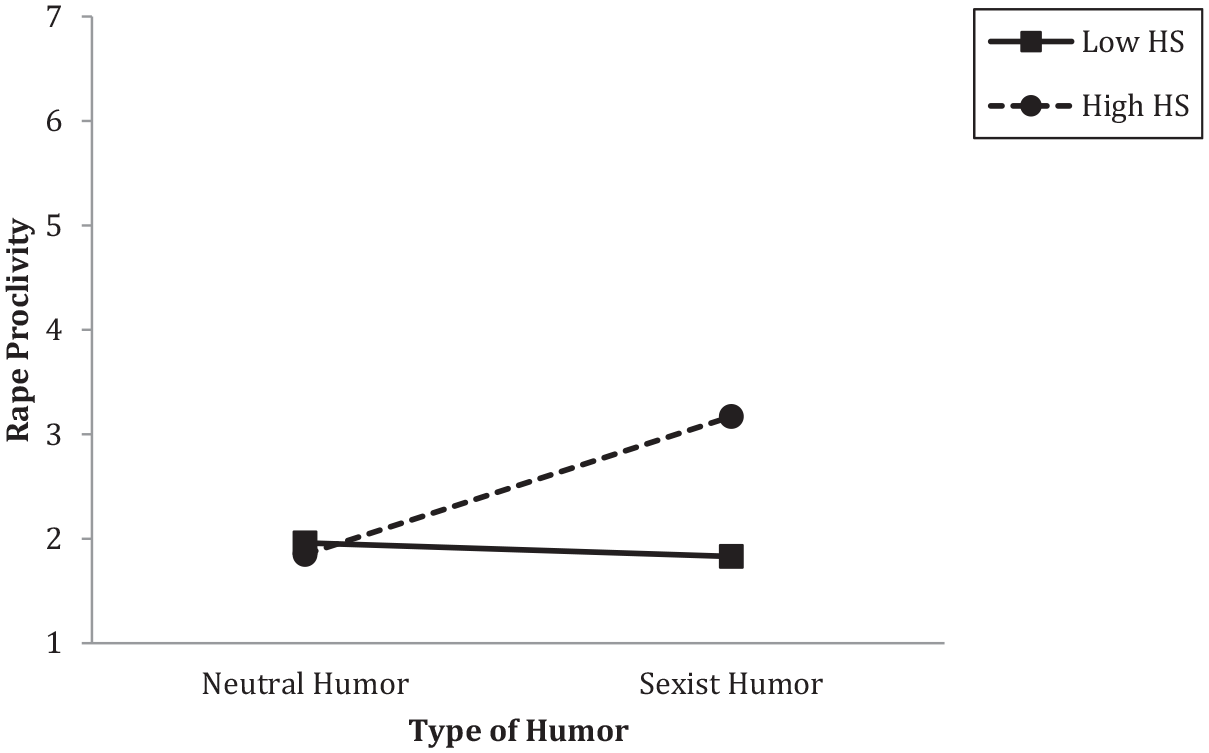
Rape proclivity as a function of humor type exposure and HS in control-primed participants.
Discussion
The results of Study 1 supported the hypothesis that control-primed participants would show higher rape proclivity upon exposure to sexist (vs. neutral) humor when they adhered to hostile attitudes toward women. These findings are consistent with those of previous studies focused on analyzing the relationship between sexist humor and rape proclivity (Romero-Sánchez et al., 2017; Thomae & Viki, 2013). However, our research went further by demonstrating the influence of motivational orientation: In essence, the results suggest that when controlled motivation is activated, the key for predicting the response lies in the context because it leads men high in hostile sexism to engage in self-reported rape proclivity upon exposure to sexist humor (Hypothesis 2). However, when participants with hostile sexist attitudes are given the opportunity to act according to their own rules or criteria (autonomous motivation), the expression of their sexist prejudices does not appear to depend on contextual cues.
Study 2
Study 1 contributes to the existing research on the topic by revealing the influence of motivational orientation on men’s proclivity to commit rape when sexist humor and sexist attitudes are taken into account. However, the self-reported rape proclivity measure we used relied on participants’ honesty and accuracy when reporting their tendency to perpetrate sexual aggression. The explicit nature of these methods makes them particularly vulnerable to response distortions and biases (Davis et al., 2014; Fazio & Olson, 2003). Consequently, Study 2 sought to expand Study 1 by testing the effect of primed motivational orientation on other aggressive responses; specifically, we used a measure of sexually aggressive thought accessibility.
Previous research (Weinstein et al., 2011) used an increment in affective hostility as an indirect criterion of being under controlled motivation. In Study 1, the affective hostility of participants was only considered prior to the experimental manipulation of motivational orientation to verify that the groups were homogeneous in this variable from the beginning and to control for its potential effect. Nevertheless, it became necessary to consider a post-manipulation measure to verify that the induced motivational state modified the affective state (Weinstein et al., 2011). The predictions proposed for this study were the same as those hypothesized in Study 1, but in this case the dependent variable (i.e., accessibility of sexually aggressive thoughts) was modified. Thus, we hypothesized that participants with higher adherence to hostile sexism would exhibit greater accessibility of sexually aggressive thoughts (Hypothesis 1). Moreover, we expected to find a joint effect of hostile sexism, motivational orientation, and humor (Hypothesis 2). Specifically, in the controlled motivation condition (vs. autonomous motivation), we expected participants high (vs. low) in hostile sexism to exhibit greater accessibility of sexually aggressive thoughts when exposed to sexist (vs. neutral) humor.
Method
Participants
A total of 150 male undergraduate students enrolled in a range of courses at a Spanish public university voluntarily took part in this experiment. Of these, 18 participants were removed from the data analyses: 7 reported a sexual orientation other than heterosexual, and further 11 responded inconsistently to motivation priming. The final sample consisted of 132 participants whose ages ranged between 18 and 30 years (M = 21, SD = 2.18).
Materials and measures
The motivation priming manipulation (control vs. autonomy), type of humor (sexist vs. neutral), and measures of individual differences (sexist attitudes and affective hostility) were all identical to those of Study 1, but the dependent variable differed. In Study 1, rape proclivity index was assessed using two scenarios from the scale developed by Bohner et al. (1998). In this study, we decided to analyze aggression against women using an indirect measure based on a word completion task (Anderson et al., 2003). This consisted of a list of words with one or more letters missing; the respondent’s role was to fill in the missing letters in order to form a word. Each item could be completed to form either aggressive or nonaggressive words (e.g., “in_ure” can become “injure” or “insure”). We adapted a task by Anderson et al. (2003) that included 11 fragments of words with one or more letters missing, and which could be completed to form either a neutral or a sexually aggressive word, for example, “ra_e” as “rape” (sexually aggressive word) or “rate” (neutral word). Participants were asked to fill in the blanks as quickly as possible (no more than 3 min) to complete the words with what first came to mind. As in the study by Anderson et al. (2003), the score in accessibility of sexually aggressive thoughts for each participant was calculated taking into account the total number of sexually aggressive words they completed. Following Koopman et al. (2013), a total of five fragments of words were retained taking into account participants’ responses showed an appropriate variability; specifically, there were discarded fragments of words due to a lack of variance in responses (<70% of participants or more formed the same word). The number of fragments of words retained is similar to those used in previous studies (e.g., Son Hing et al., 2002). Each participant’s score ranged between 0 (no words completed with aggressive content) and 5 (all words completed with aggressive content).
Design and procedure
As in Study 1, participants were randomly assigned to one of four conditions in a 2 × 2 (Primed Motivation: Controlled vs. Autonomous × Type of Humor: Sexist vs. Neutral) between-participants design. The procedure was identical to that followed in Study 1, with measures presented in a cover story including two studies that were completed in the following order: supposed “Study 1”: EVEA Affective Hostility subscale (to verify the influence of motivational orientation on affective hostility, we introduced this instrument both prior to the motivational orientation manipulation and after it), Hostile Sexism subscale, motivation-priming task (autonomous or controlled motivation), and the additional item “To what extent did you act or give your opinion because of external pressures, norms or rules in the situation you just described?”; supposed “Study 2”: four jokes and vignettes (neutral or sexist condition), questions about the funniness and aversiveness of each joke and vignette, word completion task (see the section on materials and instruments), sociodemographic questions (i.e., gender, age, nationality, and sexual orientation), and debriefing.
Results
Preliminary analyses
First, as in Study 1, two raters independently coded each situation described by participants in the experimental condition (controlled vs. autonomous motivation). When described events were unrelated to controlled or autonomous motivation task, the participants were excluded (11 participants).
Also, similarly to Study 1, the analyses of participants’ scores for the additional item showed higher mean scores in participants who described an experience in which they had acted or made comments according to rules, norms, or external pressures (M = 7.63, SD = 2.32), as opposed to participants who depicted a situation in which they could act or make comments freely (M = 1.47, SD = 2.02), F(1, 128) = 261.09, p < .001.
As in Study 1, aversiveness ratings differed between type of humor, F(1, 129) = 173.28, p <.001, being higher in the sexist humor (M = 2.68, SD = 1.03) than in the neutral humor condition (M = 0.56, SD = 0.79). Contrary to Study 1, there were statistically significant differences of funniness responses between neutral humor and sexist humor, F(1, 131) = 15.34, p < .001. This result suggests that participants found the jokes and vignettes to be funniest in the neutral humor condition (M = 1.83, SD = 1.01) than in the sexist condition (M = 1.17, SD = 0.91).
To verify the equivalence of preexisting affective hostility and hostile sexism in the groups before the experimental manipulation, we conducted two separate 2 × 2 (Motivational Orientation Primed: Autonomous vs. Controlled × Type of Humor: Sexist vs. Neutral) ANOVAs with affective hostility and hostile sexism as the dependent variables. In this particular study, we also included the post-manipulation scores in affective hostility as a dependent variable. No significant effect of hostile sexism or preexisting affective hostility was observed (all Fs < 1); in other words, scores in hostile sexism and preexisting affective hostility did not differ across the experimental conditions. However, as expected, motivational orientation priming modified post-manipulation affective hostility, F(1, 129) = 5.06, p < .05; specifically, participants primed with controlled motivation showed higher post-manipulation hostility scores (M = 3.21, SD = .31) than those primed with autonomous motivation (M = 2.25, SD = .29).
Main analyses
They were similar to those conducted in Study 1. Post-manipulation affective hostility score and funniness and aversiveness ratings were introduced as covariates. No significant main effect of hostile sexism on sexually aggressive thoughts accessibility was observed, b = −.16, SE = 0.20, t(118) = −.80, p = .43, 95% CI [−0.56, 0.24]. As in Study 1, and in keeping with Hypothesis 2, the regression analysis revealed a significant Hostile Sexism × Type of Humor × Motivational Orientation Priming interaction effect, b = .95, SE = 0.49, t(118) = 1.96, p = .05, 95% CI [−0.00, 1.91].
The analysis revealed that exposure to sexist (vs. neutral) humor promoted a higher sexually aggressive thoughts accessibility in the control-primed condition, but only in participants with high hostile sexism levels, b = 1.32, SE = 0.49, t(54) = 2.69, p < .01, 95% CI [0.33, 2.30], not in those with low hostile sexism levels, b = −0.14, SE = 0.66, t(54) = −0.21, p = .83, 95% CI [−1.45, 1.17]. Similar to Study 1, no interaction between hostile sexism and type of humor was found in autonomous condition, b = −0.25, SE = 0.42, t(61) = −0.58, p = .56, 95% CI [−1.08, 0.59]. In contrast to Study 1, no main effect of hostile sexism was observed in this condition, b = −0.11, SE = 23, t(61) = −0.49, p = .62, 95% CI [−0.57, 0.34]. The interaction between type of humor and hostile sexism in control-primed condition can be observed in Figure 2.
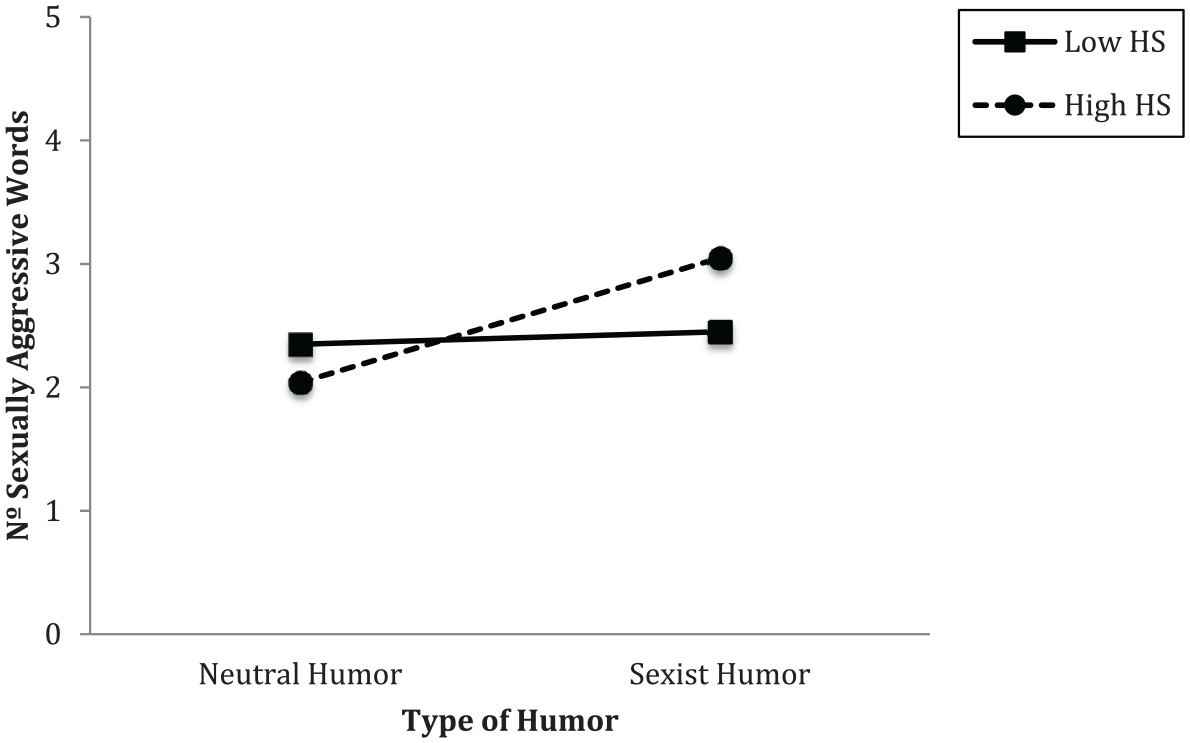
Number of sexually aggressive words as a function of humor type exposure and HS when primed under controlled motivation.
Discussion
The results of Study 2 significantly extended those of Study 1: Participants primed under controlled motivation showed an increase in aggression toward women when exposed to sexist humor but not to neutral humor, particularly when they held hostile attitudes toward women (Hypothesis 2). It must be noted that in Study 2, aggression toward women was measured with an indirect measure that specifically assesses aggressive content in implicit knowledge structures. Thus, the design used in this study (i.e., experimental) provides evidence for a causal link between controlled motivation and implicit aggression taking into account participants’ hostile sexism. Finally, it should be noted that, unlike in Study 1, in the autonomous motivation condition, we did not observe that participants with higher hostile sexism levels showed more sexually aggressive thoughts, regardless of the type of humor to which they were exposed.
General Discussion
This research contributes to our understanding of the influence of sexist humor on the expression of aggressive sexual behaviors directed against women. The results of both studies expand on previous findings (Romero-Sánchez et al., 2010, 2017), revealing the influence of factors such as motivational orientations on the relationship between prejudicial attitudes and aggressive sexual tendencies against women in contexts that facilitate the expression of prejudice, such as sexist humor.
The main purpose of Study 1 was to take a further step in the analysis of the pernicious effects of sexist humor on sexual aggression proclivity, looking for possible moderating factors in motivational orientations. To this end, these orientations were primed prior to exposure to humor stimuli. The highest scores in rape proclivity were observed when men with high hostile sexism levels were exposed to sexist (vs. neutral) humor and primed under controlled (vs. autonomous) motivation. In keeping with the prejudiced norm theory (Ford & Ferguson, 2004), which postulates that humor functions as the necessary contextual key for prejudiced individuals to express their views without being socially penalized, our findings confirm the important role of participants’ motivational orientation in the expression of this prejudice, to a greater extent than a “permissive” context and attitudes. The interaction effect between hostile sexism and sexist humor was only significant when participants were primed under controlled motivation. Thus, and in keeping with the SDT (Ryan & Deci, 2000), we can state that because controlled motivation involves acting under coercion, pressure, or the contingencies of the moment, men with high hostile sexism levels who had been primed under this motivation expressed sexually aggressive tendencies toward women in the presence of a contextual facilitating cue (i.e., sexist humor). However, as proposed in the prejudiced norm theory (Ford & Ferguson, 2004), the absence of such contextual cues (in this case, the use of neutral humor) entailed that men with high hostile sexism levels repressed their attitudes toward women, possibly in an attempt to avoid social reprisals for not following the established rules.
By contrast, when participants with high hostile sexism levels were prompted to act according to their own criteria and values (i.e., autonomous motivation), we observed a higher tendency toward sexually aggressive behavior against women (e.g., rape proclivity), regardless of the type of humor used. These results suggest that individuals with high hostile sexism levels tend to regulate their behavior in accordance with external rules or criteria. When faced with external pressure or coercion (i.e., controlled motivation), men with high hostile sexism levels regulate their behavior to conform to their environment, inhibiting the manifestation of their prejudices in normal contexts (i.e., neutral humor), but releasing them when the context is permissive (e.g., sexist humor: “it’s just a joke”). However, encouraging participants with high hostile sexism levels to act according to their own rules and principles (i.e., autonomous motivation) decreased the predictive power of context (sexist vs. neutral humor), and the prediction of aggressive tendencies was taken over by ideological variables regardless of the context.
Study 1 used self-reported measures to analyze participants’ sexually aggressive tendencies. However, previous research has revealed that individuals who respond to these types of measures indicate that the situations described represent events that could happen to them in real life (Davis et al., 2012), which suggests the ecological validity of these measures. With this in mind, we decided to conduct Study 2 to expand the main results of Study 1 using a more indirect measure of aggression: a word completion task. The results of Study 2 extended those of Study 1 revealing once again that the activation of controlled motivational orientation in men with high hostile sexism levels is related to greater sexual aggressiveness toward women, even through an indirect measure such as accessibility to aggressive thoughts, provided that the context (i.e., sexist humor) allows the expression of prejudice without fear of social reprobation. However, unlike in Study 1, in Study 2 participants with high hostile sexism scores did not show higher levels of sexual aggressiveness, regardless of the type of humor to which they were exposed. Despite the fact that these effects were not found, this inconsistency in the results obtained through the use of different measures aimed at the same object of evaluation is also present in the existing literature (Fazio & Olson, 2003). Hence, future research is needed to explore this discrepancy in results through the use of different implicit and explicit measures.
The research conducted by Weinstein et al. (2011) was the first to simultaneously consider motivational orientations (autonomous vs. controlled) and the response to humorous material. Results showed that aggressive responses increased (expressed through a greater enjoyment of hostile humor) when participants acted under a controlled motivation orientation and that this relationship was mediated by the hostile mood of the participants. Comparing our study with the results obtained by Weinstein et al. (2011), it should be noted that the effect of controlled motivation orientation on attitudes and prejudices is different to that observed on affective responses. Our research has confirmed that affective hostility before or after the experimental manipulation was not related to aggressive sexual responses (self-reported rape proclivity [Study 1] and word completion task [Study 2]). Conversely, attitudinal variables (sexist attitudes, in this case) were predictive of scores in this variable, not only directly but also in combination with sexist humor and controlled motivation. These data suggest a differential role of affective (vs. attitudinal) hostility in the prediction of sexual aggressiveness against women. Similarly, regarding type of humor, our research reveals the differences between hostile humor and disparagement humor (in this case, sexist humor). As previously mentioned, hostile humor is based on physical aggression, insult, or humiliation of a high intensity and does not require a specific group to target because of its stereotypical characteristics. Previous research has revealed the key role of the affective dimensions of anger, aggressiveness, hostility, and so on in this type of humor (Weinstein et al., 2011). By contrast, in disparagement humor, mood is no longer relevant not only to the individual’s response to this type of humor (Carretero-Dios & Ruch, 2010) but also to the individual’s behavior after exposure to it; in this case, the predictive power lies in ideological variables.
Practice Implications
The relation found in this study may also have important practice and real-world implications. Understanding the potential negative consequences of sexist humor in different contexts when attitudinal variables (i.e., sexist attitudes) or contextual variables (i.e., motivational orientations) are present makes it possible to develop strategies and interventions aimed at minimizing its impact. In this regard, it should be noted that sexist humor is present in our everyday lives in a wide range of social contexts (e.g., social or other types of media, the workplace, meetings with friends/family). However, its use is trivialized based on the premise that “it is only humor” and therefore does not have a real impact but rather should be understood as a means of expression among others. Studies like ours suggest that priority should be given to education focused on these “more subtle forms” of violence against women (i.e., sexist humor), which tend to go unnoticed but still have pernicious effects. Specifically, given the results obtained regarding the motivational orientations analyzed in this study, we can extract some interesting practical implications for educational and sexual assault prevention programs. First, enhancing the motivation for autonomy diminishes the influence of contextual cues on behavior; when these cues are sexist (i.e., sexist humor), the effect can be beneficial only in those men with nonsexist attitudes, because in those with sexist attitudes, enhancing the motivation for autonomy would lead them to act according to these attitudes. On the other hand, enhancing controlled motivation in nonsexist contexts can also have a beneficial effect, minimizing the influence of sexist attitudes on behavior. However, in the face of sexist contextual cues (i.e., sexist humor), strengthening controlled motivation can increase the likelihood of aggressive sexual behavior in sexist men.
Interventions should be aimed at modifying men’s sexist attitudes from the outset so that they will act according to internalized principles and values based on real equality between women and men.
Limitations and Recommendations for Future Research
Despite their relevance, these results should be considered along with certain limitations of this research. One of these limitations relates to the sample analyzed: participants aged 21 to 30. In this context, there is evidence that the appreciation of sexist humor varies depending on the age of the participants. In fact, older people show lower funniness and higher aversiveness when exposed to sexist humor than younger people do (LaFrance & Woodzicka, 1998; Sev’er & Ungar, 1997). The sample was also White, and all of them were university students. Bearing this in mind, future research should explore whether the same pattern of results can be obtained with samples comprising groups of greater diversity (i.e., in terms of age, race, and education level). Having such a diverse sample would greatly increase our external validity and allow us to generalize these results to a broader population.
Another limitation concerns the implicit measure of aggression used, the word completion task (Anderson et al., 2013). This measure was selected, among other reasons, to minimize the possible effects of social desirability that might affect the self-reporting measure included in Study 1. Although the relationship of the word completion task with the manifestation of aggressive behavior has been confirmed in previous studies (Jouriles et al., 2013), this instrument does not record the reaction times in the response of the participants, a possibility offered by procedures such as the Implicit Association Test (Greenwald et al., 1998) or the Lexical Decision Task (Leibold & McConnell, 2004). Similarly, the use of more direct measures of aggression, such as those used in laboratory research (for a review, see Abbey et al., 2018), may provide additional validity and rigor to our findings.
In addition, although most research in psychology is conducted in the laboratory or uses questionnaires, which allows for greater control over extraneous variables and contexts, this might also have a cost. For example, the laboratory setting removes research participants from their natural contexts and places them in an artificial environment in which nearly all aspects (e.g., goals, materials, procedure) are determined by the experimenter. Because this study was carried out with questionnaires and in libraries, moving participants away from the real world, future research could try to replicate these results in more natural environment.
Finally, because we did not have access to any effect size estimates at the start of data collection, power analyses were not conducted to determine sample sizes. Future research could use the effect sizes of this study when planning future studies to estimate sample sizes and ensure adequate power.
Conclusion
People resort to disparagement humor as a “subtle” way of expressing their rejection toward the members of the denigrated group. This type of humor minimizes the perception that its source is prejudiced, with a subsequent increase in tolerance to contexts where it is present (Mallett et al., 2016). Nevertheless, the effects of disparagement humor are far from harmless, as the literature shows. Our research contributes to the growing interest in analyzing the pernicious effects of sexist humor, showing that sexist ideology, combined with the activation of control-based motivational orientations, promotes the expression of greater aggression toward the disparaged group (women, in this case) when the context is permissive (e.g., sexist humor). Our findings provide the first evidence of the role played by controlled and autonomous motivational orientations in sexual aggressions directed toward women. These results indicate the need to study this relationship in depth to understand how motivational orientations can act in contexts that normalize the expression of prejudice (e.g., humorous situations).
Footnotes
Declaration of Conflicting Interests
The author(s) declared no potential conflicts of interest with respect to the research, authorship, and/or publication of this article.
Funding
The author(s) disclosed receipt of the following financial support for the research, authorship, and/or publication of this article: This research was financially supported by the Spanish Ministerio de Economía y Competitividad with research grants PSI2016-79812-P.
