



Abstract
“Stealthing” is a form of sexual violence wherein a sexual partner purposefully removes a condom during penetration without the receptive partner’s knowledge. Given the role of substance use in sexual violence broadly, we examined demographic and substance use correlates of stealthing perpetration (SP) and victimization (SV) among emerging adults. Participants comprised 2,550 18- to 25-year-olds (M age = 20.8, SD = 2.3), recruited via social media (48% female; 53.9% non-Hispanic White; 46.0% had another racial/ethnic identity; 67.4% heterosexual; 85.3% had some college education). Unadjusted analyses (t tests, χ2 analysis) and adjusted logistic regression analyses examined associations between demographics (age, education, race/ethnicity, sexual orientation) and substance use (binge drinking, marijuana use, other illegal drug use, and prescription drug misuse) with male SP and male and female SV. Five percent of males and 18.9% of females reported SV; 6.1% of males reported SP. In adjusted analyses, significant correlates of SP were: non-Hispanic White race/ethnicity (odds ratio [OR] = 0.39), binge drinking (OR = 1.39), cannabis use (OR = 1.37), and other drug use (OR = 1.43). Significant correlates of male SV were: non-Hispanic White race/ethnicity (OR = 0.28), non-heterosexual orientation (OR = 0.24), binge drinking (OR = 1.49), and other illegal drug use (OR = 1.79). Significant correlates of female SV were: older age (OR = 1.13), non-Hispanic White race/ethnicity (OR = 0.57), binge drinking (OR = 1.28), cannabis use (OR = 1.29), and other drug use (OR = 1.22). Consistent with literature linking alcohol to sexual violence, binge drinking correlated with both SV and SP, with other substance use also playing a role. Data are needed to explore these relationships using longitudinal, event-level assessments to investigate the influence of acute intoxication. Interventions to reduce sexually transmitted infections, unintended pregnancy, and sexual assault should include content on stealthing and substance use.
Introduction
“Stealthing” is a type of sexual violence that refers to non-consensual condom removal during sexual intercourse; it is also considered a form of reproductive coercion and referred to as condom manipulation or condom sabotage (McCauley et al., 2017; Rowlands & Walker, 2019). Although previously used in research to describe the purposeful transmission of HIV/AIDS among men who have sex with men (MSM; Klein, 2014), the practice of non-consensual condom removal was popularized by the media following a publication by Brodsky (2016) in the Columbia Journal of Gender and Law, which called for changes in legal policy related to sexual violence to better account for stealthing perpetration and victimization.
Research focused on understanding stealthing behaviors is relatively sparse, as prior work has typically measured non-consensual condom removal as a single item assessed within a measure of condom sabotage, which also includes behaviors such as intentionally breaking a condom (Davis et al., 2019). One prior study, conducted at an Australian sexually transmitted infection (STI) clinic, found that 32% of adult women (median age = 26) and 19% of MSM (median age men = 30) sampled reported a lifetime history of stealthing victimization (Latimer et al., 2018). Note that the study’s definition of stealthing included instances where a condom had never been put on, yet was requested. Although many who experienced stealthing victimization reported that it happened more than 12 months ago (35% women; 46% MSM), 12% of women and 14% of MSM reported presenting to the clinic because of recent stealthing and several (13% of women, 7% of MSM) reported multiple occasions of stealthing in their lifetimes. Factors associated with increased risk of stealthing victimization for women were majority ethnic status (i.e., Australian/New Zealander vs. Aboriginal) and current sex work, whereas the only correlates of male stealthing victimization were “self-reported health issues, such as anxiety or depression which may have affected [their] decision to use condoms for anal sex” (p. 9).
In another study of high-risk women (e.g., eligibility criteria included condomless sex, recent alcohol consumption, etc.) ages 21 to 30, 12.2% reported that a man had “successfully” completed stealthing perpetration at least once since age 14. This was also one of the only studies to assess women’s perpetration of stealthing, and although no women reported this, they did report perpetrating other coercive condom use resistance behaviors (e.g., emotional manipulation, deception). Another study that recruited 235 sexually active heterosexual U.S. women ages 18 to 20 found that 3% reported perpetrating condom sabotage since age 14, which included an item assessing stealthing, but did not report on the frequency of stealthing perpetration specifically (Wegner et al., 2018). Similarly, 9% of high-risk men (e.g., moderate drinkers, recent condomless sex) ages 21 to 30 who had heterosexual interests reported perpetrating condom sabotage since age 14, but again this measure did not separate stealthing from other items such as intentionally breaking a condom (Davis et al., 2014).
Two qualitative studies reported on stealthing. In one study of 21 French-speaking Canadian women ages 18 to 29, who experienced reproductive coercion in the past 2 years, every woman said they had experienced stealthing in both uncommitted relationships and committed relationships that involved violence (Lévesque & Rousseau, 2021). Although some of the women did not initially classify stealthing as a form of sexual violence, participants indicated that stealthing victimization was problematic because it violated a prior agreement pertaining to condom use. Participants who reported stealthing victimization in uncommitted relationships tended to take on more self-blame for their victimization (e.g., stating they should have been more clear, or the incident happened when they were drinking). Finally, another qualitative study examined 64 sexually active urban African American adolescent women (ages 14–17) attending family planning or prenatal clinics, and found that stealthing was identified by participants as a method of condom sabotage (Teitelman et al., 2011).
As stealthing involves a lack of condom use, it thereby increases the risk for transmission of HIV and STIs, as well as unplanned pregnancy. Furthermore, stealthing victimization could be associated with trauma symptoms and other known physical and mental health sequelae of sexual violence victimization (Dworkin, 2020). Given the potential for such negative individual and public health consequences, it is critical to better understand stealthing and its correlates to inform prevention efforts to mitigate these negative health outcomes. Because peaks in sexual risk behaviors (i.e., condomless sex) take place during emerging adulthood (typically ages 18–25; Arnett, 1992, 2000, 2005; Dariotis et al., 2008; Stone et al., 2012), as does substance use (Substance Abuse and Mental Health Services Administration, 2018), a known correlate of sexual and dating violence (Duval et al., 2020; Feingold et al., 2008; Shorey et al., 2014; Smith et al., 2012; Steele & Peralta, 2020; Testa et al., 2018), we focused our examination of stealthing on demographic and understudied substance use correlates of stealthing perpetration and victimization among men and women ages 18 to 25 years old.
Method
Participants and Procedures
From April 2017 through September 2017, we conducted an online survey about sexual violence experiences. All procedures were approved by the University of Michigan Institutional Review Board. Given media coverage of stealthing that occurred during the study period, we developed and added questions on stealthing partway through the study (beginning June 8, 2017). Participants were recruited via Facebook and Instagram advertisements targeted to 18- to 25-year-olds nationally in the United States, with use of ethnic affinity targeting and varied images of emerging adults from different backgrounds to increase minority participation. Participants were invited to take part in the survey (~15–20 min) and upon completion, they could choose to provide contact information and be entered to win one of four US$75 Amazon gift cards.
Specifically, after clicking on an advertisement, participants were directed to an online Qualtrics survey, which contained an informed consent document as the first page of the survey. Participants who provided online informed consent were next asked to complete a Completely Automated Public Turing test to tell Computers and Humans Apart (CAPTCHA) and indicate their age to assess study eligibility. Participants who successfully completed the CAPTCHA question and indicated being between the ages of 18 and 25 years were automatically redirected to the rest of the online survey for completion. Starting on the date the stealthing questions were added to the online survey, N = 3,539 initiated the survey with 2,692 (76.1%) completing and 847 partially completing (the majority of non-completers stopped filling out the survey during or just after initial demographics items; completion rates are higher than prior research using social media to recruit emerging adults [Ramo & Prochaska, 2012]). Among completers, 2,307 answered stealthing questions and 243 partial-completers answered these items, thus data were retained for analyses for those, N = 2,550, participants who completed the items pertaining to our primary dependent variable (stealthing).
Measures
We adapted items from prior research to assess standard demographics (age, race, ethnicity, sex, gender, sexual orientation, and education; Barber et al., 2011; Cantor et al., 2015; B. Grant et al., 2014; J. M. Grant et al., 2011; National Center for Health Statistics, 2017; Office of Management and Budget, 1997). We used four single items from the NIDA-Modified ASSIST Quick Screening to assess past 12-month binge drinking (four or more drinks for women, five or more for men; tailored based on biological sex), cannabis use, other illegal drug use, and prescription drug misuse (i.e., not prescribed; National Institute on Drug Abuse, 2012). Responses on these items ranged from 0 = “Never” to 4 = “Daily/Almost Daily.”
Given the lack of literature at the time, we developed our own questions to assess stealthing perpetration and victimization based on Brodsky (2016). Biological males were asked the following question pertaining to perpetration: “How many times have you had vaginal or anal sex with someone age 16 or older and started using a condom, but then you took it off during sex without the other person knowing?” Both men and women were asked the following question pertaining to victimization: “Since you turned 16, how many times has someone age 16 or older had vaginal or anal sex with you and started using a condom, but then they took it off during sex without you knowing it?” Response options for both items were as follows: Never (coded as 0 for analyses), once (1), twice (2), 3 to 5 times (3), 6 to 10 times (4), 11 to 20 times (5), and more than 20 times (6).
Data Analysis
We used SAS Version 9.4 to calculate descriptive statistics, unadjusted analyses (independent samples t tests for continuous variables and χ2 for categorical variables) and adjusted logistic regression models examining how demographics and substance use frequency related to stealthing perpetration (among males only) and stealthing victimization (among males and females separately). Prior to selecting variables for the adjusted models, we examined their intercorrelations for multicollinearity and found that correlations between prescription drug misuse and illegal drug use were greater than 0.50 for the male model, therefore we excluded prescription drug use from the model as other illegal drug use was more commonly reported. Note that 1.7% of males reported a history of both stealthing perpetration and victimization, which was too small to analyze separately, thus we examined stealthing perpetration and victimization for men separately. Due to skewed data or low cell size, the following variables were dichotomized for analyses: stealthing victimization and perpetration, race/ethnicity, sexual orientation, and education level.
Results
Sample and Characteristics
Among the 2,550 participants completing the stealthing questions, about half were male (52.4%) and their mean age was 20.8 (SD = 2.3). Just more than half of participants were of a non-Hispanic White racial and ethnic identity (53.9%), and 67.4% identified as heterosexual. Most participants had obtained at least some college education (85.3%). Regarding past 12-month substance use prevalence, binge drinking was reported by 62.5%, cannabis use by 54.9%, other illegal drug use by 19.3%, and prescription drug misuse by 15.5%.
Male Stealthing Perpetration
For males, 6.1% reported a history of stealthing perpetration (2.8% once, 1.2% twice, 1.5% 3–5 times, and 0.6% 6 or more times). Demographic and substance use descriptive information as well as results of analyses are shown by stealthing perpetration status in Table 1. Specifically, in unadjusted analyses among men, racial/ethnic minority individuals and those with greater frequency of binge drinking, cannabis use, other illegal drugs, and prescription drug misuse were significantly more likely to report perpetration of stealthing. In an adjusted logistic regression model, these findings remained significant with the exception that prescription drug misuse was not included in the model due to multicollinearity.
Unadjusted and Adjusted Associations of Demographics and Substance Use Factors With Men’s Stealthing Perpetration.
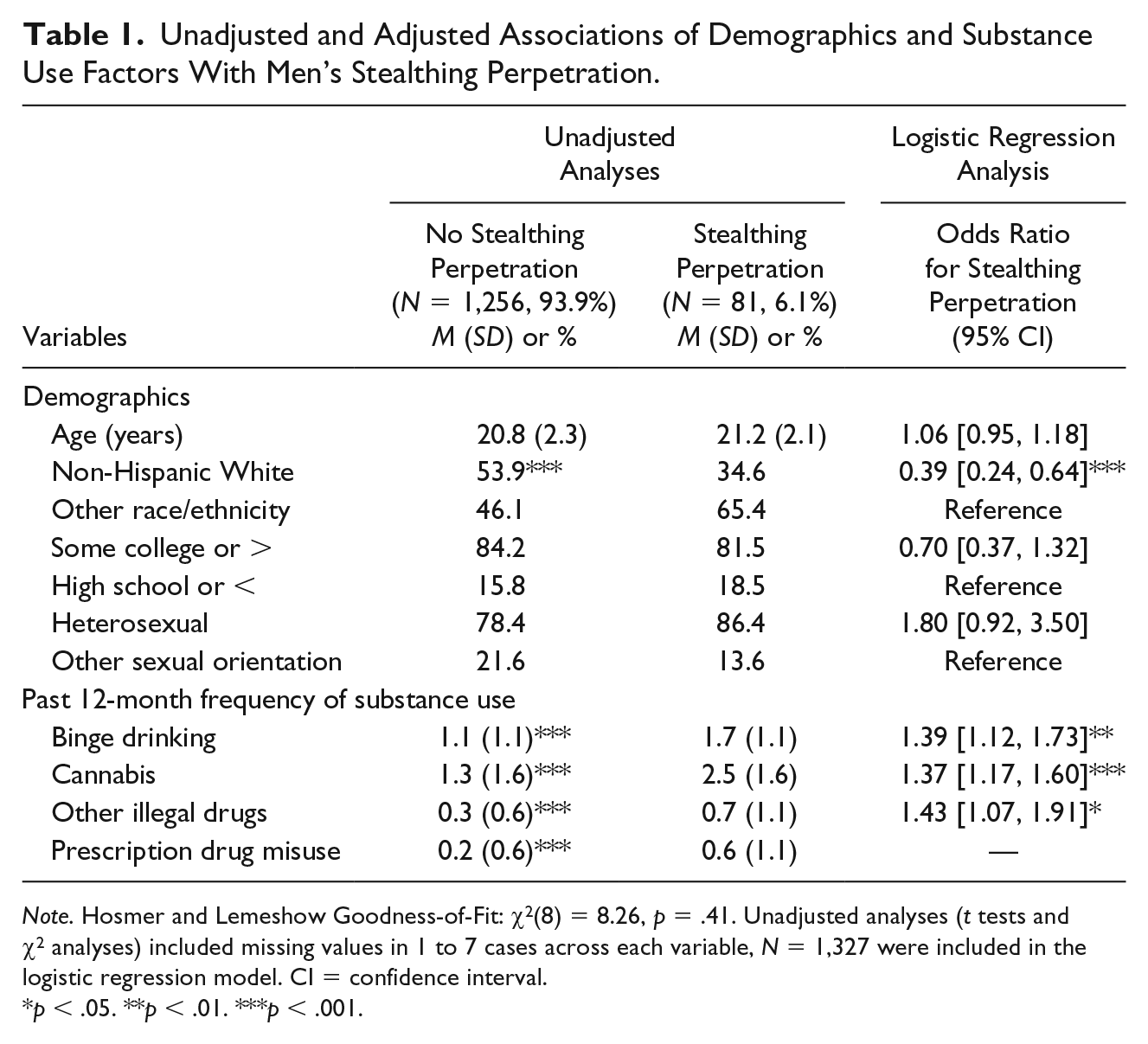
Note. Hosmer and Lemeshow Goodness-of-Fit: χ2(8) = 8.26, p = .41. Unadjusted analyses (t tests and χ2 analyses) included missing values in 1 to 7 cases across each variable, N = 1,327 were included in the logistic regression model. CI = confidence interval.
p < .05. **p < .01. ***p < .001.
Male Stealthing Victimization
Among men, 5% reported a history of stealthing victimization (2.6% once, 1.1% twice, 0.7% 3–5 times, and 0.8% 6 or more times), with unadjusted analyses revealing a pattern of significant results similar to the perpetration model (Table 2). Racial minority men were significantly more likely to report victimization. Non-heterosexual men comprised 46.3% of those who had been victimized as opposed to only 19.8% of those who had not been victimized (p < .001). Men who had been victimized had a significantly higher frequency of all substances measured. In the adjusted logistic regression model, racial and sexual minority status remained as significant correlates of victimization. Pertaining to substance use, binge drinking, and illegal drug use remained significantly correlated with stealthing victimization among men.
Unadjusted and Adjusted Associations of Demographics and Substance Use Factors With Stealthing Victimization Among Men.

Note. Hosmer and Lemeshow Goodness-of-Fit: χ2(8) = 3.30, p = .91. Unadjusted analyses (t tests and χ2 analyses) included missing values in 1 to 7 cases across each variable, N = 1,322 were included in the logistic regression model. CI = confidence interval.
p < .05, **p < .01, ***p < .001.
Female Stealthing Victimization
Among women (Table 3), 18.9% reported a history of stealthing victimization (10.3% once, 5.2% twice, 2.5% 3–5 times, and 0.9% 6 or more times). In unadjusted analyses, women who had been victimized were significantly older and more likely to be racial minorities than those who had not been victimized. Furthermore, all substances assessed were significantly more frequently used among women reporting stealthing victimization. These significant relationships persisted in the adjusted logistic regression analysis, except that prescription drug misuse was no longer significant.
Unadjusted and Adjusted Associations of Demographics and Substance Use Factors With Stealthing Victimization Among Women.
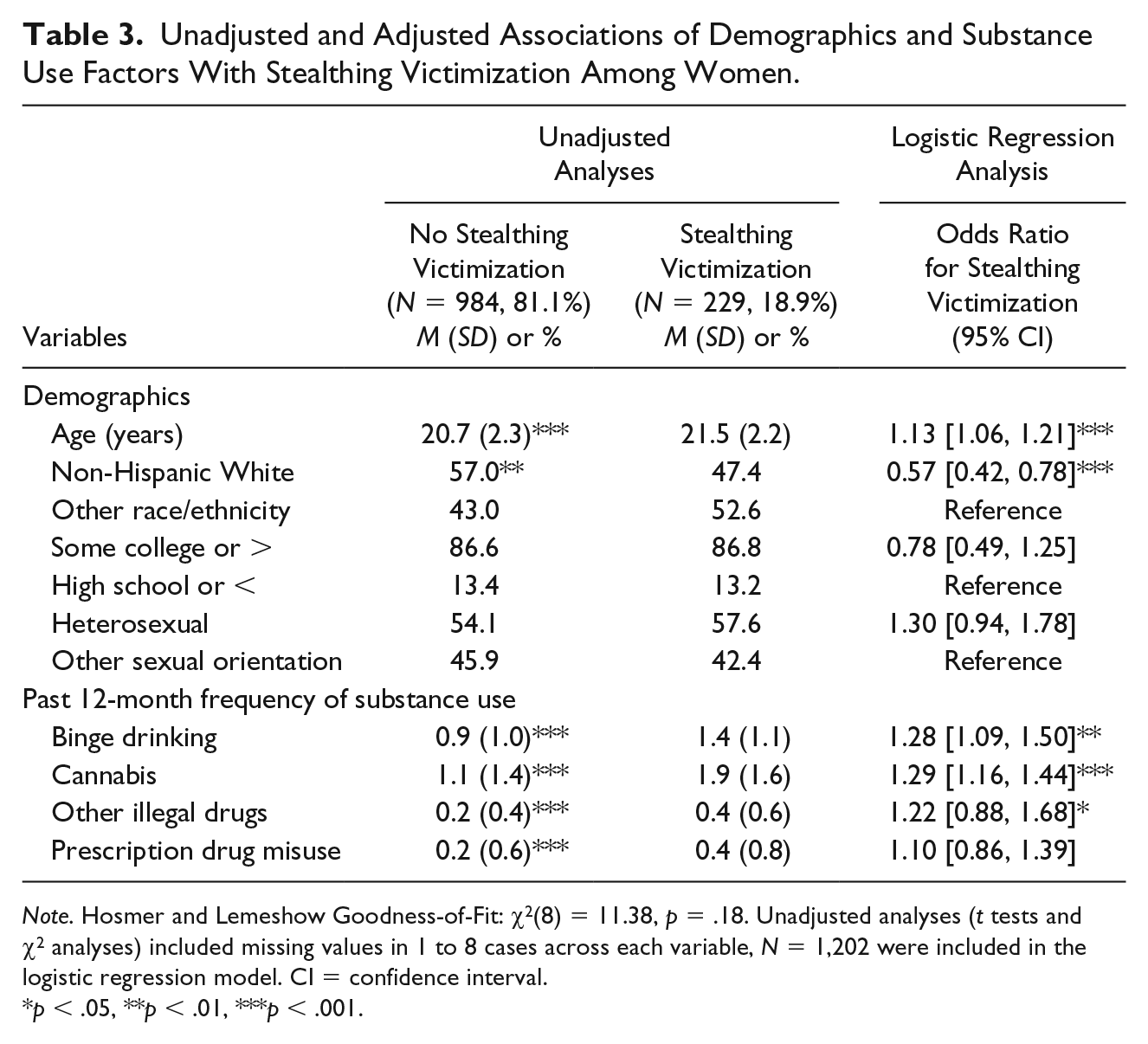
Note. Hosmer and Lemeshow Goodness-of-Fit: χ2(8) = 11.38, p = .18. Unadjusted analyses (t tests and χ2 analyses) included missing values in 1 to 8 cases across each variable, N = 1,202 were included in the logistic regression model. CI = confidence interval.
p < .05, **p < .01, ***p < .001.
Discussion
This is the first study to examine stealthing behaviors and correlates in a large sample of male and female emerging adults from across the United States. For men, about one in 20 reported stealthing victimization and about one in 16 reported perpetration; however, relatively few (1.7%) men reported both stealthing victimization and perpetration. We found that stealthing victimization was quite common among young women, with almost one in five reporting experiencing stealthing victimization, and one in 20 reporting multiple stealthing events. We did not examine stealthing perpetration by women; however, this was uncommon in the two prior studies that assessed women’s stealthing perpetration (or condom sabotage) (Davis et al., 2014; Wegner et al., 2018).
Although prior research tended to focus on higher risk samples (e.g., those attending a sexual health clinic, recent sexual risk behaviors, moderate drinkers), this study uniquely focuses on a more general population of 18- to 25-year-olds in the United States, recruited online. With 19% of women reporting stealthing victimization in our study, this is greater than the 12% of higher risk women reported by Wegner and colleagues (2018), but less than the 32% from an Australian sexual health clinic which encompassed a broader age range (Latimer et al., 2018). Differences in prevalence of stealthing victimization among women might be attributable to the online-recruited population in the current study, cultural differences, age differences in the samples, and/or the specific assessment items used (ours queried since age 16, others queried since age 14), which were created for the study as there were no known validated measures specific to stealthing at the time of this investigation. Latimer and colleagues (2018) found a higher male stealthing victimization rate among MSM (19%) specifically, and we found that non-heterosexual men were more likely to report stealthing victimization than heterosexual men. Although prior work has examined self-reported condom sabotage behaviors by men (Davis et al., 2014), none have reported specifically on prevalence and correlates of stealthing perpetration. Thus, our findings regarding the prevalence of stealthing perpetration among men is a unique addition to the field.
Only one other study has examined individual and risk behavior correlates of stealthing victimization among men and women (Latimer et al., 2018), and none have addressed risk for perpetration; thus, our work provides novel data. In our adjusted model, risk factors for men’s stealthing perpetration involved binge drinking, cannabis use, and prescription drug misuse, with minority men more likely to report perpetration. Age, education, sexual orientation, and other illegal drug use were unrelated. Substance use may be a proxy for general propensity for risk; however, event-based research could more clearly uncover the role of acute substance intoxication or impairment in stealthing perpetration. Conclusions about minority race/ethnicity related to perpetration are likely premature, due to the fact that there was a low prevalence of the outcome variable (N = 81) and we therefore used a dichotomous variable reflecting race/ethnicity and could not further examine subgroups. Future exploration of this association is key to better understand how marginalized identities may increase risk for stealthing, given that racial minorities were also more likely to report stealthing victimization and because marginalized individuals are more likely to experience violence as well as live in poverty, another risk factor for violence exposure (Bureau of Labor Statistics, 2019; Macartney, Bishaw, & Fontenot, 2013; National Institute of Justice, 2004). Larger samples will also be needed to further understand demographic differences in stealthing perpetration and victimization, to allow for subgroup analysis and understanding of the moderating effect of some variables.
Substance use was a key risk factor for stealthing victimization for men and women. Specifically, risk factors for men’s victimization included minority race/ethnicity, non-heterosexual orientation, binge drinking, and illegal drug use. For MSM, Latimer and colleagues (2018) only found, health issues like anxiety and depression were related to stealthing victimization, but they did not measure substance use behaviors separately, and differences between countries regarding minority status make comparison of related results challenging. In our study, women’s risk factors for victimization included older age, minority status, binge drinking, cannabis use, and other illegal drug use. Compared with higher risk Australian women in Latimer and colleagues’ (2018) report, race/ethnicity findings trend in opposite directions, but the lack of significant findings for age and education status were consistent. The prior study also found that injection drug use was associated with victimization for women, which corresponds somewhat to our finding that risky substance use was associated with victimization.
When interpreting the present results, it is important to consider the findings in light of the study’s limitations. First, our study recruited a large sample from across the nation via social media advertisements, thus volunteer bias could exist and results may not be generalizable to individuals who are not using social media, although this number is small among emerging adults (Perrin & Anderson, 2019). Furthermore, when comparing basic demographics in our sample to the 2017 U.S. Census data for 18- to 25-year-olds, our participants were slightly younger on average (M = 20.8 years vs. M = 21.6 years), but were similar regarding representation of men and women (our sample: 52.4% men and 47.6% women, census: 51.3% and 48.7%, respectively) and general racial/ethnic breakdown (our sample: 53.9% Non-Hispanic White, 46.1% Other identities; census: 54.3% and 45.7%, respectively). Note that census data for education is restricted to 18- to 24-year-olds; more of our sample (which included 25-year-olds) had completed some college or greater (85.3% vs. 45.7% in the census). It appears that our sample may overrepresent individuals with college experience, and be less generalizable to non-students, although this variable was not significant in any analyses. Regarding other limitations, note also that our assessment of stealthing was created for use in this specific study and has not undergone formal psychometric evaluation, though our questions are quite similar to those used in prior research (Davis et al., 2019; Wegner et al., 2018). As with any survey-based research, limitations regarding self-report data arise; however, the use of online versus face-to-face or phone-based methods of administration could reduce concerns regarding anonymity and encourage more accurate self-report.
Given the few publications available pertaining to stealthing, there is much to be done in future research. For example, studies could extend beyond substance use to examine the relationships of stealthing with other risk factors for sexual and dating violence perpetration and victimization (see prior reviews, for example, Duval et al., 2018; Tharp et al., 2013). In addition, the sequelae of stealthing (e.g., mental health effects, pregnancy) are currently understudied. Next, research could also further examine differences in types of condom sabotage, as the contexts and reasons for stealthing could differ compared with other methods of condom manipulation or sabotage, such as intentional breakage. Although likely rarer, more information is needed pertaining to female stealthing perpetration, in addition to both male and female victimization and male perpetration, in larger samples to understand diverse sub-group differences. Prospective and event-based research could shed further light on the contexts surrounding stealthing behaviors, to inform prevention programs. Next, as efficacious sexual assault prevention programs may not address stealthing specifically, research is needed to determine the best strategies to reduce stealthing as well as to examine the impact of established prevention programming on stealthing. Finally, the comprehensiveness of sexual violence screening practices could be enhanced via assessing stealthing, and training practitioners to respond in a non-judgmental, empathic fashion when such sexual violence is disclosed, as well as providing helpful referrals (e.g., counseling, HIV/STI testing, etc.).
Footnotes
Acknowledgements
The authors wish to acknowledge Katherine R. Buchholz, Penny N. Warmanen, Alaya Martin, Miranda Galang, and Linping Duan for their assistance with the design, conduct and analysis of this study.
Declaration of Conflicting Interests
The author(s) declared the following potential conflicts of interest with respect to the research, authorship, and/or publication of this article: Dr. Walton is a minor shareholder in Facebook and has a conflict of interest plan approved by the University of Michigan. The authors do not have any personal financial interests related to the subject matters discussed in the manuscript here. The remaining author(s) declared no potential conflicts of interest with respect to the research, authorship, and/or publication of this article.
Funding
The author(s) disclosed receipt of the following financial support for the research, authorship, and/or publication of this article: Research reported herein was supported by a grant to the University of Michigan Injury Prevention Center by the Centers for Disease Control (CDC) & Prevention Award Number R49-CE-002099. Dr. Bonar was supported by a career development grant from the National Institute on Drug Abuse (NIDA) during her work on this project (#036008). Dr. Ngo was supported by a career development grant from the National Institute on Alcohol Abuse and Alcoholism (NIAAA) during her work on this project (#AA022641) and a grant from the National Institute for Child Health and Human Development (#HD087520). The content is solely the responsibility of the authors and does not necessarily represent the official views of the CDC, the Department of Health and Human Services, NIDA, NIAAA, or NICHD.
