



Abstract
This study looked at 991 women surviving intimate partner violence (IPV), exploring several factors in their receipt of IPV services through the child welfare system. A secondary data analysis, the research used longitudinal data from the National Survey of Child and Adolescent Well-Being II, was conducted to evaluate the relationship between receiving IPV services and child welfare intervention and between such receipt and demographic characteristics. Women in the sample had been substantiated for maltreatment and had lifetime experience of IPV; 15% of these women had received IPV services. Generalized estimation equation results showed likelihood of receiving services increased when the case plan specified needed IPV services. Biological/adoptive mothers retaining custody of children were relatively unlikely to receive IPV services, as were lower income women. Receipt of services was relatively unlikely at the third-wave interview compared with the first-wave interview, but no difference in likelihood of receiving services was found between first- and second-wave interviews. In addition, likelihood of receiving services was not associated here with the number of recent IPV episodes, IPV maltreatment, mother’s perceived engagement with caseworker, and mother’s race/ethnicity, employment, and education. Some implications for practice are discussed.
Intimate Partner Violence and Child Welfare
In 2015, U.S. Department of Justice reported over 800,000 intimate partner violence (IPV) incidents nationally, involving over 300,000 victims of sexual assault, physical assault, and stalking by partner (Truman & Morgan, 2016). The present study focused on IPV, designated “intimate terrorism,” committed against nonviolent women by violent males with whom they are engaged in a dysfunctional relationship (M. P. Johnson, 1995, 2006, 2011). The children of woman victims of IPV may also experience abuse from the violent male partner; in some cases, the woman victims themselves assault children, trying to curb misbehavior likely to anger the IPV perpetrator (Jouriles et al., 2008). Studies with perpetrators and victims (no specified gender) have found IPV and child maltreatment to co-occur at rates of roughly 40% (Coulter & Mercado-Crespo, 2015; Hazen et al., 2004; Herrenkohl et al., 2008). Studies with male perpetrators and female survivors, however, report co-occurrence at rates as high as 89% (Jouriles et al., 2008).
Many studies are consistent in showing that experiencing IPV influences mothers’ parenting behaviors negatively (Chiesa et al., 2018; Grasso et al., 2016; Gustafsson et al., 2012; Murray et al., 2012; Ogbonnaya et al., 2019; Postmus et al., 2012). Unsurprisingly, according to published results, current and active IPV—although not past IPV—demonstrate negative associations with maternal parenting. Victims of current and active IPV have engaged in child neglect, psychological aggression, and physical violence (Casanueva et al., 2008; Chang et al., 2008). Some research shows recent and continuing severe IPV to elevate likelihood of child maltreatment or its reoccurrence (Casanueva et al., 2009; Kohl & Macy, 2008; Taylor et al., 2009). However, one study reports that fewer risk factors in child maltreatment typify IPV cases versus neglect cases (Trocme et al., 2013). Moreover, some studies have observed no link between experiencing IPV and maternal parenting (Ateah et al., 2019; Sullivan et al., 2000) or have found IPV experience to be associated with positive maternal parenting (Greeson et al., 2014; Lapierre, 2010; Nixon et al., 2017). In fact, the existence of so-called failure-to-protect laws and their enforcement by child welfare agencies is a form of blaming victims for IPV that overlooks IPV perpetrators’ culpability (Alaggia et al., 2007; Douglas & Walsh, 2010; Edleson et al., 2006; Ewen, 2007; Jaffe et al., 2003).
A national study of child welfare cases found that half of mothers actively experiencing IPV were receiving services from women’s shelters and IPV programs that helped victims to deal with abusive partners. The risk that perpetrators may retaliate against them may deter some women experiencing IPV from attempting to get help. To promote help seeking by these women, service providers need to educate the women about a potential adverse impact on children exposed to IPV (Randell et al., 2012). However, the proportion may be a result, mainly, of inaccurate identification of IPV (Kohl et al., 2005). In addition to child welfare workers’ insufficient training on IPV, some counseling services focused on ending abusive relationships that further disempower woman victims (Friend et al., 2008; Jaffe et al., 2003 S. P. Johnson & Sullivan, 2008). There are effective interventions, however. Examples include group-based programs that aim to empower and support women coping with a variety of challenges (Grip et al., 2011) or that educate women on how violence affects individual family members and family life (Peled et al., 2010). In addition, interventions focusing on safety plans and parent–child communication can be effective (Grip et al., 2012). The present study was an exploration of factors in woman victims’ receipt of IPV services within the child welfare system.
Child Welfare Intervention
Intervention by child welfare caseworkers facilitates woman victims’ receipt of IPV services. These services include counseling/therapy, crisis/outreach intervention, and parenting intervention, all addressing mothers’ mental health and parenting skills (Graham-Bermann & Miller-Graff, 2015; Rizo et al., 2011). The literature suggests that when caseworkers identify client need for IPV services, clients are relatively likely to obtain them through the child welfare system. One indicator establishing the need for IPV services is women’s experience of IPV. Within the child welfare system, anywhere from 12.0% to 56.8% of mothers are experiencing active IPV, while anywhere from 29.0% to 36.4% have lifetime IPV experience (Casanueva et al., 2014; Kohl et al., 2005; Millett et al., 2015). Studies show that, among women in the system, anywhere from 20% to 83% receive IPV services they need (Kohl et al., 2005; B. D. Smith & Marsh, 2002). Higher likelihood of service receipt among women IPV survivors appears to be associated with recent IPV experience (Finno-Velasquez & Ogbonnaya, 2017). Yet, caseworkers may not be well prepared to identify the need for IPV services. One study, for example, reported 70% of child welfare caseworkers to have IPV training assuring their confidence in their ability to address IPV experienced by clients (Coulter & Mercado-Crespo, 2015). Another, however, found that one-third to one-half (32%–49%) of foster care caseworkers lacked any IPV-related training at all (Renner, 2011a).
Another indicator establishing the need for IPV services is substantiation of IPV during a woman’s child maltreatment investigation. Even when IPV is ongoing, however, the investigation process that often substantiates/indicates child abuse/neglect may not be aware of IPV (K. C. Smith et al., 2005). Thus, many women surviving IPV are not deemed by a child welfare authority to need IPV services and do not receive them.
Researchers have reported that just 27% to 57% of caseworkers successfully identified reports of IPV coming from children’s caregivers (Casanueva et al., 2014; Kohl et al., 2005). Even when IPV is identified, caseworkers then must follow through by entering IPV services in the caregiver’s case plan. Because IPV and other services can be mandated in light of substantiation/indication of child maltreatment, caseworkers’ role in women’s receipt of IPV services is clearly crucial (Casanueva et al., 2008; Reich, 2005).
While caseworkers should prepare case plans separately for both mother and IPV perpetrator (Malik et al., 2008), male IPV perpetrators often are uninvolved in case planning (Alaggia et al., 2007; Douglas & Walsh, 2010; Edleson et al., 2006; Ewen, 2007; Jaffe et al., 2003). Identifying the need for IPV services requires collaborative engagement of caseworker with caregiver. Such caregiver–caseworker engagement is built on positive, responsive interactions between professionals and caregivers as efforts proceed to identify needs (Jolles & Wells, 2017; Lietz, 2011) and ensure receipt of needed services along with caregivers’ progress (Cheng & Lo, 2016). Two studies suggest, however, that collaborative engagement of caseworkers with women surviving IPV is not typical (Lietz, 2011; Staudt et al., 2001).
Caseworker interventions that can affect IPV service receipt also include placement decisions following substantiation. In one study, women surviving IPV who kept custody of children following substantiation received IPV services at a rate of roughly 50% (Kohl et al., 2005). Women surviving IPV who saw their children enter foster care or other placement were comparatively less likely to obtain IPV services, their caseworkers often overlooking the requisite referrals (Renner, 2011b).
Demographic Characteristics
At least four demographic characteristics of woman IPV victims—racial/ethnic background, income, employment, and education—may relate to their receipt of IPV services within the child welfare system. Where racial/ethnic background’s role in receipt of IPV services is concerned, research results appear mixed. One study found no significant association between race/ethnicity and receipt of IPV services by women surviving IPV (Kohl et al., 2005). Another, of African American women specifically, did observe several racial/ethnic barriers to IPV service receipt: inaccessibility of the services, culturally derived perceptions of IPV, and mistrust of service providers (Bent-Goodley, 2004).
Adequate family income in general helps enable individuals to receive health or mental health services. For instance, adequate income among women surviving IPV probably helps them secure affordable services addressing IPV-related problems. Nevertheless, one study of Latina mothers in the child welfare system showed no significant link between family income and mothers’ IPV service receipt (Finno-Velasquez & Ogbonnaya, 2017). A plausible explanation of this finding is that low-income women received support from state child welfare agencies and Medicaid that enabled some, at least, to obtain IPV services; another explanation is that IPV services are often free to woman IPV victims.
Regarding the impact on help seeking made by employment status and education, prior results again are mixed. One study of help seeking in general—not seeking of help for IPV specifically—reported employment to demonstrate negative association with help seeking among woman IPV victims (Cheng & Lo, 2014); another, however, found no such association (Cheng & Lo, 2015). One prior study of woman IPV victims’ help seeking showed it to be associated positively with educational level (Cheng & Lo, 2015), while another, of woman IPV victims involved in child welfare, found no significant link between education and receipt of IPV services (Finno-Velasquez & Ogbonnaya, 2017).
Literature on how child welfare intervention may relate to the receipt of IPV services by mothers experiencing abuse appears scant. To examine child welfare intervention factors in IPV service receipt, the present study hypothesized that the receipt of services by women surviving IPV would be associated with the need for services, with specification of service need(s) in case plan, with level of caseworker–caregiver engagement, with type of child placement, and with race/ethnicity, family income, employment status, and education of IPV victim.
Method
Sample
The present sample was extracted from the National Survey of Child and Adolescent Well-Being II (NSCAW-II) public-use data set. NSCAW-II contained information collected from a nationally representative sample of 5,872 children who were involved in child protective services (CPS) between 2008 and 2012 (National Data Archive on Child Abuse and Neglect, 2013). Each longitudinal record included a child’s and caregiver’s information from three waves of interviews. Information on IPV experience and need for services was collected from caregivers and caseworkers. The present sample was confined to those longitudinal records showing a substantiated or indicated instance of child maltreatment in the initial CPS investigation. Such records constituted 61.5% of NSCAW-II’s original sample. The present study excluded records with unsubstantiated/non-indicated reports, because they suggested either no maltreatment or evidence insufficient to confirm maltreatment. Any service need associated with such records would, then, be unrelated to maltreatment. In addition, each record analyzed in the present study described a female permanent caregiver (i.e., a biological or adoptive mother) with reported experience of IPV in her lifetime. The present study’s final sample comprised 991 mothers meeting all selection criteria.
The three waves of NSCAW-II interviews were conducted at 6, 18, and 36 months after an initial CPS investigation. Therefore, the present study employed the discrete-time method of longitudinal analysis (Allison, 1984; Finkel, 1995; Singer & Willett, 2003; Yamaguchi, 1991), dividing each longitudinal record into three person-waves (the units of analysis). Each person-wave constituted one case in the data file; in all, 1,436 person-waves were analyzed, the outcome and explanatory variables being measured for each. Values for some variables could vary across interview waves: receipt of IPV services, placement type, and so on. Values for others, including race/ethnicity, remained constant (see Table 1). The present study employed time indicators that controlled for interview wave, allowing simultaneous comparison of results over time.
Characteristics of Outcome and Explanatory Variables.

Note. Reference groups are in parentheses. IPV = intimate partner violence.
Measures
The study’s dichotomous (yes/no) outcome variable, receipt of IPV services, noted whether a caseworker reported mother’s receipt of IPV services such as domestic violence shelters and other programs designed to promote safety and healing from IPV (National Data Archive on Child Abuse and Neglect, 2013). The study also employed four groups of explanatory variables. The first group—number of IPV episodes and IPV maltreatment—comprised variables representing a mother’s need for IPV services. Number of IPV episodes gave the total number of violent incidents a mother reported experiencing from her partner in the year preceding interview. In turn, IPV maltreatment (yes/no) stated whether IPV was the most serious type of maltreatment substantiated or indicated in the initial investigation, as reported by the caseworker.
The second explanatory variable group consisted of three measures representing caseworker interventions. Case plan included IPV services dichotomously measured whether a caseworker had identified a need for IPV services and specified such service in the case plan. Also, a dichotomous measure, placement at home, described placement of children at home with the IPV-surviving mother, as reported by caseworker; its reference group comprised kinship care and out-of-home care, such as foster care by non-relative or group home or residential facility placement. (Types for child placements were developed by NSCAW-II researchers.) Mother’s perceived caseworker engagement measured how satisfactorily, according to a mother, a caseworker had engaged her collaboratively during the helping process. The present study measured this variable through six items asking mothers whether caseworker maintained contact with them, listened to their concerns, showed respect for them, explained problems well, invited them to meetings, and involved them in decision making. A three-point response scale was used to measure how well a caseworker explained problems. For the remaining five items, a four-point response scale measured the given engagement behaviors. In the present analysis, the engagement variable was standardized through creation of a z-score for each item, with summing of these six scores to obtain a total score. The higher the total score, the stronger the collaborative engagement reported by a mother. For the six items, a Cronbach’s alpha of .89 was generated.
The third group of four explanatory variables represented the woman IPV victims’ demographic characteristics as follows. A variable measured race/ethnicity as White (the reference group), Latina, African American, or other ethnic minority. Another continuous variable, family income, was measured at four levels reflecting NSCAW-II data: 1 (below 50% of federal poverty level), 2 (50%–99% of federal poverty level), 3 (100%–200% of federal poverty level), and 4 (above 200% of federal poverty level). The variable educational level was described through five measures: 1 (no schooling), 2 (GED or high school diploma), 3 (vocational/technical training), 4 (associate’s/bachelor’s degree), and 5 (graduate/professional degree). Finally, the dichotomous variable employed (yes/no) indicated whether a respondent reported being employed in the 6 months preceding interview.
The fourth group of explanatory variables comprised two time indicators: second and third interview wave. Each specified when a variable had been measured; the reference group was first interview wave. Time’s potential association with the outcome was not the focus of this study; nevertheless, the discrete periods were treated as variables, providing notable flexibility for the time function within longitudinal analysis (Singer & Willett, 2003).
Data Analysis
The outcome variable being dichotomous, this analysis used STATA generalized estimating equations (GEE), with Binomial Family and Logit Link options, to estimate the autocorrelations among repeat measurements in the longitudinal study (Hardin & Hilbe, 2003). Because some variables were time-invariant, the researchers used autoregressive correlation. Moreover, GEE modeling addressed attrition, such as unequal lengths of longitudinal records in the present sample (Hardin & Hilbe, 2003). Preliminary analysis of correlations (which ranged from –.44 to .26) and of tolerance statistics (.7 or higher) suggested no multicollinearity problems among the explanatory variables. Barriers to IPV services—service unavailability, client difficulty in accessing service, and/or client refusal of service—were noted only in a few person-waves. However, a barrier always led to nonreceipt of the service, creating singularities during preliminary multivariate analysis. In an initial assessment of tolerance statistics, the variable client’s referral for IPV services generated a multicollinearity problem, necessitating its exclusion from the model.
Results
Of the 991 mothers providing the data, 31.0% were White, 32.3% were Latina, 29.6% were African American, and 7.2% were other ethnic minority. Caseworkers had substantiated IPV as the most serious maltreatment type for only 10.0% of the 991. Only 15.0% of the 1,436 person-waves indicated that a mother had received an IPV service(s) (see Table 2). On average across all person-waves, 11.3 IPV episodes occurring in the past year were reported. In 17.3% of all person-waves, a case plan included IPV services, while in 95.2%, a mother’s child was placed with her. On average across all person-waves, caseworker engagement received a score of –0.6. Across person-waves, family income measures averaged 2.2 (50%–99% of federal poverty level) and educational level averaged 2.1 (GED or high school diploma). In 18.4% of all person-waves, a mother reported being employed.
Descriptive Statistics of Time-Varying Outcome and Explanatory Variables (n = 1,436 Person-Waves).
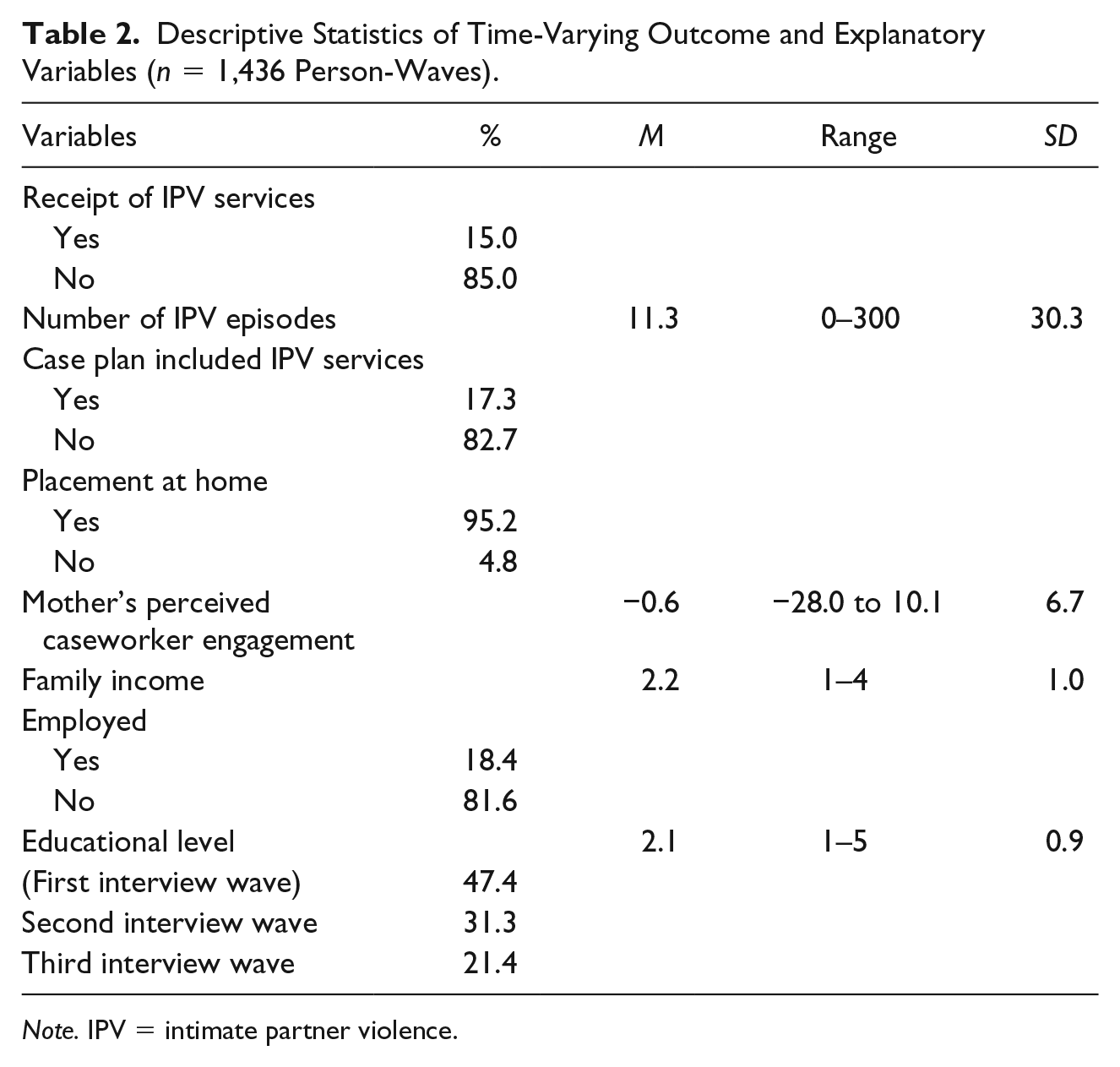
Note. IPV = intimate partner violence.
Results of multivariate analysis confirmed the hypothesized model to differ significantly from the null model (Wald’s χ2 = 198.02, p < .01; see Table 3). Likelihood of IPV service receipt significantly increased when a case plan specified IPV services (OR = 101.38, p < .01). Such likelihood was significantly reduced, however, in association with placement in home of biological/adoptive mother (OR = 0.20, p < .01). Negative associations were also found between the outcome and both family income (OR = 0.43, p < .01) and third interview wave (OR = 0.32, p < .01). The present study showed no association between the outcome and the remaining variables (number of IPV episodes, IPV maltreatment, caseworker engagement perceived by mother, race/ethnicity, education, employment).
Multivariate Analysis Results on Receipt of IPV Services (n = 1,436 Person-Waves).
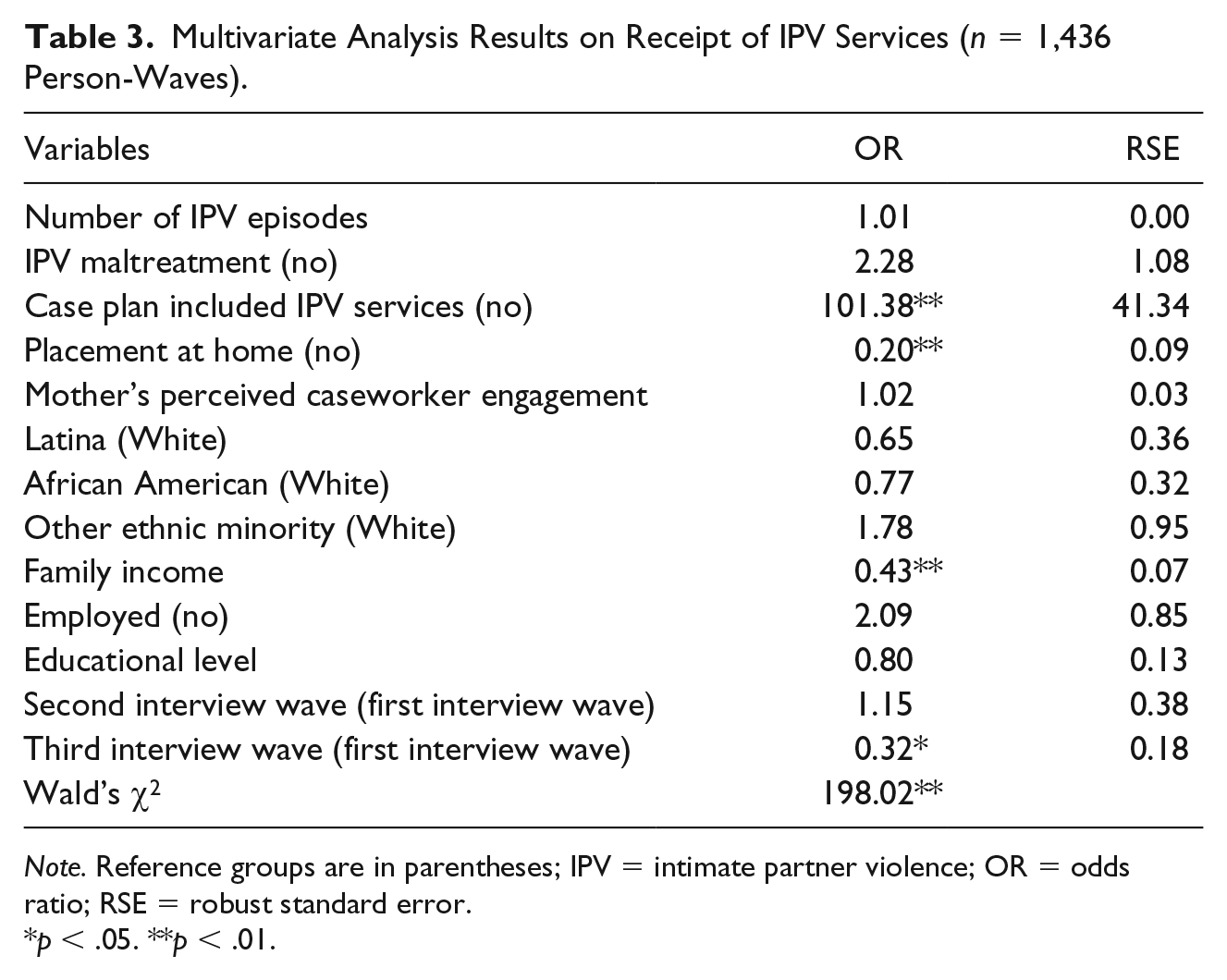
Note. Reference groups are in parentheses; IPV = intimate partner violence; OR = odds ratio; RSE = robust standard error.
p < .05. **p < .01.
Discussion
In the present study, the observed rate of IPV service receipt, at 15%, was substantially below a prior reported rate, 83% (Kohl et al., 2005). This discrepancy may stem from the earlier sample’s broader makeup. That sample included relatives (other than mother) as permanent caregivers and unsubstantiated as well as substantiated cases. The discrepancy may also stem from the fact that 30% of the present sample reported no IPV in the past year, as close examination of the present findings ultimately revealed. Finally, because the measures employed in the data set did not specify the particular IPV services, the meaningfulness of implications of our findings is necessarily limited. That includes implications of the discrepancy between the present finding that IPV services were received by 15% of the present sample and an earlier finding of a far higher rate of receiving such services. It is possible that, when abused mothers they served denied experience of IPV, caseworkers referred them for generic IPV services that the women found inappropriate or unhelpful.
The hypothesis obtained partial support from the findings: receipt of IPV services by women surviving IPV was associated with their need for services, with specification of service need(s) in case plan, with level of caseworker–caregiver engagement, with type of child placement, and with race/ethnicity, family income, employment status, and education of IPV victim. The results show a strong positive association between case plans specifying IPV services and receipt of IPV services. This suggests that accurate identification of needed services in case plans would help mothers receive these services. Contrary to a prior study that extracted Latina mothers’ data from NSCAW-II (Finno-Velasquez & Ogbonnaya, 2017), the present study observed no link between mothers’ receipt of IPV services and the number of recent IPV episodes or IPV maltreatment type. A plausible explanation is that caseworkers considered mothers’ lifetime experience of IPV in determining the need for IPV services. In addition, in the present study, no link was observed between the engagement variable and service receipt. This suggests that it can be difficult for mothers surviving IPV to build satisfying collaborative relationships with caseworkers (Lietz, 2011; Staudt et al., 2001).
The present results contradicted earlier ones obtained for a sample involved in foster care (Renner, 2011b). Unlike that prior study, the present study showed that mothers with children in out-of-home placements were more likely to obtain IPV services than mothers with children at home. It seems probable that mothers in the present sample were eager for IPV services, perhaps expecting the services to facilitate family reunification. Moreover, close examination of the present data revealed caseworker interventions to demonstrate positive effects. For instance, the interaction term between placement at home and number of IPV episodes was associated in a positive direction with likelihood of IPV service receipt (OR = 2.27, p < .05). (The interaction term is not shown in Table 3.) This association indicated that when mothers residing with children experienced relatively many IPV episodes in the home, they became more likely to obtain IPV services, perhaps because caseworkers worked especially diligently to ensure the safety of such vulnerable mothers and children.
Consistent with findings of a prior study (Kohl et al., 2005), the present study indicated no significant differences among racial/ethnic groups as to the likelihood of receiving IPV services. The present outcome variable was not associated with education or with employment, supporting further prior findings (Cheng & Lo, 2015; Finno-Velasquez & Ogbonnaya, 2017). However, relatively low-income mothers in the present study tended to exhibit comparatively high likelihood of obtaining IPV services, a finding that departs from a prior result for Latinas suggesting receipt of IPV services is not significantly associated with income (Finno-Velasquez & Ogbonnaya, 2017). A plausible explanation for the difference is that caseworkers make a special effort to help underprivileged mothers get the services they need, regardless of mothers’ racial/ethnic backgrounds.
The present study observed a negative association between third interview wave and IPV service receipt. Thus, it seems that lengthening involvement in the child welfare system leaves mothers surviving IPV less likely to get IPV services. One plausible explanation is that caseworkers view as high-risk clients any family in which the mother has experienced IPV; consequently, such mothers are retained in the system for extended periods, but for monitoring purposes rather than purposes of supplying IPV services (Alaggia et al., 2015). Such women probably face a variety of unresolved problems and persistent barriers to service access. Nevertheless, even for them, caseworker specification of IPV services in case plans raised their odds of receiving IPV services.
Conclusions and Implications for Practice
The present study obtained evidence of interventions’ key roles in receipt of IPV services by women surviving IPV and involved in the child welfare system. While the observed rate of service receipt was low, the impact of interventions on that rate was significant. This implies the importance of ongoing training of caseworkers in the identification of IPV during child welfare investigations and in proper inclusion of IPV services in case plans, along with proper making of referrals to IPV service providers. The findings also imply the potential usefulness of caseworkers’ shifting of some of their attention from monitoring mothers as to the welfare of children remaining at home, to actively attending to custodial mothers’ progress toward securing needed IPV services. Child welfare agencies should, moreover, hire IPV specialists to facilitate IPV identification and associated referrals (Kohl et al., 2005). Training for caseworkers should also present skills and strategies for collaboratively engaging woman victims of IPV who enter the child welfare system—especially in work with low-income families. Collaborative working relationships between caregiver and caseworker will enhance receipt of IPV services by abused mothers. Caseworkers who learn why women sometimes stay with abusive partners are better able to avoid victim blaming (Moles, 2008), a kind of criticism unconducive to collaborative engagement. For instance, understanding the “power and control wheel” often contributes to effective, successful caseworker intervention with clients experiencing IPV (Burge et al., 2016; Dutton & Starzomski, 1997; Gondolf, 2010). Successful child welfare agencies, moreover, are those that continue to provide caseworkers with cultural competency training—even though the present study saw no racial disparities in mothers’ receipt of IPV services.
Certain limitations constrain the present findings. First, barriers to IPV services and referral to IPV services could not be considered in this study after it was determined that the variables meant to measure them demonstrated singularity or multicollinearity. Second, since the employed national data did not speak to specific kinds of IPV services received by women in the sample, the present study could not pinpoint them either. Furthermore, the present study focused on the “receipt” of IPV services whether service delivery was fully completed or not. Potentially, some respondents received IPV services that, for whatever reasons, ended prematurely. Since the national data set only measured the maltreatment types with the most serious maltreatment type, IPV might be indicated during the investigation but not considered as the most serious type of maltreatment in the data set.
The present study focused on the receipt of IPV services by women surviving IPV. Future research might explore specific combinations of IPV services and other services the women might benefit from: mental health care, substance-use treatment, employment services, and related help. Future research might also explore whether and how receiving IPV services promotes safety, justice, and healing for IPV survivors. Finally, the literature could be enriched by the addition of studies exploring one or more specified IPV services received (or not) by women in the child welfare system; exploration should extend to the detection of any barriers likely to face them in accessing services.
Footnotes
Declaration of Conflicting Interests
The author(s) declared no potential conflicts of interest with respect to the research, authorship, and/or publication of this article.
Funding
The author(s) received no financial support for the research, authorship, and/or publication of this article.
