




Abstract
Recent revelations of the extent of sexual abuse in the Roman Catholic Church in Germany and the United States have once more triggered the debate about sexual abuse. Those inquiries identify cases that are known to authorities or have been recorded in these institutions. However, to assess the full magnitude of the problem, data beyond recorded or known cases are needed, as it can be assumed that a vast number of cases are not reported and are hence not included in such file reviews. Therefore, representative surveys are needed. The aim of the present study was to examine the prevalence of sexual abuse by priests and in different contexts in the German population based on a representative sample. A total of 2,510 participants (54.3% female, M = 48 years) were retrospectively asked about different experiences, offenders, contexts, and so on, of child sexual abuse using questions that were used to assess child sexual abuse in prior surveys and the Childhood Trauma Questionnaire (CTQ). In sum, 0.21% (n = 7) of the participants reported child sexual abuse by a priest or pastor. 0.16% reported child sexual abuse in an institution of the Roman Catholic Church. Results also indicated that victims of sexual abuse by priests and pastors reported rather severe types of sexual abuse based on the CTQ in comparison with other contexts, such as schools. Extrapolating the data for the population, it can be assumed that the estimated number of victims is much higher than those identified by research based on recorded cases.
Keywords
Background
Over the last decades, the topic of child sexual abuse in institutions has gained more public and scientific awareness. This has been triggered by a range of incidents of sexual abuse all over the world. Revelations of sexual abuse by priests and in the Roman Catholic Church around the world have also gained much attention. Child sexual abuse in the Roman Catholic Church has been increasingly recognized as a problem not limited to single institutions (Böhm et al., 2014). When cases of sexual abuse in institutions are reported, initial reactions are often marked by disbelief or followed by the assumption that these are only isolated cases (Rossetti, 1996) conducted by a few “black sheep” (White & Terry, 2008). The full extent of cases within an institution usually often only becomes known after a broad public media coverage, discussion and inquiry is initiated (Böhm et al., 2014).
The public debate around sexual abuse by clerics, priests, and in the Roman Catholic Church started as many victims in the United States and other countries came forward in the 1980s, 1990s, and 2000s (Keenan, 2009). Sexual abuse by offenders affiliated to a church triggers great indignation in the public, as offenders on one hand use their position of trust against the children and their parents by using supposedly safe contexts and on the other hand abuse their power and authority that go along with their status and position in the church (Ulonska, 2006).
About 4,000 cases of sexual abuse over the last five decades have been reported to the Congregation for the Doctrine of the Faith that is responsible for this issue in the Roman Catholic Church since 2001 as the Motu proprio “Sacramentorum sanctis tutela” was introduced (Fegert et al., 2015). The Motu proprio is an edict of Pope John Paul II that formulates standards relating to serious offenses such as child sexual abuse (Libreria Editrice Vaticana, 2001). The congregation is the promoter of justice in the Vatican that among other things deals with questions of pedophilia and child sexual abuse. About 60% of the victims were male adolescents, 30% female adolescents, and about 10% children (Fegert et al., 2015). However, these are only cases with clerics as suspects that have been pre-investigated by dioceses and have then been forwarded to the congregation. Therefore, such numbers can only be seen as very conservative estimates of the true number of victims. Consequently, independent inquiries are needed (Fegert et al., 2015), with one of the biggest inquiries being the John Jay College Study (John Jay College of Criminal Justice, 2004; John Jay College of Criminal Justice & Catholic Church, 2004). But inquires have also been taken place in Belgium (Adriaenssens, 2010), Germany (Tisch, 2012), Ireland (Commission to Inquire Into Child Abuse, 2003), Luxembourg (Kontaktstelle für Opfer sexueller und physischer Übergriffe an Minderjährigen, 2010), and the Netherlands (Deetman et al., 2011). A recent review of the literature has identified 40 studies that examine the extent and variety of sexual abuse of minors within the Catholic Church and other institutions (Dressing et al., 2017). Studies have been identified for three continents:
● Australia (Parkinson et al., 2012),
● Europe, including studies for ○ Austria (Keupp et al., 2015; Lueger-Schuster et al., 2012, 2014) ○ Germany (Fegert et al., 2011; Fernau & Hellmann, 2014; Keupp et al., 2013; Leygraf et al., 2012; Rassenhofer et al., 2015; Raue, 2010, 2011; Westphal et al., 2010, 2011; Zimmer et al., 2014; Zinsmeister et al., 2011) ○ Ireland (Goode et al., 2003F. D. Murphy et al., 2005J. Y. Murphy et al., 2009Y. J. Murphy et al., 2010; Ryan, 2009) ○ Luxemburg (Majerus & Majerus-Schmit, 2010), Netherlands (Onderzoekscommissie, 2011) ○ Switzerland (Akermann et al., 2012, 2014; Ries & Beck, 2013) ● North America, including studies for ○ Canada (Langevin et al., 2000; Loftus & Camargo, 1993) ○ USA (Calkins et al., 2015; Falkenhain et al., 1999; Fones et al., 1999; Haywood et al., 1996a, 1996b; John Jay College of Criminal Justice & Catholic Church, 2004; Plante et al., 1996; Reilly, 2003; Terry et al., 2011).
These studies are mainly based on surveys of victims (34.7%) and analyses of files of recorded cases in the institutions (28.6%). The authors report a total of 14,588 separate offenses in these studies. Offenders (over 90%) and victims (78.6%) in the context of the Catholic Church were predominantly male. The average rate of offenders in the context of the Catholic Church, that is, the relation between priests who committed offenses and the total number of priests with a clerical function during the study period, was 4% (Dressing et al., 2017).
Only recently, in Germany a study has been released with the aim to document the extent of child sexual abuse by clerics in the responsibility of the German Bishops’ Conference (Dressing et al., 2018). With the publication of the results once more the discussion about sexual abuse has been triggered, but has also caused very critical reactions (Lütz, 2018).
With an interdisciplinary approach, the researchers investigated the issue between 2014 and 2018. For the first time, all dioceses in Germany were contractually obliged to take part in the study. However, the researchers did not have direct access to the files, but staff of the dioceses or their legal representations filled out report forms and transferred these to the research team. The authors identified a total of 3,677 cases of sexual abuse over a period of almost 70 years starting from 1946 to 2014. The victims were predominantly male (62.8%), with a mean age of 12 years. Multiple acts of sexual abuse seemed to be more prevalent than single acts. In contrast, the authors report 1,670 alleged offenders. This number corresponds with 4.4% of all clerics in the period between 1946 and 2014 (Dressing et al., 2018). It can be assumed that these results only represent a smaller part of the true number of victims, as only cases that have been filed or recorded were analyzed. However, it can be assumed that a certain amount of cases is not reported and therefore are not filed and, consequently, do not appear in such analyses. Therefore, surveys from the general population are needed. The aim of the present study was to examine the prevalence of sexual abuse by priests and in institutions of the Catholic Church based on a representative survey to provide estimates about the number of potential victims beyond those that are known. Interestingly, most of the research and the public debate has focused on the Catholic Church, while data on the prevalence of sexual abuse in the Protestant Church are lacking.
Method
Procedure
The study is based on a representative sample of the general population of Germany. Data collection took place between May and July 2018. The sampling was conducted by a social research consulting company (USUMA, Berlin, Germany). To assure representativeness a random route procedure was chosen. In multiperson households, a Kish selection grid was used for a random selection of the target person. Individuals aged 14 years and older having sufficient German language skills were eligible to participate in the study. Participants were approached by research assistants and informed consent was obtained. In the case of minors, participants gave informed assent with informed consent being provided by their caregivers. Research staff conducted an initial interview on sociodemographic data and handed out a questionnaire. The research staff remained nearby, in case participants had questions or clarification was needed. Participants completed the main part of the study by answering the questionnaire without research staff interfering in answering the questions. A total of 5,418 households were approached and 2,516 complete data sets were collected. Main reasons for nonparticipation were refusal by the selected household to identify the person of target (22.4%) and refusal of the target person to participate (12.7%).
The survey was conducted in accordance with the Declaration of Helsinki and fulfilled the ethical guidelines of the International Code of Marketing and Social Research Practice of the International Chamber of Commerce and the European Society of Opinion and Marketing Research, and received an approval of the institutional review board of the University of Leipzig.
Measures
Sociodemographic information was assessed via a structured interview, including information on age, gender, educational level, occupation, marital status, number of persons below 18 years in the household, and number of own children.
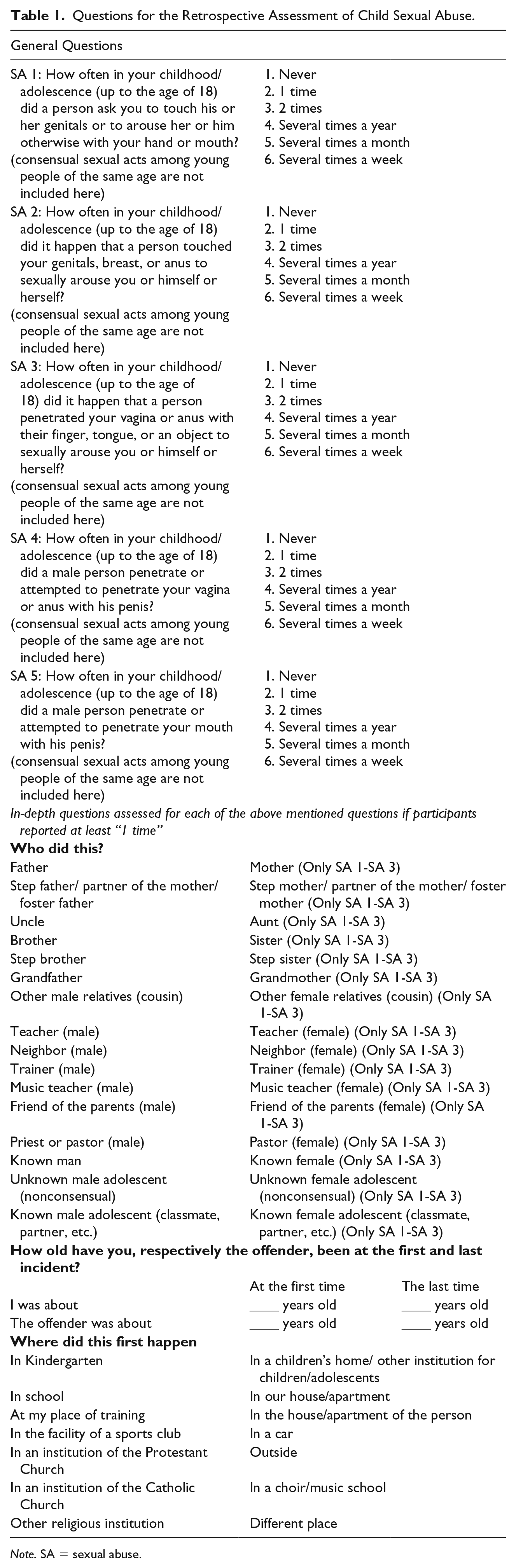
Experiences of child sexual abuse were assessed using a set of questions that have been used for this purpose before (Bieneck et al., 2011; Wetzels, 1997). The questions are presented in Table 1.
Questions for the Retrospective Assessment of Child Sexual Abuse.
Note. SA = sexual abuse.
In addition, the German Version of the Childhood Trauma Questionnaire (CTQ; Bernstein et al., 2003; Klinitzke et al., 2012; Wingenfeld et al., 2010) was administered. The CTQ is a 28-item measure for the retrospective assessment of five types of child maltreatment: physical abuse, emotional abuse, sexual abuse, physical neglect, and emotional neglect. Each subscale is assessed by five items. Three additional items assess whether participants tend to minimize problematic experiences within their family. The psychometric properties of the German version of the CTQ have been demonstrated by Klinitzke and colleagues (Klinitzke et al., 2012). The internal consistency ranged between 0.62 and 0.96 for the subscales. The intraclass coefficient for an interval of 6 weeks was 0.77 for the overall scale and for subscales between 0.58 and 0.81. Severity scores for each subscale can be calculated, ranging from “none–minimal,” “minimal–moderate,” “moderate–severe,” to “severe–extreme.” The severity scores of the sexual abuse subscale were used.
Statistical Analyses
All analyses were conducted using SPSS version 21. Descriptive analyses were performed for prevalence rates. Extrapolations were calculated to estimate a potential number of victims of sexual abuse in different contexts. Extrapolations are based on the population of Germany of 14 years and older (71.48 million in 2017; Statistisches Bundesamt [Destatis], 2018), as only participants 14 years and older were included in the present study. To calculate a potential number and range of the number of victims of the different types of abuse, the identified prevalence rates and the 95% confidence interval (CI) were used.
Results
Participants
A total of 2,516 participants were included in the study. Of those, 54.5% were female and participants were on average 48.0 years old (SD = 17.6); 96% reported to have German citizenship. The sample was representative for the German population in regard to age and gender. The characteristics of the sample are presented in Table 2.
Sample Characteristics.

Note. Data are presented as M and SD for age and number of subjects (%) for other characteristics.
Prevalence of Child Sexual Abuse
Overall, 10.5% (n = 263) of the participants, 14.9% (n = 205) of the female participants and 5.1% (n = 58) of male participants, report at least one type of child sexual abuse. The prevalence rates for different types of child sexual abuse range between 1.2% for child sexual abuse with oral penetration and 8.9% for child sexual abuse, in which victims were made to touch the offender. For all types of child sexual abuse, the prevalence rates were higher for women in comparison with men. The prevalence rates are presented in detail in Table 3.
Prevalence of Different Types of Child Sexual Abuse for the Total Sample and Stratified by Gender (N = 2,516).

Note. SA = sexual abuse; SA1 = made to touch the offender; SA2 = touched by the offender; SA3 = penetration with finger/tongue /object; SA4 = penetration of vagina/anus; SA5 = oral penetration.
Prevalence of Child Sexual Abuse by Priests and in Institutions of the Church
Overall, 0.28% (n = 7) of the participants report at least one type of child sexual abuse by priests or pastors (protestant and Catholic). Of those, most were female (n = 5). The mean age was 68.14 years. Only one person was below 50 years of age. In the CTQ, three participants reported a “moderate-severe” severity and four participants reported a “severe-extreme” severity of sexual abuse.
Any type of child sexual abuse in institutions of the Catholic Church was reported by 0.16% (n = 4) participants. This equaled the total number of participants who reported sexual abuse in an institution of the Catholic Church and by a priest. The participants were on average 72.5 years old and mostly female (n = 3). None of those were below the age of 50 years. In the CTQ, three participants reported “severe-extreme” severity of the sexual abuse and one participant “moderate-severe” severity.
Any type of child sexual abuse in institutions of the Protestant Church was also reported by 0.16% (n = 4) of the participants. Those were on average 45.5 years old and also mostly female (n = 3). In the CTQ also three participants reported “severe-extreme” severity of sexual abuse and one participant reported “moderate-severe” severity. Those who reported sexual abuse by a pastor/priest and in an institution of the Protestant Church was one participant. Those who reported sexual abuse in an institution of the Protestant Church but not by a priest or pastor reported peers (n = 2) and neighbor (n = 1) as offenders. In addition, two participants reported sexual abuse by a priest/pastor but neither in an institution of the Roman Church nor of the Protestant Church, but one in a different institution for children and one in a school. Therefore, it is unclear whether these offenders were Protestant or Catholic. The different types of child sexual abuse by priests and pastors, in institutions of the Catholic Church and in institutions of the Protestant Church, are presented in Table 4.
Prevalence of Child Sexual Abuse by a Priest/Pastor, by a Priest of the Catholic Church, by a Pastor or in an Institution of the Protestant Church.
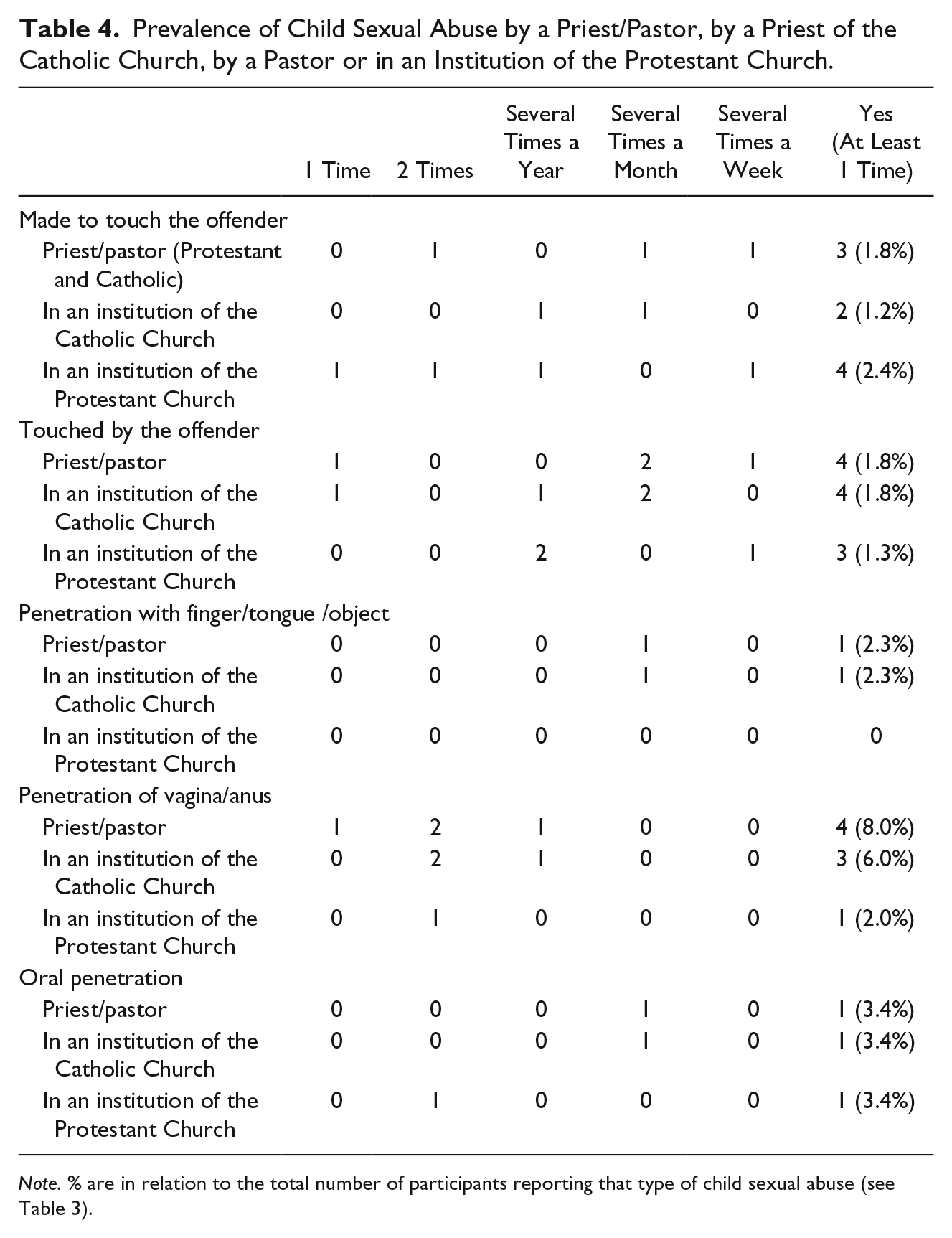
Note. % are in relation to the total number of participants reporting that type of child sexual abuse (see Table 3).
In comparison with these numbers, 1.4% (n = 36) participants reported at least one type of child sexual abuse by a teacher or in school. They were on average 47.1 years old and also mostly female (n = 21). In the CTQ, seven participants reported “none-minimal,” 12 participants “minimal-moderate,” 12 participants “moderate-severe,” and five participants “severe-extreme” severity of the sexual abuse.
Child sexual abuse by a trainer was reported by 0.28% (n = 7) participants. Those were 47.9 years on average and also mostly female (n = 4). In the CTQ, one participant reported “none-minimal,” two participants “minimal-moderate,” two participants “moderate-severe,” and two participants “severe-extreme” severity of the sexual abuse.
Child sexual abuse by a music teacher was reported by 0.12% (n = 3) of the participants. All of them were female and on average 69.3 years old. In the CTQ, all reported “severe-extreme” severity of the sexual abuse.
Extrapolation of People Potentially Affected
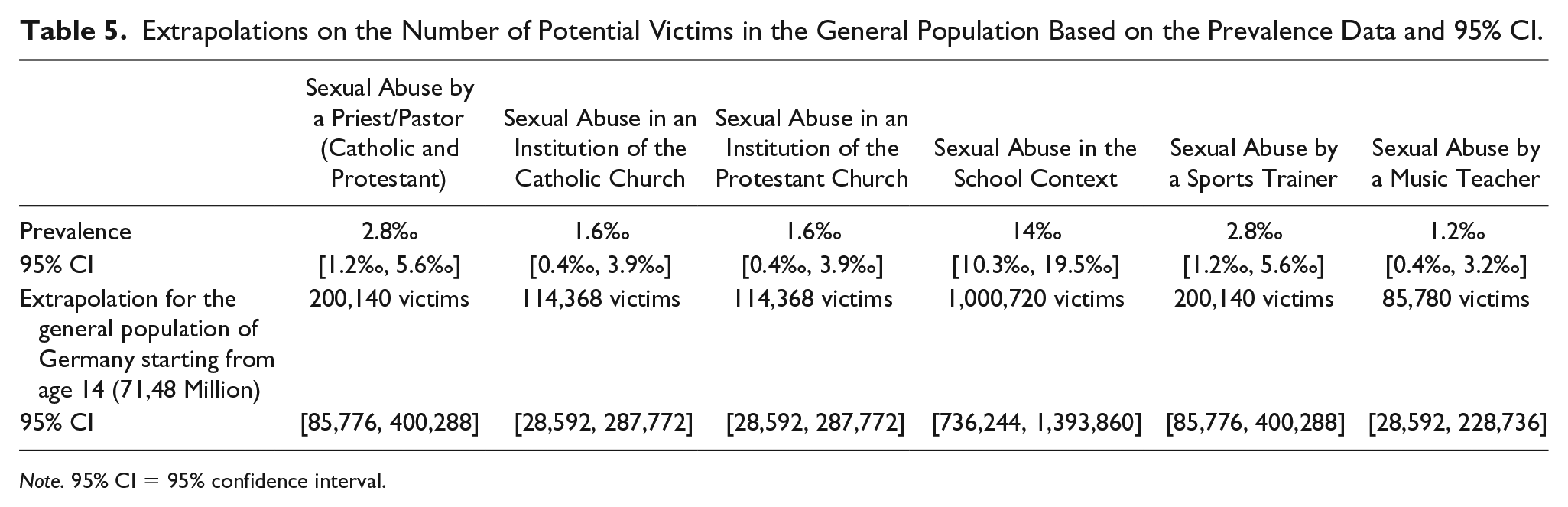
Based on the prevalence data, extrapolations on the number of potential victims in the general population were conducted. The highest number of potential victims was identified for the school context with about 1,000,000 potential victims. The potential number of victims of sexual abuse by a priest or pastor was about 200,000. The estimated number of victims of sexual abuse by a sports trainer was equally high. The extrapolations are presented in Table 5.
Extrapolations on the Number of Potential Victims in the General Population Based on the Prevalence Data and 95% CI.
Note. 95% CI = 95% confidence interval.
Discussion
The aim of the present study was the examination of different types of child sexual abuse in the general population of Germany with a special focus on child sexual abuse by clerics and in institutions of the church. The results underline the magnitude of the problem. A prevalence rate of 10.5% for any type of child sexual abuse in the general population was found. These results correspond well with rates found in European (Sethi et al., 2013) and international (Stoltenborgh et al., 2011) meta-analyses. It has to be mentioned that only hands-on sexual abuse was assessed. It can be assumed that rates would be higher if also acts of hands-off sexual abuse (such as exhibitionism or exposure to pornographic material) were assessed. In comparison with these rates, the prevalence rate for child sexual abuse by priests and pastors (0.28%), by priests in the Catholic Church (0.16%), and by pastors or in institutions of the protestant church (0.16%) are smaller. In comparison with prevalence rates identified for other leisure areas, such as child sexual abuse by sports trainers (0.28%) and music teachers (0.12%), the rates correspond well. However, in contrast to other important fields of life, such as school (1.4%), child sexual abuse in institutions of the church and by clerics seems to play a minor role (Table 5). The higher numbers of potential victims in the school context can be explained by the different importance of these contexts in the general population. While almost every person attends or has attended a school once, the church context might play a minor role.
Based on the found prevalence rates, the data have been extrapolated to estimate a potential number of victims in the general population of Germany. Within the 95% CI, the number of potential victims of sexual abuse by a priest or pastor lies between almost 85,800 and 400,000. The estimated number for victims of sexual abuse by sports trainers is equally high. With a potential number of about 730,000 to 1,300,000, the number of victims of sexual abuse in the school context is even higher, as described before.
The data also shows that child sexual abuse is not only a problem of the Roman Catholic Church, but institutions of the Protestant Church seem to be affected as well, even though offenders might differ. While the institutions of the Roman Catholic Church have largely been in the focus of the debate (Dressing et al., 2017), relatively little attention has been paid to this topic by the Protestant Church. Further information on sexual abuse also in the Protestant Church is needed. Therefore, the Independent Inquiry into Child Sexual Abuse in Germany has requested the Protestant Church in Germany to initiate an independent inquiry into child sexual abuse in their institutions (Unabhängige Kommission zur Aufarbeitung sexuellen Kindesmissbrauchs, 2018). All religious denominations that are engaged in work with youth need conceptual frameworks to prevent child sexual abuse. Debates that solely focus on the role of celibacy are an underestimation of risk situations in all relationships of dependence, supervision, and care. The simple argument that abuse could be ended by abandoning celibacy obviously falls too short.
The results of the report of the Grand Jury Report impressively illustrates the importance of an independent investigation of cases. After efforts of the Roman Catholic Church in Pennsylvania to cover up child sexual abuse by more than 300 priests over a period of 70 years, the General Attorney took over the investigation of six out of eight dioceses in Pennsylvania and identified over 1,000 cases (Office of Attorney General, 2018). Even though the prevalence rates found in this study are relatively low, the extrapolation for the number of potential victims in the general population underlines that the number of cases is much larger than those identified by analyses of files and records. It can be assumed that the number of victims exceeds the 3,677 cases identified in the latest German study (Dressing et al., 2018).
Some authors have argued that child sexual abuse in the Roman Catholic Church is rather a phenomenon of the past and the majority of incidents date back several decades (Dressing et al., 2018). The results of the present study seem to support this hypothesis, as the average of victims of child sexual abuse by priests in the Catholic Church in the present study was above 70 years of age and none of the victims was younger than 50 years. However, when interpreting these results, the very small number should be noted. A decrease of child sexual abuse in the Roman Catholic Church might have been caused by a secularization of youth work, installation of protection measures, and a higher awareness for the problem after the public debate. In addition, the influence of the church in daily life has also decreased in western European countries (Pollack, 2016), which might also be a factor leading to a decrease of rates of child sexual abuse cases in institutions or by members of the church. In contrast, Dressing and colleagues did not find evidence that the abuse only lay in the past and has now been overcome (Dressing et al., 2018).
Interestingly, a discrepancy in our data can be identified, as child sexual abuse by priests in the Catholic Church was surprisingly often reported by women, while the large majority of inquiries (Adriaenssens, 2010; John Jay College of Criminal Justice & Catholic Church, 2004) identified a relatively clear effect in the sense of ephebophilia, meaning assaults on boys between 12 and 14 years of age, a special characteristic of child sexual abuse in the Roman Catholic Church. However, this discrepancy might be due to the relatively small sample size of the present study. Another reason for this discrepancy might be the sampling method of the present study, as potential high-risk groups, such as people without permanent residence and people currently living in institutions, are systematically excluded. In addition, differences in the willingness to report the experiences might play a role.
Limitations
While interpreting these results, some limitations should be considered. First, it should be noted that with more than 2,500 participants, the sample size is fairly large. However, when analyzing rare phenomena, the numbers tend to be small and limit the generalizability. Second, the retrospective assessment of child maltreatment may always be affected by different biases, for example, recollection biases. Third, the sampling approach (random route approach) systematically excludes potential high-risk populations, such as people without permanent residence and people currently living in institutions. Fourth, for matters of comparability the present study used questions that have been used for this purpose before (Stadler et al., 2012; Wetzels, 1997). It has to be noted, though, that the confession of the offending priest/pastor was not explicitly assessed leaving some uncertainty. In addition, it has to be mentioned that due to data safety reasons, no sociodemographic information on those who refused to participate was collected. Therefore, a comparison between those who participated and those who did not is not possible.
Conclusion
Child sexual abuse is an important public health issue. The prevalence rates found in the present study underline the magnitude of the problem. In comparison with other important areas of the personal life, such as school, sexual abuse by priests seems to play a minor role. Despite the relatively small prevalence, child sexual abuse by priests or pastors represents 8% of child sexual abuse cases with vaginal or anal penetration. However, sexual abuse does not seem to be restricted to the Catholic Church, but all religious denominations are affected. Extrapolations based on the results of the present study gives cause to expect that the true number of potential victims is larger than the cases identified by reviews of records. Independent inquires in all fields where people work with children are needed and protection measures in relationships of power, care, supervision, and dependence are needed.
Footnotes
Acknowledgements
We thank the participants for sharing their experiences with us.
Declaration of Conflicting Interests
The author(s) declared the following potential conflicts of interest with respect to the research, authorship, and/or publication of this article: A.W. and E.B. state that they have no conflict interests. J.M.F. has received research funding from the EU, DFG (German Research Foundation), BMG (Federal Ministry of Health), BMBF (Federal Ministry of Education and Research), BMFSFJ (Federal Ministry of Family, Senior Citizens, Women and Youth), German armed forces, several state ministries of social affairs, State Foundation Baden-Württemberg, Volkswagen Foundation, Pontifical Gregorian University, RAZ, CJD, Caritas, Diocese of Rottenburg-Stuttgart. Moreover, he received travel grants, honoraria, and sponsoring for conferences and medical educational purposes from DFG, AACAP, NIMH/NIH, EU, Pro Helvetia, Janssen-Cilag (J&J), Shire, several universities, professional associations, political foundations, and German federal and state ministries during the last 5 years. Every grant and every honorarium has to be declared to the law office of the University Hospital Ulm. He holds no stocks of pharmaceutical companies. P.L.P. has received research funding from the German Federal Institute for Drugs and Medical Devices (BfArM), the German Federal Ministry of Education and Research (BMBF), VW-Foundation, Baden-Wuerttemberg Stiftung, Lundbeck, Servier. He has received a speaker’s honorarium from Shire. He holds no stocks of pharmaceutical companies.
Funding
The author(s) received no financial support for the research, authorship, and/or publication of this article.
