




Abstract
This study sought to describe the system of beliefs on gender, attitudes toward women, and wife beating, in young adults who live in Mysore, India. Furthermore, it identified structural sex differences in the interplay of values among these matters that can affect individual and community views toward domestic violence. Drawing from survey data gathered from 265 young adult Indian men and women, this study used network analysis to graph a correlation network of beliefs and attitudes toward domestic violence. Node, scale, and network structure descriptions allowed for comparisons among male and female participant responses. The findings support the assertion that there are sex differences among the system of beliefs toward wife beating among Indian young adults. Gender ideology, masculine role in relationships, and legal and social consequences of wife beating emerged as the most important values to focus on when addressing young men’s beliefs of domestic violence and attitudes toward women. In contrast, values influencing women’s perceptions of domestic violence are more complex and related to multiple beliefs about women’s power, family structure, and social and legal implications of domestic violence. The results highlight the importance of recognizing gender differences in the connectivity between gender and wife beating beliefs when designing interventions. There is a need for efforts to accurately target these values and attitudes to more effectively address gendered attitudes and beliefs about domestic violence in this population.
Domestic violence has been cited by the World Health Organization (WHO) as an urgent global maternal and child health priority (Garcia-Moreno & Watts, 2011). Characterized by multiple forms of abuse, terrorization, and threats and increasingly possessive and controlling behavior, more than one third of women in India have experienced domestic violence perpetrated by their husband according to India’s National Family Health Survey (NFHS-3; International Institute for Population Sciences and Macro International, 2007). There has been increased push for research to focus on identifying factors contributing to perpetration and victimization in India given its long-term negative social, economic, and health implications for women and other members in the family (Chibber, & Krishnan, 2011; Kumar et al., 2005). In response to this, several studies have pointed to the need to not only examine attitudes toward domestic violence in India, but also identify the ways in which pervasive and systemic gender inequality beliefs contribute to continued domestic violence perpetration and victimization in India (Flood & Pease, 2009; Jewkes, 2014; Kumar et al., 2005). For example, the cycle of domestic violence is repeated across generations. Women whose mothers were beaten by their fathers are twice as likely to experience violence (60%) as women whose mothers were not beaten by their fathers (30%; International Institute for Population Sciences and Macro International, 2007). Furthermore, supportive community attitudes regarding wife beating predicted the likelihood of being a woman becoming a victim (Koenig et al., 2006).
Much focus has been given to the role of socioeconomic status (SES) and education as buffers to violence; women who have higher levels of education and, in turn, are in higher SES categories experience lower rates of violence in India (Jeyaseelan et al., 2007; Koenig et al., 2006; Krishnan et al., 2010; Rocca et al., 2008). However, researchers point out that it is not the educational attainment that influences these outcomes; rather, it is the ability to negotiate gender-based violence (GBV) vis-à-vis gender role expectations that are most important (Chibber & Krishnan, 2011; Kundapur et al., 2019). Thus, it is critical to examine understandings of perceptions of GBV within the context of culturally informed beliefs about gender role expectations in India. For example, women’s violation of gender behavior norms, such as neglecting household duties or child rearing responsibilities, is among the most common reasons given by Indian women and men for condoning domestic violence across educational levels (International Institute for Population Sciences and Macro International, 2007). For example, 54% of Indian women and 51% of Indian men report that wife beating is justifiable under these types of circumstances across all educational domains (International Institute for Population Sciences and Macro International, 2007). Taken together, these factors highlight the ways in which culturally informed beliefs about appropriate gender roles can inform understandings of Indian women’s domestic violence experiences. Unfortunately, the ways in which beliefs about gender roles are related to attitudes toward wife beating have not been assessed.
To address this void, this study uses network analysis (NA) and graph methods to examine gender differences in the system of domestic violence beliefs and attitudes toward women, among a sample of educated young adults in Mysore (India), that allow building recommendations for future preventive interventions. This study will utilize NA to specifically explore and compare the network’s structure and the structural centrality of attitudes among young adult Indian men and women’s systems of gender and broader GBV values using domestic violence as the example form of victimization. This systemic approach provides an exploratory visualization of otherwise unpredictable interrelationships across a number of self-reported attitudes. The possibility of comparing the structure and connectivity of the networks and the strength of their relationships for the two groups expands on the complex analysis of this gendered phenomenon among educated Indian young adults.
Review of the Literature
Reported rates of domestic violence victimization against Indian women range between 40% and 83% (International Institute for Population Sciences and Macro International, 2007; Kumar et al., 2005; Vizcarra et al., 2004). One factor that has been focused on as differentiating women’s experience is educational level. It has been widely asserted that Indian women who have greater equality in their marriage as indicated by SES due to and exemplified by educational attainment experience lower rates of victimization (Jeyaseelan et al., 2007; Koenig et al., 2006; Krishnan et al., 2010; Rocca et al., 2008). Some studies have noted that married Indian women who have completed high school experience significantly lower rates of domestic violence as compared with women with who have not completed high school, elementary school, or received no education (International Institute for Population Sciences and Macro International, 2007; Krishnan et al., 2010). Furthermore, Indian women with education levels equal to their husbands experience lower rates of victimization (23%) than those with less education than their spouse (36%; International Institute for Population Sciences and Macro International, 2007). However, others have suggested that this difference is tied to attitudes about gender roles and types of GBV. For example, psychological abuse has been found to be inversely proportional to the educational status of women, whereas sexual violence had no relation to educational status of women ( Kundapur et al., 2019). Physical assault is highest among women with low educational status but has been found to increase in postgraduates as compared with graduates and professionals (Kundapur et al., 2019). Furthermore, the educated women in Kundapur et al.’s (2019) study noted that behaviors such as arguing back and going out without permission contributed to their experiences with domestic violence victimization. Thus, the association between women’s education and GBV is dependent upon the behavioral expectations of women within intimate relationships.
Gender role expectations have been found to be an important contributor to domestic violence (Banerjee, 2014; Chibber & Krishnan, 2011; Rocca et al., 2008; Stephens et al., 2012). Specifically, violence is likely to occur more commonly in cultures that foster beliefs of perceived male superiority and social and cultural inferiority of women (Kalra & Bhugra, 2013). Traditional values assert women’s inferiority to men, placing them in positions where men’s needs, desires, beliefs, and goals are privileged over their own (Chibber & Krishnan, 2011; Joshi et al., 2001; Stephens et al., 2012). Thus, it is more useful to consider the relevance of broader GBV attitudes in a focus on domestic violence outcomes. As one form of GBV, domestic violence occurs primarily within marital relationships. However, prior research has shown that across all forms of GBV—including sexual assault, sexual harassment, reproductive coercion, female infanticide, prenatal sex selection, obstetric violence, and honor killings—attitudes toward gender role expectations significantly influence individuals’ perceptions of victimization and perpetration (Chibber & Krishnan, 2011; Dalal et al., 2012; Garcia-Moreno & Watts, 2011; Ghosh, 2011; Jejeebhoy et al., 2014; Kundapur et al., 2019; Rastogi & Paul, 2006; Sabri et al., 2015; Vizcarra et al., 2004).
In the case of India, it is useful to consider the ways current gender role beliefs inform perceptions of domestic violence. The country is currently experiencing a shift from being male dominating to being gender equal; globalization, education, employment, and public challenges against incidents of violence against women have raised awareness about gender equality in the context of violence (Kalra & Bhugra, 2013; Koenig et al., 2006; Rocca et al., 2008). For example, 2 years after the brutal gang rape of Jyoti Singh in New Delhi that led to mass protests across the country, crimes against women in India rose by 9%. Although this was not a case of domestic violence, it has implications for understanding how violence and gender role beliefs are related. For example, does this increase reflect a trend in greater acceptance of gender equality and rejection of violence against women? Or could this increase have resulted from resistance to gender equality efforts that are framed as anti-traditional and a violation of cultural values? Having empirical research that illustrates the relationship between GBV beliefs about gender roles would be an initial step in addressing both of these possible results.
The systematic relationships between specific gender role expectations and GBV beliefs in India among young adults have not been identified in the intimate violence literature despite the research which has shown that gender, attitudes toward women, and wife beating beliefs conform a system of values that interact in complex ways. This is due in part to the fact that statistical methods have limitations in their ability to capture the structural networks and coalescent relationships among variables related with a higher risk of victimization of domestic violence.
NA
To address this methodological void, this study has utilized NA to explore these phenomena. NA is an emerging methodological approach used across multiple domains including sociology, biology, engineering, physics, medicine, and business (Wasserman & Faust, 1994). NA is developed as a method to study relational data which is typical in complex systems, by providing information on their structure and relationships. A network is composed of nodes that represent entities that are related to each other. These relationships are represented as edges. An examination of a network can provide information on the structural characteristics of the nodes or establish how the connections present opportunities or constraints within interactions. In the specific case of psychology, NA has been widely used in the study of the brain (neurosciences), educational psychology, and, more recently, to the analysis of the interactions of personality traits, consciousness states (Costantini, Epskamp, et al., 2015; Costantini, Richetin, et al., 2015), and in the analysis of constructs related to psychopathology and intercultural dynamics (Abacioglu et al., 2017; Borsboom & Cramer, 2013; Deserno et al., 2017; Epskamp & Fried, 2018). NA’s graphical methods have proven to be useful (when compared with other traditional statistical analyses) in the visualization of relationships of psychological elements and constructs that, in the specific case of exploratory studies, are otherwise unpredictable (Abacioglu et al., 2017; Costantini, Epskamp, et al., 2015; Epskamp & Fried, 2018). More recent perspectives propose NA as a tool for studying attitudes, given the added analytical possibilities when compared with latent variable models. Dalege and colleages (2016) found that this methodological approach is particularly useful in empirical studies for revealing the structural complexity of multivariate interrelated patterns. According to the authors, some of the properties of this method are as follows: (a) The inherent complexity of attitudes is captured in a systemic model, where the construct itself is the system including also the relationships that emerge in the structure of the network. This is different to a variable approach where usually attitudes tend to be latent. (b) The information flow of fully connected networks goes from one variable to the other, even if they are only indirectly connected, given that they are part of a system. (c) NA structural metrics like strength or inbetweenness allow to understand the level of connectivity of a given network and the centrality of specific nodes. This also provides the possibility of comparing networks for different groups. Finally, they also found that structural characteristics of the network itself are relevant when predicting behavior: Strongly connected attitude networks appear to have a higher impact over behavioral outcomes (Dalege et al., 2017).
These applications of NA to the psychological field that explore perception, symptoms, values, feelings, attitudes, and beliefs are supported by the foundation that there is a complex interconnected set of the relationships among the observed variables explained by the complex interactions that take place within the networks they conform (Abacioglu et al., 2017; Costantini, Epskamp, et al., 2015; Dalege et al., 2016; Epskamp & Fried, 2018; Fisher et al., 2017). In the case of this study, these assumptions that have previously been used in the study of personality traits, symptoms, attitudes, and coconsciousness states (Abacioglu et al., 2017; Costantini, Epskamp, et al., 2015; Costantini, Richetin, et al., 2015; Deserno et al., 2017; Epskamp & Fried, 2018) are considered to hold, in the system of domestic violence and gender attitudes and beliefs that individuals declare. In this sense, we use an NA approach of observed values and attitudes, as opposed to assuming the existence of latent variables that explain the observed covariance, with traditional statistical methods (Costantini, Epskamp, et al., 2015; Costantini, Richetin, et al., 2015).
Two assumptions justify the use of NA in this study. First, attitudes and beliefs toward wife beating and gender roles operate in a multivariate pattern of interrelated relationships where there is a structural covariation between the variables measured, resulting from direct interactions between them. Second, the ecosystemic structure of beliefs, values, and attitudes, with positive and negative relations, informs each other, and NA allows visualizations of these relationships without assuming latent models, which allows the observation of patterns that could be otherwise unknown in an exploratory study of this nature (Epskamp & Fried, 2018).
Together, NA provides a formal way of quantifying the net pairwise relationships among several variables, a graphical summary of these relationships, and representations that identify the differential relationships among variables and across gender groupings. In addition, network measures of centrality and density can provide relevant information on the structure of these systems. This is critical for work in this area as understanding the intersecting values and attitudes that shape networks of domestic violence and gender beliefs in young adults could help identify where to focus and how to target interventions that can ultimately prevent domestic violence perpetration. For these reasons, this study will utilize this methodological approach to identify the structure and potentially different interrelationships between observed attitudes and central beliefs about domestic violence among young adult Indian men and women.
Method
Participants
A total of 265 young adult men (N = 123) and women (N = 142) living in Mysore, India were recruited for the study from local universities and technical work settings. As a result, the majority had completed some undergraduate level of education (70.4%). Participants ranged between the ages of 18 and 25 years. Most reported that they were single (94.4%), with only 5.6% being married or engaged at the time of data collection (1.4% and 4.1%, respectively).
Procedures
Participants completed a survey that included demographic questions and subscales from the Attitudes towards Women, Adversarial Sexual Beliefs, and Inventory of Beliefs about Wife Beating measures (see below). As these surveys were originally designed for populations in the United States, three focus groups were held prior to the Institutional Review Board submissions to better understand how Indian young adults thought about the study issues and comprehended each survey question. This information was used to make terminology changes that better reflected the language and understandings of the population. This was followed by a pilot test to evaluate how people responded to the overall questionnaire, including the modified question terminologies.
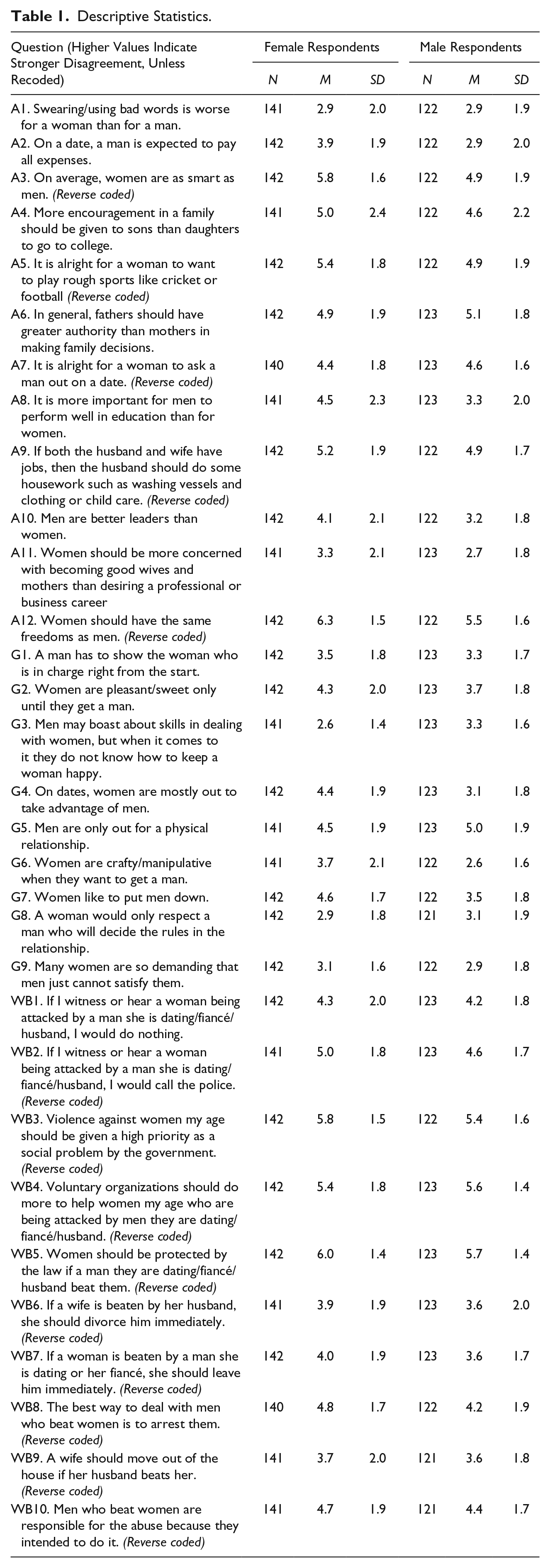
Of the 83 questions of the survey questions, 31 were analyzed in this study. Responses to all questions were recorded on a Likert-type seven-point scale ranging from strongly agree to strongly disagree. Some variables were reverse coded to facilitate interpretation, unifying the direction of healthier or more egalitarian attitudes. Table 1 contains the descriptive statistics for each of the selected questions.
Descriptive Statistics.
Attitudes towards Women subscale
The 12-item Attitudes towards Women Scale for Adolescents (AWSA; Galambos et al., 1985) measures beliefs about feminine gender roles. This scale is a modification of the Attitudes towards Women Scale (Spence et al., 1973) for its use with adolescents. In this scale, participants indicate their endorsement for beliefs about how females should behave.
Adversarial Sexual Beliefs subscale
The Adversarial Sexual Beliefs Scale (Burt, 1980) explores the beliefs regarding hostility toward women in sexual relationships. It was developed for the purposes of a study that described the “rape myth” and tested hypotheses derived from social psychological and feminist theory that acceptance of rape myths can be predicted from attitudes such as sex role stereotyping, adversarial sexual beliefs, sexual conservatism, and acceptance of interpersonal violence.
Inventory of Beliefs about Wife Beating
The Inventory of Beliefs about Wife Beating addresses beliefs and attitudes about husband-to-wife violence. The five subscales are Wife Beating Is Justified (consistency reliability = .86), Wives Gain from Beatings (consistency reliability = .77), Help Should Be Given (consistency reliability = .67), Offender Should Be Punished (consistency reliability = .61), and Offender Is Responsible (consistency reliability = .61) (Saunders et al., 1987).
Data Analysis
All analyses in this study used the statistical programming language R (R Core Team, 2013) and the R package Q-Graph (Epskamp et al., 2012). Q-Graph was developed for the analysis of psychological data, specially related to behaviors, feeling, and thoughts. It assumes that theoretical constructs in psychology are networked, causally coupled variables (Epskamp et al., 2012). The purpose of Q-Graph is to allow the visualization of correlation matrixes in which nodes represent observed or modeled variables and edges are the relationships among these variables. This R library allows plotting networks to visualize the existence of negative and positive correlations (and their strength) while grouping variables into subsets or scales.
Network building
This study has built network graphs on gender beliefs, attitudes toward women, and wife beating beliefs. Using a Kendall correlation matrix (α = .05) as an input, two separate networks were plotted: one for female respondents and another for male respondents to identify differences or similarities in the ecosystem of beliefs and gender values and wife beating.
In Figure 1, the correlations among responses by females are below the diagonal and the correlations among responses by males above the diagonal (see Figure 1). Intensities of colors indicate the strength of the statistically significant correlation coefficients (α = .05). The blue squares indicate positive correlations and the red ones, negative values. Blank spaces indicate that no significant correlations were found between variables.
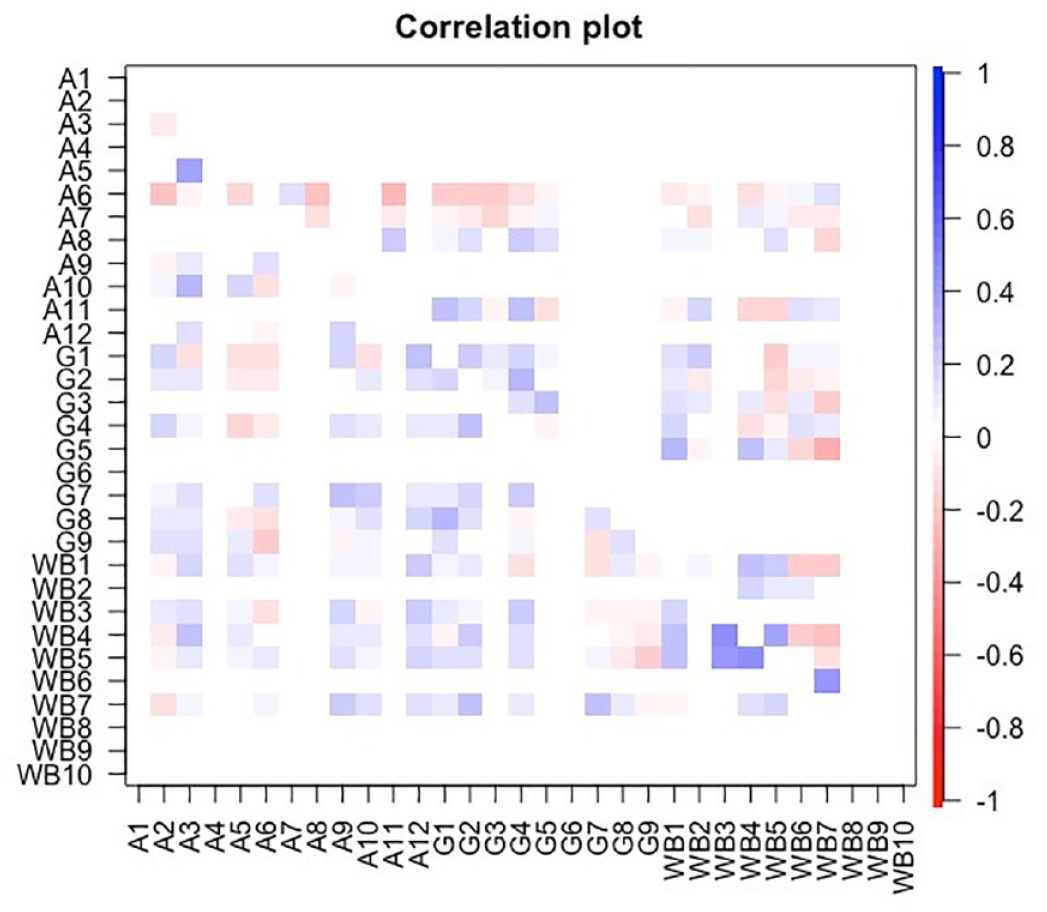
Correlation Matrix for male and female respondents.
In this correlation network (see Figure 2), the nodes are the questions about attitudes and values that are mapped. The edges represent the existence of a significant correlation. Nodes are grouped and colored by scales (red for Attitudes towards Women; green for Adversarial Sexual Beliefs, and blue for Wife Beating Beliefs). Positive correlations are shown with blue edges and negative correlations are represented by purple edges. The thickness of the edges represents the strength of the relationship between the nodes, according to the correlation matrix. Networks for this project are analyzed in two primary ways: looking at the structure of the network as a whole, for example, by comparing a network of correlations among men and women, and investigating the role of individual nodes (attitudes) within the network, for example, identifying beliefs with the greatest centrality values.

Graphs-Correlation Networks for male and female respondents.
Network metrics
For this study, we use two network-level metrics and three node-level metrics. The network-level metrics we use are density and network centralization. Density is defined as the proportion of edges present in a network divided by the number of possible edges. Network centralization represents the tendency of a network to have a more centralized structure with a few nodes prominent or a more balanced structure where all nodes have similar centrality (Freeman, 1979). Centralization is calculated by summing the difference between the centrality of the most central node and each other node and then dividing by the maximum theoretical value to normalize. Thus, a network with a value close to C = 1 is very centralized and has a few prominent nodes; a network with a centralization value close to C = 0 is a relatively balanced network with all nodes being relatively similar in importance.
Node-level metrics used in this project include strength, betweenness, and closeness. All three of these are considered centrality measures, as they indicate how central a node is within the network. For the purposes of this study, a central node is an attitude that is important due to its correlation with other nodes. The most common centrality measure is degree. Degree is simply the number of connections coming into or going out of a node. When the edges have a weight, meaning a value other than one, the metric used is strength. Strength is a weighted measure of the number of connections between a given node and other nodes in the network. Nodes with the highest strength are often interpreted as hubs. In this project, the strength is calculated by summing the weighted edges (in this case correlation coefficients) going into or out of a node. Betweenness centrality refers to the fraction of all the shortest paths that contain a given node. This metric indicates that a node is central because information flows through the node (Newman, 2015). Closeness centrality refers to the relative distance between nodes within a network. Closeness is calculated as the sum of the length of the shortest path between a given node and all other network nodes.
Results
The use of the NA provided three categories of results: (a) a description of overall characteristics and gender differences among networks’ structures and measures, (b) an analysis of each scale’s differential role among the networks, and (c) descriptions of node metrics identifying the observed values and attitudes central to the system of beliefs of gender and wife beating attitudes, each of which is discussed below.
Network Graphs
The correlation network representation of young female and male responses shows structural differences in their graphs (see Figure 2). To address the specific dissimilarities and common patterns between these systems of attitudes and beliefs, there are two approaches that were addressed: the first one, regarding the structure of the networks themselves and, the second one, concerning the differences among scales and nodes.
The first network-level measure worth examining is the density. It is visually evident that there are a greater number of edges in the women’s graph indicating that there are a greater number of relationships between both variables and scales (see Figure 2). In this study, the density indicates how interconnected, overall, the attitudes and beliefs regarding gender and wife beating are, in each network. In the case of the female respondents, the density was D = .40. For the male respondents, the measure was D = .27 (density measures range from 0 to 1), indicating that females have a more complex structure than their male counterparts.
A second structural measure of networks of interest is centralization, which expresses the compactness of a graph (also ranging from 0 to 1). A highly centralized network would be organized around a small number of nodes. In contrast to the density measure, centralization refers to the level in which the network is concentrated, upon certain central nodes (in this case values and attitudes).
As this is a weighted network (not all edges represent the same strength), centralization measures take into account the number of degrees (connections) and the weight of the connection among each of them. A centralization measure based on strength uses a ratio of the observed sum of differences in the strength of the nodes, with the maximum theoretical value for a graph with the same structure.
The female graph had a centralization of C = .22 and male’s graph measure was C = .24. To interpret the differential characteristics of these networks, we generated graph theoretic models. A total of 10,000 random graphs were created through Erdos–Renyi method, using the same number of nodes and density as the observed networks. Centralization measures were measured for all (see Figure 3). When reviewing the female respondents’ distribution, approximately 21% of the graphs had similar or higher centralization than the observed one, meaning that the observed network can be considered highly organized within a small number of nodes. For male respondents, this percentage was approximately 12% (see Figure 3), which shows that it is even more centralized than the female one.
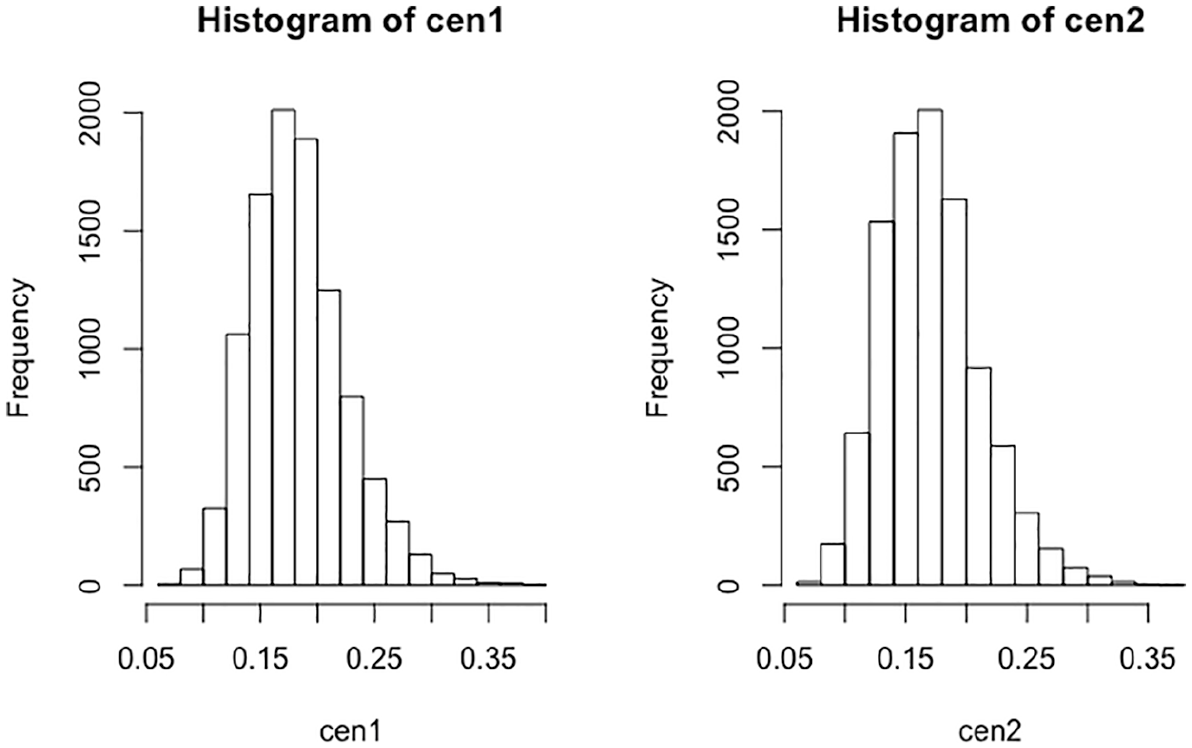
Distribution of random graphs with the same density and nodes.
Scales
The correlation networks represent a differential density on the connections between the scales and within them, by gender (see Figure 2). The Attitudes towards Women (A) scale, in particular, shows a higher connection between nodes in the females’ network when compared with the relationships in the males’ network. This would indicate a greater complexity of the structure of women’s system of beliefs and, more specifically, women’s role in society. In the case of the male respondents’ network, the A scale variables related to the division of housework and the equality of women in terms of intelligence appear more central (A6 and A11). In the female network, most of the nodes present a significant correlation with the other variables measured.
The Adversarial Sexual Beliefs (G) scale displays the most dissimilar composition between both networks. It appears to show a higher number of significant correlations in the case of the male respondents’ network than in the female network. The nodes related to the interest of men in physical relationships and how they can keep women happy (G3 and G5) appear disconnected in the female network. When examining the same results for the males, they have strong edges with other scales. In the case of nodes related to women’s roles, attitudes and perceptions of authority in relation to men in an intimate relationship (G7, G8, and G9), these nodes appear disconnected for men, whereas they indicate significant importance and strength in the female networks.
The nodes that are part of the Wife Beating Scale appear to have a similar connectivity in both male and female networks: The WB4, WB5, and WB7 nodes are highly central and connected within them and to other scales. These are beliefs related to the legal, social, and individual-level responses to victimization and the legal consequences of the perpetrator. Of particular interest is the variable stating “the best way to deal with men who beat a woman is to arrest them” (WB7). It had mainly negative connections among the males’ network, yet positive correlations in the female respondents. In contrast, the nodes related to the responsibility of the abuser, the importance of calling the police, and the reaction of the victim of leaving the house or not in a case of victimization (WB8, WB9, and WB10) showed no connection in either network.
Node Metrics: Strength, Betweenness, and Closeness
It is clear that the female network has a higher number of nodes strongly connected to a higher number of neighboring nodes than is found in the male respondents’ network (see Figure 2). In this case, the mean strength for the female network is 1.04 and that for the male network is 0.79. The nodes with the most centrality in terms of strength for the female network are WB5 (Divorcing a husband who beats a woman), WB4 (Women should be protected by law if a husband beats her), WB3 (Voluntary organizations should do more to address GBV), G1 (A man should show a woman who is in charge), and A3 (Fathers should have more authority in decisions than mothers); this is illustrated in Figure 4. In the case of the male respondents, the nodes with the greatest strength were WB7 (The best way to deal with perpetrators is arresting them), WB4 (Women should be protected by law if a husband beats her), WB1 (If I see a woman being beaten, it would be best to do nothing), A6 (Husbands should help with housework), and A11 (Women are as smart as men).

Centrality Measures for Respondents.
The measure of betweenness (see Figure 4) indicated that, for both female and male networks, the question “Women should be protected by law if the man they are dating/fiancé/husband beat them” (WB4; see Figure 4) had the higher value. In this case, variables WB4 had a larger number of shorter paths, indicating its intermediary role in the network. Thus, it could influence other variables without being directly connected to them. A high betweenness value acts as a “gatekeeper” in the network. It is relevant that both networks show the same central node in this measure, because they could allow interventions that allow effective modifications on beliefs in both genders.
In terms of closeness centrality, in the male respondents’ network, the node WB4 was the most central. In the female network, WB3, WB4, and WB5 were the most closely central. However, it is important to note that this does not refer to the number of nodes directly connected to the one measured, but to the paths that connect it to others. As such, both measures of higher closeness were part of the Wife Beating Scale. This means that attitudes and values about wife beating directly impact other nodes in this system of beliefs; however, they may not have the strength to reach the largest number of nodes.
Discussion
The findings support the assertion that young adult men and women have different networks of GBV attitudes and gender role beliefs, which could be vital to consider when designing interventions oriented to the prevention of gender inequality and GBV. Specifically, there are clear structural differences among the systems of beliefs on domestic violence and attitudes toward women among these young adults. Descriptive NA shows that the values around husband-to-wife violence are crucial when thinking about both domestic violence and gender roles in this context.
The Wife Beating Scale appeared to contain the most central nodes in terms of all centrality measures, in both the female and male networks. Specifically, the question “Women should be protected by law if the man they are dating/fiancé/husband beat them” (WB4; see Figure 4) emerged as important in both networks by showing a consistent centrality among all measures. This means that an intervention on belief regarding the legal systems’ role in domestic violence would have the possibility of both rapidly and widely affecting most the values and attitudes among young adults in India. An example of this would be the implementation of legislation criminalizing female subordination and discrimination (e.g., dowry, child marriage, restricted property rights); prior research has shown that this type of policy level directly affects rates of various forms of GBV in regions where it is enforced (Banerjee, 2014; Dixon & Graham-Kevan, 2011).
However, it is important to note that most of the edges for female respondents were positive correlations, whereas, in the case of males, they were mostly negative. This highlights a critical point for that each specific value or attitude must be addressed differently according to individuals’ gender. Specifically, these women’s support of laws protecting victims reinforces what has already been noted in prior research has empowering and motivation for many Indian women to speak out against GBV (Ghosh, 2011; Inman & Rao, 2018; Krishnan et al., 2012). However, most men in this study rejected the notion that legal systems should support domestic violence victims; this might reflect the ways in which these behaviors serve to reinforce male power and privilege. An International Center for Research on Women (ICRW; 2001) study found that a primary reason Indian men gave for enacting violent behaviors against their wives was to establish and reinforce their power (ICRW, 2001). Thus, if men were to face legal or social system–level consequences for domestic violence perpetration, they could potentially lose a powerful method of control and, in turn, the tool for maintaining privileges over women. These gender differences in values and attitudes reinforce the importance of designing culturally relevant interventions, which differ according to the target group if it is going to be effective for all.
The results also show that the overall female systems of beliefs are more complex than those of their male counterparts; several nodes were connected in contrast to the few significant connections in the men’s model. This is because women’s perceptions of violence and its potential consequences extend beyond just risk of physical victimization. For example, fears of retaliation for fighting back, lack of alternative means of economic support, concern for their children, and lack of support from family and friends have all been reported reasons why would women not challenge their husbands if they were abusive (Banerjee, 2014; Ghosh, 2011; Inman & Rao, 2018; Koenig et al., 2006; Krishnan et al., 2010; Rocca et al., 2008). Furthermore, factors such as religious beliefs, education levels, SES, and caste all serve as markers for potential victimization and cues for responding to domestic violence (Chandrasekaran et al., 2007; Jeyaseelan et al., 2007; Kalra & Bhugra, 2013). Thus, researchers have noted that it is important to consider that women face multilayered consequential risks that inform how they view domestic violence (Flood & Pease, 2009; Ghosh, 2011; Inman & Rao, 2018; Jewkes, 2002; Jeyaseelan et al., 2007; Krishnan et al., 2012; Rocca et al., 2008). This result is illustrative of these realities and highlights key areas to address. Future research must identify the differential degrees of connectivity among these points, to accurately target the values and attitudes that would be most effective for intervention.
Alternatively, mainly gender equity values, masculine role in relationships, and legal/social consequences of wife beating emerged as the most important variables to focus on when addressing men’s beliefs of domestic violence. This is consistent with previous research in the Indian context, which has found that attitudes about gender equality and roles significantly influenced men’s perceptions of legal responses to various forms of GBV. This means that, as in the case of women, a multipronged approach must be used; focusing on one approach to shift men’s perceptions of domestic violence will not be successful. For example, legal policies and legislation seeking to end dowry-related violence have not been successful as this form of GBV is on the rise in India. Women continue to be killed in “accidental” kitchen fires, or brutalized by spouses or their extended family at alarming rates; often, many cases go unreported as the laws are difficult to implement due to more powerful gender values (Banerjee, 2014; Rastogi & Paul, 2006). The underlying beliefs that men have ownership over their wives and can easily avoid punishment for abusing them reinforce the acceptability of this practice (Banerjee, 2014; Rastogi & Paul, 2006). Clearly, interventions simply focusing on men’s attitudes toward domestic violence will not address the underlying contributing factors. So future studies must integrate approaches that consider the degree to which a man believes a woman is equal, embraces traditional gender roles, and perceives the judicial systems’ consequences for wife beating are appropriate, as these are central for predicting his willingness to endorse domestic violence.
Limitations
Although this study provides important foundational information, there are methodological limitations that must be considered. For example, as this was a convenience sample of university students and workers in technical settings, we are unable to make broad generalizations with the results; the findings are specific to the Indian young adults in this study who resided in this region of the country and are highly educated. Also, the use of the NA application means that the results were dependent on the subscales selected for use in the study. It would be useful to replicate this study using additional gender and relationship value scales to gather supplementary information about these systems of beliefs.
It is also important to acknowledge that the sample had some unique characteristics. For example, the majority of the subjects had some level of high education given the recruitment area and approach. This is an important consideration given research showing an association between education and attitudes toward wife beating in India such that individuals with higher education are expected to hold less supportive beliefs toward wife beating (Rani & Bonu, 2009). Similarly, participants’ relationship status at the time of the data collection must also be considered when understanding their gender role and GBV beliefs as they are related to wife beating. As is common among higher educated young adults in India at this stage in the lifespan, only 5.6% of the participants were formally married or engaged at the time of data collection. As such, the perceptions they shared were primarily based upon experiences as single individuals and perceptions of domestic violence. Future work should explore particularly the stability of domestic violence and other forms of GBV beliefs before and after marriage (Sabri et al., 2015). This is particularly important given prior research showing that as the number of years married increases, sexual assault was found to increase among Indian women (Kundapur et al., 2019).
Research, Clinical, and Policy Implications
The study results can contribute to research, governmental, and health care provider efforts to address GBV within this population. Specifically, as domestic violence victimization leads to both short- and long-term health implications, this study provides insights into the need to focus on the gender differences in perceptions when attempting to address domestic violence (Stephens et al., 2012). Furthermore, the results point to key points for intervention that differ between men and women.
A first step would be to provide knowledge about gender role beliefs and expectations’ influence on GBV to those in a position to address this at both the individual and community levels. Health care workers (e.g., physicians, nurses, accredited social health activists [ASHAs]) have been identified as key figures for doing this as their position gives them the authority to ask about private sphere experiences, whereas their knowledge of the community and familial values ensures that they understand the cultural nuances around GBV (Hossain & Khan, 2016; Jejeebhoy et al., 2014; Kashyap, 2018; Patra et al., 2018). For example, a study by the ICRW found that increasing community leaders’ understandings of the relationship between patriarchy and violence increases their ability to address GBV in ways that do not violate cultural norms (Kashyap, 2018). Similarly, studies have noted that Indian women are more empowered to help themselves if they have a healthy trusting relationship with a doctor who has awareness about factors that contribute to and the consequences of GBV (Hossain & Khan, 2016; Jejeebhoy et al., 2014; Patra et al., 2018). This knowledge should be followed with the provision of culturally appropriate safety behavior resources and protocols that those able and/or required to report GBV incidents can implement (Jejeebhoy et al., 2014; Patra et al., 2018).
These findings also point to a need for diverse research tools and designs to accurately capture the scope of GBV outcomes among young adults in contexts that have diverse cultural value and belief systems. The interpretation and usefulness of multidimensional approaches to examining domestic violence outcomes will be strengthened by testing, in advance, hypothesized relationships with different groups of women and men in India (Stephens et al., 2012). This development of appropriate and reliable research approaches is critical for the implementation and evaluation of GBV intervention strategies that target this population.
Finally, policymakers can utilize these findings to develop policies and prioritize funding that addresses the underlying reasons for disparities in GBV outcomes. This study’s use of NA to identify the relationships between belief systems provides a comprehensive overview of the relationship between cultural norms and behavioral expectations within a specific population. This can improve policymakers’ ability to focus on key points for intervention, funding, and development of GBV-related guidelines that will be both efficient and effective for addressing GBV in India.
Conclusion
This study provides new important knowledge regarding the intersecting relationship between gender role beliefs and domestic violence among Indian young adults. To date, no studies have explored the relationship between these two belief systems using NA. Thus, these results provided us with knowledge about a unique population’s expectations about gender roles’ relevance to understandings of and responses to domestic violence perpetration and victimization. Furthermore, the results of this study provided researchers with information relevant for designing and testing attitudes toward wife beating and gender measures for use with this and populations with similar cultural values. Overall, these findings enhance our understandings of the differing values that both men and women give to these two influences, providing targeted points for general GBV and specific domestic violence interventions within this population. Given that GBV directly affects individuals’ health outcomes, the knowledge provided by this study contributes to efforts focused on improving the lives of women and men in India.
Footnotes
Acknowledgements
The authors would like to thank the research staff at the Public Health Research Institute of India (PHRII) in Mysore, including Ms. Poornima Jay and Ms. Savitha Gowda. Also, thanks to Dr. Shanthi Gopal for her assistance.
Author’s Note
Purnima Madhivanan is now affiliated with University of Arizon, Tuscon, USA.
Declaration of Conflicting Interests
The author(s) declared no potential conflicts of interest with respect to the research, authorship, and/or publication of this article.
Funding
The author(s) disclosed receipt of the following financial support for the research, authorship, and/or publication of this article: Funding for this study was provided by the Fogarty International Center and National Heart Lung and Blood Institute, and National Institute of Neurological Disorders and Stroke and of the National Institutes of Health under Award Number D43 TW010540. The content is solely the responsibility of the authors and does not necessarily represent the official views of the National Institutes of Health.
