



Abstract
Digital dating abuse is a term used to describe physical, sexual, or psychological/emotional violence that occurs between romantic partners through the use of texting, social media, and related online mediums. Survey data were obtained from a nationally representative sample of 2,218 American middle and high school students (12–17 years old) who have been in a romantic relationship. About 28% of students in a relationship in the previous year had been the victim of digital dating abuse. Males were more likely to report having experienced it (32% compared to 24%), though no other demographic differences emerged. Several covariates did emerge as significantly related to experience with digital dating abuse, including depressive symptoms, sexual intercourse, sexting, and being the victim of cyberbullying. Experiencing offline dating abuse was by far the strongest correlate. Implications for prevention and policy within schools and the community are discussed, along with considerations for future research in this important area.
Keywords
Much of adolescent development now takes place online, allowing youth to create, explore, produce, and define their identities and relationships through texting, social media interaction, multiplayer gaming, and related forms of connectivity. Most youth seem to use online technology in positive ways (Ahola Kohut et al., 2018; Bers, 2010; Blank & Lutz, 2018; Lytle et al., 2018; Metzger et al., 2018), but numerous recent studies have empirically identified problem behaviors that have arisen (Werner et al., 2010), including cyberbullying (Hinduja & Patchin, 2015; Kowalski et al., 2014), sexting (Hinduja & Patchin, 2012; Rice et al., 2012; Temple et al., 2012), catfishing (D’Costa, 2014), revenge porn (Citron & Franks, 2014; Englander & McCoy, 2017), and sextortion (Patchin & Hinduja, 2020; Wolak et al., 2018).
Another novel behavioral problem at the intersection of adolescence and technology which manifests itself within the context of a romantic relationship has been termed “digital dating abuse” (also referred to as “electronic dating violence”). Defined as “a pattern of behaviors that control, pressure, or threaten a dating partner using a cell phone or the Internet” (Reed et al., 2016, p. 1), digital dating abuse is the 21st century evolution of teen dating violence, which has been an issue of concern for decades (Lavoie et al., 2000; Levy, 1991; O’Keeffe et al., 1986; Spencer & Bryant, 2000). The Centers for Disease Control and Prevention (CDC, 2017) succinctly conceptualize teen dating violence as physical, sexual, or psychological/emotional violence that occurs within a dating relationship. Digital dating abuse can be considered a type of cyberbullying, defined as “willful and repeated harm inflicted through computers, cell phones, and other electronic devices” (Hinduja & Patchin, 2015, p. 11) and potentially can involve behaviors classified as cyberstalking, which uses technology to repetitively harass another person with the intent to control, coerce, intimidate, annoy, or threaten them (Spitzberg & Hoobler, 2002).
With regard to its frequency among youth, findings from the CDC’s national Youth Risk Behavior Survey in 2017 (the latest year available) identified that 8% of high schoolers experienced a physical form of dating abuse while 7% experienced a sexual form of dating abuse (CDC, 2018). Nevertheless, a recent meta-analysis on prevalence rates of teen dating violence suggests that the CDC percentages may be conservative. Wincentak et al. (2017) examined 96 studies of physical dating violence involving youth aged 13 to 18 and found an overall victimization rate of 20% (with a variability range of 1%–61%). They also examined 31 studies of sexual dating violence and identified an overall victimization rate of 9% (with a variability range of <1% to 64%).
There are multiple ways in which teens can exploit online communications to cause harm to a romantic partner (Dank et al., 2014; Korchmaros et al., 2013; Van Ouytsel et al., 2016). Teens may be excessively mean-spirited and hurtful to their significant other when interacting with them online for the same reasons that those who cyberbully or troll others do (Hinduja & Patchin, 2009; Leisring & Giumetti, 2014; Melander, 2010). In addition, privacy violations can occur as youth incessantly check up on, keep track of, and even stalk their partners via their device(s) (Baker & Carreño, 2016; Draucker & Martsolf, 2010; Lucero et al., 2014; Randell et al., 2016). Teens can also hack into or otherwise obtain unauthorized access into their partner’s personal social media or email accounts (Borrajo et al., 2015). Relatedly, some aggressors have improperly obtained and used private pictures or videos to blackmail, extort, or otherwise manipulate their romantic partner into saying or doing something against their will (Patchin & Hinduja, 2020; Wittes et al., 2016; Wolak et al., 2018).
Given that participation in romantic relationships increases when moving through adolescence into young adulthood (Carlson & Rose, 2012; Connolly et al., 2004; Lefkowitz & Gillen, 2006; Manning et al., 2006) and that in recent years, partners are constantly in touch with each other via their devices (Draucker & Martsolf, 2010; Subrahmanyam & Greenfield, 2008; Toscano, 2007), more opportunities for digital dating abuse can arise (Breiding et al., 2014; Hickman et al., 2004; Ybarra et al., 2016). A handful of studies in the United States over the last decade illuminate the prevalence of this phenomenon among youth. One benchmark study of 3,745 7th to 12th graders across three states in a current or recent dating relationship found that 26.3% had experienced some type of “cyber dating abuse victimization” in the prior year, while 11.8% reported perpetration (Zweig, Dank, Yahner, & Lachman, 2013). This can be compared to an examination of over 4,200 9th graders from 11 states, where 56% revealed they were victimized and 29% were aggressors (Cutbush et al., 2010), a smaller study of high schoolers from Texas, where 22.3% had experienced victimization and 17.7% were perpetrators over the last year (Temple et al., 2016), and a study of almost 800 7th graders from four schools, where 51% reported this type of victimization while 32% revealed they had perpetrated the behavior (Cutbush et al., 2018). To be sure, these numbers vary significantly. A recent critical review of digital dating abuse studies discovered a youth victimization incidence range from 6% to 91% (Brown & Hegarty, 2018, p. 47) due to significant “variability in terminology use, construct definitions, the specific behaviors elicited, and other issues related to instrument design.”
In terms of gender differences, a number of studies have identified that girls experience digital dating abuse more so than boys (Dick et al., 2014; Felmlee & Faris, 2016; Yahner et al., 2015; Zweig, Dank, Lachman, & Yahner, 2013; Zweig et al., 2014), although others have found mixed differences (Wright, 2015) or even the opposite (Cutbush et al., 2018). With regard to offending, some studies have found that girls are more likely to be aggressors (Cutbush et al., 2010), while others have found no difference (Peskin et al., 2017) or have found that it depends on the type of digital dating abuse perpetrated (with boys engaging in more threatening, pressuring, and sexual forms, and girls using more monitoring and possessive forms) (Reed et al., 2016, 2017; Zweig, Dank, Yahner, & Lachman, 2013).
Research has linked digital dating abuse to a number of emotional and psychological struggles including depressive symptomatology, anxiety, anger (Reed et al., 2015, 2016; Zweig, Dank, Yahner, & Lachman, 2013), and suicidality (Van Ouytsel et al., 2017). It also seems to occur in a constellation of other social and relational problem behaviors including teen dating violence (Bennett & Guran, 2011; Temple et al., 2016; Yahner et al., 2015), stalking (Cutbush et al., 2010), bullying and cyberbullying (Van Ouytsel et al., 2017; Yahner et al., 2015), risky sexual activity (Dick et al., 2014; Van Ouytsel et al., 2016), and sexual assault (Bonomi & Kelleher, 2007; Olshen et al., 2007). Finally, digital dating abuse has been associated with other online risk behaviors (Van Ouytsel et al., 2016), general forms of delinquency (Zweig et al., 2014), and certain adverse childhood experiences (Smith-Darden et al., 2017). All of this highlights the significant impact of this form of victimization on the lives and trajectories of adolescents today.
Additionally, research on traditional teen dating violence has identified an overlap where students report experience with both victimization and perpetration (Jennings et al., 2011; Langhinrichsen-Rohling, 2010; Straus, 2011); a finding duplicated in other digital dating abuse research (Duerksen & Woodin, 2019; Reed et al., 2016; Stonard, 2018; Zweig, Dank, Yahner, & Lachman, 2013). More research is necessary to corroborate this and to determine the direction of causality, but it potentially mirrors what has been found in the cyberbullying literature with targets and aggressors often being one and the same (Kowalski & Limber, 2007; Mishna et al., 2012).
The current work seeks to clarify the extent to which youth are experiencing digital forms of dating abuse, as well as to identify salient correlates related to those experiences. No previous study to our knowledge has examined these behaviors with a large, nationally representative sample of students in the United States. As such, we hope to share findings that are more generalizable to youth across the nation so that educators, counselors, and health professionals are equipped to prioritize the most relevant covariates in their prevention and response efforts.
Methods
Data
Data for this study came from a questionnaire administered to a national sample of English-speaking 12- to 17-year-old middle and high school students residing in the United States. Distributed via email in the fall of 2016, it examined the perceptions of, and experiences with, bullying, cyberbullying, and related adolescent behaviors, including teen dating violence. The utilization of electronic surveys has become a popular, cost-effective method for obtaining large diverse samples (Lenhart et al., 2015; Schauer et al., 2016; Strickland & Stoops, 2019; Ybarra & Mitchell, 2014). Active parental consent and child assent was obtained for all participants. Nested age, sex, and region quotas were used to ensure a diverse sample of respondents that was representative of students across America. The total sample size was 5,539, and the participation rate for this survey was approximately 15%. The project methodology was approved by the institutional review board of a university of one of the authors.
Measures
Dating abuse
Two measures of dating abuse were utilized in this study. Digital dating abuse represents responses to five questions assessing experience with abusive behaviors carried out via technology during the last year (Table 1). For example, 21.5% of respondents said their significant other had looked through the contents of their phone, tablet, or other device without permission, while 8.7% said their romantic partner posted online, or shared with others, a private picture of them without permission. Responses to these questions in the original survey were “never,” “once,” “a few times,” or “many times” but were re-coded and combined to represent those who had experienced any of the behaviors or not (Cronbach’s alpha = .854).
Experience With Digital Dating Abuse (In the Last Year) (n = 2,218).
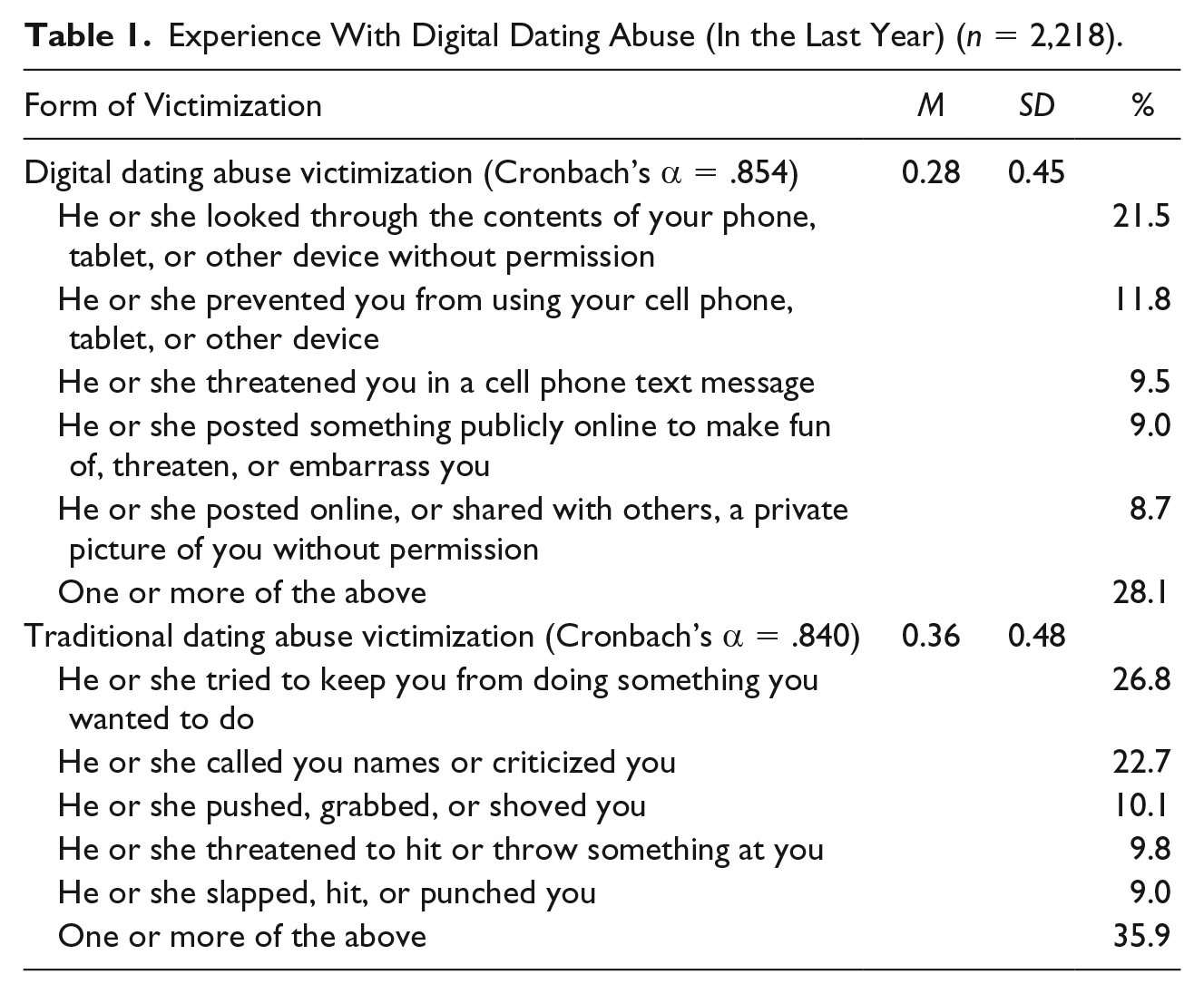
Similarly, traditional dating abuse also represented five questions assessing experience with abusive offline behaviors during the last year. For example, 26.8% of respondents said their partner tried to keep them from doing something they wanted to do, while 9% had been slapped, hit, or punched. The response choices were the same for traditional dating abuse and were also combined and dichotomized for the purpose of analysis (Cronbach’s α = .840).
Covariates
We included several demographic variables, such as age, gender, sexual orientation, and race in our analyses to control for their potential influence (Table 2). Age was included as a continuous variable representing the respondent’s age in years (range 12–17; M = 14.9). Gender represents the student’s self-reported gender identity (male, female, transgender [male living as female], and transgender [female living as male]). Due to small numbers (n=20), transgender students were removed from the analysis and the resulting gender variable was dichotomous (1 = male and 0 = female), resulting in a sample evenly divided across gender (49.9% female, 49.7% male). Sexual orientation was determined by asking participants to self-report their sexual orientation. The clear majority of the sample said that they were heterosexual (92.8%), while 0.7% said they were lesbian, 0.5% said they were gay, 2.8% said they were bisexual, 2.3% said they were questioning, and the remaining 0.9% selected “other” as a response choice. These responses were dichotomized where 1 = heterosexual and 2 = nonheterosexual. Race was a categorical variable where 1 = White, 2 = African American, 3 = Hispanic, and 4 = Other. Comparable to the population of middle and high school students in the United States (Office of Adolescent Health, 2016), 69% of the sample was White/Caucasian, 11% was Black/African American, 11% was Hispanic/Latin American, and 9% was another race.
Relationship Between Traditional and Digital Forms of Dating Abuse.
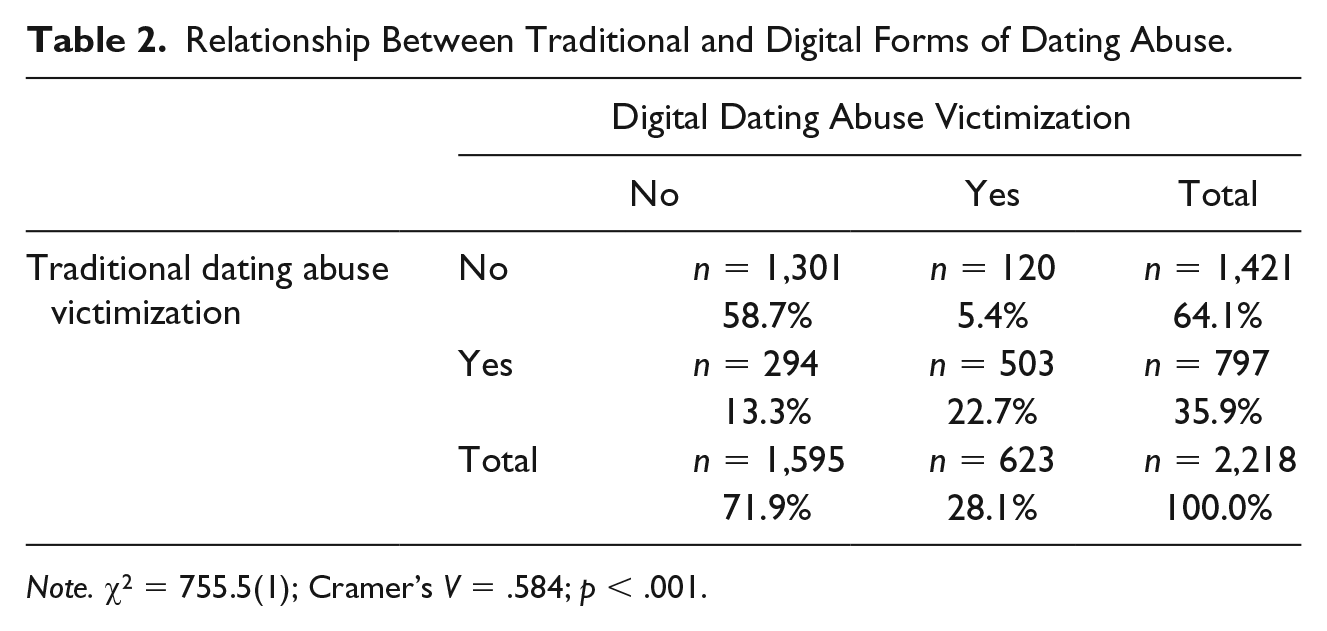
Note. χ2 = 755.5(1); Cramer’s V = .584; p < .001.
Next, we explored a series of other variables that could be related to experience with digital abuse. Depressive symptoms was a dichotomous single-item variable where students who responded yes to the following question were coded as 1: “In the past year, did you feel so sad or hopeless almost every day for two weeks or more in a row that you stopped doing some of your usual activities?” Those who responded no were coded as 0. Perhaps digital dating abuse leads to depressive symptoms or those who are exhibiting depressive behaviors make better targets of digital abuse, given the relationship between (offline) teen dating violence and depression (Banyard & Cross, 2008; Exner-Cortens et al., 2013; Holt & Espelage, 2005). Had sexual intercourse was a dichotomous single-item variable where students who reported that they had had sex in the previous year were coded 1 (if not, they were coded 0). Having sex with someone establishes a connection with them that could be subject to manipulation or abuse (Demissie et al., 2018; Hird & Jackson, 2001; Jackson et al., 2000). Sent a sext was a two-item measure which asked respondents to report if they had ever sent (a) a boyfriend or girlfriend, or (b) someone who was not a current boyfriend or girlfriend a sext. Respondents were informed that “Sexting is when someone takes a naked or semi-naked (explicit) picture or video of themselves, usually using their phone, and sends it to someone else. The image or video is called a ‘sext’.” Students who reported that they had ever sent a sext to anyone were coded 1, while the others were coded 0. Here again, if a student sends a sext to another person, the recipient could have control over the sender, since the sender might fear that the images be distributed to others or that authorities might be told (Choi et al., 2016; Henry & Powell, 2018; Stanley et al., 2018). Finally, victim of cyberbullying represented students who had been cyberbullied more than once in their lifetime. Cyberbullying was defined as “when someone repeatedly threatens, harasses, mistreats, or makes fun of another person (on purpose to hurt them) online or while using cell phones or other electronic devices.” Those who had been cyberbullied were coded 1, while the others were coded 0. As dating violence sometimes has been conceptualized as a form of bullying (Corvo & deLara, 2010; Linder et al., 2002), digital dating abuse may be considered another form of cyberbullying.
Analysis
Among the 5,539 total respondents of our national sample, 40% reported that they had been in a romantic relationship at some point in the previous year. As we are interested in experiences with digital dating abuse within the last 12 months, we excluded the 60% who had not been in a relationship during that time, leaving us with a final sample size of 2,218. As a result, the sample includes more older students (those who are more likely to have been in a relationship).
We began by calculating prevalence rates for experience with digital dating abuse, for the total sample, and then different demographic groups. We utilized t-tests to determine if there were any statistically significant differences across gender, sexual orientation, race, and age with respect to experience with digital dating abuse (reference groups noted in the table). Next, a 2 × 2 cross-tabulation table was utilized to assess the relationship between digital dating abuse and traditional dating abuse (using chi-square and Cramer’s V). We then computed a series of logistic regression models, testing the unique influence of each of the covariates of interest while controlling for age, gender, sexual orientation, and race. Quantitative statistical analyses were performed using SPSS 18, and p value < .05 was considered statistically significant (two-tailed).
Results
As displayed in Table 1, 28.1% of teens who had been in a romantic relationship at some point in the previous year said they had been the victim of at least one form of digital dating abuse. In addition, 35.9% had been the victim at least one form of traditional (offline) dating abuse. Table 2 depicts a significant connection between digital and traditional forms of dating abuse: the vast majority of students who had been abused online had also been abused offline. Specifically, 81% of the students who had been the target of digital dating abuse had also been the target of traditional dating abuse (503 of 623). Similarly, most of the students who had been the victim of offline dating violence also had been the victim of online dating violence, though the percentage (63%) was lower (503 out of 797).
Next, we examined the demographic factors related to experience with digital dating abuse. Males were significantly more likely to have experienced digital dating abuse (32.3%) compared to females (23.6%) (see Table 3). No other differences emerged with respect to demographic characteristics (sexual orientation, race, and age).
Experience With Digital Dating Violence by Gender, Sexual Orientation, Race, and Age.
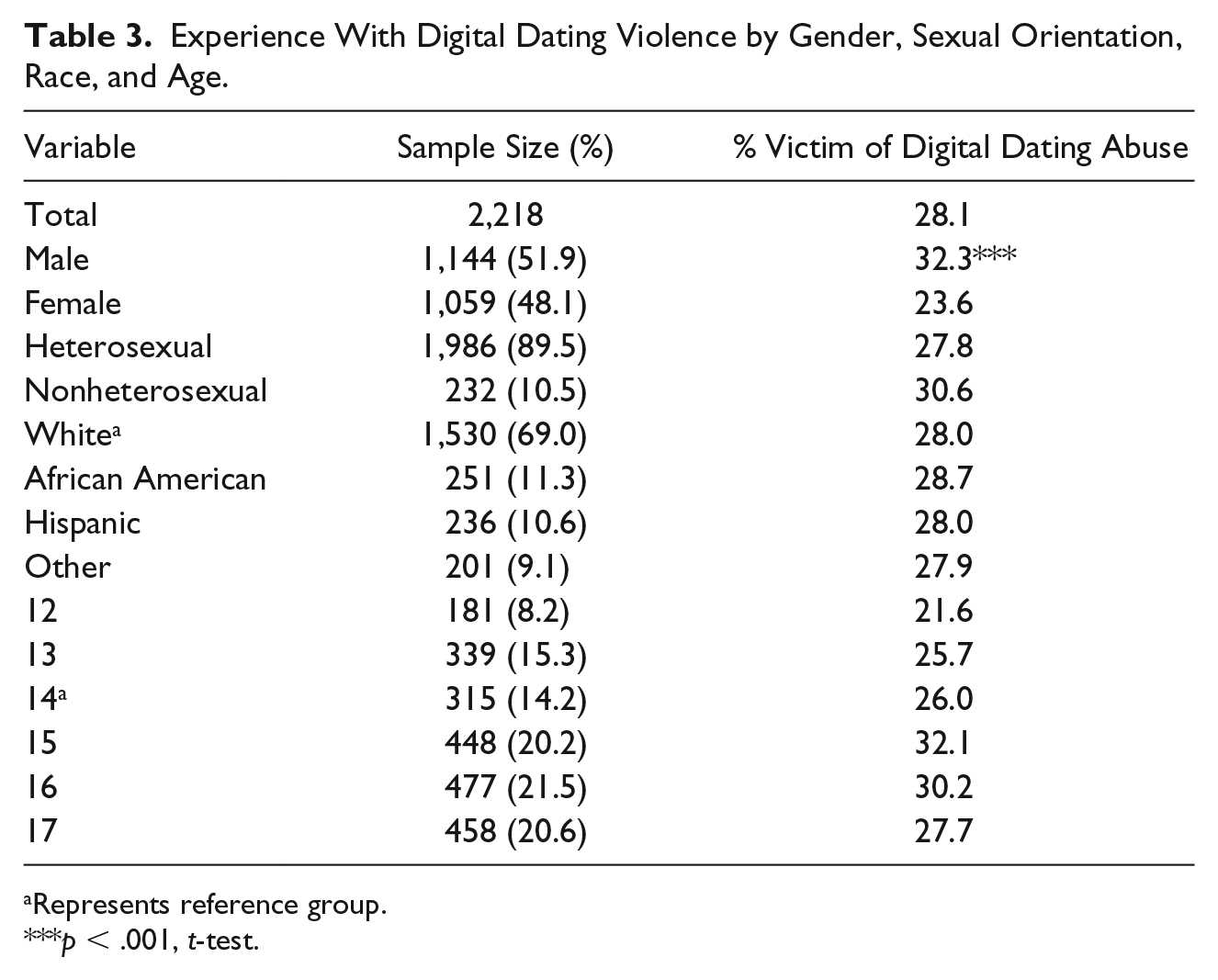
Represents reference group.
p < .001, t-test.
Finally, we explored the relationship between several covariates and experience with digital dating abuse. As a reminder, each of the covariates was entered into separate models while controlling for demographic controls (age, gender, sexual orientation, and race). For comparison purposes, we first estimated a base model to calculate the amount of variance explained by only the demographic controls. Given that gender was the only factor significantly related to digital dating abuse, it is not surprising that the amount of variance explained by the control variables was less than 2%. Moreover, as expected, experience with traditional (offline) dating abuse was strongly associated with experience with digital dating abuse. Specifically, students who had been victimized offline were approximately 18 times more likely to have also experienced online abuse compared to those who were not victimized offline. In fact, this one measure explained close to half of the variance in experience with digital dating abuse (R2 =.42) (see Table 4).
Logistic Regression Examining Correlates of Digital Dating Abuse.

Note. CI = confidence interval.
All analyses include individual indicator (bivariate) while controlling for age, gender, sexual orientation, and race.
p < .001.
All of the other covariates explored were also significantly related to digital dating abuse. Students who reported depressive symptoms were about four times as likely to have experienced digital dating abuse. In addition, students who said they had engaged in sex (Exp[B] = 2.53) or who had sent a sext (Exp[B] = 4.81) were significantly more likely to have been targeted for digital dating abuse. Finally, those who had been the target of cyberbullying were also likely to have been the target of digital dating abuse (Exp[B] = 3.33).
Discussion
Digital dating abuse is a pattern of technology-facilitated, controlling behaviors, exhibited by one person toward another within a current or former romantic relationship. Research on this phenomenon is still incipient, and this study adds some details to the nascent knowledgebase based on a large, nationally representative sample of youth. It is clear that a nonnegligible number of middle and high school students have experienced digital dating abuse; specifically, about one-third of boys and about one-quarter of girls have been victimized.
Within the context of a gendered and heteronormative developmental perspective of teen dating violence, and understanding that boys and girls have grown up learning certain problem-solving tactics in their sex-segregated friendships (Rose & Rudolph, 2006), it has been argued that youth of a certain sex may use behaviors more typical of the opposite sex when dealing with conflict in relationships (Wincentak et al., 2017). Specifically, girls may use more violence on their boyfriends to try to solve their relational problems, while boys may try to constrain their aggressive impulses when trying to negotiate discord with their girlfriends (McIsaac et al., 2008; Shute & Charlton, 2006). In an effort to better understand this, we examined the individual indicators used in our composite measure of digital dating abuse victimization, hypothesizing that one specific form might be unduly influencing the overall results. Boys were significantly more likely to experience all types of digital dating abuse—including physical aggression (aligning with previous teen dating violence research uncovering the acceptability of girls to hit their boyfriends; Simon et al., 2010).
Moreover, we found significant overlap between digital dating abuse and its traditional counterpart (paralleling findings from other studies involving local convenience samples of students; Duerksen & Woodin, 2019; Stonard, 2018). It is impossible in these cross-sectional studies to determine which came first, but the correlation is consistent with what has been observed in other forms of online and offline harm (e.g., bullying; Hinduja & Patchin, 2015; Kowalski et al., 2012; Waasdorp & Bradshaw, 2015) and self-harm (Patchin & Hinduja, 2017). Indeed, the correlation was so substantial that we examined their connection using exploratory factor analysis (principal component) and found that all 10 variables from Table 1 loaded into a single factor (Eigenvalue = 6.26; minimum individual component = 0.704). Considering the two forms of dating abuse (traditional and digital) as distinct entities actually may be inappropriate, but further research is necessary to know with more certainty.
Finally, we uncovered a number of risk factors significantly associated with digital dating abuse. Those who reported that they had sexual intercourse were 2.5 times as likely to have experienced digital dating abuse. Perhaps dating abuse is more likely when a relationship progresses to the point where the couple has engaged in sex, or if intercourse occurs early in the relationship it creates an unhealthy power dynamic where one can take advantage of the other due to fear or embarrassment of that information being disclosed (Choi et al., 2016; Demissie et al., 2018; Hird & Jackson, 2001; Jackson et al., 2000). Most notably, those students who had sent a sext to another person were nearly five times as likely to be the target of digital dating abuse as compared to those who had not sent a sext. It may be that sending explicit images to others opens one up for extortion, manipulation, or coercion (e.g., sextortion; Patchin & Hinduja, 2020). Threats of distribution to a third party might force a partner to endure abuse or to resist reporting such abuse to the authorities (for fear of being prosecuted themselves for violating child pornography laws; Crofts et al., 2015; Mabrey & Perozzi, 2010; Nelson, 2018; Podlas, 2011).
Results from this study came from a national sample of 12- to 17-year-old students, and while many efforts were taken to ensure the sample was diverse and representative (e.g., sampling quotas by sex, age, race, and region of the country), it is impossible to know whether results here are truly generalizable. This is particularly true given the online nature of the sampling frame and the relatively low response rate. While lower than other methods of data collection and not ideal (Baruch & Holtom, 2008; Kaplowitz et al., 2004), it is still satisfactory for a preliminary inquiry to an understudied problem (Fricker & Schonlau, 2002; Manfreda et al., 2008). We mentioned earlier that prevalence rates of digital dating abuse across the literature base vary widely because of sampling and measurement differences. As a nascent but increasingly important topic of empirical scrutiny, a crucial step for future inquiry should be the development of a universal definition and measurement tool that can produce standardized observations (we offer our own as an option).
It should be mentioned that this study was unable to ascertain the temporal ordering of key variables in a way that would have allowed predictions to be made regarding causality. While it is plausible that having sex with someone—or sending that person a sexually explicit image—lends itself to a power dynamic conducive to abuse, it is also possible that one could utilize abusive tactics to wear a person down enough to comply with a request for sex or explicit images. Similarly, exhibiting depressive symptoms might make a person a good target for abuse, while also being also its consequence. In short, a longitudinal exploration of these relationships is certainly warranted.
Finally, the standard caveats concerning self-report surveys must also be offered here (Brenner & DeLamater, 2014; Hindelang et al., 1981; Phillips & Clancy, 1972). We inquire about sensitive and deviant behaviors and therefore need to be mindful about potential underreporting. We attempted to minimize this by using an anonymous reporting mechanism and reminding respondents that their responses would be kept confidential to the maximum extent allowable by law. It is also true that retrospective surveys that inquire about past behavior could be inaccurate due to historical mistakes (Jenkins et al., 2002). We asked about experiences within the last year in an effort to account for this problem.
It is clear that digital dating abuse affects a meaningful proportion of teenagers. As this problem continues to be studied, we hope to learn much more about context, contributing factors, and consequences. Research is slowly uncovering a number of individual- and familial-level factors that are correlated with being either an abuser or victim of digital dating abuse; focusing on these can help inform general programmatic strategies implemented within schools and communities (Peskin et al., 2017; Van Ouytsel et al., 2017). In this way, youth-serving adults can be mindful of who might be most susceptible to this phenomenon and can concentrate their efforts on those teenagers. In addition, recent research by Walters and Espelage (2018) found that reducing dating violence offending among boys is more likely if attempts are made to address prior dating violence victimization as well as depression, while reducing the same among girls can occur if adults work to address prior delinquency and bullying perpetration. We must be aware that relational aggression in the form of dating violence seems to occur within a collection of other associated behaviors, and that there exist root issues that contribute to any manifestation of “acting out” (Ellis et al., 2009; Linder et al., 2002; Werner & Crick, 2004).
There also appears to be a general lack of knowledge associated with what exactly can be done about digital dating abuse apart from more conversations with youth about healthy romantic relationships and the positive use of social media and general internet safety practices (Miller et al., 2018; Peskin et al., 2017; Stonard et al., 2017; Van Ouytsel et al., 2016). Research to date has identified that educational and informational efforts can change cognitive beliefs around the acceptability of dating violence, but specific implementations have not borne much fruit in reducing offending or victimization (De La Rue et al., 2017). It is one thing to affect attitudes and beliefs, but if those attitudes and beliefs do not translate to behavioral changes among youth, we must more fully explore them and resolve the disconnect.
In addition, there are laws that enable police to step in and address domestic and dating violence in practically every jurisdiction, and a growing number specific to threats, stalking, sextortion, and revenge porn (DeMatteo et al., 2017; Hinduja & Patchin, 2015; National Center for Victims of Crime, 2012; Patchin & Hinduja, 2020; Wittes et al., 2016). Law enforcement and other responding entities need, however, to be perceived as capable, compassionate entities who can deal with the problem in a way that does not make it worse for the victim—especially when considering the relative vulnerability of youthful targets. Research has consistently identified a reluctance on the part of domestic and sexual violence victims to contact authorities (Campbell, 2005; Orth, 2002; Wemmers, 2013), and this is disappointing because it denies the opportunity to receive help when and where it is most needed. A deeper understanding of the emotional and psychological mind-set—and the situational circumstances—of current-day adolescents may markedly inform the policy and practice we need to develop to address digital dating abuse.
Footnotes
Declaration of Conflicting Interests
The author(s) declared no potential conflicts of interest with respect to the research, authorship, and/or publication of this article.
Funding
The author(s) disclosed receipt of the following financial support for the research, authorship, and/or publication of this article: The data utilized in this study were collected through a grant from the Digital Trust Foundation (#31-3).
