



Abstract
The experience of intimate partner violence (IPV) is influenced by individual, relationship, community, and societal-level factors, including the prevalence and acceptance of societal violence in which the victim lives. These factors transcend a woman’s present circumstances and personal history and the gender and power relationships within her household. This is particularly relevant in Honduras, where a high level of IPV occurs within a traditionally patriarchal society and growing societal violence and crime. This study examines the factors—informed by a social ecological theoretical perspective—associated with the experience of IPV. We use data from the Honduras Demographic and Health Survey (ENDESA) 2011–2012 to estimate multilevel, multivariate models predicting the likelihood that a woman experiences emotional, physical, and/or sexual IPV and/or fear of her partner. Our models contain higher level contextual effects that capture regional variations in social violence and aggregated norms capturing acceptance of IPV. We find that a woman’s likelihood of experiencing violence is related to individual, relationship, and household-level characteristics, including marital status, age at first cohabitation, employment status, violence within the parental home, women’s accepting attitudes toward IPV, autonomy in decision-making, partner’s use of alcohol, the nature of the relationship with her partner (i.e., living together or not), and educational and age differences with her partner. Notably, women living in more violent areas—measured by violence statistics and aggregate community-level norms regarding spouse beating—were more likely to experience IPV. These findings contribute to our understanding of the risk of IPV and to the evidence that can be used to identify the most vulnerable women and opportunities for intervention to prevent further victimization. By using an analytical methodology that reflects the complexity of factors that place women at risk for IPV, we can isolate, address, and advocate for changing circumstances that make Honduran women vulnerable to IPV.
Keywords
Intimate partner violence (IPV), which describes physical, sexual, and/or emotional abuse of a spouse or intimate partner, is a widespread human rights and public health problem. Worldwide, the lifetime prevalence of physical or sexual IPV against women ranges from 15% to 71% (Garcia-Moreno et al., 2006). Physical as well as nonphysical forms of violence take their toll on a survivor’s physical health (Coker et al., 2000, 2002). In the short term, consequences of IPV may include headaches, as well as facial and bodily injuries (J. Campbell et al., 2002; Muelleman et al., 1996). Beyond immediate consequences, other negative health outcomes may include obstetric complications (Bacchus et al., 2003), HIV and STI infections (J. C. Campbell, 2002; Dunkle et al., 2004), gynecological problems (e.g., urinary tract infections and chronic pelvic pain), or chronic pain and gastrointestinal conditions (J. Campbell et al., 2002; Coker et al., 2002). Previous research has demonstrated that, among survivors, IPV is also associated with poor mental health outcomes, including depression, anxiety, chronic stress, eating disorders, and psychotic disorders (Bacchus et al., 2003; J. C. Campbell, 2002; Coker et al., 2002; Ellsberg et al., 2008; Meekers et al., 2013). Furthermore, violence against mothers can propagate violence across generations and can have substantial deleterious impacts on the current and future health of children (World Health Organization, 2010).
Honduras has been classified as one of the most violent countries in the world—a fact that is reflected not only in alarming rates of homicide and violent crime (United Nations Office on Drugs and Crime [UNDOC], 2013), but also in the high incidences of femicide, domestic violence, sexual violence, and disappearances. In 2014, Honduras had a homicide rate of 73 deaths per 100,000 residents, as well as 7,477 reported cases of interpersonal violence (94 per 100,000) and 2,370 reported cases of sexual violence (30 per 100,000; Geneva Declaration Secretariat, 2015; Universidad Nacional Autonoma de Honduras-Instituto Universitario En Democracia, Paz Y Seguridad [UNAH-UIDPAS], 2015). Within Latin America, Honduras follows Haiti with the second highest rate of sexual violence perpetrated by an intimate partner within the past 12 months (Contreras et al., 2010) and follows El Salvador with the second highest rate of femicide (14.4 per 100,000 female population in El Salvador and 10.9 per 100,000 female population in Honduras; Geneva Declaration Secretariat, 2015).
Although femicide rates in Honduras are primarily driven by drug and human trafficking, these statistics also reflect the high tolerance for violence against women in Honduran society. Poverty, gender inequality, and narcotic/gang activity place Honduran women and young girls at great risk for different forms of violence, the most common of which is violence from their intimate partner (Asociadas por lo Justo, Centro de Derechos de Mujeres, Centro de Estudios de la Mujer-Honduras, Foro de Mujeres por la Vida, & Red Nacional de Defensoras de Derechos Humanos de Honduras, 2014). The most recent national estimates suggest that over one quarter of Honduran women are survivors of domestic physical violence (Instituto Nacional de Estadística & Macro International, 2013). However, data from smaller studies suggest that the lifetime prevalence of IPV is significantly higher. A study conducted in urban neighborhoods in Honduras revealed IPV prevalence rates of up to 65% (Sanchez-Paz, 2013). Data from five communities in the political regions of Francisco Morazán and Olancho show that the lifetime prevalence of IPV is between 36% and 66% (Zavala & Montoya-Reales, 2017).
Although evidence about the determinants of IPV is extensive, existing studies have some limitations. First, previous research generally examined individual-level factors associated with IPV. This study contributes to the growing body of evidence that examines the interplay between individual, relationship, community, and societal-level factors and their effects on IPV. Second, most previous studies have only focused on physical and sexual violence ; therefore, information about psychological or emotional IPV (e.g., verbal abuse, constant criticism, intimidation, and manipulation) has not been extensively examined. Third, there is no universally agreed method of measuring IPV. Moreover, in contexts of patriarchy and gender inequities, IPV is viewed as a private matter; therefore, talking about this issue can be embarrassing for the interviewer as well as for the participant. Alternatively, research has suggested asking about a woman’s fear of her partner as an alternative way of identifying experience of IPV (Bradley et al., 2002).
In a context of endemic societal violence, ensuring the safety of women in their own homes and providing recourse to those who experience violence at home is critical for their physical, mental, and emotional well-being, as well as that of their children or future children (Bair-Merritt et al., 2006). Screening and support for girls and women experiencing IPV are effective means to assist in protecting women and their children against this significant problem. However, these interventions remain out of reach for many women, in part because of an inadequate understanding of this problem and its determinants. Short-term and single-sector approaches will not achieve the necessary changes to ensure impact on causes and consequences of IPV. Holistic and multisectoral approaches are needed to truly address violence against women (Department for International Development, 2012).
Conceptual Framework for IPV
The causes and risk factors for IPV are complex and analyzable within the social ecological model (McLeroy et al., 1988), represented by concentric circles that illustrate the interplay of social, community, relationship, and individual factors that lead to violence between intimate partners (Figure 1). An extensive systematic review examined risk factors for IPV at each of the levels of the ecological model (Capaldi et al., 2012). At the individual level (i.e., the victim’s characteristics), significant associations were found with age, unemployment or poverty, minority group membership, depressive symptoms, childhood abuse, adolescent violence, and substance abuse. Risk factors for violence were also situational and associated with a woman’s relationship status, satisfaction, and discord within that relationship and the social and parental support available to her. Feminist theories posit that patriarchy, constructions of masculinity and femininity, and structural constraints lead to male-perpetrated violence in intimate partnerships. Power dynamics and jealousy relate to issues of female or male dominance within relationships that are associated with violence within intimate partners (Anderson, 1997; Ellsberg et al., 2000).
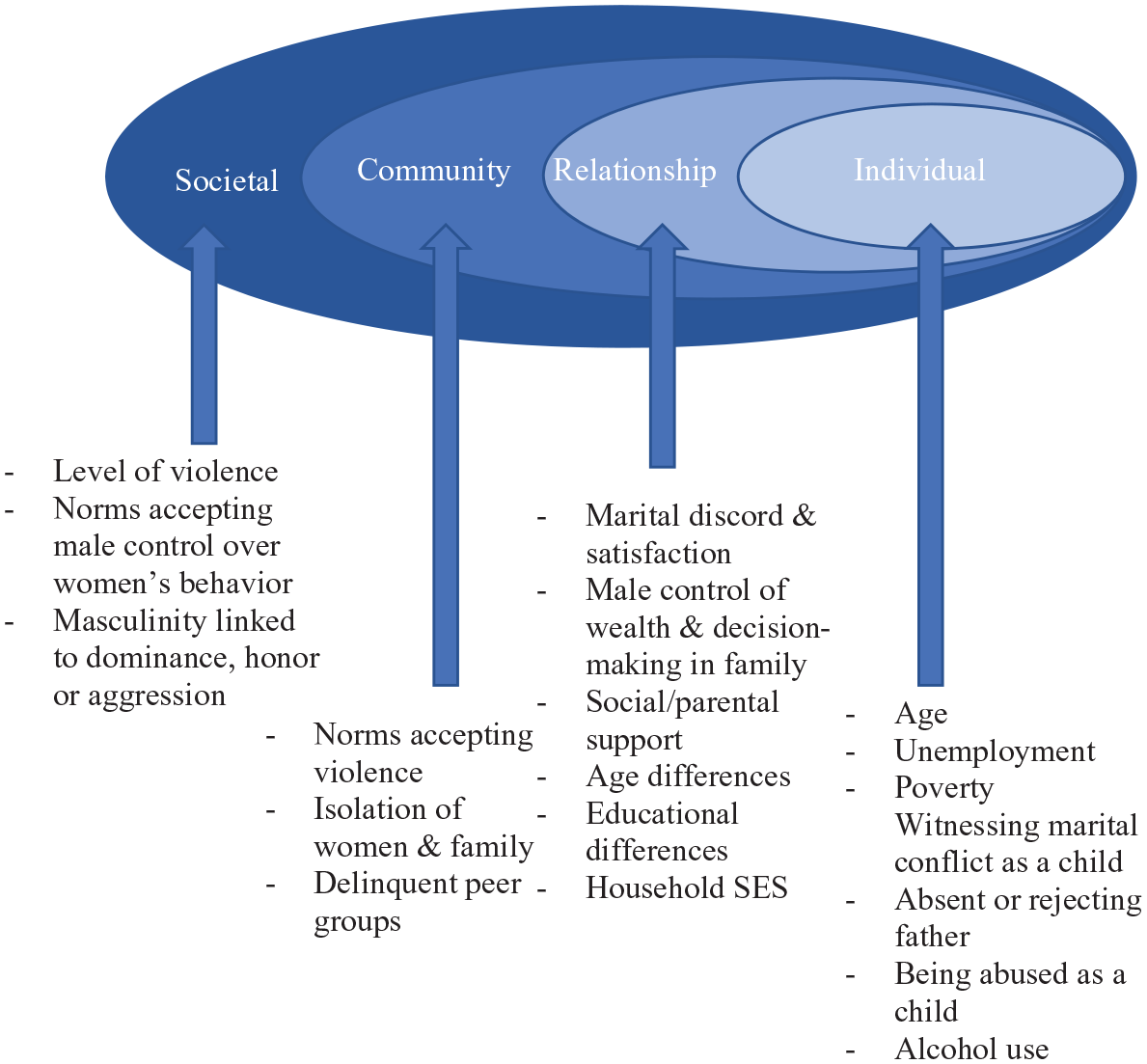
Ecological framework for intimate partner violence.
Individual-level attitudes and beliefs that are accepting of violence toward women are associated with physical aggression and violence (Simon et al., 2001). Moreover, previous literature has also found that women are more likely to experience violence in communities where there are norms and attitudes that are accepting of wife-beating (Abramsky et al., 2011; Koenig et al., 2006). This previous statement highlights the influence of contextual factors as potentially inhibiting care-seeking among female survivors of violence (Liang et al., 2005). The interplay between individual, relationship, situational, and contextual factors, and the multiple levels of influence make addressing IPV an important and complex health, human rights, and development problem.
The Current Study
The objective guiding this analysis is to produce evidence that can be used to identify and prioritize key areas of intervention at the individual, relationship, community, and societal levels to advocate for, develop, and implement the most effective, efficient, and targeted multisectoral response to IPV in Honduras. Furthermore, by using more comprehensive measures of domestic abuse, we can differentiate factors associated with each type of violence to which a woman could be exposed. The study, therefore, will seek to determine factors within the ecological framework, which are associated with women’s experiences of physical/sexual and emotional violence within the past 12 months, and with fear of their male partner. Specifically, it is hypothesized that women’s experiences of IPV and fear of their partner will be associated with individual (i.e., age, education, age at cohabitation, marital status, parity, employment, and experience of parental household violence), relationship (i.e., age, income and educational differences, partner’s consumption of alcohol, and woman’s decision-making in the household), community (i.e., aggregates of gender norm indicators to the primary sampling unit), and society-level factors (i.e., departmental homicide and intrafamily violence rates).
Methods
Sample and Procedure
Demographic and Health Surveys (DHS) are nationally representative household surveys that provide data for a wide range of monitoring and impact evaluation indicators in the areas of population, health, and nutrition. From 2011 to 2012, the National Institute of Statistics of Honduras implemented the National Demographic and Health Survey (ENDESA) with technical assistance from the MEASURE DHS program (ICF International) and financial support from the U.S. Agency for International Development (USAID). The ENDESA sampling plan followed a stratified, two-stage cluster design. The sample was stratified by department, a political and geographical division used in Honduras, and by urban/rural areas within each department. The survey collected information from 21,362 households, including 22,757 women aged 15 to 49 years and 7,120 men aged 15 to 59 years. Among other key health topics, including reproductive health, child health, gender norms, HIV, and maternal health, the study collected information regarding the experience of physical, sexual, and emotional violence among a subsample of women who are or ever were married or lived in union. To incorporate the characteristics of husband/partner into the multivariate models, we restrict our sample to women who were currently married or in a union.
Measures
Dependent variables
All of the women interviewed in the 2011 to 2012 ENDESA were asked about episodes of violence from the age of 15 years onward and episodes of sexual violence before and after the age of 12 years. All married women or women in union were asked about violence within the 12 months preceding the survey, the consequences of physical violence, and whether they sought help on those occasions. Specifically, women were asked about episodes perpetrated by their current or latest intimate partner, including episodes of emotional violence (whether the current/latest partner ever “said or did something to humiliate her in front of others,” “threatened to hurt her or someone close to her,” or “insulted or made to feel bad about herself”), physical and/or sexual violence (whether the current/latest partner ever “pushed, hit or threw something at her,” “slapped her,” “hit with a fist or some other harmful object,” “twisted her arm or pulled her hair,” “kicked or dragged her,” “tried to strangle or burn her,” “threatened or assaulted with a knife, gun, or other weapon,” “forced her to have sex against her will,” or “forced or threatened her to perform sexual acts against her will”), and fear of one’s partner (whether the respondent is afraid of the husband/partner most of the time, some of the time, or never).
While data were also collected on lifetime experiences of violence, we limit the violence outcomes to recent experiences of violence (within the past year) for both theoretical and data-driven reasons. Societal and community measures of social norms and violent crime are compiled and produced for the survey year, as relationship characteristics can only be calculated for the current relationship, and therefore are only relevant to recent experiences of violence (not those that may have occurred many years in the past). Using a shorter recall period also reduces issues of recall bias and, to the extent possible, the threat of reverse causality between the outcome and the independent variables.
Independent variables
Data for the individual and partnership-level characteristics were drawn from survey responses and include sociodemographic characteristics of the respondents, their partners, and their households. Individual- and household-level characteristics included in the analysis were age of respondent, age at first cohabitation, education, employment status, marital status, parity, woman’s attitudes toward violence, whether or not a respondent’s father ever beat her mother, household wealth, sex of the household head, and area of residence (i.e., urban/rural). As is standard with DHS surveys, variables for household wealth have been constructed using principal components analysis based on household characteristics (e.g., housing materials) and household ownership of common consumer durables (e.g., radio and bicycle; Filmer & Pritchett, 2001).
Variables measuring relationship dynamics, such as women’s decision-making in the relationship, partner’s use of alcohol, and age, income, and educational differentials were also included in the model.
Data for community- and society-level variables come from two separate sources:
Aggregate values of community norms justifying violence against women were constructed at the primary sampling unit (i.e., cluster) from the survey data, using both male and female responses. For each respondent, an additive index was created based on agreement with the following statements: ○ Wife beating justified if (a) wife goes out without telling husband, (b) wife neglects the children, (c) wife argues with husband, (d) wife refuses to have sex with husband, and (e) wife burns the food.
Community norms were then calculated for each cluster (using both male and female data) as the average of the index among residents in that cluster. Communities were than grouped into terciles of “low,” “medium,” and “high” based on the mean value of the index for a cluster.
Measures of homicide and intrafamily violence at the department level. Honduras is divided into 18 departments, with a median population size of approximately 350,000 people as of 2013. Crime statistics are compiled by the Violence Observatory housed at the University Institute for Democracy, Peace, and Security (IUDPAS) at the National Autonomous University of Honduras, which regularly collects and analyzes available data from forensic medicine, the National Prevention Police, the National Office for Criminal Investigation, and the National Transit Office, with the purpose of building the knowledge base on violent and unintentional deaths. The Observatory releases national bulletins every trimester, which summarize the year-to-date figures on homicides and other offenses, including violence against women and children, sexual offenses, and criminal offenses. The two key variables included in this analysis (measured at the department level) were homicides per 100,000 population and incidents of intrafamily violence (per 100,000 population). Data from crime statistics were matched with household data using the department or political region.
Analysis
Univariate and/or sample descriptive statistics were included. Bivariate analysis, using Pearson chi-square tests, was used to assess differences in the experience of different forms of violence between women of different sociodemographic factors. Multilevel, multivariate modeling was used to construct a predictive model of IPV and fear of one’s partner. These models capture how individual-level outcomes are shaped by higher level social and structural factors. In this case, we construct models to reflect our hypothesis that violence experienced at the individual woman–level is shaped by factors beyond her individual characteristics, thus reflecting the social ecological model with which this study approaches the theoretical framework on the causes of IPV. Multilevel models have previously been applied to a number of other disciplines, including the examination of the community characteristics, namely, a measure of development and female household concentration within the community on interpersonal violence against women (Gage & Hutchinson, 2006).
Because all outcomes are binary, multilevel models were estimated using the xtmelogit (for multilevel and mixed-effects logit) command in Stata 14. The xtmelogit command accounts for the multistage sample design used in the ENDESA sample selection and the intracluster correlation of community characteristics for respondents. The model quantifies the effects of community-level factors on IPV and determines whether community-level factors modify the effects of individual-level factors (i.e., whether violence at the community level influences the relationship-level and individual-level characteristics that expose women to violence). The multilevel approach also allows for modeling unobserved variance at the individual, household, and community levels, thereby indicating which level of variation most influences individual-level behaviors. The results from the multivariate models are presented in terms of predicted probabilities. These represent how each variable affects the probability of experiencing violence or being afraid of her partner.
Results
Univariate and Descriptive Statistics
Table 1 provides the univariate statistics for the variables considered for the full multilevel model. Approximately, 11% of the women reported that they had experienced physical or sexual violence in the past 12 months while just slightly more than one-fifth of women reported experiencing emotional violence. Approximately, 14% of women reported that they were afraid of their spouse/partner.
Univariate Statistics (N = 10,004).
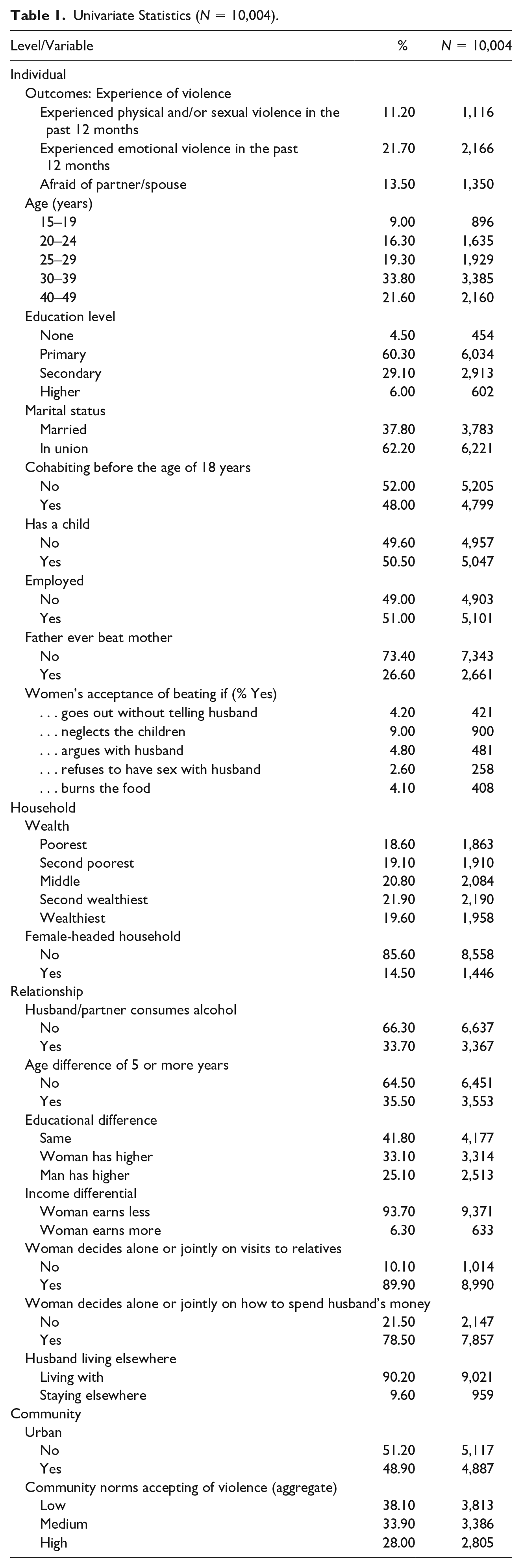
In terms of the individual characteristics of the women in the sample, approximately half were below the age of 30 years, with 9% being aged 15 to 19 years. Only 4.5% of women reported no education, whereas the majority (60.3%) had some primary education. Only 38% of the sample were currently married and roughly half started living with a man before the age of 18 years. Just over half were employed and a similar proportion had at least one child. Just over a quarter of the sample reported that they had witnessed their father beating their mother. By definition, the sample was roughly evenly split across wealth quintiles, with differences attributable to differences in the average number of women of reproductive age across quintiles.
In terms of the relationship dynamics variables, approximately 42% of the women reported having the same level of education as their partner but a third reported higher levels of education. Only 6.3% of the women reported earning more than their husband/partner, and a third reported that their husband/partner drank alcohol. The vast majority were able to decide by themselves, or with their partner, about traveling to visit relatives (89.9%) and about how to spend the husband’s/partner’s money (78.5%). Ten percent of the women reported that their husband/partner lived elsewhere, while over a third reported that their partner was 5 or more years older. Less than 5% of women agreed with statements about the acceptability of beating for all scenarios, with the exception of neglecting the children (9.0%). The sample was approximately evenly split by urban/rural residence.
Societal-level violence statistics evidence that Honduras is a highly violent society, reporting 86.5 murders per 100,000 population on average across departments, as well as 42.2 incidents of intrafamily violence (Table 2). In comparison, the 2011 homicide rates in the rest of the Americas were significantly lower. In Central America, the homicide rates in Guatemala, El Salvador, and Costa Rica were 38.5, 70.2, and 10 murders per 100,000, respectively. In contrast, the highest homicide rate in South America was reported in Venezuela, with 45 murders per 100,000, while in the Caribbean, in Jamaica, it was reported as 41 murders per 100,000 (UNDOC, 2013), all lower than the reported rate in Honduras.
Incidence of Violence at the Department Level (Rate Per 100,000), 2011 (N = 18).
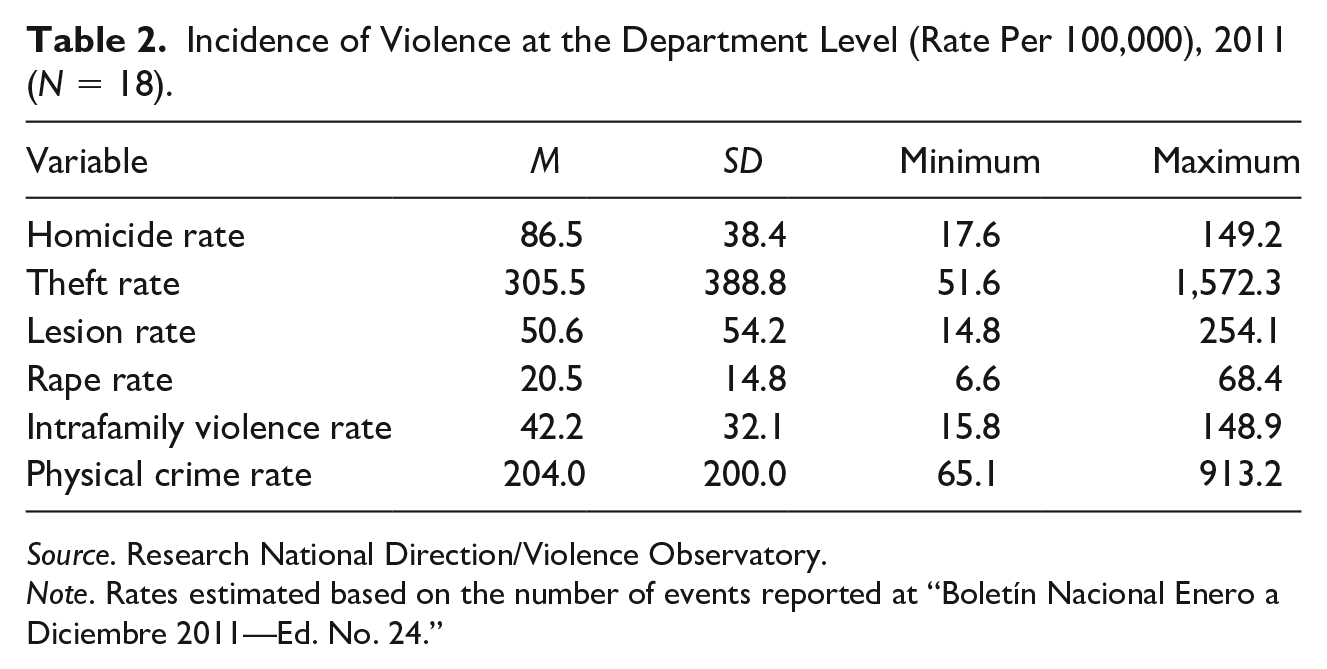
Source. Research National Direction/Violence Observatory.
Note. Rates estimated based on the number of events reported at “Boletín Nacional Enero a Diciembre 2011—Ed. No. 24.”
Bivariate
As a preliminary test of our hypotheses, we conducted bivariate analyses of the factors associated with each of the forms of violence (Table 3). The patterns were largely the same across all three outcomes. Experiences of violence were positively associated with being in a union relative to being married, having a child, being employed, earning more than one’s partner, cohabiting before the age of 18 years, having a partner who drinks alcohol, and having witnessed violence as a child. Violence was negatively associated with education and greater autonomy in decision-making, while wealth was negatively associated with fear of one’s partner. Age and educational differences were not statistically related to any outcome.
Bivariate Analysis of Factors Associated With Experiences of Violence.

Note. Bold refers to p values (in parentheses) that are less than .05.
Multivariate
Overall, several key findings emerged from the multivariate analysis (Table 4), which largely parallel those found in the bivariate analyses. First, many of the factors predictive of physical and/or sexual violence are also predictive of emotional violence. Women in less permanent relationships, relative to those who are married, were more likely to experience both types of violence and to be afraid of their partner; however, the magnitude of these effects was not large, that is, only 2 to 4 percentage points. A similar pattern was observed for women who reported cohabiting with a partner before the age of 18 years.
Predicted Probabilities From Multilevel, Mixed Effects Logit Models.
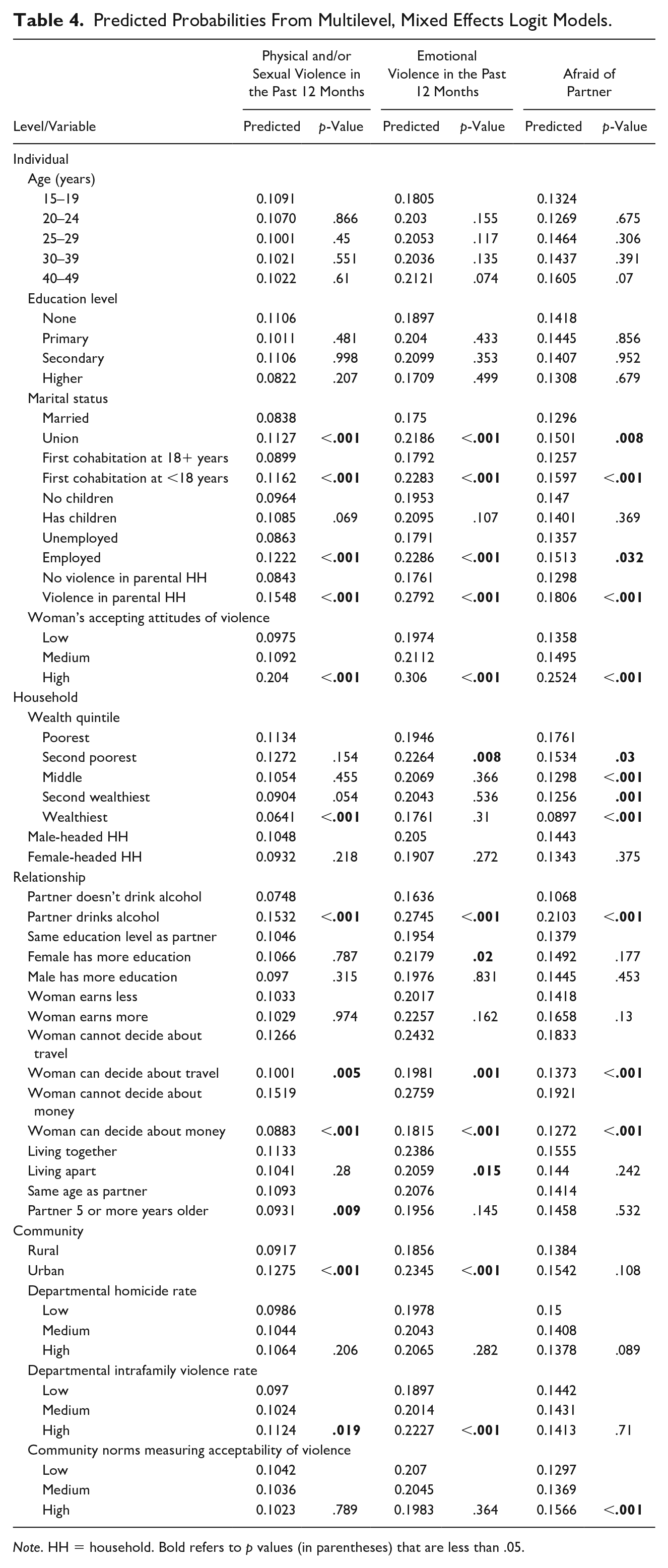
Note. HH = household. Bold refers to p values (in parentheses) that are less than .05.
Alcohol and family history of violence played very important roles. Women whose father beat their mother were 7 percentage points more likely (15.5% vs. 8.4%) to have experienced physical and/or sexual violence and 10 percentage points more likely (27.9% vs. 17.6%) to have experienced emotional violence in the past 12 months. Unsurprisingly, therefore, they were also more likely to be afraid of their partner. Women with more accepting attitudes toward IPV were also more likely to experience both physical/sexual and emotional violence although the direction of causality is ambiguous.
Several findings require more nuanced interpretations. Wealth, in general, is indicative of a lower likelihood of experiencing physical and/or sexual violence, and a lower likelihood of being afraid of a partner. For example, 17.6% of women in the lowest wealth quintile were predicted to be afraid of their spouse as compared with only 9.0% of women in the highest wealth quintile. Interestingly, the pattern was not always linear. In fact, women in the second poorest wealth quintile were predicted to be more likely to experience emotional violence than women in both the lowest wealth quintile and all higher wealth quintiles. A similar—but not statistically significant pattern—was observed for physical and/or sexual violence. Educational differences with a partner—a key indicator of potential power differentials—was not statistically significant for physical and/or sexual violence. However, women with higher education than their partner were more likely to suffer emotional violence.
Evidence for the influence of contextual factors was mixed. Being in a community with a high rate of intrafamily violence increased the likelihood of experiencing physical and/or sexual violence by 1.5 percentage points (11.2% vs. 9.7%) and of experiencing emotional violence by 3.3 percentage points (22.3% vs. 19.0%) relative to being in a community with low intrafamily violence. However, neither departmental homicide rates nor community acceptance of IPV were found to be related to any of the victimization outcomes.
Discussion
This study aimed to explore the prevalence and correlates of IPV in a nationally representative sample of Honduran women of reproductive age. Over the past decade, Honduras has been declared one of the most violent countries in the world, with high incidences of homicides, domestic violence, and disappearances. Implications from this study’s findings could have resonance for other countries facing high levels of crime and societal violence, as well as for developing countries in general. Findings indicate that 11.2% of women reported experiencing physical and/or sexual IPV within the 12 months preceding the survey. Furthermore, 21.7% of women reported experiencing emotional violence, and 13.5% declared being afraid of their partner. These rates are significantly higher than those of similar countries in the region. For example, in El Salvador, the 2014 rate of physical IPV within the preceding 12 months was 5.2% (Navarro-Mantas et al., 2015) and in Guatemala, the rate of physical or sexual IPV within the preceding 12 months was 8.5% (Ministerio de Salud Pública y Asistencia Social, Instituto Nacional de Estadística, & ICF International, 2017).
Confirming the main hypothesis of this study, our results evidence important associations between the likelihood of a woman experiencing abuse by an intimate partner and variables at each level of the ecological framework. At the individual level, sociodemographic characteristics reflective of greater vulnerability, such as low education, being in a union (as opposed to married), first cohabitation before the age of 18 years, and being employed, were positively and significantly associated with higher exposure to IPV. In contrast to the results of a pooled multi-country study (Heise & Kotsadam, 2015), we found no significant associations between IPV and women’s age.
Sociodemographic associations are largely consistent with previous evidence from developing countries. Specifically, being in a union and lower age at first cohabitation were also positively associated with physical IPV among women in Peru (Flake, 2005). Although surprising, the positive association between employment and exposure to violence has also been observed when analyzing physical IPV in Peru, Nigeria, and India (Boyle et al., 2009; Flake, 2005; Linos et al., 2014; Solanke, 2018). The patriarchal theory of IPV (Dobash & Dobash, 1979) states that in patriarchal societies, socially constructed gender scripts dictate male dominance over females; therefore, when men are unable to maintain dominance over women, including economic dominance, they might resort to violence to reestablish control. Consistent with this theory, we found that women having more education than their male partner were more likely to experience emotional violence.
Witnessing maternal abuse was highly associated with a woman’s own experience of physical and/or sexual violence, emotional violence, and fear of one’s partner. These results are consistent with previous studies (Flake, 2005; Jewkes et al., 2002; Linos et al., 2014; Solanke, 2018; Vyas & Heise, 2016) and confirm the intergenerational cycling of violence. In fact, a recent metanalysis found that witnessing interparental violence has a similar magnitude effect on IPV victimization during adulthood as experiencing physical abuse as a child (Smith-Marek et al., 2015).
Consistent with previous studies (Caetano et al., 2001; Carbone-Lopez & Kruttschnitt, 2010; Solanke, 2018), our results show that alcohol consumption by a woman’s male partner is a strong determinant of all three violence-related outcomes. Previous qualitative research in Honduras suggested a positive correlation between alcohol consumption and IPV (Berg & Carranza, 2015; Pine, 2008), however, another study found no such association for small sample of women living in a rural area (Chavarria-Mejia et al., 2017). These results provide evidence for social support programs for the prevention and mitigation of substance abuse and further exploration into potential differences between urban and rural areas.
Previous studies have found that female dominant decision-making power can increase the likelihood of experiencing physical violence (Fakir et al., 2016; Flake, 2005). However, our results indicate that in Honduras, women involved in household decision making have lower rates of exposure to all forms of violence. This conclusion implies that interventions aiming to increase Honduran women’s autonomy and their involvement in the decisions of the household may be a protective factor for interpersonal violence between intimate partners.
Our findings reinforce the role of social norms accepting of violence in the lived experiences of women in Honduras. Although studies in India, Tanzania, and Nigeria found that individual-level as well as community-level acceptance of violence is associated with physical IPV (Boyle et al., 2009; Linos et al., 2014; Uthman et al., 2011; Vyas & Heise, 2016), our results indicate that only individual-level acceptance of violence is significantly associated with emotional and physical IPV. A possible explanation for the lack of significance at the community level is the fact that community-level norms may play a mediating and not direct role on individual attitudes and beliefs; therefore, these measures are part of the causal pathway and should not be included in the regression (Heise & Kotsadam, 2015).
This study found a significant association between intrafamily violence at the community level and experience of IPV, but no such association was seen with community homicite rates. Although not significant, we believe that homicide rate might not be an ideal measure of community violence due to underreporting of crime statistics and the lack of quality data at lower levels of aggregation. Following a literature review, previous studies found that higher levels of community-level “perceived violence, exposure to violence, or worry about violence” are associated with higher rates of IPV (Beyer et al., 2015).
Highly violent societies can enable male perpetration of violence against an intimate partner through multiple pathways, including the institutionalization of social norms that normalize violence, the perpetuation of perceptions that violence will go unsanctioned, and the maintenance of mimicked violent behaviors among certain subpopulations. Social and behavior change communication strategies can work to shift the current normalization of violence and social tolerance toward violence. In Colombia, for example, a comprehensive communication strategy that targeted all members of a community and emphasized zero tolerance toward IPV shifted pervasive social norms accepting of violence and reduced victimization rates (Bicchieri, 2015). In a similar way, the results of this study highlight how IPV prevention interventions in Honduras should expand their reach beyond women to include the partner, communities, and the larger social system in which violence is currently permitted to exist.
Strengths and Limitations
This study has several strengths worth mentioning. The first is the inclusion of explanatory variables at all levels of the ecological model. Given that IPV has been typically conceptualized as a private form of violence, research in Latin America and the Caribbean has often focused exclusively on individual-level or couple-level correlates (Friedemann-Sánchez & Lovatón, 2012; Ishida et al., 2010; Priestley, 2014). In the present article, we expand the limited evidence of community-level factors by analyzing the effect of female and male community-level norms of violence acceptance, as well as department-level crime and violence statistics. Second, multilevel studies of the determinants of IPV victimization have limited their analysis to the study of physical and/or sexual violence only (Boyle et al., 2009; Flake, 2005; Gage & Hutchinson, 2006; Heise & Kotsadam, 2015). Overcoming this limitation, we include in the analysis emotional victimization as well as fear of one’s partner as outcomes of interest.
This study presents limitations that require consideration in the interpretation of results. First, this study is limited to the analysis of victimization against women by a male partner. Unfortunately, the DHS survey does not include information about same-sex partnerships or about intimate partner victimization against males. Second, as these are cross-sectional data, it is difficult to establish causality or temporal sequence of events. Third, important variables have been omitted from the analysis due to a lack of available information, such as child abuse, social cohesion and collective efficacy, depression, and relationship quality/satisfaction. Fourth, these data are self-reported, and therefore concerns about underreporting and social desirability bias are present. Finally, a clear gap in this literature is the absence of input from the male perpetrators of violence themselves. While certain characteristics of the male partner (e.g., alcohol use and age differentials) were found to be important predictors of violence, the study was unable to assess the role that contextual factors directly and indirectly play in male perpetration of violence.
Footnotes
Declaration of Conflicting Interests
The author(s) declared no potential conflicts of interest with respect to the research, authorship, and/or publication of this article.
Funding
The author(s) received no financial support for the research, authorship, and/or publication of this article.
