




Abstract
This qualitative study examines the perceptions of mothers, fathers, and adolescents on the relations they see between intimate partner violence, mental health and substances use parental problems that co-occur in their family, and the mothers’ and fathers’ associated parenting challenges. The sample was composed of 43 people (15 mothers, 16 fathers, and 12 adolescents) who were directly affected by the co-occurrence of intimate partner violence and mental health or substances use parental problems. The participants were recruited with the collaboration of public and community organizations in the Province of Québec (Canada). The data were collected through semi-structured interviews and combined with a table detailing the specific problems identified by the participants. A thematic content analysis method was employed to do the coding, and a summary of the results was returned to some participants who agreed to collaborate with the validation of the results. The analysis revealed numerous and diverse relations between the interviewees’ co-occurring problems, but two principal patterns emerged. The first one was chiefly observed in the comments made by mothers and adolescents who saw the co-occurring problems as being the consequence of the intimate partner violence on the mother. The second pattern was largely observed in the fathers’ comments, who explained that the substance use problems came before the intimate partner violence and acted as an aggravating factor. The co-occurrence of intimate partner violence with other parental problems strongly affected the mothers’ and fathers’ parenting, making it more difficult to meet the children’s needs. Considering the complexity and diversity of the experiences and needs of the mothers, fathers, and children in co-occurring situations, future studies should evaluate the services provided to these families and the coordination between the different concerned organizations.
Keywords
Introduction
Intimate partner violence (IPV) often occurs concomitantly with other parental mental health (MHP) or substance use problems (SUP; Bromfield et al., 2010; Choenni et al., 2017; Cleaver et al., 2011; Clément et al., 2013; Estefan et al., 2013; Feingold & Capaldi, 2014; Macy et al., 2013; Mirick, 2014; Nathanson et al., 2012; Woodin et al., 2014). IPV is characterized by the control of one intimate partner over the other. It is often repeatedly experienced and can take various forms (Gouvernement du Québec, 2018). Québec’s police data (Canada) indicate that women are more often victims of this violence and that men are more often the perpetrators (Ministère de la Sécurité publique, 2017). As for MHP, they refer to difficulties that result from a disruption of the relationship between a person and her environment; its manifestations can be placed on a continuum of severity, of dysfunction, and of psychological distress (Comité de la santé mentale du Québec, 1994). SUP refers to a harmful use of psychoactive substances, such as alcohol, and licit or illicit drugs that can lead to an addiction (Institut national de prévention et d’éducation pour la santé, 2014).
In situations where these problems occur concomitantly, the consequences of violence are more serious with regard to both the children’s safety and development and the mother’s and father’s parenting, as the risks of physical abuse and negligence toward the children are greater (Bauer et al., 2013; Bourassa et al., 2008; Bromfield et al., 2010; Burlaka et al., 2017; Cleaver et al., 2011; Holmes, 2013; Humphreys et al., 2005; Stover et al., 2013). In youth protection moreover, the most common reasons for reporting are exposure to IPV, negligence, and SUP in the parents (Hélie et al., 2017; Mirick, 2014; Trocmé et al., 2010). In one case out of two furthermore, these problems co-occur (Lavergne et al., 2018). Among women who stay in shelters, 20% have an SUP and 32% have a diagnosed MHP, these problems being on the rise in recent years (Fédération des maisons d’hébergement pour femmes [FMHF], 2017). A third of the children who stay in the shelters (31%) have also been reported to the child protection services (CPS; FMHF, 2017). As for men who receive services to reduce their violent behaviors, 27% have a criminal record for IPV, 23% report having already had suicidal thoughts, and 5% report having homicidal thoughts; 15% have children in the care of the CPS and a greater percentage of men (23%) admit to having already been violent with their children (a coeur d’homme, 2017). Furthermore, most of the families working with the CPS or IPV community organizations are poor and socially isolated and have difficulties with social insertion and staying in the job market (Bromfield et al., 2010; FMHF, 2017; Mirick, 2014).
Studies documenting the viewpoints of people directly concerned with problems that co-occur with IPV are quite rare, as are studies documenting the viewpoints of people directly concerned about their parenthood in this context. Nonetheless, it is essential to better understand how these co-occurring problems are experienced so as to offer services that are well adapted to diverse family needs. The present study should make it possible to bridge this knowledge gap by examining the qualitative viewpoints of mothers, fathers, and adolescents on the relations they see between co-occurring problems that they are exposed to and the mothers’ and fathers’ associated parenting challenges.
Common Situations and Multiple Expressions
While the co-occurrence of IPV and SUP has been known for more than 30 years (Humphreys et al., 2005), the results of available clinical studies point to the heterogeneity of the relations between these problems when they are expressed in both the victims (most often women) and IPV perpetrators (most often men; Feingold & Capaldi, 2014; Humphreys et al., 2005; Macy et al., 2013; Mason & Rinn, 2014). As for the co-occurrence of IPV and MHP, it has been studied less often, with the exception studies conducted to document the numerous consequences that IPV has on the mental health of victims (Bellal et al., 2015; Cerulli et al., 2011; Devries et al., 2013; Humphreys & Thiara, 2003; Lawrence et al., 2012; Nathanson et al., 2012; Wuest et al., 2009) and children (Camacho et al., 2012; Harding et al., 2013; Levendosky et al., 2013; Wolfe et al., 2003). Indeed, all these authors agree with the expert practitioners that IPV can have a significant impact on the mental health of victims (Regroupement provincial des maisons d’hébergement pour femmes victimes de violence, 2006).
Despite the current lack of knowledge about the co-occurrence and interactions of IPV, MHP, and SUP, a few studies have nonetheless shown that these cases are far from being the exception, suggesting that more knowledge is needed to support intervention in these complex cases. A study conducted with 61 mothers and 56 fathers whose children were in CPS (Estefan et al., 2013) showed that 30% of the mothers and 26% of the fathers were simultaneously going through IPV and SUP and that 29% of the mothers and 23% of the fathers were simultaneously experiencing IPV and MHP. The co-occurrence of the three problems was not specifically documented in this study; nor did it specify which of the parents was the IPV victim and which, the perpetrator. Another study conducted with 94 female victims of IPV (Nathanson et al., 2012) showed that 46% of them had at least two distinct problems, for example, post-traumatic stress disorder and depression, post-traumatic stress disorder and alcohol addiction, and depression and drug addiction.
The Importance of Knowing the Viewpoints of People Who Are Directly Concerned
Humphreys and Thiara (2003) showed that MHPs in victims are sometimes identified by practitioners without taking into account the IPV contexts that affect the mothers’ parenting. It is thus important to examine how the women portray the impact of IPV on their mental health (Humphreys & Thiara, 2003). Whereas psychological and medical studies speak of depression and post-traumatic stress disorder, the women interviewed by Humphreys and Thiara (2003) spoke rather of an intense emotional distress, without focusing solely on diagnostics. This distress is expressed in various ways: overwhelming fear, flashbacks, panic attacks, anxiety, hyper-vigilance, anorexia, compulsion for cleanliness, and so on. Mason and DuMont (2015) recommended greater concentration on the relations between these problems rather than on solely emphasizing the MHPs that affect parental competency and the social abilities of IPV victims.
The fathers, on the other hand, were more often the perpetrators of IPV, particularly the more severe forms causing physical harm (Ministère de la Sécurité publique, 2017; Statistique Canada, 2018). It is essential therefore to better understand their experiences and viewpoints to avoid making them less accountable, and the victim-mothers more accountable for the protection of their children. That being said, very little research has been conducted concerning IPV in fathers. The study by Stover et al. (2013) revealed that fathers who committed IPV and who had SUPs were more affected at the mental health level and presented more negative parenting practices. The results of a qualitative study by Bourassa et al. (2013) with 22 fathers who were IPV perpetrators showed the importance of examining the parental practices of these fathers, who themselves recognized the harmful nature of certain parenting behaviors and the effects of violence on their children. This study likewise underlines the importance of adopting a dynamic, evolving analysis of parenting in men who consult for their IPV, recognizing that they are in a process of change.
Studies carried out with children exposed to IPV show that they are just as capable as their parents of recounting their experiences and expressing their opinions about how they could be better assisted (Gorin, 2004; Lapierre & Côté, 2016; Templeton et al., 2009). Furthermore, they are quite aware of their parents’ problems and take concrete actions to try to decrease the consequences, sometimes going as far as to take on tasks that are normally those of an adult (e.g., cooking, taking care of siblings, managing the budget; Gorin, 2004; Templeton et al., 2009).
In short, it is well known that childhood victimization remains one of the best predictors of IPV (Ehrensaft et al., 2003; Fritz et al., 2012; Gravel, 2017) and that IPV affects the mothers’ and fathers’ parenting (Bourassa et al., 2008; Burlaka et al., 2017; de la Sablonnière & Fortin, 2010). The addition of associated issues such as MHP and SUP among families with IPV exacerbates these consequences. To improve interventions with these families and more effectively reduce the transfer of IPV down through the generations, it is essential to further existing knowledge about the experiences and viewpoints of both parents and children who have experienced IPV, MHP, and SUP. This study responds to the following question: what are the mothers,’ fathers,’ and adolescents’ qualitative points of view concerning the links between IPV, MHP, and SUP, as well as on the associated parenting challenges?
Methodology
Sampling and Recruitment
Given the lack of knowledge, in particular about the triple co-occurrence of IPV, MHP, and SUP, and about how people directly concerned describe the complex links between these problems, a qualitative and exploratory approach based on an interpretive paradigm was employed (Guba & Lincoln, 1994). This approach has been effectively used to explore the wealth and diversity of the participants’ viewpoints regarding co-occurrence problems. This exploratory approach is pertinent given that the current scientific knowledge raises more questions than hypotheses. The recruitment of participants was done in collaboration with several organizations in the Province of Québec (Canada), including general public service organizations (CPS, mental health, addiction) and IPV community organizations, namely shelters for female IPV victims and their children and organizations for IPV perpetrators. The practitioners working in these organizations presented the research project to the potential participants and, if they obtained their consent, gave their contact details to the researchers. Graduate students trained by the researchers regarding the research problem and process were responsible for contacting these participants. The participants had to sign the authorization to participate in the interview for themselves and their adolescent (when the latter was younger than 14 years old). Adolescents from 12 to 13 years old also had to sign an assent form, in accordance with the ethical procedures applicable in the Province of Québec. Once this process was completed, interested mothers, fathers, and adolescents could participate in the research.
The parents had to have at least one child under 18 years old with whom they had regular contact, whether they currently had custody or not, and had to have experienced an IPV situation in the last 2 years along with another parental problem. Adolescents (12–17 years old) had to have been exposed to this co-occurrence in the last 2 years and have had regular contact with their parents. The exploratory approach of the project justified including a diverse range of MHPs and SUPs that were or were not diagnosed, but acknowledged by the participants as a family disturbance. The sample included 43 participants (16 fathers, 15 mothers, and 12 adolescents) from different families. Of these, 22 were recruited by community organizations (shelters and organizations helping violent partners) and 21 by general public service organizations (CPS, mental health, addiction). On average, the fathers were 39 years old, the mothers, 36 years, and the adolescents, 14 years. Among the adolescents, an equal number of girls (50%) and boys (50%) were interviewed. Concerning the ethnocultural identity of the participants, the majority of fathers (87.5%) and mothers (84.6%) identified themselves as Quebeckers or as Canadians, while the others mentioned they had another ethnocultural identity (12.5% of the fathers) or a double ethnocultural identity (15.4% of the mothers). Adolescents, for their part, identified themselves as Quebeckers or as Canadians (58.3%), or as having a double ethnocultural identity (41.7%). When they had a double ethnocultural identity, the adolescents and mothers said that they were both Quebecker or Canadian and Latin-American, Caribbean-Antillean, African, European, or Indigenous. Some questions having gone answered, there were missing data concerning the age of two fathers and the ethnocultural identity of two mothers.
Data Collection and Analysis Methods
The main data collection method used by the students was a semi-structured interview. The participants completed a table with specific, identified problems beforehand, which allowed the interviewers to better direct the interview by taking into account the difficulties declared by the participants. The interview lasted approximately 90 min and dealt with how they perceived the following themes: the relations between IPV, SUPs, and MHPs; the manifestation of these problems in their family; and the effects of co-occurring problems on parenting, on the parent–child relationships, and on the personal well-being of family members. At the end of the interview, the participants completed a short questionnaire about their sociodemographic characteristics. A compensation of US$30 was given to each participant. The project was approved by the ethics committees of the concerned organizations as part of a multi-centered protocol, in keeping with the present-day laws and research procedures of the Province of Québec (Canada).
Each interview was recorded, transcribed, and codified with the NVivo software. The thematic content analysis method (Braun & Clarke, 2006) was employed to do the coding. The coding grid was validated by a committee of seven IPV experts (three researchers and four practitioners), who likewise read the summaries of the 43 interviews and contributed to the analyses. As the coding was done by two students and one research professional, a process of inter-rater reliability was applied. To ensure that the qualitative analysis results properly reflected the reality and needs of the families regarding co-occurrence, a summary of the results was returned to the participants who accepted to be re-contacted by the research team and to collaborate with the validation of the results (Lindlof & Taylor, 2002).
Results
The results were grouped into two main themes in keeping with the study’s specific objectives, namely (a) How did the participants describe the links between the co-occurring problems they were experiencing? and (b) What were the parenting challenges the mothers and fathers faced in co-occurrence situations? Before presenting their comments, a short presentation of the study participants is given.
Participants
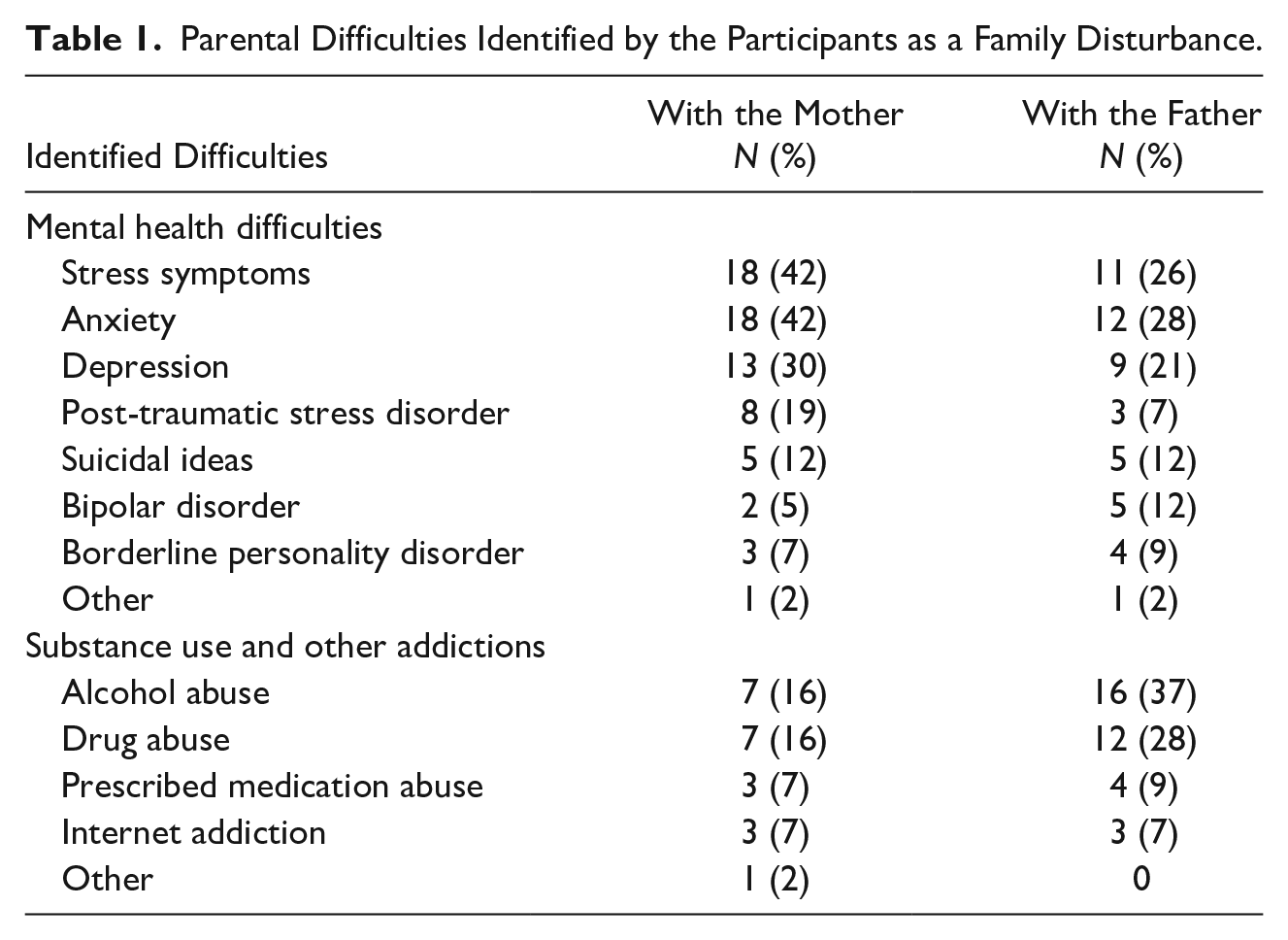
The majority of the participants (67%) identified a triple co-occurrence, a quarter of them (28%) identified a MHP plus IPV and two participants (5%) identified a SUP plus IPV. Table 1 shows that MHPs were identified more often in mothers, whereas SUPs were more common in fathers. Among the parental difficulties identified by the participants, the majority mentioned stress, anxiety, and depression. Approximately a quarter spoke of post-traumatic stress or suicidal ideas. More than 40% spoke of alcohol and drugs. Some parents (29% of the mothers and 13% of the fathers) identified a SUP in their partner in addition to their own MHP or SUP.
Parental Difficulties Identified by the Participants as a Family Disturbance.
As concerns social vulnerability, these families were quite poor. The majority of the mothers interviewed (87%) and close to half of the fathers (44%) lived on a family income of less than US$30,000, which is considered to be beneath the low-income threshold in Canada. Several of the parents were single and very socially isolated. Some parents (20% of mothers and 50% of the fathers) did not have custody of their children due to different problems even though they were in contact with them.
Multiple and diverse links between the co-occurring problems
The stories told by the participants were complex, given that there were often multiple, circular links between the different problems. Co-occurring situations can be experienced in different ways and with different specificities depending on the type of IPV and the associated problems. As it is not possible in this article to give a detailed explanation of each person’s case, the co-occurrence patterns that were more apparent in the participants’ comments will be presented.
The first co-occurrence pattern was chiefly observed in the comments by mothers and adolescents who saw MHPs and SUPs as the consequences of the IPV inflicted on the mothers. The mothers reported numerous examples of physical and psychological violence and of coercive control exercised by the fathers (or stepfathers) on them and the children. The violence often began during the perinatal period and then became worse over time, causing a great deal of suffering for the victims. There were numerous expressions of this suffering, including anxiety, stress, psychological distress, hyper-vigilance, difficulties in doing daily tasks, social isolation, physical exhaustion, low self-esteem, and suicidal thoughts. MHPs and, in certain cases, SUPs combined with victimization to create a cumulative effect that reduced the mothers’ availability to meet their children’s needs: Violence. It got to the point where I was taking medication and smoking pot. It became really excessive and then I got carried away. I wasn’t talking to anyone anymore and I was always stressed out [. . . ] I kept on wishing I didn’t exist anymore. It got to the point where, because I take antidepressants, I was taking all sorts of things, which meant I was vomiting every day. I was finally admitted into the hospital and it was about time. I don’t remember anything about the first three days I was there. It [IPV] completely destroyed me and pushed my children away. It pushed my family away. (Mother 4)
In a few situations, MHPs were also present before the arrival of IPV. Mothers reported that their MHPs made them more vulnerable to IPV or that these MHPs reappeared with the IPV: There is a very direct link [between schizophrenia and IPV] because our conflicts are all related to my own personal difficulties, to my disorder. Like my slowness, my slowness is related to my disorder. Sometimes what I say doesn’t make a lot of sense, and he can’t handle that. [. . .]. (Mother 3) [. . .] The mutilation began when I was 11 years old. It was after my parents separated. When I first had my children, I never did it at all. Then when [violent partner’s name] came into my life, it started all over again. (Mother 4)
In another co-occurrence pattern, which was primarily seen in the fathers’ comments, the SUPs came before the IPV. That being said, the majority of the fathers who talked about this experience insisted that substance use did not explain their IPV but acted, rather, as an aggravating factor. They said the violence happened in a context where SUPs led to couple relationship difficulties and conflicts, likewise hindering their parenting. Even though the partner relationships described seemed different from the situations described by the mothers and adolescents, the IPV could also be quite serious, sometimes requiring police intervention and victim protection measures: I really want people who go through something like this to understand that it’s way too easy to say that it’s the alcohol or the drugs’ fault, that it’s the fault of this or that. It’s not true. Because the beer bottle, I’m the one who opens it. The joint, I’m the one who smokes it. Yes, it has an impact on our behavior [referring to the violence he inflicted], that’s true, but it’s not because of the beer. It’s not the beer’s fault, and it’s not the drug’s fault. (Father 8)
The comparison between the mothers,’ fathers,’ and adolescents’ comments highlighted the different perceptions. The first difference concerned the way in which mothers and fathers spoke about their SUPs. For the mothers who were IPV victims, SUPs, whether they involved alcohol, drugs, medication, or internet addiction, were often described as a survival strategy, as a way of fleeing the violence and the ensuing psychological suffering. Some women explained that they had started self-medicating to attenuate the suffering created by IPV. Others drank alcohol so that they could have enough strength to defend themselves: [Drugs] It’s not just your body and mind that get stoned, [. . .] drugs help you put up with events, to get through them, [. . .] to numb the pain and suffering. (Mother 10) [. . .] When I was sober, I didn’t defend myself, [. . .] when I started drinking alcohol, [it was] to defend myself, to be braver, to not feel all those things that he said about me, [. . .] to be ready to go to war. [. . .] Whatever he was going to say, when I came in the door, I felt ready and invincible. (Mother 5)
Moreover, fathers who were IPV perpetrators did not really touch on the reasons for their SUPs. Rather they talked about how their inhibitions decreased when they took substances and how that aggravated IPV and isolated them even more: It started getting worse when I began drinking beer and alcohol on the weekends. [. . .] Drinking takes away your inhibitions, you’re less careful, you talk without thinking first. It’s not an excuse, [. . .] it’s my problem [. . .] because I’m the one who opens the beer bottle. (Father 8)
When mothers said that their partner had a SUP, they said that it was also an aggravating factor in the violence that they were subjected to. The fathers, however, sometimes presented their partners’ substance use as a trigger that triggered their abuse of her: He’d been drinking again. He pitched his glass of beer in my face. [. . .] He pulled me into the bedroom and he put me between the dresser and the door of the closet. I couldn’t move at all. He got on top of me, I couldn’t breathe, he kept hitting me. [. . .] Sometimes it happened when he wasn’t drinking, but it was always worse when he drank. (Mother 11) There were evenings when it got pretty heavy [. . .] after I had 10 or 12 beers, and she had had two bottles of wine. [. . .] like I told you, I have a short fuse. So she’d be drunk and she wanted to duke it out. Well, when you’re drunk and you come looking for problems and I’ve had a bit to drink too, well you’ve come to the right place. [. . .] There were evenings when she got everything rolling, her and “her” bottles! (Father 1)
With regard to the adolescents, their comments showed they were able to make their own analysis of what was happening in their family, even though sometimes their analysis was different from that of their parents. One adolescent explained that, in her opinion, her mother’s SUPs and MHPs were the result of the IPV inflicted on her, even though her mother felt that it was the SUPs that led to the other problems: My mother was very stressed out. She always told me that she regretted having drunk so much because she has forgotten so much of our time together [. . .]. She always told me that all the fights started because of the alcohol [. . .], my father had a problem controlling his anger but he wouldn’t admit it [. . .]. Before, when I was around five-years old, when we had normal lives without all these fights, there were disputes but no battles. My mother was really normal, she drank, but she had her limits [. . .]. [When] she fell into a depression, she didn’t want to eat anymore, she lost a lot of weight in less than a month, she wouldn’t talk to anybody anymore, she slept all the time, she fell into a really serious depression [. . .]. Especially because of what my father was saying to her. (Adolescent 7)
The challenges of parenting for the mothers and fathers in a co-occurrence context
In a co-occurrence context, the parenting roles can be affected in several ways. For example, a mother’s parenting can be targeted by a violent partner when he degrades her in her role as a mother: I try to follow my educator’s advice when I discipline my child, and then I have this guy behind me [who says] “Oh, come on, you can’t get a four-year-old child to respect you! What an unworthy mother you are!” [. . .]. (Mother 6)
It was not rare for mothers in co-occurrence situations to take on almost all the parental responsibilities, as their violent partner was often absent or hardly involved with the children, in particular if he had a SUP. These mothers were isolated from their family, and their social network was often limited or nonexistent. They said they were exhausted and, consequently, less patient and available to respond to the children’s needs. However, they mentioned concrete actions they took to protect their children from IPV, such as never leaving them alone with the violent partner and, in the most dangerous moments, leaving them with a trustworthy adult: I’ve always taken care of my family all alone [. . .]. Sometimes, it’s hard to believe you can be a good mother [. . .], there were moments when I gave up. I didn’t want to be a mother anymore [. . .] I was carrying the weight of two parents on my shoulders. [. . .] Yes, I can see the impact. But my role as a mother, I think I took it very seriously, even too seriously, [like a] mother-hen. (Mother 14)
In certain cases, a separation from the violent partner or the temporary placement of the children improved the mothers’ relationship with their children, as the mothers had become less stressed and more available to meet their children’s needs. One mother spoke about how losing the custody of her child amplified her MHPs and her SUPs in the beginning. After a while however, it helped her to stabilize her situation: When he would beat me up, instead of getting revenge, I would go and harm myself. You know, [I] had to look after myself, [. . .] had to look after my boy but I was so tired, [. . .] I couldn’t do anything. You know, my boy was taken away [was put into foster care]. During those 30 days, I was in detox, then I relapsed, [. . .] it was really rough because, added to that, there was domestic violence, they took my child away. It was too much for me, I felt so alone. [. . .] I regret losing custody, but it was because of that that I was able to get better. (Mother 2)
As for the fathers, they explained how, in an IPV context, they were less present, patient, and available for their children because of their SUP. In some cases, the contact with their children was reduced or stopped due to imprisonment, a contact ban, or a CPS foster care placement. Other problems sometimes arose, complicating parenting matters even more, such as the father’s involvement in a criminal network, financial difficulties, and the loss of a job. Some fathers spoke of the shame they felt for making their children suffer and for not acting in keeping with their family values, which were important for them: It’s clear that I’m not there for my children when I’m in my head. And when I’m drinking, we all know that [. . .] [there is] less compassion, less empathy, less . . . (Father 14) I’m not really honest with myself. My head’s not connected with my heart because of my drinking, my life’s a complete mess. I’ve completely lost control of all the different parts of my life. (Father 2)
According to the participants, it was more difficult for the parents to meet the children’s needs in a co-occurrence context. While the fathers identified a smaller number of consequences for the mothers and adolescents, some fathers were nonetheless aware of the impact of violence on their relationships with their children. Furthermore, they are willing to respect the child’s rhythm to restore the broken bonds. Despite this difference, the parents and adolescents generally recognized that co-occurrence problems affected different aspects of the children’s development and increased the risk of maltreatment and negligence. The adolescents often took on roles that should have been the parents, such as taking care of their siblings or being a parent’s confidant. Aware of their parents’ difficulties and worried for them, these adolescents would have liked their own viewpoint to be heard more often: Of course they hear us shouting at each other. For sure, they’re fed up with it. And wasn’t I stupid to consult them as if they were psychologists. I was stupid to try and get them on my side. (Father 2) My mother was sleeping at three in the afternoon, and I tried to wake her up, but she wouldn’t wake up. There was no guidance in our house. I could say, “I’m going to the park,” and she would say, “Okay, go ahead.” I could go out for an hour to the park at 11 o’clock at night, and the only thing that would happen to me would be to get scolded, but not for very long, because they were drunk and they forgot. (Adolescent 7) It stresses me out to see my mother all stressed, it really stresses me out [. . .] You know, seeing how it affects my mother, that’s what I find the hardest. (Adolescent 2) It’s not because I’m a child that . . . or a adolescent, that I don’t have the right to speak up and say what I’ve seen, what I think of the situation. (Adolescent 8)
Finally, parents also faced challenges in services related to co-occurrence. Thus, while practitioners often put the responsibility on the mothers’ shoulders to intervene quickly to alleviate further difficulties for the children, fathers were often pushed to the side in these interventions: After the first call to the CPS, I was really afraid of losing my children because I realized that, in recent years, I should have protected them more and put a brake on all that before. So, yeh, I was really afraid they would be taken away. (Mother 10) - [Interviewer] This CPS practitioner, did he meet your mother or step-father [his brother’s father]? - My mother, yes. My step-father, I don’t think so. (Adolescent 11)
Discussion
One of the methodological strengths of this study is to have given a voice to three groups of participants directly concerned by co-occurrence. This made it possible to better highlight the different viewpoints of mothers, fathers, and adolescents and, consequently, the complexity of the co-occurrence patterns involving IPV on one hand and MHPs and SUPs on the other. Our results are in line with those of other studies which have highlighted the different experiences of mothers and fathers in co-occurrence situations. Whereas for the female victims, the problems associated with IPV were often identified as the consequences of victimization (Humphreys et al., 2005; Humphreys & Thiara, 2003; Macy et al., 2013; Salomon et al., 2002); for the IPV perpetrators, they were associated with an increase in the frequency and severity of IPV episodes (Dallaire, 2011; Galvani, 2004). The participants encountered in the present study described different forms of co-occurring problems in their couple and family trajectories. This points to the importance of a nondeterministic analysis of the co-occurrences. The relations between the problems under study here should be understood not as an explanation of one problem by way of another, but rather as an accumulation of difficult experiences that interact with each other. For example, the results of the present study show that co-occurrence situations accentuate the vulnerability of people who experience them. Other studies have also shown that MHPs and SUPs cannot explain or justify IPV, as these problems can ensue in particular from IPV and from the vulnerability contexts and social exclusion in which these families often find themselves (Cleaver et al., 2011; Earner, 2010; Mason et al., 2017).
Furthermore, the concept of agency (Anthias, 2003) is likewise useful for pointing out that IPV victims do not just passively endure the difficult experiences they are confronted with. In fact, their comments presented SUPs as a strategy to regain power over their lives and to attenuate the MHPs they have developed due to IPV. Even though these SUPs can lead to other difficulties, particularly with regard to parenting (Holmes, 2013; Humphreys et al., 2005; Mason et al., 2017), they should be dealt with in interventions as an indication of needs that extend beyond mere personal weaknesses. Mason et al. (2017) recommend that practitioners who help a female victim in a co-occurrence situation ask themselves, “What’s happened to her?” instead of “What’s wrong with her?” Applied to the parental role, this logic would mean extending the analysis beyond parental failings that hamper the children’s safety and development, asking rather, “How can I make it easier for this mother to assume her parenting role by helping her to overcome the obstacles and difficulties in her life?” In this research, mothers mention that being subjected to violence and other difficulties makes them less patient with and available for their children. In the light of Mason’s findings, these difficulties in their mothering role should be understood by practitioners as consequences of co-occurrence and addressed as such. For their part, fathers can be reached by practitioners through their role as fathers. Due to their traditional masculine socialization, they often do not ask for help from aid services until they are weighed down with several particularly severe problems (Tremblay et al., 2016). That being said, their paternal role with their children represents, in their eyes, a good reason to ask for help (Bourassa et al., 2013).
The mothers encountered in the present study were, for the most part, in asymmetric power relationships with their partner. The MHPs and SUPs, which were factors that amplified the severity of the problems, further accentuated this power imbalance between the perpetrators and victims. It would thus be important to put the needs of mothers at the center of interventions, taking into account the fact that these needs can differ from one co-occurrence situation to another (Mason & DuMont, 2015). For example, despite the fact that some of the mothers encountered in this study mentioned that the couple’s separation and the temporary foster care placement of the children were events that made it easier for them to assume their parental role, these solutions should certainly not be put forward as the only way to help mothers in co-occurrence situations. Indeed, research shows that a separation is a particularly dangerous period for IPV victims and their children, as domestic homicide often occurs in and around the separation period (Campbell et al., 2007; Dubé, 2011; Léveillée et al., 2017; Lindsay, 2014; Sinha, 2013). Likewise, the children’s foster care placement was also very difficult for the parents (O’Neill, 2016). Some participants mentioned that, if these solutions are to be perceived as having a positive impact, they should allow each parent to take care of himself or herself. For example, mothers and fathers should have help in trying to decrease their MHPs and SUPs and have access to specialized IPV services that recognize the risks associated with co-occurrence situations and that provide a response which is adapted to both the parents and the children.
While co-occurrence accentuates the risk of child maltreatment and negligence (Bauer et al., 2013; Bourassa et al., 2008; Bromfield et al., 2010; Burlaka et al., 2017; Cleaver et al., 2011; Holmes, 2013; Humphreys et al., 2005; Stover et al., 2013), it is difficult to adequately respond to the children’s safety needs without adopting an overall approach that also considers the parents’ needs based on each co-occurrence pattern. It is thus important to examine the complex interactions of various identity aspects likely to increase one’s vulnerability by repositioning these aspects in the larger social context and by considering the different types of inequalities that parents can experience (Chbat et al., 2014; Warner, 2008), for example, sexism for mothers and classism or racism for both parents. In terms of the results of this research, it is plausible, among other things, that the low family income presented by many of the respondents may have contributed to their vulnerability and the complexity of their situations. The social expectations concerning the mothers’ and fathers’ parenting must accordingly be taken into account. Each of the problems studied here can individually generate social prejudice about parents, this being even more the case when they are taken together and the different forms of oppression that parents can experience are considered. For example, a mother who has an SUP or MHP is often perceived as being a bad mother. Likewise, a father who exposes his children to IPV or to a disorganized family context associated with SUPs is also perceived as being inadequate and dangerous. Mothers who are victims of violence have to deal with the constraints of social institutions that tend to assign complete responsibility for child protection to mothers (Humphreys & Thiara, 2003; Lapierre, 2010). The role of the “good mother” who protects her children by leaving her violent partner is thus put forward, ignoring the fact that IPV is a control pattern anchored in sexism that can last long after the separation (Rinfret-Raynor et al., 2008). Furthermore, these mothers often have to deal with the constraints of a judicial system that can revictimize them by encouraging agreement and mediation between the two parties regarding custody arrangements and the equal sharing of parenting responsibilities, sometimes to the detriment of the mothers’ safety and that of their children (Rinfret-Raynor et al., 2008).
As mentioned in the results, fathers who are IPV perpetrators are often not involved in the interventions, in particular those of the CPS (Scott, 2016); studies regarding the father’s parenting in IPV contexts are moreover still rare (Bourassa et al., 2013; Stover et al., 2013). Nonetheless, interventions with fathers could contribute to balancing parental responsibilities and even, according to Scott (2016), to better protecting the victims when specialized services are also offered for IPV and its associated problems. To counter this, more interventions with these fathers should be developed, drawing on programs such as Caring Dads (Scott, 2016) or Fathers for Change (Stover, 2013).
Limitations
The sample size did not make it possible to attain empirical saturation for all the analysis categories. Likewise, the recruitment procedure mainly brought in participants who at the very least recognized the co-occurring problems in their family and who were receiving help for at least one of these problems. The recruitment strategy may thus have affected the nature of the results obtained here. That being said, it would be difficult, given the complexity of reaching these families, to proceed otherwise than with the collaboration of concerned organizations.
Conclusion
In conclusion, this study leads to a better understanding of complex family situations when IPV co-occurs with MHPs and SUPs. The study results point to recommendations for interventions with the above-discussed families. It would therefore be important to conduct other studies to further existing knowledge of these co-occurring problems, in particular by comparing different families’ experiences and needs based on their co-occurrence patterns and on other personal characteristics, such as their ethnic origin. Studies evaluating the aid services provided to these families and the coordination between these services would also be essential.
Footnotes
Acknowledgments
The authors also wish to thank Mylène Bigaouette, Louise Riendeau, Mélanie St-Laurent, and Marjolaine Lord for their support in the smooth running of the different steps of the qualitative part of the project.
Declaration of Conflicting Interests
The author(s) declared no potential conflicts of interest with respect to the research, authorship, and/or publication of this article.
Funding
The author(s) disclosed receipt of the following financial support for the research, authorship, and/or publication of this article: This research was made possible through a grant from the Fonds de recherche du Québec—Société et culture (2016-VC-188444).
