



Abstract
This article contributes to the still limited analysis of gender and sexuality in the exploration of HIV infection in the Caribbean. In Trinidad and Tobago, child sexual abuse was identified as a prevalent behavior. This motivated a gendered exploration of the sociocultural factors underlying child sexual abuse and the link with HIV. Using a qualitative action research methodology, researchers sought to understand the patterns of behavior, sociocultural and gendered meanings, and significance of child sexual abuse; to sensitize stakeholders to these issues; and to develop multidisciplinary community-based interventions and policies. This article reports on the analysis of data collected from the interventions carried out as part of the action research methodology, as well as a range of national and community-specific action research activities including ethnographic case studies, national stakeholders meetings, and a study of service providers. It provides a nuanced understanding of the meanings, underlying assumptions, perceptions, and taboos associated with child sexual abuse in Trinidad and Tobago, as well as new ways of understanding child sexual abuse in the Caribbean. Findings showed that the social and gender context for child sexual abuse involves several interconnecting factors located within a framework of gender ideologies and expressions, sexual expectations and behaviors, and social norms based on patriarchal values. These findings would be of significance for the prevention of child sexual abuse and the associated HIV risk in Trinidad and Tobago, and the management of victims and perpetrators of child sexual abuse.
Keywords
Introduction and Background
Overview
In the exploration of HIV in the Caribbean, a core concern is the apparent absence of an analysis of gender and sexuality. HIV is a sexually transmitted infection, yet many of the studies do not provide an adequate understanding of the sexual cultures of the region. This article draws from a larger study aimed to better understand issues of gender and sexuality and the implications for HIV in Trinidad and Tobago. Researchers reviewed the state of the art in gender and sexuality studies in the Anglophone Caribbean region. Through interactions and consultations with community and other stakeholders, what emerged was a clear need for engagement with what had prior to this been a taboo area—child sexual abuse (CSA), particularly intrafamilial sexual abuse (IFSA) referred to locally as “incest.” Stakeholders including practitioners in health, gender, and HIV, women’s movement activists; social workers; and others reported the high prevalence of CSA in communities where they worked, identifying local differences in prevalence and forms of this sexual praxis among communities.
These events appeared to be unremarked upon in communities even where it was reported as widespread. These anecdotal data encouraged an exploration of CSA/IFSA and the link with gender, sexuality, and HIV as there had been little critical academic examination of the underlying factors—gendered, cultural, sexual, social, economic, or otherwise that contributed to its existence in the Caribbean (Jones, 2013).
Child sexual abuse is a global phenomenon; the 2012 UNICEF Study on sexual violence against children in the Caribbean reported that globally 7% of boys (73 million) and 14% of girls (150 million) below 18 years had experienced forced sexual intercourse and other forms of violence involving touch. It was noted further that up to 21% of women in some countries reported being sexually abused before the age of 15 (UNICEF, 2012).
From the 1970s to 1990s, CSA was examined by feminist scholars in the global North, as an issue of gender inequality and patriarchal power (Hughes et al., 2015). More recently, CSA has received less attention from feminist scholars and more from clinical literature, primarily the social work or public health literature but with little analysis of CSA as a gendered phenomenon. Studies have explored the gender differences in CSA cases and gender differences in responses to CSA (Banyard et al., 2004). Indeed, Bidarra et al. (2016) argue that examinations of intimate partner violence and intrafamilial CSA evolved in distinct research fields, and “their co-occurrence has rarely been examined” (p. 10). Writing on sub-Saharan Africa, Bowman and Brundige (2014) also observe that the earliest research interest emerged among pediatricians and clinical practitioners based on their observations of cases at clinics. There has been growing recognition, however, of the social and gendered factors that contribute to the prevalence of CSA and IFSA, and a number of studies in sub-Saharan Africa have highlighted the role of patriarchal ideologies and gendered expectations as shaping the context for the reproduction of CSA and IFSA (Boakye, 2009; Bohm, 2017).
CSA in the Anglophone Caribbean
Jones and Jemmott (2009) identify the main forms of CSA in the Anglophone Caribbean as IFSA that includes abuse that happens in the privacy of the home, for example, incest and stepfather abuse, nonfamily sexual abuse, abuse that takes place outside of the family setting, and transactional sexual abuse, which is carried out in exchange for goods, services, and/or money. In this region, observers frequently report CSA not only between biological fathers and their daughters but also between stepfathers and female children of their spouses and partners. In addition, children may be at risk from other family members, as well as nonrelatives. As a result, Jones and Jemmot proposed that the term “incest,” which usually refers to sexual relationships between biologically related siblings and between children and biological parents, be expanded to include step and adoptive parents (and one may add siblings). They posit, This broadening of the definition marks an important shift in attitudes and is probably linked to changes in the nature of the Caribbean family with many more families now including step-parents (usually stepfathers) and perhaps reflects a wide acceptance of this family type. It will be important for legislators and policy makers to ensure that the incest laws also fully reflect the contemporary nature of Caribbean family life. (p. 12)
National-level statistical data are not available for Trinidad and Tobago; therefore, data are drawn mainly from institutional reporting sources. For example, since 1991, at least 10% of reports to the Rape Crisis Society (RCS) in Trinidad have consistently concerned CSA (Reddock & Roberts, 2009). Reports of sexual abuse overall to the RCS have increased since 2004, which the organization attributed to increased media coverage of the topic and public education about the importance of speaking out about it (Barclay, 2008), and it continued to be the largest reason for visits to the RCS between 2010 and 2014. This ranged from 24% of 950 cases in 2010 to 31% of 934 cases in 2014 and 32% of 921 cases in 2015 (RCS, 2010, 2016). The Rape Crisis Centre data, although representing the small proportion of the society who voluntarily visited the center for support, paint a picture of vulnerability in the lives of children and youth. In a 6-month period in 2006, 85% of 165 cases of CSA reported to the police were related to violations of girls (16% were cases of incest). This was supported by data from the then new Children’s Authority of Trinidad and Tobago (2016), which during its first 9 months of operation—May 2015 to February 2016, received 915 reports of CSA, 86.8% of which were female sexual abuse cases.
According to the RCS Annual Report (2009), in 2008 42% of their clients (n = 117) were less than 17 years old. RCS data for 2014 revealed that the majority of perpetrators were male acquaintances and relatives, including fathers, stepfathers, and brothers. Data on location also showed that the location of abuse is overwhelmingly the home of the victim or that of the perpetrator (RCS Annual Report, 2016). A 2000 Pan American Health Organization (PAHO) study on adolescent health, however, found that one in 10 of the young people interviewed reported sexual abuse “most frequently by adults outside of the home or by other teens, but many also reported sexual abuse by adults in the home and by siblings” (Pan American Health Organization/World Health Organization [PAHO/WHO], 2000, p. 17). The ages of the two samples differ, suggesting that younger children were more likely abused in their homes, whereas older adolescents were abused outside the home. In its first 3 years of operation 2015 to 2017, reports to the Children’s Authority of Trinidad and Tobago of CSA were close to one quarter of all reports of any type of abuse in all 3 years. In 2015 (May to September) and 2017, CSA accounted for the highest number of reports (22.5% of 2,019 and 26.8% of 4,232 reported cases, respectively), whereas in 2016, it was the second highest number of reports (24.7% of 5,522). Of these reports, in 2016 and 2017, 88.6% and 81.6%, respectively, were female (Children’s Authority of Trinidad and Tobago, 2015, 2016, 2017).
CSA Among Males
The existing international literature also suggests that although CSA occurs among children of both sexes, it is more prevalent among females (Finkelhor et al., 1990; Wellman, 1993). A more recent study of 21 high to middle income countries found that proportions ranged from "seven to 36% of females and three to 29% of males" suggesting increased numbers of males reporting CSA (Singh et al., 2014). There is also growing recognition of the existence of sexual abuse of boys in the region. Halcón et al. (2003) found that of a sample of 15,695 students aged 10 to 18 years, 34.1% were sexually active; 31.9% of males and 47.6% of females aged 10 to 18 years reported that their first intercourse had been forced or somewhat forced. For sexually active young men below 12 years, this was stated by 42.8%. More than half of sexually active boys (54.8%) and about a quarter of females (23.5%) stated that their age of first intercourse was 10 years old or younger. Almost two thirds had intercourse before the age of 13. Males were about 3 times more likely than females to have had five or more sexual partners. In relation to same-sex abuse, however, this was less likely to be revealed (Jones & Jemmott, 2009). According to data from the Trinidad and Tobago Childrens’ Authority, in 2016 and 2017, reports on sexual abuse of males were 16.4% and 18.4%, respectively, of all cases of sexual abuse (Children’s Authority of Trinidad and Tobago, 2016, 2017).
CSA and HIV
Although a link between CSA and HIV has been suggested in a number of research documents (Barrow, 2007; Bombereau & Allen, 2008; Heise & Elias, 1995; Steel-Duncan et al., 2004; UNICEF/UNAIDS/WHO, 2002), this continues to be a lacuna in the research on HIV and AIDS in this region. Bombereau and Allen (2008), in their literature review on social and cultural factors driving the epidemic, reported (a) that youth who are sexually initiated early were more likely to be subsequently involved in risk-taking sexual behaviors such as multiple partnerships (Barrow, 2007; UNICEF/UNAIDS/WHO, 2002); (b) that girls were at particular risk of acquiring HIV if their first sexual encounter was with an older man, because older men have been sexually active for longer and so are more likely to be HIV infected; and (c) that evidence from Jamaica suggested that youth who are forced to have sex the first time are more likely to be HIV infected during the sexual encounter(s) (Heise & Elias, 1995; Steel-Duncan et al., 2004).
A 2007 review of the data from the National AIDS Hotline in Trinidad and Tobago, AIDSLINE, found direct and indirect references to HIV transmission and victims of CSA. These included queries about testing for HIV and other sexually transmitted diseases (STDs) after “sexual molestation” and reports of children diagnosed as HIV positive within a family where an older relative had died of AIDS (Reid, Nielson, & Reddock, 2010, p.101). No studies have documented this association in Trinidad and Tobago, although it has been reported in Jamaica (Lowe et al., 2008). However, in one study, close to two thirds of the sample or 69% of 68 service providers who provide direct service to children at risk of CSA regarded CSA as a potential HIV risk factor (Reid, Reddock, et al., 2010). Using similar arguments, Bowman and Brundige (2014) confidently assert that in Africa, “HIV/AIDS is both a cause and consequence of violence against children” (p. 252). It increases their vulnerability to sexual abuse and to contracting the disease itself (Bowman & Brundige, 2014).
It was with this background that the research team embarked on the action research project titled “Breaking the Silence: A Multi-Sectoral Approach to Preventing and Addressing Child Sexual Abuse in Trinidad and Tobago” (BTS Project), carried out between 2008 and 2011. The main aim of this project was to understand ethnographically the sociocultural and gendered meanings associated with CSA and IFSA within the sexual cultures of Trinidad and Tobago. This study, therefore, did not focus on prevalence or individual case studies. Instead, it aimed at understanding the meanings, rationales, and justifications that lay beneath these practices. Examining it less through the lens of pathology, and more through an ethnographic lens, it was felt that this would allow us to understand the complex interplay of gender, heteronormativity, violence, sexuality, and power, which characterizes Caribbean sexual cultures today. This study also sought to understand the patterns of behavior and sociocultural norms, how people had dealt with such situations, and to identify the popular attitudes toward such practices. In addition, bearing in mind the sensitive nature of this topic, and using action research methodologies, it sought to sensitize stakeholders to the gendered, sociocultural, and psychosocial issues underlying CSA, and to develop multidisciplinary, community-based interventions for the empowerment of women, children of both sexes, and men in addressing CSA and in the prevention of HIV.
Working in collaboration with stakeholders, recommendations for new protocols, policy recommendations, and strategies were developed in various sectors, to prevent and respond to CSA. The Break the Silence campaign to end CSA was also an important component of this project and the Break the Silence Gender and Community Empowerment Model emerged, which has already been analyzed in detail elsewhere (Reid et al., 2014).
Method
Overview
The BTS project utilized a participatory action research methodology. Approval to conduct the research was obtained from the Ethics Committee of the Faculty of Medical Sciences, University of the West Indies, Trinidad and Tobago. Traditionally, action research generates new knowledge on a particular issue, in this case, CSA in Trinidad and Tobago, and then utilizes the information generated to stimulate development and change. The study methods included the following:
National-level activities
1. National stakeholder’s meetings (one in Trinidad and one in Tobago) with relevant professionals and community members, including representatives from organizations that respond to HIV/AIDs, women’s organizations, governmental and nongovernmental organizations that address youth issues, and academics; and
2. A study of 68 service providers (e.g., social workers, psychologists, teachers) at 28 national and community agencies providing social, health, and legal services to potential victims of CSA.
Community-specific activities
1. Ethnographic case studies in three communities identified as a representative mix of urbanity, religious, ethnic, and socioeconomic status. The first community (Community 1) is a semi-urban area with a predominantly Indo Trinidadian population many of them Muslim, Hindu, and Christian. The second community (Community 2) comprises a collection of rural communities, located in a coastal area with a predominantly Christian, Afro Trinidadian, and mixed population. The third community (Community 3) is a rural fishing village in Tobago with a predominantly Afro Tobagonian Christian population.
Through observation, conversation, participation, and interviews over a 3-month period, ethnographers gathered data about sexual culture, including attitudes and perceptions about CSA, from a wide range of community members including mothers, fathers, young adults, children, and religious leaders. The specific objectives of the studies were to explore the gendered meanings and significance of CSA, community members’ perceptions of and attitudes to CSA, particularly IFSA, and its gendered dimensions; the identification of the factors that sustain CSA and a broad understanding of family and kinship systems and structures. This method would also allow the voices of the community members themselves to provide insight into how CSA was perceived in their specific communities and the best prevention and response to it.
Data were initially collected through qualitative ethnographic methods—participant observation, social mapping, key informant interviews, and informal interviews in each of the three selected communities. After 6 weeks in the field, where they interfaced with numerous community members, and using initial exploratory data, a number of themes were identified for deeper exploration and were the basis of in-depth interviews during the last 6 weeks. These interviews were carried out with a minimum of 10 key stakeholders from each community (total of 30 stakeholders), including community members and service providers working or living in the community. Themes included the definition and meanings of CSA and its impact, gender ideologies surrounding CSA, perceptions of prevalence, consequences of incest, and the impact of family types—household and kinship practices, child care patterns. Other themes included substance use and abuse, religious views on sexual beliefs and practices, persons with disabilities, ethnic diversity, abuse versus consensual sex, and myths and stereotypes. The study also explored the themes of ideological contradictions, rationalizations, myths and stereotypes, and the attitude to perpetrators known in the community.
2. Community stakeholder meetings in each community with a minimum of 10 key stakeholders, including community members (adults and children) and service providers working or living within the community to provide them with more details about the project’s goals and objectives, the preliminary findings of the ethnography, and to present a draft action research intervention model the research team hoped to implement in each community.
3. Community-specific interventions for 1 year involving 1,236 participants in three selected communities where ethnographic studies and community stakeholders meetings took place. What was novel about this action research model was that the data were drawn from the interactive, community intervention sessions, which were documented by trained note takers, and became the basis of substantial qualitative data some of which are presented in this article. These community-specific interventions were developed in collaboration with community liaison teams. Using information from this continuous community feedback, as well as findings from literature reviews, the service provider study, the ethnographic studies, and community stakeholder meetings, the research team developed a final action research intervention model that focused on education, skills building, service provision, and gender sensitization. All the model interventions introduced notions of gender and gender ideologies and how these expressions affected notions of masculinity and femininity, differential risk, attitudes, and treatment approaches related to CSA, IFSA, and HIV.
Activities varied in each community according to their interests and perceived needs on how to prevent and respond to CSA in the community, and included, for example, teachers lunchtime seminars, cottage meetings, theater in education workshops in secondary schools, and spoken word poetry sessions and invisible theater (in bars). For these community interventions, the study utilized a heterogeneous purposive sampling strategy where categories of persons or sites important for the study were selected, rather than numbers of persons or sites. Target populations were identified to enable the researchers to gain a deeper understanding of CSA in the selected communities. The community liaison team, inclusive of gatekeepers in the communities, assisted in the identification of persons and places to study. Community interventions provided the study data and simultaneously served to educate and stimulate change among the participants. Consistent with qualitative research, the project researchers were focused on reaching as many community members as possible in all three target communities for each intervention. The details and results of the community interventions have been documented in detail and published elsewhere (Reid et al., 2014). A summary of each intervention, the target population, and the numbers of persons who participated in each intervention is included in Table 1.
Community Interventions.
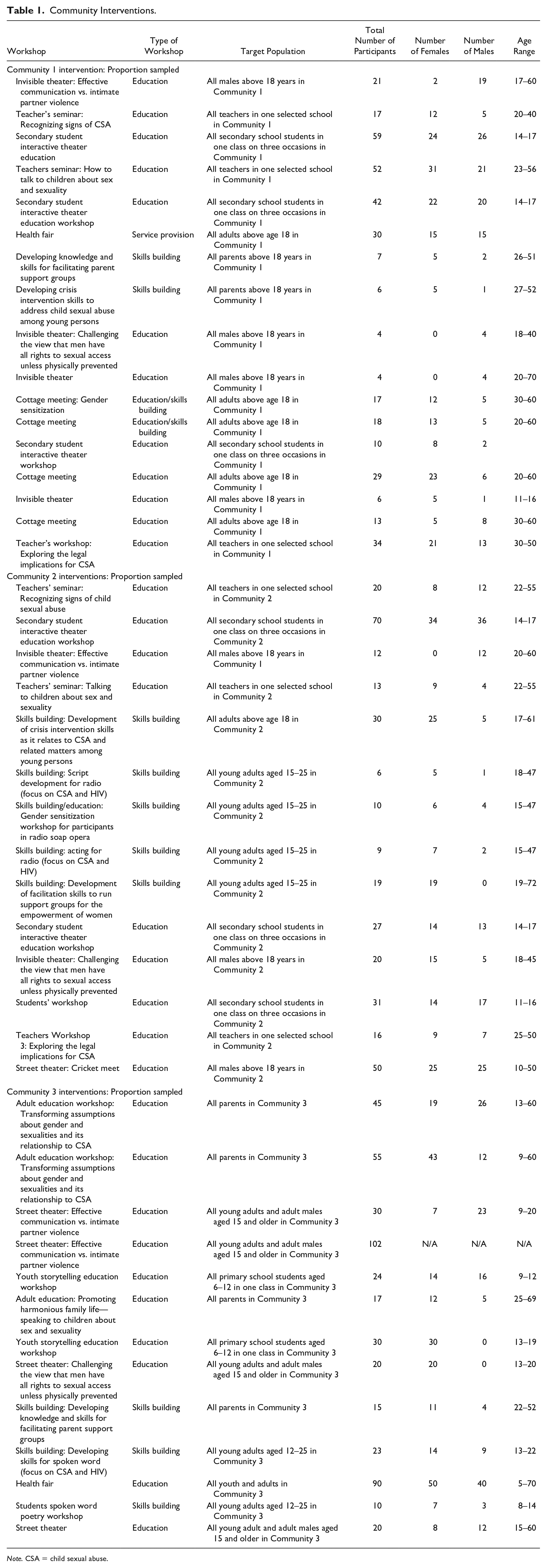
Note. CSA = child sexual abuse.
Results and Discussion
The results discussed in this section are derived from the analysis of the qualitative data collected, providing a nuanced understanding of meanings, underlying assumptions, perceptions, and taboos that cannot be easily derived from quantitative methods.
Language, Terminologies, and Popular Definitions of “Incest”
Diversity of definition among communities
“Incest” is the popular term used locally to describe sexual relations between an older adult male relative and a younger female relative. Drawing from the ethnographic case studies, there were variations among communities on the actual use and interpretation of the term. For example, in Community 1, it was reported that everyone agreed that an adult with a child was unacceptable and this included parent or stepparent with child and aunt or uncle with child. However, the lines were blurred when it came to siblings and cousins; as few saw this as acceptable while many found it unacceptable. (Ethnographic Case Study of Child Sexual Abuse, 2011, p. 23)
In Community 2, most persons defined incest as “sex among family members” but only acknowledged incest as taking place among persons who were related by “blood.” Further to this, “interfering” was the other popularly used term and the two were often used interchangeably. It was reported, for example, that No clear distinction was offered between incest and “interfering.” Most stated that one (interfering) was the physical touch, while the other (incest) was the actual physical act. The interfering (touching) usually comes before the incest (penetrating). Some persons even suggested that interfering was the local word for incest. (Ethnographic Case Study of Child Sexual Abuse, 2011, p. 38)
In Community 3, the word incest was also not often used, although understood. Like Community 2, there were other more popularly used terms to describe such acts, for example, “fingling, 1 interfering, liking him daughter, play with her, sex with underage girls, handled, inbreeding” (Ethnographic Case Study of Child Sexual Abuse, 2011, p. 65).
Nevertheless, in all three communities, there was an acceptance of the term “incest.” The taboo associated with the act, however, may have become embodied in the word, hence the preferred use of other less taboo terms.
Blood, community, and rules of acceptability
Community members also clearly differentiated between incest and child sexual abuse more generally. There was less clarity, however, about the degrees of separation that allowed such acts especially in relation to cousins. As one 14-year-old young woman at the Poetry Writing workshop in Community 3 asked, “If two cousins doing ting, is that incest?”
This also raised questions about who was family, as in most of this region, family is a generic term. In this community with a tradition of extended family, “it was seen as comprising husband, wife and children, brothers, sisters, nephews and nieces” (Ethnographic Case Study of Child Sexual Abuse, 2011, p. 56). There was some societal acceptance of sexual relations and even marriage among cousins, especially second cousins, in an attempt to maintain the integrity of the community. This may have been inevitable in such a small close-knit community.
As observed by the research ethnographer, The theme that seemed to be emerging here was one of protecting the integrity of the community by maintaining the blood ties and as far as possible refusing outsiders’ entry. The question that I began to grapple with at this early stage was how does the maintaining of the community’s purity through blood extend to familial sexual relations? (Ethnographic Case Study of Child Sexual Abuse, 2011, p. 53)
Interestingly, when students at a theater in education workshop in Community 3 were asked to identify those who would be the persons involved in incest and child sexual abuse. Stepmothers and stepfathers appeared on both lists suggesting the ambiguity of this relationship, especially in relation to the significance of “blood.” These perceptions however, contrasted with available data on perpetrators of child sexual abuse which included stepfathers but not stepmothers (Rape Crisis Society, 2010, p. 14; 2012, p. 19; 2016, p.68). The issue of “blood” emerged as a central issue in relation to degrees of allowability for intrafamilial sexual relations and abuse in these communities. It could be argued, as one of the research ethnographers did, that in close-knit rural communities such as Communities 2 and 3, where most community members were related to each other, notions of “blood” and “family” mediate traditional taboos around, and attitudes to, CSA and incest especially in contexts of unequal power. For example, the lack of a blood or biological connection often justified abuse by stepfathers. As one respondent observed, “Stepfathers think that because they are not biological they can have sex” (male, 51 years old, Community 2).
Blood ties emerged as well, in a very different way in the study, this time in relation to reports to the police. In Community 2, it was suggested that blood ties to policemen in the area may also prevent reporting.
Local Explanations for Child Sexual Abuse and IFSA
Women blaming
A number of local explanations for CSA and in particular IFSA emerged from the research. These ranged from the absence of mothers who had migrated overseas and the “suitcase” or “barrel” children left behind; the ready acceptance of strangers into a closed rural community (“over trust” on the part of the community); single parent situations (usually women); the entrance of stepfathers; male and female siblings sharing the same room and, in some instances, the same bed; and parental permissiveness and teenage defiance.
Many of these explanations refer to factors that have existed for some time. The proportion of children sharing the same bed has probably declined over the last century with improved standards of living and reduced numbers of children in households, so this would not be something new. However, the “suitcase” or “barrel children” phenomenon is a late 20th century one: the result of the increased migration of women leaving children behind. Almost all these explanations overtly or covertly blame women—women as migrants deserting children; women bringing strange men into the community, their households, or their beds; as well as women’s inability to properly bring up and protect their children. As shown below, this would be a recurring theme in local interpretations of this phenomenon.
Females responsible for establishing and maintaining boundaries: Women and girls blamed
The study found that sexual relations were associated with pleasure and power. Sex was perceived as natural but with the gendered expectation that it should be expressed by males without restraint. Females were expected to control the naturally aggressive sexuality of the men in their communities and protect their children. The occurrence of CSA was readily acknowledged, even though not always defined as abuse. Concerning the issue of consent, the consensus seemed to be that the onus was not on men to refuse but on women/girls to not be available, and the belief that if a woman (female) wants sex, then a man is obligated to give it to her. It became clear, therefore, that mothers and children were blamed for the occurrence but men were not; men were obligated to pursue all sexual opportunities that may arise.
“Mother blame” was a recurrent theme in conversations and interviews. The power of male breadwinner ideologies was apparent as while acknowledging the increasing work pressures on women, they were blamed for leaving their children with “male relatives” or for the home becoming an “unsafe place” for children. In Caribbean households, women have traditionally and increasingly accepted full or partial responsibility for the economic support for families. At the same time, however, despite some change, child care remains their primary responsibility. In the absence of family or state support for socialized child care, there is often reduced parental supervision and more premature adult responsibilities as children and young people care for younger siblings and hustle to assist financially. Unlike the past, “the village” is no longer conferred with nor accepts responsibility for children. Parents, often mothers, today usually have full responsibility (Reddock & Bobb-Smith, 2008).
Women were also blamed for introducing male partners into the home who then become predators on their children. Generally, fathers/grandfathers/stepfathers/uncles were not considered trustworthy and women spoke openly about not leaving their daughters alone with their fathers because they are “not taking any chances.” This practice was accepted as a given, the onus is on women and girls to adjust their lives to suit. In general, it was agreed that men could not be trusted to exercise sexual control, so it was up to women, especially mothers to monitor, guard, and protect their daughters. One respondent observed that “You as a woman have to be sensitive to know—have another eye—that woman must be wasn’t sensitive” (female, 71 years old, Community 3).
Not only mothers but also girl children were blamed. Respondents noted that if the female victims looked “biggish” or too big for their age in hairstyle, dress, and comportment, they were to blame for the occurrences. One informant stated, The child did look mature for her age and the man seemed to be much younger than the mother who should have known better not to get involved with a younger man. (Female, 24 years old, Community 2)
Another commented, The moral of the story is if she is 17 and she giving you a play and looking like that you could be tempted, we are all human beings. (Man in bar, invisible theater—gender ideologies and relationships, local bar, Community 1)
In response to questions about how male teachers should respond to young girls who make advances to them, the responses were as follows: She want it, she went and ask for it. (Male, cottage meeting attendee, Community 1) A 14-year-old is no fool. (Other male cottage meeting attendee, Community 1)
Both women and girls, therefore, were thought responsible for managing masculine sexual behavior through the policing and protection of girls from men: But in the end, it all boils down to parenting. Why? Especially with your children, especially a girl, you have to train her in certain things, like how to carry about herself, how to cover up her parts, attire herself properly, because the same way we as parents’ dress is the same way they will dress. That is what is parenting. It could be that the child never used to be attired properly and he keep watching her all the time and you just now see but it going on long time because of how she dress. It could be all of that. (Woman who brought along her daughter to a workshop on starting a parent support group, Community Library, Community 3)
Sexual relations between older men and young “underage” girls were considered common and it was agreed that early sexual activity by females was forced, for financial gain, to be like friends (peer pressure), or to be a woman. Teenage pregnancy was accepted as one outcome; illegal abortion was another. These incidents were also attributed to young girls exchanging sex for financial and other material gain (transactional sexual abuse). Others suggested that they were confusing sex with love.
In a clear example of the sexual double standard, blaming women and children did not seem to diminish the integrity of the community but protecting men was one way of protecting a community’s reputation as a “nice place.” Family bonds protected abusers from ostracism by family members when they were part of extended kin networks. Although IFSA was generally considered wrong and exploitative, persons suspected of or known to be involved in this kind of abuse often continued to enjoy freedom of movement, fatherhood status, and friendship even if it was known that they had abused and maybe even fathered a child with their daughter. The case studies also brought to light a shame in airing dirty laundry. As stated by a participant in the ethnographic case studies, Once you with a man and is a Christian you should not listen to gossip about him. (Female, 40 years old, Community 2)
The absence of recognition of the need for sexual accountability from men was striking.
No safe space: Children, especially female children are vulnerable
In all communities, it was noted that there were few “safe spaces” for children. In one community, in response to the facilitator’s question on the danger zones in the community, the first response was, There are no safe spaces. We know that society has broken down. Now we have boys and girls, brothers and sisters sharing the same room and sometimes even the same bed. We does have that going on. There is no safe space; and these are people who are from the church and schools. (Older woman, Church youth meeting on gender, HIV, and power relations, Community 3)
In another community, it was noted that, Home would be the danger zone. [Participant at intervention skills–building workshop for adults who work with children, Community 2) Bad spaces are the homes. Why? Well that is where the child gets abused . . . (Teachers’ Lunchtime Seminar, Community 2)
The danger presented by the home becomes even more significant in the context of women’s place being in the home. In the Anglophone Caribbean, despite a relatively greater degree of freedom of movement for women, men and boys still have more access to public space than women and girls. As noted by Chevannes (1999) in relation to Jamaica, a young girl’s life is surrounded by a protective ring, which starts at home, encompasses the school, and ends at home. Her whereabouts are known—home, school, or on an errand. Even the time it takes to get home from school is sometimes known and monitored by parents, or must be accounted for. By contrast, as soon as a boy approaches prepubescent years and the peer group begins to exercise its magnetic pull, he is allowed to socialize outside the home, that is, “out a’ street” or “out a’ road”—out of the direct control and supervision of parents. Chores and errands completed, there is no demand for a boy to remain in the yard. Indeed, too great an attachment to the confines of the yard is regarded as problematic, the symptom of a maladjusted, effeminate male—a mama-man. Boys learn from and with his peers the tricks and trade of the street culture, how to navigate the dangers, how to exploit them.
In a very contradictory way, therefore, the home could also be a most unsafe place for girls and young women. In Community 1, it was reported that, Even though girls are kept home to “stay out of trouble,” it is also recognised by some as an unsafe space where girls have to be watched and protected against predators who may or may not be related to them. It is the women who assume the duties of policing the safety of their daughters. In discussions with one woman (46 years old), she explained that she warned her daughter against a family friend who had a history of fingling animals, family, anybody. When he was around she watched her daughter very closely. She also spoke of a friend who does not leave her daughter alone with even her father because she is not taking any chances. (Ethnographic Case Study of Child Sexual Abuse, 2011, p. 65)
Other unsafe locations identified by Community 2 were lonely areas, for example, the beach on a quiet day or when strangers are around and areas in the community where alcohol and/or drugs were prevalent.
In a Community 1 workshop on developing crisis intervention skills, community members were asked to identify possible safe spaces in the community where they could seek help or support. For the most part, they identified churches or temples and health centers. They felt that there they would find “a sense of compassion, a human touch” and a “humanitarian response.” They did not trust police stations and felt that children would not go there for fear that “their father would be arrested” or that the community would find out. It is noteworthy that for many, their notion of safety included confidentiality, something which was also evident in other communities.
In Community 2, the church was also identified as a place of safety, including the Roman Catholic Church, despite its recent history of CSA. The main reason for this, however, was that the information would be safe as the priests could not divulge information gained through confession. For many, the main danger was not the physical danger to the child but rather the danger of gossip, and the stigma that would result. So, as the notetaker for the Community 2 Teachers Lunchtime seminar observed, participants could not agree whether the police station, the main public space for reporting, was safe for children. Many of the presentations advocated carrying the child to the police station as one of the first action items in dealing with child sexual abuse. However, in this area, it is doubtful whether residents would follow this direction, given the entrenched suspicion of gossip, stories told, and confidentiality.
The fear of everyone “knowing your business” was widespread and, as a result, it was commonly held that IFSA should not be disclosed but rather, concealed. This would have implications for reporting.
Where a Perpetrator Was Identified
In all three communities, abusers, victims, and stories of CSA were widely known to members, whereas the rights of children were generally not known. 2 At a workshop for the women survivors of CSA support group in Community 2, an older woman reported walking into her house to find her 9-year-old daughter being raped. In reporting her story, she noted that the man jumped through the window. She was traumatized, but consoled her daughter, and in response to a question responded that the entire family had received counseling. There was, however, no mention of what became of the perpetrator.
In that community, it was noted that where a perpetrator was identified, he simply avoided public appearances for a while until the issue was no longer a focus of attention. Sometimes, people chose religious solutions such as pressing the perpetrator to publicly “confess” and the victim to “forgive” and then reestablishing household relations with both abused and abuser remaining in the house. This often created a uniquely conflicting situation where IFSA is considered so unacceptable and unforgivable that when the child and family appear to have reconciled, others doubt that abuse ever took place. In other words, it is so unforgivable, that those who forgive risk being entirely disbelieved. This can perhaps be seen as unwittingly perpetrating an abuse-accommodation syndrome, which can lead to behaviors such as secrecy, helplessness, accommodation, disclosure, and retraction of accusations. Feiner (1997), in an article reflecting on the challenges of child victims’ testimonies in U.S. legal cases, observed the following: Keeping the secret causes the child to react with helplessness to additional acts of sexual abuse. Since the child cannot tell, cannot resist, and cannot avoid, she responds by accommodating to the abuse, that is, by becoming passive and seemingly accepting of the abuse. Accommodation allows a child-like Anna to accept the abuse and survive. She comes to believe that she is responsible for what is happening to her, and that she must keep her family intact by cooperating with her abuser. While the child’s passivity allows her to survive emotionally, it also permits and encourages the perpetrator to escalate his sexual demands without fear of disclosure. (p. 1400)
She notes further that when there is disclosure after a pattern of abuse and accommodation, there may be pressure from other family members to retract or suppress the story as they find it difficult to accept that the perpetrator committed these acts. The potential impact on the family may be overwhelming as well as the stigma that may be attached. In these circumstances, Feiner argues “Those who cannot pressure the child into recanting may instead attempt to undermine the child’s credibility to others. Children who do not go so far as to recant will often refuse to talk about the incest experience or testify” (Feiner, 1997, pp. 1400–1401).
In other cases, perpetrators appear to be untouchable in some communities as people “mind their business.” During a cottage meeting in Community 1, one man reported at a cottage meeting “I know one now, a school teacher living with a twelve-year-old, she must be sixteen by now. Even though we know, we couldn’t say anything, they weren’t from here, they were renting.” The insinuation here that this perpetrator is an outsider and not someone from the community is also telling.
Also in Community 1, one woman reported that she was aware of a young girl who had been sexually abused by her father throughout her life but nothing had been done. At a cottage meeting on sex and gender, she observed that . . . at 15 the girl was impregnated by her father and told the nurses at the hospital, but because of who her father is, nothing was done. Now the girl is an adult with a family of her own and she still cannot go to her parents’ home when her father is there.
Bohm’s (2017) writing on Ghana noted the pressures faced by victims of IFSA to remain silent to protect against family dishonor, making young women and girls responsible for protecting family honor, which takes precedence over their needs as children.
Ideologies of Gender and Sexuality
What became clear was that patriarchal gender ideologies were alive and well, although there was evidence of greater recognition of women’s rights and greater equality of treatment for girls. From the ethnographic observations, however, there is evidence of the local gender ideologies encapsulated in the popular local saying “Tie your hen, I leggo my cock” or the Jamaican equivalent—“Tie your heifer, I loose my Bull” (Chevannes & Brown, 1998): In other words, females must be controlled, whereas males should be allowed sexual freedom. Boakye observes that feminist theories and research have tended to focus largely on adult rape. He argues further that it is children’s, like women’s, vulnerability that makes them targets of assertions of masculinity (Boakye, 2009). It could be argued, however, based on this research that the role of patriarchy in relation to violence against children, especially child sexual abuse, should receive more attention—for children, as with women, their perceived vulnerability is important but only in addition to the persistent gender ideologies that justify male sexual entitlement. In all communities, religious ideas were powerful underlying parameters of gender ideologies in ways that other aspects of life were not. Although religion would be used to justify male dominance or the sexual division of labor, there was widespread recognition that its role in encouraging sexual restraint was at best unsuccessful.
In Community 3, for example community members observed, Church is trying to promote sexual purity but some church leaders and members not setting the right example. (Female, 41-year-old Pentecostal) Religion is encouraging the youth to not have sex but it does not work. (Female, 24-year-old Pentecostal)
Students in Community 2 were unfamiliar with the concepts of sexual abuse and IFSA. Both high school and primary school students had varying opinions on the issue. High school children voiced approval of younger girl–older man relationships because of the man’s experience, for material gain, and to preserve their reputation as younger men are more likely to talk.
Secondary school boys in that community reported that their notions of acceptable masculine behavior were learnt from peers through peer pressure against “girl” activities and not from parents. However, there were instances of fathers in Community 2 encouraging their sons to have sex, or to father children as mechanisms of heterosexual validation. It was reported that In fact, a number of fathers encourage their sons to instigate sexual relations with girls. One man’s rationale was that he would prefer for his [15-year-old] son to go and “breed ah gyal” (get a girl pregnant) than “to go and get in trouble with the law and the police have to put their hands on him.” (Ethnographic Case Study of Child Sexual Abuse, 2011, pp. 37–38)
This father, therefore, encouraged his son to go out and impregnate girls with the understanding that somehow the child(ren) would be taken care of. In his words, “not to worry ‘dey (the children) go get mind’” (Ethnographic Case Study of Child Sexual Abuse, 2011, p. 38).
This scenario is similar to those described by Chevannes (2001) for Jamaica, where he found that young boys were encouraged to be sexually active at very early ages, sometimes as early as 7 or 8 years by fathers and mothers in a way that girls were not. He observed further that it is a heterosexual activity that is understood and encouraged (Chevannes, 1999) almost as a perceived preventive to or protection against homosexuality. It is this sense of sexual entitlement that would continue to govern male sexual expectations and behaviors into adulthood.
In Community 3, participants at an effective parenting support group workshop expressed similar sentiments, although the ways in which masculine gender ideologies shaped masculine identity and sexual activities were expressed differently. Of note is that today, attention to school and books is perceived as feminine (Reddock, 2010). They also observed that children exhibited varying degrees of sexual awareness at early ages but teachers and parents were ill prepared to deal with such situations.
Boys as Victims?
Boys expressed awareness that they too could be victims of CSA but there was very little said about boys sexually abused by adult males. There seemed to be more discomfort speaking about it. Teenaged participants at a theater in education workshop in Community 2 noted that girls were taken more seriously than boys when it came to issues related to CSA. Boys, they noted, were indeed stigmatized if they reported any cases of CSA, as they were expected to be sexually aggressive. Some even saw this as a case of “gender bias,” in that this male victimization was perceived as normal. High school students at a poetry writing workshop generally agreed that boys are more hesitant/reluctant to reveal abuse, suggesting that when boys are abused, their masculinity is affected or decreased (Ethnographic Case Study of Child Sexual Abuse, 2011).
Generally, there was societal acceptance of the older man/younger female relationship; however, due to prevailing gender ideologies, adults did not view boys’ sexual relations with older women as abuse, according to one man from Community 2, That is batting practice. (Middle-aged male, 30–40 years)
In the ethnographic study of Community 1, it was noted that boys are provided with even less sex education than girls: Fathers left it up to the mothers; mothers spoke to their girls about what to do when they start menstruating, whereas boys seemed to be marginalised where sex education was concerned. (Ethnographic Case Study of Child Sexual Abuse, 2011, p. 22)
It was also reported that, There is no evidence that any knowledge is provided [to boys] on bodies, sexuality, hormones, feelings, etc. by the parent or the school. (Ethnographic Case Study of Child Sexual Abuse, 2011, p. 26)
This supports an earlier finding made in relation to the lack of exposure to any form of sexuality education, even within the family, among young male students at the University of the West Indies (Douglas et al., 2009), and emphasizes the importance of considerations of sex–gender diversity in understanding, preventing, and managing child sexual abuse.
Masculinities, Ideologies, and CSA/IFSA
Although men acknowledged that CSA was wrong, they justified it by saying that the society accepts it. Various explanations were given by the men for men’s sexual behavior generally, including the right to have multiple relationships. Such views were pervasive, characterizing many communities. The reasons stated for older men/younger women relationships included the lack of thinking, insecurity, and midlife crisis, whereas “poverty” was suggested as a reason why young women have relationships with older men. What is clear is that sexual–economic exchange often governed these relationships between young women and older men. For some men, contributing to their upkeep and education as fathers or stepfathers gave them this entitlement. For others, this was an expected recompense and young women accepted that this was a normative exchange. There was a general sense of sexual entitlement, which many men felt was their right, but which was also important to maintain their self-esteem and masculine gender identity.
This general acceptance of sexual activity with young girls, almost as a matter of course, was reflected in the many sayings garnered from the field: “After 8 is breakfast”; “after 9 is mine”; “after 10 is break” (referring to ejaculation); “after 12 is lunch.”
That sex with younger female family members was perceived by some as part of a sexual “rite of passage” of the male caregiver was expressed in the statement: After 12 is dinner, I not feeding any cow for anyone else to drink milk from. (Male, 40 years old, cottage meeting, Community 1)
In an invisible theater scenario conducted at a local bar, shown below, an adult man acknowledged that underage sex was wrong, while expressing a preference for 15-year-olds; another suggested that sex with a 13-year-old was normal: Male: I like them to be 15 years old Facilitator: Now is that normal? - sounding normal - In Trinidad, I know it wrong eh, I know that but that is normal. Thirteen is a normal age. You does see that everywhere - Nah man not thirteen . . . (Invisible theater activity with men 16–60+ years old, at a local bar, Community 2)
In addition, men refusing sex that appeared to be available was deemed unacceptable, and taken as a sign of possible homosexuality: “Men cannot refuse sex or else they would be considered funny” (male, 30, Community 1).
Alcohol consumption is also an important marker of adult masculinity in Trinidad and Tobago society and not drinking alcohol is seen as unmasculine: “A man who does not drink rum is a manicou man” (male 30–40 years, cottage meeting, Community 1).
In all three communities, the ethnographic studies noted the significant number of bars and their effect on male behaviors in particular. These included drug and alcohol addiction; absentee fathers; increased alcohol consumption among young people; material deprivation experienced by children, through the wastage of finances by the father; increased violent and unruly behavior such as fights; and provocative, suggestive dancing by females; even dropping out of school by some youths (Ethnographic Case Study of Child Sexual Abuse, 2011). In Community 1, a link was made between alcohol use and expressions of violent masculinity among peers. It was also described as a contributor to abuse within the home, including sexual abuse as it makes “men more brave” (Ethnographic Case Study of Child Sexual Abuse, 2011, p. 77).
Limitations of the Study
Action research using qualitative methodologies is a preferred way to investigate taboo topics such as child sexual abuse, because it allows for an in-depth understanding of the complexities of the phenomenon and to explore in more depth the issues involved. Methodologies such as ethnography and ethnographic note-taking during community interventions that allow an immersion in the lives of the people being studied are best to explore the social and cultural contexts of certain behaviors. This study, which explored for the first time the sociocultural and gendered context of child sexual abuse in Trinidad and Tobago, therefore, used a qualitative action research methodology. There are, however, limitations to such a methodological approach. This study focused primarily on three communities selected to represent the diversity of the population of Trinidad and Tobago. Because ethnographic studies are expensive and time consuming, there were limits to the length of time that ethnographers could spend in the communities prior to the creation and implementation of the community interventions. The study also utilized other country-level sources of data from the initial action research activities, including the nation-wide service providers study, which included follow-up workshops with a broad range of service providers including teachers, social workers, and women’s movement activists; a legislative review, as well as data derived from the community-based interventions. Despite this, caution is exercised in generalizing the findings to the population of Trinidad and Tobago.
Analysis of data and the generation of new knowledge on child sexual abuse in this study required a process of reflexive discussions by the facilitators. It was, therefore, a priority to ensure that the research project utilized independent trained facilitators to lead the community interventions with training and/or experience in community-based action research and gender analysis. As with all qualitative work, however, the reflexive discussions and the analytical process employed by the researchers would have been influenced by the skill of the ethnographers, community intervention facilitators, and ethnographic notetakers and may have included elements of subjectivity in the interpretation.
Notwithstanding these limitations, the study included several methodological strengths, specifically the use of a very innovative model of action research, and the multifaceted approach to data collection, utilizing informants from multiple sources. This triangulation process afforded corroboration of the findings and pointed to the validity of the data, and the usefulness of the research in providing new insights, which propose new ways of understanding this complex phenomenon in Trinidad and Tobago.
Conclusion
The social context for child sexual abuse in the Caribbean involves several interconnecting factors, but from the evidence presented above, it is clearly located within a context of gender ideologies and expressions, sexual expectations and behaviors, and social norms based on patriarchal values. It is noteworthy that women and girls continued to have the main responsibility to establish boundaries including physical boundaries and to protect themselves. At the same time, the attitudes and behaviors of men and older boys presented above reflected a strong sense of sexual entitlement among older boys and men. Many of the same factors that give rise to other forms of gender-based violence, for example, unequal power relations and economic dependence of many women on men and the status of children, are also important contributing factors to child sexual abuse. This research supports other studies that argue that children’s vulnerability makes them like women, targets of abusive masculine assertions. In addition, the decision to disclose came with significant burdens for children in relation to family honor, economic sustainability, stigma, and social judgment.
Although there was awareness by boys that they too could be victims of CSA, there was more discomfort in speaking about this. Mainstream gender ideologies constructed men as active (and normally heterosexual) sexual beings who should accept all available sexual opportunities. Refusing sexual opportunities from women, therefore, whether consensual or not, could be construed as a sign of homosexuality, whereas rape by men could also be similarly understood. Boys and young men were, therefore, unwilling to speak about their experiences of these phenomena. Meanings attached to masculinity and femininity, therefore, have important implications for CSA as they shape how girls and boys, men and women experience their bodies, their sexuality, and their sexual rights. These ideas also shape the kinds of power to which they have access as well as the kinds of power to which they are especially vulnerable. Despite the ethnic, geographical, and religious differences among communities, what was also clear from this study was that despite assumptions and stigmatization of certain communities and groups, child sexual abuse and IFSA was characteristic of the entire society.
Footnotes
Acknowledgments
We would like to acknowledge the financial support of the UWI Research Development Fund, UN Trust Fund to End Violence against Women, UNWOMEN, and UNICEF. We also thank the communities and organizations who welcomed and agreed to collaborate with us. The support of the research assistants, graduate students, resource persons, and staff of the UWI, St. Augustine’s Institute for Gender and Development Studies (IGDS) was invaluable and must also be acknowledged.
Declaration of Conflicting Interests
The author(s) declared no potential conflicts of interest with respect to the research, authorship, and/or publication of this article.
Funding
The author(s) received no financial support for the research, authorship, and/or publication of this article.
