



Abstract
The relationships between exposure to potentially traumatic events (PTEs), as well as posttraumatic stress symptoms (PTSS) and somatic syndromes, have recently been exemplified. Exposure to PTEs can also set in motion complex psychological processes such as pain catastrophizing that is associated with PTSS and somatic syndromes. However, the specific moderating role of pain catastrophizing in these links remains relatively unexamined. The present study aims to assess a moderated mediation model in which catastrophizing will moderate the indirect effect of exposure to PTEs on the number of somatic symptoms and chronic pain severity via PTSS, among individuals with somatic syndromes. A volunteers’ sample of 175 Israeli adults with varied somatic symptoms responded to online validated self-report questionnaires in a cross-sectional designed study. Participants’ self-reported PTSS rates (57.1%) were high. PTSS and pain catastrophizing, but not exposure to PTEs, were related to chronic pain severity. Interestingly, a moderated mediation analysis indicated that the indirect effect of catastrophizing in the relation between exposure to PTEs and the number of somatic symptoms via PTSS existed only among those with high levels of catastrophizing. The present study highlights the assumption that functional somatic syndromes (FSS) have much in common. Our findings support a moderated mediation model that begins with exposure to PTEs that leads to PTSS, which in turn increase the number of somatic symptoms. Higher levels of pain catastrophizing might attenuate this indirect link by affecting the interpretation of PTSS and create a vulnerability to more somatic symptoms. Thus, changes in cognitive-sensory processing in the form of catastrophic thinking can affect psychobiological processes and heighten sensitivity to stimuli arising in the body and should be considered as possible target for future research and psychological interventions.
Introduction
Somatic symptom disorder (SSD) is characterized by somatic symptoms that are either very distressing or result in a significant disruption of functioning, as well as excessive and disproportionate thoughts, feelings, and behaviors regarding those symptoms (American Psychiatric Association [APA], 2013). The prevalence of somatic symptoms among adults in the general population is estimated at 5% to 7% (Rief et al., 2011), and at least 20% to 25% who endorsed SSD might suffer from chronic or recurrent symptoms (Kroenke, 2003). Specifically, there are several functional somatic syndromes (FSS) which are defined by specific somatic symptoms associated with a unique affected area or physical manifestations of each syndrome. The most common FSS are fibromyalgia, chronic widespread pain, chronic fatigue syndrome, temporomandibular disorder and irritable bowel syndrome (Afari et al., 2014).
All FSS are quite similar, especially in their diagnostic criteria, reported symptoms, gender distribution, and response to treatment (Wessely et al., 1999). Moreover, the comorbidity between FSS and high rates of symptom overlap often presents challenges to the differential diagnosis process (Aaron & Buchwald, 2003). Due to the absence of distinct biomarkers that might help to define specific FSS, there is an ongoing debate as to whether FSS should be defined as separate entities or as one unified syndrome. While some emphasize the utility of separate diagnostic categories (Moss-Morris & Spence, 2006), others argue that all FSS are represented by one underlying common basic syndrome, and the existence of specific FSS is largely an artifact of medical specialization (Burton, 2003). To date, most of the current literature pertains to specific syndromes defined by medical subspecialties (White, 2010). Our study aims to propose the assumption that SSD are a broad grouping of symptoms with varying manifestations and severity of somatic symptoms. Unfortunately, this assumption has not been accompanied by much empirical support. Particularly, the association between posttraumatic stress symptom (PTSS) and SSD has not been examined. Therefore, the present study, which refers uniquely to all FSS as an “umbrella” of symptoms syndicated under one basic syndrome, examined their association to PTSS.
Recently, Ezra et al. (2019) formulated a conceptual model for psychosomatic disorders in which FSS are seen as a result of a bidirectional, psychobiological conditioning process of heightened sensitivity to stimuli together with hyperreactivity of the autonomic system, which form a “vicious cycle” of mutually enhancing learning processes stemming from either body or mind. Although this vicious cycle is often preceded by exposure to potentially traumatic life events (PTEs) which can dysregulate the limbic system and set in motion complex psychological processes such as catastrophic misinterpretation, selective attention, fear-based conditioning and sensitization, these links remain relatively unexplored (Ablin et al., 2010). The present study aims to fill this gap by empirical examination of the associations between exposure to PTEs, posttraumatic stress disorder (PTSD) symptoms (PTSS), and somatic symptoms among individuals with varied FSS.
Many studies have shown an association between exposure to stress and PTEs and FSS. In addition to the psychological distress that frequently accompanies exposure to PTEs, exposure to potentially traumatic experiences in childhood and adulthood has been consistently associated with increased reporting of somatic symptoms and other health outcomes (e.g., Jiao et al., 2015). Indeed, a recent meta-analysis study revealed that individuals who reported exposure to PTEs were 2.7 times more likely to have FSS regardless of type of trauma (Afari et al., 2014).
Most people who have been exposed to PTEs may experience temporary difficulties, followed by adjustment without noticeable symptoms. However, in a small but significant minority, exposure to PTEs may lead to the development of PTSD (APA, 2013). Those suffering from PTSD tend to experience recurrent, involuntary, and intrusive memories and dreams, avoidance of trauma-related thoughts or feelings, negative alterations in cognition and mood, and trauma-related alterations in arousal and reactivity. These symptoms lead to distress and may cause impairment in different areas of life, such as social or occupational (APA, 2013). Besides the behavioral and psychological consequences of PTSD, the dysregulation of physiological systems that are inherent in PTSD (Yehuda et al., 2015) can further limit one’s recovery and potentially foster the development of FSS.
Many studies have shown that PTSD has been associated with a range of medical conditions such as poorer physical health–related quality of life and greater musculoskeletal pain, and cardiorespiratory, gastrointestinal, and general health complaints (Pacella et al., 2013). PTSD is also associated with a significant increase in various somatic symptoms (Spiller et al., 2016), whereby up to 10% of somatic symptom variance has been explained by PTSD symptoms (Milligan-Saville et al., 2017). For example, PTSD has been associated with a significant increase in chronic pain symptoms (Defrin et al., 2008), fibromyalgia (Ciccone et al., 2005), rheumatoid arthritis, chronic back and neck pain, migraines and chronic headaches (Sledjeski et al., 2008).
Since exposure to PTEs precedes the development of PTSS, and both were found to be linked to heightened somatic symptoms, PTSS might serve as a mediator in the relationship between exposure to PTEs and somatic symptoms. Indeed, in their prospective study, Andreski et al. (1998) found that individuals with PTSD were at increased risk for future pain and conversion symptoms, compared with those without PTSD. Moreover, no new PTSD cases were found prospectively in people with a somatization disorder, thus hinting at temporal effects between exposure to PTEs, PTSD, and somatization. Importantly, a recent study found that specific symptoms of PTSD, namely active avoidance and hyperarousal patterns, partially mediate the relationship between PTEs and somatization symptoms (Morina et al., 2018).
Several theoretical models have attempted to explain the complex underlying mechanism between exposure to PTEs, PTSS, and somatic symptoms, and to suggest factors that may be implicated in the etiology and maintenance of both conditions (Otis et al., 2003). For example, the mutual maintenance model (Sharp & Harvey, 2001) describes several mechanisms by which chronic pain and PTSS may be mutually maintaining conditions, and that there are several pathways by which both disorders may be involved in the escalation of symptoms and distress following PTEs. This model posits that chronic pain serves as a persistent reminder of the trauma, and conversely that arousal triggered by that reminder promotes avoidance of pain-related situations. In this study, we will focus on one suggested pathway of this model, that is, the reasoning bias toward threatening stimuli in the form of pain catastrophizing. Specifically, we will explore the moderating role of pain catastrophizing in the indirect association between exposure to PTE’s and somatic symptoms via PTSS.
Pain catastrophizing is a negative cognitive-affective response, representing the tendency to think and predict the worst outcome. It is characterized by exaggerated worry, irrational thoughts, and jumping to erroneous and negative conclusions. As part of the psychobiological process of somatic symptoms, catastrophizing might lead to biases in information processing, negative beliefs about the symptoms, rumination, helplessness, and increased pain and sensations (e.g., Sharp & Harvey, 2001). Thus, it is no surprise that catastrophizing has been hypothesized to increase physical manifestations of various somatic syndromes (Ezra et al., 2019). Indeed, it was found that higher levels of catastrophizing were positively associated with increases in symptom severity for patients suffering from irritable bowel syndrome (Van Tilburg et al., 2013), chronic pain, rheumatoid arthritis (Keefe et al., 1997), and fibromyalgia (Gracely et al., 2004). A recent review concluded that catastrophizing is one of the most important psychological predictors of pain experience. Catastrophizing has been found to predict up to 31% of the variance in pain intensity ratings and has been shown to predict disability better than disease-related variables or pain itself (Sullivan et al., 2001).
Catastrophizing and the negative appraisals of the traumatic event and/or its sequelae have also been positively associated with PTSD. Catastrophizing is prevalent and highly correlated with PTSD, and has been associated with a heightened risk for developing PTSD symptoms following a traumatic event (Gellatly & Beck, 2016). Moreover, Bryant and Guthrie’s (2005) study found that catastrophic thinking prior to trauma exposure predicted PTSD among trainee firefighters. Similar conclusions were also drawn in a longitudinal study which found that pre-deployment catastrophizing was modestly associated with post-deployment PTSD symptoms in a cohort of National Guard troops and following a terrorist attack (Jenness et al., 2016).
Preliminary empirical evidence has supported propositions that catastrophizing is related to greater expression and severity of PTSD symptoms in chronic pain patients (Sullivan et al., 2009). Moreover, in a study that examined differences in coping strategies and beliefs regarding pain, it was found that patients with comorbid chronic pain and significant levels of PTSD symptomatology reported higher levels of catastrophizing and maladaptive coping strategies and beliefs about pain than patients with chronic pain alone (Alschuler & Otis, 2012). According to these findings, and based on the mutual maintenance model, it can be assumed that catastrophizing may influence the relationships between PTSS and somatic symptoms. Thus, catastrophizing may distort the ways patients, who have been exposed to PTEs and developed PTSS, perceive their state of health, experience their symptoms, and interpret their disability. Despite the prevalence of comorbid PTSS and somatic symptoms and their association with catastrophizing, only a few studies have focused on the complex mechanism by which catastrophizing is associated with PTSS and somatic symptoms. To understand how different levels of catastrophizing affect the relationship between PTSS and the number and severity of somatic symptoms, in the present study we have expanded upon previous research by examining a novel moderating-mediating hypothesis of catastrophizing regarding the association between PTSS and somatic symptoms following exposure to PTEs.
The Present Study
Based on the literature review, we hypothesize that (a) exposure to PTEs and PTSS will be positively associated with the number of somatic symptoms and chronic pain severity; catastrophizing will be positively associated with PTSS and exposure to PTEs; (b) catastrophizing will moderate the indirect effect of exposure to PTEs on the number of somatic symptoms and chronic pain severity via PTSS, such that the indirect effect will be stronger when catastrophizing is high—a moderated mediation model (see Figure 1).
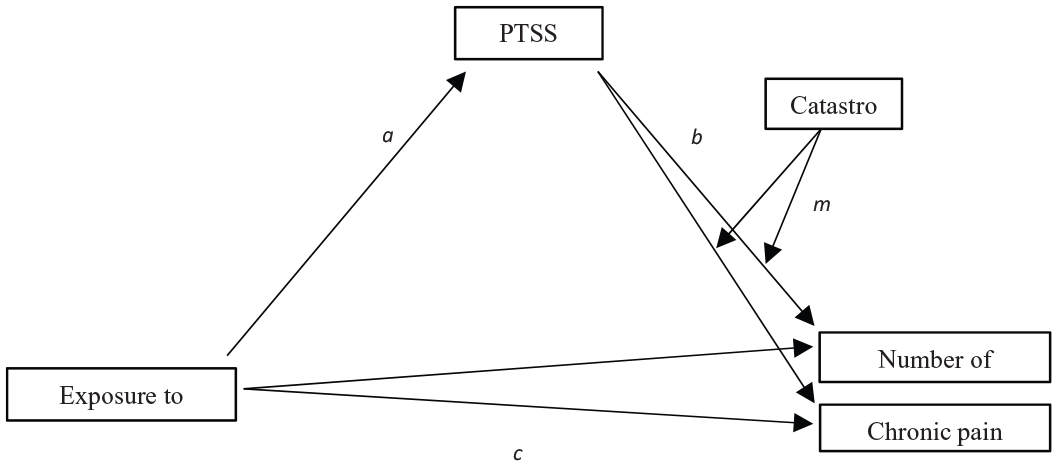
Hypothesized moderated mediation model and conditional indirect effects.
Method
Participants
A total of 175 Israeli adults participated in this cross-sectional designed study. The inclusion criteria were Israeli men and women aged 18 to 45, with significant somatic symptoms. As in previous studies, participants were identified as having significant somatic symptoms if they reported exceeding the Patient Health Questionnaire Somatic Symptom Severity (PHQ-15) cutoff point of 10, indicating moderate to high somatic symptoms severity (e.g., Kocalevent et al., 2013). The choice of this conservative and strict cutoff was made to predict more precisely and optimally the potential presence of somatic symptoms. Exclusion criteria were age above the range, nonsignificant somatization (low somatic symptoms severity on the PHQ-15), and mental distress while completing the questionnaires.
Of all the adults who replied initially on the questionnaires (n = 397), 116 participants (29.2%) completed only the sociodemographic questionnaire, 75 participants (18.9%) completed only two to three questionnaires and 206 participants (51.9%) completed all/most of the questionnaires. A comparison of these three groups did not reveal any significant differences, except for the variables age, F(2,353) = 10.392, p < .05, and self-report of somatic syndrome diagnosis given by a clinician or mental health professional, χ²(2) = 8.046, p < .05. Participants who completed all/most of the questionnaires were younger and reported higher self-report percentages of somatic syndrome diagnosis, compared with participants in the other two groups. To summarize, of the 206 participants who completed all/most of the questionnaires, 175 (44%) participants met the inclusion criteria. Participants’ sociodemographic and medical background characteristics are presented in Table 1.
Sociodemographic and Medical Background Characteristics.

Note. Diagnosis of somatic syndrome = self-report of diagnosis of somatic syndrome given by a physician or mental health professional.
Procedure
Potential participants were recruited between November 2017 and February 2018 in several ways: from among volunteers who were active participants in somatic symptoms websites and online communities (online specialized forums for discussions relating to health conditions, somatic symptoms and adjustment); volunteers from the somatization nonprofit organization data base; students from an Israeli university who participated in exchange for partial fulfillment of a research participation requirement; and volunteers who responded positively to an advertisement for enrollment in the study.
The researchers posted a message briefly explaining the purposes of the present study and asked for volunteers. Those who agreed to participate received an explanation of the study’s aims and a link to the related online survey through an online data gathering website. Participants were required to affirm willingness to participate and to give informed consent. All potential participants were promised at the outset that questionnaire data would be completely anonymous, and no personal identifying information would be collected. Moreover, participants were told that answering the questionnaire items should not cause any known harm to them, and that refusing to participate or quitting while completing the questionnaire would have no impact on them in any way. Following completion, participants were sent a letter of thanks and were compensated with a voucher for coffee and pastry (approximate value of US$5), except for university students, who in return for their participation received “coupons” in the university’s experimental system. Approval for this study was given by the University’s Ethics Committee.
Measures
Posttraumatic Stress Disorder Checklist (PCL-5)
Participants’ PTSS were assessed with the PCL-5 (Weathers, Litz, et al., 2013) self-report questionnaire that taps the 20 symptoms listed in the Diagnostic and Statistical Manual of Mental Disorders (5th ed.; DSM-5; APA, 2013). Participants were asked to rate how often they had suffered from each symptom in the previous month in response to their most traumatic experience, on a scale ranging from 0 (not at all) to 4 (extremely). PTSS was operationalized both as a continuous variable using a total symptom severity score (range = 0–80) by summing the scores for each of the 20 items, and as a dichotomized DSM self-report “diagnosis.” Participants were identified as having PTSS if they reported in excess of the PCL-5 cutoff point of 38 (Weathers, Litz, et al., 2013). Alternatively, using DSM-5 symptom criteria, a case was decided if a participant endorsed at least 1 intrusive symptom, 1 avoidant symptom, 2 negative alterations in cognitions and mood symptoms, and 2 hyperarousal symptoms. The number of positively endorsed symptoms was calculated by counting the items for which the respondents answered 2 (“moderately”) or higher. The PCL-5 was translated into Hebrew using the back-translation procedure and has been used in previous studies (e.g., Zerach & Magal, 2016). Preliminary results show an excellent construct validity (α = .92), and good convergent validity (α = .74–.85) with other PTSD measures such as the Posttraumatic Stress Diagnostic (PDS) or Detailed Assessment of Posttraumatic Stress (DAPS) (Blevins et al., 2015). It also has excellent internal reliability (α = .96), and good test–retest reliability (α = .84) properties (Bovin et al., 2016). The PCL-5 reliability in this study was Cronbach’s α = .95.
Life Events Checklist (LEC-5)
Participants’ potentially traumatic and negative life events were assessed with the LEC-5 (Weathers, Blake, et al., 2013) self-report questionnaire composed of 17 PTEs over the participant’s life that could lead to PTSD or psychological distress. The events were selected from empirical and clinical literature, covering possible traumatic life-threatening experiences (e.g., work or car accident, physical or sexual assault) and distressing family conditions (e.g., neglect, abuse). For each item, the respondent marked whether the event happened to him or her personally (0), was witnessed by him or her (1), heard of it (2), not sure (3), or irrelevant (4). Items marked as “happened personally” (0) were encoded as “1,” whereas the other responses (1–4) were coded as “0.” The sum of PTEs to which participants were directly exposed was used for analysis. In the present study, participants were also asked to mention the year in which the PTEs happened to them. The LEC-5 was translated into Hebrew using the back-translation procedure for the purposes of the present study. The psychometric properties of the LEC-5 are still under examination, but preliminary results show impressive psychometric properties such as good test–retest reliability (.82) and good convergent validity with other PTSD measures such as the IES or PDS-5 (Rzeszutek et al., 2018). The LEC-5 reliability in this study was Cronbach’s α = .76.
Patient Health Questionnaire Somatic Symptom Severity (PHQ-15)
Participants’ somatic symptoms were assessed with the PHQ-15 (Kroenke et al., 2002) questionnaire, composed of 15 somatic symptoms or symptom clusters that account for more than 90% of the physical complaints reported in the outpatient setting. The PHQ-15 also includes the most prevalent Diagnostic and Statistical Manual of Mental Disorders (4th ed.; DSM-IV; APA, 1994) somatization disorder somatic symptoms. For the 13 somatic symptoms, participants were asked to rate the severity of each symptom from which they suffered (e.g., back pain, pain in your arms, legs, or joints) in the previous 4 weeks, on a scale ranging from 0 (“not bothered at all”), 1 (“bothered a little”), or 2 (“bothered a lot”). For the two somatic symptoms that are also part of the PHQ depression module—feeling tired or having little energy, and trouble sleeping—participants were asked to rate the severity of each symptom they suffered from in the previous 2 weeks on the same scale ranging between 0 to 2. Somatic symptoms were operationalized as a total symptom severity score (range = 0–30) by summing the scores for each of the 15 items. The severity of somatic symptoms is classified as minimal (0–4), low (5–9), moderate (10–14), and high (15 and above). The PHQ-15 was translated into Hebrew using the back-translation procedure for the purposes of the present study. The PHQ-15 has high convergent validity with other indicators of dysfunction, such as functional status, disability days, and symptom-related difficulty. It also has good reliability (α = .80) (Kroenke et al., 2002), and good test–retest reliability (α = .83) (Van Ravesteijn et al., 2009) properties. The PHQ-15 reliability in this study was Cronbach’s α = .72.
Chronic Pain Grade Scale (CPGS)
The CPGS (Von Korff et al., 1992) is composed of seven items measuring the severity of chronic pain on three dimensions: persistence, intensity, and disability. It consists of six items, for which participants were asked to rate the severity of their pain over the past 6 months on a scale ranging from 0 (no pain) to 10 (pain as bad as could be). Furthermore, the number of days with disability during the past 3 months were assessed. The questionnaire results enable classification of participants into five hierarchical grades: Grade 0 (pain free), Grade I (low disability, low intensity), Grade II (low disability, high intensity), Grade III (high disability, moderately limiting), and Grade IV (high disability, severely limiting). The CPGS was translated into Hebrew using the back-translation procedure for the purposes of the present study. The CPGS has good reliability (α = .82) (Klasen et al., 2004), and good convergent validity with other pain measures such as the SF-36 general health questionnaire: greater use of painkillers, multiple visits to the doctor, depressed mood, and poor health status (e.g., Smith et al., 1997). The CPGS reliability in this study was Cronbach’s α = .86.
Fibromyalgia criteria and severity scales—Widespread Pain Index (WPI)
The number of somatic symptoms were assessed with the WPI (Wolfe et al., 2010) self-report questionnaire that is part of the fibromyalgia criteria and severity scales (FCSS). Participants were asked to indicate in which 19 body areas they had pain over the past week, and during the last 3 months (e.g., arm, hip, back). According to American College of Rheumatology (ACR) 2016 preliminary criteria, the number of areas in which the participant had pain over the last week was summed to calculate a WPI (range = 0–19). For simplification, we provided two schematic figures in the questionnaire and filled them with different colors for each group of 19 regions. The WPI was translated into Hebrew using the back-translation procedure for the purposes of the present study. The FCSS has high convergent validity with other pain measure indicators such as the Fibromyalgia Impact Questionnaire and has good reliability (α = .75) (e.g., Bidari et al., 2013). The FCSS reliability in this study was Cronbach’s α = .67.
Pain Catastrophizing Scale (PCS)
The PCS (Sullivan et al., 1995) is composed of 13 items that measure pain catastrophizing in three dimensions: rumination, magnification, and helplessness. Participants were asked to reflect on past painful experiences and to indicate the degree to which they experienced each of 13 thoughts or feelings when experiencing pain on a 5-point scale ranging from 0 (not at all) to 10 (all the time). PCS was operationalized by summing the scores for each of the 13 items (range = 0–52). The PCS was translated into Hebrew using the back-translation procedure for the purposes of the present study. The PCS has high convergent validity with other self-reported pain measures, symptoms of anxiety and negative thoughts in response to pain (Osman et al., 1997), and increased tendency to catastrophic thoughts after experimental procedures involving pain (Sullivan et al., 1995). It also has excellent reliability (α = .87) and good test–retest reliability (α = .75) properties. The PCS reliability in this study was Cronbach’s α = .90.
Sociodemographic and medical background measurements
Sociodemographic and medical background measurements were assessed using demographic characteristics of country of origin, family status, religious orientation, age, sex, income level, employment status, number of children, ethnicity, and educational level. In addition, medical background was assessed using physical condition characteristics such as level of physical activity, unexplained somatic symptoms, diagnosis of somatic syndrome, syndrome severity, and type of somatic symptoms. In all the above, participants were asked to elaborate on their symptoms and the year of the symptom’s onset.
Analytic Strategy
Data analysis was divided into three stages. First, descriptive statistics and rates of PTSS, exposure to PTEs, and number and severity of somatic symptoms were calculated. Second, the relationships between the study variables were examined with a series of Pearson correlation analyses. Third, we examined our moderated mediation model and conditional indirect effects hypothesis. This hypothesis was tested using the PROCESS macro in SPSS (Model 14; Hayes, 2013), probing moderated effects by testing conditional indirect effect at different levels of the moderator, and providing recommended bootstrapped confidence intervals. All analyses were conducted with IBM SPSS software (Version 21).
Results
Prevalence of Exposure to PTEs and PTSS
As a preliminary analysis, we examined the potentially traumatic and negative life events and PTSS, as can be seen in Table 2. According to the PCL-5, 100 participants (57.1%) exceeded the 38-cutoff score (Weathers, Litz, et al., 2013), and 71 participants (40.6%) reported fully symptomatic self-reported PTSD following stressful experiences according to the DSM-5 (APA, 2013) criteria. Scores on the PCL-5 ranged from 0 to 79, with a mean of 40.26 (SD = 19.88). According to the LEC-5, the average number of direct exposures to PTEs was 3.78 (SD = 2.61). Percentage of subjects who experienced one event = 9.7%, two events = 16.6%, three events = 24.6%, four events = 12.6%, and five events or more = 29.6%. The average year in which participants were exposed to PTEs was 2004 (SD = 9.97). The most common traumatic life events reported by the subjects were road accidents (45.1%), sudden violent death (39.4%), other unwanted or uncomfortable sexual experience (38.9%), physical assault (34.3%), and sexual assault (33.1%).
Pearson Correlation Coefficients of Study Variables.

Note. PTSD = posttraumatic stress disorder.
p < .05. **p < .01.
Prevalence of Chronic Pain Severity and the Number of Somatic Symptoms
We also examined chronic pain severity and the number of somatic symptoms, according to the WPI, which measures the number of somatic symptoms in 19 different body regions. The average number of pain events in 19 areas that the participants experienced during the previous week was 10.71 (SD = 4.99). In addition, chronic pain severity as measured by the CPGS showed that most participants reporting chronic pain had the more severe pain grades (Grades III and IV). Fifty-one participants (29.1%) suffered from high disability and moderately limiting, and 95 participants (54.3%) suffered from high disability and severely limiting.
Interrelationships Among Study Variables
As can be seen in Table 2, according to our hypothesis, PTSS was positively related to both chronic pain severity and catastrophizing. We found that the more PTSS were presented, the more participants reported chronic pain severity and catastrophizing about their somatic symptoms. However, PTSS was not positively related to the number of somatic symptoms. Finally, none of the somatic variables and catastrophizing were related to exposure to PTEs.
A Moderated Mediation Model
We hypothesized that PTSS mediated the association between exposure to PTEs and the number of somatic symptoms and chronic pain severity, only among participants with high levels of catastrophizing. To test our moderated mediation hypothesis, we used Hayes’ (2013) conditional indirect effect methodology which employs 5,000 bias-corrected bootstrapped confidence intervals for the indirect effects (Model 14; Hayes, 2013). This is a conditional process model that examines whether the indirect effect of exposure to PTEs on the number of somatic symptoms and chronic pain severity through PTSS is conditional on catastrophizing levels (Figure 1). If the indirect effect of exposure to PTEs on somatic variables differs as a function of catastrophizing levels, we will have found support for the hypothesis that catastrophizing moderates the proposed indirect effect. Also, all the measures were found consistent with an exceptionally high level of reliability.
Results for Hypothesis 2 indicated a positive relationship between exposure to PTEs and PTSS (b = 2.38, p < .001), and that the effect of PTSS on the number of somatic symptoms was contingent on catastrophizing (b = .12, 95% bias corrected confidence interval [BC CI]: [03, .20], p < .01). To determine whether the indirect effect was also contingent on catastrophizing, we used PROCESS to calculate the index of moderated mediation. We found that the confidence intervals did not contain zero (b = 0.0, 95% BC CI: [.00, .01], p < .01), suggesting that catastrophizing moderates the indirect effect on the number of somatic symptoms. We then investigated conditional indirect effects at varying levels of catastrophizing. Results indicated that the relation between PTEs and number of somatic symptoms existed only among those with high levels of catastrophizing (b = .08, 95% BC CI: [.02, .14], p < .01). However, the indirect effect was not significant at low to medium levels of catastrophizing (Table 3). This finding suggests that relatively greater exposure to PTEs seems to contribute to more PTSS, which is linked to higher numbers of somatic symptoms among those reporting very high levels of catastrophizing.
Conditional Indirect Effects of Catastrophizing in the Relation Between Traumatic Life Events and Number of Somatic Symptoms and Chronic Pain Severity Through PTSD Symptoms.

Note. CIs that do not include 0 (null association) are significant. CI = confidence intervals; PTSD = posttraumatic stress disorder; BCa = bias corrected and accelerated. DV= dependent variable.
p < .05. **p < .01, ***p < .001.
Continuing to test our hypothesis, we followed the same steps to investigate whether catastrophizing moderated the indirect effect of exposure to PTEs on chronic pain severity. Contrary to the hypothesis, catastrophizing did not moderate the indirect relationship between exposure to PTEs and chronic pain severity through PTSS (b = .00, 95% BC CI: [−.00, .00], p > .05). However, we found that catastrophizing moderated the direct relationship between PTSS and chronic pain severity (b = .02, 95% BC CI: [.01, .04], p < .01). When we investigated conditional direct effects at varying levels of catastrophizing, results indicated that the indirect effect of catastrophizing in the relation between PTEs and chronic pain severity existed only among those with high levels of catastrophizing (b = .02, 95% BC CI: [00, .05], p < .05; see Figure 2). However, the indirect effect was not significant at low to medium levels of catastrophizing (Table 3).

Conditional indirect effects of exposure to traumatic events on number of somatic symptoms at values of the moderator catastrophizing through PTSS.
Discussion
This study examined the mediating and moderating roles of PTSS and pain catastrophizing in the relationship between exposure to PTEs and the number of somatic symptoms and chronic pain severity. As hypothesized, we found that PTSS and pain catastrophizing were related to chronic pain severity. Furthermore, the main findings of this study indicated that PTSS mediated the association between exposure to PTEs and the number of somatic symptoms, only among participants with high levels of pain catastrophizing. Thus, the indirect effect of catastrophizing in the relation between PTEs and the number of somatic symptoms existed only among those with high levels of catastrophizing.
The findings indicate that the current sample was characterized by a high level of exposure to PTEs with an average direct exposure of 3.78 traumatic lifetime events. This finding is consistent with rates reported by other studies (Walen et al., 2001). However, 93.1% of the subjects in our sample experienced at least one PTE during their lives, caused by exposure to mental or physical trauma. This finding is relatively high compared with other studies (Häuser et al., 2011). Two explanations for these results are suggested. First, unlike previous studies that focused on specific kinds of trauma, the present study investigated a wide and heterogeneous range of potentially physical and mental traumatic events (e.g., Jiao et al., 2015). Second, those who experienced a single traumatic event may have a higher risk of polyvictimization and might have an increased risk of experiencing multiple traumatic events in their later lives (Finkelhor et al., 2007).
The study findings also indicated that the rates of self-reported PTSS were relatively high. Our results of approximate 40.6% of participants who reported PTSS according to the symptoms criteria of the DSM-5 (APA, 2013), and 57.1% that exceeded the 38 cutoff score according to the PCL-5, were consistent with several studies that reported higher than normal somatic symptoms for subjects who reported fully symptomatic PTSD (e.g., Sherman et al., 2000; Shipherd et al., 2007). Given recent reports about a lower cutoff for PCL-5 PTSD scores (Bovin et al., 2016), one might speculate that our reported rates might represent an under estimation. Our results suggest not only that individuals with FSS experience higher numbers of PTEs, but that they often fail to recuperate from the residues of these events and might continue to suffer from PTSS for many years, possibly even for the rest of their lives. Moreover, it is possible that following PTEs, somatic pain or PTSS or comorbidity between the two is rather expected and not unusual. Thus, the emotional and physical burden of these symptoms for syndromes might be even more intense.
The examination of the associations between exposure to PTEs, PTSS, and somatic symptoms performed in this study is limited by the study’s cross-sectional design. Thus, our ability to infer causality from results of the moderated mediation analyses is limited. In this sense, it should be noted that it cannot be proven if PTSS mediated the association between exposure to PTEs and somatic symptoms or if both somatic symptoms and PTSS are the result of exposure to PTEs. The pattern of associations that has been found in this study should be further validated in future prospective studies. Nevertheless, according to studies in the field (Afari et al., 2014; Gupta, 2013; Morina et al., 2018), and the actual reports of PTEs in the distant or near past of the subjects, we can assume that chronological order does exist between the phenomena. Thus, the present study examined a process that begins with exposure to PTEs and then continues with PTSS to somatic symptoms.
Our results show that the indirect effect of catastrophizing on the relation between PTEs and the number of somatic symptoms is stronger at high levels of catastrophizing, but diminishes as the tendency to catastrophizing decreases. Therefore, those with PTSS who tend to catastrophize may be more at risk for having a greater number of somatic symptoms. Our results are consistent with other studies which reported that catastrophizing is positively related to somatic symptoms (Tsao et al., 2009) and PTSS (Jenness et al., 2016). Furthermore, catastrophizing has been found to have a moderate relationship between different stressors and psychopathology (e.g., Pressman et al., 2017). Importantly, our study is the first to report on the mediation-moderation effect of catastrophizing on the association between PTSS and somatic symptoms following exposure to PTEs. These findings help to illuminate the role of catastrophizing among people exposed to PTEs who develop PTSS with somatic symptoms.
Pain catastrophizing is a negative cognitive-affective response, representing the tendency to think and predict the worst outcome. Different models have indicated the influence of various patterns of catastrophizing thought and emotion in FSS (e.g., Burgmer et al., 2011). The common theme of many of these patterns may be that emotional and physiological overarousal engender a cycle of psychobiological conditioning processes whereby heightened sensitivity to stimuli combined with hyperreactivity of the autonomic system form a “vicious cycle” of mutually enhancing bio-psychological learning processes that emanate from either the body or the mind (Wilhelmsen, 2005). This vicious cycle is often preceded by trauma or excessive stress, which can dysregulate the limbic system, giving rise to psychological processes such as catastrophic misinterpretation. This conditioning process is exacerbated by anxiously over noticing and amplifying bodily sensations (Ezra et al., 2019). Therefore, pain catastrophizing might affect the experience and interpretation of PTSS and create a vulnerability to varied somatic symptoms. Those changes in cognitive-sensory processing due to emotional arousal can, over time, cause sensitization of the central nervous system, so that stimuli arising in the body might be experienced as excessively painful (e.g., Yunus, 2008). According to the latter, psychosomatic symptoms are the result of psychobiological conditioning that emphasizes cognitive processes such as catastrophizing (Sullivan et al., 2001) and negative attention to symptoms.
On the existential-subjective level, catastrophizing and a negative evaluation of PTEs and their consequences may increase a feeling of helplessness and pessimism about pain-related outcomes. Perceptions of helplessness may be related to secondary appraisal processes in which individuals negatively evaluate their ability to deal effectively with painful stimuli and don’t experience a connection between actions and consequences that barely influence their future. This produces a high amount of stress and arousal associated with many pathologies (Levine & Ursin, 1980). For example, a sense of helplessness was associated with FSS (Eriksen & Ursin, 2004). These patients are faced with uncertainties about their future and lack of medical information about the origin of their symptoms. They don’t know when or if they will experience relief from their symptoms, and therefore suffer from persistent helplessness about their condition (Seligman, 1975). Accordingly, patients with somatic symptoms who have been exposed to PTEs and developed PTSS may tend to catastrophize and feel helplessness about their various symptoms. This in turn may create a sense of lack of control and inability to cope effectively with their symptoms. These factors may increase mental distress and eventually may lead to expression of even more somatic symptoms.
Limitations of Study
Several limitations must be considered when interpreting the results of the present study. First, as noted, the present study has a cross-sectional design and thus we could not draw causal inferences. Second, the measures were based on self-reports, which are known to be susceptible to reporting biases. Future studies should consider collecting data from various sources such as supplementary medical information, frontal interviews, biomarkers, and clinical diagnosis for FSS. Third, we used a volunteers’ sampling technique in the recruitment procedure. Thus, the way participants were recruited might hinder the generalizability of the findings and repressiveness of diversity on the population. Fourth, our findings may generalize to participants who completed all/most of the questionnaires. Thus, the current study sample did not fully represent the general population and contains a larger number of young women with specific demographic characteristics and significant self-report of diagnosis of somatic syndromes. Moreover, beyond these differences, it should be remembered that those who were unable to finish the survey may be a group with higher levels of needs who were unable to deal with the questionnaire itself. Further studies should examine diverse populations in age, gender, demographic characteristics, and severity of somatization. Fifth, we chose questionnaires with appropriate validity and reliability that were widely used in the literature; however, there is variability in the time frames of these measures. We preferred to use the original time frames of all the questionnaires in order to maintain uniformity of use. However, this variance in the tools time frames should be addressed in further studies, and the measures should be interpreted according to the different time frames they estimate. Sixth, although the WPI self-report questionnaire has been demonstrated to be a valid and reliable tool for measuring the number of somatic symptoms, it mainly describes the number of symptoms associated with muscular, skeletal, and rheumatological pain. Thus, other symptoms such as gastrointestinal, cardiological, neurologic, and so on were not examined using this measure. Although most of the sample contained subjects who reported having fibromyalgia which is characterized by those symptoms, there is a wide range of somatic symptoms that are relevant to other somatic syndromes that were not evaluated in the current study. Future studies should use more measures that would assess a wider range of somatic symptoms. Finally, we found that catastrophizing moderates the indirect effect on the number of somatic symptoms. The results show the confidence intervals did not contain zero, but they were close to it. Therefore, a future study with a larger sample might find it difficult to substantiate this finding.
Clinical Implications
The findings of the present studies have some important clinical implications. First, these findings suggest that the various FSS might all be treated as one underlying common basic syndrome with possible psychological mechanisms, manifested in various somatic symptoms of varying severity (White, 2010). Second, our findings emphasize that catastrophizing is a cognitive-affective risk factor that affects the expression of somatic symptoms and PTSS. Moreover, our results point to the importance of the conditional process model, in which catastrophizing moderated the indirect effect of exposure to PTEs on the number of somatic symptoms through PTSS. Hence, the tendency to catastrophizing after PTEs produces nonadaptive beliefs and behaviors which in turn affect the expression of somatic symptoms. Thus, the understanding that symptoms can be amplified due to psychological risk factors allows psychological therapy to be part of the ongoing treatment program rather than an alternative in the absence of organic findings, so that the symptoms cannot be treated medically. Third, multidisciplinary pain treatment programs are based in large part on cognitive behavioral models, which hypothesize a central role for cognitions and coping responses in the adjustment to chronic pain and better functioning (Loeser & Egan, 1989). Our moderated mediation effect and the role of catastrophizing suggest a point of intervention by clinicians that may allow for “tipping effects” for people exposed to PTEs. Altering patient catastrophic thinking may reduce the number of somatic symptoms and may improve patient coping strategies. The ability to deal with these symptoms adaptively will expand interpretation and coping with symptoms, and indirectly may reduce feelings of helplessness and pessimism as well. Last, the present study suggests an integrative disease perception of FSS that focuses attention on the connection between the patient’s body, mind, and personal pathology. Therefore, we must abandon the old-fashioned approach in which somatic symptoms should only be treated medically, without considering the involvement of psychological risk factors. Today, there is no point in asking whether the symptoms are “organic” or “psychological,” but rather whether they are permanent or reversible, and then accordingly provide the appropriate intervention. Clinicians and mental health professionals need to see the interaction between these factors as the center of the treatment and consider this as a part of their treatment program.
Conclusion
To summarize, the current study’s findings demonstrate the role of pain catastrophizing in the indirect association between exposure to PTEs and somatic symptoms via PTSS. Moreover, our findings suggest that those who suffer from somatic symptoms report relatively high levels of exposure to PTEs and PTSS. There is also an association between PTSS and chronic pain severity. Moreover, the moderated mediation model reveals that catastrophizing moderates the indirect effects between PTEs and the number of somatic symptoms via PTSS. This mechanism exists only among participants with high levels of pain catastrophizing, but diminishes as the tendency to catastrophizing decreases. Importantly, our results raise the possibility that people with a high tendency to catastrophizing, who have been exposed to PTEs and develop PTSS, are at greater risk of developing more somatic symptoms. It is important to relate to the impact of psychological risk factors as part of the patient’s treatment plan.
Footnotes
Declaration of Conflicting Interests
The author(s) declared no potential conflicts of interest with respect to the research, authorship, and/or publication of this article.
Funding
The author(s) received no financial support for the research, authorship, and/or publication of this article.
