



Abstract
The authors examined whether team athletic involvement is related to sexual violence victimization and perpetration among male and female high school students. A secondary data analysis was conducted with Minnesota Student Survey data gathered from 122,501 Minnesota eighth-grade, ninth-grade, and 11th grade students. Multivariable logistic regression indicates that sport-involved youth are more likely to be involved in sexual violence than peers not involved in sports. For example, highly sport-involved males are significantly more likely to coerce a partner into sex (odds ratio [OR] = 1.35, 95% confidence interval [CI] = [1.01, 1.67]) and be coerced (OR = 1.19, 95% CI = [1.02, 1.38]) than nonsport peers. The results suggest high school sport programs could be an important site to implement comprehensive sexual violence prevention programs targeted at individual actions as well as harmful cultural norms and systematic inequities.
Introduction
Sports are an integral part of American culture, and athletes, especially successful male-identified athletes, can hold a high social status. Participation and success in sports, from youth clubs to professional leagues, often give male athletes a privileged identity that influences their lived experiences along with their other privileged and marginalized identities (Cornell, 2013; Mordecai, 2017). In the United States, successful male athletes are often idolized as heroes and are given significant financial or scholarship compensation for, and recognition of, their athletic achievements, while being held to different standards for personal conduct than their peers (Adler & Adler, 1991; Atkinson & Young, 2008; Hattery, 2010). In some cases, athletic programs and educational institutions will cover up rule- or law-breaking of their athletes (Benedict, 1996; Benedict & Klein, 1997). Taking into consideration the privileged identity of male athletes in U.S. culture, the purpose of this research is to examine the relationship between sports and one of the most significant tools of power and control—sexual violence. By having a more nuanced understanding of the relationship between team sports and sexual violence perpetration and victimization, we gain a deeper understanding of how sexual violence can be addressed.
Given its emphasis on power dynamics, which are fundamental to understanding sexual violence, a feminist framework is used to examine the relationship between sexual violence and team sports. Feminist theory focuses on gender inequality (of relevance to men and women), structural oppression, and the effects of privileged and marginalized identities on groups in society. According to feminist theory, groups with privileged identities have benefits not available to those with mirrored marginalized identities (Jasinski, 2001). People with privileged identities may use the power that comes from having that identity to control and potentially victimize those marginalized by their identity (Jasinski, 2001). In terms of gender, male-identified people are able to use their systematic male privilege to control the behavior of, and to victimize female, transgender, and nonbinary people (Fahlberg & Pepper, 2016). Traditional male-dominated institutions such as sports, the military, and fraternities have long been criticized for masculine hegemony, misogyny, racism, heterosexism, and a culture of aggression (Gillon et al., 2019; Hinojosa, 2010; Mordecai, 2017).
U.S. Youth Involvement in Sports
Team sports play a central role in development for many youth in the United States. Youth sports are often heralded as a source of healthy human development, where fitness is gained, friendships are formed, and good morals are learned. Of 15.1 million high school students in the United States in 2017, nearly 8 million play high school sports, including 3.4 million females and nearly 4.6 million males (National Federation of State High School Associations, 2017). Sport participation has been linked to numerous positive outcomes, including higher academic achievement (Crosnoe, 2002; Marsh & Kleitman, 2003), healthier bodies (Centers for Disease Control and Prevention [CDC], n.d.-a), greater self-esteem and confidence (Keane, 2004; Marsh & Kleitman, 2003), lower rates of cigarette and marijuana use (Dawkins et al., 2006), and lower numbers of sexual partners and higher age at first intercourse for females (Erkut & Tracy, 2000; Kulig et al., 2003). However, it has also been associated with higher rates of alcohol use (Dawkins, et al., 2006; Sonderlund et al., 2013), higher rates of drunk driving (Hartmann & Massoglia, 2007), more violence outside of sports (Sonderlund et al., 2013), and higher rates of early age of first intercourse for males (Forman et al., 1995).
Sexual Violence
Sexual violence is a spectrum of behaviors involving an unwanted sexual act against a person, including sexual harassment, sexual contact, and sexual assault (CDC, n.d.-b). Because sexual activity requires everyone involved to give active, uncoerced consent, sexual assault occurs when someone cannot consent due to age, mental ability, and/or intoxication, they are forced into activity through physical means, and/or they are sexually coerced through nonphysical means. Sexual coercion includes being pressured, tricked, threatened, or forced in a nonphysical way into unwanted sexual activity (U.S. Department of Health and Human Services, Office on Women’s Health, n.d.).
In a survey of high school students, 37% of females and 21% of males reported sexual harassment victimization in the previous year, and 5% of females and 12% of males reported perpetrating sexual harassment during the past year (Clear et al., 2014). In a cross-sectional survey of high school students, Williams et al. (2014) reported 17% of females and 8% of males had been victims of unwanted sexual activity in the past 12 months due to pressure from a partner’s arguments or a partner threatening to end the relationship. Five percent of females and 4% of males had been victims due to threatened or actual use of physical force, and 10% of females and 9% of males had been victims due to alcohol and/or drug incapacitation (Williams et al., 2014). Sequelae of sexual harassment can include truancy, lower self-esteem, and mental illness in adolescents (Fineran, 2002; Timmerman, 2004). Long-term effects of sexual assault can include pregnancy, sexually transmitted infections, depression, post-traumatic stress disorder, and risky health behaviors (CDC, n.d.-c).
Sports Involvement and Sexual Violence Perpetration
Sports present a distinct context for considering issues of sexual violence. Feminist scholars analyze sports by examining the stereotypes, lack of resources, harassment, and structural oppression female and other marginalized athletes face, and the hegemony, misogyny, and culture of aggression often reflected in male sports (e.g., Messner, 1990; Messner & Sabo, 1994). As a result of feminist critiques and a multitude of high-profile athletes committing brutal acts of violence against women, scholars began assessing the relationship between sexual violence and athletics (McCray, 2015). A majority of these studies were published in the 1990s and focused on Division I male student-athletes; almost all studies found male student-athletes account for a disproportionately high number of sexual assaults committed on college campuses, both when sexual assault was self-reported by perpetrators (Koss & Gaines, 1993) and when judicial affairs records were reviewed (Crosset et al., 1996). Recently, USA Today requested all 226 public Division I universities to share their records on student sexual assaults, and whether the perpetrators were athletes. Among the 35 universities that provided the data, 3% of students were athletes, but represented 9% of students found responsible for sexual offenses (Jacoby, 2019a). In addition, Boeringer (1996, 1999) found intercollegiate varsity athletes were more likely than their nonvarsity peers to report sexually aggressive attitudes and rape myth acceptance (i.e., attitudes and false beliefs about sexual violence which justify perpetration and deny the rights of victims). However, associations between sports involvement and sexual violence may depend on the level or type of involvement; when researchers surveyed male college students and defined athletic participation more broadly to include intramural and informal participation, there was not a relationship found between sports and sexual violence (Caron et al., 1997; Smith & Stewart, 2003).
The relationship between sexual violence perpetration and male athletes is influenced by individual, relationship, community, and societal factors (Bronfenbrenner, 1979). Individual factors include an athlete’s type of sport (Brackenridge, 2002; Jacoby, 2019a), level of sport participation (i.e., Division I, II, II, club, intramural; Leahy et al., 2002), and athletic success. Important relationship factors could include how males interact with each other in sex-segregated, traditionally masculine environments (Gillon et al., 2019; Hinojosa, 2010; Mordecai, 2017). Community factors could include teams and athletic departments that allow athletes to operate above the collegiate rules and laws (Benedict, 1996; Benedict & Klein, 1997), continued community support of teams and athletes despite law- and rule-breaking, and a general perception of athletes as desirable sexual partners. Societal factors could include lax or nonexistent policies around sexual violence. For example, in 2014, the National Collegiate Athletic Association (NCAA) did not have specific penalties for sexual assault (although it has penalties for accepting free meals, failing grades, and drug use; Jacoby, 2019b) and, until recently, the NCAA allowed athletic departments to be solely responsible for investigating their own athletes and problems involving sexual violence.
Female athlete-perpetrated sexual violence has been largely enexamined in the scientific literature and in public discourse. While males are much more likely to perpetrate sexual violence, females can, and do, perpetrate sexual violence (Brackenridge et al., 2010). This is an important area for investigation.
Sports Involvement and Sexual Violence Victimization
Little research has been done on male sexual violence victimization in sport, although we know it occurs (Bjørnseth & Szabo, 2018; Parent & Bannon, 2011). In a large-scale, retrospective study, Alexander et al. (2011) found 29% of participants said they experienced sexual abuse in sport while younger than 18 years. Leahy et al. (2002) found that among elite and club athletes in Australia, 31% of female athletes and 21% of male athletes experienced sexual abuse at some point in their lives. Of those athletes who experienced abuse, 41% of females and 29% of males had experienced abuse within a sports environment. Compared with 26% of club athletes, 46% of the elite group had been sexually abused by sports personnel. Similarly, Alexander et al. (2011) found that teammates or peer athletes were more likely to have been the perpetrators at less competitive levels of sport, while coaches were more likely to be the perpetrators at elite levels of sport. Kirby et al. (2000) found that among elite athletes, 8% had been sexually abused in sport; 75% identified as female while 25% identified as male.
Studies on female sports and sexual violence have focused on the sexual harassment of female athletes by male coaches and peers and on how female athletes have responded to harassment (Fasting et al., 2007; Krauchek & Ranson, 1999; Volkwein et al., 1997). In their study of Norwegian females, Fasting et al. (2000, 2003) found female athletes experienced lower rates of sexual harassment and abuse outside of sports compared with female nonathletes; however, female athletes experienced significantly more harassment from male authority figures within sports. Mustaine and Tewksbury (2002) found women who competed in collegiate sports were more likely to be victims of sexual assault than their nonvarsity sport peers. However, evidence also exists that some kinds of participation may protect females from sexual violence. Fasting et al. (2008) found male and female U.S. college students who participated in intramural or intermural teams were less likely to be sexually victimized than their non-sport-involved peers.
The relationship between sexual violence victimization and male and female athletes is also influenced by individual, relationship, community, and societal factors (Bronfenbrenner, 1979). Similar individual factors could include age, type of sport (Brackenridge, 2002), level of sport participation (i.e., Division I, II, II, club, intermural; Fasting et al., 2008; Leahy et al., 2002), and individual athletic success. Relationship factors could include close associations with male teams (either on the same team or sharing facilities, coaches, etc.). Community factors could include wide-spread prevalence of rape myths, victim blaming, and homophobic behavior that make it difficult for victims to speak out and stop perpetrators. Societal factors could include disparities in valuing male athletes over female, trans, and gender diverse athletes.
Although existing research has contributed significantly to our understanding of sexual violence in sports, numerous questions remain. The bulk of work in sexual violence perpetration has been conducted with college samples, which may not be generalizable to younger athletes or high school settings. Much of the research on sexual violence victimization has focused on youth and women. While it is well documented that adolescents experience and perpetrate sexual violence (Silverman et al., 2001; Stein, 1999), the relationship between adolescent sport participation and sexual violence is just beginning to be examined. For example, McCauley et al. (2013) found 16% of heterosexual male high school athletes reported recently abusing their female dating partner, and athletic high school boys with more gender-equitable attitudes were less likely to abuse their female dating partners.
Existing research has illustrated a critical public health issue and created a theoretical basis for understanding male athlete-perpetrated violence. However, these studies have been criticized for using convenience samples, using small sample sizes, and treating athletes as a homogeneous group. Existing research has also not been able to account for additional contextual factors which affect adolescent sexual violence and sports participation. Furthermore, most studies on the relationship between student-athletes and sexual violence perpetration are now more than 20 years old and most studies on the relationship between student-athletes and sexual violence are still limited in scope (Bjørnseth & Szabo, 2018; McCray, 2015).
The present study aims to expand current knowledge about the relationship between athletics and sexual violence among adolescents, examining both male and female athletes as both victims and perpetrators. This study addresses a limitation of many studies on athletes and sexual violence by using a large sample size of adolescent student-athletes throughout the state of Minnesota in the United States and including multiple additional variables of relevance to both sports involvement and sexual violence experience. Based on previous literature, we hypothesize that sport-involved male student-athletes will be more likely to be perpetrators of sexual harassment and sexual coercion than those not involved in sports. We also hypothesize female athletes will be more likely to be victims of sexual harassment and coercion than noninvolved peers. We further expect stronger associations among those who are highly involved compared with those who are only moderately involved, due to more frequent exposure to sport culture. In addition, we will address the research question of whether sports involvement is associated with sexual violence victimization among males and perpetration among females; however, the lack of existing literature on these topics precludes a priori directional hypotheses.
Method
Data Source
This study is a secondary analysis of data from the 2016 Minnesota Student Survey (MSS), a population-based survey given every 3 years to fifth-grade, eighth-grade, ninth-grade, and 11th-grade students in public, charter, and tribal schools in Minnesota, USA (MSS, 2016). The MSS was developed and is revised in every cycle by the state’s Departments of Health, Education, Public Safety, and Human Services; survey items come from other large surveillance programs (CDC, n.d.-d) and may be modified to meet the needs of the statewide program. Data were made available to the authors upon request. This anonymous, cross-sectional survey asks about student attitudes and behavior, as well as a wide variety of protective and risk factors relevant to adolescent well-being (e.g., substance use and family connections). In the 2016 survey, 85% of Minnesota school districts participated in the study. Data from 122,501 Minnesota eighth-grade, ninth-grade, and 11th-grade students are included in the present study, as they were asked all relevant survey questions. Passive parental permission was used in accordance with federal law. The University of Minnesota’s Institutional Review Board determined this study was exempt from ethics review due to the study’s use of existing anonymous data.
Measures
The study’s main three measures, sport involvement, sexual violence victimization, and sexual violence perpetration, are detailed in this section. Measurement of five life experiences and attitude covariates are discussed followed by an explanation of the three demographic variables.
Sport involvement
One item in the MSS asked about sport involvement: "During a typical week, how often do you participate in each of the following activities outside of the regular school day? Sports teams, such as park and rec teams, school teams, in-house teams, or traveling teams: 0 days, 1 day, 2 days, 3 to 4 days, or 5 or more days." Participants were classified into three groups based on frequency of sports participation, to reflect the extent of a participant’s exposure to sports team culture (conceptualized as a risk factor for violence involvement): uninvolved youth with 0 days of sports per week, moderately involved youth with 1 to 4 days of sports per week, and highly involved youth with 5+ days of sports per week. Categories for sports participation were decided based on the distribution of team sports participation. More than 40% of participants reported 0 days per week of team sports involvement and approximately 30% reported 5+ days per week of sports involvement, so we collapsed the remaining 30% of students who reported 1 to 4 days per week into the moderately involved category.
Sexual violence victimization
Sexual violence victimization was assessed as experiencing sexual harassment and/or being sexually coerced by a partner. Sexual harassment victimization was measured with the question: “During the last 30 days, how often have other students at school made sexual jokes, comments or gestures towards you? Never, once or twice, about once a week, several times a week, or every day.” The question was asked as part of a set of questions regarding bullying victimization (i.e., physical assaults, threats, rumor spreading, exclusion, and cyberbullying). Responses were dicho-tomized to having experienced sexual harassment at school in the last 30 days or not. Sexual coercion victimization was asked only for ninth-grade and 11th-grade students and was kept as a dichotomous variable: “Have you ever had a boyfriend or girlfriend in a dating or serious relationship who pressured you into having sex when you didn’t want to? Yes/no."
Sexual violence perpetration
Sexual aggression perpetration was based on two behaviors, sexual harassment and sexual coercion. As with victimization, sexual harassment perpetration was dichotomized into having sexually harassed someone during the last 30 days at school or never having sexually harassed someone during the last month at school: “During the last 30 days, how many times at school have YOU made sexual jokes, comments or gestures towards someone else? Never, once or twice, about once a week, several times a week, or everyday.” Similar to the sexual harassment victimization question, the question was asked in the context of other bullying perpetration behaviors. The sexual coercion perpetration question was again asked only for ninth-grade and 11th-grade students. Sexual aggression perpetration was characterized as committing sexual harassment and/or sexual coercion of a partner. The sexual coercion perpetration question was again asked only for ninth-grade and 11th-grade students: “Have YOU ever done any of the following to a boyfriend or girlfriend in a dating or serious relationship; Pressured him or her into having sex when he or she didn’t want to? Yes/no.”
Covariates
Several additional variables were included in our analysis. Potential confounders included alcohol attitudes, positive youth development opportunities, teacher-student relationships, and sexual orientation; these were included because they have been shown to be associated with sports involvement, sexual violence perpetration, and sexual violence victimization (Abbey, 2012; Abbey et al., 2004; Barnes et al., 2009; Borowsky et al., 1997; Classen et al., 2005; Jespersen et al., 2009; Whitaker et al., 2008).
Alcohol attitudes were assessed based on how strongly students agreed or disagreed with the statement, “Drinking alcohol is never a good thing for anyone my age to do.” Responses ranged on a five-point scale from “strongly agree” to “strongly disagree.”
Positive youth development was assessed from seven questions (Search Institute, n.d.) including, “When you spend time doing activities outside of the regular school day, how often do you . . . (a) Feel safe? (b) Learn skills like teamwork or leadership? (c) Develop trusting relationships with peers your age (d) Develop trusting relationships with adults? (e) Help make decisions? (f) Do something that gives you joy and energy? (g) Learn skills that you can use in a future job?” Each question was given four response options, ranging from “rarely or never” to “very often.” A mean score was calculated for each student (α = .86).
Teacher-student relationship quality was assessed using six items from a validated scale (e.g., “Overall, adults at my school treat students fairly,” each with four response options ranging from "strongly disagree" to "strongly agree," Appleton et al., 2006) and one additional item asking how much “teachers/other adults at school care about you,” with five response options that were rescaled to range from 1 to 4 (α = .87). The mean score was found for each student; higher scores reflect higher quality school relationships.
Sexual orientation was assessed by asking students, “Which of the following best describes you? Heterosexual (straight), Bisexual, Gay or lesbian, Not sure (questioning).” The three latter categories were combined and contrasted with heterosexual for analysis.
Additional demographic variables included grade (eighth, ninth, and 11th), free or reduced lunch status (yes/no), and race/ethnicity. Ethnicity was assessed through questions asking if students were “Hispanic or Latino/a,” “Somali,” or “Hmong.” Race was assessed by asking if students were “American Indian or Alaskan Native, Asian, Black, African or African American, Native Hawaiian or Other Pacific Islander, White.” Due to small sizes of some of our other variables (i.e., female perpetrators of sexual coercion), we dichotomized race/ethnicity into White students and students of color.
Data Analysis
Chi-square tests of association were used to determine whether confounders were significantly related to both frequency of team sport participation and sexual violence experiences. Multivariable logistic regression was used to test the relationships between frequency of sport participation and two types of sexual violence perpetration and victimization (separately), using youth not involved in sports as the reference group. Models were run first unadjusted, then adjusted for potential confounders and then further adjusted for demographic characteristics. An interaction term of sex by sports involvement was included in unadjusted models; this term was statistically significant for three of the four dependent variables and marginally significant (p = .07) for one dependent variable. All data analyses were, therefore, stratified by biological sex. This approach also reflects the gender-segregated teams that are most common for adolescents to participate in. Item missingness was low for key variables and was considered negligible (range by item and gender: 1.2%–7.9%, M: 3.7%). Listwise deletion was, therefore, used for this analysis.
Results
The characteristics of the sample are described below, followed by findings about the relationship between team sports and sexual violence victimization, separately for male and female identities. The relationship between team sports and sexual violence perpetration for male and female youth is then explored. Table 2 shows unadjusted associations (Model A), associations adjusted for life experience and attitudes covariates (Model B), and associations adjusted for life experience and attitudes covariates and demographic characteristics (Model C). Statistically significant results are shown in boldface type.
Characteristics of the Sample
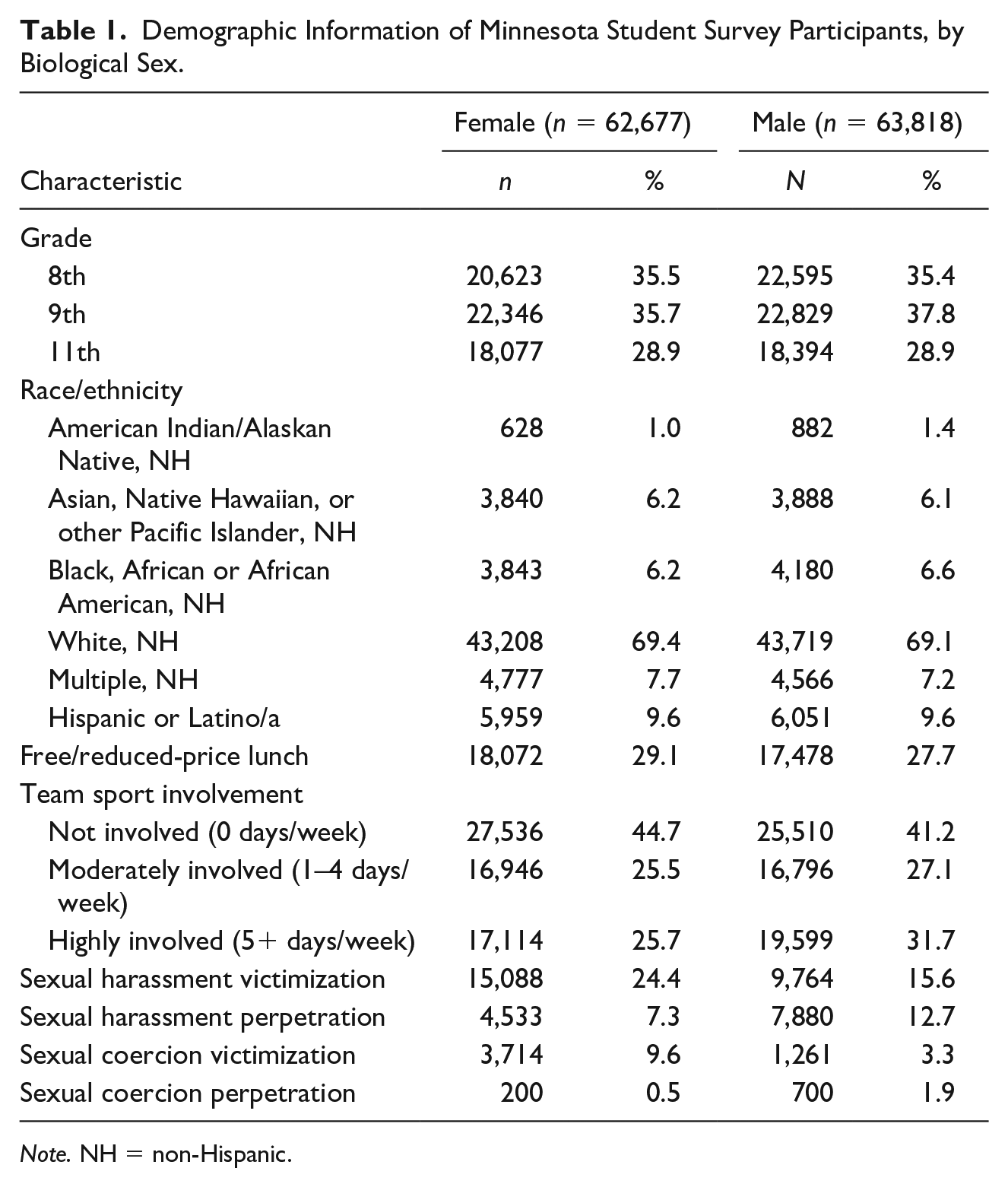
Descriptive information for study variables is shown in Table 1. Students in the sample were approximately evenly distributed on biological sex and the grade level (eighth, ninth, and 11th). A majority of the students identified as White, non-Hispanic (69.2%, n = 86,927), 9.6% identified as Hispanic or Latino/a (n = 12,010), 7.5% as multiple races (n = 9,343), 6.3% as Black (n = 8,023), 6.1% as Asian or Pacific Islander (n = 7,728), and 1.2% as American Indian (n = 1,510); 28.1% of the students received free or reduced price lunch (n = 35,550).
Demographic Information of Minnesota Student Survey Participants, by Biological Sex.
Note. NH = non-Hispanic.
Male and female adolescents had similar rates of team sport participation: 31.7% of males (n = 19,599) were highly involved (5+ days/week) and 25.7% of females (n = 17,114) were highly involved (Table 1). 15.6% of males (n = 9,764) reported being sexually harassed in school during the prior 30 days, compared with 24.4% of female students (n = 15,088). 12.7% of males (n = 7,880) and 7.3% of females (n = 4,533) reported sexually harassing others recently in school. 3.3% of males (n = 1,261) and 9.6% of females (n = 3,714) report being a victim of sexual coercion in a dating relationship. 1.9% of males (n = 700) indicated they have pressured a dating partner into sex when the person did not want to; 0.5% of females (n = 200) reported this behavior.
Associations Between Team Sports Participation and Sexual Violence Victimization
Among male students, team sport participation was shown to be a statistically significant protective factor in the unadjusted model, for both moderately and highly involved males, for sexual harassment victimization and sexual coercion victimization (Table 2, Model A). When we adjusted for other relevant variables, the associations switched directions (Table 2, Model B). Upon further adjustment for demographic covariates (Table 2, Model C), the relationships remained positive and were statistically significant for highly sport-involved males for both sexual harassment victimization (odds ratio [OR] = 1.11, 95% confidence interval [CI] = [1.03, 1.20]) and sexual coercion victimization (OR = 1.19, 95% CI = [1.02, 1.43]), showing that highly involved males were significantly more likely to be sexually harassed and to be sexually assaulted through coercion.
Odds Ratios for Sexual Harassment/Sexual Coercion Involvement (Reference Group = No team sports involvement).

Note. Model A: unadjusted. Model B: adjusted for alcohol attitudes, positive youth development, teacher relationships, and sexual orientation. Model C: adjusted for alcohol attitudes, positive youth development, teacher relationships, sexual orientation, race/ethnicity, free and reduced price lunch, and grade.
Among female students, the unadjusted model showed team sports participation was a significant protective factor for moderately and highly involved athletes, for both sexual harassment and sexual coercion (Table 2, Model A). For example, females who did sports 5+ days/week had odds of experiencing sexual coercion that were more than 40% lower than the odds for females who were not involved in sports (OR = 0.59, 95% CI = [0.54, 0.64]). After adjusting for other relevant variables, the model shifted (Table 2, Model B), with sports participation becoming either a risk factor or nonsignificant, except for participation continuing as protective against for moderately involved (OR = 0.88, 95% CI = [0.80, 0.97]) and highly involved females (OR=0.83, 95% CI = [0.75, 0.91]). When adding the adjustment for demographic variables (Model C), the only remaining significant relationship was team sports participation becoming a risk factor for sexual harassment victimization in school for moderately involved female athletes (OR = 1.12, 95% CI = [1.05, 1.20]).
Associations Between Team Sports Participation and Sexual Violence Perpetration
In terms of sexual harassment, the unadjusted model showed high involvement in team sports as a risk factor for perpetration among males (OR = 1.07, 95% CI = [1.01, 1.13]). However, team sports was a protective factor for both moderately and highly involved males around sexual coercion. When the model was adjusted for covariates and demographic characteristics (Table 2, Model C), team sports participation was shown as a significant risk factor for both moderately and highly involved males for sexual harassment perpetration (OR = 1.18, 95% CI [1.09, 1.29] moderately involved, OR = 1.27, 95% CI = [1.18, 1.38] highly involved) and a risk factor for sexual coercion perpetration for highly involved males (OR = 1.31, 95% CI = [1.07, 1.60]).
In unadjusted analyses, team sports involvement was a significant protective factor for moderately and highly involved female athletes for sexual harassment perpetration, and it was a protective factor for highly involved females for sexual coercion perpetration (Table 2, Model A). In the fully adjusted model, no protective trends remained. Moderately involved females were shown to have elevated odds of perpetrating sexual harassment (OR = 1.12, 95% CI = [1.01, 1.25]) and sexual coercion (OR = 1.47, 95% CI = [1.01, 2.14]).
Discussion
The goal of this research was to examine the relationship between adolescent team sports participation and sexual violence perpetration and victimization. For young males, more involvement in team sports was related to higher odds of being both a perpetrator and a victim of sexual aggression. We also found team sports participation was a risk factor for moderately involved adolescent females to perpetrate sexual harassment at school and sexual coercion against a dating partner. While the proportion of females who perpetrated sexual coercion in a significant dating relationship was much lower than males, to our knowledge, no previous research has been done to investigate the dynamics of sports and female-perpetrated sexual assault among high school students.
Some of our findings were consistent with prior research, whereas some were surprising; yet feminist theory and consideration of power dynamics continues to offer a framework that may aid in interpretation. Higher rates of perpetration for highly involved male athletes are consistent with prior research on Division I male student-athletes and feminist critiques of male sport culture (Crosset et al., 1996; Koss & Gaines, 1993; Melnick, 1992), in that more privileged male athletes—particularly those who are more frequently exposed to aspects of sport culture such as aggression—were more likely to perpetrate sexual violence than males not involved in sports. More unexpected was the finding of highly involved males’ increased risk of being a victim of school-based sexual harassment and sexual coercion in a dating relationship. It may be that highly involved athletes are at a higher risk of being victimized by teammates or those involved in other sports, or perhaps student-athletes who are committing sexual harassment and sexual coercion are also more likely to be a victim of these behaviors (Chiodo et al., 2009; Choudhary et al., 2010). We were also surprised that moderately involved female athletes were more likely to sexually harass others, to sexually coerce a dating partner, and to be sexually harassed, while there was no statistically significant findings among highly involved female athletes. Theories of sexual offending are based on male perpetrators and may not fit well with female offenders (Oliver, 2007), given distinct gender socializations in sport and in society at large. However, further extrapolating the idea of sport-related power dynamics may be illustrated here as well. For example, a girl involved in a prestigious sport may have greater social status in the high school setting than a boy involved in a less prestigious sport or not involved in sports at all and may, therefore, have greater power in their interaction. Without data on what sports young athletes are involved in and how they are viewed among their peers, this issue cannot be disentangled. Other unmeasured factors like the level of personal success in sports may also contribute to social status and power, which has the potential to play out in sexual harassment and coercion.
Importantly, most previous studies examining the relationship between athletics and sexual violence did not adjust for demographic characteristics and other confounders (McCray, 2015). Our unadjusted results showed team sports involvement to be protective in most cases. However, many associations changed direction upon adjustment for relevant covariates, demonstrating that in a wider sample of student-athletes, team sports involvement can be a risk factor for sexual violence perpetration and victimization. Numerous personal characteristics, such as childhood sexual abuse, alcohol attitudes, and sexual orientation, have not been included in previous studies on this topic but appeared to confound the primary associations tested here. Future research on this topic should account for these covariates to further isolate the true association between sports involvement and sexual violence in adolescent samples.
Strengths and Limitations
As a secondary analysis of existing surveillance data, this study has several limitations. Specifically, item wording and inclusion were determined by state agencies, balancing concerns about measurement and consistency with community and political concerns, survey length, and other issues. For example, sport involvement is only assessed with one question, based on team sports participation. As a result, athletes are treated as homogeneous, despite research showing important differences among athletes, for example, by the type of sport and whether the sport is considered “revenue producing” (Forbes et al., 2006; Humphrey & Kahn, 2000). In addition, the question only asks about team sports, which students may or may not have understood to include more individualistic sports such as cross-country and swimming. Another limitation is the scope of the sexual aggression questions. Given widely varying levels of sexual maturity and interest among adolescents, “sexual jokes, comments or gestures” are not necessarily unwelcome or perceived as harassment; however, the context of the sexual harassment question within a set of items about bullying victimization frames these experiences as negative. Asking about sexual harassment in school over the previous 30 days supports understanding of the school environment, but excludes all the other contexts in which sexual harassment can be experienced or acted out and older incidents of harassment in school. Similarly, the questions on sexual coercion are limited to significant dating partners, which helps in understanding relationship violence but excludes other contexts in which someone can be a victim of, or perpetrate, sexual coercion (e.g., casual dating or sexual relationships). Social desirability bias may also contribute to underreporting of these sensitive and illegal behaviors, particularly perpetration of sexual violence. An additional limitation is that the cross-sectional study gives a snapshot of students’ perceptions at a specific time, but it does not show changing dynamics or causation. A final limitation is the geographical location of the study. While results are represen-tative of the entire state of Minnesota, there may be differences in team sport participation, sexual violence experience, and other unmeasured factors across geographical regions of the United States and among the rest of the world which limit the generalizability of the results.
The study also has many strengths, including the large sample size. Due to the survey size, we were able to document adequate numbers in all perpetration and victimization categories, including hard-to-study categories such as female perpetrators and male victims. Also, because the MSS was given statewide, the data are representative of urban, suburban, and rural areas and have the potential to inform statewide prevention efforts.
Implications for Research and Action
Given study limitations, additional research is warranted to continue to update and advance our understanding of the role of team sports in sexual violence. In particular, studies including more detailed characteristics of perpetrators, victims, and sexual violence incidents (e.g., inclusion of alcohol), as well as sports involvement (e.g., type of sport, school vs. community setting) and team dynamics would help shed light on these relationships and potential underlying mechanisms. In addition, more research is needed to understand the unexpected significant findings for moderately involved female athletes which were not evident among highly involved female athletes.
Our research with adolescents supports earlier research on college students which shows athletes are at a higher risk for committing and experiencing acts of sexual aggression (Boeringer, 1996, 1999; Crosset et al., 1996; Forbes et al., 2006; Koss & Gaines, 1993). To prevent sexual violence, athletic departments and sports clubs need to educate their athletes about sexual violence, and different findings for males and females in this study suggest that different approaches may be appropriate. Bystander intervention training among college students has been shown to decrease bystander rape myth acceptance, increase bystander efficacy, and increase self-reported bystander behaviors (Banyard et al., 2007). Athlete-specific curricula are also available; Athletes as Leaders and Coaching Boys into Men are 10-week curricula that have been developed in the United States to work with adolescent athletes around dating and sexual violence. Miller et al. (2013) found in a 1-year follow-up of implementing the Coaching Boys Into Men curriculum that male athletes were less likely to have perpetrated dating violence in the previous three months and reported lower levels of negative bystander behavior than peers who had not received the training.
In addition, departments and teams need clear policies in place regarding expectations of student-athletes’ conduct involving sex, sexual harassment, and sexual assault and the consequences of acting outside of expectations. In fact, Kroshus et al. (2018) found football coaches’ expectations of their male college players’ conduct off the field, perceived likelihood for disciplining players for breaking the rules, and likelihood of intending to prevent inappropriate sexual behavior of their players positively affected prosocial bystander behavior from athletes.
Finally, athletic departments and sport clubs need to provide athletes a clear, confidential way to report sexual misconduct, and they need to train coaches to discuss sexual violence victimization with their athletes and to refer athletes who have experienced victimization to resources and support (McMahon & Banyard, 2012).
Footnotes
Author’s Note
Jamie Cheever is now affiliated with International Institute of Buffalo, 864 Delaware Avenue, Buffalo, NY, USA.
Declaration of Conflicting Interests
The author(s) declared no potential conflicts of interest with respect to the research, authorship, and/or publication of this article.
Funding
The author(s) disclosed receipt of the following financial support for the research, authorship, and/or publication of this article: This publication was supported with funds from the Maternal and Child Health Bureau (MCHB), Health Resources and Services Administration (HRSA) of the U.S. Department of Health and Human Services (HHS) (T71MC00006; R. Sieving, PI). The contents are those of the author(s) and do not necessarily represent the official views of, nor an endorsement, by HRSA, HHS, or the U.S. Government. For more information, please visit HRSA.gov.
