



Abstract
The Confluence Model of Sexual Aggression is a well-established framework for understanding factors that contribute to men’s perpetration of sexual aggression against women, highlighting the roles of hostile masculinity, impersonal sex orientation, and exposure to pornography. To date, only one study has applied aspects of the Confluence Model to examine predictors of sexual aggression in adolescent males, and the study did not include pornography exposure as a predictor. The current study evaluates the Confluence Model as a framework for understanding the perpetration of both contact and noncontact sexual aggression in a sample of 935 heterosexual 10th-grade adolescent boys. Composite scores for hostile masculinity and impersonal sex orientation were generated. Nearly all the variables included in the hostile masculinity and impersonal sex constructs were associated with perpetration. Zero-inflated Poisson regression models revealed distinct combinations of salient predictors when the dependent variable was identified as boys’ frequency of perpetration, compared with when the dependent variable was defined as any perpetration of sexual aggression. Impersonal sex orientation and violent pornography exposure were associated with perpetrating noncontact sexual aggression in the last 6 months, while violent pornography exposure and the interaction of hostile masculinity and impersonal sex orientation increased the frequency of recent contact sexual aggression. Results suggest that hostile masculinity, impersonal sex orientation, and violent pornography exposure are important factors to address within sexual assault prevention approaches for adolescent boys.
Sexual harassment, or unwanted sexually oriented behavior such as offensive sexual attention (Fitzgerald et al., 2001), is a common experience among high school boys and girls (American Association of University Women [AAUW] Educational Foundation, 2001), as is unwanted sexual contact (Ybarra & Thompson, 2018). Perpetration of sexual aggression often begins in adolescence, with 16 years old being the most common age of first perpetration (Grotpeter et al., 2008; Ybarra & Mitchell, 2013). As many as 68% of college-age men who perpetrate sexual aggression do so again (Zinzow & Thompson, 2015). For these reasons, it is important to understand the factors that foster engagement in sexually aggressive behavior in adolescence. The current study applies the Confluence Model of Sexual Aggression to perpetration of contact and noncontact sexual aggression among adolescent boys, and incorporates violent pornography exposure, a variable of interest in the model (Malamuth, 2018).
Overview of the Confluence Model of Sexual Aggression
The Confluence Model has received consistent support in the research literature (for a review, see Malamuth & Hald, 2017). The model posits that a man’s likelihood of perpetrating sexual aggression depends on two related but distinct constellations of personality, behavioral, and developmental factors. Characteristics representative of hostile masculinity, such as hostility toward women, acceptance of rape myths and sexual dominance, and adversarial heterosexual beliefs, are all related to sexual aggression (Anderson & Anderson, 2008; Hall et al., 2006; Lonsway & Fitzgerald, 1995; Malamuth et al., 1995). Aspects of the impersonal sex orientation, such as having many sexual partners, detached sexual behavior, and early delinquent behavior, are related to risk of perpetrating sexual aggression as well (Abrahams et al., 2004; Anderson & Anderson, 2008; Hall et al., 2006; Jewkes et al., 2006). Other factors included in the Confluence Model are at the relationship and community levels of the social ecology (e.g., childhood experiences of violence; Tharp et al., 2013). For example, peer pressure to be sexually active and having peers who are violent, sexually aggressive, and approve of sexual aggression, are contextual factors included in the impersonal sex construct and associated with increased risk of perpetrating sexual violence among high-school- and college-age men (Abbey et al., 2007; Humphrey & Kahn, 2000; Krahé, 1998; Ybarra & Thompson, 2018).
The Confluence Model and Pornography
Pornography viewing was first incorporated into the Confluence Model nearly two decades ago (Malamuth et al., 2000) and was found to have predictive value even controlling for previously established elements of the model. A recent meta-analysis indicates a robust association between pornography and sexual aggression in men (Wright et al., 2016). Applications of the Confluence Model suggest that pornography viewing confers additional risk of perpetration, primarily for adult and college-age men high in hostile masculinity and impersonal sex orientation (Baer et al., 2015; Vega & Malamuth, 2007).
A case also can be made for pornography use directly conferring risk of sexual aggression to all viewers, as well as indirectly through hostile masculinity and impersonal sex characteristics. While men with antisocial and aggressive tendencies are more likely to watch pornography, especially violent pornography (Baer et al., 2015; Bogaert, 2001), men who view more pornography, and violent pornography in particular, report more proclivity toward sexual aggression (Boeringer, 1994; Malamuth et al., 2000; Wright et al., 2016), as well as more negative attitudes toward women and hostile sexism (Hald & Malamuth, 2015). Depictions of aggression and coercive sex as pleasurable are common in popular free pornographic videos (Bridges et al., 2010; Gossett & Byrne, 2002), and pornography’s risky sexual scripts in turn predict sexual aggression in college-age men (D’Abreu & Krahé, 2014). It therefore appears that pornography use could be related to sexual aggression above and beyond these characteristics in adolescent boys.
Indeed, as with adult males (e.g., Wright et al., 2016), adolescent boys’ pornography consumption is related to the risk factors the Confluence Model has identified as associated with sexual violence perpetration (Owens et al., 2012). Adolescent pornography users (i.e., high-school-age and college-age men) hold less progressive gender role attitudes, objectify women more, exhibit more delinquent behavior, hold more instrumental attitudes toward sex, and are more approving of violence against women (Brown & L’Engle, 2009; Mesch, 2009; Mulac et al., 2002; Peter & Valkenburg, 2009, 2010). Furthermore, teenagers who use pornography are more sexually permissive, have more casual sex, and hold more instrumental attitudes toward sex (Peter & Valkenburg, 2016). Finally, pornography use is predictive of both sexual harassment and sexual assault by teenage boys (Brown & L’Engle, 2009; Peter & Valkenburg, 2016). In a national longitudinal sample, teenagers reporting lifetime exposure to violent pornography were more than 4 times more likely to have sexually aggressed for the first time at follow-up (Ybarra & Thompson, 2018).
Evidence for Confluence Model in Adolescents
In the only application of the Confluence Model with adolescent males to date, Reyes and Foshee (2013) found that certain risk factors in the Model, such as physical dating aggression, peer aggression, and rape myth acceptance, predicted early onset of sexual dating aggression. However, this study tested a limited number of risk factors identified by the Confluence Model and did not adjust for all the risk factors that are components of hostile masculinity and impersonal sex orientation.
The risk factors in the Confluence Model have been independently linked to teenagers’ risk of perpetration. Aggressive behaviors related to hostile masculinity, such as homophobic teasing, dating violence, delinquency, and bullying, are associated with sexual violence perpetration among adolescent boys (Basile et al., 2009; Espelage et al., 2012; Ybarra & Thompson, 2018). Aspects of the impersonal sex construct, such as growing up around interpersonal violence, having many dating and sexual partners, and becoming sexually active at a younger age, are predictive of sexual violence perpetration among high-school-age and college-age men (K. Basile et al., 2013; Krahé, 1998; Maxwell et al., 2003; Pellegrini, 2001). Finally, peer group norms that promote sexual violence appear to be risk factors for perpetration among high-school-age and college-age men (Jewkes et al., 2006; Krahé, 1998).
The Current Study
To date, no empirical study has rigorously evaluated the utility of the Confluence Model in predicting sexual aggression perpetration among adolescent males while also accounting for the influence of boys’ exposure to violent pornography. The current study unites many factors of the hostile masculinity and impersonal sex constructs in a theory-based analysis of sexual assault perpetration among 10th-grade boys. Previous research extended the Confluence Model to include exposure to pornography as a risk factor for sexual violence in adult men. These studies focused on explicit magazines to the exclusion of online media (Malamuth et al., 2000; Vega & Malamuth, 2007). The current study assessed for several types of pornographic media to address this limitation (i.e., magazines, videos or films, and written books without pictures). Most research on sexual aggression focuses on behaviors involving unwanted physical contact (Reyes & Foshee, 2013; Vega & Malamuth, 2007). As the distinction between contact and noncontact sexual aggression has received little attention in previous research, the current study includes each type of aggression as separate outcomes. In sum, drawing from the Confluence Model as well as empirical research, we proposed one specific hypothesis:
Analyses also examined whether hostile masculinity, impersonal sex orientation, violent pornography exposure, and the interactions among these variables demonstrated different patterns of association with perpetrating any sexual aggression in the past 6 months versus frequency of aggression in the past 6 months. Specific hypotheses were not proposed with respect to interaction terms given that the inclusion of interaction terms in the regression models was exploratory in nature.
Method
The current research draws on baseline data from a randomized clinical trial of a school-based sexual assault prevention program for high school youth. The study enrolled 10th-grade students in public and private schools throughout rural, suburban, and metropolitan areas in the Northeastern United States. Participants completed a baseline survey prior to implementation of the prevention programming that measured perpetration of sexual aggression and associated risk and protective factors. For the current study, the analytic sample included 904 tenth-grade boys (Mage = 15.42, SD = 0.63) who had complete information on study variables, drawn from the 1,164 boys in the sample who self-identified as heterosexual. The local Department of Education stipulated that questions that could be used to identify individuals, including ethnicity and race, could not be included in the assessment to avoid identification of participants. However, students did provide information regarding their age, gender, and sexual orientation.
Measures
Perpetration of sexual aggression
Sexual aggression was assessed by 14 items used to measure this construct in previous evaluations of sexual assault prevention programs for youth (Basile et al., 2009; Taylor et al., 2013). Students reported how many times they had perpetrated a variety of nonconsensual sexual behaviors in the last 6 months, such as “how many times have you made sexual comments, jokes, gestures, or looks about/to them?” and “how many times have you made them do something sexual other than kissing?” The answer options provided were “I have done this to a girl, but not in the past 6 months,” “0 times in the past 6 months,” “1–3 times in the past 6 months,” “4–9 times in the past 6 months,” “10+ times in the past 6 months.” Seven items measured perpetration of contact sexual aggression and seven items assessed for perpetration of noncontact sexual aggression. The overall scale showed excellent reliability in the present sample, with an alpha of .94.
Assessments of hostile masculinity
Rape myth acceptance
Items were taken from Cook-Craig et al.’s (2014) adaption of the Illinois Rape Myth Acceptance Scale (IRMAS), which was originally created by Payne et al. (1999). Questions asked participants how much they agreed with several statements regarding sex and dating, such as “Girls should have sex with their boyfriend or the guy they are dating when he wants” and “If a guy spends money on a date, the girl should have sex with him in return.” Items were scored on a 7-point scale, ranging from 0 (strongly disagree) to 6 (strongly agree). A mean score was calculated from the seven items, with higher scores representing higher acceptance of rape myths (M = 1.24, SD = 1.08, range = 0–6). In the present study, the scale demonstrated good internal reliability (Cronbach’s α = .83).
Peer rape myth acceptance
The same seven items from Cook-Craig et al. (2014) were adapted to capture perceived peer attitudes toward rape myths. Questions ask participants to agree or disagree with statements regarding other students’ beliefs about sex and dating, such as “Students at my school think that girls should have sex with their boyfriend of the guy they are dating when he wants.” Response options follow the suggested scores provided in Cook-Craig et al. (2014), which include “0 = strongly disagree,” “1 = disagree,” “2 = agree,” and “3 = strongly agree.” A mean score was computed to assess overall perceived peer rape myth acceptance, with higher scores representing greater acceptance (M = .99, SD = .62, range = 0–3). Internal reliability was calculated at .93.
Peer approval of sexual coercion
Three items assessed perceived peer approval for engaging in sexually aggressive behaviors (Boeringer et al., 1991). For example, students were asked how approving their friends would be if they “got someone drunk or high to have sex with them.” Students were instructed to respond using a 5-point scale ranging from “very disapproving” to “very approving.” Responses were summed and averaged to create a mean perceived peer approval for engaging in violence (M = 3.78, SD = 2.94, range = 0–12). The Cronbach’s alpha was .88.
Perception of friends’ engagement in dating violence and sexual aggression
Perception of peer engagement in dating violence and sexual aggression was measured with a three-item measure adapted from DeKeseredy (1990). Participants gave the number of friends who they believe engaged in various abusive dating behaviors, from insulting and controlling their partners to using physical force to make them engage in sexual activity. A fourth question, drawn from a subscale of the Boeringer Social Norms Measure (BSNM), was added to measure sexual assault due to intoxication: “How many of your friends do you think have gotten a girl or boy high or drunk to have sex with them?” (Boeringer et al., 1991). The subscale does not reference a time frame. Cronbach’s alpha for the full set of four items was .83 (M = .63, SD = 1.52, range = 0–12).
Personal perceptions of abusive behaviors
Participants were asked to indicate how abusive they considered a range of aggressive behaviors toward intimate partners to be. These 12 items comprise a scale used in previous evaluations of dating violence programs (Miller et al., 2012). Participants rated behaviors such as “name-calling or insulting them” on a 5-point Likert-type scale ranging from “not abusive” to “extremely abusive” (M= 2.73, SD = .86, range = 0–4). Cronbach’s alpha was .94.
Homophobic teasing
Homophobic name-calling was assessed via the agent subscale of the Homophobic Content Agent Target (HCAT) scale (Poteat & Espelage, 2005). Participants were asked how many times in the last 6 months they said the words “homo” or “gay” in an insulting way “to a friend,” “to someone you did not know well,” “to someone you did not like,” and “to someone you did not think was gay or lesbian,” “to someone you thought was gay or lesbian.” Answer options were “never,” “a few times,” “once or twice a month,” and “every day or almost every day.” The HCAT has shown strong internal consistency (Cronbach’s α = .85; Poteat & Espelage, 2005) and the alpha for this study was .79. Response items were treated as a 4-point scale and summed scores ranging from 0 to 15 were used for analyses (M = 2.35, SD = 2.99).
Masculine norms in relationships
Endorsement of traditional masculinity was measured using the Adolescent Masculinity Ideology in Relationships Scale (Chu et al., 2005). Participants indicated on a 4-point scale how much they agreed with statements such as “It bothers me when a guy acts like a girl” and “In a good dating relationship, the guy gets his way most of the time.” A mean score was generated for each participant using all 12 items (M= 2.03, SD = .44, range = 0–3). The Cronbach’s alpha for this sample was .75.
Assessments of impersonal sexual orientation
Bullying perpetration
Bullying behaviors in the last 6 months were assessed via a subscale of the School Crime Supplement of the National Crime Victimization Survey (Lessne & Harmalkar, 2013). Participants answered five questions regarding perpetration. For example, they indicated how many times in the last 6 months they had “made fun of others, called them names, or insulted them in a hurtful way.” Response options were “never,” “1–2 times,” “3–4 times,” and “5 or more times.” Responses were scored on a 4-point scale and a sum score was generated for analyses (M = .84, SD = 1.91, range = 0–12). In the current sample, the alpha for this scale was .80.
School disciplinary involvement
A single item assessed whether the participant was involved in disciplinary action with their school. Participants responded either “yes” or “no” to the following question: “Have you ever been suspended or expelled from school?” This item was utilized to create a dichotomous variable, with 27.0% of the sample indicating previous suspension or expulsion.
Sexual initiation
A single item assessed sexual initiation. Participants were asked “During your lifetime, with how many people have you willingly had sexual intercourse (vaginal or anal sex)?” In this sample, 22.2% of participants reported intercourse with at least one partner. The variable was dichotomized for analyses.
Violent pornography exposure
Three items were adapted from the BSNM scale measuring use of violent sexually explicit media (Boeringer, 1994). Participants indicated the number of times they had ever consumed magazines, video or films, or written books “which depict a female or females being forced to engage in sexual acts.” Answer options were “never,” “1–5 times,” “6–10 times,” “11–20 times,” “more than 20 times.” Answers were summed across all three items and then dichotomized to reflect the absence or presence of any violent pornography exposure. In this sample, 28.3% of boys reported lifetime exposure to violent pornography.
Data Analysis Plan
All analyses were conducted using SPSS 25.0. First, bivariate correlation analyses were conducted to see if perpetration of sexual aggression was associated with the risk factors that comprise the hostile masculinity and impersonal sex constructs. The t-tests for independent samples were conducted for the same purpose with categorical independent variables (history of suspension, sexual debut).
Composite factors for hostile masculinity and impersonal sex orientation were created to determine whether these factors and pornography exposure, both alone and in interaction, were associated with perpetration of sexual aggression (modeled on Vega & Malamuth, 2007). Z-scores were calculated for each continuous independent variable. These scores were then summed to create composite scores. Scores on gender equitable attitudes, rape myth acceptance, peer rape myth acceptance, homophobic teasing, peer approval of sexual coercion, peer aggression, and recognition of abusive behaviors were summed to create a hostile masculinity composite score. The same process was followed to create an impersonal sex composite score from bullying perpetration and dichotomous variables for history of suspension or expulsion and sexual initiation. Interactions among the hostile masculinity and impersonal sex constructs and violent pornography exposure were modeled by multiplying the variables together.
The approach for conducting regression analyses was based on the work of Swartout et al. (2015), who highlighted how negative binomial regression models and zero-inflated models better fit datasets with non-normal distributions of violence outcomes than does linear regression. Most of the boys in the study sample reported that they had not perpetrated sexual aggression in the past 6 months (77.3%). Accordingly, as the frequency distribution for this outcome contained a high proportion of zeros, two separate zero-inflated regression models accounted for overdispersion. The first model discriminated between two distinct populations: adolescents who might perpetrate any sexual aggression and adolescents who would not perpetrate sexual aggression. The latter group is noted as the “true zero” group. The second model estimated frequency of sexual aggression only among participants who had perpetrated (the “count” model, excluding all “zero” cases from analyses). Predictors were constant across these models: hostile masculinity and impersonal sex composite scores, violent pornography exposure, and the interactions among these variables. The zero-inflated regression models set the significance level at α = .05.
Results
In this sample, 22.7% of the sample reported any sexual aggression perpetration in the past 6 months. 20.1% of boys reported perpetrating a noncontact sexually aggressive act and 12.7% of boys reported perpetrating contact sexual aggression. Bivariate correlation analyses showed that total perpetration, total contact perpetration and total noncontact perpetration in the past 6 months were positively and significantly associated with all predictor variables except for the perceptions of abusive behavior scale (see Table 1). Higher rates of perpetration were reported by boys who reported engaging in sexual intercourse and had a history of suspension and/or expulsion from school (p < .01 for all tests).
Intercorrelations Among Outcome and Predictor Variables.
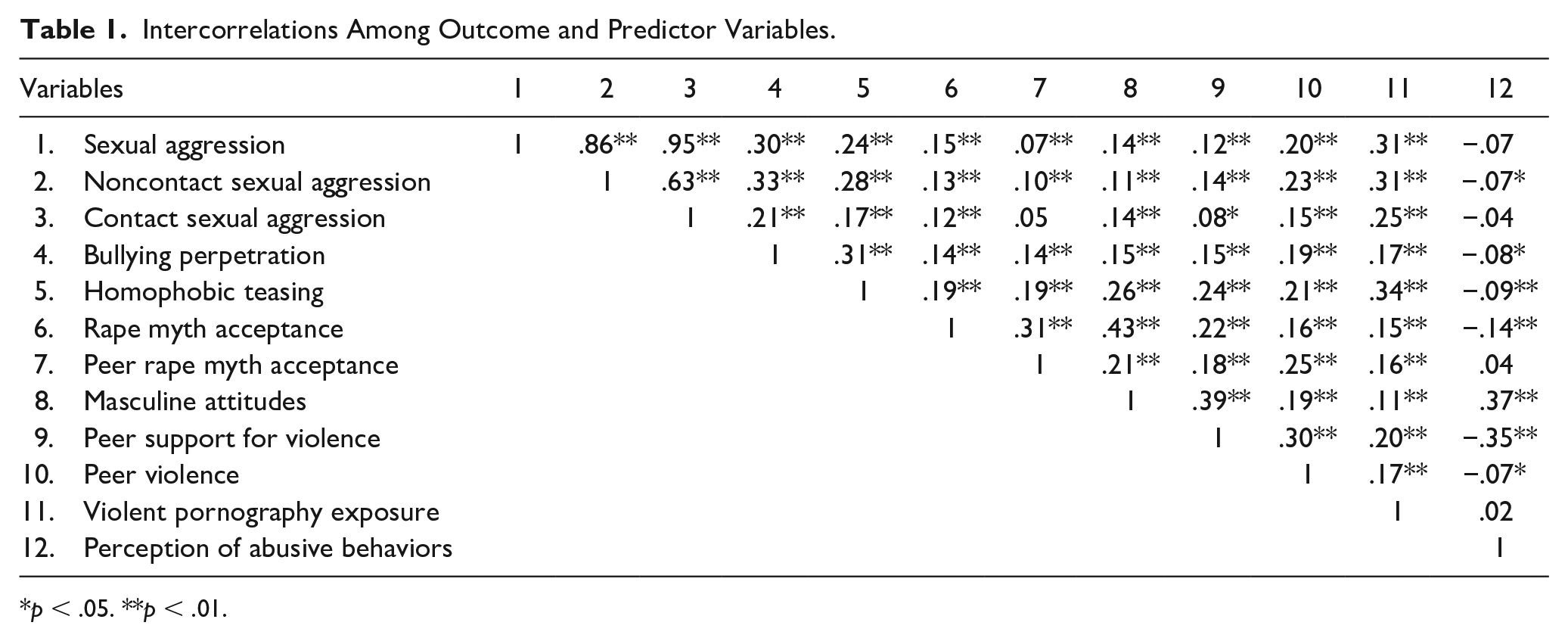
p < .05. **p < .01.
Zero-Inflated Poisson Regressions
Results of zero-inflated Poisson regressions are reported in Table 2. Participants were significantly less likely to be in the “true zero” group for perpetrating any sexual aggression in the past 6 months if they reported higher scores on hostile masculinity, impersonal sex orientation, and violent pornography exposure. The interaction of hostile masculinity and pornography was associated with a higher likelihood of being in the group that perpetrated sexual aggression. Hostile masculinity was negatively associated with frequency of overall sexual aggression among adolescents reporting aggression (i.e., the count model), while higher scores on impersonal sex orientation, violent pornography exposure and the interaction of hostile masculinity and impersonal sex orientation were positively associated with frequency of overall sexual aggression among these adolescents.
Zero-Inflated Poisson Regressions for Sexual Aggression Perpetration.
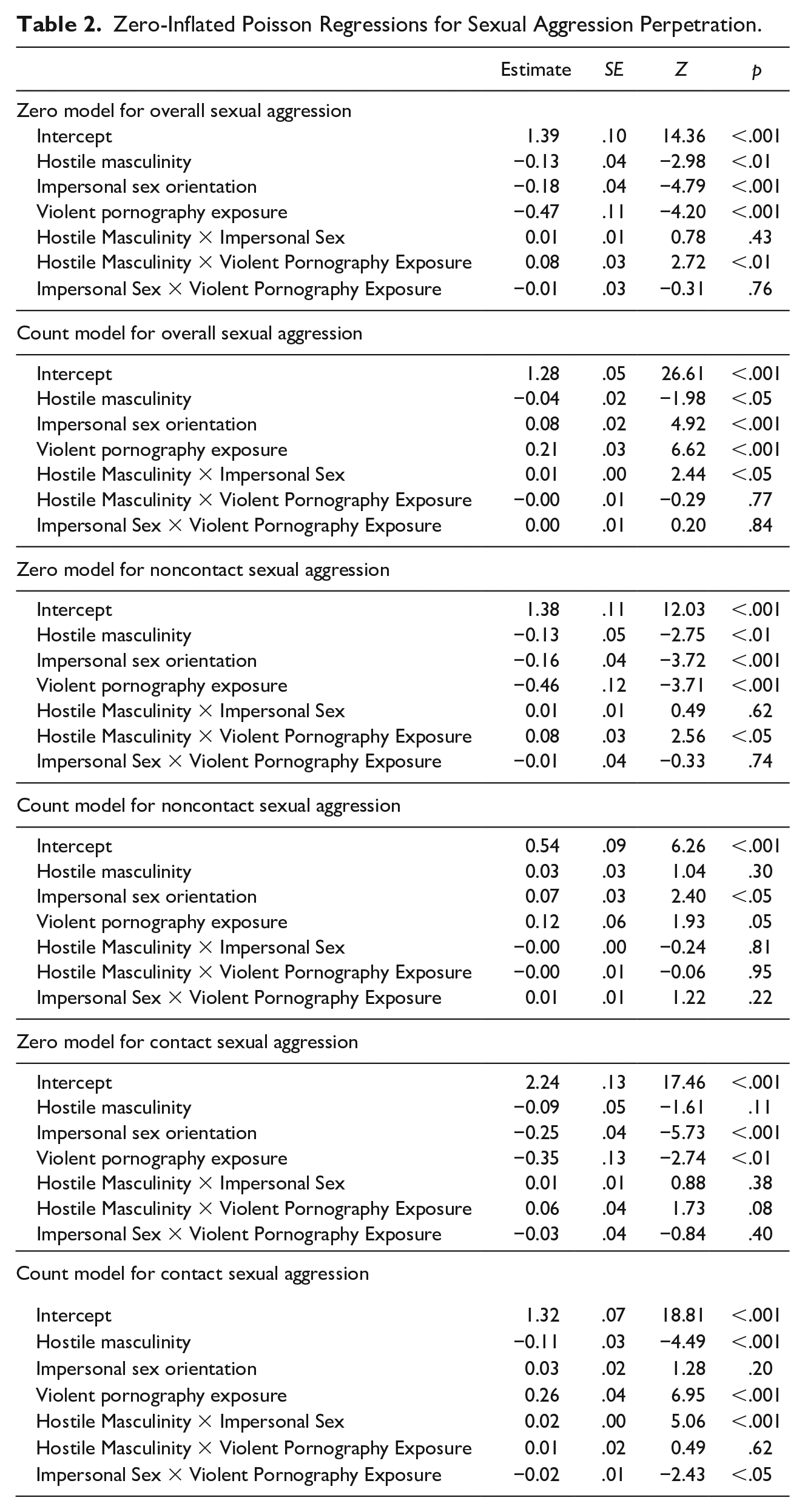
For noncontact sexual aggression, participants were significantly less likely to be in the “true zero” group if they reported higher scores on hostile masculinity, impersonal sex orientation, and violent pornography exposure. Higher scores on the interaction of hostile masculinity and exposure to violent pornography increased the likelihood of being classified in the group that perpetrated noncontact sexual aggression. Impersonal sex orientation and violent pornography exposure were positively associated with frequency of noncontact sexual aggression in the count model.
For contact sexual aggression, participants were significantly less likely to be in the “true zero” group if they reported higher scores on impersonal sex orientation and violent pornography exposure. Frequency of contact sexual aggression was negatively associated with hostile masculinity and positively associated with exposure to violent pornography. The interaction of hostile masculinity and impersonal sex orientation was positively associated with frequency of contact sexual aggression, while the reverse was found for the interaction of impersonal sex orientation and violent pornography exposure.
Discussion
This study represents the first application of the core Confluence Model constructs with a sample of adolescent boys. The study’s major findings are two-fold: demonstrating the utility of the hostile masculinity and impersonal sex constructs, as well as violent pornography exposure, in modeling sexual violence perpetration among teenage boys; and observing different patterns of predictors for being a perpetrator or not, versus frequency of perpetration, in the past 6 months. All factors—hostile masculinity, impersonal sex orientation, and exposure to violent pornography—were related to sexual aggression when entered individually in the models. Interactions among hostile masculinity, impersonal sex, and pornography exposure variously predicted both being a perpetrator and frequency of perpetration in the last 6 months.
In support of Hypothesis 1, perpetration of any type of sexual aggression in the past 6 months was positively associated with almost all components of the two constructs, such that as boys self-reported more frequent engagement in any type of sexual aggression, they also endorsed more traditional masucline norms, reported more acceptance of rape myths, engaged in more bullying and homophobic teasing, and reported having more aggressive friends and peers. This suggests that the risk factors for perpetration in adulthood, first identified and modeled by Malamuth (1986), are relevant to understanding risk among adolescents.
In zero-inflated Poisson regression models, which distinguished whether the same factors were associated with being a perpetrator versus frequency of perpetration, different patterns were observed for noncontact versus contact sexual aggression in the past 6 months. Impersonal sex orientation and violent pornography exposure were positively associated with frequency of noncontact sexual aggression. By contrast, hostile masculinity was negatively associated with frequency of contact sexual aggression. Past research indicates pornography exposure is a risk factor for perpetrating sexual violence (e.g., Ybarra & Thompson, 2018) in adolescence, but studies have not considered interactional effects. We speculate that boys high in hostile masculinity, who also seek out violent pornography as a cathartic outlet for these attitudes, may have less desire to perpetrate sexual aggression (D’Amato, 2006). This possibility should not be mistaken for approval of watching violent pornography, as pornography exposure remained positively associated with likelihood of being a perpetrator.
Findings on the relationship between impersonal sex orientation and sexual aggression were noteworthy. Higher scores on impersonal sex orientation were positively associated with any sexual aggression, and frequency of overall sexual aggression, noncontract sexual aggression and contact sexual aggression. This was not the case for hostile masculinity. Thus, aspects of the impersonal sex orientation, such as bullying perpetration, school disciplinary involvement and sexual initiation may be more useful in identifying teenage boys who are likely to perpetrate sexual aggression than are the components that comprise hostile masculinity.
Our results highlight the importance of including violent pornography exposure when utilizing the Confluence Model as a theoretical framework for understanding sexual aggression. While the current results are cross-sectional, other researchers have found that violent pornography exposure precedes perpetration in adolescents (Ybarra & Thompson, 2018). More research is needed to understand potential pathways from watching violent pornography to aggressing, especially as our findings indicate that hostile masculinity when entered into the models as a single variable and in interaction with exposure to violent pornography decreased the likelihood of frequency of perpetration of any aggression and noncontact perpetration. Nonetheless, watching violent pornography appears to confer risk of perpetrating sexual violence for many adolescent males.
This study adds to the evidence supporting the relevance of the Confluence Model for understanding sexual aggression perpetration in adolescent boys. To our knowledge, this study is the first to include contemporaneous measurements of behaviors previously measured retrospectively among men in other studies (Malamuth, 1986; Malamuth et al., 1991). As men often perpetrate sexual aggression for the first time in adolescence (Grotpeter et al., 2008), evaluating whether delinquency and association with delinquent peers would be associated with perpetration during adolescence is particularly pertinent. Peer interactions thus emerge as an important category of risk factors for perpetration of sexual aggression, pointing to the necessity of socioecological models for predicting aggression (Tharp et al., 2013). Just as on-screen modeling of aggression may influence propensity to aggress, modeling by peers may also shape teenage boys’ expectancies. Indeed, previous research has suggested peer aggression and sexual violence share an underlying desire for control and dominance (Espelage et al., 2012). Thus, interventions to decrease sexual aggression among adolescent boys need to address both boys’ actual behaviors (e.g., bullying, school delinquency) as well as boys’ perceptions of peer group norms.
Limitations and Future Directions
Age 16 is identified as the age at which men first perpetrate sexual aggression (Grotpeter et al., 2008), and 22.7% of the current sample had committed some kind of sexual aggression in the past 6 months. As boys at this age differ in their degrees of sexual experience and opportunities to aggress (Reyes & Foshee, 2013), these results may better describe adolescent males who are already sexually active or dating than less experienced boys. Statistical analyses attempted to account for this possibility by including noncontact sexual aggression as an outcome (i.e., making sexual comments, sending sexual pictures), as boys who are not yet sexually active may have more opportunities to engage in these forms of aggression.
In addition, analyses considered only adolescent males who identified as heterosexual. While this approach aligns with the Confluence Model’s emphasis on men’s violence toward women, it does not address how the Confluence Model constructs and violent pornography exposure are associated with aggression among bisexual and gay teenagers. Research on the effects of pornography use on sexual minority youth’s mental health and sexual outcomes is scarce (McCormack & Wignall, 2017). Subsequent research should consider how the influence of sexualized media such as pornography differs by adolescents’ sexual orientation.
There are public health and policy implications of validating the Confluence Model with adolescent males. Factors on multiple ecological levels can influence adolescent males’ propensity to sexually aggress; for example, sexual assault prevention efforts could address adolescents’ perceptions of social norms and peer sexual behaviors. Social norms interventions showing teenagers that risky and harmful behaviors are less socially supported than they think have been effective in reducing behaviors such as bullying and drinking (Perkins et al., 2011; Valentin-Holbech et al., 2018). Finally, the current study was correlational and cannot determine the directionality of the association between violent pornography exposure and sexual aggression perpetration. However, adolescence is a time of sexual exploration and pornography is readily available to teenagers (Peter & Valkenburg, 2016). Understanding adolescents’ perceptions of pornography and how it might directly shape their sexual expectancies remain critical research topics (Wright & Stulhofer, 2019).
Diversity Considerations
State educational departments that reviewed the study’s survey did not permit a question on race and ethnicity, as some schools have a small number of students, and it was believed that this information could be utilized to identify a student’s survey. However, the schools that participated in this study serve a diverse population. Publicly available demographic data for study schools show that over one third of the students identified as non-White. While we do not examine the role of race or ethnicity in our analyses, we anticipate that adolescent boys who identified as racial or ethnic minorities were well represented in the study sample. Our models are inclusive of adolescents who are both sexually active and not sexually active.
Conclusion
The current study addressed a gap in the literature using a well-established theoretical model to examine sexual aggression among 10th-grade heterosexual boys. Boys’ likelihood of sexually aggressing and the frequency of their perpetration over 6 months were significantly related to their self-reported hostile masculinity, impersonal sex, and exposure to violent pornography. The interactions among these risk factors were also associated with aggression. Results provide initial validation of the Confluence Model with teenage males, with significant implications for public health and sex education researchers and practitioners.
Footnotes
Declaration of Conflicting Interests
The author(s) declared no potential conflicts of interest with respect to the research, authorship, and/or publication of this article.
Funding
The author(s) disclosed receipt of the following financial support for the research, authorship, and/or publication of this article: This research was supported by a grant from the Centers for Disease Control and Prevention (U01CE002531, PI: Lindsay M. Orchowski).
