



Abstract
Within the past decade, there has been an increase in research focusing on young people who abuse their parents. However, most research has narrowly focused on adolescent children, neglecting to investigate the nature, pattern, and factors related to child-to-parent abuse perpetrated by young adults. This article integrated two complementary social-cognitive theories of aggression to explore factors associated with perpetration of child-to-parent abuse among university students (N = 435, aged 18–25 years). Participants completed the Abusive Behavior by Children–Indices, a self-report measure that was designed to differentiate abusive and normative child-to-parent behavior. The results highlight that abuse is not limited to adolescent children, as one in seven young adults were categorized as abusive toward a parent over the previous 12 months. Sons were more likely than daughters to report abusing their parents. Specifically, sons disclosed greater rates of father abuse than daughters, but similar rates of mother abuse. Hierarchical logistic regression found that exposure to marital violence, parent-to-child aggression, trait anger, and aggressive scripts were significant predictors of both mother and father abuse. However, other factors related to abuse differed according to which parent was the target of abuse. For instance, male sex was a significant predictor of father abuse, whereas rumination and impulsive emotional regulation were significant predictors of mother abuse. Overall, father abuse was better explained by the model than mother abuse. The results suggest that although factors related to general aggressive behavior may be good predictors for father abuse, additional factors may be needed to explain mother abuse.
Keywords
Child-to-parent abuse (CPA) accounts for half of all juvenile family violence reports and one in 20 adult family violence reports in the United States (Snyder & McCurley, 2008). Despite these rates, young people who abuse their parents are among the least studied and understood family violence perpetrators. Research has often provided descriptive findings that offer relatively limited insight into the possible causes of CPA. For example, studies suggest that CPA is related to strained relationships with parents (e.g., Brezina, 1999; Calvete, Orue, et al., 2015; Kennedy et al., 2010; Lyons et al., 2015) or a pattern of other antisocial behavior (e.g., Herrera & McCloskey, 2003; Ibabe et al., 2014; Ulman & Straus, 2003). There has been little emphasis on theoretically informed research investigating the mechanisms by which behavioral, psychological, or relationship risk factors affect the likelihood of CPA perpetration (Simmons, McEwan, Purcell, & Ogloff, 2018).
Recently, there has been increasing interest in understanding CPA from a more psychological perspective (e.g., Beckmann, 2019; Calvete, Orue, et al., 2015; Contreras & Cano, 2014). This is consistent with the broader aggression literature that seeks to explain aggressive behavior using social-cognitive theoretical frameworks suggesting psychological mechanisms of effect (Anderson & Bushman, 2002; Finkel et al., 2012; Hamby & Grych, 2013). There are two particularly prominent social-cognitive theories of aggressive behavior: the General Aggression Model (GAM; Anderson & Bushman, 2002) and I3 theory (pronounced I-cubed, Finkel, 2007; Finkel et al., 2012). While CPA research has occasionally generated hypotheses using the GAM (e.g., Calvete, Gamez-Guadix, & Garcia-Salvador, 2015), the I3 model, which was specifically designed to address the limitations of the GAM, has received little attention in CPA research.
Although the GAM and I3 are competing theories, these frameworks are rather complementary, each addressing the other’s weaknesses. Indeed, Finkel (2014) suggested that despite generating different research questions when used independently, if used together, they provide a more comprehensive understanding of aggressive behavior. This article seeks to advance the understanding of CPA by drawing upon both GAM and I3 theories to provide a more nuanced understanding of the psychological mechanisms related to CPA perpetration.
Aggression Theories
Within the field of aggressive behavior, the GAM was the first framework to integrate various theoretical perspectives with an emphasis on explaining proximal psychological mechanisms that link distal factors to aggression. The GAM suggests that the decision to act aggressively in a social encounter (i.e., outcome) is dependent on the individual and situational characteristics (i.e., inputs) and the individual’s cognition, affect, and physiological response at the time of the encounter (i.e., routes). Anderson and Bushman (2002) emphasized the role of social learning in aggressive behavior as each aggressive episode informs the decision to act aggressively in the future. Although Anderson and Bushman described a broad framework, attention was given to the relationship between aggressive cognitions (i.e., scripts, schemas, attitudes, and beliefs) and behavior, which was the focus of much subsequent research (Calvete et al., 2016; Dunne et al., 2018).
The GAM's focus on aggressive cognitions has since been criticized as being too narrow (Finkel, 2007; Finkel et al., 2012). To illustrate the limitations of the GAM, Finkel (2007) provided an example of a family violence perpetrator who fought with his partner 20 times but only became violent on four occasions. While this perpetrator may have aggressive cognitions, the GAM provides little insight into why people stop themselves from acting aggressively on some occasions and not others. To address this gap, Finkel (2007) created the I3 theory to provide a theoretical framework of aggressive behavior that emphasized the role of inhibitory failure in aggression action. The model proposed that the likelihood of aggressive behavior is dependent on whether the strength of instigators (i.e., triggers) and impelling factors (i.e., those that increase the likelihood of aggression) outweighs the inhibiting factors (i.e., those that decrease the likelihood of aggression).
The GAM and the I3 theories largely consider the same factors but have modeled them in different ways. For instance, both the GAM and I3 suggest that aggression typically begins with an instigating social encounter (Anderson & Bushman, 2002; Finkel, 2007). However, the GAM delineates factors related to aggressive behavior into inputs and routes, according to whether the factor is a predisposing factor (of the person or situation) or a present internal state. In contrast, the I3 theory organizes the same factors according to their function, whether they increase (i.e., impellor) or decrease (i.e., inhibitor) the likelihood of aggression. As such, inputs and routes may be categorized as either impellors or instigators, depending on whether they drive or inhibit aggressive behavior. While the I3 theory largely views aggression as a formulaic outcome when the weight of the instigators and impellors is greater than the weight of the inhibitors, the GAM describes the cognitive appraisal and decision-making process that occurs prior to aggressive behavior. Although the appraisal and decision-making process is separated from the inputs and routes, the factors considered in this process could also be broadly categorized as impelling or inhibiting factors, depending on whether the appraisal of the situation increases or decreases the likelihood of aggression (Anderson & Bushman, 2002; Finkel, 2007).
Instigating Social Encounters From CPA Research
Both the GAM and I3 emphasize that aggressive episodes begin with a social encounter or instigator that initiates an aggressive impulse. The instigators that are most consistently related to general aggression (Berkowitz, 1993; Geen, 2001; Magdol et al., 1997) and CPA perpetration (e.g., Beckmann, 2019; Brezina, 1999; Contreras & Cano, 2016a; Fawzi et al., 2013; Herrera & McCloskey, 2003; Ibabe et al., 2013b; Kennedy et al., 2010; Lyons et al., 2015; Margolin & Baucom, 2014; Ulman & Straus, 2003) are provocation and victimization.
In Brezina’s (1999) study of 1,886 male students, aggressive parent-to-child behavior increased the likelihood of CPA, while CPA decreased the likelihood of parent-to-child aggression. To explain these results, he hypothesized that children may use CPA to stop parent-to-child aggression; however, when successful, CPA was reinforced as a useful conflict strategy and contributed to the development of aggressive behavioral scripts (Brezina, 1999). A subsequent study by Margolin and Baucom (2014) provided some support for Brezina’s hypotheses. In this 8-year longitudinal study of 93 young people and their parents, beginning when participants were aged 9 to 10 years old, Margolin and Baucom found that past parent–child aggression predicted CPA, even when controlling for concurrent parent–child aggression. Together, these results suggest that parent–child aggression may increase not only the likelihood of individual episodes of CPA as children act in response to provocation but also the likelihood of future aggressive behavior through changing how children think about aggression as they learn that it is a normal, acceptable, and useful conflict tactic. As such, through social learning, repeated exposure to aggressive behavior increases an individual’s impelling factors or alters the personal characteristics that they possess in each potentially aggressive episode. This is wholly consistent with the GAM’s account of how patterns of aggressive behavior develop through reinforcement over time.
Impelling Inputs and Routes of CPA Perpetration
Although aggression-related cognition (e.g., scripts, beliefs, schemas) could be broadly grouped within impelling factors, there is relatively little emphasis on cognition in the I3 model. Whereas according to GAM, cognition is essential to understand how individuals learn aggressive behavior and why they become aggressive in a given situation (Anderson & Bushman, 2002; Anderson et al., 2007). Although aggression-related cognition is a useful treatment target (Andrews & Bonta, 2010), it has received relatively little attention in CPA research, with only a few studies suggesting that CPA is associated with antisocial attitudes (Contreras & Cano, 2016b), negative social schemata (Calvete, Gamez-Guadix, & Garcia-Salvador, 2015; Calvete, Orue, et al., 2015; Contreras & Cano, 2014, 2016a), and aggressive behavior scripts (Calvete, Gamez-Guadix, & Garcia-Salvador, 2015). Given the centrality of aggression-related cognition to the GAM’s explanation of aggression, this is clearly an area in need of greater research within the context of CPA.
There is some evidence to suggest that the relationship between aggression-related cognition and aggressive behavior may be moderated by the experience of anger. Anger is a strong impellor of aggression (Novaco, 2007) and can be viewed as either an input that increases the likelihood of aggression (I3; Finkel, 2007) or the route in which aggressive behavior is processed (GAM; Anderson & Bushman, 2002). A recent longitudinal study that examined a multivariable model predicting CPA found that while aggressive scripts and schemas at Time 1 were not related to CPA at Time 2, trait anger measured at Time 1 successfully predicted future CPA, as well as the presence of aggressive scripts and schemas at Time 2 (Calvete, Gamez-Guadix, & Garcia-Salvador, 2015). Examination of univariate correlations revealed that the strength of the relationship between schemas, scripts, and CPA appeared to attenuate over the course of a year, suggesting that aggressive scripts and schemas may be not be stable in young people, instead fluctuating in presence (or maybe accessibility) over time (perhaps if not reinforced). These findings suggest that while aggression-related cognitions may be concurrently related to CPA, anger appears to be related to the development or maintenance of such cognitions.
Inhibiting Inputs and Routes of CPA Perpetration
Anderson and Bushman (2002) contend that anger is related to aggression not only through activation of aggressive cognition but also through impairing decision-making, reducing inhibitions, and prolonging aggressive potential. This failed inhibitory control is central to the I3 theory and elaborated upon in greater detail than in the GAM. Surprisingly, with the exception of Calvete, Gamez-Guadix, and Garcia-Salvador (2015), the investigation of anger has largely been absent from CPA research. As such, there is limited evidence to suggest that anger increases the likelihood of CPA perpetration, let alone to provide an understanding of how anger is related to CPA.
However, within general aggression research, evidence suggests that the relationship between anger and aggression may be mediated by ruminative thinking (Denson, Pedersen, et al., 2011). Ruminative thinking has been shown to sustain angry affect, cognition, and physiological arousal (Pedersen et al., 2011), which depletes the cognitive resources that individuals would typically rely upon to inhibit aggressive behavior (Ammerman et al., 2015; Donahue et al., 2014; Finkel et al., 2012). Indeed, Denson and colleagues (2011) suggested that anger rumination may deplete self-control, increasing the likelihood of emotional dysregulation and impulsive behavior, which in turn increases aggression (Derefinko et al., 2011; Donahue et al., 2014; Dvorak et al., 2013; Gratz & Roemer, 2004; Whiteside & Lynam, 2001). Although there is a well-established body of general aggression research highlighting the effects of rumination and depleted self-control on aggression and intimate partner violence (e.g., Denson et al., 2011, 2012; DeWall et al., 2007; Finkel et al., 2012), these concepts have not yet been investigated in relation to CPA.
The Current Study
CPA research has recently begun to draw upon social-cognitive theoretical frameworks by examining variables that have not been previously considered within the literature. Research has consistently found that victimization by a parent increases the likelihood of CPA (see Simmons et al., 2018, for review), but there is a limited understanding of how victimization relates to CPA.
One potential route may be through its effect on angry affect (Calvete et al., 2013), which may, in turn, increase both aggression-supportive cognitions (Calvete, Gamez-Guadix, & Garcia-Salvador, 2015) and rumination, although no research has investigated the latter hypothesis. According to general aggression research, rumination may decrease self-control (e.g., increased impulsivity and emotional dysregulation), thus increasing aggression (Denson et al., 2011). Other individual characteristics that have been theoretically linked to general aggression as either impellors or inhibitors are also understudied in relation to CPA. For example, recent studies have found that CPA is positively related to impulsivity (Contreras & Cano, 2016a; Rico et al., 2017), and the findings regarding the relationship between emotional regulation and CPA are mixed (Contreras & Cano, 2016b; Kethineni, 2004; Stewart et al., 2006). This study adds to the nascent literature by drawing on two complementary social-cognitive theories of aggression to guide investigation of the psychological mechanisms underpinning CPA perpetration in young adults.
This study aims to explore the social-cognitive mechanisms by which exposure to family violence is related to CPA directed toward mothers and fathers by drawing upon two complementary aggression theories. Controlling for sex as well as experiences of family violence (i.e., witnessing marital aggression and parent-to-child aggression), we investigated the extent to which self-reported impellors (i.e., aggression-related cognitions [i.e., aggression-supportive attitudes; rehearsal of aggressive scripts] and trait anger) and disinhibitors (i.e., emotionally dysregulated impulsivity; rumination) were related to CPA.
We hypothesized that there would be no sex difference in mother abuse, but that males will be significantly more likely to abuse their fathers, in line with previous research with young adults (Agnew & Huguley, 1989; Peek et al., 1985; Walsh & Krienert, 2007). Drawing on past CPA and general aggression research, we hypothesized that victimization by the parent would be the strongest predictor of CPA, as it may act as a provocation, as well as promoting the development of knowledge structures over time. Similarly, witnessing marital aggression is expected to be strongly related to CPA as it likely influences the development of knowledge structures over time through social learning. We hypothesized that all impelling and disinhibiting factors would have a significant positive relationship with both mother and father abuse.
Method
Sample
Participants (n = 435) aged between 18 and 25 years (M = 20.62, SD = 2.17) and enrolled in undergraduate psychology classes at a university in an Australian metropolitan center were recruited. Most participants were female (n = 329; 75.6%) and identified as Australian (n = 337; 77.5%), with three participants identifying as Australian Aboriginal (0.7%). The remaining participants identified as European (n = 39; 9.0%), Asian (n = 31; 7.1%), African (n = 11; 2.5%), New Zealander or Māori (n = 7; 1.6%), from the Americas (n = 5; 1.5%), or Russian (n = 2; 0.5%).
Procedure
Undergraduate university students were recruited online and were compensated for their participation, with 0.5% added to their course grade. Participants read a plain language statement explaining that the purpose of the study was to investigate factors that differentiate between “normal versus more abusive behavior.” After reading the plain language statement, participants clicked, “I consent.” Participants completed questionnaires regarding normative beliefs about CPA and violent behavior, psychological factors related to aggression, experiences of family aggression, and perpetration of CPA-related behaviors over the past 12 months. Participants described who raised them as a child. The majority (n = 300; 69.0%) reported that they were raised by both parents, followed by being raised by their mother (n = 120; 27.6%), their father (n = 9; 2.1%), or raised by others, such as grandparents (n = 6; 1.4%). There were no reported same-sex parental relationships or guardianships. Sixty-four percent (n = 278) of participants lived with a parent or guardian. Participants provided separate responses to the CPA questionnaires for up to two parents or guardians who raised them. In total, 427 participants reported on aggression toward their mother (or female caregiver) and 315 participants reported on aggression toward their father (or male caregiver). This procedure was approved by the relevant university ethics committee.
Measures
CPA perpetration
CPA was measured using the Abusive Behavior by Children–Index (ABC-I; Simmons, McEwan, Purcell, & Huynh, 2019), a nine-item tool measuring the presence and severity of CPA, which has been validated for Australian young people aged 14 to 25 years, and Australian parents. Participants identified how often nine potentially abusive behaviors occurred over the past 12 months, on a 6-point scale (never–once–a few times–monthly–weekly–daily). The score assigned to each point on the scale differs by item, according to norms set by parents regarding how often the behavior described in the item would have to occur to be abusive. For example, in the Australian sample of parents used to set scoring on the ABC-I in this study, yelling or swearing at a parent had to occur daily over 12 months to be abusive, while being physically aggressive toward a parent had to occur only once (Simmons, McEwan, & Purcell, 2019).
For each item, the frequency at which the behavior described becomes abusive receives a score of 16. If a behavior is reported more or less frequently than the item’s threshold for abuse, the item score increases or decreases by a factor of 2. For instance, scores for yelling or swearing at a parent range from 0 (once) to 16 (daily), but scores for acted physically aggressively toward parent (e.g., hit, slap, kick, push, punch, grab, burn, strangle) range from 16 (once) to 256 (daily). The maximum score that a participant could receive is 1,248, although only individuals who engaged in severe behavior daily would warrant this score. Participants who received a total summed score of 16 or higher on the ABC-I would be considered abusive (see Simmons, McEwan, Purcell, et al., 2019, for more information on scoring the ABC-I). Overall, 14.7% of the sample was categorized as abusive toward at least one parent (12% categorized as abusive toward mothers; 12% categorized as abusive toward fathers; 5% categorized as abusive toward both).
Aggressive behavior by parents
Participants were asked to separately “consider how your parent behaved towards (his or her partner)/(you)” by indicating how frequently they witnessed their parent or were victimized by them, using three types of aggression: verbal aggression (yell, swear, insult), minor physical aggression (push, shove, slap), or significant physical aggression (punch, kick, beat up). Each type of behavior was rated on a 3-point scale from never (scored 0) to often (scored 2). Scores ranged from 0 to 9 (M = 1.38, SD = 1.54) for witnessing marital aggression, 0 to 8 (M = 1.33, SD = 1.48) for being victimized by their mother, and 0 to 8 (M = 1.31, SD = 1.43) for being victimized by their father. All scales evidenced good internal consistency (α = .71, .74, and .73, respectively).
Anger
The Trait Anger subscale from the State-Trait Anger Expression Inventory–2 (STAXI-II; Spielberger, 1999) was used to assess trait anger. The subscale asks participants to rate the degree to which each they identify with 10 items on a 4-point scale ranging from 1= not at all to 4 =very much. Participants’ scores ranged from 10 to 37 (M = 17.89, SD = 4.90), with higher scores representing higher levels of trait anger. The STAXI-II demonstrated good internal consistency in the current sample (α = .83).
Aggressive script rehearsal
The frequency of aggressive script rehearsal was measured using a single question derived from the Schedule of Imagined Violence (SIV; Grisso et al., 2000) asking participants, “How often do you have thoughts about hurting or injuring other people?” on a scale from 0 = never to 7 = several times a day. Two hundred forty-one (65.7%) participants indicated a score greater than never, indicating the presence of aggressive thoughts within the past year (M = 1.18, Mdn = 1.00, SD = 1.43).
Impulsivity in the context of emotional dysregulation
Participants rated the extent to which six questions on the Difficulties with Emotional Regulation Scale’s (DERS; Gratz & Roemer, 2004) Impulsivity subscale applied to them on a 5-point scale ranging from 1 = almost never to 5 = always almost. Participants’ responses ranged from 6 to 29 (M = 12.40; SD = 5.96), with higher scores suggesting more impulsive behavior within the context of emotional dysregulation. The DERS demonstrated good internal consistency in this sample (α = .88).
Rumination
The Perseverative Thinking Questionnaire (PTQ; Ehring et al., 2011) is used to assess general rumination (i.e., repetitive, intrusive negative thinking). Participants rated how often they identified 15 items on scale from 1 = rarely to 4 = almost always. Participants’ responses ranged from 0 to 75 (M = 37.79; SD = 17.26), with greater scores suggesting greater tendency to ruminate. The PTQ demonstrated good internal consistency (α = .96).
Violent attitudes
The Measure of Criminal Attitudes and Associates’ (MCAA; Mills et al., 2004) Violent Attitudes subscale was used. Participants responded agree or disagree to 12 questions regarding whether they thought violent behavior was appropriate (maximum possible score of 12). Participants’ scores ranged from 0 to 12 (M = 2.37; Mdn = 2.00; SD = 2.32), with greater scores suggesting greater acceptance of violence behavior. The scale demonstrated good internal consistency in this sample (α = .80).
Statistical Analyses
SPSS (IBM SPSS statistics for Windows, Version 24.0) was used for statistical analyses. Participants were categorized according to whether they were abusive toward their mothers or fathers using the ABC-I cut-off total score of 16. Chi-square goodness-of-fit tests were calculated (reporting Fisher’s exact test when expected cell counts were less than 5), with odds ratios (ORs) as measures of effect size, comparing the sex of abusive and nonabusive young people. T tests (with d as a measure of effect size) compared abusive and nonabusive participants’ scores on emotional dysregulation, rumination, trait anger, negative urgency, experience of victimization, and experience of witnessing marital aggression. Mann–Whitney U tests (with θ as a measure of effect size; Newcombe, 2006a) were used to compare abusive and nonabusive participants’ violent attitudes and impulsivity in the context of emotional dysregulation as these variables were not normally distributed. Chi-square statistics with ORs were used to compare abusive and nonabusive participants’ gender and endorsement of aggression scripts.
Binary logistic hierarchical regression was used to investigate factors that predicted the presence of abuse toward mothers and fathers. To test the assumptions of binary logistic regression, the log of each predictor variable was computed. The interaction between each predictor variable and its log was investigated, with nonsignificant interactions suggest linearity of the log is not a problem. To investigate multicollinearity, predictor variables were entered into the linear regression, and variance inflation factors (VIFs) and tolerance were investigated. VIF values below 10 and tolerance values above .10 suggest multicollinearity is not a problem (Field, 2009). In the binary logistic hierarchical regression, the first step controlled for sex, the second step controlled for exposure to family violence, and the third step included hypothesized impellors and inhibitors of aggression. Only factors that were significantly related to CPA against mothers and fathers at the univariate level were entered into the regression analysis.
Results
Univariate Analyses
Rates of father abuse did not differ significantly between young people who lived at home (13%; n = 29) and those who did not, 7%, n = 7, χ2(N = 315, 1) = 2.22, p = .14. However, young people who lived at home (15%; n = 41) were more likely than those who did not (6%; n = 10) to be categorized as abusive toward their mothers, χ2(N = 425, 1) = 7.29, p < .01, OR = 2.63.
Sons (22.6%; n = 24) were significantly more likely to be abusive toward a parent than daughters, 12.2%, n = 40, χ2(N = 435, 1) = 7.02, p < .01, OR = 2.12 (95% confidence interval [CI] = [1.21, 3.71]). However, when mothers and fathers were examined separately, sons were only more likely to abuse fathers (20.0%; n = 16) than daughters, 8.5%, n = 20, χ2(N = 315, 1) = 7.78, p = .05, OR = 2.69 (95% CI = [1.14, 5.49]). Sons (16.0%; n = 17) and daughters (10.6%; n = 34) did not significantly differ in the frequency of mother abuse, χ2(N = 427, 1) = 2.25, p = .13.
Table 1 displays the univariate relationships between CPA and potential risk factors for abuse, according to the sex of the abused parent. Participants who abused their mother had higher scores on all potential risk factors, except for violent attitudes. Those who abused their fathers received significantly higher scores on all risk factors for abuse with the exceptions of emotional dysregulation, rumination, and violent attitudes. Age did not differ significantly between abusive and nonabusive young people for either parent.
Comparisons of Risk Factors for Abuse According to Parents’ Sex.

Note. Mann–Whitney U with θ as measure effect size (Newcombe, 2006a, 2006b) used for violent attitudes; chi-square with OR as a measure of effect size was used for gender and aggressive scripts; t test with d as measure of effect size used for the remaining calculations. IQR = interquartile range; OR = odds ratio.
p < .05, **p < .01, ***p < .001.
Notably, the endorsement of aggression-related cognitions (i.e., scripts and attitudes) was very low in our sample overall, even among those categorized as abusive. Indeed, 34% of participants who were categorized as abusive toward their mothers denied thinking any aggressive thoughts within the past year, and the same was true of 26% of participants who abused their fathers. Similarly, 21% of participants who were categorized as abusive toward their mother and 25% who were abusive toward their father did not endorse violent attitudes.
Hierarchical Logistic Regression Predicting CPA
First, the assumptions of logistic regression were tested. Using only the risk factors that were significantly related to mother abuse and father abuse at the univariate level, the interaction between the predictors and logs of the predictor was investigated to test linearity (Hosmer & Lemeshow, 1989). None of the interactions were significant for the mother model (p = .08–.99) or father model (p = .29–.64), suggesting that the assumption of linearity was not violated. To assess multicollinearity, the tolerance values and VIFs were investigated. All values were within the appropriate range (mothers: tolerance = .61–.83, VIF = 1.20–1.64; fathers: tolerance = .62–.89, VIF = 1.12–1.61).
Mother abuse model
The regression model for mother-directed CPA is shown in the top of Table 2. Exposure to family violence scores were entered into the first step. This produced a significant model, χ2(2) = 23.63, p < .001. The Hosmer and Lemeshow goodness-of-fit test indicated that the model had good fit (p = .17). The model correctly classified 72% of cases (sensitivity = 54.9; specificity = 74.5). Both factors significantly predicted being classified as abusive (Wald = 7.26–8.98, ps < . 007).
Hierarchical Logistic Regression Predicting Mother and Father Abuse.
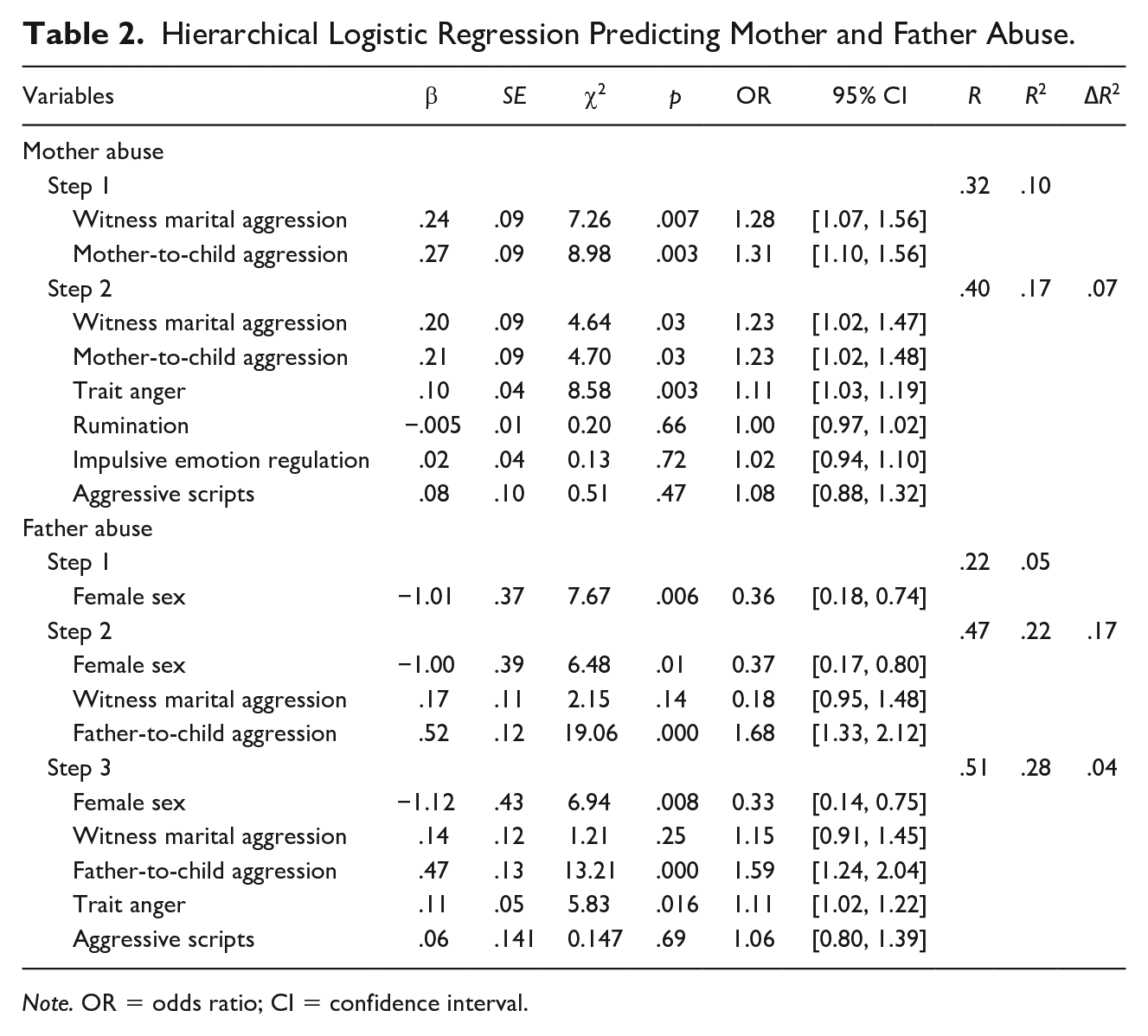
Note. OR = odds ratio; CI = confidence interval.
Impellor (i.e., trait anger, aggressive scripts) and disinhibitor factors (i.e., rumination and impulsive behavior when experiencing difficult emotions) were entered into Step 2. The model was significant, χ2(6) = 38.30, p < .001, and continued to be a good fit (Hosmer and Lemeshow test: p = .94). The model correctly classified 73% of cases (sensitivity = 60.0; specificity = 75.3). However, the improvement in prediction was solely related to trait anger (Wald = 8.58, p < .01) as aggressive scripts, rumination, and impulsive emotion regulation did not add significantly to the model (ps range = .47–.72).
Father abuse model
The model for father-directed CPA is displayed at the bottom of Table 2. Sex was entered into the first block as a control variable. This produced a significant model, χ²(2) = 7.31, p < .01. The Hosmer and Lemeshow goodness-of-fit test could not be calculated to assess the fit of the model because it cannot be calculated when both variables are dichotomous. The model correctly classified 74% of cases (sensitivity = 44.4; specificity = 77.5). Female sex was significantly inversely related to father abuse (Wald = 7.67, p < .01, OR = 0.36).
Factors related to history of family violence were entered into Step 2 and produced a significant model, χ2(3) = 36.51, p < .001. The Hosmer and Lemeshow goodness-of-fit test indicated that the model was a good fit (p = .83). The model correctly classified 76% of cases (sensitivity = 66.7; specificity = 77.5). While aggressive father–child behavior predicted father abuse (Wald = 19.06, p < .001), witnessing marital aggression did not (Wald = 2.15, p = .18).
Trait anger and aggressive scripts were entered into Step 3. The model was significant, χ2(5) = 46.90, p < .001, and continued to be a good fit (Hosmer and Lemeshow test: p = .48). The model correctly classifying 80% of the cases (sensitivity = 71.4; specificity = 81.5). Trait anger was a significant predictor of father abuse after controlling for sex of child and father–child aggression (Wald = 5.83, p < .05, OR = 1.11), but aggressive script rehearsal was not (Wald = 0.16, p = .69, OR = 1.06).
Discussion
Drawing upon two complementary models of aggression (i.e., GAM and I3 theory), this study explored social-cognitive factors related to CPA, accounting for both the frequency and severity of the pattern of abusive behavior. This was the first study to differentiate abusive and nonabusive young people using an empirically derived threshold, as has been recommended in the literature (Hollenstein & Lougheed, 2013; Kennedy et al., 2010). In this sample, one in seven young people were abusive to at least one parent. Univariate results suggested that participants who abused their mothers reported greater exposure to family violence (i.e., exposure to marital violence and victimization by parent), trait anger, aggressive scripts, and self-regulation deficits (i.e., rumination and impulsivity in the face of negative emotions). In contrast, participants who abused their fathers did not significantly differ from nonabusive participants on rumination and impulsive emotional dysregulation but did report greater levels of family violence and trait anger. Although abusive young people endorsed more violent attitudes than those who were not abusive, the difference was not significant.
Logistic regressions for mother and father abuse were calculated separately. The findings suggested that the factors that were broadly related to both the GAM and I3 theory were significant, as parent–child aggression and trait anger were independently related to abuse against either parent. In addition, male sex predicted father abuse, while witnessing marital aggression predicted mother abuse. Aggressive cognitions (i.e., scripts) and inhibitory difficulties (i.e., impulsive emotional dysregulation, rumination), which differentiate the GAM from I3 models, did not independently contribute to the prediction of CPA in this sample.
As expected, participant sex was not significantly related to mother abuse, but males were three times more likely to abuse their fathers than females. While this finding appears to be contrary to most community CPA research, which has found sex symmetry in CPA perpetration (see Simmons et al., 2018), these results support the hypothesis that the pattern of parental abuse changes with the young person’s age. Research investigating older adolescents or young adults, like the sample used here, has reported higher rates of father abuse among older males (Agnew & Huguley, 1989; Peek et al., 1985; Walsh & Krienert, 2007).
Parent–child aggression was expected to be the strongest predictor of CPA. This hypothesis was partially confirmed as it was the strongest predictor of father abuse and one of the strongest predictors of mother abuse. However, contrary to our hypothesis, witnessing marital aggression added to the prediction of mother abuse, but not father abuse. Although limited, research that has investigated the relationship between CPA and family violence in a gender sensitive manner has previously found that marital aggression did not predict father abuse, despite being a strong predictor of mother abuse (Lyons et al., 2015; Ulman & Straus, 2003), which is consistent with our findings. Notably, Lyons and colleagues (2015) found that marital physical aggression initially predicted father abuse but was not significant after father’s physical abuse and spanking was accounted for. Similarly, our results found that, while marital aggression and father-directed CPA were moderately related at the univariate level, when entered into the regression model with father-to-child aggression, marital aggression did not add to the prediction of CPA. This suggests that while young people who are exposed to aggressive behavior in the home may be more likely to act aggressively toward their parents (Cornell & Gelles, 1982; Ibabe et al., 2013b), their abuse is more likely to be directed toward their mothers, unless their fathers are directly aggressive to them.
The investigation of the impelling and inhibiting factors related to CPA found that trait anger was the only significant predictor. This is consistent with Calvete, Gamez-Guadix, and Garcia-Salvador’s (2015) research which also found that anger was the only social-cognitive risk factor that predicted CPA. Although contrary to our hypotheses, these results do not exclude the possibility that anger is related to CPA through a pathway of aggressive scripts, rumination, and emotional dysregulation. Instead, the results suggest that these factors are not independently related to CPA after anger is accounted for. These findings highlight the need for continued research regarding the relationship between anger and CPA, as anger is grossly understudied within this field. Comparatively, there is a wealth of research in the intimate partner (see Birkley & Eckhardt, 2015, for review) and general aggression (Anderson & Bushman, 2002; Berkowitz, 1993) literatures that highlight anger as important predisposing factor and precipitant.
Overall, the regression model for mother-directed CPA correctly classified 73% of cases, although fewer than two thirds of abuse cases were correctly identified. In contrast, the model for father-directed CPA correctly classified 80% of cases overall, with 71% of abuse cases correctly identified. The relatively low rate of correct classification in the mother abuse model suggests that there are likely other factors related to CPA perpetration that were not included in our study. In contrast, the model of father abuse paints an interesting picture as three factors (i.e., male sex, trait anger, and father-to-child aggression) demonstrated good discriminant validity and correctly classified almost three quarters of abusive young people.
Limitations and Future Research
Although this study investigated differences in perpetration of mother abuse and father abuse, there were too few male participants to create gendered perpetration models. Previous research has identified that perpetrator gender may influence the factors related to CPA (e.g., Calvete, Orue, et al., 2015; Ibabe et al., 2013a, 2013b). The lack of gender-sensitivity in our perpetration analysis may have obscured results in the mother model as males and females abused their mothers at similar rates. However, as males were more likely to abuse their fathers in this sample, the model likely provides clearer insight into the predictors for son-to-father abuse, while offering little understanding of daughter-to-father abuse.
Aggressive scripts and violent attitudes were endorsed at unexpectedly low rates by abusive participants in our sample. This may reflect impression management, which was not measured. Alternatively, the low rate of endorsement may suggest that these attitudes and scripts are relatively uncommon in nonoffender samples or that prosocial young people may engage in post hoc justification or minimization that means they do not easily recall infrequent thoughts about such socially unacceptable topics. Furthermore, the broader family violence literature suggests that relationship-specific aggressive attitudes may be more useful predictors of abuse compared with generally violent attitudes, particularly in female-dominated samples (Morris et al., 2015). Considering that individual factors were poor predictors of mother abuse in our sample, relationship-specific social-cognitive factors may be more useful to investigate in the future.
Furthermore, while a variety of social-cognitive factors were investigated in this study, not all aspects of the GAM or I3 could be tested. Future research could draw greater inspiration from the I3 model, which provides somewhat more guidance regarding the types of factors that may increase or decrease the likelihood of aggression, relative to the GAM. Within the I3 framework, impellors and inhibitors are grouped according to evolutional and cultural factors (e.g., biological or social norms), dyadic factors (i.e., factors specific to the relationship in which aggression occurs), personal factors (i.e., factors of the potentially aggressive individual), and situational factors (e.g., affective, cognitive, and arousal at the time of situation; Finkel, 2007). Considering the unique relationship dynamics involved in CPA, there may be dyadic or cultural factors that are particularly important in CPA perpetration that have yet to be explored in other aggression research. Future research would benefit from creating an integrated theory of CPA that combines both I3 theory and GAM as well as addressing the unique aspects of the child–parent relationship.
Conclusion
Considering the cross-sectional nature of this study, we can only conclude that there are correlational rather than causal relationships between the predictors in the model and CPA. However, drawing upon two theoretical frameworks, this research provides initial evidence to assist with understanding the individual social-cognitive processes that may connect exposure to familial violence and CPA. The results of this study suggest that, regardless of whether young people target mothers or fathers, CPA perpetrators report higher levels of anger, which may present a useful treatment target in conjunction with treatment of aggression-related cognition and familial risk factors (e.g., conflict tactics used within the family). Furthermore, this research adds to the literature by highlighting that CPA does not stop at the arbitrary “adult” age of 18 years, with one in seven participants in our sample reporting parental abuse. Considering the rising age at which young people move out of home in Western countries (Australian Bureau of Statistics, 2009; Eurostat, 2015; Vespa et al., 2013), abuse by young adult children is only likely to increase in importance, yet young adult perpetrators of CPA have received relatively little attention in academic or social discussion of the phenomenon. In addition to highlighting new avenues of research into potential causes of CPA, the results of this study underscore the need for increased research and policy attention to young adult perpetrators.
Footnotes
Declaration of Conflicting Interests
The author(s) declared no potential conflicts of interest with respect to the research, authorship, and/or publication of this article.
Funding
The author(s) received no financial support for the research, authorship, and/or publication of this article.
