




Abstract
This study intended to examine rape myth acceptance (RMA) among police officers and its relationship with sociodemographic data, length of service, specific training in the field, and professional experience with victims of rape. To this end, we applied the Sexual Violence Beliefs Scale (ECVS) and controlled for sociodemographic data, as well as professional experience and specific training in the field, through a self-report questionnaire. The sample was composed of 400 police officers from a city in the north of Portugal, aged between 29 and 54 years, and most were men (94.3%). We found that tolerance to overall sexual violence exhibits positive correlations with age and length of service, as well as negative correlations with education levels. Differences were also found regarding gender, with men exhibiting greater tolerance/acceptance of overall sexual violence. It was also found that officers who exhibit higher tolerance/acceptance for sexual violence, overall, are those who do not consider it relevant to receive specific training in the field of sexual violence to perform their duties, who report not having any professional experience with cases of sexual violence and also do not consider it necessary to have specific abilities for these types of cases. Implications for decision-making in legal proceedings are discussed, stressing the need for specific specialization in intervention with victims of sexual assault, with a strong practical component.
This work intended to analyze the degree of rape myth acceptance (RMA), specifically about rape, in a sample of police officers. RMA influences and limits not only the beliefs and attitudes of society, but also of the victims themselves (LeMaire et al., 2016; Stoll et al., 2021).
Over the last decades, there has been a significant increase in the number of studies that report on the phenomenon of sexual violence perceptions (Ryan, 2011; Suarez & Gadalla, 2010; van der Bruggen & Grubb, 2014). Therefore, it is possible to observe a set of beliefs that are beginning to be discredited, considering the accumulated knowledge (Mennicke et al., 2014), because there is, in particular, a disagreement among the general population regarding rape myths (Martins & Machado, 2008). However, many erroneous beliefs persist, with the most characteristic example being the idea that rape is a crime committed mostly by strangers (Venema, 2019), in the streets, at night, in a dark, isolated location, in which the victims are alone and unprotected (Eyssel, 2009; Page, 2008; Temkin & Krahé, 2008), and in many cases provoked by the victim (Temkin & Krahé, 2008).
These types of stereotypes are found not only in the discourse of ordinary citizens, but also of various professionals, such as doctors, police officers, lawyers, and judges (Du Mont et al., 2003; Ferreira, 2004; Kassing & Prieto, 2003; Page, 2008; Temkin & Krahé, 2008). Consequently, these stereotypes are reflected in the ways these professionals evaluate rape (McMillan, 2018; Page, 2008; Temkin & Krahé, 2008) and in the way the victims themselves define and disclose the occurrences to which they were subjected (Khan et al., 2018; Patterson & Campbell, 2010; Stoll et al., 2021).
Not perceiving this crime as terrible and extremely severe may lead to extreme negative consequences, not only in terms of the recovery of victims (Decker & Littleton, 2018; Kubany et al., 1995), who tend to silence their victimization (McMillan, 2018; Ventura, 2018), but also in terms of the complaint and intervention of the legal system, which, by not punishing the perpetrator, conveys a feeling of insecurity and helplessness to victims (Frese et al., 2004; Venema, 2016).
Over the years, several studies have been conducted with the aim of analyzing how attitudinal factors and myths that surround the rape phenomenon relate to the occurrence and acceptance of this type of crime, with gender being the main variable under study (Burt, 1980; Ong & Ward, 1999; Ryckman et al., 1992; Sierra et al., 2010).
It has been found that men tend to agree more with sexual assault myths about both men and women (Geiger et al., 2004; Reitz-Krueger et al., 2017; Sierra et al., 2010; Suarez & Gadalla, 2010), to have more hostile and homophobic reactions (Anderson, 2004; Sierra et al., 2010), to blame the victims more (Basow & Minieri, 2011; Mitchell et al., 1999; Suarez & Gadalla, 2010; White & Kurpius, 2002), and to exhibit less tolerant attitudes toward victims (Carroll et al., 2016; Nagel et al., 2005). Moreover, men continue to display relatively higher values in terms of RMA (Jimenez & Abreu, 2003; Martins & Machado, 2008; McDonald & Kline, 2004; Sierra et al., 2010; Vrij & Kirby, 2002). The differences observed are mostly due to the highly gendered nature of rape (McPhail, 2015), because, historically, women are more likely to be raped and men are vastly more likely to be perpetrators of sexual assault, and due to rape culture, which places on women the responsibility for their own victimization (Bohner et al., 2009; Choudhary et al., 2012).
Thus, studying, analyzing, and understanding the attitudes of the population and of police officers toward sexual violence, especially rape, allows for the increase of knowledge about how the population reacts and behaves, not only toward victims but also toward perpetrators. In general, attitudes and behaviors tend to be marked by victim blaming (Gravelin et al., 2019), by minimizing the psychological impact (Loughnan et al., 2013), and by attempting to justify the behavior of the perpetrator, which, in turn, increases the expression of tolerance to rape (Edwards et al., 2011), as well as the adherence to traditional sexual stereotypes of masculinity and femininity (Loughnan et al., 2013).
Some studies prove the correlation between the presence or absence of physical force and feelings of hostility toward women, the acceptance of rape myths and the belief that women like and deserve to have violent sexual relations (Sierra et al., 2010). On the other hand, there is emphasis on the relationship between a sexist, aggressive and dominant education, and the acceptance and fostering of myths and beliefs regarding the practice of violent sexual activities (Lee et al., 2010; Sierra et al., 2010).
Overall, women tend to evaluate sexual assault more severely than men (Bieneck & Krahé, 2011; Temkin & Krahé, 2008); however, similar values are achieved when women are questioned about the violence perpetrated by those close to the victim (friend, partner, boyfriend, husband) or by strangers. In other words, both genders consider that sexual violence perpetrated by a stranger tends to be more severe and traumatizing for the victim (Eyssel, 2009). Likewise, men and women both tend to blame the victim in cases of sexual assault by a known person (Gravelin et al., 2019; Temkin & Krahé, 2008).
The evaluation by the general population of an episode of rape, that is, about the participation of the victim, about the blame of the victim or the perpetrator, about the greater or lesser severity of the situation, among others, is conditioned by a set of factors. Thus, the factors that interfere in the degree of resistance of victims are alcohol consumption (Baldwin-White & Elias-Lambert, 2016; Ong & Ward, 1999), the existence of physical injuries, threats and/or the use of weapons by the perpetrator, the circumstances of the rape (e.g., hour, day and location) (Campbell et al., 2009), and the relationship between the victim and the perpetrator (Eyssel, 2009; Gravelin et al., 2019; Grubb & Harrower, 2008; Grubb & Turner, 2012; Lee et al., 2010).
Men appear more likely to accept rape myths (Carroll et al., 2016; Cotton et al., 2002; Page, 2008; Sierra et al., 2010; Temkin & Krahé, 2008), to exhibit attitudes that provide less support to victims (Page, 2008), to be more tolerant to this crime, and to place more blame for the crime of rape on the victims (Sierra et al., 2010). On the other hand, women tend to reject more easily the idea that men are frequently falsely accused of rape. In turn, men adhere more easily to the idea that a “normal” man does not commit a crime of rape (Sleath & Bull, 2017). Women also reject more the idea that, when they invite a man to go out, it is because they are looking for a sexual relationship, or that when they say “no” they mean “yes,” or that rape by individuals close to the victims is not as severe (Stoll et al., 2021). At the same time, men seem to trivialize, to a greater extent, rape by individuals close to the victims. As for attitudes regarding the causality and severity of rape, men assign, to a higher degree, the cause of rape to the personality of the victim/survivor, whereas women tend to blame the perpetrator (Temkin & Krahé, 2008).
Education and age have direct influence on RMA, as younger individuals with higher education reveal attitudes that are less stereotyped, less adversarial toward sexuality, less supportive of violence, as well as less accepting of rape myths (Eyssel, 2009; Sierra et al., 2010).
Tolerance for interpersonal violence was also described as a good predictor of RMA, influenced by more traditional and sexist orientations and, consequently, conservative attitudes toward the role of women (Davies et al., 2012; Ryan, 2011; Sierra et al., 2010).
Various studies have questioned how professionals and the population who directly deal with the crime of rape perceive and react to the victims (Whitby & Pina, 2013). Often, police forces are the first contact of rape victims (Spohn & Tellis, 2012), and the intervention of these professionals has a decisive impact on the future action of victims (Heath et al., 2013) and can even be a moment of revictimization (Whitby & Pina, 2013). The attitudes and beliefs of these professionals about rape, as well as about the role of the victim, influence their actions (Wentz & Archbold, 2012), which may even override legal impositions (Mennicke et al., 2014; Venema, 2016). Many police officers believe that victims have a relevant role in their process of victimization, and physical evidence is required to proceed with the investigation (Page, 2010) and, in the cases where the police agents find that the victim is under the influence of alcohol, they tend to react with less rigor (Campbell et al., 2015; Romero-Sánchez et al., 2017; Sleath & Bull, 2015). Although they do not blame, nor trivialize the victims or the crime of rape, some police officers believe that these women provoke the occurrence of the crime with their appearance (O’Neal, 2019) and that only someone with a disorder is capable of perpetrating rape (McMillan, 2018).
By studying the way police officers framed the crime, studies have shown that, although they consider rape as a severe offense, with harmful consequences, they also had a limited, stereotyped, and incorrect view of the crime (McMillan, 2018). For the officers, rape happens in a public space, at night, and is perpetrated by strangers with mental disorders (Sleath & Bull, 2015).
By further widening the focus of analysis, studies have examined differences in attitudes toward rape among rapists, police officers, health professionals, psychology and law students, and ordinary citizens (McMillan, 2018; Sleath & Bull, 2015). It was possible to observe that health professionals had the least tolerance for rape, whereas police officers displayed more agreement and tolerance, accompanied by the group of rapists and male students (Sleath & Bull, 2015). Police officers, compared with the general public, are less tolerant of rape (Whitby & Pina, 2013), but compared with other professionals, they were more suspicious of victims (Sleath & Bull, 2015, 2017), perhaps due to the training the officers receive related to the importance of physical evidence to determine the credibility of victims (Maddox et al., 2012). Therefore, for police officers, factors such as the absence of physical injuries, a delay in filing a complaint, or a nonmarital sex life by the victim (Campbell et al., 2015), and previously knowing the perpetrator were indicators that the accusations were false, justifying the causality of the rape with the behavior of the victim (O’Neal, 2019; Venema, 2018).
Moreover, rapists receive lighter sentences when the behavior of the victim is defined as promiscuous (Shaw et al., 2016), that is, if the victim consumes alcohol or drugs (Grubb & Turner, 2012), is adulterous, if the victim is the one who makes the invitation to go out, initiates conversation with the perpetrator, accepts to go to the perpetrator’s home, and/or is not firm and immediate in refusing sexual intercourse (Masser et al., 2010).
Therefore, it is possible to observe that RMA remains present in several contexts, including among police officers, who are very relevant for the support of victims and punishment of perpetrators (Sleath & Bull, 2017). In Portugal, there are no specific studies with this population. As such, the present study, using a quantitative cross-sectional design with a nonprobabilistic sample of police officers, aimed to understand the degree of RMA present in officers, to examine the possible associations between age, length of service, and education level of officers and their beliefs about sexual violence, and to analyze possible differences in RMA according to previous professional experience with sexual violence cases, the perception of specific training in the field of sexual assault, as well as specific training in this field. In this sense, the professional justification for this study is the analysis of the referred cognitive beliefs to be considered in professional training programs aimed at promoting the skills of police officers, in the context of their action with victims of sexual assault.
Method
Participants
The participants of this study were a nonprobabilistic sample of 400 law enforcement officers from the District Command of Northern Portugal, recruited through a convenience sampling process. The ages of participants ranged from 29 to 54 years old (M = 34.83; SD = 9.34), with most being men (94.3%). As for marital status, most participants were married or in a de facto union (63.0%), and the remaining were single (34.8%), divorced, or separated (2.3%). Education was coded according to the existing education levels in Portugal (basic level—1st cycle, 2nd cycle, 3rd cycle, secondary, higher). Thus, regarding education level, most participants had completed high school (55.3%), and the remaining participants were distributed accordingly: 26.8% had completed Grade 9, 8.3% had completed Grade 6, 7.0% had completed Grade 4, and 2.8% had a university education. As for length of service, this ranged from 1 to 37 years (M = 12.09; SD = 9.20).
When asked about the relevance of specific training in the field of sexual violence for performing their duties, most answered affirmatively (90.3%), although only 20.0% reported having received specific training in this field. Almost half of the participants mentioned having at least one professional experience with rape cases (42.0%); however, it is evident for nearly all participants that there needs to be specific preparation to attend to victims of sexual violence (93.5%).
Instruments
Sociodemographic questionnaire was developed specifically for this study, comprising questions that aim to gather personal information (gender, age, marital status) professional information (education levels and professional activity), and questions related to specific training in the field of sexual violence (if they consider it relevant, if they have undergone it), with the goal of analyzing possible relationships between the dependent variable in this study and personal and professional information.
Sexual Violence Beliefs Scale (ECVS) (Martins & Machado, 2008) comprising 30 items, designed based on the clinical observation of rape victims and on literature about myths and cultural beliefs pertaining to sexual violence was used. As references for building the scale, we also used reports from the clinical observation of rapists, as well as what literature postulates about their cognitive strategies for legitimizing abusive sexual behavior. The response options were formulated on a 5-point Likert-type scale, from 1 (completely disagree) to 5 (completely agree) and allow the assessment of beliefs related to sexual violence. There are five main factors among the responses to the ECVS: “Stereotyped Representations of Rape” (Items 2, 6, 9, 15, 16, 22, 23, 24, 25, 28, 29), “Victim Provocation” (Items 8, 11, 21, 26, 27), “Victim Consent” (Items 10, 17, 18, 19), “False Invulnerabilities” (Items 1, 3, 4, 7, 13, 30), and “False Allegations” (Items 5, 12, 14, 20). The total score of the scale measures the degree of tolerance/legitimization/acceptance of the individual toward sexual violence, where the higher the score, the greater the degree of tolerance toward sexual violence. The score in each of the factors allow us to better understand the type of specific beliefs involved in the tolerance to this type of violence. The internal consistency of the original scale, obtained through Cronbach’s alpha, was .91 (Martins et al., 2012). The present study found that this instrument also exhibits excellent internal consistency, obtaining a Cronbach’s alpha of .92 for the global scale. Regarding its dimensions, the following Cronbach’s alpha values were obtained: .89 for stereotyped representations of rape, .75 for victim provocation, .74 for victim consent, .69 for false invulnerabilities, and .67 for false allegations.
Procedure
Considering the objectives of this study, we contacted the District Command of Police Services, in Portugal, called “Guarda Nacional Republicana” (Republican National Guard), from the north of Portugal, which authorized this study and the data collection process. A quantitative methodology was adopted for this process, with a descriptive cross-sectional research design, resorting to self-report measures, where 750 paper surveys were sent, and 400 were returned. All ethical considerations were taken into account, informed consent was obtained, and the confidentiality of data was assured.
Statistical Analysis
Data analysis was processed using the program IBM Statistical Package for the Social Science (SPSS), version 24.0. For the characterization and description of the sample, frequency and descriptive statistics (mean and standard deviation) were used. Considering the sample size (N = 400) and the fact that almost all variables assumed a normal distribution, we opted for the use of parametric tests, namely the independent samples t test, to study the differences, and the Pearson correlation test, to study associations. However, when the analysis encompassed ordinal variables, such as education levels, we opted for the use of nonparametric tests, namely the Spearman correlation test, to study the associations. The minimum significance level considered was 95% (p < .05).
Results
Starting with the characterization of RMA among the participants, they present an overall mean of 61.24 (SD = 14.77). To examine the associations between beliefs toward rape and age and length of service, we used the Pearson correlation test (Table 1), which showed that age has positive correlations with overall beliefs (r = .165, p < .01) and with the dimensions of stereotyped representation (r = .174, p < .001), victim provocation (r = .143, p < .01), false invulnerabilities (r = .163, p < .01), and false accusations (r = .110, p < .05). On the other hand, length of service exhibits positive correlations with overall beliefs (r = .154, p < .01) and with the dimensions of stereotyped representations (r = .167, p < .01), victim provocation (r = .139, p < .01), and false invulnerabilities (r = .140, p < .01).
Summary of Mean Values, Standard Deviation and Pearson Correlations Between Age, Length of Service, and Beliefs About Sexual Violence.
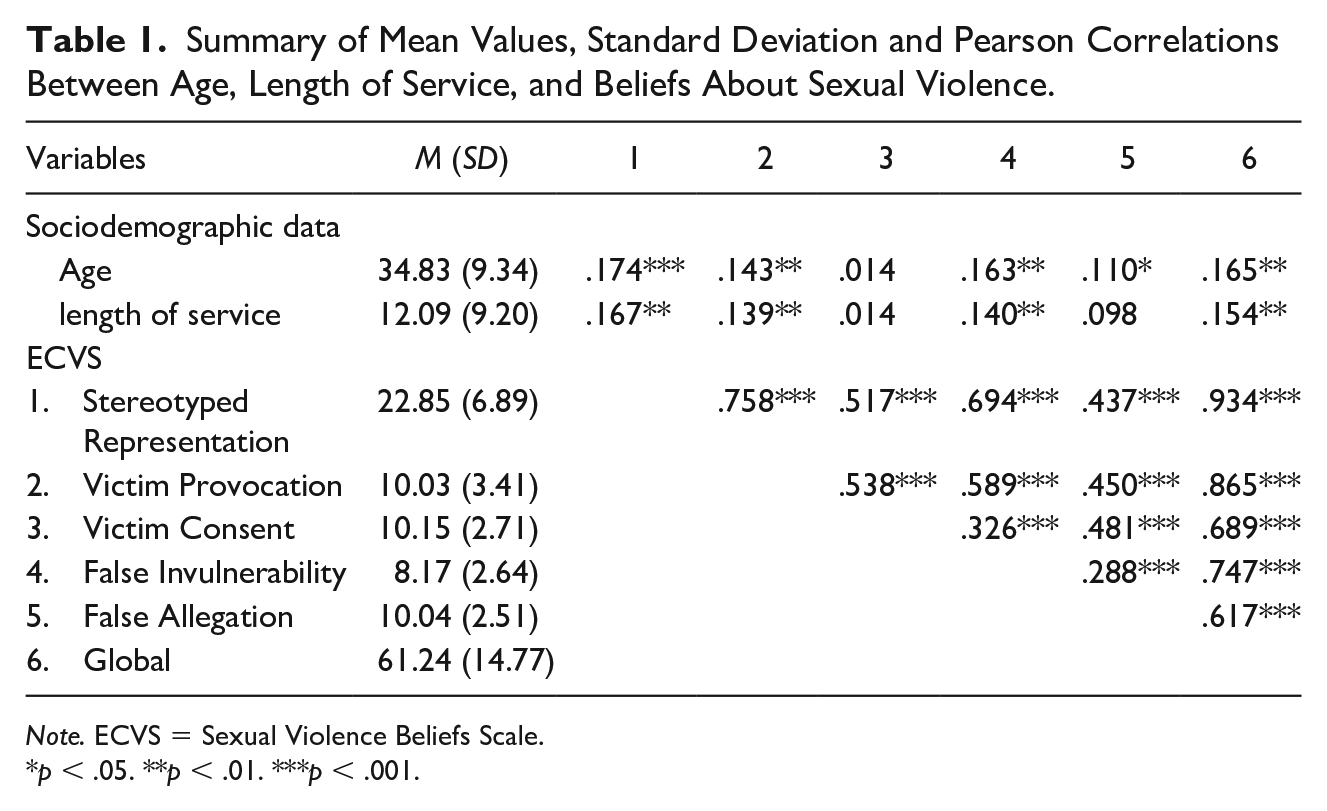
Note. ECVS = Sexual Violence Beliefs Scale.
p < .05. **p < .01. ***p < .001.
The Spearman correlations test was used to examine the relationship between beliefs about sexual violence and education levels, with the latter exhibiting negative correlations with beliefs (rs = −.189; p < .001) and with the dimensions of stereotyped representations (rs = −.206; p < .001), victim provocation (rs = −.176; p < .001), and false invulnerabilities (rs = −.169; p < .01).
Seeking to describe differences regarding beliefs about sexual violence according to the gender of the participants, we used the independent samples t test statistical procedure (Table 2). Statistically significant differences were found, with men exhibiting greater tolerance/acceptance for overall sexual violence, t (398) = −3.380; p < .01, as well as greater tolerance/acceptance toward stereotyped representations of rape, t (398) = −2.652; p < .01, victim consent, t (398) = −4.326; p < .001, false invulnerabilities, t (398) = −2.040; p < .01, and false allegations, t (398) = −3.202; p < .01.
Averages and Standard Deviation Summary of Beliefs About Sexual Violence by Sex Using the t Student for Independent Samples.

Note. ECVS = Sexual Violence Beliefs Scale.
p < .01. ***p < .001.
A t test statistical procedure was used to examine differences regarding beliefs about sexual violence, according to aspects such as relevance assigned to specific training in the field of sexual violence to perform duties, undergoing this type of training, professional experience with cases of sexual violence, and the need to have specific preparation to intervene with victims of sexual violence. This analysis showed that participants who exhibit greater tolerance/acceptance for overall sexual violence are those who least believe it is relevant to have specific training in the field of sexual violence to perform their duties, t (398) = 3.539; p < .001, who had no professional experience with cases of sexual violence, t (398) = 4.141; p < .001, and who also do not believe it is relevant to have specific abilities for this type of cases, t (398) = 4.496; p < .001 (Table 3). No statistically significant differences were found in terms of undergoing or not undergoing specific training in this field.
Summary of Means and Standard Deviations of Beliefs About Sexual Violence According to Agreement About Training, Previous Experience, and Preparation in the Field of Sexual Violence, Using the Independent Samples t Test.

Note. ECVS = Sexual Violence Beliefs Scale.
p < .001.
Discussion
The main aim of the study was to develop a better understanding of the degree of RMA among police officers, by examining sociodemographic data (e.g., age, gender), length of service, specific training in the field, as well as the perceived relevance of training and professional contact with cases of rape, in their association with RMA. Results found that RMA presents a low overall mean.
This study determined that both age and length of service exhibit positive correlations with overall beliefs and with the dimensions of stereotyped representations, victim provocation, false invulnerabilities, and false allegations.
Therefore, the older the police officers and the longer their years of service, the greater their RMA and their stereotyped representations of the victim and perpetrator, that is, rape is legitimized based on the absence of physical violence during rape (Huitema & Vanwesenbeeck, 2016) and on the idea that there is a previous affective bond between the victim and the perpetrator (Eyssel, 2009).
It is also older police officers (Eyssel, 2009; Sierra et al., 2010), with greater professional seniority, who exhibit more legitimizing beliefs based on the notion that the victim somehow provoked the perpetrator, as other researchers have demonstrated (e.g., Monson et al., 2000; Temkin & Krahé, 2008), and, thus, their behavior may justify the occurrence of rape. Therefore, contributing to greater RMA are representations that people with sexualized, promiscuous, or provocative behavior (Shaw et al., 2016), who use drugs (Adams et al., 2010), and usually frequent locations with greater exposure to risks, somehow deserve to be victims of sexual assault, or on the other hand, may be lying about the occurrence of this crime, as their lifestyle removes firmness and veracity from their statements (Campbell, 2006; Campbell et al., 2015). This contributes to viewing rape as something that is not as severe or may not have even happened (Spohn et al., 2014). A possible explanation may be supported in the analysis by Huitema and Vanwesenbeeck (2016), of the heterosexual sexual script, which suggests that men play the role of sexual “barometers” and women are the guardians. In other words, it is men who seek sex and it is up to women to decide whether or not they accept. Thus, a woman victim of rape who, for example, has consumed alcohol is less able to set boundaries. As such, the perpetrator is less responsible than the victim.
With regard to false invulnerabilities, it was also found that the older the police officers and the greater their length of service, the more they rely on the notion that victims and perpetrators of rape present certain peculiar characteristics, different from the rest of the population, to legitimize and tolerate rape (Hine & Murphy, 2017). Rape is, thus, assessed as a crime mostly committed by strangers (Venema, 2018), in the streets, at night, in a dark isolated place, where the victims are alone and unprotected (Eyssel, 2009; Page, 2008; Ryan, 1988; Temkin & Krahé, 2008). It is likely that they share a very common representation, with important cognitive contours, found among the general population, and explained by the Assumptive World Theory, that if a person does not exhibit certain characteristics of victims, and avoids specific behaviors, they are not at risk of being victims of sexual assault (Javaid, 2016).
Previous research has found that, based on erroneous ideas that it was not rape but rather a consenting relationship (Hine & Murphy, 2017) which the victim later regretted, the older the police officers are and the longer their time of service, the more they share the thesis of false allegations in cases of rape. That is, officers believe that false allegations are more common than they actually are, which increases their tolerance to the sexual assault. They analyze rape allegations or attempted rape as if it were the victim’s revenge on the perpetrator or regret over a sexual act that was initially consented (McMillan, 2018; Sleath & Bull, 2017).
As for differences regarding RMA according to the gender of the participants, statistically significant differences were found, with male police officers exhibiting greater RMA toward stereotyped representations of rape, victim consent, false invulnerabilities, and false allegations. Male officers judged victims as more responsible than female officers (Hine & Murphy, 2017). Although not all studies found the influence of gender (Sussenbach & Bohner, 2011), men appear, overall, more tolerant to rape (Carroll et al., 2016; Grubb & Turner, 2012) and, in comparison with female police officers, male police officers have a more stereotyped view of rape (Bitton & Jaeger, 2020) and tend to legitimize sexual violence to a greater extent, based on the argument that victims consent or contribute to the occurrence of the sexual intercourse, because they desire it and derive sexual satisfaction from it. These conclusions are widely supported internationally (Jimenez & Abreu, 2003; Kheswa & Dayi, 2014; Martins & Machado, 2008; McDonald & Kline, 2004; Sierra et al., 2010; Suarez & Gadalla, 2010; Testa et al., 2010; Vrij & Kirby, 2002). Another factor found in this study, which is widely documented and increases RMA in men, derives from the belief of false allegations (McMillan, 2018; Sleath & Bull, 2017). It is worth noting that, overall, there was a strong acceptance of this myth among men and women, supporting the conclusions from previous studies that female police officers tend to share, to a greater degree, the belief of false allegations than do women from other professions (Sleath & Bull, 2015).
This study has found that education level exhibits negative correlations with overall beliefs and with dimensions of stereotyped representations, victim provocation, and false invulnerabilities. Therefore, and according to other studies in the field, the police officers who participated in this study and have higher education levels reveal less stereotyped, less adversarial attitudes regarding sexuality, are less supportive of violence, and exhibit lower RMA (Eyssel, 2009; Sierra et al., 2010). The weakening of beliefs that legitimize rape in officers with a high school education or higher education may be explained by maturity and academic socialization, as well as by the better quality of reasoning toward poorly structured problems, such as those analyzed here (Bastos, 1998).
Furthermore, participants who exhibit lower overall RMA are also those who consider it relevant to have specific training in the field of sexual violence to perform their duties, thus confirming previous studies showing that officers who assign greater relevance and utility to training hold more favorable attitudes toward women and the consequences of sexual violence. It should also be noted that this type of training, in addition to contributing to cognitive change in terms of myths and beliefs, also serves to improve intervention practices with victims (Campbell, 2006).
There was also greater RMA among police officers with less professional experience with cases of sexual violence and those who also do not consider it necessary to have specific abilities for this type of cases. Thus, considering the evidence, from other researchers in studies about crime in general, that positive interactions with people from different statuses, social groups, and victims of crime contribute to the reduction of stereotypes associated with these social groups (Taschler & West, 2017), the interaction with victims increases empathy, reduces discrimination and, thus, reduces RMA. This result may be explained by the reduced number of cases of sexual assault received by most of the participants in the present study. Therefore, we can assume that, more than length of service, it is important to have previous professional contact with cases of sexual violence, preferably in a nonstereotyped and nonprejudiced manner.
A curious piece of data was the absence of statistically significant differences regarding having or not participated in specific training about sexual violence, reaffirming the conclusions of other studies, which have found that receiving specific training about sexual violence does not prevent tolerance toward this type of violence (Kinney et al., 2008). This demonstrates the need for training programs about sexual assault to include a strong practical component and profound self-assessment about their own attitudes, as well as critical reflection on knowledge about sexuality, gender roles, ethics, and morality (Darwinkel et al., 2013).
Police officers play an important role in preventing the retraumatization of victims and in their ability to actively participate fully in the legal process. Thus, the most important national and international agencies have suggested that police should adopt a “victim-centered” approach, in all their interactions with victims. By using this perspective, police officers will center their focus of action on the interest of the victims, with a supportive, more empathetic manner (Gibbs & Kendrick, 2011).
Conclusion
The main goal of this study was to understand RMA among police officers, and the possible relationship with sociodemographic data, such as age, length of service, specific training in the field, as well as the perceived relevance of having training and professional contact with cases of sexual violence, for RMA.
Despite some limitations (e.g., reduced sample size of women, social desirability bias), it has been demonstrated that higher or lower RMA influences decision-making in judicial processes (Grubb & Turner, 2012 ) and that not only legal factors, as evidenced in this study, but also many other nonlegal factors influence decision-making and the assessment of rape by police officers (Camplá et al., 2017). As such, if the police officer “looks” at rape as a severe crime, based on knowledge and not on stereotyped ideas of victims or perpetrators, their behavior during case building and reporting (Venema, 2014, 2019) will contribute to rape being considered a crime and, as such, punished by law (Hine & Murphy, 2019).
Suggestions for Future Research
Considering that police officers may be the first contact that victims of sexual violence have with the justice system, and that it is expected that these professionals, regardless of gender, be free of preconceived ideas, thus having a nontolerant attitude toward sexual violence, we suggest controlling for some variables. It was important to know the perception and maintenance of sexual double standards, sexual scripts (Ryan, 2011), representations about gender equality, personal attitudes toward sexuality, and sexual stimuli (e.g., erotophobia and erotophilia, proposed by Fisher et al., 1988). It would also be very interesting to characterize the experiences of sexual victimization of police officers themselves and their characteristics, namely disclosure, complaint, and professional help received. In the present study, we analyzed the professional experience police officers had with victims of rape, but it would be important to further the information about the courses of action taken, such as the type of support provided to victims, and how these variables relate to RMA.
In this study, we noted the low levels of education of the police force. It would be important to extend this research to the entire country of Portugal and to analyze whether the police in other areas have higher levels of education and greater exposure to meaningful training than the police who participated in the present study.
It would also be interesting to study how cases are assigned to officers, in Portugal. Is it possible that the officers with lower RMA in this study are more likely to be assigned to rape cases, rather than lower RMA being a result of professional experience with rape?
Footnotes
Authors’ Note
After the local ethics committee approved the study, it was conducted according to APA ethical standards.
Declaration of Conflicting Interests
The author(s) declared no potential conflicts of interest with respect to the research, authorship, and/or publication of this article.
Funding
The author(s) received no financial support for the research, authorship, and/or publication of this article.
