




Abstract
An extensive amount of research has been devoted to understanding rape myths, especially in the context of sexual attitudes. Few studies have examined sexual actions as a correlate of rape myth acceptance (RMA). As such, this study utilizes the Updated Illinois Rape Myth Acceptance Scale (IRMA) and its four distinct subscales to examine adherence to rape myths and an individual’s view of sex and sexuality in a sample of 1,310 college students. The IRMA was included in its entirety and separated into its four subscales: “She asked for it,” “He didn’t mean to,” “It wasn’t really rape,” and “She lied.” Results indicated that the most impactful variables for all four subscales were adversarial heterosexual beliefs, stereotypical gender beliefs, and being male. The main implications of this study pertain to implementation of programming. Intervention programming should focus on younger males due to their increased adherence to certain rape myths. Furthermore, programs that address not only rape myths but also other traditional and negative belief systems should be employed. Results of this study lend support to the supposition that it is not necessarily individual characteristics that have a large effect on RMA but is instead a strong adherence to traditional belief systems.
Rape myths, first recognized in the 1970s, were originally defined as cultural beliefs that supported sexual violence against women (Brownmiller, 1975; Schwendinger & Schwendinger, 1974). In 1980, Burt further defined rape myths as “prejudicial, stereotyped, or false beliefs about rape, rape victims, and rapists” (p. 217) and noted that these myths are common not only among the general public but also among those who work with victims daily. These beliefs may affect how individuals interact with victims, mainly in terms of whether they see the victim as believable or even blameworthy in their own victimization. Burt created the most widely used and validated scale to measure rape myth acceptance (RMA; Payne et al., 1999), influenced by an increase of feminist literature and victimization focus during the 1970s. Burt (1980) attempted to predict RMA using a variety of variables, concluding that attitudinal variables (i.e., sex role stereotyping, adversarial sexual beliefs, and acceptance of interpersonal violence) produced the strongest relationships with RMA, regardless of gender, suggesting that rape myths are strongly connected with other deeply engrained attitudes about sex and gender roles.
Based on concerns about the limited significant relationships produced using Burt’s RMA scale, Payne et al. (1999) re-conceptualized the measurement of RMA, creating the 45-item Illinois Rape Myth Acceptance (IRMA) Scale. Focusing on the addition of structural questions and seven subscales, an original goal of the IRMA was to add items capturing the idea that rape myths “serve to deny and justify male sexual aggression towards women” (p. 30) and that women falsely claim rape under certain circumstances. Subscales were included under the hypothesis that individual experiences, such as sexual assault victimization, may decrease acceptance of some rape myths, while raising acceptance of others, therefore creating a null effect when all items are combined into one scale, as in the case of Burt’s RMA.
An updated version of the IRMA published by McMahon and Farmer (2011) attempted to capture the changing social acceptability of rape myths. McMahon and Farmer (2011) argued that society has become less accepting of overt sexism and rape myths, leading to more subtle and covert victim blaming and sexist attitudes. An example of this is a shift from directly blaming a victim for her assault to suggesting that her own actions placed her at an increased risk of assault. Furthermore, the authors updated the language of the IRMA to reflect cultural changes such as an emphasis on “hooking up” (p. 74). The resulting updated scale included 22 questions and four subscales: “She asked for it,” “He didn’t mean to,” “It wasn’t really rape,” and “She lied.”
In a meta-analysis of 37 RMA studies published in the United States from 1997 to 2007, Suarez and Gadalla (2010) reported that Burt’s (1980) RMA scale was most frequently used (74% of studies examined), while the original IRMA was used in 16% of studies. The updated version of the IRMA Scale was published in 2011 (McMahon & Farmer) and is therefore not included in the meta-analysis but has been used in recent research to measure RMA (e.g., Debowska et al., 2016; Venema, 2019). The Updated IRMA is used in this study.
RMA and Sexual Attitudes/Behaviors
As noted above, Burt (1980), along with creating the initial RMA scale, proposed and tested additional attitudinal variables expected to correlate with RMA. The first of these, sexual conservatism, refers to “restrictions on the appropriateness of sexual partners, sexual acts, conditions, or circumstances under which sex should occur, and so on” (p. 218). Burt (1980) found that sexual conservatism produced the smallest effect on RMA, when considering other attitudinal variables. Notably, later research linked sexual conservatism to sexual dysfunctional behavior (SDB) for both males and females (Barnett et al., 2017). 1 Using the Illinois Rape Myth Scale—Short Form and measures for adherence to traditional gender roles, Barnett and colleagues (2017) found a strong, positive correlation between SDB and RMA for both males and females. The authors suggest that RMA is not a function of individual identity but instead related to stereotypical belief systems. The importance of this consideration will be discussed further below.
While the inclusion of sexual attitudes is relatively common in the research on RMA, few studies have examined sexual actions and behaviors as a correlate of RMA. It can be suggested that just because one has overtly sexualized thoughts, it does not mean that they will act on those impulses and desires. In this study, sexual attitudes and behaviors are measured as number of sexual partners, sexual compulsivity, and use of sexual deception. As the present form of sexual compulsivity and sexual deception have not been previously examined in the RMA literature, they will be detailed in the methodology.
Many studies on RMA have examined the impact of sexual history; however, this is mainly done through the use of the Sexual Experiences Survey, (SES; Koss et al., 1987, 2007; Koss & Oros, 1982), which measures acts of sexual assault either experienced as a victim or perpetrated as an offender (Christopher et al., 1998; Forbes & Adams-Curtis, 2001; Mason et al., 2004). While this measure is commonly used in the sexual assault literature, it does not include consensual sexual history, only that which would be considered on a range of problematic to illegal. Frydenborg (1999) surveyed 616 freshmen at a small, private college using an extended version of Burt’s (1980) RMA scale and a measure of sexual history. Using the SES and adding an additional item to measure if the respondent ever experienced consensual sex, sexual history was separated into four categories: no sexual experience, consensual sex, aggressive sexual experiences, and assaultive sexual experiences. Females who had experienced aggressive sexual behavior reported the lowest levels of RMA, but these differences were not significant compared to the other three groups. Males who had engaged in assaultive sexual behavior had significantly higher RMA than men who reported never having engaged in sex and those who had engaged in consensual sexual intercourse.
Monto and Hotaling (2001) also examined the effect of sexual history on RMA, but instead used a sample of males arrested for solicitation in three major cities. It was expected that this sample of men would have higher RMA beliefs as the author’s suggest that RMA is more harshly applied to sex workers. Using Burt’s (1980) RMA scale, both number of sexual partners in the past year and thoughts about sex were negatively related to the acceptance of rape myths in the sample, suggesting that RMA is higher among sexually conservative men.
Finally, Yost and Zurbiggen (2006) examined the correlation between RMA and sociosexuality, a measurement of comfort with casual sex and/or multiple sexual partners. Number of sexual partners was included as a component of sociosexuality but was not examined as a separate relationship. Supporting prior research, sociosexuality was negatively correlated with RMA, implying higher RMA among sexually conservative individuals.
Additional Relationships With RMA
A multitude of additional attitudinal scales have been related to RMA, most commonly those which measure oppressive beliefs, with a greater focus on traditional/stereotypical gender roles. Burt (1980) created scales measuring sex role stereotyping, adversarial sexual beliefs, and acceptance of interpersonal violence. Sex role stereotyping focuses on traditional gender roles in the realms of family, work, and social life. Adversarial sexual beliefs “refers to the expectation that sexual relationships are fundamentally exploitative, that each party to them is manipulative, sly, cheating, opaque to the other’s understanding, and not to be trusted” (p. 218). Finally, acceptance of interpersonal violence measures the extent to which an individual feels that force and coercion should be used in a relationship. All three scales were found to be significantly, positively correlated with RMA during initial testing. These scales have been adapted and revised over time, but consistently produce significant relationships with RMA in bivariate correlations (Aberle & Littlefield, 2001; Boxley et al., 1995; Cowan, 2000; Forbes et al., 2004), multivariate analyses (Locke & Mahalik, 2005; Truman et al., 1996), and in the form of similar scales measuring sexist attitudes (Aosved & Long, 2006; Truman et al., 1996). Furthermore, RMA has been significantly correlated with other oppressive attitudes, such as racism, ageism, classism, religious intolerance, homophobia (Aosved & Long, 2006), and heterosexism (Locke & Mahalik, 2005).
Aside from attitudinal scales, gender has produced one of the most consistently strong relationships to RMA, with males scoring higher than females in co-ed samples (Suarez & Gadalla, 2010). With consideration to male respondents, sexually aggressive and coercive males score consistently higher on measures of RMA (Christopher et al., 1998; Forbes et al., 2004; Lee et al., 2005), along with males who have higher feelings of sexual entitlement (Hill & Fisher, 2001). While studies of RMA using male samples focus on deviant sexual behavior, studies using female samples focus their attention on history of sexual victimization and coercion. Findings are mixed, with some studies finding no differences in RMA based on victimization history (Carmody & Washington, 2001) and others finding that a history of victimization actually increases female RMA (McQuiller Williams et al., 2016). Furthermore, higher RMA among females has been correlated with higher acceptance and expectation of sexual assault (Morry & Winkler, 2001) and longer time spent in scenarios that could result in sexual assault (using vignettes; Loiselle & Fuqua, 2007). These gender-specific findings suggest that not only does RMA have greater consequences than just negative attitudes about victims but can also increase an individual’s chance of perpetrating or being a victim of sexual assault.
Other demographic variables associated with RMA include age, with younger individuals reporting higher levels of RMA (LaVerdiere, 2005), and race/ethnicity, which has produced mixed findings in prior research (Suarez & Gadalla, 2010). Overall, it appears that it is not an individual’s race that influences their acceptance of rape myths, but instead their acculturation to American culture. Devdas and Rubin (2007) focused specifically on multiple generations of Asian immigrants finding that second-generation, compared to first-generation, Asian immigrants had higher RMA. Similar results were reported for Asian immigrants in Canada (Kennedy & Gorzalka, 2002). As suggested above, it may not be individual characteristics that affect RMA but deeply engrained attitudes and stereotypes about sex and women more generally (McQuiller Williams et al., 2016).
Due to the high prevalence of college student samples in the study of RMA, both fraternity membership and athletic status are often included as potential correlates of RMA, with both variables producing mixed results. Fraternity membership has produced significantly different effects across studies (Suarez & Gadalla, 2010). It is possible that this difference depends on the measurement used. For example, Blecker and Murnen (2005) reported a strong correlation between being in a fraternity and acceptance of rape supportive attitudes, while Drapeau (2003), using Burt’s RMA scale did not find a significant correlation between fraternity membership and RMA. Finally, using the IRMA, McMahon (2010) reported significantly higher RMA among respondents planning to pledge to a fraternity/sorority, compared to those not pledging. Regarding athletes, Peters (1999) reported a significant correlation between increased RMA and being an “elite athlete,” but did not conduct any multivariate analyses, with similar results found by McMahon (2010) for athletes, generally. Locke and Mahalik (2005) reported no relationship between being a college athlete and RMA, after including measurements of risk-taking, heterosexism, and sexual dominance. Bivariate correlations specifically targeting athletes suggest that male athletes are more susceptible to programming aimed at reducing RMA; however, this may be due to the significantly higher levels of RMA among males generally, compared to females, prior to entering any program (Holcomb et al., 2002).
Current Study
As RMA involves the consideration of sexual situations, it seems logical that an individual’s views of sex and sexuality could influence their beliefs about rape. As covered above, past studies have considered sexual behaviors and attitudes in limited ways. This study expands on research exploring correlates of RMA through the addition of variables not previously considered, namely the use of sexually deceptive behaviors outside of the Sexual Experiences Scale, sexual compulsivity, and number of sexual partners. Based on results from earlier research, we hypothesize that individuals with less sexual experience will have higher levels of RMA, potentially related to naiveté, along with those reporting increased sexually deceptive behaviors and higher sexual compulsivity. Furthermore, we explore these relationships through the use of the relatively new Updated IRMA Scale and its four distinct subscales.
Methodology
Sample and Data Collection
Data for this project was collected through a systematic random sample of college students from a large southern university during August and September 2016. Based on the size of the student body, there was a sample size goal of approximately 1,000 participants. Consulting the registrar’s office, a list of all courses being offered on campus during the fall 2016 semester and their possible enrollments was created (N = 1,750). The average maximum course size was 36, indicating a minimum of 28 classes needed to reach the sample goal. Assuming that courses may not reach the maximum enrollment, instructors may decline to participate, and individual students may decline to participate or not be in attendance on the day of the survey, 100 courses were systematically selected for recruitment. Of the departments offering courses during the fall 2016 semester, 74% had at least one course chosen for recruitment.
Following course selection, instructors were emailed requesting time during the first 3 weeks of the semester for a paper and pencil survey. After follow-up emails continued to produce low response rates, an additional 50 courses were selected for recruitment using the same method discussed above. As some instructors were selected more than once, a total of 135 instructors received recruitment emails, resulting in 47 individual classes surveyed. These 47 courses had a potential of 1,701 students, based on enrollment numbers on the day before classes began for the fall 2016 semester, and a total of 1,440 surveys were collected (85% of the potential). Students who declined to participate or had already taken the survey in a different class accounted for less than 5% of students who were presented with the survey on the respective day of data collection.
Measures
RMA
The dependent variable, RMA was measured using the 22-item Updated IRMA Scale (McMahon & Farmer, 2011; Payne et al., 1999). Responses were measured on a 5-point Likert-type scale from strongly agree (1) to strongly disagree (5). Items were reverse-coded, resulting in higher scores indicating greater acceptance of rape myths with a potential range of 1 to 5, using average scores (M = 2.04; SD = 3.82; Cronbach’s α = 0.94). The IRMA also includes four subscales: “She asked for it” (six items, Cronbach’s α = 0.87), “He didn’t mean to” (six items, Cronbach’s α = 0.78), “It wasn’t really rape” (five items, Cronbach’s α = 0.87), and “She lied” (five items, Cronbach’s α = 0.92).
Sexual history
The first measure of sexual history, number of sexual partners, was a categorical variable with answers including zero partners (0), 1 to 2 (1), 3 to 5 (2), 6 to 10 (3), and more than 10 (4). Most commonly, respondents reported a lifetime history of 1 to 2 sexual partners (29.67%; n = 426), followed by those who had not engaged in sexual intercourse at the time of the survey (21.73%; n = 312).
The second measure of sexual history was sexual compulsion, a 10-item Likert-type measure, intended to capture potentially detrimental sexual thoughts and behaviors, such as those that disrupt an individual’s social life (e.g., “I sometimes fail to meet my commitments and responsibilities because of my sexual behaviors”) and cause personal discomfort (e.g., “I think about sex more than I would like to”) (Kalichman & Rompa, 1995). Compared to sexual conservatism, sexual compulsivity focuses on an individual’s sexual thoughts and desires, as opposed to gendered beliefs about sex. Individual items are measured on a 4-point scale (1 “Not at all like me,” 2 “A little bit like me,” 3 “More so like me,” and 4 “Very much like me”) with a potential range of 1 to 4. The current sample produced a range of 1 to 4 with a mean of 1.32 (SD = 0.47; Cronbach’s α = 0.89).
Finally, sexual deception encompasses 15 additive dichotomous items measuring a range of deceptive behavior used leading up to and during sexual encounters (Marelich et al., 2008). The scale measures three types of deception: blatant lying (e.g., “Have you ever told someone ‘I care for you’ just to have sex with them?”), self-serving (e.g., “Have you ever had sex with someone in order to get resources from them?”), and avoiding confrontation (e.g., “Have you ever had sex with someone so they wouldn’t break up you?”). Higher scores indicate increased use of deceptive behaviors during sexual encounters. This variable has not been used in prior research on RMA. In the current sample, respondents had engaged in an average of 1.83 behaviors (SD = 2.55; Cronbach’s α = 0.83). Due to the data producing a higher standard deviation compared to the mean, a log variable was created for analysis (M = 0.71; SD = 0.78).
Belief systems
Two separate scales were used to capture potentially negative gender-based beliefs. Adversarial heterosexual beliefs, first developed by Burt (1980), was re-conceptualized by Lonsway and Fitzgerald (1995), resulting in a 15-item Likert-type scale with options ranging from (1) strongly disagree to (5) strongly agree with higher scores indicating greater acceptance of an adversarial view between sexes (after reverse-coding three items). The mean score for the current sample was 2.08 (SD = 0.59) with a range of 1 to 5 (Cronbach’s α = 0.84).
Gender stereotyping was captured using an 11-item Likert-type scale (Foshee et al., 1996) with options ranging from (1) strongly disagree to (4) strongly agree, with four items reverse-coded and higher scores indicating higher acceptance of stereotypical gender beliefs. Generally, the scale measures power dynamics between men and women and “traditional” gender roles (e.g., “boys should be expected to pay for all expenses”). Respondent scores ranged from 1 to 3.73 with a mean of 1.71 (SD = 0.46; Cronbach’s α = 0.83).
Self-esteem was included based on Burt’s (1980) study and to explore its correlation with the Updated IRMA. Self-esteem was measured using Rosenberg’s (1979) 10-item scale with responses ranging from (1) strongly disagree to (4) strongly agree. Five items were reverse-coded, with higher scores indicating higher levels of self-esteem. In this sample, mean self-esteem was 3.16 with a range of 1.2 to 4 (SD = 0.56; Cronbach’s α = 0.89).
Demographic control variables
Individual manifest variables chosen based on prior literature exploring RMA included sex, race, sexual orientation, athletic status, Greek membership, history of sexual victimization, and age. The sample was 60.17% female (n = 864) and 50.39% White (n = 738), with an average age of 21.28 (SD = 3.81; range = 17–55). Approximately one tenth of the sample identified as a sexual minority, which included bisexual, homosexual/gay/lesbian, pansexual, or asexual (9.12%; n = 131). Regarding extra-curricular status, 8.22% (n = 118) of the sample were current college athletes and 9.89% (n = 142) were members of a Greek organization. Finally, sexual victimization was measured using the 10-item SES (Koss et al., 1987). If respondents answered “yes” to any of the 10 sexual victimization items, they were classified as a victim, resulting in 29.81% (n = 428) of respondents with a history of sexual victimization.
Two additional variables were added based on research suggesting underlying latent differences based on an individual’s history of online dating and “sexting” behaviors (the sending and receiving of explicit digital images). Exploring the characteristics of people who engage in deviant technological behavior, Boillot-Fansher (2017) suggested that individuals who have a history of using online dating applications and those who have actively sent and received explicit messages have higher levels of sexual behaviors, including sexual compulsivity and sexual deception. For this analysis, any history of online dating activity is captured as a dichotomous variable (1 “Yes,” 0 “No”) and sending explicit images is categorical with higher numbers indicating higher levels of participation (0 “Have never sent or received,” 1 “Have received only,” 2 “Have sent only,” 3 “Have sent and received”). Approximately one third (32.45%; n = 466) of respondents reported a history of online dating. Most commonly, nearly half of respondents (45.96%; n = 660) had both sent and received explicit images.
Results
Bivariate Correlations
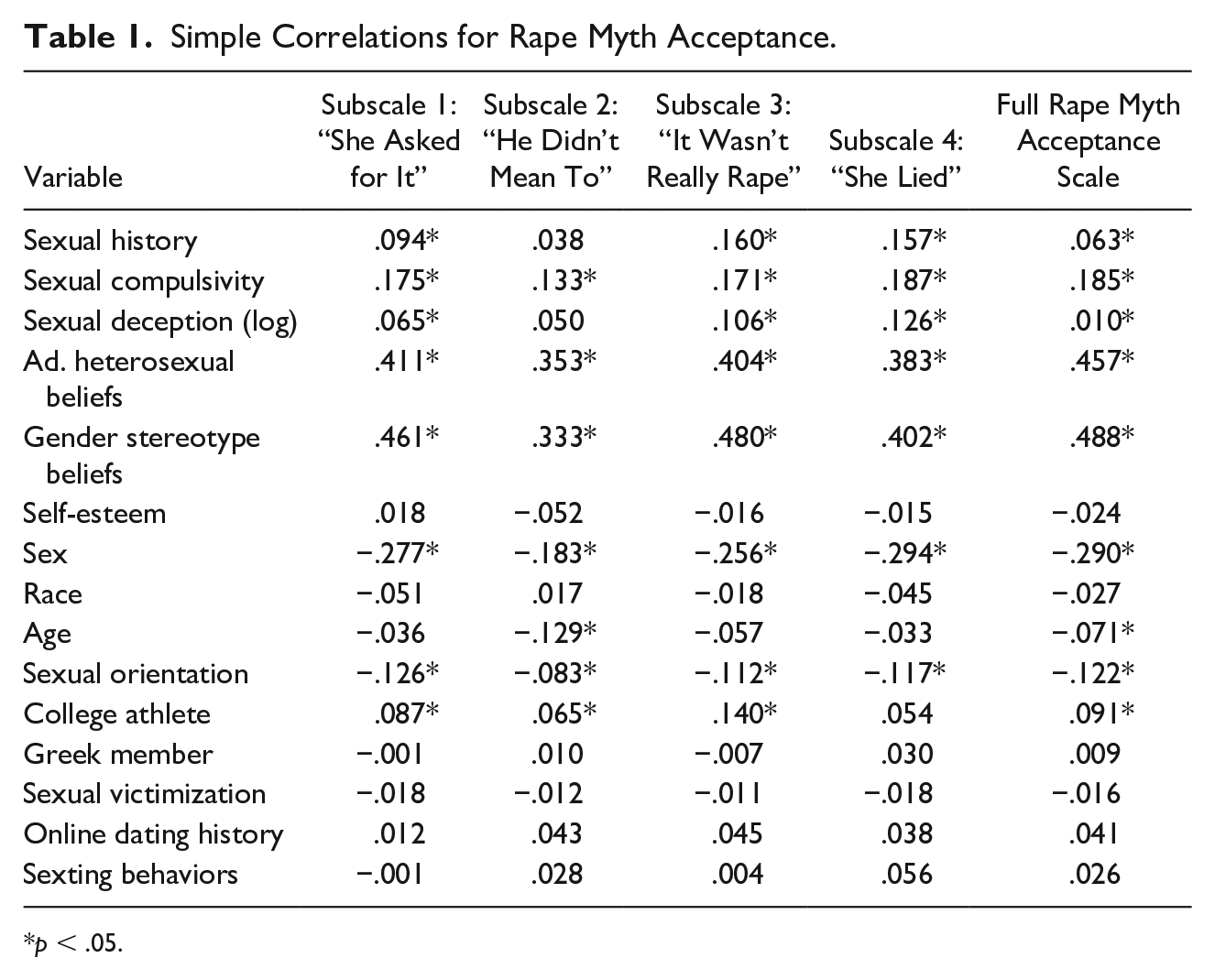
To explore whether the four subscales of the IRMA are correlated with different sets of variables and determine what variables should be used in the multivariate models, five sets of correlations were conducted, all using the same variables. These can be seen in Table 1.
Simple Correlations for Rape Myth Acceptance.
p < .05.
Higher scores on all four subscales and the full Updated IRMA scale were significantly correlated (p < .05) with higher levels of sexual compulsivity, increased adversarial heterosexual beliefs, higher belief in gender stereotypes, being male, and being heterosexual. Subscale 2, “He didn’t mean to,” was the only subscale/scale not correlated with increased sexual history and higher levels of sexual deception. Higher scores on all subscales/scales were correlated with being a college athlete, with the exception of subscale 4, “She lied.” Finally, age had the least amount of significant correlations, with younger respondents reporting higher scores on subscale 2, “He didn’t mean to,” and the full RMA scale.
Multivariate Relationships
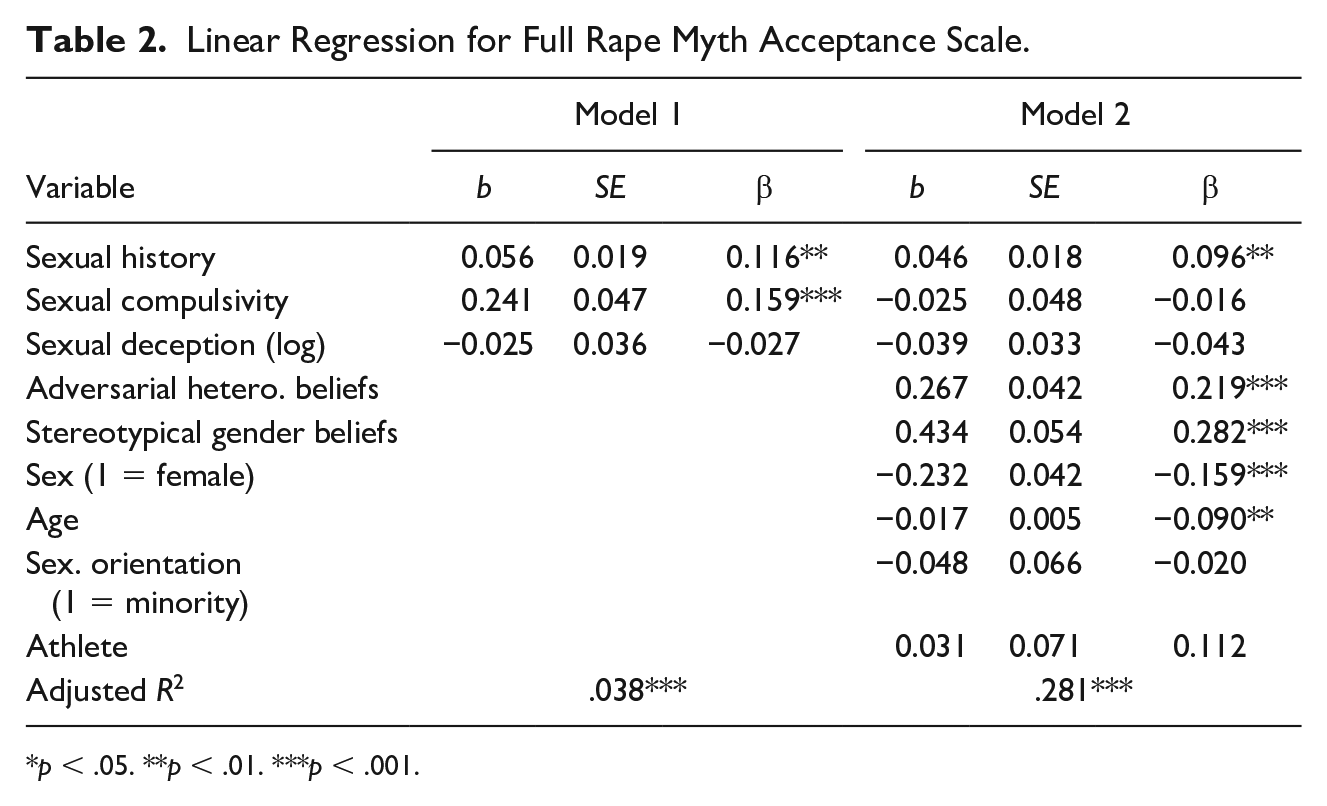
Variables for the multivariate models were determined based on the aforementioned correlations, with the same variables used for each subscale and the overall scale. Self-esteem, race, Greek membership, sexual victimization history, online dating history, and sexting behaviors were not included in multivariate analyses, based on nonsignificant correlations. Table 2 presents models for the full 22-item Updated IRMA Scale. Model 1 includes only the main independent variables of interest, sexual history, sexual compulsion, and sexual deception. The second model adds in the other significantly correlated variables.
Linear Regression for Full Rape Myth Acceptance Scale.
p < .05. **p < .01. ***p < .001.
Using only the sexual behavior predictors, a small amount of variance in RMA is predicted (Adjusted R2 = .038, p < .001). Increased sexual compulsivity (β = 0.159, p < .001), along with greater number of sexual partners (β = 0.116, p < .001) were both significantly related to increased RMA, while sexual deception was not significantly related. When examining Model 2, after the addition of variables correlated at the bivariate level, sexual compulsivity is no longer significant, and number of past sexual partners has a decreased effect (β = 0.096, p < .10). As expected, increased adversarial heterosexual beliefs and stereotypical gender beliefs, were the most significant correlates to increased RMA (β = 0.219, p < .001 and β = 0.282, p < .001, respectively). Furthermore, males reported higher acceptance of rape myths (β = −0.159, p < .001), along with younger respondents (β = −0.090, p < .01). With the additional variables, Model 2 predicted a higher amount of variance than Model 1 (Adjusted R2 = 0.281, p < .001).
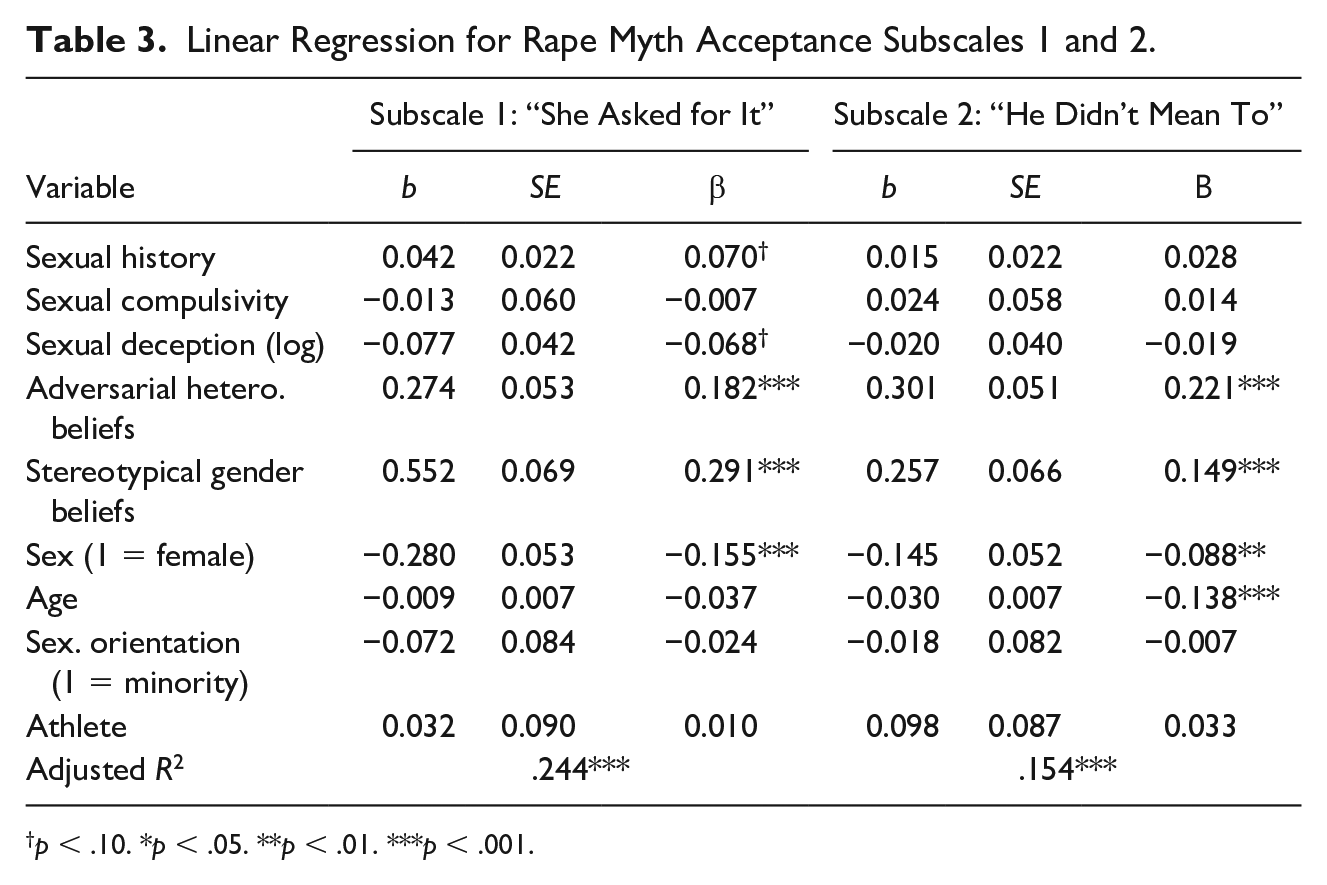
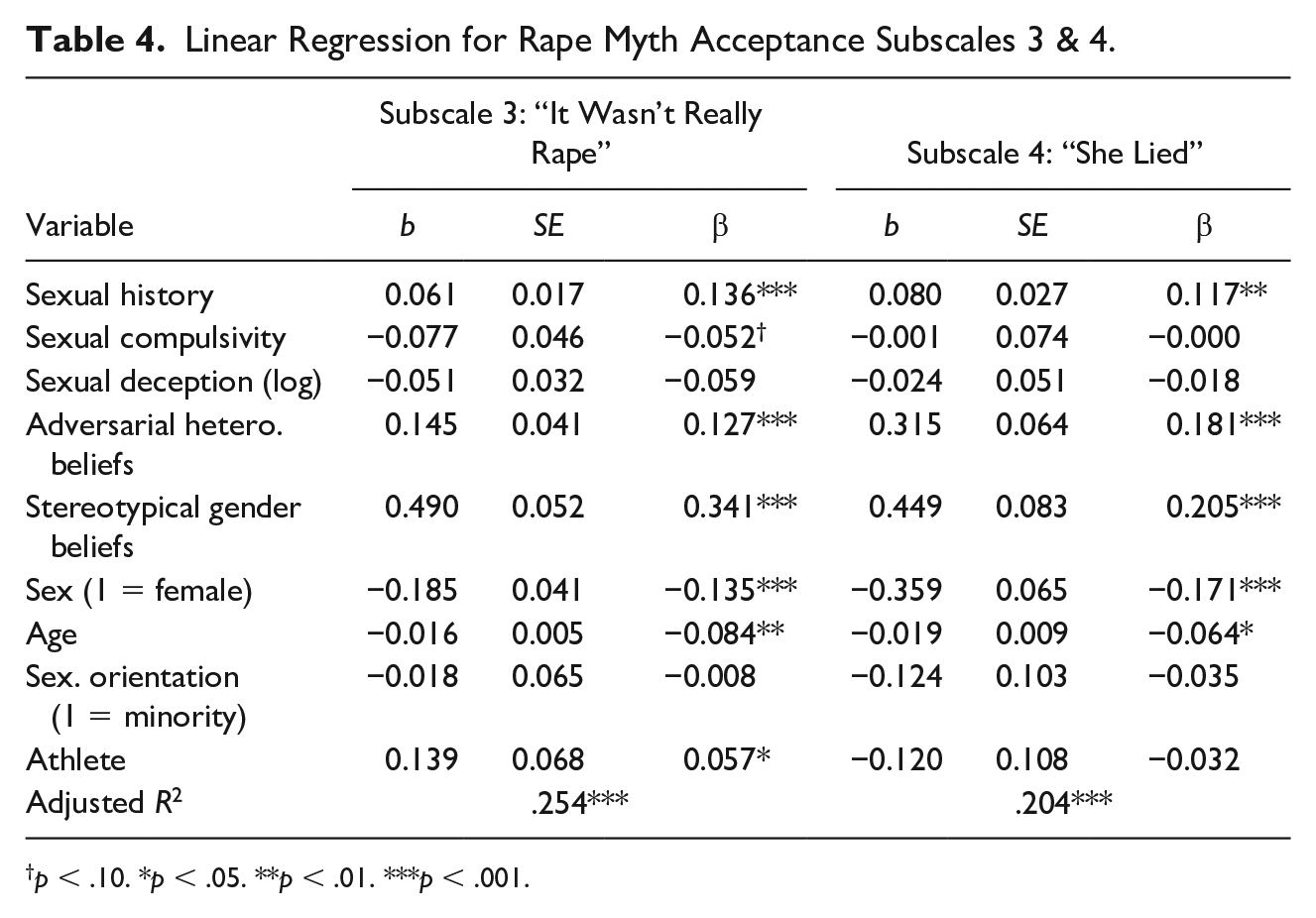
Due to the different variable correlates of the four RMA subscales, separate linear regressions were conducted for each subscale, found in Tables 3 and 4. The model for subscale 4, “It wasn’t really rape,” had the most variance explained of the four subscales (Adjusted R2 = 0.254, p < .001) and Subscale 2, “He didn’t mean to,” produced the lowest variance explanation (Adjusted R2 = 0.154, p < .001). The top three most impactful variables for the subscales overall were increased adversarial heterosexual beliefs, increased stereotypical gender beliefs, and being male, with the rank of these variables changing depending on the subscale.
Linear Regression for Rape Myth Acceptance Subscales 1 and 2.
p < .10. *p < .05. **p < .01. ***p < .001.
Linear Regression for Rape Myth Acceptance Subscales 3 & 4.
p < .10. *p < .05. **p < .01. ***p < .001.
Aside from the three similar variables, each subscale produced a unique variable relationship. For subscale 1, increased sexual history and lower levels of sexual deception approached significance in relation to higher subscale scores suggesting that “She [the rape victim] asked for it [to be raped]” (β = 0.070 and β = −0.068, p < .10, respectively). For subscale 2, younger respondents reported higher agreement with items suggesting that “He [the rapist] didn’t mean to [rape the victim]” (β = −0.138, p < .001). Age was also a significant predictor for subscale 3, “It wasn’t really rape,” (β = −0.084, p < .01), along with three other unique variable relationships. Individuals who had more sexual partners and higher levels of sexual compulsivity were more likely to agree with items suggesting that an act “. . . wasn’t really rape” (β = 0.136, p < .001; β = −0.052, p < .10; respectively). In addition, this was the only subscale for which being an athlete was significantly related to higher acceptance of rape myths (β = 0.057, p < .05). Finally, the model for subscale 4, aside from the three similar variables discussed above, suggested that individuals with a history of more sexual partners and younger respondents were more likely to ascribe to rape myths implying that the “She [the victim] lied [about being raped]” (β = 0.117, p < .01; β = −0.064, p < .05; respectively).
Discussion and Conclusions
Prior research suggests that numerous factors influence individual perceptions of blame and responsibility for sexual victimization (Hockett et al., 2016). These factors include demographic variables (e.g., race/ethnicity, age, and gender) and attitudinal variables (e.g., sex role stereotyping and adversarial heterosexual beliefs). Despite increased recognition of RMA and how problematic these perceptions and beliefs can be among the general public, as well as those who work with victims, a variety of potentially impactful variables on RMA have gone unstudied. This study expands the RMA literature by including additional variables, namely the use of sexually deceptive behaviors, sexual compulsivity, and number of sexual partners, to explore the relationship between RMA and an individual’s view of sex and sexuality. In addition, distinctions are made between four subscales to better understand the factors that influence specific categories of rape myths.
The results of this study lend support to prior research that suggests it is not individual actions, but deeply engrained beliefs that influence the extent of individuals’ RMA. Key results indicate that there was no significant relationship between sexual deception and RMA in multivariate analyses, and sexual compulsivity was only statistically significant prior to the addition of other variables to the multivariate model. In addition, a greater adherence to both adversarial beliefs and stereotypical gender beliefs were significantly related to higher RMA across all models. These findings further substantiate extant conclusions that RMA is related to negative attitudes toward women, gender-role norms, and sexual aggression (Aronowitz et al., 2012; Debowska et al., 2015; Edwards et al., 2011) and that these negative attitudes toward women predict higher levels of RMA across cultures (Aosved & Long, 2006; Rebeiz & Harb, 2010).
Contrary to what was expected, individuals with more sexual experience scored significantly higher on items suggesting “It wasn’t really rape” and “She lied” (subscale 3 and subscale 4, respectively). Prior research would suggest that sexually conservative individuals would have higher levels of RMA (Monto & Hotaling, 2001; Yost & Zurbiggen, 2006). It is interesting that this study found opposite effects, possibly indicating that individuals with more sexual experience can feel somewhat entitled to sex and feel that they could not be turned down sexually. This belief may contribute to traditional beliefs about women’s sexuality and negative perceptions of rape victims. Prior research has consistently noted a gender effect on RMA—males have higher RMA than females (Cowan, 2000; Holcomb et al., 1991; Powers et al., 2015; Suarez & Gadalla, 2010). Existing research on RMA indicates that males have more negative attitudes about rape victims, have higher feelings that females are responsible for rape prevention, that sex is motivation for rape, and that victims cause rape (Lee et al., 2005). Cowan and Quinton (1997) examined two subscales of rape myths, male sexuality and female precipitation, finding that individuals who believe men have no control over their sexuality are also more likely to believe that women cause their own rape by sexually arousing men. Lee et al. (2005) also found similar results. Furthermore, the belief that females precipitated their own rape was supported more by men than women (Cowan & Quinton, 1997), again lending support to the gender effect on RMA.
Being a college athlete was associated with higher scores on Subscales 1 to 3 and the full IRMA scale in bivariate analyses, but this relationship disappeared in multivariate analyses except for Subscale 3 “It wasn’t really rape.” Younger respondents had higher scores on Subscale 2 and the full IRMA scale, which is consistent to findings from Powers et al. (2015) who found that younger respondents had a stronger adherence to rape myths using similar subscales as those in this study. This is an interesting finding that warrants more attention—current research tends to focus on college students when examining RMA, but if RMA varies as a function of age as found in Powers et al. (2015) and substantiated in part in this study, then other age groups should be included in subsequent research, and programming should focus on younger individuals, as suggested by LaVerdiere (2005).
Significant relationships were not found for several individual factors, such as being White, heterosexual, sexting behaviors, Greek membership, online dating history, and history of sexual victimization. As such, the results of this study continue to substantiate the likelihood that it is more than individual behaviors that have a strong influence on the acceptance of rape myths, but more likely a strong adherence to traditional belief systems that are the main contributor to RMA.
Limitations and Future Research
This study expands the literature on RMA by including additional correlates (e.g., sexual deception, sexual compulsivity, and number of sexual partners) and delineating analyses by the full IRMA scale, as well as its four distinct subscales. The data collection for this study was cross-sectional; future studies should employ longitudinal research designs to better establish causal relationships between variables of interest and RMA to explore if RMA changes as individuals progress through college and possibly mature sexually. Furthermore, the data were collected from one university in a Southern state. As such, the sample may not be generalizable to a larger, more diverse population. Moreover, this study utilized retrospective self-report data, which does have some potential reliability issues related to memory decay. However, to help mitigate issues with retrospective recall, a prevalence measure instead of a frequency measure was used (Franklin & Kercher, 2012). Finally, as discussed in the literature review, multiple scales exist to measure RMA, including Burt’s (1980) scale and the Perceived Causes of Rape Scale (Cowan & Quinton, 1997), among others. While Burt (1980) was the most commonly used scale in a series of studies from 1997 to 2007 (Suarez & Gadalla, 2010), the Updated IRMA Scale was used here due to societal and cultural changes since the inception of Burt’s original piece. Common in prior studies of RMA, this study did not include a measure of sexually coercive behaviors perpetrated by respondents and only explored relationships regarding consensual activities.
Research on RMA has not incorporated much diversity. Lee and colleagues (2005) explored differences between Caucasian and Asian student populations regarding their RMA, finding that Asian students were more likely to adopt certain rape myths (e.g., women are responsible for rape prevention, sex is a motivation for rape, victims precipitate rape, and stranger rape) likely due to the Asian cultural emphasis on female purity and virginity. In these instances, female rape victims are blamed because they “fail[ed] to protect their virginity or chastity” (p. 191). Future studies should explore diverse populations to understand the cultural differences that could underlie RMA. Furthermore, White et al. (1998) explored a Black feminist model of RMA specifically looking at the intersectionality of sexism and racism and the influence on rape myths. They found that African-American antirape activists had less RMA, as well as more race and gender consciousness than their nonactivist counterparts. Their findings suggest the importance of considering the overlap between racism and sexism, especially when discussing RMA. It is important, therefore, for future research on this topic to include diverse samples to better represent the unique factors of varying populations.
Policy Implications
Rape prevention and awareness programs need to focus on date rape/acquaintance rape and target outreach programs to male populations (Lee et al., 2005). Research indicates that sexual assault prevention programs are successful in the short term (Frazier et al., 1994), but certain formats of prevention programs have found long-term success. Theatrical performance is one format that has demonstrated success both as a therapeutic activity for sexual assault survivors and as an effective method for evoking emotion and shifting attitudes on rape myths (Black et al., 2000). Additional research suggests that sexual assault intervention programs for college students are more effective when they include specific information relating to rape myths, facts about sexual assault, risk reduction, and gender-role socialization (Anderson & Whiston, 2005). Longer trainings are also shown to be more effective among college student populations—more exposure to a myriad of information about sexual assault provides greater results (Anderson & Whiston, 2005). These trainings are useful at addressing those broader negative belief systems that are highly related to RMA.
It is not just college students, however, who need to be the focus of these intervention programs. As this study found, RMA varies as a function of age, with younger individuals reporting higher levels of RMA. Therefore, it is imperative to start targeting younger individuals to counteract these negative belief systems. De La Rue et al. (2014) conducted a systematic review to examine the effectiveness of school-based interventions on dating violence finding that students who received the intervention program showed lower adherence to traditional rape myths and less acceptance of violence in relationships. While the intervention programs they analyzed were specifically targeting dating violence, the implications remain the same—targeting youth (in this case, 4th–12th graders) does work to reduce negative attitudes. One caveat, however, is that the researchers did not find much impact of intervention programs on dating violence victimization and perpetration (De La Rue et al., 2014). As such, when working toward school-based RMA intervention programs, it is not enough to challenge and change these negative belief systems, but we must focus on changing negative behaviors, as well.
Bystander intervention programs also show promise for rape prevention and awareness on college campuses (McMahon, 2010). Training programs, such as Green Dot Bystander Intervention or Step Up!, seek to educate students on bystander intervention and hope to influence students to be a catalyst for an overall culture change on college campuses. Further research is needed in exploring the effects RMA has on the likelihood of intervening; as evidenced in Power and colleagues (2015), higher adherence to certain rape myths reduced the likelihood of bystander intervention. Powers and colleagues’ (2015) finding reinforces the need for researchers, advocates, and policy makers to focus on intervention programs to eliminate rape myths and other toxic belief systems among individuals. Another promising program is Catharsis, You Got This!, which incorporates diverse populations into its training programs to engage students from all racial/ethnic backgrounds, religious beliefs, and lesbian, gay, bisexual, transgender, and queer (LGBTQ) populations, among others. Catharsis attempts to take the place of the current first-year college student training on sexual assault, sexual harassment, and dating violence, by making modules more interactive and incorporating lessons on masculinity and gender-based stereotypes. By providing training in an online format, this program can quickly and easily reach the student population and provide effective interaction through personalized modules. Ideally, if first-year college students are required to take some form of these trainings, their own toxic behaviors and beliefs will decrease, and they will be empowered to change the world around them—eventually leading to a widespread cultural shift in which rape myths are no longer endemic.
Supplemental Material
reviewer_comments_1_3 – Supplemental material for The Relationship Between Rape Myth Acceptance and Sexual Behaviors
Supplemental material, reviewer_comments_1_3 for The Relationship Between Rape Myth Acceptance and Sexual Behaviors by Ashley K. Fansher and Sara B. Zedaker in Journal of Interpersonal Violence
Footnotes
Declaration of Conflicting Interests
The author(s) declared no potential conflicts of interest with respect to the research, authorship, and/or publication of this article.
Funding
The author(s) received no financial support for the research, authorship, and/or publication of this article.

Note
Author Biographies
References
Supplementary Material
Please find the following supplemental material available below.
For Open Access articles published under a Creative Commons License, all supplemental material carries the same license as the article it is associated with.
For non-Open Access articles published, all supplemental material carries a non-exclusive license, and permission requests for re-use of supplemental material or any part of supplemental material shall be sent directly to the copyright owner as specified in the copyright notice associated with the article.
