



Abstract
This study investigates the role of sexual sadism in the crime-commission process of sexual homicide (SH) involving child victims. A comparison between sadistic and nonsadistic cases involving child victims is conducted by examining the crime context, crime characteristics, methods of killing, body recovery characteristics, and forensic awareness strategies used by offenders. The sample comes from the Sexual Homicide International Database (SHIelD) including 135 cases of solved SHs involving child victims—35 cases with sexual sadism and 101 cases without sexual sadism. The Sexual Homicide Crime Scene Rating Scale for Sexual Sadism (SADSEX-SH) scale is used to identify sexual sadism from crime scene actions. Bivariate and multivariate analysis are performed to examine the differences between the two groups. Findings indicate that sadistic SH of children are characterized by an important level of structured premeditation, the commission of more diversified sexual acts, the use of specific method of killing, and the partial use of forensic awareness strategies. Practical implications in terms of criminal investigations are discussed.
Introduction
Gilles de Rais, a French nobleman living in the 15th century is known to have tortured and killed hundreds of children to obtain sexual gratification. He is often considered as the first sadistic sexual homicide offender (SHO) of children. In the 19th century, Fritz Haarman, also known as the “Oger of Hanover” murdered numerous young boys. He reported obtaining sexual pleasure by ripping the throat of his young victims and mutilating them (Holmes, 1983; Holmes & DeBurger, 1985). Sadistic sexual homicide (SH) of children is a rare, unusual, and horrible event. However, despite these gruesome characteristics and what appear to be “irrational” motivations, this type of crime was never empirically studied. Knowledge on this particular form of SH comes mainly from the sadistic SH of adult victims. Empirical research on child SH has been nonexistent and cases involving child victims were included with cases involving adult victims (for a review see Chopin & Beauregard, 2019b, 2019c). More recently, an emergence of empirical studies demonstrated that child SH constituted a specific form of offending with a distinct crime-commission process (Beauregard et al., 2008; Chopin & Beauregard, 2019c; Firestone et al., 1998; Gratzer & Bradford, 1995; Proulx et al., 2007, 2018; Schmidt & Madea, 1999). To further investigate the heterogeneity of SH, Chopin and Beauregard (2019c) were the first to empirically identify a classification specific to SH of children. In continuity with this line of research, this study aims to examine the role of sexual sadism in SH of children.
SH of Children
Although these findings are informative, very few studies have examined the phenomena of SH of children. To show the distinct aspects of SH against children, some researchers compared sexual murderers of children to diverse groups of sex offenders. In terms of offender characteristics, these studies have shown that SHO of children exhibited more antisocial personality disorders, deviant sexual fantasies and paraphilias, were more likely to receive three or more Diagnostic and Statistical Manual of Mental Disorders (3rd ed., rev.; DSM-III-R; American Psychiatric Association [APA], 1987) diagnoses, and demonstrated higher levels of deviant arousal to pedophilic and adult assault stimuli (Firestone et al., 1998; Gratzer & Bradford, 1995; Proulx et al., 2007; Schmidt & Madea, 1999). However, SHOs of children were less likely to report alcohol abuse and drug dependency, as well as to present sexual dysfunctions or a narcissistic personality disorder (Spehr et al., 2010). The SHOs of children have been described as stressed individuals who feel rejected and have low self-esteem (Beauregard et al., 2008). They are also more likely to use pornography prior to the crime and to plan the crime, compared with SHOs of adults (Beauregard et al., 2008). In addition, SHOs of children were more likely to establish contact with the victim prior to the crime, to commit the crime during the day, to use strangulation to kill the victim, and to dismember and hide the victim’s body, as compared with SHOs of adults (Beauregard et al., 2008). Furthermore, SHOs of children were more likely to find the victim at home or outside on the street and to physically beat the victim during the criminal event (Beauregard & Martineau, 2015). A study conducted by Proulx et al. (2018) showed that SHOs of children were more likely to use physical violence to control the victim, to kill the victim for the purpose of eliminating a witness, and to commit the crime outdoors. SHOs of children were less likely to exhibit a structured premeditation, to preselect the crime site and body dump site, to use restraints, to kidnap and confine the victim, to humiliate the victim, to use expressive violence as well as to use torture, compared with the SHOs of adult victims (Proulx et al., 2018). Moreover, SHOs of children were less likely to commit a crime that occurred over a longer duration or use physical violence or kill the victim out of anger (Proulx et al., 2018). Skott (2019) compared eight SHOs of children with 89 SHOs of adults and 176 nonsexual child homicide offenders. Analysis of SHO characteristics and modus operandi showed that SHOs of children were more similar to SHOs of adult victims than nonsexual homicide offenders (NSHO) of children.
Lanning (1994) suggested that in addition to the definitional problem of what constitutes a child, the discussion of SH of children has been obscured by the fact that SHOs of children appear to be a diverse population of offenders. Lanning (1994) further explained that the violence used in SH can take different forms and proposed a theoretical classification: (a) inadvertent (i.e., killing for a lack of care), (b) indiscriminate (i.e., killing if necessary), and (c) intentional (i.e., varied categories including sadists, killing to avoid detection, misguided love from a pedophile or ambivalent hate). Chopin and Beauregard (2019c) were the first to propose a first empirical classification of SH against children with 72 cases from France. They identified a six-cluster typology based on Lanning’s (1994) level of violence as well as the age category. The first type was labeled as the intentional/prepubescent where offenders usually select very young male victims and they typically anally penetrate them. They kill victims to avoid detection and move the victims’ body from the crime scene following the murder. Offenders of this category are relatively young, do not suffer from social isolation, and consumed alcohol and/or drugs at the time of the offense. The inadvertent/prepubescent is characterized by young offenders targeting very young victims who are mostly male. Offenders from this category are mostly single, they are not socially isolated, and they generally have not engaged in previous criminal activities. However, their behavior is very violent, as these offenders are characterized by beating the victim and performing unusual acts. They do not typically penetrate the victim but instead fondle the victim as well as inflict some sadistic acts. The crime scene is never a residence, and, in most cases, victims are killed by strangulation. Offenders of intentional/preteen category present a high prevalence of alcohol and/or drug consumption during the criminal event, similar to the intentional/prepubescent category. This category of SH is mainly characterized by the diversity of sexual acts committed as well as the presence of sadism. These offenders typically use a ruse to approach the victim and they are generally familiar with the crime scene, which is most often not a residence. The inadvertent/preteen category of offenders exclusively targets female preteen victims. These offenders are particularly violent with their victim, but the sexual acts committed appear as less sadistic and less humiliating than previous category. However, one of the most distinguishable features of this modus operandi is the use of a coercive approach by offenders to assault their victims. Offenders from the intentional/teen category only target female teenagers and perpetrated sexual penetration of the victim, acts of sexual sadism, as well as using strangulation to kill the victim. In these SHs, the offender and the victim are complete strangers, but the offender uses a ruse to approach the victim. These offenders always commit their crime in a residence but are never familiar with the crime location. Offenders from the indiscriminate/teen category are the oldest and they target the oldest female child victims. These SHs are characterized by the absence of sadism and humiliation, the presence of the vaginal penetration of the victim, and the use of strangulation to kill the victim. Another distinguishable feature of these SHs is related to the criminal career of the offenders. Chopin and Beauregard (2019c) observed that two thirds of them were frequently engaged in a variety of criminal activities, similar to the versatile sex offender identified by Beauregard et al. (2018). This criminal experience could also be related to the fact that all offenders have moved the victims’ bodies after the murder, which is a strategy developed by experienced offenders to avoid being detected by the police (Beauregard & Martineau, 2015).
SH of Adult Victims and Sadism
In his book Psychopathia Sexualis, Krafft Ebing (1886) described the sadistic offender as an individual driven by the experience of pleasure, which could only be achieved through means of cruelty and corporal punishment on animals or people. Since then, multiple efforts by researchers and clinicians have been made to validate the notion of sadism. Despite some difficulties in reaching an agreed upon definition, it seems that there exists a general consensus as to the sexual arousal of sexual sadists, whether it is (a) some form of violent or humiliating behavior (e.g., Abel, 1989; Groth & Birnbaum, 1978; Knight et al., 1994; Knight & Prentky, 1990), (b) the victim’s reaction to this behavior (e.g., being frightened, scared, or being in pain; Marshall & Kennedy, 2003), or (c) the resulting feeling of power and control as a result of the violence inflicted (Brittain, 1970; Dietz et al., 1990; Grubin, 1994; MacCulloch et al., 1983). The Diagnostic and Statistical Manual of Mental Disorders (5th ed.; DSM-5; APA, 2013) defines sadism as “recurrent and intense sexual arousal from the physical or psychological suffering of another person, as manifested by fantasies, urges, or behaviors” (p. 694). Furthermore, the DSM-5 requires that these urges, fantasies, and behaviors are acted onto a nonconsenting individual. Others have argued that sadists can be characterized by a deviant sexual preference for violence (Abel, 1989; Groth & Birnbaum, 1978; Knight et al., 1994; Knight & Prentky, 1990). However, researchers like Gratzer and Bradford (1995) have suggested that violence is not a sufficient condition to elicit sexual arousal, but the “control of another person through domination, degradation, or infliction of pain for the purpose of sexual pleasure” (p. 50). According to this perspective, it is not so much the violence, but the humiliation, degradation, subjugation, and suffering producing fear, terror, pain, and panic in the victim, which makes the sadist feel powerful and sexually aroused.
Although most researchers have reached a consensus on the main features associated with sexual sadism, there are still some methodological issues related to the measurement of sadism. Consequently, diagnosing sadism is still challenging today, and it has led to various estimates on the actual prevalence of this disorder. Depending on the study, it ranges anywhere from 5% to 50% of all sexual offenders (Barbaree et al., 1994; Groth & Birnbaum, 1978; Harenski et al., 2012; Proulx et al., 1999). In a recent estimate, sadism has been detected in approximately 35% of SHs (Hill et al., 2007).
Although most existing scales that used to measure sadism require access to the offender (see Guttman, 1944; Marshall & Hucker, 2006; Nitschke et al., 2013), a new type of scale was recently developed to dimensionally measure the degree of offender sexual sadism expressed at SH crime scenes (see Jones et al., 2013). The Sexual Homicide Crime Scene Rating Scale for Sexual Sadism (SADSEX-SH; Myers et al., 2019) aims to assist in the diagnostic assessment of unidentified or unconfirmed perpetrators purely from crime scene actions. It was constructed based on the sexual sadism and SH literature combined with the empirical experience of the authors in evaluating sexually sadistic murderers and SH crime scene characteristics (e.g., Brittain, 1970; Chan et al., 2015; Chan & Heide, 2009; Dietz et al., 1990; Fedoroff, 2008; Gratzer & Bradford, 1995; Healey et al., 2013; Marshall et al., 2002; Myers et al., 2010, 2016; Nitschke et al., 2009). The SADSEX-SH scale is based on the eight following items: (a) sexual domination of the victim through the use of bondage, asphyxia, blindfolding, a knife, and so on; (b) physical or psychological torture of the victim; (c) the victim forced to verbally or physically engage in sexually degrading, humiliating behavior; (d) gratuitous violence, excessive injury, biting, cutting, or other acts of physical cruelty inflicted on the victim; (e) anal and/or oral sex forced upon the victim; (f) use of an inanimate object(s) to sexually penetrate the victim; (g) sexual mutilation of the victim; and (h) souvenirs or trophies taken from the victim.
Sadistic SHs and Crime Scene Behaviors
Several studies have compared the crime scene behaviors of sadistic and nonsadistic SHO. Following the classical organized/disorganized classification of offense characteristics (Ressler et al., 1988), Meloy (2000) suggested that sadistic SHO are organized offenders. Warren et al. (1996) found that sadistic SH were highly planned, that offenders used a con or manipulative approach, and that victims were taken to a preselected location. Victims were generally bound and sexual intercourse, as well as sexual ritual, occurred in most of the cases. Most of the time, sadistic SHOs targeted female victims who were strangers (Warren et al., 1996). Gratzer and Bradford (1995) used a sample of 59 sadistic SHO and found that they were more likely to perform a variety of sexual acts during the crime and that they more often inserted foreign objects and beat their victims. In the study by Beauregard and Proulx (2002), findings showed that sadistic SHOs more often premeditated their crime, selected a victim, humiliated and mutilated their victims, used physical restraints, left the victim’s body at the crime scene, and presented a higher risk of being apprehended in comparison with angry SHOs. Healey et al. (2013) confirmed these findings by investigating crime scene behaviors of a mixed sample of 182 sexual aggressors and 86 SHOs. They found that crime premeditation, use of physical restraints, mutilations, and humiliation were typical characteristics of crimes committed by sexual sadists. In their study based on 350 cases of SH, Reale et al. (2017) identified distinct groups of SHOs based on varying degrees of sadistic behavior. Three subgroups of SHOs emerged including a severe sadistic group, a mixed group, and a nonsadistic group. The mixed group of SHOs demonstrated forensic awareness at the crime scene (i.e., they are more able to avoid police detection by using various strategies focused on forensic evidence potentially left at the crime scene, see Beauregard & Martineau, 2018; Chopin & Beauregard, in press), as well as the use of torture, sexual mutilation, and the use of inanimate objects on their victims. These findings, particularly for the mixed group of offenders, are well situated in the current view that sadistic SHOs use instrumental violence for personal gain and thrill-seeking tendencies (see Porter et al., 2000), in comparison to other SHOs whose primary motivation may differ (e.g., acting on deviant sexual fantasies, or reacting due to situational factors such as excessive resistance). With the same sample, Reale et al. (2020) tested if sadistic SHOs were more forensically aware. They found that sadistic SHOs used strategies to avoid police detection more often than nonsadistic SHOs. Specifically, sadistic SHOs selected deserted places to encounter their victims and dump their bodies, in addition to using forensic awareness strategies (FAS). They acted on victims and/or the environment, destroyed and removed forensic evidence, and used other precautions such as staging the crime scene or protected their identity (Reale et al., 2020).
Aim of Study
In addition to the limited knowledge available on SH of children, there is a lack of empirical insight into the role of sadism in these types of offenses. To the best of our knowledge, no studies have empirically explored this aspect of SH of children. Therefore, this study aims to investigate the role of sexual sadism in the crime-commission process of SH involving child victims and its implications for theory and practice. Specifically, this exploratory study aims to answer the following two research questions:
Method
Sample
The sample used in this study was taken from the Sexual Homicide International Database (SHIelD; see Chopin & Beauregard, 2021 for a description of the database methodology). The SHIelD includes 772 solved and unsolved cases of extrafamilial (strangers or acquaintance) SHs from France (N = 412) and Canada (N = 350) that have occurred between 1948 and 2018. The SH cases were identified using the definition from Ressler and colleagues (1988), stating that for a homicide to be considered sexual, it has to present at least one 1 of the following characteristics present at the crime scene: victim’s attire or lack of attire; exposure of the sexual parts of the victim’s body; sexual positioning of the victim’s body; insertion of foreign objects into the victim’s body cavities; evidence of sexual intercourse; and evidence of substitute sexual activity, interest, or sadistic fantasy. Information included in the database is coded by crime analysts who analyze the criminal investigation files for each case. Information included in these files are mainly filled out by police officers but also by other experts involved in the investigation process (e.g., coroner, forensic psychologist, forensic experts).
For this study, a sample of 136 solved cases of SHs involving children was selected. There is no concrete method to operationalize what constitute a child victim. However, to be congruent with the existing literature on SH, the victim was considered as a child if they were under the age of 16 years (see Beauregard & Martineau, 2015; Chopin, 2017; Chopin & Beauregard, 2019c; Chopin & Caneppele, 2019a, 2019b; Gravier et al., 2010; Proulx et al., 2018; Skott, 2019).
Measure
Dependent variable
The dependent variable is a dichotomous variable (0 = nonsadistic SH ; 1 = sadistic SH) and was created from the SADSEX-SH scale identified by Myers and colleagues (2019). This scale uses a cut-off score of six (i.e., not present or unknown = 0 point, possibly present/some evidence = 1 point, present = 2 points) to determine the presence or absence of sadism in a case of SH. This score is computed on the basis of eight items: (a) sexual domination of the victim through the use of bondage, blindfolding, a knife, and so on; (b) physical or psychological torture of the victim; (c) victim forced to verbally or physically engage in sexually degrading, humiliating behavior; (d) gratuitous violence, excessive injury, biting, cutting, or other acts of physical cruelty inflicted on the victim; (e) anal or oral sex forced upon the victim; (f) use of an inanimate object(s) to sexually penetrate the victim; (g) sexual mutilation of the victim; and (h) souvenirs or trophies taken from the victim. What distinguishes the SADSEX-SH scale from other sadism scales is its reliance on only observable crime scene indicators. Among the sample, we identified 35 cases of sadistic SH with an average score of 6.97 (SD = 1.31; range = 6–10) and 101 cases of nonsadistic SH with an average score of 2.69 (SD = 2.69; range = 0–4).
Independent variables
A total of 34 independent variables were used to describe the crime-commission process. First, six dichotomous variables describe the context in which victims were assaulted: (a) victim was involved in domestic activities at the time of offense (e.g., watching TV); (b) victim was traveling to or from somewhere at the time of offense (i.e., victims move from one place to another independently of the traveled distance that could be very short), (c) victim was hitchhiking, (d) victim was biking, (e) victim was visiting friends or relatives, and (f) victim was partying.
Second, three dichotomous variables provide information on crime scene locations: (a) Contact scene is an outdoor location, (b) crime scene is an outdoor location, and (c) body recovery scene is an outdoor location.
Third, six variables were used to describe the crime characteristics. One of these variables is continuous (i.e., number of sexual acts committed) while all the others are dichotomous. These variables are as follows: (a) offender and victim were strangers (i.e., describes situations where offenders and victims were totally unknown at the time of the crime), (b) victim was targeted by offenders, (c) offender used a con approach (e.g., befriended the victim, posed as an authority figure, offered assistance), (d) offender used restraints, (e) number of sexual acts committed by the offender (range = 0–6), (f) unusual acts (i.e., carving on victim, evisceration, skinning victim, exploration of body cavities or wounds, cannibalism, and drinking of victim’s blood).
Fourth, 14 dichotomous variables were used to describe the method of killing and the body recovery characteristics: (a) beating, (b) stabbing, (c) cutting, (d) stomping, (e) crushing, (f) burning, (g) strangulation, (h) asphyxiation, (i) drowning, (j) gunshot (k) body was moved from the crime scene, (l) body was found naked, (m) evidence of postmortem sexual activity, and (n) evidence of overkill (i.e., inflicting more grievous bodily harm on the victim than is necessary to cause death; see Geberth, 1986).
Finally, five variables describe the FAS used by offenders to avoid police detection. One of these variables is continuous (i.e., number of FAS while other are dichotomous. These variables are as follows: (a) offender administered drugs to victim, (b) offender destroyed evidence (e.g., destruction of forensic evidence, offender set fire to scene, offender washed victim’s body, offender cleaned crime scene, offender planted evidence/staged scene), (c) offender acted on environment (e.g., disable the victim phone), (d) offender protected his identity (e.g., offender used a condom, offender wore gloves), and (e) number of FAS used by the offender (range = 0–3).
Analytical Strategy
The first analytical step of this research was to assess differences between the two groups (sadistic and nonsadistic SHs) at the bivariate level, in relation to all the independent variables. For dichotomous variables, we used chi-square analysis. When the cell count was insufficient to justify chi-square tests, the Fisher’s exact significance was used. As the four continuous variables did not follow a normal distribution, we used nonparametric Mann–Whitney U test to explore potential relationships with the dependent variable.
The second analytical step was to examine the differences between the two groups at the multivariate level with binomial logistic regressions. The goal was to explore differences at the multivariate level to identify the most important factors that characterized the sadistic SH of children. As the sample size is limited, we utilized a series of five binomial logistic regression (methodological outcome of this decision is discussed in the limitation section). Each binomial logistic regression focuses on one predetermined block of independent variables that was significant (p ≤ .05) at the bivariate level.
Results
Bivariate Analyses
Table 1 describes analyses conducted on the eight items of the SADSEX-SH scale with the two types of SHOs (i.e., sadistic and nonsadistic). These findings suggest that only six of the eight items are important in cases of SH of children. Results showed that sexual domination behaviors (χ2 = 11.56, p ≤ .001), gratuitous violence (χ2 = 25.42, p ≤ .001), anal and/or oral sex (χ2 = 24.71, p ≤ .001), inanimate object insertion (χ2 = 20.45, p ≤ .001), sexual mutilation (χ2 = 18.11, p ≤ .001), and souvenirs or trophies collection (χ2 = 27.72, p ≤ .001) are more often present in sadistic SH.
Bivariate Analysis of the Eight Items of the SADSEX-SH Scale (N = 136).
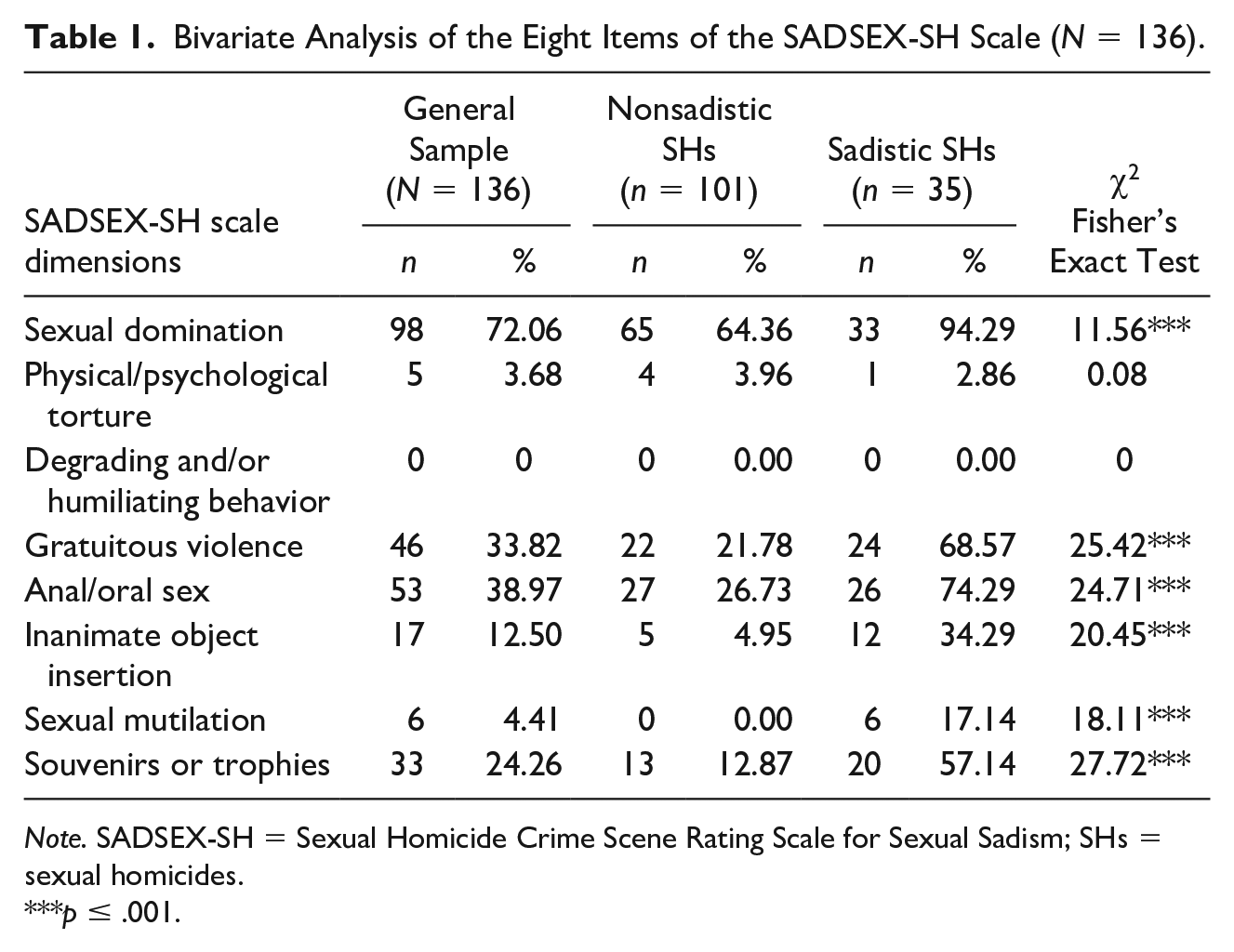
Note. SADSEX-SH = Sexual Homicide Crime Scene Rating Scale for Sexual Sadism; SHs = sexual homicides.
p ≤ .001.
Bivariate analyses related to crime characteristics are presented in Table 2. As to the crime context, victims of sadistic SH were more often assaulted while they were hitchhiking (χ2 = 6.63, p ≤ .01) or biking (χ2 = 4.48, p ≤ .05). Analysis of crime characteristics indicated that individuals who have committed sadistic SH against children were more often strangers (χ2 = 4.20, p ≤ .05) and they less often targeted their victims (χ2 = 5.68, p ≤ .01). During the crime, they perpetrated more sexual acts (U = 829.50, p ≤ .001, r = .39) as well as unusual acts (χ2 = 8.35, p ≤ .01). Individuals who have committed sadistic SH against children more often selected outdoor locations for contact scenes (χ2 = 2.53, p ≤ .01), crime scenes (χ2 = 6.15, p ≤ .01), and body recovery scenes (χ2 = 9.66, p ≤ .001). As to the method of killing, they more often stabbed (χ2 = 3.26, p ≤ .1), strangled (χ2 = 15.44, p ≤ .001), asphyxiated (χ2 = 10.89, p ≤ .001), and drowned their victim (χ2 = 8.44, p ≤ .01). Individuals who have committed sadistic SH against children less frequently moved the victim’s body after the crime (χ2 = 3.92, p ≤ .05), while more often undressing the victim completely (χ2 = 9.96, p ≤ .01) and perpetrating postmortem sexual acts (χ2 = 3.03, p ≤ .1). Individuals who have committed sadistic SH against children more often administered drugs to their victims (χ2 = 17.04, p ≤ .001), destroyed evidence (χ2 = 4.85, p ≤ .05), acted on the environment (χ2 = 14.04, p ≤ .001), and used a higher number of FAS to avoid police detection (U = 1,141, p ≤ .001, r = .28).
Bivariate Analysis of Crime-Commission Process (N = 136).

Note. SHs = sexual homicides.
The mean. bThe median.
p ≤ .05. **p ≤ .01. ***p ≤ .001.
Binomial Logistic Regression Analyses
Findings of binomial logistic regressions are presented in Table 3. Model 1 describes crime context variables. Results indicate that victims of SH who were hitchhiking or biking were, respectively, 5.81 (odds ratio [OR] = 5.81, p < .01) and 4.84 times (OR = 3.94, p < .01) more likely to be victim of sadistic SH. Model 2 examines crime characteristics. In SH of children, as the numbers of sexual acts perpetrated increases, individuals are 1.72 times more likely to be sadistic (OR = 1.72, p < .001). Similarly, unusual acts are 3.92 times more likely to be perpetrated in sadistic SH (OR = 3.92, p < .05). Model 3 focuses on crime locations and indicates that a victim’s body is 3.61 times more likely to be found at an outdoor location in sadistic SH (OR = 3.61, p < .05). Model 4 includes the method of killing and body recovery characteristics. The SH in which the method of killing was strangulation, asphyxiation, or drowning were, respectively, 6.75 (OR = 6.75, p < .001), 7.70 (OR = 7.70, p < .01), and 13.78 (OR = 13.78, p < .05) times more likely to be sadistic. The victim’s body was 3.03 times less likely to be moved in a sadistic SH (OR = 1/0.33, p < .05) while they were 7.41 times more likely to be found naked (OR = 7.41, p < .001). Model 5 focuses on FAS used by offenders. Individuals who have committed SH against children who have destroyed evidence or acted on the crime scene were, respectively, 4.55 (OR = 4.55, p < .05) and 2.72 (OR = 2.72, p < .05) times more likely to have committed a sadistic SH.
Binomial Logistic Regressions of Factors Influencing Sadistic SH of Children (N = 136).

Note. SH = sexual homicide.
p ≤ .05. **p ≤ .01. ***p ≤ .001.
Discussion
This study aimed to explore the role of sadism in SH of children. Using the SADSEX-SH scale (Myers et al., 2019), we showed that approximately one quarter of SH of children within our sample scored at least six, which is the cut-off to determine whether SH are sadistic or not. Such prevalence is coherent with previous studies on sadism in SH based on mixed or adult victims’ samples (Barbaree et al., 1994; Groth & Birnbaum, 1978; Harenski et al., 2012; Hill et al., 2007; Proulx et al., 1999). The analysis of the individual item’s distribution of SADSEX-SH allowed us to identify specific aspects of SH of children. First, sexual domination appears to be a distinguishing feature in cases of SH of children, as it was always present in sadistic cases, compared with only half of the cases for the nonsadistic SH of children. Nevertheless, we observed that this item is also common in nonsadistic SHs. This suggests that sadistic SHs of children are specifically characterized by the combination of sexual domination with other items like the presence of gratuitous violence, anal and/or oral sex, and the collection of souvenirs or trophies. Second, physical/psychological torture as well as degrading and humiliating behaviors were totally absent from the SH of children cases in our sample, which is different from the findings from Reale and colleagues (2017) based on a sample mostly composed of adult SH cases. This overrepresentation of sexual domination behaviors with an absence of torture and humiliating behaviors in sadistic SH of children suggests that the type of victim is important when analyzing the offender’s behavior at the crime scene and that knowledge produced on sadistic SH of adult victims should not be applied blindly to cases involving children (Chopin & Beauregard, 2019c; Leclerc et al., 2009; Proulx et al., 2018).
Specific Crime-Commission Process for Sadistic SHO of Children
Our findings are congruent with previous studies which found that sadistic SHO present a structured premeditation (Beauregard & Proulx, 2002; Healey et al., 2013; Ressler et al., 1988; Warren et al., 1996). The SHOs of children demonstrate what Rossmo (2000) termed “premeditated opportunism.” These offenders are ready to commit their crime and they have made some preparation. However, they do not necessarily know which victim they will choose or the exact time they will strike. Nonetheless, they have elaborated their plan in their fantasies and are ready to act when the right opportunity presents itself. This was illustrated in our findings, as offenders looked for specific crime opportunities as well as crime locations. Our analysis of the crime context suggested that victims of sadistic SH of children were more often biking or hitchhiking prior to being assaulted. This is coherent with the notion of predatory behavior of sadistic SHO of children. They were looking for opportunities where young victims were alone to assault them. According to the routine activities theory (Cohen & Felson, 1979), both hitchhiking and biking represent situations where children are vulnerable targets for a motivated offender. Contrary to adults, children are more difficult to access for offenders because they spend most of their time under the supervision or the care of adults protecting them (e.g., teacher, parents). Offenders who premeditated their crimes searched and identified riskier conditions for children (i.e., lack of supervision) to approach and assault them. This could imply that sadistic SHO of children identified hunting areas they are familiar with and where such conditions are present. Second, our findings suggest that individuals involved in sadistic SH of children chose an outdoor location, not just at the contact location but also to dump the victim’s body. This is coherent with the study by Reale and colleagues (2017) where sadistic SHOs selected deserted places to encounter their victims and dump their bodies. The fact that sadistic SH of children are characterized by an important level of premeditation is contradictory to the findings by Proulx and colleagues (2018). They found that in general, SHOs of children were less likely to exhibit a structured premeditation compared with those who target adult victims. This discrepancy could be partly due to the fact that not all SH of children follow the same crime-commission process, with similar motivations, and that they constitute a heterogeneous subgroup of SHOs (Chopin & Beauregard, 2019c).
Analysis of the crime characteristics showed that individuals involved in sadistic SH of children perpetrated more diversified sexual acts as well as unusual acts during the criminal event—a finding in line with previous studies on sexual sadism (Gratzer & Bradford, 1995; Warren et al., 1996). In the case of sadistic SH involving child victims, this could be explained by the fact that sadistic offenders present a clear sexual preference for children and are unable to find excitement in classical sexual relationship with consenting adults (Proulx et al., 1996). Consequently, they choose to express their deviant sexual fantasies with children leading to the commission of diverse sexual and unusual acts to increase their sexual arousal (Firestone et al., 1998; Gratzer & Bradford, 1995; Proulx et al., 2007; Schmidt & Madea, 1999). We can also make the hypothesis that in nonsadistic SHs, the sexual motivation might not be as strong, and other motives (e.g., anger, revenge, search for intimacy) might be more important for the offense.
Killing methods used by sadistic SHO are more often asphyxiation or strangulation. This finding is coherent with the method used by child SHO of the “intentional teen” category of Chopin and Beauregard’s (2019) typology, which also included strong elements of sexual sadism. Method of killing used by SHO changed according to their motivations. When the death of the victim is nonintentional, the use of an excessive amount of violence to beat the victim is more likely (e.g., to avoid resistance, to express feelings of anger) and lead to a lethal outcome (Chopin & Beauregard, 2019a, 2019c). On the opposite, when the crime is intentional and that the death of victims is part of the deviant script, offenders used other methods of killing like strangulation. We can hypothesize that sadistic SHO especially used asphyxiation or strangulation to kill their victims because these methods combine both feelings of sexual domination and suffering, which are two major components of sexual sadism (see Abel, 1989; Dietz et al., 1990; Gratzer & Bradford, 1995; Groth & Birnbaum, 1978; Knight et al., 1994; Knight & Prentky, 1990; Marshall & Kennedy, 2003). In addition to the method of killing, our findings highlighted that the victim’s body is more often found naked in sadistic SHO. This behavior could be an ultimate way to sexually degrade the victim as well as shock the people who will discover the body.
As to the use of FAS by individuals involved in sadistic SH of children, our findings are somewhat different from those of Reale and colleagues (2020). Our findings suggested that sadistic SHOs of children are partially forensically aware. On one hand, they choose deserted locations to assault and dump the victim’s body, they acted on the environment (e.g., disable victims’ phone), and they administered drugs to victims to limit the resistance at the time of contact or during the crime, showing some forensic awareness. On the other hand, they did not move the victim’s body after the crime, they did not remove or destroy forensic evidence, and they did not protect their identity (e.g., use of gloves, condoms) during and after the crime. This observation could refer to the inverted U-shaped dose response performance curve phenomenon identified by Cromwell and Olson (2004) in cases of burglary. Thus, offenders seem to be capable of using FAS until the crime was effectively committed. After they obtained their sexual gratification, however, they focused on leaving the crime scene and are less likely to use any strategies to avoid police detection (Beauregard & Martineau, 2018; Chopin & Beauregard, in press). Such pattern of behavior was also identified in the crime-commission process of stranger rapists (Beauregard & Bouchard, 2010; Chopin et al., 2020).
Diversity
This study examined sadism in cases of SH involving child victims. Specifically, analyses compared the similarities and differences in the crime-commission process of sadistic and nonsadistic SHO of children. Diversity is specifically addressed in this research through two aspects. First, this empirical study is based on an international database including cases which occurred in France and Canada over a period of 70 years. Second, this study focuses on a specific type of victims as we considered only victims under the age of 16 years old. The combination of these two aspects increases the reliability and the validity of the findings while being based on a very specific population. Research on specific types of crime is needed to both improve their theoretical understanding and allow for better tailored practical implications.
Conclusion
This study was the first to explore the role of sadism in SH of children. Our findings show first that approximately a quarter of SHOs of children can be considered as sadistic. Also, sadistic fantasies of individuals involved in SH of children seem to differ from the ones of those offenders targeting adult victims. Thus, there is an overrepresentation of sexual domination behaviors as well as an absence of physical/psychological torture and degrading and/or humiliating behavior. Second, several differences in the crime-commission process were observed between sadistic and nonsadistic SHOs. Especially, we observed an important level of structured premeditation, the commission of more diversified sexual acts, the use of specific method of killing, and the partial use of FAS.
These findings present several implications. First, as mentioned previously, this study is the first to explore sadism in SH of children. The comparison with sadistic SH involving adult victim and nonsadistic SH of children shows that it constitutes a specific group in itself. This confirms the idea that SH of children constitute a heterogeneous category of crimes and that the presence of sexual sadism will largely influence the crime-commission process. This exhaustive picture of the crime-commission process used by sadistic SHO of children may be used by investigators to better understand the presence of specific behaviors at the crime scene as well as potentially identify whether the offender they are looking for is sadistic. Contrary to sadistic SH of adult victims, our study showed that sadistic SHO of children do not use coercive strategies to assault their victims and instead prefer to take advantage of their weaknesses related to their routine activities and use a ruse to approach them. Hence, despite what may appear as “irrational” and “unusual,” sadistic SHOs of children still present rational decision-making. Notwithstanding the presence of some rationality in their decision-making, our findings showed that sadistic SHOs do not use any FAS during the postcrime phase. This is important as this lack of forensic awareness after the crime could be used by investigators and more specifically forensic technicians to search for evidence at the crime scenes or where the body was found.
This study is not without limitations. First, limitations are inherent to the use of police data (see Aebi, 2006 with references) in terms of validity and reliability. Findings of this research are also concerned only with cases that have been reported to the authorities. However, the dark figure of homicide is especially low (Aebi and Linde, 2012), and is likely even more so in cases that involve the SH of children. Nevertheless, we cannot exclude that some homicides involving children are not identified as sexual due the fact that victims’ bodies are never recovered (Beauregard & Martineau, 2017). Moreover, our study focused only on solved cases and we cannot exclude that unsolved cases present different patterns (see Balemba et al., 2014; Beauregard & Martineau, 2014; Chopin et al., 2019). Second, we used the SADSEX-SH scale to identify sadistic case of SH on the basis of crime scene behaviors. We cannot exclude that some sadistic cases remain unidentified by this tool. Finally, the limited sample size has led to methodological choices that could have had an impact on the interpretation. In this study, we tested an important number of independent variables (34) for a limited sample size (N = 136), which can lead to Type-1 error. Although using Bonferroni correction is one way to avoid this type of error, our study is exploratory in nature and is not meant to test specific hypotheses. Bonferroni correction is a very conservative procedure that has been criticized for increasing the risk of Type-2 errors (see, for example, Napierala, 2012; Simes, 1986; Streiner & Norman, 2011), especially in the context of exploratory studies. Due to the limited sample size, we utilized a series of binomial logistic regressions instead of integrating all the variables in one model of sequential binomial regression. As methodological problems of rare events with logistic regression have been highlighted and can lead to bias (e.g., over-representation of odds ratio; King & Zeng, 2001), the results should be interpreted with this in mind.
Future studies should examine the distinction between sadistic SH of child and adult victims. In addition to comparing crime characteristics according to the type of victims (i.e., child and adult), future studies should test the heterogeneity of sadism in cases involving adult victims and compare the findings with sadistic SHOs of children. Finally, further studies could test whether differences exist according to the different childhood stages.
Footnotes
Acknowledgments
The authors would like to acknowledge Mr. the Police Chief of the French Central Office for the Repression of Violence against Persons (Office Central de Répression des Violences aux Personnes) and Mr. the Central Director of the French Judicial Police (Direction Centrale de la Police Judiciaire).
Declaration of Conflicting Interests
The author(s) declared no potential conflicts of interest with respect to the research, authorship, and/or publication of this article.
Funding
The author(s) disclosed receipt of the following financial support for the research, authorship, and/or publication of this article: Authors want to acknowledge the Swiss National Science Foundation who kindly supported this research (Fund no. P400PS_190994).
