



Abstract
The present study adds to the small body of research that illustrates that when individuals are experiencing intimate partner violence (IPV) at home, they are impacted at work. Data were collected using an anonymous web-based self-report survey of workers in Saskatchewan, Canada. Survey results demonstrate that IPV is prevalent among the workers surveyed. Half of all survey respondents reported that they had experienced IPV, and for 83%, it impacted them in work in at least one way. Some respondents had lost a job as a result of the abuse. In addition, the survey found that some respondents who had experienced IPV did not identify as having experienced IPV, demonstrating the need for increased public awareness about IPV. Recommendations for workplace responses to IPV are offered.
Keywords
Introduction
The present study examined the impact of intimate partner violence (IPV) in the workplace in Saskatchewan through an online survey. This research was conducted at a time when one study on the topic had been conducted in Canada (Wathen et al., 2014, 2015) and provincial legislation allowing a leave from work for survivors of IPV had recently been passed in a neighboring province. The survey was designed to gather input from Saskatchewan workers to deepen the understanding of how IPV impacts workplaces and to inform recommendations for legislation and workplace policies and programs that would help to improve the workplace response to IPV in this province.
Survey research on the impact of IPV has begun to illustrate the prevalence of this issue and demonstrate some of the workplace IPV impacts for survivors and perpetrators of IPV, as well as their colleagues and managers. National online surveys have been conducted in the United States (Reeves & O’Leary-Kelly, 2009), Australia (McFerran, 2011), New Zealand (Rayner-Thomas, 2013), England (Trades Union Congress, 2014), and Canada (Wathen et al., 2014, 2015).
A third (33.6%) of respondents in a pan-Canadian survey (Wathen et al., 2014) reported experiencing IPV at some point during their lives. Of those who experienced IPV, 81.9% stated that it “negatively affected their performance, most often due to being distracted, or feeling tired and/or unwell” (Wathen et al., 2014, p. 6). For 20.5% of victims, stalking and harassment continued near the workplace (Wathen et al., 2014). An American online survey (Reeves & O’Leary-Kelly, 2009) found that 30% of women and 19% of men had experienced IPV in their lifetimes and of those currently experiencing IPV, more than 20% reported that they had experienced some form of abuse on work premises, with stalking being the most common.
Women with a history of IPV “tend to have a more disrupted work history, are consequently on lower personal incomes, have had to change jobs more often, and are employed at higher levels in casual and part-time work than women with no experience of violence” (Wathen et al., 2015, p. 65). More than 8% (8.5%) of Canadian IPV survivors who responded to the national survey stated that they had lost their job because of the violence (Wathen et al., 2014).
Method
Procedure
Data were collected using a web-based self-report survey. The survey consisted of quantitative questions combined with opportunities for qualitative, open-ended responses. The project’s Steering Committee, which comprised members from unions, crown corporations, nonprofit organizations, government, policing, and survivors of violence, approved the survey design, provided input on the survey questions, and pilot tested the survey before its implementation. The survey was open for voluntary participation from April to September 2016. The online survey was part of a mixed methods study, with focus groups and interviews completed following closure of the survey. (Results from the qualitative portion of the study are reported in Giesbrecht, 2020)
In addition to a number of yes/no and multiple choice questions, the online survey asked two open-ended questions. Data from both qualitative questions were thematically coded using an open-coding method (Auerbach & Silverstein, 2003).
Participants
The survey was open to adults residing in the province of Saskatchewan. Four hundred and thirty-seven (n = 437) respondents participated in the survey. The survey design did not require respondents to answer all questions, allowing respondents to skip questions if they chose. For this reason, all 437 responses were included in data analysis, though individual question data do not always total 437. The average age of respondents was 43 years. The youngest respondent was 19 years, the oldest was 83 years. Four hundred and thirty-four (434) respondents answered a question asking their gender: 354 (81.6%) identified as female, 79 (18.2%) identified as male, and 1 (0.2%) specified another gender, writing “transgender woman.” The majority of survey respondents came from the Community/Non-Profit and Government sectors (177, 40.5% and 86, 19.7%, respectively). Most of the participants (93.1%, 407) were born in Canada. Thirteen percent (58) of respondents identified as Indigenous. Eight percent (33) replied that they lived with a disability. Forty-nine and a half percent (215) responded that they belonged to a union, while 50.5% (219) did not.
Results
Quantitative Survey Responses
Experiences of IPV were captured in two ways—first by asking simply “Have you ever experienced intimate partner violence?” Following this question, respondents were asked if they had used or experienced specific violent/abusive behaviors.
Four hundred and eight people responded to the question, “Have you ever experienced intimate partner violence?” with 185 (45.3%) selecting “yes,” 197 (48.3%) selecting “no,” and 26 (6.4%) selecting “not sure.” “Not sure” included an open-ended question asking respondents to explain. Twenty-three people responded with details. These included verbal, emotional, or psychological abuse (past or present; 19), physical intimidation (hitting walls, breaking possessions, etc.) (2), witnessing IPV as a child (1), and unsure what “IPV” is (2). One respondent specified that they had experienced both emotional abuse and physical intimidation. Adding the 20 respondents who had experienced abuse or physical intimidation, totals became Yes: 50.2% (185 + 20 = 205), No: 48.3% (197), and Not sure: 1.5% (26–20 = 6).Those who had experienced violence were asked to specify who perpetrated violence in their relationship. One-hundred and fifty-nine (82.4%) selected “my partner was violent toward me,” 33 (17.1%) identified “both my partner and I were violent,” and one respondent (0.5%) identified “I was violent toward my partner.”
Next, survey respondents were asked if they had ever experienced specific abusive behaviors from a current or previous intimate partner. The list was modeled on behavioral descriptions of different types of violence used in a Turkish survey of domestic violence experienced by working women (Ararat et al., 2014). Adjustments and additions to this list were made with the guidance of the project’s Steering Committee. The behavioral descriptions of different types of violence include psychological (“humiliate you in front of others”), economic (“prevent you from attending work”), social (“prevent you from seeing friends and/or family”), sexual (“physically force you to have sex”), moderate physical (“pull hair, slap, or push you”), and severe physical (“choke or strangle you.”)
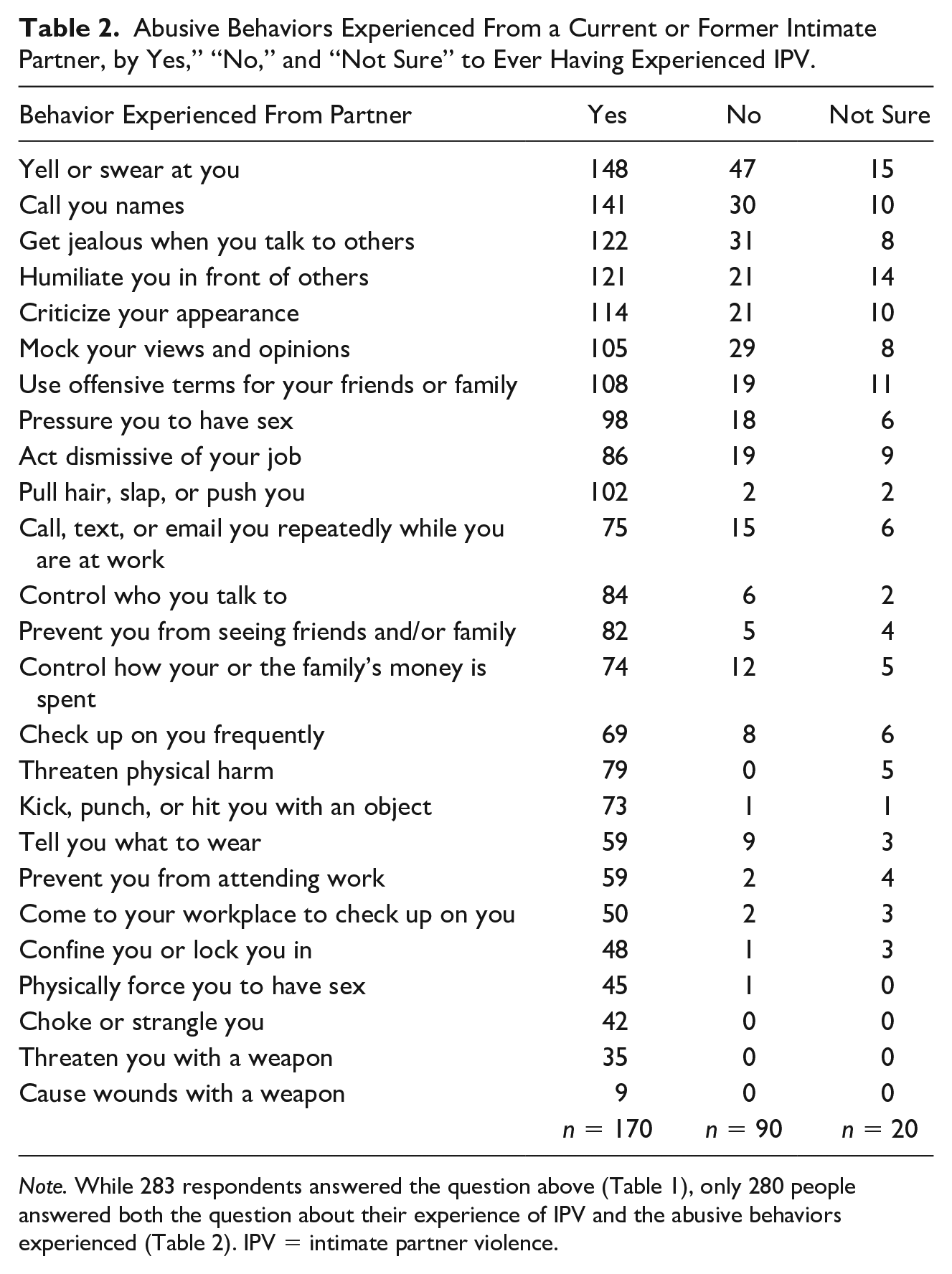
Notably, while 185 initially identified as having experienced IPV (205 when counting those who selected “not sure” but specified violent experiences), 283 (64.8% of 437 survey respondents) reported having experienced at least one of the abusive behaviors from the list, directed at them by a current or former intimate partner (Tables 1 and 2).
Abusive Behaviors Experienced From a Current or Former Intimate Partner.

Abusive Behaviors Experienced From a Current or Former Intimate Partner, by Yes,” “No,” and “Not Sure” to Ever Having Experienced IPV.
In addition, respondents were asked if they had used any of the following behaviors toward a current or former partner. While only one person identified that they had been the perpetrator of violence and 33 people stated that both they and their partner had used violent or abusive behavior, 231 respondents (52.8% of 437 survey respondents) identified that they had used at least one of the following behaviors. The most common were behaviors used by these respondents were forms of emotional abuse (127 people [29% of 437] reported yelling or swearing and 91 [20.1%] respondents identified that they had called their partner names), while some respondents identified perpetrating moderate and severe physical violence. Eighteen respondents (4.1% of 437) identified that they had pulled their partner’s hair, slapped them, or pushed them; six had kicked, punched, or hit their partner with an object; and three had threatened their partner with a weapon. Survey respondents also reported abusing or harassing their partners at work, including calling, texting, or emailing them repeatedly while they were at work (22), checking up on them frequently (17), going to their partner’s workplace while they were at work to check up on them (5), and preventing their partner from attending work (4). Some of the respondents who reported using these behaviours had not identified in the previous question that they, or both they and their partner, had perpetrated IPV.
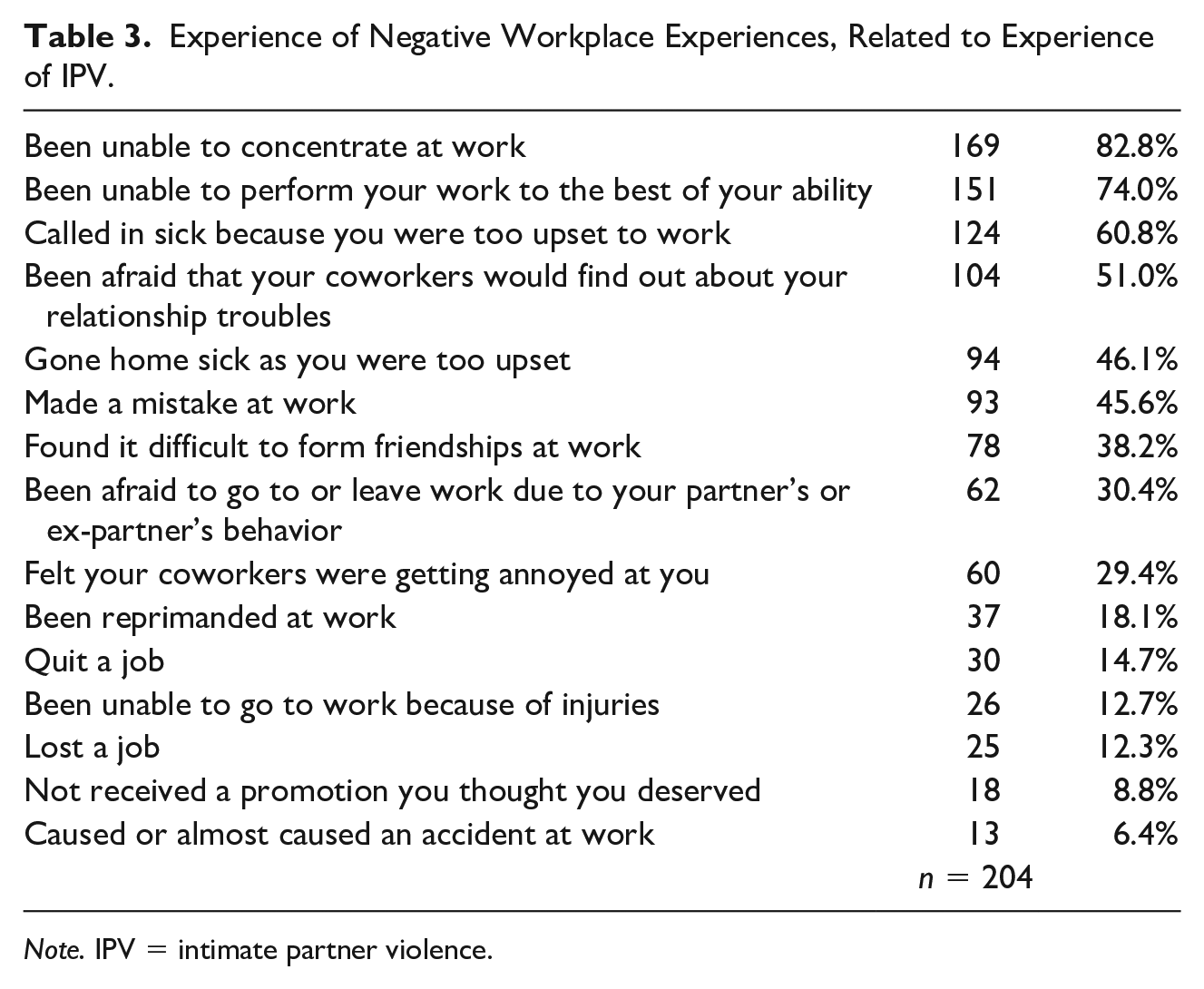
Survey respondents were asked if, as a result of IPV in their relationship, they ever experienced any of the negative workplace impacts listed (Table 3). Two-hundred and four people answered the question by choosing at least one behavior from the list. While only 185 respondents initially identified as having experienced IPV (205 when counting those who selected “not sure” but specified violent experiences), 204 reported that IPV had impacted them in their workplace in at least one way. The most common experiences were being unable to concentrate at work (169, 82.8% of 204); being unable to perform to the best of their ability (151, 74%); and calling in sick because they were too upset to work (124, 60.8%). Sixty-two (30.4%) reported that they had been afraid to go to or leave work due to their partner’s or ex-partner’s behavior. As a result of violence or abuse in their relationship, 30 respondents (14.7%) had quit a job, 25 (12.3%) had lost a job, and 26 (12.7%) had been unable to go to work because of injuries. When asked if they had confided in someone at work about what they were experiencing, only 20.1% of the survivors who responded to the question had confided in a manager and only 3.4% had talked to a union representative.
Experience of Negative Workplace Experiences, Related to Experience of IPV.
Note. IPV = intimate partner violence.
Three-hundred and eighty-two individuals responded to a question asking if they had ever known or suspected that a coworker was experiencing IPV. Of these, 187 (49%) said yes, 150 (39.2%) said no, and the remaining 45 (11.8%) were unsure. The majority of survey respondents recognized the seriousness of the impact of IPV on workers. Ninety-five percent (362 of 381 who answered the question) agreed that experiencing IPV can impact someone’s ability to feel safe at work. Ninety-eight percent (376 of 382) agreed that experiencing IPV can impact someone’s ability to function well at work.
In response to a question inquiring if their workplace has policies or procedures related to IPV, the greatest proportion, more than 45% (171, 45.7% of 374 respondents who answered the question) were unsure. The majority of survey respondents (255, 68.2%) had not received information at work on how to identify and respond to IPV.
Qualitative Survey Responses
The first open-ended question was “In your opinion, what policies or procedures could your workplace put into place to help people who are experiencing intimate partner violence?” The second question was “Any other comments that you would like to make on the impact of intimate partner violence in the workplace?” Responses were coded into four themes: Leaves and Workplace Accommodations, Workplace Services and Supports, Awareness in the Workplace, and Workplace Policy on IPV. A fifth theme of respondents’ experiences emerged, where participants wrote about the impact that experiencing IPV had on them in their own work, including being reprimanded at work for things that happened in relation to IPV.
Twenty-eight respondents mentioned making the possibility of a leave from work available to people who are experiencing violence. Some responded that paid leave for workers experiencing violence should be implemented for all employees, at the provincial level. Other respondents suggested that paid leave, when needed in cases of IPV, should be negotiated into collective agreements. One respondent suggested, Time excused for days needed to take off for court or if the victim is accessing the use of a shelter and currently have no place to live, adjusting hours accordingly in a compassionate manner that allows the victim to know their employment is secure.
Other suggestions relating to the theme of Leaves and Workplace Accommodations included flexible work schedules; the opportunity to access counseling, legal assistance, medical appointments, and look for alternative housing during work hours; the ability to transfer to another office or work location (when available, depending on the nature of the employment); and additional administrative assistance offered to assist employees who are experiencing IPV (e.g., answering their phone calls).
Twenty respondents offered suggestions relating to Workplace Services and Supports, with an additional 21 offering suggestions on “making work a safe space.” Most suggestions centered around access to counseling and benefit plans that include counseling. In terms of making work a safe space, many respondents wrote that employees need to know that it is safe to talk to management and coworkers about what they are experiencing. Respondents wanted to ensure that those who report IPV will receive a respectful response and be free from negative repercussions.
A large category was Awareness in the Workplace, which included 69 comments with several subthemes. These included ensuring that all employees are aware of the dynamics of violence and abuse and how to recognize warning signs, available resources, and policy and procedures related to IPV within the workplace. Some respondents suggested having designated support people within the organization who could provide information. Comments included “make sure that there are available materials in the workplace [and] on website to assist employees to find information they need if victimized or if they are concerned a colleague is being victimized,” “appointing someone in the workplace who is knowledgeable in intimate partner violence and is bound by confidentiality to provide support to the impacted staff,” and training for employees on violence in general . . . signs, symptoms, safety, how to help the victim. All staff need to be trained on the topic of domestic violence so they will know what steps to take if and when it occurs.
The importance of a basic level of awareness among all staff was mentioned by multiple respondents. In addition, several respondents noted the importance of training for managers on recognizing signs of IPV and knowing what to do. Others mentioned the Women’s Advocate program (available through Unifor, n.d.) as a helpful resource.
Another category was called Workplace Policy on IPV. Twenty-five comments fit this category, including respondents’ suggestions for policies to make workplaces safer for individuals experiencing IPV and protecting the employment of survivors. Suggestions included procedures for reporting and initiating discussion if it is suspected that a coworker is experiencing IPV, making training mandatory for new employees, and ensuring confidentiality is protected.
A survey respondent shared, Work might be the only safe calm place away from the abuse. I feel if I had had support to maybe take time to go counselling during work hours it may have helped me to keep the position as it was my only thing that made me self-sufficient . . . Victims lose everything. Had to move away, leave school and work to be safe. If I could be open about the abuse, maybe I could have created a safety plan.
It came out clearly in the surveys that work is positive for many survivors, not only in terms of financial stability but because it is a safe place. Work can increase feelings of self-efficacy and self-sufficiency. As one respondent wrote, I used work as my get away and dove into my work to get away from everything. This would be the reason my work actually at times improved and I was at work more because of a poor and stressful home life.
Discussion
This work is the second survey regarding the impact of IPV in workplaces to be completed in Canada and the first to focus on the specific impact in the province of Saskatchewan. Given the prevalence of IPV (in Saskatchewan, where the survey was conducted, as well as nationally), it is clear that many workplaces have been impacted by IPV, whether or not survivors have come forward or the violence has been recognized by others. Workplaces can play a key role in reducing the impact of IPV and increasing employee safety by providing access to information and support and being prepared to respond effectively when employees are impacted.
Awareness of IPV
Less than half (45.3%) of the survey respondents indicated that they had experienced IPV themselves when directly asked, though 64.8% of survey respondents reported that they had experienced some form of abuse from a current or former intimate partner, when identifying behaviors from a list (Table 2). It is concerning both that such a high percentage of survey respondents had experienced IPV and that many of these individuals did not identify as having experienced IPV. A sizable proportion of respondents had experienced several of the abusive behaviors listed (Tables 1 and 2), such as being humiliated in front of others, having their hair pulled or being slapped or pushed, having who they talk to controlled, and not being allowed to see friends or family. More than 10% (46) of the total survey respondents reported that their intimate partner had sexually assaulted them (physically forced them to have sex) and more than 17% (75) had been kicked, punched, or hit with an object. A large proportion (53, 12.1%) had been forcibly confined. Furthermore, we saw high numbers of participants who had experienced potentially lethal violence—42 people (9.6% of the 437 respondents) had been strangled and 35 people (8% of 437) had been threatened with a weapon.
Respondents were also asked if they had used any of these behaviors toward a current or former partner. While only one person identified that they had been the perpetrator of IPV and 33 people stated that both they and their partner had been violent, when asked if they had perpetrated any of the behaviors from the list against a current or former partner, 231 respondents identified that they had used at least one of the behaviors, including name calling and controlling behaviors. This illustrates that people tend to think of IPV as only physical violence or do not consider emotional and psychological abuse to be abusive or violent. In addition, many who did not identify as having perpetrated IPV had been physically violent to their partner—18 people had pulled their partner’s hair, slapped them, or pushed them but only seven of them identified as “I was violent toward my partner” or “Both my partner and I were violent.”
If people who are impacted by IPV do not recognize what they are experiencing as violence or abuse or are unaware that there is assistance available, they will be unlikely to reach out for help. In addition, if there is a lack of recognition of the behaviors that constitute IPV among the general public, it is unlikely that someone who is experiencing IPV will receive a supportive response if they do reach out for help.
Violence impacted many respondents’ work in the form of receiving repeated calls, texts, and emails from their partner while at work; being prevented from attending work; and having their partner come to their workplace to check up on them (Table 3). While only 185 initially identified as having experienced IPV (205 when counting those who selected “not sure” but specified violent experiences), 204 reported that abusive behaviors directed at them from a partner had impacted them at work. It is clear that productivity is negatively impacted for people who are experiencing IPV. More than 80% (82.8%, 169) of those 204 respondents reported that they had been unable to concentrate at work. It is also common for workers who are experiencing IPV to feel that they are unable to perform to the best of their ability (74%, 151). A significant proportion of respondents who had experienced IPV had called in (60.8%, 124) or went home sick (46.1%, 94) because they were too upset to work. Furthermore, 12.7% (26) missed work due to injuries from IPV. Organizations also experience losses to productivity, as well as financial costs related to hiring and training, when survivors lose their job (12.3%, 25) or quit (14.7%, 30) because of IPV.
Recommendations
In their qualitative responses, survey respondents stated that all workers must have access to information and training so that they can respond appropriately if they suspect that someone they work with is experiencing IPV. Quantitative and qualitative survey results point to a lack of awareness about IPV generally, as well as the workplace impact. It is clear from the results of this survey that many people (including those who have been victims or perpetrators of IPV) do not see emotional, psychological, sexual, financial abuse, and controlling behaviors as part of a pattern of IPV. Training provided in the workplace can educate all workers about the dynamics of IPV, as well as how to recognize IPV, how to respond, and the available referral sources. This not only helps workers when IPV is impacting someone that they work with, it provides valuable knowledge that may help individuals to recognize when a friend or family member is experiencing abuse. It also let people who are experiencing IPV know that all forms of violence and abuse are unacceptable and that there is support available.
The majority of survey respondents were unsure whether their workplace had policies or procedures related to IPV. It is necessary to not only to implement policies and procedures to support workers impacted by IPV but also to ensure that there is awareness of these policies, so that workers who are experiencing IPV know that they will be protected if they disclose IPV and know what provisions are in place to help them. Awareness of the polices also helps to ensure that others in the workplace know how to respond and feel empowered to do so.
Participants indicated that work is an ideal setting to provide information to people who are experiencing violence. It is important that information about IPV, including contact information for agencies that offer support and safety planning, be made easily accessible at work. For workers who are experiencing IPV, work may be the only safe place where they can access support and information without their partner finding out. Allowing workers who are experiencing violence to do necessary tasks related to IPV during work hours (such as reporting to police, attending counseling, attending court, or looking for housing or moving) can help to maintain survivors’ safety when they currently in, planning to leave, or have exited a situation of IPV. Supporting survivors of IPV to maintain their employment is crucial because work not only breaks up isolation but also provides financial security that can help someone to exit the relationship and maintain their independence (McFerran, 2011).
Since 2016, several Canadian provinces have passed legislation granting leaves from work. If legislation granting leaves exists in the jurisdictions, workplaces may choose to grant additional leave, beyond what is legislated, to their employees. In areas without legislated workplace leaves, organizations should provide for leaves within policy. An effective workplace policy should specify provisions such as access to supports for workers who are experiencing IPV, including treatment for those who are using violence against their partners. Survey respondents made it clear that organizations should have a policy which states that workers will be protected from job loss or other negative repercussions if they disclose that they are experiencing IPV.
Legislative (or policy) provisions granting leaves and other supports to workers who are experiencing IPV must also be accompanied by training for managers and workers, so that everyone within the organization knows how to recognize and respond to IPV and connect with local domestic violence agencies.
Footnotes
Acknowledgements
Sincere thanks to the workers who shared their experiences. Thanks also go out to our Steering Committee members, who provided valuable insight as PATHS was beginning this work. Steering Committee members included representatives from Saskatchewan Ministry of Justice, Saskatchewan Public Service Commission (PSC), Saskatchewan Status of Women Office, SaskTel, STOPS to Violence, Regina Immigrant Women Centre, Saskatchewan Government and General Employees’ Union (SGEU), Saskatchewan Federation of Labour (SFL), Unifor 1S, Regina Police Service, and survivors of violence.
Declaration of Conflicting Interests
The author(s) declared no potential conflicts of interest with respect to the research, authorship, and/or publication of this article.
Funding
The author(s) disclosed receipt of the following financial support for the research, authorship, and/or publication of this article: This study is part of Working Together to Build Protective Factors into Workplace Policies and Procedures for Victims of Intimate Partner Violence, a 3-year project (2015–2018) undertaken by the Provincial Association of Transition Houses and Services of Saskatchewan (PATHS) and funded by Status of Women Canada’s Women’s Program (grant no. SK15140).
