




Abstract
Responses to rape victims, although often helpful, can be hurtful and hinder victims’ health and recovery. Adopting a multidimensional approach to dispositional empathy, this research investigated how different subfacets of empathy predict responses to hypothetical rape victims. Before reading a sexual assault scenario, 282 participants completed measures of cognitive and emotional empathy. Participants’ subsequent emotional arousal was measured by self-report, as were their intentions to help, avoid, or blame the victim. A path model demonstrated that dispositional empathy predicted behavioral intentions toward hypothetical rape victims by altering their vulnerability to experience shame or anger. People who tended to feel personal distress were more likely to mirror rape victims’ assumed shame. Due to its antisocial nature, experiencing shame, in turn, led to hurtful behaviors such as blaming or distancing oneself from the victim. On the other hand, people who tended to feel empathic concern were more likely to feel anger on behalf of the victim following a rape disclosure. Anger is a motivating force for action and promotes helping behavior. A second study demonstrated that these results appear unique to rape disclosure, namely, participants reactions to nonsexual assault were unsuccessfully captured by this model. Understanding how empathetic arousal of shame can lead to hurtful intentions toward rape victims has important implications for future interventions: Programs that draw attention to the shame or humiliation experienced by rape victims may do more harm than good. For instance, some anti-rape campaigns portray pictures of women covering their faces. These campaigns, however well intentioned, may discourage people from helping victims because they may evoke feelings of shame in the perceiver. On the other hand, societal movements, such as the #Metoo movement, may be particularly effective by reducing the shame surrounding sexual assault and promote helpful behaviors.
There is widespread agreement that rape constitutes an unacceptable violation of another person. Yet, when rape victims turn to others for support, they are confronted, all too often, with hurtful rather than helpful responses. More than 80% of rape victims report being blamed for their assault, being stripped of their autonomy, or having support providers pull away, focus on their own needs, or discourage them from talking about the event (Ahrens et al., 2009). Although not necessarily intended to harm, these reactions are often devastating, hindering victims’ recovery and causing increased levels of post-traumatic stress and depression (Campbell et al., 2001). Hurtful reactions to rape disclosure are not exclusive to distant onlookers and often characterize the reactions of those who we would expect to care the most: close friends, family, police, educators, and medical personnel (Filipas & Ullman, 2001; Holland et al., 2020). Luckily, helpful responses are also common, with more than 74% of rape victims reporting that they received offers of emotional or tangible help (Ahrens et al., 2009). The present study aims to understand why rape disclosures sometimes elicit hurtful, and sometimes helpful, responses in others and identify characteristics of respondents who are more, or less, likely to behave in each manner.
Discovering someone has been a victim of sexual assault usually prompts a strong emotional reaction in the responder, typified by a concurrence of two very different emotions: shame and anger. These two emotions have been found to predict contradictory patterns of behavior: Feelings of anger are a consistent predictor of helping behavior, while shame is considered a paralyzing, self-focus inducing emotion that can lead to hurtful responses (Tangney & Dearing, 2002; Van Zomeren & Lodewijkx, 2005). Of course, a host of other emotions are also experienced by the recipient of a rape disclosure including sadness, guilt, humiliation, disgust, helplessness, and fear (Ahrens & Campbell, 2000), but these will not be discussed further.
Feelings of anger predict people’s self-reported likelihood of helping a victim of date rape (Earnshaw et al., 2011), and anger is reported by rape crisis counselors to be a “motivating force for action” (Wasco & Campbell, 2002, p.121). In contrast, psychological evidence suggests that shame promotes defensiveness, interpersonal separation, and antisocial behavior (Tangney et al., 2007). Rape disclosures, therefore, may elicit hurtful reactions in those who hear them because they trigger strong feelings of shame. Understanding how shame and anger predict the level of support offered to a rape victim takes us one step closer to understanding why these responses occur. However, to understand what makes respondents more or less likely to feel shame or anger in the first place, we must consider individual differences in disposition. There are several dispositional variables and ingrained biases that may influence peoples’ emotional responses to rape victims (Willmott et al., 2018). However, this research will focus exclusively on the extent to which people resonate and respond to others’ emotional states, in other words, their dispositional empathy.
Empathy is a complex multidimensional construct and since the 18th century, at least two different types of empathy have been proposed. Adam Smith (1759) differentiated between one’s emotional reactions to others’ and the ability to recognize the emotional states free of emotional experience. Smith’s distinction persists today under the nomenclature of emotional and cognitive empathy, and a new measure of empathy has demonstrated their differential predictive validity within the context of intimate partner violence (Victim Responsiveness Assessment, Debowska et al., 2019). Theorists have also distinguished within this emotional response between feeling as another person feels and feeling for another, typically sorrow or concern (Batson & Ahmad, 2009; Miller & Eisenberg, 1988; Zaki & Ochsner, 2012). The extent to which individuals have a propensity for each of these facets of emotional empathy may predict the likelihood that they respond with shame and/or anger to a rape disclosure. Measures of empathy must differentiate between these two emotional responses, therefore, to capture their effects. The interpersonal reactivity index (IRI; Davis, 1983) makes such a distinction by including two measures of emotional empathy (Empathetic Concern [EC] and Personal Distress [PD]) as well as a measure of cognitive empathy (Perspective Taking [PT]).
People who report being high in PD are more likely to feel as another feels, that is, to suffer others’ pain vicariously and mirror the other persons’ emotions. In response to a rape disclosure, therefore, people high in PD may be more likely to experience shame. Although any type of victimization may evoke shame, victims of sexual assault are especially susceptible. In a recent survey 75% of female sexual assault victims indicated that they felt ashamed following the attack (Vidal & Petrak, 2007). This high incidence of shame makes it likely that would-be supporters will witness its expression and empathetically resonate. Given the antisocial nature of shame, this type of emotional empathy is, therefore, likely to ultimately lead to hurtful behavioral responses.
On the other hand, people who report high levels of EC feel an emotional response for others, without mirroring the expressed emotion. There are a variety of emotions that recipients of a rape disclosure may feel, but a recent survey suggests anger is the most common, with 46.6% of respondents reporting feeling angry after a friend disclosed a sexual assault (Banyard et al., 2010). Experimentally induced EC increases the likelihood of experiencing anger in response to another person being treated unfairly (Batson et al., 2007). Therefore, it is expected that EC may increase respondents’ propensity to feel anger on behalf of a rape victim, which, as discussed earlier, may in turn promote attempts to ease victims’ suffering (Batson, 2011).
These disparate behavioral predictions for people with high levels of EC and PD outlines how the prosocial nature of emotional empathy is only expected to be as prosocial as the emotion aroused.
The possible drawbacks to emotional empathy have been acknowledged in other fraught situations, such as emergency medicine. For this reason, physicians are expected to maintain emotional distance from their patients to limit their exposure to adverse emotions (Decety et al., 2014). Rather than relying on emotional empathy, physicians engage in “detached concern” (Halpern, 2003), a term unique to the medical community but can be considered synonymous with cognitive empathy (Martingano & Martingano, 2017). Similarly, it is expected that cognitive empathy (as measured by self-reported PT) will predict prosocial responses, and reduced antisocial responses, in response to a rape disclosure.
The pattern of behavioral predictions outlined here for each subfacet of empathy has recently been partially documented by researchers Silver et al. (2015). These researchers found that both EC and PT predicted participant’s reported likelihood of engaging in proactive behaviors to help women forcibly involved in prostitution. On the other hand, PD did not predict such proactive behaviors. Although the authors measured a variety of proactive behaviors, such as willingness to donate money, volunteer, or alert law enforcement or social services, they did not measure hurtful responses to the victims. This research also did not delve into the mechanism behind this pattern of results, namely, the nature of the emotional empathetic response. Indeed, there has, to the best of our knowledge, been no theoretical nor empirical investigation into how empathy and emotions conspire to determine responses to rape disclosure, which this research intends to rectify.
Aims and Hypotheses
The present research adopts a multidimensional approach to empathy to investigate how different types of empathy may predispose individuals to react in hurtful or helpful ways in response to a rape disclosure. Cognitive empathy is expected to predict helpful intentions, regardless of emotion, but emotional empathy is expected to predict increased helpful intentions only to the extent it arouses prosocial emotions.
Specifically, EC is hypothesized to predict increased helpful and decreased hurtful behavioral intentions, and this relationship was expected to be, at least partially, mediated by feelings of anger for the victim. On the other hand, PD is hypothesized to predict behavioral intentions in the opposite direction, and its effects were expected to be, at least partially, mediated by feeling shame as the victim might. PT is assumed by its cognitive nature to be unrelated to emotional processing of events; however, it is hypothesized that PT will directly predict prosocial responses and reduced antisocial responses without arousing emotion. Path analysis was expected to support the existence of these relationships following a hypothetical disclosure of sexual assault (Study 1) but not nonsexual assault (Study 2) because of the unique emotional reactions that typify a rape disclosure.
Study 1
To test this model, the present study asked participants to read scenarios depicting sexual assault and indicate their likelihood of engaging in different types of social reactions: hurtful reactions (distancing and victim blaming) and helpful reactions (offering emotional and tangible aid). Path modeling was used to predict participants’ likelihood of engaging in each response from their self-reported emotional reactions to the scenarios, along with measures of their dispositional empathy.
Method
Participants
Two hundred eighty-two American participants (161 women, 120 men, and one unreported) were recruited through Amazon’s MechanicalTurk “crowdsourcing” website: mturk.com. MTurk participants have been found to be significantly more diverse than typical American college samples and produce results as reliable as those obtained via traditional methods (see Buhrmester et al., 2011). Despite these improvements from college samples, our participants were still predominantly young (M age: 32.7 years [SD: 11.8]); liberal (57%); White (78%), and educated (63% had a college/graduate-level education). Participants were offered 50 cents in Amazon credits as compensation for completing the study.
Procedure
Participants completed the Empathetic Concern (EC), Perspective Taking (PT), and Personal Distress (PD) subscales of the IRI (Davis, 1983). Items include “I sometimes try to understand my friends by imagining how things look from their perspective” for the PT subscale; “I often have tender, concerned feelings for people less fortunate than me” for the EC subscale; and “In emergency situations, I feel apprehensive and ill-at-ease” for the PD subscale. Respondents rated themselves on each item using a 5-point scale (1 = does not describe me well, 5 = describes me very well). Higher scores indicate a greater level of the quality being measured. All subscales were found to be reliable (EC’s α = .89, PT’s α = .82, PD’s α = .85). In an effort to reduce the likelihood that completing the IRI would bias reactions to the rape scenario, participants were then asked to complete a distraction task before reading an adapted version of a female date rape scenario previously used by Abrams et al. (2003; see Appendix A). After reading the scenario, participants used a 1 to 10 scale (1 = not at all, 10 = the most I have ever experienced in my life) to indicate to what extent they experienced shame, anger, sadness, guilt, humiliation, disgust, helplessness, and fear while reading the scenario (only results for shame and anger are reported here). Finally, participants were asked to indicate their likelihood of behaving in a helpful, blaming, or distancing manner toward the victim.
Helpfulness
Willingness to help victims was measured by asking participants to indicate their likelihood of engaging in three behaviors on a scale from 1 to 10 (1 = not at all likely, 10 = extremely likely): (a) Report the incident to the police, (b) Talk with Kathy about the event, and (c) Ask Kathy how you can help. The reliability coefficient for these three items was acceptable (α = .70, M = 8.01, SD = 1.79).
Distancing
Using the same 1 to 10 scale as before, participants indicated to what extent they would distance themselves from the rape victim by rating their likelihood of engaging in four behaviors: (a) Keep quiet about what happened, (b) Try to act as though nothing happened, (c) Avoid thinking about the incident, and (d) Act awkwardly around Kathy. The reliability coefficient for these four items was good (α = .71, M = 3.57, SD = 1.91).
Victim blaming
Again using the same 1 to 10 scale, participants indicated to what extent they would blame the rape victim using three items adapted from Abrams et al. (2003): (a) How much do you think Kathy should blame herself for what happened?, (b) How much control do you think Kathy had over the situation?, and (c) How much do you think this incident could have been avoided? The reliability coefficient for these three items was good (α = .77, M = 4.02, SD = 2.12).
Results
Descriptive statistics
Descriptive statistics for Study 1 are presented in Table 1. There were significant gender differences in all behavioral intentions and in self-reported EC. Women reported higher levels of EC (F = 29.17, p < .01) than men. Women subsequently indicated greater willingness to help the victim (F = 16.39, p < .01) and less intentions to blame (F = 4.62, p = .03) or distance oneself from the victim (F = 13.74, p < .01).
Descriptive Statistics Study 1.
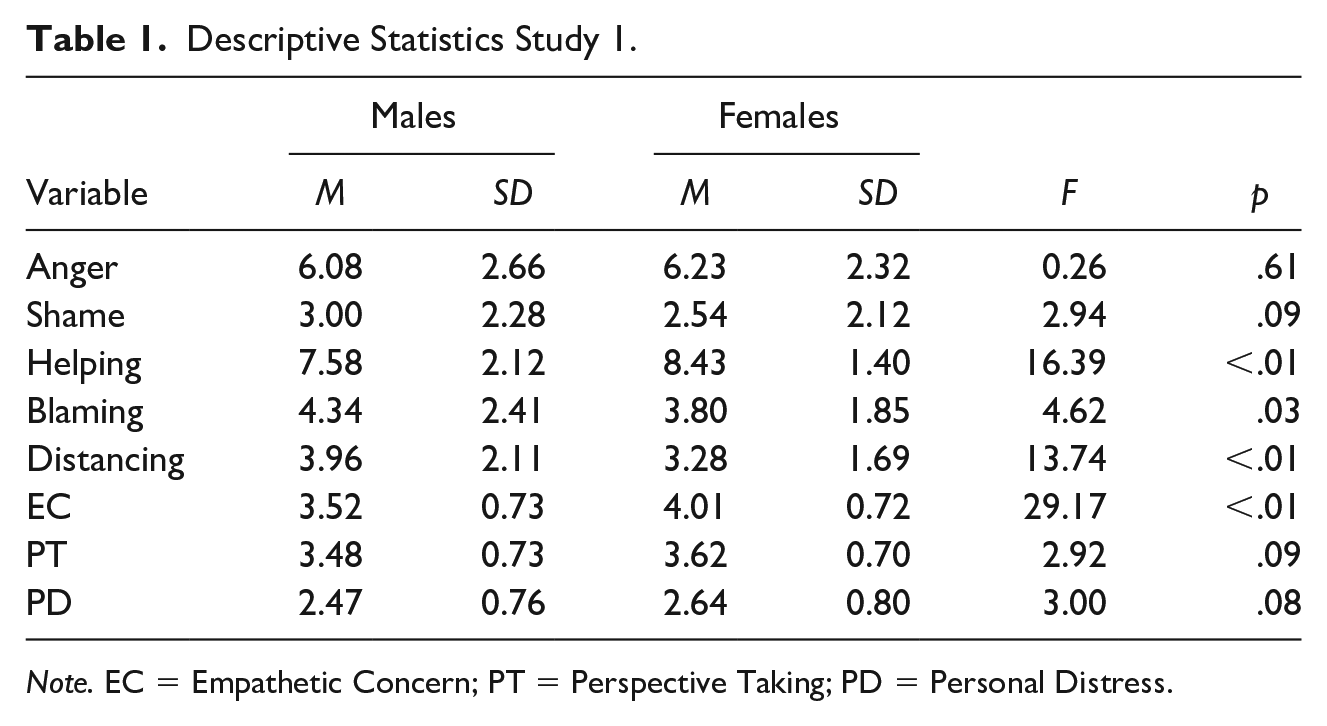
Note. EC = Empathetic Concern; PT = Perspective Taking; PD = Personal Distress.
Path analysis
Path analysis was performed to assess the viability of our hypothesized model using PROC CALIS (maximum likelihood method of parameter estimation) based on the variance–covariance matrix in SAS® 9.4.
In accordance with previous literature, our initial model hypothesized EC and PT would predict helpful behavioral intentions directly, but the effect of EC was expected to be, at least partially, mediated by anger. PD was also expected to predict behavioral intentions, but in the opposite direction by increasing hurtful responses, and that its effects were expected to be, at least partially, mediated by shame. Estimated path coefficients for this initial model did not differ significantly from 0, χ2 (4, N = 281) = 0.625, p = .960; therefore, we can accept our null hypothesis of good model fit. Various other goodness-of-fit indices also indicated our initial model fits the data well (comparative fit index [CFI] = 1.000; standardized root mean square residual [SRMR] = .008; root mean square error of approximation [RMSEA] = .000; CL90 = [.000–.000]). Values for the CFI greater than .94 suggest good fit between data and path models (Hu & Bentler, 1999), whereas SRMR and RMSEA values less than .090 suggest acceptable fit, and values less than .055 suggest good model fit (McDonald & Ho, 2002). Despite good model fit, the t tests for path coefficients reveal three nonsignificant parameters: the direct effect of PD on blaming intentions (t = 1.19 p > .05); and the direct effect of PT on blaming (t = 0.50, p > .05) and distancing intentions (t = −1.27, p > .05).
The lack of a direct effect between PT and antisocial responses is theoretically interesting as this suggests that the negative association between empathy and antisocial behavior (Castano, 2012) is mainly driven by EC. Some researchers have attempted to disentangle the predictive validity of these empathy facets in recent years: VanNoorden et al. (2014) reviewed 40 studies and concluded that emotional empathy plays an important role in the inhibition of aggression, but that the role of cognitive empathy (PT) is unclear. Although inconclusive, this research suggests it is theoretically reasonable to drop the paths between PT and antisocial responses if they do not have empirical support. Although we also expected a direct effect of PD on blaming intentions, subsequent analyses showed that this effect was rendered nonsignificant by full mediation through shame. It was, therefore, decided to drop these nonsignificant paths to create a more parsimonious revised model. This decision was supported by analyzing appropriate Wald tests, which indicated that stepwise deletion of these paths would not negatively affect model fit.
The revised model (see Figure 1) also does not differ significantly from 0, χ2 (8, N=281) = 7.07, p = .530, and the goodness-of-fit measures indicate a very good fit to the data (CFI = 1.000; SRMR = .024; RMSEA = .000; CL90 = [.000–.065]). Path coefficients are all statistically significant (see Table 2), and squared multiple correlation values for helping (R2 = .33), blaming (R2 = .14), and distancing intentions (R2 = .23) indicate that predictor variables capture meaningful percentages of observed variance in these dependent variables.
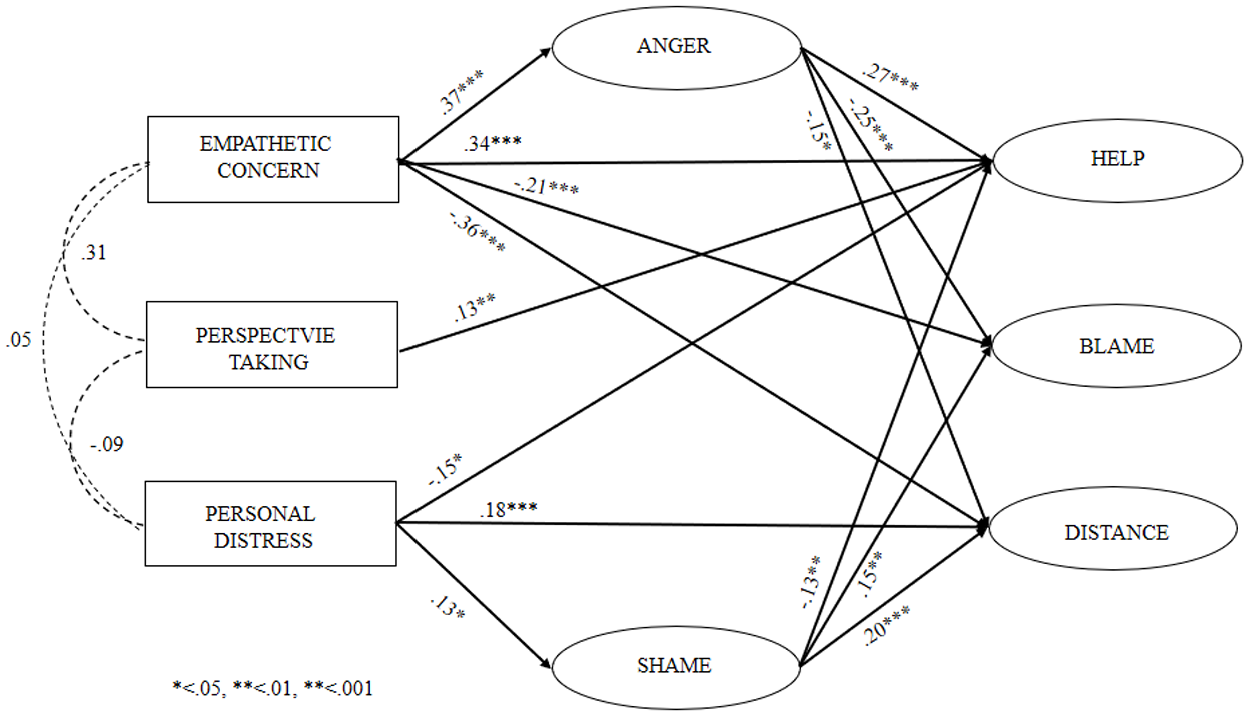
Revised path model Study 1.
Intercorrelations and Standardized Path Coefficients for the Revised Rape Model.
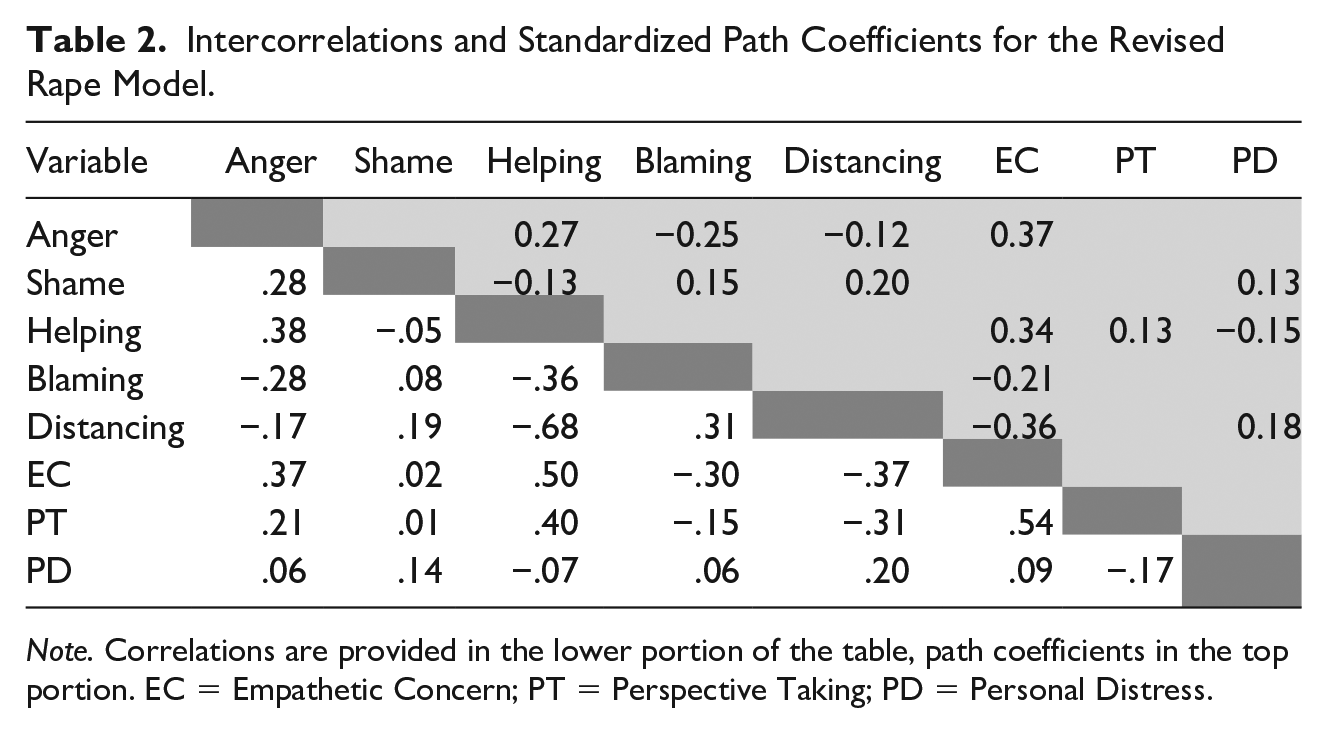
Note. Correlations are provided in the lower portion of the table, path coefficients in the top portion. EC = Empathetic Concern; PT = Perspective Taking; PD = Personal Distress.
On this basis, we suggest that our revised model best reflects the patterns of association within the derived data set. Revisions to the initial hypothesized model are theoretically tenable and lead to a more parsimonious and equally well-fitting model.
Mediation analysis
We used the Hayes (2013) procedure to investigate the extent to which shame and anger mediated the relationship between empathy and behavioral intentions. We confirmed that shame significantly mediated the relationship between PD and helpful, distancing, and blaming intentions. Specifically, a significant indirect effect of PD was found for helpful (b = −0.055, 95% confidence interval [CI] = [−0.107, −0.022]), distancing (b = 0.094, 95% CI = [0.049, 0.156]), and blaming intentions (b = 0.103, 95% CI = [0.052, 0.176]). Consistent with path model findings, the direct effect of PD on helpful and distancing intentions was significant, indicating that shame partially mediated these relationships (bhelp = −0.163, p = .039; bdistance = 0.530, p < .001). Also consistent with the path model, the direct effect of PD on blaming intentions was nonsignificant, indicating that shame fully mediated this relationship (bblame = 0.150, p = .151). Although we did not expect full mediation, this finding is also consistent with the nonsignificant coefficient between PD and blaming intentions in the path model.
Anger partially mediated the relationship between EC and helpful and blaming intentions. A significant indirect effect of EC was found for helpful (b = 0.100, 95% CI = [0.042, 0.175]) and blaming intentions (b = −0.112, 95% CI = [−0.204, −0.042) but not for distancing intentions (b = −0.057, 95% CI = [−0.128, −0.001]). Furthermore, the direct effect of PD on all behavioral intentions was significant, indicating that anger only partially mediated the relationship with helping and blaming intentions (bhelp = 0.916, p < .001; bblame = −0.684, p < .001). PD did not mediate the relationship with distancing behavior (bdistance = −0.899, p < .001).
Overall, the results of Study 1 confirmed the viability of our proposed model: that dispositional empathy predicts behavioral intentions toward hypothetical rape victims through shaping respondents’ relative vulnerability to experience shame or anger. It appears that emotional empathy can lead to helpful or hurtful intentions depending on the nature of the emotion it arouses.
Study 2
It is expected that our proposed model of behavioral intentions is unique to rape disclosure because of the unique constellation of emotions elicited in this situation. However, it is possible that a range of responses to assault victims can be modeled in this manner. To determine if our results are unique to rape disclosure, we conducted the same experiment using a nonsexual assault scenario, specifically asking participants how they would react to a disclosure of robbery.
Methods
Two hundred ninety-five American participants (144 women, 149 men, and one unreported) were recruited through Amazon’s MechanicalTurk “crowdsourcing” website: mturk.com. Participants were predominantly young (M age: 32.9 years [SD 12.0]), liberal (58%), White (82%), and educated (57% had a college/graduate-level education). Participants were offered 50 cents in Amazon credits as compensation for completing the study. The procedure for Study 2 was the same as that used in Study 1 except participants read about a nonsexual physical assault scenario. This scenario was constructed using a similar structure to the rape scenario used in Study 1 (see Appendix B).
Results
We tested the same model as reported in Study 1, and, although it showed a good fit to the data, χ2(7) = 8.95, p = .347; RMSEA = .020; SRMR = .027, local paths were poor. The paths between anger and helping (thelp = 1.17, p > .05) and distancing (tdistance = −1.47, p > .05) were nonsignificant. In addition, the direct path between PT and helping (t = 1.86, p > .05) was nonsignificant. Social reactions to robbery appear, therefore, to be unsuccessfully captured by this model.
General Discussion
The unique horror of rape is all too often compounded by unhelpful and even hurtful responses to disclosure. We present a model of how empathy and emotions conspire to determine responses to rape disclosure, specifically how emotional empathy leads to helpful outcomes only to the extent that it elicits prosocial emotions, while cognitive empathy leads to prosocial behavioral intentions without emotional involvement.
Participants who report high levels of PD are likely to mirror the shame they attribute to a hypothetical rape victim. The experience of shame, in turn, predicts hurtful behavioral intentions toward the victim and reduces the likelihood of helpful intentions. It appears, therefore, that the manifestation of empathy can, in some cases, lead us to hurt others.
On the other hand, participants who report having high levels of EC are more likely to respond emotionally with anger on behalf of the victim. Anger predicts behavioral intentions in the opposite direction to shame: increasing helpful behavioral intentions and decreasing hurtful ones. Similarly, helpful behavioral intentions are directly predicted by high levels of self-reported PT, whose prosocial effects occur without emotional arousal. The different effects of each facet of empathy on emotional arousal and subsequent behavioral intentions highlight the importance of measuring empathy as a multidimensional construct.
Although path models are useful for understanding relational data in a multivariate system, it is important to remember that they cannot test directionality in relationships. The directionality in our model purely represents our assumed causal hypotheses. It is plausible, and we would argue reasonable (based on previous theoretical and empirical research), that PD increases peoples’ experience of shame, that EC increases peoples’ experience of anger, and that these emotions, in turn, cause behavioral intent. However, this is not established by modeling, and this technique simply confirms that the data can fit this interpretation. In addition, future research may also wish to evaluate the contribution of other dispositional factors, such as rape myth acceptance, which is currently not captured by this model.
There are other limitations to the current study, such as constraints on ecological validity, which should be considered when interpreting the results. Participants’ intentions to help, blame, or distance themselves from a hypothetical rape victim were measured rather than actual engagement in these responses following a real disclosure of rape. It is possible that actual behavior might deviate from intended behavior. However, there is reason to believe that behavioral intentions can act as a suitable proxy for actual behavior. The theories of reasoned action (Fishbein & Ajzen, 1975) and planned behavior (Ajzen, 1985) provide a theoretical rationale for the relationship between behavioral intentions and actual behavior. This is supported by empirical work demonstrating that behavioral intentions lead to actual behavior (Ajzen & Fishbein, 1973; Hagger & Chatzisarantis, 2009; Schifter & Ajzen, 1985). It is important to note that intentions may be less predictive of behavior in highly emotional situations like penetrative rape, with prior research suggesting only a small, yet significant, effect of intentions on behavior in sexual assault scenarios (McMahon et al., 2015). Nevertheless, the use of hypothetical victims appears justifiable and, indeed, ethically obligatory.
The ecological validly of the scenarios used in the current research is also limited. The scenarios were not designed to be particularly graphic. There is, however, experimental precedent for the use of such scenarios (Abrams et al., 2003; Earnshaw et al., 2011). Moreover, these scenarios yielded strong emotional reactions and were sensitive enough to capture differences in emotional reactions following disclosure, suggesting that despite the lack of ecological validly, these scenarios were successfully manipulating our participants. It remains possible, however, that actual rape disclosures may yield more extreme, or different, behavioral intentions than those found in the current study. In a real interpersonal setting, it is also reasonable to expect additional factors (such as how well one knows the victim) will effect emotional and behavioral reactions. Our findings are most relevant to those who are likely to receive rape disclosures from strangers, such as educators, police, medical professionals, or others who, by the nature of their professional roles, are likely to be the target of such a disclosure. Schools, hospitals, and local government may want to include dispositional empathy as a consideration in hiring such positions, with preference given to those demonstrating high levels of empathic concern. In addition, these results could be used to inform the design of training programs to encourage would-be supporters to be cognizant of their emotional responses and how they might be shaping their responses to rape victims. Such training could target individuals with the highest levels of PD for early prevention.
An additional limitation of the current work is the extent to which its findings are generalizable. Our online samples comprised mostly young Americans, and thus, we make no claims beyond this population. It is particularly important not to generalize these results to different age groups or cultures as the relative expression of different facets of dispositional empathy changes with age (Davis & Franzoi, 1991) and culture (Cassels et al., 2010), and the expression of anger and shame is also culturally bound (Fischer, 1999). However, given that rape is a significant problem among young Americans, it is useful to understand responses to rape even solely within this population.
Notwithstanding the above limitations, the model presented here makes an important contribution to our understanding of how emotional empathy motivates behavior. The current results suggest that the hurtful consequences of PD may be explained by increasing vulnerability to the experience of shame, a self-focused emotion that has been linked to social withdrawal (Lewis, 1995). Moreover, this study corroborates previous research suggesting that EC may lead to helpful intentions though increasing anger (Batson et al., 2007).
The role of shame in predicting hurtful responses to rape disclosure has important implications for future interventions: Programs that draw attention to the shame or humiliation experienced by rape victims may do more harm than good. For instance, some antirape campaigns portray pictures of women covering their faces. These campaigns, however well intentioned, may discourage people from helping victims because they may evoke feelings of shame in the perceiver. On the other hand, societal movements such as the #Metoo movement may be particularly effective by changing would-be supporters’ perceptions of the shame of victimhood. By reducing the shame and stigma surrounding sexual assault, we may increase the amount of help victims receive even by those predisposed to feel PD.
Footnotes
Appendix A
Appendix B
Declaration of Conflicting Interests
The author(s) declared no potential conflicts of interest with respect to the research, authorship, and/or publication of this article.
Funding
The author(s) received no financial support for the research, authorship, and/or publication of this article.
