



Abstract
The current study examined the extent to which evaluative attitudes toward sexual aggression (i.e., positive or negative evaluative judgments about sexually aggressive behavior) mediate the association between injunctive norms (i.e., extent to which peers approve or disapprove of sexually aggressive behavior) and self-reported sexual aggression against women. Participants were 200 male undergraduate students. Approximately one in four males reported engaging in at least one sexually aggressive act since the age of 16. Participants with a history of sexual aggression also reported the highest likelihood of engaging in sexually aggressive behavior in the future. We tested two separate mediation models to examine the extent to which evaluative attitudes account for the link between injunctive norms and sexual aggression: one model with self-reported history of sexual aggression as the outcome and the other with likelihood of engaging in sexually aggressive behavior as the outcome. Results showed that more positive evaluative attitudes toward sexual aggression accounted for the association between injunctive norms and self-reported history of sexual aggression. Similarly, evaluative attitudes accounted for the link between injunctive norms and self-reported likelihood of engaging in sexually aggressive behavior in the future. Overall, these findings are consistent with theoretical and empirical explanations of sexual offending and general criminal behavior; however, this is the first study to explore the relationship between injunctive norms and evaluative attitudes in the context of explaining sexually aggressive behavior. If more rigorous research establishes a causal relationship between injunctive norms, evaluative attitudes, and sexually aggressive behavior, this would suggest that targeting these factors in prevention programs may reduce sexual aggression by male undergraduate students.
In the United States, approximately two in five women and one in four men report experiencing some form of sexual aggression at some point during their lifetime, including rape, sexual coercion, and unwanted sexual touching (Smith et al., 2018). Notably, one in five women report experiencing attempted or completed rape in their lifetime, which is more than 16 times the reported rate among men (Smith et al., 2018). Some of the highest rates of sexual assault are reported by women attending college (Fedina et al., 2018). A systematic review found that, while attending college, between 1% and 8% of women report experiencing attempted or completed rape, between 2% and 14% report incapacitated rape, and between 2% and 34% report experiencing unwanted sexual touching (with most studies reporting rates more than 20%; Fedina et al., 2018). A meta-analysis of the prevalence of sexual assault perpetrated by college men also revealed that, on average, 29% of college men report engaging in some form of sexual assault perpetration, including verbal sexual coercion, and 7% report attempted or completed rape, including any sexual intercourse obtained via incapacitation, physical force, and threats of physical force (Anderson et al., 2019). Evidently, campus sexual assault remains a serious public health concern. Sexual victimization is associated with increased levels of depression, anxiety, post-traumatic stress disorder, and suicidal ideation (Campbell et al., 2009; Choudhary et al., 2012; Elliott et al., 2004; Gidycz et al., 2008). To reduce sexual aggression and its consequences, it is important to understand the mechanisms that can lead an individual to engage in sexually aggressive behavior.
Male Peer Groups and Injunctive Norms
Male peer groups have been identified as an important factor in the perpetration of sexual aggression against women. The male peer support model (Schwartz & DeKeseredy, 1997) was one of the first models to identify male peers as an important factor in the perpetration of sexual assault against women by college men. It contends that some college men turn to their male peers for dating advice when they experience stress in their romantic relationships. The type of advice that is offered by the peer group when discussing women, dating, and sex forms the basis for injunctive norms within the peer group. Injunctive norms reflect the extent to which peers approve or disapprove of a behavior (Cialdini et al., 1990). For example, if a group member expresses that a woman is willing to participate in sexual touching but not in sexual intercourse, the peer group may express approval for sexual aggression against women (e.g., suggestions to force the woman to have sex, get her drunk to lower her inhibitions). Once group norms are learned, members of the group tend to behave in ways that are consistent with these norms because going against them could result in ridicule or rejection by other group members (Aronson et al., 2006; Cialdini et al., 1990; Terry et al., 1999). Therefore, more positive injunctive norms toward sexual aggression against women can increase the likelihood that men in the group will engage in sexually aggressive behavior. Schwartz and DeKeseredy (1997) suggest that many young men undergo this learning process as they join social groups, such as sports teams or fraternities, during their first years in college.
Empirical studies provide compelling evidence for the relationship between injunctive norms and sexually aggressive behavior among male undergraduate students. In a test of Schwartz and DeKeseredy’s male peer support model, Franklin et al. (2012) assessed perceived verbal support provided by male friends that explicitly encourages the use of coercive tactics to have sex with women. In a sample of 255 male undergraduate students, those who self-reported a history of engaging in behaviors legally considered to be sexual assault also reported receiving more verbal support from their friends that encouraged sexual aggression against women. Similarly, Abbey et al. (2001) asked 343 male undergraduate students the extent to which their friends approved of, and how much pressure they felt from their friends to engage in, sexually coercive tactics to have sex with a woman. They found that men who had engaged in sexually aggressive behaviors perceived greater peer approval for using coercive tactics to have sex with women, compared with those who did not have a history of sexual aggression.
Consistent with these cross-sectional studies, longitudinal studies have also found a relationship between injunctive norms and sexually aggressive behavior. Thompson et al. (2011) found that more positive peer approval of coercive strategies to obtain sex with women predicted higher frequency and severity of self-reported sexual aggression within the following year. In a separate sample, Thompson et al. (2013) examined different sexual aggression trajectories among 800 male college students throughout 4 years in college. Participants were assessed at the end of each year, including measures of their friends’ approval of, and pressure to engage in, various coercive tactics to have sex with women. They found that perceived peer approval and pressure to engage in sexually coercive tactics was one of the most consistent predictors of self-reported sexual aggression across time points. More positive perceived peer approval and pressure at the beginning of college, but not at the end of college, predicted membership in a trajectory characterized by a decrease in self-reported sexual aggression. In contrast, more positive perceived peer approval and pressure at the end of college, but not at the beginning, predicted membership in a trajectory characterized by an increase in self-reported sexual aggression.
Similarly, a randomized experiment found a link between injunctive norms and sexual aggression. Edwards and Vogel (2015) experimentally manipulated injunctive norms by randomly assigning 382 male college students to one of three norm manipulation conditions: pro-rape, neutral, or anti-rape norms. The pro-rape condition consisted of evaluating the content of four posters containing rape conducive messages, such as “Most men and women believe if a woman leads a man on, it’s ok for the man to become a bit stronger with her if she tries to duck out of sex at the last minute” (Edwards & Vogel, 2015, p. 90). The anti-rape condition consisted of evaluating the content of four posters containing anti-rape conducive messages, such as “Most men and women believe if a date changes her mind about sex at any time, the right thing to do is to stop and respect her wishes” (Edwards & Vogel, 2015, p. 91). The neutral condition consisted of four posters with messages about safe sex practices, such as condom use. Students exposed to the pro-rape norms reported a higher likelihood of engaging in sexually aggressive behavior in the future compared with those exposed to the anti-rape norms (even after controlling for history of sexual aggression). These findings suggest that injunctive norms influence intentions to engage in sexually aggressive behavior.
Evaluative Attitudes as a Mediator of the Injunctive Norms–Sexual Aggression Link
The mechanisms through which injunctive norms influence sexually aggressive behavior, however, have received little empirical attention. One potential explanation for this relationship may be that injunctive norms have an impact on the extent to which someone personally views sexual aggression favorably or unfavorably, also known as evaluative attitudes (Nunes et al., 2013, 2018). Evaluative attitudes are better known as attitudes in the social psychological literature (see Ajzen, 1991, 2001; Eagly & Chaiken, 2007). In the forensic/correctional literature, however, the term attitude appears to reflect a lay definition in which attitude refers to a broader group of cognitions that are presumed to be relevant to sexual aggression, but do not necessarily reflect positive or negative evaluations of behavior (Nunes et al., 2013, 2018). These include constructs such as rape myth acceptance and cognitive distortions. For instance, rape myths reflect cognitions that serve to place blame on victims for their rape, disbelieve claims of rape, and minimize perpetrator responsibility (Grubb & Turner, 2012). In contrast, evaluative attitudes are typically assessed using semantic differential scales with evaluative anchors, such as negative versus positive and bad versus good (Nunes et al., 2018; Snider & Osgood, 1968). Preliminary research suggests that measures of evaluative attitudes may be distinct from measures of other cognitions regarding sexual aggression (Nunes et al., 2018) and non-sexual violence (Nunes et al., 2015).
More positive evaluative attitudes toward sexual aggression have been found to be associated with more self-reported past sexually aggressive behavior and a greater reported likelihood of perpetrating sexual aggression (Hermann et al., 2018; Nunes et al., 2013, 2018). Specifically, Nunes et al. (2018) assessed the evaluative attitudes of 660 male undergraduate students by asking them to evaluate rape on seven different 7-point semantic differential scales, including negative versus positive, unpleasant versus pleasant, and bad versus good. They found that more positive evaluative attitudes toward rape showed small to moderate correlations with more self-reported past sexually aggressive behavior and perceived likelihood to rape.
Similarly, Hermann et al. (2018) found that male university students with a self-reported history of physical sexual aggression (n = 17) had significantly more positive evaluative attitudes toward sexual aggression than those without a history of sexually aggressive behavior (n = 75). Evaluative attitudes were assessed by asking participants to evaluate a range of sexually coercive tactics used to have sex with women on a 7-point semantic differential scale from very negative to very positive, such as giving a woman drugs or alcohol and using physical force. Evaluative attitudes toward sexually coercive tactics also showed moderate to strong correlations with greater self-reported likelihood to rape (Hermann et al., 2018). In a prospective study, Hermann and Nunes (2018) examined evaluative attitudes toward sexually coercive tactics in a sample of 248 men from the community recruited online. More positive evaluative attitudes toward a range of sexually coercive tactics predicted more self-reported sexual aggression during a 4-month follow-up period (Hermann & Nunes, 2018). This suggests that evaluative attitudes toward sexual aggression may be a risk factor for engaging in sexually aggressive behavior.
Together, research suggests that injunctive norms and evaluative attitudes are both associated with self-reported sexually aggressive behavior. However, no studies have examined the extent to which one variable may account for the other. The Integrated Theory of Sexual Offending suggests that “exposure to antisocial models” can result in problematic cognitions supportive of offending (Ward & Beech, 2006, p. 54). These cognitions are identified as direct causal factors in the perpetration of sexual offending; whereas, antisocial models are distal factors that influence one’s likelihood of sexual offending through their impact on direct causal factors (i.e., state factors). Although evaluative attitudes are not specifically mentioned in this theory, it is consistent with the notion that injunctive norms may be indirectly linked to sexual offending through evaluative attitudes toward sexual aggression. Similarly, Sutherland’s (1974) differential association theory about the causes of crime maintains that individuals are exposed to favorable and/or unfavorable definitions of crime by important individuals in their social environment (i.e., injunctive norms). When favorable definitions exceed unfavorable definitions, one learns to evaluate crime more favorably (i.e., evaluative attitudes) and is more likely to engage in criminal behavior. In the context of sexual offending, if an individual is exposed to positive injunctive norms toward sexual aggression, one may develop more positive evaluative attitudes toward this behavior and, thus, be more likely to use sexually coercive and aggressive tactics against women.
Present Study
We conducted two separate mediation models to test the following hypotheses:
Method
Participants
A total of 213 heterosexual male undergraduate students from a Canadian university participated in this study. Participants missing more than 15% of data on any variable of interest were excluded (n = 11, 5.2%). When participants were missing less than 15% of data on a measure, their responses were retained and, if appropriate, prorated. 1 In addition, participants who failed more than one of four attention-check questions designed to detect inattentive respondents were excluded from analyses (e.g., “Please respond to this question by selecting C”; n = 2, 0.9%). This resulted in a final sample of 200 participants. On average, these participants were 20 years old and ranged from 17 to 49 years of age. The majority identified as White (61.5%), followed by Asian (12.0%), Arab (9.5%), Black (7.0%), Hispanic/Latino (2.5%), Aboriginal (1.0%), East Indian (0.5%), and Other (6.0%). In addition, most participants reported they were single (62.5%) or in a romantic relationship (31.5%); whereas, fewer were living with a romantic partner (4.0%) or married (2.0%). Participants received 0.25% course credit for participating in this study.
Measures
Demographic questionnaire
Participants were asked about their age, ethnicity (White, Black, Asian, Aboriginal, East Indian, Hispanic/Latino, Arab, Other), relationship status (single, in a romantic relationship, living with a romantic partner, married, separated/divorced/widowed), and sexual orientation (heterosexual, homosexual, bisexual, other).
Past sexual aggression
We used a modified version of the Sexual Experience Survey–Tactics First version (SES-TF; Abbey et al., 2005) to assess past sexually aggressive behavior. The SES-TF is a 35-item self-report measure of past sexual perpetration experiences (Abbey et al., 2005). Respondents are asked, since the age of 14, the frequency with which they have engaged in a range of sexually coercive and aggressive tactics to obtain sexual behaviors with women on a 4-point scale from 0 (never) to 3 (three or more times). The scale includes seven different tactics (i.e., using arguments and pressure, telling lies and making promises, using guilt and anger, giving alcohol, giving drugs, taking advantage of a woman who is too intoxicated to consent, and using physical force) and five types of sexual behaviors (i.e., sexual touching, attempted sexual intercourse, oral sex, completed sexual intercourse, and anal sex/insertion of objects). Questions are framed by asking about the tactic first followed by the five types of sexual behaviors listed below the tactic. For example, “Since the age of 14, have you overwhelmed a woman with continual arguments and pressure although she indicated she didn’t want to, to fondle, kiss, or sexually touch her without her consent?”
SES measures are commonly modified by researchers for the purposes of their studies (Anderson et al., 2019; Koss et al., 2007). In the current study, the SES-TF was modified in the following ways to create our revised version (SES-TFR): We asked about acts of sexual aggression since the age of 16 rather than 14 because 16 is the legal age of consent for sexual activity in Canada. We used a wider response scale ranging from 0 (never) to 9 (nine time or more) in an effort to encourage reporting of sexually aggressive behaviors. We speculated that participants who have engaged in sexually coercive behavior would be more likely to report that they have done so at least once when the highest response option is nine times or more rather than three times or more because one incident of sexually aggressive behavior may seem less extreme relative to nine incidents. We discarded two items that asked about using “arguments and pressure” and “telling lies or making promises” and replaced them with items that asked about direct and indirect threats to make something bad happen to a woman’s reputation, finances, employment, or relationships with people she cares about. We added two new tactics that ask whether respondents had ever made it so that a woman could not get away from them (e.g., by blocking the doorway) and whether they had ever threatened to physically harm a woman or someone she cares about. We revised the item that asked about using “guilt and anger” to read as follows: “Have you scared a woman by yelling, swearing, or showing you were angry (for example, breaking stuff, punching the wall), to … ” As suggested by Abbey et al. (2005), we combined the items asking about giving alcohol and drugs to a woman without her knowledge. We combined oral sex, sexual intercourse, and anal sex into a single item and included two new sexual behaviors: “take sexual pictures or videos of her when she didn’t want to” and “for you and your friends to kiss, sexually touch, or have some sort of sex (oral, vaginal, or anal) with her when she didn’t want to”
Each tactic was fully crossed with each sexual behavior resulting in a total of 40 items. An example item from the modified scale is, How many times SINCE YOU WERE 16 years old have you directly said to a woman that you would make something bad happen to her reputation, finances, employment, or relationships with people she cares about, to kiss and/or sexually touch her when she didn’t want to?
Likelihood of future sexual aggression (SES-TFR Likelihood)
We adapted the SES-TFR to assess likelihood of future sexual aggression by modifying the response scale to ask about the likelihood of engaging in 32 sexually aggressive behaviors (eight tactics and four sexual behaviors fully crossed). Specifically, participants were asked “How LIKELY would you be to do the behavior below?” Each item is rated on a 7-point Likert-type scale from (1) very unlikely to (7) very likely (response labels: very unlikely, unlikely, somewhat unlikely, could go either way, somewhat likely, likely, very likely). The eight tactics are the same as those listed under the SES-TFR; however, we excluded one sexual behavior from the likelihood measure (i.e., attempted kissing, sexual touching, or sex). A total score was computed by averaging responses to the items, with higher scores indicating a greater likelihood of engaging in sexual aggression. Internal consistency was high in this sample (α = .98). In previous research, measures of self-reported likelihood of engaging in sexual aggression have been found to be valid proxies for engaging in sexually aggressive behavior up to 4 months later (Hermann et al., 2016).
Injunctive norms regarding sexual aggression (SES-TFR Norms)
We also modified the SES-TFR to assess injunctive norms. Participants were asked about how their peers would evaluate the 40 different sexually coercive/aggressive behavior–tactic combinations listed under the SES-TFR. Specifically, participants were asked “How POSITIVE or NEGATIVE would your FRIENDS think the behavior below is?” Each item is rated on a 7-point Likert-type scale from (1) very negative to (7) very positive (response labels: very negative, negative, somewhat negative, neutral, somewhat positive, positive, very positive). A total score was computed by averaging responses to the items, with higher scores indicating more positive injunctive norms regarding sexual aggression. Internal consistency was high in this sample (α = .98).
Evaluative attitudes toward sexual aggression (SES-TFR Evaluative Attitudes)
Finally, we adapted the SES-TFR to assess evaluative attitudes toward sexual aggression. In this version, participants were asked to evaluate the 40 different sexual behavior–tactic combinations listed under the SES-TFR. Specifically, participants were asked “How POSITIVE or NEGATIVE do you think the behavior below is?” Each item is rated on a 7-point Likert-type scale from (1) very negative to (7) very positive (response labels: very negative, negative, somewhat negative, neutral, somewhat positive, positive, very positive). A total score was computed by averaging responses to the items, with higher scores indicating more positive evaluative attitudes toward sexual aggression. The internal consistency for this scale was high (α = .98).
Instructional attention-checks
Four attention-check questions were randomly distributed throughout the survey to detect lack of attention or comprehension. For example, participants were asked to “Please respond to this question by selecting C.” If they did not select C as their response, this would suggest that they were not carefully reading the question or did not understand it; as such, we excluded participants who incorrectly answered more than one of these questions from analyses (non-responses were coded as incorrect).
Procedure
Participants were recruited online through SONA, a university platform for recruiting undergraduate students for research. People who clicked on the survey link in the recruitment notice were presented with the consent form. Individuals who consented to participate were asked to complete the demographic questionnaire, followed by the measures of past and future likelihood of sexual aggression, personal evaluative attitudes, and injunctive peer norms regarding sexually aggressive behavior in a counterbalanced order. Four attention-check questions were also randomly distributed throughout the survey. Participants could withdraw from the survey at any point by clicking the withdraw option provided on each page. Once participants completed or withdrew from the survey, they were presented a debriefing form outlining the purpose of the study and resources to contact for additional questions and support. Ethics clearance was obtained through the Carleton University Research Ethics board. This study conforms to ethical guidelines set forth by the American Psychological Association.
Overview of Statistical Analyses
Mediation
Two mediation models were tested to examine the extent to which evaluative attitudes toward sexual aggression mediated the relationship between injunctive norms and sexually aggressive behavior. The first mediation model examined the relationship between injunctive norms and self-reported past sexual aggression as mediated by evaluative attitudes toward sexually aggressive behavior; the second mediation model examined the relationship between injunctive norms and self-reported likelihood of engaging in sexual aggression as mediated by evaluative attitudes. We also included past sexual aggression as a covariate in the second mediation model to remove the variance explained by this variable. Direct and indirect (i.e., mediation) effects for each model were estimated in PROCESS, a publicly available computational tool (Hayes, 2013). A direct effect represents the direct association between injunctive norms and sexually aggressive behavior, whereas an indirect effect indicates the extent to which the direct effect is reduced by including evaluative attitudes in the model. In other words, the indirect effect represents the extent to which the direct relationship is accounted for by the mediating variable. Unbiased 95% bootstrapped confidence intervals (CIs) are reported for indirect effects because they provide the most consistent, high powered test of mediation effects and reduce bias in the results by correcting for skewed distributions (Fritz & MacKinnon, 2007). CIs that do not include zero indicate a statistically significant mediation effect (p < .05).
Diagnostics and Data Management
Correlations
For correlations, we identified univariate outliers (i.e., standardized scores ±3.29) and reduced them to one score above the next highest score in the distribution, which maintains the rank order of the data. Next, for each pair of variables, we removed any multivariate outliers with Mahalanobis distance greater than a critical chi-square with df = k and p < .001, where k is the number of variables in the model. Scatterplots of each bivariate association with outliers reduced/removed suggested all relationships were linear; however, homoscedasticity was violated. In addition, data were not normally distributed; as such, we computed intercorrelations using a logarithmic transformation of each variable. We also analyzed bivariate associations using non-parametric statistics (Spearman’s rho). The same pattern of results was obtained regardless of outliers, logarithmic transformation, and use of parametric versus non-parametric statistics. Thus, we only report the results using parametric statistics, the full sample, and original variables (but see Supplemental Online Information for Pearson correlations between transformed variables with outliers reduced/removed and Spearman rho correlations).
Mediation
As mediation is a regression-based analysis, we examined the data for influential residual outliers. Specifically, we examined cases with standardized residuals ±2.24 (as suggested by Aguinis et al., 2013) and/or Mahalanobis distance greater than a critical chi-square value with df = k and p < .001. When a residual outlier was identified, we determined whether it had undue influence on one or more regression coefficients using Cook’s Distance, DFFIT, and DFBETA values (Aguinis et al., 2013). Residual outliers with a Cook’s distance value greater than a critical F with df = (k + 1, n–k – 1) and a = .50, DFFIT value greater than ±2sqrt(k + 1/n), or DFBETA value greater than ±2/sqrt(n) were considered influential outliers. We conducted analyses with and without influential outliers. Normality and homoscedasticity were violated for each analysis; thus, as previously mentioned, we interpreted bias corrected 95% bootstrapped CIs to reduce bias in the results. Finally, we screened for multicollinearity using tolerance and variance inflation factor (VIF) values, with values below 0.2 and above 10 indicating multicollinearity, respectively. Multicollinearity was evident between variables; this issue is addressed in the “Discussion” section.
Results
Descriptive Information on Measures of Interest for Participants With No History of Sexual Aggression (None), a History of Sexual Coercion Only, a History of Physical Sexual Aggression, and a History of Both Sexual Coercion and Physical Sexual Aggression.
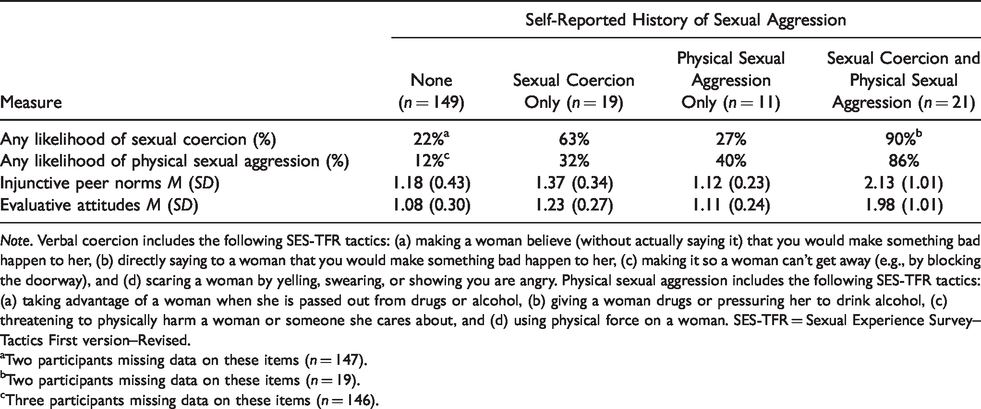
Note. Verbal coercion includes the following SES-TFR tactics: (a) making a woman believe (without actually saying it) that you would make something bad happen to her, (b) directly saying to a woman that you would make something bad happen to her, (c) making it so a woman can’t get away (e.g., by blocking the doorway), and (d) scaring a woman by yelling, swearing, or showing you are angry. Physical sexual aggression includes the following SES-TFR tactics: (a) taking advantage of a woman when she is passed out from drugs or alcohol, (b) giving a woman drugs or pressuring her to drink alcohol, (c) threatening to physically harm a woman or someone she cares about, and (d) using physical force on a woman. SES-TFR = Sexual Experience Survey–Tactics First version–Revised.
Two participants missing data on these items (n = 147).
Two participants missing data on these items (n = 19).
Three participants missing data on these items (n = 146).
On the SES-TFR Likelihood, most participants (n = 126, 63.0%) indicated that it would be very unlikely for them to engage in any sexually coercive and aggressive behavior in the future. Of the 74 (37%) participants who endorsed something other than very unlikely for at least one sexually coercive or aggressive behavior, the highest endorsed response options included unlikely (n = 46, 23%), somewhat unlikely (n = 10, 5%), could go either way (n = 5, 3%), somewhat likely (n = 2, 1%), likely (n = 6, 3%), and very likely (n = 5, 3%). Table 1 shows the proportion of participants who reported any likelihood of sexual coercion and physical sexual aggression according to their self-reported history of sexual perpetration (i.e., none, sexual coercion only, physical sexual aggression only, and sexual coercion and physical sexual aggression). Results indicate that participants with a history of both sexual coercion and physical sexual aggression had the highest rates of any self-reported likelihood of sexual coercion and physical sexual aggression in the future. This group of participants also scored the highest on measures of injunctive norms and evaluative attitudes indicating more positive injunctive norms and evaluative attitudes toward sexual aggression against women (see Table 1).
Intercorrelations, Means (M), and Standard Deviations (SD) for Variables of Interest (N = 200).

Note. All Pearson product–moment correlations were statistically significant (p < .01).
Do Evaluative Attitudes Mediate the Link Between Injunctive Norms and Sexual Aggression?
The first mediation model examined the extent to which evaluative attitudes mediated the relationship between injunctive norms and past sexual aggression (see Figure 1 Model testing the total (c), direct (c′), and indirect effects (ab) of injunctive peer norms on past sexual aggression, through evaluative attitudes.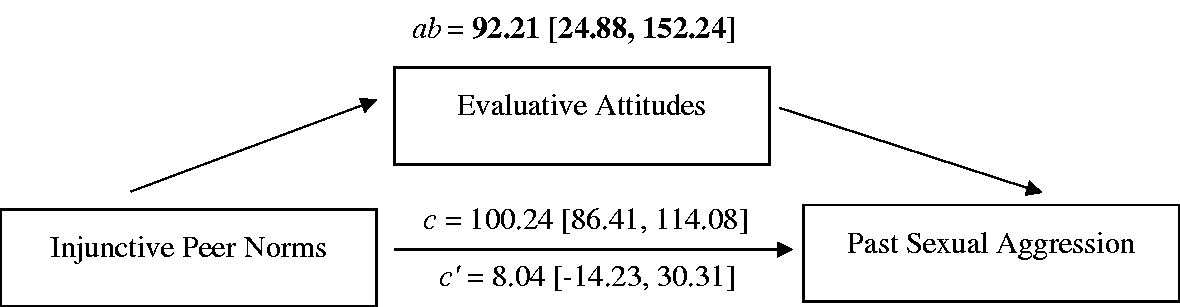
The second mediation model we tested examined whether evaluative attitudes mediated the relationship between injunctive norms and likelihood of engaging in sexually aggressive behavior, while controlling for past sexual aggression (see Figure 2 Model testing the total (c), direct (c′), and indirect effects (ab) of injunctive peer norms on likelihood of engaging in sexual aggression, through evaluative attitudes.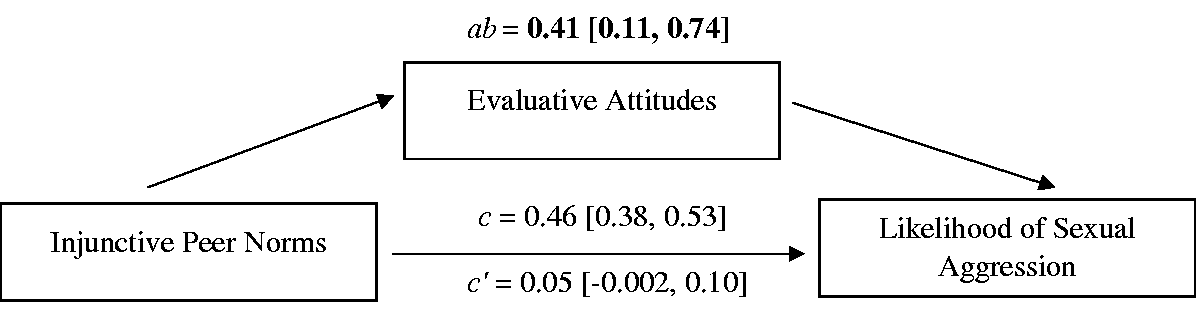
Sensitivity analyses
We tested alternative mediation models with injunctive norms as the mediator between evaluative attitudes and sexual aggression (past and future likelihood). Injunctive norms did not significantly mediate the association between evaluative attitudes and past sexual aggression (Indirect effect = 7.98, 95% bias corrected bootstrapped CI [–22.86, 59.25]) or likelihood of engaging in sexually aggressive behavior (Indirect effect = 0.05, 95% CI [–0.03, 0.21]). This suggests that the initial model with evaluative attitudes as the mediator is a better reflection of the data.
In addition, although multicollinearity is not known to systematically bias mediation results, we tested whether the surprisingly high correlation between evaluative attitudes and likelihood of engaging in sexually aggressive behavior could explain the observed mediation effect. To do so, we tested the mediation model with a subsample of participants (n = 45) with the lowest correspondence between evaluative attitudes and reported likelihood of sexual aggression. The correlation between evaluative attitudes and likelihood of sexual aggression was reduced to r = .76 (vs. r = .98). The same pattern of results was observed in this subsample: evaluative attitudes significantly mediated the association between injunctive norms and likelihood of engaging in sexually aggressive behavior (Indirect effect = 0.78, 95% bias corrected bootstrapped CI [0.31, 1.03]), and injunctive norms did not mediate the association between evaluative attitudes and likelihood of sexual aggression (Indirect effect = 0.09, 95% bias corrected bootstrapped CI [–0.14, 0.33]). Thus, this suggests that the mediation effect is likely not an artifact of the high correlation between evaluative attitudes and likelihood of engaging in sexual aggression.
Discussion
This study examined the relationships between injunctive norms, evaluative attitudes, and sexual aggression against women. In line with a recent meta-analysis that highlighted the high rates of sexual assaults perpetrated by college men (Anderson et al., 2019), 26% of the male undergraduate students in the current sample reported perpetrating at least one act of sexual coercion or aggression and 16% reported engaging in at least one act that fits the legal definition of sexual assault. In addition, men who reported a history of both sexual coercion and physical sexual aggression were also the most likely to report at least some likelihood of engaging in future sexual aggression, with more than 85% of them indicating at least some likelihood of engaging in an act of physical sexual aggression in the future. This subset of reportedly sexually aggressive men also endorsed more favorable injunctive norms and more positive evaluative attitudes toward sexual aggression against women. Indeed, more positive injunctive norms and evaluative attitudes toward sexual aggression were both strongly correlated with more self-reported past sexual aggression and likelihood of being sexually aggressive in the future. These findings are consistent with previous research examining injunctive norms (Franklin et al., 2012; Thompson et al., 2011, 2013) and evaluative attitudes (Hermann et al., 2018; Nunes et al., 2018) toward sexual aggression.
The current research expands on the male peer support model (Schwartz & DeKeseredy, 1997) by addressing the question of how the support for sexually aggressive behavior by one’s peers could lead a man in college to engage in sexual assault against a woman. Specifically, we tested the extent to which evaluative attitudes mediate the association between injunctive norms and sexually aggressive behavior. We found that the association between injunctive norms and self-reported past sexual aggression was accounted for by more positive evaluative attitudes toward sexually aggressive behavior. Similarly, evaluative attitudes accounted for the association between injunctive norms and reported likelihood of engaging in sexually aggressive behavior in the future. These findings suggest that evaluative attitudes toward sexual aggression may represent one mechanism through which injunctive norms are associated with sexually aggressive behavior.
Although the cross-sectional non-experimental design of the current study provides equivocal evidence regarding causality and the direction of influence between injunctive norms, evaluative attitudes, and sexual aggression, the Integrated Theory of Sexual Offending suggests that social norms have an indirect effect on sexual offending through their influence on individual cognitions (Ward & Beech, 2006). Similarly, as mentioned previously, Differential Association theory purports that injunctive norms about crime and delinquency influence evaluative attitudes, which in turn have a direct impact on criminal behavior.
Furthermore, our findings are in line with research on delinquency that found that evaluative attitudes mediated the relationship between injunctive norms regarding delinquency and subsequent delinquent behavior (Megens & Weerman, 2012). Specifically, Megens and Weerman (2012) measured peer evaluative attitudes and beliefs about delinquent behavior at Time 1, respondents’ evaluative attitudes and beliefs about delinquency at Time 2, and self-reported delinquent behavior at Time 3 (1-year intervals). They found that respondents’ evaluative attitudes and beliefs about delinquency (second assessment) mediated the association between evaluative attitudes/beliefs (first assessment) and subsequent delinquent behavior (third assessment). The temporal ordering of variables in this study suggests that injunctive norms and beliefs about delinquency predict personal evaluative attitudes and beliefs which, in turn, predict one’s likelihood of engaging in delinquent behavior. Again, although the current study is cross-sectional, our findings are consistent with the temporal ordering suggested by Megens and Weerman’s prospective study. That is, we found that evaluative attitudes mediated the association between injunctive norms and sexual aggression, but that injunctive norms did not mediate the association between evaluative attitudes and sexual aggression.
Practical Implications
If additional research provides support for a causal relationship between injunctive norms, evaluative attitudes, and sexual assault perpetration, this would have implications for preventive and rehabilitative programs aimed at reducing sexual aggression. For example, it would support efforts by the Centers for Disease Control and Prevention to “promote social norms that protect against violence” (Basile et al., 2016, p. 11). Approaches such as bystander intervention programs target injunctive norms by encouraging individuals to speak up against remarks that endorse sexual violence in their peer groups and intervene when they see behavior that could result in sexual violence (Basile et al., 2016). Green Dot is one example of a bystander intervention program that has been associated with lower rates of sexual harassment and stalking perpetration by males attending college (Coker et al., 2015). If evaluative attitudes are found to have a direct influence on sexually aggressive behavior, it may also be important to target these cognitions directly. Well-established evaluative attitude change procedures could be integrated into bystander intervention programs and public health information campaigns, such as providing logical arguments against sexual assault (i.e., persuasive communication; for example, Gawronski & Bodenhausen, 2006; Petty & Cacioppo, 1986) and highlighting incongruent beliefs, values, and behavior related to sexually aggressive behavior (i.e., manipulating cognitive dissonance; for example, Gawronski & Strack, 2004; Sritharan & Gawronski, 2010). If there is additional evidence to support the role of evaluative attitudes in mediating the relationship between injunctive norms and sexual aggression, this would provide an important framework for clinicians in understanding the mechanisms leading to sexual aggression that may be particularly salient among college men.
Limitations and Future Directions
The following limitations should be considered when interpreting the results of this study. First, we used a convenience sample of university students who likely differ from non-volunteers on several variables. For instance, participants received course credit for participating in this study; as such, it is possible that students who participated represent a more academically motivated group and, thus, a potentially more pro-social group. Nevertheless, a quarter of participants reported engaging in at least one sexually coercive or aggressive act since the age of 16, which is consistent with previous research with undergraduate males (Abbey et al., 2001; Loh et al., 2005), including a nationally representative survey of this population (Koss et al., 1987).
Second, we used a measure of perceived injunctive norms rather than asking participants’ peers to complete a measure of evaluative attitudes toward sexual aggression. This method has been criticized for being a poor reflection of actual peer norms because it is likely influenced by a respondent’s own attitudes, beliefs, and behavior (Dardis et al., 2016; Megens & Weerman, 2012). We would argue, however, that the perception of how important others evaluate a behavior may be equally or even more important than actual peer attitudes when it comes to their influence on individual cognitions and behavior. Furthermore, the operationalization of injunctive norms as the perception of important others’ evaluation of a behavior is utilized in influential theories about the causes of general behavior, such as the theory of planned behavior (Ajzen, 1991). We did not assess descriptive norms in the current study (i.e., peers’ actual behavior); however, these types of norms may also play a role in sexually aggressive behavior. For instance, peer behavior may be especially relevant in multiple perpetrator sexual assaults. Therefore, multiple measures of social norms should be considered in future research.
Third, measures of evaluative attitudes, injunctive norms, and past and future likelihood of sexual aggression were all highly correlated in this study. This may be due—in part—to the similarities between these measures. For instance, all the measures included similar sexually coercive and aggressive acts, as well as response scales. When variables in a regression model are highly correlated, the amount of independent information available to statistically predict the outcome is reduced (i.e., partial redundancy; see Darlington & Hayes, 2016). However, despite a reduction in available information, we found statistically significant mediation effects in both mediation models.
Fourth, as noted above, this study used a cross-sectional non-experimental design. As such, the current findings cannot be used to infer causality or the direction of influence between injunctive norms, evaluative attitudes, and sexual aggression. That is, the relationships observed in this study may be driven by factors that were not included in the mediation models (e.g., childhood abuse/trauma). In addition, based on the current findings, we cannot conclude that injunctive norms influence evaluative attitudes rather than the other way around. Nevertheless, we can draw on past research to speculate about the potential mechanisms the current results may reflect. For instance, as previously discussed, longitudinal research has found evidence that injunctive norms predicted evaluative attitudes toward delinquency (Megens & Weerman, 2012). Future studies using longitudinal or experimental designs would provide more conclusive evidence regarding the role injunctive norms and evaluative attitudes may play in sexually aggressive behavior.
Finally, we only examined sexual aggression against women as perpetrated by men. Research shows that approximately 4% of men are sexually assaulted in adulthood and many experience negative consequences as a result (Elliott et al., 2004). There are very few studies that have examined the cognitive mechanisms underlying sexual aggression toward men. It is possible that the factors that explain sexually aggressive behavior or increase its likelihood between two men differ from those that lead to male on female sexual assault. For example, a review of research on sexual aggression against gay and bisexual men found that many reported experiencing a hate crime–related sexual assault (Rothman et al., 2011). Moreover, there is a body of research that suggests that college women also report elevated rates of sexual coercion and aggression perpetration, and that different factors may contribute to this behavior among women and men (e.g., Krahé & Berger, 2013; Schatzel-Murphy et al., 2009). Future research should reflect this diversity of contexts within which sexual assault occurs.
Conclusion
This is the first study to explore the combined relationship between injunctive norms and evaluative attitudes in the context of explaining sexually aggressive behavior. We found that evaluative attitudes accounted for the association between more favorable injunctive norms toward sexual aggression and self-reported sexually aggressive behavior (past and future likelihood). These results are consistent with theoretical and empirical explanations of sexual offending as well as general criminal behavior. If more rigorous research establishes a causal relationship between injunctive norms, evaluative attitudes, and sexually aggressive behavior, this would suggest that targeting these factors in prevention and rehabilitative programs may reduce sexual aggression by male undergraduate students.
Supplemental Material
sj-pdf-1-jiv-10.1177_0886260520926306 - Supplemental material for Evaluative Attitudes May Explain the Link Between Injunctive Norms and Sexual Aggression
Supplemental material, sj-pdf-1-jiv-10.1177_0886260520926306 for Evaluative Attitudes May Explain the Link Between Injunctive Norms and Sexual Aggression by Chloe I. Pedneault, Kevin L. Nunes, Chantal A. Hermann and Kristen White in Journal of Interpersonal Violence
Footnotes
Authors’ Note
The views in this paper do not necessarily reflect the views of the Ontario Ministry of the Solicitor General.
Declaration of Conflicting Interests
The author(s) declared no potential conflicts of interest with respect to the research, authorship, and/or publication of this article.
Funding
The author(s) received no financial support for the research, authorship, and/or publication of this article.
Supplemental Material
Supplemental material for this article is available online.

Note
Author Biographies
References
Supplementary Material
Please find the following supplemental material available below.
For Open Access articles published under a Creative Commons License, all supplemental material carries the same license as the article it is associated with.
For non-Open Access articles published, all supplemental material carries a non-exclusive license, and permission requests for re-use of supplemental material or any part of supplemental material shall be sent directly to the copyright owner as specified in the copyright notice associated with the article.
