



Abstract
Because unacknowledged rape survivors (i.e., those who do not conceptualize their victimization as rape) are less likely to report the crime to police or seek formal services, a better understanding of factors that contribute to rape acknowledgment is a key step to improving access to care and assault reporting on college campuses. To contribute to this line of research, this study examined the indirect effect of sexist attitudes toward men on rape acknowledgment via rejection of rape myths among female rape survivors. The analyzed sample included 250 college female rape survivors (M age = 22.49 years, SD = 7.27) who completed measures of sexual assault history, sexist beliefs toward men, and rejection of rape myths. Among these women, 49.6% were classified as acknowledged rape survivors and 50.4% of the sample was classified as unacknowledged rape survivors. Indirect effects of sexist beliefs on rape acknowledgment via rape myth rejection were supported for four types of sexist beliefs, including resentment of paternalism, compensatory gender differentiation, maternalism, and complementary gender differentiation. Specifically, the findings supported that people with greater levels of these particular types of sexist beliefs toward men rejected rape myths less, and lower rejection of rape myths was associated with increased likelihood of unacknowledged rape. The indirect effects were not supported for the heterosexual hostility or heterosexual intimacy subscales of sexist beliefs. By identifying antecedents of rape acknowledgment, the findings from this study can be used to inform programming geared toward encouraging survivors to seek services, which ultimately improves survivor outcomes.
Due to the accumulating evidence demonstrating high rates of sexual violence on college campuses, there has been a push over the last 30 years for more comprehensive prevention efforts and response practices (e.g., Campus Security Act of 1990; Karjane et al., 2005; White House, 2014). Among the statistics driving the importance of improving crime reporting procedures and assault response policies, robust data have documented that one in five college women is sexually assaulted during her time in college (Muehlenhard et al., 2017). Furthermore, there is some evidence that women enrolled in college may be at greater risk of sexual victimization than their counterparts not enrolled in college (Fisher et al., 1999). Responding to sexual victimization on college campuses is further complicated by numerous factors, such as student survivors being less likely to report the crime to police than noncollegiate survivors (Sinozich & Langton, 2014) and student survivors evidencing low rates of seeking services (Walsh et al., 2010). Although great strides have been made in improving the prevention of and response to sexual violence on college campuses, barriers still exist that warrant further investigation.
One relevant aspect of sexual victimization that deserves greater empirical inquiry is rape acknowledgment or the way in which a survivor conceptualizes the victimization incident. A meta-analysis demonstrated that approximately 60% of female rape survivors do not use the term “rape” to describe their victimization (Wilson & Miller, 2016). Instead, these survivors tend to use non-victimizing language to describe the rape incident (e.g., “miscommunication”) or indicate they are uncertain of how to conceptualize what happened (Littleton et al., 2007). Koss (1985) coined the term unacknowledged rape survivors to describe these individuals. Because unacknowledged survivors are less likely to report the crime to police (Cohn et al., 2013) or seek formal services (Wood & Stichman, 2018), a better understanding of factors that contribute to rape acknowledgment is a key step to improving access to services and assault reporting on college campuses.
A growing evidence base has established an association between rape myths and rape acknowledgment status among female survivors. Rape myths are “attitudes and beliefs that are generally false but widely and persistently held, and that serve to deny and justify male sexual aggression against women” (Lonsway & Fitzgerald, 1994, p. 134). These “stereotypes” contribute to blaming the victim, absolving the perpetrator, and minimizing the victimization (Burt, 1980). For example, the Updated Illinois Rape Myth Acceptance Scale (UIRMAS; McMahon & Farmer, 2011; Payne et al., 1999) assesses four categories (i.e., factors) of myths, including “she asked for it,” “he didn’t mean to,” “it wasn’t really rape,” and “she lied.” The extent to which female survivors adhere to rape myths has been found to affect the way they conceptualize their own victimization experience. Specifically, acknowledged rape survivors have been shown to reject rape myths more than unacknowledged survivors (e.g., LeMaire et al., 2016; Newins et al., 2018; Reed et al., 2020; Wilson & Newins, 2019). Despite this robust link between rape myths and rape acknowledgment among female survivors, the predictors that contribute to belief in rape myths are less well established in the literature (Chapleau et al., 2008).
The most commonly posited and examined antecedents to rape myths are sexist attitudes toward women (Chapleau et al., 2008; Lonsway & Fitzgerald, 1994). In one of the first studies on the topic, Burt (1980) demonstrated that greater sex role stereotyping (i.e., beliefs about women), adversarial sexual beliefs (i.e., sexual relationships are inherently exploitative), and acceptance of interpersonal violence (i.e., force is an acceptable way to obtain sexual compliance) were all positively related to acceptance of rape myths. Since this initial research, subsequent scholars have conceptualized sexist attitudes within the framework of ambivalent sexism because Glick and Fiske (1996) note that sexism is not unambiguously hostile, but instead is composed of both positive attitudes as well “sexist antipathy” (p. 491). In their work, they identified two components of sexist attitudes toward women, including benevolent and hostile sexism. Hostile sexism is reflective of overtly prejudicial beliefs and includes explicit hostility and antagonistic attitudes toward women, particularly those who defy traditional gender roles. Conversely, benevolent sexism consists of chivalrous attitudes that restrict women to traditional gender roles and often elicit helping behaviors. Research based on this theoretical framework found that hostile sexism toward women, but not benevolent sexism toward women, was significantly associated with rape myth acceptance among both male and female participants (Glick & Fiske, 1997). Conversely, other studies have found that benevolent sexism toward women, and not hostile sexism toward women, was associated with acceptance of rape myths among male and female participants (Abrams et al., 2003). Thus, there is growing evidence supporting claims that sexist attitudes about women contribute to rape myths among both male and female participants, with some discrepancies in which particular forms of sexist beliefs are particularly relevant.
The majority of these existing studies have focused on sexist attitudes toward women, with less attention focused on sexist attitudes toward men. Considering that the majority of rapes are perpetrated by men (U.S. Department of Justice, 2014), it seems particularly relevant to examine the impact of sexist attitudes toward men on rape survivors. Although less research has been dedicated to this particular line of research, preliminary evidence has demonstrated that benevolent sexism toward men, but not hostile sexism toward men, may be associated with rape myths about both male and female rape survivors (Chapleau et al., 2007, 2008). Given these findings, Chapleau et al. (2007) suggested that sexism toward men is a “theoretically important variable” (p. 136) and the present study will contribute to the literature by further considering its impact on rape survivors.
Although the existing literature has demonstrated that acknowledged rape survivors evidence greater rejection of rape myths than unacknowledged survivors (e.g., LeMaire et al., 2016; Newins et al., 2018; Reed et al., 2020; Wilson & Newins, 2019) and greater sexist beliefs about men are associated with lower rejection of rape myths (e.g., Chapleau et al., 2007, 2008), no existing study has tested the indirect effect of sexist attitudes about men on rape acknowledgment via rejection of rape myths. Furthermore, the direct association between sexist attitudes about men and rape acknowledgment has received little attention in the literature, with the few existing studies yielding mixed results. For example, LeMaire et al. (2016) found that acknowledged rape survivors had significantly lower benevolent sexism toward men and women than unacknowledged rape survivors and found no differences on hostile sexism toward men and women. Conversely, Wilson et al. (2016) found that acknowledged and unacknowledged rape survivors did not significantly differ on benevolent or hostile sexism toward women. Given that less attention has been given to the impact of sexism toward men on survivors, this study contributes to the literature by examining the direct link between sexist attitudes toward men and rape acknowledgment status. Furthermore, we examined the indirect effect of sexist attitudes toward men on rape acknowledgment via rejection of rape myths. We restricted our analyzed sample to college women because the rates of victimization among men is substantially lower (The Association of American Universities, 2019) and the number of gender nonbinary participants in our sample (n = 2) was too small to conduct meaningful analyses.
We hypothesized the following:
Method
Participants and Procedure
As part of a larger study, undergraduate students at a large, public university in the Southeastern United States were recruited via the Psychology Department online study management system for a study on sexual experiences of college students. For this study, the sample was restricted to female undergraduate students who had experienced at least one rape since the age of 14. To be included in these analyses, they also must have responded correctly to reading validity items on relevant measures and provided sufficient data to be included in the analyses (n = 250). Demographic information for the sample is presented in Table 1. Participants received study participation credit worth either course credit or extra credit, depending on their course syllabus, in exchange for their participation. After signing up for the study on the study management system, participants were provided with a link to a secure Qualtrics survey where they completed all study measures as part of a larger study on sexual experiences of college students. Study procedures were approved by the institutional review board (IRB) at the university where the study was conducted. Participants implied their consent to participate by continuing on to the study questionnaires after being provided with an IRB-approved study information form. Participants were given resources for campus and community services in both the study information form and post-participation information form. They were encouraged to contact one of those resources in the event that they had a negative emotional reaction to completing the survey or if they believed they had experienced sexual misconduct.
Demographic Information for Analyzed Sample.
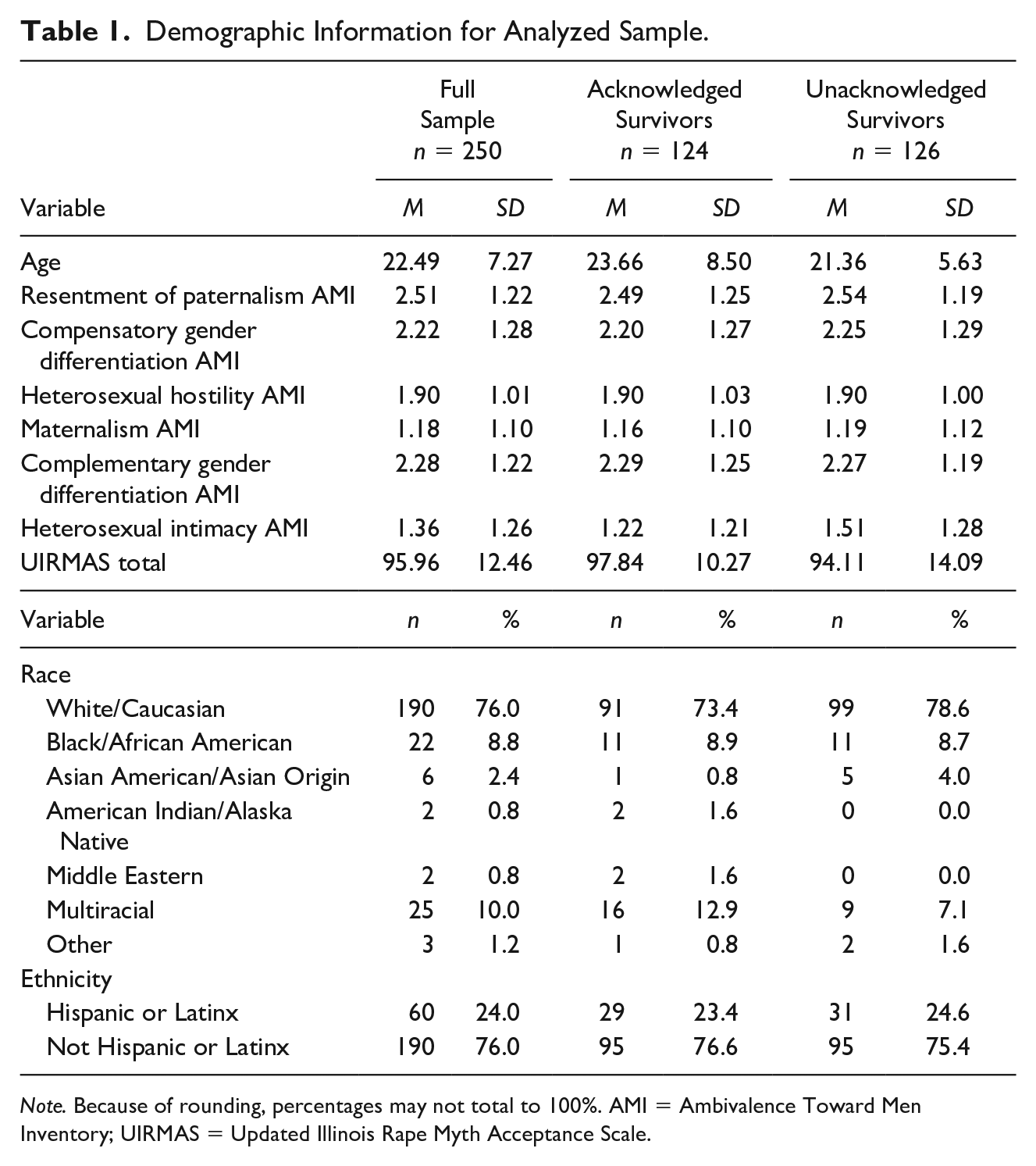
Note. Because of rounding, percentages may not total to 100%. AMI = Ambivalence Toward Men Inventory; UIRMAS = Updated Illinois Rape Myth Acceptance Scale.
Measures
Sexual Experiences Survey–Short Form Victimization (SES-SFV)
The SES-SFV assesses seven types of unwanted sexual contact (unwanted sexual touching; oral, vaginal, and anal penetration; and attempted oral, vaginal, and anal penetration) via five perpetration tactics (Koss et al., 2007). These items use behavioral descriptions to allow for assessment of victimization regardless of the label the survivor uses to describe the experience. Participants were asked to indicate if they had experienced each type of unwanted sexual contact both since the age of 14 and in the past 12 months. Participant responses on the SES-SFV have been shown to be a reliable and valid assessment of sexual victimization among collegiate women (Johnson et al., 2017). These questions were used to determine if participants had experienced a rape (i.e., oral, vaginal, or anal penetration via force, threat of force, or incapacitation; Koss et al., 2008) since the age of 14, which was required for inclusion in the current analyses.
In addition, the final item on the SES-SFV asks participants if they have been raped. This item was used to classify participants as either an acknowledged survivor (i.e., those who responded they had been raped) or an unacknowledged survivor (i.e., those who indicated they had not been raped). The sample was approximately evenly split regarding acknowledgment status, as 49.6% of the sample was classified as acknowledged.
Ambivalence Toward Men Inventory (AMI)
The AMI is a 20-item questionnaire that assesses both hostile and benevolent sexist beliefs about men (Glick & Fiske, 1999). Participants rate each item on a 6-point Likert-type scale from 0 (disagree strongly) to 5 (agree strongly). Factor analyses have indicated that the scale is composed of two factors (hostile and benevolent sexism toward men) and each contains three subfactors (Glick & Fiske, 1999). The subfactors that comprise hostile sexism toward men are resentment of paternalism (i.e., resentment of the power and prominence afforded to men as the perceived dominant social group), compensatory gender differentiation (i.e., negative stereotypes about men to compensate for women’s lower social status), and heterosexual hostility (i.e., bitterness about men’s sexual aggression and men’s dominance in social relationships). The benevolent sexism factor is composed of maternalism (i.e., an assumption that men need women to nurture them due to weaknesses in men), complementary gender differentiation (i.e., favorable stereotypes about men that support higher social status), and heterosexual attraction (i.e., affection related to romantic attraction). Because the number of items differs by subfactor, the average score for each subfactor was used rather than the total scores. Previous research has demonstrated good internal consistency (αs > .78) for all six subfactors of the AMI and good predictive validity of scores from the AMI (Glick & Fiske, 1999). In this study, internal consistency of the subfactors was marginal to good (αs = .69–.85).
UIRMAS
Rejection of rape myths was assessed using the UIRMAS, an updated version of one of the most widely used scales assessing rape myths, the Illinois Rape Myth Acceptance Scale (McMahon & Farmer, 2011; Payne et al., 1999). Participants responded to the 22 items on this measure using a 5-point Likert-type scale from 1 (strongly agree) to 5 (strongly disagree). The items were summed to create a total score. Due to item wording and the rating scale, higher scores on the UIRMAS indicate greater rejection of rape myths. Items on the UIRMAS demonstrate good internal consistency (α = .87), and gender differences in scores on the UIRMAS support the validity of scores on this scale (McMahon & Farmer, 2011). Internal consistency in this study was excellent (α = .91).
Statistical Analysis
Analyses were conducted in SPSS Version 24. If participants were missing four or fewer items on the AMI with no more than one item missing on any given subscale, the mean score from the other items of the subscale was imputed for the missing items. Also, the AMI subscales were transformed to z-scores prior to the indirect effects analyses to allow computation of standardized coefficients. If participants were missing four or fewer items on the UIRMAS with no more than one item missing on any given subscale, the mean score from the other items of the subscale was imputed for the missing items. Also, the UIRMAS total score was transformed to a z-score prior to the indirect effects analyses to allow computation of standardized coefficients. Rape acknowledgment was coded as a dichotomous variable (unacknowledged rape coded as 0 and acknowledged rape coded as 1). Bivariate correlations were examined between all continuous variables of interest. Independent samples t-tests were used to compare acknowledged and unacknowledged rape survivors on the AMI subscales and UIRMAS total score. The INDIRECT macro (Preacher & Hayes, 2008) was used to estimate the indirect effects of the AMI subscales on rape acknowledgment via scores on the UIRMAS. Bias-corrected and bootstrap 95% confidence intervals (with 5,000 bootstrap resamples) were used to evaluate the statistical significance of the indirect effect. Separate analyses were conducted to examine each of the AMI subscales separately.
Results
See Table 2 for the bivariate correlations between the study variables. These correlations revealed negative associations between participants’ UIRMAS total scores and all of the AMI subscales, except for the heterosexual hostility subscale of the AMI. All of the AMI subscales were significantly positively inter-correlated. Independent samples t-tests revealed that acknowledged and unacknowledged rape survivors significantly differed on UIRMAS total score, t(228.72) = −2.39, p = .018, with acknowledged rape survivors (M = 97.84, SD = 10.27) reporting greater rejection of rape myths than unacknowledged rape survivors (M = 94.11, SD = 14.09). Acknowledged and unacknowledged rape survivors did not significantly differ on the AMI subscales (ps ranging from .064 to .969).
Bivariate Correlations Between Study Measures.
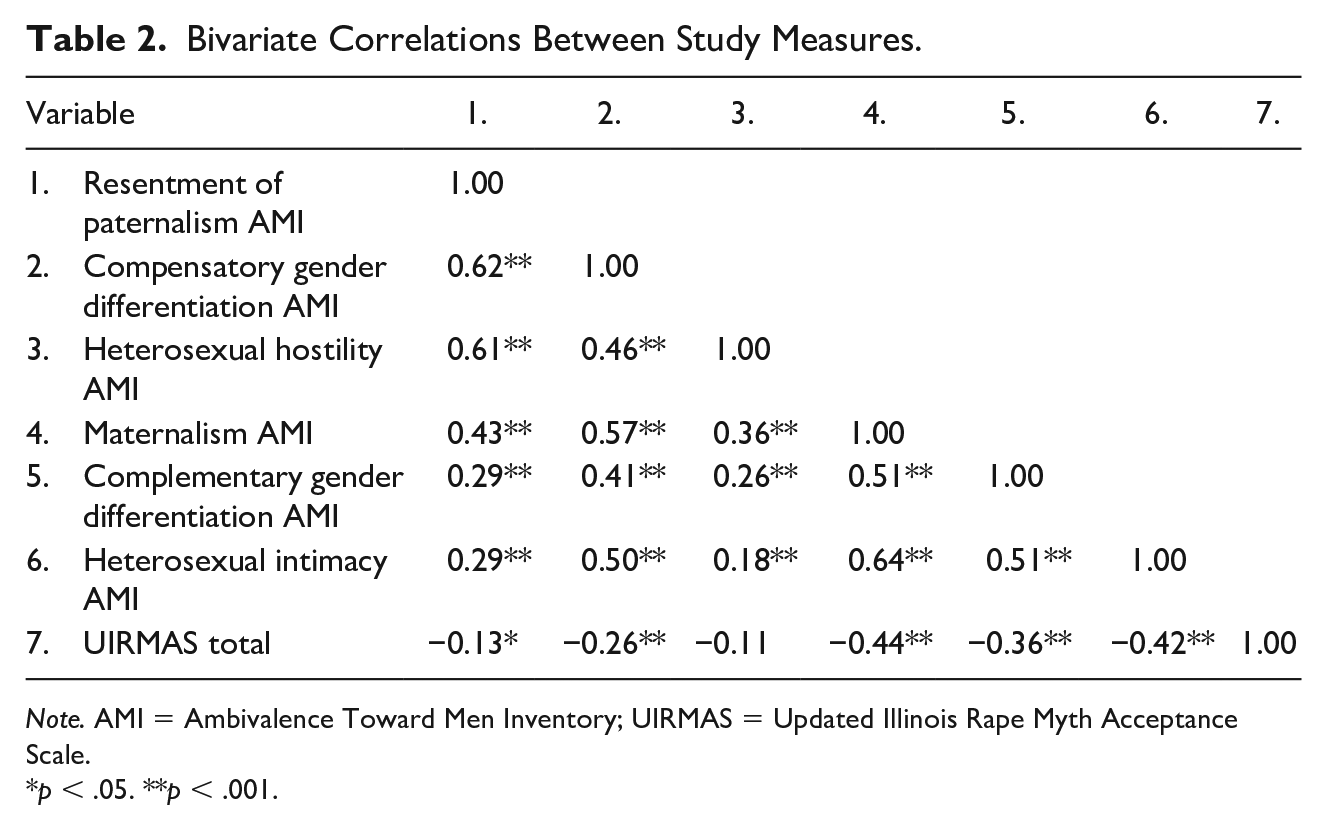
Note. AMI = Ambivalence Toward Men Inventory; UIRMAS = Updated Illinois Rape Myth Acceptance Scale.
p < .05. **p < .001.
As can be seen in Figure 1, the indirect effect of resentment of paternalism (i.e., AMI subscale) on likelihood of rape acknowledgment through rape myth rejection was statistically significant (ab = −0.041, 95% confidence interval [CI] = [−0.119, −0.003]), such that individuals who reported greater resentment of paternalism rejected rape myths less, and lower rejection of rape myths was associated with increased likelihood of unacknowledged rape.
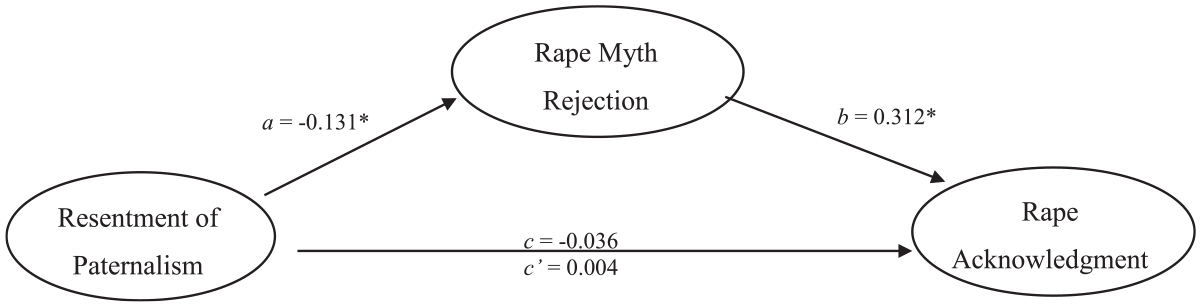
Indirect effect of resentment of paternalism on rape acknowledgment via rape myth rejection.
As can be seen in Figure 2, the indirect effect of compensatory gender differentiation (i.e., AMI subscale) on likelihood of rape acknowledgment through rape myth rejection was statistically significant (ab = −0.083, 95% CI = [−0.185, −0.019]), such that individuals who reported greater compensatory gender differentiation rejected rape myths less, and lower rejection of rape myths was associated with increased likelihood of unacknowledged rape.
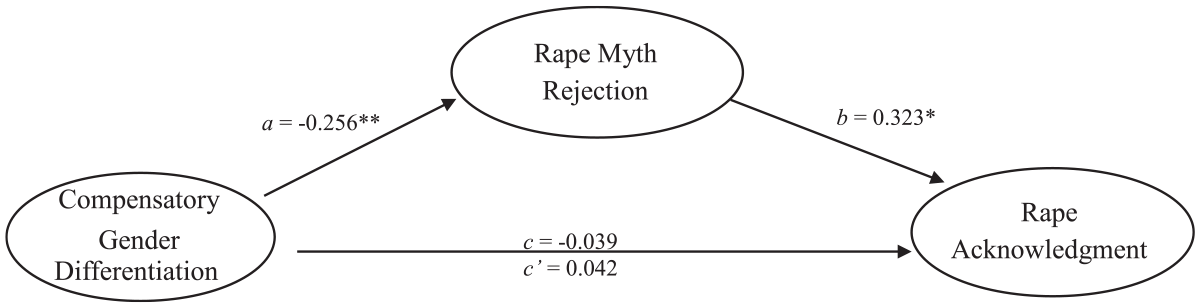
Indirect effect of compensatory gender differentiation on rape acknowledgment via rape myth rejection.
As can be seen in Figure 3, the indirect effect of heterosexual hostility (i.e., AMI subscale) on likelihood of rape acknowledgment through rape myth rejection was not statistically significance (ab = −0.036, 95% CI = [−0.120, 0.0005]).
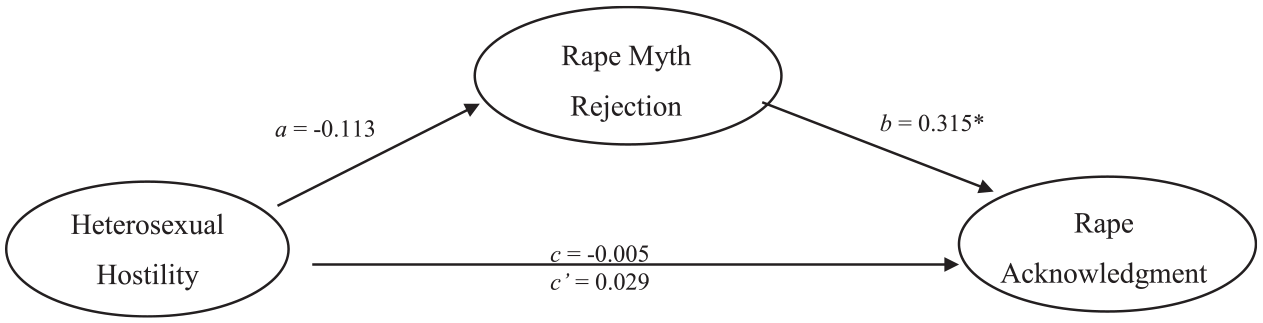
Indirect effect of heterosexual hostility on rape acknowledgment via rape myth rejection.
As can be seen in Figure 4, the indirect effect of maternalism (i.e., AMI subscale) on likelihood of rape acknowledgment through rape myth rejection was statistically significant (ab = −0.165, 95% CI = [−0.349, −0.038]), such that individuals who reported greater maternalism rejected rape myths less, and lower rejection of rape myths was associated with increased likelihood of unacknowledged rape.
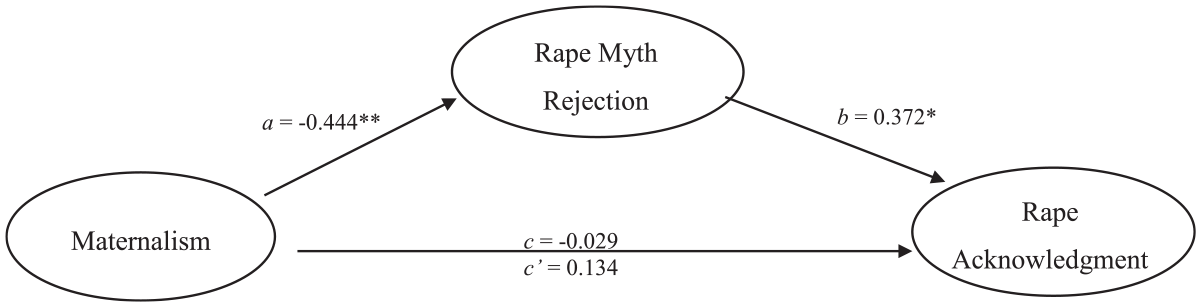
Indirect effect of maternalism on rape acknowledgment via rape myth rejection.
As can be seen in Figure 5, the indirect effect of complementary gender differentiation (i.e., AMI subscale) on likelihood of rape acknowledgment through rape myth rejection was statistically significant (ab = −0.132, 95% CI = [−0.254, −0.035]), such that individuals who reported greater complementary gender differentiation rejected rape myths less, and lower rejection of rape myths was associated with increased likelihood of unacknowledged rape.

Indirect effect of complementary gender differentiation on rape acknowledgment via rape myth rejection.
As can be seen in Figure 6, the indirect effect of heterosexual intimacy (i.e., AMI subscale) on likelihood of rape acknowledgment through rape myth rejection was not statistically significant (ab = −0.8, 95% CI = [−0.246, 0.009]).

Indirect effect of heterosexual intimacy on rape acknowledgment via rape myth rejection.
Discussion
This study examined the link between different types of sexist beliefs about men and rape acknowledgment and whether rape myths account for these relationships. A unique aspect of this study was the use of the six subfactors of the AMI rather than simply examining benevolent and hostile sexism. Also, the sexist beliefs were in reference to men, not the more commonly examined beliefs toward women.
The first hypothesis that acknowledged survivors would endorse higher levels of sexist beliefs toward men was not supported, as t-tests and examination of total effects (the sum of all direct and indirect effects) revealed no association between any of the sexist beliefs about men and likelihood of rape acknowledgment. This finding is consistent with previous research that found no differences in benevolent or hostile sexism toward women between acknowledged and unacknowledged female rape survivors (Wilson et al., 2016). However, another previous study found higher levels of benevolent sexism toward men and women among unacknowledged female rape survivors (LeMaire et al., 2016). Taken together, the results of this study, combined with results from previous research, suggest that it is important to consider the role of potential third variables (both mediators and moderators) in the relationship between sexist beliefs and rape acknowledgment. For example, the sample in the LeMaire et al. study was almost exclusively White (i.e., 90.1%), whereas this study had a more diverse sample in terms of race and ethnicity, which could suggest that race and ethnicity are important factors to consider in these relationships. In addition, the lack of a total effect between sexist beliefs about men and rape acknowledgment suggests it is not sexist beliefs themselves that impact rape acknowledgment, but these beliefs may affect other factors that in turn affect likelihood of acknowledgment (MacKinnon et al., 2000).
The second key finding of this study was that both hostile and benevolent sexist beliefs about men were generally negatively correlated with rape myth rejection, supporting the second hypothesis and indicating higher levels of sexist beliefs were associated with more acceptance of myths about rape. This finding is consistent with several previous studies examining myths about rape involving female survivors conducted with female collegiate rape survivors (LeMaire et al., 2016) and college students in general (Abrams et al., 2003). The only exception to this pattern was the heterosexual hostility subfactor, which was not significantly correlated with rape myth rejection. On one hand, the lack of a relationship between sexist beliefs focused on resentment of sexual aggression by men and rape myth acceptance is surprising, as it seems that these beliefs would be negatively associated with acceptance of rape myths. However, given that all subfactors of the AMI were positively correlated with one another and the other AMI subfactors were positively associated with acceptance of rape myths, it is possible that the lack of association with rape myth acceptance is due to these competing factors. In general, this set of findings suggest that individuals who endorse sexist beliefs tend to be more accepting of rape myths, which may indicate that both of these factors should be targeted when trying to address rape myth acceptance.
Consistent with Hypothesis 3, rape myth rejection was positively associated with likelihood of rape acknowledgment, which is consistent with previous research (LeMaire et al., 2016; Reed et al., 2020; Wilson & Newins, 2019). As a result, it appears that believing inaccurate information about rape and endorsing stereotypes about rape may interfere with identifying situations as rape. Given that unacknowledged survivors are less likely to report the rape to police and seek supportive services (Cohn et al., 2013; Wood & Stichman, 2018), it may be important to attempt to reduce rape myth acceptance to facilitate survivors’ use of services following a rape. Furthermore, future research should examine whether the relationship between rape myth acceptance and acknowledgment varies by characteristics of the rape and should examine the relationship longitudinally to better understand the direction of the relationship.
Finally, consistent with the above findings and the fourth hypothesis, four types of sexist beliefs about men (i.e., resentment of paternalism, compensatory gender differentiation, maternalism, complementary gender differentiation) were negatively associated with likelihood of acknowledgment via rape myth rejection. This finding is important because it demonstrates that even in the absence of a significant total effect, certain types of sexist beliefs about men do seem to reduce the likelihood of rape survivors labeling their experience as such by increasing their acceptance of beliefs about rape. However, it was the two domains related to sexual relations between men and women (i.e., heterosexual hostility, heterosexual intimacy) that did not have a direct effect or indirect effect via rape myths on rape acknowledgment. For heterosexual hostility, the lack of an indirect effect was due to the absence of a significant relationship between heterosexual hostility and rape myth rejection, which was discussed above. In contrast, in the model examining heterosexual intimacy, the relationship between rape myth rejection and rape acknowledgment was not statistically significant. Given the generally robust relationship between endorsement of rape myths and rape acknowledgment, future studies should further examine this finding.
The study findings must be considered in light of the limitations. First, the study was cross-sectional, so it is not possible to determine the direction of the relationships between variables. Future studies should examine these models using longitudinal designs, particularly given that rape acknowledgment may change with time. Second, the sample was restricted to female collegiate rape survivors, which limits the generalizability of the findings. Therefore, these relationships should be examined in samples of survivors of other gender identities, individuals who experienced a sexual assault that does not meet criteria for rape, and noncollege participants. Third, though the sample was more diverse than many existing studies in this area and was representative of the collegiate population from which it was drawn, future research should examine the influence of aspects of identity (e.g., race, ethnicity, sexual orientation, gender) on these relationships. This is particularly important because prior research has suggested that rape acknowledgment status may differ depending on identity factors, such as sexual orientation (Wilson & Newins, 2019), race/ethnicity (Kalof, 2000), and gender (Reed et al., 2020). Furthermore, there is increasing evidence that belief in rape myths may be an explanation for the observed differences in rape acknowledgment between different identity groups (e.g., sexual orientation, gender; Reed et al., 2020; Wilson & Newins, 2019).
In conclusion, this study found that endorsement of multiple types of sexist beliefs about men (i.e., resentment of paternalism, compensatory gender differentiation, maternalism, complementary gender differentiation) was associated with a decreased likelihood of being an acknowledged rape survivor among female undergraduate students, and this effect occurred via decreased rape myth rejection. In contrast, sexist beliefs about men related to sexual interactions between men and women (i.e., heterosexual hostility, heterosexual intimacy) were not associated with rape acknowledgment. This study expands existing literature by focusing on sexist beliefs about men, with an emphasis on specific types of sexist beliefs.
Footnotes
Declaration of Conflicting Interests
The author(s) declared no potential conflicts of interest with respect to the research, authorship, and/or publication of this article.
Funding
The author(s) received no financial support for the research, authorship, and/or publication of this article.
