



Abstract
Few studies have explored the disclosure of child physical abuse although child sexual abuse disclosure has been widely studied and debated for years. The present study explores the characteristics of child physical abuse disclosures and compares them to previously published findings on child sexual abuse disclosure from the same data. The data consist of a representative sample of 11,364 sixth and ninth graders. Participants responded to a wide variety of questions concerning experiences of violence, including child physical abuse and child sexual abuse, in the Finnish Child Victim Survey conducted in 2013. Within this sample, the prevalence of child physical abuse was 4.1%. Children reporting abuse experiences also responded to questions regarding disclosure, reactions encountered during disclosure, and potential reasons for nondisclosure. Findings show that most of the children who disclosed physical violence had disclosed to their mother. The overall disclosure rate of child physical abuse was 74%. However, only 42% had disclosed to adults, and even fewer had reported their experiences to authorities (12%). The most common reason for nondisclosure was that the youth did not consider the experience sufficiently serious to report (53%). These findings were largely in line with the child sexual abuse disclosure rates in our previous study. Analyses of variables associated with disclosing to an adult indicate that the strongest factors predicting disclosure to an adult are younger age, female gender, no previous experiences of child physical abuse, and parents knowing who their child spends her or his spare time with. Implications for further research and practice are discussed.
Introduction
In child abuse cases, a child’s disclosure is often crucial for getting help for the child and ending the abuse (Bottoms et al., 2016; Pipe, Lamb, et al., 2007). However, according to disclosure research, it appears that, regardless of the form of child abuse, a considerable number of victims fail to disclose their abuse (Bottoms et al., 2016). Only a few studies have explored the disclosure of child physical abuse (CPA) (Jernbro et al., 2017; Thulin et al., 2019). The paucity of CPA disclosure research is striking compared to the large amount of research and debate on child sexual abuse (CSA) disclosure during the past two decades. As the prevalence of CPA is clearly higher than that of CSA (Fagerlund et al., 2014; Finkelhor et al., 2009; Radford et al., 2013) and as CPA is a known risk factor for several negative mental and physical health outcomes in short and long terms (Affifi et al., 2017; Mills et al., 2013; Moffitt, 2013), up-to-date research on CPA disclosure has major implications in the field. Almost 60 countries have currently outlawed violence toward children, including corporal punishment in the home (Global Initiative to End All Corporal Punishment of Children, 2019), and, at least in serious cases, suspected CPA may lead to criminal investigation in these countries.
Researchers (e.g., Bottoms et al., 2016; Foynes et al., 2009; Lev-Wiesel et al., 2014) have assumed that disclosure patterns and factors associated with the disclosure of abuse are similar, regardless of the form of abuse, since abuse is always potentially traumatic. Research evidence partially supports this idea. For example, Bottoms and colleagues (2016) have shown that the person most frequently disclosed to was a friend, regardless of the form of abuse. Only a few of the victims had disclosed to professionals (see also Annerbäck et al., 2010; Jernbro et al., 2017). Furthermore, both CPA and CSA victims were found more likely to disclose abuse if they were more frequently abused, worried about injury, or emotionally upset at the time of abuse. Disclosers were also found more likely to label themselves as victims, regardless of the type of abuse, than were nondisclosers (Bottoms et al., 2016).
Possible differences in disclosure patterns have also been found. A recent retrospective study by McGuire and London (2020) reported higher CSA disclosure rates compared to CPA disclosure rates. In contrast, Lev-Wiesel and First (2018) have concluded that CSA victims are more reluctant to disclose than victims of other forms of abuse and that boys are more reluctant to disclose all forms of abuse than girls. They have examined the role of gender in willingness to disclose CSA compared to other forms of abuse in a population-based sample of children (12–17 year olds) in Israel (Lev-Wiesel & First, 2018). In contrast to Bottoms et al. (2016), a recent study with this Israeli sample indicates that exposure to multitype maltreatment in conjunction with high-emotional reactions predicted higher reluctance to disclose. Almost a third of the children had been exposed to two types, and a fifth to three or four types, of maltreatment in this sample (Lev-Wiesel et al., 2019).
Contradictory findings concerning CSA disclosure rates have created considerable debate (Pipe, Orbach, et al., 2007; Rush et al., 2014) and have revealed many of the problems involved in studying disclosure that are also relevant to other types of abusive experiences. Due to the varying sources of information used in different studies (mainly retrospective surveys of adults or children undergoing forensic evaluations) and the variation in the definitions of both CSA and disclosure, comparing the results of different studies is complicated (Lahtinen et al., 2018; London et al., 2008; Olafson & Lederman, 2006). As defining concepts and sources of information are crucial elements in evaluating implications of research, these should be the focus of attention also when reviewing studies on CPA disclosure.
Some researchers have explored CPA disclosure rates in forensic or mental health settings. Different patterns of disclosure have emerged in these settings: CPA victims have been found to be more reluctant to disclose than CSA victims (Rush et al., 2014). For example, Hershkowitz et al. (2005) have reported higher rates of disclosure for CSA (71%) than for CPA (61%). They explain this discrepancy with the fact that suspected perpetrators in the sample were parents/parent figures in almost all (93%) of the CPA allegations (Hershkowitz et al., 2005), whereas this was not true for the CSA cases. Rush and colleagues (2014) have suggested that the observed reluctance of children with CPA experiences to disclose may also be linked to the fact that CPA investigations are less likely than CSA investigations to be initiated as a result of prior disclosures, and they are more likely to be initiated by other evidence of abuse, such as bruises. Those authors also argue that, in CPA cases, the perpetrators confess more often than they do in CSA cases. Within forensic samples, however, there is often no way to assess the fundamental truth, namely, whether the suspicions are founded or not. Where suspicions are unfounded, the fact that children do not disclose abuse is obviously not a problem of nondisclosure, whereas in cases where suspicions are unfounded and children do disclose, there is a problem of “wrong” disclosure. In other words, forensic samples are not suitable for investigating the prevalence of disclosure (Azzopardi et al., 2019; London et al., 2007; Pipe, Orbach, et al., 2007). To conclude, it should be noted that, despite the different approaches discussed above, there is agreement that delayed CSA disclosures are not rare, and there are children who do not disclose even when questioned directly about their abuse experiences (Azzopardi et al., 2019; Pipe, Orbach, et al., 2007). Emerging evidence of CPA disclosures shows a similar trend (Foynes et al., 2009).
Most studies exploring different types of abuse and disclosure have been retrospective (Bottoms et al., 2016; Foynes et al., 2009). CPA disclosure rates reported in these retrospective surveys vary between 61% and 73%, whereas CSA disclosure rates in retrospective surveys are much lower, varying mostly between 31% and 45% (Jernbro et al., 2017; London et al., 2008). Retrospective studies of adults with a self-reported CSA history have found that fear of negative consequences often prevents disclosure (e.g., Anderson et al., 1993; Browne & Finkelhor, 1986; Conte & Berliner, 1988; Palmer et al., 1999).
Retrospective studies offer a population-based estimate of disclosure rates and factors related to disclosure. However, retrospective approaches to disclosures have considerable disadvantages. First, memory errors of omission and/or commission may change the data (Schacter, 2001). For example, an adult may fail to recall having disclosed to someone as a child. Adults may also be unable to remember abusive experiences or may have false memories of maltreatment, or they may falsely deny remembering abuse (London et al., 2008). Second, adults may reinterpret their experiences and the possible motives for keeping the abuse secret in their childhood (Malloy et al., 2011). Therefore, population-based child victim surveys are relevant in exploring reasons behind nondisclosure (Lahtinen et al., 2018). Only a few surveys have explored CPA disclosure among population-based samples of adolescents or children. In a Swedish population-based sample, 52% of the adolescents who reported severe CPA experiences had disclosed the abuse, most of them to peers but only a few to professionals. According to Jernbro et al. (2017), a lack of trust in adults was reported to be the most significant reason for not disclosing CPA. Additional freely formulated answers by the adolescents also revealed that they often perceived the response of professionals to be ineffective (Jernbro et al., 2017).
In our previous study (Lahtinen et al., 2018), we studied CSA disclosure in a population-based sample of children (12–15 year olds) in Finland. We found a CSA disclosure rate to be as high as 80%, indicating that most of the children disclosed CSA to someone. However, in line with previous research (e.g., Bottoms et al., 2016; Helweg-Larsen & Larsen, 2006; Kogan, 2004; Priebe & Svedin, 2008), our analysis suggested that children rarely disclosed to adults (26%). Disclosures to authorities were even more uncommon (12%). Nearly half (48%) of the children had disclosed to a friend. Mothers were the most frequent disclosure recipients (20%) followed by fathers (12%). The most frequent reason for nondisclosure was that the experience was not considered serious enough to tell anyone. Multivariate analyses showed that the age of the perpetrator and the victim at the time of abuse, as well as experiences of emotional abuse by the mother, were the factors in the sample associated with disclosing to an adult (Lahtinen et al., 2018).
Aims of the Present Study
The overall aim of the present study is to contribute to the scientific literature on CPA disclosure by exploring the disclosure rates and factors associated with disclosure in a large population-based sample of children, the Finnish Child Victim Survey (FCVS). The focus of this study is specifically on factors associated with disclosing CPA to adults (parents and/or professionals), since adults tend to serve as intermediaries who control access to treatment and investigation processes (Tashjian et al., 2016). Examining disclosure as part of the national Child Victim Survey enabled us to examine how much CPA is hidden from adult society and to consider a wide variety of factors (including other forms of abuse experienced) that possibly influence the tendency to disclose CPA to adults.
Since the study is based on the same data used in our previous analysis of CSA disclosure (Lahtinen et al., 2018), the CSA disclosure rates will also be compared to the CPA disclosure rates. However, in this comparison, only previously published information about the CSA disclosure rates is used, without new statistical analyses. It was expected that the CPA disclosure rates would be comparable to the rates reported in other representative studies of CPA experiences with samples of adolescents or young adults (Annerbäck et al., 2010; Jernbro et al., 2017; Lev-Wiesel & First, 2018).
Method
Participants
This study utilized data from the FCVS 2013. A stratified cluster sampling method based on county, type of municipality, and school size was used to obtain a nationally representative sample for the study. In all, 11,364 sixth and ninth graders from 483 schools in Finland responded to the survey. Of these, 55% were sixth graders (mainly 12–13 year olds) and 45% ninth graders (mainly 14–15 year olds). The gender distribution in the data was equal (Lahtinen et al., 2018). The response rate was 75%. Some of the schools (n = 142) canceled or ignored the survey, despite having originally stated that they would participate (625 schools originally accepted the invitation to participate). The most frequent reason reported for not participating was a lack of computers. The representativeness of the final data was ensured by crosschecking the distributions of gender, parental unemployment, parental education, and family structure compared to other representative youth surveys in Finland. Apart from a minor over-representation of children with highly educated parents, no systematic differences were found (Fagerlund et al., 2014; Lahtinen et al., 2018).
Measures
FCVS 2013 included a wide variety of questions related to different types of violence, such as violence in the home, street violence, cyber victimization, and sexual abuse, and reporting of these experiences to authorities, friends, or family members (for further details, see Ellonen et al., 2008; Fagerlund et al., 2014). Most of the questions covered in the survey were based on Finnish modifications of well-known research instruments, such as the Juvenile Victimization Questionnaire (Finkelhor, 2007, 2008; Finkelhor et al., 2007a, 2007b, 2007c), and the Conflict Tactics Scale (Straus et al., 1996). The data were collected during the fall of 2013 by the Police University College in Finland. The participants responded to the questions via web-based questionnaires during school hours. Anonymity was guaranteed, and participation in the survey was voluntary. The survey was introduced by teachers who were closely instructed by the research team. The children accessed the questionnaire via a website that included information about the research project and violence in general. The mean time used to take the survey was 29 minutes.
CPA in this study was defined as agreeing with the question: “Have you been hit or attacked in the past 12 months.” All these types of acts are considered criminal according to the Finnish Penal Code. Since the scope of the study was to investigate the disclosure of adult-committed CPA, experiences among younger peers were excluded. Only experiences in which the perpetrator was at least 15 years of age (minimum age of criminal responsibility in Finland) were included in the analyses. The definition of CPA differs from many previous studies that have focused solely on experiences of violence committed by caregivers (Hershkowitz et al., 2005; Jernbro et al., 2017; Lev-Wiesel & First, 2018).
Participants were also asked questions about the perpetrator (age, gender, nationality, who they were, if they were under the influence of alcohol [no/yes, a little, they were drunk or otherwise intoxicated, I don’t know]), physical injuries (if injured, the type of injury: a small bruise, a scrape or cut, a large bruise, a major cut or black eye, sprain, broken bone or teeth, internal injuries, lost consciousness, other—specify), the number of times violence was experienced in the past 12 months, earlier experiences of violence (yes/no), the type of violence (pushed, shaken, slapped/kicked, hit with a fist or with an object, threatened with violence, thrown against furniture or a wall or down stairs, choked, assaulted with a knife or a gun, something else—specify), possible use of a weapon (stick, stone, knife, other—specify), if they visited a doctor/hospital (yes/no), and if the child was under the influence of alcohol or other substances when they were abused (no/yes, a little, I was drunk or otherwise intoxicated).
Corresponding to most of the survey studies (e.g., Bottoms et al., 2016; Helweg-Larsen & Larsen, 2006; Jernbro et al., 2017; London et al., 2008; Priebe & Svedin, 2008 review) on CSA/CPA experiences and disclosure, disclosure in the present study refers to telling someone about the CPA experience before completing the survey. This was measured by asking: Think about the most serious incident in the past 12 months when you were hurt or were threatened to be hurt. Have you told anyone about the most serious incident? You can choose any one or more of the following options, if they apply.
The options were mother, father, sister or brother, friend, teacher, police, school nurse, school counselor, social worker, nobody, and someone else (specify who). The children who answered “nobody” were considered nondisclosers.
The nondisclosing CPA victims were also asked to select possible motives for the nondisclosure from six different choices (“I did not think it was so serious,” “I did not have the courage to tell,” “I did not believe that anyone would be interested,” “I did not believe that disclosure would help me,” “I was too ashamed to disclose,” and “Some other reason [specify what]”). Gender, age, family structure, parents’ socioeconomic status, and immigrant status were measured as background variables (for more details, see Fagerlund & Ellonen, 2016; Fagerlund et al., 2014).
Ethical Considerations
This study followed the Finnish research ethics guidelines in social research. Parental consent for children to participate in the study was not required. According to the Finnish Constitution, hearing children is a priority, and Finland is also committed to following the United Nations Convention on the Rights of the Child, one of the core principles of which is the right to participate. Therefore, parental approval for children’s participation is necessary only in medical research. Furthermore, the Ombudsman for Children in Finland (2012) has published a statement declaring that sixth and ninth graders can decide for themselves whether they want to take part in a study or not. Thus, parents were not informed about the study until it had been completed, with one exception: in the capital city, Helsinki. Authorities in the city required that parents could exclude their children from such a study. For a more detailed reflection on the ethical issues related to conducting the FCVS, see Ellonen and Pösö (2011a, 2011b) and Fagerlund and Ellonen (2016).
Statistical Analyses
The analyses in this study focus on the subsample of 464 children and adolescents who reported being hit or attacked during the past 12 months and a perpetrator who was at least 15 years old. The 127 cases in which the age of the perpetrator was unknown (the participant had either left the question unanswered [n = 66] or answered “I do not know” [n = 61]) were excluded from the sample. In addition, along with the cases where the age of the perpetrator could not be assessed, all the cases (685) in which the perpetrator was under 15 years of age were excluded. First, a series of Chi-square tests were performed to examine potential variables associated with disclosure to at least one adult (mother, father, teacher, police, school nurse, school counselor, and/or social worker) compared to nondisclosure or disclosure only to peers. Logistic regression analyses (method enter) were performed to examine which of the variables predicted the disclosure of CPA to adults when the influence of other variables was controlled. All data were analyzed using IBM SPSS for Windows version 25.
Results
Among the total sample of 11,364 children, the prevalence of CPA was 4.1% (n = 464). Most of the children who reported CPA experiences were ninth graders (81%, n = 374). The gender distribution of the victims was almost equal, with 52% (n = 240) girls. Approximately half of the children (49%, n = 229) reported having experienced CPA more than once during the past 12 months (number of incidents M = 6.4, SD = 28.4, Mdn = 2), and 65% (n = 302) of the children reported experiences of CPA before that. Most often, they reported being pushed, shaken, or slapped (55%, n = 254). Being kicked, hit with a fist or with an object (32%, n = 147), or being threatened with violence (25%, n = 117) were also quite common. More serious forms of abuse, such as being thrown against furniture or a wall or down the stairs (12%, n = 54), or being choked, or assaulted with a knife or a gun (7%, n = 33), were less reported. Seventeen percent (n = 80) of the victims selected the response option “something else,” typically specified as hitting (mentioned 11 times) or hair pulling (mentioned nine times). Thirteen percent (n = 57) of the children reporting CPA experiences also reported CSA experiences, and 45% (n = 208) of these respondents reported experiences of both CSA and emotional abuse by parents. They were all included in the further analyses.
Thirty-one percent (n = 145) of the CPA victims had been injured because of the incident. The most prevalent injury was a small bruise, scrape, or cut (19%, n = 87). A large bruise, major cut, or a black eye was reported in 14% (n = 66) of the cases. Serious injuries, such as broken bones/teeth, sprains or internal injuries, or losing consciousness, were rarely reported (by less than 9% [n = 40] of the CPA victims).
In most of the cases (75%, n = 344), the perpetrator was a male aged 15–17 years (61%, n = 284) or over 25 years old (30%, n = 137). The most common perpetrator was a friend or acquaintance (30%, n = 137). In 22% (n = 102) of the cases, the perpetrator was a parent or their spouse (parental CPA in further analyses). Mothers (n = 40) were perpetrators almost as often as fathers (n = 43), and the father’s spouse (n = 8) was the offender almost as often as the mother’s spouse (n = 11). A minority of the victims (16%, n = 72) reported that the perpetrator was a sibling or a half-sibling, and 13% (n = 62) of the victims reported that the perpetrator was unknown to them. A dating partner or ex-dating partner was rarely the perpetrator (5%, n = 22) in this sample.
Disclosure Rate and Recipients of Disclosure
The overall disclosure rate of CPA in the sample was 74%. However, less than half of the children (42%) disclosed to at least one adult (mother, father, teacher, police, school nurse, school counselor, social worker), and only 12% disclosed to at least one of the professionals named in Table 1. Parental CPA disclosure was analyzed separately. However, the Chi-square tests showed no significant differences in the rates of overall disclosure or disclosure to adults compared to CPA by other perpetrators. As Table 1 illustrates, differences were found only regarding disclosing to a father, school counselor, or social worker. Parental CPA was disclosed less to fathers, whereas it was disclosed to school counselors and social workers more often than CPA by other perpetrators. The Chi-square tests indicated that sixth graders disclosed to adults more often than ninth graders, χ² (1) = 19.12, p < .001. As Table 1 shows, sixth graders also disclosed to their mothers more often than ninth graders, χ² (1) = 14.18, p < .001, and less often to friends, χ² (1) = 5.84, p < .05. An analysis of gender differences in disclosure revealed that girls disclosed to adults significantly, χ² (1) = 5.68, p < .05, more often than boys, and that girls also tended to disclose more to friends, χ² (1) = 8.63, p < .01. Table 1 also illustrates that disclosure to authorities was rare.
Disclosure Rate and Recipients of Disclosure in the Sample, Compared With Pearson’s Correlation Coefficient.

Note. Parental CPA = child physical abuse perpetrated by a parental figure (parent/parent’s spouse). CPA = child physical abuse perpetrated by any perpetrator.
p < .05. **p < .01. ***p < .001.
Children who reported that they had not disclosed to anyone (n = 120) responded to the question of why they had not disclosed by choosing one of the given options. The most popular reason for nondisclosure was considering that the experience was not serious enough (53%, n = 62). The remaining responses were distributed between the other options: “I did not believe that disclosure would help me” (20%, n = 23), “I did not believe that anyone would be interested” (11%, n = 13), “I was too ashamed to disclose” (4%, n = 5), and “I did not have the courage to tell” (3%, n = 4). Nine percent of the children (n = 11) reported having some other reason not to disclose (such as “I did not want to” or “it was only a joke”).
Relationship to Parents and Situational Factors
An analysis of other variables using Chi-square tests showed that, in addition to the demographic factors reported above (gender and grade level at school), some situational and child–parent relationship factors were associated with disclosing CPA to an adult instead of not disclosing or disclosing to peers only. Table 2 shows the results of a series of Chi-square tests performed to examine each relationship. Two situational factors were significantly associated with disclosure to an adult: children who were not using alcohol or drugs at the time of the incident and who had no previous experiences of violence disclosed to adults more often than children who used alcohol or drugs and who had previous experiences of violence. Furthermore, three child–parent relationship factors were significantly related to disclosing to adults: (a) if the parents knew who the child spends their spare time with; (b) if the child felt they were able to talk with their parents about what happens in their life; and (c) if the child did not see their parents drunk often (maximum a couple of times a year). All these circumstances were associated with the child being more likely to disclose to adults instead of not disclosing at all or disclosing to peers only.
Demographic, Situational, and Child–Parent Relationship Factors Associated With Disclosure to Adults.

p < .05. **p < .01. ***p < .001.
No statistically significant relationships between disclosing to an adult and measured offense-related variables (such as severity of CPA, use of a weapon, or sustaining injuries) were found. Neither were significant associations found between disclosure to adults and individual background characteristics (such as experiences of other forms of abuse, such as sexual or emotional abuse by parents; divorced parents; parental education; socioeconomic status; or cultural background). Perpetrator-related factors, such as the perpetrator being a caregiver/parent, and the perpetrator’s age or closeness to the victim, were also tested. However, no statistically significant associations were found. Analyses of factors associated with parental CPA disclosure to adults are not presented here separately, as these findings were similar to the findings of disclosing CPA outside the home environment.
Multivariate Prediction of Disclosing CPA to an Adult
Logistic regression analyses were performed for the variables significantly associated with disclosure to an adult to examine whether they individually predicted disclosure of CPA experiences to an adult when the influence of other variables was controlled. Table 3 presents the results of logistic regression analyses (method enter). The first model includes only the demographic variables. Both gender and grade level were found to be significant in predicting disclosure to an adult. The model correctly classified 63.3% of the cases. However, as the Nagelkerke R² value (.067) indicates, this model explains only a small amount of the variation in disclosure to adults. The second model introduces situational variables as predictors. These variables improved the model, and all the variables remained significant, correctly classifying 63.3% of the cases. Nevertheless, the variance explained was still relatively low (Nagelkerke R² = .102). After entering the child–parent relationship variables as predictors in the final model, the Nagelkerke R² value improved (.180), and the proportion of correctly classified cases increased to 65.1%. Demographic variables were found to be significant predictors of disclosure in the final model: girls and sixth graders were more likely to disclose to an adult than boys and ninth graders. If parents were aware of who their child was spending their spare time with, it was more likely that the child would disclose to an adult. In contrast, having earlier experiences of CPA decreased the likelihood of disclosure to an adult.
Logistic Regression Models for Variables Predicting Disclosure of CPA to an Adult.
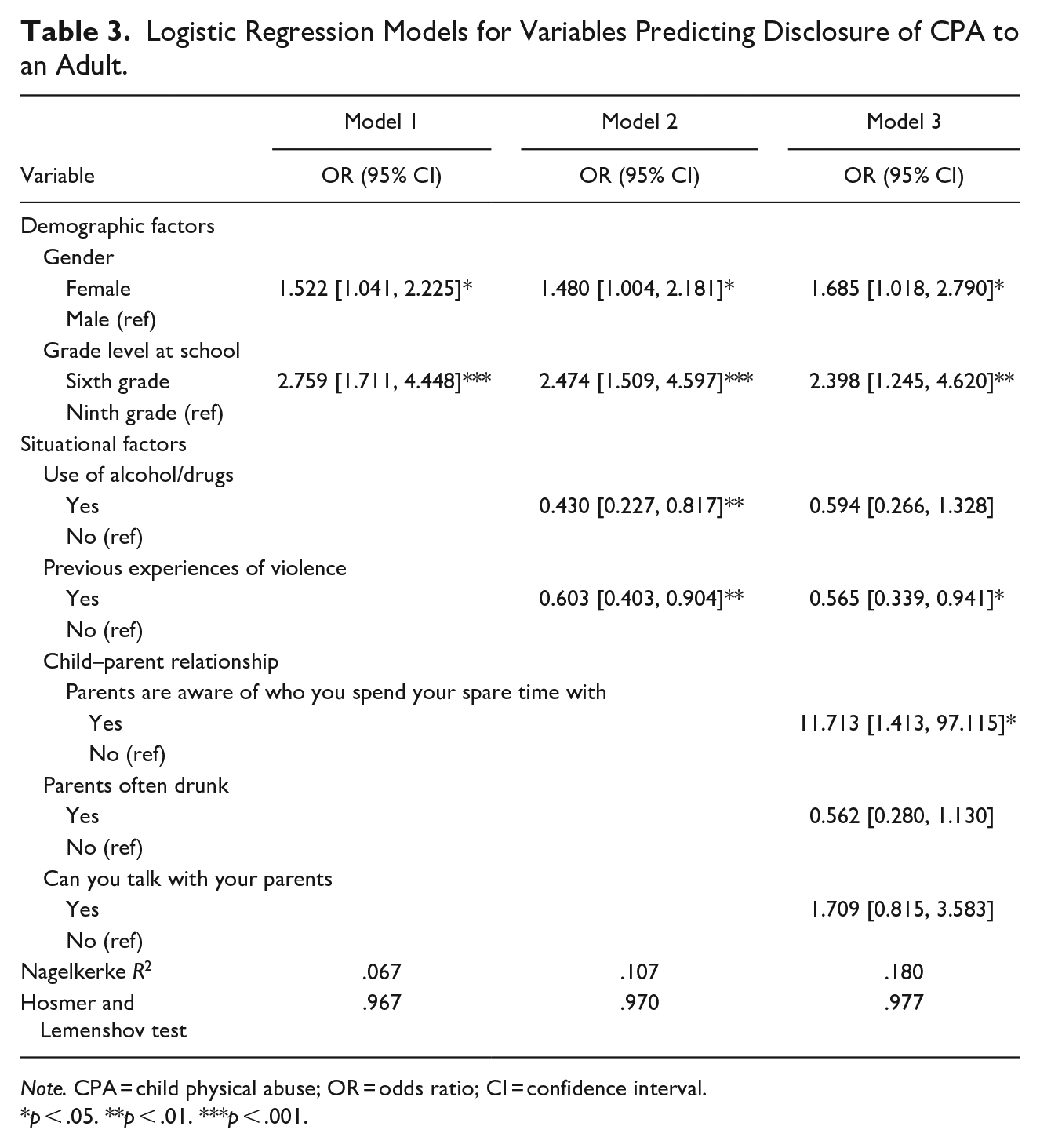
Note. CPA = child physical abuse; OR = odds ratio; CI = confidence interval.
p < .05. **p < .01. ***p < .001.
Since gender differences were found in disclosure to adults, we also tested separate logistic regression analyses for boys and girls. However, no significant models predicting disclosure to adults were found.
Discussion
The present study focused on exploring characteristics of CPA disclosures in a large, population-based sample of children. The overall CPA disclosure rate in the present study was 74%, indicating that most of the children disclosed CPA to someone. However, further analyses revealed that fewer than half of the CPA victims (42%) disclosed to adults, and that disclosure to professionals was even rarer (12%). The most common self-reported reason for nondisclosure was that the experience was not evaluated as sufficiently serious to tell anyone about it. While these findings were largely in line with the CSA disclosure rates in our previous study, multivariate analyses indicated that the factors predicting disclosure to an adult were rather different in CPA compared to CSA. The strongest factors predicting CPA disclosure to an adult were younger age (sixth grade level at school compared to the ninth grade), female gender, and parents being aware of who the child spends their spare time with. In contrast, previous experiences of CPA significantly decreased the likelihood of disclosure to an adult. Findings are discussed below in detail and compared to previously published findings on CSA disclosure from the same data.
CPA Disclosure Rate and Recipients of Disclosure
As hypothesized, the overall disclosure rate of 74% is consistent with rates reported by retrospective surveys with samples of young adults (varying between 61% and 73%) (Jernbro et al., 2017). However, the disclosure rate was slightly higher than the 52% rate discovered in another representative Scandinavian study exploring the CPA experiences of adolescents (Jernbro et al., 2017). The finding that only a minority of the children with CPA experiences reported disclosure to professionals and the relatively low disclosure rate to adult recipients overall are in line with previous research (Annerbäck et al., 2010; Bottoms et al., 2016; Jernbro et al., 2017). Previous studies of CPA disclosure (Annerbäck et al., 2010; Bottoms et al., 2016; Jernbro et al., 2017) have reported that peers are clearly the most frequent choice as a disclosure recipient among adolescents and young adults. The most popular disclosure recipient in the present study was the child’s mother (36%), closely followed by disclosure to a friend (33%). This slight difference might be explained by the fact that the present study also includes children as young as 11 years old, whereas participants in previous studies were older. Compared to CSA disclosures in this same population-based sample of children (Lahtinen et al., 2018), it appears that disclosing CSA to adults may be more difficult than disclosing CPA. Children most frequently disclosed CSA to a friend (48%), and CSA disclosure to adults was even more uncommon (26%) than CPA disclosure in the present study (42%). Regardless of the form of abuse, the low disclosure rates to adults create the risk that the abuse will continue for years and may take on more serious forms. In addition, without adult involvement, children are unlikely to obtain professional support (e.g., psychotherapy) or legal assistance (Bottoms et al., 2016; Pipe, Lamb, et al., 2007).
Interestingly, separate analyses comparing parental CPA disclosure to disclosure of CPA outside the home environment showed no differences except for more frequent disclosures to social workers and school counselors and fewer disclosures to fathers. It is to be noted that in intrafamilial CPA cases, the mothers were reported to be perpetrators as often as the fathers. The fact that social workers and school counselors were more often disclosed to in cases of parental CPA compared to CPA outside the home is understandable but also promising, since it signals that the professionals whose task is to help children with difficulties at home are being trusted by the children. Also, it increases the opportunities for these children and their families to get help. However, the number of disclosures to social workers (8%) and school counselors (7%) was still the tip of the iceberg of the total cases of parental CPA.
The current results showed that many children considered their experiences of violence not to be serious enough to report, which is worrying. In line with the previously reported findings from the CSA sample from the same data (Lahtinen et al., 2018), the most common self-reported reason for nondisclosure of CPA was that the experience of physical abuse was not considered sufficiently serious to report to anyone. The present finding can be related to children who do not recognize their experiences as abusive (at least in less serious cases) or who define some of the abusive acts as a normal part of everyday life. In line with these findings, a recent retrospective study comparing CSA and CPA disclosures (McGuire & London, 2020) reported that not realizing the experience was abusive when it occurred was the most common reason for nondisclosure. In addition, reviews of qualitative CSA disclosure studies (Brennan & McElvaney, 2020; Reitsema & Grietens, 2016) have recurrently reported that one of the most important facilitators of disclosure is understanding that what happened was abusive. Owing to the paucity of surveys that investigate children’s self-reports of reasons for nondisclosure of CPA (Jernbro et al., 2017), this is a significant theme that should be explored further in future research.
Another worrying finding was the fact that many adolescents with CPA experiences reported a distrust toward adults. In line with the findings by Jernbro and colleagues (2017), the children in the present study also reported a lack of trust in adults by responding: “I did not believe that disclosing would help me” (20%), or “I did not believe that anyone would be interested” (11%). Similar results were also found regarding CSA disclosures (Lahtinen et al., 2018), suggesting that the lack of a trusted friend/adult seems to be a common factor affecting the likelihood of disclosing different forms of abuse. McGuire and London (2020) reported that, both in CSA and CPA cases, adults reported having a trusted friend as the most popular reason for disclosure. However, differences have also been found. In the present study, only a minority of the respondents reported lacking the courage to tell someone (3%) or being ashamed (4%) as reasons for nondisclosure. Nondisclosers of CSA gave these reasons more often (corresponding percentages are 14% and 10%, see Lahtinen et al., 2018) than nondisclosers of CPA in the present study. This suggests that adolescents may experience CSA as, to some extent, more intimate and shameful than CPA.
Characteristics Associated With Disclosure to Adults
The present study focused specifically on factors associated with disclosing CPA to adults. This perspective was chosen because adults can take responsibility for ensuring that the child receives proper support, and they can also report to authorities, such as child protection services and/or the police (Tashjian et al., 2016). The multivariate analyses showed that girls and younger children tend to disclose to adults more often than boys and older children, even when the effect of other variables is controlled. In contrast, adolescents preferred to disclose to friends significantly more often than younger children. This is in line with findings on CSA disclosures using the same data, suggesting that a younger age at the time of the incident increases the likelihood of disclosing to adults (Lahtinen et al., 2018), and it is also in line with some earlier CSA disclosure studies (Kogan, 2004; London et al., 2007). As research in the field of developmental psychology (Arnett & Hughes, 2012) shows, peers are generally the primary reference group with whom teenagers are likely to share their thoughts and experiences with. Thus, it is anticipated that peers may be favored as disclosure recipients in the context of abuse experiences, as well.
The finding that girls disclosed to adults more often than boys is in line with previous research on CPA disclosure (Jernbro et al., 2017), and with several studies on CSA or multiple forms of abuse and disclosure (see e.g., Lev-Wiesel & First, 2018; Okur et al., 2017), suggesting that gender differences may not be specific to CSA, and that boys as victims of abuse may need more support to disclose as compared to girls. Even if different patterns of disclosure to adults in separate analyses for boys and girls were not found in the present study, within larger groups, differences may occur. Consequently, more research is needed before definite conclusions can be drawn. Recent research (Okur et al., 2017) suggests that there are gender differences in the reasons for not disclosing CSA.
In addition to demographic factors, situational and child–parent relationship factors were associated with disclosing CPA to an adult, compared to not disclosing at all or disclosing to peers only. The finding that previous experiences of violence decrease the likelihood of disclosure to adults is consistent with a recent population-based study of adolescents in Israel, which found that multiple exposures to maltreatment, in conjunction with high-emotional reactions, are associated with greater reluctance to disclose (Lev-Wiesel et al., 2019). Contrary to the findings of the present study and Lev-Wiesel et al. (2019), Bottoms and colleagues (2016) have found that both CPA and CSA victims are more likely to disclose the abuse if they are more frequently abused, worried about being injured, and emotionally upset at the time of abuse. In the present study, sustaining injuries was not associated with disclosure (being emotionally upset was not measured). However, it should be noted that results are not easily comparable. The study by Bottoms and colleagues (2016) is a retrospective survey for adults, and it only includes female participants. Adults responding retrospectively can add the understanding of hindsight to their experiences; for instance, an awareness of the risk of being injured might have evolved later. The present study (as well as Lev-Wiesel et al., 2019), in contrast, is a survey for children, both girls and boys. It is possible that, at the time of the survey, the children in the present study had not yet reached the point at which the urge to disclose is stronger than the reluctance to disclose. As qualitative research on CPA disclosure (e.g., Alaggia et al., 2019; Foster & Hagedorn, 2014; Thulin et al., 2019) has suggested, disclosure is often a process that includes several judgments by the child. In addition, the missing association between sustaining injuries and disclosure can be explained by the fact that children may see the severity of abuse differently compared to adults. Whereas adults may think that injuries are a sign of severe abuse, children and adolescents may have other criteria for defining abuse as severe. As the present study showed, children and adolescents do not always recognize abuse. This is in line with the findings on CSA disclosure utilizing the same data (Lahtinen et al., 2018). Two abuse-related variables measuring the severity of the CSA experience (Lahtinen et al., 2018) were associated with disclosures to an adult in the bivariate analyses, namely, the perpetrator’s use of violence and the use of force, intimidation, or blackmail. Nevertheless, other variables measuring severity, such as an experience including penetration, the frequency of the CSA, or the perpetrator using bribery, were not related to disclosing to adults. This underlines the need for further studies on abuse severity and how it may be associated with disclosure.
Many researchers (see e.g., Ellonen & Salmi, 2011; Finkelhor et al., 2007a, 2007b) have criticized the fragmented way in which child abuse in general has been studied and how the connection between polyvictimization and its influences has been consequently neglected. Recent studies (Jernbro et al., 2017; Lev-Wiesel et al., 2019) have also found that experiences of multiple forms of abuse are related to reluctance to disclose abuse and a distrust of adults. In the present study, 13% of CPA victims also had experiences of CSA, and 45% of them had also experienced emotional abuse by their parents. However, no associations between experiences of multiple forms of abuse and disclosing CPA to adults were found. In contrast, in the same data, experiences of emotional abuse by the mother decreased the likelihood to disclose CSA to adults (Lahtinen et al., 2018). This difference may be explained by the fact that the gender distribution was different in these samples of children. CSA experiences were mostly reported by girls (79%), whereas CPA experiences were reported almost equally often by boys and girls. This may also affect other differences observed in disclosing CSA and CPA.
In addition to earlier experiences of CPA, child–parent relationship factors were associated with disclosing CPA to an adult. The strongest of these factors was parental awareness of who their child spends their spare time with. This is probably a reflection of an adequate relationship between a child and a parent: parents are available to help and provide support when needed. Bivariate-level analyses showed that the experience of being able to talk with parents and not seeing them drunk may also increase the likelihood of a child disclosing to adults. These findings are not surprising in consideration of the fact that the children in this sample most often preferred to disclose to their parents instead of any other adults. If the parents are not interested in their child’s life, and/or they are not the ones the child feels they can talk to, and/or the parents drink a lot, it can be difficult for the child to trust adults in general. This conclusion is supported by the finding of Priebe and Svedin (2008), who concluded that children who perceived their parents as caring (but not overprotective) were more likely to disclose CSA. In addition, Tashjian and colleagues (2016), among others, have suggested that maltreated children are more likely to be insecurely attached, which is associated with difficulties in trusting parental figures to provide safety in times of stress. Finally, it can be hypothesized that children with unengaged parents may be less well informed about abusive behavior and how to protect themselves from it. Instead, a safe, stable, and nurturing relationship with parents is known to be a significant protective factor against child abuse (see e.g., Jaffee et al., 2013; Schultz et al., 2013).
Strengths and Limitations
This study has some limitations. First, there is the possibility of both under- and over-reporting of CPA experiences. Nevertheless, in large samples such as this, the influence of these biases has been found to be small, even if these biases cannot be neglected (Ellis et al., 2010). In addition, computerized questionnaires, such as the one used in the present study, have been found to increase confidentiality while also improving the accuracy of responses (Helweg-Larsen & Larsen, 2006). Second, the model developed in the present study only explains a limited amount of the variance in factors predicting disclosure to adults, which suggests that more research is needed to increase our knowledge of factors influencing disclosure. There is also the risk of excluding potentially significant factors, since some of the background information was collected using a single question. This risk can increase when the focus is only on the most serious cases within a limited time frame, which is reflected in the question about the most serious incident in the past 12 months. It is possible that the respondents had disclosed other incidents of CPA but not the most serious one. Finally, the number of observations for some variables, such as CSA experiences, ethnic background, and self-reported mental health problems, was so low in this sample that the power of statistical analyses to detect any differences may be weakened. It should be noted that children participating in special education (known to be a high-risk group for abuse, see, e.g., Hershkowitz et al., 2007) were not included in this study. Thus, the findings herein may not be descriptive of disclosure factors among more vulnerable groups of children, and more research is needed. More research is also needed on possible delays in disclosure and the number of children who refuse to disclose, even if they are asked about their CPA experience. The FCVS did not include inquiries into these themes.
Despite the limitations of the present study, the findings contribute to a broader understanding of CPA disclosures and, in particular, the possible characteristics related to disclosure to adults. In the field of CPA (and CSA) disclosure research, only a few previous studies have used population-based samples, and many of those surveys were retrospective. The present study examined disclosure as part of the FCVS, which enabled taking a wide variety of factors into consideration. This sample also allowed access to children who had not disclosed to anyone before the survey. Furthermore, not requiring parental consent and ensuring anonymous responses probably enabled children to provide more honest answers and minimized the risk of missing participants who had experience of CPA. Compared to retrospective studies, the present study had the advantage of entailing a reduced risk of memory bias and avoiding adult reinterpretation of experiences, since the participants were children (mainly 12 and 15 year olds).
Conclusion and Implications
As studies examining CPA disclosures are few, and studies with nationally representative samples are almost nonexistent (Jernbro et al., 2017), the need for further research on the subject is obvious. This study contributed to research on CPA disclosure by offering a population-based estimate of CPA disclosure rates and a model that explains some of the variation in disclosure to adults. Studying disclosure as part of the FCVS also enabled the analysis of differences and similarities in disclosing CSA and CPA. The finding that children may not recognize their experiences as abusive regardless of the form of abuse highlights the importance of exploring how children define CPA and CSA, as well as their attitudes toward violence, in future studies. The findings also indicate that safety education and teaching about children’s rights at school are necessary to encourage children and adolescents to disclose abuse to adults, and especially to professionals. As earlier studies (e.g., Brennan & McElvaney, 2020; Jensen et al., 2005; Reitsema & Grietens, 2016; Thulin et al., 2019) have shown, disclosures of both CPA and CSA are often facilitated by addressing the topic at school or watching a TV program dealing with abuse. In addition, if the recipients of disclosure are peers (as they often are), they are probably faced with a moral dilemma of not disclosing confidential information and need guidance on how to report to a trusted adult (McGuire & London, 2020). Experiences of CPA and other forms of abuse remain largely hidden from adult society otherwise, and the potential to intervene in abuse will be limited.
Footnotes
Declaration of Conflicting Interests
The author(s) declared no potential conflicts of interest with respect to the research, authorship, and/or publication of this article.
Funding
The author(s) disclosed receipt of the following financial support for the research, authorship, and/or publication of this article: Academy of Finland (Graduate School for Family Studies), University of Eastern Finland, Olvi Foundation.
