



Abstract
Intimate partner violence (IPV) and sexual violence (SV) are drivers of women’s morbidity and mortality yet remain among the most underreported crimes in the United States. Understanding IPV/SV survivors’ justice preferences and justice definitions can strengthen violence prevention and response systems. In-depth interviews were conducted with women who experienced past-year IPV (n = 26), to explore their justice preferences and recommendations. Primary themes included accountability, safety, and rehabilitation, with examples within and outside the current justice system, and across restorative and retributive justice frameworks. Women sought accountability through a variety of means. Retributive approaches like incarceration offered accountability as well as fleeting safety, but were critically limited in addressing the root causes of violence and, in some cases, were felt to exacerbate the problem. Women’s expressed needs and preferences centered on restorative aspects of justice, including perpetrator’s acknowledgment of harm, achieving physical safety and stability, and perpetrator rehabilitation through counseling. Paradoxically, women’s safety-related justice goals both encouraged and discouraged their engagement in the formal justice system. The discordance between women’s justice preferences and their perceptions and experiences within the current justice system illustrate complex and difficult trade-offs faced by survivors in achieving physical, social, and economic safety. Moreover, they likely contribute to the low levels of IPV/SV reporting to police. Women’s goals were aligned with restorative justice principles, illustrating the value of this approach. In an era of unprecedented dialogue on justice reform, results provide direction for integrating restorative justice practices to strengthen the justice response to violence against women.
Introduction
Intimate partner violence and sexual violence (IPV/SV) impart poor physical, mental, and sexual health (Campbell, 2002), and IPV is implicated in more than half of homicides to women (Petrosky et al., 2017). An estimated 36% of U.S. women have experienced nonfatal IPV (Smith et al., 2018), and 21% of women have experienced SV (Smith et al., 2018). In 2015, homicide was the second-leading cause of death for Black women aged 15 to 24 (Centers for Disease Control and Prevention, 2018; Petrosky et al., 2017). Lifetime IPV prevalence is highest among women of color (Black: 44%; multiracial: 54%; American Indian/Alaskan Native: 46%); compared with 35% among White women (Black et al., 2011). Gender differences persist in the nature and impact of IPV/SV (Black et al., 2011). Nationally, physical IPV prevalence is comparable for women (33%) and men (28%); however, women experience significantly more sexual IPV (9% vs. too small to report among men), and more IPV with resulting fear, injury, or other health or social issues (29% vs. 10%; Black et al., 2011). Women’s IPV homicide risk is profoundly higher than that of their male counterparts (Cooper & Smith, 2011; Stockl et al., 2013).
Justice through offender accountability remains a critical component of multisectoral prevention and response to violence against women (VAW), in addition to prevention and survivor support (Decker et al., 2018; USAID, 2012). However, IPV continues to be one of the most underreported violent crimes (Truman & Morgan, 2016), with up to 46% of violent crimes committed by intimate partners going unreported (Langton et al., 2012). Past research reveals that non-reporting reflects a wide range of motivations and fears including system mistrust, perception of futility, and entrenched racial disparities in the justice system (Langton et al., 2012). In addition to structural barriers to justice engagement, family-based considerations such as fear of financial loss may factor into women’s desired justice outcomes (Decker et al., 2019; Dichter & Rhodes, 2011). Discordance between women’s perceived potential outcomes with desired outcomes for justice has also been implicated in non-reporting (Goodmark, 2018b).
The current policy framework for IPV/SV takes a retributive justice approach oriented toward punishment of offenders, in approximate proportion to the severity of the crime (Goodmark, 2018a; Hopkins, 2012). Restorative justice, by contrast, is centered on repairing harm; in doing so, it prioritizes victim needs while holding offenders accountable (Daly, 2011; Koss, 2014) and can facilitate healing (Braithwaite et al., 2010). Restorative justice models can involve formal and informal procedures meant to give voice to the victim and encourage reflection and rehabilitation for the offender (Hopkins, 2012; Ptacek & Frederick, 2008). While processes used to achieve these goals can vary substantially, all restorative processes share a commitment to identifying and articulating the impact of harms and finding responses that ameliorate those harms (Goodmark, 2015; Koss et al., 2004; Wager et al., 2015); restorative justice can be embedded within systems. By contrast, the transformative justice model positions restorative principles outside the justice system, to hold communities accountable for their role in violence and transform the conditions that facilitate abuse (Coker, 2002).
The extent to which restorative justice can be appropriate for IPV/SV is somewhat contentious and remains understudied. Concerns include the risk that it may undervalue the harm of IPV/SV, place undue demands on survivors, reprivatize gendered violence in ways that perpetuate harm, or revictimize victims through the expression of power imbalances between victims and perpetrators or other means (Curtis-Fawley & Daly, 2005; Hayden et al., 2014). Evidence from victim-advocates is also somewhat mixed in that it echoes these concerns and simultaneously articulates benefits of restorative justice, most notably that it provides a clear alternate to a criminal justice system that can revictimize women and fail to achieve justice goals (Curtis-Fawley & Daly, 2005). Very limited research has explored justice preferences of IPV/SV survivors; available evidence indicates that desired outcomes span retributive to restorative justice forms (Herman, 2005). Restorative justice can be particularly valuable for the many IPV victims, and victims of acquaintance-perpetrated SV, for whom ties within the survivor-offender dyad are maintained via ongoing relationships, shared peers, and community members, shared custody of children, joint financial commitments, and other factors (Ptacek, 2009). Interest in face-to-face restorative justice conferences has been demonstrated among both victims and offenders, with interest higher for those with ongoing relationships and lower levels of fear (Nettleton & Strang, 2018). Evidence from post-conflict settings further illustrates the preference for restorative justice practices in situations of ongoing relationships maintained with perpetrators; by contrast, support for retributive justice is associated with severity of violence and loss (Hall et al., 2018).
Our study addresses a critical yet understudied dimension of victims’ engagement in the justice response, specifically their own preferences for justice across retributive and restorative domains. Enhancing the justice response to IPV/SV requires understanding victims’ justice preferences, evaluating the extent to which these preferences and other factors influence victim engagement in the system, and designing justice responses that align with victims’ needs while prioritizing physical safety first and foremost, and recognizing the need for related economic and social safety. We conducted qualitative research in Baltimore, Maryland, to understand IPV survivors’ preferences for justice, spanning both restorative and retributive preferences, and within and outside the formal justice system.
Method
Setting
This study was conducted in Baltimore, Maryland. Baltimore represents one of many midsized U.S. cities with entrenched challenges in access to justice for IPV/SV as well as racial discrimination; a 2016 Department of Justice investigation of the Baltimore City Police Department revealed biases against believing IPV/SV survivors, minimization, undue skepticism, and victim-blaming specific to IPV/SV (U.S. Department of Justice, 2016).
Sample
Eligibility criteria for the study required that participants were (a) at least 18 years old, (b) self-identified as female (including transgender women), (c) experienced IPV and/or SV within the past 12 months, and (d) were fluent in English. The final sample size (n = 26) was determined by saturation. Recruitment was community-based and took place from November 2017 to April 2018 with the help of IPV/SV support programs as well as social media; additional details are available elsewhere (Decker et al., 2019).
Procedures
Procedures were aligned with ethical best practices for violence-related research (World Health Organization [WHO], 2016). In-depth interviews lasted 60 to 90 min and were audio recorded and transcribed verbatim for analysis. After the interview, participants received a distress screen, a local resource sheet, and $25. Following informed consent and a brief demographic survey, trained, racial/ethnically diverse research staff comprised of two South Asian women and one Black woman conducted the interviews in a private, safe, and mutually agreeable location, most often office space at a participating support organization or that of the investigative team. At the outset of the interview, participants were told the purpose of the study was to better understand the experiences of seeking help and justice following IPV/SV. The interview guide was semistructured and included questions about justice preferences and considerations for how justice can be achieved. Specifically, through main questions and probing, women were asked to describe what justice looks like in situations of IPV and SV, and what influences how and when justice is achieved. Women were also asked to describe their experiences with IPV/SV with an emphasis on careseeking, support, and efforts to attain justice.
Data Analysis
The research team read a set of transcripts (n = 2) and generated themes for the initial codebook. This codebook was further refined by independent application by two coders to two additional transcripts, with the addition of newly emergent codes, and subsequent side-by-side review for consistency in the use of codes. This process was duplicated with additional transcripts, and full-team discussion, until the codebook was refined with a finalized shared understanding of codes. At this point, the remaining interviews were coded independently. Intercoder agreement was maintained through regular research team meetings. Reliability was enhanced through ongoing team debriefing during data collection, and audit trail during analysis (Glaser & Strauss, 1967; LeCompte & Schensul, 1999; Maxwell, 2005). Qualitative analysis followed the constant comparison method (Glaser, 1965), which is derived from Grounded Theory (Creswell, 2018; Glaser & Strauss, 1967; Taylor et al., 2015) and has been recommended for research specific to social justice and inequity (Charmaz, 2011). An advisory team of local violence prevention researchers and practitioners provided input and collaborative interpretation of preliminary results. The current analysis reports on four themes specific to justice preferences, and contextualizes quotes with data on participant age, race, and IPV/SV experience.
Results
The study enrolled a total of 19 Black women, 5 White women, and 2 multiracial women (total n = 26; Table 1). The age range of participants was 25 to 58 years. None of the participating women reported experiencing SV outside the context of IPV. Key domains of justice described by women included offender accountability, safety, and rehabilitation and healing for the victim and offender, achieved both within and outside the existing justice system, a dichotomy that emerged organically during the interviews and helped to illuminate how survivors’ justice goals could either intersect with or diverge from the structures readily available to them. We organize these domains based on their fit with retributive and restorative justice goals, respectively, and illustrate how women sought and experienced these aspects of justice within and outside the current system (Figure 1).
Sample Demographic Characteristics.
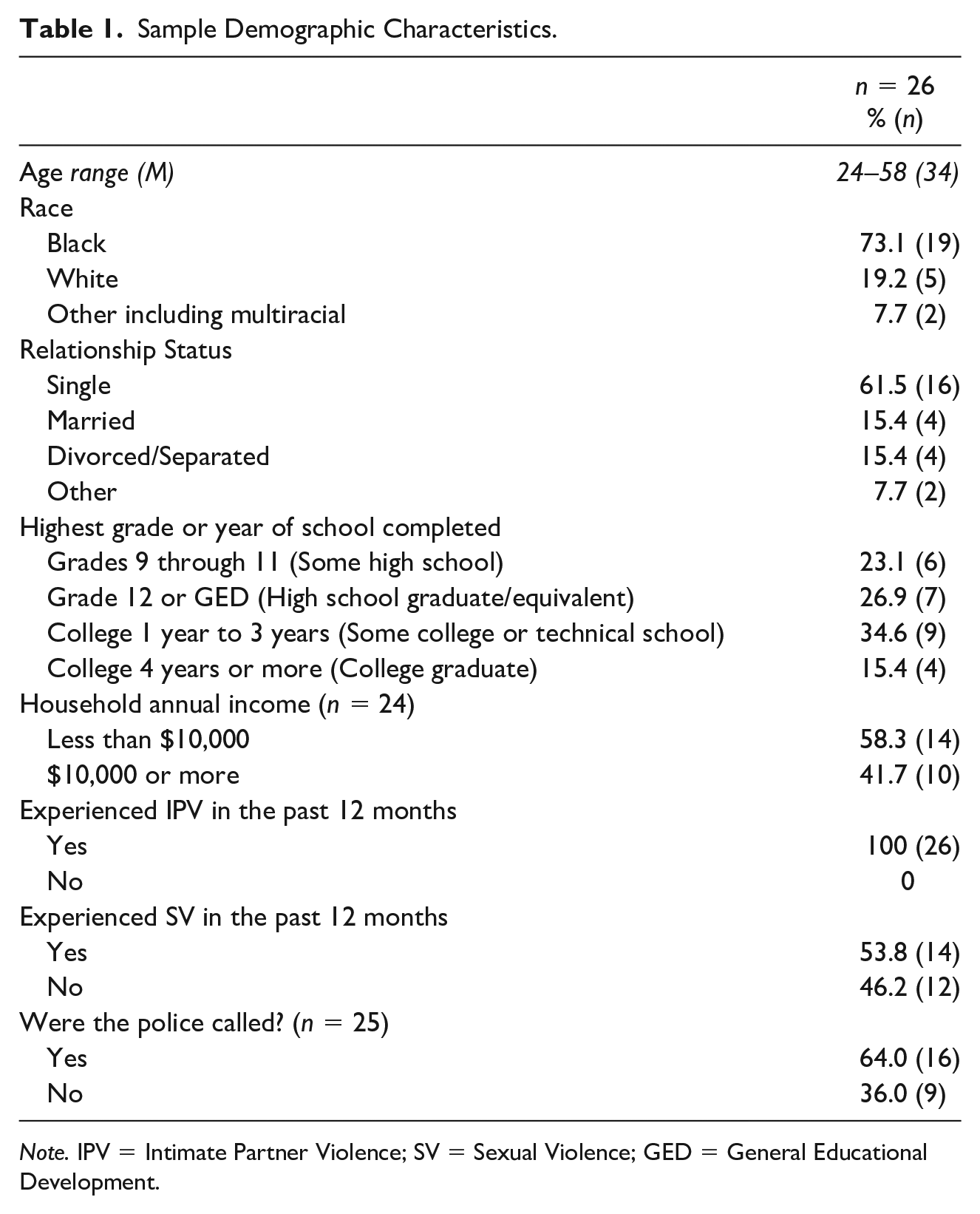
Note. IPV = Intimate Partner Violence; SV = Sexual Violence; GED = General Educational Development.
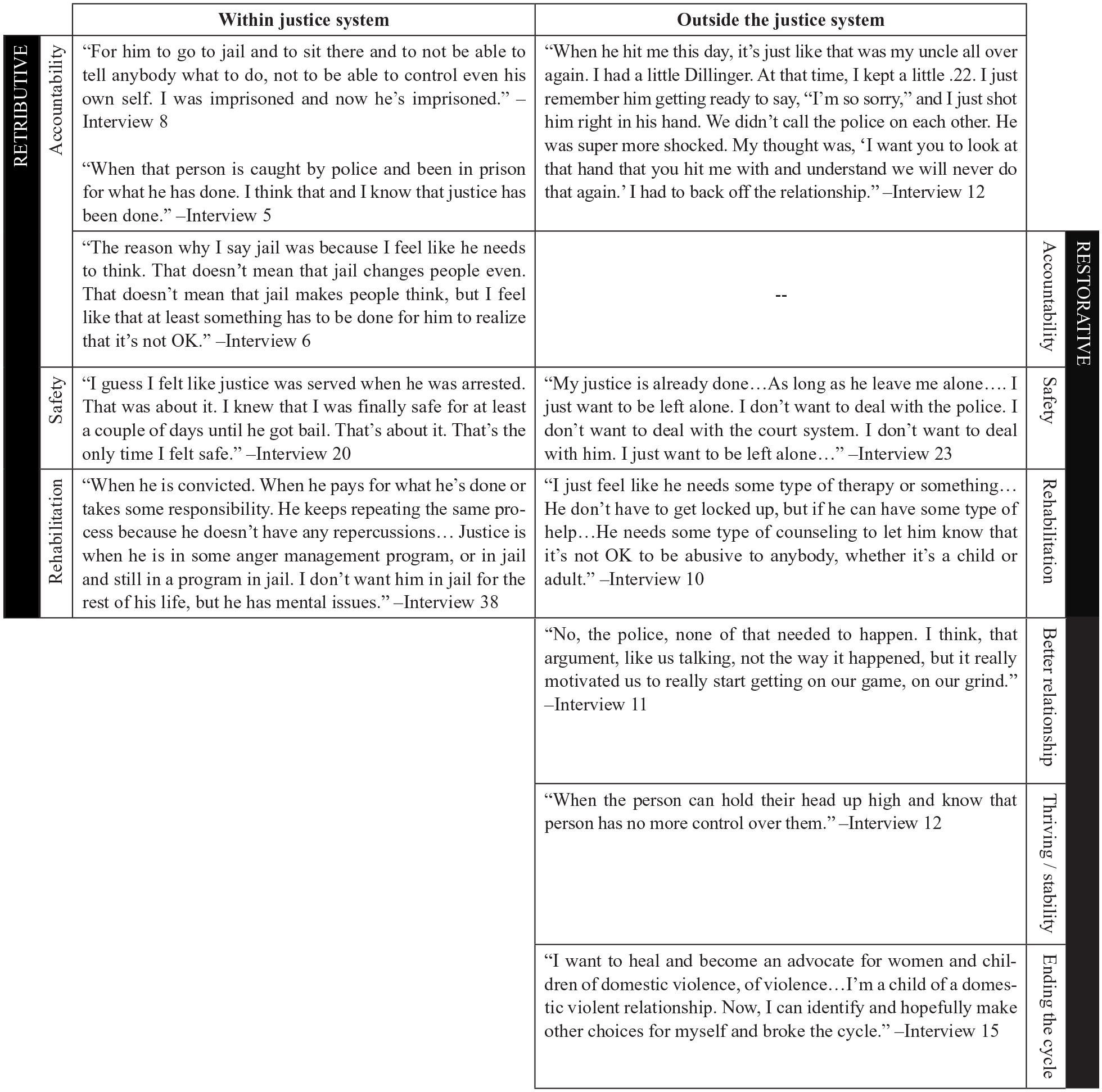
Women’s justice goals and experiences by domains, across retributive and restorative justice principles, achieved within and outside the current justice system (illustrative quotes).
Justice descriptions ranged widely among participants; this heterogeneity of responses is explained by one participant: It depends on the person and the situation. That’s what I think. Everybody thinks differently, does things differently, and has justice differently. (Interview 25, Black, age 37, IPV/SV)
Accountability
A primary justice goal for women was accountability through consequences, often expressed as wanting perpetrators to recognize they had done something wrong.
Within system
Women often turned first to incarceration through the justice system as a means for holding perpetrators accountable for their actions, exemplifying the retributive focus of the current system. Although for some women, punishment was an explicit justice goal, most women’s described desires for incarceration spoke less to revenge than to creating a space for perpetrators to develop empathy and express remorse for abusive actions. The punishment women sought was one situated in the need for reflection; it was a sanction they hoped would lead to perpetrators grappling with their actions.
Justice is for him to sit, or for them to sit and think, in jail, prison, what they did. That’s justice to me. To be punished for what they did. (Interview 1, Black, age 38, IPV) For him to go to jail and to sit there and to not be able to tell anybody what to do, not to be able to control even his own self. I was imprisoned and now he’s imprisoned. He’s seeing what he was putting me through, but I didn’t deserve it. (Interview 8, Black, age 35, IPV) For me when the person is prosecuted, they are maybe put in the prison or in the jail for some months, years. When that person is caught by police and been in prison for what he has done. I think that and I know that justice has been done. (Interview 5, Black, age 30, partner SV)
Women often expressed hope that perpetrator time spent in jail would be an opportunity for their abusers to reflect and, in turn, change. These expressed desires align with the accountability goals of restorative justice, which center on acknowledgment of harm as a path to restoration.
The reason why I say jail was because I feel like he needs to think. That doesn’t mean that jail changes people even. That doesn’t mean that jail makes people think, but I feel like that at least something has to be done for him to realize that it’s not OK, that you have been treating me extremely badly for no reason. (Interview 6, Black, age 31, IPV) I didn’t want him to go away forever . . . I wanted him to be arrested, of course. I still loved him at the end of the day. I thought that once he’d get locked up, he’d probably be in there for a little bit. He would get his mind together. He’d see, “OK, that’s not something that she with [IPV].” If I love her then I need to change. (Interview 22, Black, age 31, IPV)
Women also sought to use the legal system to establish limits and parameters for contact for themselves and their children as a means of establishing consequences and boundaries following violence.
We have to have some set guidelines for when he comes back. You can’t call me and say, “I want to see my kids.” I want some paperwork that says, “You have to do this when you want to see your kids,” or, “You can see your kids, but you can see your kids if you do this to see your kids.” (Interview 8, Black, age 35, IPV)
Outside the justice system
Many women felt that the justice system provided insufficient accountability or consequence. Several expressed the need to take accountability and personal safety into their own hands, often following extensive violence and failures of the existing response system.
When he hit me this day, it’s just like that was my uncle all over again [references flashback to childhood abuse]. I had a little Dillinger. At that time, I kept a little .22. I just remember him getting ready to say, “I’m so sorry,” and I just shot him right in his hand. We didn’t call the police on each other. He was super shocked. My thought was, “I want you to look at that hand that you hit me with and understand we will never do that again.” I had to back off the relationship. (Interview 12, Black, age 46, IPV)
Safety
Many women discussed justice in terms of safety and separation from abusive partners. Both within and outside the system, conflict was evident in their description of the options available relative to their needs. When it came to safety, women’s responses were not clearly delineated along lines of retributive or restorative justice. Instead, women expressed dismay at the limited level of enforcement and severity of existing retributive justice measures such as jail time and protective orders. For some women, the realities associated with seeking justice within the current system prompted disengagement.
Within system
Women discussed justice in the context of periods of temporary safety afforded during their partner’s arrest or incarceration. Almost universally, these separations were felt to be insufficient, undercutting the justice and safety they afforded.
I guess I felt like justice was served when he was arrested. That was about it. I knew that I was finally safe for at least a couple of days until he got bail. That’s about it. That’s the only time I felt safe. (Interview 20, White, age 28, IPV/SV) The locking up was helpful, but six damn months . . . INT: You’d rather him had been locked up for longer. Yeah, for a couple of years. [laughs] I really would have because then that wouldn’t have made me have to second guess anything. He would have just been gone. (Interview 21, Black, age 27, IPV/SV)
Prison was seen as enhancing safety by deterring more severe violence.
He needs to be behind bars because he’s going to wind up killing somebody. I see the look in his face. He don’t have no gratitude for somebody living. (Interview 17, White, age 55, IPV)
Protective orders were described as another option for justice-related safety via establishing limits on contact.
I guess with the protective orders. I feel like even though it’s a piece of paper, most abusers would abide by it and in that sense, like, “OK, you got the guy out of the house or the female. You got the abuser out. You should feel a little more safe and secure.” (Interview 20, White, age 28, IPV/SV)
Outside system
Women’s needs for safety and freedom from their abuser also prompted disengagement from the justice system to maximize their distance from the situation and the abuser. A paradox emerged in that many defined justice as an end to the abuse and being away from the situation and perpetrator, yet the current system was felt to be counterproductive to this goal by prolonging victim-perpetrator contact, an experience known as court-related abuse and harassment (Clemente et al., 2019). These dynamics drove women to avoid the current justice system altogether, and attempt safety-related and separation-related justice outside the system.
When I got down here, they asked me if I wanted to put a protective order against him and stuff. I decided it was best just to not have any contact with him at all. I never did file through and have him arrested or anything like that . . . I didn’t want to have any more interactions with him. (Interview 16, White, age 58, IPV/SV) All I want him to do is just leave me alone. I can’t even cope with him. I don’t even feel comfortable. I’m very protective over my son, very, very. Hopefully, I will win custody over him, hopefully. I would be so happy. That’s my justice. I don’t really care about anything else. I want him just to leave me alone. (Interview 4, Black, age 30, IPV/SV) My justice is already done . . . As long as he leave me alone. You did whatever you did. I hope and pray to God that no other woman has to go through the things that I went through, as far as dealing with this man. I just want to be left alone. I don’t want to deal with the police. I don’t want to deal with the court system. I don’t want to deal with him. (Interview 23, Black, age 36, IPV)
Healing
Several domains of healing emerged in women’s discussions of justice. These generally were described as requiring change or transformation; be it altered perpetrator behavior, a healthier relationship with their partners, thriving on their own, and/or breaking the cycle of violence within society. Healing and restoration are core concepts within restorative justice, though not necessarily incompatible with retributive models. These discussions reflected a relentless optimism for change on the part of survivors.
Within system
Rehabilitation
Perpetrator help for underlying mental health and anger issues was raised as an essential element of justice. Some offered the possibility that this could co-occur with incarceration.
When he is convicted. When he pays for what he’s done or takes some responsibility. He keeps repeating the same process because he doesn’t have any repercussions . . . Justice is when he is in some anger management program, or in jail and still in a program in jail. I don’t want him in jail for the rest of his life, but he has mental issues. (Interview 38, White, age 24, IPV/SV)
Outside system
Rehabilitation
Other women felt strongly that incarceration did not prevent future violent behavior and was, therefore, ineffective. They articulated that justice required rehabilitation.
What is jail time going to do? It may change some of them. It might make some of them even more worse . . . I’m just going to give you an example. Let’s say for instance my husband, he go to jail and he don’t change. He do his time, whatever, get out, and he do it to the next one. Justice would be if that behavior stopped. (Interview 2, Black, age 43, IPV/SV)
Women expressed deep frustration with the limits of the existing justice system and articulated the need for alternate models focused on healing and rehabilitation.
Justice has never been served in intimate partner violence. It has never been, because what everybody don’t understand is even though they get locked up . . . only thing they’re sitting in there doing is thinking about how they’re going to fuck you up when they get out because you got them locked up. It’s more deeper than that. That’s their anger. That’s something that’s been embedded. That’s something that’s built in. That’s something that they haven’t gotten accustomed to . . . They just can’t go around hitting people because, “Oh, they weren’t raised right.” No. Go to counseling. Go to alcohol . . . go to a work program. Go to something. (Interview 21, Black, age 27, IPV/SV)
Resolutions aimed specifically at altering abusive behavior and preventing future violence were thought to be more appropriate than incarceration, in that women described wanting to feel like perpetrators had been changed by reckoning with the IPV, but were not at all confident that serving time would result in such a change.
He didn’t get locked up or anything like that, which to me, that wouldn’t have did anything. I just feel like he needs some type of therapy or something . . . I feel like he’s just getting away with the situation, because he’s out, living his life. He’s just doing a normal routine like nothing happened. He don’t have to get locked up, but if he can have some type of help . . . He needs some type of counseling to let him know that it’s not OK to be abusive to anybody, whether it’s a child or adult. (Interview 10, Black, age 33, IPV/SV)
This quote underscores the limited options women perceive for justice in that incarceration is undesirable and ineffective in driving behavior change, yet witnessing offenders out and living their lives without accountability is similarly untenable. One participant explicitly contrasted punitive consequences in favor of a support-oriented framework.
Yeah, some support instead of consequence. It’s always justice for people. To them it’s, “I need the consequence” but then that’s not always the case. That’s not what justice looks like. It’s not always a consequence that needs to be made. (Interview 11, Black, age 26, IPV/SV)
The participant went on to suggest supportive services to de-escalate and help resolve IPV/SV that are completely outside of the justice system to avoid incarceration.
It could have been prevented. If there was some type of middleman, some service, like the helpline, but they probably would still involve the police. Just another Black man in jail. That’s the last thing he needed. I’m like, “Why does he have to go to jail?” It was a lot. That’s the last thing he needs. (Interview 11, Black, age 26, IPV/SV)
Other aspects of healing
Other aspects of healing that emerged in justice-related discussion included relationship strengthening, thriving after violence, and ending the cycle of abuse.
That argument that we had about the money and it being emotional. I think, that argument, that whole argument. It really motivated us . . . No, the police, none of that needed to happen. I think, that argument, like us talking, not the way it happened, but it really motivated us to really start getting on our game, on our grind. (Interview 11, Black, age 26, IPV/SV)
Thriving and restoration of agency were also raised in the context of women’s justice goals.
When the person can hold their head up high and know that person has no more control over them. That’s the whole thing to do and/or standing up. There are women who are in situations worse than ours and just for them to know, just for us to know that they’re not thinking about our feelings why should we think about theirs. (Interview 12, Black, age 46, IPV) I don’t think there is any complete justice. I think for me to get my life together. It’s no justice for him because he’s out of the picture. It’s not justice for him. It’s more of a closure for me . . . Yeah, just closure. That chapter is over. (Interview 24, Black, age 27, IPV/SV)
In reflecting on justice, women also spoke of the desire to see cycles of violence come to an end.
I guess with my son till today he don’t know his father did that [abuse]. He will never know. It’s just me and showing [my son] there’s a certain way to treat a lady, to treat women in life. If you don’t feel like you want to be bothered, then you have the choice of end the relationship and not putting your hands on them because I’ve experienced that . . . He knows you have the right to walk away. (Interview 12, Black, age 46, IPV) I’m a child of a domestic violent relationship. Now, I can identify and hopefully make other choices for myself and broke the cycle. (Interview 15, multiracial, age 34, IPV/SV [including non-partner] survivor)
Procedural Justice
Some women focused their discussion of justice on process-related or procedural elements; their insights emphasized the need for greater sensitivity to survivors’ needs within the justice system response to IPV/SV.
Women described lack of empathy, victim-blaming, and a sense of futility on the part of the police and other system actors, which undermined their confidence in the system and effectively undercut their ability to obtain justice.
Investigate it, look into it, instead of automatically assuming that the victim is the problem. I went around, be more compassionate. They’re more non compassionate, no emotions, more or less. I think that’s how mostly every single cop that I’ve . . . not every single cop, 50 percent of the cops that I’ve encountered have no emotions, no feelings. (Interview 13, Black, age 25, IPV/SV) The attitudes of people in the position to help you. Meaning the police department. Meaning social workers. People, believe it or not, because it hasn’t happened to them their demeanor is . . . She’s going to keep going back so why should we waste our time prosecuting. Because they fucking deserve to be prosecuted . . . It’s going to come a time when you don’t go back. I want to be able to know that I’m safe. That the people that I am reaching out to are there for me regardless of how many times I went back. I went back 20 times, so what? (Interview 12, Black, age 46, IPV)
Women also expressed a desire to have more voice and participation in the justice process. For example, while acknowledging the onus of change was on their partner, some women expressed the desire to be a part of that process—something the system did not always allow.
Oh, the judge didn’t want him to have any contact with me. I think I got that right. I don’t know. I guess for couples that have been involved for so many years, like him and I, that maybe I should have also been asked to go to the Healthy Relationship class too . . . Yeah, so I could understand, be there and listen, and know what he was learning or the dealing situation, how to de-escalate a partner when they get like that. That education, I probably could’ve used, myself. (Interview 16, White, age 58, IPV/SV)
Other women indicated concern for lack of monitoring for compliance.
I think they need to have better follow through with what the judge . . . like with those classes, I don’t think he ever went to the classes. Basically, even though that was told what he had to do, doesn’t mean that he did it. (Interview 16, White, age 58, IPV/SV)
Women also raised needs that spoke to systemwide change, including addressing self-defense laws in the state of Maryland that are subject to manipulation. Specifically, the ability for abusers to use the right to self-defense as a defense of their actions in criminal court, enabled by the burden of proof resting with the prosecution to persuade juries that self-defense was not needed.
I would like to see the police held accountable for their actions. The city and state be held accountable for theirs. I would also like them to remove that self-defense law. You’re pretty much saying that it’s OK for somebody to do something to me but I can’t defend myself. That’s crazy. (Interview 23, Black, age 36, IPV)
Discussion
Results demonstrate that IPV survivors prioritize accountability, safety, and rehabilitation in their definitions of justice. Moreover, findings detail women’s profound frustrations in achieving justice following IPV within the current justice system. These frustrations reflect implementation issues in the current system, as well as a fundamental discord between the goals of the retributive system relative to women’s stated justice priorities, which included safety and rehabilitation alongside accountability, and align with a restorative framework. These dynamics likely at least partially explain the low levels of IPV/SV reporting. Justice systems perceived as unresponsive and incompatible with survivors’ needs discourage their use. Moreover, they enable impunity for perpetrators and ongoing risk for victims. Findings underscore the need for an IPV justice response that centers victims needs for safety and stability.
Echoing past evidence of justice system mistrust, and perception of futility (Langton et al., 2012), the current justice response to IPV was described as failing to create safety. Specifically, women explained that incarceration periods were not sufficiently long so as to afford safety, and they feared the retaliatory violence that it could prompt. Lack of confidence in the system prompted disengagement for many. Others avoided it for fear it could result in prolonged contact with an abuse perpetrator.
Understanding survivors’ justice preferences relative to their experiences enables new and important understanding of frustrations that stem from points of discord between survivors’ own justice priorities and that of the underlying system. Specifically, survivors contrasted their desire for perpetrator rehabilitation with their observation that jail itself is not conducive to achieving remorse or regret for actions, nor does it afford rehabilitation to support new, healthy means of interaction post-incarceration. These very domains of rehabilitation that were fundamental to survivors’ definitions of justice were the ones for which the system was unfit. Women also described unmet needs for stability and social support. System failures prompted survivors to seek alternate means of justice, often as a last resort. Accordingly, results provide important direction for considering the ways the restorative justice model can complement and inform the current policy response to IPV.
These dynamics, and the relatively low odds of prosecution for IPV in the current retributive justice system, have made the restorative model a compelling alternative (Sherman, 2000). However, in this study, women’s justice preferences integrated concepts of both restorative and retributive principles, allowing an understanding of the ways in which these frameworks can be used in tandem to advance justice for IPV survivors and in doing so, meet their stated needs. While accountability is identified as a shared goal of both restorative and retributive models, women often feel like the current focus of retributive models is on punishment, which is in conflict with their hope that while in jail, their abusive partner will reflect on their actions, express remorse, and be rehabilitated. The accountability domains raised in this study were often framed as a means to an end, that is, an acknowledgment of harm as a first step toward change, which is more consistent with restorative models. The safety and rehabilitation-related justice preferences raised by participants align with restorative justice principles and emerging abuse intervention programming (Karakurt et al., 2019).
Notably, participants did not explicitly articulate a desire for restorative responses, rather, the majority first turned to discuss retributive solutions, primarily incarceration. This aligns with survivor need for immediate removal and safety from further violence. This dynamic may also reflect the long-standing social and policy emphasis on retributive justice, which fails to identify alternative ways to achieve necessary safety before addressing other justice needs. While many women expressed desires for solutions other than jail, they did not necessarily have language or examples to fully describe those solutions, suggesting a lack of options widely known and available to the community. It is also possible that survivors internalize underlying social stigma, minimization of IPV/SV, and cultural norms, such that the decision to ask for incarceration feels disproportionately harsh or dangerous.
Applying results to practice will require formative research to understand feasibility, acceptability, and positioning of restorative models to guide how well and for what scenarios (e.g., low lethality risk) they may allow survivors to achieve their justice goals, and where and how they can be best paired with retributive solutions to maximize survivor safety and stability, and perpetrator accountability. Emerging restorative models for IPV/SV include methods to address the need for remorse and accountability, such as supported face-to-face accountability sessions for offenders to take responsibility for harm, written acknowledgment of harm, and apology (Braga et al., 2018; Iovanni et al., 2018; Koss, 2014). Additional research is needed to understand the longer term safety and rehabilitative capacity of these models.
Survivors also explained the need for responses that include rehabilitation beyond safety and accountability. Pairing retributive justice responses with opportunities for abusive partners to financially support their families, get help for mental health and substance abuse issues, and create a positive understanding of what healthy relationships look like represent some options for innovation that better align with the expressed needs of victims (Holliday et al., 2019). The heterogeneity of justice preferences described demonstrates the need for a survivor-centered orientation when presenting and implementing solutions. Assessing justice-related needs and barriers within existing surveillance systems such as the National Crime Victimization Survey would help clarify justice priorities among survivors to understand how they may affect police reporting and, more importantly, guide the integration of restorative justice principles and practices within the current policy framework.
Results point to the urgent need to take effective, survivor-centered practices to scale within the justice system, with a focus on safety as a shared goal of both restorative and retributive justice frameworks. Evidence-based systems linkages such as the lethality assessment program, in which homicide risk assessment conducted by police is followed by referral for violence support services, can facilitate access to services as well as reduce frequency and intensity of violence. New tools for electronic tracking of high-risk IPV offenders with violations reported instantly to police and victims (Erez et al., 2012) are also showing promising results in deterring revictimization both pretrial and longer term. Firearm prohibitions that accompany restraining orders related to IPV can be most effective in safety promotion when they are successfully implemented, and when they are maximally inclusive, that is, included in emergency protective orders and extended to cover non-marital relationships (Sorenson & Spear, 2018; Zeoli et al., 2018).
Several limitations should be noted. Recruitment relied heavily on collaborating IPV/SV support organizations whose client experiences may be disproportionately severe or unique in other ways. Despite recruitment efforts to enroll survivors of IPV and SV, participants had predominantly experienced IPV and/or SV in the context of IPV. None of the women referenced experiences of non-partner SV and, therefore, justice preferences and discussions were primarily framed by IPV experiences, which is a limitation in that past scholars have noted that restorative justice may afford distinct risks and benefits across forms of gendered violence (Curtis-Fawley & Daly, 2005). We did not explore differences or drivers of justice preferences in this study, nor situations for which restorative models may be most appropriate; this is an important area for future research as justice-related preferences have been found to vary based on the extent of ongoing relationships with offenders (Nettleton & Strang, 2018). This qualitative study does not allow for quantification of the relative justice preferences discussed, nor their individual or social influences. The racial diversity of our sample is a strength and is consistent with the underlying demographic of the setting. The generalizability of results to other settings is unclear; in particular, we note that Baltimore, Maryland, is one of many U.S. cities with a demonstrated history of police bias (U.S. Department of Justice, 2016). While racial discrimination in the justice system is by no means unique to Baltimore, it is possible that the history specifically in this setting could have shaped participant responses, including those specific to frustration with the retributive system.
The justice sector response to IPV/SV advanced tremendously since the 1994 Violence Against Women Act, which included provisions for sensitivity training for law enforcement and court systems and coordination of victim services. It remains a vital tool heavily relied upon by IPV survivors, with more than half of female homicide victims having contacted police in the year before their death (Campbell et al., 2003). Yet, the justice response to IPV/SV continues to suffer misalignment with the expressed justice goals of victims, which likely relate to underuse as reflected by low levels of police reporting of IPV/SV. IPV/SV skepticism and minimization represent additional deterrents. Responding to victims’ expressed goals for justice, safety, and stability by better integrating accountability systems with those providing safety, stability, and healing may be synergistically valuable in restoring IPV/SV survivors’ trust in the justice system and promoting their safety and stability.
Footnotes
Acknowledgements
We wish to thank our participants for trusting us with their experiences, and we thank our reviewers for exceptionally thoughtful input.
Declaration of Conflicting Interests
The author(s) declared no potential conflicts of interest with respect to the research, authorship, and/or publication of this article.
Funding
The author(s) disclosed receipt of the following financial support for the research, authorship, and/or publication of this article: This study was supported by the Bloomberg American Health Initiative, which is funded by a Grant from the Bloomberg Philanthropies (Spark Award, PI Decker); with additional support from the Health Resources and Services Administration, Maternal and Child Health Bureau (T76MC00003), and National Institute of Minority Health and Health Disparities (1L60MD012089-01, Holliday; 5U54MD000214-17).
