



Abstract
Immigrant Mexican American (MA) youth are at greater risk for violence exposure due to risk factors associated with migration–postmigration processes and as they settle into urban U.S. communities marked by crime and poverty. Less is known about the contexts of this exposure. Specifically, what are the ecological contexts in which youth witness intimate partner violence (IPV), how do these experiences differ by immigration generational status, and what is the impact on youth’s externalizing and internalizing behaviors? MA adolescents (N = 279; 15–17 years, M = 16.17, SD = 0.81) from the Southwest United States participated in an online survey. Over half of adolescents had witnessed at least one incidence of IPV in the prior 2 weeks, usually involving their peers. Adolescents who had spent more time in the United States were more likely to witness violence and rated it as more severe than more recently immigrated youth. A cross-sectional path model revealed that witnessing IPV was associated with internalizing and externalizing problems. However, the associations between witnessing IPV and dating violence perpetration and victimization were mediated through acceptance of dating violence norms. Each successive generation may be more likely to witness violence across a range of ecological contexts. Witnessing violence may be central to a host of negative outcomes, including deviancy, poor mental health, and dating violence. However, preventive interventions can help youth to challenge violence norms within intimate partnerships as well as to cope with violence in their homes, peer groups, and communities.
Keywords
Latinx adolescents, particularly those from low-income urban communities, experience higher rates of violence than non-Latinx youth (Shukla & Wiesner, 2016; Smokowski et al., 2009). Immigrant youth are at greater risk for violence exposure due to risk factors associated with the migration and postmigration process (Rubens et al., 2018) and when they settle into urban U.S. communities marked by crime and poverty (Brady et al., 2008; Jocson et al., 2018). In this sense, cultural considerations cannot be understood apart from larger societal constraints (Herrera & Agoff, 2018). Community-based studies with Latinx immigrant youth find that the majority report at least some exposure to violence, with rates ranging between 70% and 92%, although some report exposure within the past 6 months and others longer time frames (Gudiño et al., 2011; Jocson et al., 2018; Shukla & Wiesner, 2016). These rates are higher than national averages, whereby 36.9% of adolescents had witnessed any violence within the past year and 68.1% had witnessed violence within their lifetimes (Finkelhor et al., 2015). Less is known about the contexts in which youth are exposed to violence and specifically contexts of intimate partner violence (IPV). There is a need to examine where youth witness IPV within the ecosystem, who is involved, how this is experienced by immigration generational status, and its associations with externalizing, internalizing, and dating violence behaviors.
We address this gap in the literature by examining in the present study the types and contexts of IPV that Mexican American (MA) adolescents witness in a 2-week period (Aim 1), as well as the associations of MA adolescents’ generational status to exposure to IPV incidents and the severity of these incidents (Aim 2). We present a cross-sectional path model of the associations of exposure to IPV with MA adolescents’ internalizing and externalizing behaviors, as well as to their acceptance of dating violence norms and dating violence behaviors, specifically physical and sexual dating violence victimization and perpetration (Aim 3).
Exposure to IPV
IPV is commonly defined to include physical, psychological, and sexual acts of perpetration by adult intimate partners (Coker et al., 2000). Exposure to IPV in adolescence is associated with internalizing and externalizing behavioral problems, such as depression, anxiety, stress, posttraumatic stress disorder (PTSD), sleeping problems, and dysthymia (Georgsson et al., 2011; Jocson et al., 2018). Youth who have witnessed IPV can also experience feelings of guilt, helplessness, and responsibility for the violence (Viosin & Hong, 2012). Such youth are more likely to have compromised coping skills, including self-harm, and have challenges in school and with peers (Olaya et al., 2010). Cognitive and integrative skills can be affected due to difficulties processing and recalling information when exposed to parental IPV (Georgsson et al., 2011).
Likewise, witnessing IPV in peer contexts, such as within friends’ romantic relationships, is associated with dating violence in youths’ own romantic relationships (Halpern et al., 2009). Other reported externalizing problems include aggression, bullying, and victimization in school (Olaya et al., 2010), as well as substance use (Izaguirre & Calvete, 2018). Both internalizing and externalizing behaviors lead to problems in academic outcomes, problems with peer interactions, and increased instances of mental health difficulties (Viosin & Hong, 2012). In addition, exposure to both physical and verbal IPV greatly increases risks for role exits, defined as dropping out of school, pregnancy, suicidality, and early admittance into adulthood (Haynie et al., 2009).
The type and context of where youth witness IPV matters, although there have been few studies examining multiple, as opposed to single, contexts. In one study, Shukla and Wiesner (2016) found that witnessing violence in the home as compared with neighborhood and schools was the most salient predictor of youth delinquency. When youth witness violence in the home, this can translate to lower levels of social competency and a decreased likelihood to be involved in social and extracurricular activities (Viosin & Hong, 2012). It is normative for adolescents to withdraw from their parents and shift the intensity of attachment to the peer group and new intimate relationships (Hagan & Foster, 2001); however, youth exposed to IPV who do not find a close network of peers experience greater feelings of loneliness and alienation (Georgsson et al., 2011). Such youth tend to cling to peer groups with greater acceptance of aggression, which can lead to bullying and victimization (Viosin & Hong, 2012). Witnessing violence from peers in the community also has an impact. Exposure to street violence has been linked to dating violence in adolescence (Hagan & Foster, 2001), as well as higher levels of other antisocial behaviors (Criss et al., 2017). Friends who have witnessed dating violence among peers are also more likely to be victimized within their own dating relationships (Foshee et al., 2004). Witnessing violence across environmental contexts has been associated with anxiety, depression, and adolescents’ own use of aggression over a year later (Mrug & Windle, 2010). Youth may learn to uphold a “tough façade” and externalize rather than exhibit anxiety or depression, although they can also become desensitized to it and exhibit reduced symptoms over time (Taylor et al., 2018).
Social Learning Theory (SLT)
We use SLT as a foundation to understand how exposure to IPV is associated with dating violence norms and behaviors. SLT, in its most recent perspective as attributed to Ronald Akers (1998, 2009), posits four main components underlying deviance and violent behavior: definitions, differential association, imitation, and differential reinforcement. We chose to utilize SLT given that it is among the most widely tested and utilized theories for examining the perpetration of IPV (Cui et al., 2013; Dardis et al., 2015; Pratt et al., 2010).
SLT defines definitions as attitudes toward specific deviant behaviors (Akers, 1998, 2009). According to SLT, the more weakly or situationally held values the individual has toward the deviant behavior, the more likely he or she is to engage in it. Youth’s definitions are influenced by the behavior of others in their environment, particularly those that they hold in high esteem, and are modified on the extent to which the behavior is modeled and reinforced. That is, imitation is the replication or modeling of behaviors, which, according to SLT, are made more or less likely via differential reinforcement—the cognitive assessment of what the rewards and/or costs will be for engaging in a behavior. Differential association is the term utilized to describe the distinct manners by which youth are exposed to deviancy norms (Akers, 1998, 2009). Deviant associations are not necessarily formed as a result of mutual deviant activity; rather, youth can become involved with and share attraction to one another due to mutual proximity via school or neighborhood and then experiment with and reinforce one another’s norms and activities (Akers & Lee, 1996).
The developmental stage of adolescence is a time of heightened engagement in high-risk behaviors and the solidification of definitions (i.e., core values and beliefs; Beyers & Seiffge-Krenke, 2010; Ireland & Smith, 2009). Youth who witness IPV see it modeled and reinforced, and thus internalize moral messages that signify its acceptance (Cochran et al., 2011; Tschann et al., 2008). When parents of youth demonstrate aggression toward one another, the likelihood that their own children act aggressively and tolerate aggression within dating relationships is increased (Simons et al., 2012). Dating partners are chosen based on the beliefs, values, and norms that have been learned in the home, as well as those that are modeled by friends who share similar beliefs, such as aggression and violence acceptance (Cochran et al., 2011; Connolly et al., 2003; Simons et al., 2012). Thus, youth who witness IPV across contexts may normalize staying with an abusive partner. Hispanic youth tend to witness violence across ecological contexts, which may contribute to their increased proclivity to view it as acceptable within dating relationships (Black & Weisz, 2004; Smokowski et al., 2009).
A review of theoretical explanations for dating violence perpetration found that SLT has empirical support, particularly when multiple contextual indicators are examined (e.g., intergenerational transmission of violence, peers’ use of violence, personal beliefs; Dardis et al., 2015). As Cochran and colleagues (2011) discuss, the theory has been employed to a greater extent in examination of perpetration, although these authors found support for its utility in predicting violence victimization, repeat victimization, and frequency of victimization among an urban college sample, where there were no significant differences by gender. Moreover, a meta-analysis found that the theory has been most strongly supported with regard to youth’s analysis of perceived gains (i.e., definitions) and association with peers experiencing violence (i.e., differential association) (Pratt et al., 2010). No studies to our knowledge have sought to understand how youth are exposed to deviancy norms by witnessing violence across various contexts and taking into account generation status.
Immigration and IPV
Latinxs experience higher rates of violence and are more vulnerable to the consequences of violence due to a myriad of personal-level (e.g., increased acceptance of violence; Black & Weisz, 2004; Coker et al., 2019), interpersonal-level (e.g., increased likelihood of witnessing parental and interpersonal violence; Ingram, 2007), and community-level factors (Smokowski et al., 2009). Ethnicity and socioeconomic status are frequently confounded making causal links difficult. Although more Latinxs are entering secondary education, as a group they experience low educational attainment, high unemployment, and a high incidence of poverty, compared with Whites (U.S. Bureau of the Census, 2015).
Over a third (34.5%) of today’s Latinxs are foreign-born (63.4% of Mexican origin; U.S. Census Bureau, 2015), and the social context of immigration has been identified by many as having a possible protection effect on adolescents’ vulnerability to dating violence (Decker et al., 2007; Sabina et al., 2016; Updegraff et al., 2012). For example, one study found that dating violence victimization was less among MA females who had foreign-born as opposed to U.S.-born parents (Sanderson et al., 2004). Another recent meta-analysis of Latinx adult couples found an association between higher acculturation and IPV (Alvarez et al., 2018). However, one study using a nationally representative sample of Latinx youth (the National Longitudinal Study of Adolescent to Adult Health [ADD Health]; Jennings et al., 2012) found no differences in dating violence prevalence rates by generational status. More research is required to determine differences in prevalence rates by immigration status, specifically with regard to subgroups of Latinx youth populations.
Values and belief systems of the Mexican culture (e.g., familism, ethnic pride) may serve to protect teens from dating violence and the extent to which youth witness and experience these attributes within their close relationships influences what they will imitate in their own intimate partnerships (see Malhotra et al., 2015). Gender norms commonly described as “traditional” can also serve as protective; despite much research highlighting overly simplistic and often negative notions of Mexican machismo and marianismo (i.e., masculinities/femininities), research with MA youth has delineated how adaptive characteristics of these constructs can contribute to healthy conflict resolution tactics (e.g., emotional attentiveness; Rueda & Williams, 2015). The extent to which youth are differentially associated with positive role models within their peer and familial circles is important in understanding the use of both negative and positive conflict behaviors.
Distinguishing the causal mechanisms associated with IPV behaviors is compounded by power and control dynamics which often intersect with proximal motivators such as anger or frustration at a partner. Although the adult IPV literature is more developed with regard to these intersections, one of the strongest factors associated with IPV in adolescence is the belief that it is acceptable (i.e., definitions within SLT; Ulloa et al., 2004). One study of MA youth found utilizing a multidimensional construct of acculturation (i.e., music, linguistic, social preferences) that male adolescents who were less acculturated evidenced greater acceptance of violence as a conflict tactic than did bicultural and highly acculturated youth (Adams & Williams, 2014). Research with both adult and youth living in Mexico finds that males may use their “power” to dominate their relationships through requiring obedience to traditional values assigned to females (Gilfus et al., 2010; Gutmann, 2006; Rueda et al., 2019). Counter to common portrayals in the literature, however, females often exert resistance in the face of societal and cultural confinements which have not paralleled gender role shifts (e.g., women in the workforce; Herrera & Agoff, 2018). Furthermore, cultural notions cannot be studied apart from structural and societal barriers and inequalities, and the engenderment of Mexican men and women within various societies differ significantly (Gutmann, 2006).
Research on the contexts through which MA youth witness IPV, and how that translates to internalizing and externalizing behaviors, including IPV behaviors, is currently lacking in the literature. We choose to focus on MA youth in particular because Latinxs are not a heterogeneous group; we specifically focus on MA youth in an urban area of a Southern state to understand youth’s experiences within unique sociocultural contexts as a border state where bicultural orientation is particularly advantageous (see Matsunaga et al., 2010). The first aim of this study is to investigate the frequency, forms, and social and physical contexts in which MA adolescents witness IPV. The second aim is to assess whether each successive generation of immigrant youth are exposed to greater and more severe levels of violence across multiple contexts. Our third aim is to develop a path model to understand how youth’s generational status is associated with exposure to IPV and to (a) youth’s internalizing and externalizing behavior, and to (b) physical and sexual violence perpetration and victimization against a dating partner. We include the mediating role of acceptance of dating violence norms (i.e., definitions) as a possible explanatory factor underlying the link from exposure to IPV to use of their own self-reported IPV behaviors.
Method
Participants
The Mexican American Teen Relationships (MATR) study (2010–2012) invited MA adolescents (N = 279; 53% female; 15–17 years old, M = 16.14, SD = 0.82) from an urban area in the Southwest to participate in an online survey and complete information on violence between romantic partners, including whether they had witnessed IPV in the prior 2 weeks. The neighborhoods and schools in the area sampled were characterized by majority Hispanic populations; half the youth in our study lived in homes with both their mother and father present while another 44% lived with a single parent (see Table 1 for demographic characteristics). High schools (52% of participants) and community agencies (48% of participants) recruited self-identified MA adolescents and allowed time in their day/curriculum to complete them onsite (e.g., through laptops or desktop computers). Written parental consent and adolescent assent were obtained. All study materials were written in Spanish and English.
Participant Descriptive Information.

Note. First generation denotes that the adolescent was born in Mexico. Second generation denotes that the adolescent was born in the United States, but that one or both parent(s) were born in Mexico.
The survey included follow-up questions for each incident of IPV that adolescents’ witnessed. If participants did not witness an act of IPV, they were not asked the follow-up questions, and those data are treated as missing at random. Mothers’ education, a proxy for socioeconomic status, indicated that 48% of the sample had mothers with less than a high school education.
Measures
Immigration generation status
Generational status was coded as 0 (first generation: born in Mexico; 23.0%), 1 (second generation: one or both parents born in Mexico, adolescent born in the United States; 53.1%), and 2 (third or more generation: both parents and adolescent born in the United States; 23.9%). There were no significant differences by gender and first-generational (21.1% of males vs. 24.7% of females), second-generational (52.1% of males vs. 53.7% of females), or third-generational (26.8% of males vs. 21.6% of females) status, χ2(2) = 1.291, p = .524.
Exposure to IPV
Adolescents were asked to report on whether they had been exposed to five different forms of IPV in the prior 2 weeks to taking the survey. This time frame has the benefit of capturing specific events with enhanced recall; however, it also assumes that, as found in prior research (Monahan et al., 2015), recent exposure to violence reflects prior exposure to violence. Types of violence included (a) physical conflict (e.g., force from one partner to another, hitting or throwing objects), (b) emotional or verbal conflict (e.g., name-calling, insults, being controlled—being told how to dress, what to do, and so on—or manipulated), (c) relational conflict (e.g., anything that is meant to hurt a current or former partner’s reputation or friendships by spreading rumors and gossip), (d) threatening behavior (e.g., threatening to destroy something valuable to the other person, or threatening to hurt or hit the other person), and (e) sexual conflict (e.g., any force or pressure by a partner to participate in unwanted sexual activity).
Participants were given the following prompt: We would like you to think back over the past two weeks and recall as many incidents of conflict that you have either witnessed (heard or saw) between two people who are involved romantically. When we say “involved romantically” we mean people that could be married, boyfriend/girlfriend, dating, or even just seeing each other casually.
Participants were then asked, “In the past two weeks, did you witness an incident of physical conflict between two people who are involved romantically? For example, force from one partner to another, hitting or throwing objects.” For affirmative responses, participants received the following questions. (a) “For this incident of physical conflict you witnessed, who was involved?” Response options included the following: a friend; other teen my age that I know (but who is not a friend); other teen my age that I do not know (a stranger); a parent, stepparent, or guardian; other adult family member; other adult from my neighborhood/community; an adult that I do not know (a stranger); other: please explain. (b) “For this incident of physical conflict you witnessed, where were you?” Response options included the following: at home; at my dating partner’s house; at a friend’s house; at work; at school; at the mall; in my neighborhood; public place that is not in my neighborhood (park, street, etc.); other: please explain. (c) “For this incident of physical conflict you witnessed, please rate the severity.” Response options ranged on a 5-point Likert-type type scale from minimal (1) to extreme (5). (d) “Did you witness another incident of physical conflict between two people who are involved romantically in the past 24 hours?” Affirmative response options cycled through this set of questions for that incident. Responses of no prompted the survey to ask about the other four types of IPV violence in the past 2 weeks.
Internalizing behaviors
Participants completed the Positive and Negative Affect Schedule (PANAS)–short form, which has been shown to be internally consistent, have excellent convergent and discriminant correlations with longer measures, and have stability over a 2-month time period (five items; Watson et al., 1988). The following stem question was used: “Thinking about yourself and how you normally feel, to what extent do you generally feel . . .” on five items: upset, hostile, ashamed, nervous, and afraid. Response options ranged on a 5-point Likert-type scale from never (1) to always (5). Reliability of the Negative Affect scale was adequate; higher scores indicate greater negative affect (α = .73; M = 1.93, SD = 0.65). Participants also completed the Depressive Mood Scale, which is a self-report scale that was validated in a clinical sample of adolescents with major depressive disorder (six items; Kandel & Davies, 1982), to assess their depressive symptoms. The following stem question was used: “During the past 12 months, how often have you . . .” on six items: Felt too tired to do things? Had trouble going to sleep or staying asleep? Felt unhappy, sad, or depressed? Felt hopeless about the future? Felt nervous or tense? Worried too much about things? Response options ranged on a 4-point Likert-type scale from never (1) to often (4). Reliability of the Depressive Mood Scale was adequate; higher scores indicate higher depressive symptoms (α = .79; M = 2.43, SD = 0.64).
Externalizing behaviors
Participants completed the Self-Report Delinquency Involvement, which has shown to have high reliability and validity with officially reported delinquent behaviors (27 items; Elliott & Ageton, 1980). Adolescents were asked how many times in the last 12 months that they participated in 27 different behaviors. Example items included the following: “Damaged or destroyed property on purpose” and “Been drunk in a public place.” Adolescents received a score of 1 for each item if they reported having done it at least once. All 27 items were summed to create a delinquency scale, with higher scores indicating greater delinquency (α = .88; M = 7.04, SD = 5.25).
Acceptance of dating violence norms
Participants completed the Acceptance of Dating Violence scale (12 items; Gray & Foshee, 1997), which has shown to have consistent reliability (e.g., α = .81; Foshee et al., 2000). An example item included the following: “A boy angry enough to hit his girlfriend must love her very much.” Response options ranged on a 4-point Likert-type scale from strongly disagree (0) to strongly agree (4). Higher scores indicated greater acceptance of dating violence norms (α = .81; M = 1.40, SD = 0.50).
Dating violence victimization and perpetration
Participants completed the Conflict in Adolescent Dating Relationships Inventory (35 items, CADRI; Wolfe et al., 2001) to assess victimization and perpetration of violent behavior in adolescents’ dating relationships. The CADRI has demonstrated strong internal consistency, 2-week test–retest reliability, acceptable partner agreement, and correlation between observer ratings of dating partners’ interactions and youths’ self-report scores across studies of adolescents (Wolfe et al., 2001). Adolescents responded in reference to an actual conflict or disagreement that occurred in their current or most recent dating relationship in the past year. If they had not dated, they were asked to not answer these questions and were treated as missing data (n = 5). Response ranges included never (0); seldom, one to two conflicts (1); sometimes, three to five conflicts (2); and often, six or more conflicts (3). Adolescents rated both their perpetration toward and victimization by dating partner(s). In the present study, we include the following subscales: Physical Victimization (four items, α = .86; M = 1.42, SD = 0.66), Physical Perpetration (four items, α = .83; M = 1.34, SD = 0.59), Sexual Violence Victimization (four items, α = .75; M = 1.39, SD = 0.60), and Sexual Violence Perpetration (four items, α = .80; M = 1.35, SD = 0.59).
Plan of Analysis
Descriptive statistics were conducted to assess the first aim of the study: to describe incidents of IPV that MA adolescents witnessed in the prior 2 weeks, including the distinct forms, and the social and physical contexts of witnessing. Independent t-tests were used to assess differences by gender. A nonparametric chi-square statistics test was used to assess the second aim of the study: to examine the association of adolescents’ immigration generational status with witnessing IPV. The associations between generational status and severity of IPV were assessed using independent t-tests. The associations between generational status and likelihood of witnessing violence, and severity of violence, were assessed using point-biserial and Pearson’s correlation coefficients, respectively. Finally, to assess the third aim, we conducted a path model using Mplus to assess the associations of exposure to IPV with adolescents internalizing and externalizing behaviors, and examine the role of acceptance of dating violence norms as a mediator of physical and sexual dating violence victimization and perpetration.
Results
Aim 1
In the prior 2 weeks, 51.7% of adolescents had witnessed at least one incident of IPV violence. Specifically, 34.4% witnessed emotional violence, 21.1% witnessed physical violence, 10.4% witnessed relational violence, 7.1% witnessed sexual violence, and 5.4% witnessed threatening behavior. Almost one fifth of adolescents (18%) had witnessed two or more forms of IPV in the past 2 weeks. There were no statistically significant differences by gender by: any IPV witnessed, M(diff) = −.006, t(240) = −0.094, p = .925; the type of IPV witnessed, range of M(diff) = −.009 to .053, t(240) = 0.116 to 1.078, p = .283 to .908; or the number of IPV incidents that males (M = 0.83, SD = 1.13) and females (M = 0.74, SD = 0.85) witnessed, t(240) = 0.746, p = .457.
The majority of violence involved their friends or peers (59.7%), followed by parents/guardians (18.1%), unknown adults (10.4%) and known adults from their neighborhood/community (7.6%), and other (4.2%, for example, soap opera). Violence took place across the ecosystem, including in their home (21.4%), partners’ or friends’ home (21.4%), school (20.2%), neighborhood (9.8%), work (6.4%), and other public places (20.8%). There were no statistically significant differences by gender, by who the IPV incidents involved, or where they took place, range of M(diff) = −.002 to .068, t(240) = −0.077 to 1.416, p = .158 to .950. Because the experience of witnessing IPV by type, frequency, or social contexts did not vary by gender, gender was not included in subsequent analyses.
Aim 2
Across generational status, third-plus-generation adolescents were more likely to witness at least one incident of IPV (64.4%) than second-generation (48.8%) and first-generation adolescents (44.4%), χ2(1)= 5.08, p = .02, Phi = .145, and at trend level, they rated incidents of IPV they witnessed as more severe, M = 2.60, SD = 1.00 (third plus generation) versus M = 2.26, SD = 1.02 (first and second generation), p = .09, t(122) = −1.70.
Aim 3
The path model was statistically significant and had good model fit statistics: χ2(11) = 22.99, p = .02, root mean square error of approximation (RMSEA) = .06, comparative fit index (CFI) = .98, and Tucker–Lewis index (TLI) = .90. CFI and TLI model estimates greater than .90 indicate a good fit (Bentler, 1990; Bentler & Bonett, 1980; see Figure 1). Immigration generational status was associated with exposure to IPV (B = 0.34, SD = 0.13, β = .23, p = .007). That is, adolescents who had been in the United States longer were more likely to witness an incident of IPV in the prior 2 weeks. Witnessing IPV was associated with internalizing problems, externalizing problems, and acceptance of dating violence norms. Witnessing IPV was associated with negative affect (B = 0.11, SD = 0.04, β = .18, p = .01), symptoms of depression (B = 0.10, SD = 0.05, β = .16, p = .03), delinquency (B = 1.84, SD = 0.38, β = .36, p < .001), and acceptance of dating violence norms (B = 0.13, SD = 0.03, β = .27, p < .001). The associations between immigration generational status and delinquency, and immigration generational status and acceptance of dating violence norms, were cross-sectionally mediated through witnessing IPV (see Table 2 for the structural indirect paths). Acceptance of dating violence norms cross-sectionally mediated physical violence perpetration (B = 0.49, SD = 0.05, β = .41, p < .001) and victimization (B = 0.48, SD = 0.06, β = .36, p < .001), and sexual violence perpetration (B = 0.58, SD = 0.05, β = .48, p < .001) and victimization (B = 0.50, SD = 0.05, β = .41, p < .001). That is, using a cross-sectional path model, the associations between witnessing IPV and dating violence behaviors were mediated through acceptance of dating violence norms. Physical violence was only partially mediated, such that a direct effect from witnessing IPV to physical violence victimization remained after accounting for acceptance of dating violence norms (B = 0.12, SD = 0.04, β = .18, p = .008).
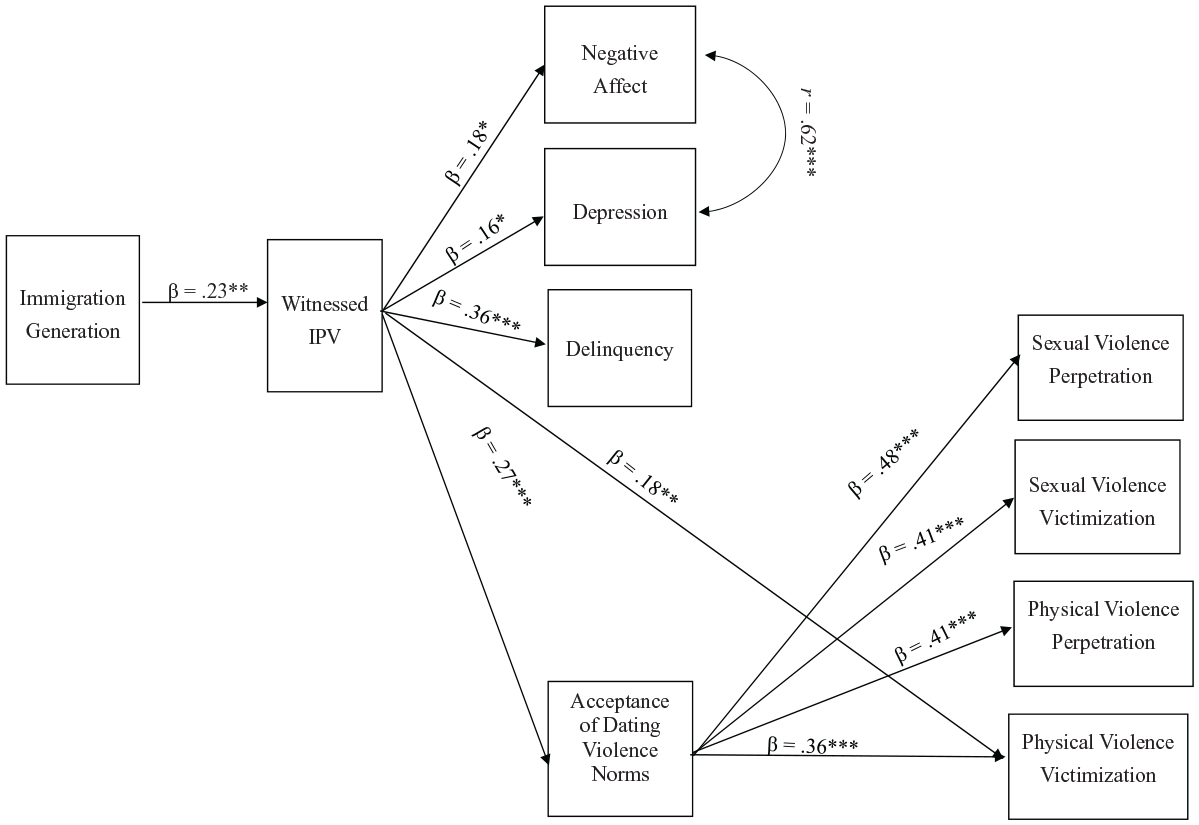
Path Model of Witnessing IPV to IPV Victimization and Perpetration.
Variance Accounted for in the Outcome Variables and Measures of Indirect Effects in the Mediator Variables.

Note. IPV = intimate partner violence; DV = domestic violence.
The p values of less than .05 are noted as significant.
Discussion
Consistent with previous research, we found that MA youth witness violence, including IPV, across the ecosystem. Over half of youth had witnessed at least one incident of IPV, one fifth within the past 2 weeks. The most common types of violence they witnessed were emotional and physical, and those typically occurred between their friends in either personal homes or at school. We utilized SLT to understand how witnessing IPV in these varied contexts (i.e., differential association) varied by immigration status and was associated with dating violence norms and behaviors. Risk of witnessing IPV increased with each immigration generation, where youth from families who had been in the United States longer were also more likely to have witnessed severe forms of violence. Although we did not directly assess youth’s cognitive appraisals of these events (i.e., differential reinforcement), witnessing at least one incident of IPV in the past 2 weeks was cross-sectionally associated with increased internalizing and externalizing symptoms. Acceptance of dating violence (i.e., definitions) was also positively associated with youth’s witnessing of IPV, which in turn was associated with being a perpetrator and victim of physical and sexual violence. According to SLT, these relationships help to elucidate factors associated with youth’s imitation of violence as witnessed in their day-to-day lives.
It is important to underscore that our study design does not allow for temporal or causal inferences and that our findings may not hold in a longitudinal mediation model (see O’Laughlin et al., 2018). Therefore, it is important to interpret findings with caution and as avenues for future research. The ordering of constructs within our cross-sectional model stemmed from SLT, prior research, and the otherwise plausibility of directionality. Specifically, SLT posits that witnessing violence may serve as a model whereby violence is learned (i.e., violence norms) and modeled (i.e., delinquency, dating violence). Prior research further supports that witnessing violence is associated with subsequent delinquency (Mrug & Windle, 2010) and violence perpetration (Mrug & Windle, 2010; Sadeh et al., 2014), and that acceptability of dating violence predicts one’s own involvement in violent relationships (Vagi et al., 2013). It is plausible that at least some youth have witnessed and reinforced violence given shared peer norms and activities (Akers & Lee, 1996); in this manner, witnessing violence is likely cyclical and associated with further witnessing of violence within peer environments (Dishion et al., 2010). Finally, with regard to affect, it seems more plausible that witnessing violence could influence depression and negative affect as opposed to the reverse. This is supported by research finding that having witnessed violence over the past year predicted internalizing and externalizing symptoms 16 months later (Mrug & Windle, 2010).
Immigrant youth face more violence, including IPV, across multiple contexts (Brady et al., 2008; Smokowski et al., 2009). Compared with national samples (Finkelhor et al., 2015), youth in our study were twice as likely to witness IPV between family members and over a shorter time period (8.4% in the past year vs. 18.1% in the prior 2 weeks). Risk for violence exposure increases as youth’s generational status increases, suggesting further attendance to the environments that youth navigate with length of stay (Horevitz & Organista, 2012). Although it is developmentally normative that adolescents increasingly engage more actively outside the family, immigrant youth’s parents are more likely to experience IPV as a result of acculturative stress (Caetano et al., 2007), which may contribute to these youth spending increased time away from home, increased time with peers, and reduced parental monitoring. It is noteworthy that nearly 80% of the witnessed IPV in our study occurred in contexts outside of their own home. Indeed, Updegraff and colleagues (2012) found that from early to late adolescence, Mexican-origin youth spent less time with family and experienced declines in familism values. Although they did not study exposure to violence, findings from our study may help to elucidate why youth in their sample also reported an increase in deviant behaviors over time. The positive association between witnessing violence across multiple contexts and deviancy, as well as dating violence norms, suggests an acceptability of violence that may be learned and translate into aggressive behaviors albeit in distinct ways across interpersonal, peer, and community contexts.
We recommend home-, school-, and community-based interventions for MA youth. Despite less time spent in the home, ethnic minority youth raised in low-income households are more likely to have experienced cumulative adversity and exposure to multiple forms of violence, including IPV (Turner et al., 2006). Interventions with adults are important because these may expose youth to less violence in the home. For youth, interventions should include peers. A large percentage (41.6%) of IPV incidents involved other teens (i.e., at friends’ or partners’ homes or in school) and another 30.6% were in neighborhoods or other public places. Schools are an ideal arena to help youth who would otherwise be difficult to reach (e.g., homeless youth; Temple et al., 2013), and policies that address dating violence are already in place in many states. These policies are often not implemented, however, likely because they are not financially incentivized (Rueda & Fawson, 2018). Rather, the responsibility to implement dating violence prevention efforts often falls on teachers and school helping professionals (i.e., counselors, psychologists, social workers) who are already overburdened with large caseloads (Rueda & Fawson, 2018). Given that 29 states require some form of sexual health education (National Conference of State Legislatures, 2018), this is a promising avenue for the inclusion of healthy relationship content within comprehensive sexual health curricula.
We found that witnessing violence was associated with delinquency and internalizing symptoms, including anxiety and low mood. Youth from ethnic minority communities can benefit from after-school and other recreational activities, which offer opportunity for building prosocial relationships with peers and mentoring adults (McGuire et al., 2016). Their decreased likelihood to participate should be considered in light of structural barriers and be targeted by imparting motivating factors specific to ethnic minority youth. These include increased positive interactions with peers and staff, integration of youth’s personal goals, and logistical considerations (McGuire et al., 2016). Faith-based interventions are also supported by research finding that Latinx youth who are highly involved in a spiritual or religious practice experience buffering effects against witnessing violence (Jocson et al., 2018). Furthermore, familism among Mexican heritage youth is protective against violence (see Hébert et al., 2017, for a review); thus, strengthening these values in programming may counter the decline that occurs as youth interact with U.S. society (Updegraff et al., 2012).
Limitations
There are a number of limitations of this study. One is that we captured youth’s experiences of witnessing violence within the past 2 weeks while capturing other constructs over a 1-year time frame. Other studies further suggest that adolescents’ witnessing of violence may vary from early to late adolescence, requiring longitudinal studies to assess its impact and consequences (e.g., Mrug et al., 2016; Taylor et al., 2018; Updegraff et al., 2012). Given our focus on witnessing interpersonal violence, we directly measured attitudes accepting of dating violence but did not include a measure of youth’s acceptance of delinquency. An avenue for future research is to explore how acceptance of dating violence norms may be related to acceptance of deviancy norms and whether the latter is associated with witnessing violence. Finally, our study is limited in its generalizability, particularly given that youth volunteered to take the survey either at their schools or through their involvement in after-school programs and community events. We recommend that future research use larger samples across different regions to increase generalizability and also to account adequately for confounding variables.
Although not necessarily a limitation, it is important to contextualize our study as taking place at the start of major changes in immigration policies, including Arizona’s SB1070. At its introduction in 2010, it was the nation’s most exclusionary bill on illegal immigration (Archibold, 2010). We did not study how these policy changes may have influenced violence within homes and communities; it may have hindered youth participation, however, and contributed to acculturative stress, which in turn has been associated with youth violence (Hurwich-Reiss & Gudiño, 2016). Furthermore, this study focuses on Mexican heritage youth; findings may not generalize to members of other Latinx communities.
Conclusion
Multiple studies have found that witnessing and experiencing violence are associated with one’s own use of interpersonal violence. However, not all who witness violence reenact it; the distinct pathways associated with violence perpetration and victimization have been understudied. Programming efforts targeting immigrant youth, and particularly MA youth, should understand that each successive generation may be more likely to witness violence across a range of contexts. Preventive interventions can help youth to challenge violence norms within intimate partnerships as well as to foster resilience across home, peer group, and community settings. Witnessing violence may be central to a host of negative outcomes, including deviancy, poor mental health, and dating violence. Future research should continue to explore these findings, including those regarding immigration experiences, with other diverse populations.
Footnotes
Declaration of Conflicting Interests
The author(s) declared no potential conflicts of interest with respect to the research, authorship, and/or publication of this article.
Funding
The author(s) received no financial support for the research, authorship, and/or publication of this article.
