



Abstract
The purpose of this study was to (a) explore the prevalence of, and gender differences in, self-reported physical, sexual, and psychological violence perpetration in dating relationships (i.e., not married or engaged), (b) evaluate the factorial validity of the Power Perceptions and Power Satisfaction Questionnaire in dating relationships, and (c) document the mediating role of power satisfaction in the associations between power perception and physical, sexual, and psychological dating violence perpetration. College students (N = 812) completed the Power Perceptions and Power Satisfaction Questionnaire and the Psychological Aggression, Physical Assault, and Sexual Coercion subscales of the Revised Conflict Tactics Scale. Gender differences emerged in the prevalence of physical (43.0% for women and 35.0% for men) and sexual violence (25.0% for women and 41.8% for men) but not psychological violence (80.1% for women and 75.5% for men). Exploratory factor and parallel analyses yielded two subscales of power perceptions and power satisfaction, which explained 40.56% of the variance. Mediation analyses revealed that college students who perceived lower relationship power were more dissatisfied with that relationship power and, in turn, perpetrated more physical, sexual, and psychological violence against their partners. The mediation effects were evident in both women and men. The implications of the current findings for future research and mental health professionals at colleges are outlined.
Keywords
Dating violence is “the threat or actual use of physical, sexual, and verbal abuse by one member of an unmarried couple on the other member within the context of a dating relationship” (Anderson & Danis, 2007, p. 88). Dating refers to “a relationship in which two individuals share an emotional, romantic, and/or sexual connection beyond a friendship, but they are not married, engaged, or in similarly committed relationship” (Murray & Kardatzke, 2007, p. 79). Rates of violence perpetration in such relationships were found to be relatively high across 31 samples from 16 different countries (Straus, 2004, 2008). Yet, evidence on the prevalence of dating violence is limited for non-Western countries, including Turkey.
Owing to the high prevalence of dating violence among emerging adults (Straus, 2004, 2008), it is crucial to identify risk markers for intervention and prevention. Although numerous risk markers have been discussed in the dating violence literature, the role of power perceptions and power satisfaction in predicting such behaviors has received limited attention, most probably due to the absence of a validated measure. Power perceptions refer to the amount of power one perceives she/he holds in the relationship and power satisfaction is the level of satisfaction one has with the amount of power she/he has in the relationship (Ronfeldt et al., 1998). Ronfeldt et al. (1998) proposed that the two constructs are conceptually distinct yet related in dating relationships. Empirical evidence supports the view that power perceptions and power satisfaction are positively related; yet, satisfaction with power, rather than perceptions of power, predicts physical and psychological dating violence perpetration (Rogers et al., 2005; Ronfeldt et al., 1998). A review of research on the relation between power and interpersonal violence suggests that intimate partner violence is the consequence of power rather than vice versa (Leone & Conroy, 2019).
In addition to validating a measure of power perceptions and power satisfaction and bringing the two complementary power issues to bear on dating violence, the present research investigates power and dating violence in a non-Western cultural context in which less is known about prevalence and risk factors. If power perceptions and power satisfaction emerge as predictors of violence in dating couples in a culture that is more morally restrictive than Western cultures, this may provide cross-cultural data on the critical role of power perceptions and power satisfaction in predicting dating violence (Clark et al., 2012).
Turkey offers a useful comparison culture because it is a predominantly Muslim country, but unusual in its secular and democratic structure. For example, alcohol is strictly forbidden in Islamic countries, particularly for Muslims. In Turkey, however, alcohol consumption is legal. However, drinking is less socially acceptable than in Western countries (Evered & Evered, 2016). Moreover, Turkey was the first country in the world to sign the “Law for the Protection of the Family and Prevention of Violence Against Women” promulgated in 2012. On the contrary, the country’s ruling party which has Islamic roots recently discussed a bill to allow men who marry or have sex with underage girls to avoid prosecution or jail time (“Why the Proposed Law Change, . . . ” 2020), which may decrease the legal age of consent and marriage to 13 years of age. Turkish culture has also been regarded as highly traditional and patriarchal with unequal opportunities for men and women (Okman-Fisek, 1982; Yüksel-Kaptanoglu et al., 2012). According to the Gender Inequality Index, which measures gender inequalities in three critical aspects of human development—reproductive health, empowerment, and economic status, Turkey is 59th of 189 countries (United Nations Development Programme, 2019). This position is reflected in everyday practices. For example, people still hold strong negative attitudes toward premarital sex for women, and they see women who have engaged in premarital sex as less desirable marriage partners (Sakallı-Uğurlu & Glick, 2003). Double standards regarding virginity and premarital sexuality are upheld even among the highly educated (Eşsizoğlu et al., 2011). In addition, Turkish culture is largely collectivistic (Göregenli, 1997; İmamoğlu, 2003) and has also been considered an honor culture, a specific form of collectivism. In honor cultures, one’s sense of worth depends heavily on the views of others (Gül & Schuster, 2020). For example, female partner infidelity, or suspicion of female partner infidelity, is a blemish on one’s reputation. Perhaps not surprisingly, women’s lives are strictly controlled by their partners (in dating and marital relationships), and honor killings of women by their partners are unusually common (Dilmaç, 2014). These happen despite legal amendments implemented to advance equal rights for women since the foundation of a secular and democratic Turkish Republic. However, such progress has faltered in the past two decades.
In summary, occupying a unique geographic location, lying partly in Asia and partly in Europe and holding both Eastern and Western values, Turkey provides a unique culture that presents the opportunity to explore both potentially universal and culturally specific characteristics of dating violence.
Dating Violence: Types, Prevalence, and Gender Differences
This study addresses three specific types of dating violence: physical, sexual, and psychological. Physical violence involves behaviors such as throwing something at a partner, slapping a partner, and punching or hitting the partner with something; sexual violence includes using force and threats to make the partner have oral, anal, or vaginal sex; and psychological violence involves behaviors related to verbal abuse such as shouting, name-calling, insulting the partner, isolating and/or ignoring them, and threatening a partner or making accusations against them (Straus et al., 1996).
An international study by Straus (2004) with a representative sample of 8,666 college students in 16 countries from the Far East, Australia and New Zealand, Europe, and Latin and North America revealed that a median of 29.0% of the participants had physically assaulted partners in the previous year. In another representative study, involving nearly 16,000 college students in 21 countries (from the Far East, Australia and New Zealand, Europe, and Latin and North America), the median physical violence perpetration rate was 30% (Chan et al., 2008).
Rates of sexual dating violence are also surprisingly high. Krahé et al. (2015) studied 3,480 young adults (aged between 18 and 27 years) in 10 European countries and found that 16.3% of male and 5% of female participants reported they had engaged in at least one act of sexual aggression. According to the international study conducted by Chan et al. (2008), a median of 20% of college students has committed sexually aggressive acts toward their partners in the past year.
Finally, the rate of psychological dating violence is higher than those for physical and sexual violence. Jenkins and Aube (2002) reported rates of 88.2% and 90.6% for psychological aggression among college men and women, respectively. Similarly, Shook et al. (2000) found that 80.0% of college men and 83.0% of college women reported the occurrence of psychological aggression in their dating relationships over the past year. A more recent study reported rates among college samples of 98.0% both for men and women (Torres et al., 2012).
Although rare, some studies investigate physical, sexual, and psychological aggression simultaneously in college students, as we do in this article. For example, Hines and Saudino (2003) reported that 82% of males and 86% of females perpetrated psychological aggression, while 29% of males and 35% of females perpetrated physical assault. The rates for sexual aggression were 29.0% for males and 13.5% for females. In a more recent study, Cornelius et al. (2010) obtained similar violence perpetration rates; for males 80.0% psychological and 31.0% physical, for females 83.0% psychological and 36.0% physical. Gender comparisons of physical and psychological violence perpetration yielded minimal or no differences, whereas sexual violence was higher in males (Chan et al., 2008; Hines and Saudino, 2003; Shorey et al., 2008; Straus, 2004; Torres et al., 2012).
Unfortunately, the studies cited above did not include samples from Turkey. However, two recent studies suggest that dating violence is also common among college-aged samples in Turkey. Among 1,015 dating college students, Toplu-Demirtaş (2015) found psychological aggression rates for the last 6 months were as following: hostile withdrawal (96.3% for women and 91.1% for men), restrictive engulfment (85.2% for women and 80.3% for men), denigration (54.8% for women and 50.0% for men), and dominance/intimidation (56.4% for women and 52.3% for men). Schuster et al. (2016) studied sexual aggression with (ex-)partners in the past 12 months and found that among 1,279 university students the following rates emerged, unwanted sexual touching (8.4% for women and 14.6% for men), attempted sexual intercourse (3.5% for women and 7.5% for men), and completed sexual intercourse (1.7% for women and 6.2% for men). As in Western samples, there were no gender differences in psychological aggression, but males engaged in more sexual aggression.
The studies in Turkey utilized less widely used measures, the Multi-dimensional Measure of Emotional Abuse (MMEA; Murphy & Hoover, 1999) for psychological aggression and the Sexual Aggression and Victimization Scale (Krahé & Berger, 2013) for sexual assault, and did not provide physical violence perpetration rates, which precludes comparison with prior findings. Therefore, the first purpose of this study is to investigate potential gender differences in the prevalence of psychological, physical, and sexual violence perpetration with a more widely used measure (the Revised Conflict Tactics Scale [CTS2]; Straus et al., 1996). More specifically, we expected that:
Power and Violence in Romantic Relationships
Research on power has a long history. One of the earlier attempts to conceptualize power comes from French and Raven (1959), who simply defined it as one’s ability to influence the other in a way that changes the other’s cognitions, emotions, or behaviors. This definition was adopted to investigate the dynamics of power in dyadic contexts, one of which is romantic relationships. Multiple theories of power have been proposed such as interdependence theory (Thibaut & Kelley, 1959), resource theory (Blood & Wolfe, 1960), feminist theory (see Hawkesworth, 2011, for a review), power-approach theory (Keltner et al., 2003), and more recently the dyadic power social influence model (Simpson et al., 2015). It is beyond the scope of this article to present a thorough discussion of each theory. However, it is not an oversimplification to suggest that their focus is on the absolute amount of power (derived from proposed sources such as rewards and costs, socioeconomic resources, gender, personality traits and skills, and dyadic characteristics) the person has in the relationship.
Although power is frequently related to intimate partner violence, the role of power in violence has been underresearched, particularly in dating relationships. Much of the existing research was informed by theories such as feminist theory (Hawkesworth, 2011) and resource theory (Blood & Wolfe, 1960), which adopt the premise that power imbalances between women and men may increase violence in intimate relationships. According to feminist theory, for example, violence against women in marriage reflects the absolute amount of power possessed by men and the unequal distribution of power. According to resource theory, it is not patriarchy per se, but insufficient resources (e.g., income, education, and skills such as communication and problem solving) that are the cause of violence in marital relationships.
These theories may be useful for understanding the role power plays in marital violence. Still, they do not thoroughly capture the nature and parameters of power in dating violence on several counts. First, in contrast to both spousal and dating relationships in previous decades, dating relationships are now more flexible and egalitarian due to less adherence to traditional gender roles beliefs. Or, more interestingly, adherence to traditional gender roles may function differently in dating relationships. For example, in the 1990s, Bookwala et al. (1992) found that less traditional sex-role attitudes for men and more traditional sex-role attitudes for women predicted the use of violence in college student dating relationships. Second, dating violence has been investigated, primarily among people in colleges, where men and women are receiving a similar level of education. Third, violence in dating relationships is widespread, yet it rarely results in severe injuries and is regarded as “common couple violence” contrary to “intimate terrorism,” in which victims (women) are more likely to suffer from serious injuries, both physical and mental (Johnson, 2006). Except for sexual violence, dating violence is largely mutual; men are not simply perpetrators, and women are not simply victims (Straus, 2004, 2008); Fourth, significant decisions in marital relationships such as parenting, division of household labor, purchases (house, car, etc.), plans, finances, vacations, family and in-law family, and religious activities are not made. However, who will have the final say and decision-making processes are still issues in dating relationships, which makes power a critical issue to research in such relationships, especially given the association between power and violence. Thus, novel constructs have emerged to address power issues in violent dating relationships.
Decades ago, Sprecher (1985) found that one’s power in a dating relationship and the perception of that power tended to correlate negatively, which may create different dynamics for the role of power in dating violence. Moreover, even though individuals, particularly women, indicate that they want more egalitarian dating relationships, 35 years of research reveal that dating relationships still continue to be highly gendered (Eaton & Rose, 2011), which implies that gender may still be a factor related to power and violence in dating relationships. We, therefore, turn to explore how perceptions of power relate to power satisfaction and violence in dating relationships.
Power Perceptions, Power Satisfaction, and Dating Violence
As a new attempt to understand the role of power, Ronfeldt et al. (1998) proposed that satisfaction with perceived relationship power rather than the absolute amount of relationship power may be a better predictor of violence perpetration in dating relationships. They found that satisfaction with power was significantly and negatively associated with physical and psychological violence among college men (Ronfeldt et al., 1998). Power perceptions, on the contrary, correlated positively only with psychological violence.
Kaura and Allen (2005) obtained similar findings in that dissatisfaction with relationship power predicted dating violence perpetration. Using data from 80 heterosexual dating college couples, Rogers and colleagues (2005) used the actor partner independence model to test the interactions between gender, perceived relationship power, and relationship power satisfaction for physical dating violence perpetration. Women who perceived their relationship power as low and were dissatisfied with that relationship power used more physically violent behaviors against their partners than women who perceived their relationship power as low but were satisfied with that relationship power (Rogers et al., 2005). However, a different pattern was observed for men. Regardless of their perceived level of relationship power, men who were dissatisfied with their relationship power perpetrated more physical violence against their partners than men who were satisfied with their power (Rogers et al., 2005). Overall, the study generally replicated and extended Ronfeldt et al.’s (1998) results in that power satisfaction rather than power perceptions was a stronger predictor of physical dating violence perpetration.
Notwithstanding the above findings, whether the level of influence on the partner is directly related to violence remains unclear. Specifically, the modest associations between power perceptions and dating violence perpetration give rise to the following question. Might power satisfaction mediate the associations between power perceptions and dating violence perpetration? Moreover, Rogers et al. (2005) examined only physical violence perpetration, which is an important limitation as power perceptions and power satisfaction may function differently in psychological and sexual dating violence perpetration. The third purpose of this study, therefore, is to investigate the mediating role of power satisfaction in the relationship between power perception and dating violence perpetration (i.e., psychological, physical, and sexual) among dating college students. More specifically, we expected that:
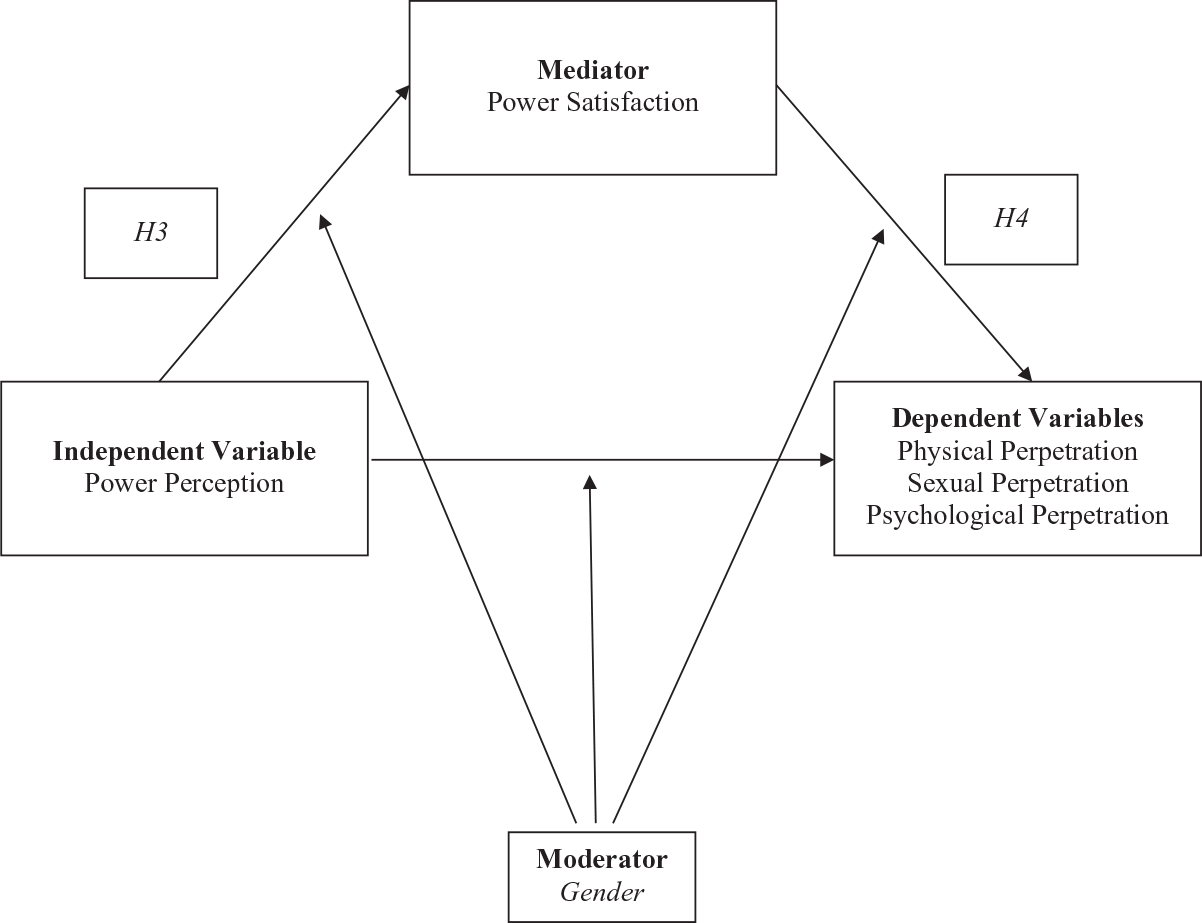
Power satisfaction mediating the relationships between power perception and physical, sexual, and psychological dating violence perpetration.
We further investigated whether gender moderated the direct and indirect associations in H3, H4, and H5. As the role of gender in the proposed hypotheses above is either lacking or controversial, we do not offer any hypotheses regarding moderation.
Assessment: Power Perceptions and Power Satisfaction
Previous studies on power perceptions and power satisfaction (i.e., Kaura & Allen, 2005; Rogers et al., 2005; Ronfeldt et al., 1998) used the original or revised versions of the Power Perception and Power Satisfaction Questionnaire. In the original version, Ronfeldt et al. (1998) assessed power perceptions with six items that asked participants to indicate which partner had a greater impact in specific situations. They later deleted an item due to reliability issues. Then, participants indicated how satisfied they were with their impact in specific situations. Validity evidence regarding the original scale was not provided.
Rogers et al. (2005) later modified the original scale. The revised version involved 24 items, 12 of which asked respondents to report how much power they perceived they have in the relationship, and 12 of which asked respondents to report how satisfied they were with their perceived relationship power. The conceptualization of two separate but related constructs remained the same, but the number of items increased, and the situations became more specific. For example, the item “Who has more say about how much time the two of you spend with other people?” in the original version evolved into several items: “Who has more say about how much time the two of you spend together?,” “Who has more say about how much time the two of you spend with friends?,” and “Who has more say about how much time the two of you spend with family members?”
Although promising, the modified scale lacks sound validity data. It also has not been used with samples from Turkey. Therefore, another purpose of this study was to examine the utility of the Power Perception and Power Satisfaction Questionnaire in a sample of participants in Turkey and to provide evidence on factorial validity for this measure.
This Study
In short, this study had the following three purposes:
To document the prevalence of, and potential gender differences in self-reported physical, sexual and psychological dating violence perpetration in Turkish college students.
To evaluate the psychometric properties (factorial validity and reliability) of the Power Perception and Power Satisfaction Questionnaire in a sample of participants in Turkey.
To examine the mediating role of power satisfaction in the associations between power perception and physical, sexual, and psychological dating violence perpetration among dating college students with gender as a moderating variable.
Method
Participants
College students from four state universities in a Midwestern city in Turkey participated in the study. Of 1,057 participants, 138 did not have a current relationship (13.1%), 75 were engaged (7.1%), 30 were married (2.8%), and two did not indicate their relationship status (0.2%). The rest defined their relationship status as dating (N = 718; 67.9%) and cohabiting (N = 94; 8.9%). Due to the dating definition we used, we excluded married and engaged participants. Participants unclear about their relationship status were also not included in the analyses. Therefore, the final sample comprised 812 college students (women = 428 [52.7%], men = 383 [47.2%]), and one person who identified as other. Participants ranged in age from 18 to 35 years, with a mean age of 21.44 (SD = 2.34). A substantial percentage of the sample reported being an undergraduate (N = 731; 90.2%). The rest were graduate students (N = 81; 9.8%). Relationship length varied from 1 to 144 in months (M = 16.17; SD = 17.25).
Measures
Demographics
We included questions regarding participant sex, age, educational level, relationship status, and relationship length in the demographic form.
Dating violence perpetration
Participants completed the Psychological Aggression (PsyA), Physical Assault (PhyA), and Sexual Coercion (SC) subscales of the CTS2 (Straus et al., 1996). The eight-item PsyA involves items such as shouting, yelling at partner, and accusing the partner of being a lousy lover. The 12-item PhyA includes items such as throwing something at the partner, slapping the partner, and punching or hitting the partner with something. The seven-item SC involves items such as using force and threats to make the partner have oral, anal, or vaginal sex. All CTS2 items were rated on a 7-point frequency scale for the past 12 months (never, once, twice, 3–5 times, 6–10 times, 11–20 times, and more than 20 times), with an additional response option (not in the past 12 months, but it has happened before). Scores for subscales were formed by summing the item response category values. As recommended by Straus et al. (1996), and as we were interested in the use of violence in the past 12 months, we re-coded the Response Category 8 (not in the past 12 months, but it has happened before) as zero. Higher scores indicate greater psychological, physical, and sexual violence perpetration. Turhan et al. (2006) translated the CTS2 into Turkish and evaluated its preliminary psychometrics among married women. They demonstrated that the psychometrics were satisfactory. Coefficient alpha in this study was .78, .89, and .76, for PsyA, PhyA, and SC, respectively.
Power perception and power satisfaction
To measure power perception and power satisfaction, we used a modified version (Rogers et al., 2005) of the Power Perception and Power Satisfaction Questionnaire. For this study, we translated the scale into Turkish through a rigorous forward translation-back translation method to ensure conceptual and linguistic equivalency. An instructor from the Department of Turkish Language reviewed the Turkish version in terms of grammar, and with her feedback, we made minor revisions. We then conducted cognitive interviewing (Collins, 2003) with four college students (two undergraduates: one woman and one man; two graduates: one woman and one man). We asked them to assess the instrument in regard to overall appearance and length, clarity of the instructions and items, and choice of rating scale by thinking aloud while completing the scale. They did not provide any criticism but had some suggestions regarding the overall appearance. After acting on these suggestions, we finalized the scale for testing.
The scale comprised 24 items. Twelve items assessed perceived power (PP) in the relationship (e.g., “To what degree do you think that you influence how much time you and your partner spend with each other?”). The remaining 12 items measured power satisfaction (PS) by asking how satisfied one is with his or her power in the relationship (e.g., “To what degree are you satisfied with the influence you have over how much time you and your partner spend with each other?”). Participants responded to items on a 7-point Likert-type scale ranging from 1 (almost none of the time) to 7 (almost all of the time). Items 4, 7, and 8 both for PP and PS items are reversed coded. The total scores vary between 12 and 84. Higher scores in PP and PS reflect higher perceived relationship power and power satisfaction, respectively. Ronfeldt et al. (1998) reported internal consistency coefficients as .62 for the PP and .74 for the PS. Both Ronfeldt et al. (1998) and Rogers et al. (2005) failed to provide any validity data.
Procedure
Throughout the data collection, we followed the requirements of the Human Subjects Ethics Committees of the universities. Instructors were contacted via email to ask for their collaboration. In participating classes, the first author informed prospective participants about the study, its voluntary nature, and participation criteria (i.e., being voluntary, being 18 years of age or older, a college student, and having a past or current relationship). We collected consent forms separately from the completed questionnaires to ensure confidentiality and anonymity. It took 10–15 min for participants to complete the survey. There were no incentives for participation.
Data Analysis
We initially performed an exploratory factor analysis (EFA) on the items used to assess power perceptions and power satisfaction and a parallel analysis (PA) to decide the number of factors. Then, we explored the self-reported prevalence of psychological, physical, and sexual dating violence perpetration for males and females. Next, we examined correlations between independent (power perception), mediator (power satisfaction), and outcome variables (psychological, physical, and sexual dating violence perpetration). Finally, we utilized three separate mediation analyses with PROCESS (Hayes, 2013) to see if power satisfaction mediated the associations between power perception and dating violence perpetration (i.e., psychological, physical, and sexual) with gender as a moderator.
Results
First, we present results relating to the factorial validity and reliability of the Power Perceptions and Power Satisfaction Questionnaire followed by analyses of gender differences in the prevalence of self-reported physical, sexual, and psychological dating violence perpetration. Finally, we report the results for the moderated mediation analyses.
Validity and Reliability of the Power Perceptions and Power Satisfaction Questionnaire
Factor analysis
To determine the factor structure of the Power Perception and Power Satisfaction Questionnaire, we ran an EFA. Before doing so, we checked the assumptions for this analysis. The sample size exceeded the recommended subject to variable ration (20:1 ratio, Hair et al., 2010). Bartlett’s Test of Sphericity was significant χ2(16) = 8,284.16; p = .00; and the Kaiser–Mayer–Olkin (KMO) value (.90) exceeded the recommended minimum (.60), both of which ensured the factorability of the data (Hair et al., 2010). To check multivariate normality, we used Mardia’s test. Its significance indicated a violation of the multivariate normality assumption. Thus, we selected principal axis factoring for factor extraction as recommended by Fabrigar et al. (1999) due to its robustness against the violation of multivariate normality. As a rotation method, we selected oblique rotation (direct oblimin) as we expected our factors to be correlated (Preacher & MacCallum, 2003).
The EFA yielded five factors with eigenvalues greater than 1 (eigenvalues for Factor 1 = 7.336, Factor 2 = 3.508, Factor 3 = 1.235, Factor 4 = 1.143, and Factor 5 = 1.055), explaining 60.04% of the total variance. However, the scree plot showed a clear break between the second and third factors. To decide on the number of factors, we used PA, a technique developed by Horn (1965) to handle the overestimation of the eigenvalue greater than one criterion. The logic behind PA is that it produces random datasets of the same size and number of variables as in the original dataset. For interpretation, one should compare the eigenvalues provided by the original data and those produced from the random data. If the eigenvalues from the original data are larger than the ones from the random data, they are accepted; if not, they are rejected.
We used Watkins’s (2000) Monte Carlo procedure for the PA. We set the number of variables as 24 and subjects as 812 as in the original dataset with the number of replications as 1,000. The random eigenvalues were as follows: F1 = 1.3226, F2 = 1.2741, F3 = 1.256, F4 = 1.2021, and F5 = 1.1718. The results demonstrated that we should accept the first two factors and reject the rest of the factors, implying a two-factor structure. Hinkin (1998) also suggests the use of the theory proposed for the factor structure to decide on factor extraction. Therefore, we re-ran the analysis and forced the two-factor solution in light of the statistical and theoretical evidence and the proposed two-factor structure.
The new factor structure accounted for 40.56% of the total variance. The factor loadings are displayed in Table 1. All the items had factor loadings higher than .30 (Hair et al., 2010) and no items cross-loaded on the other factor. The factors are labeled as “Power Perception” and “Power Satisfaction,” and both factors included 12 items as the revised scale by Rogers et al. (2005).
Factor Loadings, Mean Scores, and Standard Deviations of the Scale Items and Percentages of the Variances.
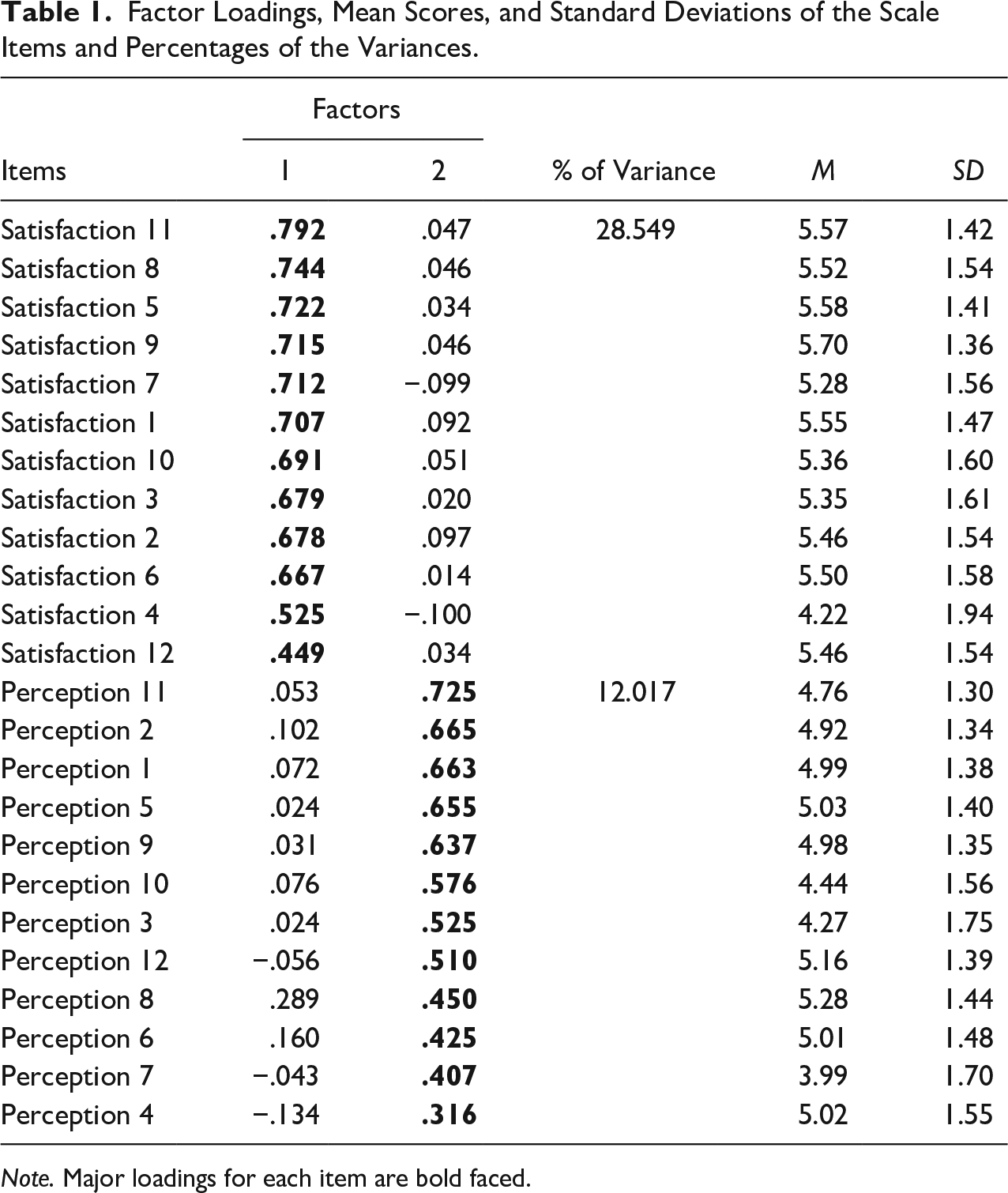
Note. Major loadings for each item are bold faced.
Reliability
We calculated Cronbach’s alphas for internal consistency. Both PP (.83) and PS (.91) subscales had coefficients higher than the minimum (.70) recommended by Nunnally (1978).
Gender Differences in the Prevalence of Dating Violence Perpetration
Dichotomous 0/1 scores were assigned (“yes” and “no”) to determine prevalence. At least one violent behavior in the last 12 months was sufficient for a “yes” for each type of violence. Of 428 women, 343 (80.1%), 184 (43.0%), and 107 (25.0%) reported perpetrating psychological, physical, and sexual dating violence, respectively. Of 383 men, 289 (75.5%), 134 (35.0%), and 160 (41.8%) indicated using psychologically, physically, and sexually violent behaviors, respectively. Gender differences did not emerge in the prevalence of psychological violence, χ2(1, N = 811) = 2.31, p = .13, φ = −.06, but did emerge for physical, χ2(1, N = 811) = 5.43, p = .02, φ = −.08, and sexual dating violence, χ2(1, N = 811) = 25.00, p = .00, φ = .18.
Correlation Analysis
Table 2 shows the zero-order correlations among the variables used in the mediation analyses. The only significant association from power perception to violence perpetration was for sexual violence, r = −.07, p < .05. In contrast, power satisfaction was negatively related to all three forms of violence; psychological (r = −.29, p < .01), physical (r = −.25, p < .01), and sexual (r = −.16, p < .01) perpetration. Power perception and power satisfaction were positively correlated, r = .31, p < .01; that is, dating college students who perceived more relationship power were more satisfied with their power in their relationships. Psychological, physical, and sexual dating violence perpetration showed strong and positive correlations.
Cronbach Alphas, Mean Values, and Standard Deviations and Nonparametric Correlations among Study Variables.
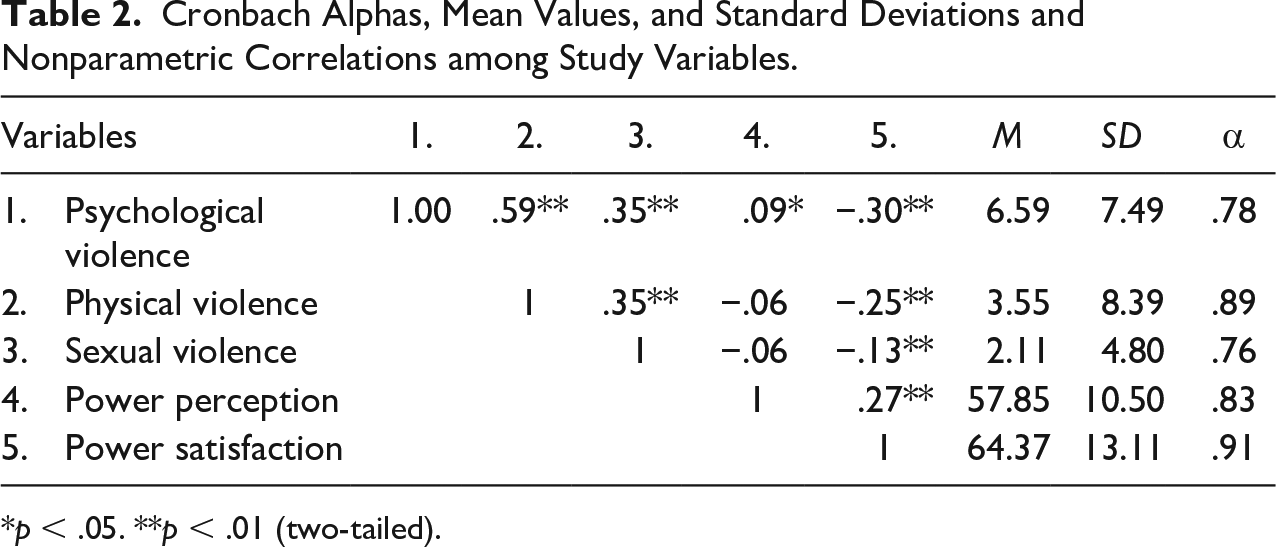
p < .05. **p < .01 (two-tailed).
Moderated Mediation Analysis
We performed three separate moderated-mediation analyses, one for each type of dating violence perpetration (physical, psychological, and sexual) using PROCESS (Hayes, 2013, Version 3.4, Model 59; see Figure 1). Model 59 in PROCESS allows testing mediation (indirect effect of power perceptions on types of dating violence through power satisfaction) and moderation (conditional effect of gender) on the direct and indirect effects, simultaneously. For each dependent variable (physical, psychological, and sexual violence), the model was tested using 5,000 bootstrap samples.
The model tested comprised two components, one where the mediator (power satisfaction) was the outcome variable and one where a type of violence (e.g., physical violence) served as the outcome variable. In the first component, power satisfaction was regressed on power perceptions, gender, and their interaction. As this component is the same in analyzing each form of violence, we report it only once in the tables that summarize the three analyses (Table 3). The second component involved regressing the type of violence on power perceptions, power satisfaction, and gender together with the Power Perception × Gender Interaction and Power Satisfaction × Gender Interaction. In sum, we tested the conditional effect of gender (1 = woman and 2 = man) on each path in the model.
Model Summary for the Association between Power Perceptions and Dating Violence Perpetration Through Power Satisfaction by Gender.
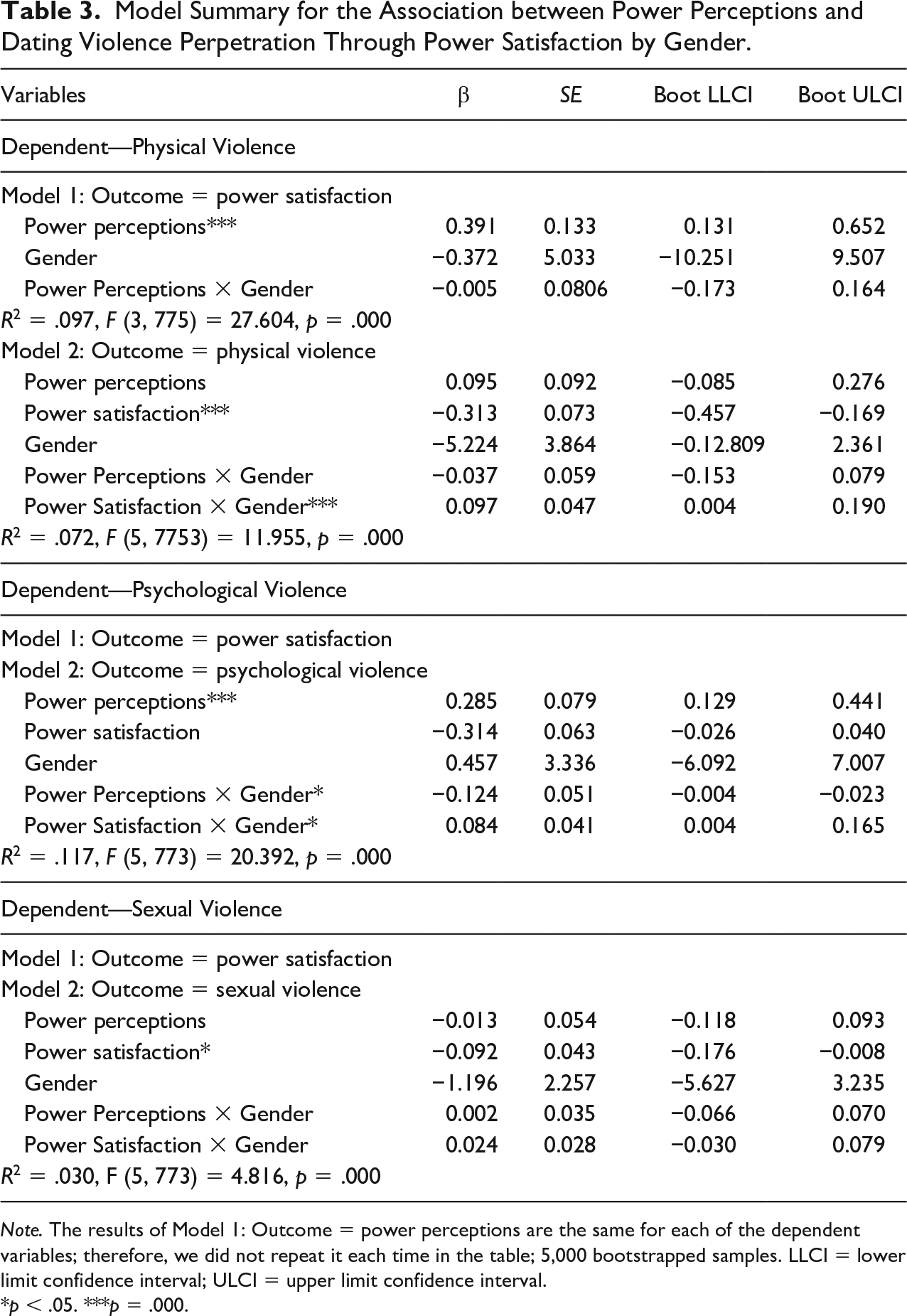
Note. The results of Model 1: Outcome = power perceptions are the same for each of the dependent variables; therefore, we did not repeat it each time in the table; 5,000 bootstrapped samples. LLCI = lower limit confidence interval; ULCI = upper limit confidence interval.
p < .05. ***p = .000.
For physical violence perpetration, power perceptions predicted power satisfaction, β = .391, t(775) = 2.946, 95% confidence interval (CI) = [0.131, 0.652], but no gender or Gender × Perceptions effects emerged. Power satisfaction, β = −.313, t(773) = −4.266, 95% CI = [−0.457, −0.169], and Gender × Power Satisfaction, β = .097, t(773) = 2.052, 95% CI = [0.004, 0.190], significantly predicted physical violence. Regarding the Gender × Power Satisfaction moderation, the slope for women (β = −.216, 95% CI = [−0.280, −0.152]) was larger than for men (β = −.119, 95% CI = [−0.187, −0.051]). Direct effects of power perceptions on physical dating violence perpetration were not significant both for women and men. However, there was evidence of mediation as students with less perceived power were less satisfied with their power and, in turn, more prone to use physically violent behaviors. This indirect effect was evident for both women (β = −.084, 95% CI = [−0.142, −0.038]) and men (β = −.045, 95% CI = [−0.076, −0.020]) (Table 4).
Conditional Indirect Effects of Power Perceptions on Dating Violence Perpetration Through Power Satisfaction With Gender as Moderator.
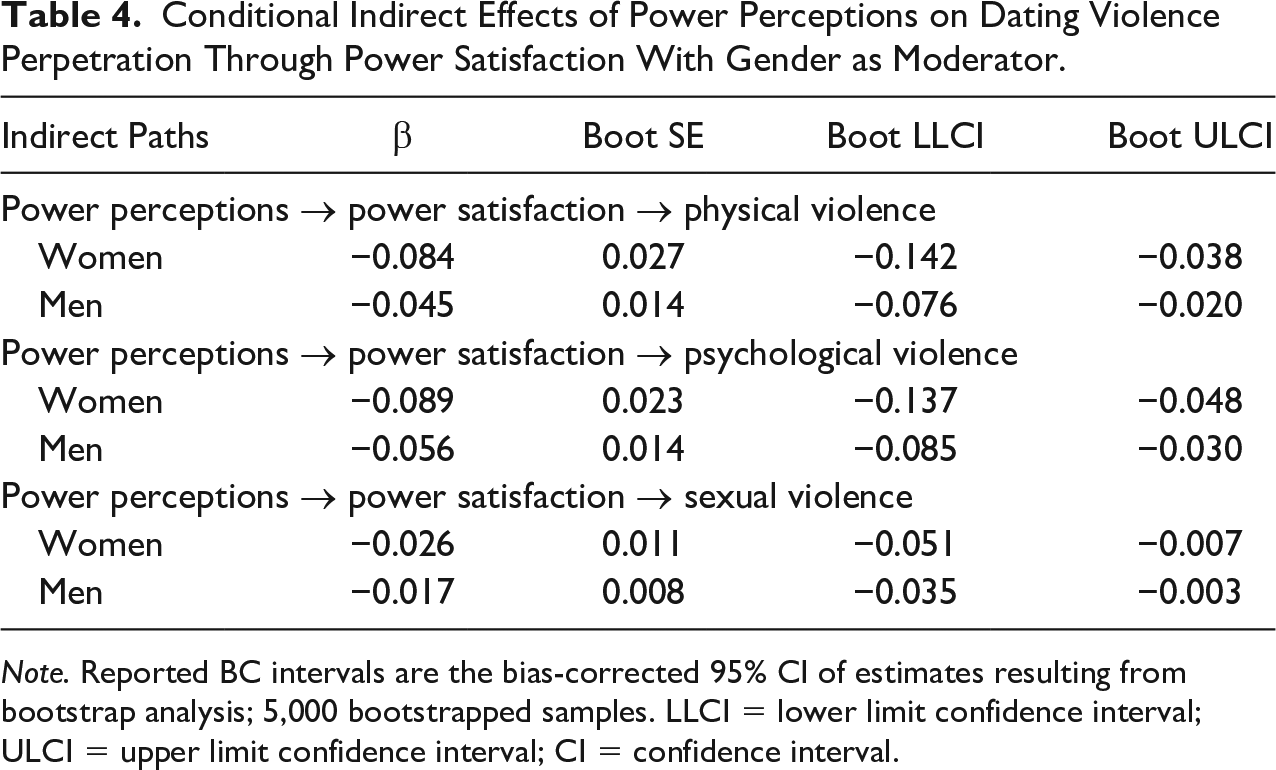
Note. Reported BC intervals are the bias-corrected 95% CI of estimates resulting from bootstrap analysis; 5,000 bootstrapped samples. LLCI = lower limit confidence interval; ULCI = upper limit confidence interval; CI = confidence interval.
For psychological violence, all direct associations were significant in the model, except for the paths from power satisfaction to psychological violence, β = −.314, t(773) = −.017, 95% CI = [−0.026, 0.040], and gender to psychological violence, β = .495, t(773) = .137, 95% CI = [−6.092, 7.007]. The Gender × Power Perceptions effect reflected the fact that the power perception psychological violence path was significant for women (β = .161, 95% CI = [0.093, 0.230]) but not for men (β = .037, 95% CI = [−0.036, 0.111]). The Gender × Power Satisfaction direct effect was larger for women (β = −.230, 95% CI = [−0.285, −0.175]) than men (β = −.146, 95% CI = [−0.204, −0.087]). We also found significant indirect effects for women (β = −.089, 95% CI = [−0.137, −0.048]) and men (β = −.056, 95% CI = [−0.085, −0.030]). Dating college men and women with less power were less satisfied with power and thus more likely to use psychological aggression toward their partners.
For sexual violence, all moderated and nonmoderated effects were nonsignificant, except for the direct effect from power satisfaction to sexual violence, β = −.092, t(443) = −2.150, 95% CI = [−0.176, −0.008]. Dating college students who were more dissatisfied with their power displayed more sexually aggressive behaviors toward their partners. The indirect effect from power perceptions to sexual violence was significant both for women (β = −.026, 95% CI = [−0.051, −0.007]) and men (β = −.017, 95% CI = [−0.035, −0.003]).
Discussion
The purpose of this study was threefold. First, it explored the prevalence of and gender differences in self-reported physical, sexual, and psychological dating violence perpetration in a non-Western culture. Second, it examined the utility of the Power Perception and Power Satisfaction Questionnaire in a Turkish sample and provided much needed factorial validity data for the measure. Third, it examined the roles of power perception and power satisfaction in the use of physical, sexual, and psychological violence perpetration among dating college students.
Compared with most of their counterparts all over the world, Turkish college students reported relatively high rates of physical (for women, 43.0% and for men, 35.0%), and sexual (for women, 25.0% and for men, 41.8%) dating violence perpetration. For example, in the international study by Chan et al. (2008), college students from 21 countries reported perpetration rates for physical violence from 14.3% (Singapore) to 68.4% (Greece) for males and from 16.2% (Sweden) to 46.6% (Mexico) for females. In the same study, sexual perpetration rates were from 9.3% (Hong Kong) to 62.2% (Greece) for males and from 5.9% (Belgium) to 28.9% (Brazil) for females in the past 12 months. According to the comprehensive dating violence research of Straus (2008) for 32 countries, only participants from Iran reported more physical dating violence. Contrary to the findings for physical and sexual violence, psychological aggression perpetration rates (for women, 80.1% and for men, 75.5%) reported by Turkish students were similar to their Western counterparts (i.e., Jenkins & Aube, 2002; 90.6% for women and 88.2%; for men; Hines & Saudino, 2003, for women, 86.0% and for men, 82.0%). As previously found (Murray & Kardatzke, 2007; Shorey et al., 2008), psychological aggression was the most, and sexual coercion was the least frequently perpetrated form of violence, with physical assault being intermediate.
Our first two hypotheses concerned possible gender differences in dating violence perpetration. We found that college women (80.1%) reported a slightly higher rate of psychological aggression perpetration than men (75.5%). As specified in Hypothesis 1, this difference was not statistically significant, a finding consistent with prior results (i.e., Hines & Saudino, 2003; Jenkins & Aube, 2002; Toplu-Demirtaş, 2015; Torres et al., 2012). College men (41.8%) reported considerably higher rates of sexual aggression perpetration than women (25.0%), and as we hypothesized (H2), this difference reached statistical significance, again in line with the previous findings (Chan et al., 2008; Krahé et al., 2015). We also found that contrary to H1, college women (43.0%) reported a higher rate of physical aggression perpetration than men (35.0%), and this difference was statistically significant. Although the literature is contradictory concerning the role of gender in the prevalence of physical aggression perpetration, contrary to our hypothesis, we found gender differences in reported physical violence perpetration. Thus, our first hypothesis was only partially supported. However, an important consideration when assessing relationship violence is the intention and potential purpose it serves in the relationship. Surveys, such as the CTS2, are limited in their ability to determine whether violent behaviors were utilized in self-defense or serve as a protective function (Murray & Graves, 2012). Therefore, one should judiciously interpret results regarding higher rates of physical assault perpetration in women as women have historically been at higher risk for more severe forms of abuse in dating and other types of romantic relationships (Murray & Graves, 2012).
Even Chan et al.’s (2008) study revealed that college men compared with college women were the perpetrators of more injurious physical assault in almost all countries. Whether or not associated with gender, such high rates of psychologically, physically, and sexually aggressive behaviors in the current college sample are cause for concern. Moreover, our study of a non-Western sample also revealed that multiple forms of dating violence perpetration co-occurred, with psychological and physical aggression being more related to each other than psychological and sexual aggression. Sexual and physical aggression perpetration were highly correlated.
Although utilized several times in different studies (i.e., Kaura & Allen, 2005; Rogers et al., 2005; Ronfeldt et al., 1998), we provided initial factorial validity evidence for the Power Perception and Power Satisfaction Questionnaire. The results of the EFA and PA confirmed the a priori two-factor structure of the Power Perception and Power Satisfaction Questionnaire with a dating college sample from Turkey. Both power perception and power satisfaction were represented by the 12 items hypothesized with significant loadings over .30. Reliability coefficients for the two subscales were above the recommended standard of .70 for research measures (Nunnally, 1978). The significant and positive correlation between the two subscales (r = .31) provided further evidence for conceptually distinct yet related constructs. College students who perceived higher power in dating relationships were more satisfied with their relationship power (Rogers et al., 2005; Ronfeldt et al., 1998). In short, adequate evidence was obtained for the reliability and factorial validity of the Power Perception and Power Satisfaction Questionnaire to justify its use in this initial study.
Turning to our third hypothesis concerning the relationship between power perceptions and power satisfaction, we found that power perceptions were related to power satisfaction in the manner predicted as students who perceived less power in their dating relationships were dissatisfied with the relationship power, a finding consistent with prior results (Rogers et al., 2005; Ronfeldt et al., 1998). Thus, our third hypothesis was supported. Gender was not a moderator in the association. The fourth hypothesis that specified a negative relationship between satisfaction with relationship power and different types of dating violence perpetration was also supported. This parallels earlier findings and provides evidence for criterion-related validity (Kaura & Allen, 2005; Rogers et al., 2005; Ronfeldt et al., 1998). College students who felt less satisfied with perceived power in their dating relationships committed more psychological, physical, and sexual violence, which was not surprising. Different patterns emerged for each violence type regarding the role of gender as the moderator of the relation between power satisfaction and dating violence perpetration. For physical and psychological violence, the moderator effect was significant and negative (and larger for women), whereas, for sexual violence, it was not.
Our final hypothesis tested satisfaction with relationship power as a potential mechanism that might account for the association between perception of relationship power and dating violence perpetration. We found that college students who perceived their relationship power as low and who were dissatisfied with that relationship power, in turn, perpetrated more physical, sexual, and psychological violence against their partners. The mediation effects were evident in men and women. Our findings for the mediating hypothesis not only replicated but extended those of Rogers et al. (2005). We extended their findings because we included not only physical violence as they did but also psychological and sexual violence. The lack of research on the relationships between power perceptions, power satisfaction, and physical, sexual, and psychological dating violence perpetration in Turkish samples and the broader literature makes it impossible to offer further comparisons with previous findings. However, the nonsignificant, or significant yet low correlations, between power perceptions and dating violence perpetration further supported Ronfeldt et al.’s (1998) assumption that satisfaction with perceived relationship power rather than the absolute amount of relationship power is a better predictor of violence perpetration in dating relationships. The findings suggest that college students may become physically, sexually, and psychologically violent in response to dissatisfaction with relationship power as a means of controlling their dating partners. The risk of higher violence appears to stem not from the perceived distribution of power but rather from dissatisfaction with power in the dating relationships, particularly those in which violence is more frequent but less intense/severe and gendered (which is largely reflected in community-based and college samples) as Johnson (2006) argued.
Perceived power in this study measured how couples made decisions about where, with whom, and how they spend time and make purchases. It also measured “one’s ability to resist decisions made by the partner,” a relatively new definition of power also proposed by Simpson and colleagues (2015) and built into the Relationship Power Inventory (Farrell et al., 2015). In other words, both the Power Perception and Power Satisfaction Questionnaire and Relationship Power Inventory provide similar conceptualizations of power, one in dating relationships and the other in marital relationships (or cohabiting relationships with children). We believe that this novel conceptualization sheds more light on the dynamics of power in dating relationships; power (perceptions or satisfaction) seems to permeate interactions in romantic relationships. For example, though we did not measure sex-related decisions directly, the results imply that one’s ability to change and to resist in decision-making in the other areas of the relationships is related to sexual dating violence, as well.
Moreover, regarding our third, fourth, and fifth hypotheses, we found very limited evidence for gender differences. What might explain the relative lack of gender differences? One possible explanation might be gender balance in education in this sample. Although significant differences remain in gender roles, dating relationships appear to be more egalitarian in terms of education and, accordingly, income. This might increase women’s ability to influence her partner or to resist his influence, which results in narrowing the gender gap in terms of power perceptions, and thus power satisfaction.
As revealed by Impett and Peplau’s (2006) review, earning more money, being more educated, or having a prestigious job advantages the partner’s power. This may also explain why women, as well as men, behave more aggressively; to regain a sense of power and power satisfaction. It seems that perceiving less power and wanting more power might culminate eventually in violence (Kim et al., 2019) in dating relationships. Flipping the perspective of our findings, we can also say one’s perceptions of more power via higher power satisfaction decreases the risk of behaving violently. In both interpretations, we don’t know (because we did not measure) “the actual power” one has in the relationship. So, there may still be a power imbalance in favor of men that reflects traditional sex roles (Peplau & Campbell, 1989). As the paucity of gender differences was also observed in previous studies conducted in the United States, the effect does not appear to be culture-specific but rather universal.
Recommendations for Future Research
This study represents an initial step in the validation of the Power Perception and Power Satisfaction Questionnaire. Future studies should continue to collect data to document the nomological network of the constructs assessed by the measure to establish construct validity. Such data would optimally come from diverse samples and would reflect dating relationships not only in college samples but also those who do not participate in tertiary education and who have been referred to as the “forgotten half” about which little is known in both Western and Asian countries (Halperin, 1998; Nelson & Chen, 2007). In particular, power perceptions and power satisfaction should be studied in relation to gender-related constructs, such as adherence to traditional gender stereotypes, attitudes accepting of aggression, perceptions of violence, and justification of violence. A dyadic perspective that explores accuracy and bias in the perceptions of power in dating relationships would help capture the dynamics of power in couples. In this regard, the Investment Model (Rusbult, 1983) may be useful for answering the question of why college students who are dissatisfied with power choose to stay (and use violence) rather than leave their dating relationship. Moreover, the popularization of smartphones and social media in the lives of college students has provided a new means of perpetrating violence by means of cyber-bullying, cyber-stalking, and cyber-control of the partner. Research on perceptions of, and satisfaction with, relationship power in regard to newer forms of violence would advance our understanding of power issues in dating relationships.
This study was exploratory, and therefore used brief instruments, such as the PsyA, PhyA, and SC subscales of the CTS2 (Straus et al., 1996), to gauge psychological, physical, and sexual dating violence perpetration. Future studies would profit from employing more sophisticated measures, particularly for psychological aggression such as the MMEA (Murphy & Hoover, 1999) and for sexual aggression, such as the Sexual Aggression or Victimization Scale (Krahé & Berger, 2013) or Sexual Experiences Scale (Koss et al., 2007). This will facilitate a fuller understanding of the associations among power perceptions, power satisfaction, and psychological and sexual violence perpetration. Furthermore, considering the dearth of research on the validation of the Power Perception and Power Satisfaction Questionnaire, it would be valuable to assess measurement invariance across cultures, age, gender, and sexual orientation.
Limitations and Conclusion
The results of this study should be interpreted in light of several limitations. First, we collected data from dating college students enrolled in state universities in the capital city, which might be relatively liberal. Thus, sampling bias may be a significant issue for the generalizability of the findings. Replication of this research with more diverse and, if possible, randomly selected college samples would strengthen its novel findings. By diversity, we refer to college samples from different regions (e.g., rural and urban), age groups (e.g., younger and older), and subcultures (e.g., lesbian, gay, bisexual, trans, and queer [LGBTQ]). Second, the design of the study is correlational; therefore, we cannot infer causality. Longitudinal research is needed to understand the potential direction of effects. Third, we utilized self-report and retrospective data, which are subject to mono-method and social desirability biases. To address mono-method bias, utilizing dyadic data will help us gain insight into the interactional dynamics of couples. To address social desirability bias, we suggest online administration of dating violence measures to afford more privacy and use of social desirability measures as a control variable. However, it is worth noting that in a recent study with a similar sample, Toplu-Demirtaş et al. (2018) found that social desirability bias did not influence college students’ responses to questions about psychological dating aggression. Nevertheless, adding social desirability as a control variable will also provide further validity evidence for the Power Perception and Power Satisfaction Questionnaire.
Despite its limitations, the study has several strengths. It is the first to report on gender differences in the prevalence of self-reported physical, sexual, and psychological dating violence perpetration and the first to investigate the relationships among physical, sexual, and psychological dating violence perpetration in a sample of dating college students in Turkey. Although it needs further validation, the translation, cultural adaptation, and preliminary psychometrics of the Power Perception and Power Satisfaction Questionnaire is a promising attempt to fill the need for a sound instrument to gauge power perceptions and power satisfaction among dating college students.
Next, in addition to replicating and extending Ronfeldt et al.’s (1998) and Rogers et al.’s (2005) work, this study shows that satisfaction with relationship power mediates the associations between power perceptions and violence perpetration among Turkish college students in dating relationships. The Power Perception and Power Satisfaction Questionnaire will allow further investigation of college students’ power issues in dating relationships, and power perceptions and power satisfaction can offer an alternative lens for understanding the driving forces behind violence perpetration in college students’ dating relationships.
Importantly, this study provides data from a different culture, one which is predominantly collectivistic, with a greater emphasis on relationship harmony. To our knowledge, most of the research on power and dating violence has been conducted in Western cultures, suggesting the need to replicate results in different sociocultural contexts (even among people in Western sub-cultures). We believe findings from a non-Westernized country contribute to the growing literature on power and dating violence.
The current findings also have implications for those interested in fostering healthy dating relationships that are free from violence. One implication might be for mental health professionals at colleges who aim to deliver psychoeducation to prevent dating violence. Our findings suggest that mental health practitioners at colleges focus on desired power rather than actual power in their efforts to reduce vulnerability to dating violence perpetration.
Given the finding that power imbalance is one of the reasons why couples seek therapy (Parker, 2009), there is a need to develop relationship skills regarding decision-making at the individual and couple levels. Indeed, research on shared decision-making among married couples suggests that partners experience less conflict and aggression when they are each about equally committed to the relationship (Stanley et al., 2017). Furthermore, campus-based attempts to prevent dating violence might benefit from focusing on the fact that in dating relationships, partners are equal no matter what their gender, sexual orientation, or sexual identity. Attempts that only and directly address power issues might be insufficient without challenging sexism. In fact, it has been shown that men with strong sexist attitudes underestimate their power (compared with their partner’s reports) and, in turn, were more aggressive toward their partners as reflected both in their own self-reports and video-recorded observations (Cross et al., 2019). Any prevention attempts should give college students a voice to discuss power and gender issues with an emphasis on equal and satisfying relationships, in which decision-making is shared. Same-sex couples should also be invited and included in those attempts as the power dynamics may operate differently in those relationships (Peplau & Spalding, 2000).
Footnotes
Acknowledgements
The authors are grateful to Dr. Frank D. Fincham for his support and to the Family and Child Sciences at Florida State University for the hospitality during the postdoc.
Declaration of Conflicting Interests
The author(s) declared no potential conflicts of interest with respect to the research, authorship, and/or publication of this article.
Funding
The author(s) disclosed receipt of the following financial support for the research, authorship, and/or publication of this article: The authors are thankful for the financial support provided by the Fulbright Postdoctoral Research Grant from the Turkish Fulbright Commission (grant no. FY-2019-TR-PD-10), while part of this paper was written. The data reported come from a project funded by the Office of Scientific Research Projects Coordination, Middle East Technical University (Project # BAP- 05-02-2010-04) awarded to Associate Professor Zeynep Hatipoğlu-Sümer as the principal investigator.
