



Abstract
Peer victimization patterns from elementary school transitioning into late middle school have not been assessed in detail. Even less work has considered how these patterns differ across family context and then are linked to delinquency in adolescence. This study used longitudinal data (n = 2,892) from the Fragile Families and Child Wellbeing Study to examine peer victimization classification and change over six years while distinguishing across sex and family contexts. Latent transition analysis (LTA) shows that youth can be classified into minor victimization, mainly verbal victimization, and all-type victimization subgroups over time with some sex differences, regardless of whether they were in two-parent families. The majority of the youth were in either the mainly verbal victimization (53% for boys; 42% for girls) or all-type victimization (12% for boys; 21% for girls) statuses when they were about 9 years old, but substantial transition positioned most boys (84%) and girls (82%) in the minor victimization status instead when they were about 15 years old. Youth who were Hispanic, in two-parent families, and more open to parents had a reduced risk of peer victimization, but youth who were in a poor family had an increased risk of peer victimization. Peer victimization statuses were significantly associated with youth delinquency, and there were sex and time differences in the association. In year 9, 45% to 94% of boys and 24% to 75% of girls were involved in delinquency based on their victimization statuses, but the difference was 48% to 67% for boys and 39% to 59% for girls in year 15. The findings suggest developing and implementing peer victimization prevention starting from early elementary school, concurrently addressing peer victimization and delinquency, and paying close attention to sex and family context differences.
Peer victimization, which includes teasing, purposeful exclusion, being a target of gossip, and experiencing physical threat or violence (Bond et al., 2001), is a serious concern for students, educators, school officials, and policymakers (Espelage & Hong, 2017). Approximately 20% of students, aged 12–18 years, in US public school districts had reported being bullied by their peers in 2017 (Musu et al., 2019). A large body of research findings has substantiated that children who are victimized by their peers are at risk of internalizing problems (see Reijntjes et al., 2010). Victims of bullying are also at an increased risk of delinquency in early (Piquero et al., 2017) and middle (Piquero et al., 2013) adulthood. For instance, Kim et al. (2019) found that peer victimization was associated with delinquency six years later, and Wong and Schonlau (2013) found that early victimization predicted participation in six out of ten delinquent behaviors. Further, youth vulnerability especially when they face adverse family and social contexts may exacerbate the risks of delinquency (Patchin & Hinduja, 2011). Despite these findings, research has yet to examine the link between peer victimization profiles and delinquency, and how the linkage may evolve over time.
Understanding how peer victimization relates to delinquency among adolescents has been widely supported, both empirically and theoretically. Agnew’s (1992) general strain theory, for instance, postulates that peer victimization is a source of strain, which pressures adolescents into delinquent behaviors as a way of coping with negative emotional states resulting from victimization (Hay & Evans, 2006; Wallace et al., 2005). Moreover, Hirschi’s (1969) social control theory proposes that delinquency is a by-product of weak social bonds to conventional society. A victim of bullying might turn to delinquent behaviors because of a weakened bond to school, for example (Popp & Peguero, 2012). The criminal lifestyle theory, similar to the general strain theory, on the other hand, hypothesizes that general strain (e.g., victimization) is a significant predictor of delinquency through the intervening mechanism of cognitive impulsivity (Walters, 2017; Walters & Espelage, 2017). Prior research has also demonstrated a major overlap between victimization and offending in that both the victims and offenders share some similar profiles and characteristics (Gottfredson, 1981; Lauritsen & Laub, 2007; Schreck et al., 2002). The victim–offender overlap has been largely informed by routine activities theory, which includes opportunities, exposure, and engagement in activities (Jennings et al., 2012). According to routine activities theory, offenders and victims interact in the same place and time. The victim–offender overlap has also been highlighted by the general theory of crime (Gottfredson & Hirschi, 1990). Although Gottfredson and Hirschi’s (1990) theory focuses on antisocial behavior and analogous acts, for which there has been strong support (Pratt & Cullen, 2000), Schreck (1999) extended the general theory of crime and found that youth with low self-control are more likely to engage in unstructured social activities, which exposes them to victimization risks. Moreover, sex and family structure may play a role in the victimization–offending overlap. Research has shown that male students are more likely to respond to peer victimization aggressively (Kristensen & Smith, 2003) than female students, and parent–child interactions and parenting quality, which are likely related to family structure (Zhang & Eamon, 2011), moderate the victimization–offending association (Aceves & Cookston, 2007).
Despite the substantial empirical and theoretical advances in the peer victimization–delinquency linkage, less is known about the specific profiles of peer victimization during developmental stages, and how they might be related to delinquent behavior over time. Previous studies have explored peer victimization profiles of multiple youth populations (Bradshaw et al., 2013; Festl et al., 2017; Haltigan & Vaillancourt, 2018; Williford et al., 2014). However, it is unclear what youth peer victimization profile looks like in different types of familial contexts, how the profile might change over a large time span, and how the profile is associated with delinquency. The evaluation of these questions from a developmental perspective is of great importance. Exploring specific profiles of peer victimization and how they might relate to delinquent behaviors over time is necessary because as children age, their experiences in one type of victimization (e.g., physical) tend to decrease while another type of victimization (e.g., relational) increases (Nishina et al., 2005). Also, as children reach adolescence, they may be affected by certain forms of peer victimization more than others (Chen et al., 2011; Maunder et al., 2010). Therefore, existing studies may not fully capture the magnitude and nature of behavioral problems (e.g., delinquency) arising from different profiles of peer victimization. The current study aims to explore profiles of peer victimization and change over six years, and how they might be related to delinquency.
Peer Victimization Profiles
When profiling peer victimization, latent class analysis (LCA) and its longitudinal extension, latent transition analysis (LTA), have become common methodological approaches (Bradshaw et al., 2013; Festl et al., 2017; Haltigan & Vaillancourt, 2018; Nylund et al., 2007; Wang et al., 2010). Compared with traditional approaches that typically scale indicator responses and use random cutoffs to determine victimization subgroups, LCA or LTA adopts probability-based statistical models to assign individuals into distinctive latent classes, which specifies the characteristics of the subgroups (Bradshaw et al., 2013; Lanza et al., 2007). The class (in LCA) or status (in LTA) determination is based on the substantive theories and statistical support as reflected in the model fit indices (Bradshaw et al., 2013; Nylund et al., 2007).
Youth peer victimization profiles based on LCA or LTA have been studied extensively on the basis of victimization frequency (e.g., “never victimized,” “sometimes victimized,” and “victimized;” Nylund et al., 2007), severity (e.g., “low victimization” and “elevated victimization;” Haltigan & Vaillancourt, 2018), and type (e.g., “low victimization/normative”, “verbal, physical, and relational victimization”, “verbal and relational victimization”, and “verbal and physical victimization”; see Bradshaw et al., 2013). Some researchers have also explored the profiles of peer victimization along with aggression, such as Williford et al. (2014; “non-involved,” “victims,” “bullies,” and “bully-victims”) and Festl et al. (2017; “insulting perpetrator–victims,” “non-involved pupils,” “heavy perpetrator–victims,” “heavily victimized pupils with mild perpetration,” and “gossiping perpetrator–victims”). In total, these studies have largely focused on the general student population. Youth in vulnerable states such as being born to unmarried parents may be at an elevated risk of victimization, given their known disadvantages in family financial condition, parenting, and risks of child maltreatment (Slack et al., 2011). Studies on youth profiles have rarely compared these youth with the general youth population.
In addition, studies on youth victimization profiles have examined the association between victimization profiling and adverse psychosocial outcomes such as substance use, depression, aggression, and other psychosocial problems (Bradshaw et al., 2013; Haltigan & Vaillancourt, 2018; Nylund et al., 2007; Wang et al., 2010), which has served to assess the validity of the profiling. Generally, these studies report that youth who are subject to more severe or more forms of peer victimization are at an elevated risk of experiencing psychosocial problems than youth who suffer from less from victimization.
Pattern Changes in Peer Victimization
Longitudinal change of youth peer victimization patterns is an important part of a profile analysis as it provides results that have implications for intervention strategies along with youth development. These studies generally show that peer victimization decreases substantially over time. Williford et al. (2011) found that about half of fourth-grade students who were victimized transitioned to uninvolved status every year later in the next two years. Ryoo et al. (2015) followed a sample of fifth to ninth grade students over three semesters and found that about half of the students who experienced frequent peer victimization transitioned to less severe victimization statuses the following semester. Festl et al. (2017) followed students from seventh to tenth grades and found that between one-third and two-thirds of the students who were heavily victimized or those who were both heavily victimized and perpetrating in cyberbullying would transition to less severe status every year later.
However, some studies showed that victimization remains more stable over time. Haltigan and Vaillancourt (2018) followed a sample of Canadian students from fifth grade to tenth grade and found about 70 to 90% of the students remained in originally low or elevated victimization status every year later. Although the continuation of youth living environment and interactional styles can contribute to the continuation of peer victimization (Scholte et al., 2007), other factors may contribute to the change. Given that most of the existing studies used a local sample or trace the transition for a short period of time, it is important to use a more representative sample to observe the continuation/change in a large time span to understand the substantial developmental changes among youth in this period.
Current Study
Although studies on peer victimization profiles have made important advances, there are limitations that preclude a deeper understanding of the process and trend of victimization over time, and how they relate to delinquency. First, most studies utilize a local sample, which may limit generalizability (e.g., Bradshaw et al., 2013; Nylund et al., 2007; Ryoo et al., 2015). Wang et al.’s (2010) study is among the few that used a nationally representative sample, but the data did not longitudinally explore pattern transition. Second, most studies examined general youth rather than youth in fragile families, i.e., non-two-parent, which is important in order to gain a better understanding of similarities and differences between the two populations for both victimization classification and transition. Moreover, studies typically investigated victimization profiles either in elementary school or middle school or observed the transition in a short period of time (e.g., Bradshaw et al., 2013; Nylund et al., 2007; Ryoo et al., 2015). Haltigan and Vaillancourt’s (2018) study is one of few that traced youth in Canada over a six-year course. It is important to advance our understanding of how victimization patterns transition across different school contexts in a longer time frame. Finally, many studies investigated victimization classification’s linkage to psychosocial outcomes, but its linkage to delinquency has not been assessed, although peer victimization is closely associated with delinquency.
In the current study, we traced a national sample of youth from early elementary school to late middle school in order to help address some of the limitations noted above by asking the following questions: (a) what are the patterns of peer victimization when the youth are about 9 and 15 years old? (b) How stable will youth remain in the same victimization patterns over time, or alternately, how would youth transition from one pattern to another? (c) Would the victimization patterns and transitions vary by youths’ family structure? and (d) How are the patterns of peer victimization associated with youth delinquency? Finally, because sex differences are commonly observed in peer victimization and aggression (Bradshaw et al., 2013; Haltigan & Vaillancourt, 2018), we pay close attention to potential sex differences in the examined associations.
Methods
Sample
Data for the study were derived from the Fragile Families and Child Well Being Study (FFCW), a nationally representative longitudinal study that initially surveyed 4,898 children and their parents born in 20 representative large cities in the United States. The baseline survey was initiated from 1998 to 2000 while oversampling non-marital birth families, and five waves of follow-up surveys have been conducted (FFCW, 2018). Our study used data from the latest fifth (year 9) and sixth (year 15) waves when the children were about 9 and 15 years old respectively. In year 15, 77% (n = 3,580) of eligible primary caregivers and 74% (n = 3,444) eligible children completed the interviews. The final sample consisted of 2,892 children and their caregivers after excluding cases with missing data.
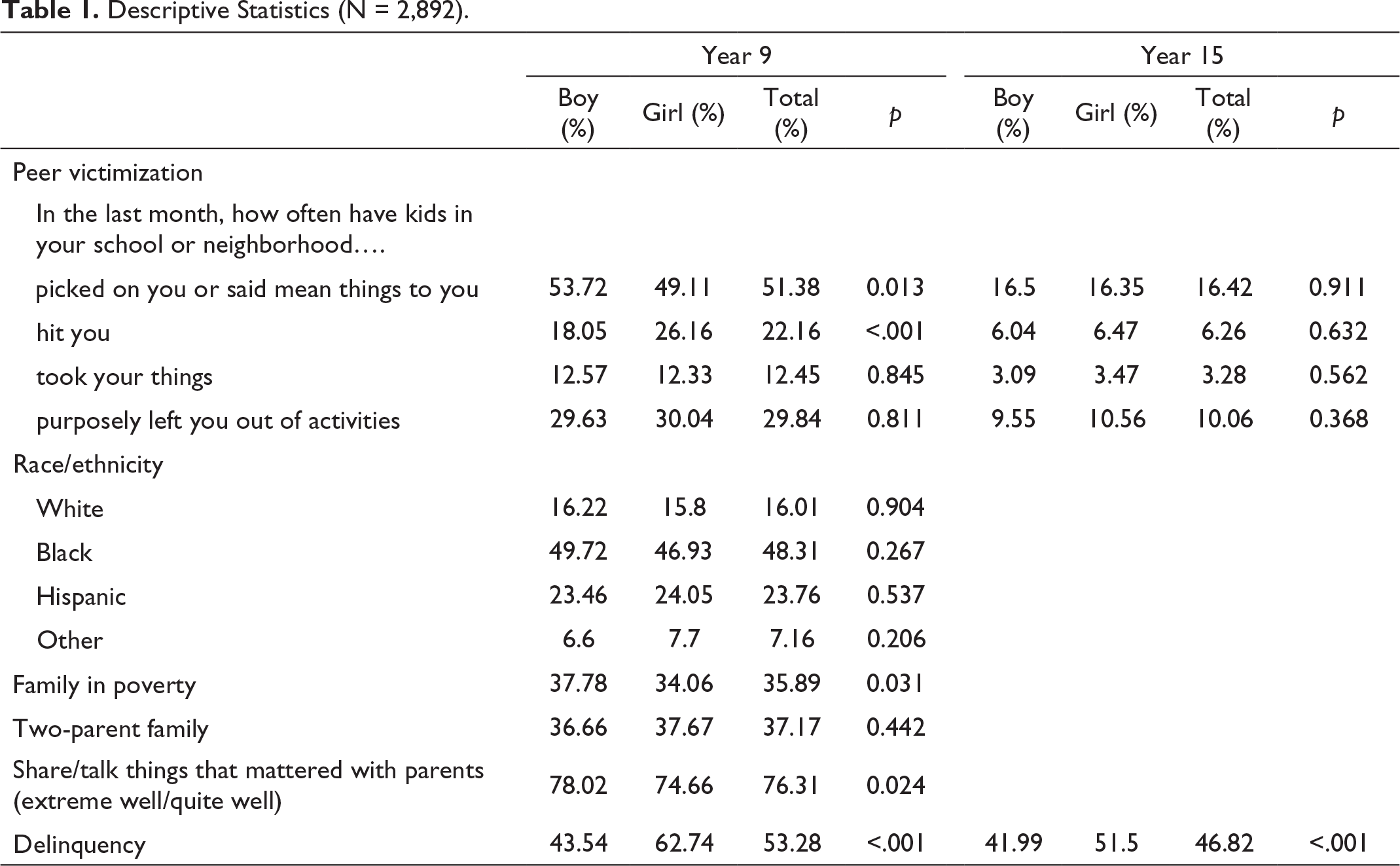
The sample had an even distribution of boys and girls. The majority were Black (48.31%), Hispanic (23.76%), and White (16.01%). Slightly more than one-third of boys and girls were living with both parents, and about one-third of boys (37.78%) and girls (34.06) were living in poverty (p = .031). Boys (78.02%) were slightly more likely to say they shared/talked things that mattered extremely well or quite well with their mothers than girls (74.66%, p = .024). As for peer victimization, in year 9, 51.38% of the children reported having been picked on or had mean things said to them by their peers in the past month, 29.84% said they were purposely left out of activities, 22.16% had been hit, and 12.45% had things such as money or lunch taken away by their peers. A higher percentage of boys (53.72%) than girls (49.11%) reported having been picked on or had mean things said to them (p = .013), but more girls (26.16%) than boys (18.05%) reported being hit (p < .001). Similar proportions of boys and girls were impacted by the other two types of victimization. In year 15, the overall rates of peer victimization substantially decreased, as indicated in the report of being picked on or had mean things said to them (16.42%), purposely left out of activities (10.06%), hit (6.26%), and having things taken (3.28%) in the past month. The differences between boys and girls were small (see Table 1).
Descriptive Statistics (N = 2,892).
Measures
Peer victimization
In the year 9 and 15 surveys, youth were asked to rate the frequency of peer victimization in the last month at school based on four statements: “pick on you or say mean things to you;” “hit you or threaten to hurt you physically,” “take things, like your money or lunch, without asking;” and “purposely leave you out of activities.” Response options were on a four-point scale: 0 = never, 1 = less than once a week, 2 = once a week, 3 = several times a week, and 4 = every day. Each item was dichotomized to indicate whether the youth ever experienced a specific type of victimization, with “never” being coded as 0 (no) and others being coded as 1. (yes) 1
Because data sparseness is a common issue in LCA/LTA, the current study followed the common practice of dichotomizing variables for analysis (Bradshaw et al., 2013; Festl et al., 2017).
Delinquency in year 9
In the year 9 survey, questions on delinquency were derived from the Things That You Have Done scale (Maumary-Germaud, 2000). Youth were asked whether they had ever engaged in a series of 17 delinquent behaviors at school or elsewhere, such as “purposely damaged or destroyed property that wasn’t yours,” “taken or stolen something that didn’t belong to you from another person or from a store,” “had a fistfight with another person,” and “smoked marijuana, grass, pot, weed.” A positive response to any of the listed behaviors was coded as being involved in delinquency in the past year (0 = no, 1 = yes).
Youth delinquency in year 15
In the year 15 survey, questions regarding youth delinquency were from the National Longitudinal Study of Adolescent Health (Add Health) Wave I and Wave II Home Visit interviews. Youth were asked to rate the frequency of their involvement in each of the 13 types of delinquent behaviors in the past 12 months, such as “paint graffiti or signs on someone else’s property or in a public place,” “deliberately damage property that didn’t belong to you,” “take something from a store without paying for it,” and “get into a serious physical fight.” A response of having one or more times of the listed behavior was coded as having delinquency in the past year (0 = no, 1 = yes).
In addition to family structure variable two-parent family status (0 = no, 1 = yes), similar to other studies (Bradshaw et al., 2013; Nylund et al., 2007; Ryoo et al., 2015), a few covariates were included in the models, including race/ethnicity (non-Hispanic White, Black, Hispanic, and Other) and family in poverty (i.e., below the federal poverty line; 0 = no, 1 = yes). Shared/talked about things that mattered was measured with one question, “how well do you and your mom share ideas or talk about things that really matter?” Responses were coded as 0 = fairly well/not very well and 1 = extremely well/quite well.
Analytic Techniques
A series of LCA models were first estimated using data in years 9 and 15 respectively, to determine the appropriate number of underlying classes. Next, using LTA, we tested the measurement invariance in the models to determine if the same latent structure can be applied to both boys and girls, youth in two-parent and other families, and youth in the years of 9 and 15. Finally, we assessed the probability of stability and transition of peer victimization statuses from year 9 to year 15, both with and without including the covariates. PROC LCA and LTA for SAS were used for the analyses (Lanza et al., 2007).
Results
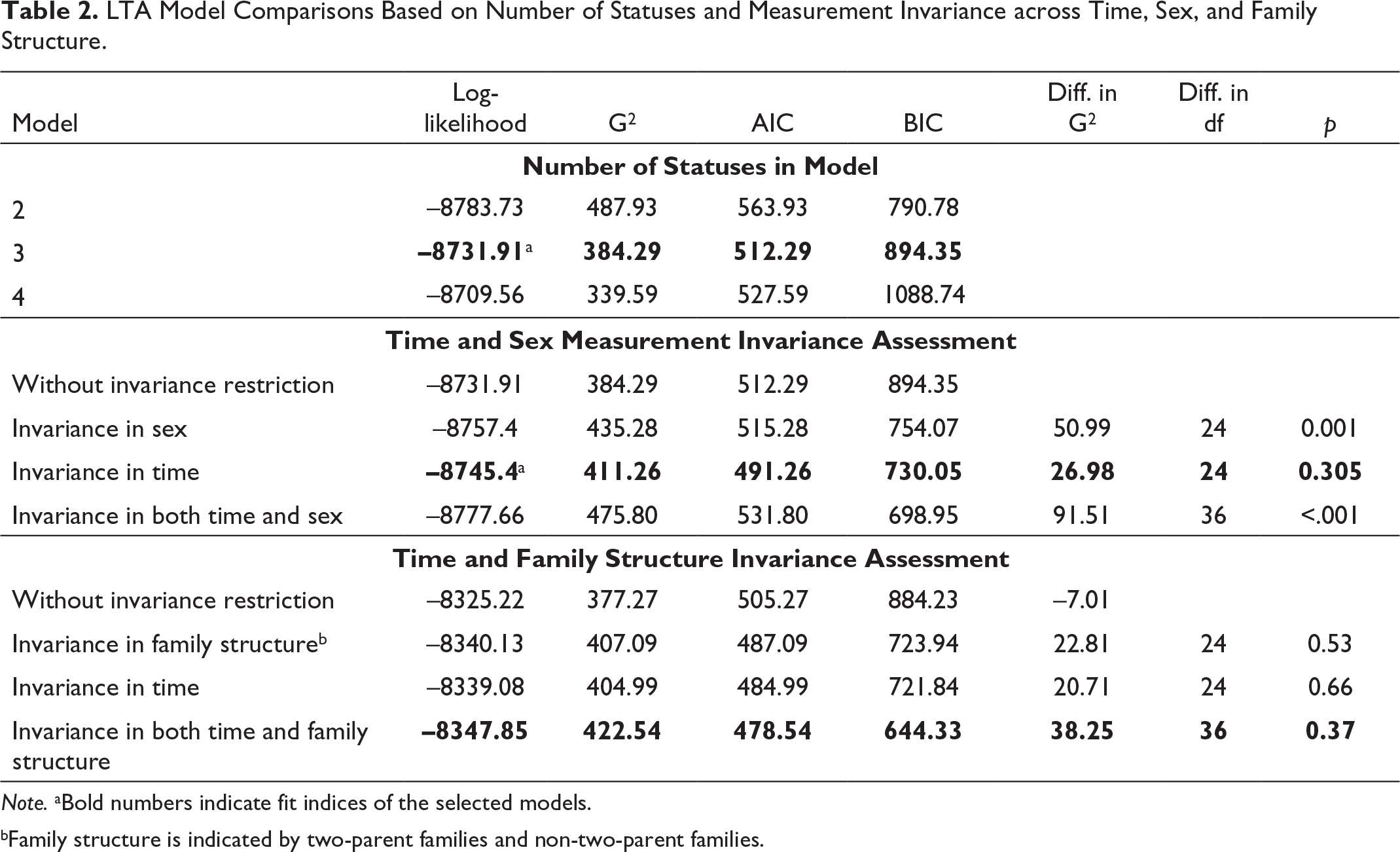
Akaike Information Criterion (AIC) or Bayesian Information Criterion (BIC) in combination with status interpretability is used to determine the LCA/LTA model with the optional number of statuses, where a smaller value suggests a preferable model (Lanza et al., 2007). The fit indices of 2 to 4-status LCA models for years 9 and year 15, respectively, show that a three-class model fits the data in each year well (outputs not shown due to space limitations), which provided a solid base for considering a three-status LTA model using the combined data of years 9 and 15. As shown in the top panel of Table 2, LTA models with 2 to 4 statues were run, which confirms the three-status LTA model fits the combined data of years 9 and 15 well (AIC = 512.29).
LTA Model Comparisons Based on Number of Statuses and Measurement Invariance across Time, Sex, and Family Structure.
Note.
aBold numbers indicate fit indices of the selected models.
bFamily structure is indicated by two-parent families and non-two-parent families.
Further, the middle and bottom panels of Table 2 present model comparisons with and without assuming time and sex/family structure invariance. The LTA three-status models without assuming sex/family structure invariance were used as the benchmark models, and then models assuming time invariance, sex/family structure invariance, and both time and sex/family structure invariance were compared. The difference in G2 values, which is the difference between chi-square fit indices between the compared models, and the difference in the degree of freedom (df) between the compared models were calculated to make the tests (see Table 2). The LTA model assuming measurement invariance across year 9 and 15 is acceptable (difference in G2 = 26.98, difference in df =24, p = .305), but the model assuming invariance across sex should be rejected (difference in G2 = 50.99, difference in df = 36, p = .001). The LTA model assuming measurement invariance across family structure and over time is acceptable (difference in G2 = 38.25, difference in df = 36, p = .37). Overall, the model test suggests that youth in two-parent families and youth in other families do not differ in peer victimization patterns and transitions over time, but they varied across sex (see Table 2).
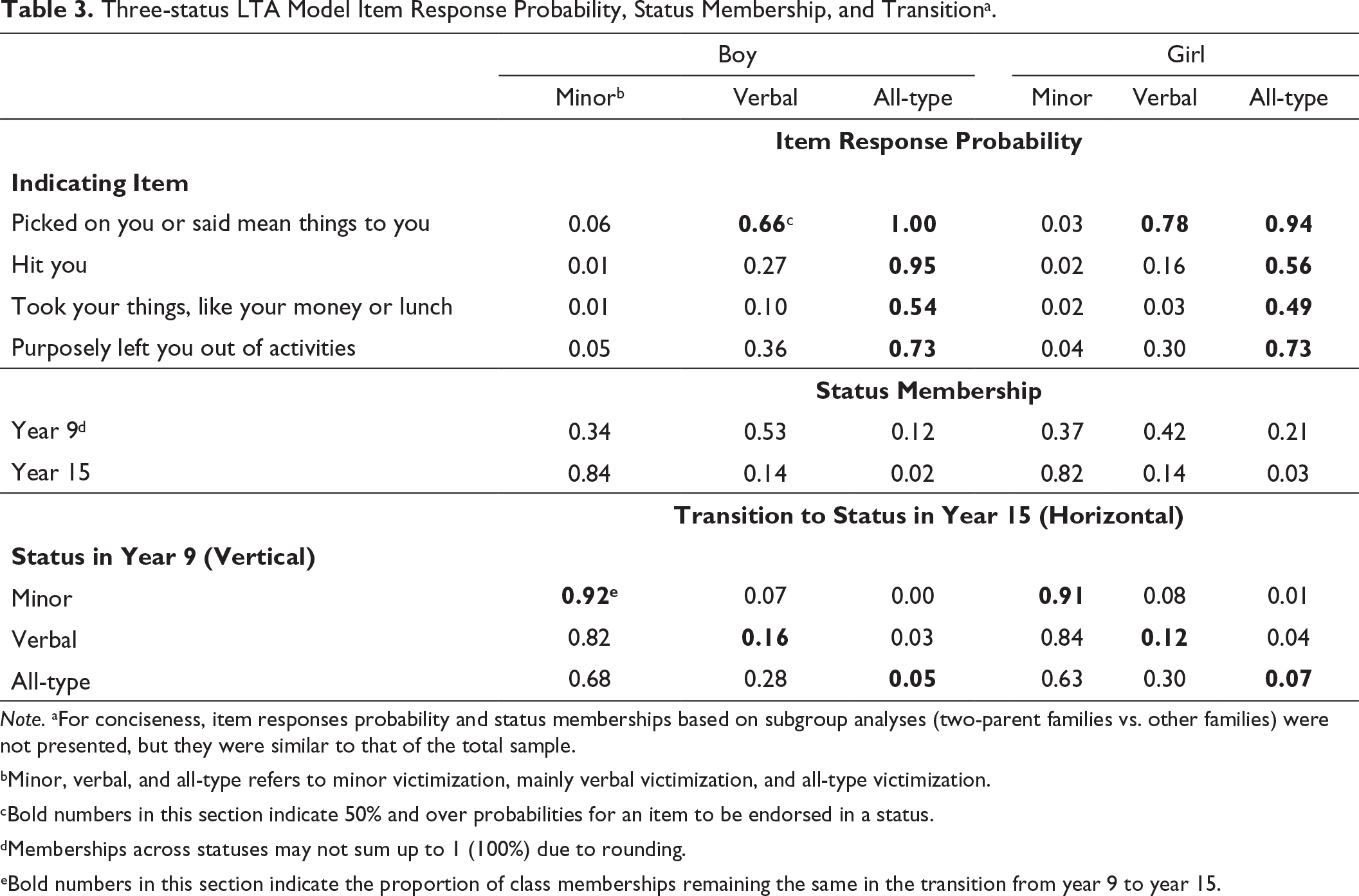
Table 3 shows the three-status (“status” in LTA is equivalent to “class” in LCA) LTA model’s item response probabilities, status memberships, and transition from year 9 to year 15 by sex. The item response probabilities reflect the correspondence between the observed indicators and latent status memberships, which is similar to factor loadings for latent variables in factor analysis. Typically, a value of 0.5 or higher corresponding to membership would be included (Lanza et al., 2007). For the minor victimization status, the probability was very low for both boys and girls to report any type of peer victimization (1 to 6%). For the mainly verbal victimization status, the probability was high for both boys (66%) and girls (78%) to report that other kids were picking on him/her or saying mean things to him/her while low in other item probabilities (e.g., lower than 30%). For the all-type victimization status, the probability ranged from moderate to extremely high for youth to report being verbally bullied (boys: 100%, girls: 94%), physically bullied (boys: 95%, girls: 56%) and being subject to stealing (boys: 54%, girls: 49%) (see Table 3 top panel).
Three-status LTA Model Item Response Probability, Status Membership, and Transitiona.
Note.
aFor conciseness, item responses probability and status memberships based on subgroup analyses (two-parent families vs. other families) were not presented, but they were similar to that of the total sample.
bMinor, verbal, and all-type refers to minor victimization, mainly verbal victimization, and all-type victimization.
cBold numbers in this section indicate 50% and over probabilities for an item to be endorsed in a status.
dMemberships across statuses may not sum up to 1 (100%) due to rounding.
eBold numbers in this section indicate the proportion of class memberships remaining the same in the transition from year 9 to year 15.
In terms of status memberships in year 9, for boys, the proportions in the minor victimization status, mainly verbal victimization status, and all-type victimization statuses were 34%, 53%, and 12% respectively, and the corresponding proportions for girls were 37%, 42%, and 21% respectively. However, the status memberships of boys and girls were very similar: 82% to 84% were in the minor victimization status, 14% were in the mainly verbal victimization status, and only 2% to 3% were in the all-type victimization status (see Table 3 middle panel).
We also assessed the status memberships among youth in two-parent families and youth in other families separately. In year 9, the membership difference for boys was small, but for girls, 52% of those in two-parent families were in the mainly verbal or all-type victimization statuses, relative to 67% of those in other families. However, in year 15, the difference across family structure reduced to a minimum for both boys and girls, with 20% of boys and 13% girls who were in two-parent families being in the mainly verbal and all-type victimization statuses relative to 15% of boys and 18% of girls who were in other families (results not shown in the table due to space limitations).
The bottom panel of Table 3 displays the results for the status membership transition from year 9 to year 15. The transition for both boys and girls was similar. For youth who were in the minor victimization status in year 9, most of them (92% boys and 91% girls) remained in the same status in year 15, a small percentage (7% boys and 8% girls) transitioned to mainly verbal victimization status, and almost none of them transitioned to all-type victimization status. Among youth who were in the mainly verbal victimization status in year 9, only a small percentage of boys (16%) and girls (12%) remained in the mainly verbal victimization status in year 15; most of the boys (82%) and girls (84%) transitioned to the minor victimization status in year 15, and a very small percentage (3% boys and 4% girls) transitioned to all-type victimization status. For youth in the all-type victimization status in year 9, a small percentage (5% boys and 7% girls) remained in the same status in year 15, the majority transitioned to minor victimization status (68% boys and 63% girls), and more than one-quarter (28% boys and 30% girls) transitioned to mainly verbal victimization status in year 15 (see Table 3 bottom panel).
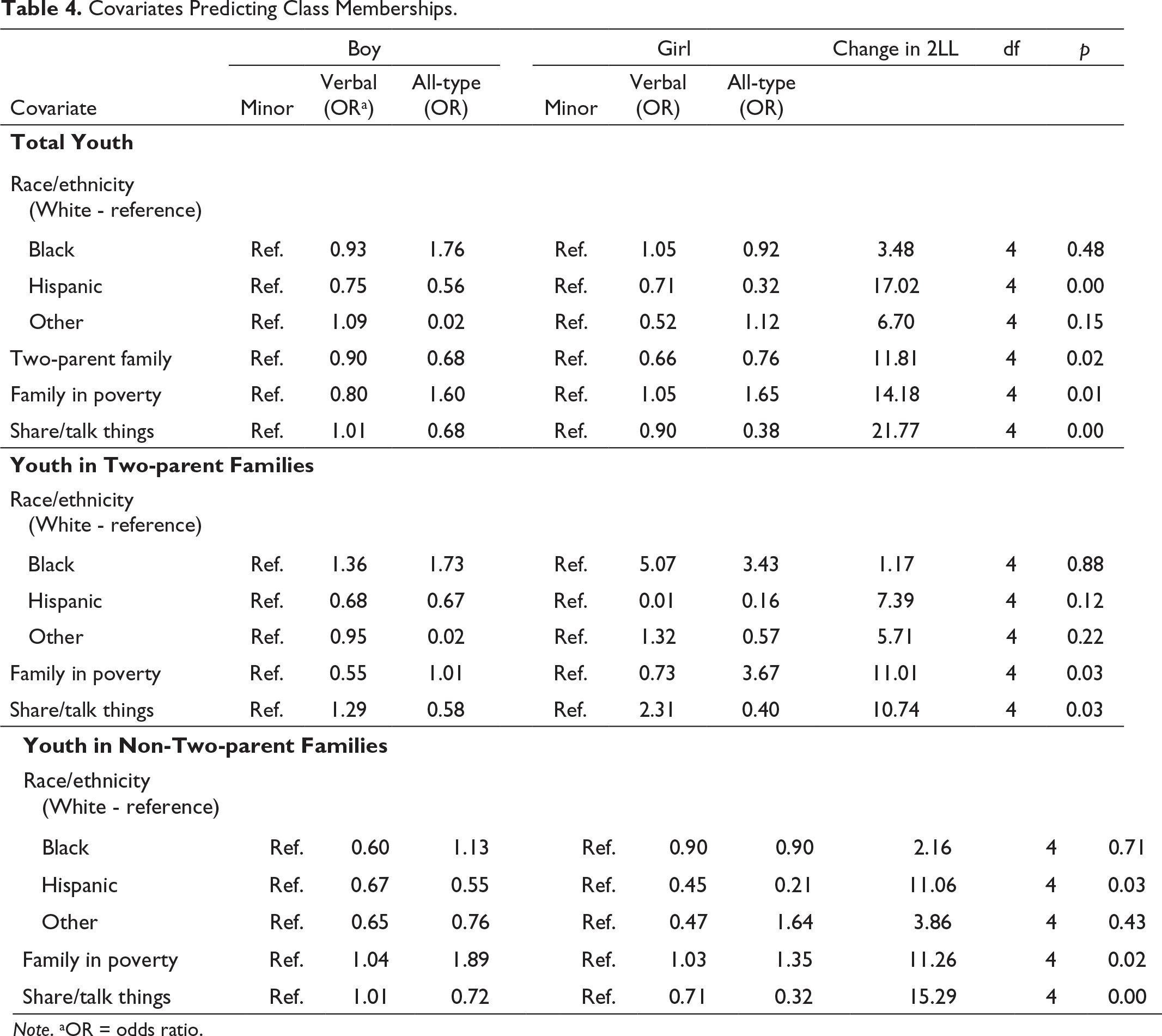
The top panel of Table 4 shows how covariates may influence peer victimization status of youth without distinguishing their family structure. Hispanic youth (vs. non-Hispanic White youth; OR = 0.75 for boys and OR = 0.71 for girls; p = .001), youth in two-parent families (vs. youth not in two-parent families; OR = 0.90 for boys and OR = 0.66 for girls; p = .02), boys who were in poor families (vs. non-poor, OR = 0.90; p < .01), and girls who shared ideas or talked about things that mattered with their parents extremely well or quite well (vs. fairly well or not very well; OR = 0.90; p < .001) were less likely to be in the mainly verbal victimization status relative to the minor victimization status. Similarly, Hispanic youth (vs. non-Hispanic White youth; OR = 0.56 for boys and OR = 0.32 for girls, p = .001), youth in two-parent families (vs. youth not in two-parent families; OR = 0.68 for boys and OR = 0.76 for girls, p = .02), and youth who shared ideas or talked about things that mattered with their parents extremely well or quite well (vs. fairly well or not very well; OR = 0.68 for boys and OR = 0.38 for girls, p < .001) were less likely to be in the all-type victimization status relative to the minor victimization status. However, youth who were living in poor families (vs. non-poor; OR = 1.6 for boys and OR = 1.65 for girls, p = .01) were more likely to be in the all-type victimization status relative to the minor victimization status.
Covariates Predicting Class Memberships.
Note. aOR = odds ratio.
The middle and bottom panels of Table 4 show the results of subgroup analyses based on whether youth were in two-parent families. The results show that youth in different family contexts were similar in terms of the relation between the covariates and victimization statuses. However, girls in two-parent families who were more open to share ideas or talk about things that mattered with their parents extremely well or quite well (vs. fairly well or not very well; OR = 2.31, p = .03) were much more likely to be in the mainly verbal victimization status relative to the minor victimization status, but it would be the opposite for girls in non-two-parent families (OR = 0.71, p = .001).
Figure 1 shows the percentages of youth involved in delinquency based on their status memberships in years 9 and 15 by sex. In year 9, the delinquency percentages were 45%, 69%, and 94% for boys regarding minor, mainly verbal, and all-type victimization statuses, respectively, while the corresponding percentages were 24%, 46%, and 75% for girls. In year 15, the delinquency percentages were 48%, 72%, and 67% for boys regarding minor, mainly verbal, and all-type victimization statuses, respectively, while the corresponding percentages were 39%, 64%, and 59% for girls. The comparisons between boys and girls between the corresponding percentages were all statistically significant (p = .01 to < .001), except for the comparison of minor victimization status in year 15 (p = .66).
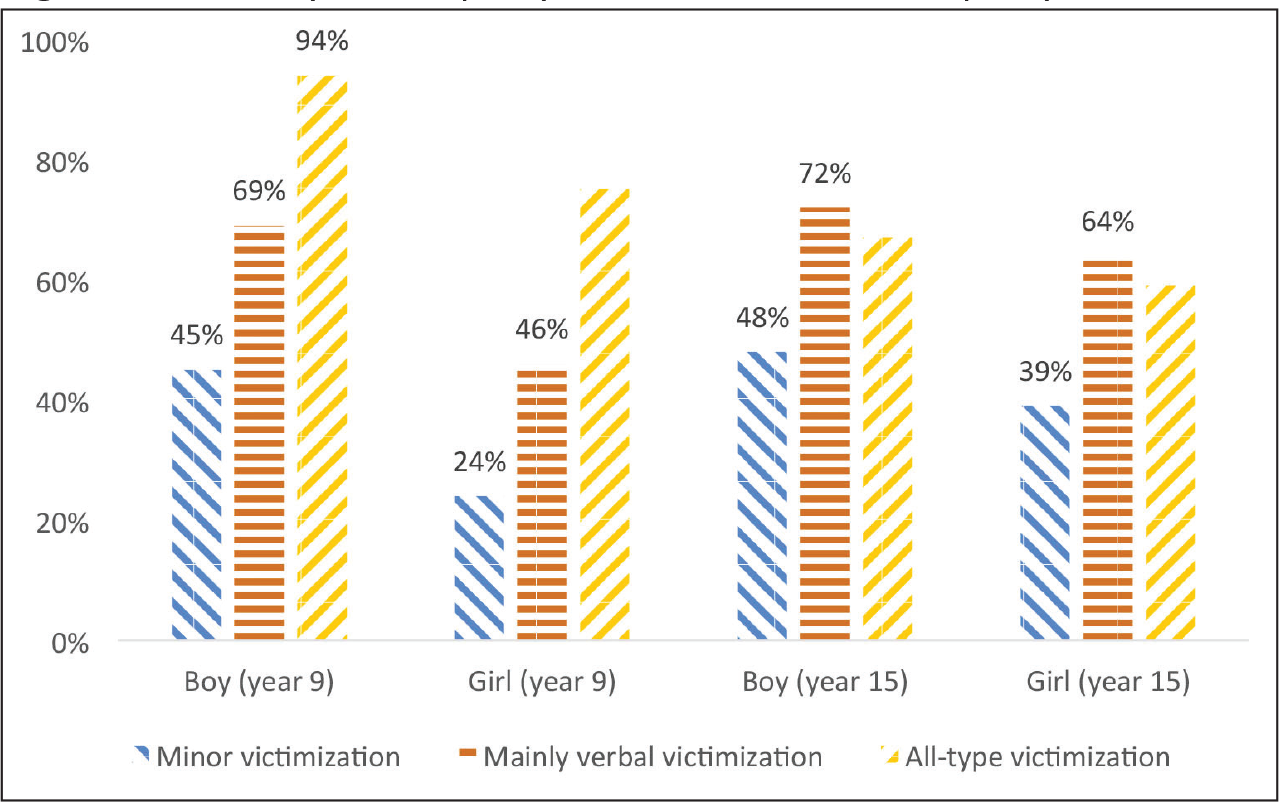
Note. In year 9, all subgroup comparisons between boys and girls of corresponding statuses are statistically significant (p < .001); in year 15, subgroup comparisons between boys and girls of corresponding statuses are statistically significant (p < .01) except for the subgroup of verbal mainly victimization (p = .66).
Discussion
In response to the gaps in peer victimization profiling research, we examined the pattern and transition of peer victimization in general and across sex/family structure over six years using a nationally longitudinal sample. In addition, we examined how peer victimization profiles are linked to delinquency over time. One feature of the current study is the use of latent transition models with a large national sample, which helped identify patterns of peer victimization over a large time span across sex and family structure. Another novelty is the examination of the relationship between status classification and delinquency, which has been rarely considered in extant studies.
Peer Victimization Classification
In this study, the LTA models identified three subgroups of peer victimization over time, including minor victimization, mainly verbal victimization, and all-type victimization. Previous studies using latent class models and victimization indicators, similar to our study, typically identified a non/low victimization, all-type victimization, and one or two additional subgroups that were characterized by verbal victimization (e.g., Bradshaw et al., 2013; Wang et al., 2010). Different from the current study, the previous studies mostly used cross-sectional data to examine middle/high school students, and few have investigated early elementary youth. We expanded to younger students and tracked them over an important transitional period. When the youth were about 9 years old, about one-third of them were minor victims, and the remaining suffered from verbal or all-type victimization. The rate that about two-thirds of the youth in year 9 were victimized by their peers was higher than that found in other studies which included children older than the students in our study (Bradshaw et al., 2013; Ryoo et al., 2018). Extending earlier findings that younger children may be more vulnerable to peer victimization than older children (Bradshaw et al., 2013; Haltigan & Vaillancourt, 2018; Nylund et al., 2007), the current study suggests the pattern may occur as early as in the early elementary school.
Our findings may also provide clues for future examination of peer victimization types. For youth classified in the all-type victimization, nearly all of them endorsed verbal victimization. This may suggest that peer victimization may start from verbal victimization or closely related relational aggression victimization (Wang et al., 2010), and then escalate to all-type victimization. Future research can further investigate the underlying mechanisms of peer victimization, which is of important value for the development of effective intervention strategies.
Peer Victimization Status Transition
The LTA models show that in both years 9 and 15, youth shared the same three-status (minor, mainly verbal, and all-type) peer victimization structure. This is consistent with findings from multiple studies which suggest that victimization structures remain the same across school contexts (Haltigan & Vaillancourt, 2018; Nylund et al., 2007). The findings, along with findings from previous studies (Ryoo et al., 2018; Wang et al., 2010) may suggest that the structure of youth victimization is largely stable from early elementary school to middle school or even high school. Previous studies examining victimization pattern transition typically used cross-sectional data (Bradshaw et al., 2013; Nylund et al., 2007), longitudinally followed individuals for one to two years (Ryoo et al., 2018), specifically focused on cyberbullying (Festl et al., 2017), and mostly used a local sample. Haltigan and Vaillancourt (2018) used LTA to trace the transition of victimization patterns of a sample of Canadian fifth-grade students over a long span of six years, but they focused on identifying patterns based on the severity of victimization rather than types. Our study was unique in that we used nationally representative longitudinal data to investigate victimization patterns and transitions from early elementary to late middle schools.
Although the victimization status structure remained consistent over time, there was a substantial membership transition across statuses, primarily from the mainly verbal and all-type victimization statuses to the minor victimization status. In year 9, about two-thirds of the youth were in the mainly verbal or all-type victimization statues, but the rate declined to less than one fifth by year 15. Most youth initially in the mainly verbal and all-type victimization statuses transitioned to the minor victimization status by year 15. The magnitude of transition in the current study was larger than that of previous studies (Haltigan & Vaillancourt, 2018; Ryoo et al., 2018), which usually recorded a similar change of less than 50%. The larger magnitude of change in our study may possibly be due to the long time frame for the observation. Peer victimization is likely much more prevalent in the early elementary years than in late middle school years since earlier studies generally suggest younger students are more likely to be subject to peer victimization (Haltigan & Vaillancourt, 2018). The dominance theory suggests that when youth transition from elementary school to middle school, peer aggression becomes less intense but more power seeking. Aggressors are more likely to persistently target a small fraction of children as part of their construction of the hidden power system (Pellegrini & Bartini, 2000; Schäfer et al., 2005). Also, the reduction of peer victimization may be related to students’ increased awareness of its negative consequences, and school and the society’s low tolerance and strengthened interventions (Williford et al., 2014).
Sex and Family Structure Differences in Victimization Statuses and Transitions
Sex differences are manifested in both the victimization classification and transition. In year 9, boys and girls were both more likely to be in the minor victimization status, but boys were more likely to be in the mainly verbal victimization status and less likely to be in the all-type victimization status than girls. However, such differences almost disappeared in year 15, with boys and girls being similarly likely to be in each of the statuses. This may be because in middle school socioeconomic status rather than sex is more likely related to peer victimization (Pellegrini & Bartini, 2000; Schäfer et al., 2005).
Although boys and girls shared the same three statuses, there were some sex differences regarding item responses within each status. In the mainly verbal victimization status, girls had a moderately higher odds than boys in endorsing the verbal victimization item (“…picked on you or said mean things to you”), but in the all-type victimization status, boys had a substantially higher odds of endorsing the physical peer victimization item (“…hit you”). Although latent class models present classification with multi-dimensional information, the subgroups may be heterogeneous (Bradshaw et al., 2013).
Peer victimization patterns and transitions over time did not differ across family structure, which is generally consistent with previous research (Hong et al., 2020; Zhang et al., 2019). Negative impacts of non-two-parent families may be confounded by related family processes, such as abusive parenting that is more common in non-two-parent families (Berger, 2004; Zhang & Eamon, 2011). However, an interaction was found between sex and age regarding the influences of family structure. While girls in non-two-parent families were more likely to be victimized than girls in two-parent families when they were about 9 years old, the difference disappeared when they were about 15 years old. However, family structure was not related to boys’ victimization statuses. The findings suggest that although girls in vulnerable families may be at an elevated risk of peer victimization, most may avoid victimization later like girls in two-parent families.
Relation to Delinquency
In both years 9 and 15, youth in the mainly verbal and all-type victimization statuses were more likely to be involved in delinquency than youth in the minor victimization status, and there were differences across sex and over time. In year 9, the odds of delinquency were ranked from low to high for the minor, mainly verbal, and all-type victimization statuses. Boys had higher odds of involvement than girls, with nearly all boys relative to three-quarters of the girls in the all-type victimization status engaging in delinquency. Interestingly, the linkage between peer victimization statuses and delinquency in year 9 was stronger for girls than boys; when compared with girls in the minor victimization status, girls in the mainly verbal and all-type victimization statuses were two and three times more likely to engage in delinquency, relative to 1.5 and two times for boys. In year 15, the linkage between victimization statuses and delinquency seems to diminish; both boys and girls in the mainly verbal and all-type victimization statuses were only about two thirds more likely to engage in delinquency than their counterparts in the minor victimization status. This reduced sex difference in delinquency over time may reflect a diminishing sex gap in delinquency due to the changing social environment or social control responses (Kerig & Schindler, 2013; Keyes et al., 2018).
Given the strong linkage between peer victimization and delinquency (Barker et al., 2008), the findings regarding the relationship between peer victimization statuses and delinquency provide support for the classification revealed in the study. There are some possible explanations for the lower discrepancy of delinquency across victimization statuses from year 9 to year 15. The reduced difference in delinquency may not mean reduced negative consequences, but a shift of such consequences. Some studies reported that children who suffered from peer victimization are more likely to experience depression and other psychosocial problems than children who were less victimized (Bradshaw et al., 2013; Haltigan & Vaillancourt, 2018). When youth transition from elementary school to middle school, the negative consequences of peer victimization may partially shift from externalizing to internalizing problems, such as depression and anxiety (Garthe et al., 2018). Another possibility is that youth resilience toward peer victimization may increase when they grow older (Nguyen et al., 2019).
Limitations
This study has several limitations. First, while the longitudinal data has its strengths, it does not assess cyber victimization, an increasingly prominent form of peer victimization. However, the patterns revealed in our study may not be so different from the patterns that include cyber victimization (Wang et al., 2010) since both forms of peer victimization are likely to overlap (Schneider et al., 2015). Still, replication and extension of our work to include cyber victimization are needed to verify the findings. Second, although the longitudinal data provides an invaluable six-year time window for observation, we may miss some important pattern dynamics during the long interval (Ryoo et al., 2015; Williford et al., 2014). Future research with more frequent assessments between the childhood and adolescent years are needed to depict potential dynamics. Third, the study examined discrepancies by sex and family structure and revealed important discrepancies and similarities. However, these two variables may simplify the underlying peer victimization profiles in more complex social contexts. Research has suggested substantial variation in peer victimization and other forms of aggression across gender, the sex-based social construct, and family socioeconomic contexts. Sexual minority youth are much more likely to be victimized than heterosexual youth (Robinson et al., 2013), and family socioeconomic contexts that are related to family structure impose a significant impact on peer victimization (Hong & Espelage, 2012). Future research should consider variation and more extensive family social-economic contexts in such examination. Fourth, the study did not include youth aggression in profiling, which is known to be robustly associated with peer victimization. Future research should investigate how the pattern and transition look like, and whether there is variation across gender and family socioeconomic status when considering both peer victimization and aggression. Finally, peer victimization and delinquency were self-reported, which may be subjected to social desirability bias (Bradshaw et al., 2013).
Implications
The findings have some important implications. The high prevalence of the mainly verbal and all-type victimization statuses among youth in the early elementary years suggests the need to enhance bullying prevention in early school years. Current prevention programs mainly focus on older youth, and they may overlook a critical period of bullying prevention. Timely and effective early intervention is not only necessary to protect children from peer victimization, but also because early childhood is a critical stage to intervene in child behavioral and psychosocial problems. Moreover, early prevention programs need to pay special attention to girls in fragile families, given that they are at an elevated risk of encountering peer victimization in elementary school years. In addition, we found that verbal victimization may be a gateway to escalated all-type victimization, yet research has shown that verbal victimization is often ignored by teachers and school staff (Cortes & Kochenderfer-Ladd, 2014). Our findings suggest the need to update such perceptions and place more emphasis on verbal victimization in bullying prevention efforts. The strong association between peer victimization and delinquency, along with findings from previous studies (e.g., Strohacker et al., 2019), suggests that peer victimization is linked to various psychosocial problems. It is important to develop joint programs that tap into peer victimization and related problems simultaneously, or at the very least strengthen coordination across different programs. Research has shown that among strategies taken to deter peer aggression, punishment by parents and school is especially effective (Patchin & Hinduja, 2018), and effective parental monitoring and support reduce the risk of youth delinquency (Walters, 2020). Last but not least, the findings revealed that sex and family structure were related to peer victimization classification, transition, and linkage to delinquency, suggesting the importance of considering these characteristics when designing and implementing prevention programs.
The study warrants future investigations. Future work can extend to investigate whether verbal victimization is the gateway to all-type victimization. The substantial difference between all-type victimization and mainly verbal victimization’s linkage to delinquency diminished to a minimum when youth grew older. Is such a change due to youth increased resilience, or signaling a shift of peer victimization consequences from delinquency to psychosocial problems? Moreover, in addition to sex, future studies may consider racial and ethnic differences in peer victimization and their influences on adverse psychosocial outcomes. Future research may also consider profiling the transition of peer victimization statuses at various time periods to depict a more comprehensive picture across children’s development, and how this is related to adult criminality (Klomek et al., 2015; Piquero et al., 2013).
Conclusion
The findings suggest that peer victimization can be classified into three statuses (e.g., minor victimization, mainly verbal victimization, and all-type victimization) and those statuses seem pretty stable from early to mid-adolescence. About two-thirds of youth who were about 9 years old were identified as being in the mainly verbal or all-type victimization statuses, but most youth in these two statuses transitioned to the minor victimization status in year 15. Girls who were in fragile families had a higher risk of experiencing mainly verbal or all-type victimization than girls in two-parent families when they were about 9 years old, but boys of this age were similar in the risk regardless of their family structure. The unbalanced victimization risks for girls in fragile families disappeared when they grew older. Peer victimization statuses were linked to delinquency in years 9 and 15, with victimized youth being more likely to engage in delinquency. Boys were much more likely to engage in delinquency than girls across the victimization statuses at age 9, but such differences diminished to a minimum at age 15.
The prevalence of youth peer victimization in early elementary school suggests the importance of early prevention and paying special attention to girls in fragile families because of their comparatively higher risks. Given that verbal victimization is highly prevalent among victimized youth and that it may be a gateway for victimization, it is important to take verbal and other non-physical victimization seriously in prevention efforts. The close association between victimization statuses and youth delinquency suggests the importance of tapping into peer victimization and related problems simultaneously or in a coordinative manner for effective prevention outcomes.
Footnotes
Authors’ note
Alex R. Piquero is now affiliated with University of Miami, Miami, FL, USA and Monash University, Clayton, VIC, AU.
Declaration of Conflicting Interests
The author(s) declared no potential conflicts of interest with respect to the research, authorship and/or publication of this article.
Funding
The author(s) received no financial support for the research, authorship and/or publication of this article.
