



Abstract
Antidomestic violence advocates have begun to question two essential policies that have long defined domestic violence shelters—strict secrecy regarding shelter location and prohibitions on shelter access to all except staff and residents—both of which serve to increase survivors’ social isolation and entail coercive rules that resonate painfully with broader oppressive dynamics. In response a growing number of communities have begun experimenting with open shelters, which break from tradition by making their locations public, and allowing visitors. Although this innovation is a sharp departure from tradition, virtually no research exists to explore its philosophical underpinnings, benefits, and challenges. This study addresses this gap. Study Questions: We used a qualitative descriptive approach to explore the experiences and perspectives of open shelter directors. Participants included 14 open shelter directors from 11 states. We conducted semistructured phone interviews with each participant, focusing on their shelter’s (a) nature and history; (b) rationale; (c) policies and programs related to secrecy and openness; (d) benefits and challenges; (e) effects on specific survivor subgroups; and (f) practices used to build or strengthen survivors’ relationships. Open shelters: (a) promote physical safety using a broad array of measures; (b) adopt a range of policies that promote varying degrees of location disclosure and visitor accessibility; (c) face challenges, such as the need to gain buy-in from multiple constituents; and (d) Improve survivor outcomes, including decreased shame; improved advocacy relationships; increased access to services and community involvement in shelter life; and deepened relationships with network members; in turn increasing prospects for physical and psychological well-being long after survivors’ shelter stays are over. Findings suggest a new path for shelters interested in promoting survivor safety and healing in the context of a web of meaningful relationships.
Concerns are growing about two essential policies that have long defined domestic violence (DV) shelters in the US: (a) strict secrecy regarding shelter location; and (b) strict prohibitions on shelter access, to all except staff and survivor-residents. Although both policies are rooted in a desire to keep survivors physically safe, a growing number of survivors, scholars, and advocates have expressed concern about their unintended negative consequences, including a prolonged isolation from social support that undermines survivor well-being and can result in profound harm that persists long after a shelter stay, and a proliferation of related rules that severely constrain the choices and behavior of survivor-residents (Stylianou & McGinnis, 2017). These consequences may be especially challenging for some marginalized survivors, for whom shelter rule policing may echo oppressive dynamics in the larger society, and who may rely particularly heavily on their communities for support (Anais-Bar, 2012; Hymen et al., 2009).
In response to these concerns, advocates in a handful of communities across the country have begun experimenting with a new, open approach to shelter (Olsen, n.d.; Pieper, 2014). Open shelters break from the canonical rules that shelter location must remain hidden and shelter premises must be inaccessible. They approach openness in varying degrees, from a simple cessation of secrecy regarding location, to a full embrace of accessibility for members of residents’ personal networks and relevant service providers.
The innovation of open shelter has captured great interest among domestic violence movement leaders and is consistent with a growing commitment to support survivors in the context of their own social and cultural communities. Mobile advocacy approaches move services from program offices to local neighborhoods (Sullivan & Olsen, 2017); flexible funding approaches provide the necessary financial support to enable survivors to remain in their homes (Sullivan et al., 2019); and restorative justice approaches bring communities together to support survivor safety, hold violent actors accountable, and collectively define the meaning of justice (Decker et al., 2020). But the idea of open shelter has also triggered serious concern, particularly around the issue of survivor safety. Despite this controversy, virtually no research exists to describe the open shelter approach, explore its philosophical underpinnings, or assess its benefits and challenges as implemented. We set out to address this gap through an interview study with program directors of open shelters across the country. We focused on shelter directors because they are best positioned to know about: the history of their program’s evolution from closed to open; the experiences of different constituencies (advocates, community members, survivors, and funders) with the open shelter model; and the rationale underlying shelter-specific practices adopted in support of openness. To our knowledge, this study is the first of its kind.
Secret Location, Closed Access Shelters, and the Impact on Survivors
In the 1970s, second-wave feminists successfully advocated for an enormous expansion of available DV shelters. The accepted understanding was that violence in an intimate partnership would predictably, and perhaps necessarily, escalate in severity over time (Feld & Straus, 1989). Research has shifted this understanding, but early on this one-size-fits-all and, indeed, worst-case-fits-all perspective led activists to an obvious conclusion: Women survivors should take refuge in hidden spaces far away from the men who had harmed them in order to be physically safe (Schechter, 1982). Confidentiality of shelter locations was seen as absolutely essential to victim safety (Olsen, n.d.).
This secret location, closed access approach to shelter, however, carries with it some serious harm for survivor-residents. First, this approach substantially increases the isolation and loneliness of survivor-residents during what is typically one of the worst periods in their lives. Some survivors describe this isolation as worse than the abuse itself (Thomas et al., 2015). Shelter-imposed isolation can also undermine survivor-residents’ long-term physical safety: Feeling lonely and cutoff, some survivors choose to leave the protection of shelter early in their stay, often to return to the partners who hurt them (Fisher & Stylianou, 2016). Those who chose to remain tend to find that their time in shelter results in a deterioration of ties to their support networks. Indeed, one study found that although 73% of survivors who entered shelter expressed a desire for closer connection to friends and family who could help, upon exiting—a time when support from others is particularly crucial—67% reported feeling emotionally distant or cutoff from their network members (Stylianou & McGinnis, 2017). As researchers Haaken and Yragui (2003) put it, entering DV shelter is much like going underground (p. 51).
Second, these near-universal shelter requirements of secret location and closed access drive a proliferation of related rules for survivor-residents. These rules both greatly restrict survivor autonomy and create an oppressive dynamic between staff, who must enforce the rules, and survivors, who must comply with them or risk discharge. Many of these rules directly contribute to the isolation and loneliness described earlier by requiring that survivors: leave their communities to enter shelter far from home; refuse to reveal their location even to those closest to them; refrain from contacting any source of social support for the first days of their shelter stay, and sometimes even longer; and refrain from any contact with the person who has harmed them, regardless of the circumstances (Stylianou et al., 2018). Other shelter rules create more practical challenges for survivors: friends and family can only meet residents at locations that will not reveal the shelter address; taxis and ride-shares must drop residents several blocks away, no matter how burdened they might be with strollers or groceries; limitations must be imposed on survivor use of smartphones and other traceable technologies. Survivor reactions to the extensive system of shelter rules range from disappointment to anguish (Gregory et al., 2017; Wood et al., 2017). In one qualitative study of survivors’ experience in shelters, all participants described feeling frustrated with rules that limited their ability to contact support networks, and many reported that these rules comprise the most difficult aspect of shelter life (Glenn & Goodman, 2015). Put differently, these rules equate safety with physical protection from harm, ignoring the more complex conceptualizations of safety that survivors may hold, including safety from loneliness and safety from new forms of oppression and control. These harms have led some scholars and activists to question the value of the traditional DV shelter model, and a small but growing number of shelters have moved to an open approach.
Controversy Around the Open Shelter Model
Although research on open shelters themselves is scant, a few studies have demonstrated advocates’ increasing ambivalence about the traditional DV shelter model. For example, in a qualitative study of 12 shelter directors, half urban and half rural, researchers found that questions about secret versus disclosed location shelters elicited the greatest number of participant comments; some directors argued that shelter locations should remain as hidden as possible for survivor safety, and others argued that this approach is impractical, because partners determined to find shelters can and will do so (Macy et al., 2010). Similar ambivalence was revealed in a quantitative survey of 97 North Carolina shelter directors, where 78% of participants strongly agreed or agreed with the statement “shelter services best help clients when the shelter location is hidden from most in the community” (p. 9), while 21% strongly disagreed or disagreed with the same statement (Macy et al., 2013).
At the same time, both popular press and movement activist accounts reveal a burgeoning interest in open shelters (e.g., Olsen, n.d.; Zwang, 2018). Some DV shelter directors believe that secret location and closed access policies prevent survivors from accessing shelter, evoke a sense of shame in survivor-residents, impose the burden of maintaining secrets upon children, make it impossible for survivors to maintain their reliance on existing networks and daily routines, and reduce community support and interest. Questions are being raised about the burdens—both practical and existential—that secret, closed shelters place on survivors. A highly influential guide on decreasing shelter rules, developed by shelter leaders across Missouri, summarized the practical consequences:
Safety is usually the explanation for why residents are not supposed to disclose the location of the shelter [,but] a rule requiring that a resident not disclose that she is staying in the shelter, much less the shelter’s location, to family, friends, employers and other agencies can be, at a minimum, difficult for residents. It could also disrupt or eliminate a resident’s job prospects and relational support. Therefore, what was meant as a rule regarding safety might not help residents and could become more of a hindrance to their efforts to gain self-sufficiency…. (Missouri Coalition Against Domestic and Sexual Violence, n.d., p. 36) As Linda Olsen, an influential antidomestic violence advocate, put it: “When does the safety from an abusive partner become a total separation from the rest of the support system that the survivor needs most in her life?” (Olsen, n.d.).
Given the importance of both reducing survivor isolation and increasing responsiveness to survivors’ stated needs, a systemic understanding of the benefits and challenges of the open shelter approach is crucial to the continued evolution of the DV movement. This qualitative, descriptive study of open shelter directors’ perspectives begins to address this information gap.
Methods
We used a qualitative approach to explore the experiences and perspectives of leaders of a geographically diverse set of DV shelters that identified as either disclosed location (ranging from passively unconcealed to publicized) or open access (ranging from allowing visitors under careful restrictions to having almost no rules about who is permitted to visit). We sought to explore the philosophies held by open shelter directors, the policies and practices they have implemented, and the successes and challenges they have witnessed, both in terms of survivor experiences and programmatic developments.
Participants and Recruitment
We identified open shelters fitting the aforementioned criteria through literature and Google searches; contact with national DV organizations to solicit names of open shelters; and requests made of each participant about whether they were aware of other open shelters. We continued this process until we reached theoretical saturation. This search yielded 15 DV shelters that met the disclosed location and/or open access criteria. We reached out to the executive directors of these programs by email and/or phone to seek their participation. Thirteen of the 15 directors responded and agreed to be interviewed. Three of these asked that we also interview an additional shelter staff member who could provide a different perspective.
The 16 final participants included 14 adult, cisgender women and one adult, cisgender man, all of whom hold leadership roles at their shelter. Fifteen were White and one was Latinx. Participants had worked in the DV field from three years to over 30 years; over half (62.5%) had more than two decades of experience in the field. All interviews were conducted in English.
Participating shelters were located in 11 states across varying regions of the United States, including urban (7), suburban (2), and rural (4) communities. They varied in terms of location disclosure policies: Nine had fully public locations, and four had discreetly unconcealed locations (locations that are not published but are not secret). The programs also varied in degree of open access. Four were closed and did not allow visitors at all, and two were closed with some exceptions (e.g., noncustodial children and caregivers). Six programs allowed controlled visitor access. Only one program was fully open to any visitor a survivor chose to invite, except the partner who had caused harm. Of the open access shelters, eight offered varying degrees of onsite family intervention services (e.g., secondary victimization counseling; family reunification support; and even shelter provided for caregivers).
Regarding demographics of shelter residents, seven shelters served predominantly White survivors, three served largely Black survivors, one served largely Latinx survivors, one served predominantly Black and White survivors, and one served a mix of Black and Latinx survivors. Participating shelters also provided services to survivors who identified as Asian, Hawaiian/ Pacific Islander, American Indian/Alaskan Native, Punjabi, Hmong, Indigenous, and mixed-race. For all 13 programs, a majority of survivor-residents came from the surrounding community. Shelter sizes ranged from 24 to 168 beds, with an average of 61 beds. A majority offered shared or communal living arrangements; four offered individual units for each family. The average length of stay ranged from one month to over two years; a few permitted unlimited stays.
Procedures
Each interview lasted between 45 and 75 minutes (average: one hour) and was conducted over the phone with one of the first three authors. All interviews were audiotaped. The interview guide was semistructured in order to provide consistency across interviews without restricting the conversation. Questions focused on (a) the nature and history of the participant’s DV shelter model; (b) rationale for the approach taken; (c) policies and programs related to secrecy and openness; (d) benefits and challenges of the model for survivors and their families, shelter staff, the organization itself, and the broader community; (e) effects of the model on specific survivor subgroups (e.g., survivors of color, immigrant survivors, those with the most dangerous partners); and (f) other open shelter-based practices used to build or strengthen DV survivors’ relationships with family, friends, and community. To get at these broad categories, we used open-ended questions followed by more specific probes, such as: Tell us about your own experience (or your organization’s experience) with considering an open shelter? What was the need or concern you were trying to address? What were your biggest challenges? How did you try to overcome them? What have been the biggest benefits? The biggest challenges? How has the model affected your residents’ relationships with people they know? With people in the community? With other survivors? With other organizations? How did/do different subgroups of survivors respond differently?
Data Analysis
To analyze the data, we used inductive qualitative content analysis, a dynamic approach that aims to summarize and describe without imposing a great deal of interpretation (Elo & Kyngäs, 2008). We sought to capture the complexity of participants’ experiences in a manner that remained as close as possible to their own words. This analysis involved three steps: First, we conducted open or in vivo coding, a process that translated participants’ messages into briefer statements or codes while aiming to maintain their language as closely as possible. Next, we organized codes into categories based on their conceptual similarity. Finally, we combined categories into clusters that captured core themes. Throughout, we used constant comparison so that new interviews were compared to previous ones in order to generate new codes, categories, and clusters, and refine existing ones (Kim et al., 2017). Data analysis occurred alongside interviewing, with each process informing the other. Questions or points of confusion that arose in the analysis process led to new interview questions, and these questions, in turn, led to enriched data for analysis. This process continued until theoretical saturation was reached; that is, when new data no longer yielded new codes (Morrow, 2007). At that point, we stopped searching for new shelters.
Trustworthiness and Credibility
We took a number of steps to ensure the trustworthiness of our findings. Throughout the process, we remained mindful of the ways in which our personal and professional identities could influence our interpretations. For example, we are five White women, one White man, and one Black woman. In order to learn how our identities could be shaping our thinking, we consulted about our emerging findings with a number of people with specific expertise in working with Latinx, LGBTQ, and Asian-Pacific Islander communities. In addition, because four of the authors have worked in shelters and seen firsthand the dangers of shelter-imposed isolation, we went into the project hoping that open shelters could mitigate this harm. To guard against allowing this hope to become a bias, we intentionally asked questions about the limitations and drawbacks of the open shelter approach. In general, we made a careful effort to attend to the impact of our own biases and beliefs.
The coding process also allowed us to incorporate checks on our decision-making. We began by coding the first three interviews as a group. Once it became clear that we were making similar decisions on codes, we created a draft codebook, which continued to evolve throughout the process. Each week, we brought our coded interviews to a team meeting, where each new code was reviewed and differences in interpretation discussed and resolved by consensus. At the same time, we began to use the constant comparative process to develop categories and clusters from the codes. This process continued as we coded new interviews, until we reached saturation.
Finally, we engaged in ongoing member-checking throughout the research process, rather than as a stage at the end of data collection (Birt et al., 2016). Consistent with this contemporary approach, we asked participants about their perspectives on specific practices and concepts mentioned in other interviews. By explicitly inviting multiple opportunities for the elaboration of specific ideas, we ensured that we obtained a robust sense of each concept.
Results
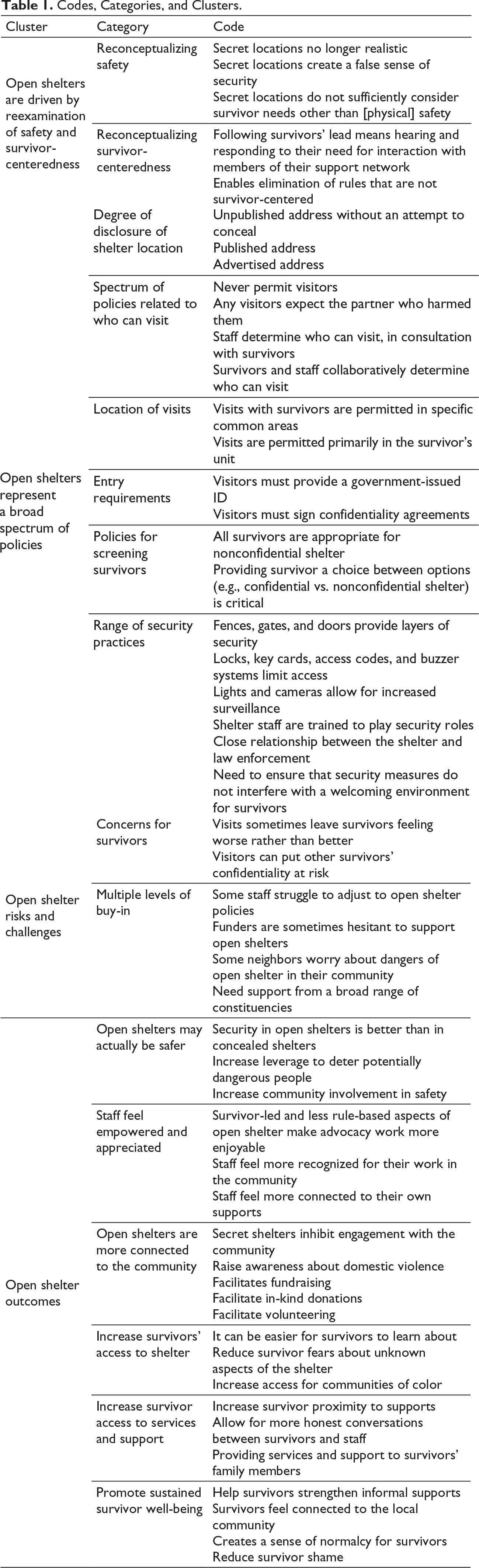
Four overarching clusters emerged from the data: Open shelters (a) reflect a re-examination of safety and survivor-centeredness; (b) employ a spectrum of policies on visitors, screening, and security; (c) create specific risks and challenges; and (d) produce unique outcomes. In this section, the term open shelter refers to all shelters in this study; we specify when codes refer specifically to degree of location disclosure (unconcealed, published, or advertised) or open access (from none to full). Clusters are listed in headers, categories are bolded, and codes are italicized (see Table 1 for a chart summarizing clusters, categories, and codes).
Codes, Categories, and Clusters.
Cluster I: Open Shelters Reflect a Re-examination of Safety and Survivor-centeredness
Participants consistently described reconceptualizing safety as a driving force that led them to the open shelter model. Although survivors’ physical safety has always been a key rationale for keeping shelter addresses confidential, all participants described secret locations as no longer realistic in an age of social media and location sharing. They described the whole community knowing where they were, citing examples from pizza deliverers and bus drivers, to neighbors and donors. They noted the impossibility of operating secretly in small communities or conspicuous locations and reported that knowledge of shelter locations spread over time via friends and family, children, and survivors themselves. As one interviewee put it, the shelter was the “biggest unkept secret in the city.”
Participants pointed out that secret locations are also potentially damaging to survivors. A few thought that secret locations create a false sense of security, causing shelter staff to mistakenly let their guard down or assume that no dangerous incident could occur. Many noted that secret locations do not sufficiently consider survivor needs other than [physical] safety—such as the need to be with family and friends and to maintain connections to important communities. These participants shared that open shelters gave them more freedom to respond flexibly to survivors and their families.
Participants also saw reconceptualizing survivor-centeredness as both a catalyst and consequence of open shelters. Many noted that following survivors’ leads meant hearing and responding to their need for interaction with members of their support network. Interviewees reflected on the importance of family, friends, religious groups, and other sources of support for survivors’ well-being during a time of upheaval. One pointed out that a survivor’s shelter stay is “just a blip in time”; external relationships substantially affect the rest of the survivor’s life, before and after shelter. This perspective contributed to the view that survivors needed greater freedom to decide who they could tell about their location and who they could invite in.
The open shelter model enabled elimination of rules that were not survivor-centered. For example, some interviewees explained that, in the past, shelter rules prohibited survivors from telling anyone where they were staying; those who violated this rule were asked to leave the program. At an open shelter, such control over survivor choices was no longer necessary. Opening shelters to visitors also allowed programs to eliminate some rules inhibiting survivors’ ability to lean on friends and family for support. For example, if a survivor needed her mother to take care of her children during the day, some open shelters can accommodate this on-site. As one interviewee explained: “Rather than starting with rules, we’re sort of preaching … [the idea of] giving survivors what they want and trusting survivors like [they’re] the place that you should start, and then build your program around that.”
Cluster II: Open Shelters Adopt a Broad Spectrum of Policies
Participants described a broad spectrum of policies related to open shelters. First, they articulated differing degrees of disclosure of shelter location. A few simply stopped trying to conceal their address; they did not publish or advertise their location, but also took no steps to conceal it. Many others went further, making their address public. This approach enabled shelters to, for example, state their address on their website so they were easier for survivors to find; put up no trespassing signs to deter the presence of partners who caused harm; communicate with the local school district about bus routes; and collaborate with law enforcement officers, who could keep an eye on the building. Finally, a few shelters went as far as to actively advertise their address, for instance with a sign in front of their building for passers-by to see. One interviewee described having a “huge LED sign right off the highway” to enable survivors to discover them and encourage more donations and involvement from community members.
Second, the shelters in this study adopted a spectrum of policies related to who can visit. At one end, a few interviewees said they never permit visitors. On the other, a few permitted survivors to invite any visitors except the partner who harmed them. Between these two poles, participants described a variety of visitation policies. For instance, in a few shelters staff determine who can visit, in consultation with survivors. Interviewees from these shelters vet potential visitors and ask survivors to consult with case managers or therapists before issuing invitations. One participant talked about the need to consider the concerns of other survivors residing in the shelter. For example, her shelter does not permit visitors when undocumented survivors are present for fear that visitors might report a resident to Immigration and Customs Enforcement (ICE).
Many other participants described policies where survivors and staff collaboratively determine who can visit. Participants work with each survivor to make the best possible decision. One participant, for example, felt that it was important to make sure a survivor was not being pressured or feeling unsafe in deciding whether to invite any particular visitor. Another described the need to explore survivors’ thinking:
So if my sister cares for my kids and I don’t have another way to have reliable child care, then she can come into the shelter too. We would first explore options with the survivor, to see if she can meet her needs another way, without us housing more people or having more people as regular visitors, but if she needs to have others, in her family or not in her family, then she needs them and they can come in.
In shelters where visitors are permitted on the premises, interviewees described a range of policies related to the location of visits. At a few shelters, visits with survivors were permitted in specific common areas, including waiting rooms, smoking patios, community rooms, or kitchens. At the small number of shelters where survivors have private, apartment style units, visits were permitted primarily in the survivor’s unit, creating a sense of normalcy for families while protecting the privacy of other residents.
Almost all participants described visitor entry requirements. At some shelters, visitors must provide a government-issued ID to enter. At many, visitors must sign confidentiality agreements, promising not to divulge any residents’ names or identities.
Participants also described two policies for screening survivors to assess their fit with an open shelter model. Many said they found all survivors to be a good fit, emphasizing that survivors did not experience increased safety concerns at the open shelter. However, a few interviewees took the position that it is important to provide survivors with an option between shelters that are and are not open, wherever possible.
All participants agreed that survivor and staff physical safety is of primary importance; they described a range of security practices. Many described the use of physical barriers, such as fences, gates, and doors. Almost all used locks, key cards, access codes, buzzer systems, lights, and cameras for increased surveillance outside their properties. A few said they had bulletproof glass on the most prominent windows. Many used alarm systems and panic buttons. In one case, a panic button was installed at the bus stop directly in front of the shelter.
Interviewees talked about the role of human beings, in addition to infrastructure, in maintaining security. Many said that shelter staff are trained to play security roles. A few also described private security contracts with companies hired to patrol at night. Many said that law enforcement helps in emergencies and provides extra patrols when shelter staff express concern about a high-risk situation. For many interviewees, this responsiveness was reflective of a close relationship between the shelter and law enforcement. One interviewee, however, acknowledged the complicated relationship that some survivors might have with police and noted that close collaboration with law enforcement wouldn’t work for many shelters.
Despite interviewees’ universal endorsement of heightened security, a few named the importance of ensuring that security measures do not interfere with a welcoming environment for survivors. They noted that the shelter should appear inviting to the whole community and should feel like a home, rather than an institution.
Cluster III: Open Shelter Risks and Challenges
Interviewees discussed a range of risks and challenges associated with open shelters, including a handful of concerns for survivors. A few indicated that visits sometimes leave survivors feeling worse rather than better. For example, family members might fail to take a survivor’s side, blame her, or pressure her to see them when she does not wish to. Almost all interviewees also expressed concern that one survivor-resident’s visitors can put other survivors’ confidentiality at risk. One interviewee from a shelter with a particularly open visitor policy admitted that, while they asked visitors not to breach other residents’ confidentiality, they could only rely on an honor system, and that there had been conflicts in the past when a visitor recognized another resident.
Many participants identified the need for multiple levels of buy-in from staff, funders, and neighbors as a challenge. For example, sometimes staff struggle to adjust to open shelter policies, particularly those regarding accessibility to outsiders and reduction in rules. The open shelter’s more flexible approach can be exhausting and anxiety-producing for some staff and may not be a good fit for everyone.
External stakeholders may also have trouble with open shelters: A few interviewees mentioned that funders are sometimes hesitant to support open shelters because they are used to equating domestic violence shelters with secrecy. A few also said that some neighbors expressed concerns about the risks of having an open shelter in their community. One participant noted the anxiety of some shelter neighbors:
Since we've moved in, I think that our neighbors have been interested in the dialogue about safety… in terms of, if an abusive partner were to come there, how would you manage a critical incident? What does that look like? What if a survivor comes looking for services at our building? Or what if an abusive partner comes to our building?
A few interviewees articulated the need for support from a broad range of constituencies and described steps they had taken to win it. They reached out to community organizers, businesses on their street, city officials, health care organizations, law enforcement, and legislators. One participant described her shelter’s thorough advance work:
We did a really extensive and intentional outreach to all of the surrounding neighborhoods before we even purchased the property…. It was a lot of up-front work to do all of that outreach, but [we needed] to explain why we were doing what we were doing, and to ask the community to also be partners with us, in terms of keeping an eye out for suspicious behavior and things like that.
Cluster IV: Open Shelter Outcomes
Despite the challenges, participants described a range of positive outcomes for staff, survivors, and the community. First, open shelters often actually increased safety. A few interviewees said they believed that security in open shelters is better than in concealed shelters and that, as a result, survivors and staff prefer it. A few said open shelters increase leverage to deter potentially dangerous people. For instance, such shelters are able to put up no trespassing signs and then have a former partner’s car towed when parked in front. Interviewees also said that many partners who have harmed residents do not wish to be identified; as a result, increased security cameras and watchful neighbors deter them from harassing the shelter and its residents. They remarked that noticeably fewer former partners had appeared at the shelter since the location became public.
Almost all interviewees agreed that open shelters increase community involvement in safety. Neighbors keep an eye out for suspicious behavior and call if they notice someone loitering outside. Interviewees described more coordination and safety-planning with schools, law enforcement, and neighboring businesses. One interviewee explained the impact of this increased involvement:
If survivors can be better embraced by their community, they are going to be safer…because we’re able to say this is where we are and…we need to have a zone of safety around this area.… It calls the [neighborhood] into action to say alright, she’s right, we need to declare [the shelter] as part of our community.
A second outcome was that staff feel empowered and appreciated. A few interviewees noted that a more survivor-led approach makes advocacy work more enjoyable because it facilitates open communication with survivors and involves other informal supports, creating a team for survivors. One interviewee described how liberating this more trusting, less rule-based approach can feel: “It’s, in my opinion, just a freer way to be and that … makes your job very enjoyable, because you’re not policing.” A few interviewees also said staff feel more recognized for their work, because community members are more likely to know about the shelter. One interviewee shared a story about a local restaurant that delivered pizza for shelter staff as a gesture of appreciation. A few interviewees also said that staff feel more connected to their own supports. Staff are free to talk openly about where they work, lifting the psychic burden of keeping this secret from friends and family. Family members could show support too, bringing food, sending flowers, or donating needed items.
Third, open shelters enable community engagement that benefits survivors. Many interviewees said secret shelters inhibit engagement with the community because community members do not know what they are, or even that they exist. They described an uphill battle to spread information about their organization when no one knew where it was or what it looked like. Since making the decision to disclose their location, many participants described a new capacity to raise awareness about DV. One interviewee said, “It has really increased the conversation in our community about the issue. We have been able to see some greater understanding about domestic violence, what the issue is… people are becoming much more knowledgeable about the resources that are available.”
Community awareness, in turn, facilitates fundraising for many open shelters. One interviewee described a large neighboring business that had always supported them, but now could do so publicly; this, in turn, has increased contributions from other business. Others described how being able to give tours of their facility has aided fundraising efforts: “We can show our campus so readily to donors, that they get the story. You walk through our buildings and our spaces and you are moved and you are inspired to give.” Similarly, many interviewees said unconcealed shelters facilitate in-kind donations, such as food and clothing, and donors appreciate the ability to drop off donations in person. One interviewee described an LED sign that her organization put up, right off the highway, where they indicate urgent donation needs, and said that the community had been incredibly responsive: “We saw in-kind donations go way up.… We’ll have people who, you know, will tell us, ‘I was driving up and I saw your sign and saw you needed socks. Here’s three packages of socks’ or whatever it is.” Many interviewees also have found that unconcealed shelters facilitate volunteering. Community members volunteer to share their skills in various ways that would not have been possible before. For instance, at one shelter, a retired doctor became involved in the shelter’s garden and taught survivor-residents gardening skills.
Fourth, open shelters increase survivors’ access to shelter. Almost all interviewees agreed that it can be easier for survivors to learn about shelters in disclosed locations. Although partners committing harm always seemed able to find secret shelters, survivors often did not. With central locations, conspicuous buildings, and identifying signs, open shelters are easier for survivors to locate. A few interviewees also said that disclosed location shelters can be easier to get to, particularly due to ease of public transportation access. Two interviewees described being able to have a bus stop moved right in front of their shelter, so that survivors no longer had to wait down the street, feeling vulnerable to harm. Another said that the decision to disclose their location enabled her shelter to relocate to downtown, where survivors could access them by public transit.
A few interviewees shared that unconcealed shelters reduce survivor fears about unknown aspects of the shelter. Survivors sometimes feel anxious about entering shelter because they do not know what to expect; one interviewee had heard that some partners capitalize on this, spreading frightening rumors about secret shelters in an effort to deter victims from seeking services. In contrast, survivors can find out about open shelters for themselves. One open shelter posted a video on their website, touring the shelter exterior and interior, in an attempt to assuage survivor concerns. As one participant stated, survivors can see that a disclosed location shelter is not an “awful, scary place.”
A few interviewees noted that open shelters increase access for communities of color. They explained that some members of these communities may be wary of traditional shelters, which impose “rules that feel resonant with oppressive and racist forces in the outside world.” In contrast, open shelters are able to create a more antioppressive atmosphere, with fewer rules and with advocates who can work flexibly with survivor-residents. Other interviewees found that survivors of color, especially those from immigrant communities, often particularly valued the increased family connection afforded by open shelters.
Fifth, open shelters increase survivor access to services and support. A few interviewees discussed ways in which unconcealed shelters increase survivor proximity to supports. Central and published locations enable service providers to come to the shelter, and facilitate survivor access to libraries, YMCAs, and free community events. Some interviewees noted that open shelters allow for more honest conversations between survivors and staff, improving the likelihood that a survivor’s individual needs will be met. Participants described how secret location shelters can “create systems that force people to lie to [staff]”; this might happen, for example, if a survivor needs to hide the fact that she has shared the shelter location. Participants talked about the immense freedom survivors feel when they can stop lying:
I think some survivors, there’s the role they play as a program participant, and then the role that they play as a human being in this world with their friends and family…. In an open shelter, ideally, they can just be their full selves, and be honest about everything, including who their friends and family are and … if they’re dating, who they’re dating. They can be more honest and transparent, and they don’t have to have two double lives.
At a few shelters, supporting survivor relationships included providing services and support to survivors’ family members. One interviewee described providing referrals, counseling, and peer support to survivors’ loved ones. Another said her program is able to provide a counselor for each member of a survivor’s family. A third said that family members who are also in danger can reside in the shelter.
Finally, open shelters promote sustained survivor well-being. Many interviewees said that they help survivors strengthen informal supports. When visitors can come into the shelter, survivors feel less alone, can begin to strengthen potentially frayed relationships, and can better maintain social connections after they leave shelter. Interviewees described inviting family members to the shelter for celebrations and holidays, and seeing how this expansion of in-house social support benefits both survivors and their children during a chaotic time. One participant shared a powerful story of a survivor who reconnected with her mother while in the shelter and relied on her mother’s support to stay sober during the entirety of her shelter stay:
[She] said… to me. “I would be using if I couldn’t see my mother and daughter…. I would never have been able to stay sober… because they are the ones to kind of give me hope….” It was just beautiful to watch them. They’d laugh, they’d play and they’d go out swinging and I do believe that that was the reasons for her to fight hard to stay sober.
A few interviewees also shared that at open shelters survivors feel connected to the local community. Increased community engagement allows survivors to feel more valued and less alone. It also creates a sense of normalcy for survivors, who can use the same entrance as everyone else and work side-by-side with volunteers.
Ultimately, many interviewees said that open shelters reduce survivor shame. They described the way secrecy inevitably leads to shame, for both survivors and their children. Open shelters, however, allow survivors to come out of the shadows. As one put it:
[The open shelter model] kind of normalizes their life, that it reduces the shame, so part of the isolation, right?… [You] see that people care and that they are not judging you and they are here for you, and so the community supports you. Then that kinda encourages you… I am not alone, [my abusive partner tries] to convince me I’m alone, but I’m not.
Discussion
The DV shelter movement has its origins in secrecy (Schechter, 1982); confidential locations and closed access shelter policies have long been understood as critical to survivors’ physical safety (Olsen, n.d.). But an increasing number of antidomestic violence advocates and policy-makers are challenging the rationale for such secrecy, given that closed access shelters in secret locations isolate survivors from their closest supporters and necessitate enforcement of coercive rules that can resonate painfully with other oppressive dynamics. This study sought to investigate one approach that promotes safety without sacrificing connection or imposing oppressive rules: open shelters.
Summary of Findings
The four clusters that emerged from our findings illustrate the aims, philosophies, practices, and outcomes of open shelters. In cluster I, participants confirmed that DV shelters can be open and still safe for survivor-residents. Cluster II highlighted the fact that there is no monolithic open shelter model; instead, open shelters adopt a wide range of policies and practices that promote varying degrees of location disclosure and visitor accessibility. These can be understood as existing along a continuum, with disclosure of location alone at one end and openness to almost any visitor the survivors want (except the harmful partner) at the other. Cluster III identified potential challenges facing open shelters, most notably the need to gain buy-in from concerned funders, neighbors, and some shelter staff. Finally, cluster IV demonstrated the positive outcomes of open shelters, such as an increased sense of safety, transparency, and connection for both survivors and staff; improved access to a broader range of services and resources for survivors and their closest supporters; and expanded community involvement in shelter life. Participants reported that open shelters decrease survivors’ sense of shame and foster sustained engagement in supportive relationships which, in turn, increase prospects for physical safety and psychological well-being long after their shelter stays are over.
A common thread across clusters was the rejection of a fundamental assumption underlying the traditional shelter model—that physical safety exists in tension with other aspects of survivor well-being. Instead, study findings suggest that open shelters engender a more comprehensive approach to safety in that they have developed both a wide array of measures to ensure physical safety and a range of new opportunities for achieving a broader sense of security and well-being for survivors and their families.
A More Comprehensive Approach to Physical Safety
When shelters move from secrecy to openness, they do not do so at the expense of survivors’ physical safety. Indeed, all participants in this study described a set of carefully constructed physical safety measures that have proven effective. At the same time, they believed that open shelters promote physical safety in ways that go beyond locks and security cards.
First, open shelters are more accessible to survivors who need them: Many survivors consider traditional shelter to be either a last resort, or an option they will not consider due to a fear of the unknown (Lyon et al., 2008). This may be especially true for marginalized survivors such as those who are of color, immigrants, queer, or disabled, who may have well-founded distrust of social service systems that have failed them in the past (Bent-Goodley, 2004). When survivors know where a shelter is located, understand that family and friends can visit, and can take an online or real-life advance tour, barriers to shelter entry are lowered, requiring no distressing leap of faith. Improved access to shelter, in turn, increases survivors’ options for safety.
Second, open shelters leverage the local community to increase physical safety for survivors and their families. At a traditional shelter, community members are prohibited from knowing of the shelter’s existence, and thus cannot contribute to its safety. But at an open shelter, neighbors can keep an eye out for suspicious behavior, or organize community watches. Open shelters can also coordinate with schools, public transit, and other community agencies to ensure the safety of survivors and their children, both in the shelter and in the broader community.
Open shelters that permit visitors can provide a third layer of protection. Research over the last quarter century overwhelmingly demonstrates that, even in the face of their partners’ attempts to isolate them, most survivors rely on informal social support for the primary thing that shelters aim to provide: physical safety (Goodman et al., 2005). Friends, family, and neighbors can provide myriad forms of help, including transportation, childcare, financial support, and advice (Goodman & Epstein, 2008). Indeed, survivors in traditional shelters may choose to leave shelter prematurely for exactly this reason—because they feel unable to manage without their networks (Fisher & Stylianou, 2016). When survivors are able to access the people on whom they rely for practical support, they are in a better position to manage the challenges of shelter life, and perhaps even to use their shelter stay to strengthen the relationships they will most need upon exit (Bybee & Sullivan, 2005).
Finally, open shelters promote physical safety by enabling more honest, transparent relationships between survivors and staff. Closed, secret shelters depend on an extensive proliferation of rules governing survivors’ lives (Stylianou et al., 2018). These rules force many survivors to conceal aspects of their lives from shelter staff, such as the fact that they are in touch with the person who harmed them, that they have shared the shelter’s location with a friend or family member, or that they are dating someone new. Open shelters obviate the need for such rules, facilitating a stronger alliance between advocate and survivor, which, research suggests, allows for greater capacity to plan effectively for safety (Goodman et al., 2020).
New Possibilities for Achieving Survivor Well-being
Beyond physical safety, open shelters create new possibilities for achieving survivor well-being more broadly. When a shelter is unconcealed and open, it can become part of the local community in a way that ultimately provides new and expanded resources. The shelter can collaborate with culturally specific programs, religious organizations, mental health and legal service providers, and other social service agencies. Neighbors can come in to teach skills, start collaborative projects, or provide practical assistance on site. At some open shelters, survivors’ family members can take advantage of these collaborations, thereby providing support and stability for the entire family system.
Perhaps more importantly, open shelters facilitate new, creative ways for survivors to maintain or rebuild their closest relationships, which have often been frayed by abuse-related isolation, or by confusion and exhaustion on the part of those seeking to help. Strong social networks are crucial to survivors’ healing and emotional well-being (Adkins & Kamp Dush, 2010). Family, friends, and coworkers can provide a survivor with recognition that she is a whole and complex person—a mother, a daughter, a friend, a colleague—tied to the world in multiple ways and part of something larger (Smyth et al., 2006). In open shelters, staff can work directly with survivors and the people with whom they want to reconnect. In addition, when open shelters are engaged with the community, survivors have the chance to build new social connections, through volunteering in local shared childcare programs, attending local religious services, or participating in other interest-based activities in the shelter community.
Limitations
The findings of this study should be understood within the context of a number of sampling limitations. First, the vast majority of study participants were White. This is, unfortunately, not surprising, given the current demographics of the DV field, where most shelter directors are White, while many staff and residents are people of color. Although multiple interviewees noted that communities of color are leading efforts to support survivor connection with informal support networks, those voices and perspectives are not fully represented in this study. Further, all interviewees were shelter directors. We chose this subgroup of shelter employees based on the belief that they would be in the best position to speak to the underlying rationales for and practices of their shelters. Although many participants conveyed ideas rooted in conversations with survivors and frontline staff, we did not obtain direct information from these groups. Finally, it should be noted that the sample is one of convenience; there are likely additional open shelters that we were unable to identify or include.
Implications for Future Research
Further research is needed to investigate the experience and perspectives of staff and survivors in open shelters. How do they understand the challenges and advantages for various subgroups across contexts? In particular, it is critical to understand the perspectives of survivors from marginalized communities, for whom disclosed locations and visitor access policies may hold particular promise. A quantitative survey could provide a broader picture of policies and practices related to location disclosure and openness to visitors, and would also provide invaluable information on how approaches vary across geographic locations, types of communities, and residents’ intersecting identities, all of which would provide useful information to policy-makers and program leaders interested in shifting their paradigm.
Implications for Practice
As noted earlier, participants were not uniformly positive about every aspect of open shelters. Further, some adopted approaches that represent a middle ground between closed and open shelter (e.g., locations that are not secret, but also not publicized; and visitor policies that are limited). Nonetheless, these findings indicate the need for DV shelter programs to reexamine longstanding practices and adopt a more expansive approach to survivor safety. Although protecting survivors from physical harm must remain a baseline concern, secrecy and separation must no longer be presumed as the sole path to achieving that goal. Increased security, implemented through structural measures and new approaches to staff roles and community engagement, can support physical safety for many survivors while allowing a new openness and freedom in shelter life. At the same time, open shelters pave the way for conversations about redefining safety to include safety from extreme isolation and loneliness. For many, these issues can be even more important than physical safety. We hope that this study provides initial grist for further discussion within the movement. The wide range of open shelter models creates space for every community to consider the best fit for its particular context and survivor needs, both in terms of visibility to the community and openness to visitors.
The move toward open shelter is part of a larger, innovative movement focused on increasing survivors’ community connections, including mobile advocacy services that meet survivors in their own communities (Sullivan & Olsen, 2017), restorative and transformative justice approaches (Mills et al., 2019), and interventions that center the healing of whole families (Wathen et al., 2015). This study supports the powerful potential of programs that promote survivor connection as central to survivor safety and psychological well-being.
Conclusion
DV shelters have long provided essential refuge for survivors leaving violent relationships. These shelters have traditionally and understandably prioritized the physical safety of survivors above all else. In contemporary society, however, there is no longer a clear connection between a secret and inaccessible shelter location and the safety of survivor-residents. This study investigated the practices and promises of open shelters, where secrecy is disavowed in favor of visibility, connection, and support. These shelters did not sacrifice physical safety; if anything, they promoted it more intentionally. In addition, they were able to provide survivors with an invaluable benefit: greater social connectedness. According to shelter leader participants, survivors’ increased ability to remain in community and invest, on site, in preexisting and new relationships leads to benefits that are both tangible, such as access to childcare and social service resources, and intangible, such as increased autonomy and decreased loneliness and shame. These findings suggest a new path toward understanding and promoting survivor safety, healing, and well-being in the context of a web of meaningful relationships.
Footnotes
Acknowledgments
We are enormously grateful to the many shelter directors whose conversations with us inspired this article.
Declaration of Conflicting Interests
The author(s) declared no potential conflicts of interest with respect to the research, authorship, and/or publication of this article.
Funding
The author(s) received no financial support for the research, authorship, and/or publication of this article.
