



Abstract
In prior research, samples of incarcerated and reentering men and their partners report partner violence at roughly 10 times the frequency found in the general population. The relationship dynamics underlying these experiences remain poorly understood. Addressing this gap and expanding prior applications of Johnson’s typology in other populations—which typically rely on survey data alone and include reports from just one member of a couple—we applied latent class analysis with dyadic survey data from 1,112 couples to identify types of partner violence in couples affected by incarceration. We assessed congruence between quantitative types and couples’ qualitative accounts and compared the two major types using two-sample t-tests.
In some couples, one partner used various tactics to systematically dominate and control the other, as in Johnson’s coercive controlling violence. In others, physical violence arose in the context of jealousy but no other controlling behavior. This type resembled Johnson’s situational couple violence. Qualitative data suggested that jealousy represented a common, situational response to periods of prolonged separation, relationship instability, status insecurity, and partnership concurrence and not a tactic of control per se. Victims of coercive controlling violence experienced more PTSD symptoms and felt less safe in their relationships than victims of jealous-only violence. Perpetrators of coercive controlling violence were more likely to use severe physical violence against their partners than perpetrators of jealous-only violence. Findings indicate that broader context is critical for interpreting the presence of jealousy (and whether it constitutes a control tactic). They indicate that prevention and response strategies tailored to these types could help couples cope safely with the extreme relationship stressors of incarceration and reentry. Finally, they suggest a need to move from an exclusive focus on individual accountability and services toward a model that also incorporates institutional accountability and change.
Keywords
Introduction
One in five American women is partnered with someone with a history of incarceration (Enns et al., 2019). This experience is even more common among women in racially, spatially, and socioeconomically targeted communities: A total of 30% of Black women have a formerly incarcerated partner and 44% of unmarried new mothers in major American cities report that their baby’s father is formerly incarcerated (Enns et al., 2019; Jones, 2013).
Studies with incarcerated and reentering individuals and their partners find very high rates of partner violence (e.g., McKay et al., 2018; Wildeman, 2012)—as much as 10-fold those observed in the general population (Breiding et al., 2014). Qualitative research documents unique relationship dynamics among such couples (Comfort, 2008; Comfort et al., 2018), suggests serious partner violence risks and challenges (Hairston & Oliver, 2011; Oliver & Hairston, 2008), and highlights the need for supportive responses (McKay et al., 2020). Partner violence behavioral types represent a promising tool for guiding the development and tailoring of partner violence interventions (e.g., Jaramillo-Sierra & Ripoll-Nunez, 2018; Stith et al., 2004). Yet no study has examined partner violence types among couples affected by incarceration. The current study applies latent class analysis (LCA) with dyadic survey data from 1,112 couples and a qualitative case study to identity types of partner violence in couples affected by incarceration.
Nature of Partner Violence in Couples Affected by Incarceration
Researchers and service providers recognize partner violence as a complex behavioral universe encompassing physically and sexually violent acts as well as controlling behavior and verbal abuse (Center for Injury Prevention and Control, 2018). Researchers most often capture it with self-report survey measures that ask about individual behaviors and combine these reports into composite measures; for example, “any physical or sexual violence victimization.” However, such approaches fail to capture the contexts for such behaviors (Hamby, 2017), which could have distinct impacts and etiologies.
Johnson’s typology offers a more precise empirical understanding of dyadic (couple level) behavioral dynamics with relevance for prevention and response (Derrington et al., 2010; Schneider & Brimhall, 2014). Arguably the most influential (Ali et al., 2016) and also contested (Langhinrichsen-Rohling, 2010; Straus & Gozjolko, 2016) typology of partner violence, it uses information on each partner’s physically violent and controlling behavior to distinguish dyadic types of violence (Johnson, 1995, 2008, 2016). Johnson and others applying his method find that individuals who seek formal services or legal help for partner violence often report being both physically victimized and highly controlled by their partners, whereas physical violence in the general population often involves low levels of control (e.g., Graham-Kevan & Archer, 2003; Johnson, 1995; Love et al., 2018).
According to Johnson’s theory, the high-control type observed in court, clinic, and shelter samples represents “coercive controlling violence” in which one partner uses a variety of tactics to dominate the other, while the low-control type represents “situational couple violence” arising when conflicts escalate without a one-sided controlling dynamic (Johnson & Ferraro, 2000). These types have been found to differ from one another in the severity of physical violence and its impact on the victim. The presence or nature of dyadic types has not been tested among couples affected by incarceration, but research in other populations finds that perpetrators of coercive controlling violence are more likely to use more frequent and severe physical violence (Anderson, 2008; Friend et al., 2011; Graham-Kevan & Archer, 2003; Hardesty et al., 2015; Johnson et al., 2014; Johnson & Leone, 2005; Leone et al., 2004). Their victims experience more depression and PTSD (Adkins & Kamp Dush, 2010; Anderson, 2008; Johnson & Leone, 2005; Leone et al., 2004) and more fear (Hardesty et al., 2015) than victims of situational couple violence. Further, supporting the idea that situational couple violence arises from conflict escalation (and coercive controlling violence does not), poor conflict and communication skills are a risk factor for situational couple violence, but not coercive controlling violence (Love et al., 2018).
Methodological Approaches to Understanding Partner Violence Types
Despite advances in research on partner violence types, several shortcomings persist. Some typology studies have begun to apply cluster modeling to identify an empirically based cutoff that distinguishes high- and low-control groups (e.g., Hardesty et al., 2015; Mennicke, 2019) rather than a standardized cutoff such as percentile or number of standard deviations from the mean (e.g., Johnson, 2006; Straus & Gozjolko, 2016). To date, however, many such studies have applied k-means or hierarchical clustering approaches, which assume continuous data with spherical bivariate distributions. This assumption is likely to be violated by the typical variable structure and response distributions of survey-reported controlling behavior, a problem that could be addressed with the use of LCA. LCA has proven useful for identifying distinct types of partner violence and their gendered distribution in other focal populations, including a diverse sample of divorcing couples and a Canadian general-population survey (Ansara & Hindin, 2010; Beck et al., 2013). However, LCA is still rare in research on Johnson’s typology and has never been applied to examine partner violence behavior among couples affected by incarceration.
Second, researchers and theorists have long acknowledged the limitations of quantitative research methods for describing and classifying partner violence experiences—particularly given the role of victim–perpetrator power imbalances in shaping whether and how certain acts are experienced as abuse (Stark, 2007; Stark & Hester, 2019) and the complexity of capturing such imbalances in behaviorally based surveys (Hamby, 2014, 2017; Stark, 2010). Subjective contexts (for example, gendered social conditioning) are known to shape how the individual acts captured in surveys coalesce into the distinct dyadic behavioral patterns distinguished in Johnson’s typology, such as one partner establishing domination and control over the other (Nybergh et al., 2016). Nevertheless, most typology-based research uses behaviorally based survey reports alone (see Rosen et al., 2005 for an early exception).
In addition, partners’ accounts of abuse in their relationships with one another differ more often than they agree (Berger et al., 2012; Cunradi et al., 2009; Nakamura & Hashimoto, 2021; Schafer et al., 2002). Typology research tends to rely on a single partner’s accounts of both partners’ behavior, yet representative research with urban adults finds that intimate partner violence experiences reported by either partner (even when the other partner’s report does not concur) are associated with significant victim impacts (Nakamura & Hashimoto, 2021). Incorporating accounts from both couple members could help to capture a more complete picture of the dyadic behavioral dynamics on which Johnson’s typology is based.
Remaining Gaps and Research Questions
Applying a novel dyadic, mixed-method approach, this study fills gaps in our understanding of partner violence among couples affected by incarceration, and contributes to the development of more rigorous methods in partner violence research generally, by addressing the following research questions: What dyadic behavioral types are evident in the use of physical violence and controlling behavior in a large, multistate sample of couples affected by incarceration? Do partner violence types obtained from survey data correspond to meaningful narrative distinctions in participants’ qualitative accounts of their relationships? How do individuals assigned to the major dyadic types differ from one another?
Drawing on quantitative and qualitative data from couples-based interviews conducted for the Multisite Family Study on Incarceration, Parenting, and Partnering, this study reveals and refines types of partner violence in a 5-state sample of 1,112 couples affected by incarceration.
Method
Data Source
The Multisite Family Study on Incarceration, Parenting and Partnering (“Multisite Family Study”)1 recruited 1,991 incarcerated men and 1,482 of their intimate or coparenting partners from five states: New York, New Jersey, Indiana, Ohio, and Minnesota. To be eligible, men had to be incarcerated in a state prison in one of five study sites and identify as being in a committed intimate or coparenting relationship with a different-sex partner.2 Male partners were consented and interviewed first and asked to refer researchers to the individual they identified as a committed intimate or coparenting partner. Interviewers then contacted each male enrollee’s female partner to invite her to participate in the study. Each couple member was interviewed separately at baseline and again 9, 18, and 34 months later. (34-month interviews were conducted only in the two largest study sites, Indiana and Ohio.)
Surveys lasted approximately 90 minutes and collected information on participants’ family lives and involvement with the criminal justice system. Highly trained field interviewers conducted all interviews in private rooms within state prisons and local jails or in private community settings, including homes. Respondents completed sensitive questions, including those about partner violence, via audio computer-assisted self-interviewing. Men in the study sample who lived within an hour’s drive of New York City or any major metropolitan area in Ohio or Indiana and who had recently been released from prison and their partners were invited to participate in in-depth qualitative interviews on family relationships. This resulted in 170 completed 90-minute interviews that drew on selected survey responses provided by the participant, including partnership and parenting status and reports of partner violence. All interviews were recorded; deidentified verbatim transcripts were prepared from each by a professional transcriptionist and a member of the study research team, with recordings subsequently destroyed. All protocols were reviewed and approved by the United States Office for Human Research Protections, departments of correction in the five states, and by RTI International’s Institutional Review Board. Interview data were protected from subpoena or other law enforcement use under a federal Certificate of Confidentiality obtained from the U.S. Department of Health and Human Services. RTI International’s Institutional Review Board determined that the current study, which used deidentified versions of the survey and qualitative interview data, did not constitute research with human subjects as defined by the United States Code of Federal Regulations (45 CFR 46, 102).
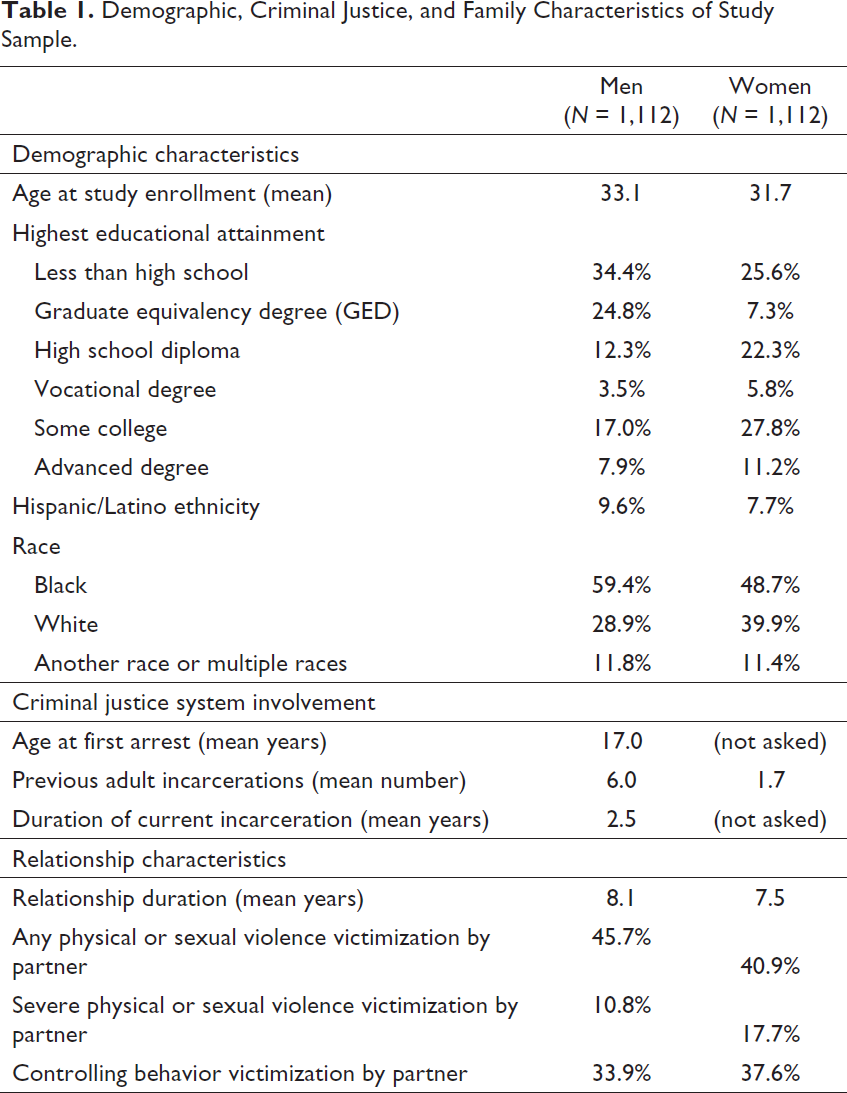
Sample Characteristics
Demographic, Criminal Justice, and Family Characteristics of Study Sample.
Measures
Survey measures.
The Multisite Family Study survey captured two key dimensions of partner violence, physical violence, and controlling behavior, using a modified version of the Revised Conflict Tactics Scale (Straus et al., 1996) that omitted subscales on injury and negotiation and added items on threat, isolation, and financial abuse. Each couple member was asked independently about their victimization and perpetration in the focal relationship during a 6-month reference period. Physical violence items assessed how many times in the reference period one partner shoved, hit, slapped, grabbed, threw something at, strangled, slammed, kicked, burned, or beat the other; used a knife or gun on the other; or forced him or her to have sex by hitting, holding down, or using a weapon. Dichotomous composite variables representing any physical violence victimization or perpetration and severe physical violence perpetration or victimization were created based on both partners’ reports of these behaviors (with severe violence defined as strangling, slamming, kicking, burning, beating, weapon use, or forcible sexual assault). Controlling behavior items assessed how many times one partner threatened to hurt the other or his/her children, family members, or loved ones; tried to keep the other from seeing or talking to friends or family; tried to keep money from the other, took money from him or her, or made him or her ask for money; and in two items asking how often one partner was jealous or possessive and how often one partner made the other feel not good enough. This final dimension of control has not been measured consistently in other research on Johnson’s types, but recent work on measurement of coercive control has highlighted its importance (Myhill, 2015; Stark & Hester, 2019). Variables representing reports of each of these individual behaviors from each couple member were included in our models, while a mean of these controlling behavior items was used to create a composite control score for classification using the cutoff point approach.
Qualitative interview.
Qualitative interviews were conducted separately with each partner using a semistructured guide that elicited respondent-driven narratives on general topics including the nature and quality of their intimate and coparenting relationship with one another during the male partner’s incarceration and reentry, whether and how incarceration had shaped this relationship, what had informed their decisions to continue or end the relationship, and their general perspectives on healthy and unhealthy relationships.
Analytic Approach
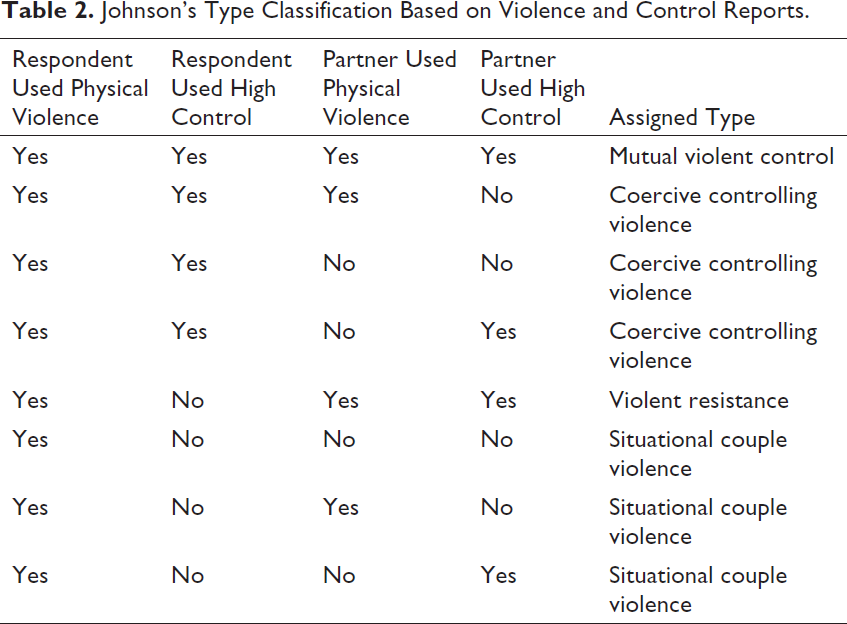
Johnson’s Type Classification Based on Violence and Control Reports.
To address the second research question, we examined transcripts from a subsample of cases for which a quantitative type had been assigned and whose qualitative transcripts contained a sufficient description of power and control dynamics to support qualitative type assignment. This included 10 transcripts from cases who were classified quantitatively as experiencing mutual violent control, 13 transcripts from cases who were identified as victims or perpetrators of coercive controlling violence, and 19 who were identified as victims or perpetrators of situational couple violence. We reviewed each in full, paired by couple, to identify participants’ accounts of power and control dynamics and the context for violence. We also examined qualitative markers of victimization and perpetration of each type of violence as described by advocates and in prior qualitative research (Hodes & Mennicke, 2019; Rosen et al., 2005) as well as aspects of victims’ interpretations or responses that were not captured in the survey data (e.g., fear or a sense of restriction). Partner violence type based on the qualitative account, along with other observations related to patterns of violence or control and representative quotations, were documented in an analytic memo for each case. Congruence between the quantitatively and qualitatively assigned types was tabulated and the approach to quantitative type assignment was assessed on that basis.
To address the third research question, we ran two-sample t-tests comparing victims and perpetrators of the two highest-frequency types of violence. We compared perpetrators’ use of severe physical or sexual violence, substance use, perceived service needs (asked of men only), and conflict skills; victims’ PTSD and depression symptoms, feelings of safety in the relationship, and extended-family social support; and victims’ and perpetrators’ reports of fidelity issues in the relationship. We applied a Bonferroni correction for multiple comparisons.
Results
Types of Partner Violence Among Couples Affected by Incarceration
Model Characteristics for Latent Class Analysis of Men’s Controlling Behavior.
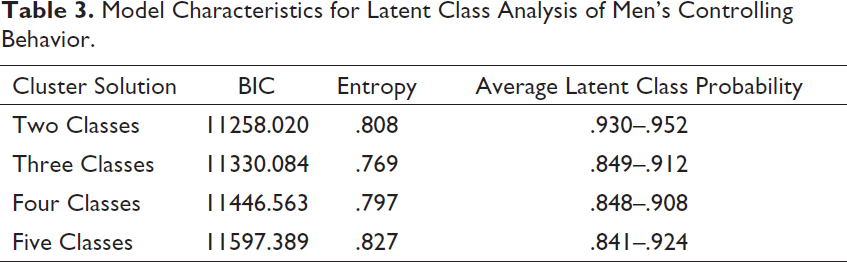
As shown in Table 3, the three empirical criteria that we assessed indicated that a two-class solution was preferred in terms of model fit (lowest BIC value) and clear class delineation (entropy and latent class probability values approaching 1). Although the entropy for the 5-class model was closer to 1 than for the 2-class model, the associated BIC and average latent class probabilities were less desirable. With regard to substantive interpretation, an examination of variable thresholds within the two-class solution indicated that men assigned to Class 1 (who comprised 32.3% [N = 199] of the subsample of men who had used physical violence against their partners as of the baseline survey) resembled Johnson’s coercive controlling type: they used a variety of control tactics, including threats to hurt the partner; threats to hurt the partner’s children, pets, or other loved ones; social isolation; and financial abuse—as well as being jealous or possessive. Men assigned to Class 2 (who comprised 67.7% [N = 417] of the physically violent subsample) resembled Johnson’s situational couple violence type in that they used physical violence without high levels of controlling behavior. However, it was not simply the level of controlling behavior but its form that distinguished Class 2 from Class 1 cases. They tended to exhibit jealousy or possessiveness (though response patterns suggested that they did so less often than their Class 1 counterparts) and they did not tend to use threats or other tactics of control with their partners. The controlling behavior mean score (a composite of all controlling behavior items; M = 0.41, SD = 0.50, min = 0, max = 4.0) among men assigned to Class 1 (coercive controlling) was .67, compared to .36 among men assigned to Class 2 (jealous only). When the male 2-class model was fitted to data on controlling behavior perpetration among physically violent women, it assigned 17.4% of such women (N = 125) to the coercive controlling Class 1 (compared with 32.3% of men, N = 199) and 82.6% (N = 593) to the jealous-only Class 2 (compared with 67.7% of men, N = 417).
ARI for the controlling behavior means score identified an optimal cutoff of 1.0. This cutoff was applied to the composite controlling behavior score (incorporating each partner’s reports of their own and their partner’s behavior) to create a high/low control indicator. This indicator and the physical violence perpetration indicator were used to assign all cases to Johnson’s types (mutual violent control, coercive controlling violence, violent resistance, situational couple violence, and nonviolence) based on their own and their partner’s behavior, as shown in Table 2.
Qualitative Salience of Quantitative Types
To assess the qualitative salience of these initial quantitative types, we stratified the qualitative sample using the assigned type indicators. Using descriptions provided by expert domestic violence advocates and in typological research, we reviewed these qualitative narratives (paired by couple) to identify qualitative markers for coercive controlling and situational couple violence perpetration and victimization. Victims of coercive controlling violence expressed fear of their partners and a feeling of being trapped in their relationships. I was scared, I feared for my life and I just wanted better for my kids. So, I had to find a way out. Even though I tried plenty of times before, it didn’t work out because he just knew. Like he wouldn’t allow me to leave. Like I was stuck.
Perpetrators of coercive controlling violence often mentioned plans to use the legal system against their partners, particularly to take away their children. They devoted significant interview time to attempts to discredit the partner (for example, as drug addicted, promiscuous, neglectful of children) to the interviewer. Coercive controlling violence perpetrators were also largely unable to take the perspective of the study partner or to empathize, even when directly asked to do so during the qualitative interview (for example, in responding to probes such as, “What do you think it was like for study partner when you were incarcerated?”). Finally, narratives of coercive controlling violence perpetrators directed blame toward their study partners and lacked statements reflecting on or assuming responsibility for their own actions. I just snapped and beat her up and I don’t remember it. And I apologized to her and she was not being herself like she used to be. She was going around, sleeping with whoever and all that. And I see through it … I respect her, but essentially … somebody needs to knock some sense into her.
Qualitative narratives did not always align well with assigned quantitative types, however. For example, all 10 transcripts from couples who were assigned the type “mutual violent control” based on survey data pointed instead to either coercive controlling violence or situational couple violence. Among these apparently misclassified couples, expressions of jealousy that were classified as highly controlling in the quantitative analysis were not interpreted as such by participants. Jealousy, a dimension of controlling behavior captured in the survey and included in the LCA, was very salient in most of the qualitative narratives. However, jealousy was often interpreted as a situational response rather than a character trait or a control tactic comparable to the other controlling behaviors measured in the survey and discussed in the qualitative interviews. Interviews emphasized a variety of situations specific to the study population that appeared to contribute to jealousy among individuals who were not otherwise attempting to dominate their partners. All couples had undergone periods of prolonged physical separation during the incarceration, and partners were often uncertain or insecure regarding their relationship status and agreements even in highly committed, long-term primary romantic relationships. Concurrent sexual relationships by one or both partners were common and one or both partners often had romantically ambiguous and financially competing coparenting relationships with the other parents of their children.
One couple, classified as experiencing mutual violent control using quantitative data, had separated by the time of their qualitative interview. They described an amicable coparenting relationship and strong mutual respect after ending a romantic relationship that both described as ridden with jealous conflict over the multiple intimate and coparenting relationships that the male partner maintained during and after prison. He characterized his study partner, whom the quantitative approach had classified as violent and controlling, as being an ideal partner who was unable to tolerate the interpersonal drama that he brought home from prison: I had three or four more chicks, I’m juggling four, five people while I was in [prison]. It was killing time … lying to people or the games that I was playing with them people.… It ain’t nothing bad [about partner]. She was all good … I honestly don’t have nothing bad to say about her and the relationship. She’s cool. I mean, she’ll be a good wife. She’s good. It’s just me.
Among couples like these for whom the quantitative classification did not align with couple members’ narrative accounts, it seemed that one or both partners’ emotional responses to these relationship conditions were identified as “high control” based on the mean control score cutoff, but were understood as a noncontrolling situational response by those involved.4
Refined Quantitative Types of Partner Violence
Frequency of Identified Partner Violence Types.
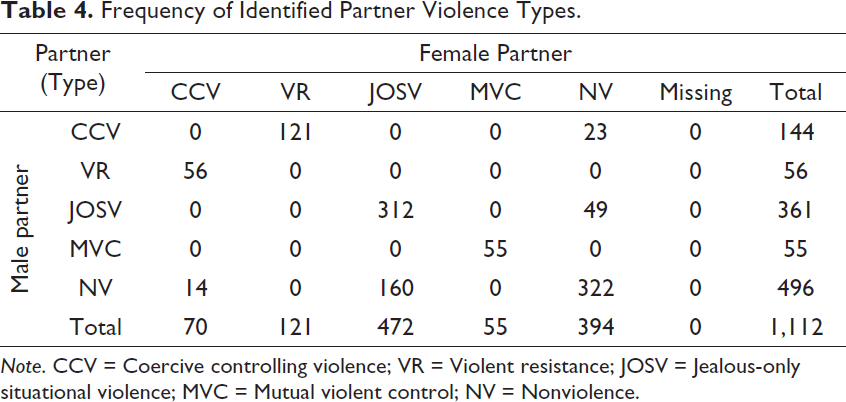
Note. CCV = Coercive controlling violence; VR = Violent resistance; JOSV = Jealous-only situational violence; MVC = Mutual violent control; NV = Nonviolence.
The revised control classification approach reduced by roughly 28% (from N = 76 to N = 55) the number of couples assigned to the “mutual violent control” type—a category which the qualitative analysis had suggested was previously misapplied. Among those included in the qualitative case review, the revised quantitative assignments resulted in newly congruent quantitative–qualitative classification for four such cases, maintained congruent classification for 24 cases, and produced unimproved qualitative–quantitative congruence for 16 cases.
Distinctions Among Quantitative Types
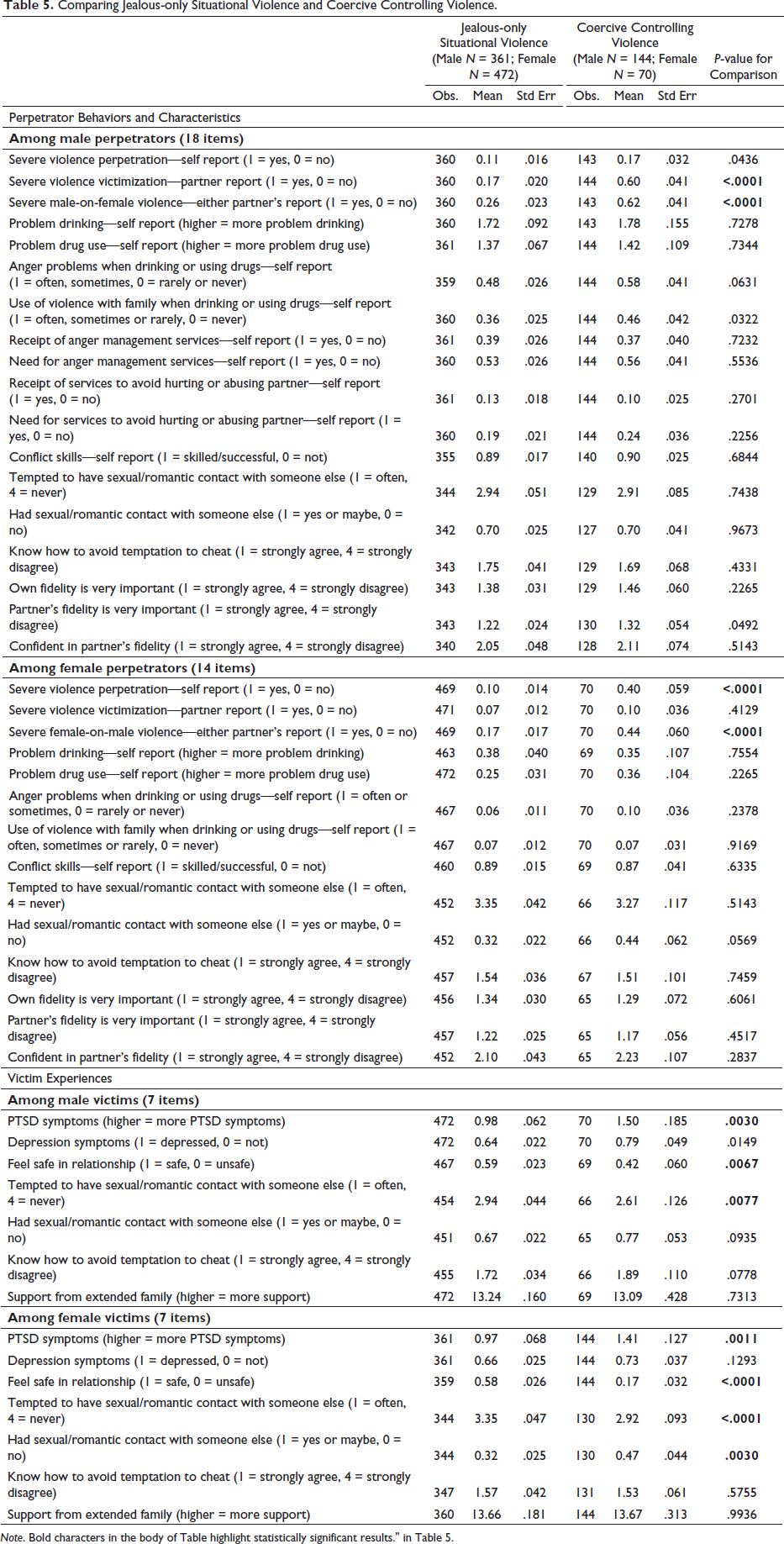
Results of t-tests comparing perpetrators and victims of the two largest violence types, coercive controlling violence and jealous-only situational violence, appear in Table 5. Applying a Bonferroni correction for multiple comparisons, we obtained critical alphas of .003 and .004, respectively, for comparisons of male and female perpetrator characteristics and of .007 for comparisons of male and female victim characteristics. As shown in the table, perpetrators of coercive controlling violence were more likely to use severe physical or sexual violence against their partners than perpetrators of jealous-only violence (p < .0001 for both men and women based on both partners’ reports). Among victims, both men and women who experienced coercive controlling violence reported more PTSD symptoms than those who experienced jealous-only situational violence (p = .0011 for female victims and p = .0030 for male victims). Both male and female victims of coercive controlling violence reported feeling less safe than did victims of jealous-only situational violence (p < .0001 for female victims and p = .0067 for male victims). Victims of coercive controlling violence were more likely to report that they were tempted to have sexual or romantic contact with another person during their relationship with the perpetrator (p < .0001 for female victims and p = .0077 for male victims). Female victims of coercive controlling violence were also more likely to report that they actually had sexual or romantic contact with another person during the relationship (p = .0030).
Comparing Jealous-only Situational Violence and Coercive Controlling Violence.
Discussion
Nature of Partner Violence in Couples Affected by Incarceration
Studies with large, multistate samples of couples affected by incarceration (McKay et al., 2018; Wildeman, 2012) have found rates of partner violence roughly tenfold those observed in the general population (Breiding, 2015). Focus group research with formerly incarcerated men and their partners has suggested that violence in couples affected by incarceration arises in the escalation of post-release conflicts, or as part of a partner’s attempt to assert control over the household upon his return from prison (Oliver & Hairston, 2008). Qualitative research with Multisite Family Study couples indicated that prisonization (Clemmer, 1958) and secondary prisonization (Comfort, 2003; Comfort, 2008)—particularly the effects of institutional violence and control on couples’ communication, economic stability, and understandings and responses to interpersonal violence and control—might shape the incidence and forms of partner violence (McKay, Manuscript in preparation). The current study expands prior understandings of partner violence among couples affected by incarceration by examining dyadic behavioral patterns of physical violence and controlling behavior. This sample included both current and former intimate partners, which Johnson has indicated is critical for accurately identifying violence types (Johnson et al., 2014).
LCA identified two clusters of controlling behavior distinguished by both the frequency and form of controlling behaviors, echoing findings from a recent study that used similar methods in a nonincarcerated convenience sample (Mennicke, 2019). In our analysis, physically violent individuals who used high levels of control, including a variety of control tactics, to dominate their partners were assigned to Class 1, which resembled the coercive controlling violence found in various prior studies, predominantly among clinic and shelter samples and those adjudicated for criminal domestic violence (Johnson, 2010, 2016; Mennicke, 2019).5
More often, however, physical violence among the couples in our study occurred in the context of one or both partners’ jealousy (only), without generalized attempts at control. Qualitative and quantitative analyses suggested that issues with jealousy were widespread among study couples and reflected a plausible situational response to periods of prolonged physical separation, complex family relationships involving multiple coparents, sexual partnership concurrency, and relationship status insecurity or ambiguity. Both the situational context in which jealousy arose, and the level and form of control tactics observed in this subgroup (who rarely used threats and who reported lower overall levels of controlling behavior) suggested a strong resemblance to the situationally violent type common in general-population samples (Johnson, 2010, 2016; Langhinrichsen-Rohling et al., 2012; Zweig et al., 2014). Consistent with prior research comparing jealousy in situationally violent and coercive controlling perpetrators (Love et al., 2018), jealous-only cases in our sample demonstrated jealous behavior less frequently than coercive controlling cases and were distinguished from the latter by the absence of other control tactics rather than by the presence of jealousy.
T-tests comparing perpetrator and victim experiences with jealous-only situational violence and coercive controlling violence confirmed the observed parallels between these two groups and the types obtained in prior research using Johnson’s typology. Relative to jealous-only individuals, the coercive controlling individuals in our sample were more likely to use severe physical violence against their partners, and their victims experienced more PTSD symptoms and felt less safe in their relationships than victims of jealous-only partners. These distinctions echo those found in prior studies comparing victims and perpetrators of situational violence and coercive controlling violence (Adkins & Kamp Dush, 2010; Anderson, 2008; Hardesty et al., 2015; Johnson et al., 2014; Johnson & Leone, 2005; Leone et al., 2004; Piispa, 2002). The distribution of these types in our sample of couples affected by incarceration generally resembled that found in prior typology research with community or school-based surveys, rather than samples of clinic or shelter clients or individuals adjudicated for domestic violence, but with a somewhat higher proportion of cases classified as mutual violent control (Johnson, 2006; Zweig et al., 2014).
These results confirm the relevance of Johnson’s typology for partner violence research with a uniquely vulnerable study population. They also lend empirical support to a growing chorus of practitioners who reject the “one-size-fits-all approach” to partner violence intervention (Messing, Ward-Lasher, et al., 2015, p. 310) consisting of formal adjudication and Duluth Model treatment for perpetrators and shelter-based services for victims (Pence & Paymar, 1993; Price & Rosenbaum, 2009). Research with other marginalized groups, such as immigrant women (see Bhattacharjee, 2006; Messing, Becerra, et al., 2015), suggests that such a model may be of limited utility for those who are conditioned to expect punishment rather than protection from formal institutions. Responses to partner violence that are sensitive to the distinction between situational couple violence (including the jealous-only violence evident in this sample) and coercive controlling violence might be useful for reducing recidivism and revictimization (Hodes & Mennicke, 2019; Stare & Fernando, 2014). Therapeutic and supportive responses to situational couple violence, such as joint educational and cognitive-behavioral interventions (Jaramillo-Sierra & Ripoll-Nunez, 2018; C. Schneider & Brimhall, 2014) may be more appropriate than punitive and criminalizing responses.
In addition to reinforcing the utility of typology-based approaches to addressing partner violence, this study also contributes to a growing body of research suggesting that individual and family-based services for partner violence victims and perpetrators must be accompanied by efforts to address community- and institutional-level determinants of violence (Holliday et al., 2019; Iyengar & Sabik, 2009; Raiford et al., 2013; D. Schneider et al., 2016; Voith & Brondino, 2017). Together, the qualitative and quantitative findings presented here suggest that partner violence in Multisite Family Study couples did not usually represent a concerted effort by one partner to dominate and abuse the other. Unlike the violence observed in research with those convicted for domestic violence offenses or their partners, most violence in this sample arose amid a complex of incarceration-related relationship circumstances that were widely experienced by study participants as promoting jealousy and outstripping their ability to relate in healthy, nonviolent ways. This suggests that future research on controlling behavior should continue to test and refine analytic strategies capable of distinguishing between what Johnson has characterized as a universal desire for some degree of interpersonal control in intimate relationships (Johnson, 2008) (such as clear mutual expectations and consistent agreement-keeping) and the dominating forms of controlling behavior that are the hallmark of the most damaging and dangerous forms of abuse (Leone et al., 2007; Myhill & Hohl, 2019; Stark, 2007; Stark & Hester, 2019) It also suggests a need to expand from an individual accountability-focused approach to partner violence to a model that incorporates institutional accountability for mass incarceration-era practices. This could include reversing the harsh sentencing policies identified by Tonry (2014) and making a robust array of behavioral health treatment and partner violence prevention and response services freely available in the predominantly poor, Black communities that such practices have targeted.
Refining Research Methods for Understanding Partner Violence
The current study advances a quantitative modeling strategy that is more suitable for working with the typical structure and distribution of survey reports of controlling behavior. The LCA approach applied here accommodates multinomial controlling behavior variables with zero-inflated distributions or floor effects, making it useful not only for partner violence research generally (as previously noted; e.g., Ansara & Hindin, 2010) but particularly useful for typology research in which meaningful distinctions between clusters of behavioral reports are critical. This study is also unique in drawing on survey reports from both couple members to capture a more accurate picture of the dyadic behavioral dynamics on which Johnson’s typology is based. Finally, where most previous efforts at partner violence type classification have relied on single-method (usually quantitative) approaches, the Multisite Family Study data structure made it possible for the current analysis to compare the quantitative types obtained from a quantitative classification procedure against individuals’ qualitative accounts of their relationship dynamics. Like at least one prior study that used qualitative data to examine types of controlling behavior (Crossman & Hardesty, 2018), this study was able to identify distinctions in controlling behavior patterns that were subjectively meaningful among those who experienced them and to map them to broader social and structural constraints; in this case, the relationship challenges associated with criminal justice system involvement in an era of mass incarceration. This comparative case review prompted a further refinement of the quantitative classification method: that is, the use of predicted class membership, rather than a “high/low” control score cutoff, to distinguish controlling behavior for purposes of type classification. (The “high/low” approach, typical in typology research, could overemphasize the frequency of controlling behavior while eliding differences in its form, such as the distinction between expressing jealousy and threatening harm to a partner or partner’s loved ones.) This new approach permitted retention of the essentially qualitative distinction between the two patterns of controlling behavior uncovered with LCA.
Study Limitations and Directions for Future Research
As in most prior research on partner violence typologies, this study was limited by use of a nonrepresentative sample. Findings may not generalize to broader populations of couples affected by incarceration, and comparisons of the distribution of partner violence types relative to those observed in other nonrepresentative studies must be interpreted with particular caution. In addition, this analysis was subject to several measurement limitations associated with the secondary data source. The Multisite Family Study survey items on partner violence focused on a 6-month reference period, is shorter than the 12-month reference period used in the National Intimate Partner and Sexual Violence Survey (Breiding, 2015) and other partner violence research. The controlling behavior measure constructed from these data omitted monitoring, a common dimension of coercion and control (Hardesty et al., 2015; Myhill & Hohl, 2019). These two limitations amplify the already considerable possibility in partner violence research that individuals who were violent or controlling were not identified as such in survey data. Further, our research team’s assessment of likely partner violence type based on qualitative interview transcripts was subject to error: assessments of the same case will differ even among skilled advocates (Hodes & Mennicke, 2019), let alone researchers. In addition, as only a subset of qualitative interviews addressed dynamics of control and violence in the relationship in enough detail to permit type assessment, those who opted not to discuss these experiences during the interview are not represented here. Prior research suggests that experiences of victims and perpetrators in current coercive controlling relationships were especially likely to be left out, due to the higher risks associated with disclosing such experiences (Johnson et al., 2014).
Finally, consistent with prior empirical applications of Johnson’s typology, this study began by using cluster analysis to identify the number of distinct groups evident in respondents’ reports of controlling behavior in their relationships. However, future work (including reanalysis of prior data) should first test the assumption that distinct types exist (Lubke & Tueller, 2010). In this study as in prior typological research using LCA or other clustering methods, the possibility remains that a single, normally distributed factor, rather than distinct classes, is the true latent structure of the observed items. With these limitations in mind, findings from the current study point to an urgent need for future research to assess partner violence types, prevalence, and etiologies in a representative sample of couples affected by incarceration.
Conclusions
Findings from this study enrich our understanding of the couple-level behavioral dynamics that underlie high observed rates of partner violence in samples of couples affected by incarceration. Their experiences conform to distinct types that are analogous to Johnson’s partner violence types but take a unique form in the context of situational strains faced by the incarcerated and their partners. This work also helps to advance increasingly precise methods for partner violence research generally, including the use of dyadic survey data, the integration of qualitative and quantitative accounts, and the refinement of LCA-based typology research strategies. Such approaches represent an important next step in ongoing efforts to better understand, distinguish, and address the contexts in which partner violence arises.
Footnotes
Acknowledgments
The authors are indebted to the Multisite Family Study participants who graciously shared their experiences, to Jonathan Jackson for excellent comments on an earlier version of this manuscript, and to the anonymous peer reviewers for their very helpful suggestions.
Declaration of Conflicting Interests
The author(s) declared the following potential conflicts of interest with respect to the research, authorship, and/or publication of this article: This article has not been published elsewhere nor is it under review for another publication.
Funding
The author(s) disclosed receipt of the following financial support for the research, authorship, and/or publication of this article: This work was funded in part by grant 2016-VF-GX-0010 from the National Institute of Justice in the U.S. Department of Justice. The original Multisite Family Study data collection was funded by contract HHSP2332006290YC from the Office of the Assistant Secretary for Planning and Evaluation and Office of Family Assistance in the U.S. Department of Health and Human Services.
